
Judge, 1926-02-13 · page 15 of 36
Judge — February 13, 1926 — page 15: what you’re looking at
What you’re looking at
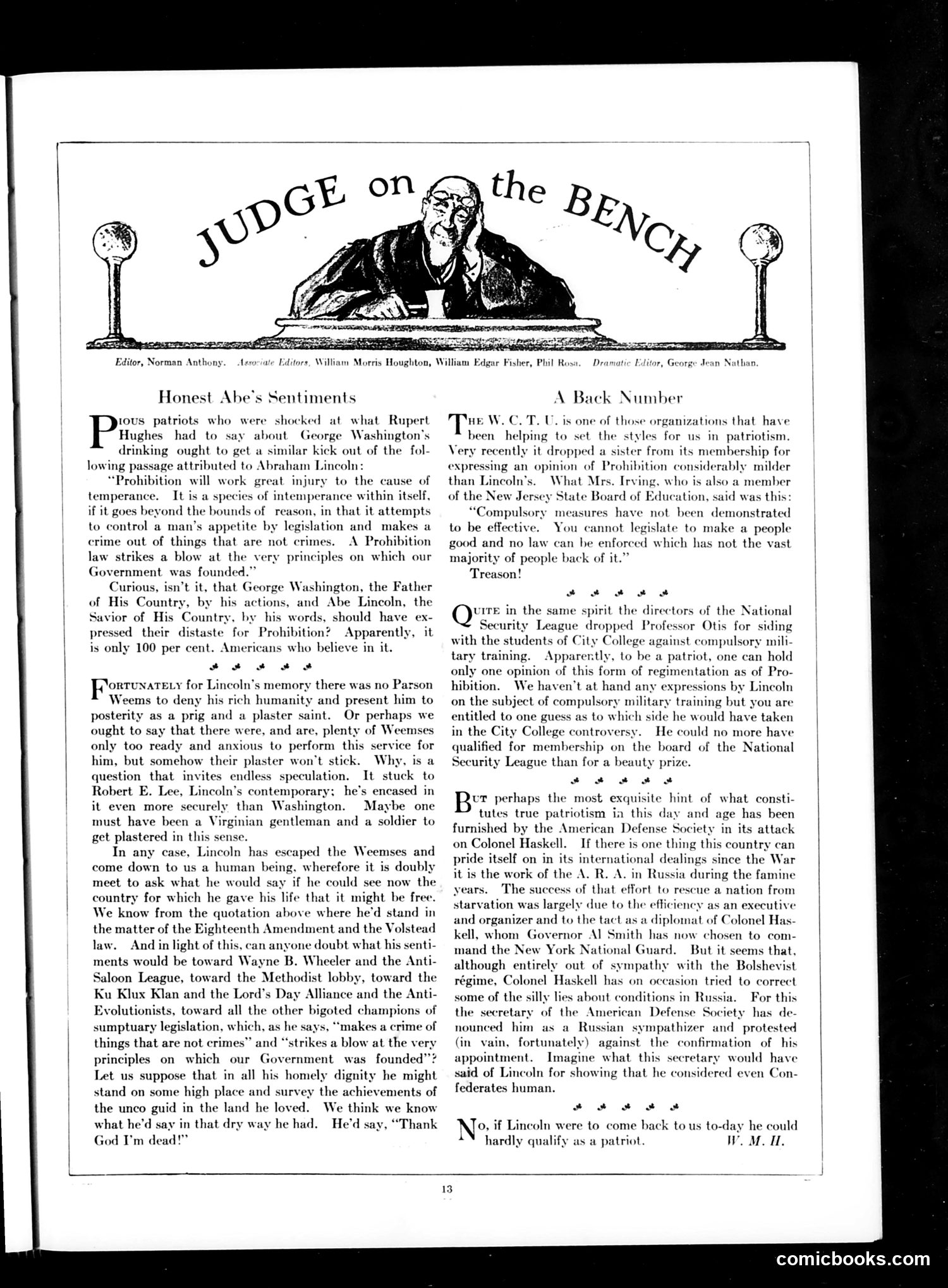
This editorial page attacks what it calls rigid, intolerant patriotic organizations. The masthead shows a stern judge overseeing the content. **"Honest Abe's Sentiments"** attributes an anti-Prohibition quote to Lincoln, arguing that even America's revered founders opposed such moralistic legislation. The author criticizes "Weemses" (referring to Mason Locke Weems, who sanitized George Washington's biography) for creating false, pious versions of historical figures. The piece mocks modern "sumptuary legislation" champions—the Anti-Saloon League, Methodist lobby, Ku Klux Klan, and anti-evolutionists—suggesting Lincoln would despair at their control of the country. **"A Back Number"** criticizes organizations for enforcing ideological conformity. The W.C.T.U. (Women's Christian Temperance Union) expelled a member for mildly questioning Prohibition's effectiveness. Similarly, the National Security League dropped Professor Otis for opposing compulsory military training. The piece argues these groups demand absolute obedience to single opinions, not genuine patriotism. Both pieces attack prohibition-era moral policing and military conscription advocacy as un-American and illiberal.
📄 Transcribed text from this page (OCR, searchable)
Machine-transcribed from the original scan — historical spelling and the odd misread are preserved.
Editor, Norman Anthony sorial Honest. Abe's Sentiments ious patriots who were shocked at what Rupert Hughes had to say about George Washington's drinking ought to get a similar kick out of the fol- lowing passage attributed to Abraham Lincoln: “Prohibition will work great injury to the cause of temperance. It is a species of intemperance within itself, if it goes beyond the bounds of reason, in that it attempts to control a man’s appetite by legislation and makes a crime out of things that are not crimes. A Prohibition law strikes a blow at the very principles on which our Government was founded.” Curious, isn’t it, that George Washington, the Father of His Country, by his actions, and Abe Lincoln, the Savior of His Country, by his words, should have ex. pressed their distaste for Prohibition? Apparently, it is only 100 per cent. Americans who believe in it. te oe ee Froetesatery for Lincoln's memory there was no Parson Weems to deny his rich humanity and present him to posterity as a prig and a plaster saint. Or perhaps we ought to say that there were, and are, plenty of Weemses only too ready and anxious to perform this service for him, but somehow their plaster won't stick. Why, is a question that invites endless speculation. It stuck to Robert E. Lee, Lincoln’s contemporary; he’s encased in it even more securely than Washington. Maybe one must have been a Virginian gentleman and a soldier to get plastered in this sense. In any case, Lincoln has escaped the Weemses and come down to us a human being, wherefore it is doubly meet to ask what he would say if he could see now the country for which he gave his life that it might be free. We know from the quotation above where he'd stand in the matter of the Eighteenth Amendment and the Volstead law. And in light of this, can anyone doubt what his senti- ments would be toward Wayne B. Wheeler and the Anti- Saloon League, toward the Methodist lobby, toward the Ku Klux Klan and the Lord’s Day Alliance and the Anti- Evolutionists, toward all the other bigoted champions of sumptuary legislation, which, as he says, “makes a crime of things that are not crimes” and “strikes a blow at the very principles on which our Government was founded”? Let us suppose that in all his homely dignity he might stand on some high place and survey the achievements of the unco guid in the land he loved. We think we know what he'd say in that dry way he had. He'd say, “Thank God I'm dead!” Editors, William Morris Houghton, William Edgar Fisher, Phil Rosa. Dramati Editor, George Jean Nathan, A Back Number Tr W. C. T. U. is one of those organizations that have been helping to set the styles for us in patriotism. Very recently it dropped a sister from its membership for expressing an opinion of Prohibition considerably milder than Lincoln’s. What Mrs. Irving, who is also a member of the New Jersey te Board of Education, said was this: “Compulsory measures have not been demonstrated to be effective. You cannot legislate to make a people good and no law can be enforced which has not the vast majority of people back of it.” Treason! Q' TE in the same spirit the directors of the National Security League dropped Professor Otis for siding with the students of City College against compulsory mili- tary training. Apparently, to be a patriot, one can hold only one opinion of this form of regimentation as of Pro- hibition. We haven't at hand any expressions by Lincoln on the subject of compulsory military training but you are entitled to one guess as to which side he would have taken in the City College controversy. He could no more have qualified for membership on the board of the National Security League than for a beauty prize. sa so B perhaps the most exquisite hint of what consti- tutes true patriotism in this day and age has been furnished by the American Defense Society in its attack on Colonel Haskell. If there is one thing this country can pride itself on in its international dealings since the War it is the work of the A. R. A. in Russia during the famine pars. The success of that effort to rescue a nation from vation was largely due to the efficiency as an executive nd organizer and to the tact as a diplomat of Colonel Has- kell, whom Governor Al Smith has now chosen to com- mand the New York National Guard. But it seems that, although entirely out of sympathy with the Bolshevist régime, Colonel Haskell has on occasion tried to correct some of the silly lies about conditions in Russia. For this the secretary of the American Defense Society has de- nounced him as a Russian sympathizer and_ protested (in vain, fortunately) against the confirmation of his appointment. Imagine what this secretary would have said of Lincoln for showing that he considered even Con- federates human. NZ if Lincoln were to come hack to us to-ds a y he could hardly qualify as a patriot. WM. ML. comicbooks.com