
A complete issue · 40 pages · 1925
Judge — November 21, 1925
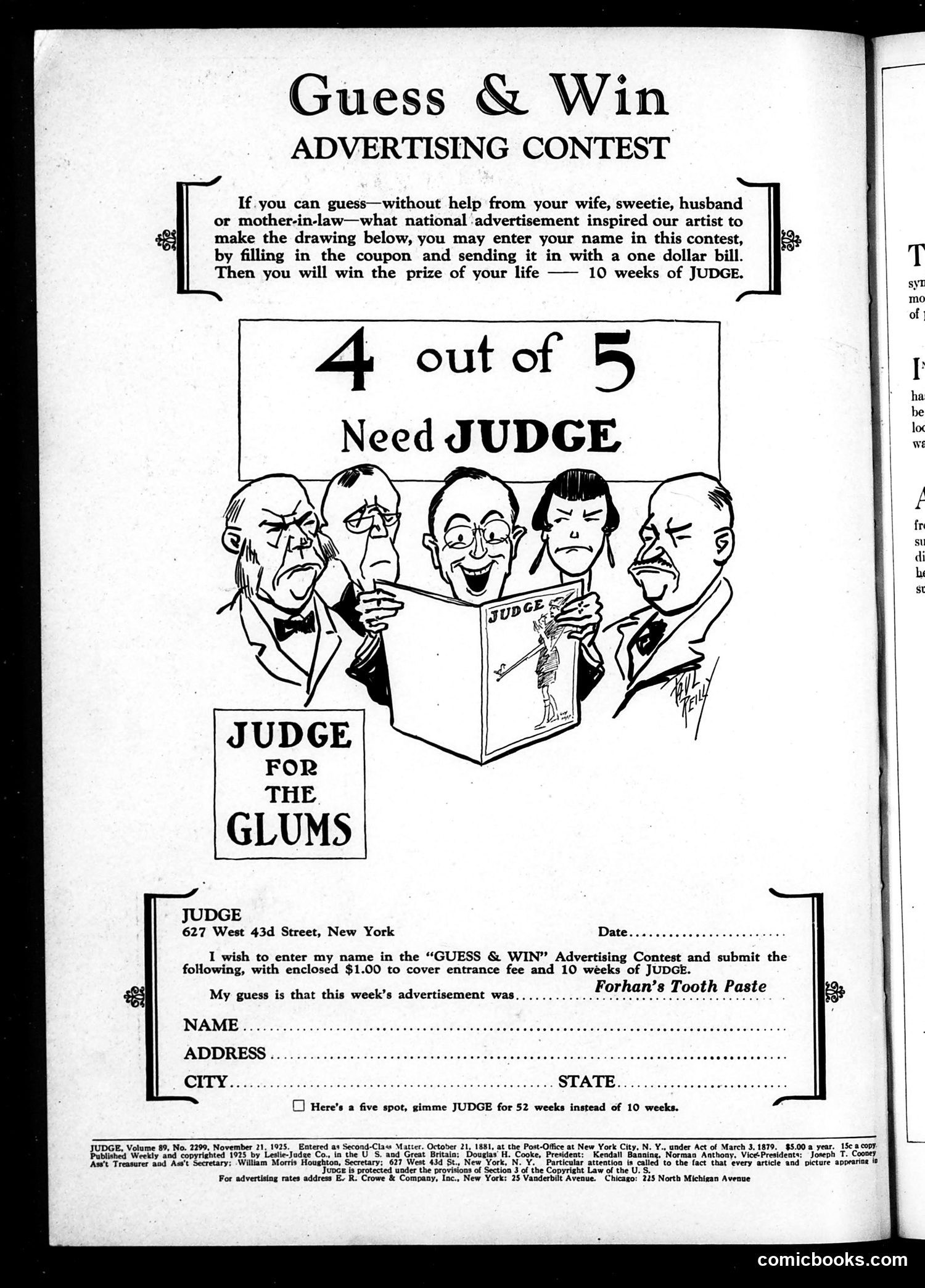
This is a "Guess & Win" advertising contest from **Judge** magazine. The contest challenges readers to identify which national advertisement inspired the cartoon shown—the answer appears to be **Forhan's Tooth Paste** (visible in the entry form). The cartoon depicts five caricatured faces above a shield labeled "JUDGE FOR THE GLUMS," with the text "4 out of 5 Need JUDGE." The imagery satirizes the product's advertising format, which likely used the "4 out of 5" statistical claim common in early 20th-century advertising. The joke plays on Judge magazine's self-promotional claim that most people need its satirical content, while mimicking the exaggerated testimonial style of contemporary toothpaste advertisements. Contestants submitted $1 to enter, with the prize being a 10-week Judge subscription.
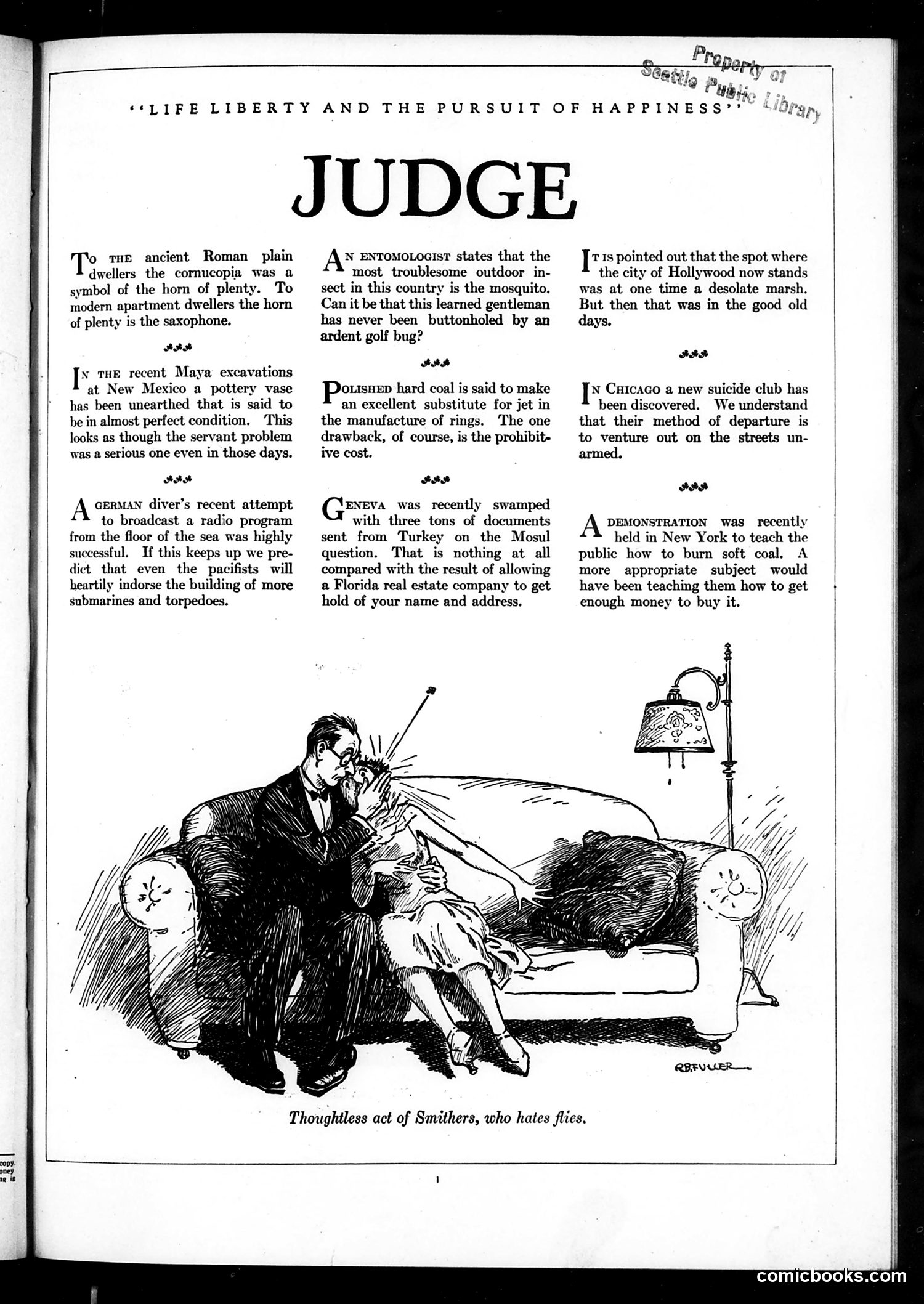
This page contains satirical commentary on contemporary issues rather than a unified cartoon. The main illustration depicts a man swatting a fly near a woman on a sofa, captioned "Thoughtless act of Smithers, who hates flies." The page's text sections mock various topics: entomologists debating mosquitoes as the worst insect; Roman symbolism of horns; Maya pottery preservation; German submarine development; Polish hard coal as jet fuel substitute; Geneva documents from Turkey; and a New York demonstration on burning soft coal. The central joke appears to be that Smithers, despite hating flies, thoughtlessly endangers his companion while attempting to kill one—satirizing careless behavior or misguided solutions. The scattered brief items represent Judge's typical format of humorous social and political commentary on contemporary absurdities and inefficiencies.
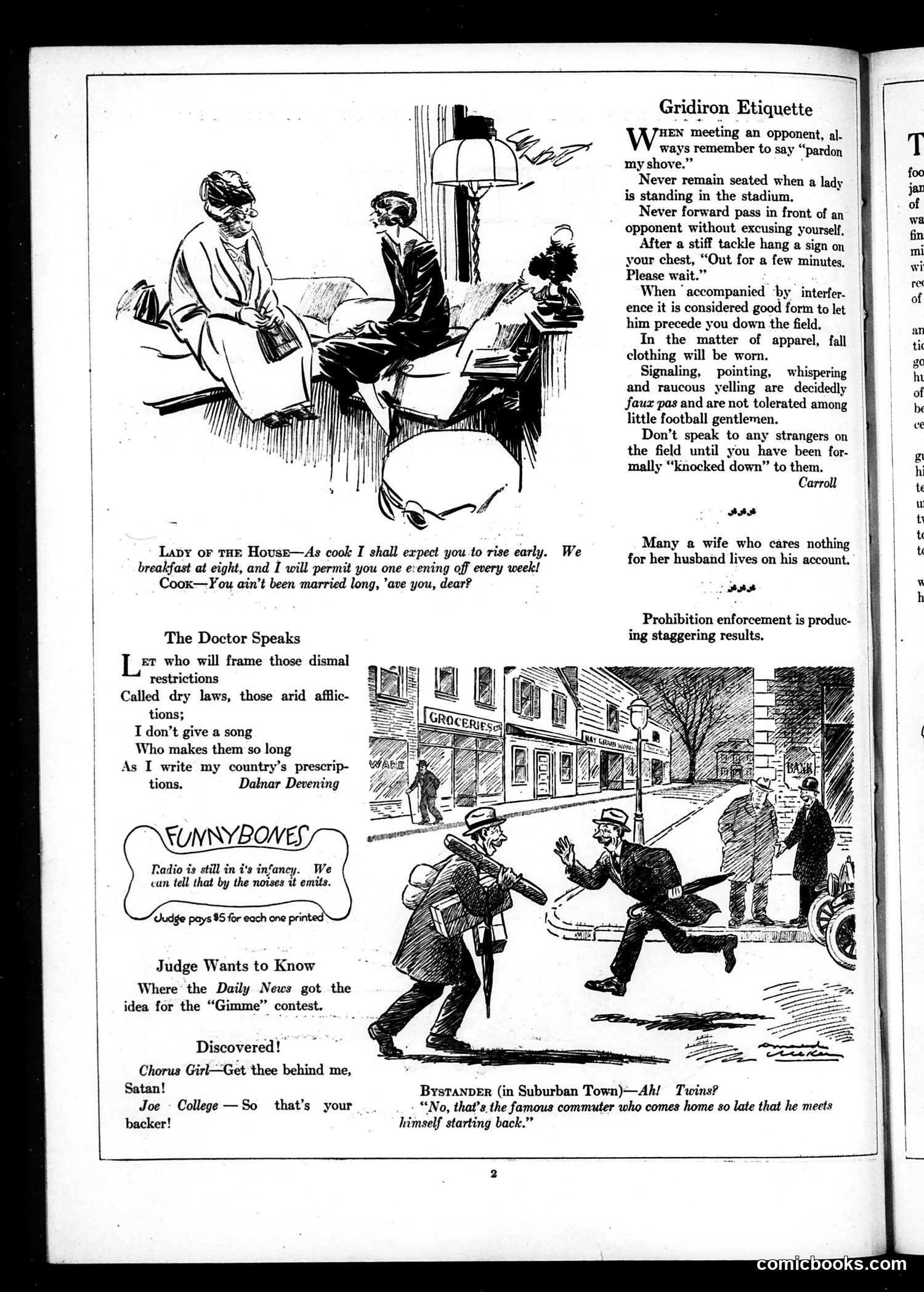
This page contains several satirical pieces from Judge magazine reflecting early 20th-century social concerns: The **"Gridiron Etiquette"** section mocks football spectator behavior and sportsmanship, advising gentlemen on proper conduct at games—notably that "signaling, pointing, whispering and raucous yelling are decidedly *faux pas*." **"The Doctor Speaks"** quotes a physician criticizing restrictive laws, likely referencing Prohibition enforcement, which the page notes produces "staggering results." The street scene cartoon satirizes urban life, showing what appears to be a collision or confrontation between pedestrians and a car—commentary on the chaos of modern automobile traffic in cities. The **"FunnyBones"** section includes brief jokes about radio's infancy and college life. Overall, the page reflects 1920s-era anxieties about Prohibition, modern transportation, and changing social manners.
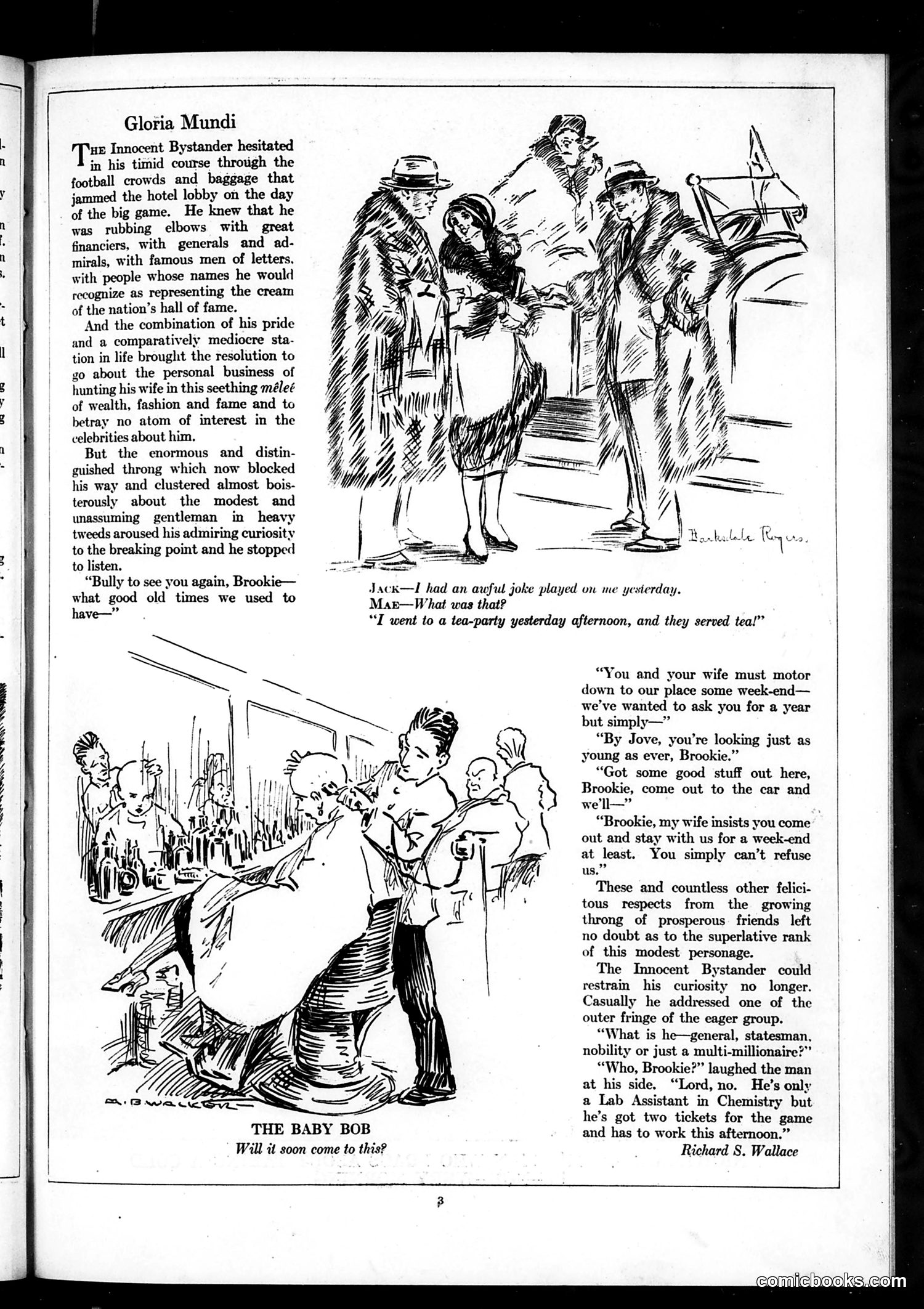
This page satirizes social climbing and celebrity worship among the wealthy. "The Innocent Bystander" observes a crowded hotel lobby where an unassuming gentleman is surrounded by admirers—generals, admirals, famous people—all eager to know him. The joke hinges on his complete lack of actual importance: he's merely hunting for his wife among the crowds. The lower cartoon, "The Baby Bob," depicts someone asking when a baby will arrive, playing on uncertainty about paternity or legitimacy. The satirical point: wealthy society people desperately seek proximity to anyone they *think* might be important, revealing their superficiality. The "innocent bystander" protagonist is innocent precisely because he possesses no genuine status—yet receives worship anyway, exposing the absurdity of status-consciousness.
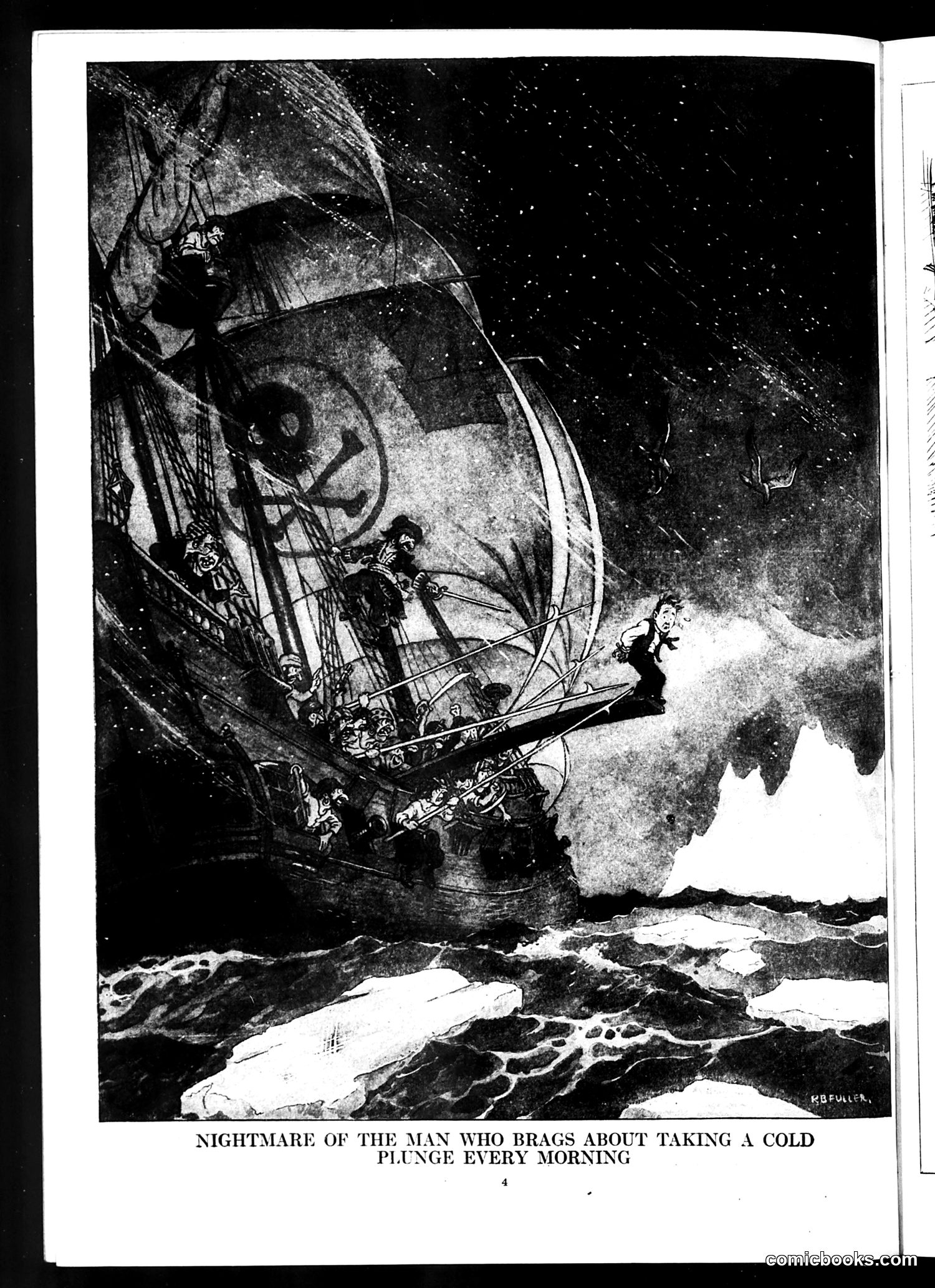
This satirical illustration depicts a shipwreck in stormy seas, titled "Nightmare of the Man Who Brags About Taking a Cold Plunge Every Morning." The cartoon mocks a common boast among health-conscious men of the era who claimed daily cold water bathing as evidence of toughness and vigor. The artist shows such a braggart's nightmarish fantasy: a sinking vessel in turbulent waters—the ultimate, involuntary "cold plunge." The humor relies on ironic exaggeration: the man who voluntarily endures cold water to display his hardiness now faces it under the worst possible circumstances, rendered powerless and terrified. This reflects early-20th-century attitudes about masculine self-improvement and the satirizing of health trends through absurdist consequences.
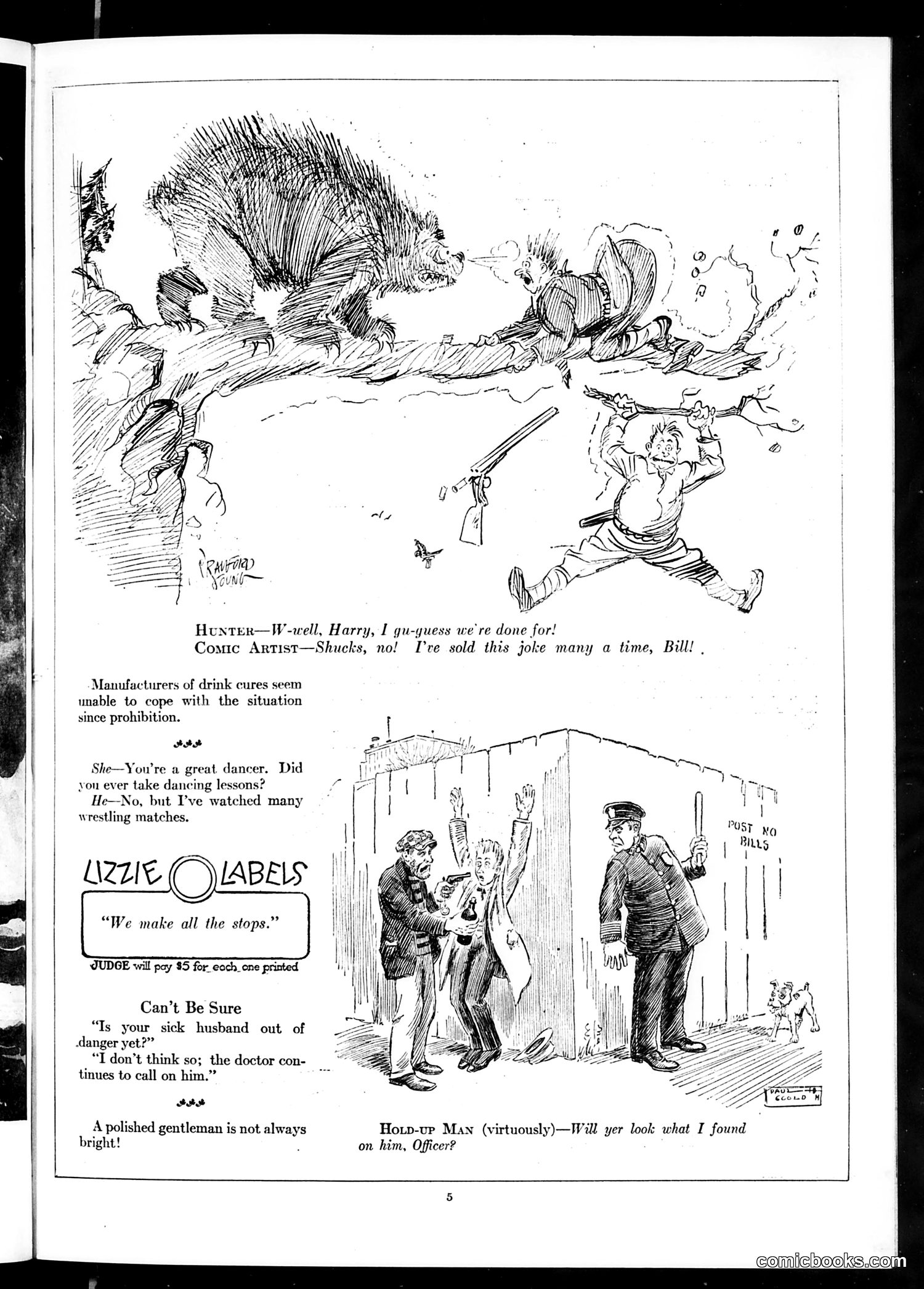
This page contains several unrelated satirical items typical of Judge magazine's format: **Top cartoon**: A hunter and comic artist discuss a worn-out joke about hunting, suggesting the "dead animal" gag has been overused. **Middle section**: Advertisements and brief quips, including "Lizzie Labels" (a product ad) and jokes about dancing lessons and marital health. **Bottom cartoon**: Titled "Hold-up Man," depicts a police officer discovering contraband on a suspect, asking what he found. The caption's phrasing suggests this satirizes either police procedures or Prohibition-era law enforcement. The page appears to date from the Prohibition era (references to "drink cures" and "rust no pills" suggest bootlegging concerns), though the specific historical context isn't entirely clear without additional dating information.
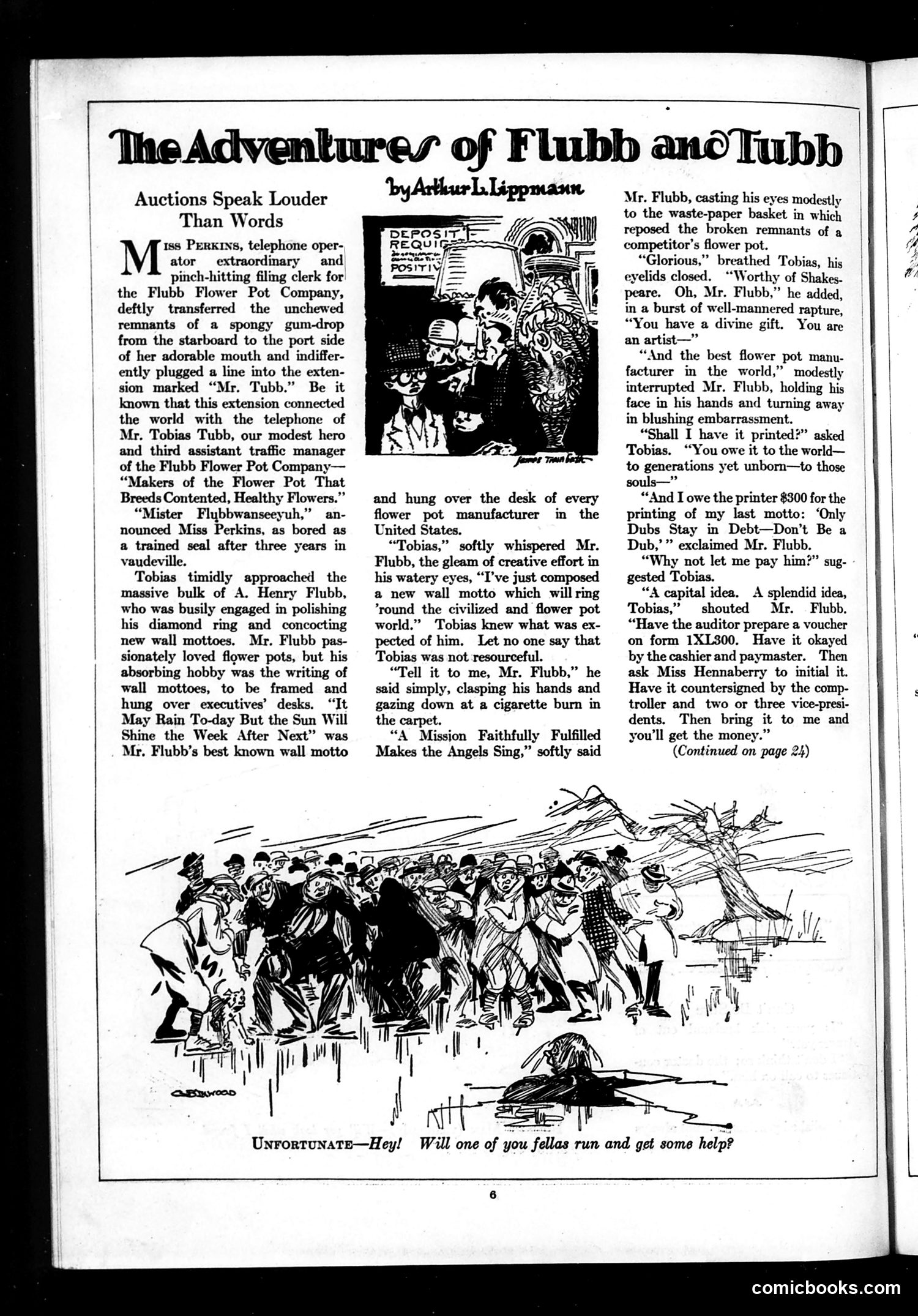
This is a satirical comic strip mocking corporate bureaucracy and obsequious workplace culture. A. Henry Flubb, the flower pot company owner, is portrayed as an absurdly self-important executive who spends his time composing vapid motivational "wall mottoes" rather than actual work. His employee Tobias Tubb is the archetypal yes-man, breathlessly praising Flubb's mediocre creativity with exaggerated flattery. The satire centers on corporate pretense: Flubb's mottoes are platitudinous drivel ("A Mission Faithfully Fulfilled Makes the Angels Sing"), yet they're treated as profound wisdom. When Tobias offers to pay a printer's debt, Flubb's solution involves ludicrous bureaucratic procedures—auditors, vouchers, comptrollers, and vice-presidents—to accomplish a simple transaction. The bottom cartoon depicts an accident, captioned to suggest the story continues. The piece ridicules early-twentieth-century corporate inefficiency, flattery culture, and the gap between executive self-regard and actual competence.
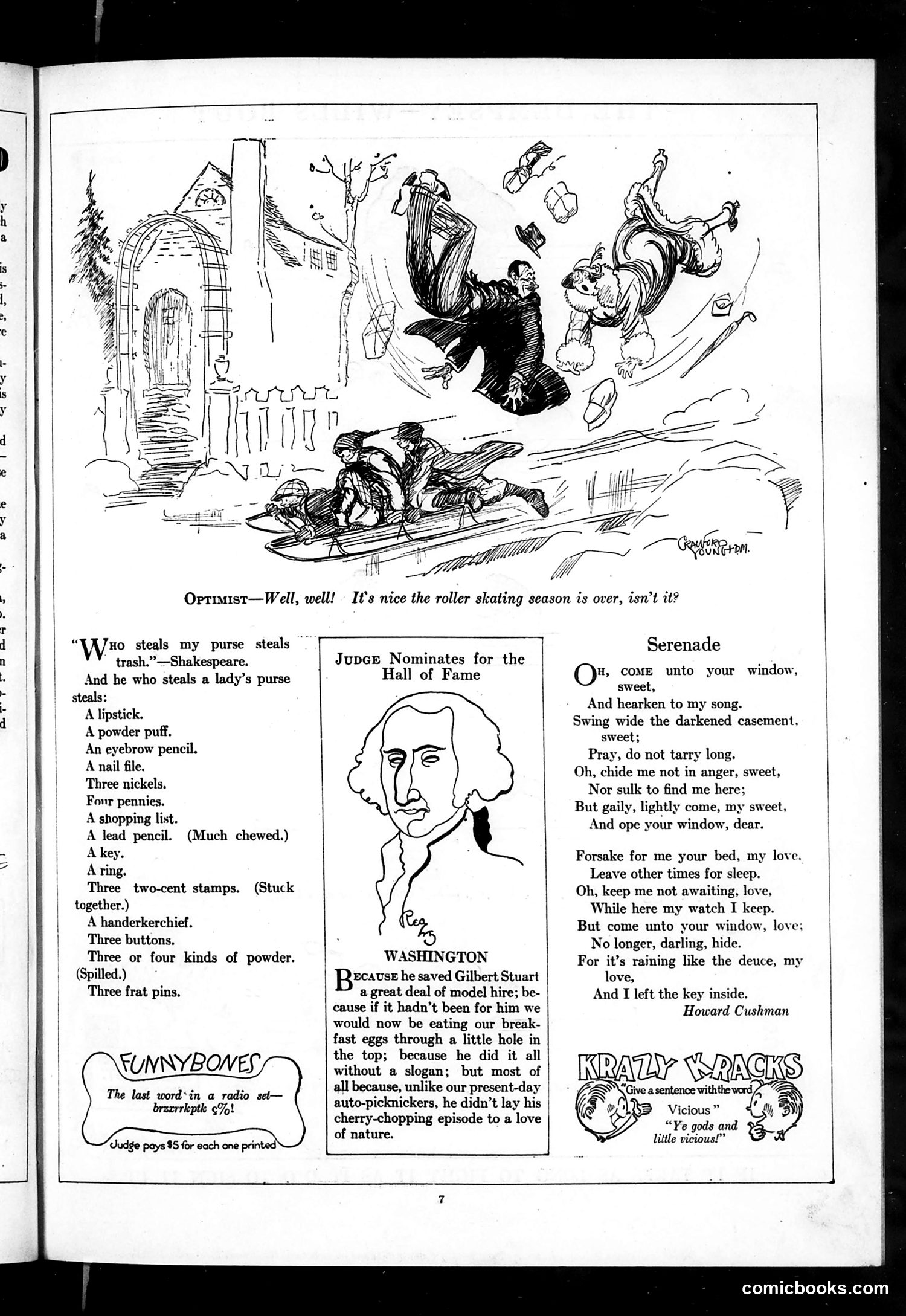
This page contains three satirical pieces: 1. **"Optimist" cartoon** (top): Shows chaos during roller skating season—people colliding, belongings flying everywhere. The optimist's comment that "the roller skating season is over" is darkly ironic given the visible destruction, satirizing blind optimism despite obvious problems. 2. **"Who steals my purse" section** (left): A Shakespeare parody listing the trivial contents of a lady's purse—lipstick, powder puff, nail file, etc.—satirizing women's accessories and materialism of the era. 3. **"Judge Nominates for the Hall of Fame"** (center): Features George Washington, praising him for saving artist Gilbert Stuart money on model fees, avoiding slogans, and—notably—not exploiting the cherry-tree legend for personal gain (unlike "present-day auto-picknickers"). This satirizes modern celebrities who commercialize their images. 4. **"Serenade"** (right): A humorous poem parodying romantic serenades, ending with the practical joke that the serenader left his key inside—deflating romantic pretension with mundane reality.
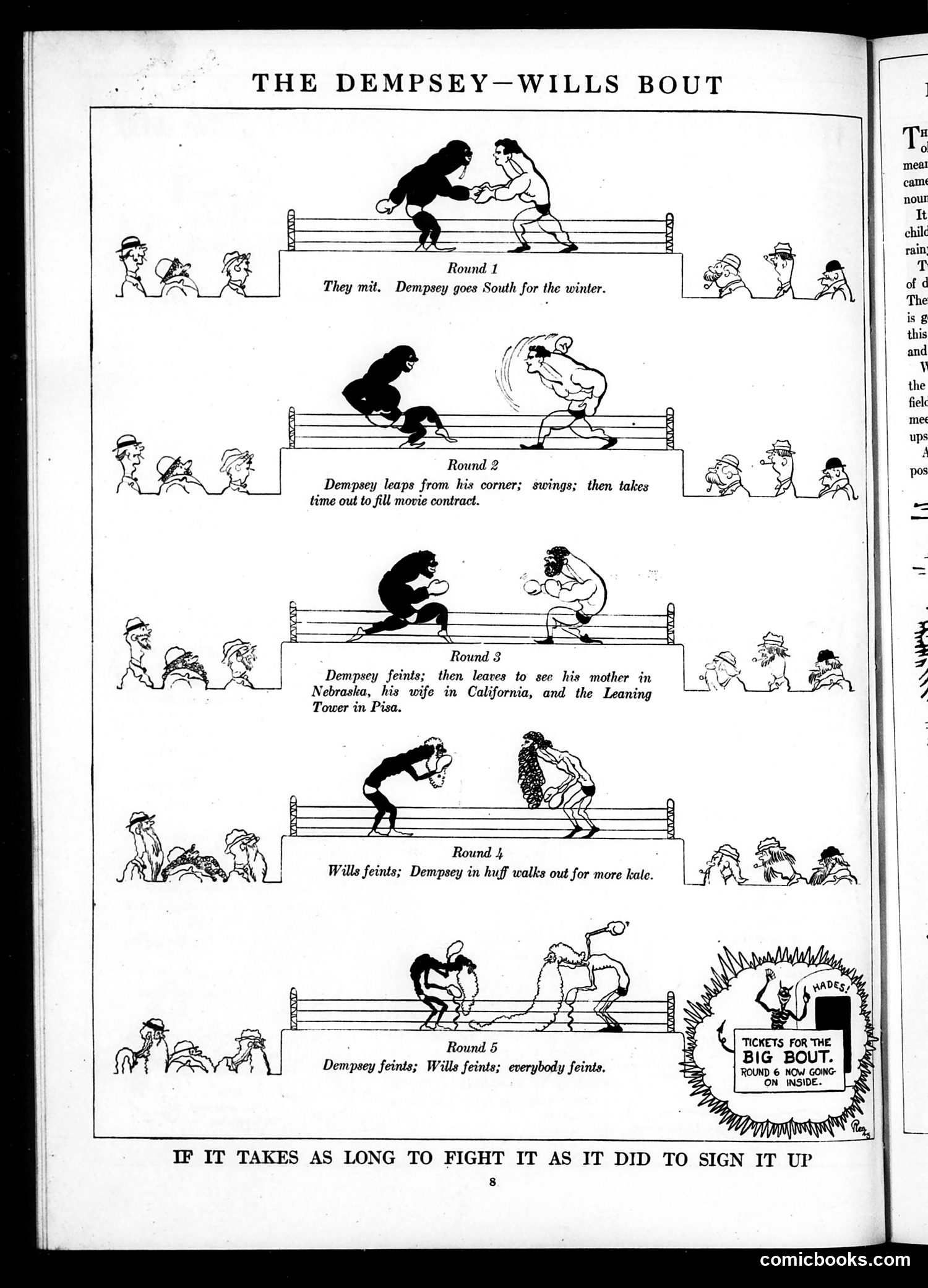
This satirical comic mocks the delayed heavyweight championship fight between Jack Dempsey and Harry Wills. The joke is that the fight kept getting postponed, so the cartoon depicts each "round" interrupted by frivolous excuses: Dempsey leaving for winter, filming movies, visiting his mother in Nebraska and wife in California, sightseeing at the Leaning Tower of Pisa, and demanding more money ("kale"). The final caption—"IF IT TAKES AS LONG TO FIGHT IT AS IT DID TO SIGN IT UP"—criticizes how long negotiations dragged on before the bout actually occurred. The cartoon suggests the fighters are more interested in money and personal business than actually competing, turning an anticipated sporting event into a bureaucratic farce.
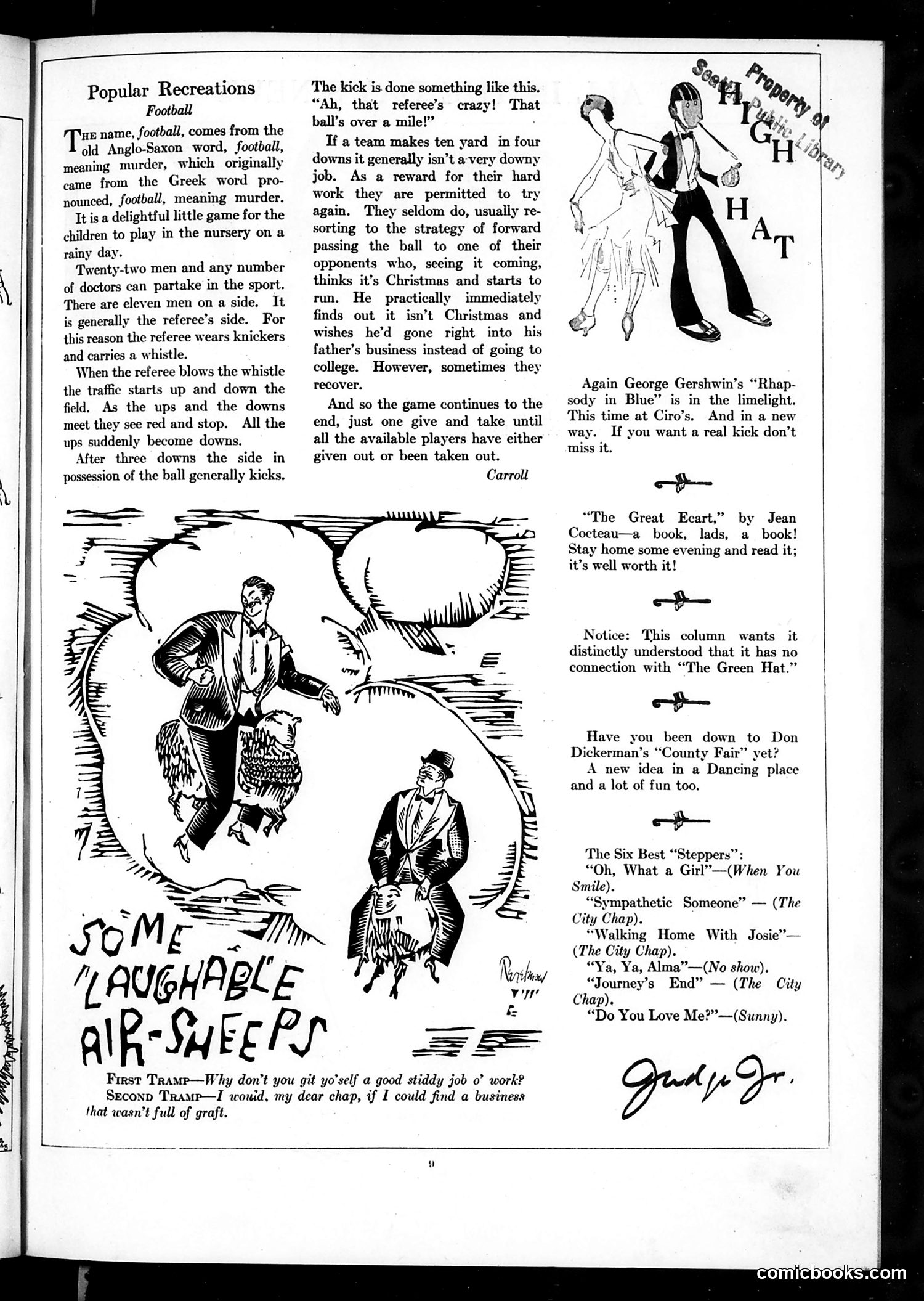
This page from *Judge* magazine contains satirical humor typical of the 1920s. The main cartoon mockingly defines football's etymology as deriving from words meaning "murder," then humorously describes the sport's chaos—players seeing red, inexplicable rule mechanics, and the brutal reality that receivers often wish they'd pursued safer careers instead. The accompanying cartoon "Some Laughable Air-Sheers" depicts two vagrants, with the second explaining he can't find steady work because every business is "full of graft"—a reference to widespread corruption concerns of the era. The remaining content advertises entertainment: George Gershwin's "Rhapsody in Blue" (already famous), Jean Cocteau's experimental novel *The Great Ecart*, and various nightlife venues and popular songs. The disclaimer distancing the column from "The Green Hat" (a scandalous 1924 novel) suggests *Judge* wanted to maintain respectability while covering contemporary culture.
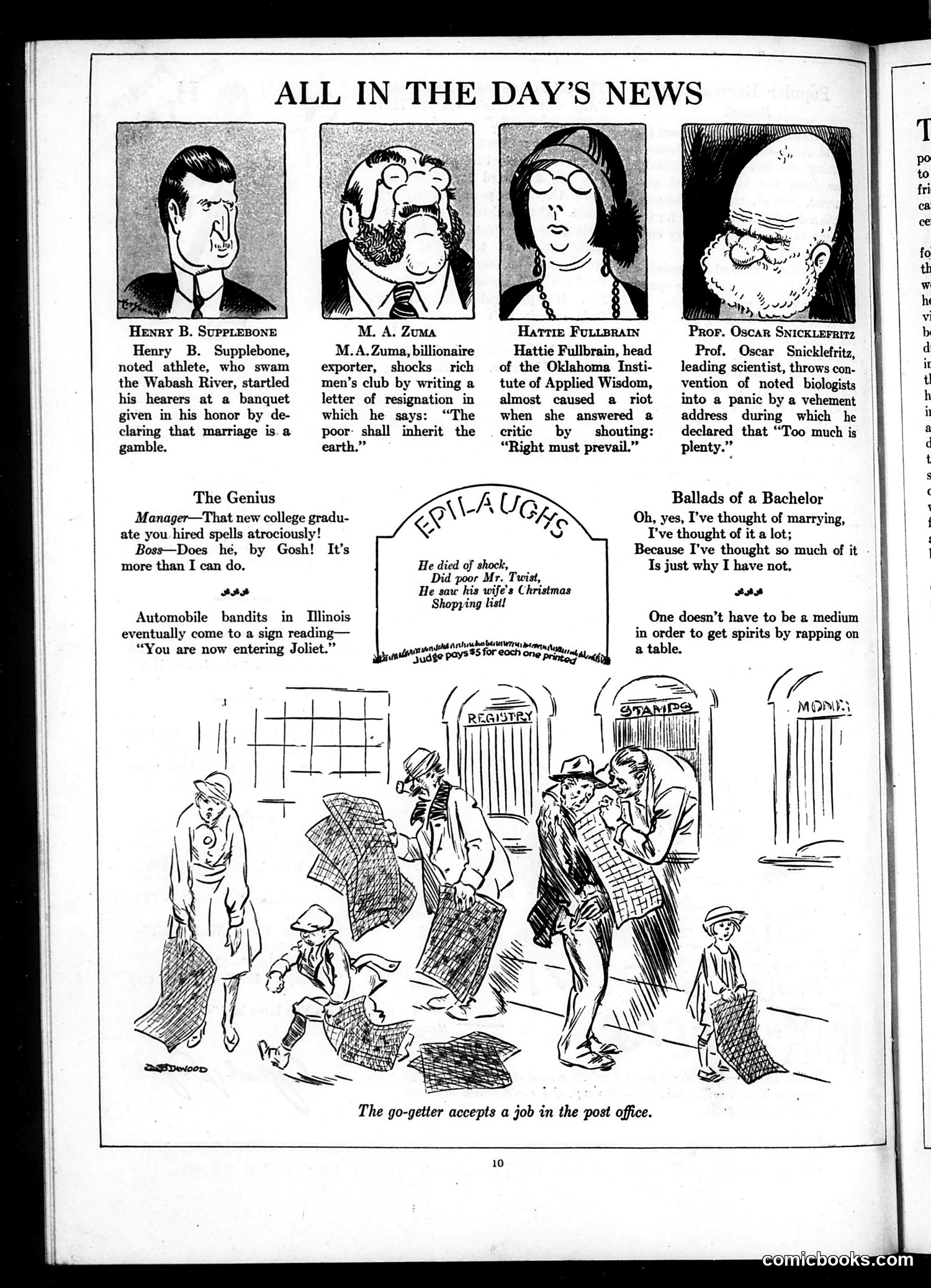
This is a satirical news digest from *Judge* magazine featuring mock "newsworthy" statements and humorous commentary on early 20th-century American life. **"All in the Day's News"** presents four fabricated headlines mocking absurd public pronouncements: an athlete declaring marriage a gamble, a billionaire claiming the poor shall inherit the earth, a wisdom institute head insisting "right must prevail," and a scientist declaring "too much is plenty." The satire targets pretentious public figures making banal or contradictory statements. **"The Genius"** mocks incompetent hiring practices. **"Automobile bandits in Illinois"** jokes darkly about criminals entering Joliet prison. **The bottom cartoon**, "The go-getter accepts a job in the post office," depicts Depression-era unemployment lines where desperate men compete for any available work, including low-status postal jobs—satirizing economic desperation and diminished ambitions during hard times. The "Ballads of a Bachelor" section humorously addresses marriage anxiety and the cost of wives' spending habits, reflecting contemporary domestic concerns.
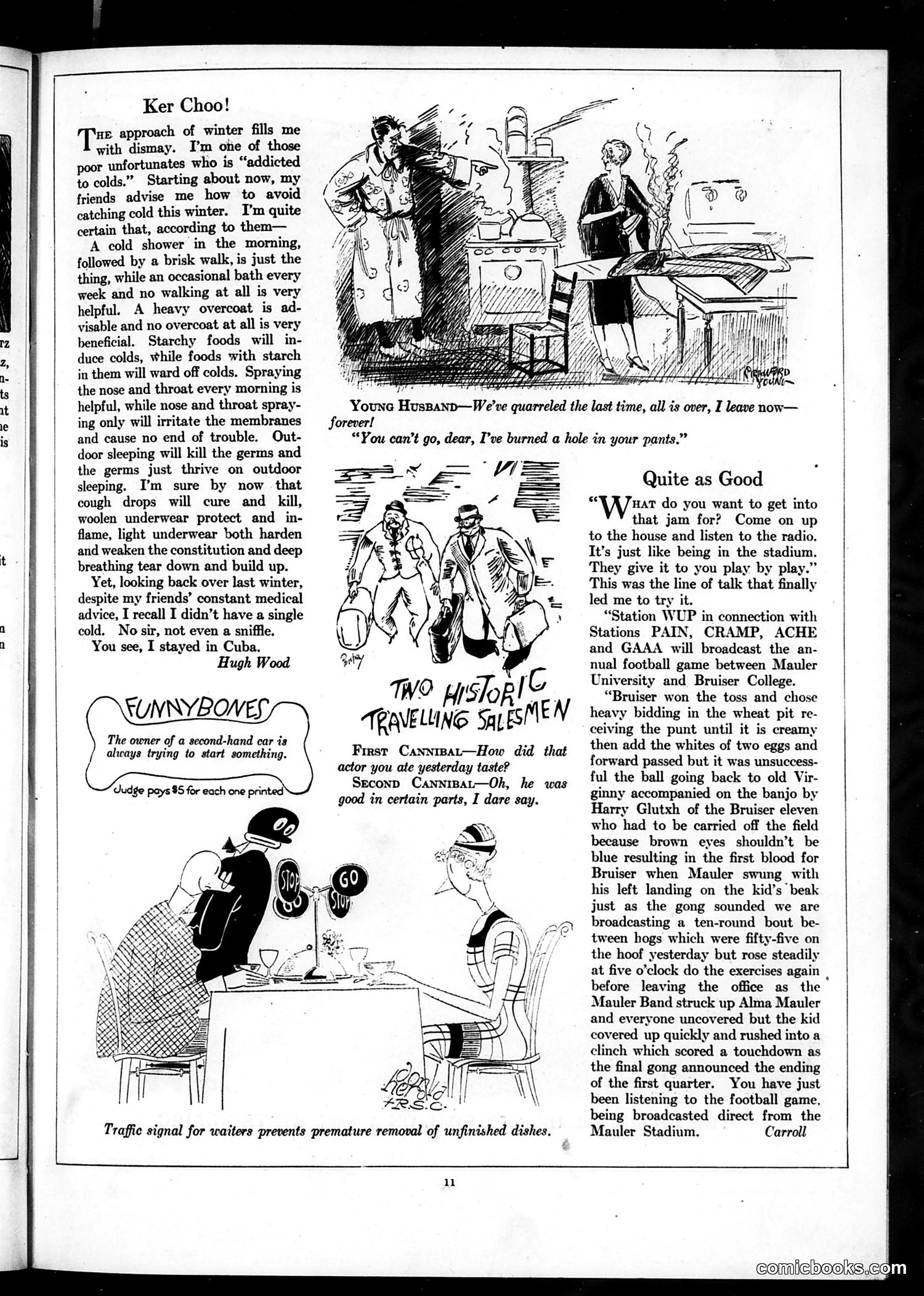
This page contains three satirical pieces mocking common advice and modern conveniences: 1. **"Ker Choo!"** – A humorous essay by Hugh Wood ridiculing contradictory health advice about avoiding winter colds. Friends offer mutually exclusive recommendations (cold showers vs. no walking; starchy foods both cause and prevent colds). The joke's punchline: the author stayed healthy by simply remaining in Cuba, rendering all the conflicting advice irrelevant. 2. **"Funnybones"** – Two brief visual gags: one about used-car salesmen, another depicting cannibals discussing eating an actor ("good in certain parts"), playing on theater terminology. 3. **"Quite as Good"** – A satire on radio broadcasts attempting to simulate live sports. The joke mixes football commentary with cooking instructions and other random content, suggesting radio play-by-play is indistinguishable from actual stadium experience—yet equally incoherent. It mocks both radio's new appeal and listeners' gullibility. The cartoons reflect 1920s-30s anxieties: medical fads, new technology (radio), and modern life's contradictions.
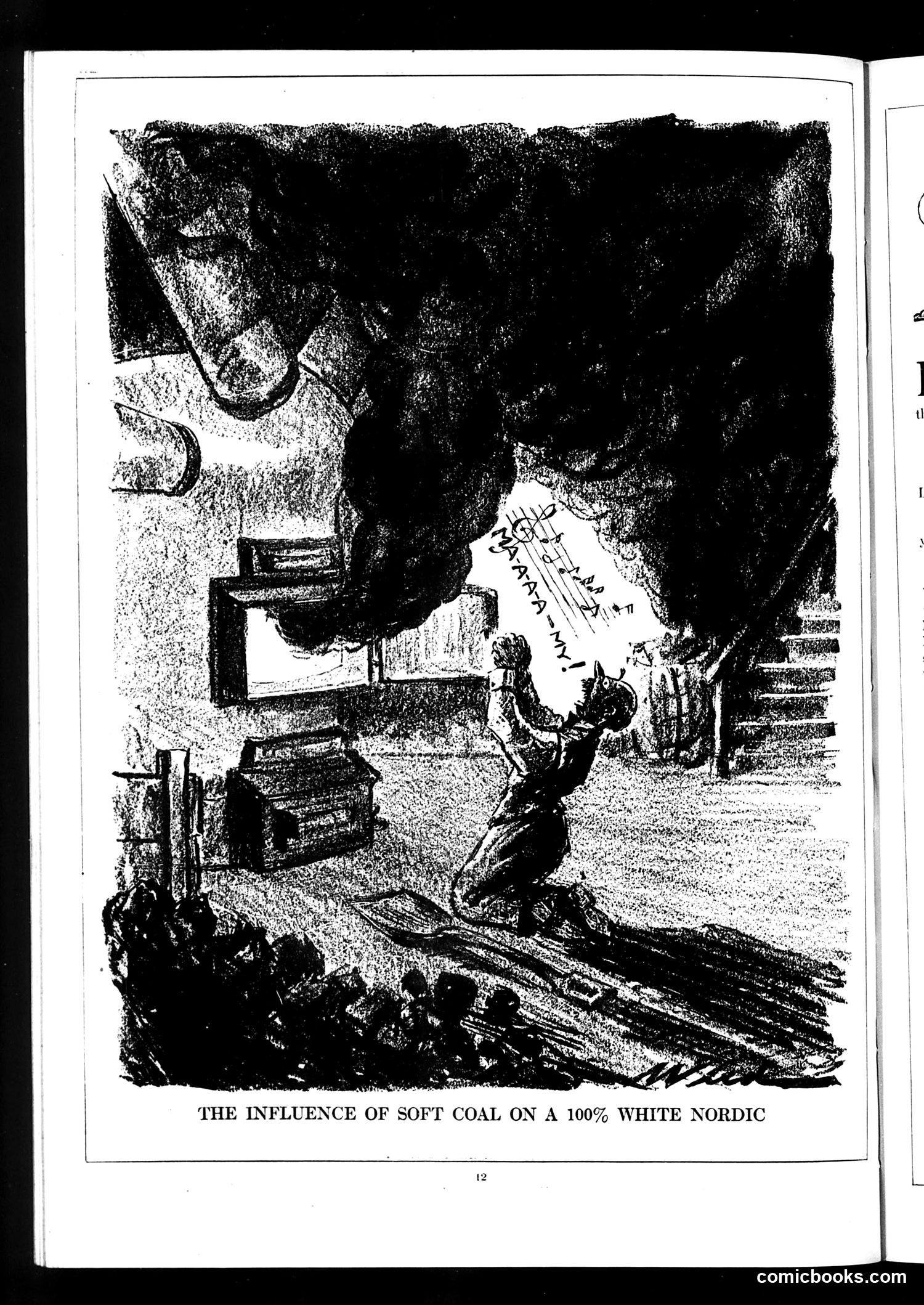
This political cartoon satirizes racial pseudoscience popular in the early 20th century. The caption's reference to "100% White Nordic" invokes the era's obsession with racial purity and eugenics. The image depicts a figure emerging from or covered in coal dust, appearing darkened by soft coal exposure. The satire targets the contradiction inherent in white supremacist ideology: the notion that a "pure" Nordic/white person could be literally blackened by industrial work conditions. The cartoon mocks those who simultaneously claimed racial superiority while the working class—regardless of ethnicity—faced dangerous, dirtying labor. It's commentary on how industrial pollution and harsh working conditions affected all workers equally, undermining racial hierarchy claims.
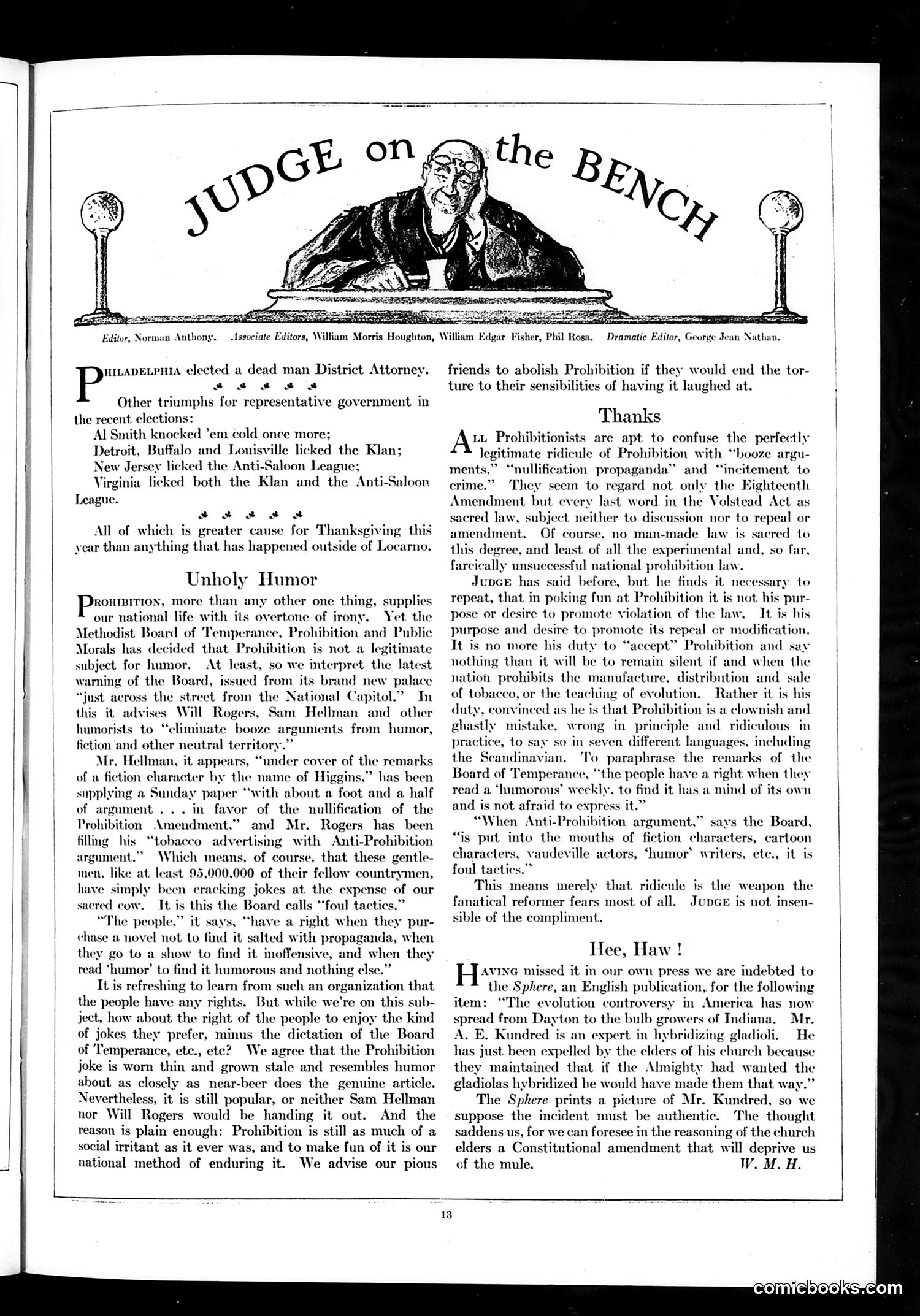
This page satirizes the Methodist Board of Temperance's attempt to censor humor about Prohibition. The board warned humorists like Will Rogers and Sam Hellman to stop making "booze arguments" in their comedy. Judge's position: the board conflates legitimate ridicule of an unpopular law with promoting lawbreaking. The magazine argues Americans have the right to mock Prohibition through humor—their "national method of enduring it"—without this constituting criminal incitement. The opening paragraph lists recent election results where anti-Prohibition forces won, suggesting public opposition to the law itself. Judge suggests the remedy isn't silencing jokes but actually repealing Prohibition. The satire critiques religious organizations imposing moral censorship while ignoring that 95 million Americans oppose the law they're defending.
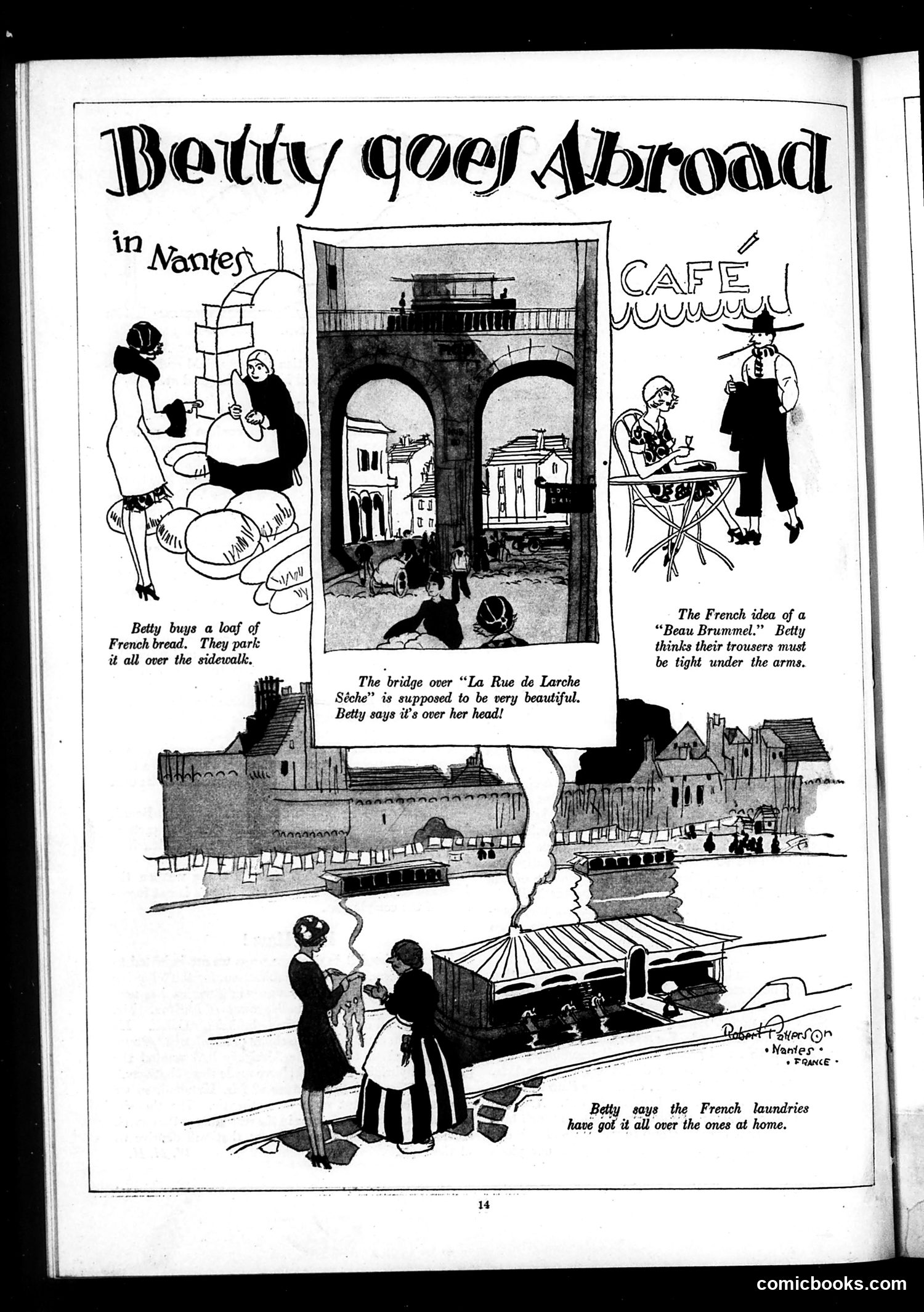
This is a humorous travel comic about an American character named Betty visiting France. The satire gently mocks both American and French cultural differences through Betty's naive observations: **The jokes:** - French people's casual sidewalk bread storage vs. American orderliness - French fashion ("Beau Brummel" reference to a famous dandy) where tight trousers are stylish—Betty thinks they're uncomfortably tight - A beautiful local bridge Betty finds incomprehensibly pretentious ("over her head") - French laundries' superior skill compared to American ones The cartoon contrasts American practicality with French aesthetic sophistication and fashion consciousness. Betty represents the bewildered American tourist encountering unfamiliar European customs. The humor is gentle cultural ribbing rather than sharp satire—typical of Judge magazine's light satirical approach to international differences during the early-to-mid 20th century.
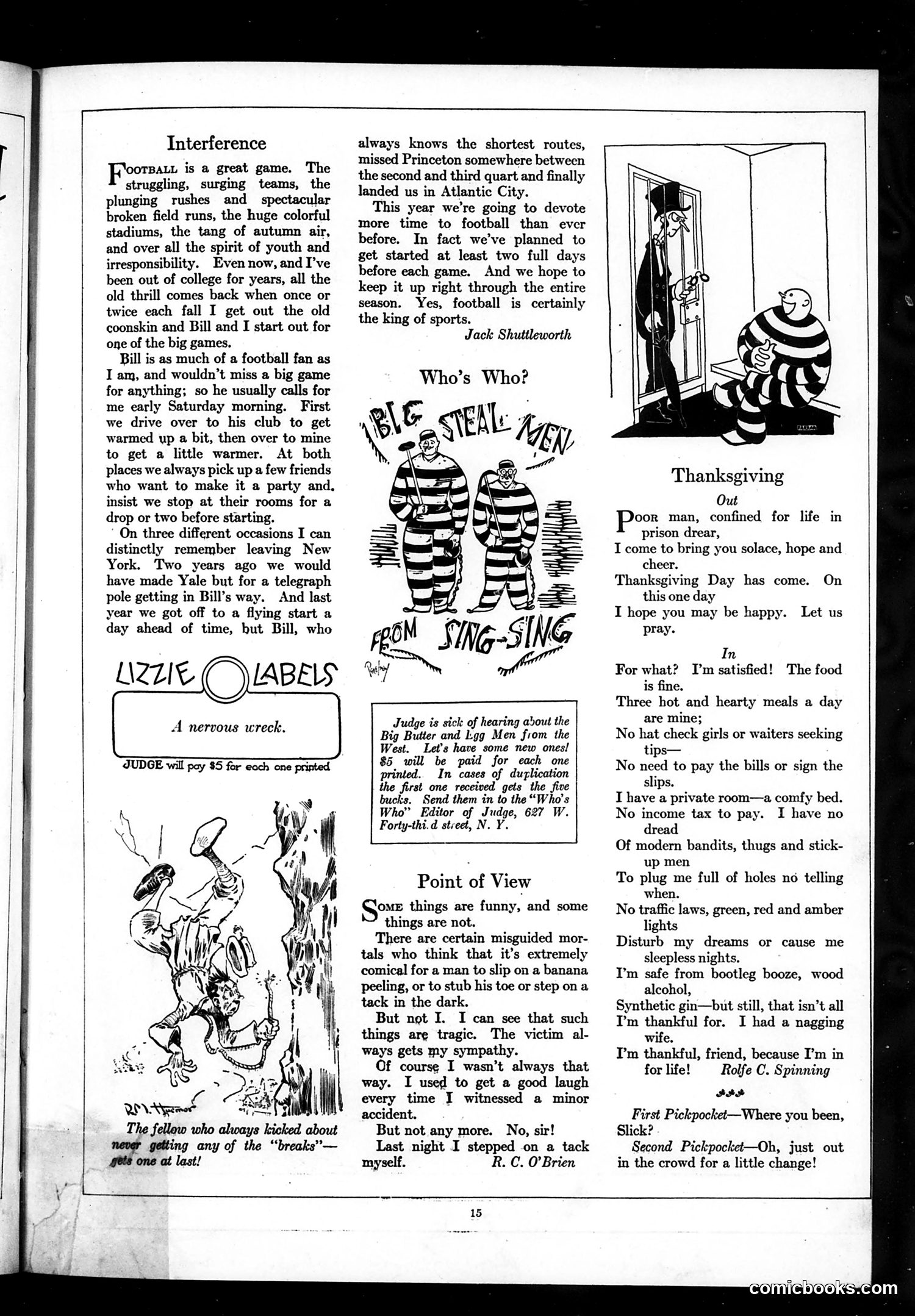
This page from Judge magazine contains several satirical pieces targeting early 20th-century American life: **"Interference"** mocks wealthy men's drinking culture. The author describes pre-game rituals involving stops at clubs for alcohol before attending football games, with alcohol consumption so excessive they miss their destination entirely (landing in Atlantic City instead of Yale or Princeton). The satire critiques how prohibition-era drinking undermines their stated intentions. **"Who's Who?"** appears to be a contest soliciting humorous caricatures of unnamed public figures (references to "Big Butter and Egg Men from the West"). **"Thanksgiving"** presents darkly comic irony: a imprisoned man lists his contentment with prison life—free meals, no bills, no taxes, no gangsters or nagging wife—suggesting incarceration offers better conditions than modern society. The cartoons use exaggerated visual humor typical of period satire, including caricatures of criminals in striped prison garb and slapstick situations. The overall tone critiques wealth, drinking culture, and modern anxieties through humor.
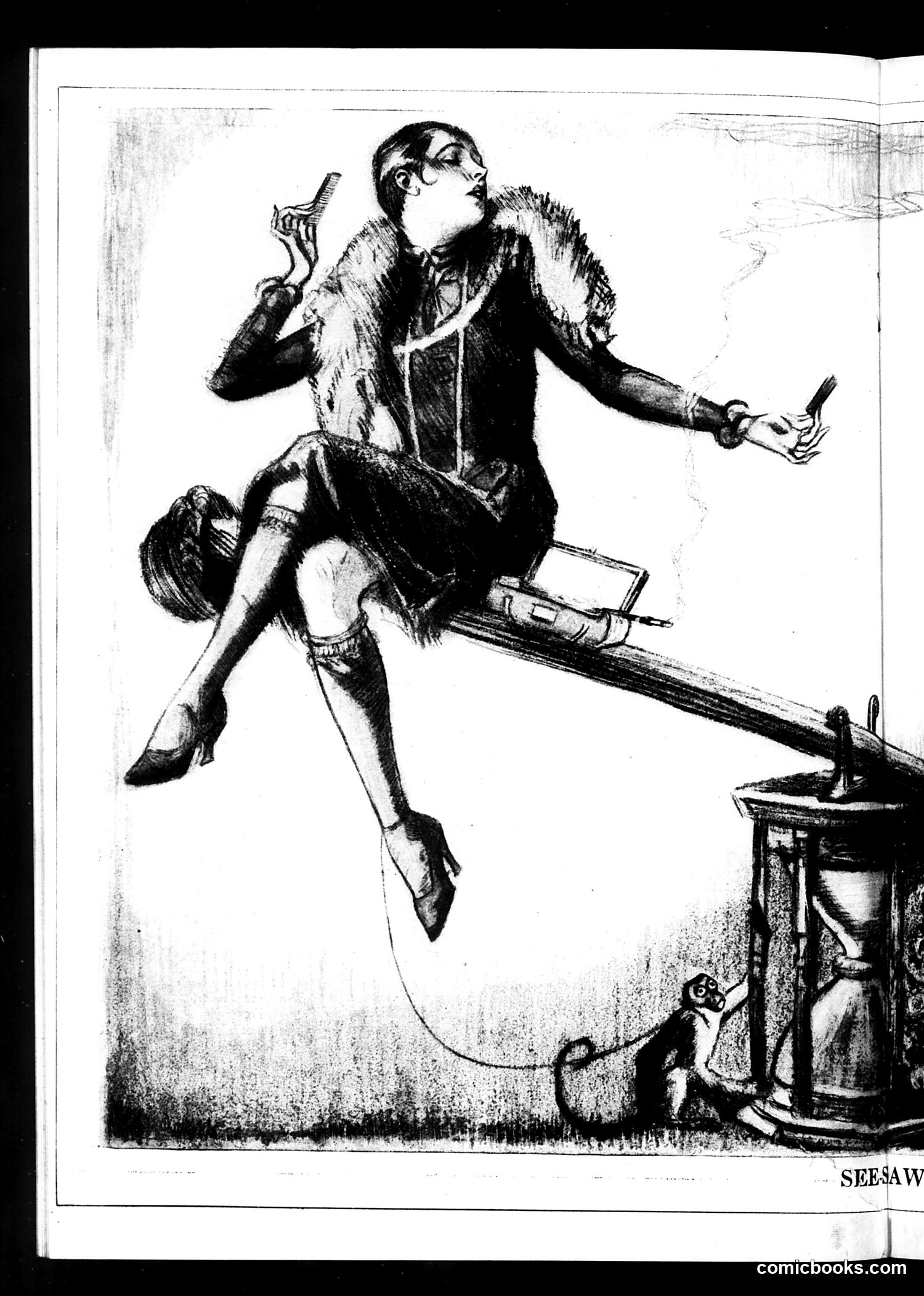
This appears to be a satirical illustration from *Judge* magazine (signed by what looks like "SEESAW"). The image depicts a figure in feminine dress juggling various tools and objects while balancing on a seesaw or plank—likely representing a woman attempting to "balance" multiple roles or responsibilities simultaneously. The figure holds what appears to be a hammer, paintbrush, and other implements, suggesting commentary on women's work, labor, or social roles. The fur-trimmed outfit and heeled shoes indicate class positioning. A small monkey or ape sits below, possibly adding commentary on the absurdity of the situation. Without additional context or readable text beyond "comicbooks.com," the precise historical reference remains unclear, though this likely satirizes contemporary debates about women's expanding social roles or labor participation.
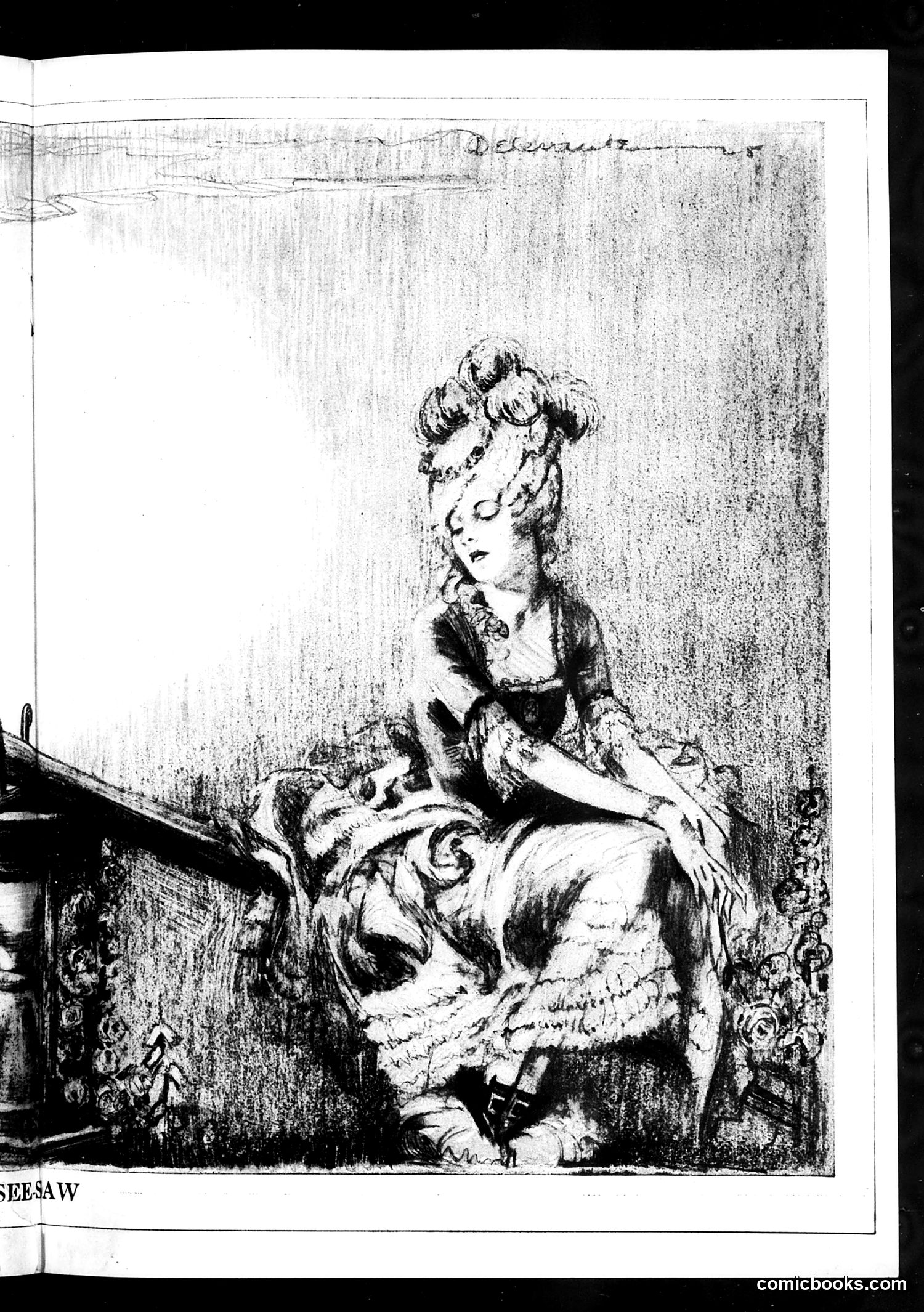
This appears to be a sketch or illustration from Judge magazine, likely from the late 19th or early 20th century based on the artistic style and printing technique. The image shows a woman in fashionable period dress—featuring elaborate upswept hair, a dark corset-style bodice, and flowing skirts—seated in a relaxed pose. The minimal OCR text ("SRESAW") is unclear and may be corrupted or a signature. Without additional context or visible caption text, the specific satirical point is difficult to determine. The illustration appears to be commenting on women's fashion, social behavior, or contemporary feminine aesthetics, but the exact nature of the satire cannot be confidently identified from the image alone.
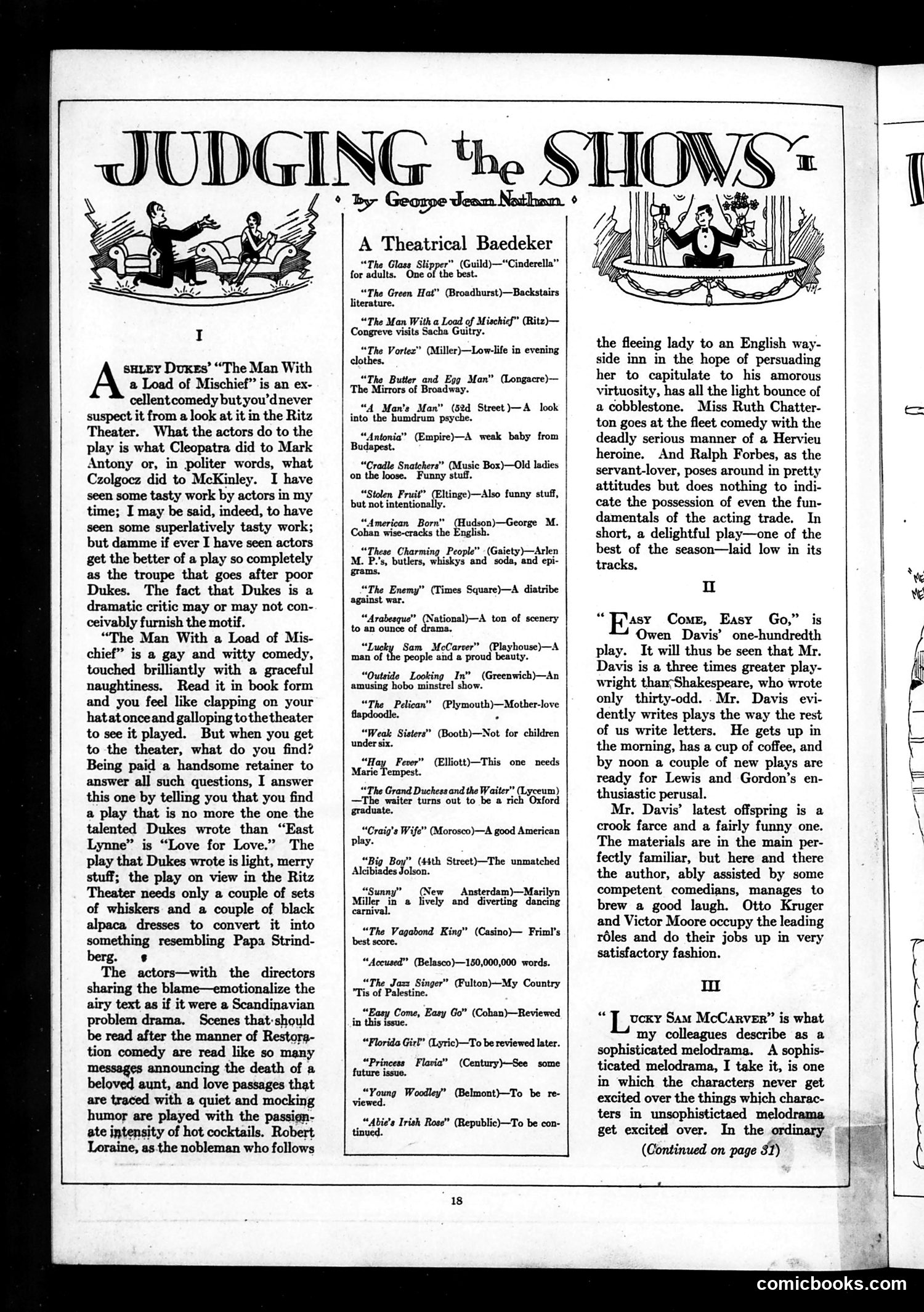
This is a theater review column by George Jean Nathan, a prominent drama critic. The page contains two main elements: **The Main Review** critiques a play called "The Man With a Load of Mischief" at the Ritz Theater. Nathan argues that while playwright Dukes' script is witty and light comedy, the actors and directors have completely misinterpreted it, playing it as heavy Scandinavian drama (referencing Ibsen/Strindberg) instead of restoration-era comedy. He uses violent metaphors—comparing what the actors do to the play to what Cleopatra did to Mark Antony or what assassin Czolgocz did to McKinley—to convey his disgust. **"A Theatrical Baedeker"** is a satirical reference guide to current Broadway shows, offering one-line dismissals or descriptions (e.g., "The Green Hat"—"Backstairs literature"; "Hay Fever"—"This one needs Marie Tempest"). The satire targets both incompetent theatrical interpretation and contemporary Broadway productions.
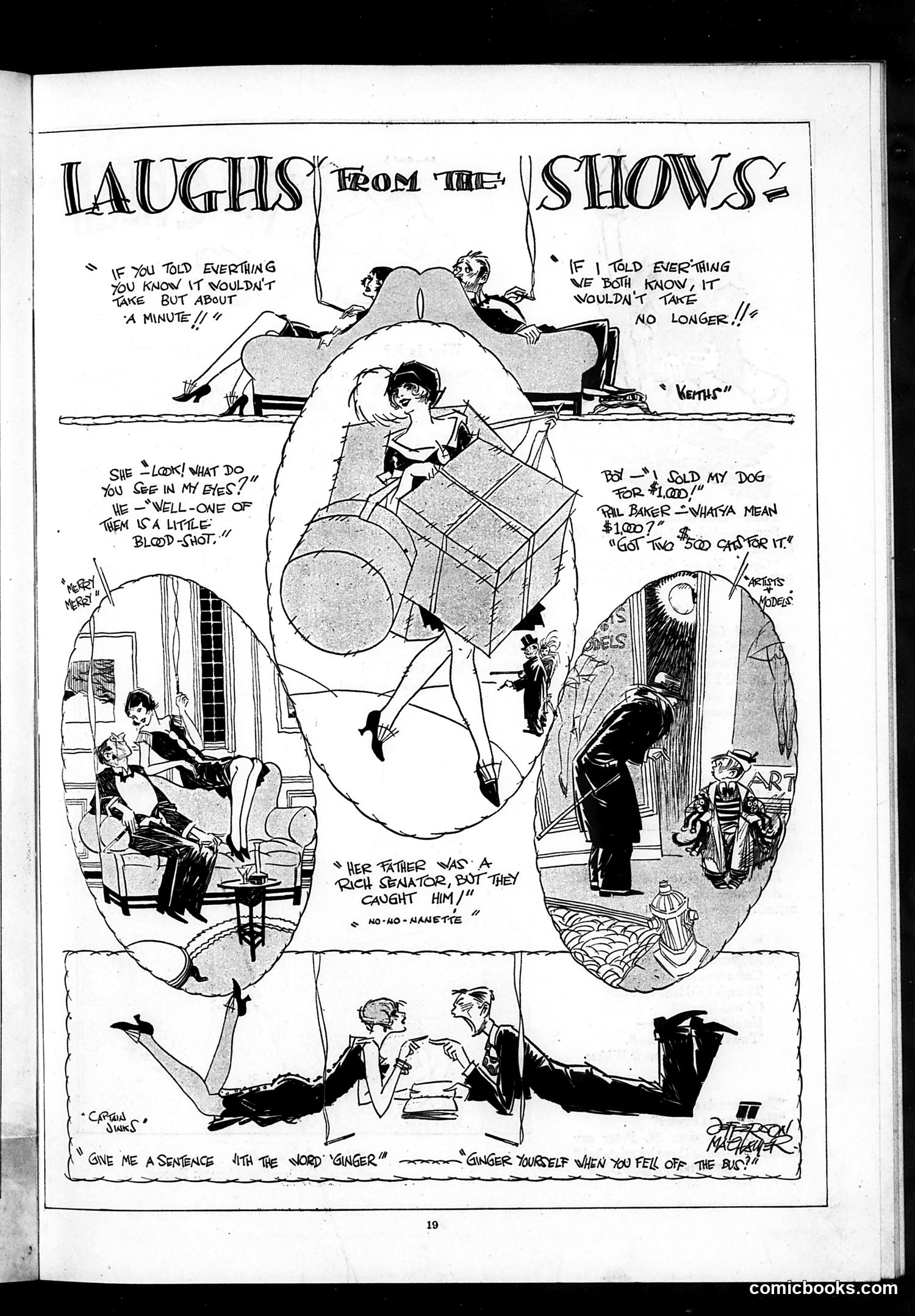
This page features theatrical humor tied to contemporary Broadway productions. The central vignette shows a woman reclining while two men discuss her—a setup for gossipy backstage banter typical of 1920s stage comedy. The surrounding scenes mock various theatrical scenarios: a seduction scene, a senator being caught in compromising circumstances, and slapstick moments. The humor relies on double entendres and innuendo common to Jazz Age entertainment. References include "Ginger" (likely a character or actress name), a senator scandal joke, and a "fell off the bus" punchline—all suggesting these were recognizable theater personalities or famous shows of the era. The satire mocks both theatrical pretension and the scandalous private lives of performers, a Judge magazine specialty. Without specific date or production credits visible, exact show identification remains unclear, but the page captures how satirical magazines covered Broadway's celebrity gossip and stage humor for contemporary readers.
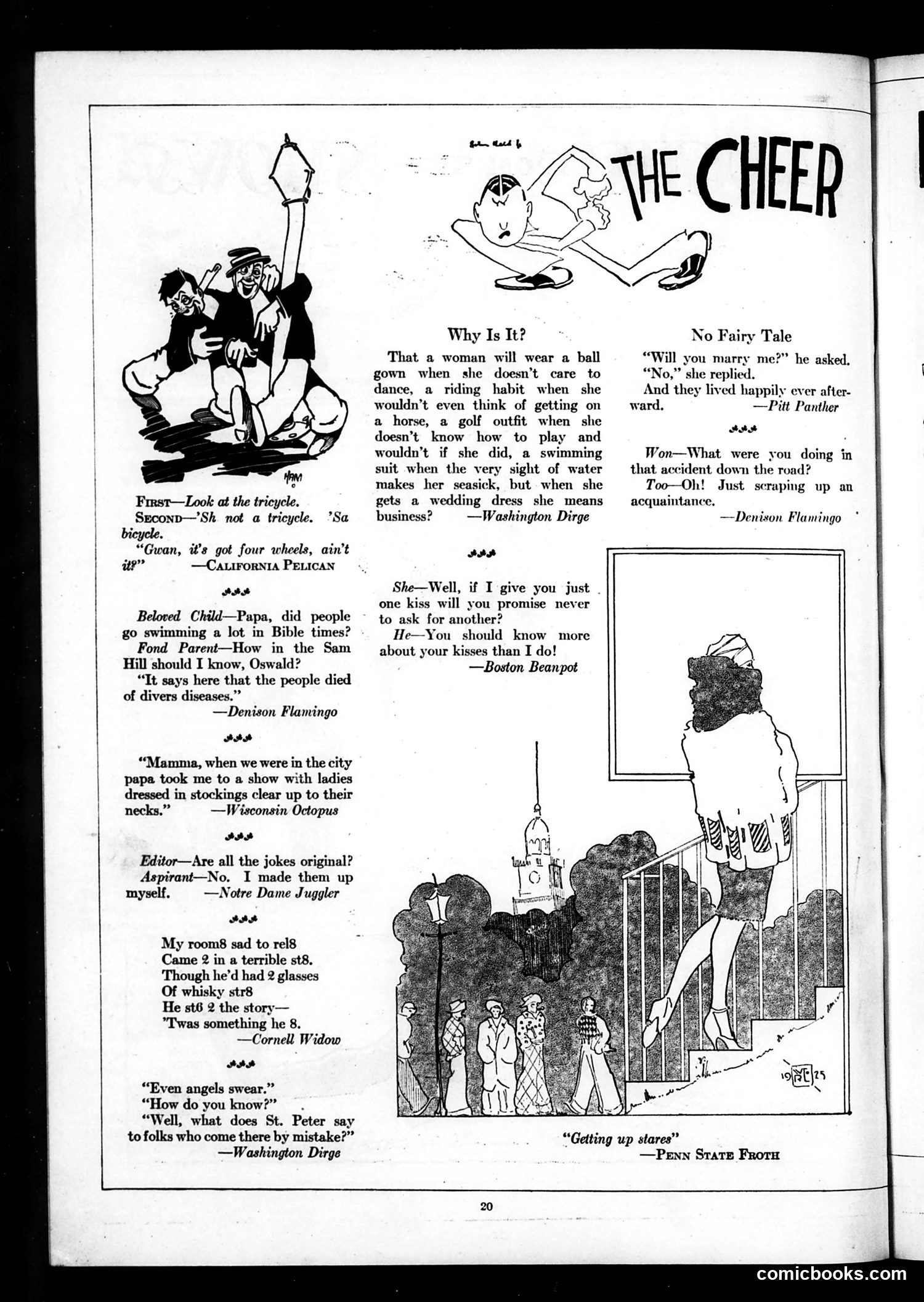
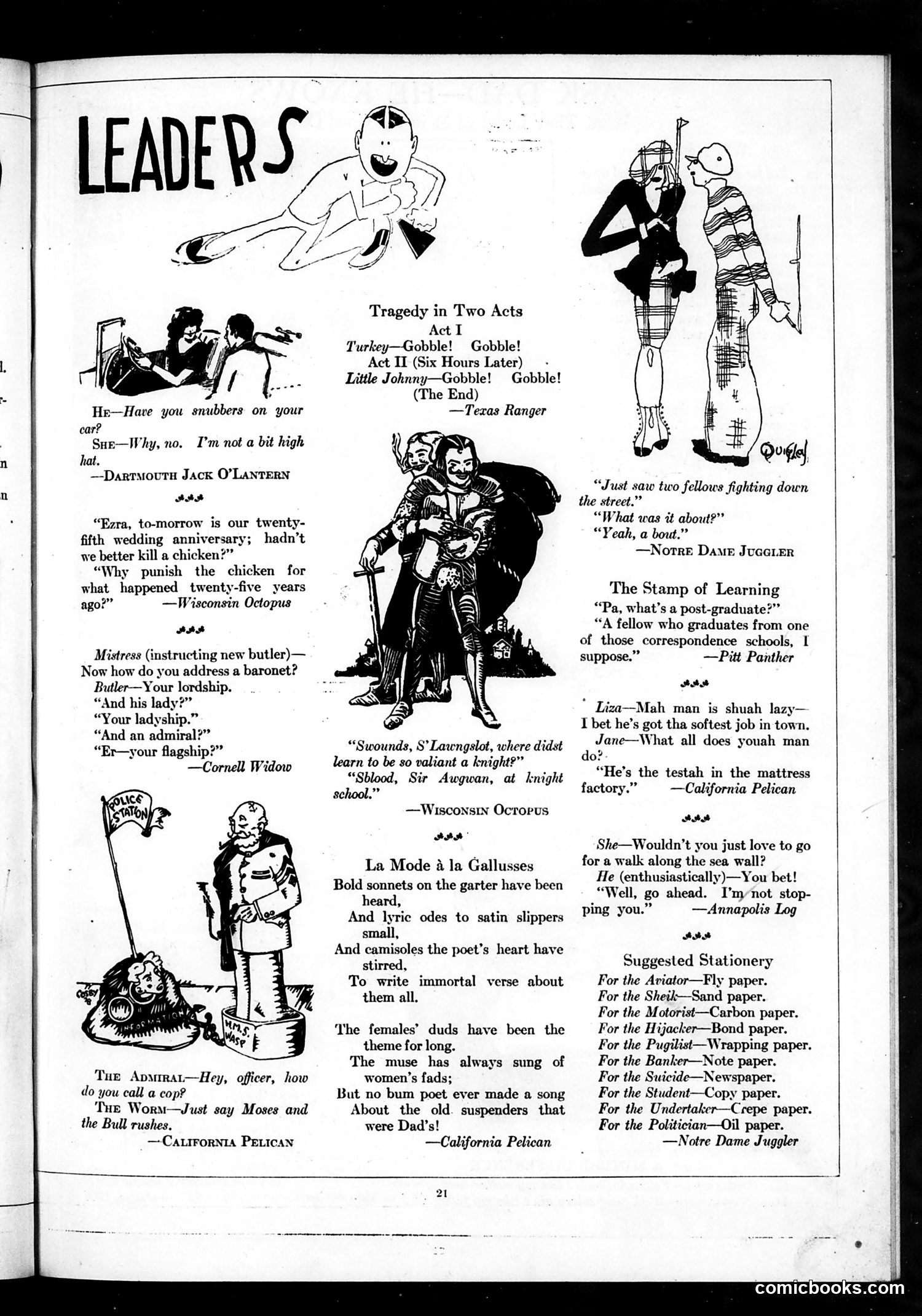
This page contains humor snippets from various college publications, typical of Judge's "Leaders" section featuring collegiate wit. **Key content:** The jokes target contemporary social situations: automobiles (snubbers/shock absorbers), marriage expectations, proper etiquette for British nobility, and emerging professions. One recurring theme mocks correspondence schools as less rigorous than traditional education. **Notable items:** - A dark joke about Thanksgiving (turkey's "tragedy in two acts") - Satire on poets ignoring mundane subjects (suspenders vs. fashionable garters) - Puns on occupational stereotypes ("testah in the mattress factory") - The "Suggested Stationery" list uses wordplay matching professions to paper types (politicians get "oil paper," suggesting corruption/slickness) **Context for modern readers:** These reflect 1920s concerns: automobile adoption, class anxieties about etiquette, skepticism toward distance learning, and gendered humor about work and romance. The college humor credits indicate this was syndicated among American universities.
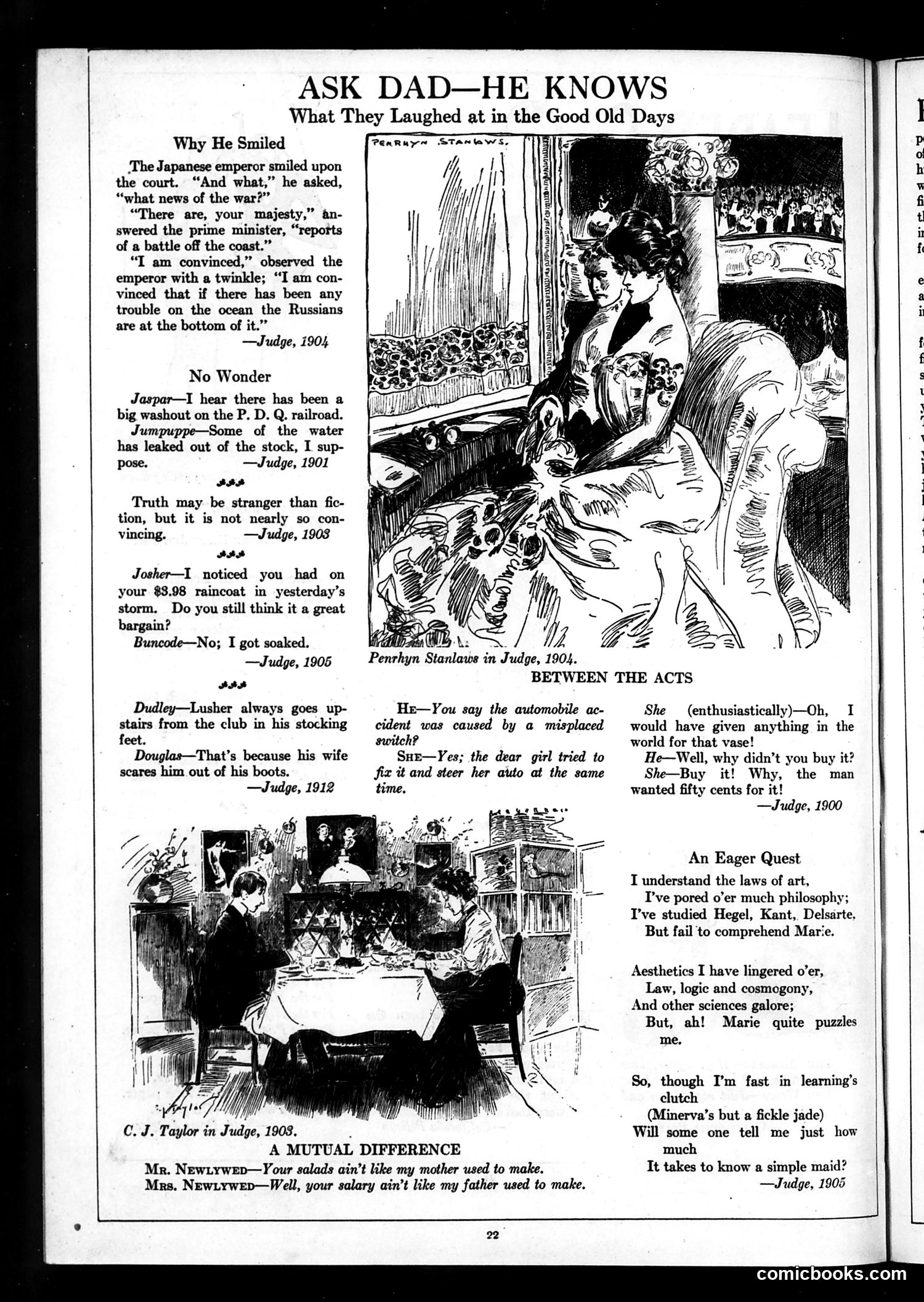
This page collects short jokes and quips from Judge magazine (1900-1912), presented as timeless humor parents might share. The content reflects period anxieties and social observations: **Political/Historical**: The 1904 joke mocks the Russo-Japanese War, portraying the Japanese emperor as confident Russia will lose ("at the bottom of it"—drowned). **Social satire**: Other jokes target modern inconveniences (railroad accidents, faulty raincoats, automobiles), class tensions ("salads ain't like mother made" meets "your salary ain't like father made"), and gender dynamics (a woman's ignorance of automobile mechanics, the mysterious incomprehensibility of women to educated men). **Tone**: Gentle mockery of everyday life, marital friction, and generational change. The cartoons illustrate romantic and domestic scenes reflecting the text's themes. The page presents itself as nostalgic humor, though it's actually contemporary satire—the "good old days" framing is ironic.
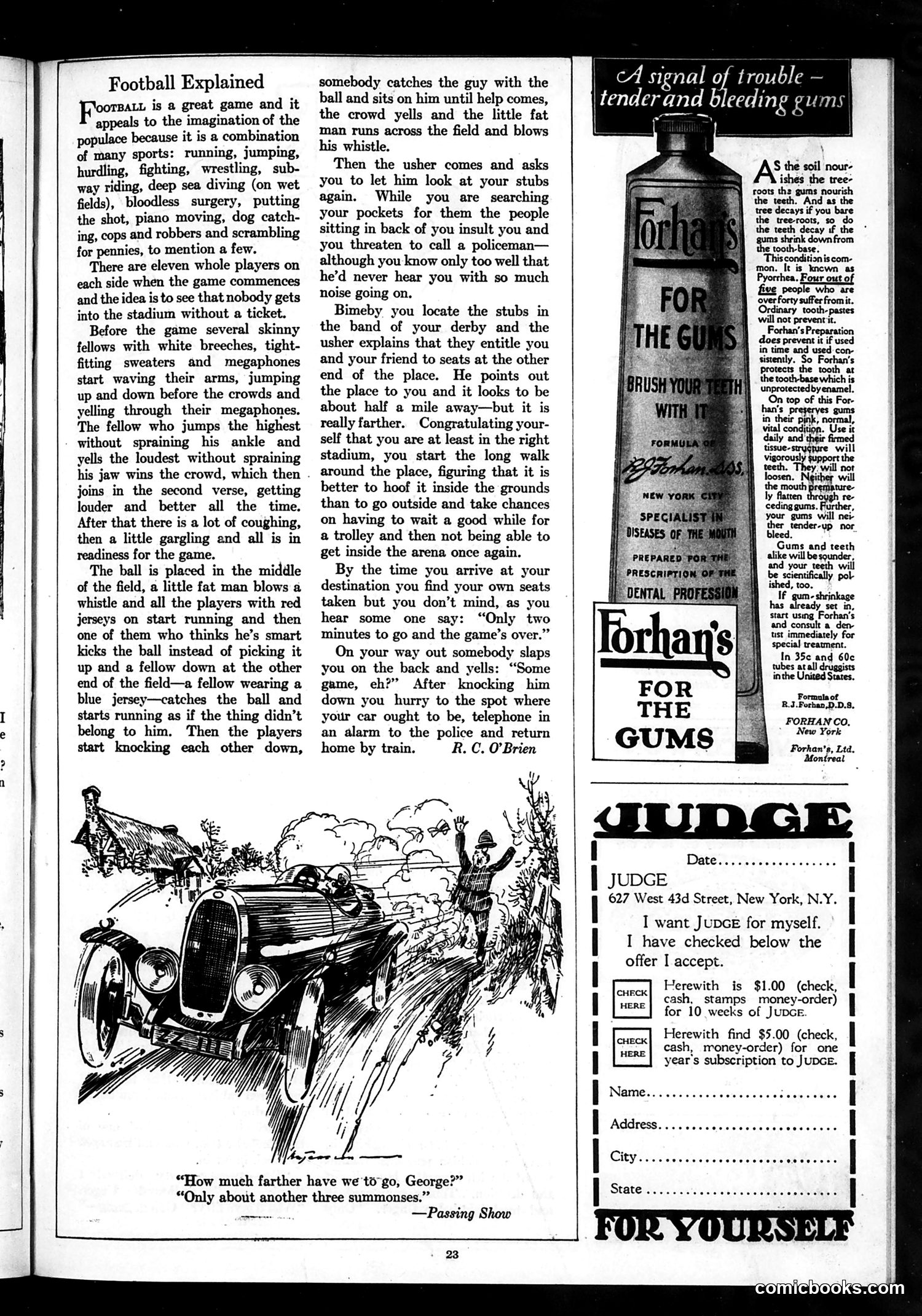
This page contains a humorous essay satirizing American football by treating it as a chaotic, overcomplicated spectacle rather than an organized sport. The author R.C. O'Brien mocks the experience: fans struggling to find seats after long walks, ushers checking tickets repeatedly, rude spectators, and the confusing aftermath where attendees can't locate their cars and must call police. The accompanying cartoon depicts motorists asking "How much farther have we to go, George?" with the reply "Only about another three summonses"—suggesting the chaotic traffic and parking violations associated with attending sporting events. The satire targets not football itself but the *social experience*: the pretentiousness of stadium attendance, crowd behavior, and urban inconvenience. This reflects early-20th-century frustrations with mass entertainment culture and automobile congestion in cities. The page also contains period dental product advertisements, typical for Judge magazine's revenue model.
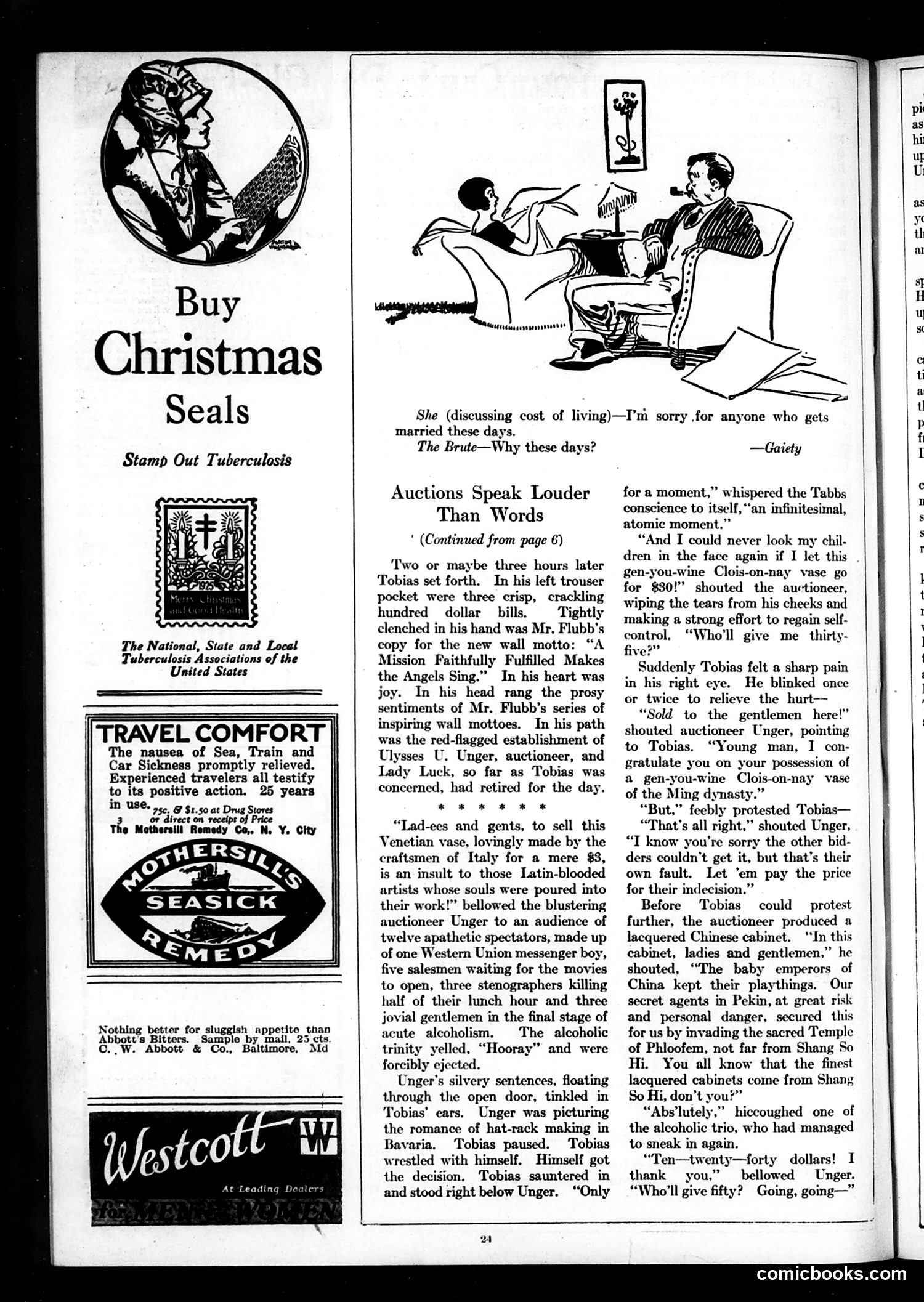
This is a serialized story (continued from page 6) satirizing auction house manipulation and consumer gullibility. The protagonist Tobias, armed with $300 and moral resolve from his employer Mr. Flubb's inspirational motto ("A Mission Faithfully Fulfilled Makes the Angels Sing"), enters auctioneer Ulysses U. Unger's establishment. Unger is a archetypal con artist who uses theatrical rhetoric—romantic descriptions of a Venetian vase's Italian craftsmanship, invented histories of Chinese cabinets from a fabricated temple—to manipulate his sparse, disinterested audience (messenger boys, stenographers, drunks). Through emotionally charged storytelling rather than honest salesmanship, he goads the reluctant Tobias into bidding by making a spontaneous eye-blink appear intentional. The satire targets early 20th-century auction fraud and the ease with which eloquent salesmen exploit consumer aspirations and social insecurity about cultural refinement.
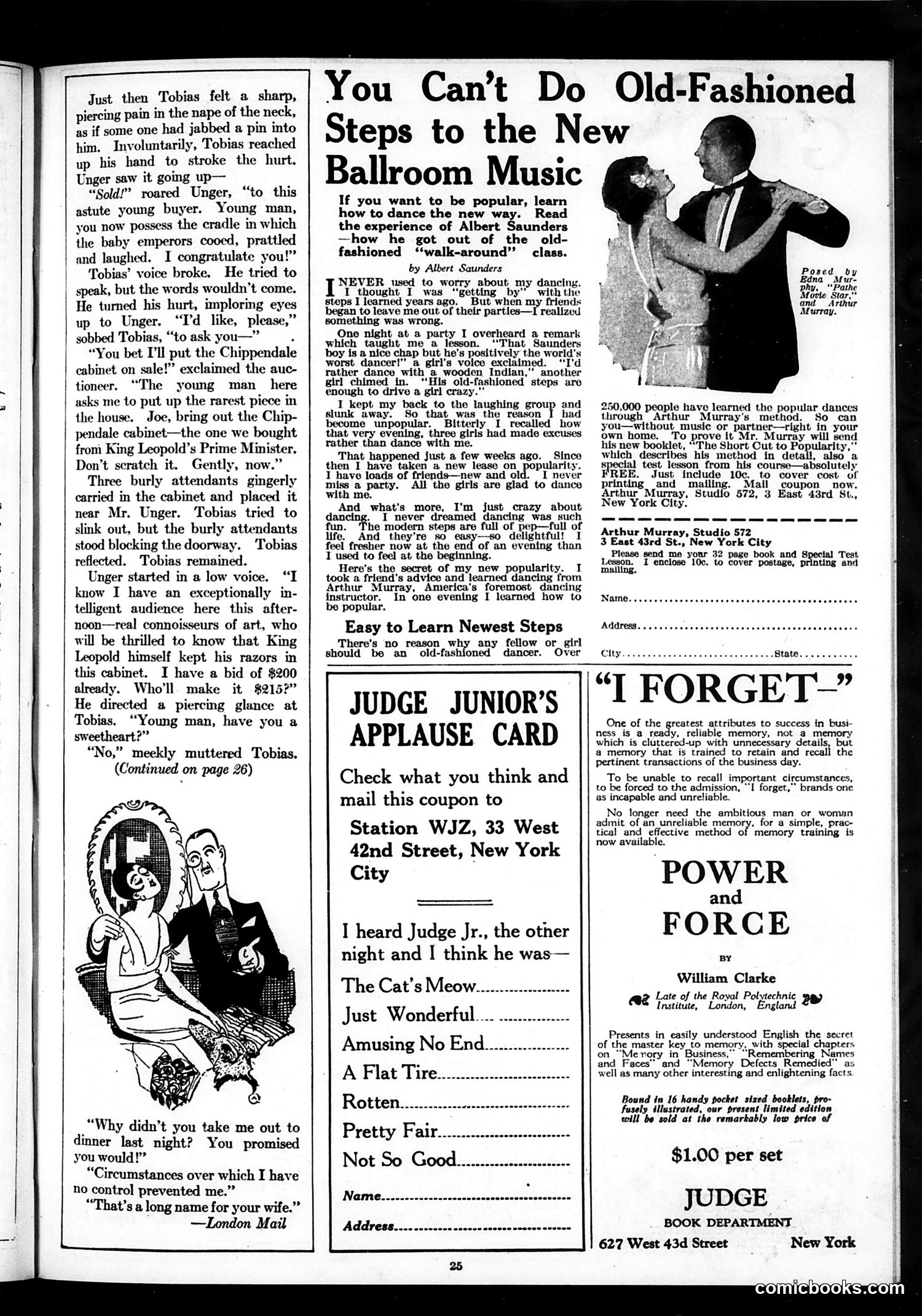
This page mixes fiction and advertising typical of 1920s Judge magazine. **The fictional story** (left column) satirizes an auction house swindle: a naive young man named Tobias attends an auction where a shifty auctioneer named Unger manipulates him into buying expensive furniture through flattery and misdirection. When Tobias innocently gestures, Unger claims he's bidding and awards him a "Chippendale cabinet" supposedly owned by King Leopold. The joke targets gullible wealthy buyers and unscrupulous auctioneers. **The main article** (center/right) promotes modern ballroom dancing instruction via Arthur Murray Studios, contrasting "old-fashioned" dance steps with trendy new ones. It's essentially advertorial content. **The small cartoon** (bottom left) is a marriage joke: a wife complains her husband broke a dinner promise; he blames circumstances beyond his control; she sarcastically suggests his wife (herself) is the real obstacle. The "Judge Junior's Applause Card" and "Power and Force" book advertisement fill remaining space—typical magazine monetization of the era.
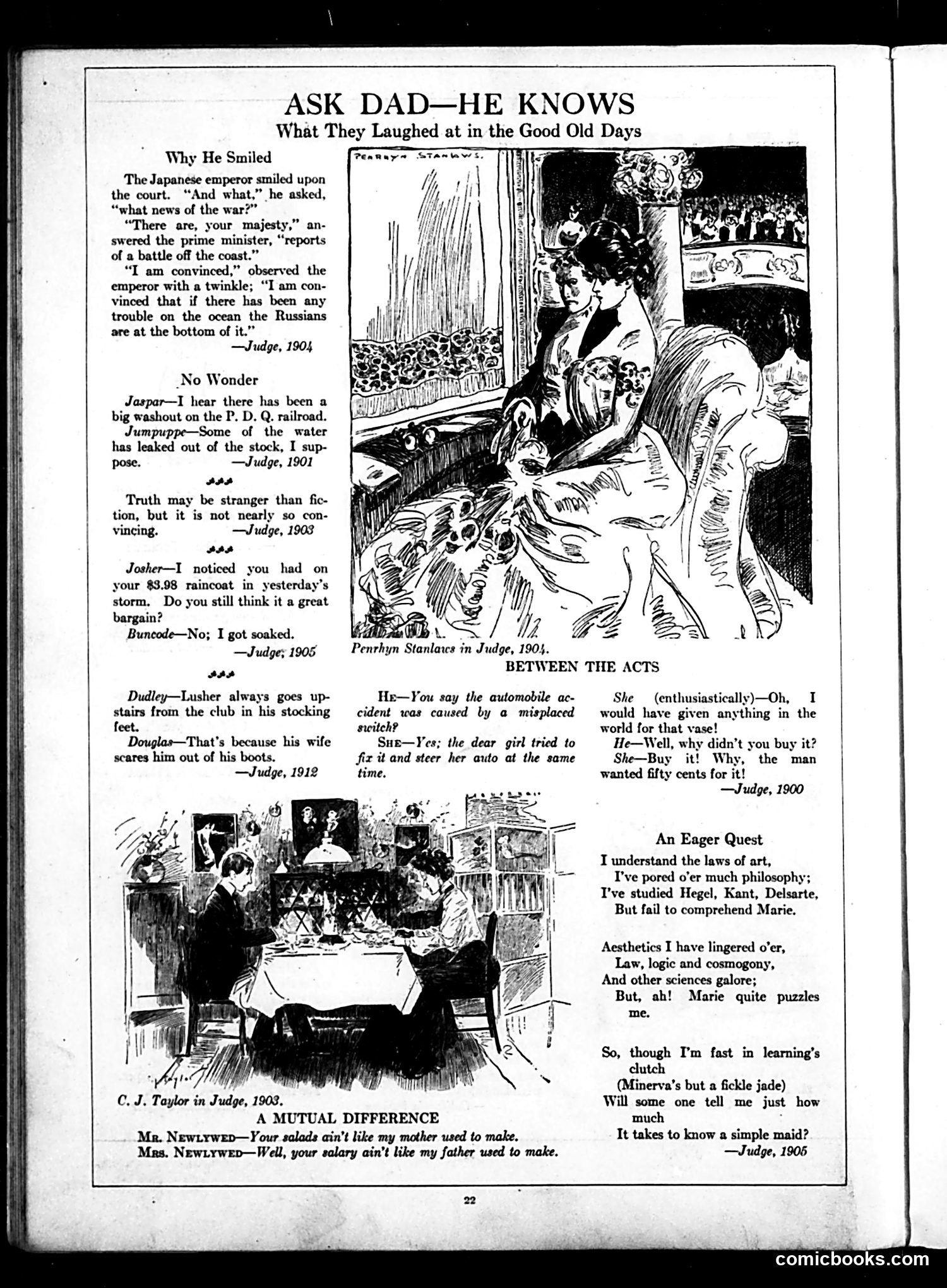
This page collects short humorous anecdotes and jokes from Judge magazine (1900-1912), reflecting early 20th-century American attitudes. **"Why He Smiled"** (1904): References the Russo-Japanese War. The Japanese emperor's quip—that any ocean trouble must involve Russians "at the bottom of it"—is darkly comedic, suggesting Russia's military defeats and naval losses in that conflict. **Other jokes** satirize everyday American life: railroad stock schemes, false advertising (the raincoat), marital dynamics (salary complaints), and automotive novelties (the "misplaced switch" joke). **"An Eager Quest"** mocks educated men who study philosophy and aesthetics yet remain baffled by understanding women—a common early-1900s trope presenting women as inherently unknowable despite intellectual pretension. The page's title, "Ask Dad—He Knows," frames these as wisdom from older generations about timeless human follies.
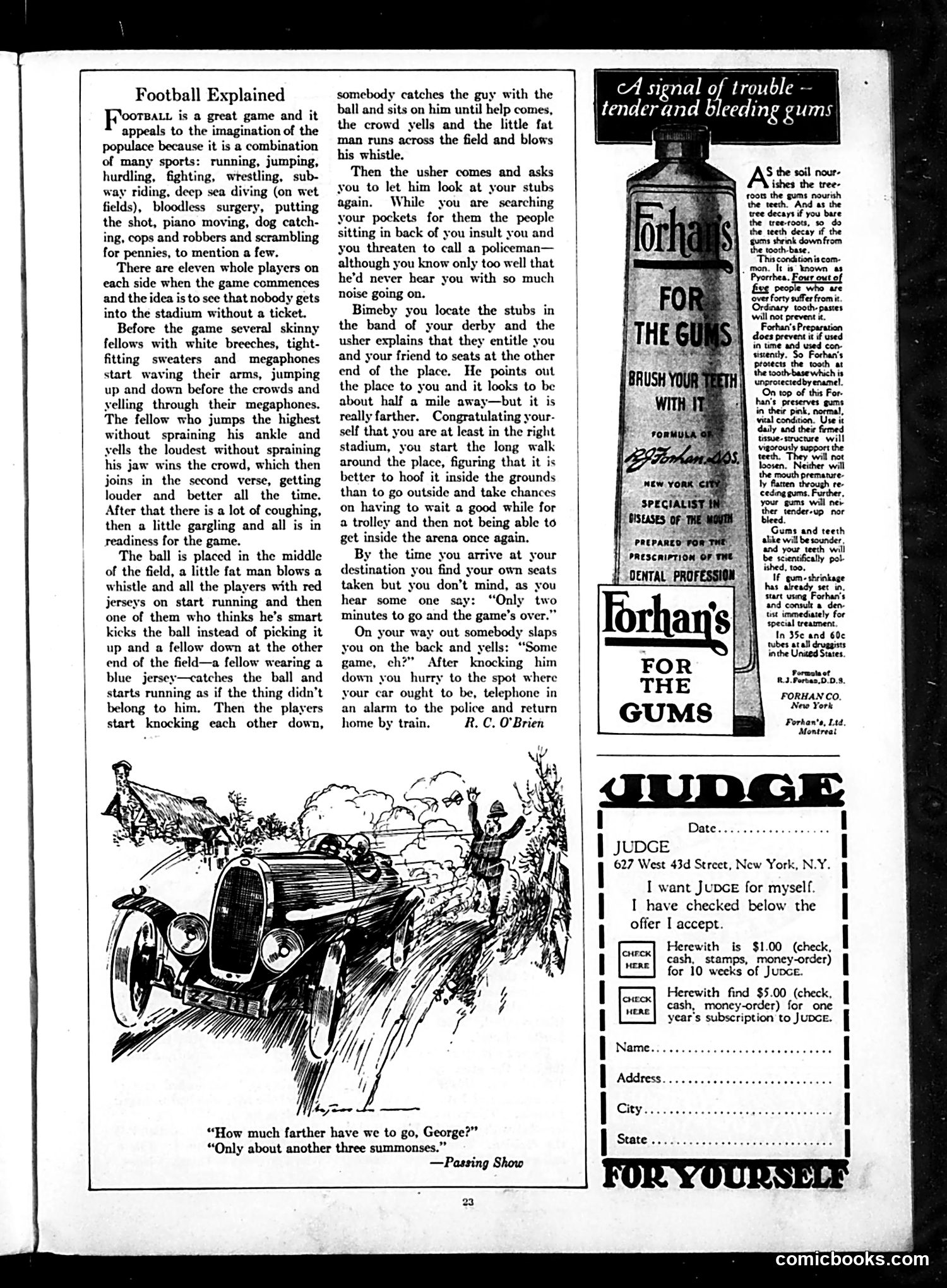
This R.C. O'Brien piece satirizes the chaos and inconvenience of attending a football game rather than the sport itself. While the opening section humorously describes football as a combination of many activities (fighting, wrestling, "cops and robbers"), the bulk of the article mocks the *spectator experience*: aggressive ticket ushers, poor seating assignments, crowds blocking views, long walks to seats already occupied, and the challenge of leaving afterward. The accompanying cartoon shows a chaotic car chase scene, reinforcing the theme that getting to or from a game is as tumultuous as the game itself. The satire suggests that attending a football match in this era involved significant hassle, poor organization, and frustration—the actual sport being almost secondary to the ordeal of the crowd management and logistics.
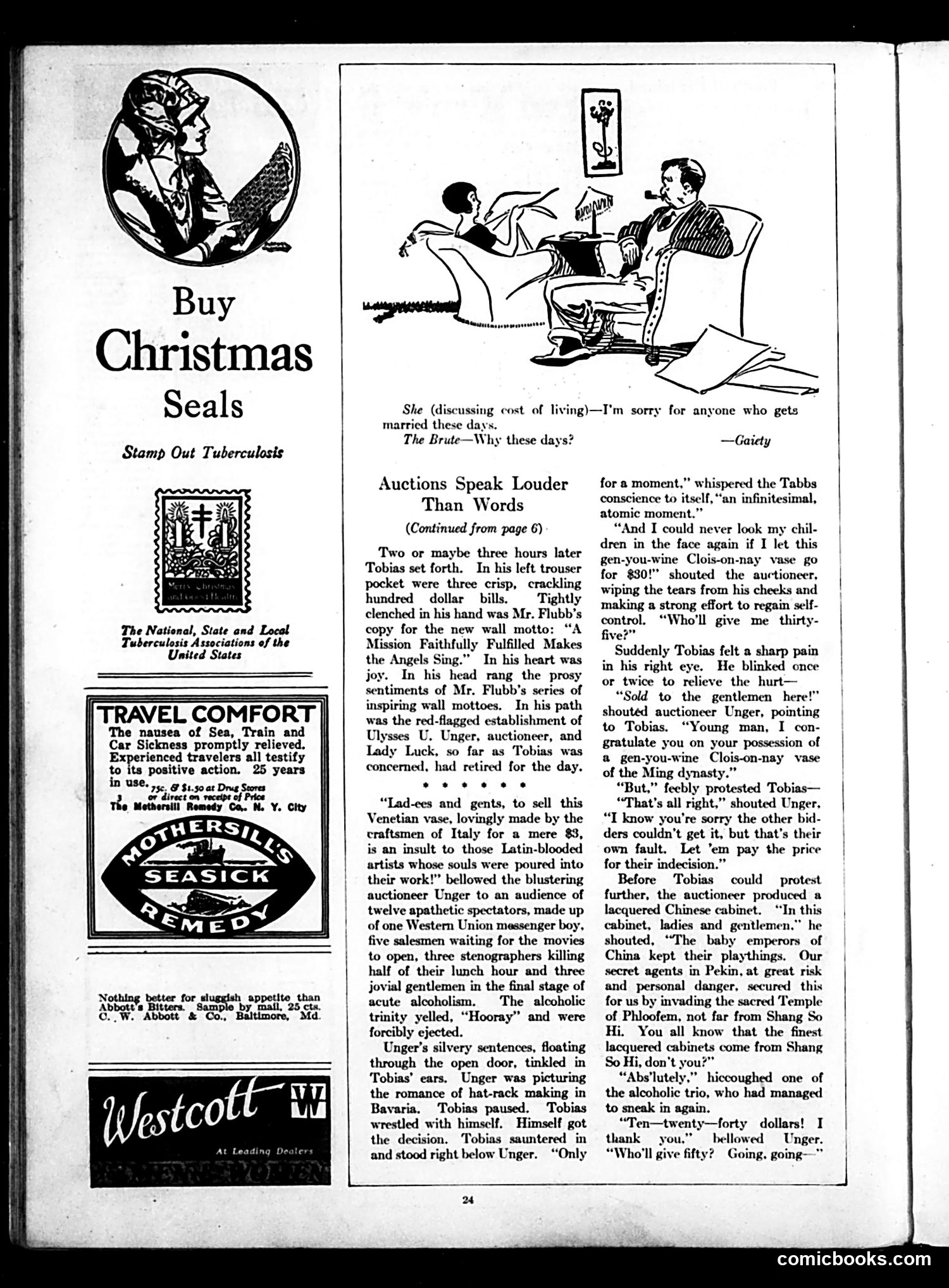
This is a satirical short story about auction manipulation and consumer gullibility. A naive man named Tobias attends an auction by the bombastic auctioneer Ulysses U. Unger, who uses high-pressure salesmanship and fabricated romantic backstories to inflate prices of dubious goods. Tobias bids on a supposedly Italian Venetian vase (actually worth far less) and a "Ming dynasty" Chinese cabinet supposedly from an emperor's temple—claims that strain credibility. The humor lies in how Unger's flowery rhetoric ("gen-you-wine," emotionally manipulative descriptions) and theatrical performance sway the audience despite the audience being mostly indifferent onlookers (messenger boys, salesmen killing time, stenographers on lunch break). The satire mocks both the slick auctioneer exploiting buyers and the buyers susceptible to romantic storytelling over actual value. It's a period commentary on American consumer culture and the vulnerability of ordinary people to smooth-talking salesmanship and manufactured prestige.
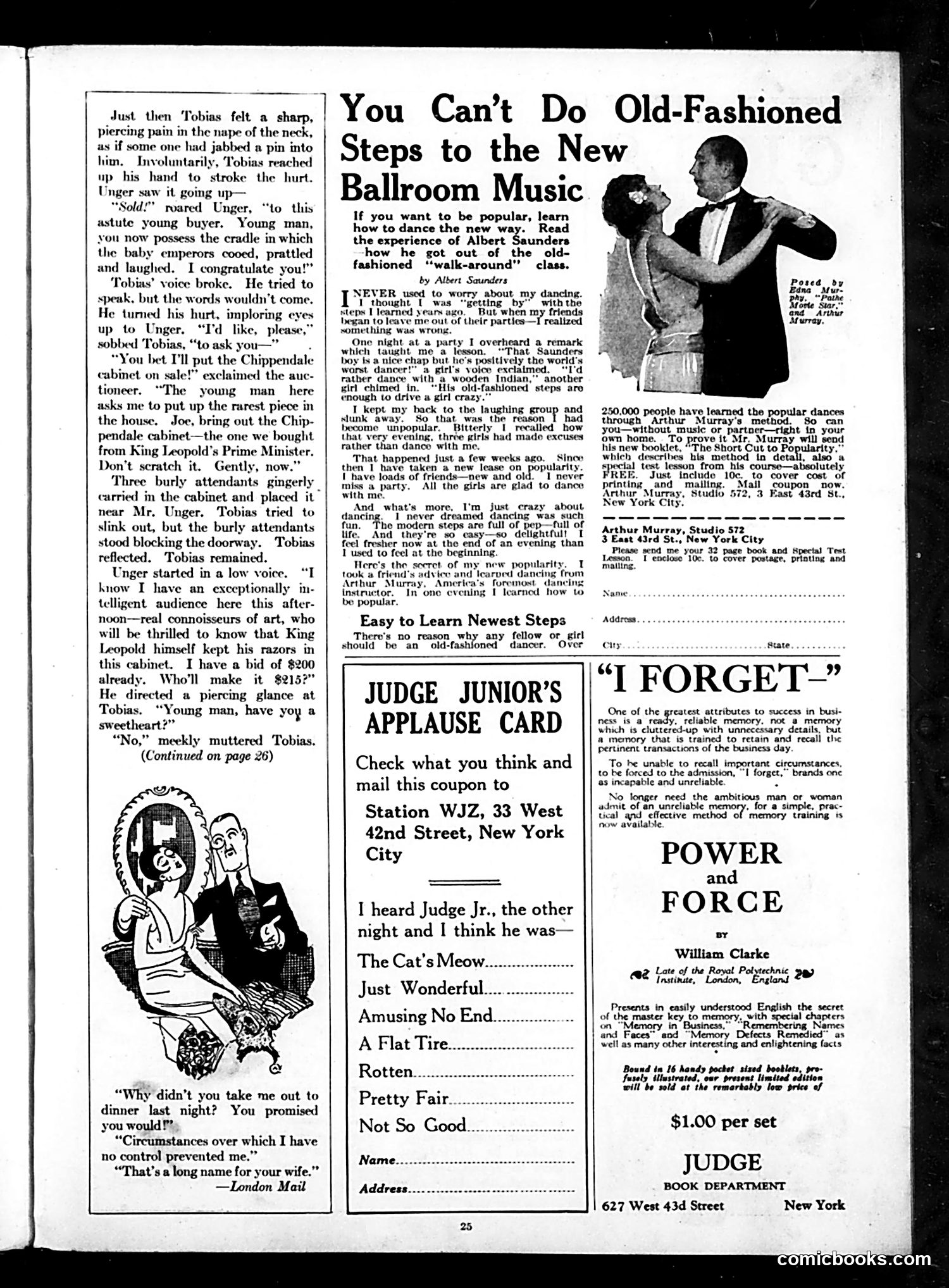
This Judge magazine page contains two distinct elements: **Main Story (Left):** A fictional narrative about "Tobias," a naive young man at an auction who is manipulated by a cunning auctioneer named Unger. The satire targets auction-house deception—Unger deliberately provokes Tobias into bidding by flattering him and creating artificial urgency, ultimately tricking him into expensive purchases. The humor relies on Tobias's bumbling, upper-class pretension, and the auctioneer's con-artist tactics. This reflects early 20th-century anxieties about marketplace fraud and social climbing. **Sidebar Cartoon:** A domestic quarrel where a wife complains her husband broke a dinner promise. His excuse—"Circumstances over which I have no control prevented me"—is mocked by the London Mail caption suggesting he's blaming his wife's controlling behavior, satirizing marital power dynamics. **Advertisements:** The page also promotes dancing lessons and memory-training books, typical Judge content mixing humor with commercial appeals. The overall tone mocks both commercial dishonesty and romantic/social fumbling.
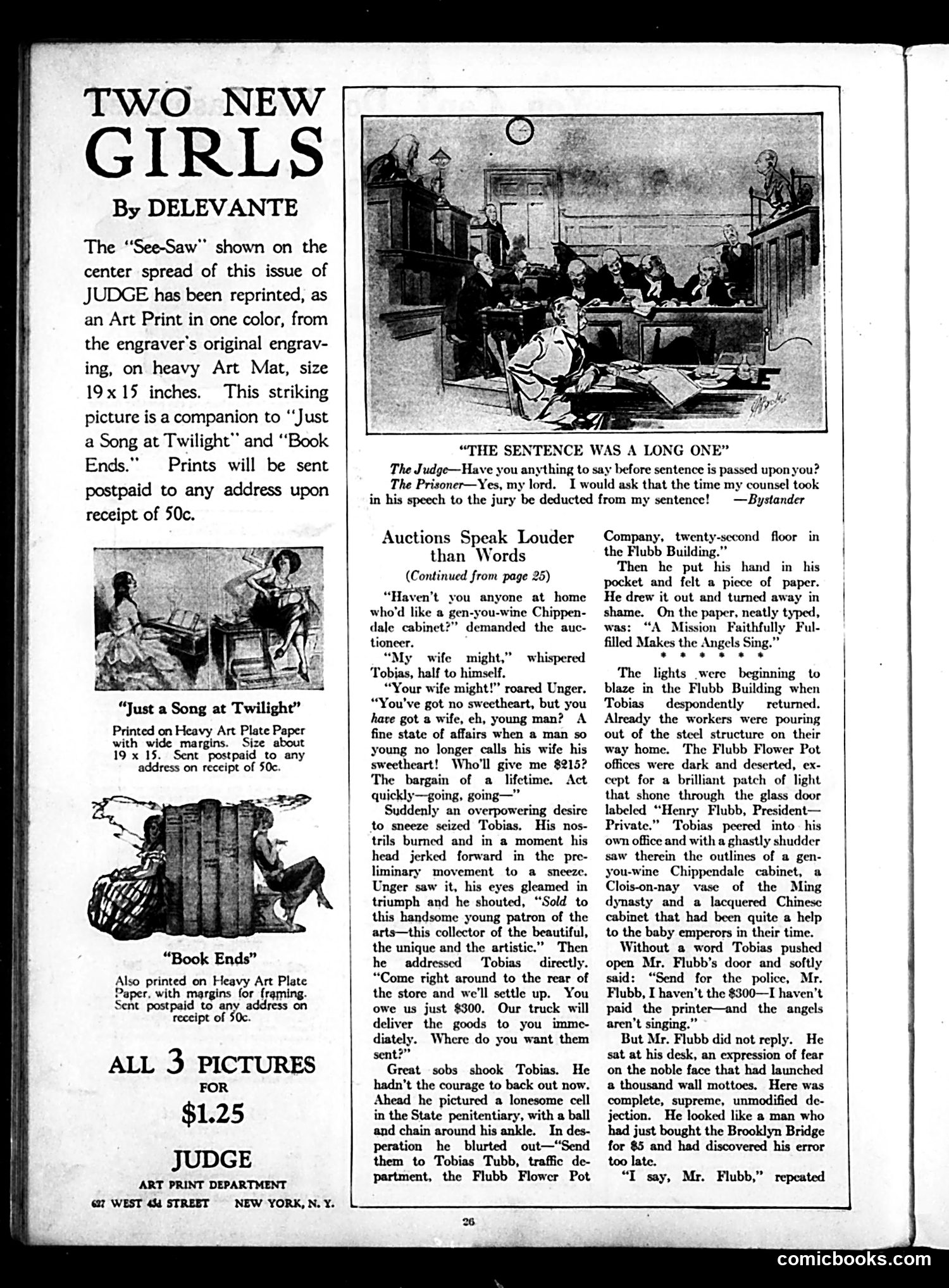
This page contains advertising for art prints alongside two unrelated satirical pieces. **The Top Cartoon** ("The Sentence Was a Long One"): A courtroom joke where a prisoner requests that his lawyer's lengthy jury speech be deducted from his sentence—mocking verbose legal arguments as torture worse than imprisonment. **The Main Story** ("Auctions Speak Louder than Words"): A comedic tale about Tobias, who accidentally "purchases" a Chippendale cabinet at auction when he sneezes during bidding. He then tries to pawn off the $300 debt by having it delivered to the Flubb Flower Pot Company's traffic department. The story satirizes auction-house trickery and the desperation of working-class men caught in financial schemes. **The Ads**: The page primarily advertises three Delevante art prints available for 50 cents each (or all three for $1.25) from Judge's Art Print Department—typical period advertising content.
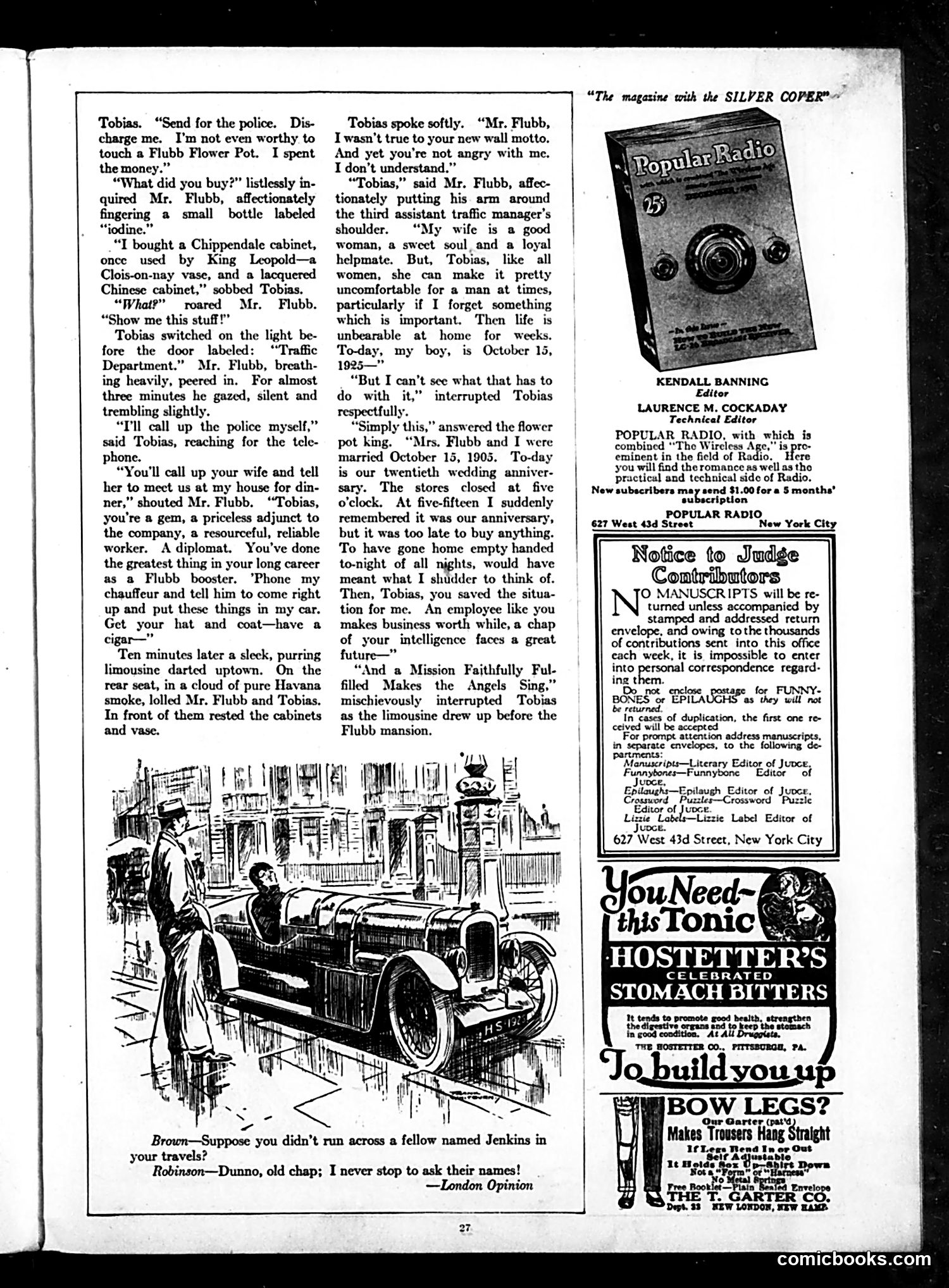
This page contains a humorous short story about workplace dynamics and marital obligation rather than political satire. **The Setup:** Tobias, a low-ranking "third assistant traffic manager," admits to his boss Mr. Flubb that he spent company money meant for a flower pot on antique furniture—a serious offense warranting dismissal. **The Twist:** Mr. Flubb suddenly becomes delighted instead of angry, revealing it's his 20th wedding anniversary (October 15, 1925). He was dreading going home empty-handed to his wife, so Tobias's expensive purchases become perfect last-minute gifts. Flubb rewards the employee who technically committed theft. **The Satire:** The joke mocks how workplace hierarchies and gender dynamics intersect—a man fears his wife's displeasure enough to rationalize theft as acceptable if it solves his anniversary problem. It's commentary on both corporate loyalty and marital anxiety, portraying the boss as willing to overlook misconduct when it serves his personal interests, while praising the employee as "resourceful" and having a "great future." The bottom joke about Jenkins is unrelated British humor about not remembering acquaintances' names.
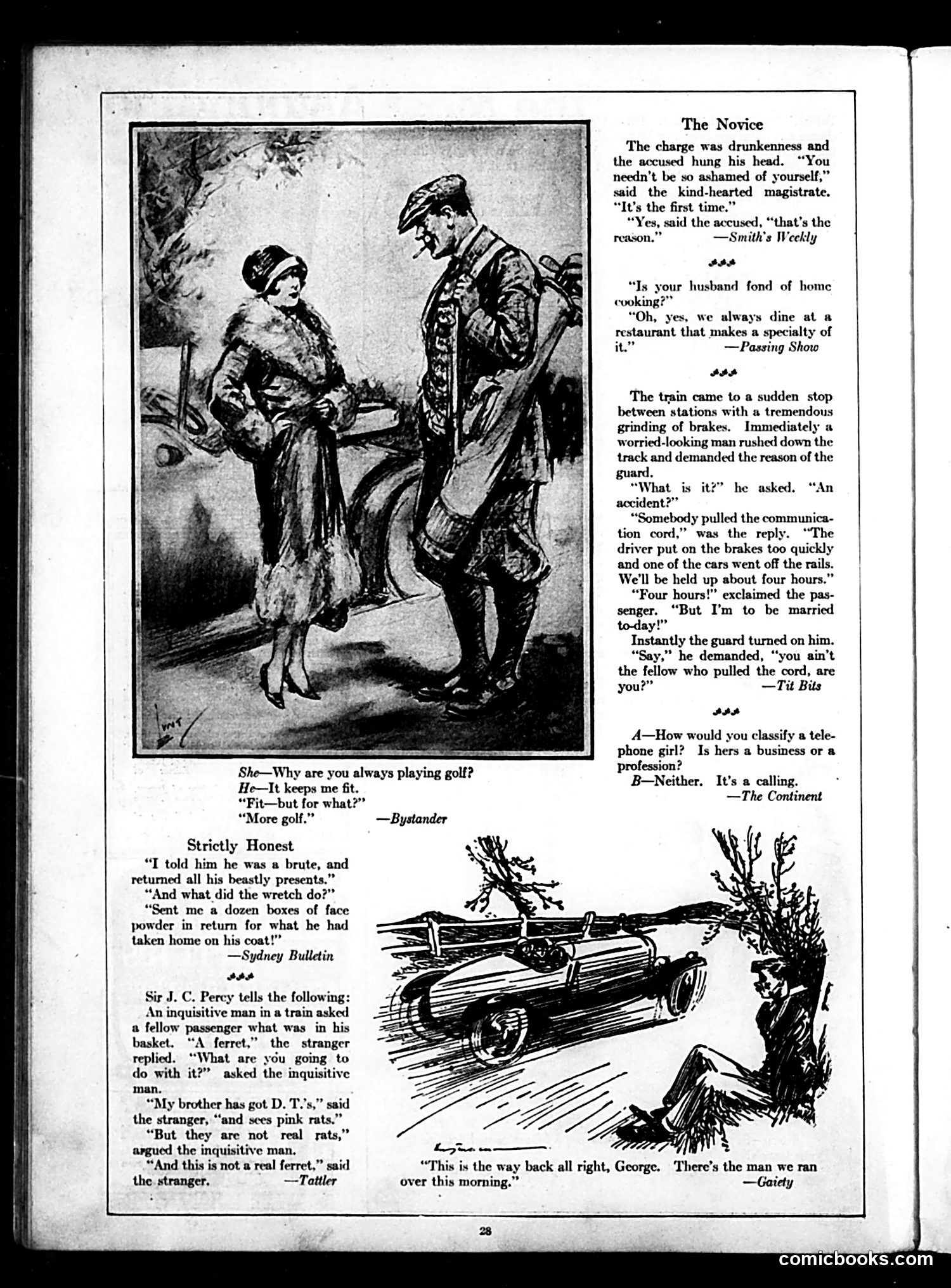
This page from *Judge* magazine collects humorous short jokes and anecdotes typical of early 20th-century satirical publications. The content satirizes contemporary social behaviors: **Main themes:** - **Marital dynamics**: A husband's obsession with golf; a woman's petty revenge through face powder - **Urban manners**: An inquisitive train passenger's nosiness (mocked across two anecdotes) - **Modern dining**: Restaurants replacing home cooking, suggesting wives' domestic failure or changing social norms - **Technology mishaps**: A wedding delay caused by someone pulling an emergency train cord, with the guard's ironic response - **Professional classification**: A telephone operator's job described as a "calling"—wordplay on switchboard operation The accompanying illustration shows a flirtatious military or uniformed figure encountering a woman, likely illustrating courtship rituals. **The humor relies on** observational comedy about marriage, gender relations, class anxieties, and the disruptions of modern transportation and communication technology—concerns recognizable to *Judge's* educated, urban audience.
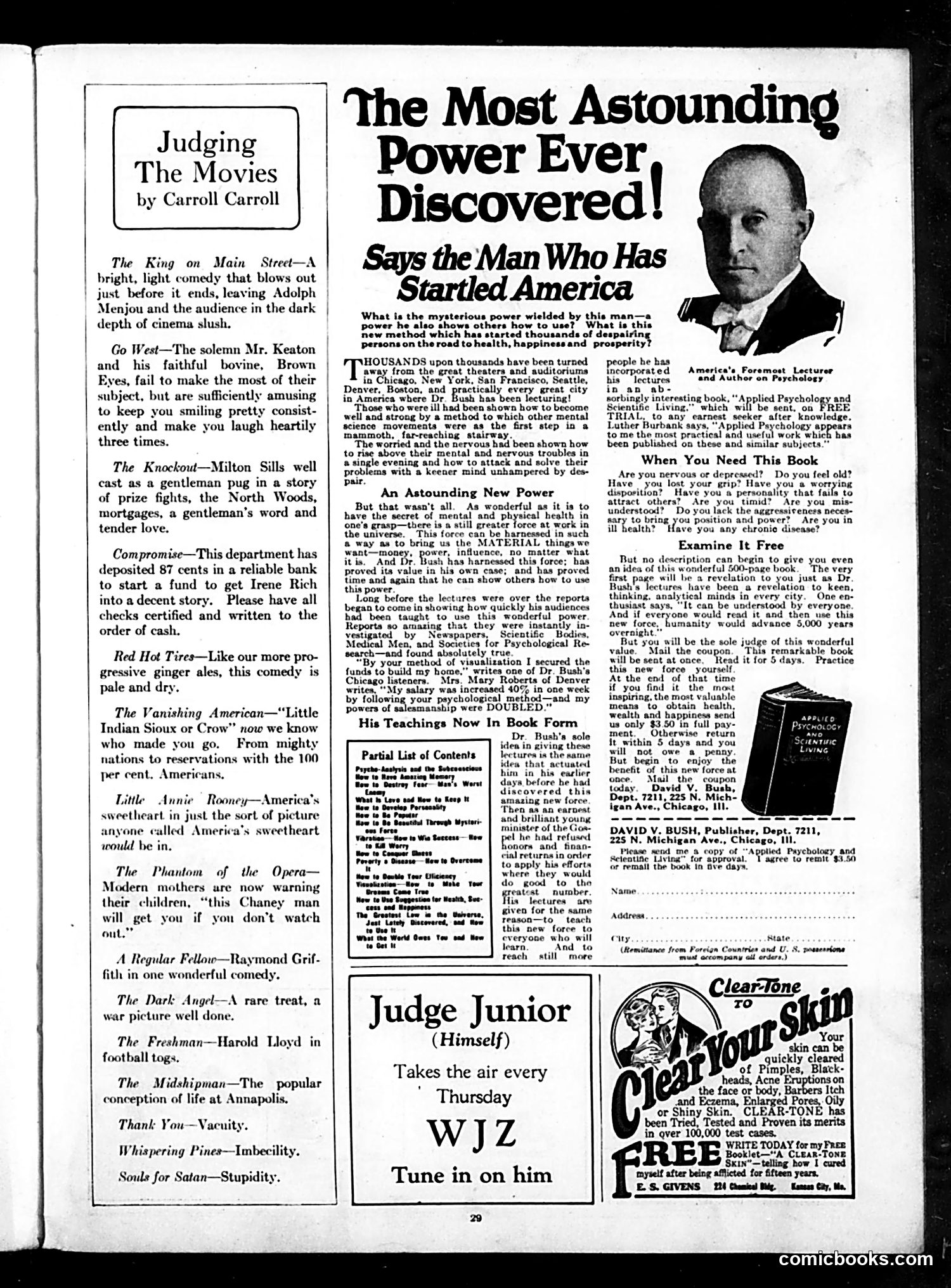
This page features a **movie review column** by Carroll Carroll (left) and a **full-page advertisement** (right) for Dr. Bush's self-help lectures and book on "Applied Psychology." The advertisement claims Dr. Bush has discovered a mysterious power that draws thousands to his lectures in major American cities. It promises to cure nervousness, solve problems, and—most remarkably—materially improve one's circumstances through "visualization" and psychological methods. Testimonials claim increased salaries (40-50% raises) and doubled sales abilities. **Context for modern readers:** This represents the early-1920s boom in **self-help and New Thought movements**, which promised to harness mental/spiritual forces for practical success. The hyperbolic claims, vague promises, and emphasis on "scientific" validation are characteristic of this era's pseudoscience marketing—the precursor to modern self-help industries. The page itself, through its juxtaposition with straightforward movie reviews, subtly suggests how credulous audiences of the time could be.
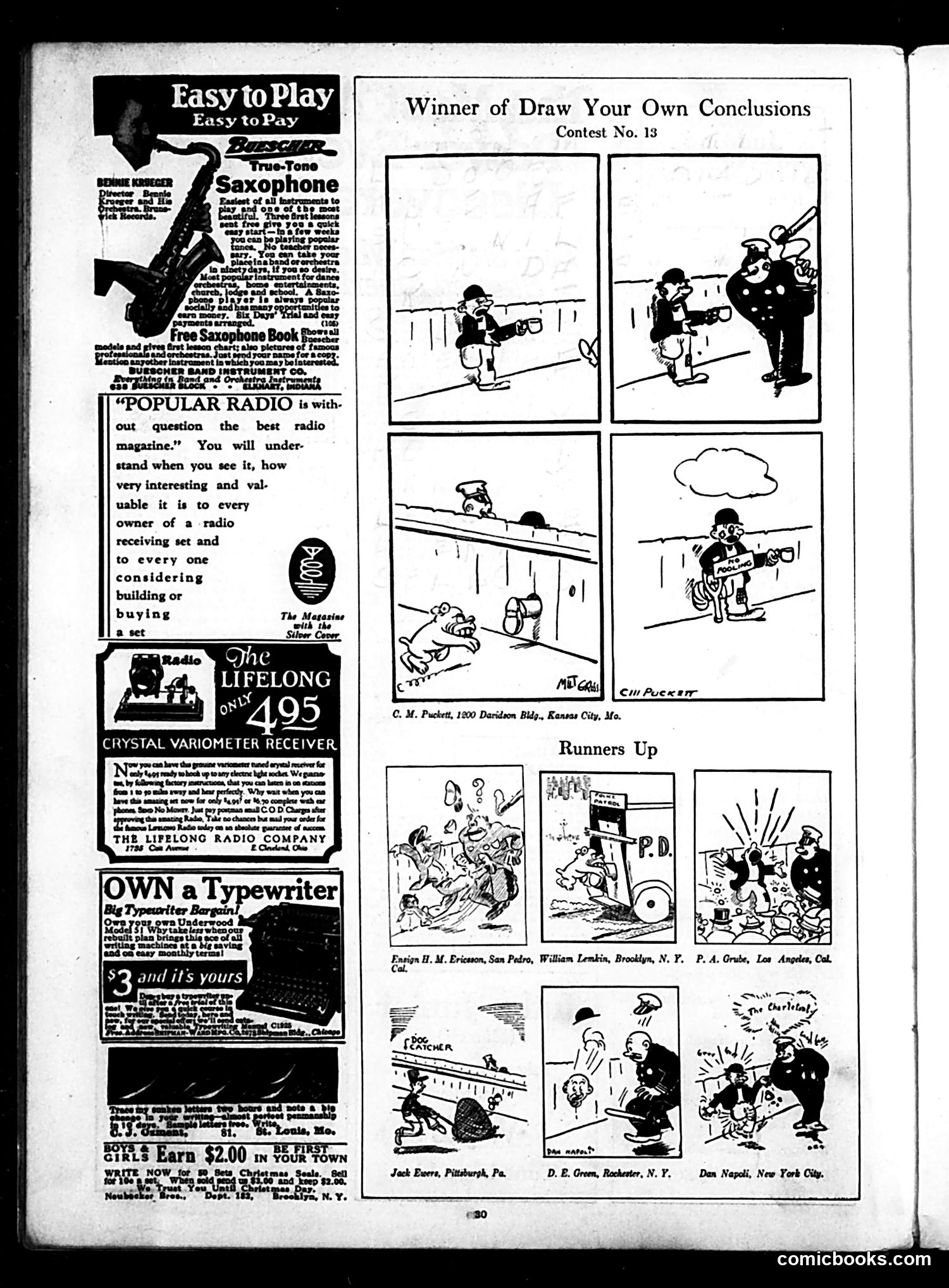
This page from Judge magazine features a "Draw Your Own Conclusions" contest (Contest No. 13) showcasing humorous cartoon submissions. The winner, by C.M. Puckett of Kansas City, depicts a child with a toy gun confronting an adult authority figure (appears to be a police officer or military personnel), with the joke's punchline requiring readers to visually complete the narrative themselves. The "Runners Up" section shows six additional cartoon submissions from contributors across America, featuring similar comedic scenarios with exaggerated characters and action sequences typical of early 20th-century comic humor. The page is primarily advertising for radios and saxophones—products marketed as "Easy to Play, Easy to Pay"—reflecting the consumer goods boom of the 1920s-1930s era. The contest itself served as engagement content to attract readers to the magazine while promoting consumer products through paid advertisements surrounding the editorial cartoons.
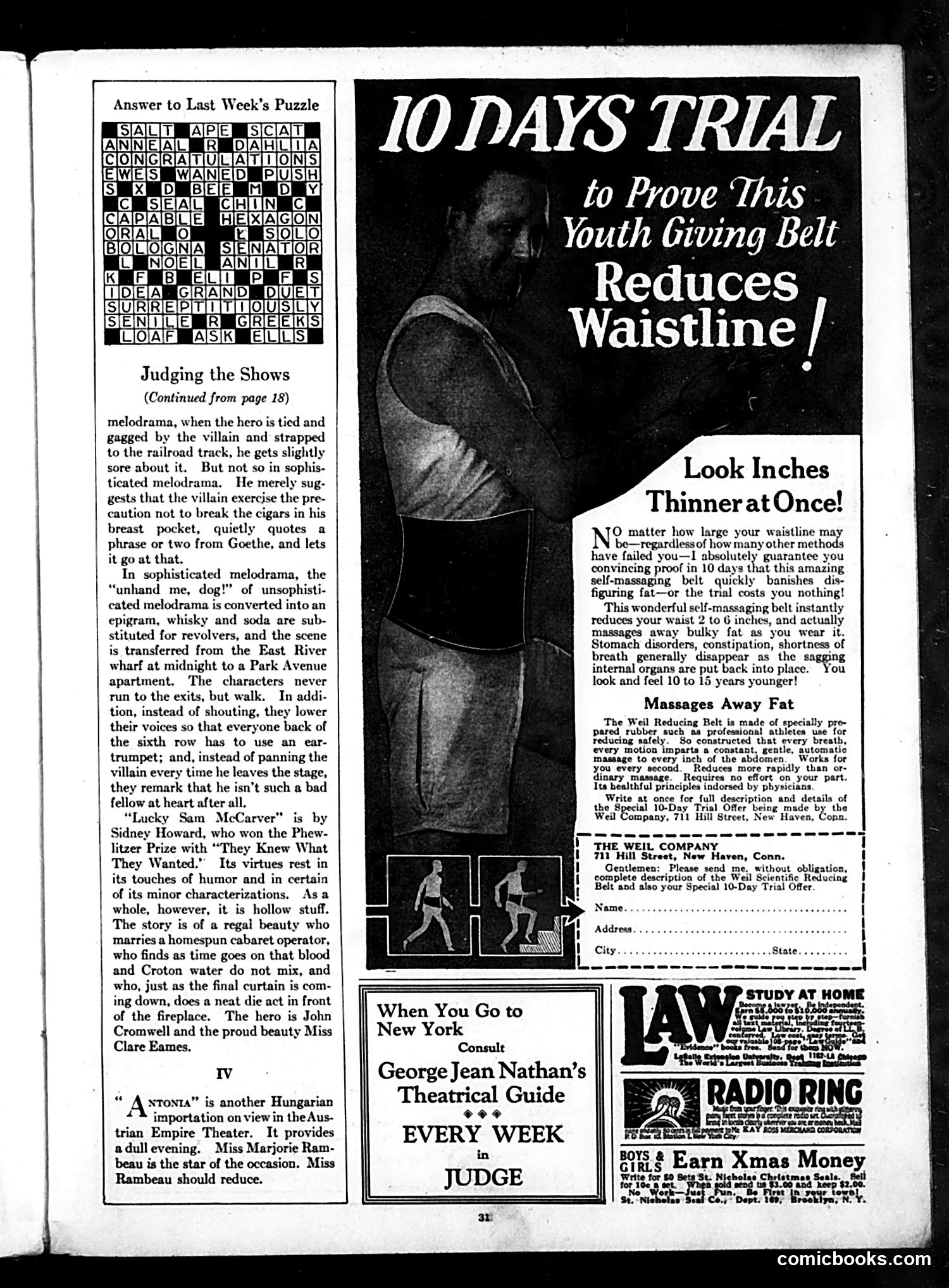
This page is primarily **advertising with some theater criticism**, not political satire. The main content critiques theatrical styles: the text mocks "sophisticated melodrama" that substitutes witty epigrams and whisky for traditional action and gunfire—characters walk rather than run, whisper instead of shout. It reviews plays including "Lucky Sam McCarver" by Sidney Howard. The largest advertisement promotes the **"Weil Reducing Belt,"** a rubber abdominal corset marketed as a self-massaging weight-loss device. It claims to reduce waistlines 2-6 inches and promises results in 10 days, allegedly endorsed by physicians. This reflects 1920s-era pseudo-scientific health gadgetry. A final note sarcastically suggests actress **Marjorie Rambeau** "should reduce"—a cruel personal jab at her appearance. The page includes a crossword puzzle answer and smaller ads for correspondence law courses, radio rings, and Christmas money schemes—typical Judge magazine filler content from this era.
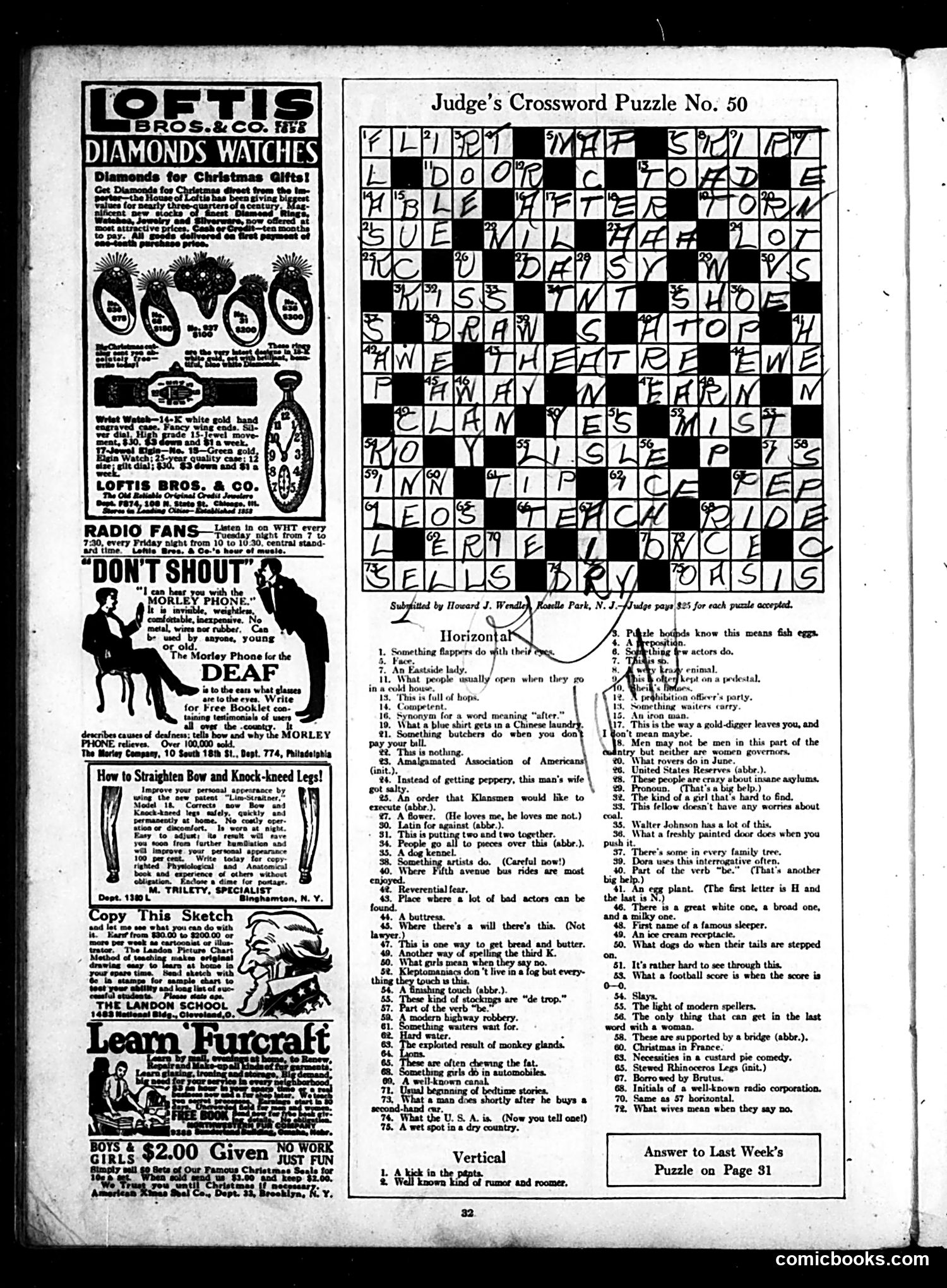
This page is primarily **advertising and a crossword puzzle** rather than political satire. The dominant content includes: **Advertisements:** - Loftis Bros. diamonds for Christmas gifts - Morley Phone for the deaf (a communication device) - "Don't Shout" ad promoting the Morley Phone - Various self-improvement ads (posture, furcraft learning, etc.) **Main Content:** Judge's Crossword Puzzle No. 50 occupies the right half, with clues and a filled grid. The puzzle appears typical of 1920s-era word games. **Social Context:** The Morley Phone ad reflects early 20th-century attitudes toward deafness and accessibility technology. The broader page reflects Judge's role as a general-interest magazine mixing humor, puzzles, and commercial advertising rather than focusing on political commentary. The page demonstrates how vintage magazines funded themselves through dense advertising while providing entertainment content like puzzles to readers.
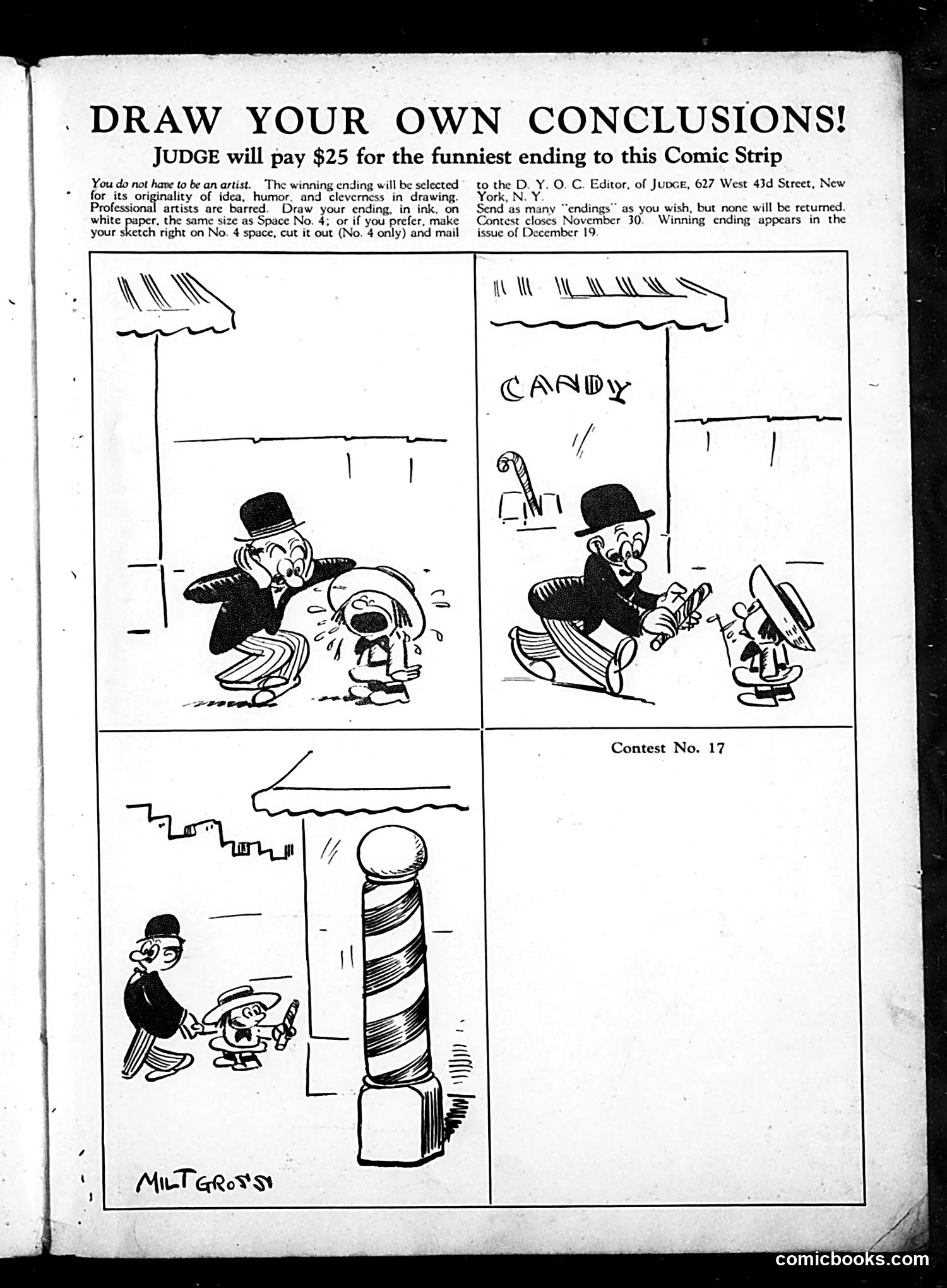
This is a reader-participation contest page from *Judge* magazine. The page presents three incomplete comic strips featuring a bowler-hatted character (a stock figure of the era) in various situations: appearing to comfort a crying child, interacting with a child near a candy store, and standing with a child near a barber pole. Readers were invited to submit funny endings to these strips, with a $25 prize for the wittiest conclusion. The contest emphasizes originality of idea and humor rather than artistic skill. The incomplete narratives appear designed to prompt humorous or clever narrative resolutions from amateur contributors—a form of early interactive entertainment that was popular in satirical magazines of this period. The bowler-hatted figure's exaggerated features suggest caricature-style humor typical of *Judge's* visual approach.
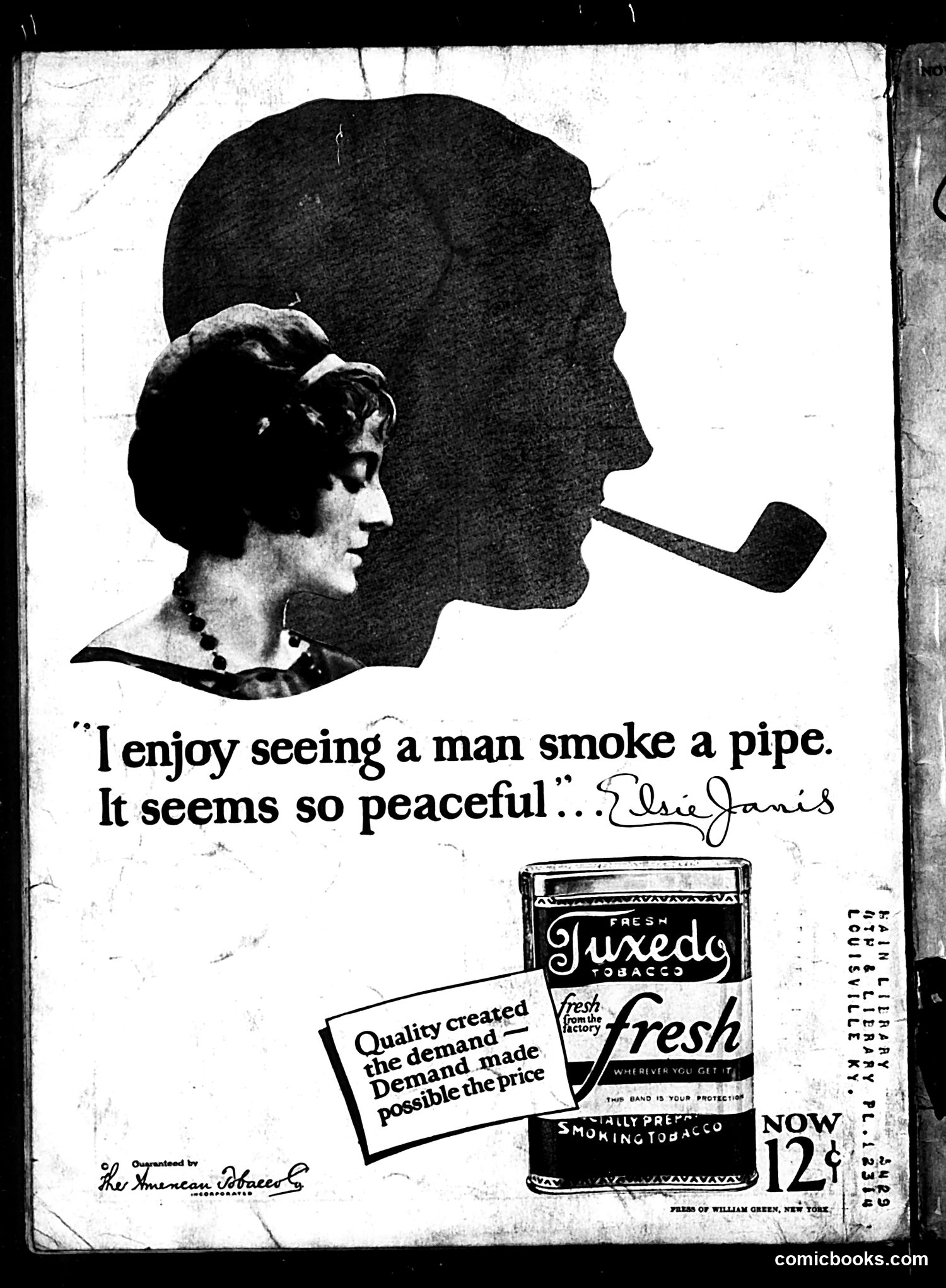
This is a tobacco advertisement rather than a political cartoon. The ad features a silhouette of a man smoking a pipe alongside a photograph of a woman's profile. The woman (attributed to "Elsie Janis" via signature) endorses pipe smoking as peaceful and pleasant. Below, the ad promotes "Tuxedo" brand tobacco, emphasizing that "Quality created the demand / Demand made possible the price," and advertises it at 12 cents. The ad appears designed to appeal to both male smokers and female consumers by suggesting that women find pipe-smoking men attractive and peaceful. This reflects early 20th-century marketing strategies targeting smoking as a desirable, sophisticated habit. Elsie Janis was likely a recognizable entertainment figure of the era, lending celebrity endorsement to the product.