
Judge, 1925-11-21 · page 11 of 40
Judge — November 21, 1925 — page 11: what you’re looking at
What you’re looking at
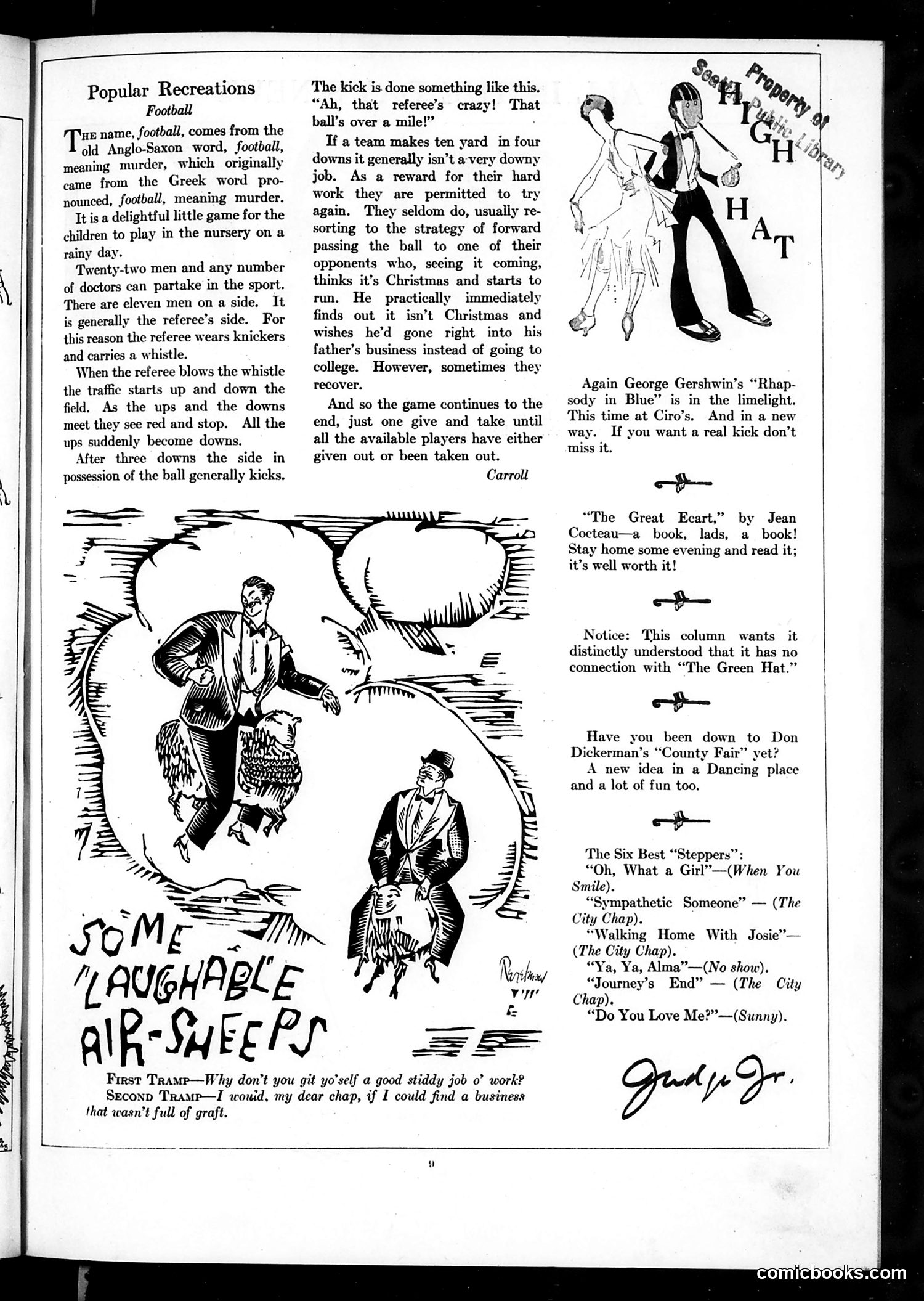
This page from *Judge* magazine contains satirical humor typical of the 1920s. The main cartoon mockingly defines football's etymology as deriving from words meaning "murder," then humorously describes the sport's chaos—players seeing red, inexplicable rule mechanics, and the brutal reality that receivers often wish they'd pursued safer careers instead. The accompanying cartoon "Some Laughable Air-Sheers" depicts two vagrants, with the second explaining he can't find steady work because every business is "full of graft"—a reference to widespread corruption concerns of the era. The remaining content advertises entertainment: George Gershwin's "Rhapsody in Blue" (already famous), Jean Cocteau's experimental novel *The Great Ecart*, and various nightlife venues and popular songs. The disclaimer distancing the column from "The Green Hat" (a scandalous 1924 novel) suggests *Judge* wanted to maintain respectability while covering contemporary culture.
📄 Transcribed text from this page (OCR, searchable)
Machine-transcribed from the original scan — historical spelling and the odd misread are preserved.
Popular Recreations Football T= name, football, comes from the old Anglo-Saxon word, football, meaning murder, which originally came from the Greek word pro- nounced, football, meaning murder. It is a delightful little game for the children to play in the nursery on a rainy day. Twenty-two men and any number of doctors can partake in the sport. There are eleven men on a side. It is generally the referee’s side. For this reason the referee wears knickers and carries a whistle. When the referee blows the whistle the traffic starts up and down the field. As the ups and the downs meet they see red and stop. All the ups suddenly become downs. After three downs the side in possession of the ball generally kicks. The kick is done something like this. That “Ah, that referee’s crazy! ball’s over a mile!” If a team makes ten yard in four downs it generally isn’t a-very downy job. As a reward for their hard work they are permitted to try again. They seldom do, usually re- sorting to the strategy of forward passing the ball to one of their opponents who, seeing it coming, thinks it’s Christmas and starts to run. He practically immediately finds out it isn’t Christmas and wishes he’d gone right into his father’s business instead of going to college. However, sometimes they Tecover. And so the game continues to the end, just one give and take until all the available players have either given out or been taken out. Carroll First Tramp—Why don’t you git yo'self a good stiddy job 0” work? Seconp Tramp—I wouid, my dear chap, if I could find a business that wasn’t full of graft. Again George Gershwin’s ““Rhap- sody in Blue” is in the limelight. This time at Ciro’s. And in a new way. If you want a real kick don’t miss it. =o “The Great Ecart,” by Jean Cocteau—a book, lads, a book! Stay home some evening and read it; it’s well worth it! ht Notice: This column wants it distinctly understood that it has no connection with “The Green Hat.” pp Have you been down to Don Dickerman’s “County Fair” yet? A new idea in a Dancing place and a lot of fun too. > The Six Best “Steppers”: “Oh, What a Girl”—(When You Smile). “Sympathetic Someone” — (The City Chap). “Walking Home With Josie”— (The City Chap). “Ya, Ya, Alma”—(No show). “Journey’s End” — (The City Chap). “Do You Love Me?”—(Sunny).