
Judge, 1925-11-21 · page 20 of 40
Judge — November 21, 1925 — page 20: what you’re looking at
What you’re looking at
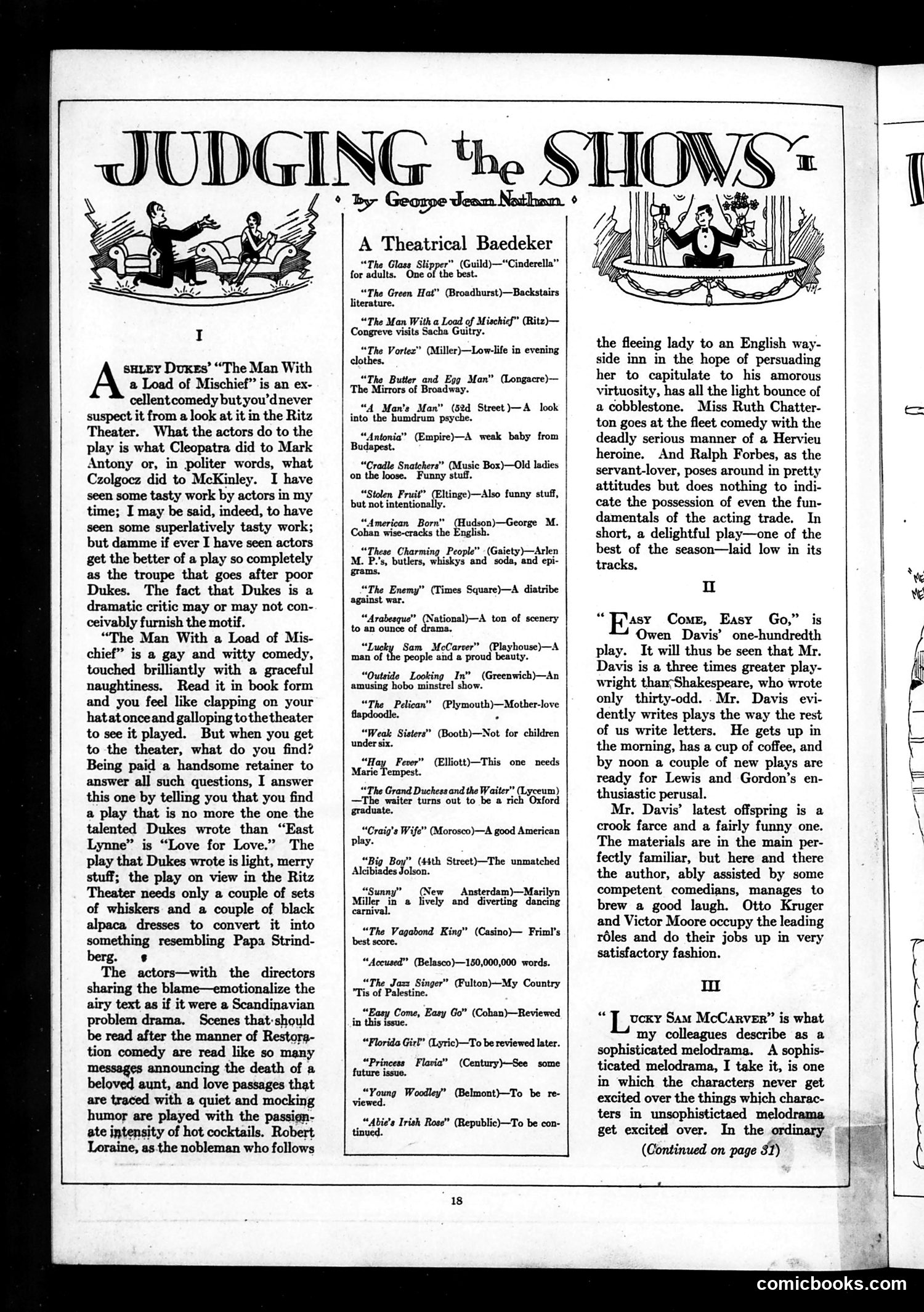
This is a theater review column by George Jean Nathan, a prominent drama critic. The page contains two main elements: **The Main Review** critiques a play called "The Man With a Load of Mischief" at the Ritz Theater. Nathan argues that while playwright Dukes' script is witty and light comedy, the actors and directors have completely misinterpreted it, playing it as heavy Scandinavian drama (referencing Ibsen/Strindberg) instead of restoration-era comedy. He uses violent metaphors—comparing what the actors do to the play to what Cleopatra did to Mark Antony or what assassin Czolgocz did to McKinley—to convey his disgust. **"A Theatrical Baedeker"** is a satirical reference guide to current Broadway shows, offering one-line dismissals or descriptions (e.g., "The Green Hat"—"Backstairs literature"; "Hay Fever"—"This one needs Marie Tempest"). The satire targets both incompetent theatrical interpretation and contemporary Broadway productions.
📄 Transcribed text from this page (OCR, searchable)
Machine-transcribed from the original scan — historical spelling and the odd misread are preserved.
[eke saiey Doxes’ “The Man With a Load of Mischief” is an ex- cellentcomedy but you’dnever suspect it from a look at it in the Ritz Theater. What the actors do to the play is what Cleopatra did to Mark Antony or, in politer words, what Czolgocz did to McKinley. I have seen some tasty work by actors in my time; I may be said, indeed, to have seen some superlatively tasty work; but damme if ever I have seen actors get the better of a play so completely as the troupe that goes after poor Dukes. The fact that Dukes is a dramatic critic may or may not con- ceivably furnish the motif. “The Man With a Load of Mis- chief” is a gay and witty comedy, touched brilliantly with a graceful naughtiness. Read it in book form and you feel like clapping on your hatat onceand galloping tothetheater to see it played. But when you get to the theater, what do you find? Being paid a handsome retainer to answer all such questions, I answer this one by telling you that you find a play that is no more the one the talented Dukes wrote than “East Lynne” is “Love for Love.” The play that Dukes wrote is light, merry stuff; the play on view in the Ritz Theater needs only a couple of sets of whiskers and a couple of black alpaca dresses to convert it into something resembling Papa Strind- berg. ¢ The actors—with the directors sharing the blame—emotionalize the airy text as if it were a Scandinavian problem drama. Scenes that:should be read after the manner of Restora- tion comedy are read like so many es announcing the death of a beloved aunt, and love passages that are traced with a quiet and mocking humor are played with the passion- ate intensity of hot cocktails. Robert Loraine, asthe nobleman who follows | JUDGING the e SHOWS: ° by Georpe deom Nathan A Theatrical Baedeker “The Glass Slipper (cata “Cinderella” for alate “ue ofthe bes “The Green Hat” (Broadhurst)—Backstairs literature. “The Man Witha bare A Mink: Qitz)— Congreve visits “The Vortex” ie in evening clothes. “The Butter and Egg Man” (Longacre)— The Mirrors of Broadway. “A Man's Man” (52d Street)—A look into the humdrum psyche. “Antonia” (Empire)—A weak baby from Budapest. “Cradle Snatchers” (Music Box)—Old ladies on the loose. Funny stuff. “Stolen Fruit” (Eltinge)—Also funny stuff, but not intentionally. “American Born’ Pisipe) Coors M. Cohan wise-cracks the “These Charming om (Gaiety)—Arlen M. P.’s, butlers, whiskys and soda, and epi- grams. “The Enemy” (Times Square)—A. diatribe against war. crates isbonal) —* ton of scenery to an ounce of “Lucky Sam McCareer” (Playhouse)—A man of the people and a proud beauty. “Outside Looking In” (Greenwich)—An amusing hobo minstrel show. “The Pelican” (Plymouth)—Mother-love flapdoodle. “Weak Sisters” (Booth)—Not for children “Hay Fever” (Elliott)—This one needs Marie Tempest. “The Grand Duchess and the Waiter” (Lyceum) —The waiter turns out to be a rich Oxford graduate, ore 's Wife” (Morosco)—A good American play. “Big Boy” (44th Street)—The unmatched Alcibiades Jolson. “Sunny” (New _ Ansterdam)—Marilyn Mille ino lively and diverting dancing carni “The Vagabond King” (Casino)— Friml’s t score. “Accused” (Belasco)—150,000,000 words. “The Jazs Singer” ulton)—My Co aTwapaniees Ce ee “Easy Come, Eary Go” (Cohan)—Reviewed in “Florida Girl” (Lyric)—To be reviewed later. “Princess Flavia” (Century)—See some future issue. “Young Woodley” (Belmont)—To be re- viewed. , “Abie’s Irish Rose” (Republic)—To be con- tinued. be —_ the fleeing lady to an English way- side inn in the hope of persuading her to capitulate to his amorous virtuosity, has all the light bounce of a cobblestone. Miss Ruth Chatter- ton goes at the fleet comedy with the deadly serious manner of a Hervieu heroine. And Ralph Forbes, as the servant-lover, poses around in pretty attitudes but does nothing to indi- cate the possession of even the fun- damentals of the acting trade. In short, a delightful play—one of the best of the season—laid low in its tracks, pa se Ess Come, Easy Go,” is Owen Davis’ one-hundredth play. It will thus be seen that Mr. Davis is a three times greater play- wright thanShakespeare, who wrote only thirty-odd. .Mr. Davis evi- dently writes plays the way the rest of us write letters. He gets up in the morning, has a cup of coffee, and by noon a couple of new plays are ready for Lewis and Gordon’s en- thusiastic perusal. Mr. Davis’ latest offspring is a crook farce and a fairly funny one. The materials are in the main per- fectly familiar, but here and there the author, ably assisted by some competent comedians, manages to brew a good laugh. Otto Kruger and Victor Moore occupy the leading réles and do their jobs up in very satisfactory fashion. m ucky Sam McCarver” is what my colleagues describe as a sophisticated melodrama. A sophis- ticated melodrama, I take it, is one in which the characters never get excited over the things which charac- ters in unsophistictaed melodrama get excited over. In the ordinary (Continued on page 31) comicbooks.com r