
A complete issue · 36 pages · 1925
Judge — November 7, 1925
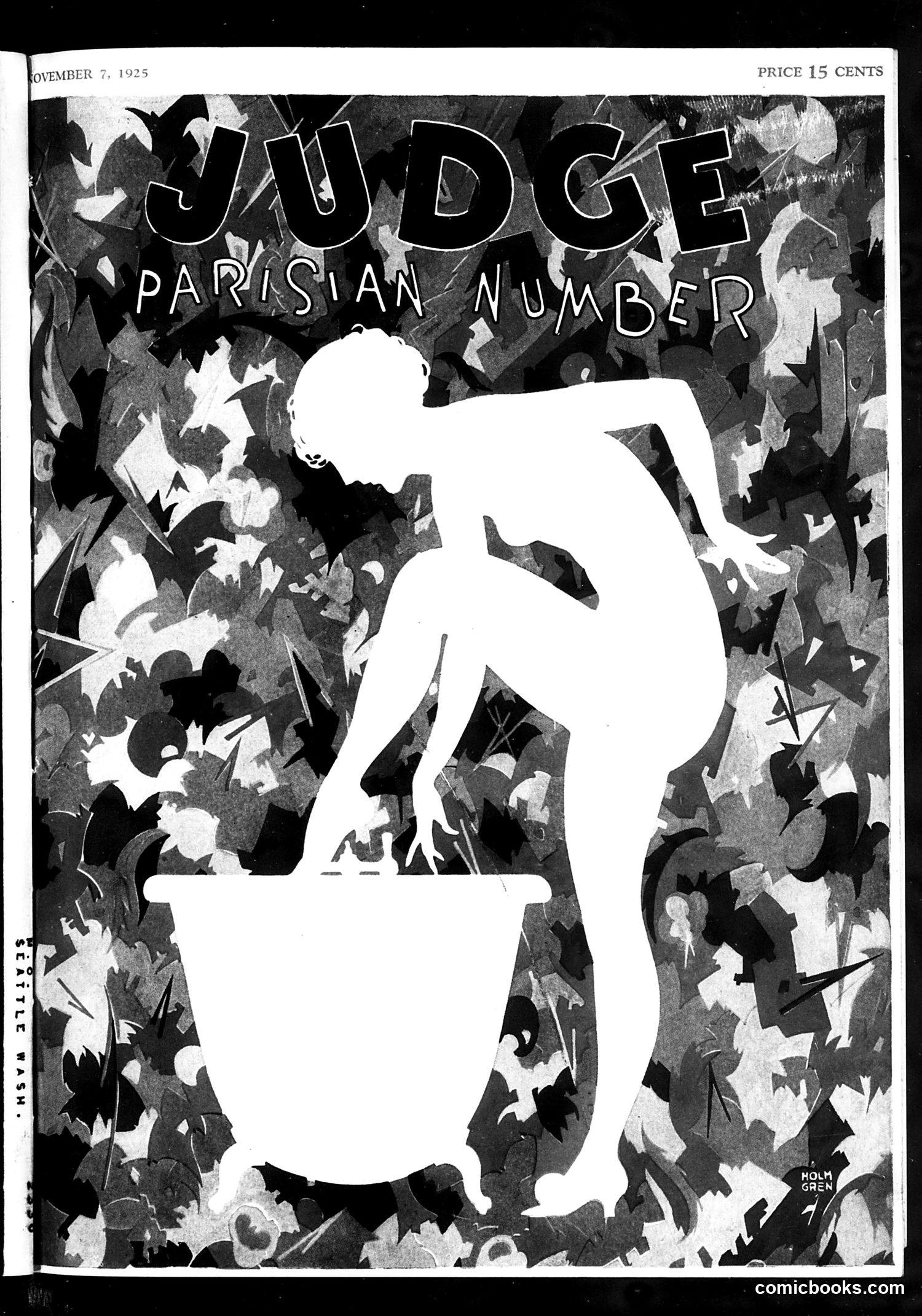
This is the cover of *Judge*, a satirical magazine priced at 15 cents. The title reads "JUDGE PARISIAN NUMBER," indicating this issue focuses on Parisian themes or culture. The image shows a stylized white silhouette of a woman in a bathtub or basin, posed against a decorative background of ivy or flowering vines in black and white. The art style is Art Deco, typical of 1920s design. The "Parisian" reference likely alludes to France's reputation during the Jazz Age for sophisticated, bohemian culture and loose social attitudes—particularly regarding women's fashion and behavior. The bathing scene may satirize French luxury or sensuality. Without additional OCR text identifying specific satirical targets or commentary, the exact political point remains unclear, though the cover appears designed to appeal to contemporary fascination with Continental sophistication.
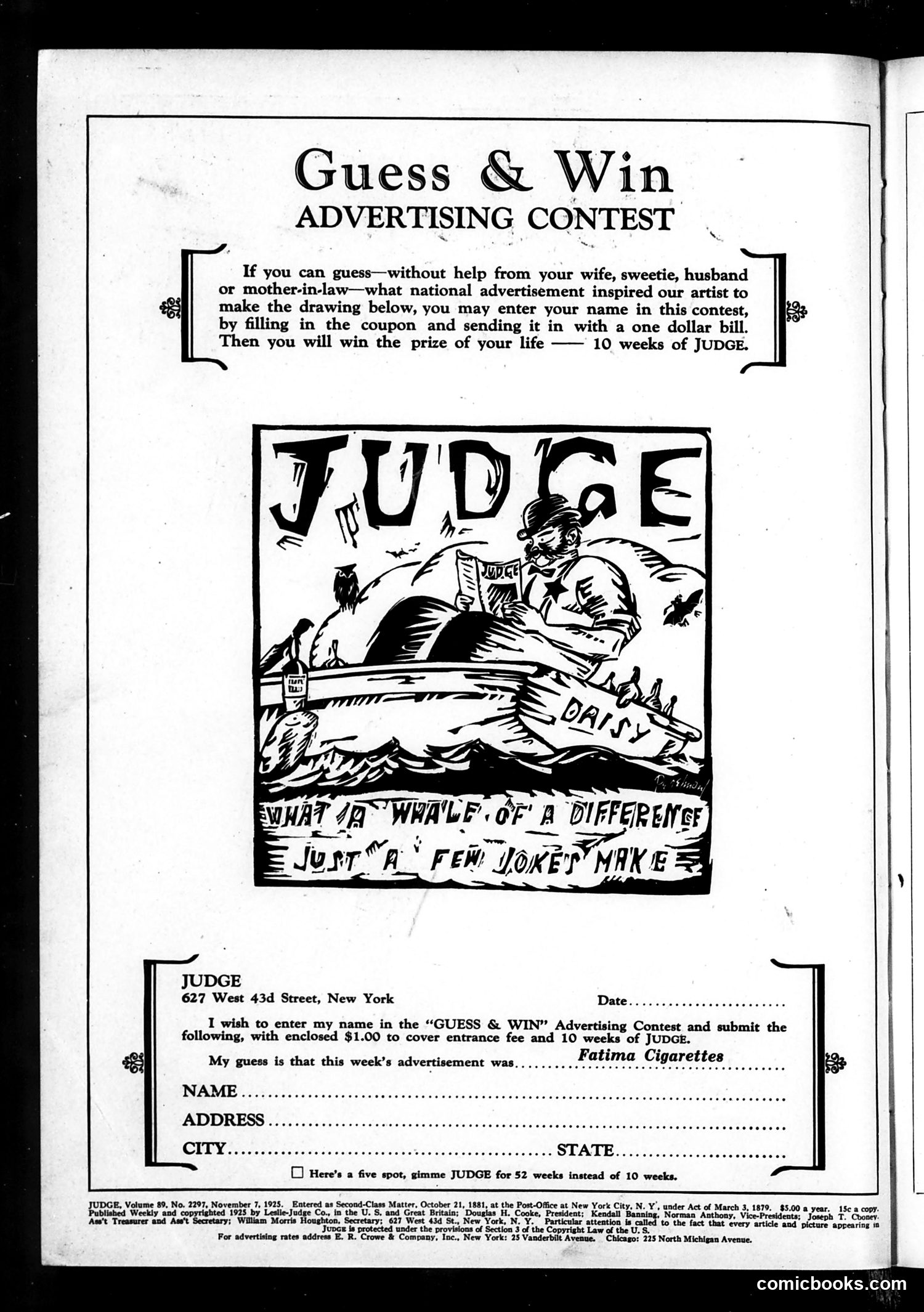
This page is primarily an advertising contest for **Fatima Cigarettes**. The central cartoon depicts a figure labeled "JUDGE" riding in a small boat or vessel labeled "DAISY," with the caption "WHAT A WHALE OF A DIFFERENCE JUST A FEW SMOKES MAKE." The joke appears to be a pun playing on the phrase "what a difference a day makes"—substituting "whale of a" (meaning "huge") and referencing cigarette smoking. The cartoonist suggests that smoking Fatima cigarettes creates a dramatic, humorous transformation. Readers could enter the contest by guessing which national advertisement inspired the drawing, then submit their answer with one dollar to Judge's New York office for a chance to win 10 weeks of the magazine. This was a common early 20th-century magazine promotion strategy.
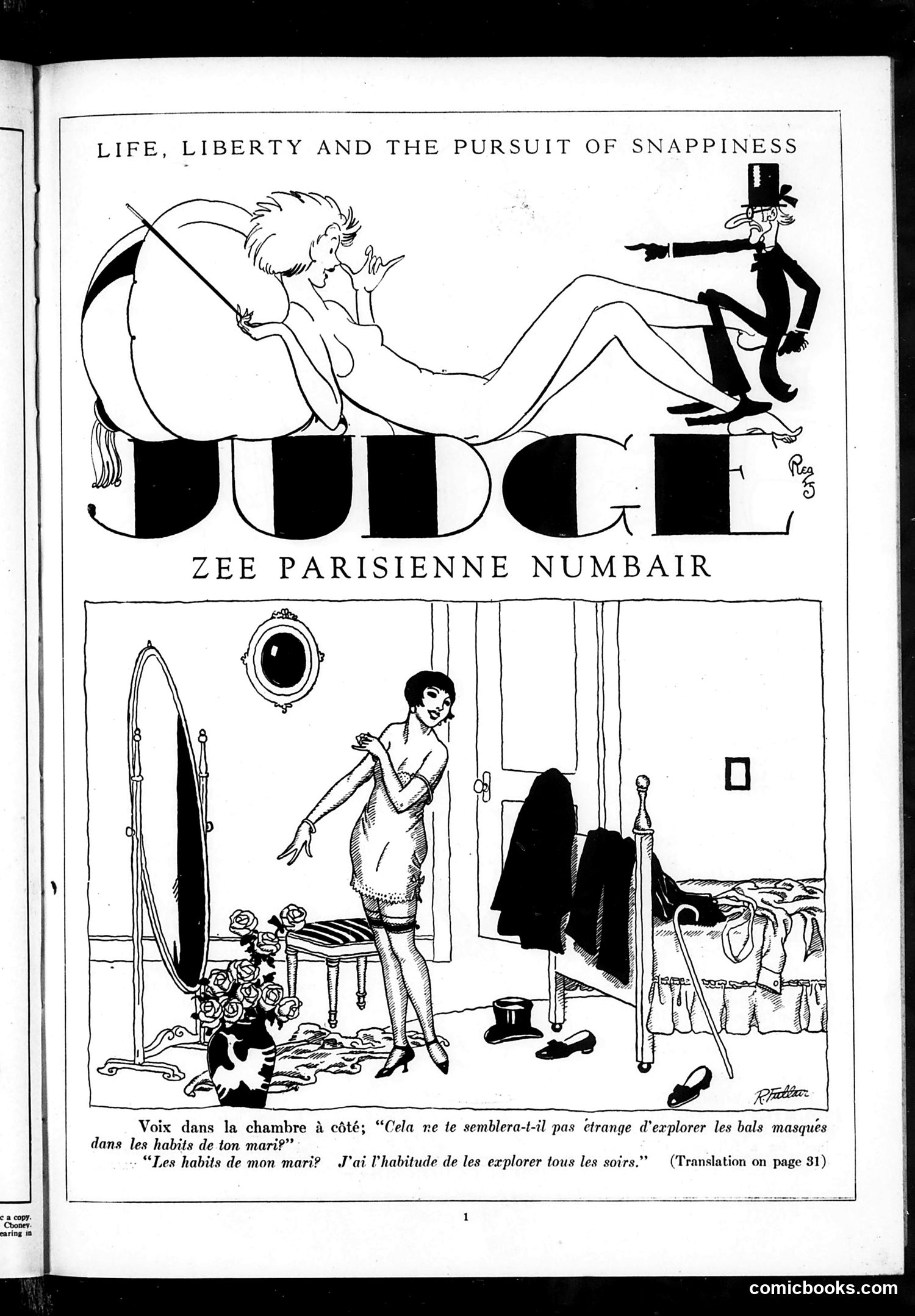
This Judge magazine page satirizes 1920s female fashion and behavior, titled "Life, Liberty and the Pursuit of Snappiness." The top cartoon depicts a flapper woman in a revealing dress, reclining provocatively while a formally-dressed man points at her—likely mocking the era's "New Woman" and changing sexual mores that shocked conservative society. The bottom panel shows a bedroom scene where a woman in lingerie discusses her nighttime habits with someone (partially obscured). The French caption references exploring "masked balls" at night versus daytime routines—suggesting the double lives some women led during Prohibition and the Jazz Age. The satire targets 1920s anxieties about female independence, sexuality, and the loosening of Victorian social standards. The sophisticated but risqué tone was typical of Judge's commentary on modern gender relations.
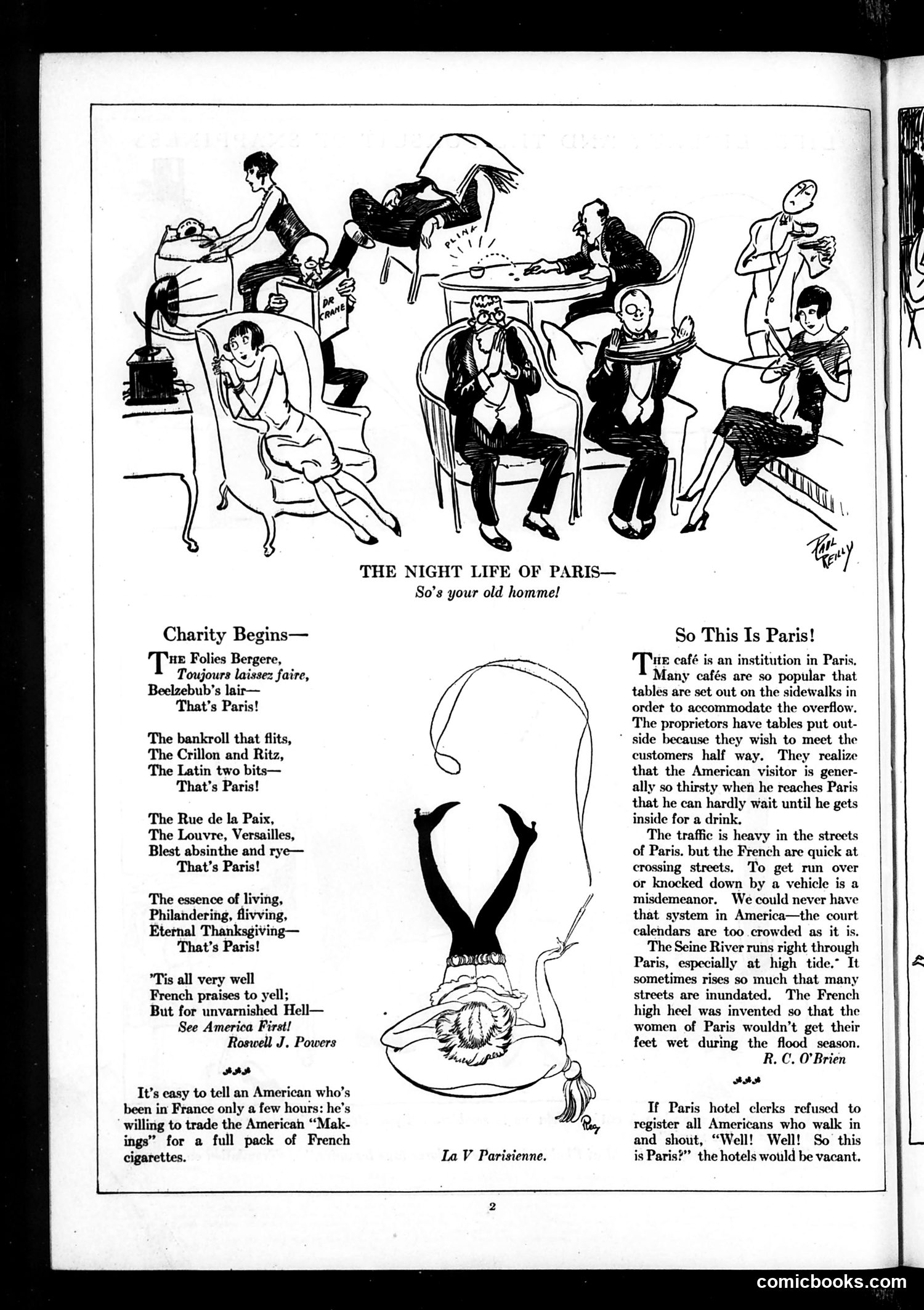
This page satirizes American tourists in 1920s Paris. The top cartoon depicts wealthy Americans at fashionable Parisian venues (the Folies Bergère, Crillon and Ritz hotels, nightclubs) engaging in excessive behavior—drinking, flirting, and generally carousing. The accompanying poem mocks both French culture and Americans' superficial appreciation of it, suggesting they conflate Paris with vice and indulgence. The text below criticizes American tourists for being loud and rowdy, implying they embarrass themselves abroad. The central illustration "La V Parisienne" (The Parisian Woman) appears to mock French women or French aesthetics that fascinated Americans. The overall message: American visitors reduce Paris to stereotypical hedonism rather than appreciating genuine culture—a common criticism of "ugly American" tourists.
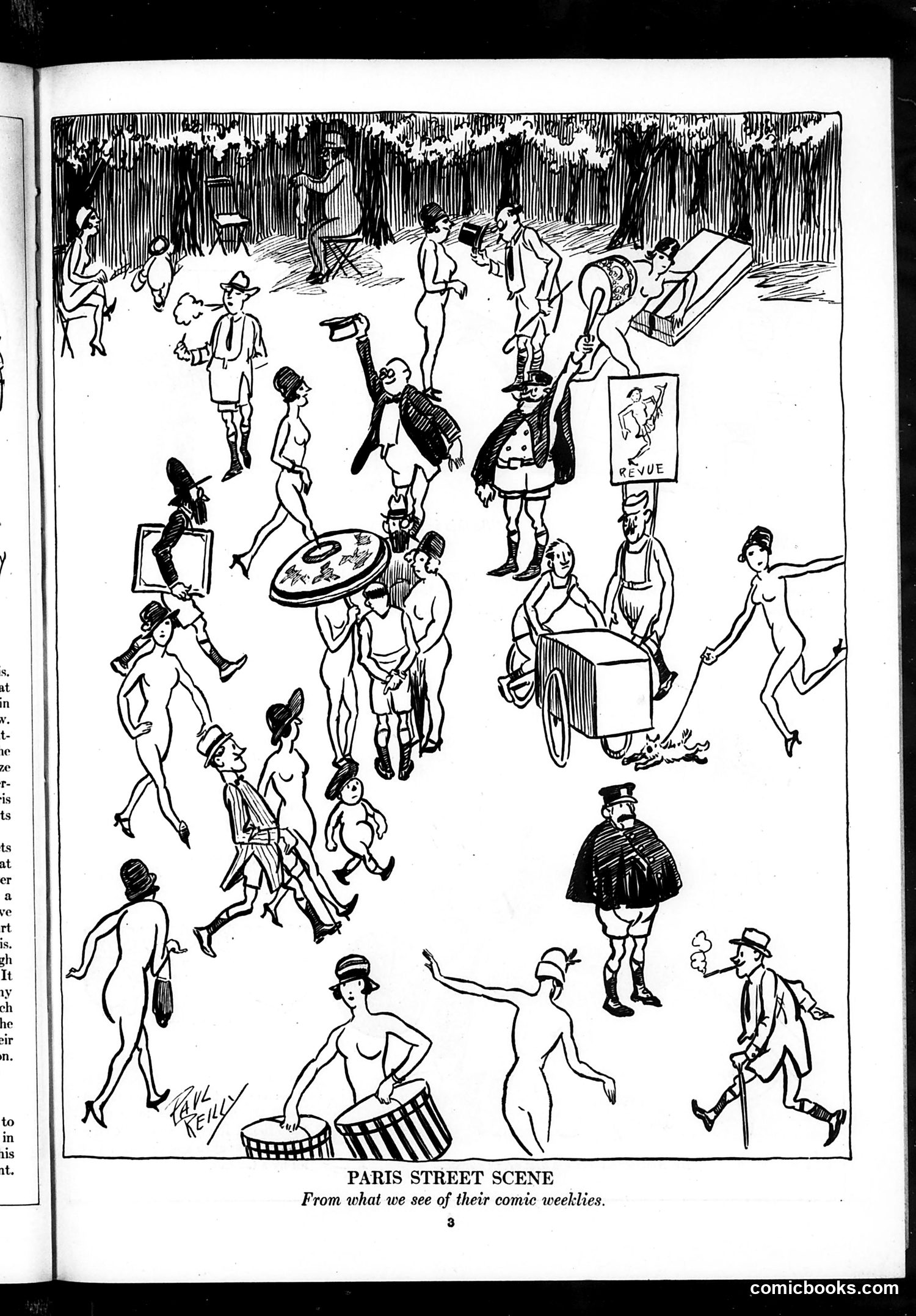
This satirical illustration depicts a chaotic Parisian street scene "from what we see of their comic weeklies," as the caption notes. The cartoon mocks French culture and morality through exaggerated depictions of public behavior: nudity, lewdness, and general licentiousness. Multiple nude and semi-nude figures engage in various activities alongside clothed characters, acrobats, musicians, and performers. The satire appears to reinforce American stereotypes about France as morally lax and sexually permissive—a common theme in Judge magazine's satirical commentary. By attributing these scenes to French "comic weeklies," the cartoonist suggests such depictions were typical of French popular entertainment, contrasting implicitly with more conservative American standards of the era.
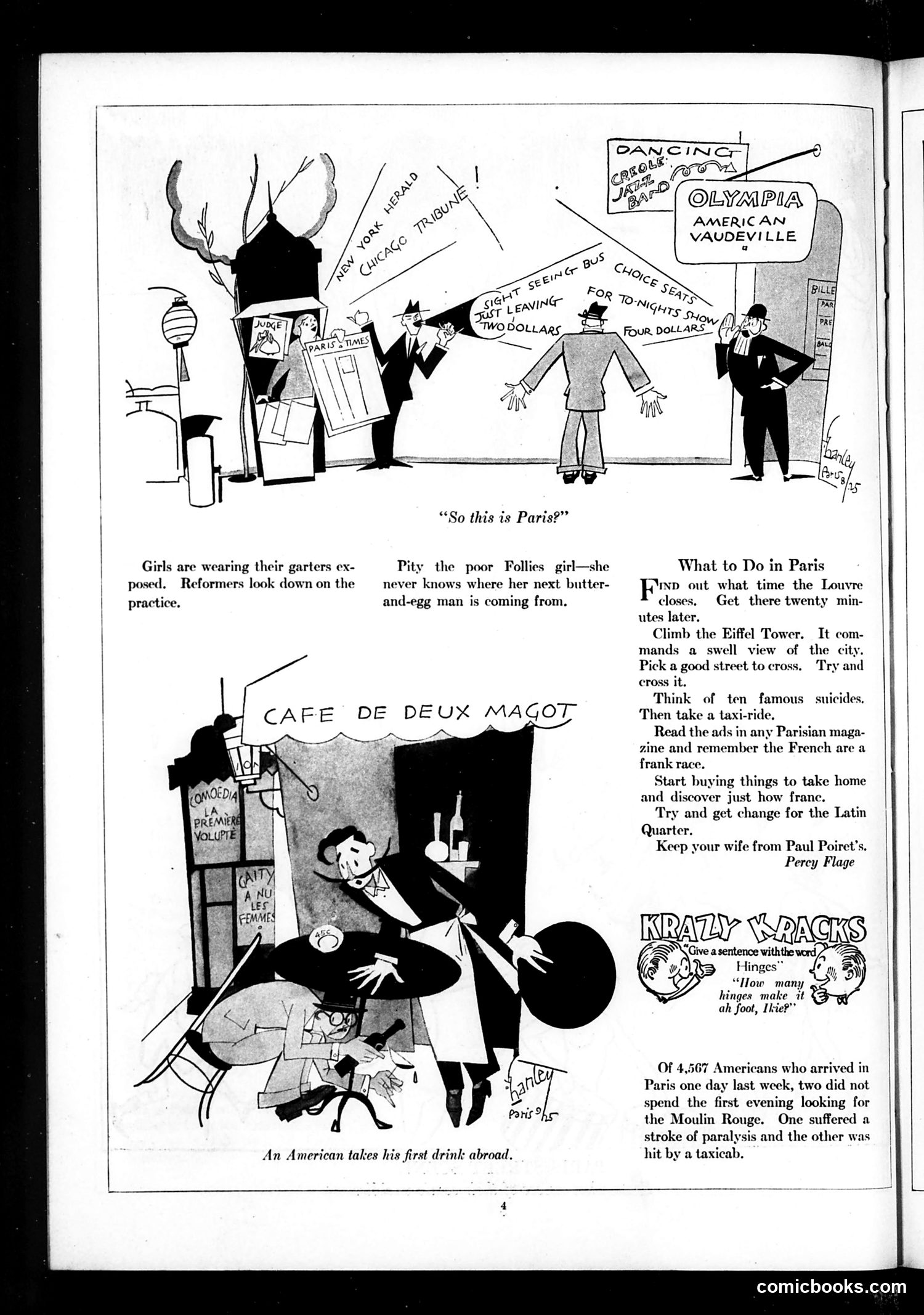
This 1920s satirical page mocks American tourists visiting Paris. The top cartoon "So this is Paris?" depicts confused Americans at the Olympia music hall, with dialogue about theater attractions and costs—satirizing tourists' confusion and vulnerability to scams. The "Cafe de Deux Magot" illustration shows an American man's bewildered first experience at a Parisian cafe, suggesting culture shock and unfamiliarity with French customs. The "What to Do in Paris" advice column by Percy Floge humorously instructs visitors on tourist activities (Eiffel Tower, Louvre, famous suicides, Latin Quarter), while warning to "keep your wife from Paul Poiret's"—referencing the famous French fashion designer, implying Parisian male seduction of American wives. The "Krazy Kracks" item provides statistics on tourist mishaps, emphasizing the dangers American visitors faced abroad.
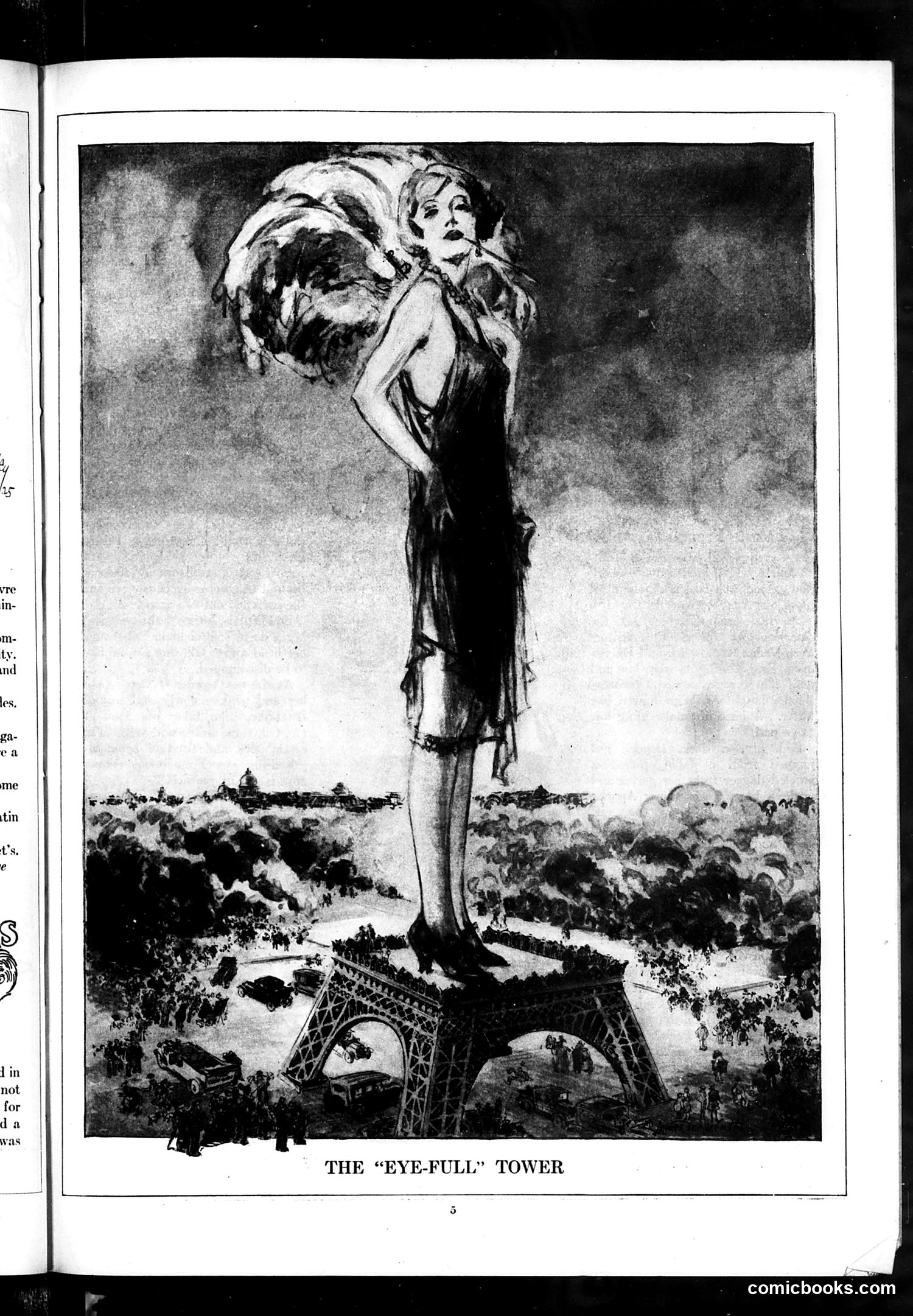
This satirical illustration depicts a stylized woman standing atop the Eiffel Tower, gazing into the distance. The caption "The 'Eye-Full' Tower" is a pun playing on "Eiffel" and "eye-full" (slang for an attractive sight). The cartoon likely satirizes the exotic appeal of Paris and French culture to Americans, particularly the sexualized perception of Parisian women. The elongated, somewhat exaggerated female figure represents stereotypical notions of Continental femininity and glamour that fascinated American audiences during the early-to-mid 20th century. The composition—with tiny figures below gazing upward—emphasizes the spectacle and the male gaze. This reflects Judge magazine's frequent commentary on American fascination with European sophistication and sensuality.
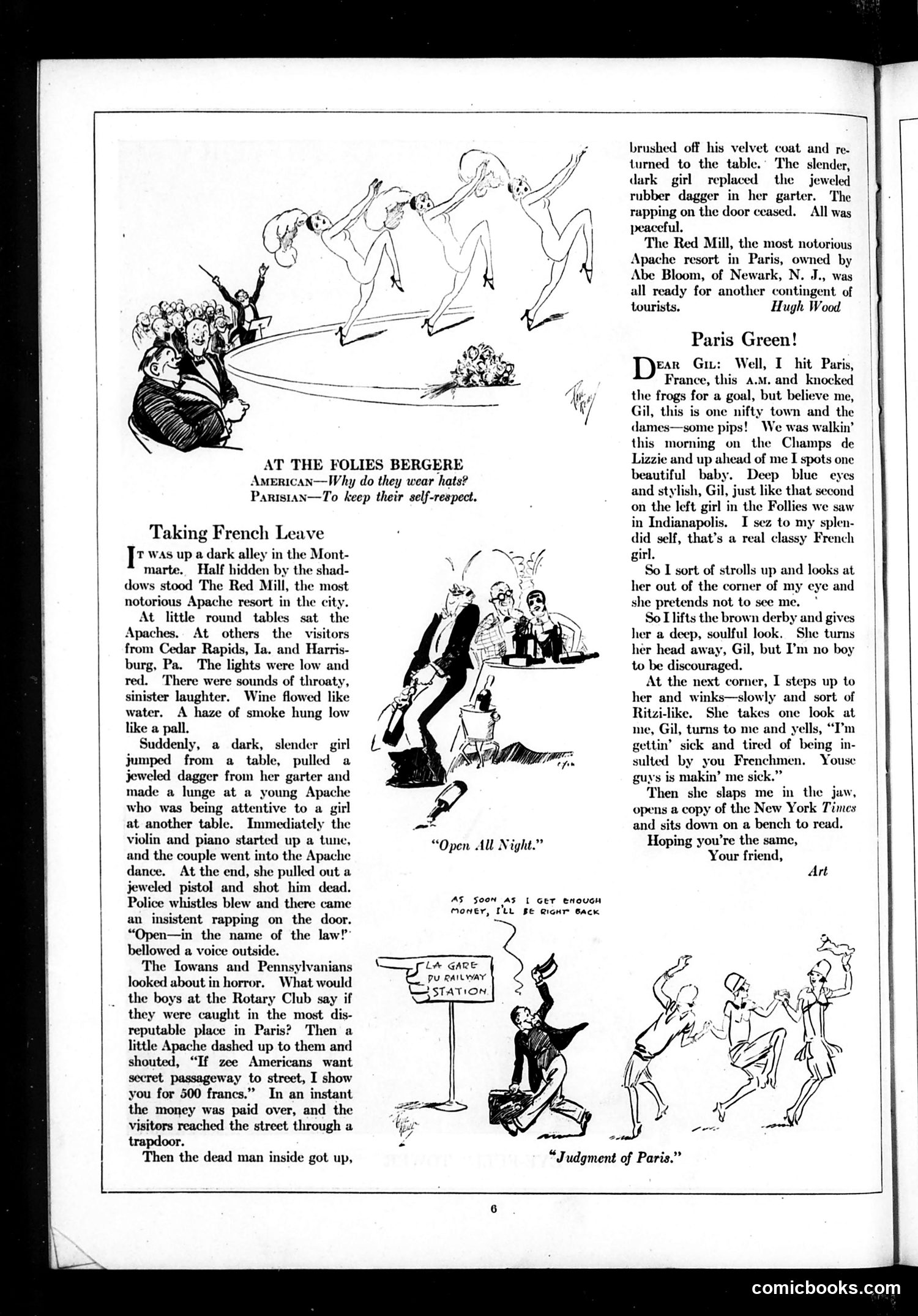
This page satirizes American tourists in Paris through two pieces: **"Taking French Leave"** mocks Midwestern tourists (from Iowa and Pennsylvania) seeking "authentic" Parisian vice at the Red Mill, a notorious Apache nightclub. The satire works on multiple levels: the staged "Apache dance" and staged shooting are exposed as theatrical entertainment for tourists, yet the Americans remain fooled and frightened. The joke is that these provincial Americans, worried about their Rotary Club reputations back home, are paying for a manufactured experience of danger and depravity—and even bribing their way out when police arrive (all part of the show). **"Paris Green!"** depicts an American tourist's failed romantic encounter: he attempts to flirt Continental-style with a Parisian woman, who responds by insulting him, rejecting his advances, and dismissing French men as inferior to Americans. The irony: his attempt at Continental sophistication backfires. Both pieces ridicule American provincialism abroad and suggest that Paris marketed "authentic French experience" as packaged entertainment for gullible tourists.
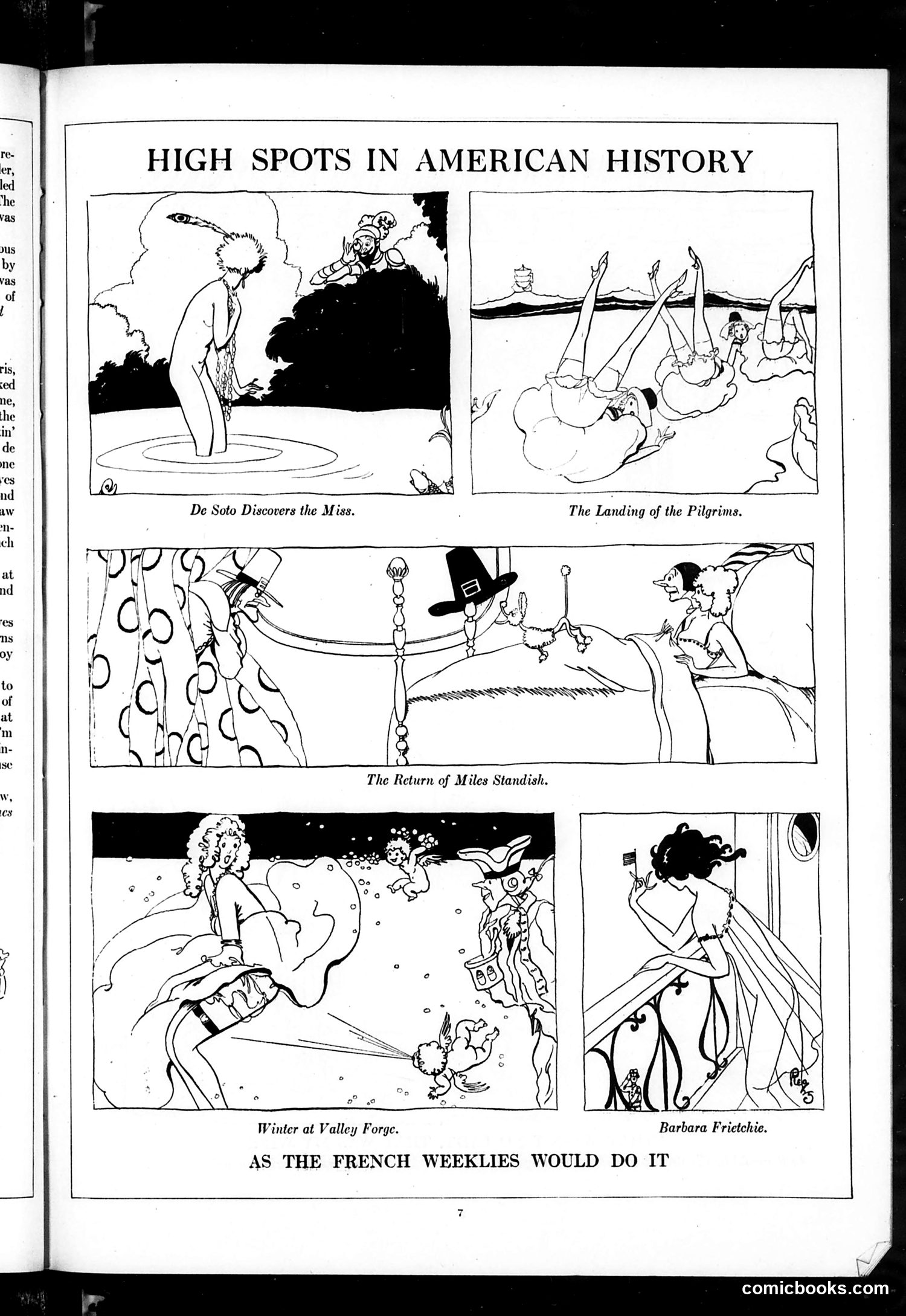
This satirical page mocks how French publications might depict famous American historical moments by sexualizing them. The title "High Spots in American History" labels six scenes that parody well-known events: - De Soto Discovers the Miss[issippi] - The Landing of the Pilgrims - The Return of Miles Standish - Winter at Valley Forge - Barbara Frietchie Each cartoon transforms these dignified historical scenes into suggestive, sexually-charged situations featuring scantily-clad women. The subtitle "As the French Weeklies Would Do It" suggests this reflects perceived French cultural attitudes about sexuality and frivolous treatment of serious subjects—a common Anglo-American stereotype of the era. The joke relies on contrasting American historical reverence with imagined French irreverence and licentiousness.
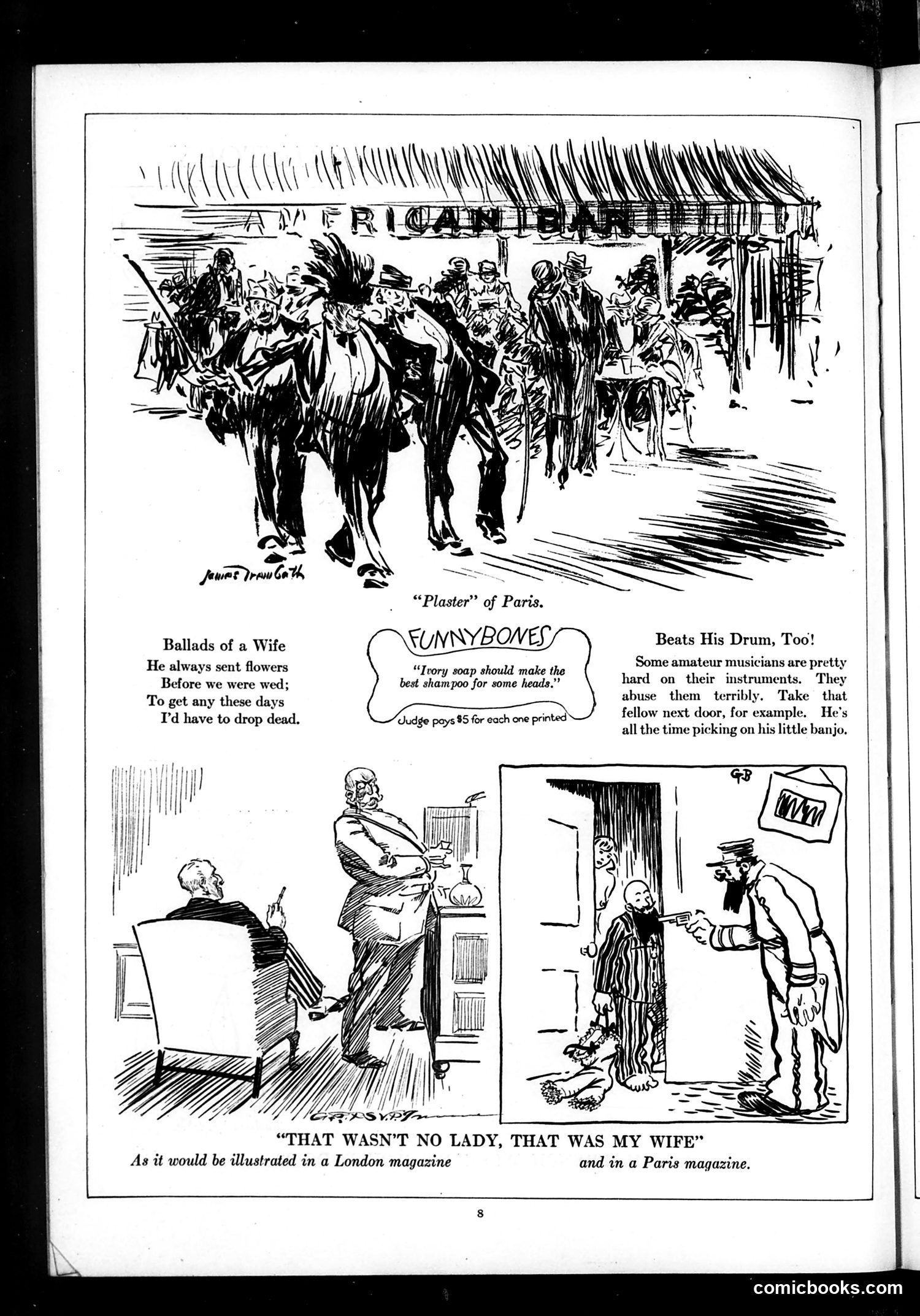
This page contains multiple satirical pieces typical of early 20th-century humor magazines: **Top illustration:** "Plaster of Paris" shows a street scene, likely referencing Paris's reputation for bohemian culture and loose morals—a common Anglo-American stereotype. **"Funny Bones" section:** Three short humorous quips, including one about ivory soap as shampoo (likely a product tie-in joke) and one mocking amateur banjo players who mistreat instruments. **"Ballads of a Wife":** A sarcastic poem about courtship—a husband once sent flowers before marriage but now would "have to drop dead" to do so. This reflects period humor about marriage diminishing romantic gestures. **Bottom cartoons:** Twin illustrations titled "That Wasn't No Lady, That Was My Wife" contrast how the same scenario would be drawn in London versus Paris magazines. This appears to satirize different cultural attitudes toward wives and propriety between nations, though the specific joke requires seeing both versions clearly. The overall page reflects common turn-of-the-century themes: marital disillusionment, cultural stereotyping, and product humor.
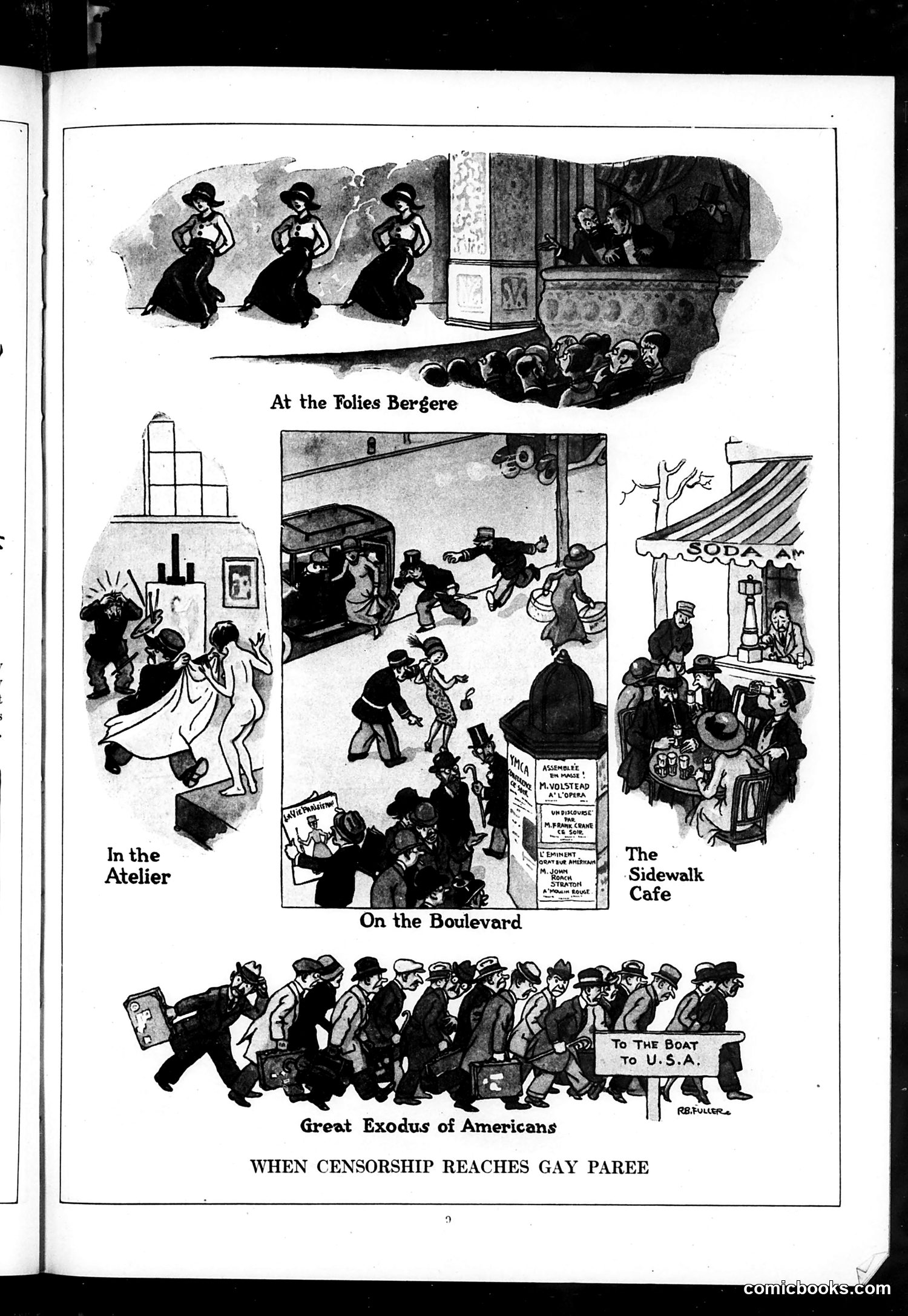
This satirical cartoon critiques American censorship by contrasting it with Paris's reputation for permissiveness. The page depicts various scenes of Parisian entertainment—the Folies Bergère cabaret, bohemian artists' studios, street cafés, and sidewalk life—all presented as vibrant and uncensored. The bottom panel shows Americans fleeing to boats bound for the U.S.A., labeled "Great Exodus of Americans." The satire suggests that if censorship becomes as strict in Paris as in America, even the famously liberal French capital will lose its appeal, forcing pleasure-seeking Americans to abandon Europe altogether. The title indicates concern that American moral standards are encroaching on European cultural freedom, treating Paris's "gay paree" (carefree Paris) as a haven threatened by puritanical American values.
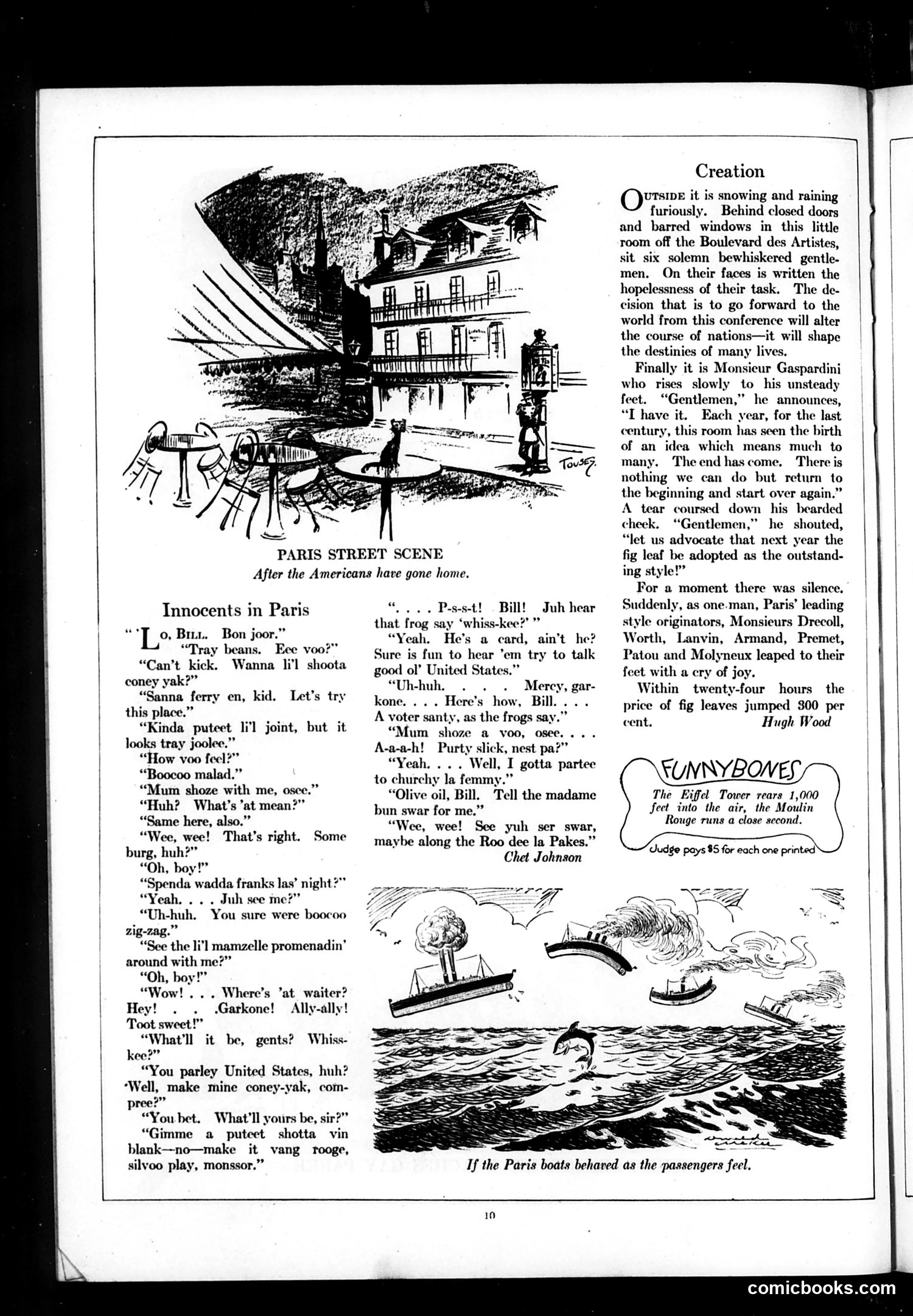
This Judge magazine page satirizes American soldiers in post-World War I Paris through two pieces: **"Innocents in Paris"** mocks American GIs attempting French, depicted through mangled pseudo-French dialogue ("coney yak" for cognac, "garçon" as "garkone"). The humor relies on Americans butchering the language while confidently ordering drinks and pursuing women—a stereotype of uncultured American servicemen abroad. The soldiers find this amusing themselves, laughing at French attempts to speak English. **"Creation"** is a separate satirical vignette about Parisian fashion designers (Worth, Lanvin, Patou, Molyneux—all real couture houses) meeting to decide next season's trend. Their solution: adopt the fig leaf as fashion. The joke: this drives demand so high that fig leaf prices spike 800%. It's social satire about fashion's absurd cyclicality and how designers can profit from any trend, however ridiculous. Both pieces reflect post-WWI American attitudes: condescension toward European culture mixed with newfound economic power—American soldiers spending freely in Paris, American capital driving European markets.
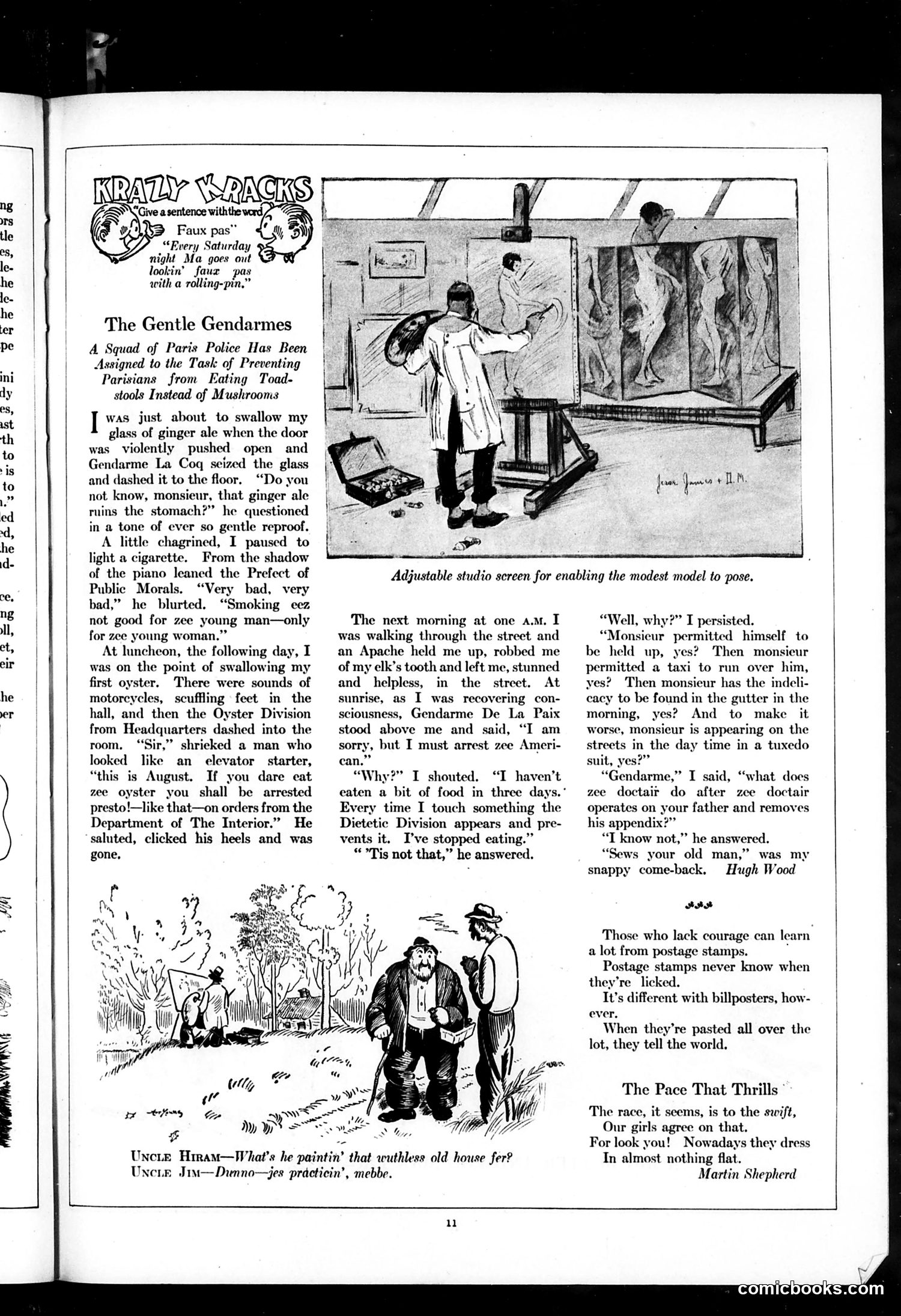
This story satirizes French police intervention in everyday life, particularly the Parisian gendarmerie's obsession with regulating citizens' dietary and behavioral choices. The narrator, an American, encounters increasingly absurd police interventions: a gendarme destroys his ginger ale for being "bad for the stomach," officers confiscate his oysters (out of season), and authorities arrest him for appearing in public disheveled after being robbed—deemed "indecent" in a tuxedo. The humor rests on the contrast between the police's genteel, bureaucratic tone ("a tone of ever so gentle reproof") and their authoritarian meddling. The final irony: when the narrator asks a gendarme what doctors do *after* appendix removal, then answers "sew your old man," he's mocking how absurdly the police extend control into matters beyond their jurisdiction. The satire critiques French governmental paternalism and policing as intrusive and illogical—protecting citizens from themselves to the point of absurdity.
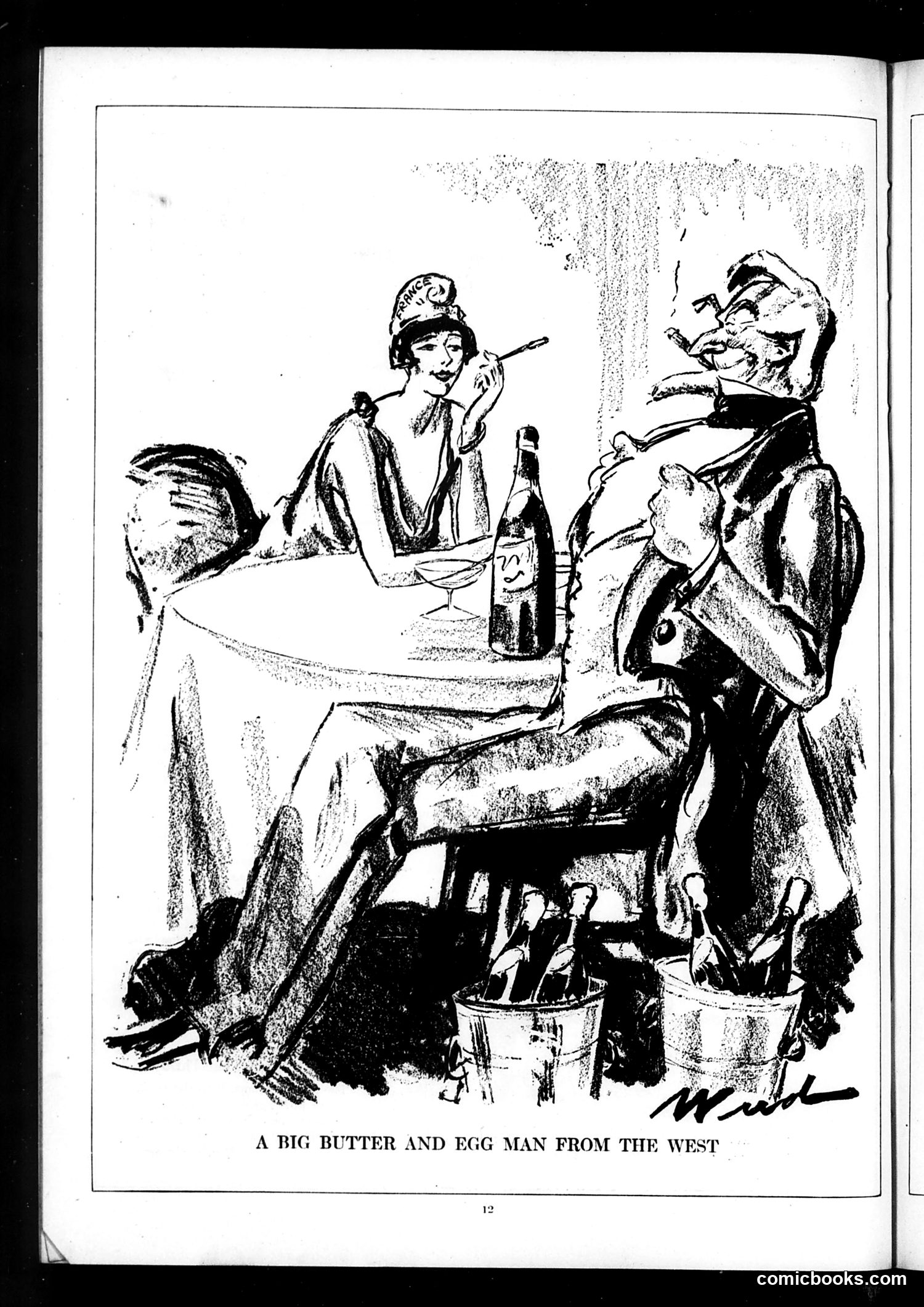
This cartoon satirizes a wealthy Western businessman entertaining a fashionable woman at an elegant dinner. The caption "A Big Butter and Egg Man From the West" references a 1920s slang term for a nouveau-riche entrepreneur from rural or frontier regions who displays his wealth ostentatiously in urban social settings. The satire targets the cultural clash between Western business success and Eastern sophistication. The man's exaggerated features and posture suggest he's uncouth or lacking refinement despite his obvious prosperity (evident from the champagne and fine dining). The woman's bemused expression implies she finds him amusing or ridiculous rather than genuinely impressive. The cartoon mocks both the pretensions of newly wealthy Western businessmen and the snobbish attitudes of urban elites, capturing Jazz Age anxieties about changing American wealth distribution.
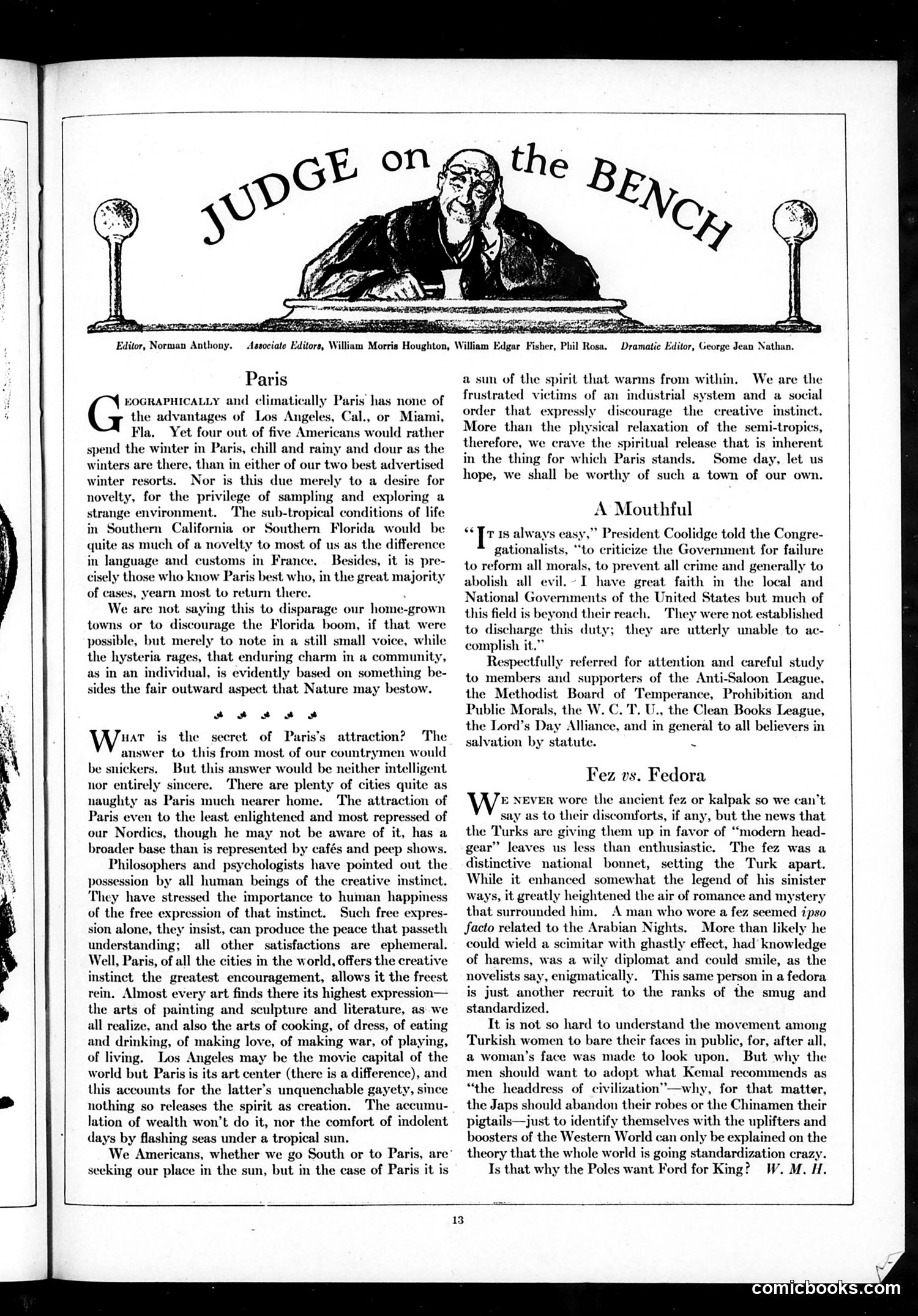
This page contains editorial essays rather than political cartoons. The header illustration shows a stern judge at a bench, framing the "Judge on the Bench" opinion column. **Main Content:** The first essay defends Paris's appeal to Americans over Florida/California resorts, arguing Paris attracts visitors because it encourages creative expression and artistic freedom—not merely vice. The author contends Paris represents spiritual and intellectual fulfillment that material comfort cannot provide. **"A Mouthful" Section:** This brief piece quotes President Coolidge telling Congregationalists that the government cannot reform all morals or prevent all crime—these matters exceed governmental capacity. The column respectfully refers the matter to moral reform organizations like the Anti-Saloon League and Methodist Board. **Context for Modern Readers:** This reflects 1920s American debates about Prohibition, moral regulation, and government responsibility. The page criticizes American consumerism while praising European culture—a common intellectual position among American elites of this era.
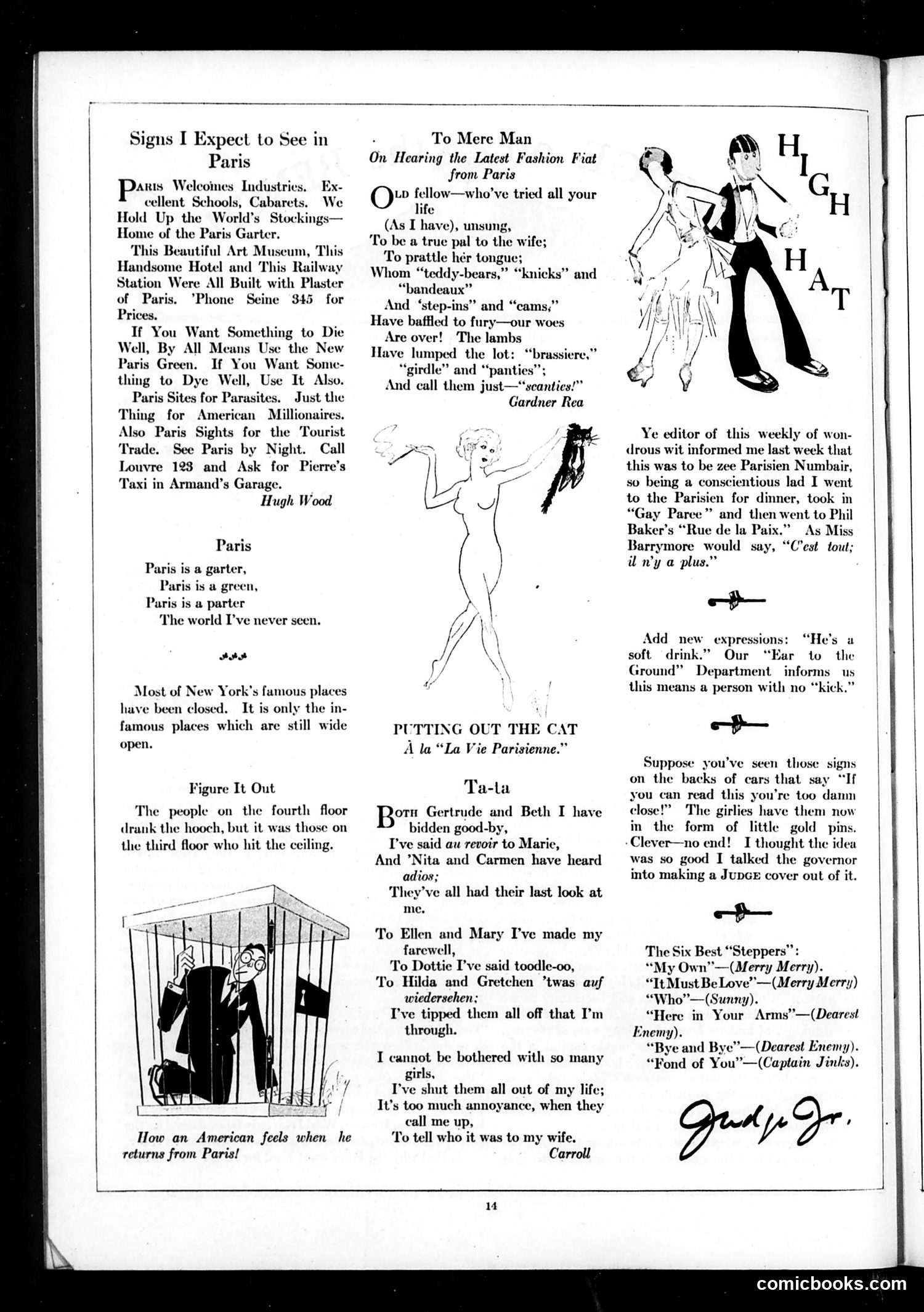
This page satirizes American fascination with Paris in the 1920s. The "Signs I Expect to See in Paris" mocks American commercialism by imagining absurd advertisements exploiting Paris references—"Paris Green" (poison), "Paris garter" stockings, plaster of Paris—reducing French sophistication to marketable products. The fashion poem ridicules men's confusion over women's evolving undergarments ("brassiere," "girdle," "panties"), newly consolidated into the single term "scanties." It's satirizing rapid fashion changes that confuse even attentive husbands. The "Ta-ta" poem humorously depicts a man breaking up with multiple girlfriends simultaneously, creating marital complications—a commentary on 1920s dating culture and infidelity. The "Figure It Out" cartoon uses Prohibition-era humor: people on the fourth floor drank illegally obtained alcohol while those below suffered the consequences (hitting the ceiling in anger/protest). Overall, the page reflects post-WWI American attitudes: Paris obsession, bewilderment at changing social norms (particularly regarding women), Prohibition enforcement, and urban sophistication mixed with vulgarity.
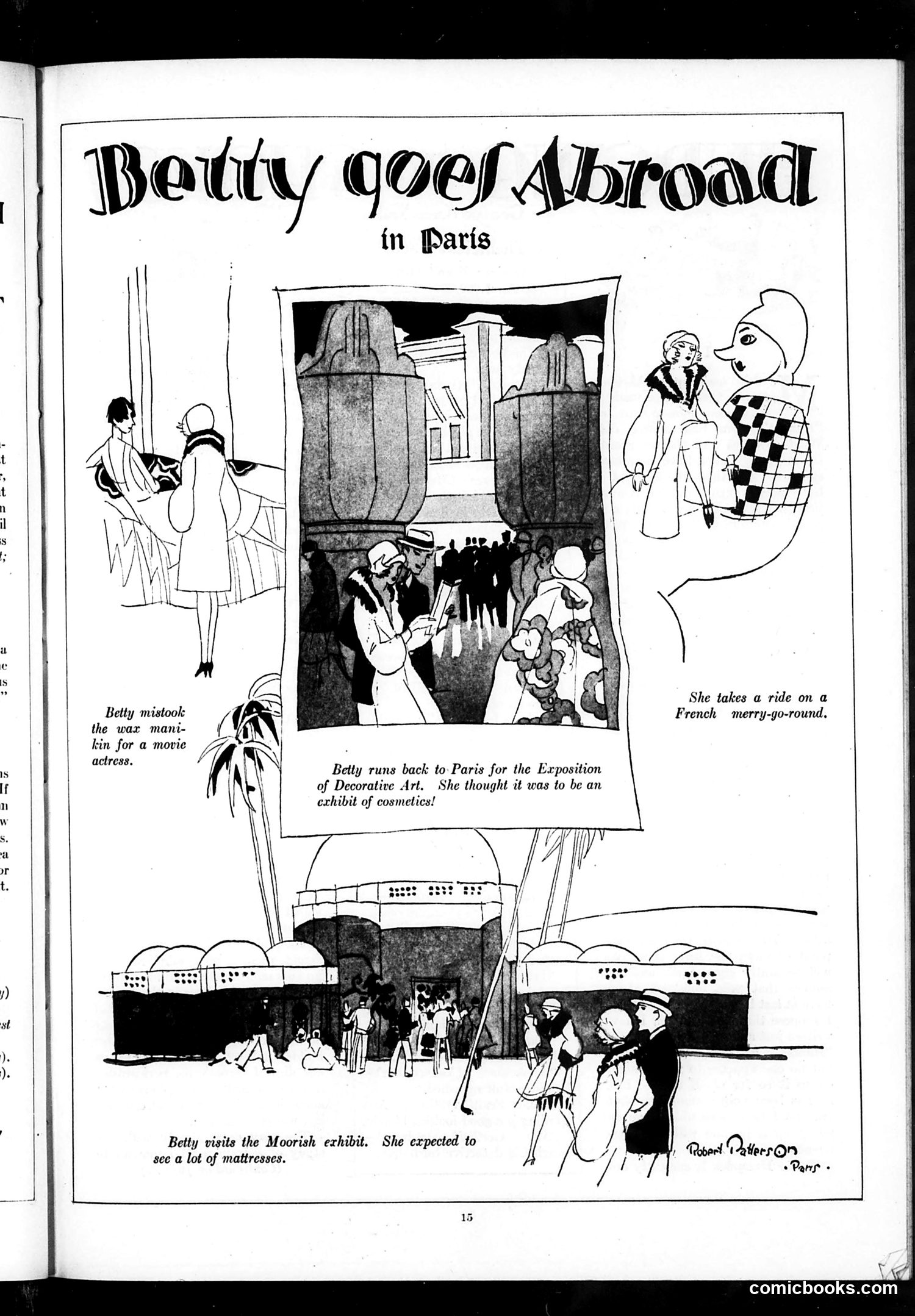
This is a humorous comic strip about a naive American woman named Betty visiting Paris. The satire relies on ethnic and cultural stereotypes common to 1920s American humor: 1. **The wax figure mistake**: Betty confuses a wax mannequin for a French movie actress, suggesting American ignorance of Continental culture. 2. **The Exposition joke**: Betty expects "Decorative Art" to be an exhibit of cosmetics, mocking American women's perceived obsession with beauty products. 3. **The Moorish exhibit**: Betty expects to see mattresses, playing on the stereotype that Moorish/Middle Eastern cultures are associated with luxurious bedding and indolence. The strip's humor derives from portraying Betty as comically uninformed about art, culture, and world affairs—a common trope in Judge magazine satirizing American provincialism and consumerism during the Jazz Age.
This page contains theater criticism rather than political satire. Nathan, a prominent drama critic, opens with a self-congratulatory essay about profiting from decades of writing about *Hamlet*—claiming he's made more money from criticism than Shakespeare did from royalties. He humorously boasts that his contradictory interpretations have all seemed valid, suggesting theater criticism is inherently malleable nonsense. The second section is a "Theatrical Baedeker"—a satirical capsule review of current Broadway productions (circa 1923). Nathan delivers witty, dismissive one-liners: calling one play "rented dress-suit literature," another "hippety hop," and cruelly noting that Walter Hampden's *Hamlet* performance makes him sound like Iago instead. The humor lies in Nathan's acidic verdicts on contemporary theater's quality, revealing his contempt for much of what Broadway was producing at the time.
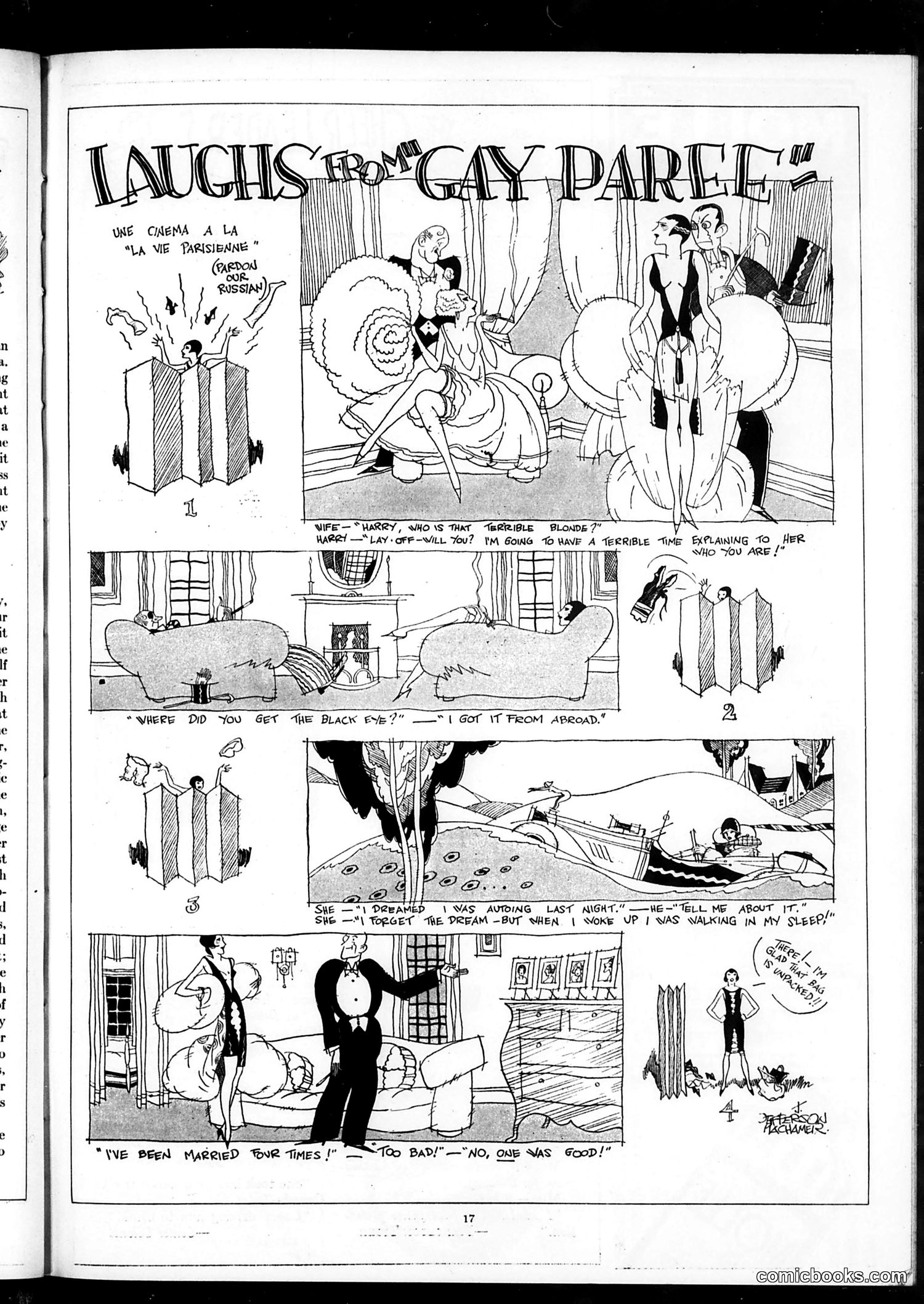
This is a multi-panel comic satirizing Parisian nightlife and marital infidelity, styled as "cinema à la 'La Vie Parisienne'" (referencing a famous French satirical magazine). The humor targets: **The Setup:** A husband encounters his wife with a suspicious "terrible blonde" woman, claiming he'll have "a terrible time explaining" who she is—implying extramarital entanglement. **The Jokes:** - A wife describes dreaming of driving, then realizes she was sleepwalking—a surreal non-sequitur punchline - References to acquiring a "black eye from abroad" and multiple failed marriages ("too bad—no one was good!") - Visual gags of characters in exaggerated poses with large decorative elements **The Satire:** Judge is mocking Parisian sophistication and casual attitudes toward marriage/affairs as decadent and absurd. The "gay Paree" framing presents this as exotic continental vice for American readers to find both titillating and morally superior to. The artwork style and casual infidelity references date this to the Jazz Age era (1920s).
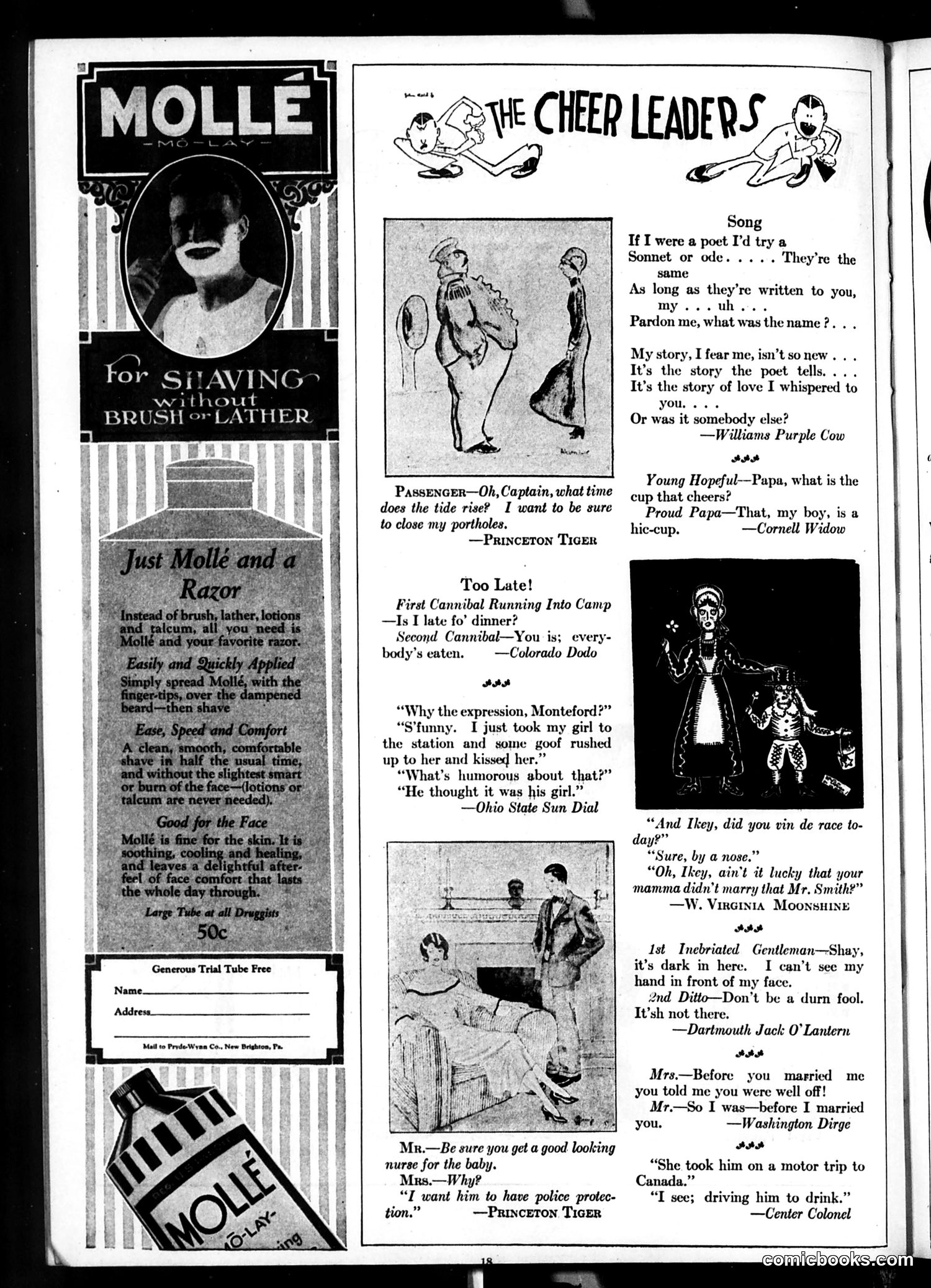
This is a humor page from Judge magazine, likely early 20th century, featuring brief jokes and quips sourced from college newspapers (Cornell Widow, Princeton Tiger, Ohio State Sun Dial, etc.). The jokes rely on wordplay and mild social humor typical of the era: - **"Hic-cup"** pun (the drinking toast "the cup that cheers") - **Cannibal stereotype** joke about timing and food - **Mistaken identity** humor (kissing someone else's girlfriend) - **Irish dialect** comedy ("Ikey" winning "by a nose") - **Drunk humor** (man can't see his own hand; friend explains it's not there) - **Marriage humor** (husband was "well off" before marriage; man driven to drink by motor trip) The left side features a **Mollé razor advertisement** promising shaving without brush or lather. The humor is gentle, collegiate, and focuses on romance, drinking, and marriage—reflecting Jazz Age anxieties about courtship and domesticity. Nothing here requires political context; it's pure social satire aimed at young, educated readers.
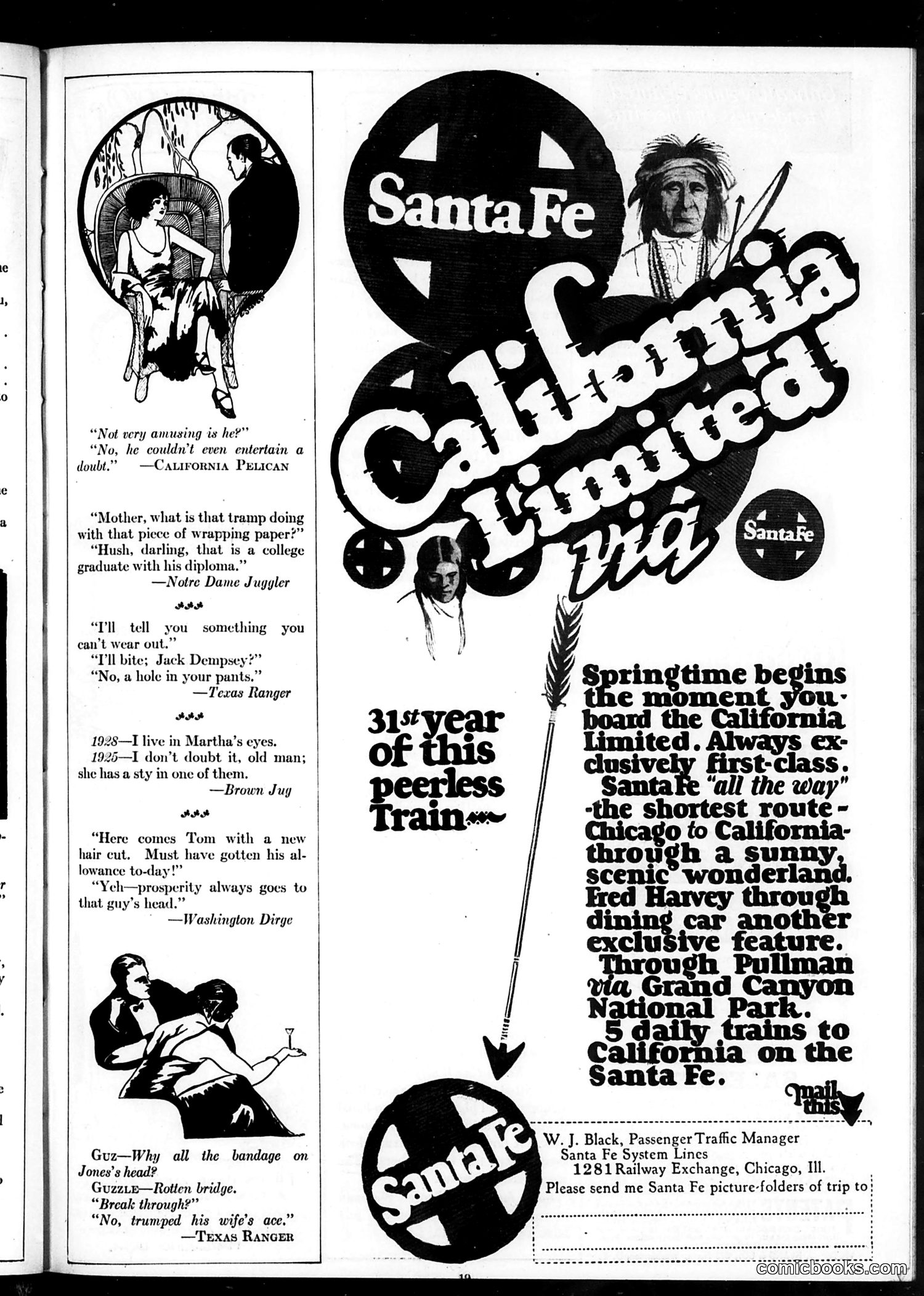
This page contains primarily **satirical jokes and a railroad advertisement**, not political cartoons. The left side features brief humorous quips mocking various targets: a dull entertainer, unemployed college graduates (their diplomas worthless), boxer Jack Dempsey, infidelity, and a man whose newfound prosperity makes him vain. These are generic social humor typical of 1920s magazines—poking fun at everyday absurdities rather than specific political figures. The dominant right-side content is a **Santa Fe Railway advertisement** for their California train service. It uses period imagery (Native American figure, a woman in classical dress) and emphasizes the route's scenic qualities and exclusive dining cars. The ad promotes the train as a prestigious way to reach California. The small illustrations accompanying the jokes are decorative rather than substantive commentary. Overall, this page blends entertainment with commercial messaging—typical of Judge's mixed-content format during this era.
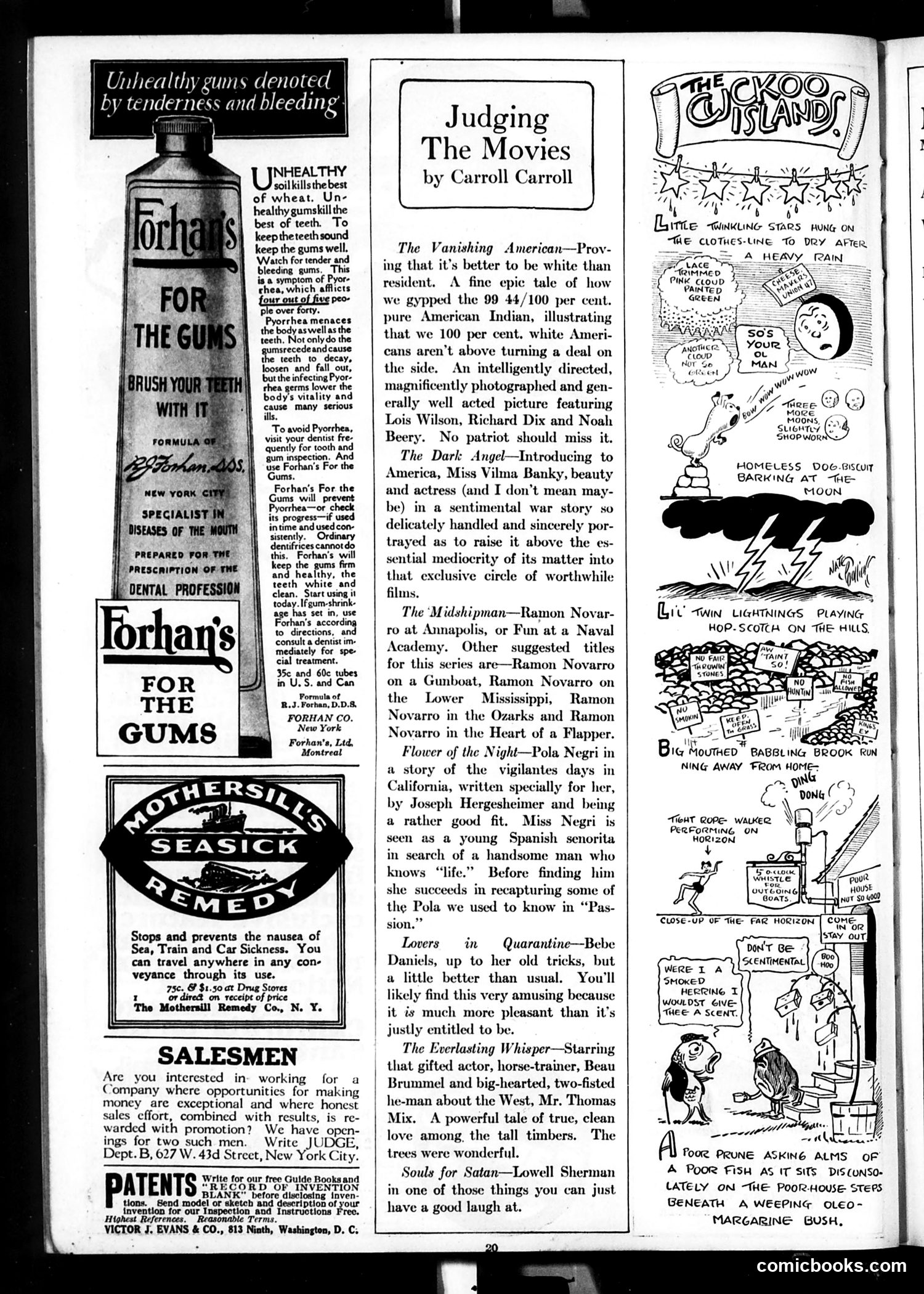
This page features Carroll Carroll's sardonic movie reviews from the 1920s silent film era. The humor lies in his cutting critiques that undercut the films' pretensions: **The Vanishing American** — Carroll mocks this film about Native Americans as hypocritical, sarcastically noting it "proves" white Americans are justified in cheating the "99 44/100 per cent. pure American Indian" (a reference to Ivory soap's purity claim). The satire exposes Hollywood's treatment of Indigenous peoples while Americans claim moral superiority. **Other reviews** similarly deflate inflated claims: *The Dark Angel* is elevated merely by its "exclusive circle of worthwhile films" status despite mediocre content; the *Midshipman* films are repetitive star vehicles for Ramon Novarro. **The cartoon** ("The Cuckoo Island") mocks Hollywood absurdity with slapstick visual gags about film productions. The reviews exemplify 1920s highbrow magazine satire: witty, acerbic critiques that assumed readers shared skepticism toward commercial cinema and celebrity culture.
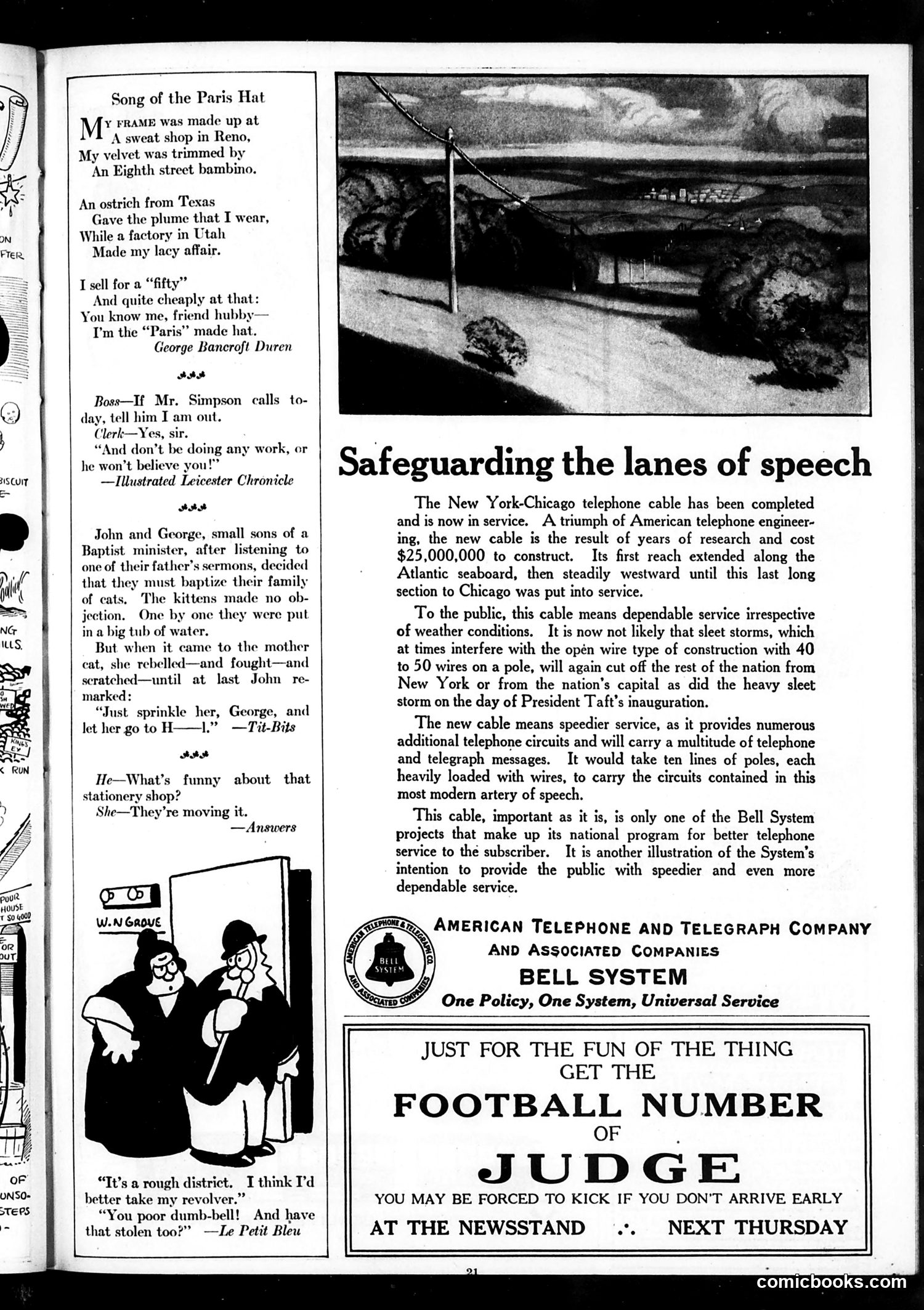
This page mixes humor pieces with corporate advertising. The left side contains short jokes mocking working-class life and absurd situations—a "Paris" hat assembled from American sweatshops (Reno, Utah) yet marketed as French luxury; a boss demanding his clerk appear idle to fool a visitor; children baptizing cats; and people discussing theft in rough neighborhoods. The dominant content is a Bell System advertisement celebrating the New York-Chicago telephone cable completed around President Taft's inauguration (1909). The ad presents technological progress as national infrastructure—the cable provides reliable service despite weather that previously disrupted communications. The rhetoric—"safeguarding the lanes of speech," "artery of speech"—frames telephone service as essential to national unity and commerce. This is corporate propaganda dressed as public interest journalism, typical of Judge's era when advertising increasingly colonized editorial space. The bottom promotes Judge's football issue as a must-read entertainment product.
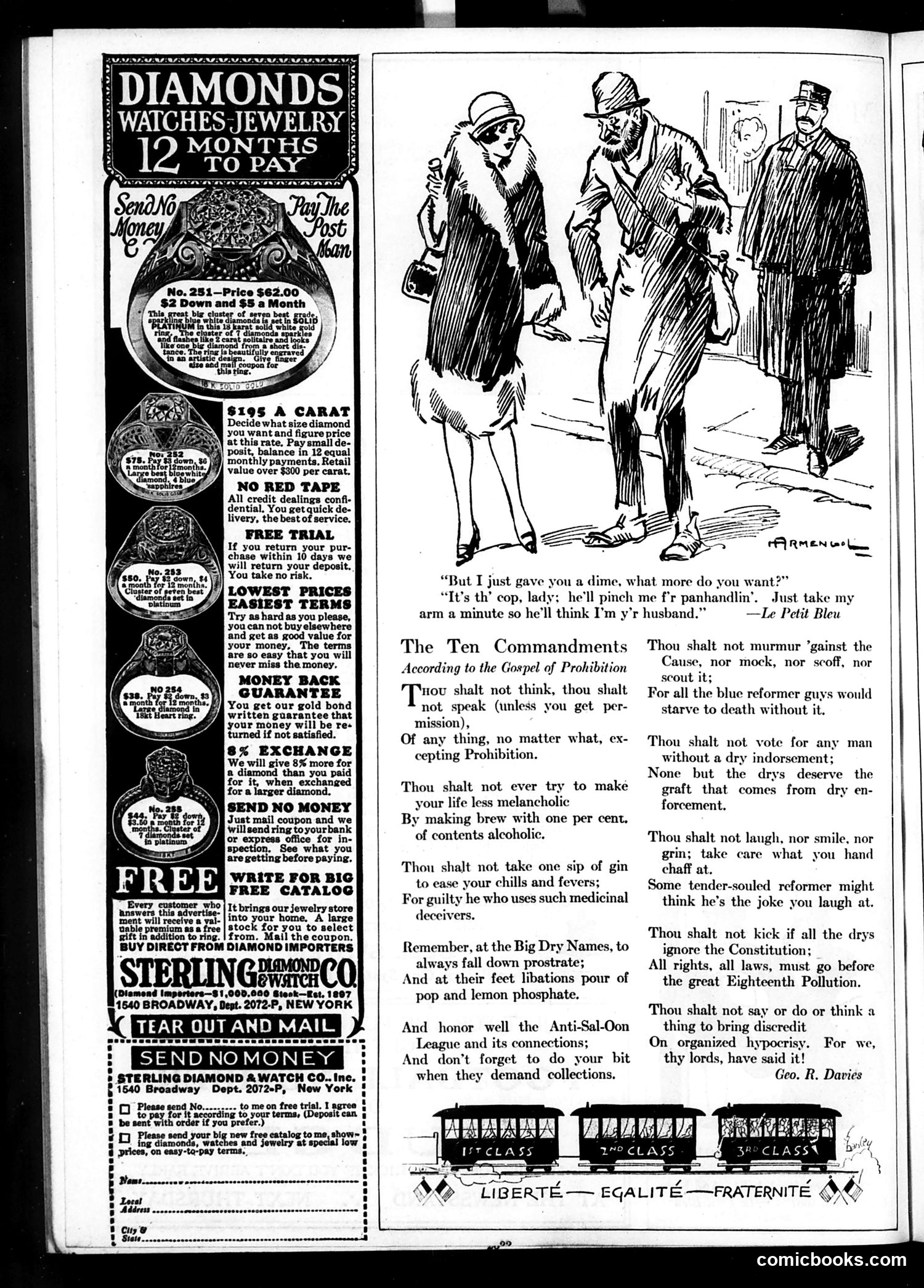
This Judge magazine page contains political satire attacking Prohibition (the 1920s ban on alcohol). The cartoon shows a beggar asking a woman for money, then requesting she let him pose as her husband so police won't arrest him for panhandling—a commentary on how Prohibition enforcement created petty crime and social dysfunction. The main satire is "The Ten Commandments According to the Gospel of Prohibition," a mock-religious text mocking the movement's zealotry. It ridicules Prohibition advocates as hypocritical reformers who profit from enforcement, suggests supporters blindly obey without questioning constitutionality, and condemns the movement's censorious control over speech and thought. The "Eighteenth Pollution" reference mocks the 18th Amendment (Prohibition itself). The page also features advertisements for diamond jewelry—typical Judge content—showing this was a commercial magazine mixing editorial satire with advertising revenue.
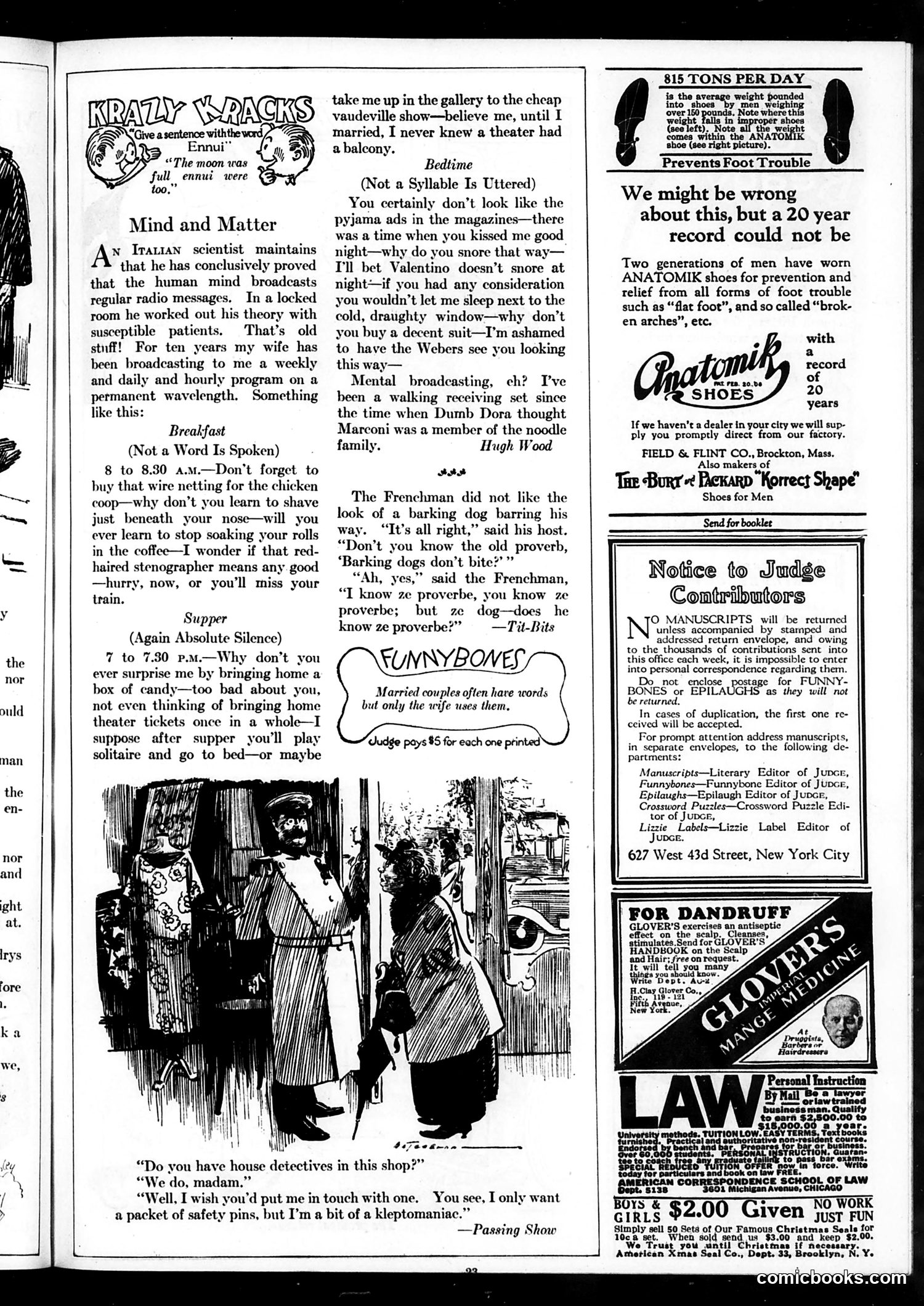
This page from *Judge* magazine contains several humor pieces satirizing married life and domestic dynamics: **"Mind and Matter"** (main article): A scientist claims the human mind broadcasts radio messages. The author humorously applies this to his wife, describing her constant (silent) mental "broadcasting" of complaints throughout the day—about forgotten errands, his appearance, snoring, and perceived inadequacies compared to romantic film stars like Valentino. The satire targets the relentless, unspoken criticism wives directed at husbands, portraying marriage as a one-way stream of female nagging. **Other short jokes** continue this theme of marital conflict, with quips about wives monopolizing conversation and a woman admitting to kleptomania to a department store detective. The advertisements (Anatomik Shoes, Glover's Mange Medicine, Law correspondence school) are period typical. The overall tone reflects early 20th-century gender stereotypes: wives as critical nags, husbands as inadequate providers and lovers, presented as humorous "universal truths" about marriage.
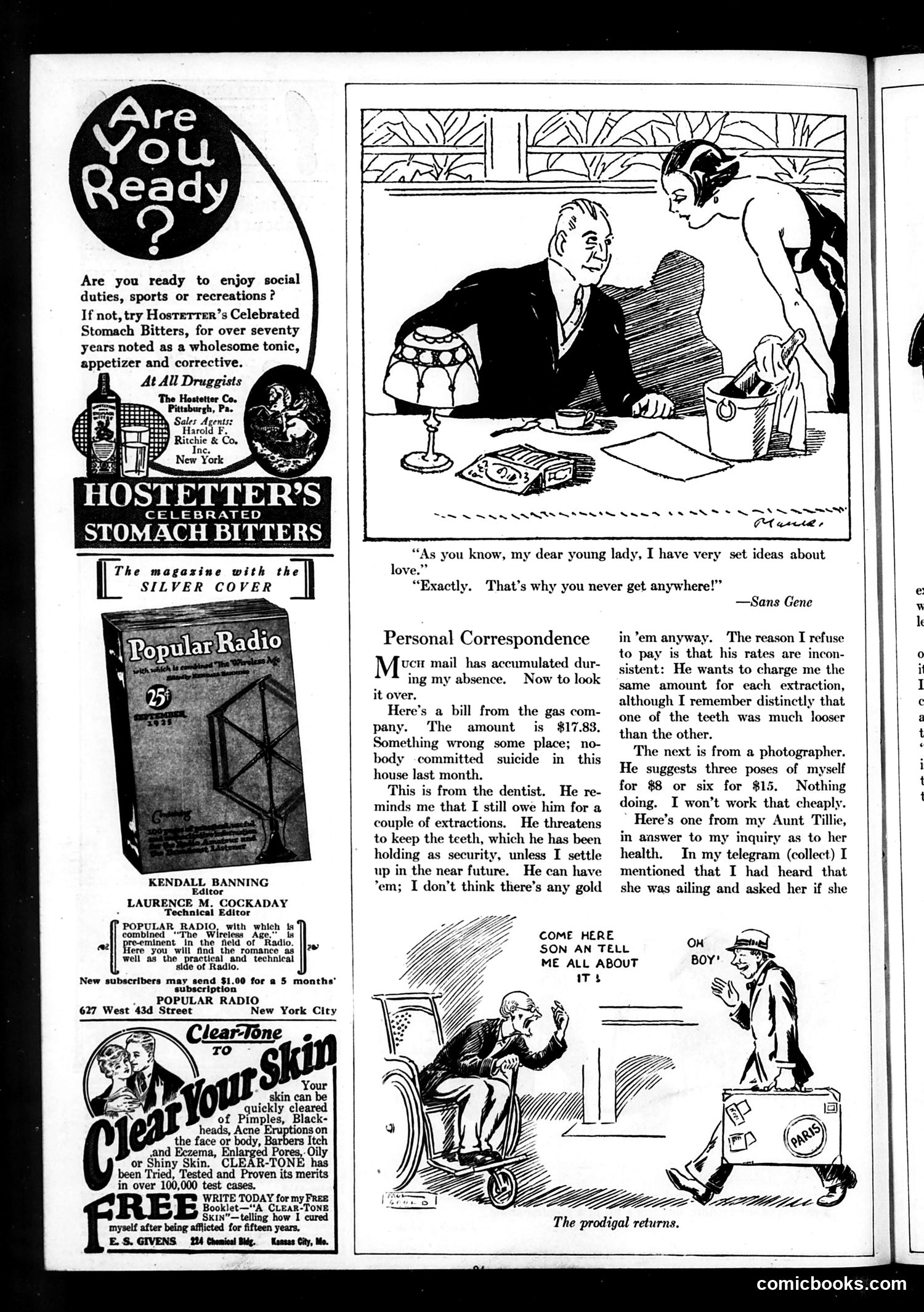
This page mixes advertisements with satirical content typical of early 20th-century Judge magazine. **The Main Cartoon:** A domestic scene where a man tells a young woman he has "very set ideas about love," and she responds that this is "why you never get anywhere!" The satire mocks rigid, old-fashioned attitudes about romance—suggesting that inflexible principles guarantee romantic failure. **"Personal Correspondence" Section:** A humorous monologue about accumulated bills and mail, satirizing petty financial disputes. The writer refuses to pay a dentist's equal extraction fees (claiming one tooth was looser) and declines a photographer's rates as too cheap. The final anecdote about his Aunt Tillie—where he sent a *collect* telegram asking about her health—suggests the joke is self-directed: his stinginess and poor judgment. "The prodigal returns" caption implies consequences for such miserliness. **Surrounding Advertisements:** Promote stomach bitters, radio magazines, and skin-clearing products—typical period remedies marketed as cure-alls. The page's humor relies on recognizing period attitudes toward courtship, frugality, and dubious patent medicines.
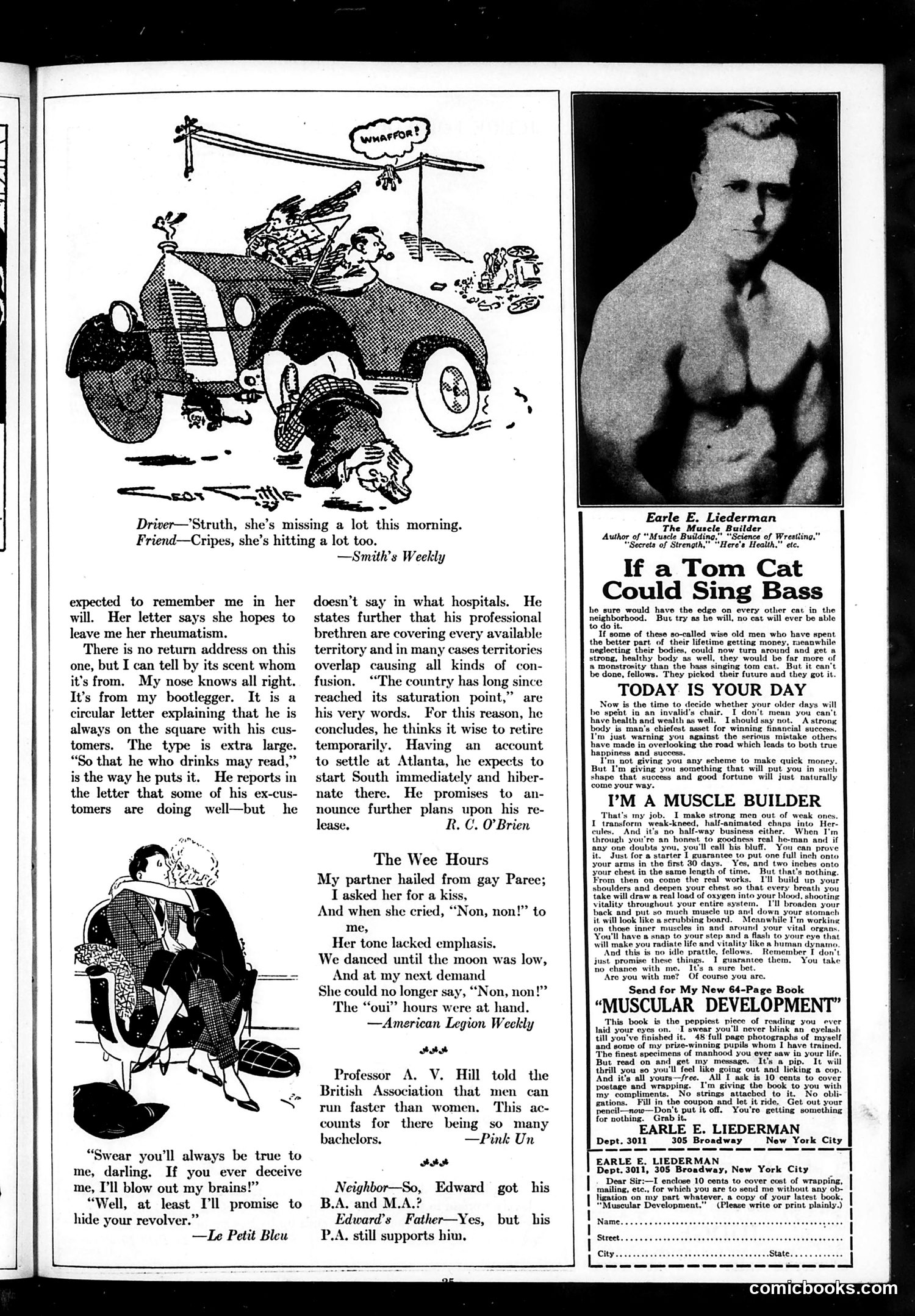
This page satirizes **Prohibition-era America** (likely 1920s). The top cartoon mocks a car accident where the female driver is "missing a lot this morning" but "hitting a lot too"—suggesting intoxication from illegal alcohol. The bootlegger's circular letter is darkly humorous: he's retiring because illegal liquor production has saturated the market and created territorial turf wars among competitors. His mention of "ex-customers" in hospitals and his planned retreat to Atlanta to "hibernate" (avoid arrest) lampoons the widespread criminal enterprise that Prohibition spawned. The page also contains period humor about courtship ("The Wee Hours"), gender differences, and education. **Right side:** An advertisement by muscle-builder Earle Liederman promises physical transformation—reflecting 1920s-30s fitness culture and confidence in self-improvement. The satire targets how Prohibition created criminal chaos while failing to eliminate drinking, a common contemporary critique of the failed policy.
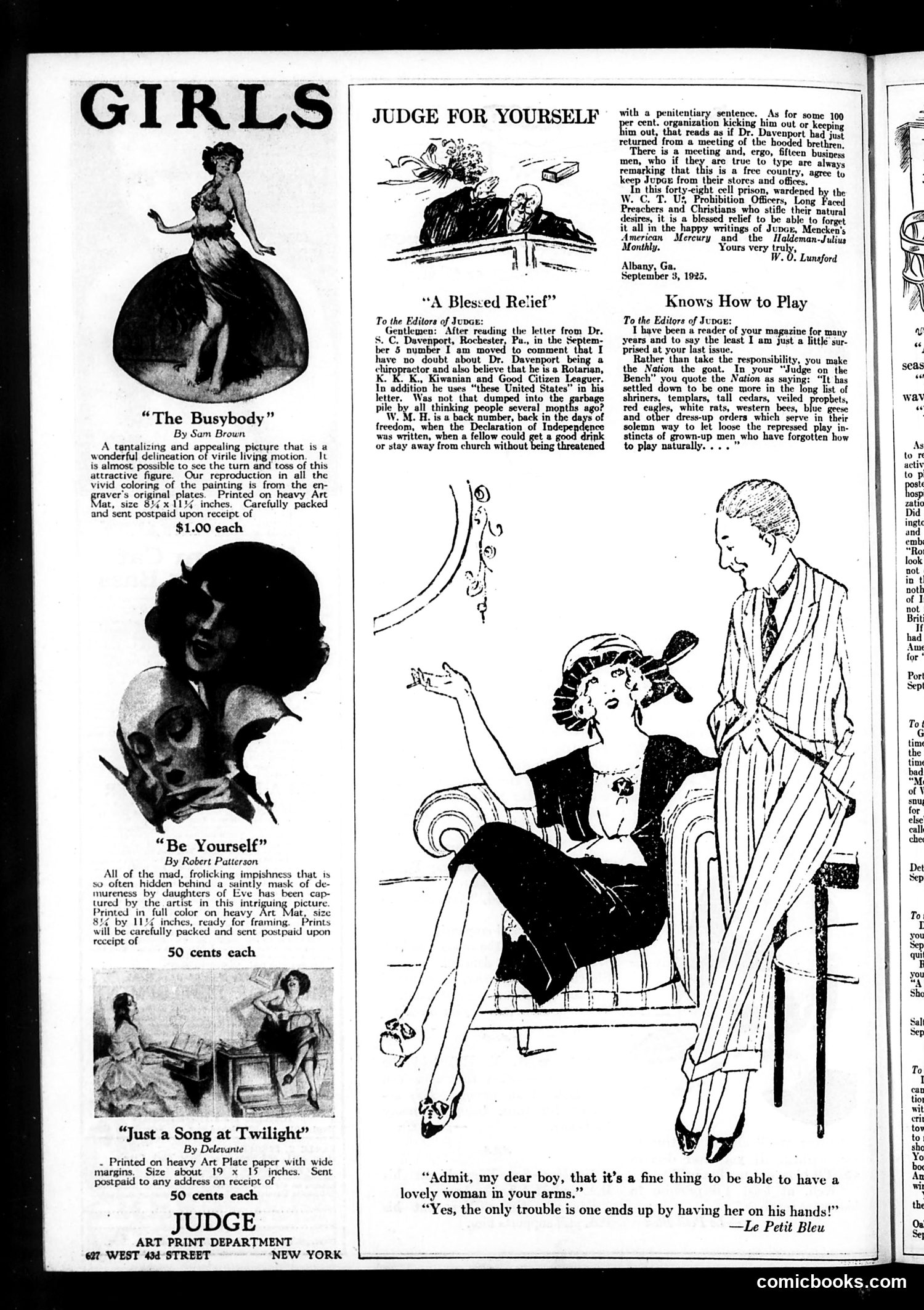
This page combines reader letters and satirical cartoons typical of Judge's editorial content. **The Letters Section:** Two readers debate American social restrictions. One praises Judge for offering relief from what he calls a puritanical society dominated by the W.C.T.U. (Women's Christian Temperance Union), Prohibition Officers, and churches that "stifle natural desires." He contrasts this repressive environment with Judge and H.L. Mencken's *American Mercury*—both known for mocking American conformity and prudishness. The second letter sarcastically criticizes Judge for blaming *The Nation* magazine regarding fraternal organizations (Shriners, Masons, etc.), suggesting these groups serve the legitimate purpose of letting "grown-up men...play" since they've "forgotten how." **The Cartoon:** The illustration depicts a flirtation scene where a man compliments a woman's attractiveness. Her response—that the "trouble" is ending up with her "on his hands"—is a marriage joke: romantic involvement leads to matrimonial obligation. **Overall Context:** This reflects 1920s cultural debates over prohibition, sexual morality, and leisure versus responsibility.
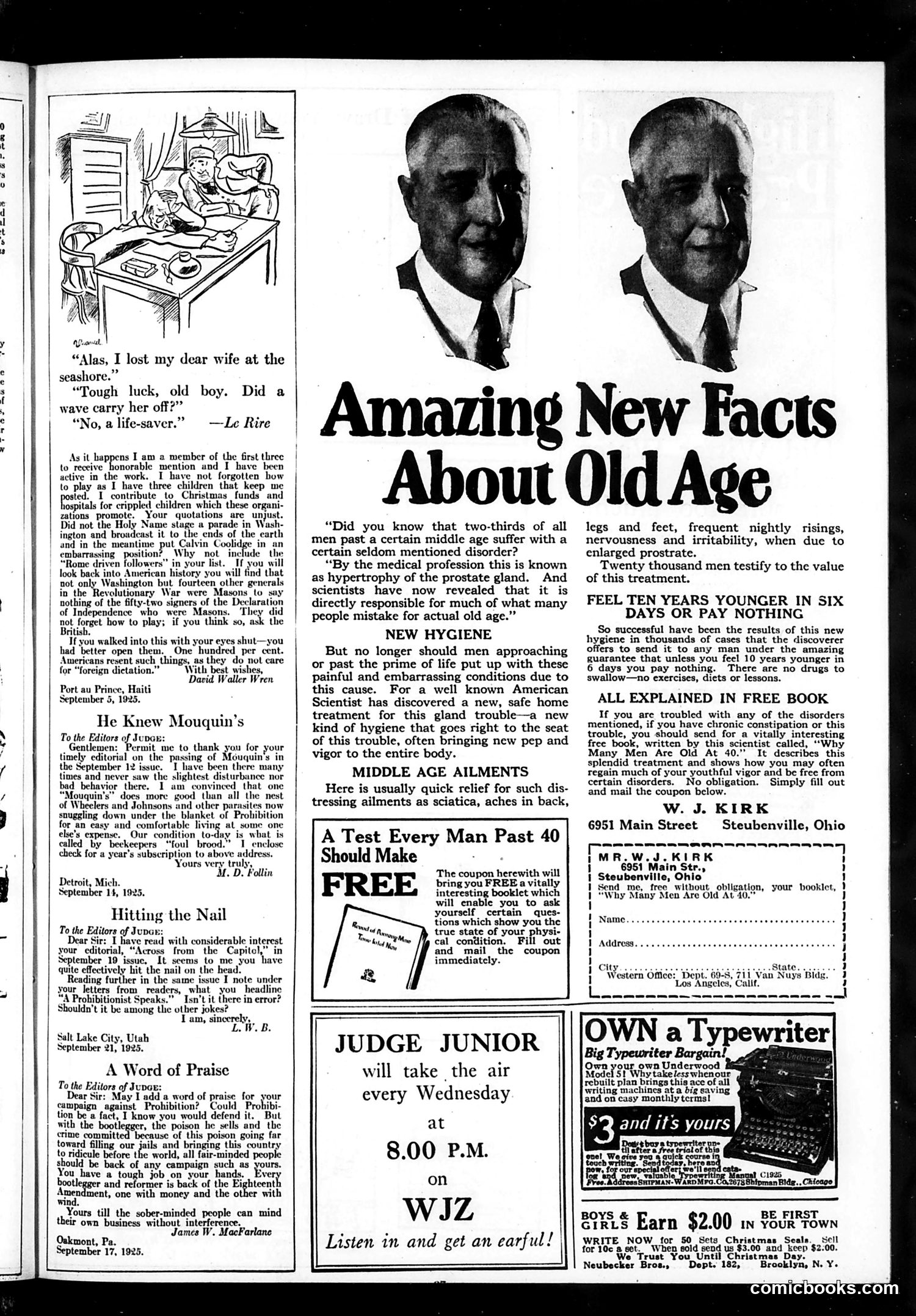
This page is primarily **advertising**, not satirical commentary. The small cartoon at top-left is a mild joke from *Le Rire* (a French publication): a man lost his wife at the seashore—not to a wave, but to a "life-saver" (the person who rescued her, implying romance or elopement). It's a simple pun with no political content. The bulk of the page advertises a medical treatment for prostate problems marketed to aging men, using pseudo-scientific language ("hypertrophy of the prostate gland"). This reflects early-20th-century advertising practices: vague health claims, free booklets, and mail-in coupons targeting middle-aged male anxieties about aging and sexual vigor. The letters section contains reader responses to previous *Judge* articles about Freemasonry and Prohibition—contemporary social issues—but these aren't cartoons.
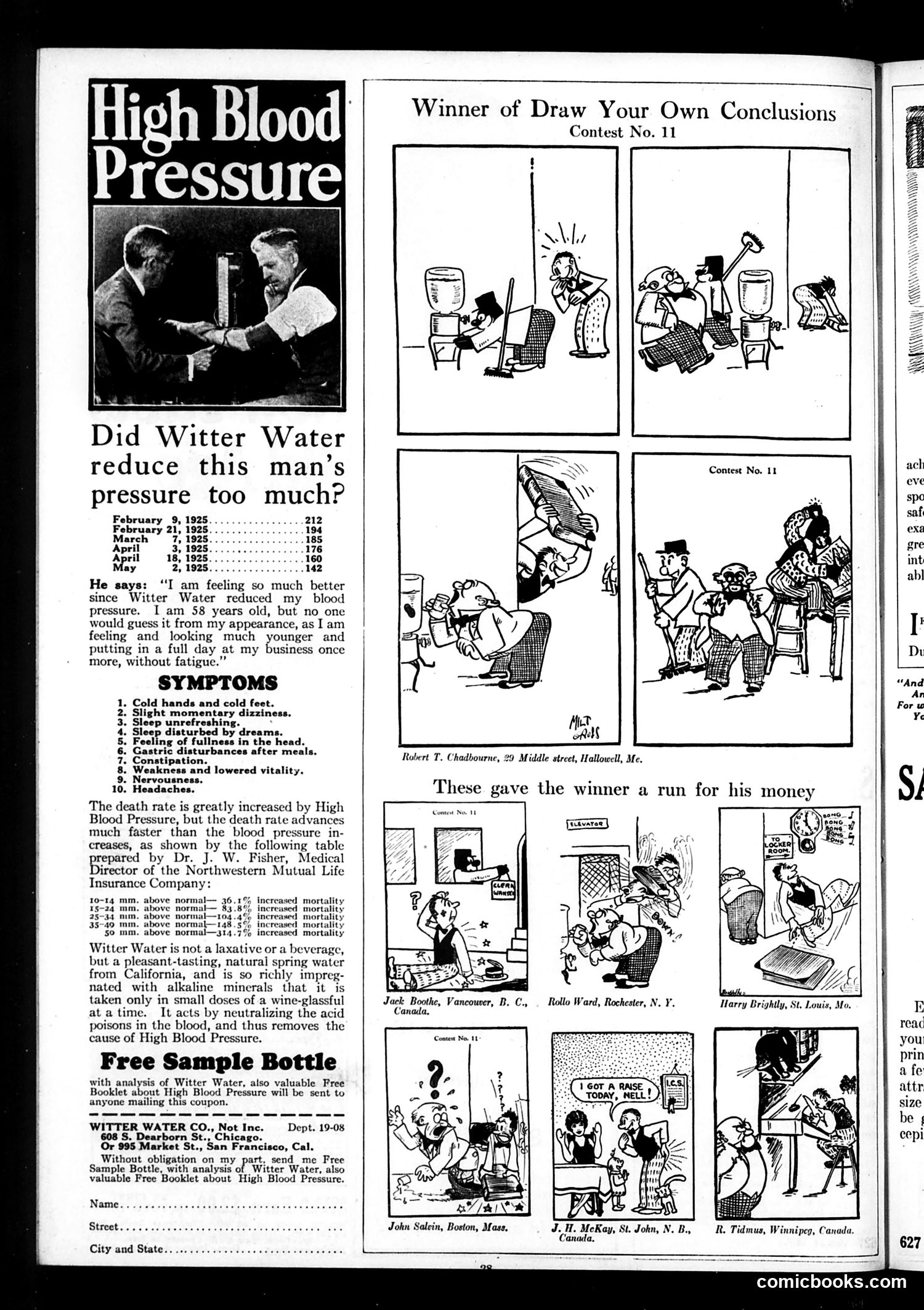
This page showcases a contest where readers submitted comic strip sequences and Judge published the winning entry. The winner, Robert T. Chadbourne from Maine, created a multi-panel cartoon depicting domestic chaos—a man sits reading while his family creates mayhem around him: children run amok, objects fly, someone appears injured or distressed. The joke's title asks "These gave the winner a run for his money," suggesting the cartoon illustrates the saying through literal visual chaos. The other contest entries shown depict various comedic scenarios of ordinary domestic life and mishaps. The page also contains a full-page advertisement for "Witter Water," a patent medicine claiming to cure high blood pressure through mineral-rich spring water. The testimonial and medical statistics are typical early-20th-century health product marketing. The ad's inclusion alongside the satirical contest content is ironic—Judge frequently mocked dubious medical claims while accepting their advertisements.
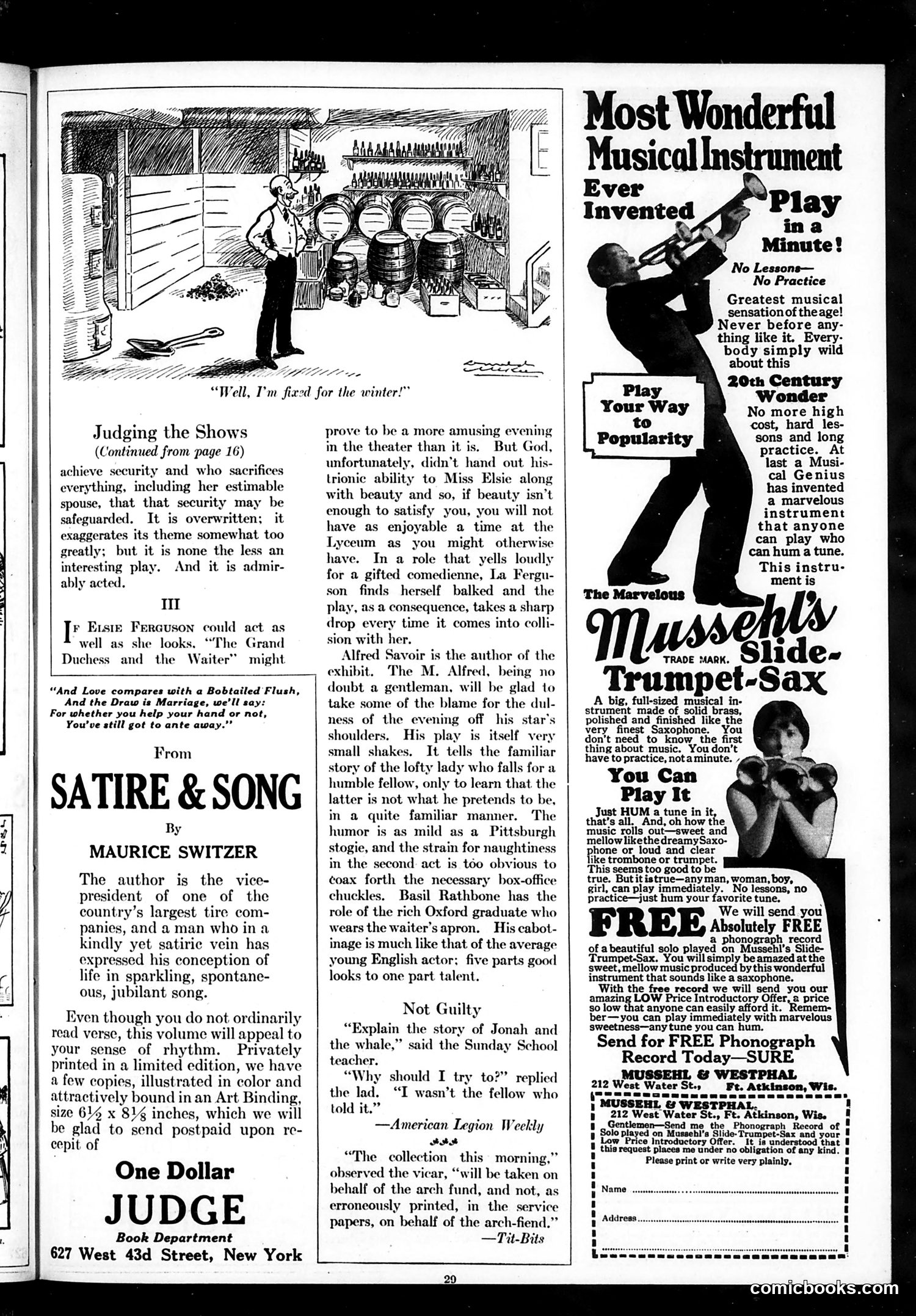
This page contains theater criticism and advertising rather than political cartoons. The main content includes: **Theater Reviews**: A critic evaluates recent theatrical productions, including "The Grand Duchess and the Waiter," critiquing actress Elsie Ferguson's beauty but limited acting ability, and praising actor Basil Rathbone despite the play's weak plot. **The Cartoon**: A single small illustration shows a man in a cellar standing before large barrels, captioned "Well, I'm fixed for the winter!"—likely commenting on Prohibition-era home alcohol production, a common humorous reference of the 1920s-30s. **Humor Fillers**: Short jokes about religion (Jonah and the whale; church fundraising typo) reflect period sensibilities. **Advertisement**: The bulk of space promotes the "Mussehls Slide-Trumpet-Sax," a dubious musical instrument promising instant musicianship "no lessons, no practice"—satirizing get-rich-quick schemes typical of magazine advertising. The page reflects Judge's satirical voice through both editorial content and the absurd ads it published.
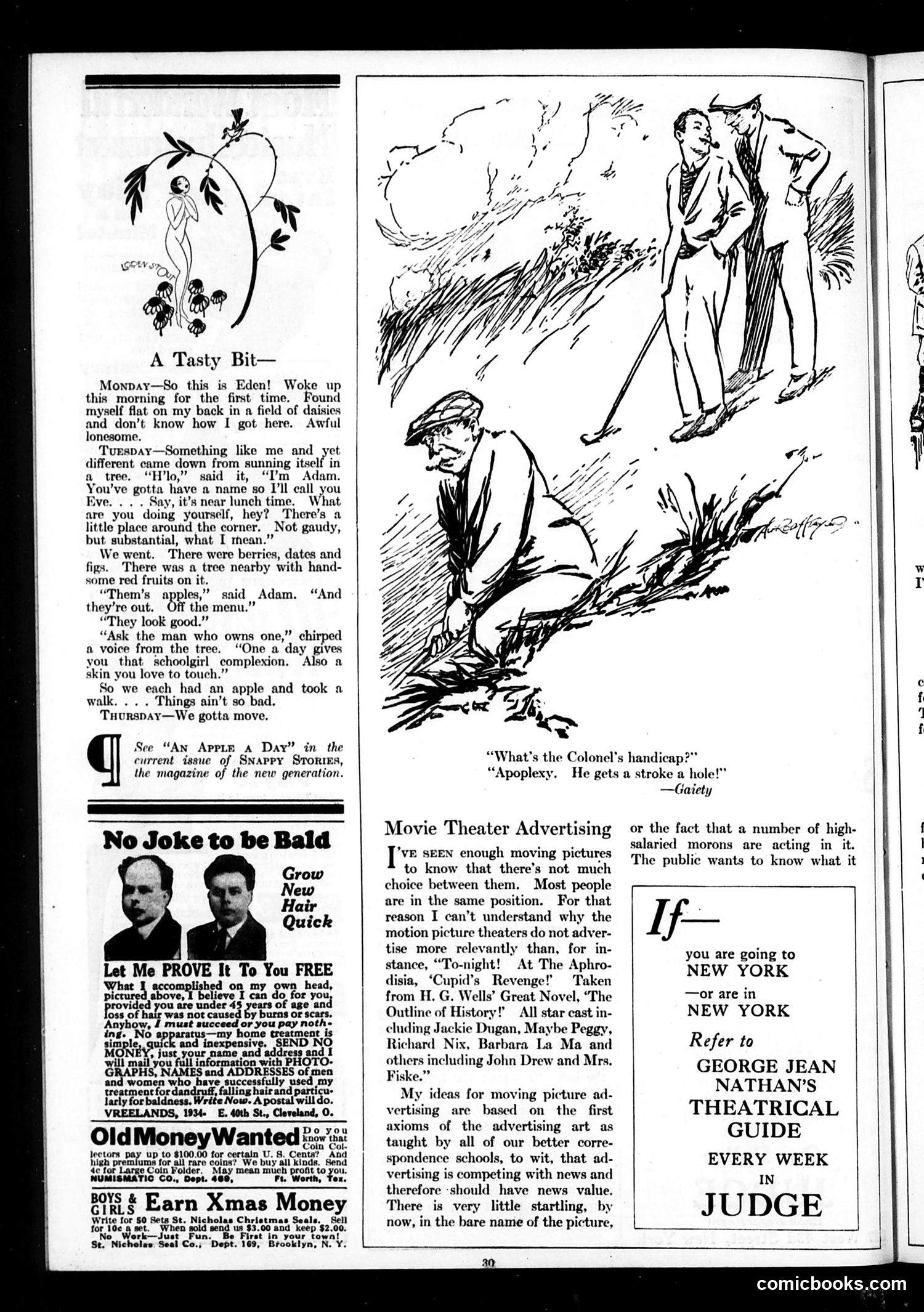
This comic strip satirizes the biblical Adam and Eve story through a modern lens. The humor works on multiple levels: **The Setup:** A newly conscious being ("Eden") encounters Adam, who immediately treats her as a dating prospect—establishing a restaurant outing and complimenting her appearance with a sales pitch about apples giving "schoolgirl complexion." **The Satire:** The piece mocks contemporary advertising culture by placing a modern cosmetics pitch ("One a day gives you that schoolgirl complexion") in humanity's origin story. The serpent has become a beauty-product huckster. By Thursday, they've already "gotta move"—suggesting the relationship failed as quickly as modern romance. **The Point:** Judge is satirizing both aggressive commercial advertising (especially beauty products targeting women) and the performative nature of courtship in consumer culture. The timeless biblical narrative becomes a vehicle to mock 1920s-era hard-sell advertising tactics and how commercialism has infiltrated even the most sacred narratives. The accompanying "Snappy Stories" advertisement suggests the piece also promotes competitor magazine content.
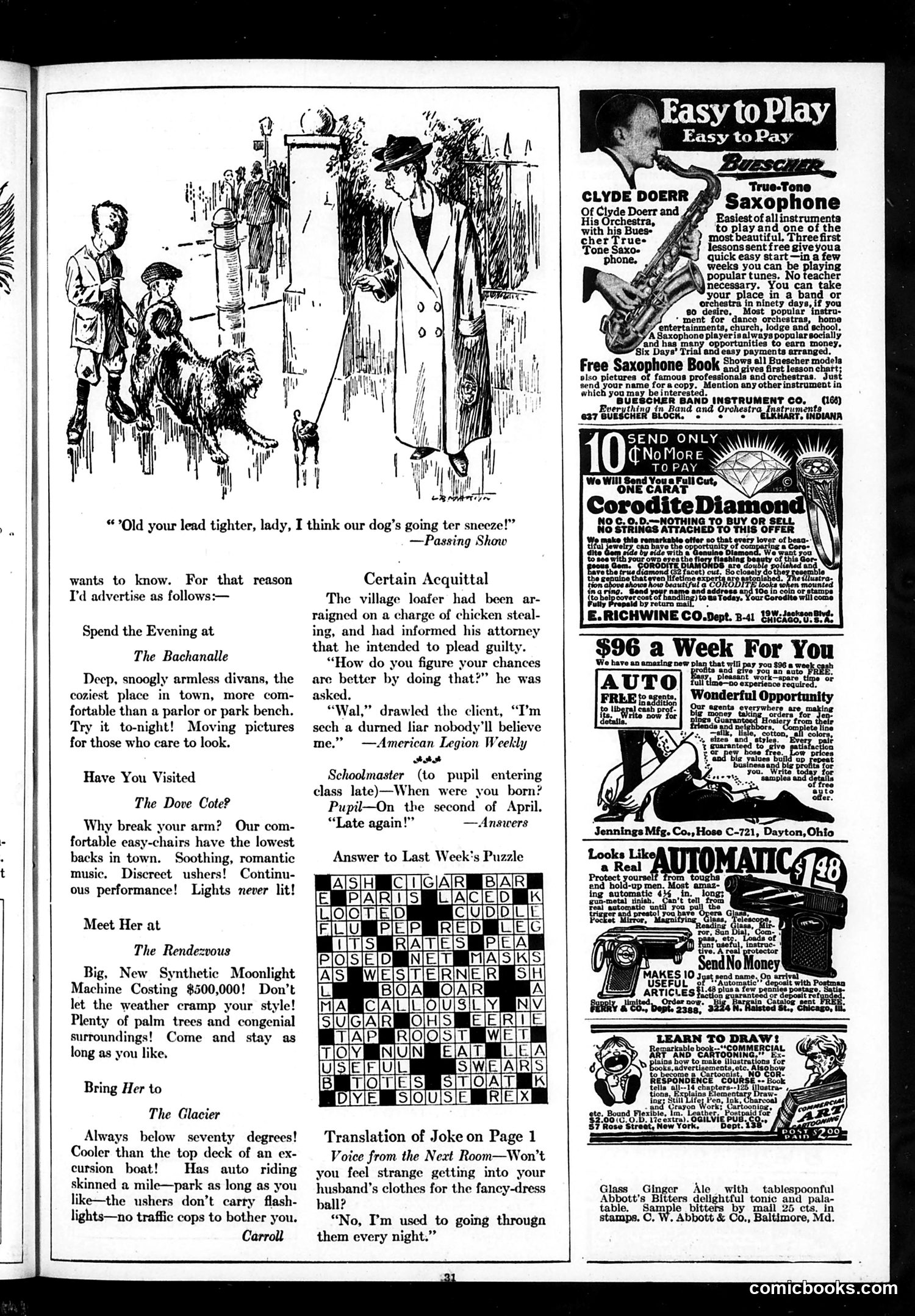
## Main Cartoon The cartoon depicts a couple in a car with a dog; the man warns the woman to "hold your lead tighter, lady, I think our dog's going ter sneeze!" This is a visual pun—"lead" refers both to the dog's leash and to the woman's role as the "lead" (female) in the romantic situation. The joke plays on early 20th-century courtship anxieties about physical contact and propriety. ## Text Content The page consists mainly of: - **Humorous advertisements** for entertainment venues ("The Bachanalle," "The Dove Cote") that satirize how businesses market romantic/intimate settings to couples - **Short jokes** about social situations (a guilty defendant claiming nobody believes him; a pupil's excuse for tardiness; a wife's quip about accessing her husband's belongings) - **Vintage advertisements** for saxophones, automotive products, and patent medicines ## Context This reflects 1920s-era American humor focused on dating etiquette, gender relations, and consumer culture. The satirical advertisements mock commercialized romance.
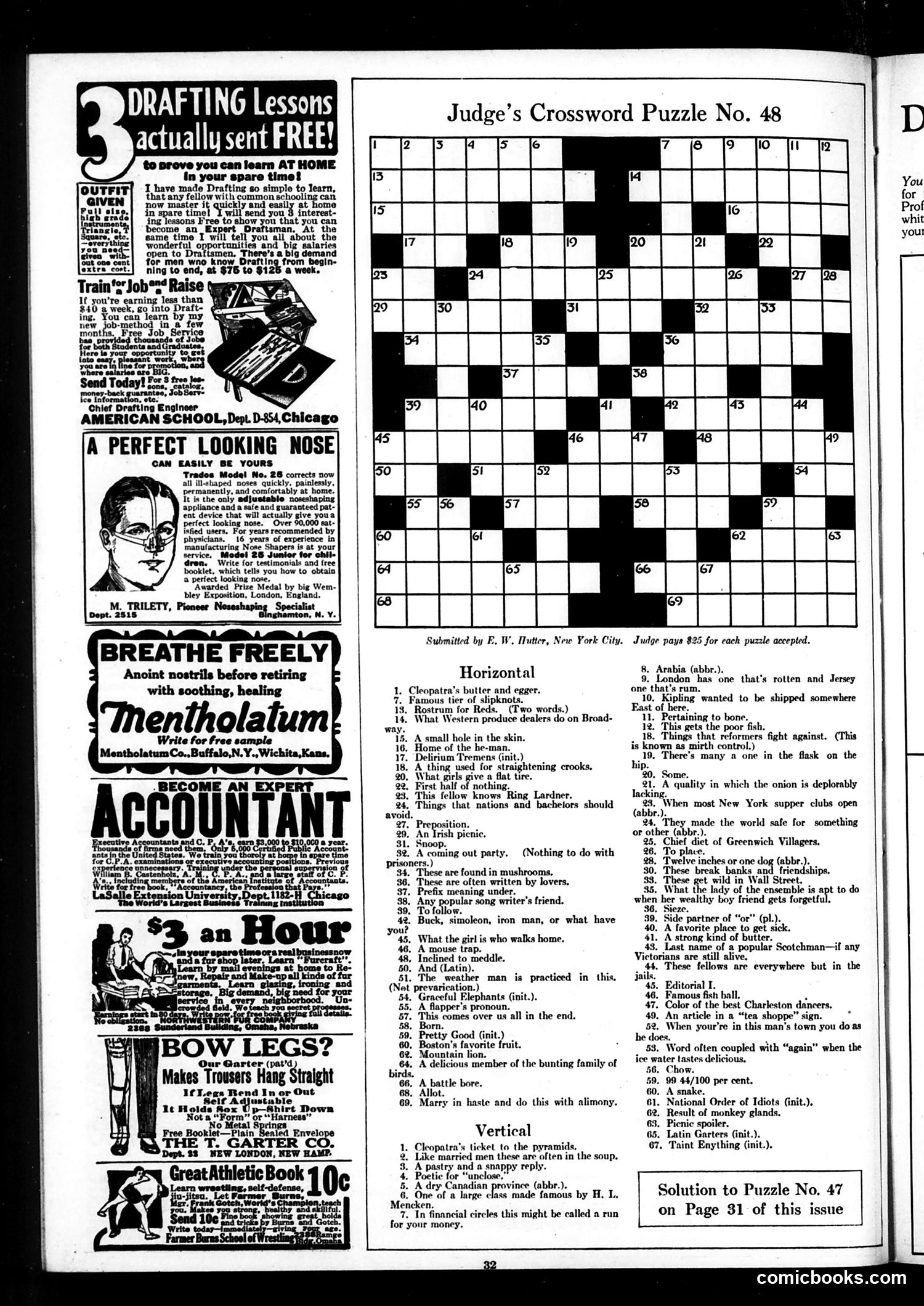
This page is primarily a **crossword puzzle** submission with accompanying advertisements—typical filler content for Judge magazine. The puzzle itself contains no political satire; it's a standard word puzzle with clues ranging from literary references (Ring Lardner, H.L. Mencken) to contemporary slang ("simoleon" for money, "flapper"). The **advertisements** surrounding it reveal the economic concerns of the 1920s-era readership: vocational training (drafting, accounting), personal improvement schemes (a nose-shaping device, mentholatum), and fashion solutions (a garter to straighten trouser legs). These ads reflect period anxieties about social mobility and appearance. The crossword clues occasionally reference contemporary figures and slang but lack satirical bite—they're simply period-appropriate puzzle content. The $25 payment offered for accepted puzzles indicates Judge actively solicited reader submissions.
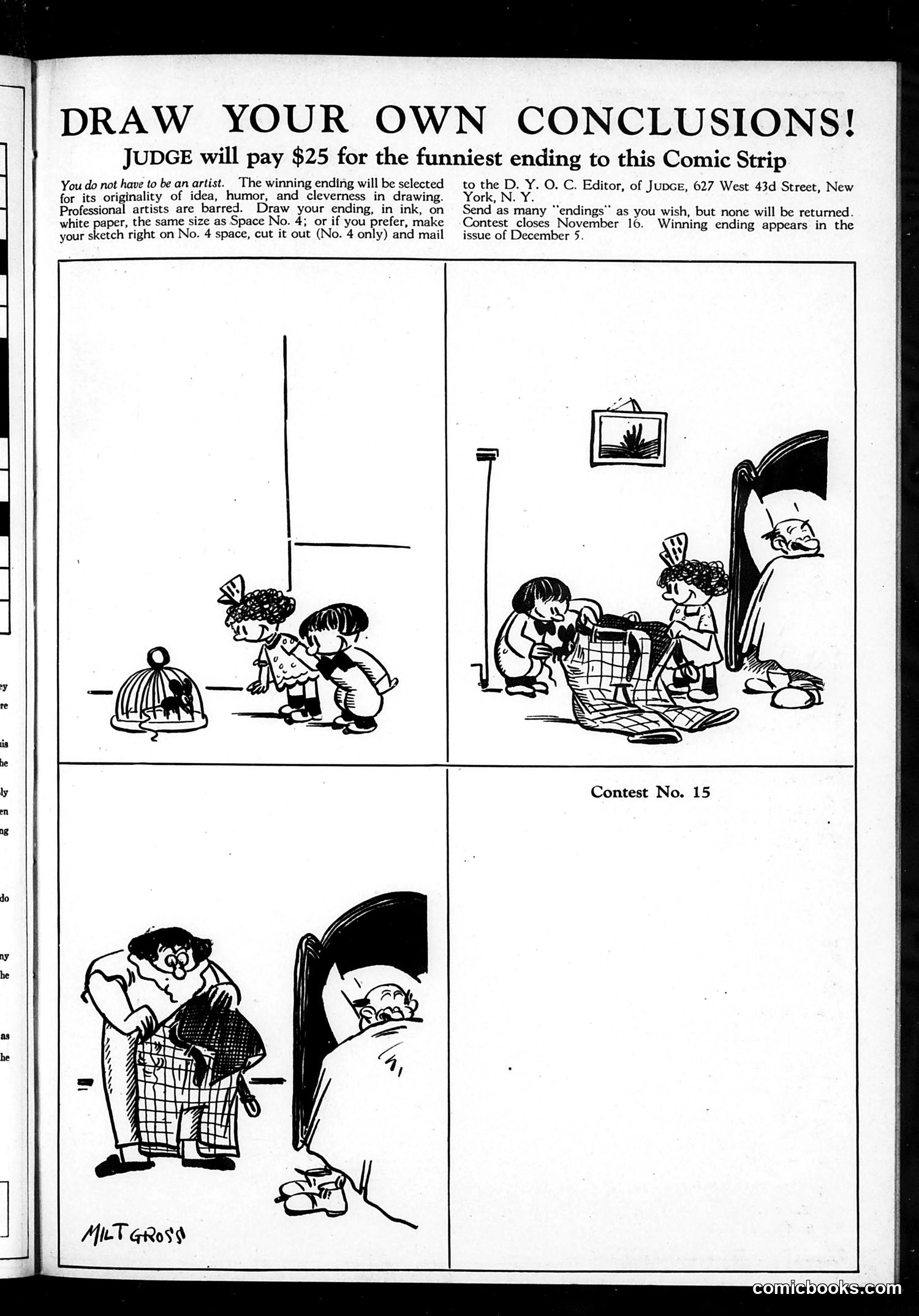
This is a reader-participation contest from *Judge* magazine offering $25 for the funniest comic strip ending. The strip, drawn by Milt Gross (a prominent cartoonist of the era), shows a domestic scene: children playing with dolls and a picnic basket, observed by adults including what appears to be a woman and a man in a coat. The narrative setup is incomplete—readers are invited to supply their own punchline or conclusion. This was a common *Judge* feature testing readers' humor and wit rather than artistic skill (professionals were barred from entering). The joke likely hinges on mundane domestic/family life and children's play, typical of *Judge's* middle-class humor from this period. Without the intended punchline visible, modern readers would miss the specific satirical target, though the format itself—crowdsourcing comedy—remains recognizable today.
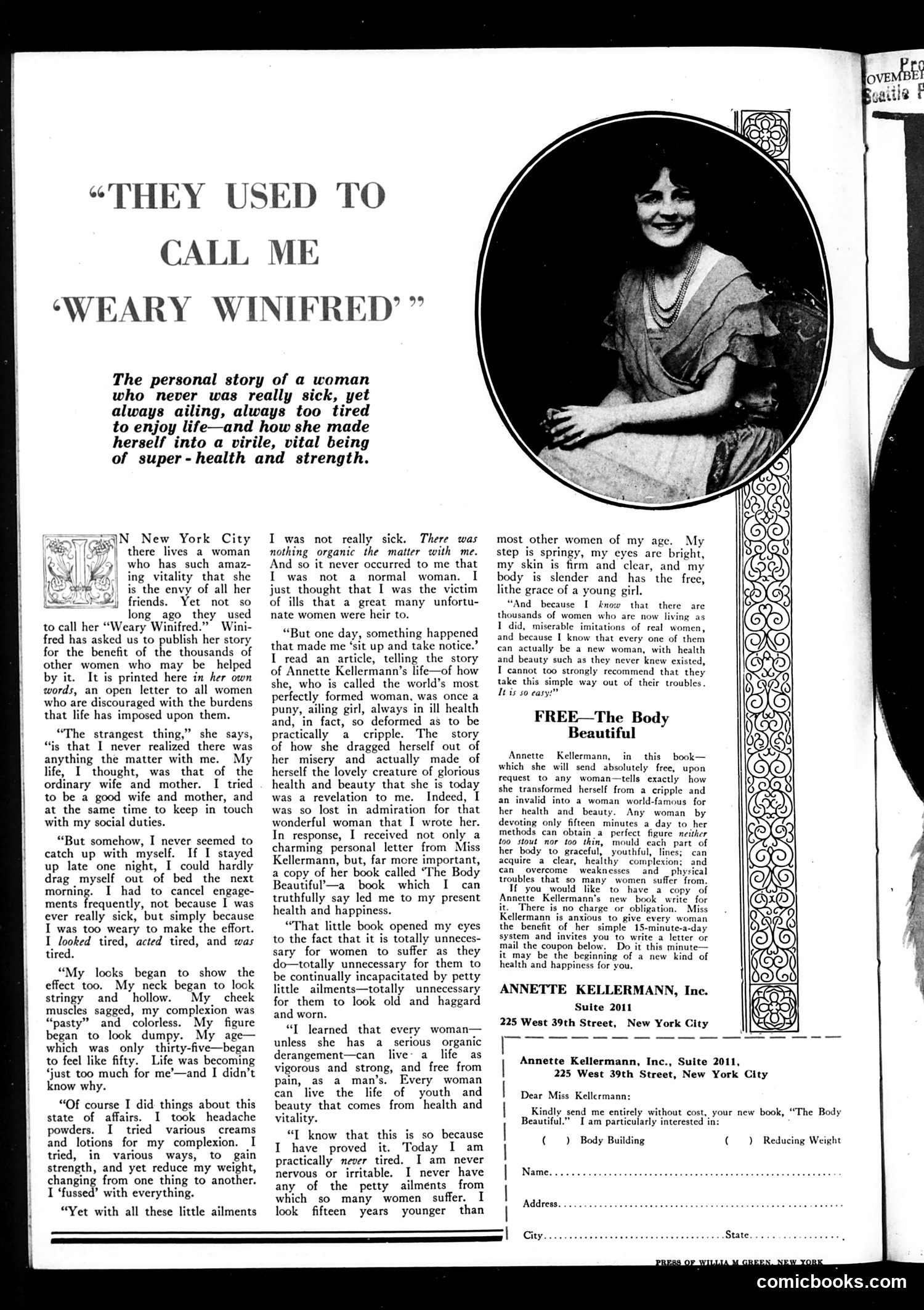
This page is primarily an **advertisement masquerading as editorial content**, not political satire. It's a testimonial promoting Annette Kellermann's self-help book *The Body Beautiful*. The narrative presents "Winifred," a fictional 35-year-old housewife who suffered chronic fatigue and physical decline without medical cause. She attributes her transformation to reading about Kellermann—a real Australian swimmer/performer famous for physical fitness and beauty—and following principles in Kellermann's book. The implicit message targets early 20th-century women: chronic tiredness and poor appearance aren't unavoidable; they result from neglecting one's body. The solution is purchasing Kellermann's book, which promises any woman can achieve youthful vigor through proper self-care. This reflects period attitudes conflating women's health with appearance and vitality with moral/personal worth—positioning wellness as a purchasable commodity.