
Judge, 1925-11-07 · page 12 of 36
Judge — November 7, 1925 — page 12: what you’re looking at
What you’re looking at
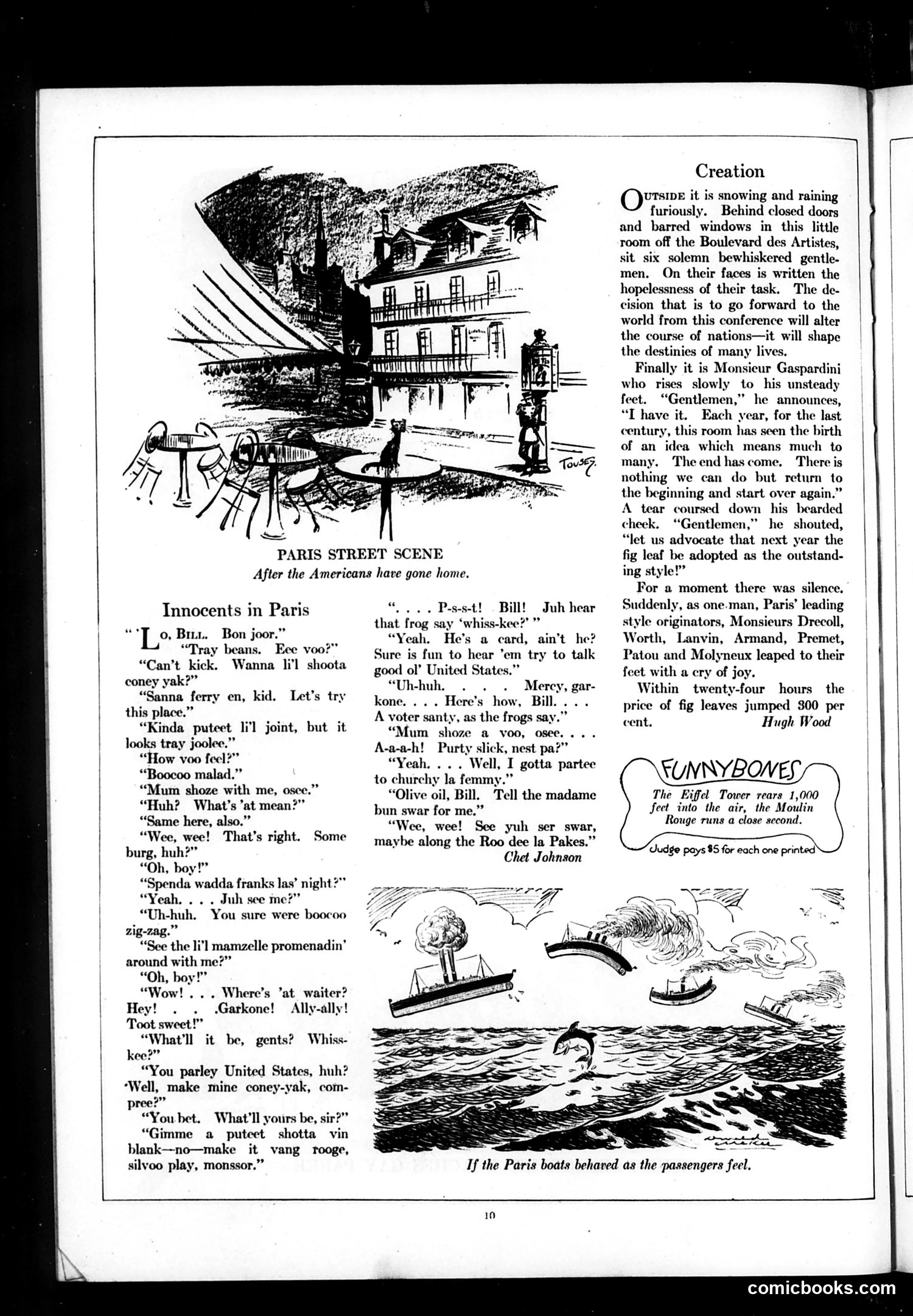
This Judge magazine page satirizes American soldiers in post-World War I Paris through two pieces: **"Innocents in Paris"** mocks American GIs attempting French, depicted through mangled pseudo-French dialogue ("coney yak" for cognac, "garçon" as "garkone"). The humor relies on Americans butchering the language while confidently ordering drinks and pursuing women—a stereotype of uncultured American servicemen abroad. The soldiers find this amusing themselves, laughing at French attempts to speak English. **"Creation"** is a separate satirical vignette about Parisian fashion designers (Worth, Lanvin, Patou, Molyneux—all real couture houses) meeting to decide next season's trend. Their solution: adopt the fig leaf as fashion. The joke: this drives demand so high that fig leaf prices spike 800%. It's social satire about fashion's absurd cyclicality and how designers can profit from any trend, however ridiculous. Both pieces reflect post-WWI American attitudes: condescension toward European culture mixed with newfound economic power—American soldiers spending freely in Paris, American capital driving European markets.
📄 Transcribed text from this page (OCR, searchable)
Machine-transcribed from the original scan — historical spelling and the odd misread are preserved.
PARIS STREET SCENE After the Americans have gone home. Innocents in Paris “ ‘Le Br. Bon joor.” “Tray beans. Eee voo?” “Can’t kick. Wanna li'l shoota coney yak?” “Sanna ferry en, kid. this place.” “Kinda puteet li'l joint, but it looks tray joolee.” “How voo feel?” “Boocoo malad.” “Mum shoze with me, osece.” “Huh? What’s ’at mean?” “Same here, also.” “Wee, wee! That’s right. Some burg, huh?” “Oh, boy!” “Spenda wadda franks las’ night?” “Yeah. . . . Juh see me?” “Uh-huh. You sure were boocoo zig-zag.” “See the li'l mamzelle promenadin’ around with me?” “Oh, boy!” “Wow! . .. Where’s ’at waiter? Let’s try Hey! . .Garkone! Ally-ally! Toot sweet! “What'll it be, gents? Whiss- kee?” “You parley United States, huh? ‘Well, make mine coney-yak, com- pree?” “Youbet. What’ll yours be, sir?” “Gimme a puteet shotta vin blank—no—make it vang rooge, silyoo play, monssor.” “)... P-s-s-t! . Bill! that frog say ‘whiss-kee?’ ” “Yeah. He's a card, ain't he? Sure is fun to hear ’em try to talk good ol’ United States.” “Uh-huh, Mercy, gar- kone. . . . Here’s how, Bill... . A voter santy, as the frogs say.” “Mum shoze a voo, osee.... A-a-a-h! Purty slick, nest pa? “Yeah. « Well, I gotta partee to churchy la femmy.” “Olive oil, Bill. Tell the madame bun swar for me.” “Wee, wee! See yuh ser swar, maybe along the Roo dee la Pakes.”” Chet Johnson Juh hear ey a Creation UTSIDE it is snowing and raining furiously. Behind closed doors and barred windows in this little room off the Boulevard des Artistes, sit six solemn bewhiskered gentle- men. On their faces is written the hopelessness of their task. The de- cision that is to go forward to the world from this conference will alter the course of nations—it will shape the destinies of many lives. Finally it is Monsicur Gaspardini who rises slowly to his unsteady feet. “Gentlemen,” he announces, “T have it. Each year, for the last century, this room has seen the birth of an idea which means much to many. Theendhascome. There is nothing we can do but return to the beginning and start over again.” A tear coursed down his bearded cheek, “Gentlemen,” he shouted, “let us advocate that next year the fig leaf be adopted as the outstand- ing style!” For a moment there was silence. Suddenly, as one.man, Paris’ leading style originators, Monsieurs Drecoll, Worth, Lanvin, Armand, Premet, Patou and Molyneux leaped to their feet with a cry of joy. Within twenty-four hours the price of fig leaves jumped 800 per cent, Hugh Wood The Eiffel Tower rears 1,000 Seet into the air, the Moulin Rouge runs a close second. ‘ude pays $5 for each one printed comicbooks.com