
Judge, 1925-11-07 · page 18 of 36
Judge — November 7, 1925 — page 18: what you’re looking at
What you’re looking at
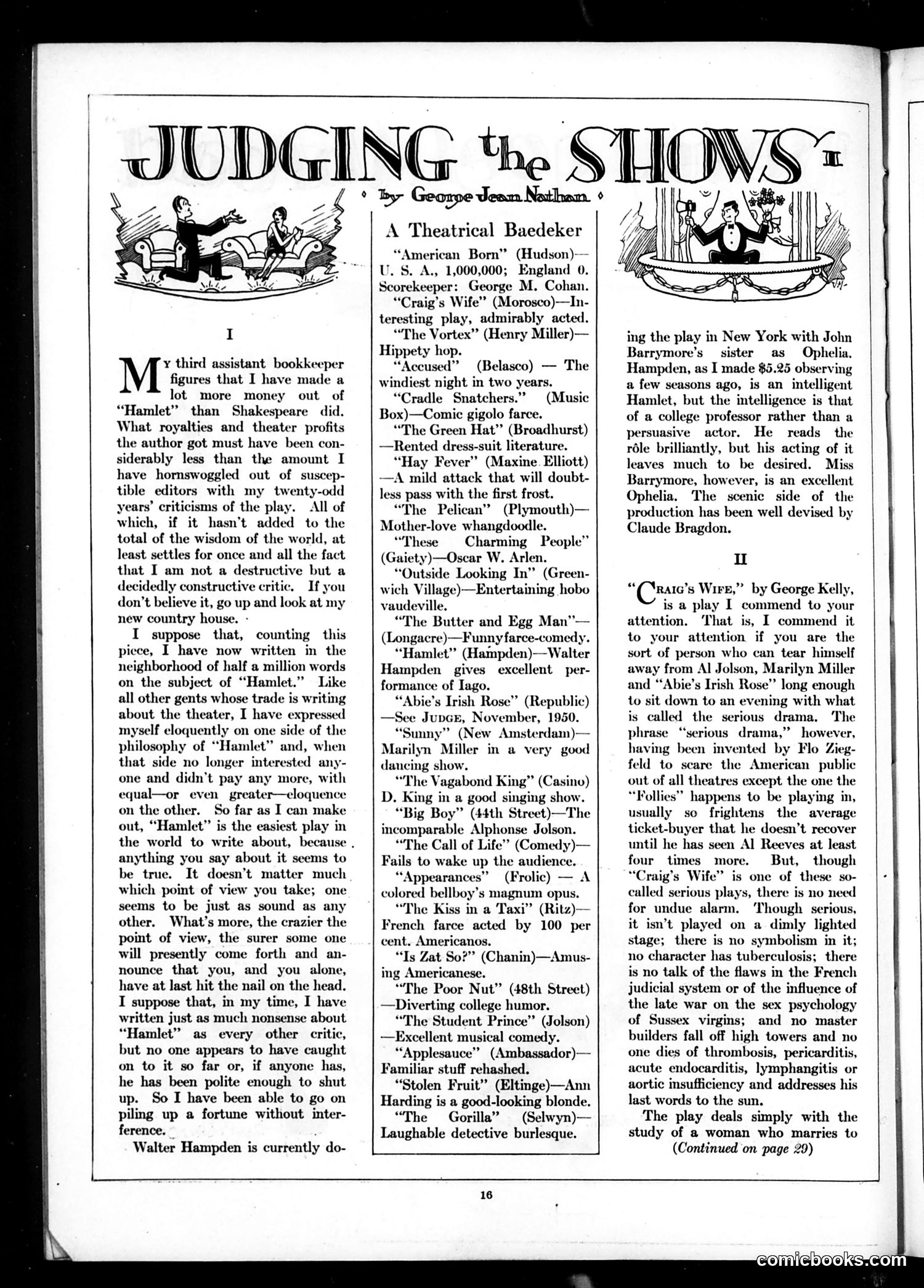
This page contains theater criticism rather than political satire. Nathan, a prominent drama critic, opens with a self-congratulatory essay about profiting from decades of writing about *Hamlet*—claiming he's made more money from criticism than Shakespeare did from royalties. He humorously boasts that his contradictory interpretations have all seemed valid, suggesting theater criticism is inherently malleable nonsense. The second section is a "Theatrical Baedeker"—a satirical capsule review of current Broadway productions (circa 1923). Nathan delivers witty, dismissive one-liners: calling one play "rented dress-suit literature," another "hippety hop," and cruelly noting that Walter Hampden's *Hamlet* performance makes him sound like Iago instead. The humor lies in Nathan's acidic verdicts on contemporary theater's quality, revealing his contempt for much of what Broadway was producing at the time.
📄 Transcribed text from this page (OCR, searchable)
Machine-transcribed from the original scan — historical spelling and the odd misread are preserved.
Y third assistant bookkeeper M figures that I have made a lot more money out of “Hamlet” than Shakespeare did. What royalties and theater profits the author got must have been con- siderably less than the amount I have hornswoggled out of suscep- tible editors with my twenty-odd years’ criticisms of the play. All of which, if it hasn't added to the total of the wisdom of the world, at least settles for once and all the fact that I am not a destructive but a decidedly constructive critic. If you don’t believe it, go up and look at my new country house. - I suppose that, counting this picce, I have now written in the neighborhood of half a million words on the subject of “Hamlet.” Like all other gents whose trade is writing about the theater, I have expressed myself eloquently on one side of the philosophy of “Hamlet” and, when that side no longer interested any- one and didn’t pay any more, with equal—or even greater—cloquence on the other. So far as I can make out, “Hamlet” is the easiest play in the world to write about, because . anything you say about it seems to be true. It doesn’t matter much which point of view you take; one seems to be just as sound as any other. What’s more, the crazier the point of view, the surer some one will presently come forth and an- nounce that you, and you alone, have at last hit the nail on the head. I suppose that, in my time, I have written just as much nonsense about “Hamlet” as every other critic, but no one appears to have caught on to it so far or, if anyone has, he has been polite enough to shut up. So I have been able to go on piling up a fortune without inter- ference. Walter Hampden is currently do- by Geonpe Jeam Nathan. 6 A Theatrical Baedeker “American Born” (Hudson)-— U.S. A., 1,000,000; England 0. Scorekeeper: George M. Cohan. “Craig’s Wife” (Morosco)—In- teresting play, admirably acted. “The Vortex” (Henry Miller)— Hippety hop. “Accused” (Belasco) — The windiest night in two years. “Cradle Snatchers.” (Music Box)—Comic gigolo farce. “The Green Hat” (Broadhurst) —Rented dress-suit literature. “Hay Fever” (Maxine. Elliott) —A mild attack that will doubt- less pass with the first frost. “The Pelican” (Plymouth)— Mother-love whangdoodle. “These Charming People” (Gaiety) —Oscar W. Arlen. “Outside Looking In” (Green- wich Village)—Entertaining hobo vaudeville. “The Butter and Egg Man”— (Longacre) —Funny farce-comedy. “Hamlet” (Hampden)—Walter Hampden gives excellent per- formance of Iago. “Abie’s Irish Rose” (Republic) —See Jupce, November, 1950. “Sunny” (New Amsterdam)— Marilyn Miller in a very good dancing show. “The Vagabond King” (Casino) D. King in a good singing show. “Big Boy” (44th Street)—The incomparable Alphonse Jolson. “The Call of Life’”’ (Comedy)— Fails to wake up the audience. “Appearances” (Frolic) — A colored bellboy’s magnum opus. “The Kiss in a Taxi” (Ritz) — French farce acted by 100 per cent. Americanos. “Is Zat So?” (Chanin)—Amus- ing Americanese. “The Poor Nut” (48th Street) —Diverting college humor. “The Student Prince” (Jolson) —Excellent musical comedy. “Applesauce” (Ambassador)— Familiar stuff rehashed. “Stolen Fruit” (Eltinge)—Ann Harding is a good-looking blonde. “The Gorilla” (Selwyn)— Laughable detective burlesque. ing the play in New York with John Barrymore's sister as Ophelia. Hampden, as I made $5.25 obsei a few seasons ago, is an intelligent Hamlet, but the intelligence is that of a college professor rather than a persuasive actor. He reads the role brilliantly, but his acting of it leaves much to be desired. Miss Barrymore, however, is an excellent Ophelia. The scenic side of the production has been well devised by Claude Bragdon. sig RAIG’s Wire,” by George Kelly, is a play I commend to your attention. ‘That is, I commend it to your attention if you are the sort of person who can tear himself away from Al Jolson, Marilyn Miller and “Abie’s Irish Rose” long enough to sit down to an evening with what is called the serious drama. The phrase “serious drama,” however, having been invented by Flo Zieg- feld to scare the American public out of all theatres except the one the “Follies” happens to be playing in, usually so frightens the average ticket-buyer that he doesn’t recover until he has seen Al Reeves at least four times more. But, though “Craig’s Wife” is one of these so- called serious plays, there is no need for undue alarm, ‘Though serious, it isn’t played on a dimly lighted stage; there is no symbolism in it; no character has tuberculosis; there is no talk of the flaws in the French judicial system or of the influence of the late war on the sex psychology of Sussex virgins; and no master builders fall off high towers and no one dies of thrombosis, pericarditis, acute endocarditis, lymphangitis or aortic insufficiency and addresses his last words to the sun. The play deals simply with the study of a woman who marries to (Continued on page 29)