
Judge, 1925-11-07 · page 15 of 36
Judge — November 7, 1925 — page 15: what you’re looking at
What you’re looking at
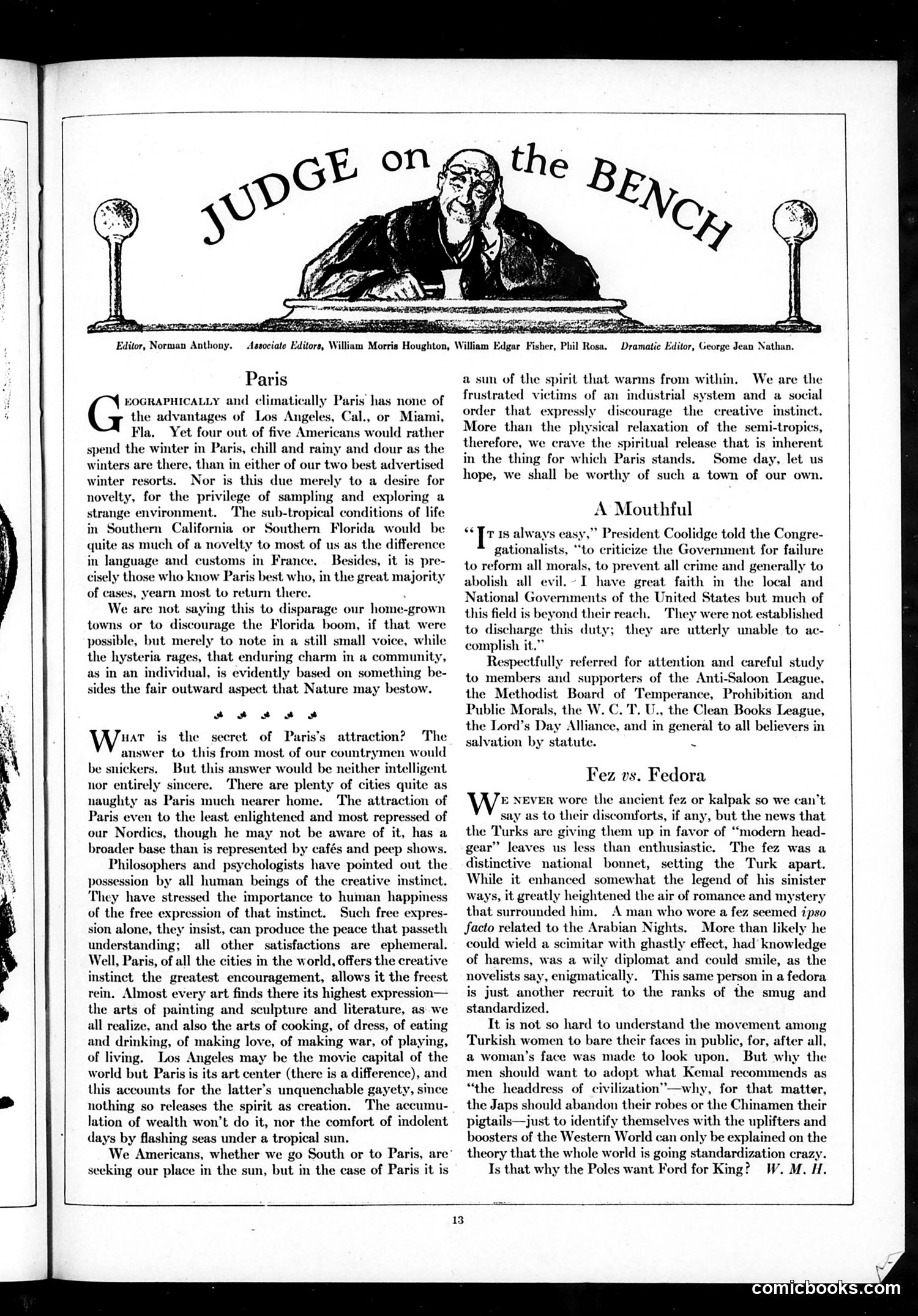
This page contains editorial essays rather than political cartoons. The header illustration shows a stern judge at a bench, framing the "Judge on the Bench" opinion column. **Main Content:** The first essay defends Paris's appeal to Americans over Florida/California resorts, arguing Paris attracts visitors because it encourages creative expression and artistic freedom—not merely vice. The author contends Paris represents spiritual and intellectual fulfillment that material comfort cannot provide. **"A Mouthful" Section:** This brief piece quotes President Coolidge telling Congregationalists that the government cannot reform all morals or prevent all crime—these matters exceed governmental capacity. The column respectfully refers the matter to moral reform organizations like the Anti-Saloon League and Methodist Board. **Context for Modern Readers:** This reflects 1920s American debates about Prohibition, moral regulation, and government responsibility. The page criticizes American consumerism while praising European culture—a common intellectual position among American elites of this era.
📄 Transcribed text from this page (OCR, searchable)
Machine-transcribed from the original scan — historical spelling and the odd misread are preserved.
the advantages of Los Angeles, Cal., or Miami, Fla. Yet four out of five Americans would rather spend the winter in Paris, chill and rainy and dour as the winters are there, than in either of our two best advertised winter resorts. Nor is this due merely to a desire for novelty, for the privilege of sampling and exploring a strange environment. The sub-tropical conditions of life in Southern California or Southern Florida would be quite as much of a novelty to most of us as the difference in language and customs in France. Besides, it is pre- cisely those who know Paris best who, in the great majority of cases, yearn most to return there. We are not saying this to disparage our home, -grown. towns or to discourage the Florida boom, if that were possible, but merely to note in a still small voice, while the hysteria rages, that enduring charm in a community, as in an individual, is evidently based on something be- sides the fair outward aspect that Nature may bestow. Wwe is the secret of Paris’s attraction? The answer to this from most of our countrymen would be snickers. But this answer would be neither intelligent nor entirely sincere. There are plenty of cities quite as naughty as Paris much nearer home. The attraction of Paris even to the least enlightened and most repressed of our Nordices, though he may not be aware of it, has a broader base than is represented by cafés and peep shows. Philosophers and psychologists have pointed out the possession by all human beings of the creative instinct. They have stressed the importance to human happiness of the free expression of that instinct. Such free expres- sion alone, they insist, can produce the peace that passeth understanding; all other satisfactions are ephemeral. Well, Paris, of all the cities in the world, offers the creative instinct the greatest encouragement, allows it the freest rein. Almost every art finds there its highest expression— the arts of painting and sculpture and literature, as we all realize, and also the arts of cooking, of dress, of eating and drinking, of making love, of making war, of playing, of living. Los Angeles may be the movie capital of the world but Paris is its art center (there is a difference), and this accounts for the latter’s unquenchable gayety, since nothing so releases the spirit as creation. The accumu- lation of wealth won’t do it, nor the comfort of indolent days by flashing seas under a tropical sun. We Americans, whether we go South or to Paris, are seeking our place in the sun, but in the case of Paris it is ( : EKOGRAPHICALLY and climatically Paris has none of tH HH SH a sun of the spirit that warms from within. We are the frustrated victims of an industrial system and a social order that expressly discourage the creative instinct. More than the physical relaxation of the semi-tropics, therefore, we crave the spiritual release that is inherent in the thing for which Paris stands. Some day, let us hope, we shall be worthy of such a town of our own, A Mouthful T 18 always easy,” Pre: sident Coolidge told the Congre- gationalis' i the Government for failure to reform all morals, to prevent all crime and generally to abolish all evil.» I have great faith in the local and National Governments of the United States but much of this field is beyond their reach. They were not established ge this duty; they are utterly unable to ac- ully referred for attention and careful study to members and supporters of the Anti-Saloon League, the Methodist Board of Temperance, Prohibition and Public Morals, the W. C. T. U., the Clean Books League, the Lord’s Day Alliance, and in general to all believers in salvation by statute. ss Fez vs. Fedora NEVER wore the ancient fez or kalpak so we can’t to their discomforts, if any, but the news that W the ‘Turks are giving them up in favor of “modern head- gear” leaves us less than enthusiastic. The fez was a distinctive national bonnet, setting the Turk apart. While it enhanced somewhat the legend of his sinister ways, it greatly heightened the air of romance and mystery that surrounded him. A man who wore a fez seemed ipso facto related to the Arabian Nights. More than likely he could wield a scimitar with ghastly effect, had’ knowledge of harems, was a wily diplomat and could smile, as the novelists say, enigmatically. This same person in a fedora is just another recruit to the ranks of the smug and standardized. It is not so hard to understand the movement among Turkish women to bare their faces in public, for, after all, a woman’s face was made to look upon. But why the men should want to adopt what Kemal recommends as “the headdress of civilization”—why, for that matter, the Japs should abandon their robes or the Chinamen their pigtails—just to identify themselves with the uplifters and boosters of the Western World can only be explained on the theory that the whole world is going standardization crazy. Is that why the Poles want Ford for King? W. M. H.