
A complete issue · 37 pages · 1925
Judge — September 26, 1925
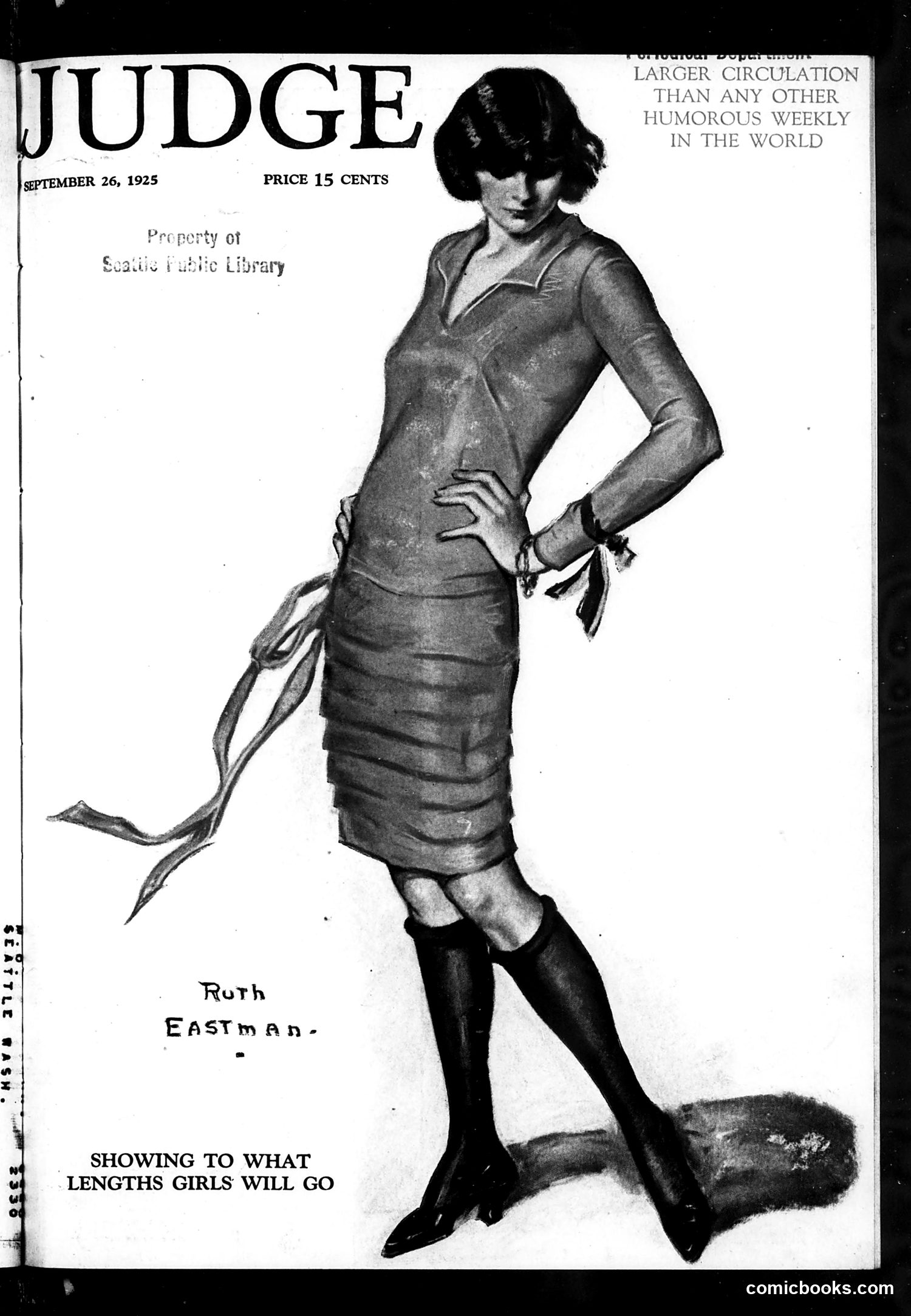
This cover features Ruth Eastman, a performer or public figure of the 1920s. The caption "SHOWING TO WHAT LENGTHS GIRLS WILL GO" suggests satirical commentary on women's fashion or behavior during the Jazz Age. The image depicts a woman in a form-fitting, horizontally-pleated dress with shortened hemline—typical 1920s "flapper" style—posed provocatively with ribbons. The satire appears to critique the increasingly daring fashion choices and social freedoms young women were embracing during this period. The exaggerated, somewhat unflattering pose and the reference to "lengths girls will go" mock both the extremes of flapper fashion and perhaps the social anxieties such changes provoked in more conservative quarters. This reflects typical Judge magazine content: satirizing contemporary social trends through humor.
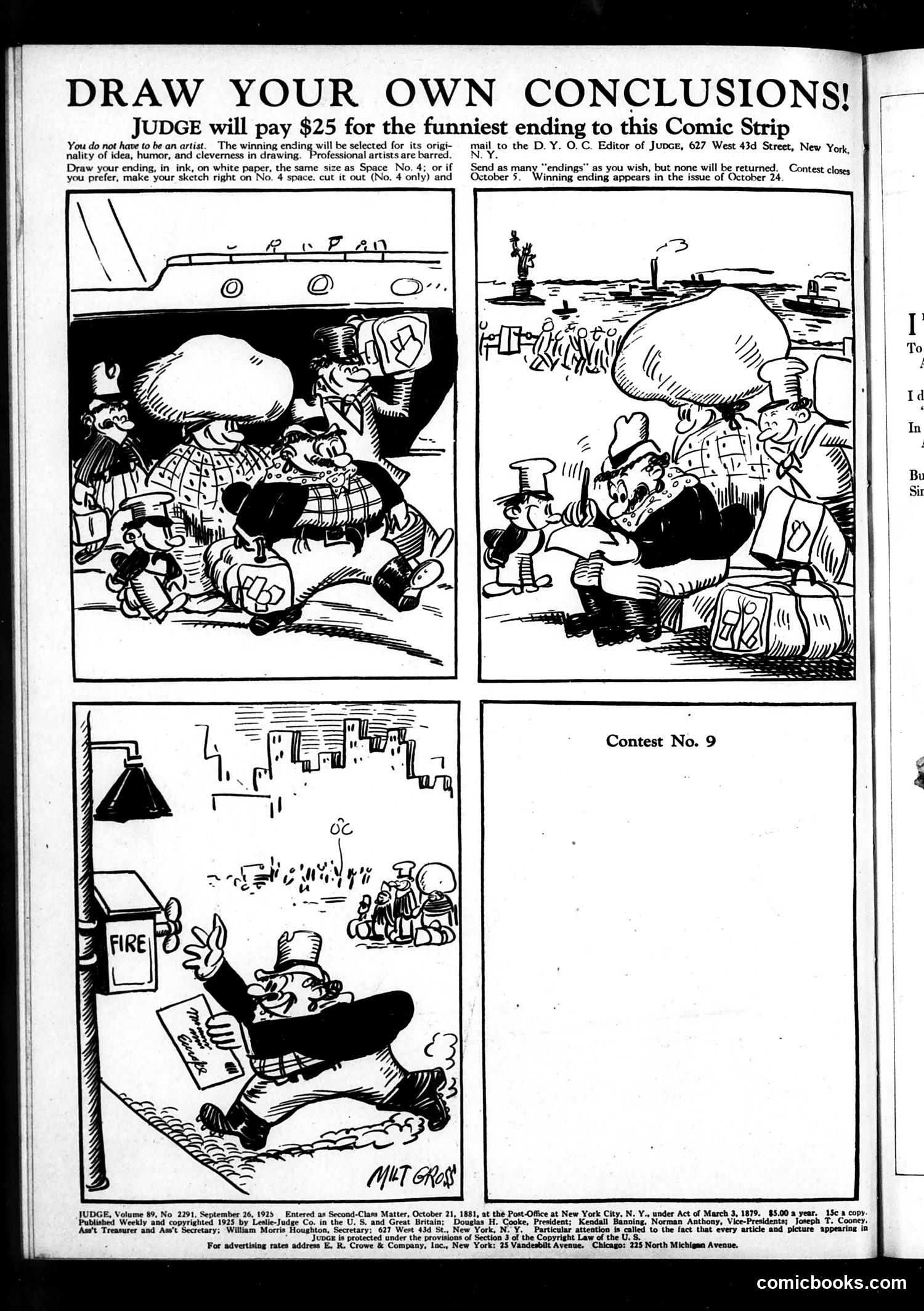
This page presents "Contest No. 9," inviting readers to complete a comic strip's ending for a $25 prize. The three completed panels show exaggerated cartoon scenarios typical of Judge's satirical humor. The top panels depict what appears to be crowded public transportation or an airship, with characters in comedic distress. The lower panel, signed by cartoonist Milt Gross, shows a figure in a top hat near a fire alarm and "FIRE" sign, apparently causing or reacting to chaos in an urban building. The humor relies on physical comedy and absurd situations rather than specific political commentary. This reflects Judge's early 20th-century focus on slapstick humor and social observation. The contest itself was a common magazine engagement tactic of the era, encouraging reader participation and submissions.
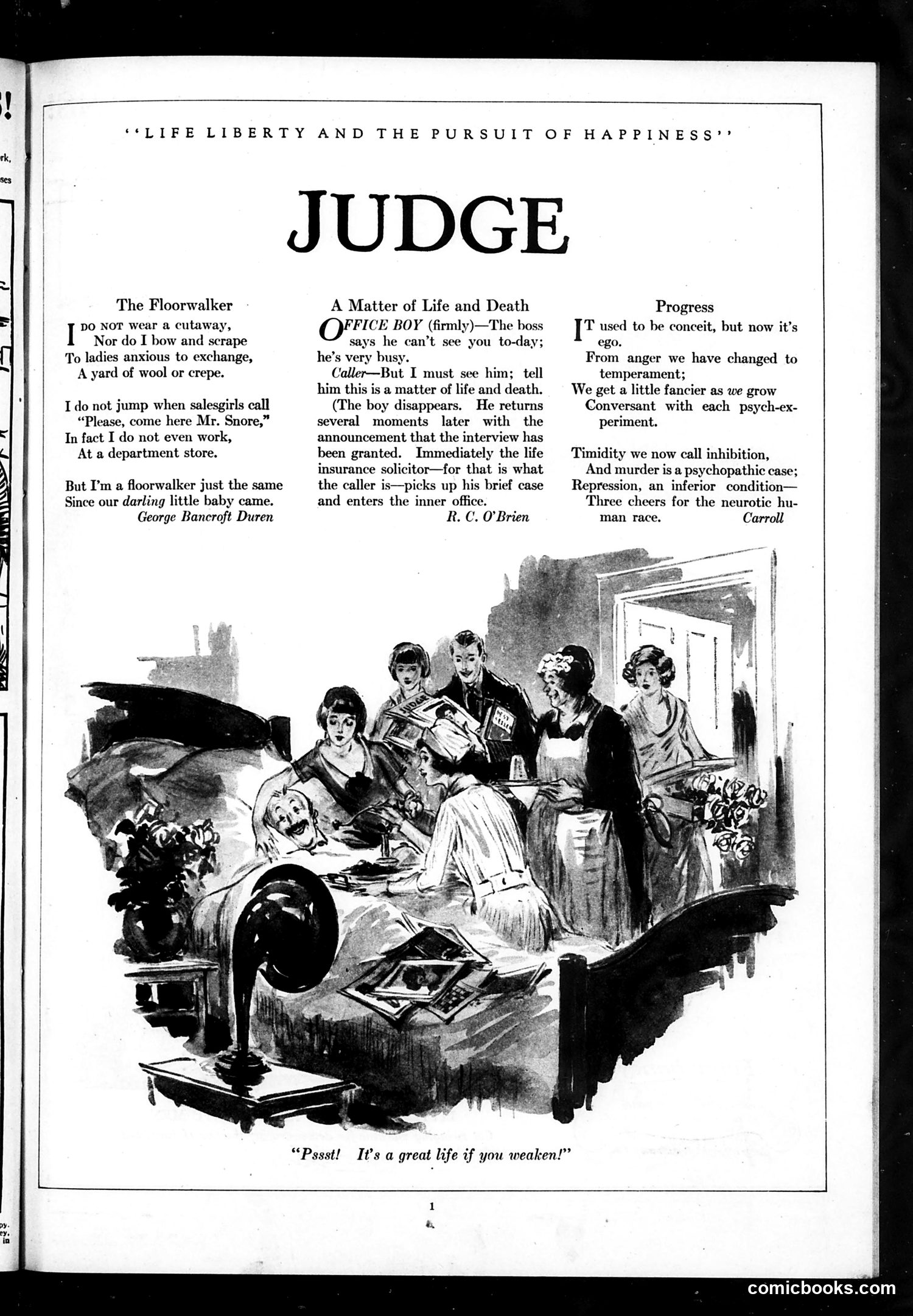
This page contains three separate pieces of social commentary: **"The Floorwalker"** satirizes workplace dignity—a department store employee maintains self-respect despite humble work. **"A Matter of Life and Death"** mocks bureaucratic indifference: an insurance company denies a policyholder's urgent request to see his case file, claiming business is too pressing. The irony is that life-and-death matters are reduced to procedural obstacles. **"Progress"** critiques modern psychology, suggesting society has traded genuine confidence for neurotic "inhibition" and "repression"—framing psychological concepts as fashionable weaknesses rather than progress. The illustration depicts women gossiping, with the caption "Psst! It's a great life if you weaken!"—reinforcing the theme that modern society encourages vulnerability disguised as sophistication.
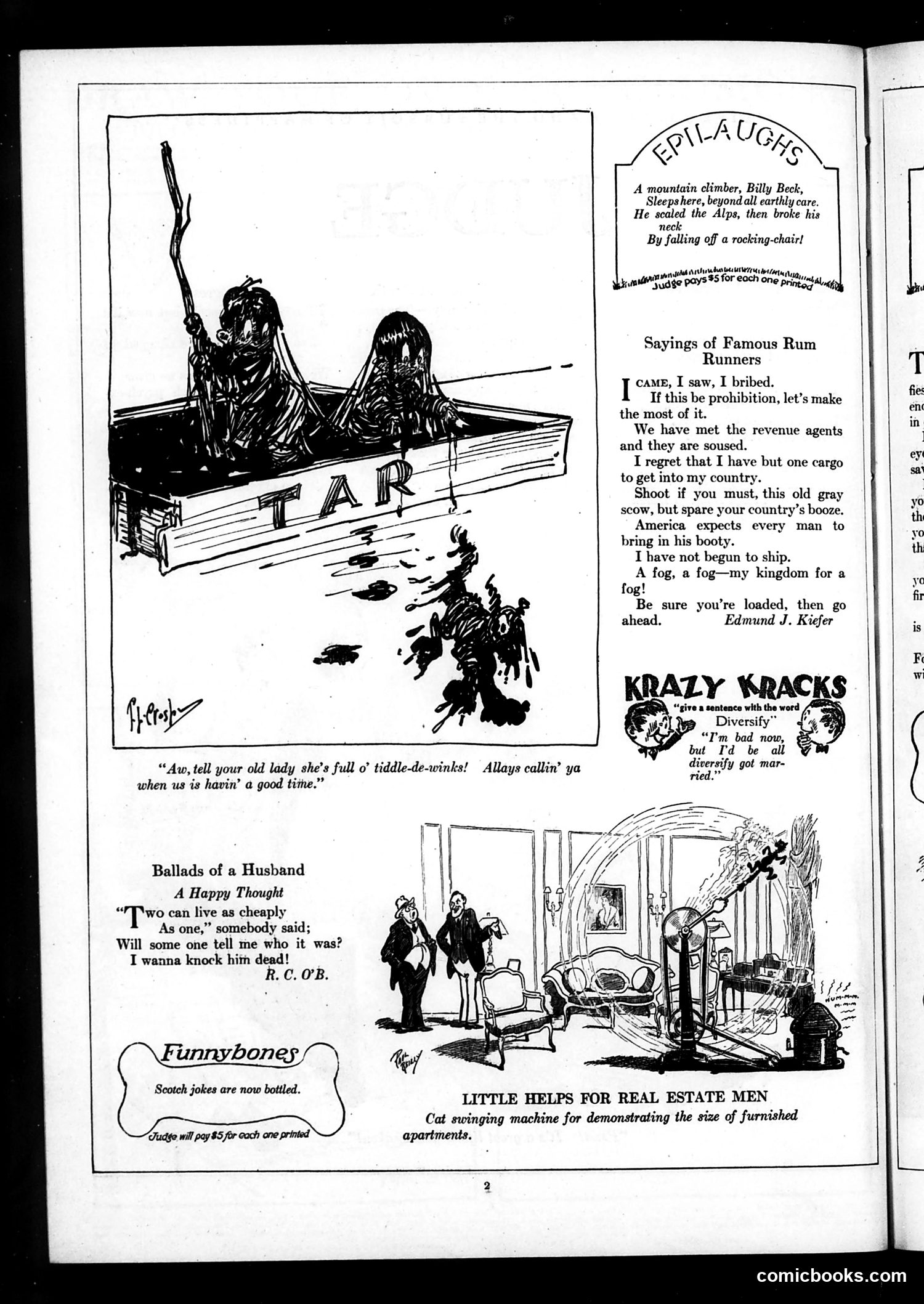
This page contains several satirical pieces about Prohibition-era smuggling and rum-running. The main cartoon depicts two figures in a tar barrel labeled "TAR," illustrating the caption about someone being "full of fiddle-de-winks" during a good time—likely mocking the hypocrisy of Prohibition enforcement. The "Sayings of Famous Rum Runners" section includes quotes attributed to Edmund J. Kiefer, referencing bribing revenue agents, smuggling cargo, and the expectation that "every man" brings booze into the country. This satirizes the widespread corruption and public flouting of Prohibition laws. Other sections mock marriage ("Ballads of a Husband") and include a real estate joke. The overall page targets Prohibition's ineffectiveness and the social consequences of alcohol bans during the 1920s-1930s.
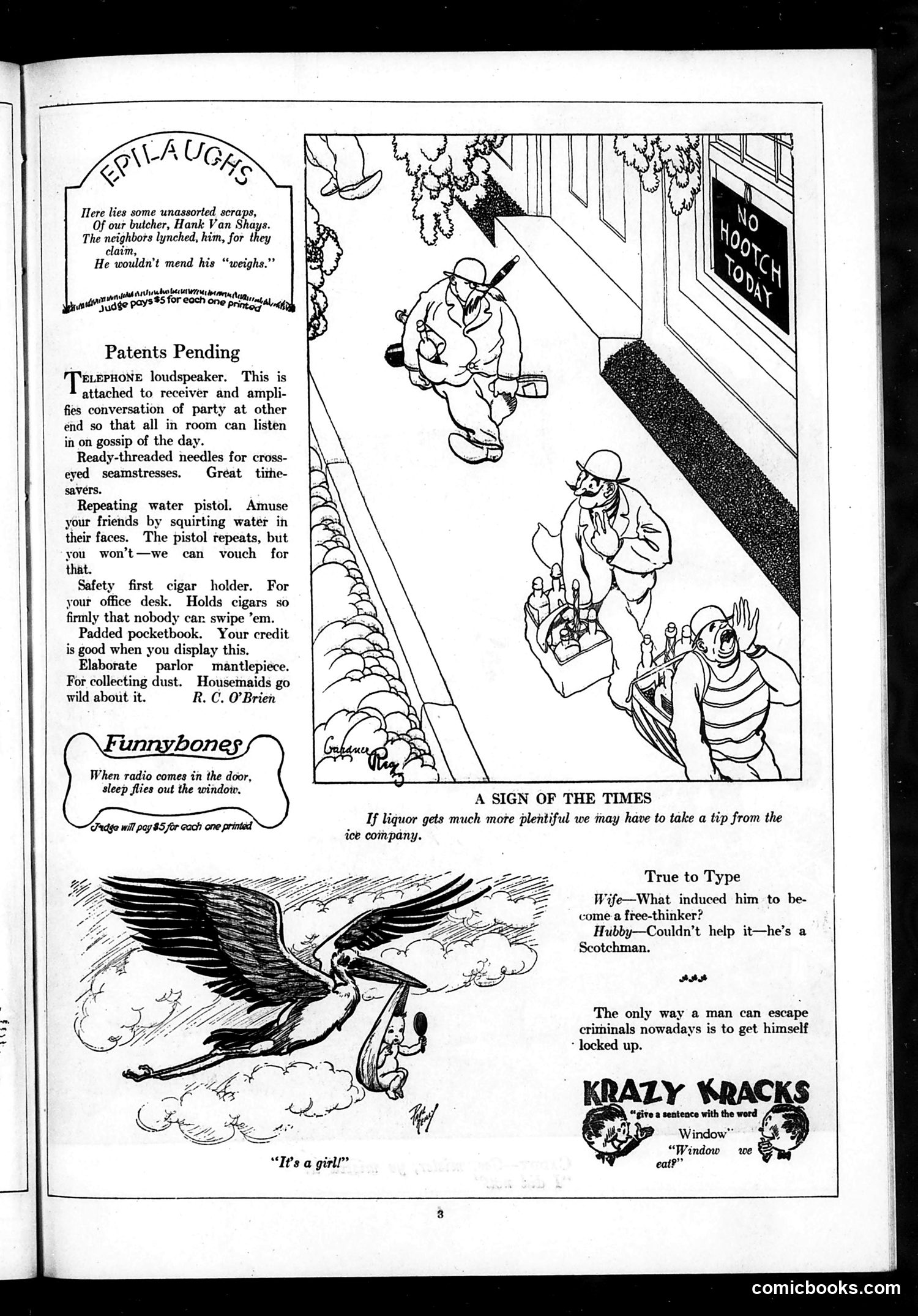
The main cartoon, "A Sign of the Times," depicts Prohibition-era bootlegging. The image shows men conducting what appears to be an illegal liquor operation near a building with a "No Hooch Today" sign—indicating the establishment's public facade of compliance with Prohibition laws (1920-1933). The caption jokes that "If liquor gets much more plentiful we may have to take a tip from the ice company," satirizing how ice delivery companies were actually fronts for distributing illegal alcohol during Prohibition. The cartoon mocks both the ineffectiveness of Prohibition enforcement and the transparent subterfuge used by speakeasies and bootleggers. The absurdity of the situation—that illegal liquor was becoming easier to obtain despite the law—is the satirical point.
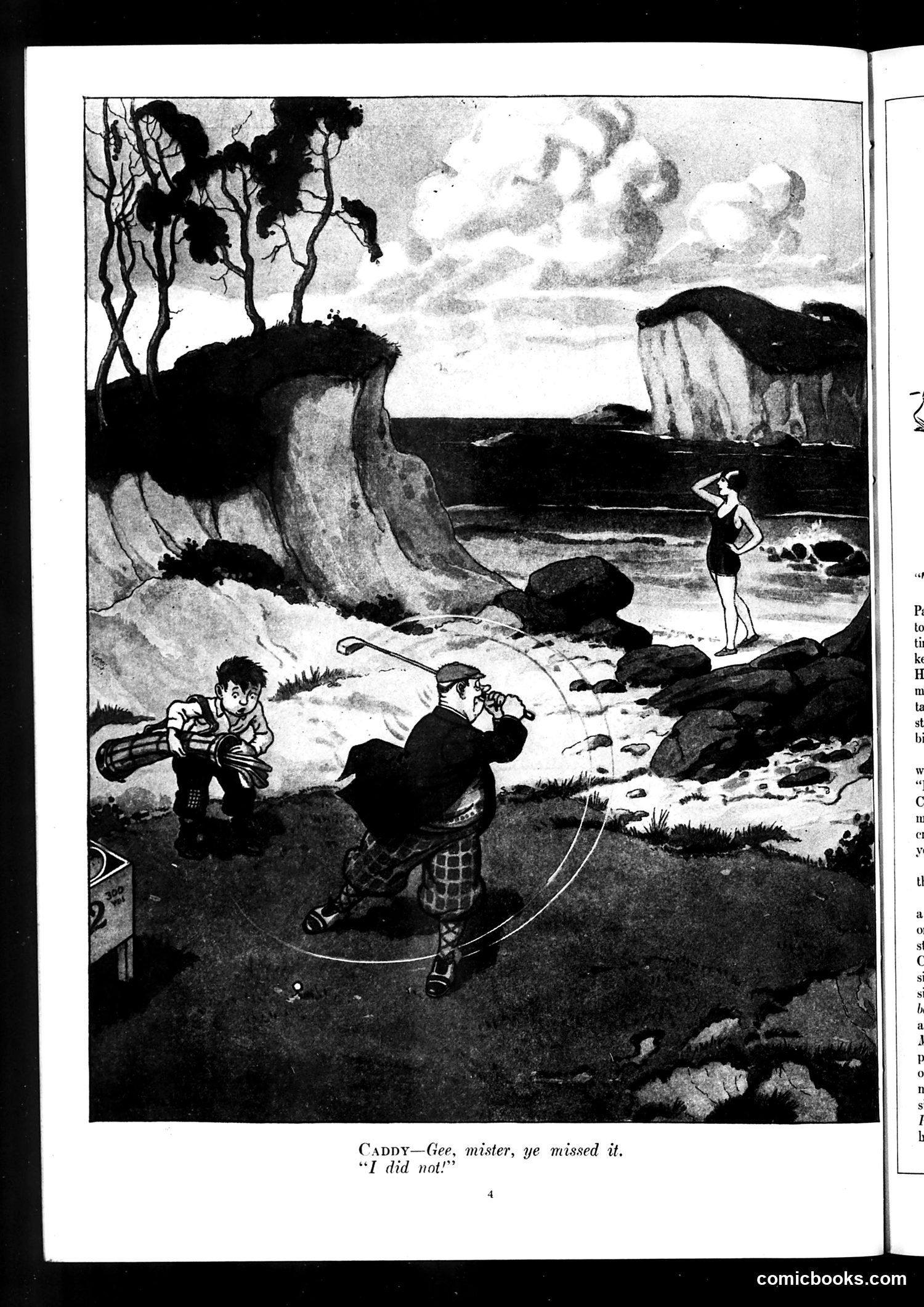
This illustration depicts a seaside golf scene with a humorous exchange. Two golfers appear to be playing near dramatic white cliffs (possibly Dover or similar coastal location). The caption reads: "CADDY—Gee, mister, ye missed it. 'I did not!'" The joke relies on a simple premise: the golfer insists he didn't miss his shot, contradicting what the caddy (and presumably the reader) clearly witnessed. This represents a common early-20th-century satirical theme mocking golfers' self-delusion or dishonesty about their poor play. The illustration style and setting are typical of Judge magazine's leisure-class humor targeting affluent readers who golfed. No obvious political commentary appears present—this is straightforward recreational satire about sporting vanity rather than social commentary.
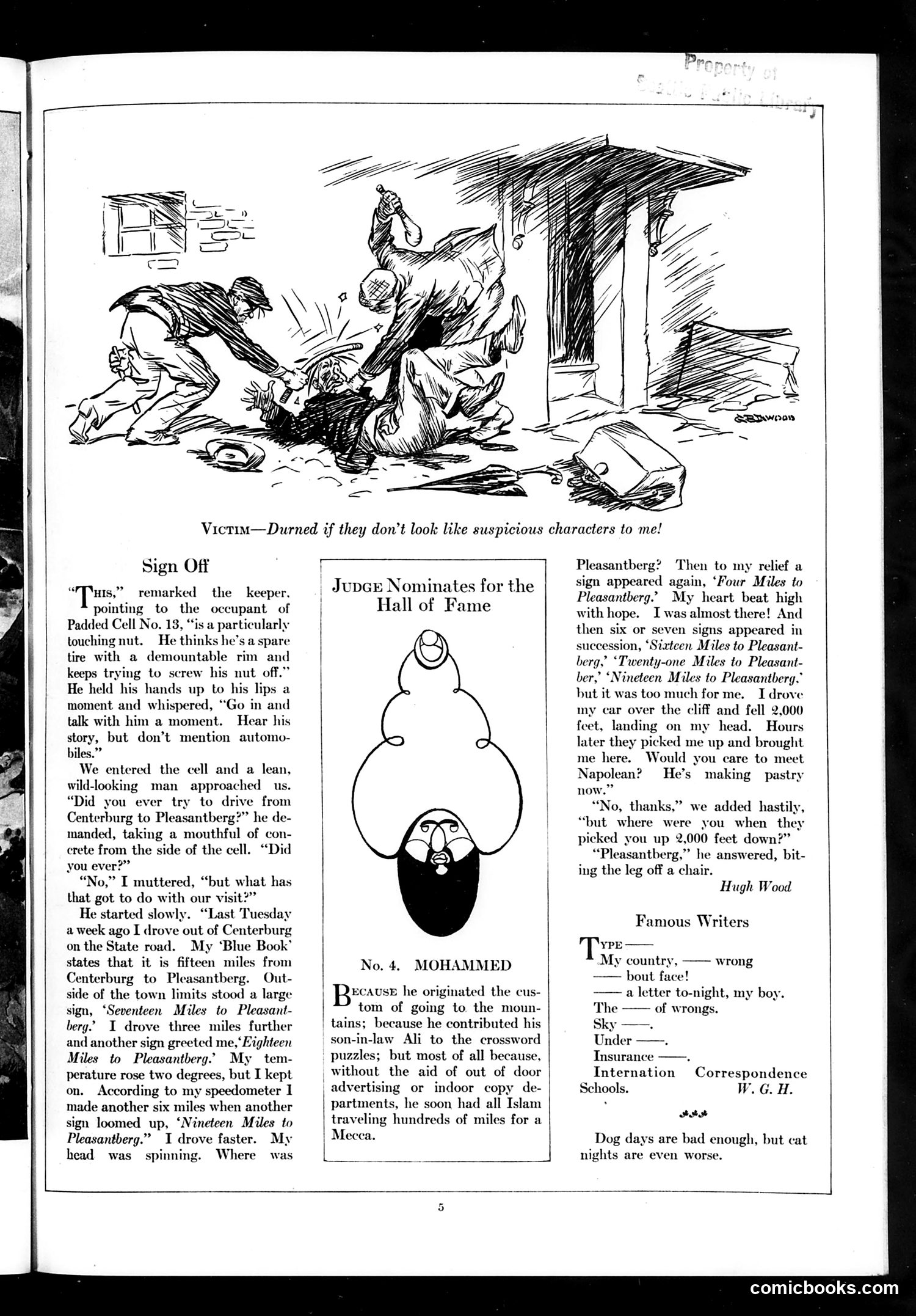
The top cartoon titled "Victims" depicts a robbery scene with the caption "Turned if they don't look like suspicious characters to me!" This appears to be satirizing police profiling—mocking law enforcement's tendency to judge people as criminals based on appearance rather than actual evidence. The "Sign Off" column humorously recounts a prisoner's complaint about being held in solitary confinement. He claims he drove from Centerburg to Pleasantberg multiple times, referencing road signs that kept appearing (suggesting either his poor driving or hallucinations from isolation). The remaining sections feature "Famous Writers" word games and a section on "Mohammed" noting his cultural contributions, plus brief humor items. The page is primarily satirical commentary on crime, policing, and social issues of the era.
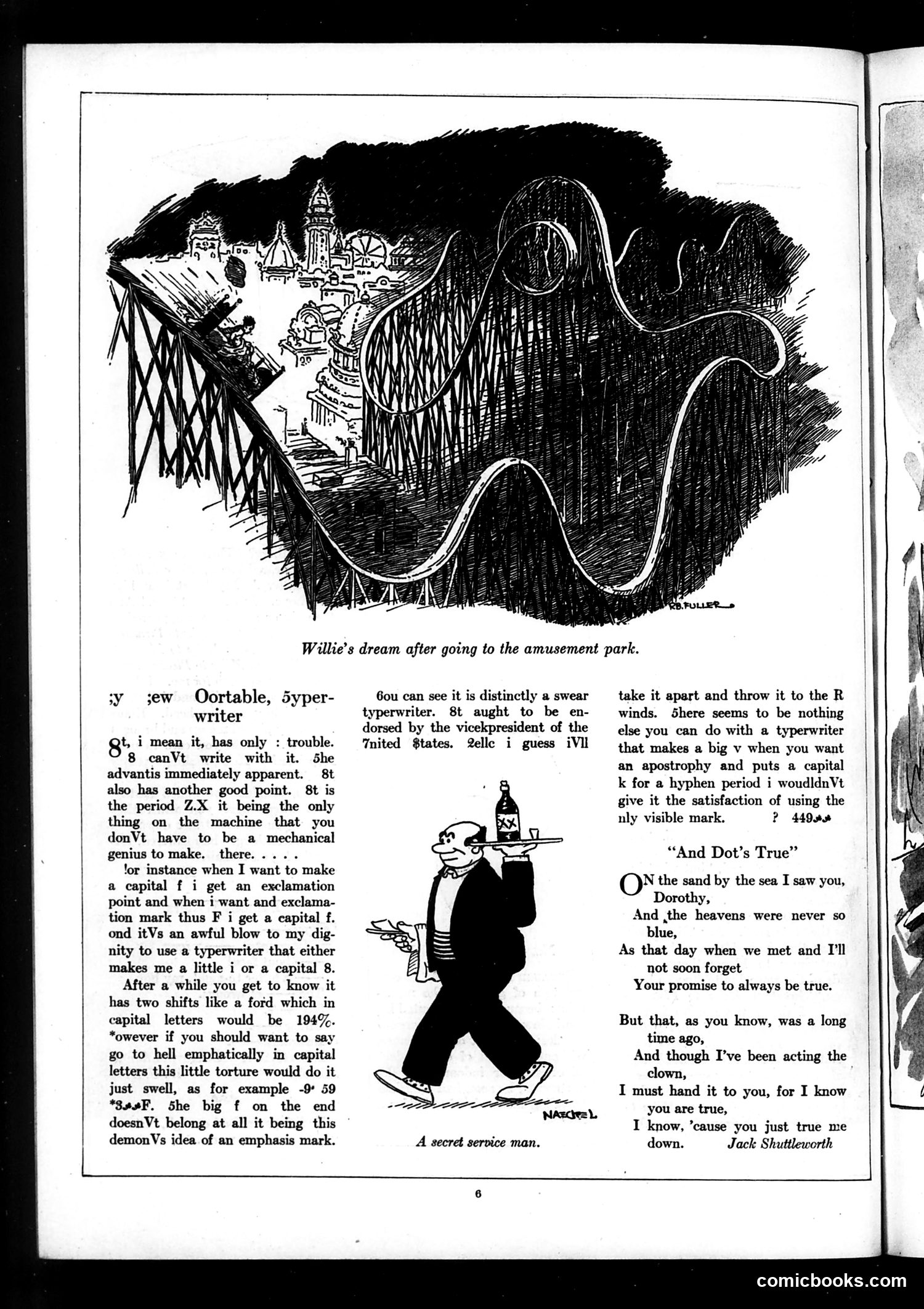
This page contains two distinct pieces: **Upper section**: A humorous complaint about a malfunctioning portable typewriter. The author describes a temperamental machine with broken shift keys that randomly produces capital letters, exclamation points, and hyphens in wrong places—making typed text appear chaotic and emphatic. The piece jokingly suggests this "swear typewriter" should be endorsed by the Vice President. The accompanying illustration shows "Willie's dream" of a fantastical amusement park with roller coasters, satirizing the chaotic experience of using this defective machine. **Lower section**: A sentimental poem titled "And Dot's True" by Jack Shuttleworth, recalling a romantic seaside meeting with "Dorothy" and promises of faithfulness, though set "a long time ago." The accompanying illustration depicts a cartoonish "secret service man" character. The page reflects early 20th-century concerns about emerging office technology and includes period romantic verse, typical of Judge magazine's mix of satirical commentary and lighter entertainment content.
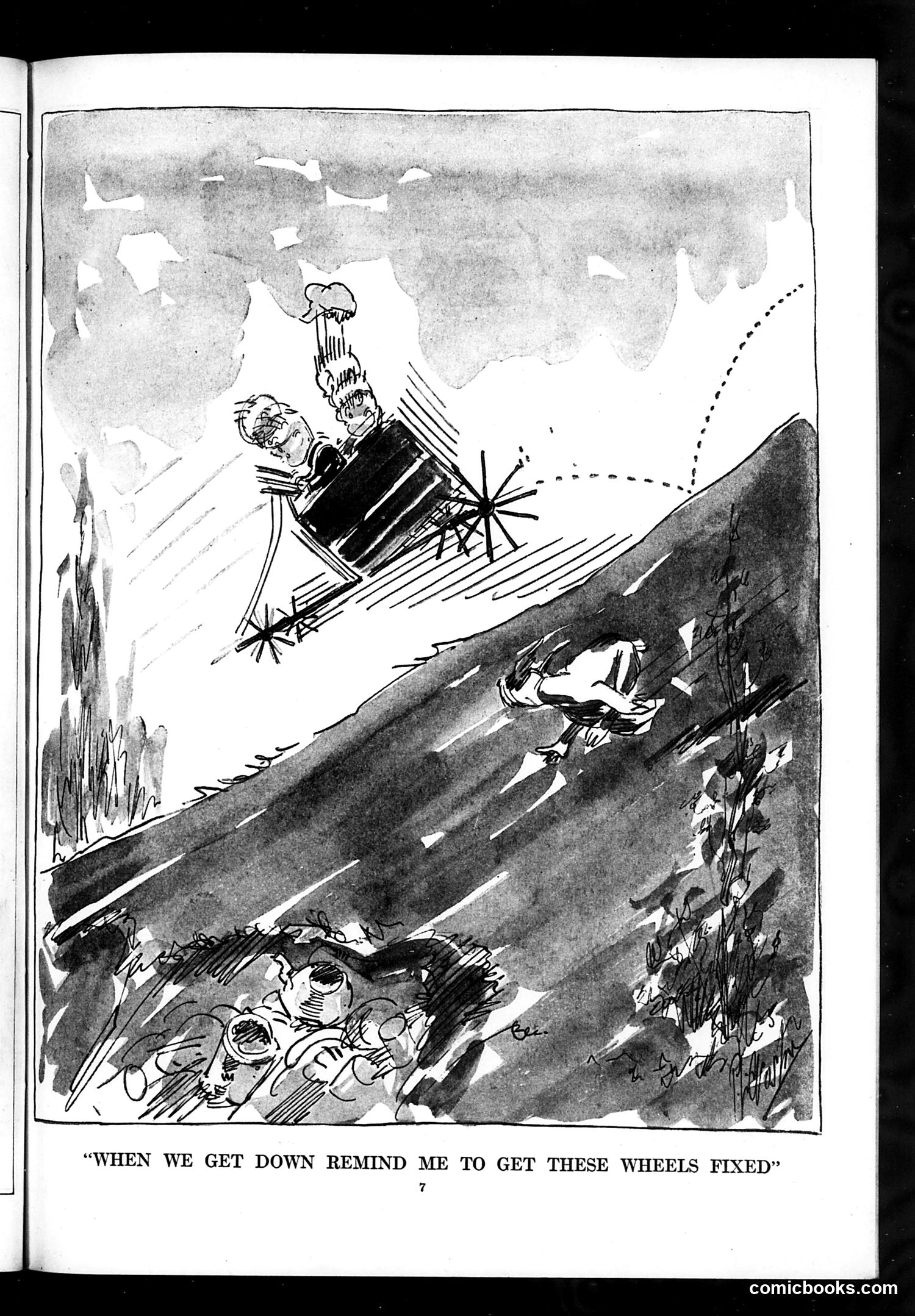
This is a satirical cartoon showing a figure in a car careening down a steep, rocky slope toward disaster. The passenger remarks casually about fixing the wheels—a darkly humorous understatement given the immediate peril. The cartoon likely satirizes a political or social situation where leadership is ignoring urgent, dangerous problems in favor of minor concerns. The rickety vehicle, the precipitous descent, and the wreckage below suggest catastrophe is imminent, yet the dialogue suggests complacency about trivial maintenance. Without additional context about Judge magazine's publication date, I cannot identify the specific political figures or events referenced. However, the satire's point is clear: those in power are dangerously negligent about critical issues.
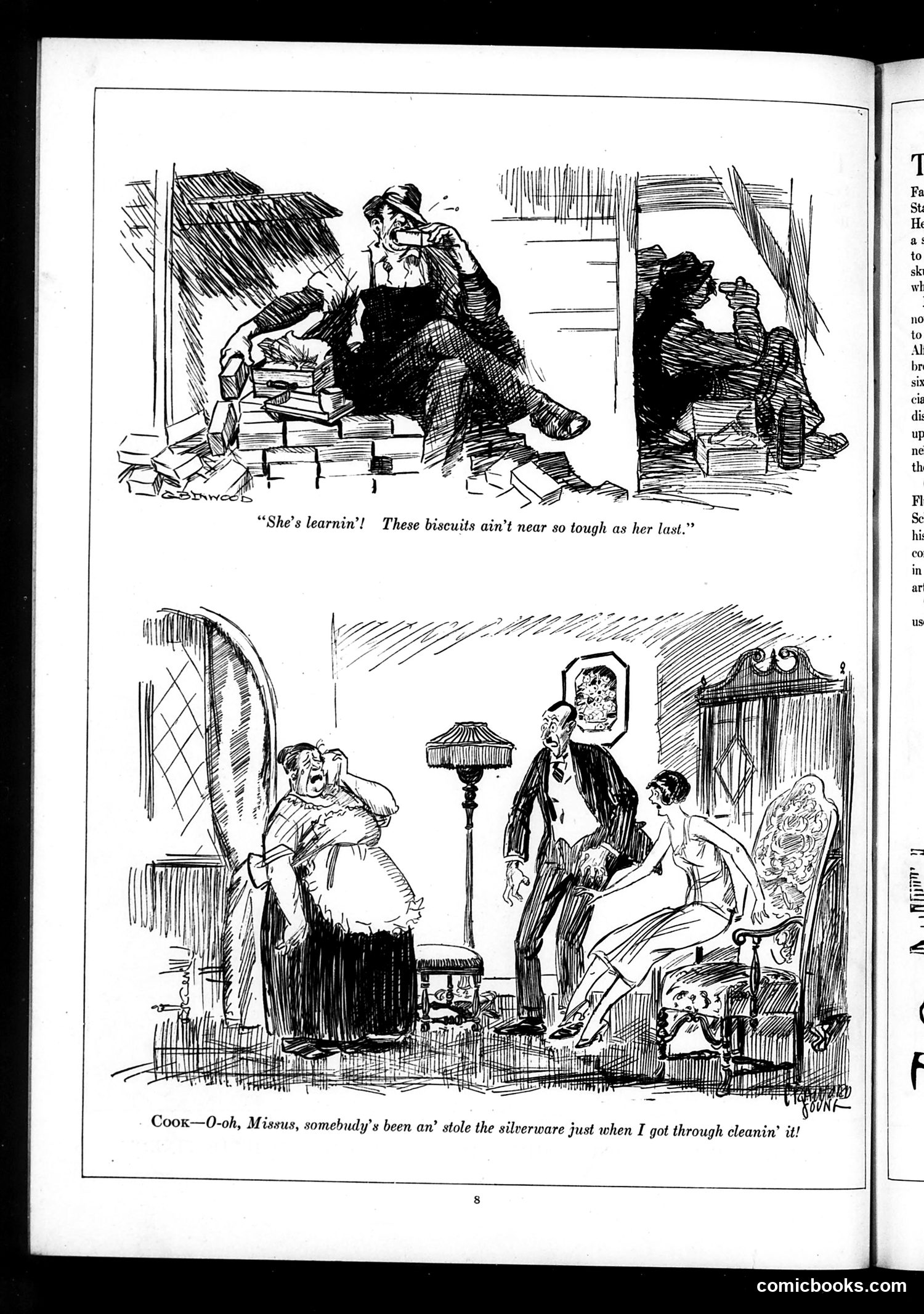
This page contains two domestic humor cartoons typical of early-20th-century Judge magazine. **Top cartoon:** A man watches a woman baking biscuits, commenting that they're not as tough as her previous ones—a joke about her improving (or remaining poor) cooking skills. **Bottom cartoon:** A cook complains to her employer that silverware has been stolen just after she finished cleaning it. The humor plays on the irony of theft occurring immediately after the laborious task of polishing silver—a common servant complaint about household management. Both cartoons satirize domestic life and class relationships between employers and servants, reflecting the magazine's focus on middle-class anxieties and household humor. The drawings use exaggerated facial expressions typical of the period's cartooning style.
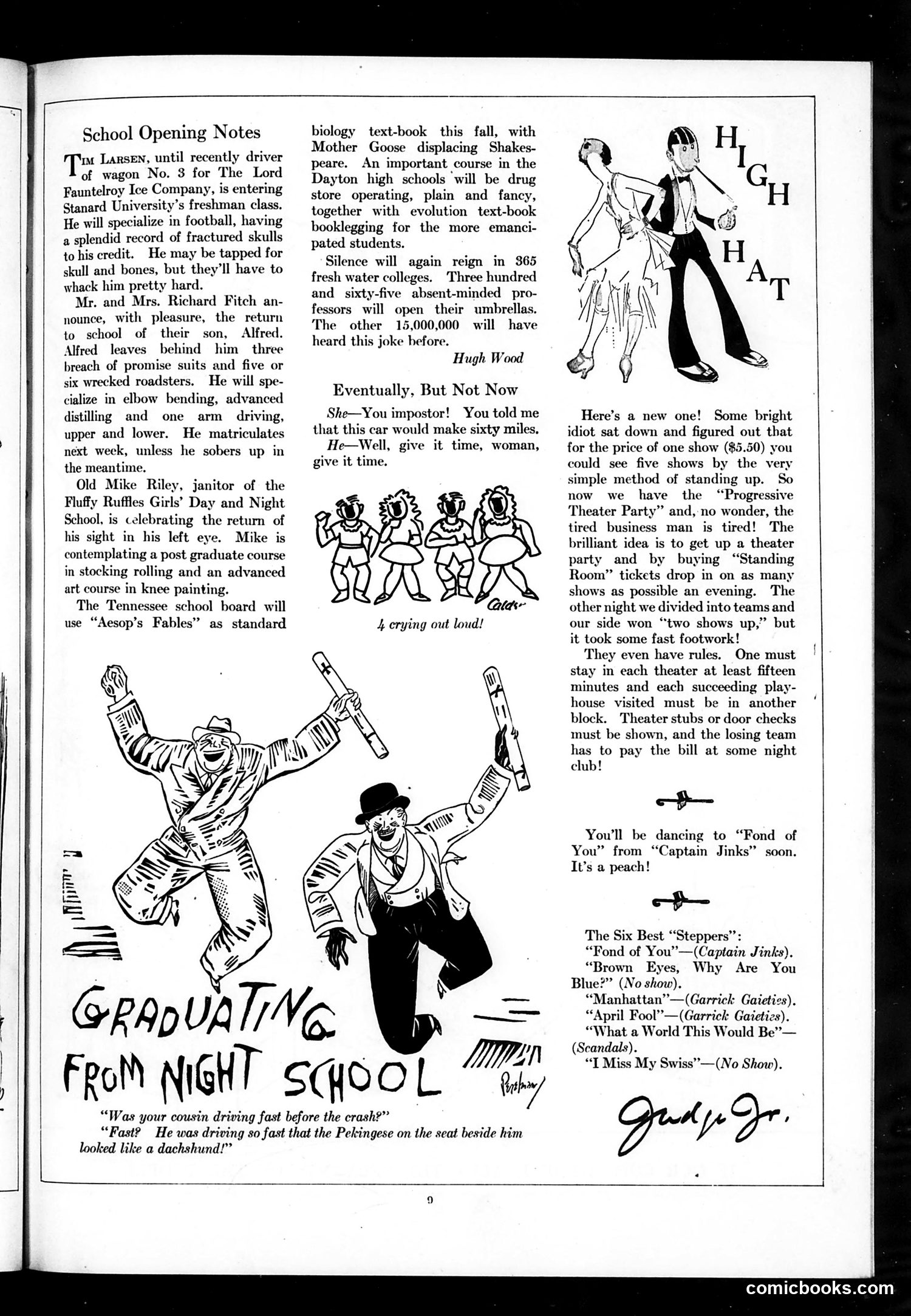
This page from *Judge* magazine contains satirical "School Opening Notes" mocking American educational institutions and student behavior circa the 1920s. The humor targets: **Educational absurdity**: Tennessee schools replacing Shakespeare with *Mother Goose* and *Aesop's Fables* as biology texts—satirizing perceived inadequate curriculum standards. **Student character**: Three brief character sketches mock wealthy, irresponsible college students: one specializing in "fractured skulls," another leaving "breach of promise suits and wrecked roadsters" behind, suggesting frivolous, consequence-free privilege. **Academia**: A joke about absent-minded professors and worn-out jokes circulating among thousands of colleges. **Social trends**: A separate article ridicules the "Progressive Theater Party"—a scheme where young people buy standing-room tickets to see multiple shows in one evening, treating serious theater as a competitive game with "rules" and penalties. The cartoons illustrate these themes with exaggerated figures, including one labeled "Graduating from Night School," depicting celebration over minimal academic achievement. The satire reflects early-20th-century anxiety about youth morality and educational standards.
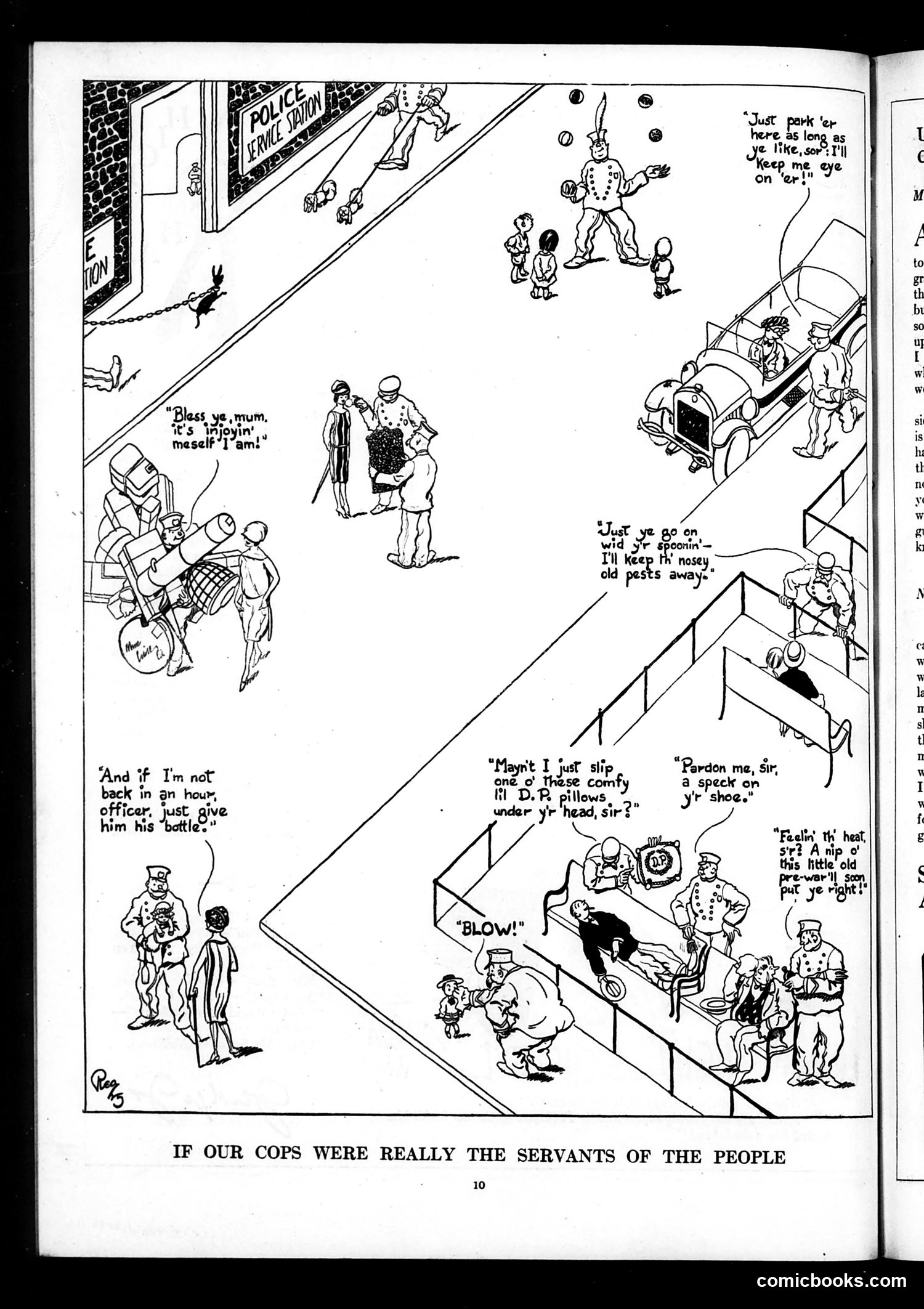
This is a satirical cartoon titled "If Our Cops Were Really the Servants of the People," critiquing police conduct through ironic contrast. The comic depicts police officers actively *serving* citizens—literally carrying babies, offering refreshments, polishing shoes, providing cushions, and attending to comfort. This exaggerated helpfulness mocks the actual relationship between police and the public. The cartoon targets police who abuse their authority rather than serve the community. By showing officers in absurdly deferential poses, the artist highlights how far removed real police behavior was from their stated duty as "servants of the people." The Irish dialect in the speech bubbles suggests this may reference working-class or immigrant communities, who typically experienced aggressive policing. The satire's point: contemporary police acted as enforcers for authorities, not public servants. The fantasy scenario underscores the bitter reality—actual cops wielded power over citizens rather than serving them.
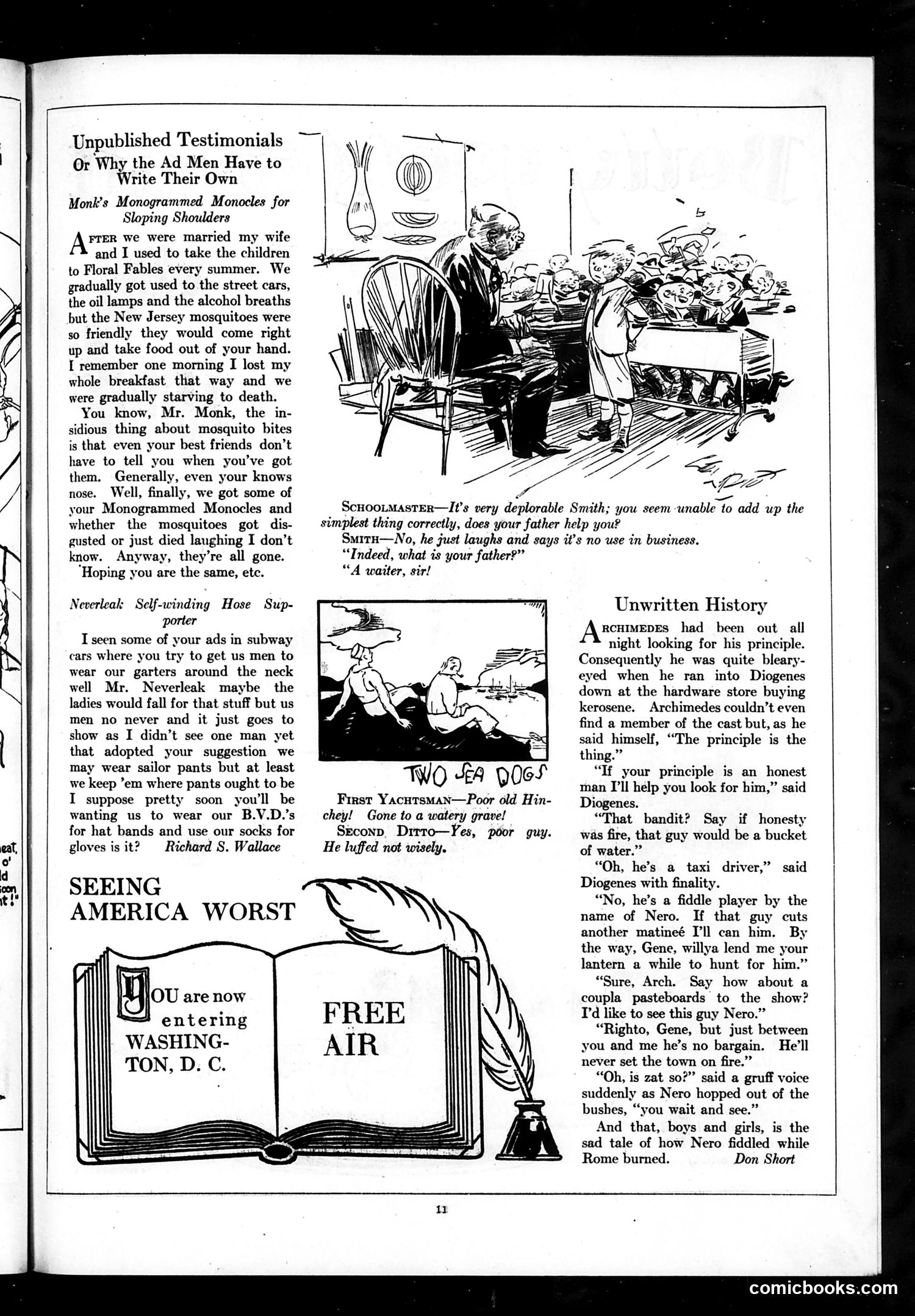
This page contains **satirical fake testimonials** mocking advertising claims. The top section features humorous (fabricated) customer letters praising absurd products like "Monogrammed Monocles for Sloping Shoulders" and self-winding hose supporters worn around the neck—clearly invented to ridicule how advertisers exaggerate product benefits. The letters use deliberately poor grammar and obvious lies to highlight how ads manipulate consumers. The cartoons include a schoolroom joke about a student's father being a waiter, and a sailing mishap ("he luffed not wisely"—a pun on nautical terminology). The "Unwritten History" section is a comedic twist on the classical story of Archimedes and Diogenes, replacing Archimedes' famous principle of displacement with a cynical modern interpretation where Nero is a mediocre fiddle player. The joke subverts the historical reference by applying it to contemporary (presumably 1920s-30s) show business absurdity.
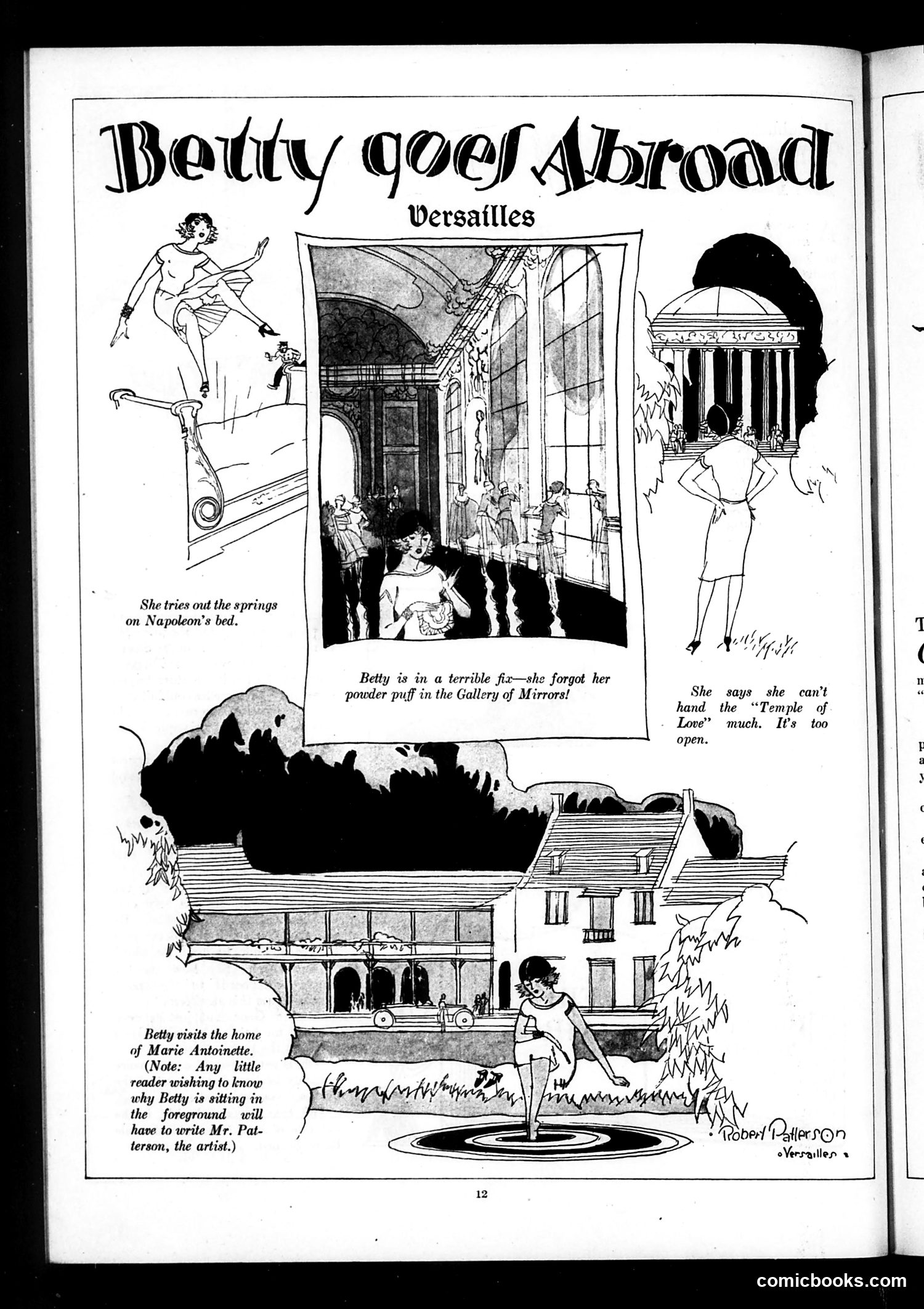
This is a humorous comic strip about a character named Betty visiting the Palace of Versailles. The satire plays on early 20th-century American attitudes toward European history and culture. The jokes rely on anachronistic contrasts: Betty treats famous historical sites casually—bouncing on Napoleon's bed like a modern tourist, forgetting her cosmetics at the Gallery of Mirrors, and complaining that the Temple of Love is "too open" (likely a prudish reference). The final panel shows her at Marie Antoinette's home, with a note from the artist acknowledging readers will ask why Betty sits in the foreground—a meta-joke about the cartoon's composition. The humor targets both American tourists' irreverence toward European cultural monuments and contemporary social conventions around propriety and femininity (powder puffs, modesty).
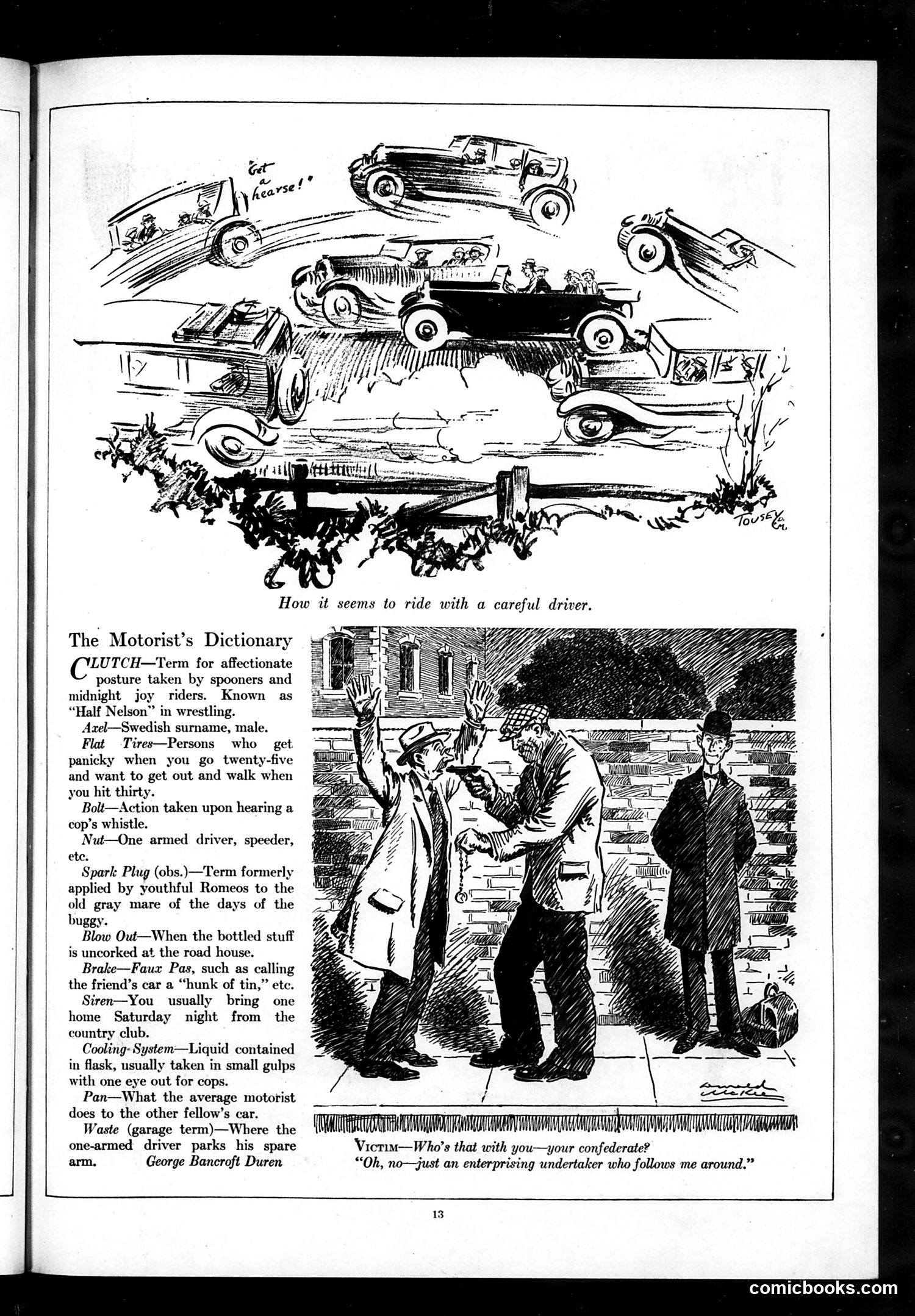
This page from *Judge* magazine presents automotive-era humor through two pieces: **Top cartoon**: A chaotic scene showing multiple cars careening wildly off a road, with the caption "How it seems to ride with a careful driver"—satirizing reckless driving by depicting the opposite of safety. **"The Motorist's Dictionary"**: A humorous glossary mocking early 1920s car culture and driver behaviors. Key jokes include: - "Clutch" as intimate behavior (spooning/wrestling holds) - "Flat Tires" as nervous passengers - "Bolt" as fleeing from police - "Siren" as picking up women at country clubs - References to flasks and alcohol consumption (Prohibition-era coded language) **Bottom cartoon**: Two well-dressed men confront a third figure, with dialogue about "an enterprising undertaker who follows me around"—dark humor suggesting the driver is so reckless he needs funeral services nearby. The overall satire targets dangerous driving, drunk driving culture, and the moral anxieties surrounding automobiles as symbols of youth rebellion and lawlessness in the Jazz Age.
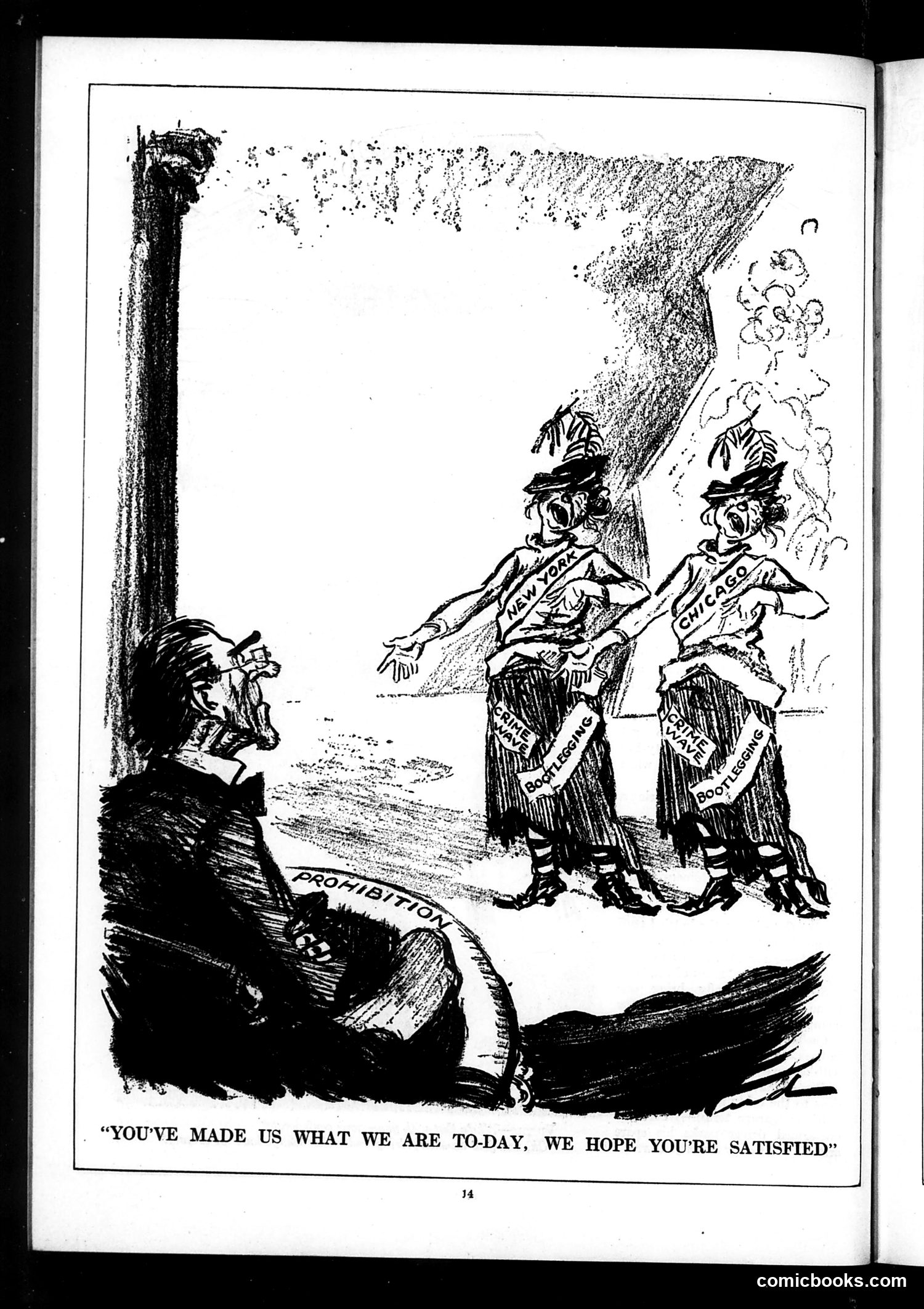
This cartoon appears to criticize Prohibition's effects on American society. On the left sits a hunched, miserable figure labeled "PROHIBITION," apparently personified as having caused societal decay. On the right stand two caricatured figures representing "NEW YORK" and "CHICAGO," dressed as gangsters or criminals with labels suggesting organized crime and violence ("BOOT LEGGING" appears visible). They sarcastically address Prohibition, suggesting the policy created the very criminal enterprises and urban corruption it aimed to prevent. The cartoon's message: Prohibition didn't eliminate drinking—it spawned organized crime, gang violence, and moral corruption in major American cities. The satire blames the Prohibition policy itself for transforming cities into criminal enterprises, making the ironic point that well-intentioned legislation produced the opposite of its intended effect.
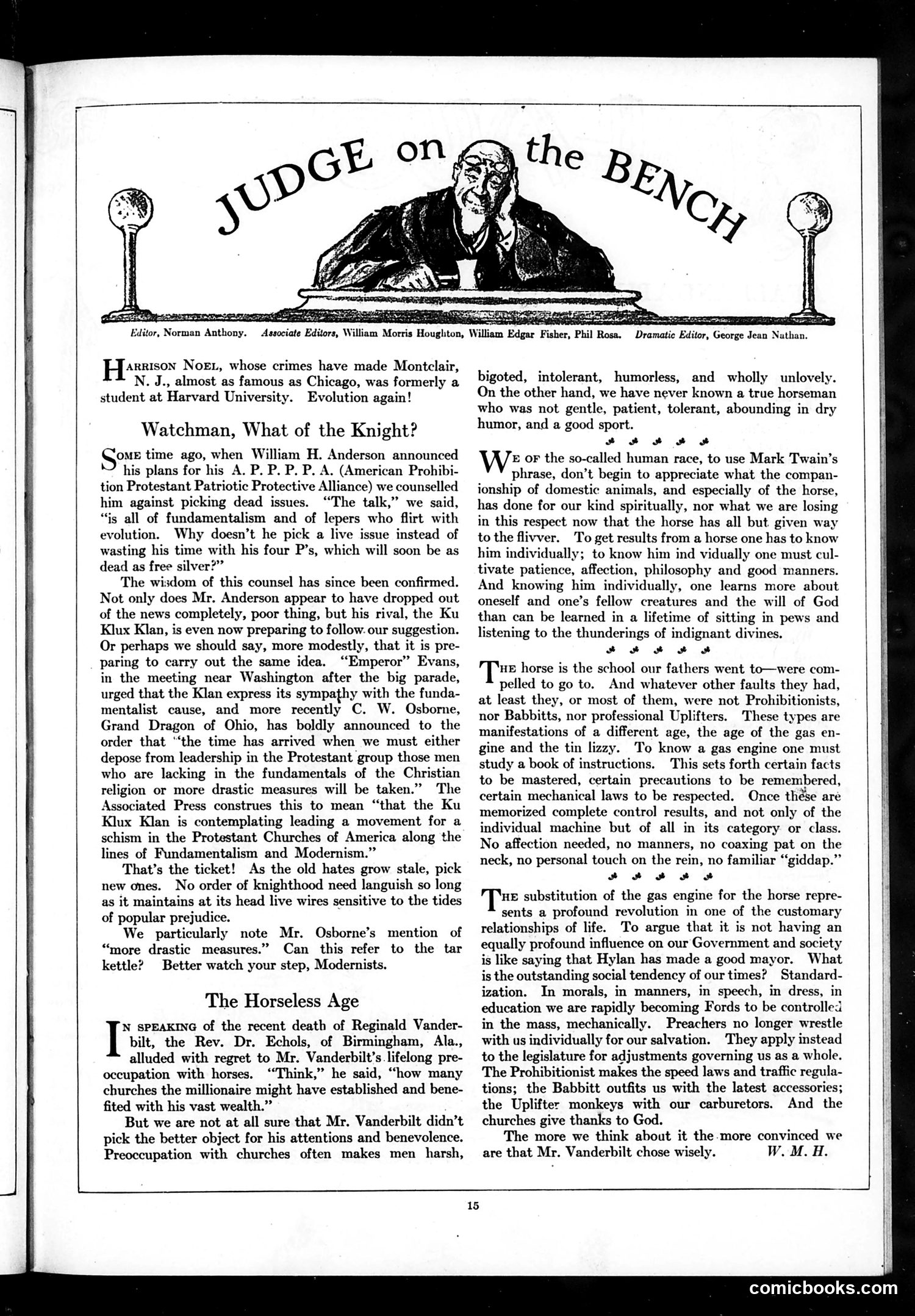
This page contains two editorial pieces criticizing 1920s religious and social movements: **"Watchman, What of the Knight?"** Satirizes William H. Anderson's anti-evolution Protestant organization and the Ku Klux Klan. The writer mocks both groups for pursuing "dead issues" (evolution debates) and warns that the Klan's Ohio leadership, citing "more drastic measures," may be veering toward actual violence against "Modernists"—suggesting the satirist recognizes the Klan as a genuine threat, not merely a social club. **"The Horseless Age"** Uses Reginald Vanderbilt's death as a springboard to contrast horse-ownership (requiring patience, gentleness, manners) with religious fundamentalism (producing bigotry, intolerance). The piece laments automobiles replacing horses as character-builders, and subtly mocks religious institutions as corrupting rather than improving people. Both articles criticize organized religion while celebrating secular pursuits—a distinctly liberal position for the era.
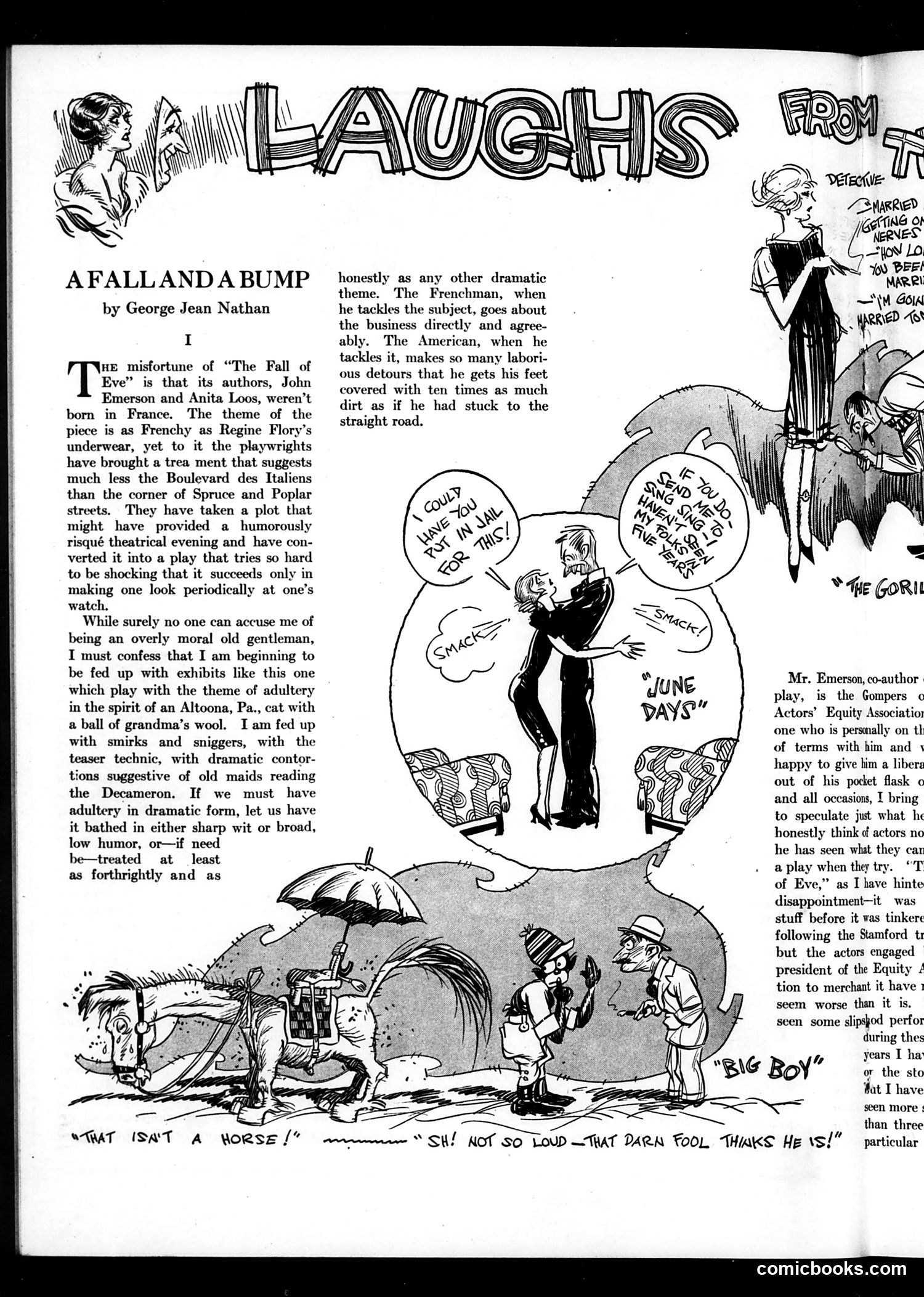
This is a theater criticism piece by George Jean Nathan reviewing a play about adultery by American playwrights John Emerson and Anita Loos. The cartoon illustrates Nathan's complaint that American dramatists overcomplicate treatments of infidelity with awkward detours and theatrical tricks, whereas French playwrights handle it more directly. The bottom cartoon shows a bumpy journey—a man in a carriage being jostled around, with bystanders commenting "That isn't a horse" and "Sh! Not so loud—that barn fool thinks he is!" This visualizes Nathan's metaphor: American playwrights take needlessly complicated routes to their destination, covering themselves "with ten times as much dirt" compared to straightforward treatment. Nathan criticizes the play for trying too hard to shock rather than employing genuine wit or broad humor. He references the Decameron (a classic work about seduction) and suggests the execution is amateurish—like an Altoona cat playing with yarn—rather than sophisticated satire.
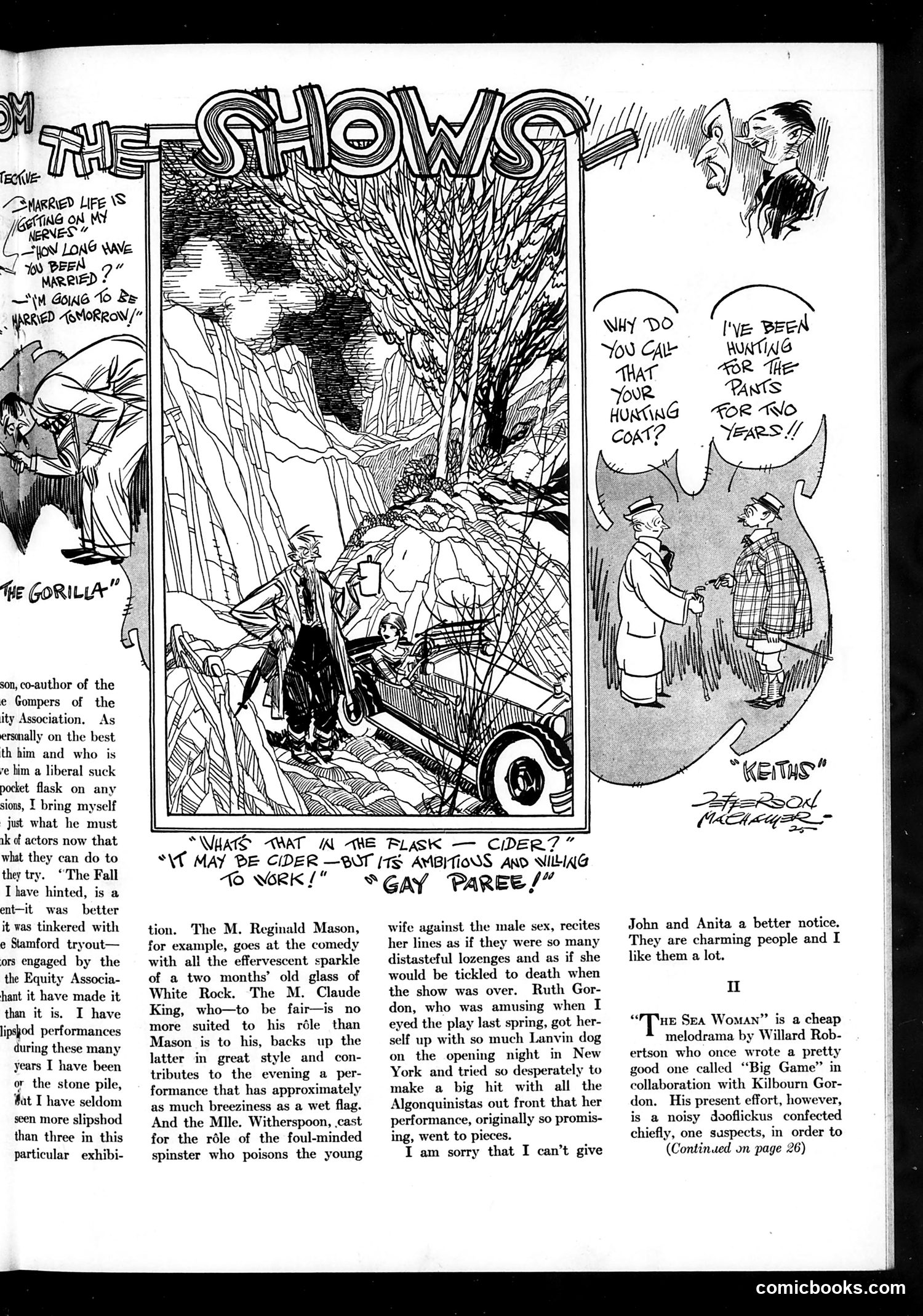
**"The Shows"** is a theatrical review column. The main cartoon depicts a gorilla-like creature emerging from dense foliage, illustrating the idiom "the gorilla"—likely mocking a theatrical production's clumsy, brutish quality. The smaller cartoon "Keiths" shows two men discussing a flask of cider with "ambitions" to work, satirizing either bootleg liquor during Prohibition or theatrical performers' pretensions. The text reviews three Broadway plays with harsh criticism. The reviewer attacks performers M. Reginald Mason and M. Claude King for their listless acting, actress Mlle. Witherspoon for her disengaged delivery, and notably Ruth Gordon for over-performing with excessive "Lanvin" (expensive perfume/styling) to impress the "Algonquinistas" (the sophisticated literary crowd at NYC's Algonquin Hotel). The satire targets theatrical mediocrity, actors' desperation to please elite audiences, and the affectations of New York's cultural establishment circa the 1920s.
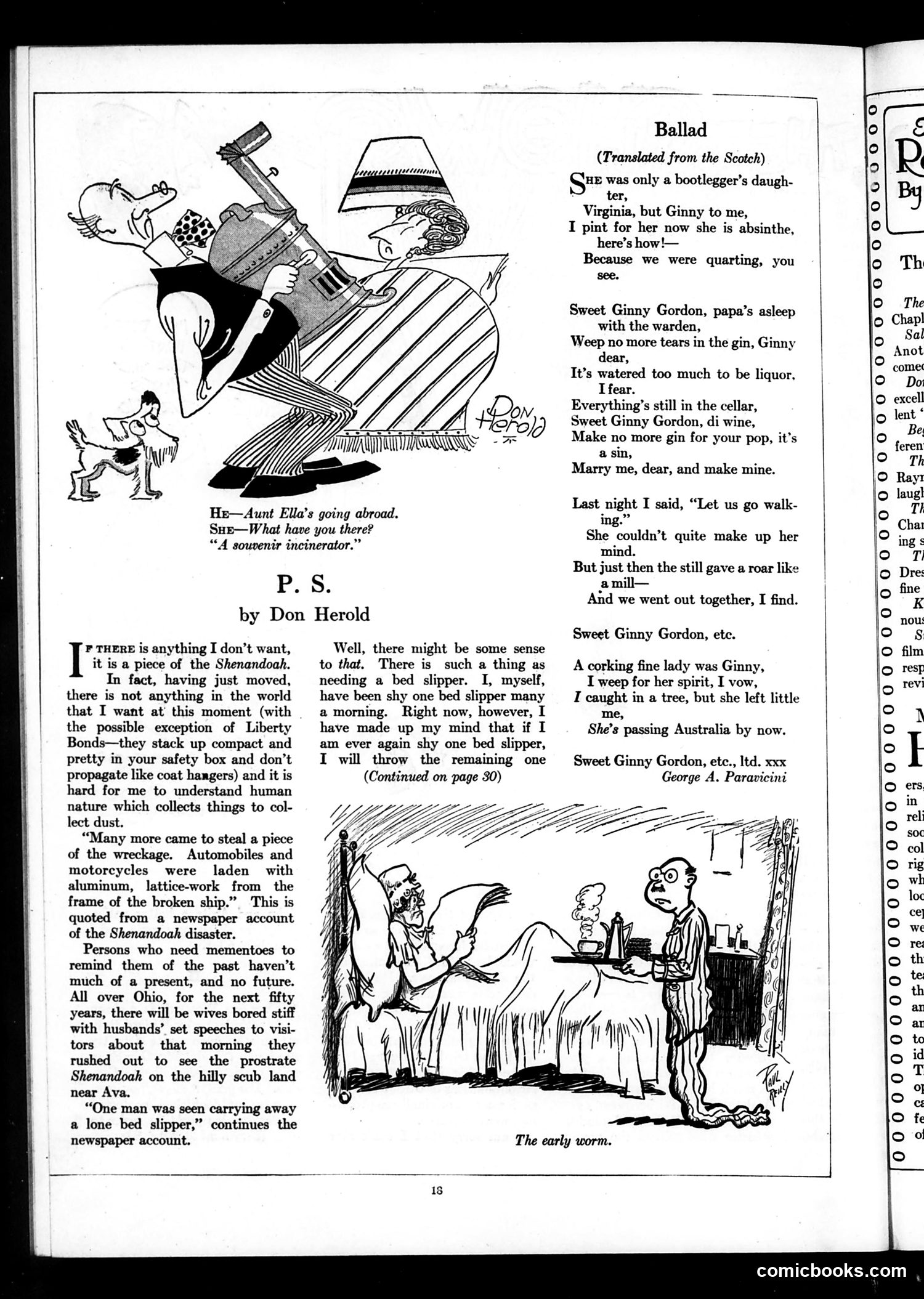
This page contains satirical commentary on American culture circa the 1920s (likely post-Shenandoah airship disaster of 1925). **"P.S." by Don Herold** mocks souvenir collecting and nostalgia. It references the *USS Shenandoah* airship crash in Ohio, where people scavenged wreckage—even a lone bed slipper. Herold satirizes the human impulse to collect meaningless mementos, suggesting people who cling to physical reminders of past events lack engagement with present life. **The "Ballad"** is a humorous song translation (supposedly from Scots) satirizing **Prohibition-era bootlegging**. "Ginny Gordon" is a woman involved in illegal alcohol production. References to "pint," "gin," "cellar," and "still" allude to underground distilling operations. The romantic narrative mocks both the bootlegging trade and sentimental ballads, while the absurd plot (she escapes during a still explosion) exaggerates Prohibition's chaos. Both pieces are characteristic Judge satire—using humor to critique contemporary American social behaviors and laws.
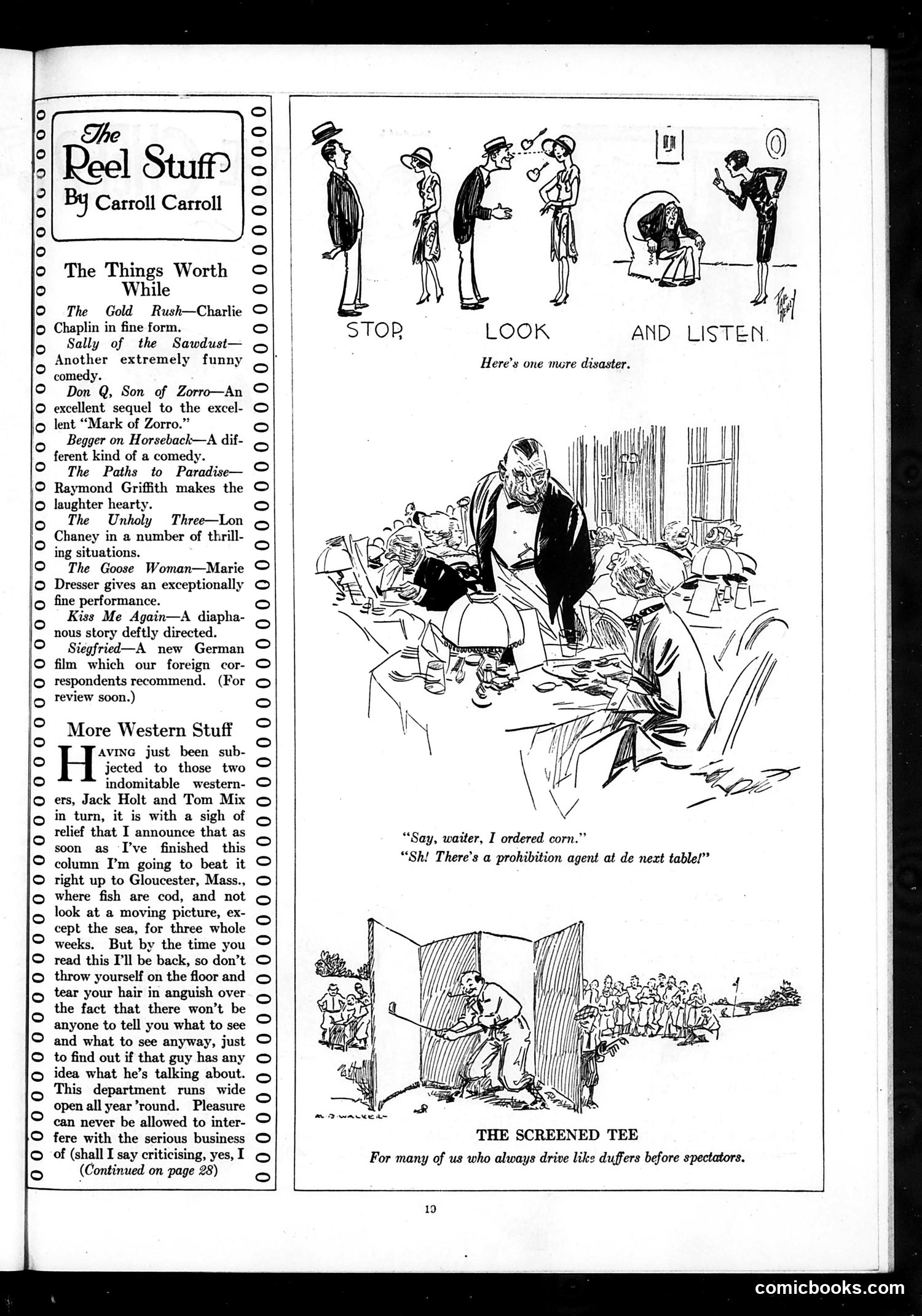
This page contains a film review column and three unrelated cartoons satirizing 1920s American life. **Top cartoon ("Stop, Look, and Listen"):** A pun on the traffic safety slogan, showing men and women in flirtatious interaction—the humor derives from treating romantic encounters like traffic hazards requiring caution. **Middle cartoon:** References Prohibition (the 1920-1933 alcohol ban). A waiter warns a customer that ordering corn (likely code for whiskey) is dangerous because a "prohibition agent" sits nearby. The satire mocks both the absurdity of Prohibition enforcement and people's continued illegal drinking despite the law. **Bottom cartoon ("The Screened Tee"):** A golf joke about poor golfers who perform worse when watched by spectators, humorously suggesting they need protective "screens" during their golf swings. The column itself reviews recent films featuring major stars: Chaplin, Lon Chaney, Marie Dressler, and westerns with Jack Holt and Tom Mix—typical entertainment fare of the era.
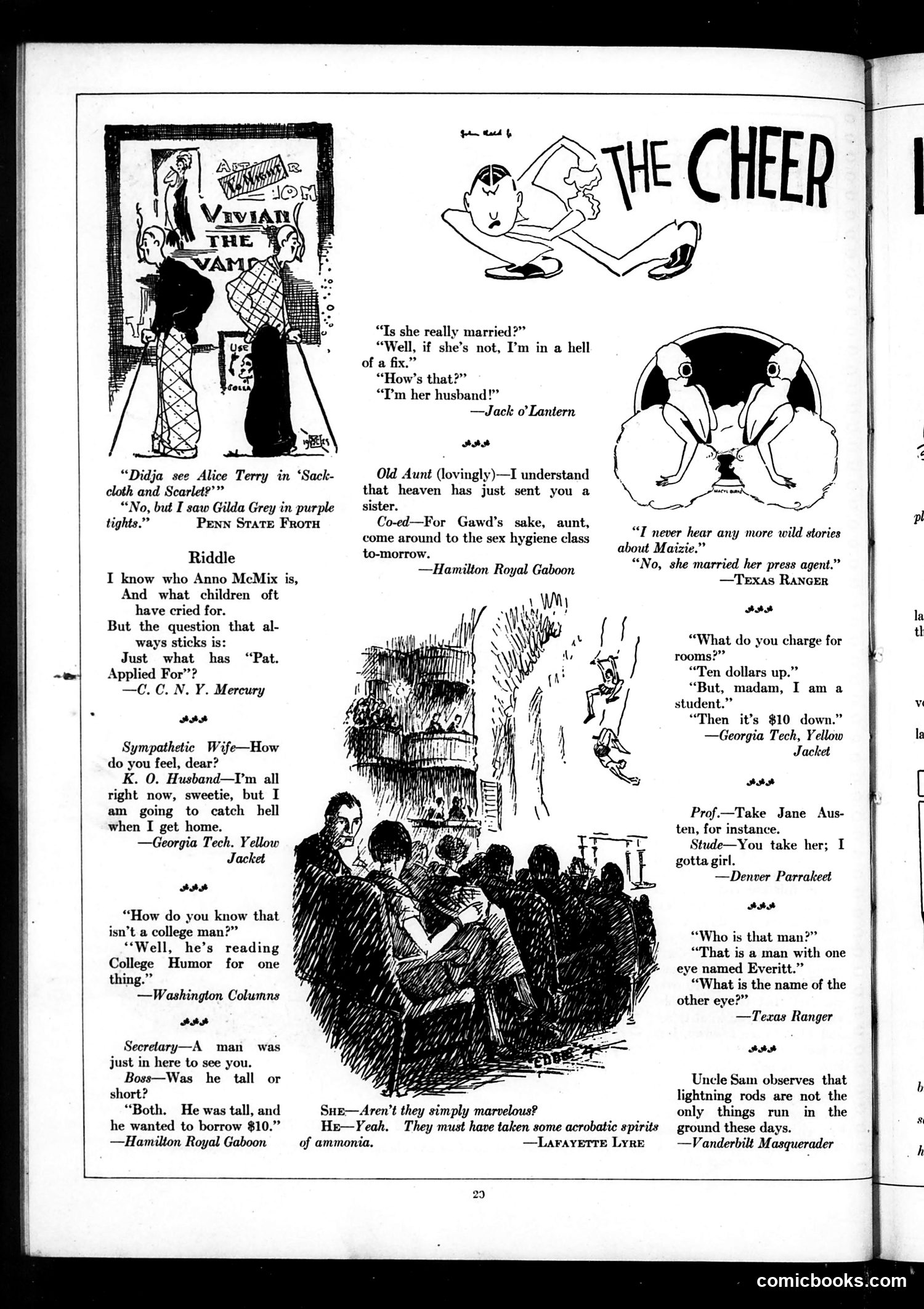
This Judge magazine page collects brief humor items—jokes and quips from college publications—rather than political cartoons. The content reflects 1920s collegiate and social satire: **Key references:** - Alice Terry and Gilda Grey were contemporary actresses/performers; the jokes mock casual cinema-going - "Pat. Applied For" mocks patents and commercial culture - Sex hygiene classes reference early-1920s progressive education initiatives - The "press agent" joke reflects Hollywood's growing publicity machinery - College humor dominates, with frequent references to student life, borrowing money, and dating **Social satire targets:** - Casual infidelity and marital complications - Working-class aspirations (student discounts) - Academic pretension - Gender and courtship dynamics The page demonstrates Judge's practice of reprinting student newspaper humor, offering a snapshot of Jazz Age collegiate sensibilities—witty, somewhat risqué, focused on youth culture, entertainment, and modern social anxieties rather than serious political commentary.
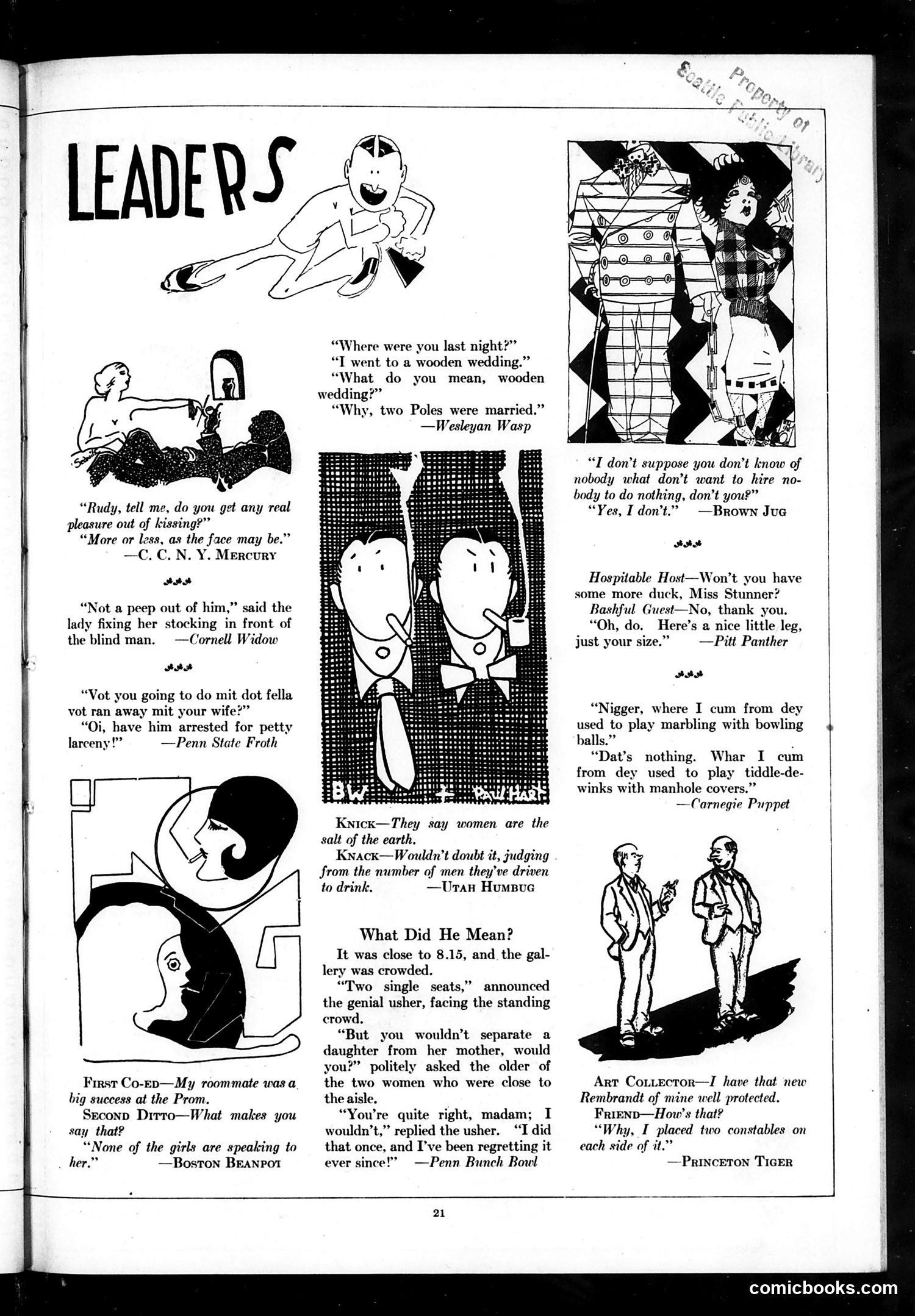
This page collects brief jokes from college humor magazines (circa early 20th century), organized around romantic, social, and racial themes typical of the era. **Key content:** The jokes traffic in crude ethnic stereotypes—a "wooden wedding" joke about Polish people, and two separate jokes using the N-word to depict Black dialect speech as comical. These reflect deeply offensive period attitudes. Other humor relies on double-entendres (the blind man / stocking joke) and wordplay about courtship and dating among college students. **The satire:** There's minimal political satire here; rather, this is collegiate humor mocking social awkwardness, class pretension ("Art Collector" protecting a Rembrandt with police), and linguistic confusion (garbled grammar presented as funny). **For modern readers:** This page starkly documents how racial slurs and ethnic mockery were normalized entertainment in mainstream American magazines, even prestigious ones like *Judge*. The casual inclusion of such content shows how embedded these attitudes were in the era's culture.
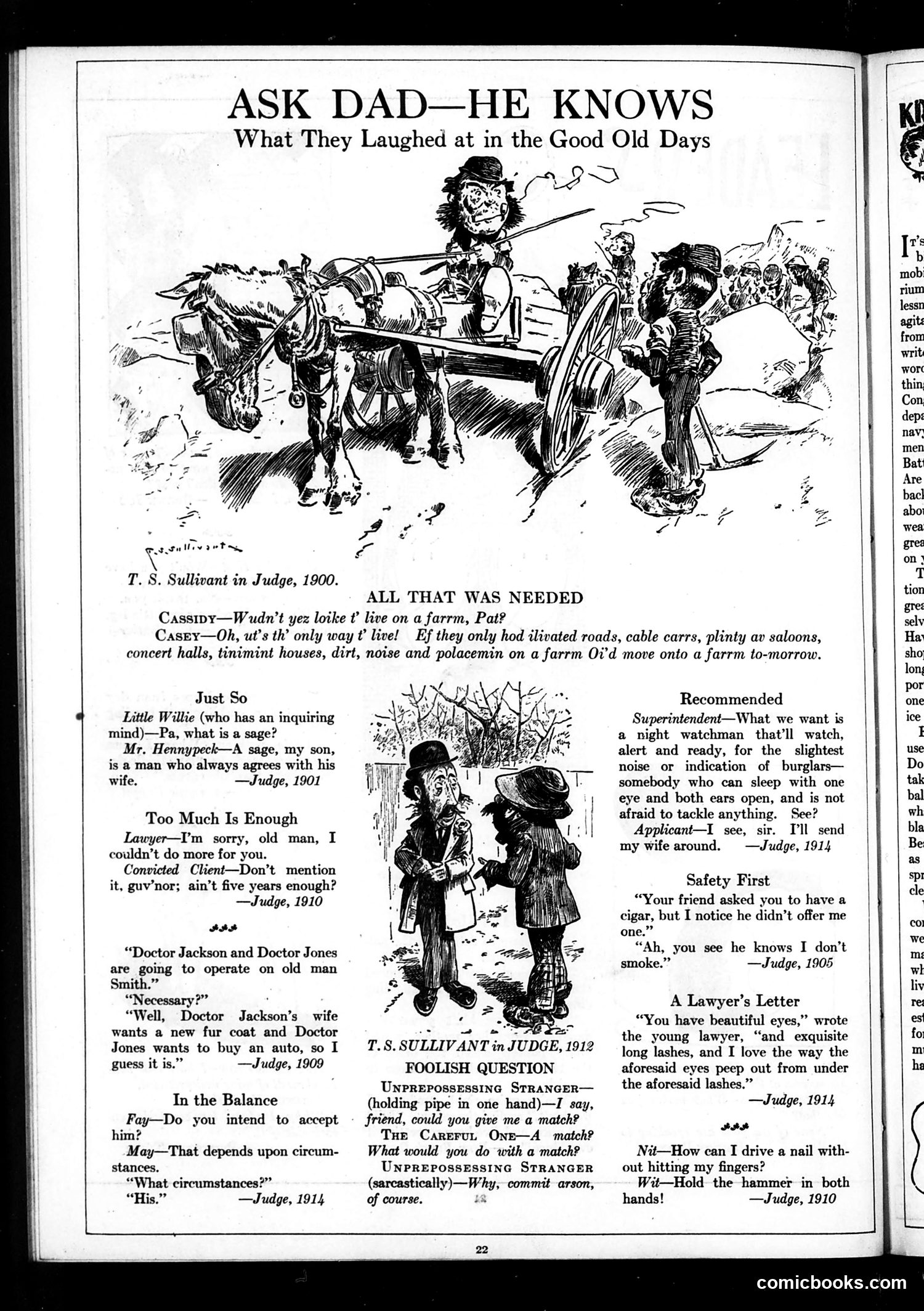
This page collects brief jokes and cartoons from Judge's humor column, featuring domestic and social satire typical of early 20th-century American comedy. The main cartoon by T.S. Sullivant depicts Irish immigrant farmers debating rural life in exaggerated dialect—reflecting Judge's frequent ethnic humor targeting Irish and working-class Americans. The surrounding jokes mock familiar targets: nagging wives ("a sage is a man who always agrees with his wife"), incompetent professionals (doctors performing unnecessary surgery for personal gain), and gender relations. One recurring theme is marital discord treated as inevitable comedy. The humor relies on wordplay, sarcasm, and situations presenting women as either materialistic or domineering, men as henpecked. A 1914 joke about a superintendent hiring someone's wife as a night watchman (implying she's aggressive/watchful) trades on stereotypes about aggressive wives. The overall tone treats social pretension, professional dishonesty, and domestic unhappiness as universal sources of amusement rather than serious critique.
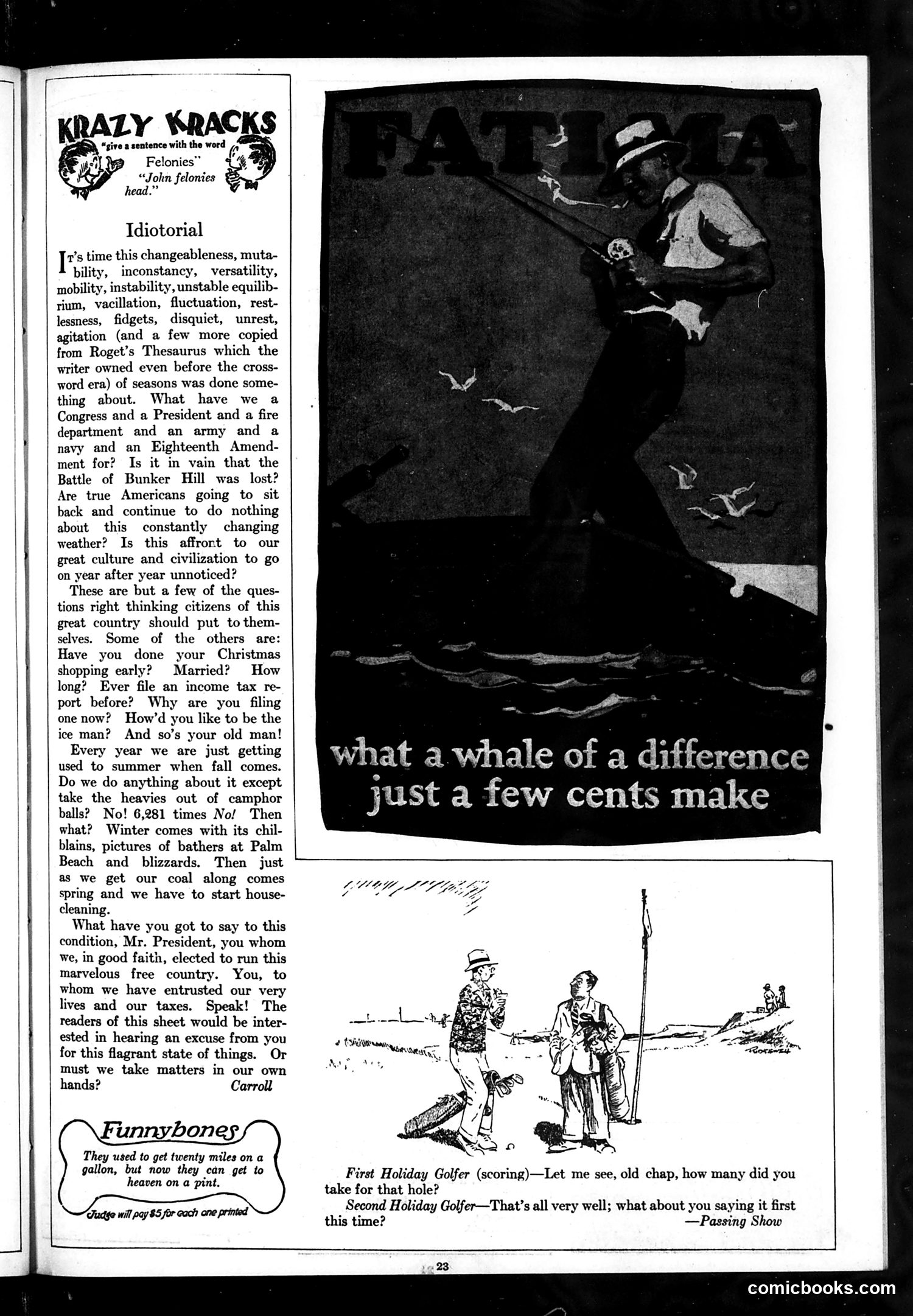
This Judge magazine page contains political and social satire from the early 20th century (likely 1920s, given the Eighteenth Amendment reference). **"Idiotorial"** is a mock editorial sarcastically attacking government inaction on seasonal weather changes—a absurdist complaint about natural phenomena that no institution can control. The author ridicules citizens for accepting unchangeable conditions while expecting their elected President and government to solve everything. **The whale advertisement** promotes a product (likely fuel or oil) using the common advertising trope that small cost differences yield major benefits. **"Funnybones"** joke mocks Prohibition-era car efficiency: vehicles now consume alcohol ("a pint") to "reach heaven" instead of gasoline for practical distance. This references the 18th Amendment's alcohol ban and suggests people are drinking fuel or using cars for illegal alcohol transport. **The golf cartoon** jokes about golfers' dishonesty in scoring—the first golfer asks the second's score, but the second deflects by questioning the first's honesty, implying both cheat and neither trusts the other's count.
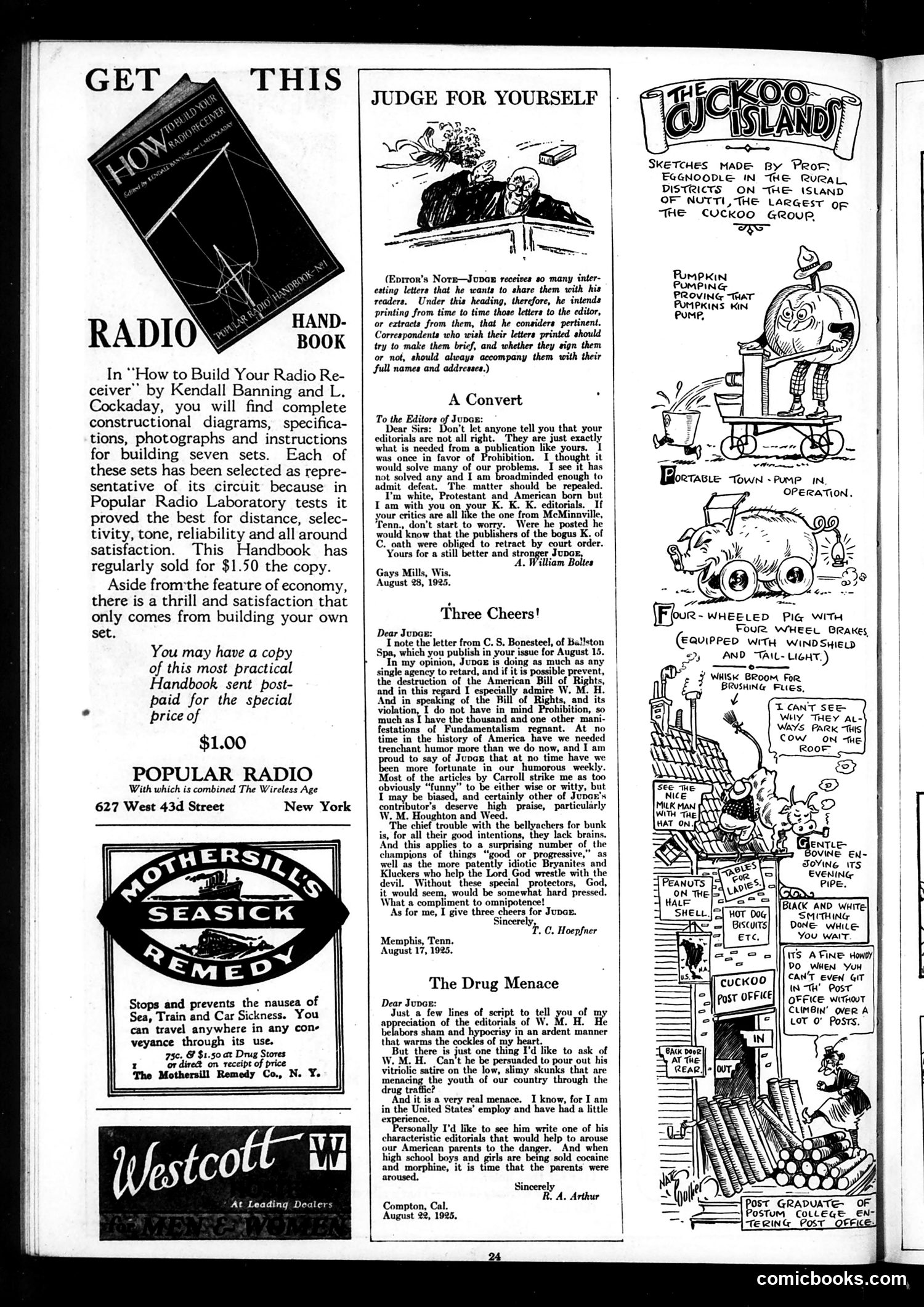
This page from Judge (August 1925) primarily contains reader letters and advertisements rather than political cartoons. The main content is a "Judge for Yourself" section featuring three published letters to the editor. The letters reveal 1920s social conflicts: a writer from Wisconsin renounces his earlier support for Prohibition, claiming it hasn't solved social problems. Another correspondent from New York praises Judge's editorials opposing the KKK while defending the Bill of Rights against "Fundamentalism." A third letter criticizes "bellyachers" opposing progressive causes. The right side shows "The Cuckoo Island," an unrelated comic strip about fantastical rural inventions. Advertisements for radio handbooks and seasickness remedies fill the lower portion. The page reflects Judge's stance as a publication defending secular modernism against both Prohibition enforcement and religious fundamentalism—key cultural battles of the 1920s.
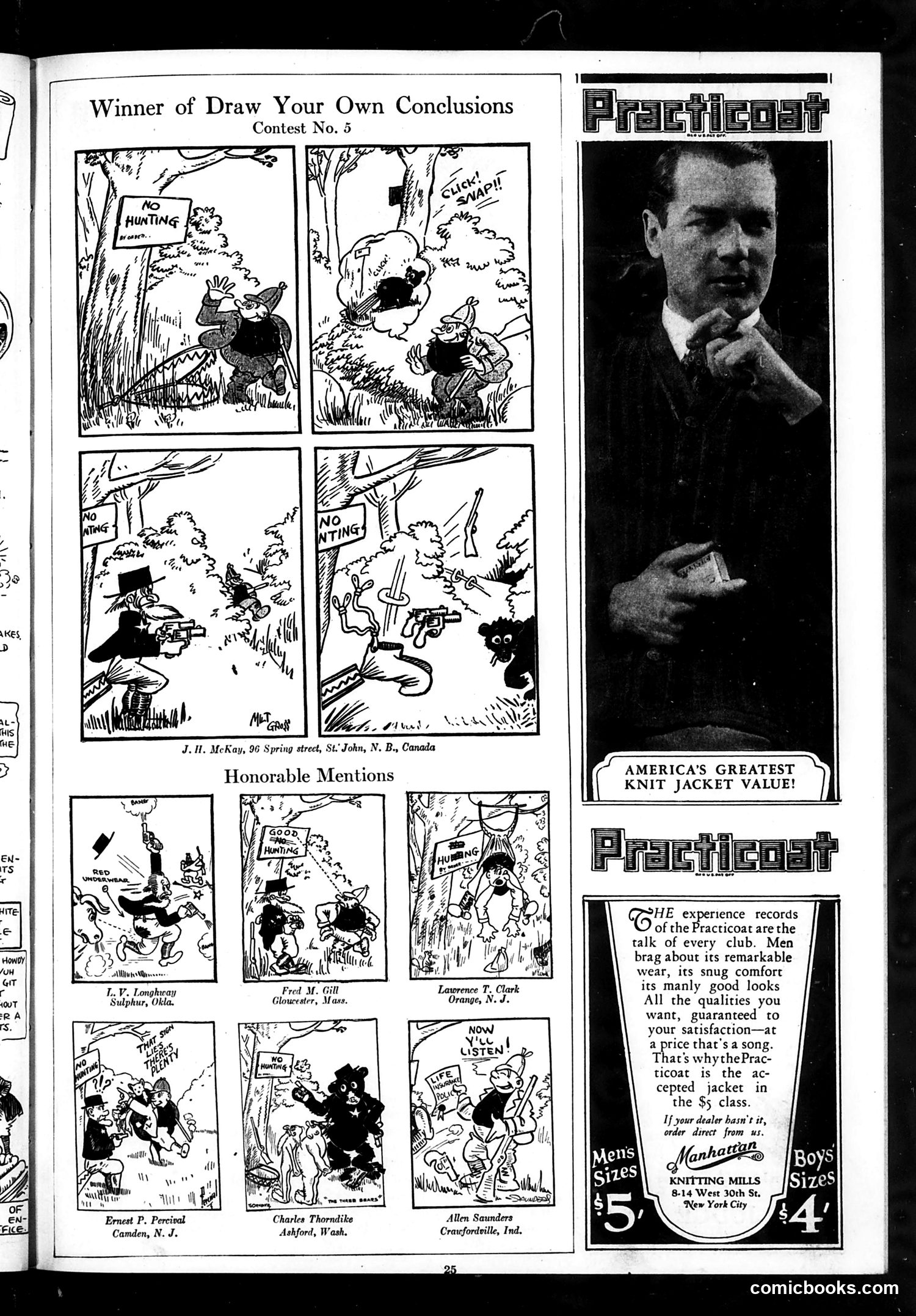
This page features Judge magazine's "Draw Your Own Conclusions" comic contest. The winning four-panel cartoon by J.H. McKay depicts animals (appearing to be a fox or similar creature) encountering a "No Hunting" sign in a forest. The humor relies on visual wordplay: the animals proceed to ignore the sign's prohibition, with the final panel showing them violently attacking what appears to be a hunter—a darkly comedic "conclusion" about what happens when hunting restrictions go unenforced. The "Honorable Mentions" section shows six other contest entries with similar themes of animals subverting or responding to posted rules. The page's right side contains a Practicoat knitted jacket advertisement, unrelated to the cartoons. This was a typical Judge magazine layout mixing editorial content with advertising.
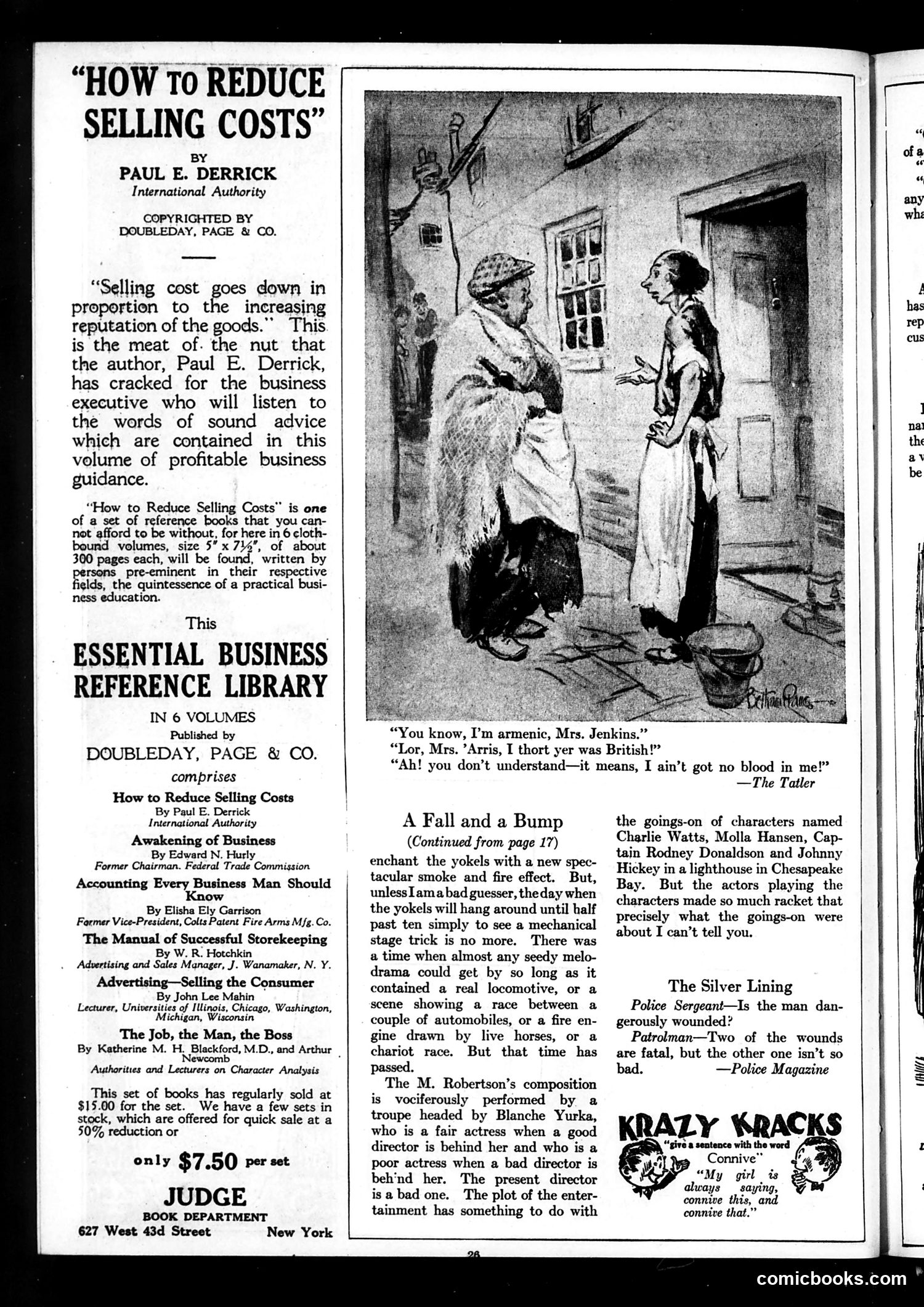
This page is primarily **advertising and book promotion**, not political satire. The main content advertises an "Essential Business Reference Library" of six volumes published by Doubleday, Page & Co., with the lead title "How to Reduce Selling Costs" by Paul E. Derrick. The single cartoon depicts two working-class women (indicated by their dress and dialect) discussing one woman's claim to be "armenic"—a humorous confusion, likely misheard or mispronounced. The joke plays on class and accent differences: Mrs. Jenkins explains "armenic" means "I ain't got no blood in me," a nonsensical statement that creates the humor. The remaining content includes short entertainment reviews (theater, police anecdotes) and a "Krazy Kracks" joke section—typical filler material for Judge magazine. This page reflects early 20th-century magazine formatting: advertising mixed with light humor and brief cultural commentary, targeting business readers and middle-class audiences.
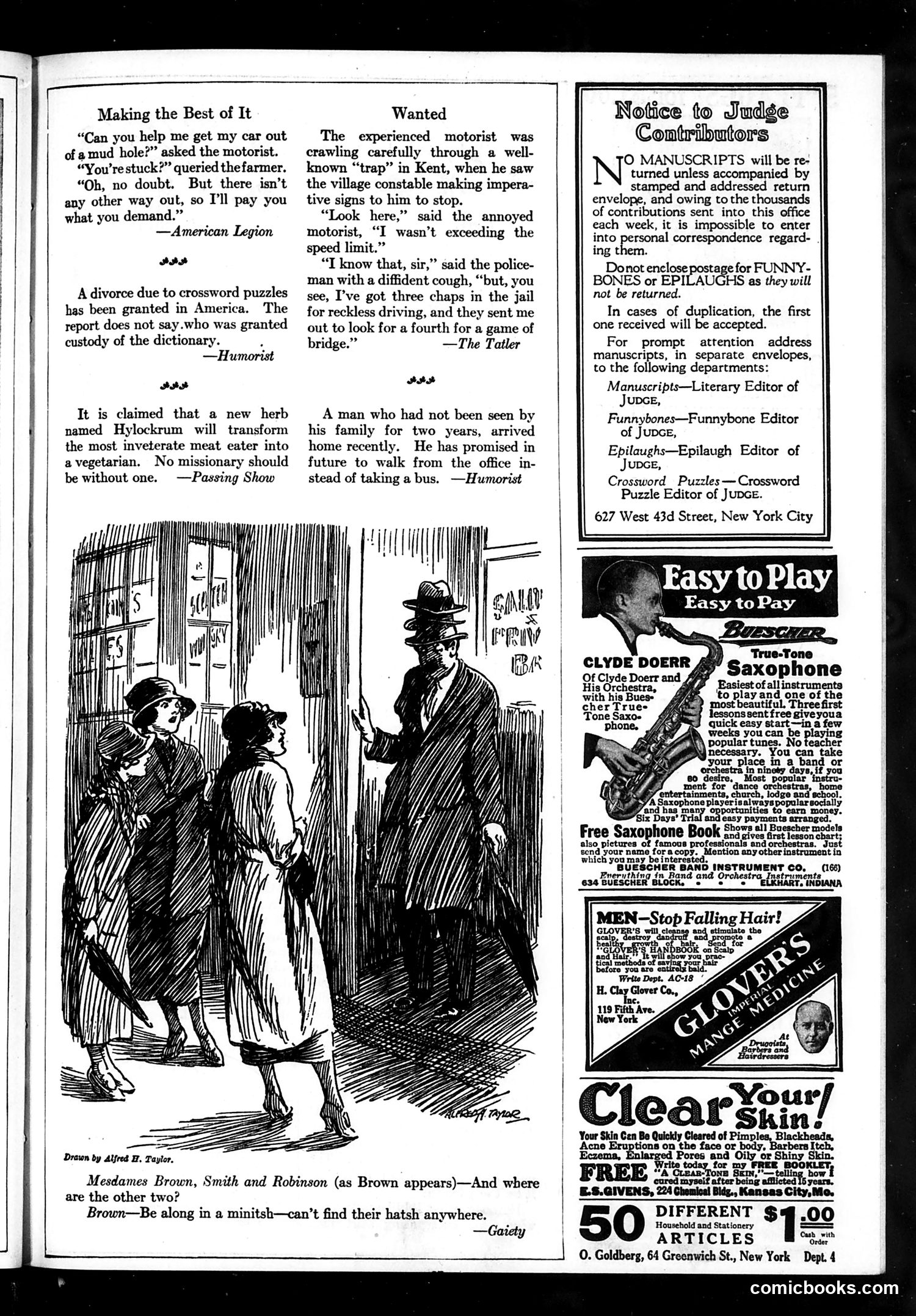
This page contains primarily **short humorous anecdotes and advertisements** rather than political cartoons. The main cartoon depicts **three working-class women** (identified as Mesdames Brown, Smith, and Robinson) searching for their hats. The joke relies on wordplay: Brown's speech pattern suggests intoxication ("hatsh," "minitsh"), implying they've lost their hats while out drinking or partying—a mild social satire about women's behavior. The anecdotes mock contemporary concerns: motorists stuck in mud, crossword puzzle obsession (a 1920s fad), reckless drivers, and absent husbands. They reflect post-WWI American life with gentle, accessible humor targeting middle-class readers. The page is predominantly **advertising**—saxophone lessons, hair loss remedies, and skin treatments—typical of Judge's revenue model. The "Notice to Judge Contributors" provides submission guidelines for readers sending in jokes and puzzles. Overall, this represents **mainstream, non-partisan humor** rather than sharp political satire.
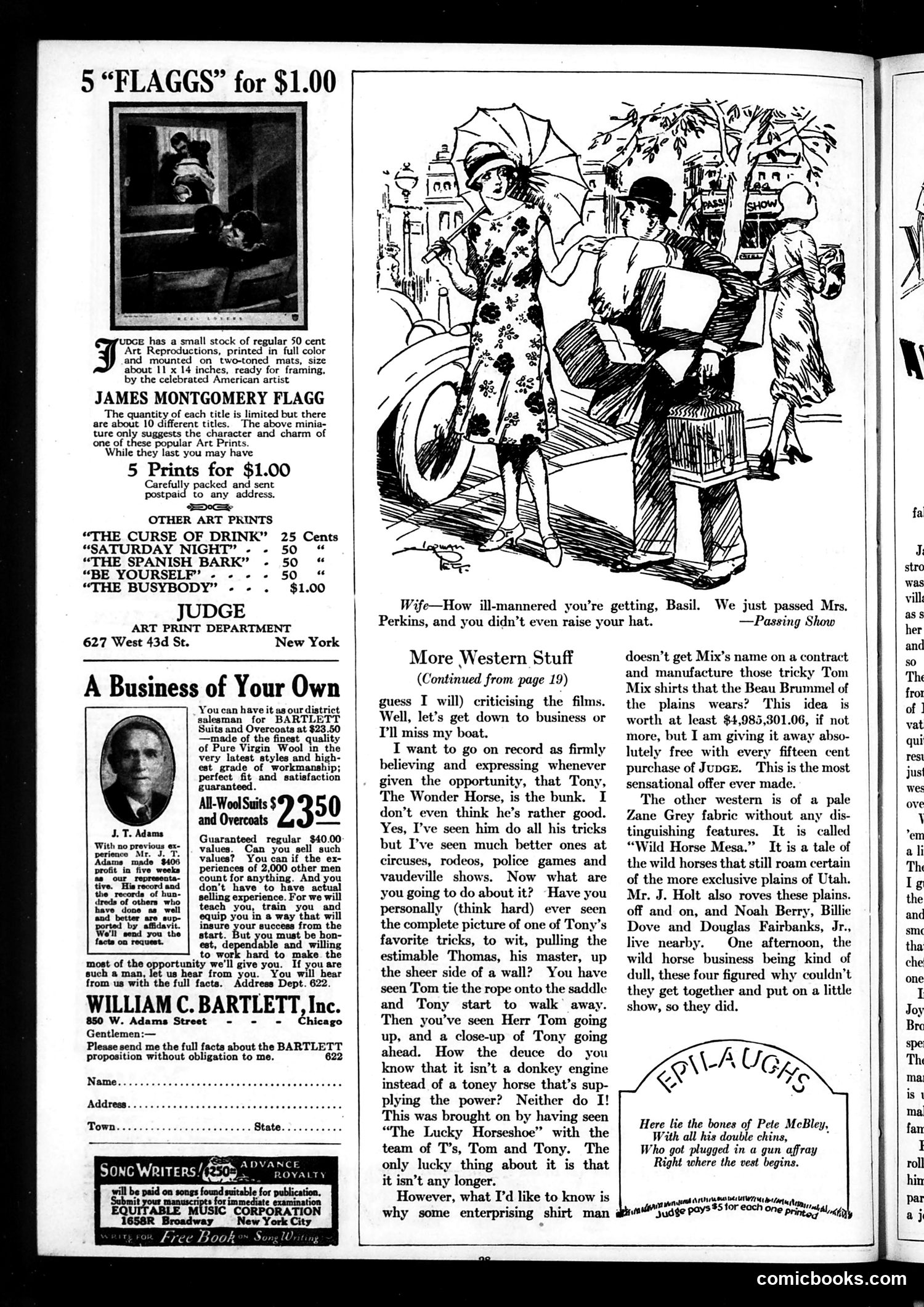
This page is primarily **advertising and editorial content**, not political satire. The main cartoon (top right) shows a domestic scene where a wife scolds her husband "Basil" for poor manners toward someone named Perkins—a mild social humor piece about etiquette, captioned "Passing Show." The bulk of the page consists of **commercial advertisements**: art prints by James Montgomery Flagg (a famous illustrator), Bartlett suits at $23.50, and a song-writing promotion. The "More Western Stuff" section is a **film critique** discussing Western movies, particularly criticizing "Tony, the Wonder Horse" and discussing Tom Mix films and Zane Grey adaptations. The author questions whether Tony is genuinely performing stunts or if they're faked using equipment like donkey engines, and jokes about merchandising opportunities. The content reflects early 1920s popular entertainment (silent Westerns, vaudeville) and consumer marketing rather than political commentary. Judge magazine here functions as an entertainment and advertising publication.
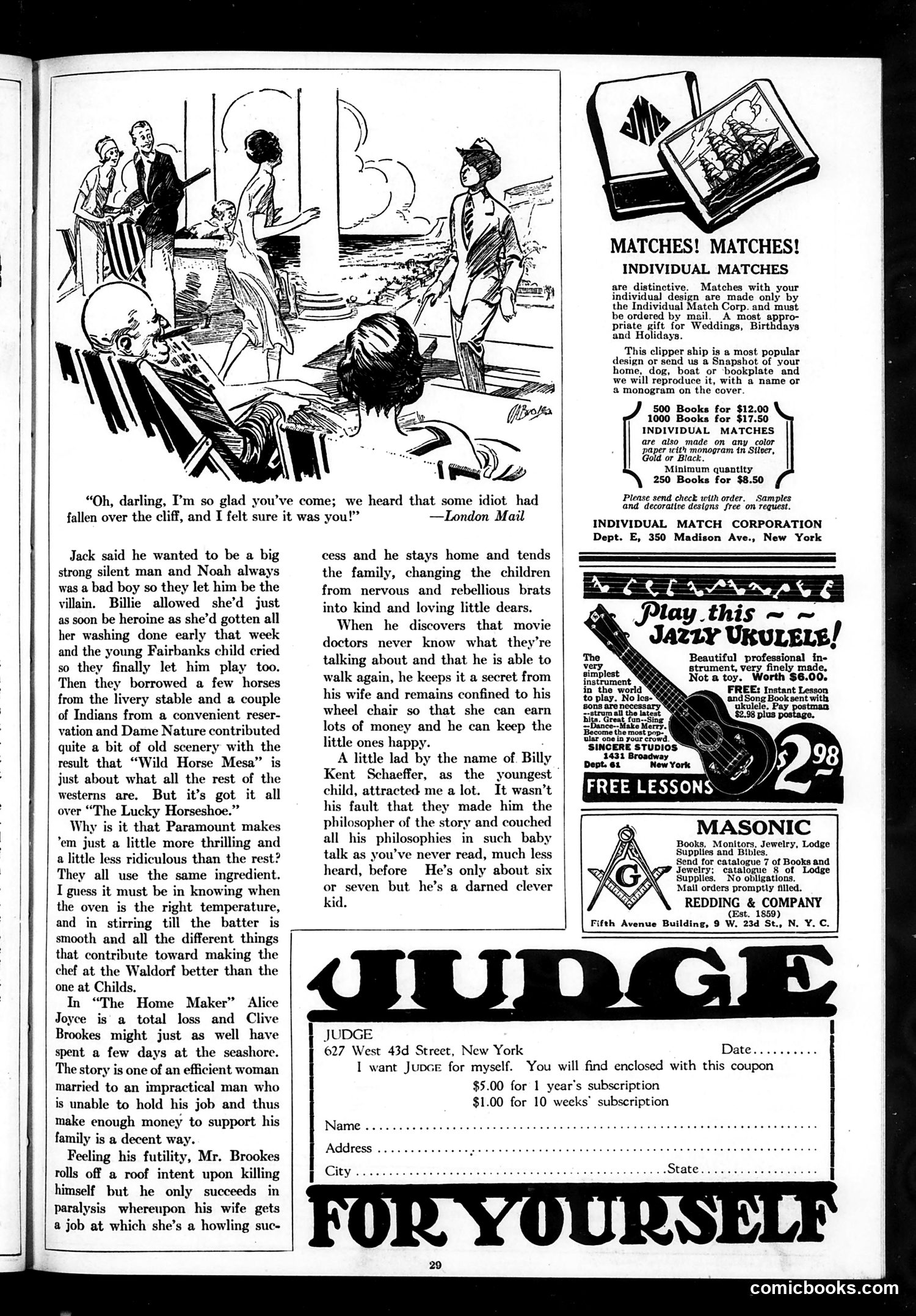
This page combines film reviews with advertisements. The main cartoon depicts a beach/seaside scene where a woman greets an arriving man with the joke: "I'm so glad you've come; we heard that some idiot had fallen over the cliff, and I felt sure it was you!"—a darkly humorous domestic jab suggesting marital discord. The accompanying text reviews silent films, including "Wild Horse Mesa" and "The Home Maker" (featuring actors Alice Joyce and Clive Brookes). The critic mocks how Paramount westerns, while slightly better-crafted than competitors, fundamentally recycle identical plot ingredients. He notes the film about an impractical man whose wife supports the family while he feigns paralysis is emotionally manipulative, though he praises young actor Billy Kent Schaeffer. **For modern readers:** This reflects 1920s film criticism's focus on plot mechanics and acting talent in silent cinema, plus era-specific advertisements (custom matchbooks, ukuleles, masonic supplies). The humor assumes readers recognized these actors and followed contemporary film releases.
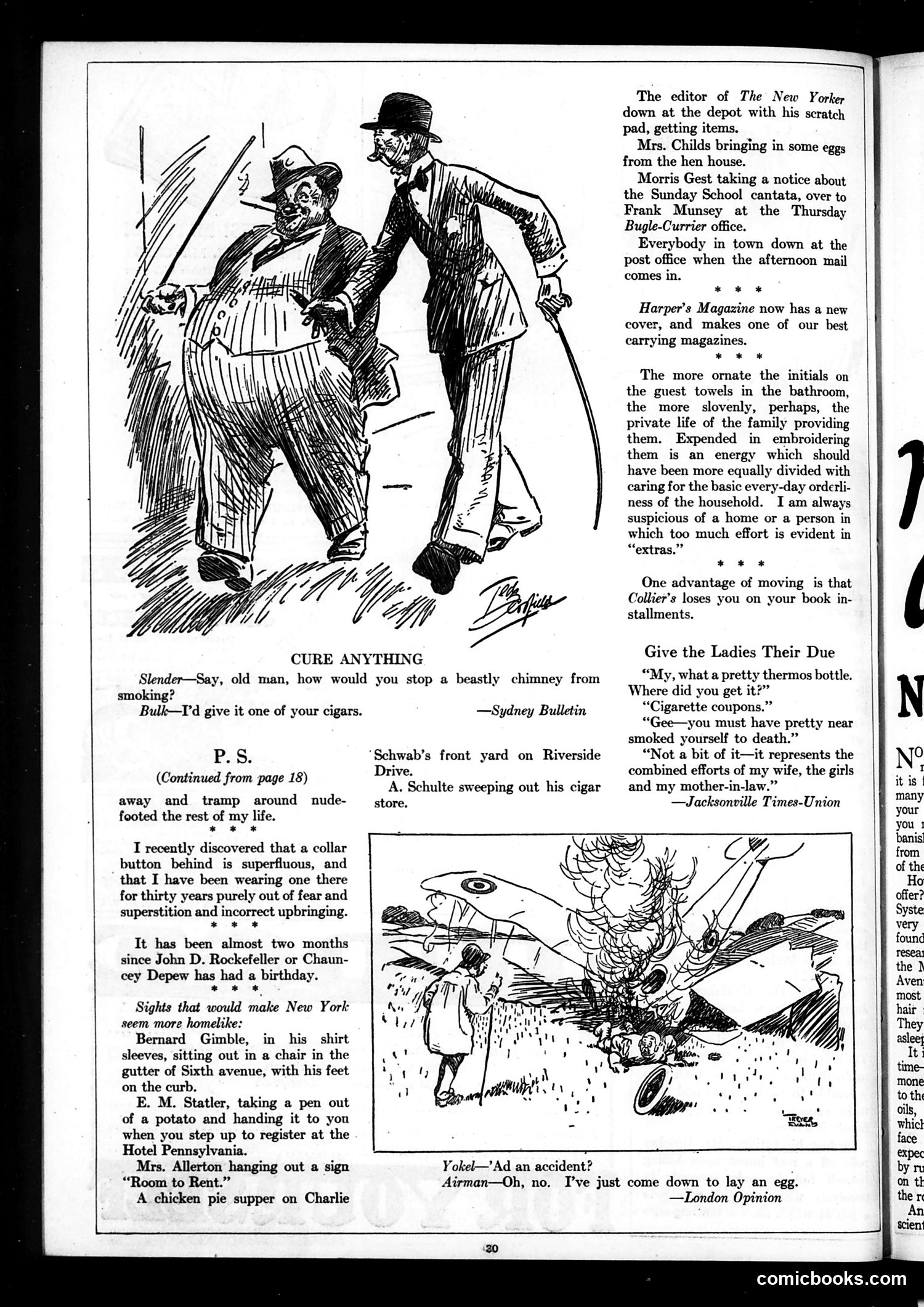
This page contains miscellaneous humor and social commentary typical of Judge magazine's satirical format. **Top Cartoon:** A joke about cigars as a cure-all. A thin man asks a portly man how to stop chimney smoking; the fat man jokes he'd give the thin man's poor-quality cigars to the chimney—implying the cigars are so bad they'd stop anything (likely a dig at cheap cigars or specific cigar brands). **Text Section:** Rambling observations mocking wealthy New York figures and institutions. References include Rockefeller, Depew, and department store owner Gimbel—imagining absurd scenarios like them doing manual labor. It satirizes social pretension and the gap between the wealthy elite and ordinary life. **"Give the Ladies Their Due":** A joke about a man crediting his wife, daughters, and mother-in-law for smoking enough cigarette coupons to earn a thermos bottle—gently mocking both excessive smoking and women's domestic labor going unrecognized. **Bottom Cartoon:** An airman crashes; when asked if he had an accident, he quips he "came down to lay an egg"—slang for failing or performing poorly.
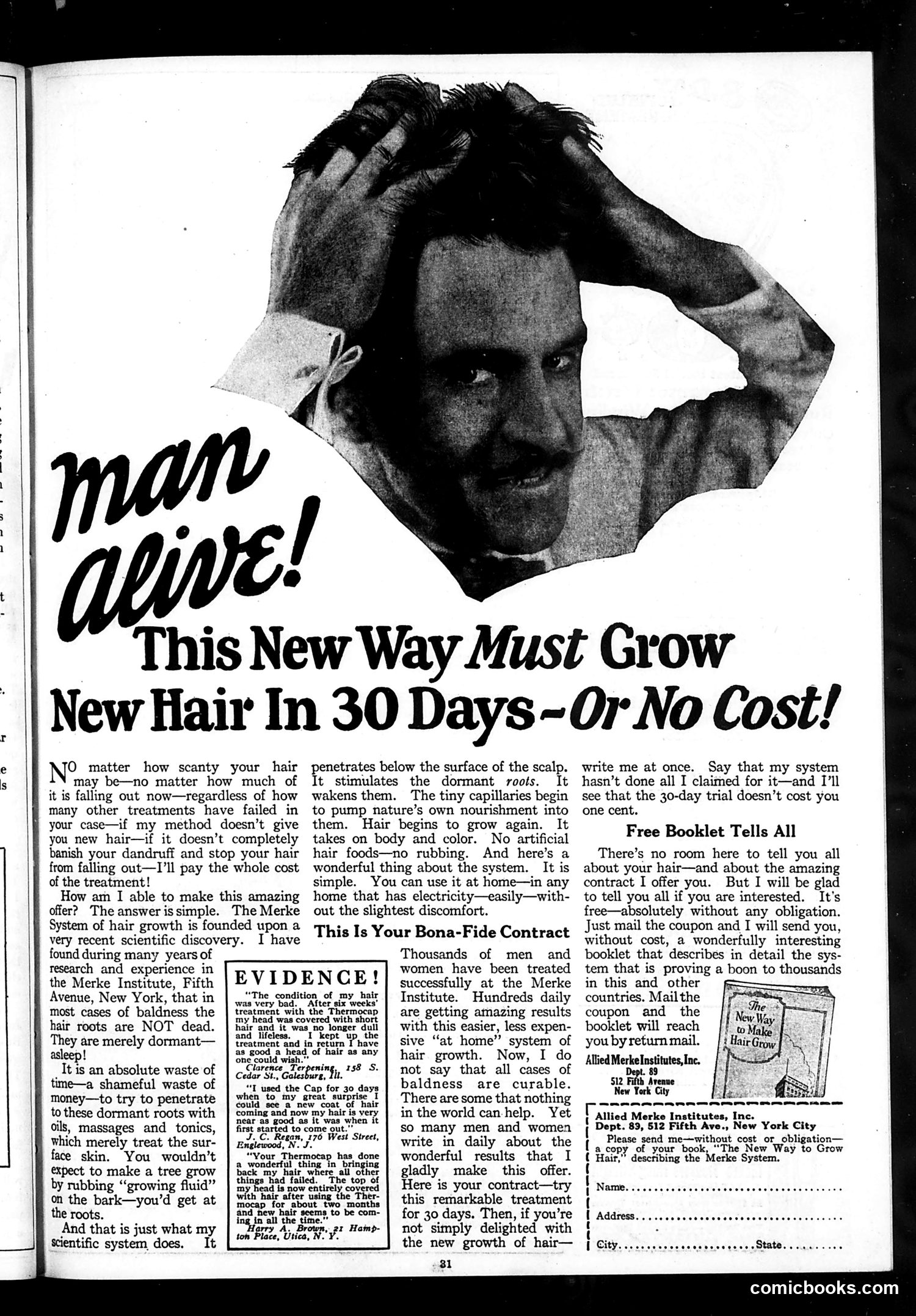
This page is primarily a **mail-order advertisement**, not political satire. It promotes the "Merke System"—a hair-growth treatment using a device called a "Thermocap" that claims to revive dormant hair roots through electrical stimulation. The appeal uses common early-20th-century advertising tactics: - **Bold guarantees**: "30 Days—Or No Cost!" - **Testimonials** from satisfied customers (Clarence Teipening, J.C. Regan, etc.) - **Scientific language** about "dormant roots" and "capillaries" to sound credible - **Bona-fide contract** language to build trust - **Free booklet offer** requiring only a mailed coupon The photograph shows a man with a prominent mustache demonstrating the treatment's results—meant to suggest virility and restored masculine appearance. For modern readers: this reflects early-1900s consumer culture, before FDA regulations, when extravagant health claims and mail-order medical devices were commonplace and largely unregulated. The "no cost" guarantee was marketing psychology, not legal binding.
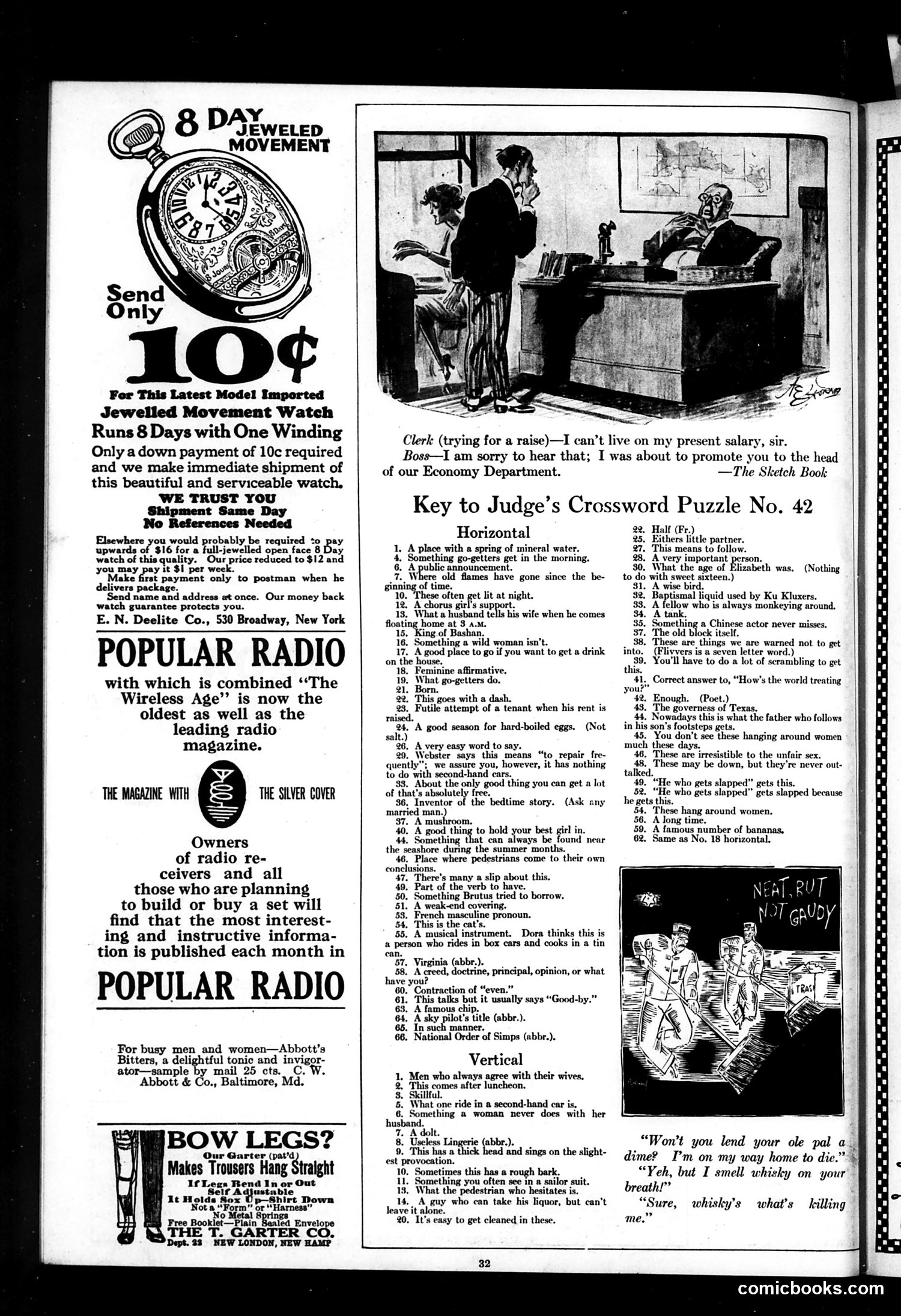
This page is primarily **advertising and puzzle content** rather than political satire. The main cartoon depicts a workplace joke about economic hierarchy during what appears to be the early 20th century. **The Cartoon's Meaning:** A clerk requests a raise, claiming he cannot live on his current salary. The boss responds with ironic cruelty: rather than granting the raise, he "promotes" the clerk to head of the "Economy Department"—a devastating joke implying the clerk should learn to economize instead of earning more. This satirizes employers' indifference to workers' financial struggles and the gap between labor and management during an era of worker exploitation. **Social Context:** The humor reflects real anxieties about wages and cost of living in the pre-Depression era. The surrounding ads (watches, radio equipment, medical remedies) show common consumer goods marketed via payment plans—suggesting many readers lived paycheck-to-paycheck, making the cartoon's economic desperation particularly resonant.
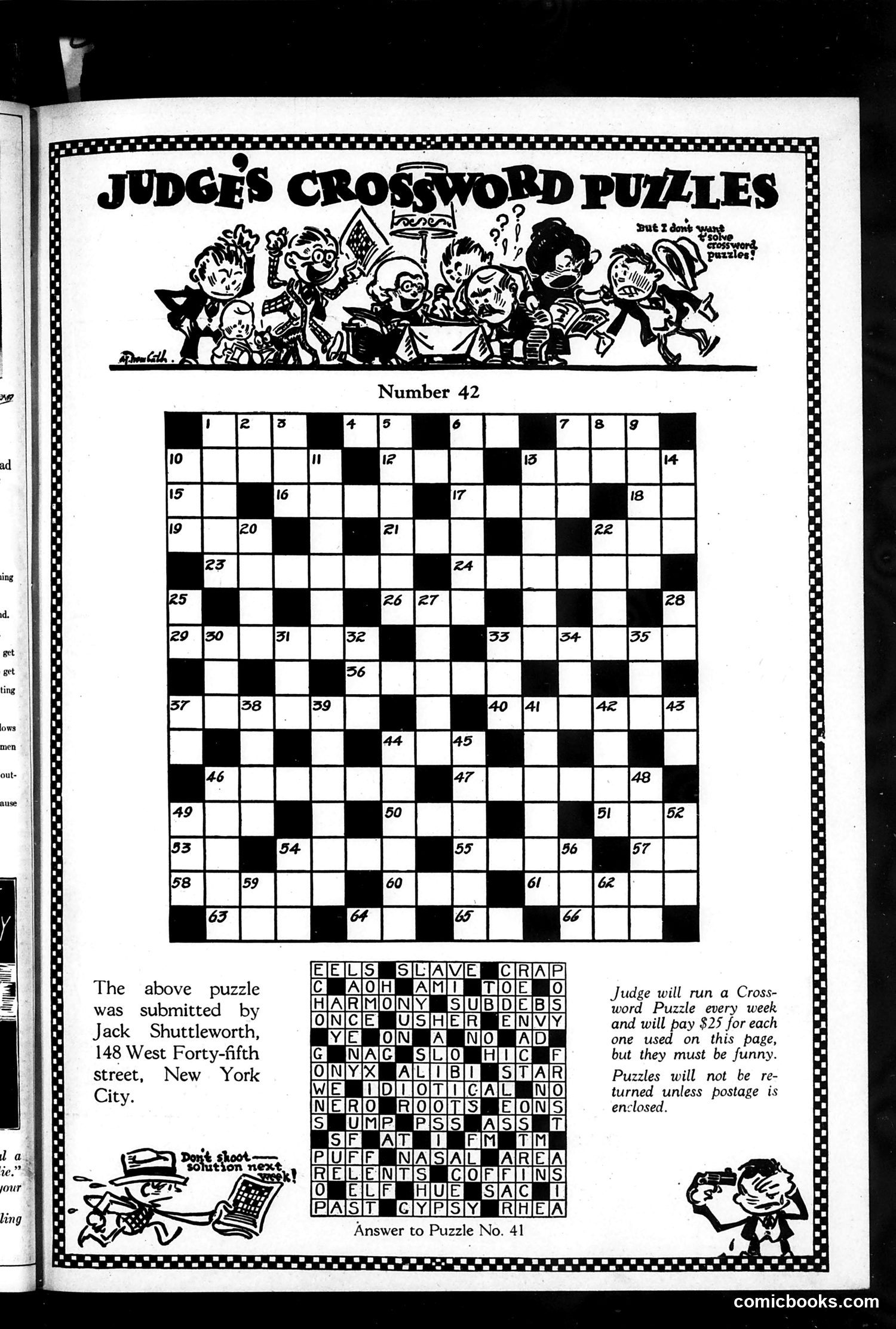
This page is primarily a **crossword puzzle feature**, not political satire. Judge magazine ran weekly crossword puzzles and paid $25 for accepted submissions—a notable prize during this era. The puzzle was submitted by Jack Shuttleworth of New York City. Below the grid is the answer key to the previous week's puzzle (No. 41), with clues like "EELS," "SLAVE," and "CRAPS" visible. The decorative header shows cartoon characters celebrating puzzle-solving, fitting Judge's satirical humor magazine format. The cartoon mascots at bottom corners are generic Judge mascots, not specific political figures. **Modern context**: This reflects the 1920s-30s crossword craze that swept America—puzzles were hugely popular entertainment. Judge capitalized on this trend by crowdsourcing puzzles from readers while maintaining editorial control over humor quality, as noted in the rules ("they must be funny").
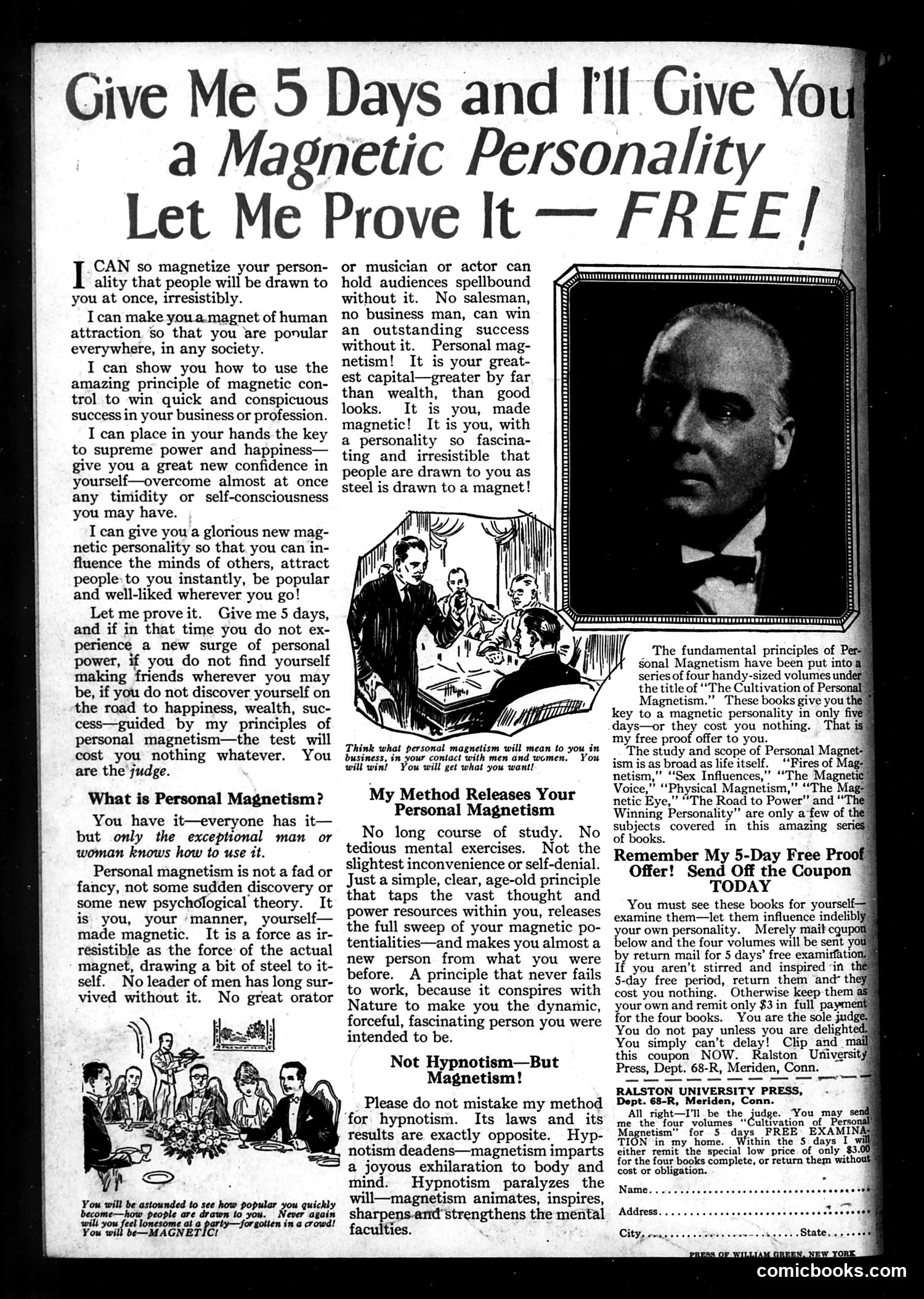
This page is primarily **self-help advertising** from an early 20th-century mail-order publisher, not satire. It promotes a four-volume book series claiming to teach "Personal Magnetism"—a pseudoscientific concept promising to make readers charismatic and successful. The ad explicitly distinguishes its method from hypnotism, claiming to "animate" rather than "paralyze" the will. The offer is a classic direct-mail tactic: five days free examination with no obligation. The illustrations show well-dressed men in social situations, implying the promised benefits. There's a portrait photo (likely the author, though unidentified here) lending authority. **For modern readers:** This represents early self-improvement marketing using vague psychological language and money-back guarantees—tactics still common today. The term "magnetic personality" itself survives as contemporary slang, though the pseudoscientific framework has been forgotten.

I can see this is a page from *Judge* magazine, but the image quality is too degraded for me to reliably identify specific cartoons, figures, or read the OCR text with confidence. The right side shows what appears to be a decorative or patterned background, while the left margin contains partial text fragments that are difficult to parse completely. Without being able to clearly discern the cartoon imagery or read the accompanying text accurately, I cannot responsibly identify the political figures, social references, or satirical points being made. To provide accurate historical context, I would need a clearer or higher-resolution image of this page.