
Judge, 1925-09-26 · page 17 of 37
Judge — September 26, 1925 — page 17: what you’re looking at
What you’re looking at
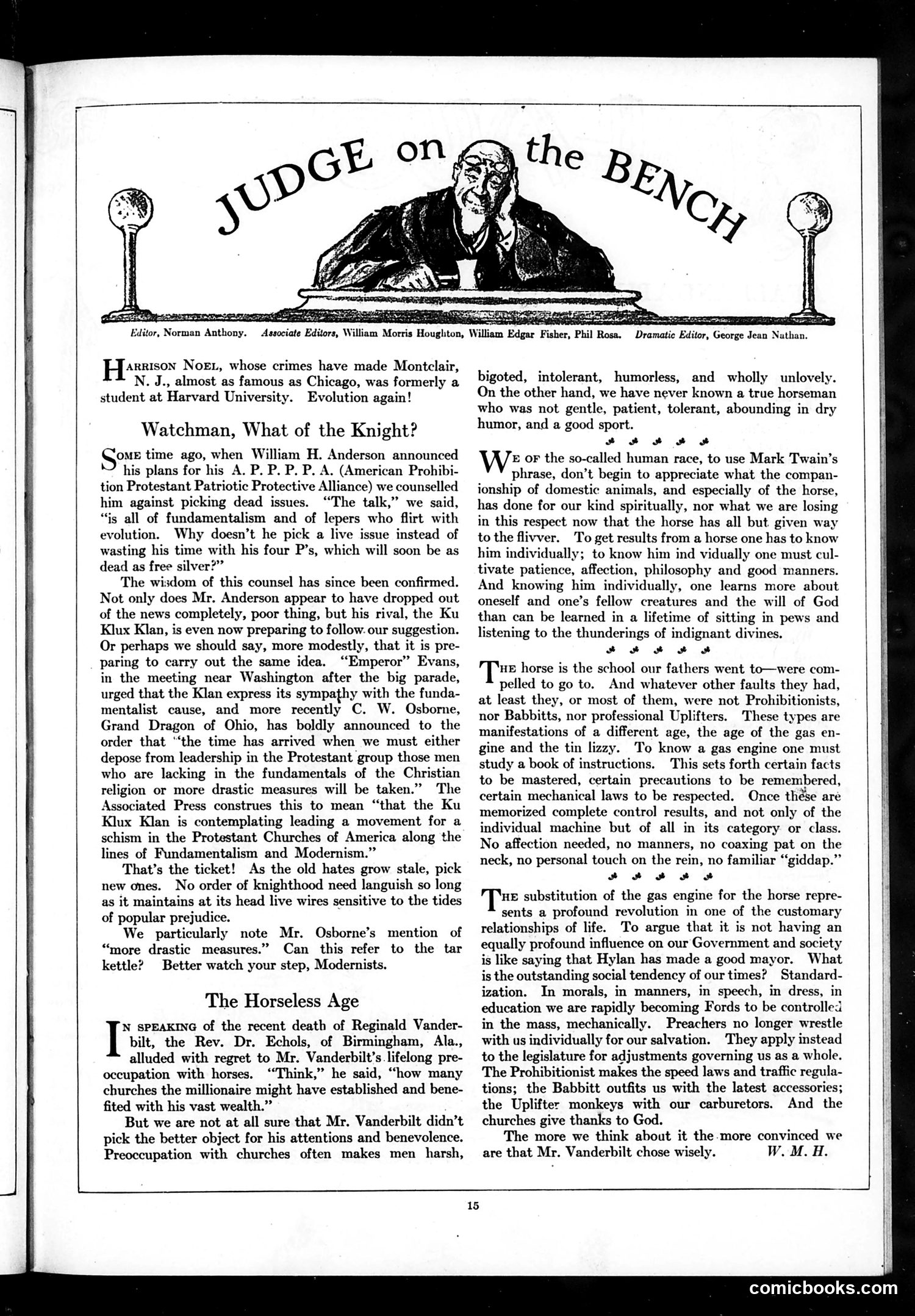
This page contains two editorial pieces criticizing 1920s religious and social movements: **"Watchman, What of the Knight?"** Satirizes William H. Anderson's anti-evolution Protestant organization and the Ku Klux Klan. The writer mocks both groups for pursuing "dead issues" (evolution debates) and warns that the Klan's Ohio leadership, citing "more drastic measures," may be veering toward actual violence against "Modernists"—suggesting the satirist recognizes the Klan as a genuine threat, not merely a social club. **"The Horseless Age"** Uses Reginald Vanderbilt's death as a springboard to contrast horse-ownership (requiring patience, gentleness, manners) with religious fundamentalism (producing bigotry, intolerance). The piece laments automobiles replacing horses as character-builders, and subtly mocks religious institutions as corrupting rather than improving people. Both articles criticize organized religion while celebrating secular pursuits—a distinctly liberal position for the era.
📄 Transcribed text from this page (OCR, searchable)
Machine-transcribed from the original scan — historical spelling and the odd misread are preserved.
Editor, Norman Anthony. Associate Editors, Hye 820s Noex, whose crimes have made Montclair, N. J., almost as famous as Chicago, was formerly a student at Harvard University. Evolution again! Watchman, What of the Knight? ‘OME time ago, when William H. Anderson announced his plans for his A. P. P. P. P. A. (American Prohibi- tion Protestant Patriotic Protective Alliance) we counselled him against picking dead issues. “The talk,” we said, “js all of fundamentalism and of lepers who flirt with evolution. Why doesn’t he pick a live issue instead of wasting his time with his four P’s, which will soon be as dead as free silver?” The wisdom of this counsel has since been confirmed. Not only does Mr. Anderson appear to have dropped out of the news completely, poor thing, but his rival, the Ku Klux Klan, is even now preparing to follow. our suggestion. Or perhaps we should say, more modestly, that it is pre- paring to carry out the same idea. “Emperor” Evans, in the meeting near Washington after the big parade, urged that the Klan express its sympathy with the funda- mentalist cause, and more recently C. W. Osborne, Grand Dragon of Ohio, has boldly announced to the order that “the time has arrived when we must either depose from leadership in the Protestant group those men who are lacking in the fundamentals of the Christian religion or more drastic measures will be taken.” The Associated Press construes this to mean “that the Ku Klux Klan is contemplating leading a movement for a schism in the Protestant Churches of America along the lines of Fundamentalism and Modernism.” That’s the ticket! As the old hates grow stale, pick new ones. No order of knighthood need languish so long as it maintains at its head live wires sensitive to the tides of popular prejudice. We particularly note Mr. Osborne’s mention of “more drastic measures.” Can this refer to the tar kettle? Better watch your step, Modernists. The Horseless Age N SPEAKING of the recent death of Reginald Vander- I bilt, the Rev. Dr. Echols, of Birmingham, Ala., alluded with regret to Mr. Vanderbilt’s. lifelong pre- occupation with horses. “Think,” he said, “how many churches the millionaire might have established and bene- fited with his vast wealth.” But we are not at all sure that Mr. Vanderbilt didn’t pick the better object for his attentions and benevolence. Preoccupation with churches often makes men harsh, jam Morris Houghton, William Edgar Fisher, Phil Rosa. Dramatic Editor, eorge Jean Nathan. bigoted, intolerant, humorless, and wholly unlovely. On the other hand, we have never known a true horseman who was not gentle, patient, tolerant, abounding in dry humor, and a good sport. ee od E OF the so-called human race, to use Mark Twain’s phrase, don’t begin to appreciate what the compan- ionship of domestic animals, and especially of the horse, has done for our kind spiritually, nor what we are losing in this respect now that the horse has all but given way to the flivver. To get results from a horse one has to know him individually; to know him ind vidually one must cul- tivate patience, affection, philosophy and good manners. And knowing him individually, one learns more about oneself and one’s fellow creatures and the will of God than can be learned in a lifetime of sitting in pews and listening to the thunderings of indignant divines. FF HF HH SH HE horse is the school our fathers went to—were com- pelled to go to. And whatever other faults they had, at least they, or most of them, were not Prohibitionists, nor Babbitts, nor professional Uplifters. These types are manifestations of a different age, the age of the gas en- gine and the tin lizzy. To know a gas engine one must study a book of instructions. This sets forth certain facts to be mastered, certain precautions to be remembered, certain mechanical laws to be respected. Once thése aré memorized complete control results, and not only of the individual machine but of all in its category or class. No affection needed, no manners, no coaxing pat on the neck, no personal touch on the rein, no familiar “giddap.” tse HS T= substitution of the gas engine for the horse repre- sents a profound revolution in one of the customary relationships of life. To argue that it is not having an equally profound influence on our Government and society is like saying that Hylan has made a good mayor. What is the outstanding social tendency of our times? Standard- ization. In morals, in manners, in speech, in dress, in education we are rapidly becoming Fords to be controlled in the mass, mechanically. Preachers no longer wrestle with us individually for our salvation. They apply instead to the legislature for adjustments governing us as a whole. The Prohibitionist makes the speed laws and traffic regula- tions; the Babbitt outfits us with the latest accessories; the Uplifter monkeys with our carburetors. And the churches give thanks to God. The more we think about it the-more convinced we are that Mr. Vanderbilt chose wisely. W.M. H. comicbooks.com