
A complete issue · 37 pages · 1925
Judge — July 18, 1925
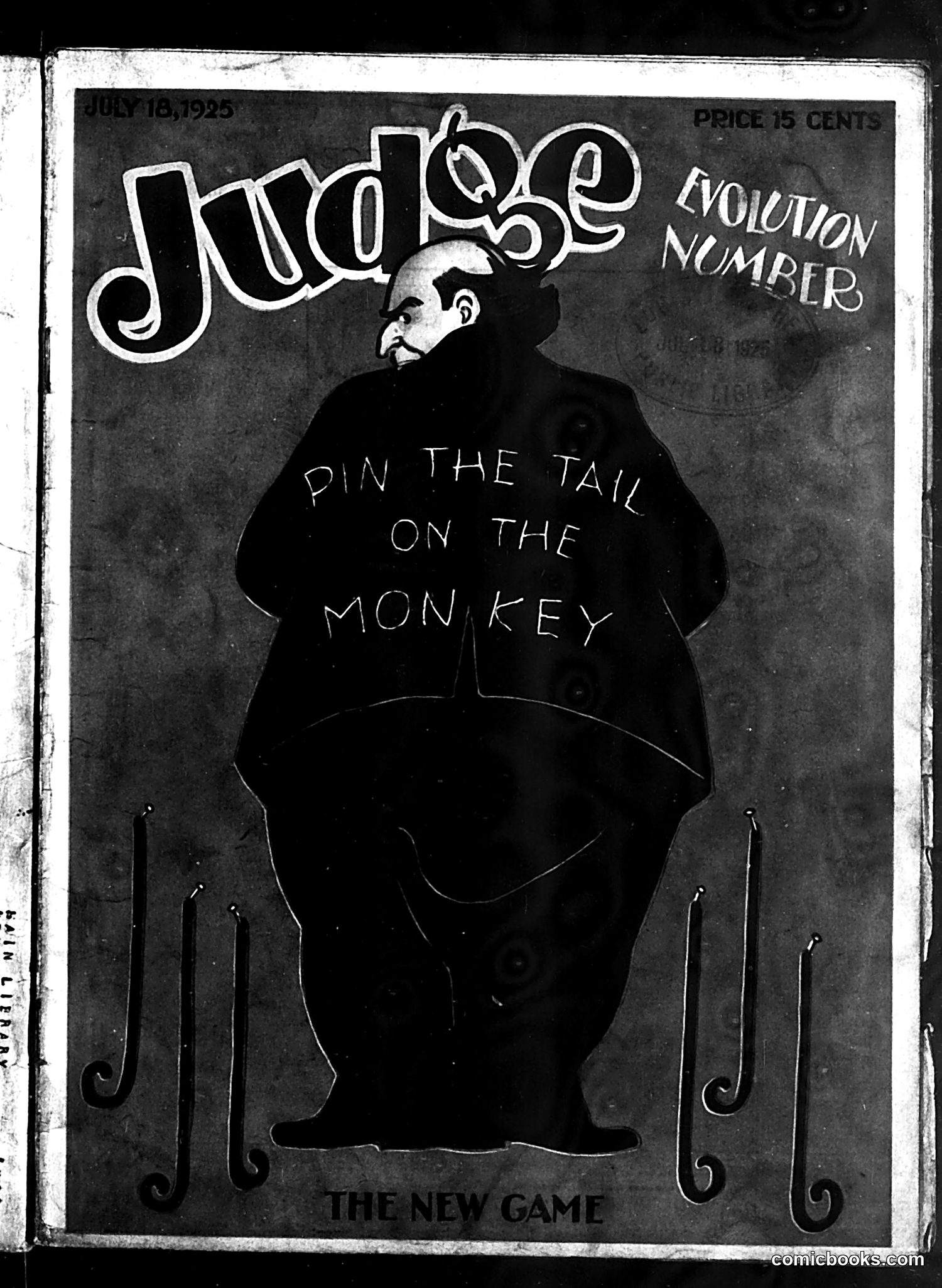
This is the cover of Judge's "Evolution Number" issue. The central image depicts a man in formal dress emerging from or transforming out of a large monkey silhouette, illustrating the concept of human evolution from primates. The caption reads "PIN THE TAIL ON THE MONKEY" — a playful reference to the children's game "Pin the Tail on the Donkey," repurposed here as satire about evolutionary theory. This likely reflects the intense "evolution debate" of the 1920s, particularly following the 1925 Scopes Monkey Trial in Tennessee, which tested laws prohibiting the teaching of evolution in schools. The cover satirizes both evolutionary theory and its cultural controversy by treating it as a parlor game, mocking either evolutionists or their critics.
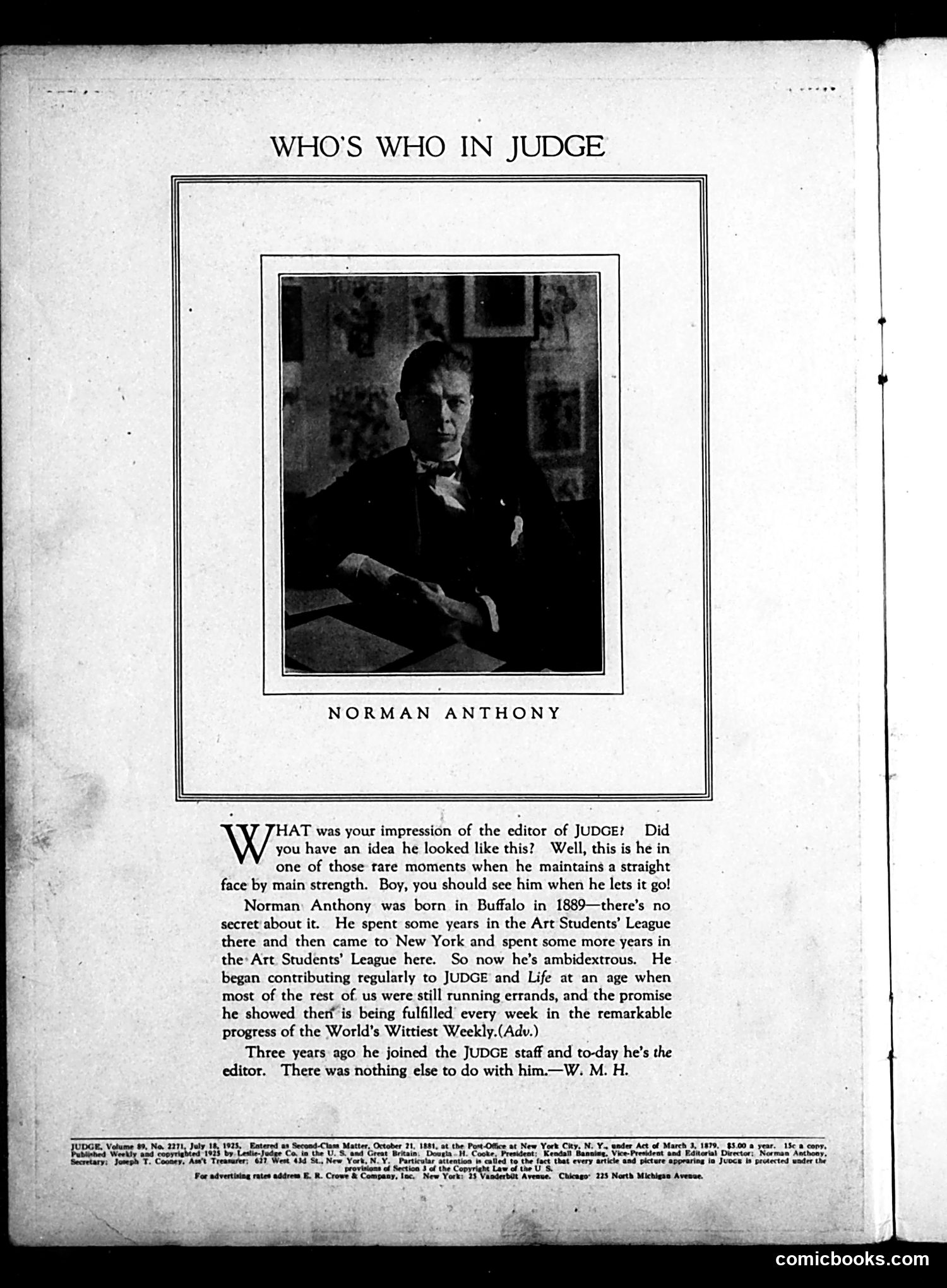
This is a profile page featuring Norman Anthony, who became editor of *Judge* magazine three years prior to this publication. The accompanying photograph shows Anthony in formal attire at his desk, presenting what the text describes as a rare moment of "straight face" seriousness. The biographical sketch reveals Anthony was born in Buffalo in 1889 and trained at Art Students' Leagues in both New York locations before joining *Judge*'s staff. The text humorously notes his "ambidextrous" talents—contributing regularly to both *Judge* and *Life* magazines while maintaining other work. The piece appears to be a lighthearted introduction to the magazine's leadership, emphasizing Anthony's long tenure and commitment to the publication's satirical mission.
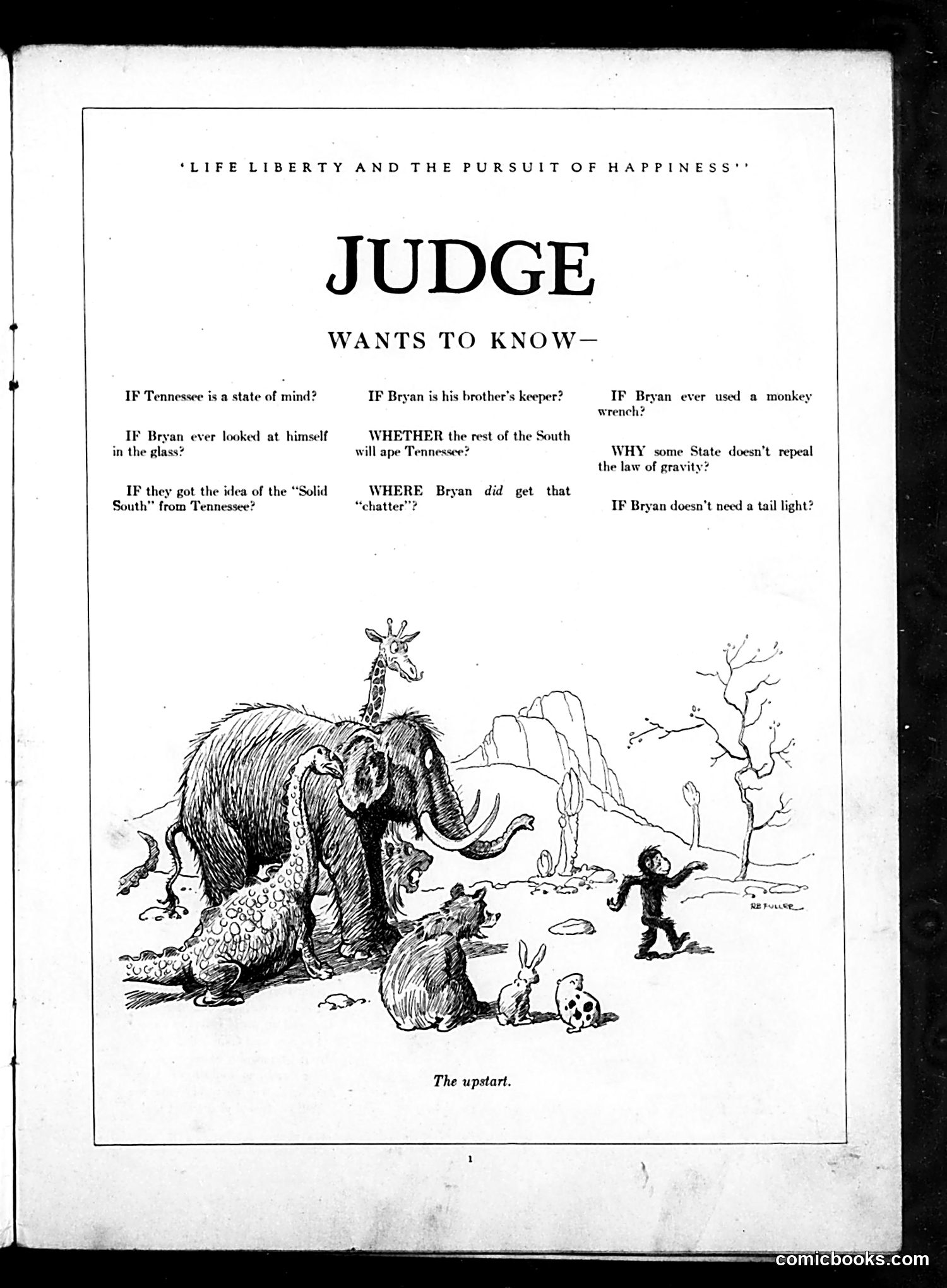
This appears to be a satirical page from *Judge* magazine mocking William Jennings Bryan, a prominent populist politician of the late 1800s. The heading "'Life Liberty and the Pursuit of Happiness'" ironically frames absurdist questions posed by a "Judge" about Bryan—whether Tennessee is a "state of mind," if Bryan is his brother's keeper, whether he used a monkey wrench, and other nonsensical queries. The cartoon below titled "The upstart" depicts Bryan (likely the figure on the right) amid fantastical creatures—an elephant, giraffe, and other animals in a surreal landscape. This visual absurdism reinforces the satirical point: the questions are equally ridiculous, mocking what the magazine apparently viewed as Bryan's illogical or dangerous political ideas. The satire suggests Bryan's philosophy was fantastical nonsense.
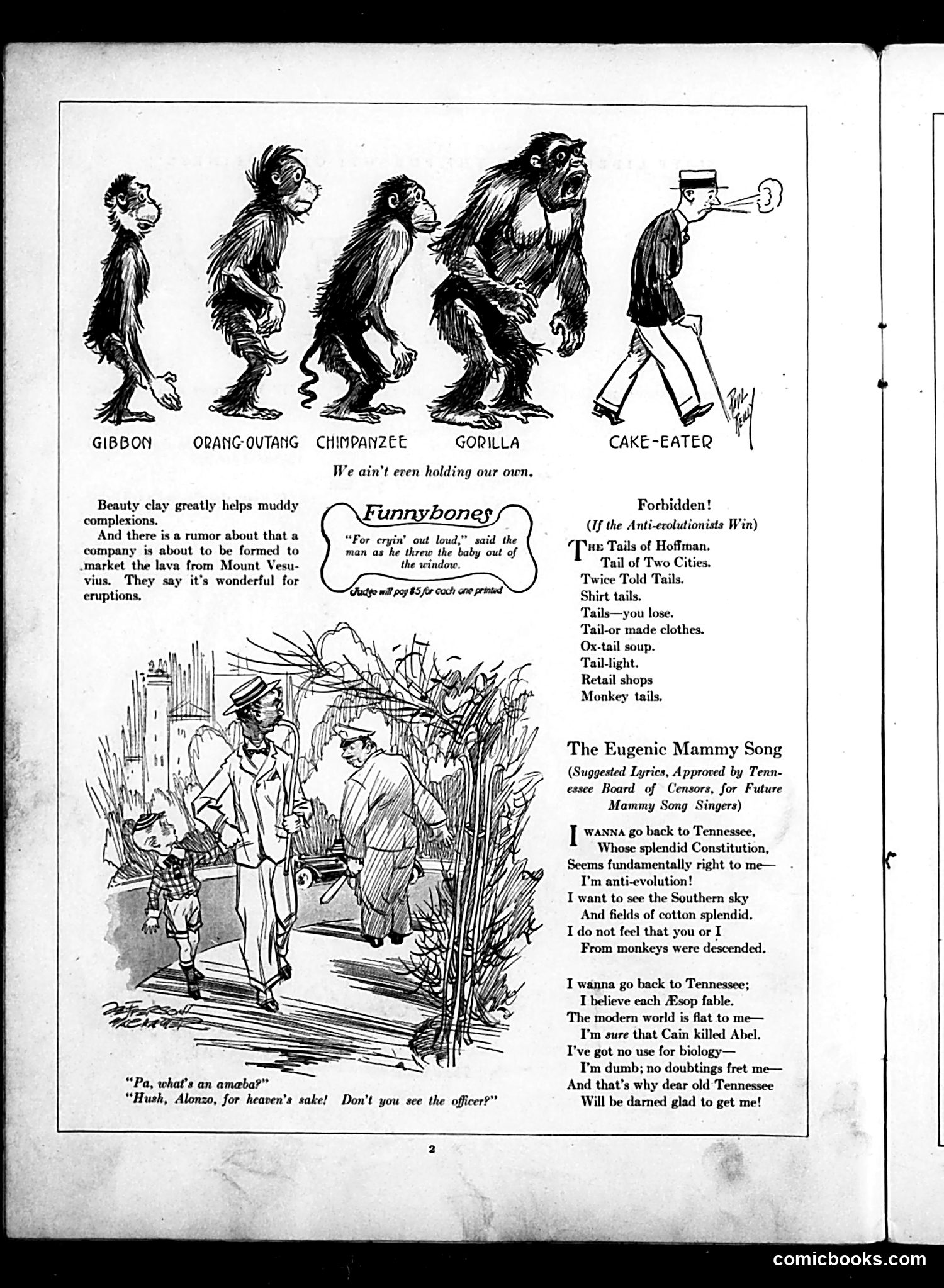
**Top Cartoon - "We ain't even holding our own":** This depicts an evolutionary hierarchy from ape to human, labeled "Gibbon," "Orang-Outang," "Chimpanzee," "Gorilla," and "Cake-Eater." The satirical point suggests that modern young men ("cake-eaters"—slang for wealthy, idle youths) represent *devolution* rather than progress, ranking them alongside primates. This reflects early 20th-century anxieties about masculinity and generational decline. **Bottom Content:** A humorous sketch depicts confusion about "amoeba" (likely referencing Darwinian evolution/biology education). **Right Section - "The Eugenic Mammy Song":** This anti-evolution protest song mocks evolutionary theory and eugenics, expressing Tennessee conservatism and religious opposition to Darwinism. This likely references contemporary debates over teaching evolution in schools during the 1920s.
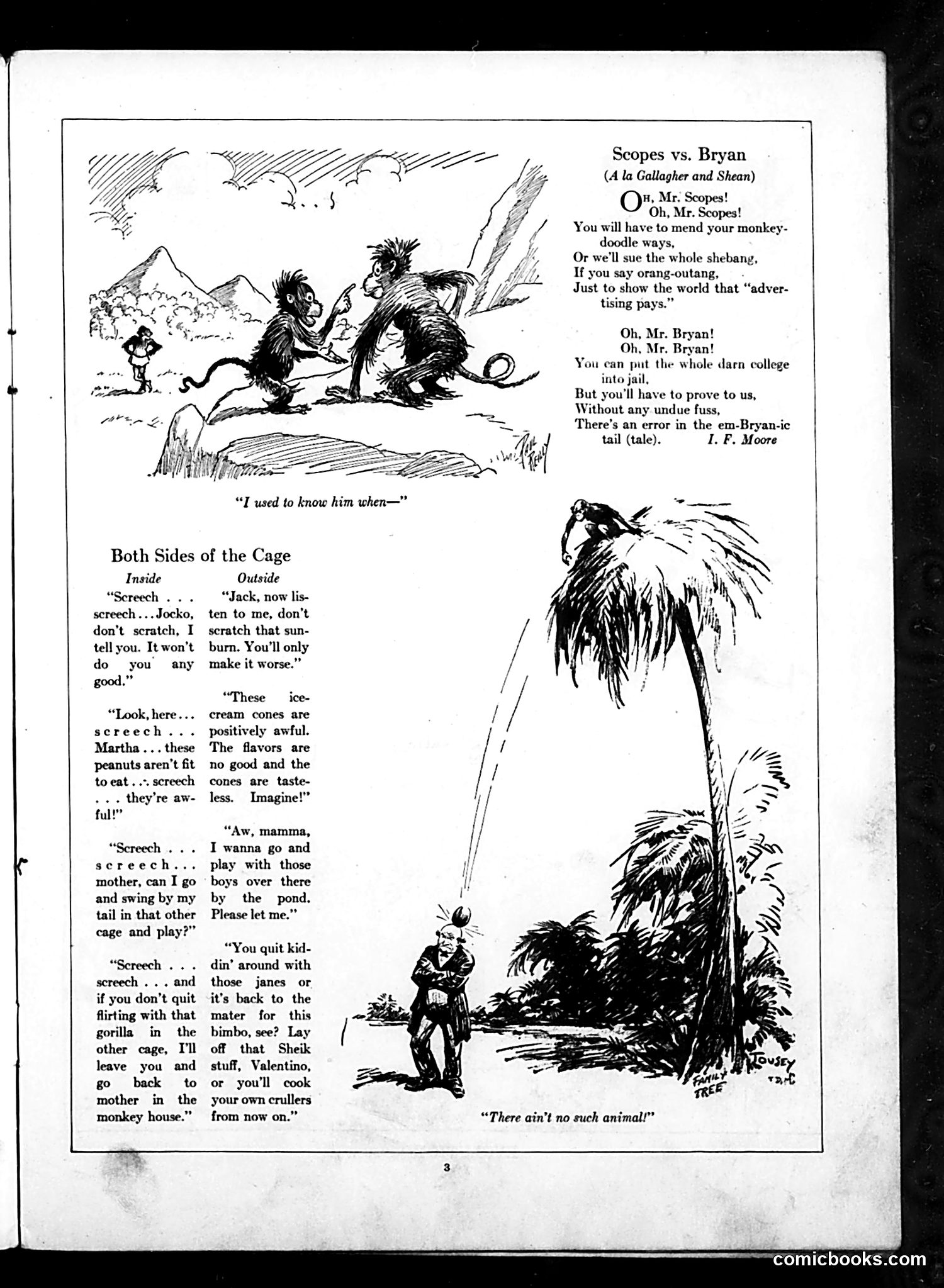
This page contains satirical poetry and illustrations from Judge magazine, likely early 20th century. **"Scopes vs. Bryan"** references the famous 1925 Scopes Monkey Trial, where teacher John Scopes was prosecuted for teaching evolution. William Jennings Bryan led the prosecution. The cartoon depicts monkeys mocking Bryan, with the poem sarcastically suggesting Scopes face jail unless he can disprove the error in "the em-Bryan-ic tail (tale)"—a pun on Bryan's name and evolution. **"Both Sides of the Cage"** presents dueling domestic complaints: inside voices (children's complaints) versus outside voices (a mother's retorts about unruly behavior). It's humorous social commentary on family conflict. The right illustration shows a figure claiming "There ain't no such animal!" while observing what appears to be a large creature—likely mocking denialism about evolution.
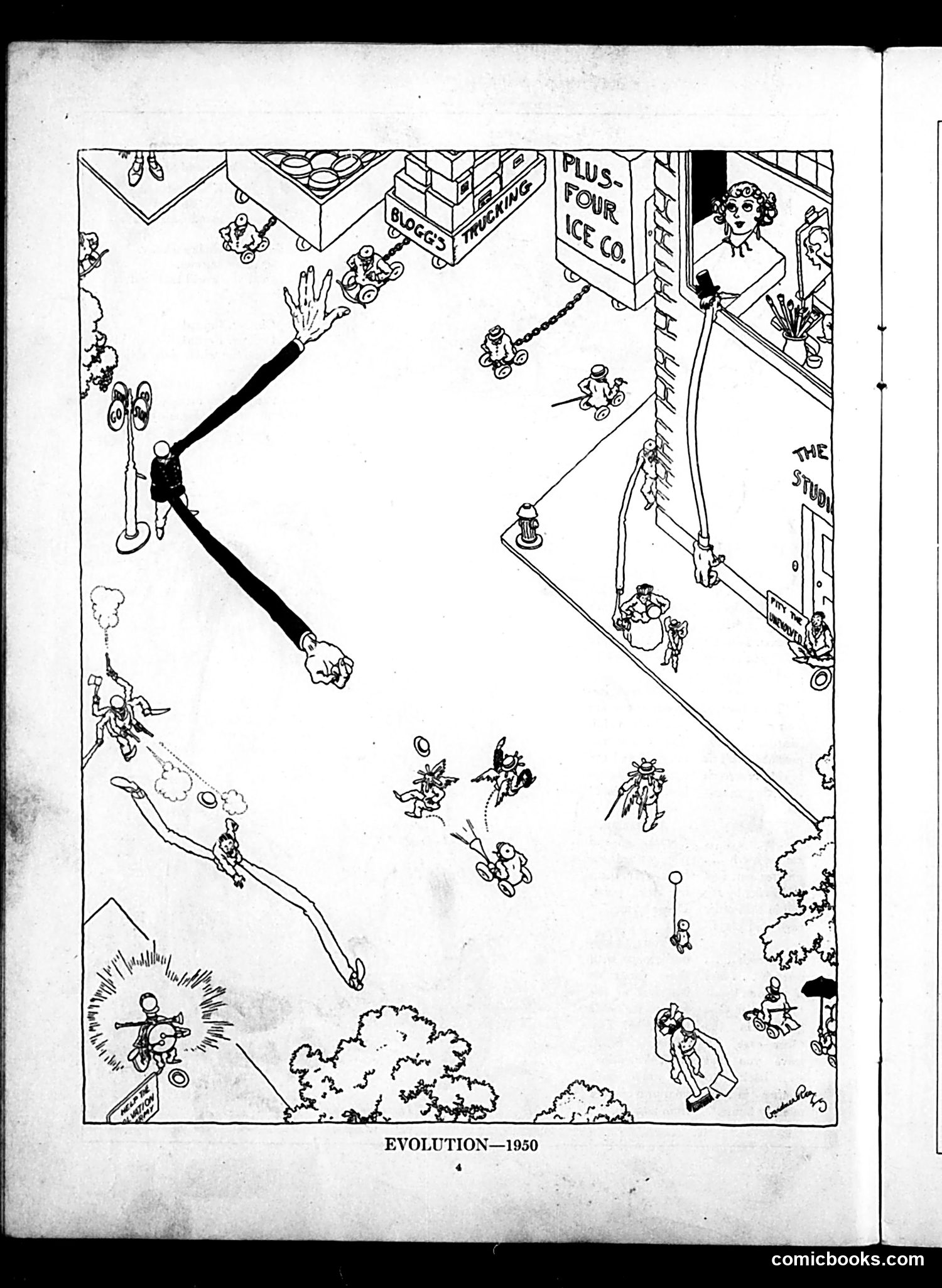
This cartoon satirizes technological and social progress by 1950. The title "Evolution" suggests humanity's advancement, depicted through a bird's-eye view of modern life. The image shows people engaged in contemporary leisure activities—playing with toys, using ice delivery services (the "Plus-Four Ice Co." sign), recreational activities, and commercial establishments. The aerial perspective emphasizes how consumer culture and conveniences have become central to American life. The satire likely critiques how mid-century "progress" has translated into frivolous consumption and dependency on commercial services rather than meaningful advancement. The detailed, busy composition suggests a society absorbed in entertainment and material goods rather than substantive development. The artist's signature appears lower right.
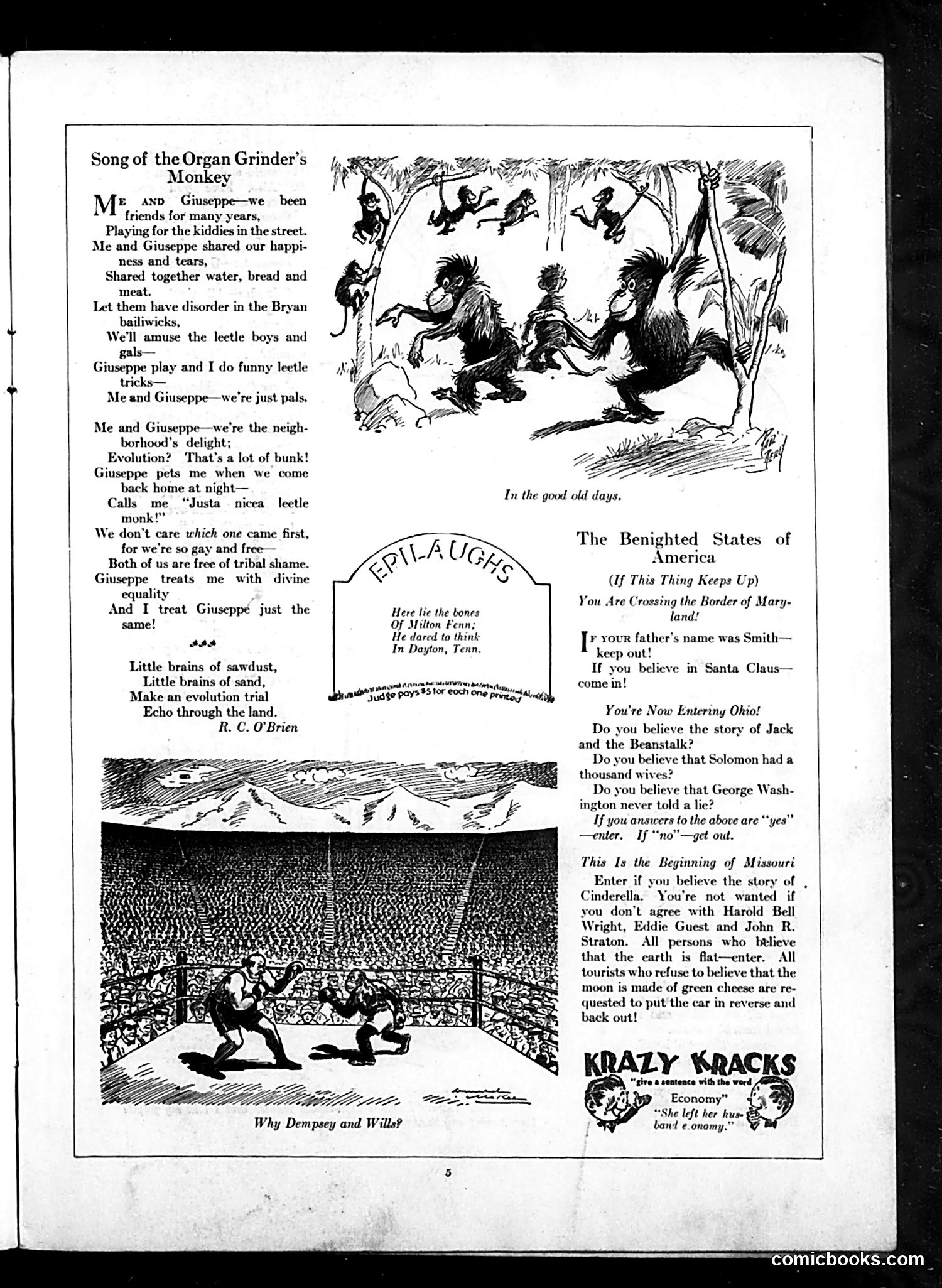
This page contains three distinct pieces: 1. **"Song of the Organ Grinder's Monkey"** (top left): A poem by R.C. O'Brien celebrating friendship between an organ grinder and his monkey, treating them as equals regardless of "tribal shame" or "evolution." 2. **Middle illustration** labeled "Why Dempsey and Wills?": Shows two boxers in a ring before a massive crowd. This likely references the famous 1921 heavyweight championship fight between Jack Dempsey and Georges Carpentier (not "Wills" as printed—possibly an OCR error for a contemporary boxer). 3. **"The Benighted States of America"** (right): Satirical state-entry warnings mocking regional superstitions and beliefs (flat earth theories, Santa Claus doubters, etc.). The page blends light social satire with sports commentary typical of Judge's mixed-content format.
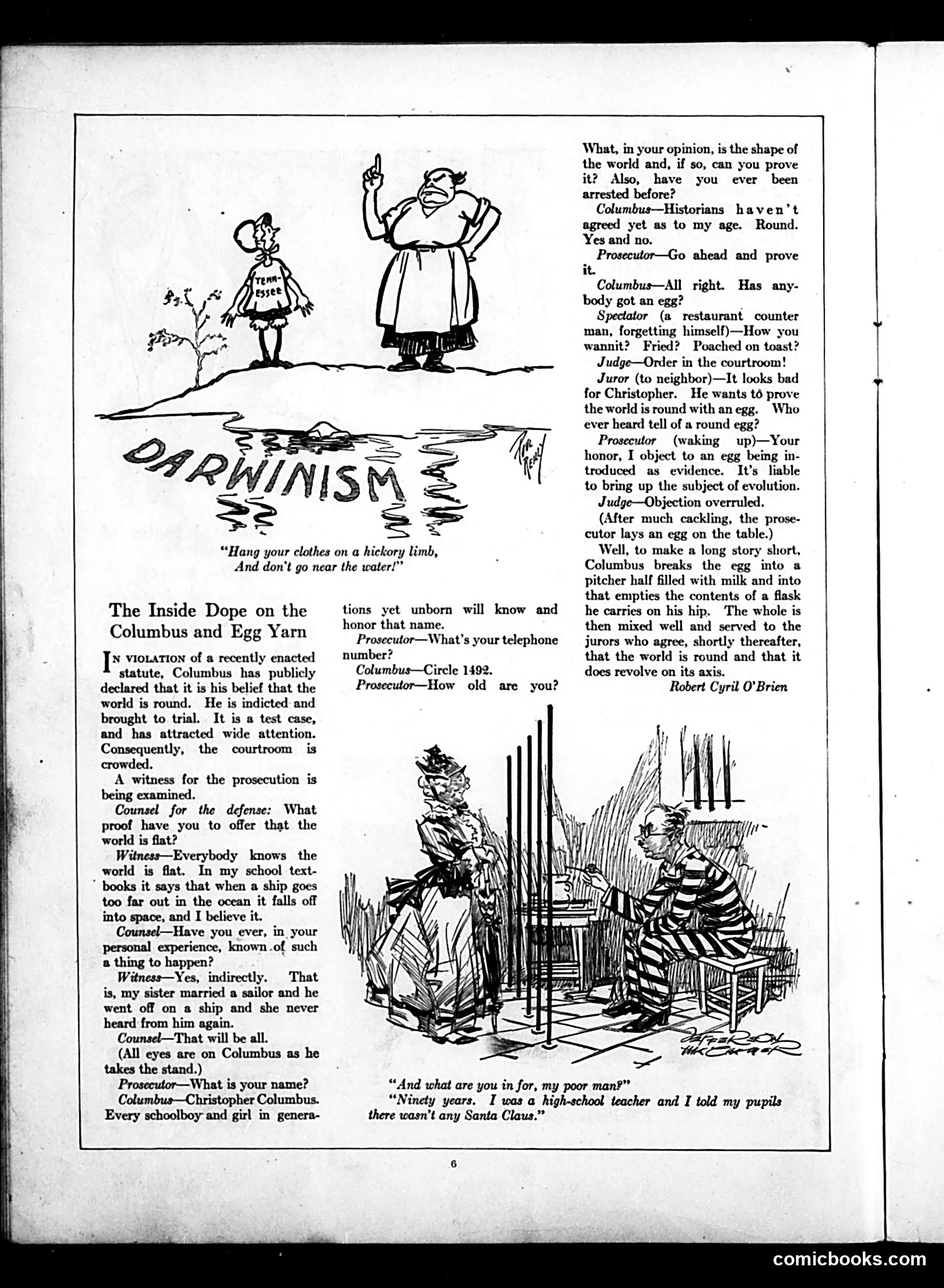
This Judge magazine page satirizes anti-evolution sentiment and scientific ignorance in early 20th-century America. Columbus is prosecuted for claiming the world is round—a stand-in for Darwinian evolution, which faced fierce public and legal opposition (notably the 1925 Scopes Trial). The courtroom witnesses represent willful ignorance: claiming textbooks prove a flat earth, offering anecdotal "evidence" instead of facts. Columbus "proves" roundness through a trick involving an egg and alcohol, getting drunk jurors to agree—mocking how actual evolution debates devolved into absurdity. The bottom panel extends the joke: a teacher imprisoned for denying Santa Claus parallels being punished for teaching scientific truth. Both cartoons critique prosecuting people for contradicting popular belief, satirizing the broader cultural resistance to modernism and science that characterized the era.
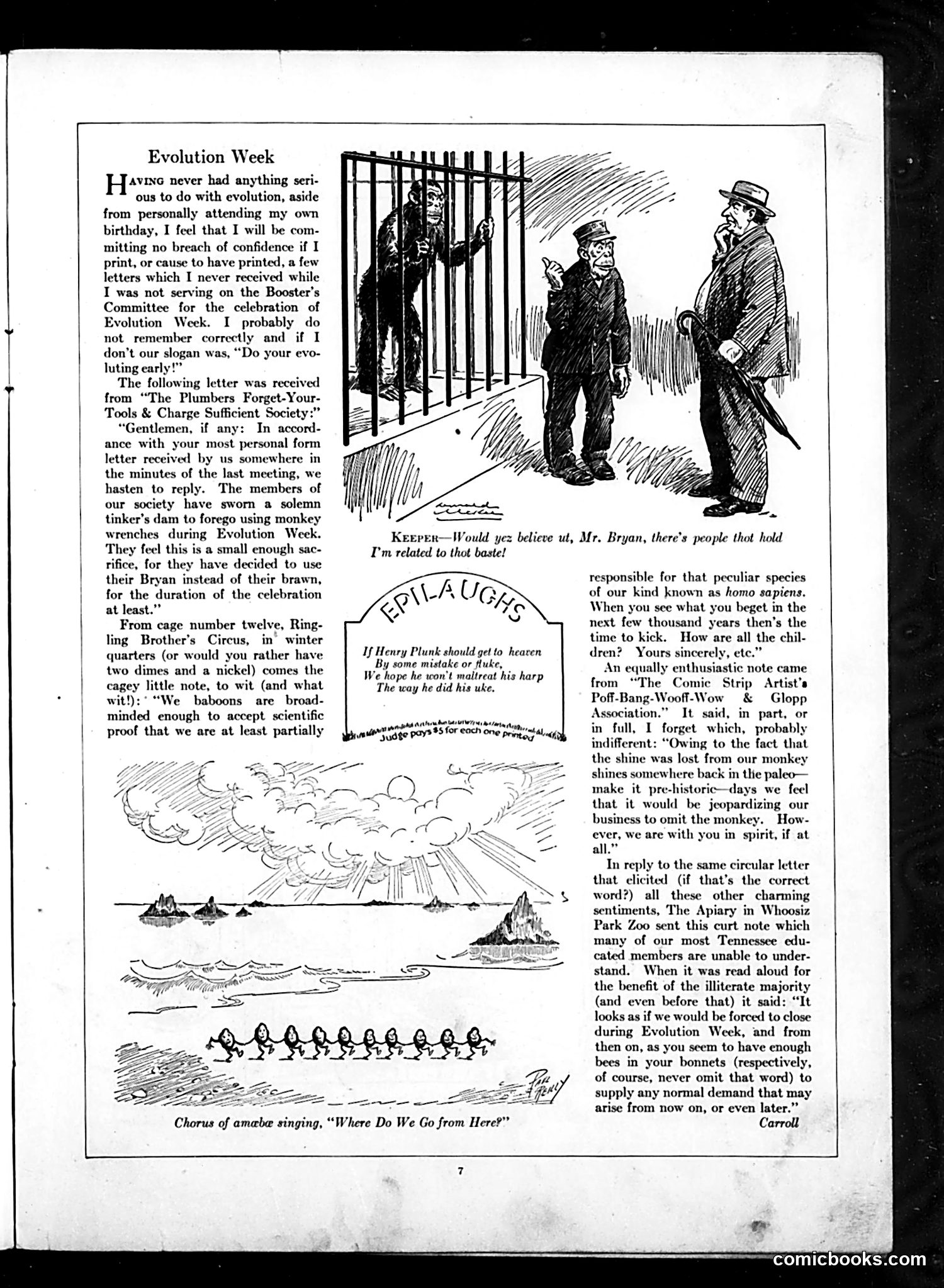
This page satirizes "Evolution Week" celebrations and, implicitly, William Jennings Bryan's opposition to evolutionary theory. The main cartoon shows a zookeeper addressing Bryan (identifiable by the caption mentioning him), with an ape in a cage—the visual pun being that Bryan himself appears ape-like, reinforcing the evolutionary connection he rejected. The humor comes from mock letters from various groups (plumbers, circus performers, comic artists, zoo animals) announcing their support for Evolution Week through absurd compromises: plumbers will use "Bryan instead of brains"; baboons accept being "partially responsible" for humans; a zoo threatens closure due to having "enough bees in your bonnets." The satire mocks both Bryan's anti-evolution stance and the public enthusiasm for "Evolution Week" celebrations, treating the entire controversy as ridiculous theater worthy of carnival-level absurdity.
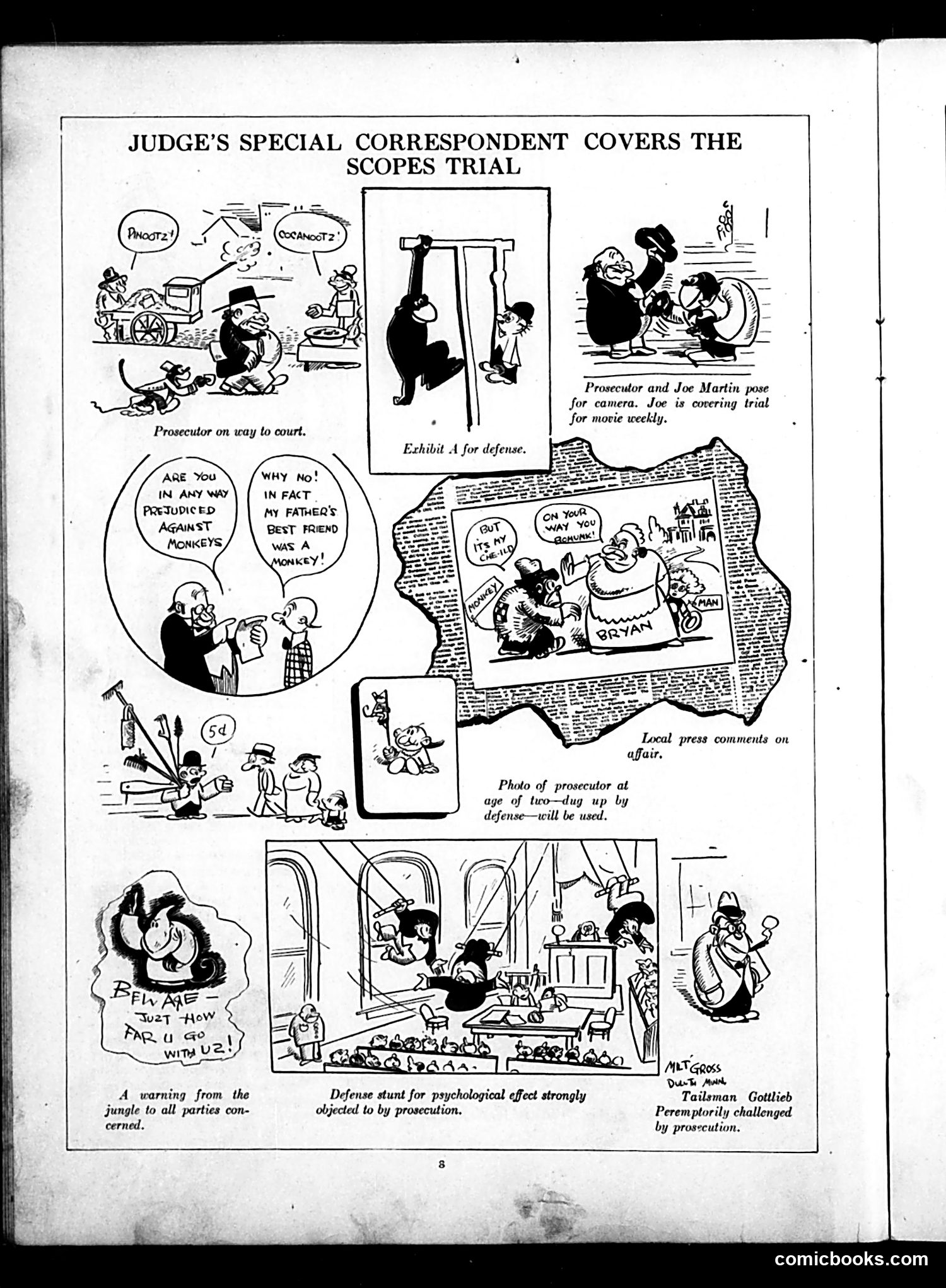
This Judge magazine page satirizes the famous 1925 Scopes "Monkey Trial" in Tennessee, where a teacher was prosecuted for teaching evolution. The cartoons mock both sides' courtroom tactics: **The satire includes:** - A prosecutor traveling to court while monkeys mock him ("Phootz!" and "Cooanootz!") - "Exhibit A for defense": a hanging monkey, referencing evolution theory - A child asking if the prosecutor is "prejudiced against monkeys"—absurdist humor mocking the trial's fundamental tension between evolution and creationism - Press coverage exaggeration and sensationalism - Defense strategy showing the prosecutor as a two-year-old ("dug up by defense"), mocking dramatic psychological tactics used in trials - A "defense stunt" involving a circus performer (Gottlieb), satirizing theatrical courtroom antics The overall message ridicules how both sides used spectacle and emotion rather than substantive argument, while the repeated monkey imagery underscores the trial's absurdity to Judge's educated readership.
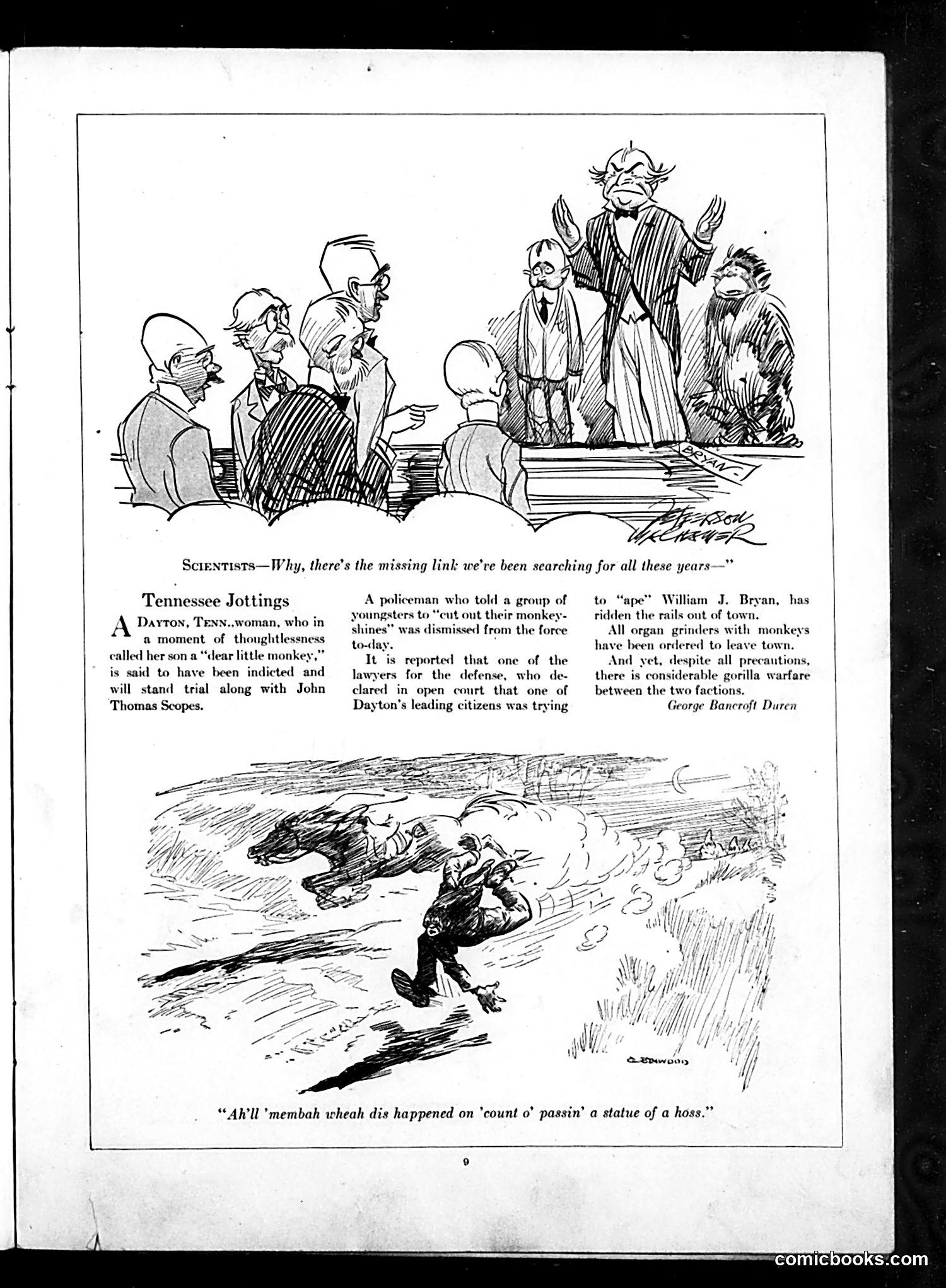
This page satirizes the famous 1925 Scopes "Monkey Trial" in Dayton, Tennessee, where biology teacher John Scopes was prosecuted for teaching evolution. The top cartoon shows "scientists" discovering the "missing link"—a visual pun on the trial's central debate about human evolution and our relationship to primates. The "Tennessee Jottings" section uses absurdist humor to mock the trial's hysteria. It describes increasingly ridiculous consequences of mentioning monkeys: a woman indicted for calling her son a "monkey," a policeman fired for saying "monkey-shines," and organ grinders expelled from town. This escalating absurdity ridicules the trial's intensity and the town's apparent descent into unreasonableness. The bottom cartoon's caption—referencing someone passing "a statue of a hoss" (horse)—appears to mock the trial's chaotic atmosphere where even innocent comments could be misconstrued. Overall, Judge magazine uses exaggeration and dark humor to criticize the Scopes trial as an example of anti-scientific, provincial American religious fundamentalism.
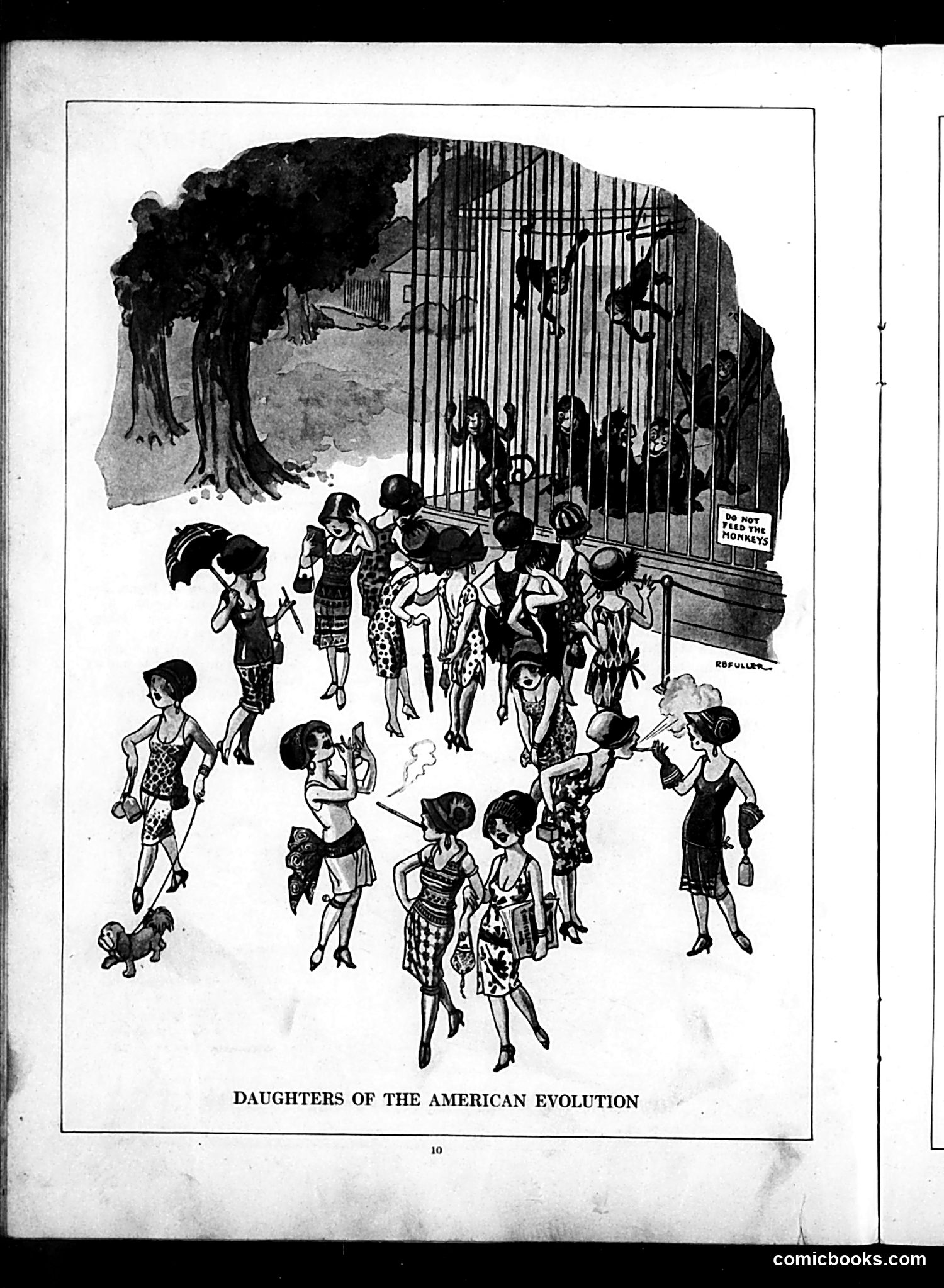
This satirical cartoon depicts women visiting a zoo or animal enclosure, with a sign reading "DO NOT FEED THE MONKEYS." The title reads "DAUGHTERS OF THE AMERICAN EVOLUTION" (likely a pun on "Revolution"). The satire appears to mock women of a particular social class or organization—possibly the Daughters of the American Revolution (DAR), a real patriotic women's society founded in 1890. By showing fashionable women in front of a monkey cage, the cartoonist suggests a comparison between the women and primates, implying they are foolish, superficial, or intellectually base despite their claims to refined patriotic heritage. The joke mocks both the women's pretensions and perhaps the DAR organization itself, satirizing their exclusivity or their actual nature beneath their genteel veneer.
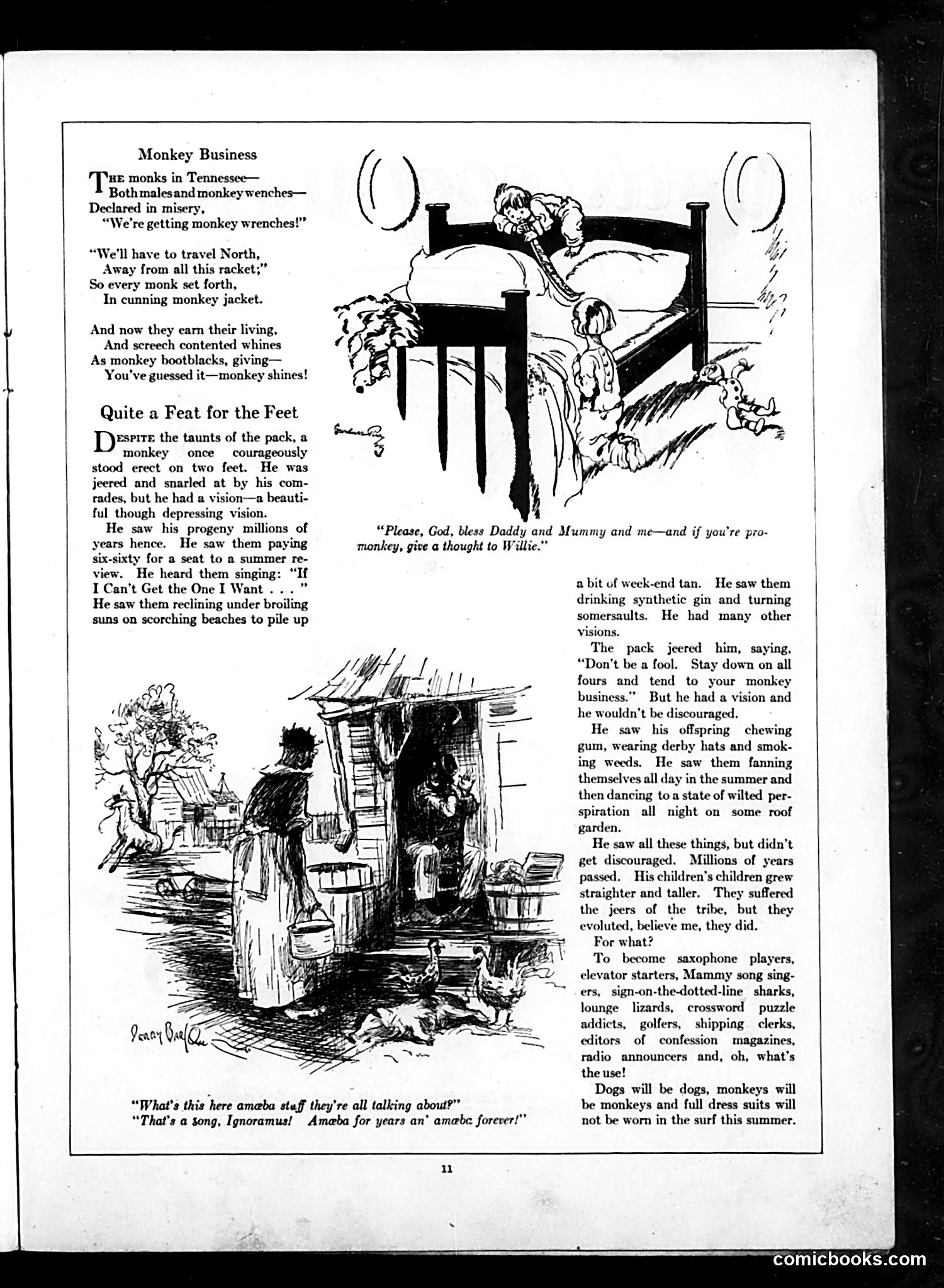
This page contains two interconnected satirical pieces mocking human "progress" and modern society through primate metaphors. **"Monkey Business"** jokes about monkeys migrating north from Tennessee to escape "monkey wrenches" (troubles), then earning livings as "bootblacks" performing "monkey shines"—a pun suggesting monkeys reduced to menial, stereotypical labor. **"Quite a Feat for the Feet"** presents darker social satire: a visionary monkey evolves upright over millennia, imagining his descendants achieving human civilization. But the payoff is cynical—they become saxophone players, elevator operators, con artists, and office workers. The final line ("Dogs will be dogs, monkeys will be monkeys") suggests human "progress" is meaningless; we merely trade animal instincts for modern vices like synthetic gin, beach vanity, and confession magazines. The satire attacks both blind faith in social evolution and 1920s consumer culture's hollowness. The cartoons suggest civilization hasn't elevated humanity—only given base nature more elaborate outlets.
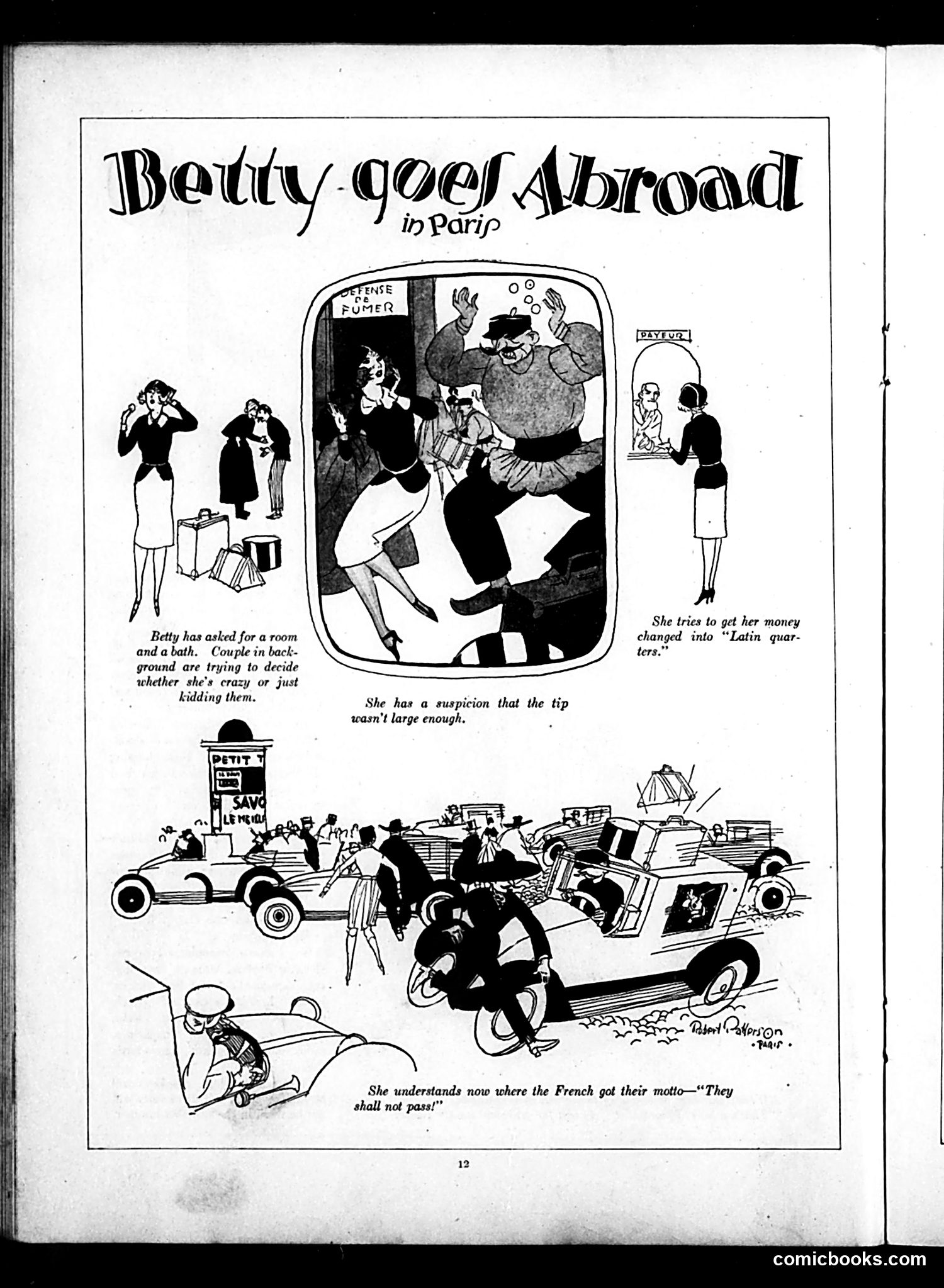
This is a humor piece about an American woman named Betty traveling in Paris. The cartoon satirizes American tourists abroad, particularly their cultural ignorance and aggressive behavior. The jokes: Betty demands a hotel room change and bath in broken French; onlookers can't tell if she's serious or joking. At a Parisian café, she suspects her tip was insufficient—reflecting American tipping culture clashing with French customs. The final panel shows her causing traffic chaos, with the caption parodying the French WWI motto "They shall not pass!" to mean the French won't let her pass through. The satire targets American tourists as loud, demanding, culturally insensitive travelers who impose their expectations and behaviors on European hosts.
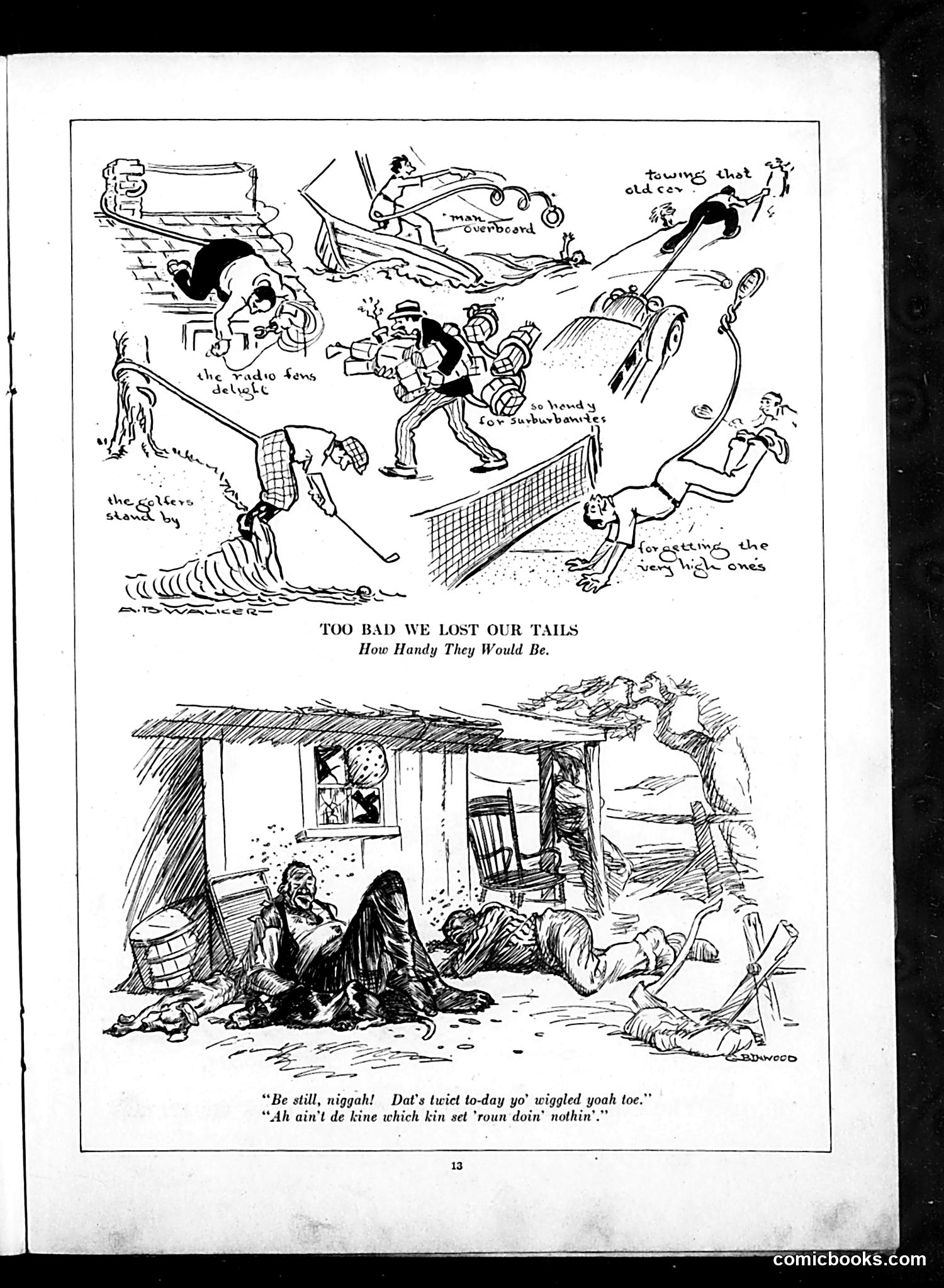
This page contains two cartoons satirizing modern life through the premise that humans lost their tails during evolution. **Top cartoon:** Shows various contemporary activities where tails would supposedly be useful—balancing while using radio equipment, steering a boat, playing tennis, hefting heavy objects for suburban life, and catching very high ones. The humor relies on exaggeration: tails as practical tools for modern tasks. **Bottom cartoon:** Depicts what appears to be an impoverished family in poor conditions, with dialogue in dialect. The caption sardonically suggests tails would help the unemployed or idle stay busy with movement. The satire critiques modern life's absurdities and, in the lower image, appears to comment on poverty and idleness during what was likely the Depression era. The racist dialect in the dialogue reflects the deeply problematic conventions of early-20th-century American humor magazines, which routinely employed such stereotypes without commentary.
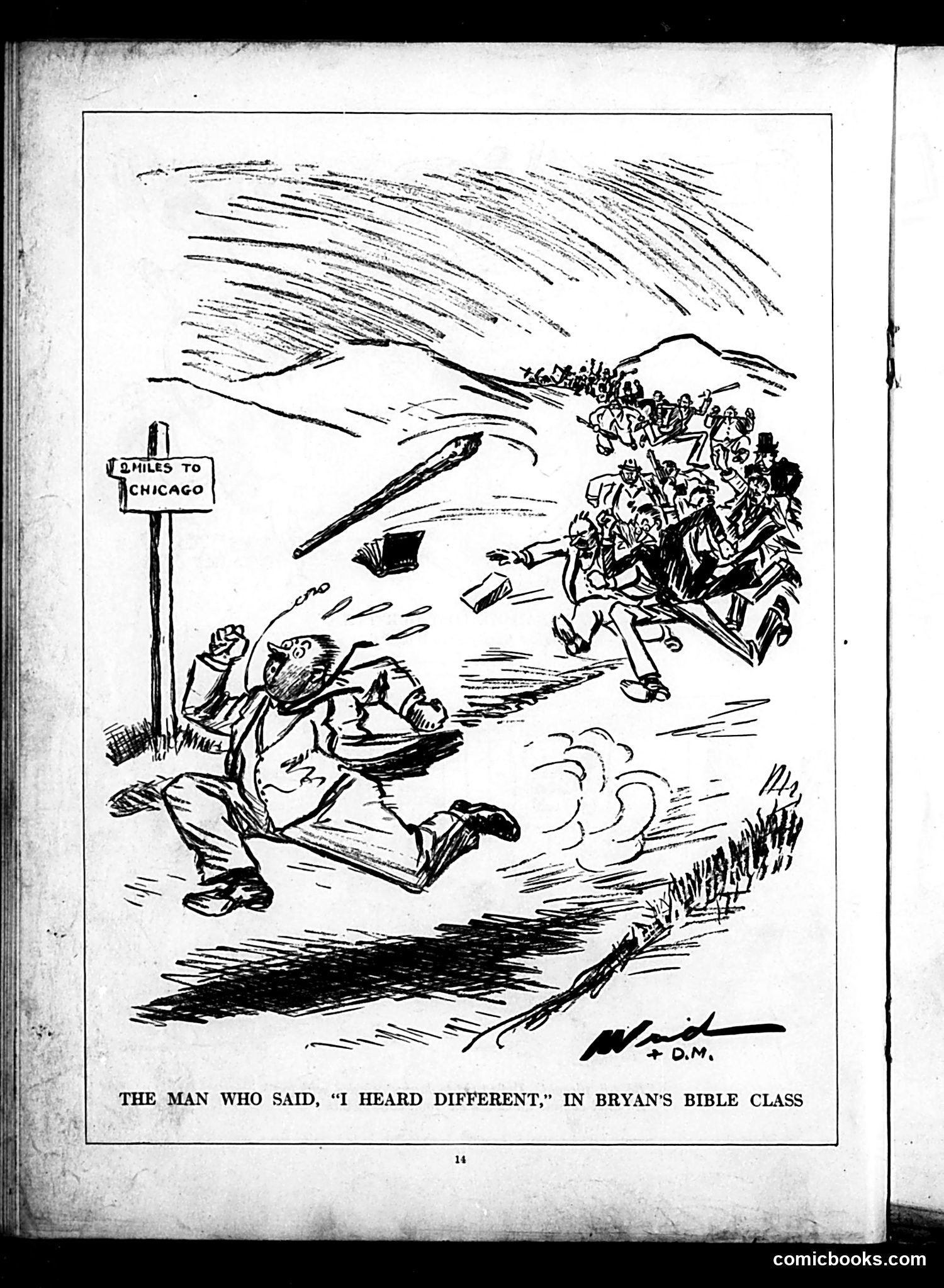
This cartoon satirizes William Jennings Bryan's Bible class or religious teaching. A man fleeing Chicago (indicated by the roadside sign) is being chased and attacked by a mob of people, apparently Bryan's students or followers. The caption states this depicts "the man who said, 'I heard different,' in Bryan's Bible class." The satire appears to target Bryan's intolerance of dissenting religious opinions. The cartoon suggests that expressing disagreement in Bryan's religious instruction resulted in violent persecution by his followers. This likely references Bryan's famous anti-evolution stance and his dominance in certain religious circles, implying his teachings discouraged free thought or debate among believers.
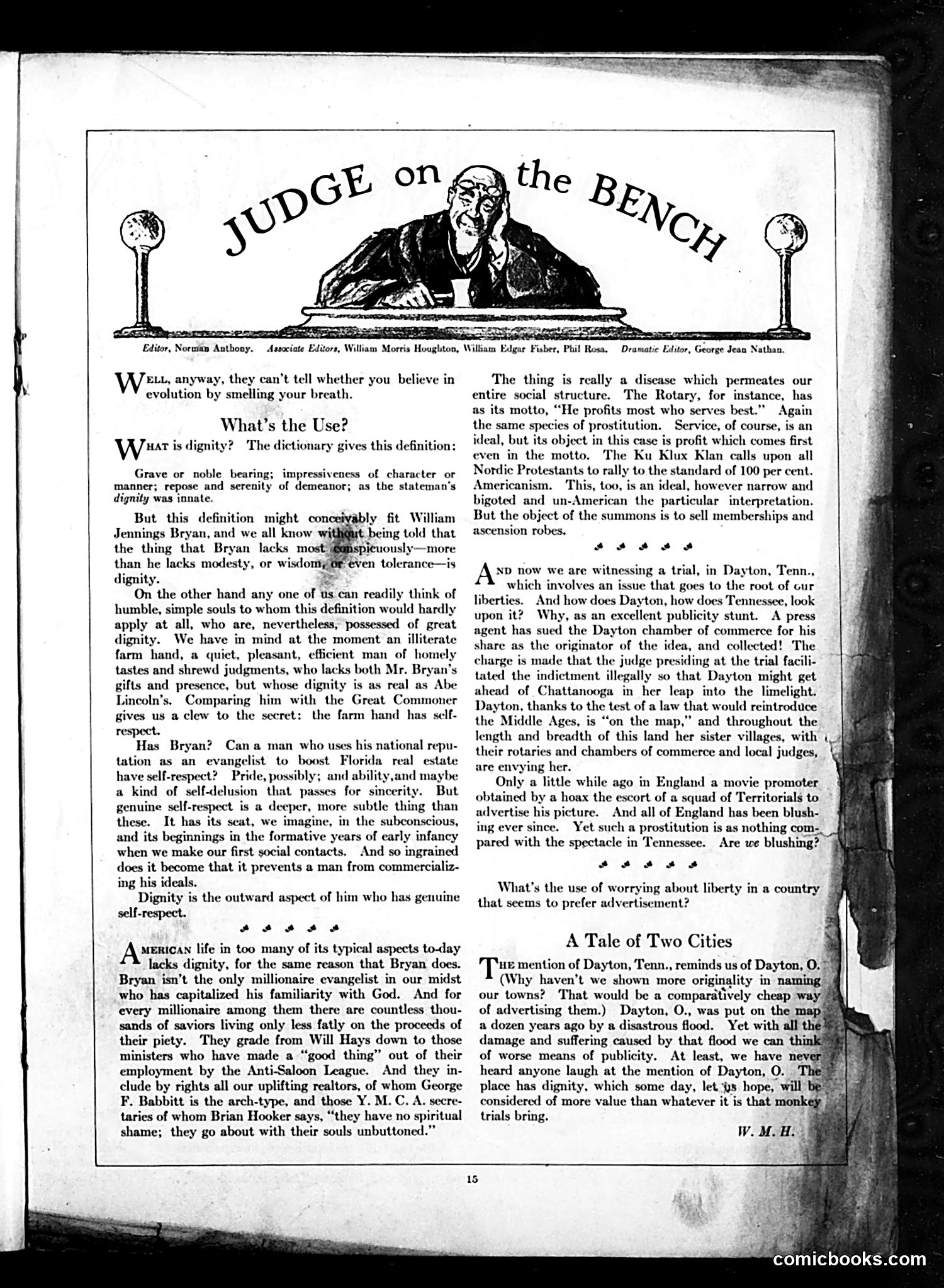
This satirical essay attacks William Jennings Bryan and broader American hypocrisy about "dignity" and "self-respect." **Main Target:** Bryan, the three-time presidential candidate and famous evangelist, is criticized for using his religious reputation to promote Florida real estate—commercializing his faith for profit rather than demonstrating genuine dignity. **Broader Critique:** The author argues this disease of commercialized piety infects American institutions: the Rotary Club (profit disguised as service), the Anti-Saloon League (clergy profiting from temperance), the KKK (selling memberships under patriotic pretense), and YMCA secretaries operating without spiritual integrity. **The Dayton Reference:** Appears to reference the 1925 Scopes Trial, where the author suggests Dayton, Tennessee exploited the evolution controversy as a publicity stunt, with the judge allegedly facilitating illegal proceedings to beat Chattanooga for media attention. **The Point:** America claims dignity and ideals while systematically prostituting them for profit and publicity. Self-respect has vanished from public life.
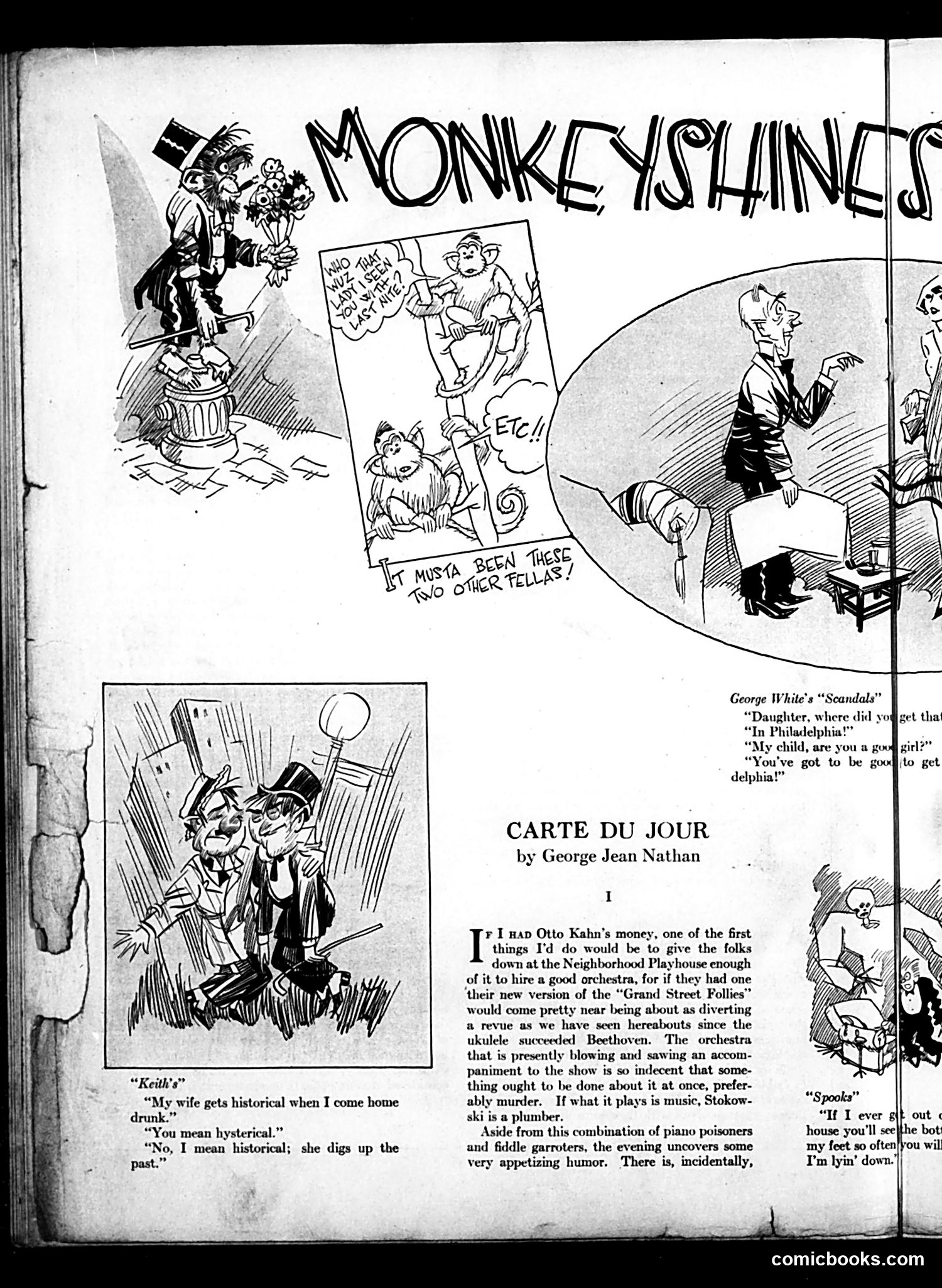
This page contains satirical humor typical of 1920s entertainment criticism. The "Monkeyshines" cartoons mock domestic life and social pretension through visual gags. The "Keith's" cartoon plays on a malapropism: the wife becomes "historical" (dredging up past grievances) rather than "hysterical." This targets henpecked-husband humor common to the era. The George White's "Scandals" dialogue satirizes parental naïveté about Broadway shows—the daughter must be a "good girl" in Philadelphia but goes to the morally questionable revue in New York, highlighting contemporary anxieties about urban vice and young women's independence. The main article by George Jean Nathan reviews a Neighborhood Playhouse production, harshly criticizing its orchestra as incompetent ("piano poisoners and fiddle garroters"), suggesting even murder would improve it. Nathan compares the poor musicianship unfavorably to Stravinsky. The piece exemplifies period theatrical criticism's caustic wit while referencing the ukulele's popularity replacing classical music.
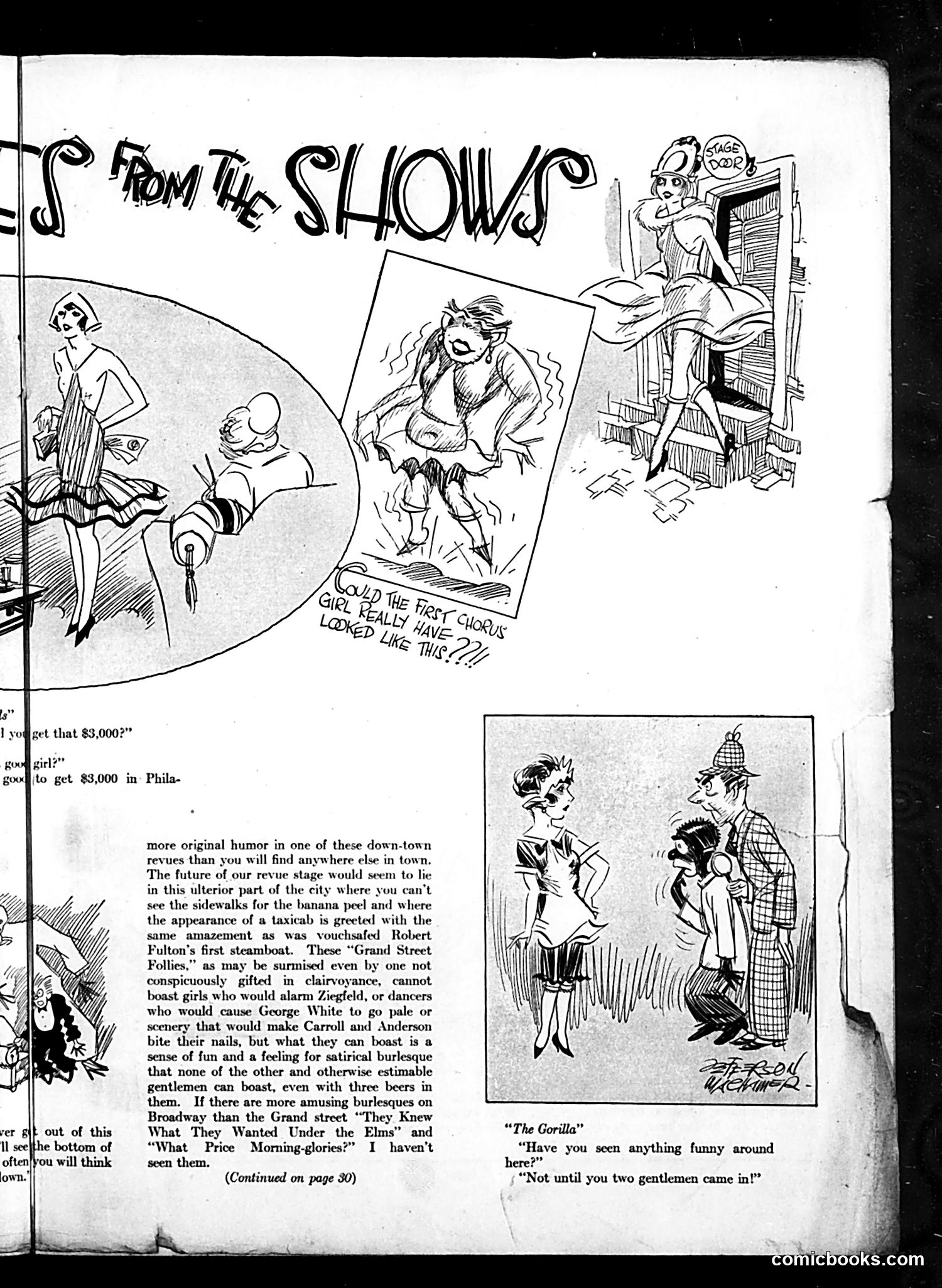
This page reviews theatrical revues, particularly the "Grand Street Follies"—downtown New York productions. The text praises these modest shows for their satirical humor, contrasting them favorably with Broadway's big productions (referencing Florenz Ziegfeld and George White's more elaborate revues). The cartoons illustrate show business themes: the top section depicts theatrical performances and backstage scenarios; the bottom comic titled "The Gorilla" shows a man and woman encountering another couple, with the woman's quip suggesting the newcomers are unattractive ("funny looking"). The satire celebrates lowbrow, scrappy downtown theater's genuine comedic wit over Broadway's spectacle. The page mocks pretentious theatrical producers while defending working-class entertainment's value. References to Robert Fulton's steamboat humorously emphasize the contrast between sophisticated Manhattan and the less-developed Lower East Side where these revues played.
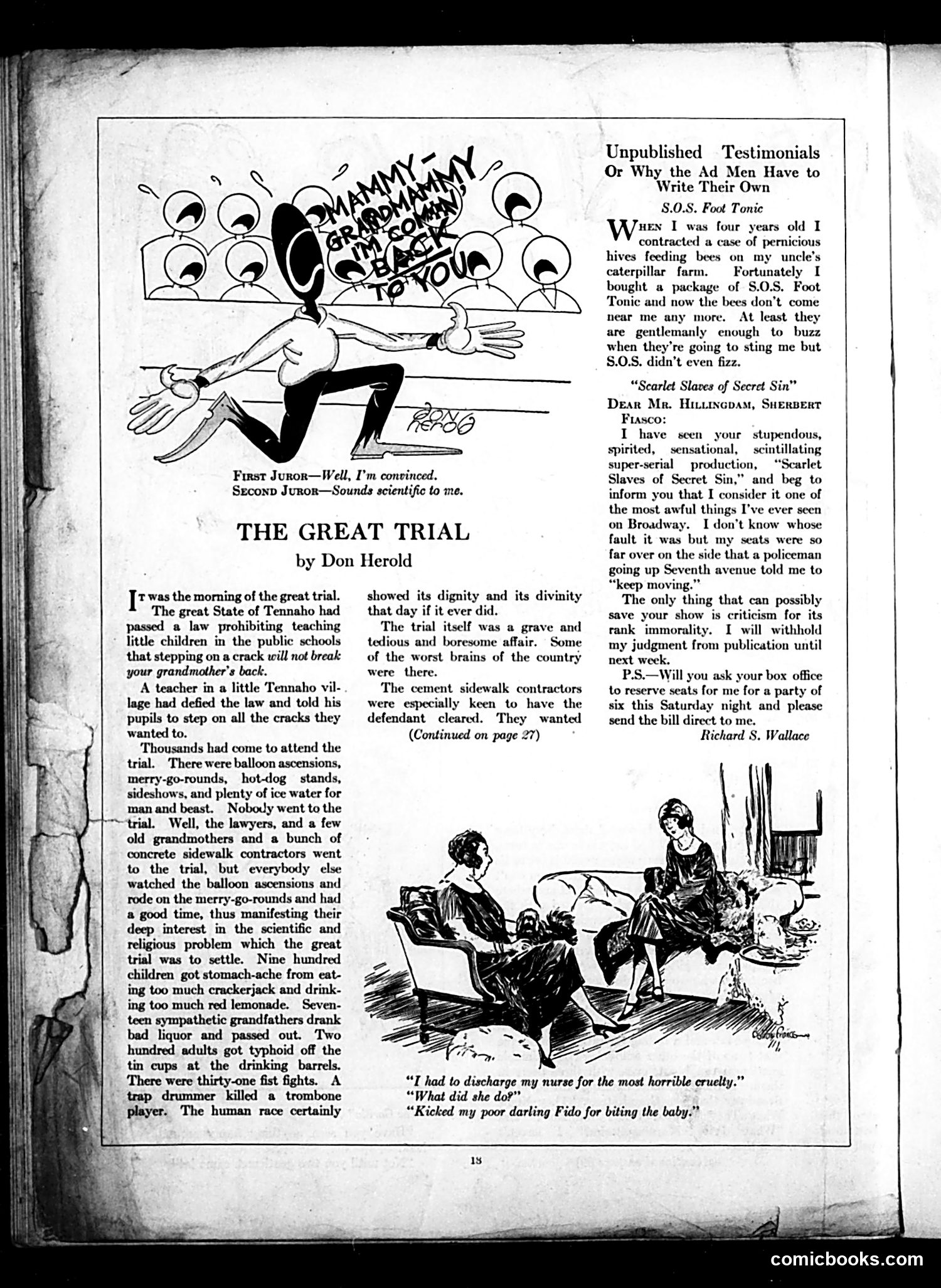
This is a satirical story mocking Tennessee's real "Monkey Trial" laws restricting evolution teaching. Herold inverts the premise: a teacher is prosecuted for telling children it's safe to step on sidewalk cracks (contradicting superstition about breaking grandmothers' backs). The satire works on two levels. First, it ridicules the trial's circus atmosphere—crowds ignore the actual proceedings for balloon rides and hot dogs while children get sick and fights break out. Second, it mocks the trial's absurdity by treating superstition with the same legal gravity as evolution. The cartoon shows jurors declaring conviction based on no evidence ("Sounds scientific to me"), satirizing how such trials were predetermined and intellectually hollow. Concrete sidewalk contractors wanting the teacher cleared lampoons special interests influencing proceedings. The page also includes fake product testimonials mocking ad copywriting—absurd claims presented with deadpan sincerity, paralleling how the trial treats nonsense as serious law.
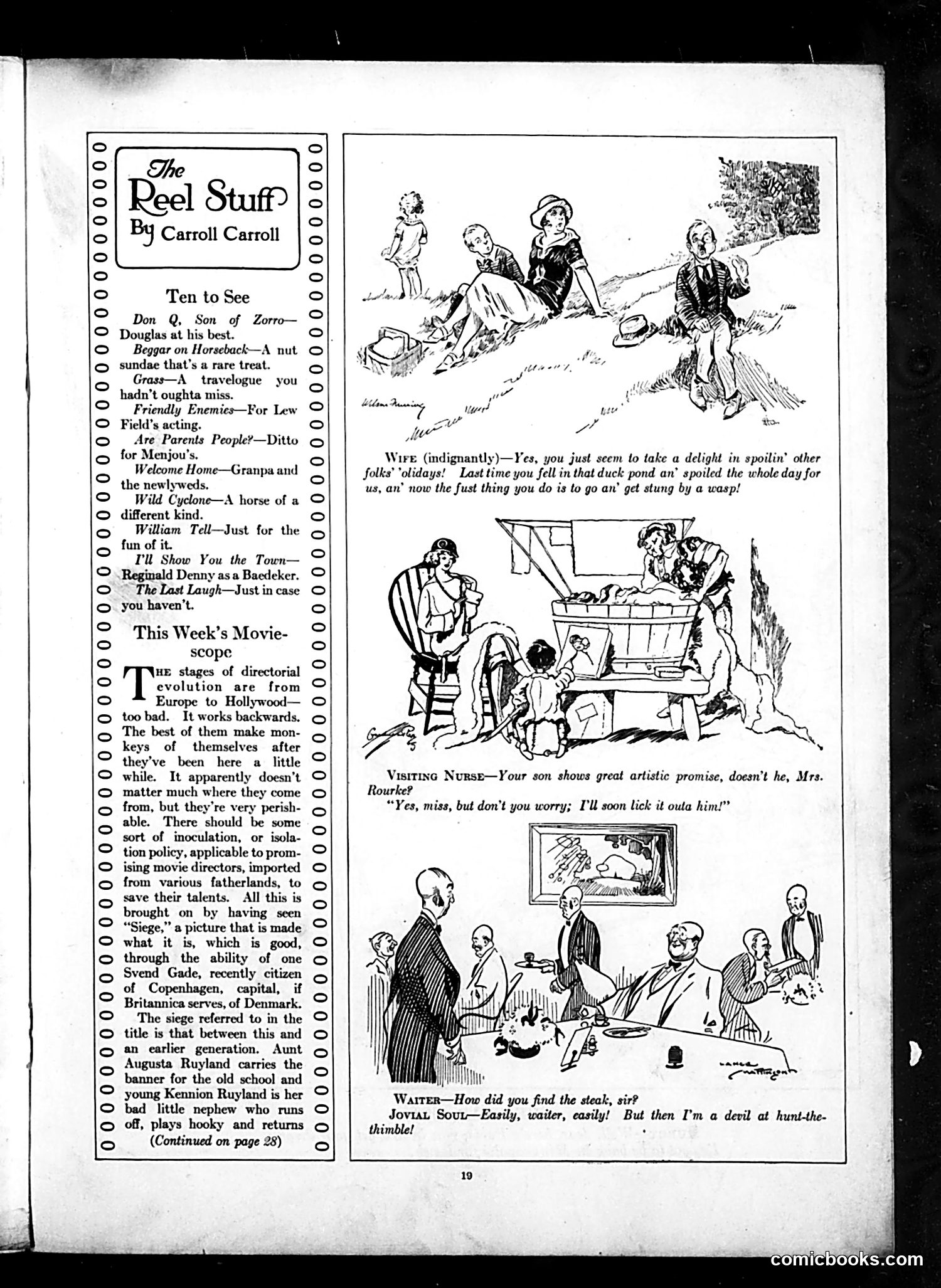
This page from *Judge* magazine contains movie reviews and three separate humorous cartoons satirizing everyday life. **The cartoons' jokes:** 1. **"Wire"**: A mother scolds her mischievous child for repeatedly ruining family outings—first by falling in a duck pond, now by getting stung by a wasp. The humor lies in the child's apparent talent for disaster. 2. **"Visiting Nurse"**: A nurse compliments a boy's artistic talent; his mother responds she'll "lick it outa him"—crude parental suppression of artistic inclination, played for dark comedy about working-class anti-intellectualism. 3. **"Waiter"**: A diner boasts he found the steak easily, then jokes he's skilled at "hunt-the-thimble" (a children's game), implying the steak was hard to locate—sarcastic commentary on poor restaurant quality. The movie reviews above list silent-era films starring popular actors like Douglas Fairbanks and Reginald Denny. The editorial discusses European film directors losing their talent after moving to Hollywood.
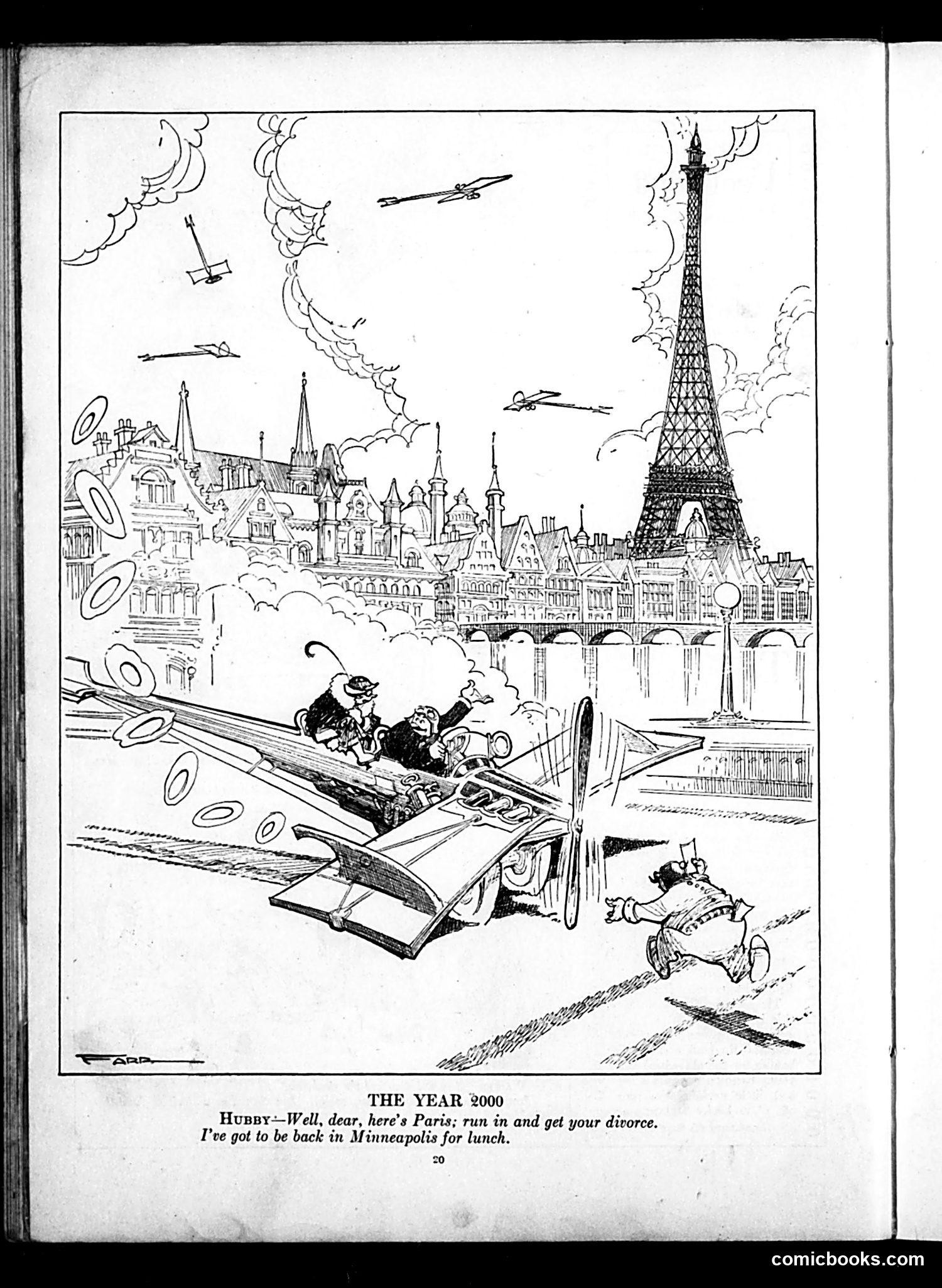
This early 20th-century cartoon satirizes rapid transportation technology and changing social attitudes. Titled "The Year 2000," it imagines futuristic air travel so fast that a husband can casually fly his wife to Paris for a divorce, then return to Minneapolis for lunch—all in one morning. The satire operates on two levels: it mocks both the era's optimistic predictions about speed (the aircraft and flying vehicles shown), and contemporary anxieties about marriage dissolution. The husband's casual tone ("run in and get your divorce") treats divorce as a trivial errand, reflecting contemporary concerns that modernization and easy travel would undermine traditional marriage values. The joke assumes readers find the scenario absurdly cynical—implying widespread belief that technology and social change threatened family stability.
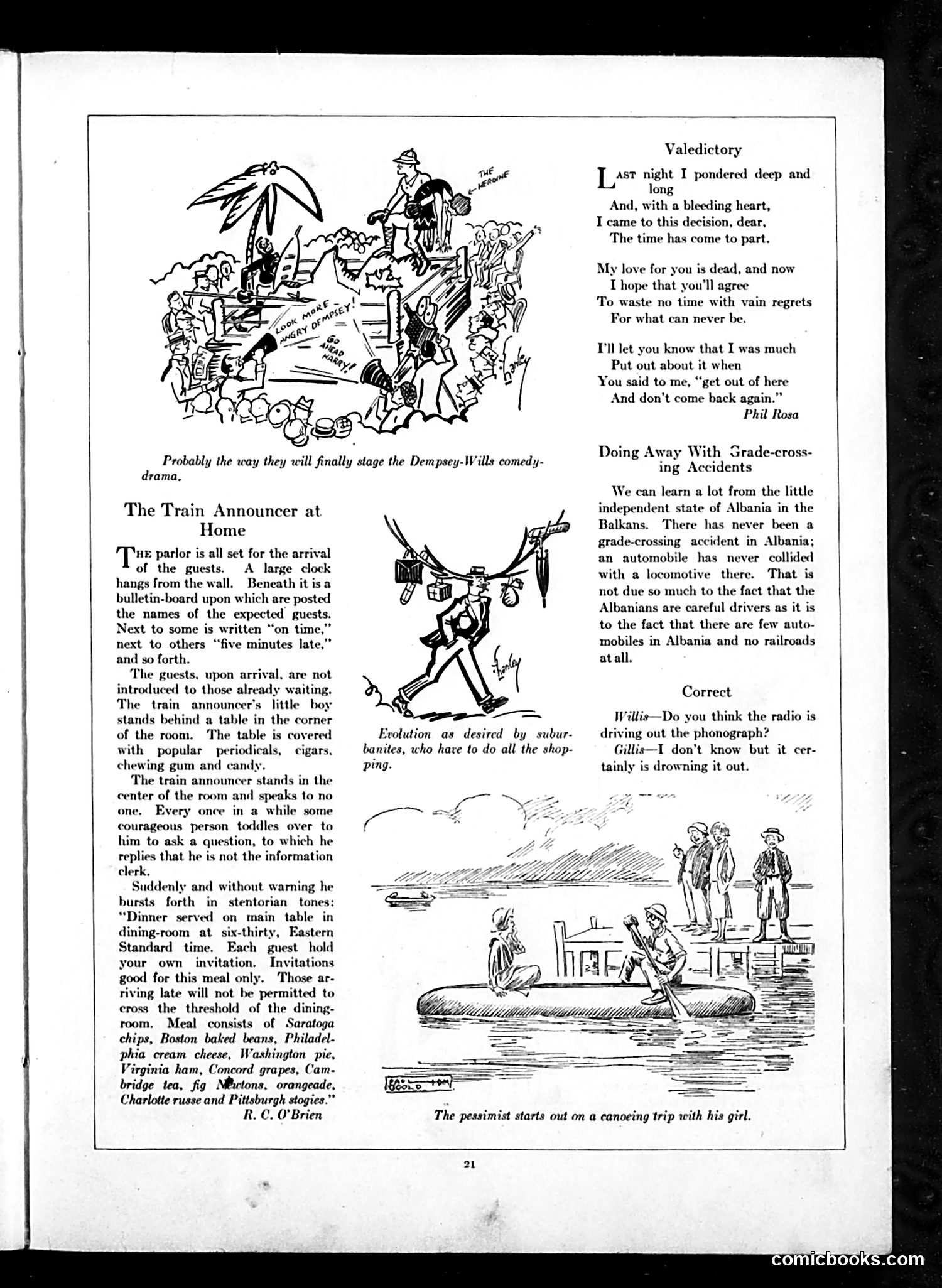
This page contains three distinct satirical pieces: **"The Train Announcer at Home"** mocks the rigid formality of railroad announcements by imagining a train conductor applying his professional manner to hosting a dinner party. He treats guests like passengers, posting arrival times on a bulletin board and barking dinner announcements with official railroad language. The satire critiques both the dehumanizing efficiency of modern transportation and the absurdity of applying institutional rules to social situations. **"Doing Away With Grade-crossing Accidents"** is deadpan humor about Albania's absence of automobile-train collisions—not because Albanians are careful drivers, but because Albania has few cars and no railroads at all. It mocks the logical absurdity of solving modern infrastructure problems by eliminating the infrastructure. **"The Pessimist"** is a simple cartoon joke: a pessimistic man taking his girlfriend on a canoeing trip humorously implies the relationship is doomed (he's already anticipating disaster). The page appears from the Prohibition/Jazz Age era, blending sarcasm about modern life, social customs, and contemporary technology.
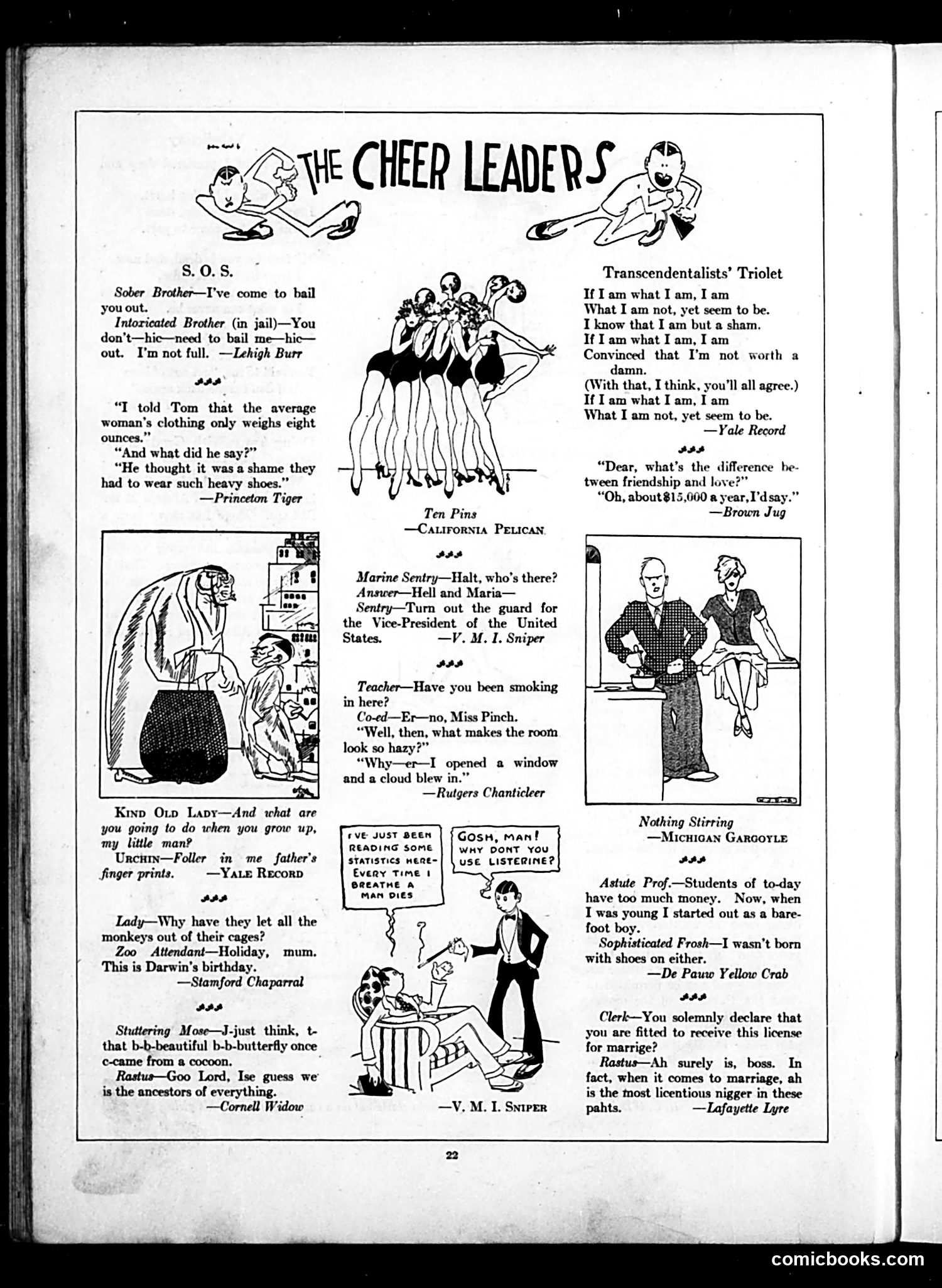
This is a humor page featuring short jokes and comic vignettes typical of early 20th-century satirical magazines. The content includes: **Recurring themes:** - Racial stereotypes (dialect humor featuring "Rastus" and "Mose," common in period publications) - Gender roles and courtship comedy - Student/college humor (Yale, Brown, Michigan references) - Prohibition-era drinking jokes - Class commentary (wealth, poverty) **Notable items:** - A "Marine Sentry" joke referencing the Vice-President, likely dating the page - Transcendentalist poetry parody mocking philosophical pretension - A statistics joke about breath and death (possibly early health/hygiene awareness) - A social commentary on student wealth versus the professor's humble beginnings The page reflects 1920s-era Judge magazine humor: lighthearted, often crude by modern standards, focused on domestic situations, wordplay, and social observation rather than explicit political satire. The illustrations are cartoonish and deliberately exaggerated for comedic effect.
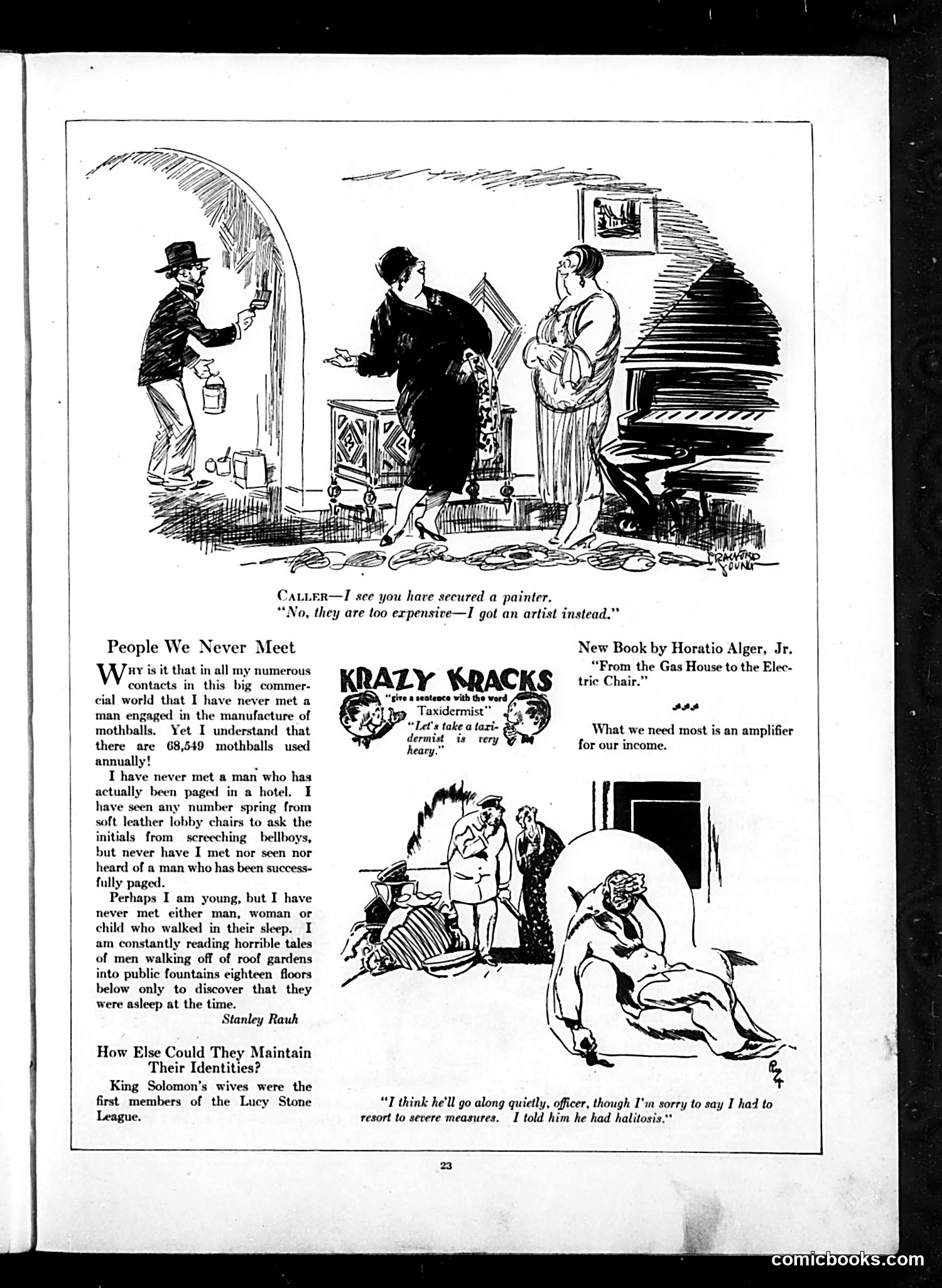
This page contains satirical commentary on everyday absurdities and social conventions circa early-to-mid 20th century. **Top cartoon**: A caller mistakes an "artist" (likely a struggling bohemian) for a professional painter, mocking the economic gulf between fine artists and working tradesmen—or possibly the pretension of calling oneself an "artist." **"People We Never Meet"** essay by Stanley Rauh humorously catalogs statistical impossibilities: 68,549 mothballs manufactured annually yet no one knows the manufacturer; hotel pages that never actually succeed; sleepwalkers who supposedly walk off roofs. The satire targets both mass production/consumerism and newspapers' sensational, likely invented stories. **"Krazy Kracks"**: A wordplay joke section (typical magazine filler). **"How Else Could They Maintain Their Identities?"**: References the Lucy Stone League—a real organization of married women who kept their maiden names, a then-radical feminist stance. The Solomon reference jokes that even biblical polygamy required identity maintenance. **Bottom cartoon**: Police use mention of "halitosis" (bad breath) as a euphemism for coercion—satirizing both police brutality and aggressive advertising of commercial products like mouthwash.
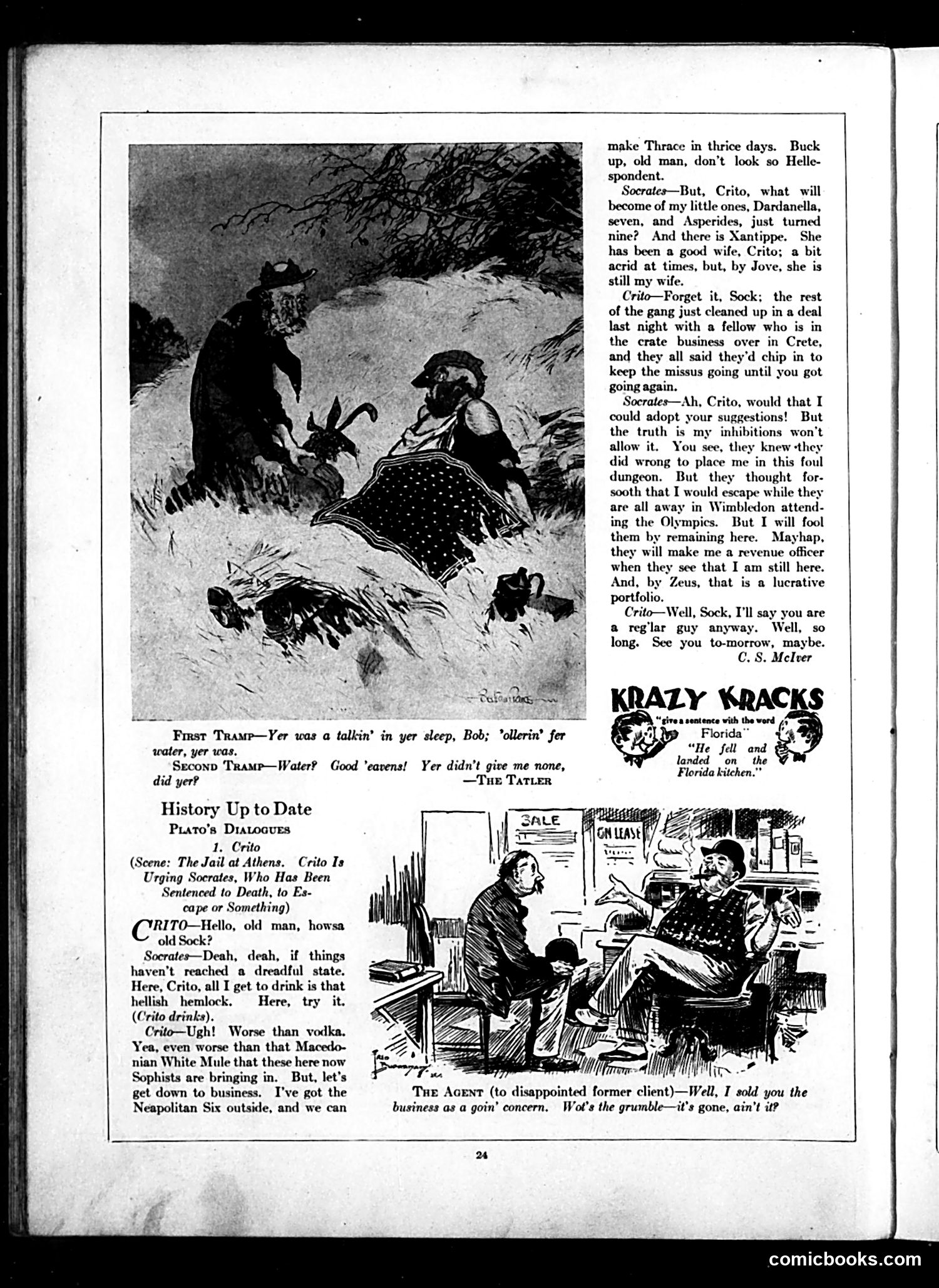
This page presents a comedic reimagining of Plato's *Crito*, the classical dialogue where Socrates refuses to escape his death sentence. The satire modernizes the ancient scene with contemporary slang and concerns. **The Main Cartoon:** Socrates, condemned to death, worries about supporting his family. Crito urges escape, offering help from friends in the "crate business" in Crete—a pun on their criminal enterprise. Socrates refuses, claiming his "inhibitions won't allow it," then absurdly suggests he'll stay imprisoned to fool his friends and possibly become a "revenue officer" (tax collector)—presented as a desirable career. **The Satire:** Judge mocks both classical pretension and contemporary bureaucratic ambitions. By giving Socrates mundane modern concerns (supporting a family, hoping for government employment) and having him refuse escape through stubborn principle while fantasizing about cushy positions, the piece ridicules both ancient philosophy and modern careerists. The lower cartoon, "Krazy Kracks," is unrelated advertising humor.
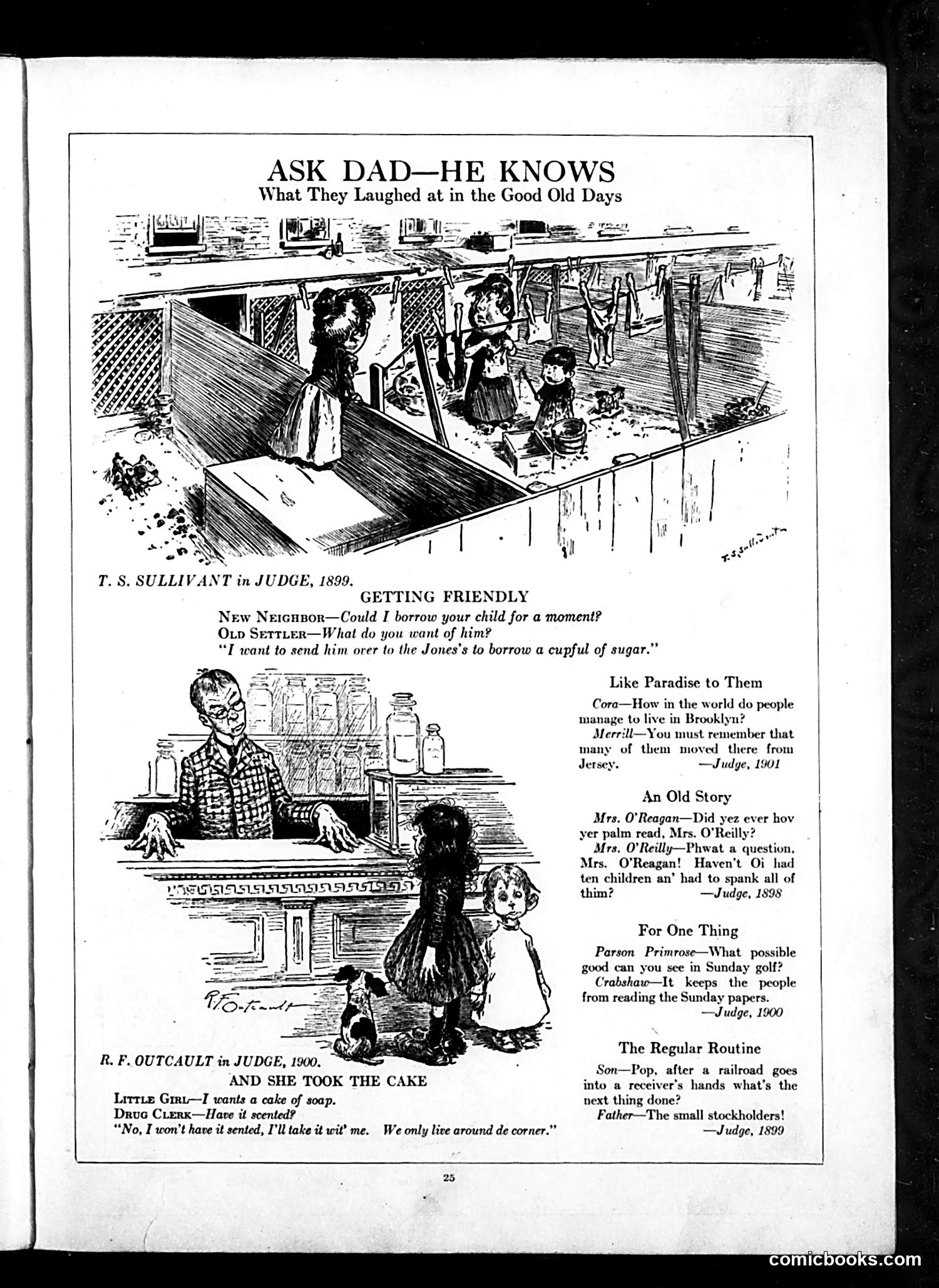
This page collects humorous anecdotes from Judge's early years, satirizing American social customs and class attitudes circa 1898-1901. **Key targets:** 1. **Rural/frontier nostalgia**: "Getting Friendly" mocks the idealized "good old days" by showing neighbors borrowing goods—presenting frontier life as quaint but inconvenient. 2. **Immigrant humor**: The soap-buying joke uses dialect humor (common-era ethnic stereotyping) to mock lower-class speech patterns and urban poverty. 3. **Geographic snobbery**: Brooklyn and New Jersey jokes reflect period class anxieties about urban crowding and migration. 4. **Irish-American caricature**: The palm-reading dialogue uses Irish brogue to make crude jokes about large families and corporal punishment. 5. **Class cynicism**: The railroad joke's punchline—"the small stockholders!"—reflects Gilded Age skepticism about corporate corruption, where ordinary investors lose money when companies fail. 6. **Moral hypocrisy**: The golf joke satirizes clergy who oppose Sunday recreation while potentially avoiding moral scrutiny themselves. The humor relies heavily on ethnic caricature and period prejudices now considered offensive.
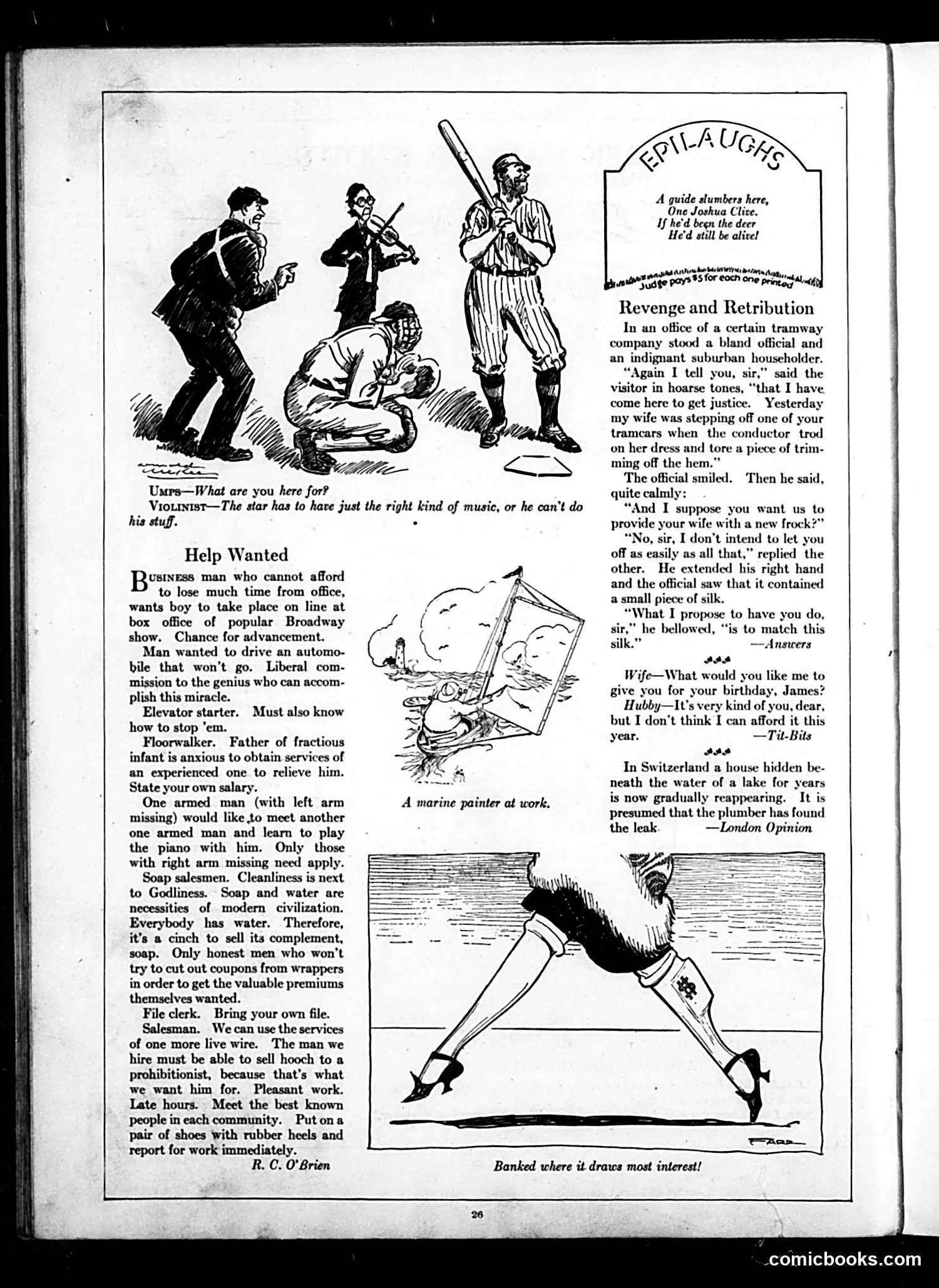
This page contains satirical humor typical of early 20th-century Judge magazine, mixing visual cartoons with humorous "Help Wanted" ads and brief anecdotes. The top cartoon mocks musicians by showing an umpire questioning a violinist at what appears to be a baseball game—the joke being the violinist's claim that "the star" needs proper musical accompaniment to perform, absurdly applying theatrical pretension to sports. The "Help Wanted" section parodies impossible or contradictory job postings: a man needed to "drive an automobile that won't go," an elevator operator who must also "stop 'em," a one-armed pianist seeking another one-armed pianist. These mock both unrealistic employer demands and job-seeker desperation. The remaining anecdotes ("Revenge and Retribution," wife's birthday gift, Swiss house) are brief comedic stories common to the era—gentle humor about domestic life, bureaucratic absurdity, and wordplay ("plumber has found the leak"). The illustrations include a "marine painter at work" sketch, playing on the double meaning of "painter." The overall tone reflects pre-Depression era American humor: observational, class-conscious, and focused on everyday frustrations.
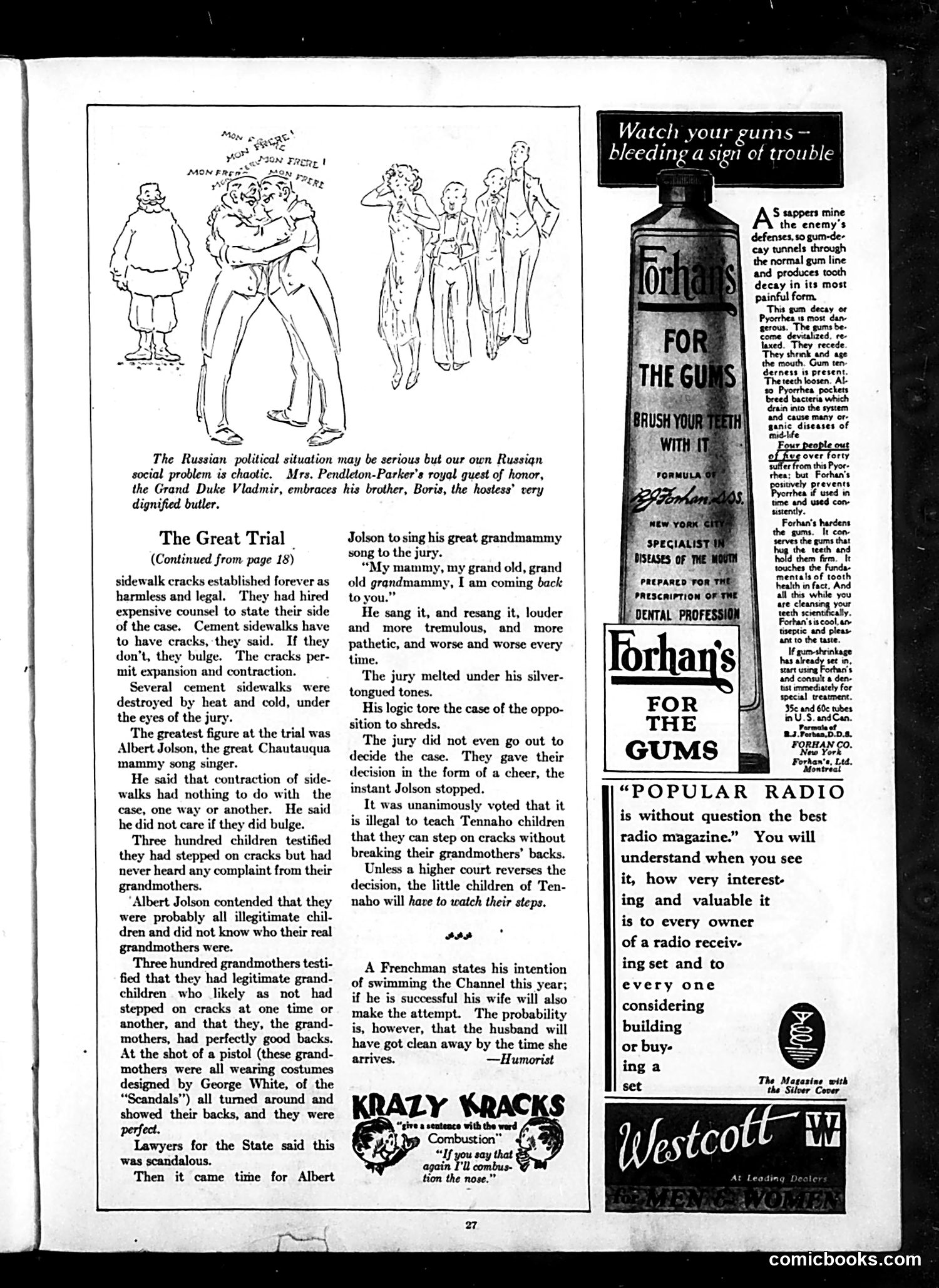
This page from *Judge* magazine contains two main elements: **The Cartoon**: The top illustration satirizes American high society's fascination with Russian nobility. It depicts Mrs. Pendleton-Parker hosting the Grand Duke Vladimir as her guest of honor, but the joke is that he's embracing her butler, Boris—also Russian—as if they were equals. The satire mocks how American socialites fawn over foreign aristocrats while treating their own servants as invisible, yet the "dignified butler" here receives the same embrace as the distinguished guest. It's commentary on the absurdity of American class-consciousness and snobbery toward European nobility. **"The Great Trial"**: This is a humorous legal satire about a lawsuit concerning whether children can step on sidewalk cracks without "breaking their grandmother's back" (referencing a children's rhyme). The absurd trial features Al Jolson performing his famous "Mammy" song, which so emotionally manipulates the jury that they rule cracks illegal—showing how sentiment overrides logic in courtrooms. The page is otherwise advertisements for dental products and radios.
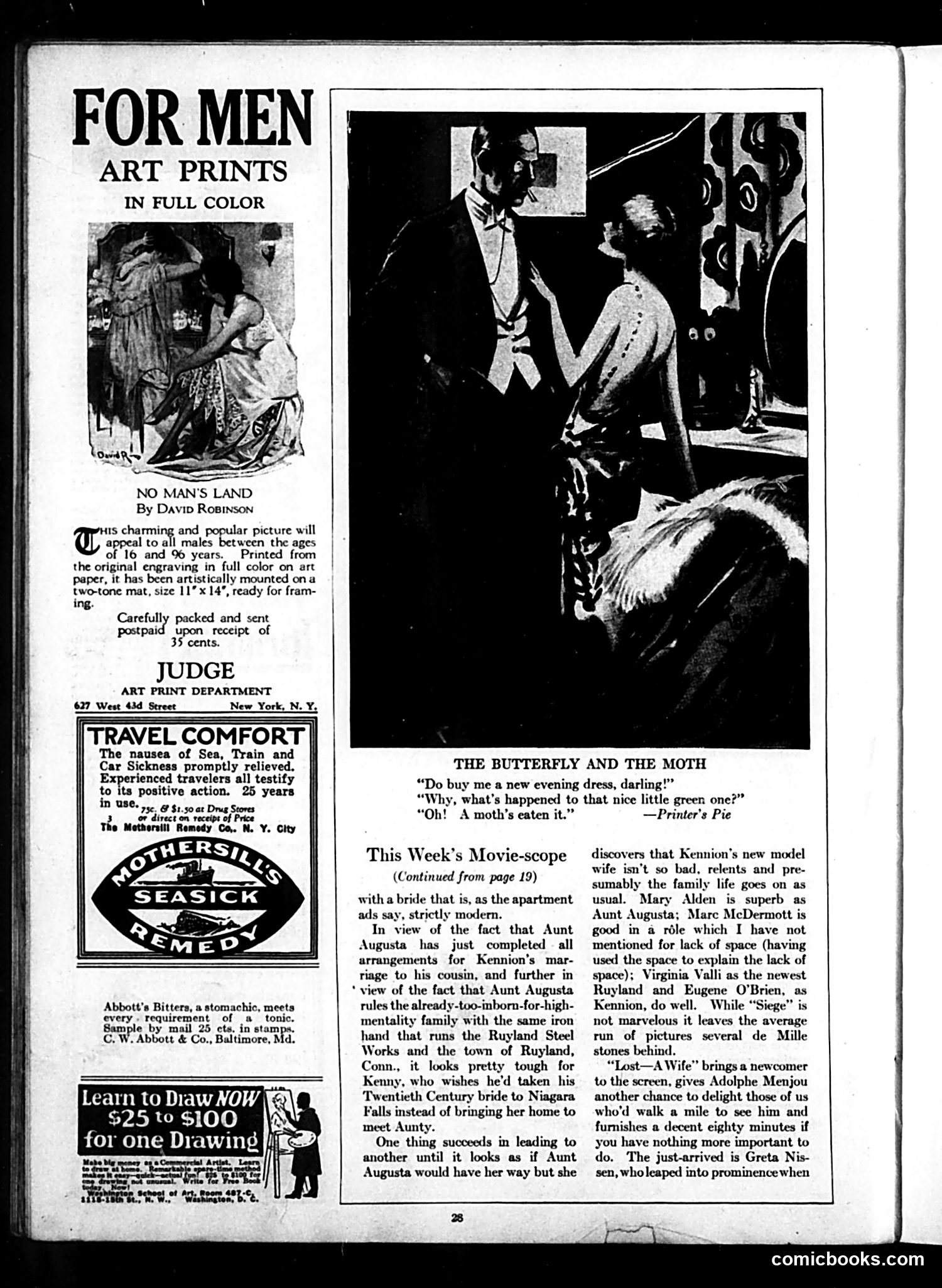
This page is primarily **advertising and entertainment content**, not political satire. The main cartoon, "The Butterfly and the Moth," is a domestic humor joke: a wife asks her husband to buy her a new evening dress, claiming a moth ate her "nice little green one." The joke plays on the double meaning—she's either lying about the dress's fate or making a crude implication about her own infidelity (being "eaten" by another man, the "moth"). The page otherwise features art print advertisements (including "No Man's Land" by David Robinson), patent medicine ads (Travel Comfort seasickness remedy, Mothersilk Remedy), and a "Movie-scope" review discussing several current films with actors like Mary Alden and Eugene O'Brien. The content reflects early 1920s consumer culture and entertainment interests rather than political commentary.
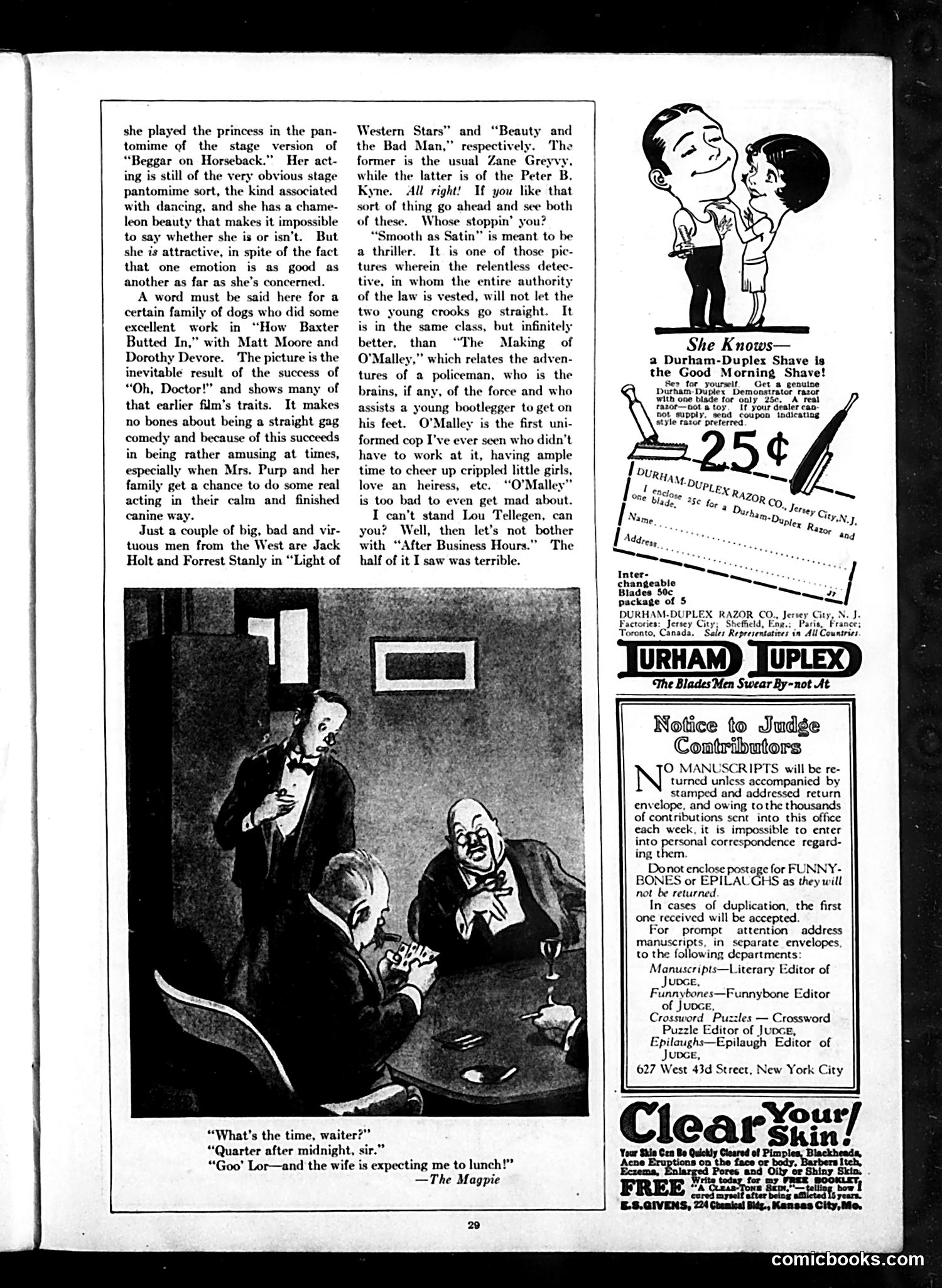
**The Main Cartoon:** The bottom illustration depicts a domestic humor scene: a waiter is questioned about the time, replies "quarter after midnight," and the man responds with alarm that his wife expects him home for lunch. The joke plays on marital anxiety—the husband has been out all night and faces spousal anger. This reflects period-specific gender dynamics where wives controlled domestic schedules and husbands feared their displeasure. **Page Content:** The bulk of this page is a film review column criticizing recent movies, including westerns with Jack Holt and Forrest Stanley, and criticizing actor Lou Tellegen. The reviewer dismisses several pictures as poorly made or derivative. **Advertisements:** The Durham-Duplex razor ad promotes a 25-cent safety razor, emphasizing the "good morning shave"—targeting male grooming routines. **Notices Section:** Standard Judge contributor guidelines rejecting unsolicited manuscripts. The page is primarily editorial/advertising rather than satirical content.
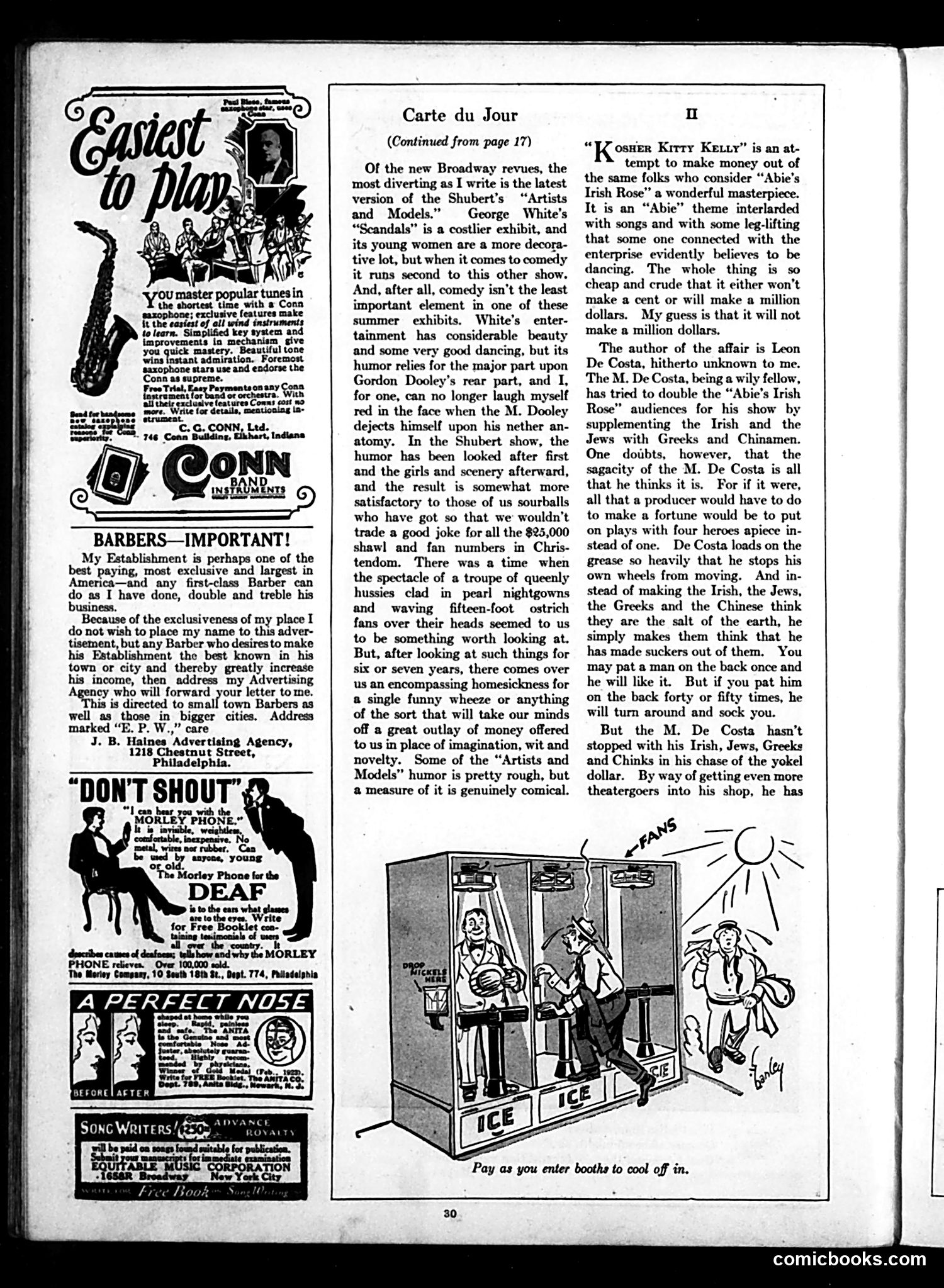
This page primarily contains advertisements and entertainment criticism rather than political satire. The main content is "Carte du Jour," a theater review column discussing Broadway revues. The reviewer critiques several shows: George White's "Scandals" and the Shubert's "Artists and Models." He dismisses the spectacle of chorus girls in expensive costumes, claiming audiences have grown tired of such displays after years of similar productions. He argues that genuine comedy and wit matter more than lavish staging. The column mocks "Kosher Kitty Kelly," an attempt to capitalize on the success of "Abie's Irish Rose" by adding Greek and Chinese characters to its Irish-Jewish immigrant humor. The reviewer suggests the show is so crude it will either fail entirely or become unexpectedly profitable. The cartoonish illustration shows an ice-dispensing booth—likely depicting a theater lobby cooling feature—with the caption "Pay as you enter booths to cool off in," suggesting summer heat relief. The page is mostly advertisements for musical instruments, barbering services, and theatrical products.
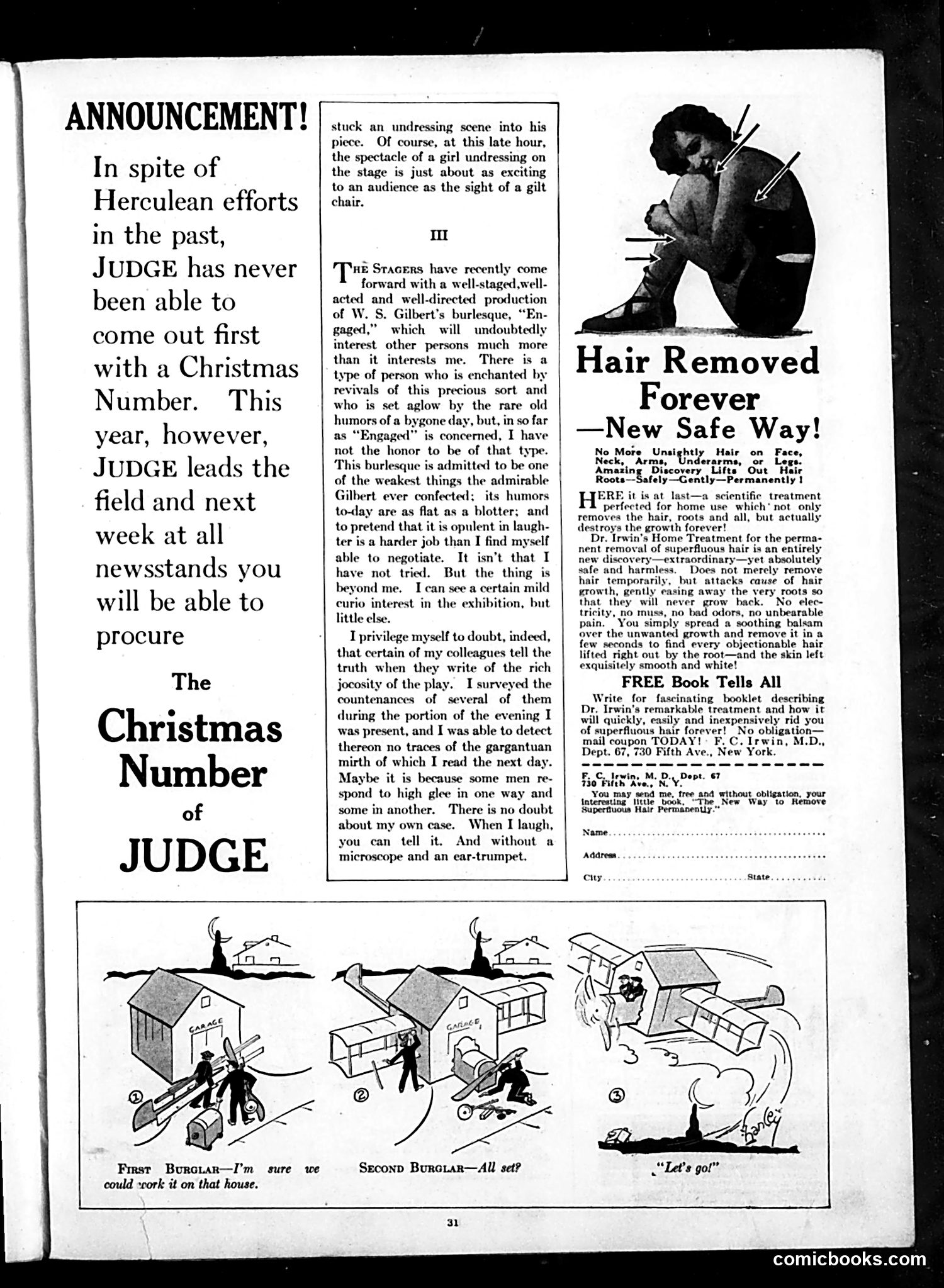
This page contains Judge magazine's announcement of its upcoming Christmas Number, alongside period advertisements and a small comic strip. **Main Content:** The announcement boasts that Judge will finally lead the field with an early Christmas issue, ending past failures to do so. **Theater Critique:** The middle column reviews a W.S. Gilbert burlesque called "Engaged," dismissing it as tediously unfunny. The critic suggests colleagues fake enthusiasm for the outdated production, claiming he can detect their lack of genuine amusement during performances. **Advertisements:** The page features a hair-removal product ad for "Dr. Irwin's Home Treatment," promising permanent superfluous hair removal through a home-use balsam—typical pseudoscientific advertising common to early-20th-century magazines. **Comic Strip (bottom):** Shows two burglars discussing whether they can "work" robbing a house, with the second declaring "All set?" before they escape by airplane—a simple joke playing on burglary planning and the incongruity of aerial getaway methods for common criminals.
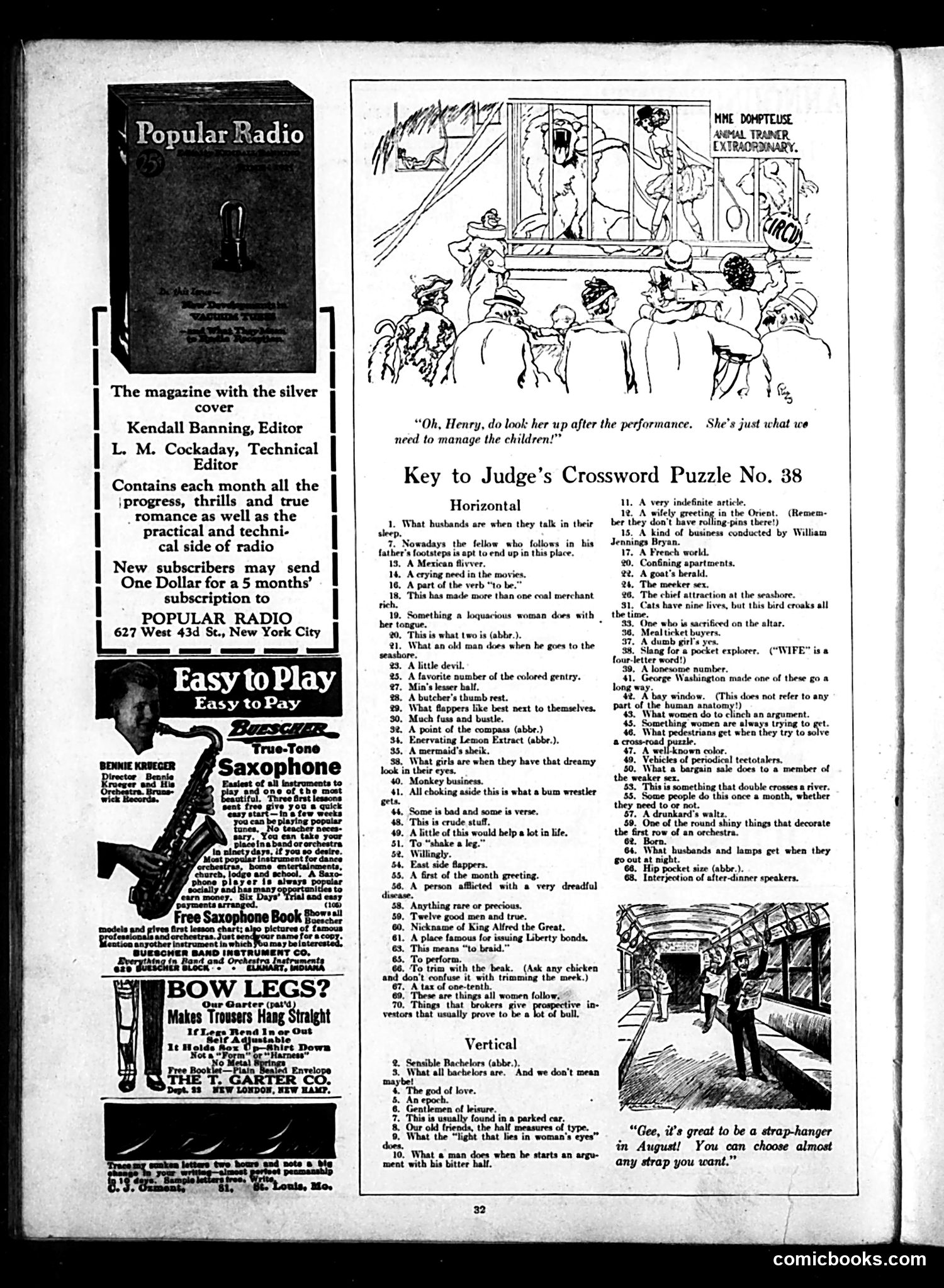
This page is primarily **advertising and a crossword puzzle answer key**, not political satire. The cartoon at top shows a crowd outside a theater praising a female performer ("Mime Dumpleuse, Naval Trainer, Extraordinary"), with one man suggesting they hire her to manage children—a sexist joke implying women are naturally suited to childcare. The bulk of the page contains the answer key to "Judge's Crossword Puzzle No. 38," with clues revealing period attitudes: references to "flappers," wives as "the meeker sex," and stereotypes about women and romance. One clue notes Oriental wives don't use "rolling-pins" (implying Western wives hit their husbands). The left side advertises Popular Radio magazine, a saxophone instruction course, and a "Bow Legs?" corrective device—typical early 20th-century commercial offerings. The bottom cartoon shows men discussing strap-hanging on transit, with crude humor about choosing "any strap you want." The page reflects 1920s-era casual misogyny and consumer culture.
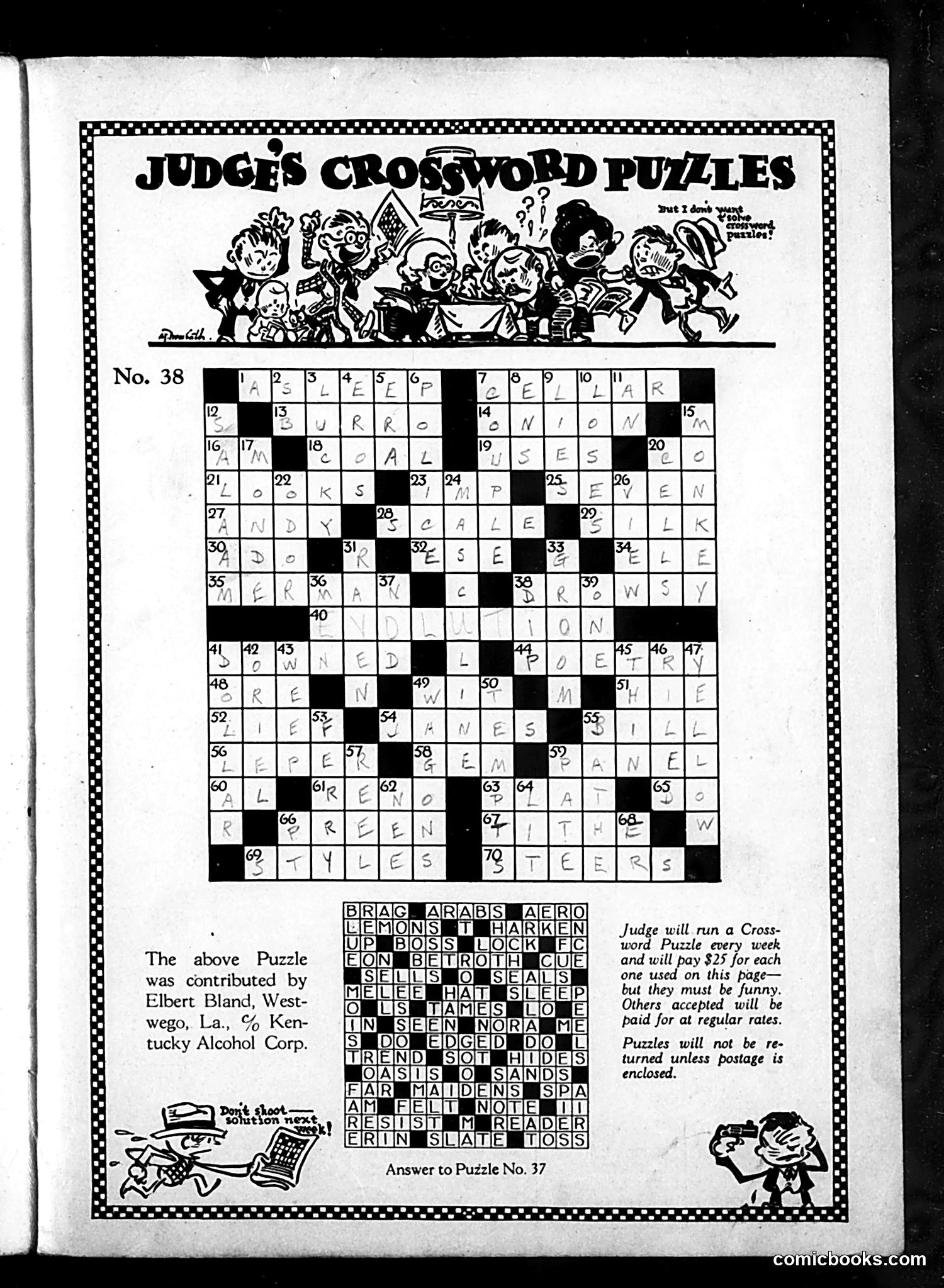
This page displays **Puzzle No. 38**, a crossword puzzle contributed by Elbert Bland of Westwego, Louisiana, affiliated with Kentucky Alcohol Corp. The content is primarily **advertising and puzzle content** rather than political satire. Judge magazine is offering to publish reader-submitted crossword puzzles weekly, paying $25 per puzzle used (noting entries must be humorous). The page includes the puzzle grid itself and the answer key to the previous week's puzzle (No. 37). The cartoon elements are minor—decorative header illustrations showing jovial figures typical of Judge's style, and small cartoons at the bottom left and right corners. These appear to be generic mascots rather than specific political references. The main point is straightforward: Judge is soliciting funny crossword puzzles from readers, establishing clear submission and payment terms.
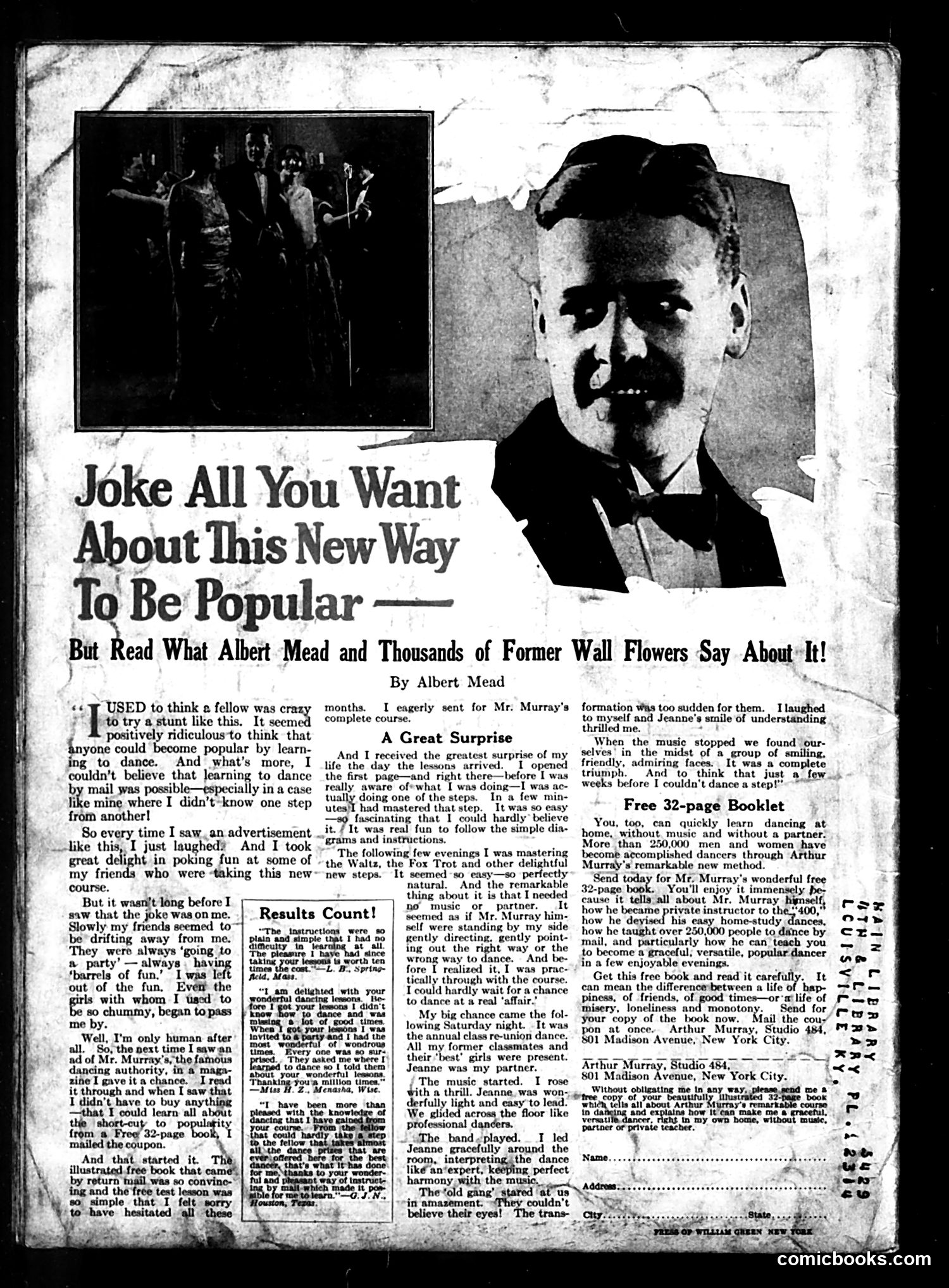
This is an advertisement disguised as editorial content, promoting Arthur Murray's mail-order dance lessons. The man pictured appears to be Albert Mead, whose supposed testimonial fills the page. The satire targets the widespread American anxiety about social popularity in the early 20th century. The "joke" is that someone mocked others for taking mail-order dance lessons, only to discover he was the real fool—excluded from parties and social events because he couldn't dance. The advertisement exploits this social shame, claiming that even a complete novice (someone who "didn't know one step from another") can quickly become a confident dancer and win romantic approval (represented by his partner "Jeanne"). The pitch capitalizes on the fantasy that transformation through dance instruction equals social success and romantic desirability. The free booklet offer was Murray's standard marketing hook. This blurs advertising and journalism in ways modern readers would immediately recognize as manipulative.

I can see this is a page from *Judge* magazine with a white spine/binding visible on the left edge. However, the image is extremely dark and difficult to read. While I can make out what appears to be a repeating circular pattern or design across most of the page—possibly decorative wallpaper or a background pattern—I cannot reliably identify any specific cartoon figures, captions, text content, or political references. To provide an accurate analysis of the satire, political figures, or social commentary as requested, I would need a clearer or higher-contrast version of this image. I cannot responsibly guess at identities or meanings without being able to see the details clearly.