
A complete issue · 36 pages · 1925
Judge — April 11, 1925
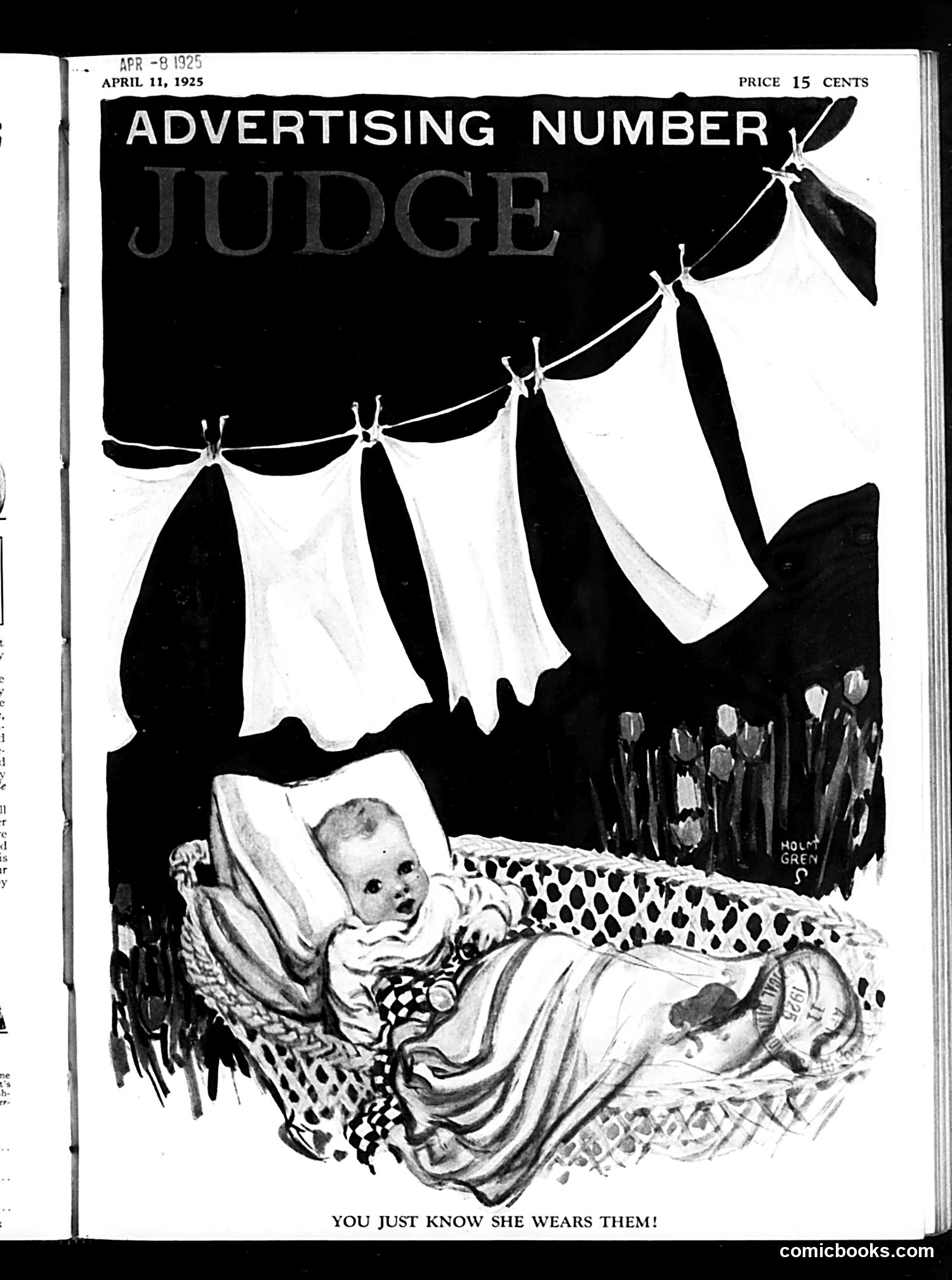
This is an **advertising number** for Judge magazine (price 15 cents). The main illustration shows a baby sleeping peacefully under draped white fabric hung like a clothesline, with flowers visible in the background. The caption reads "YOU JUST KNOW SHE WEARS THEM!" This appears to be an **advertisement for women's undergarments or hosiery**, likely targeting mothers. The imagery emphasizes cleanliness, freshness, and domestic comfort—suggesting the advertised product keeps women looking pristine and well-maintained. The sleeping baby symbolizes contentment and safety, implying the product enables women to manage household duties while maintaining their appearance. The artistic style and domestic scene were typical marketing approaches for intimate apparel in the 1920s.
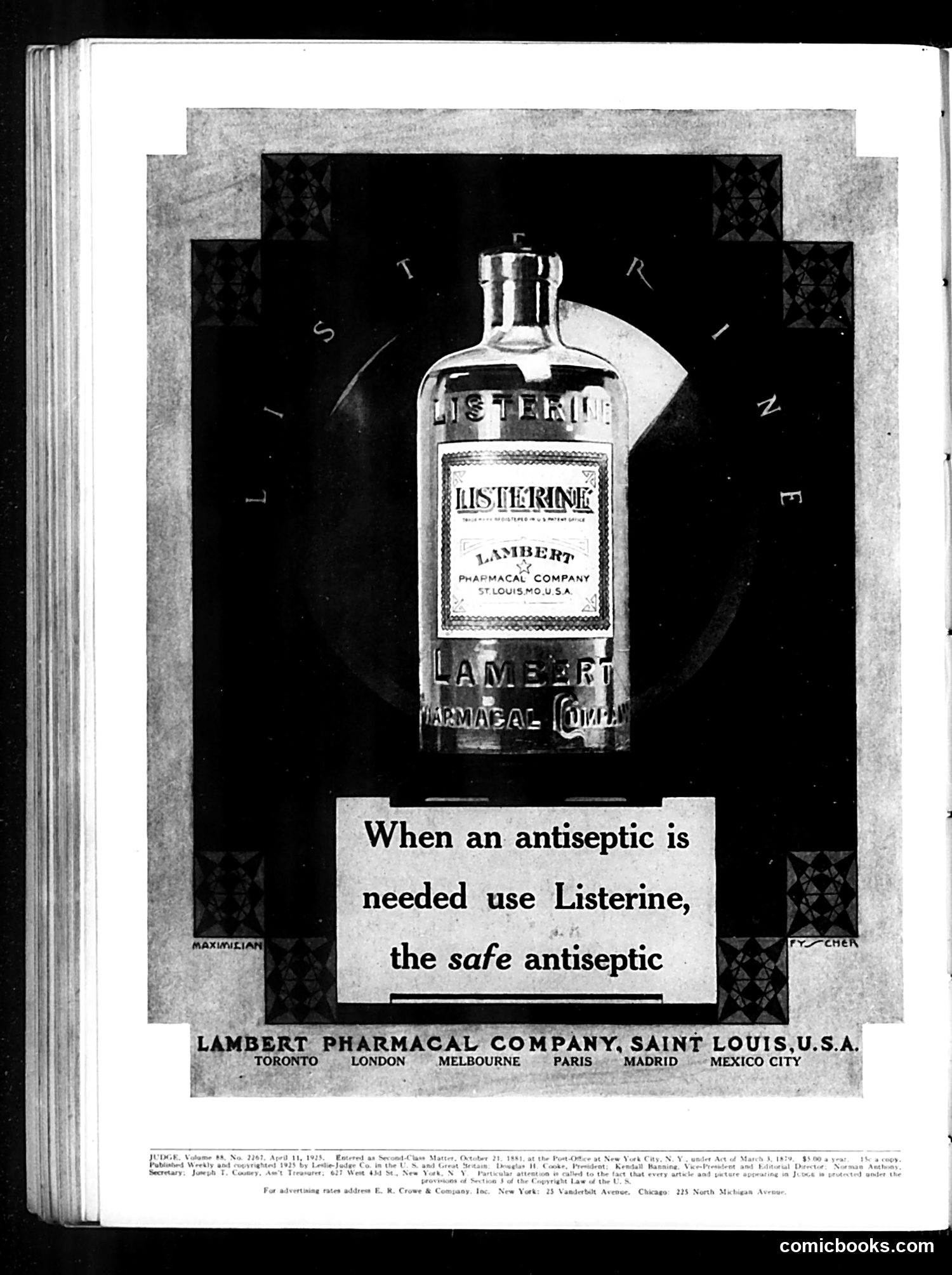
This page is a straightforward advertisement, not political satire or a cartoon. It promotes Listerine antiseptic mouthwash, produced by Lambert Pharmacal Company of Saint Louis. The ad features a large bottle of Listerine and includes the tagline "When an antiseptic is needed use Listerine, the *safe* antiseptic." The word "safe" appears emphasized in italics, likely addressing contemporary concerns about product safety—a relevant marketing point during an era when pharmaceutical regulation was less stringent than today. The company's international offices are listed (Toronto, London, Melbourne, Paris, Madrid, Mexico City), indicating Listerine's global distribution. This represents typical early 20th-century pharmaceutical advertising in American magazines.
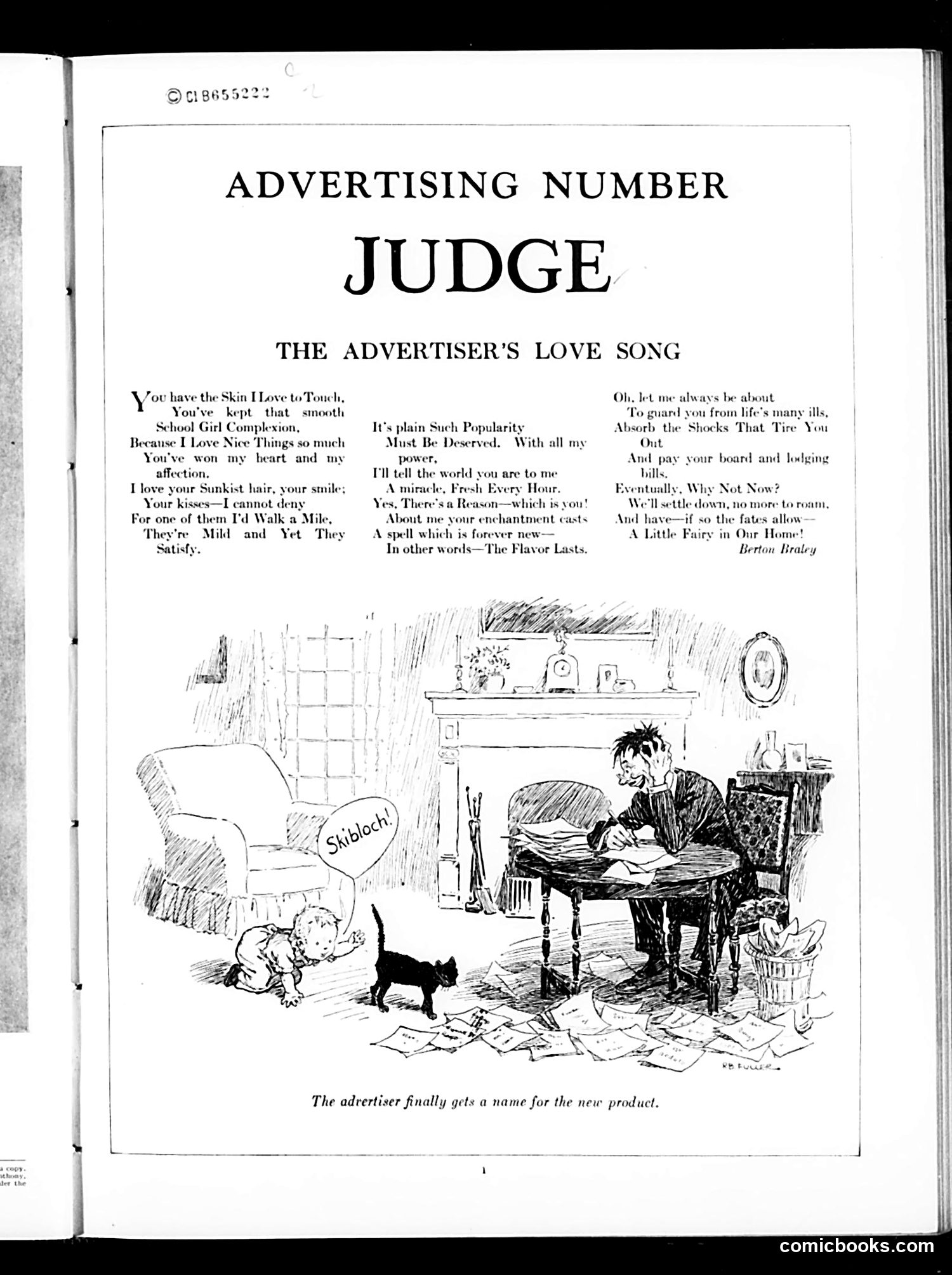
This is primarily **advertising content**, not political satire. The page features a humorous poem titled "The Advertiser's Love Song" that romanticizes product qualities—skin, complexion, hair, kisses—using advertising language. The accompanying cartoon depicts a messy office scene where an advertiser sits surrounded by scattered papers, appearing disheveled and frazzled while working. A cat and sleeping figure are visible on the floor. The joke, indicated by the caption "The advertiser finally gets a name for the new product," suggests the chaotic creative process behind naming consumer goods. The satire gently mocks advertising industry workers' labor and the absurdity of marketing language that treats ordinary products as romantic conquests. It's lighthearted mockery of early 20th-century advertising culture.
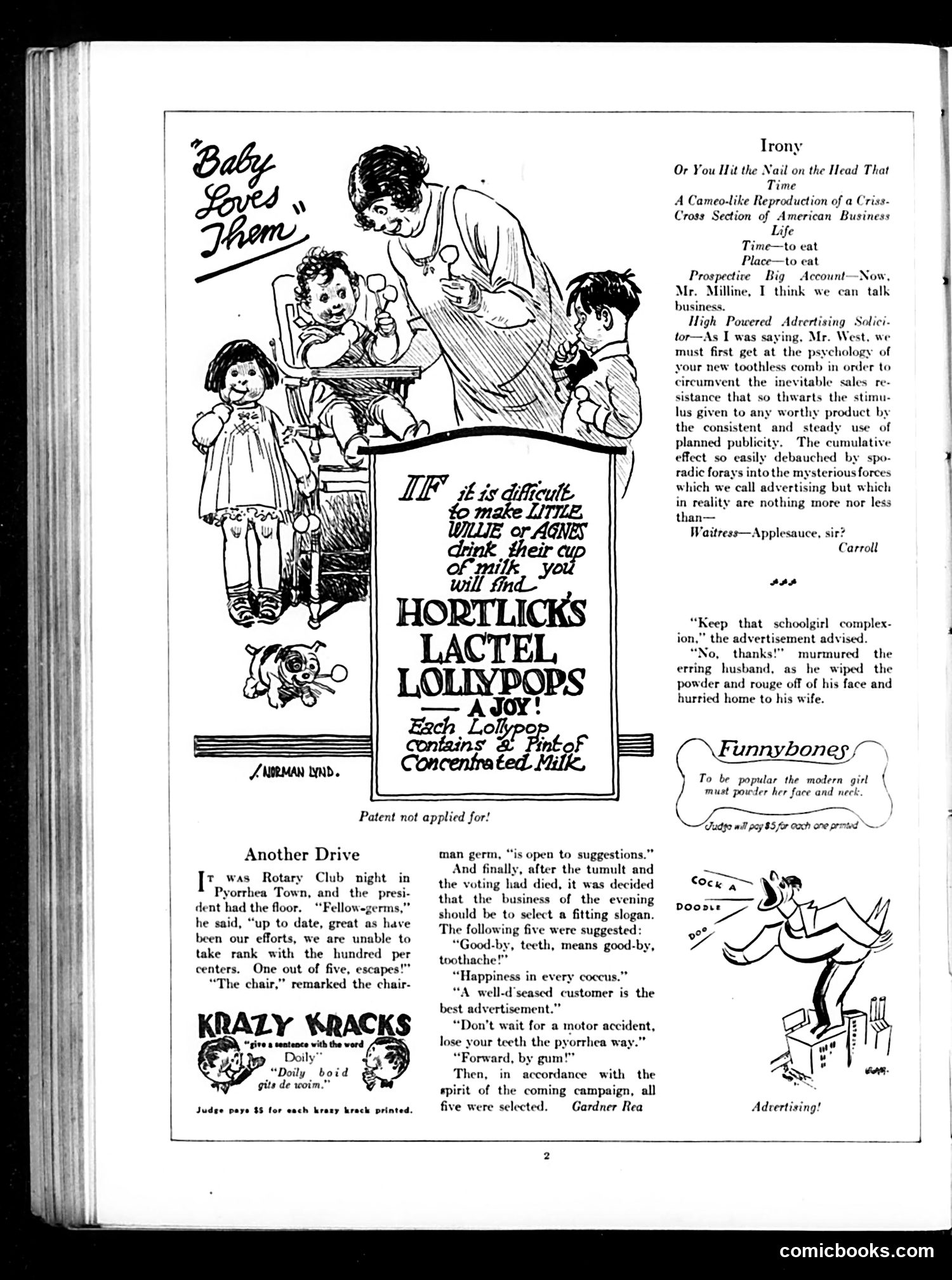
This page is primarily **advertising and humor content** rather than political satire. The main advertisements feature: 1. **Hortlicks Lactel Lollypops** - a children's candy product claiming to contain concentrated milk 2. **Krazy Kracks** - a word game offering judges' prizes The page includes three separate pieces: - **"Baby Loves Them"** - illustrated advertisement showing children with the milk lollypops - **"Irony"** - a brief comedic sketch about office/waitress interactions and advertising psychology - **"Another Drive"** - describes a Rotary Club meeting selecting advertising slogans, with humorous suggestions about teeth and good-bye The humor relies on wordplay and gentle mockery of business culture and advertising practices, rather than political commentary. The cartoons satirize early 20th-century American consumer culture and commercial absurdity.
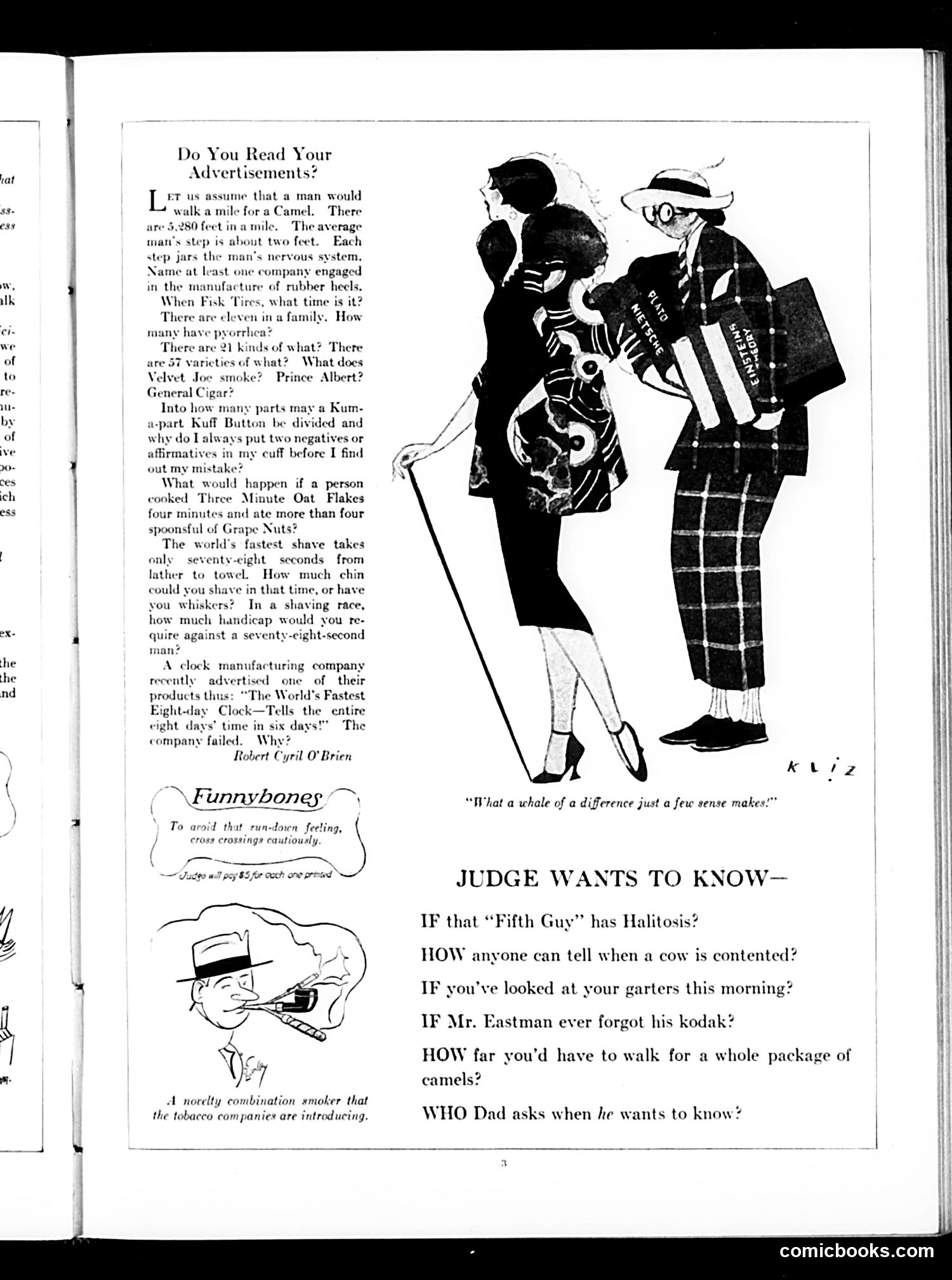
This page satirizes advertising claims through rhetorical questions. The main article "Do You Read Your Advertisements?" by Robert Cyril O'Brien critiques absurd product marketing—questioning how many steps are in a mile (leading to rubber heel advertisements), or claims about a clock that "tells the entire eight days' time in six days." The illustration shows a well-dressed man examining a woman's fashion choices, captioned "What a whale of a difference just a few sense makes"—mocking exaggerated advertising promises about products improving appearance or life. The "Judge Wants to Know" section parodies advertisements' ridiculous rhetorical questions (does Mr. Eastman forget his kodak?) that assume products are indispensable. The "Funnyboney" section presents brief humorous observations about cigars and smoker behavior, typical of the magazine's filler content.
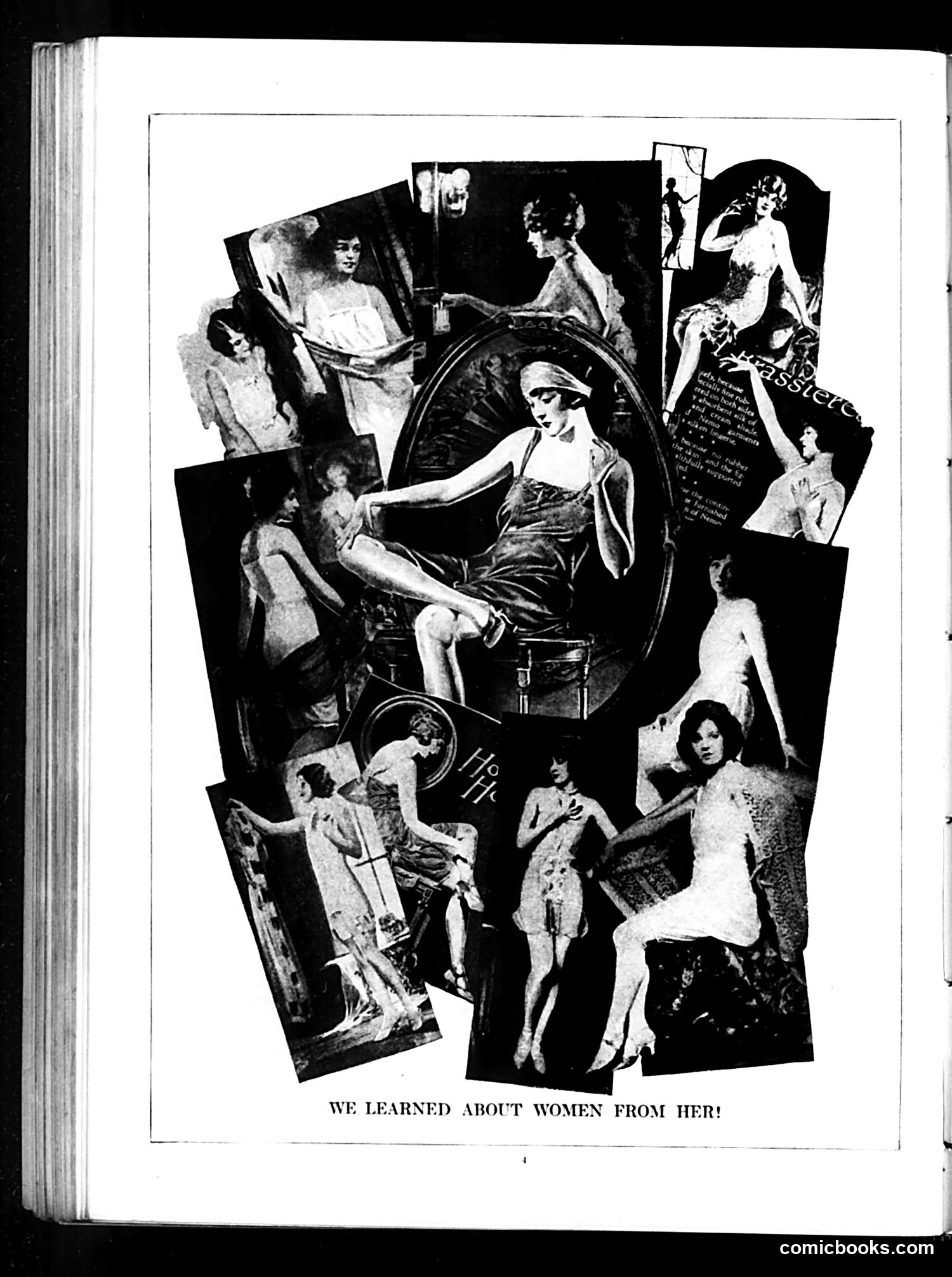
This Judge magazine page is a collage of film stills arranged around a central circular portrait of a woman, likely an actress or film personality from the silent or early sound era. The caption suggests this figure was influential in shaping public perceptions of women through cinema. The surrounding images show various female characters in different scenarios—some undressed or in states of undress, others in dramatic poses. The satire appears to critique how movies portrayed women and influenced cultural attitudes about femininity, sexuality, and women's roles. The joke targets both the film industry's representation of women and audiences' reception of these portrayals, suggesting cinema taught viewers problematic or exaggerated lessons about women's behavior and bodies.
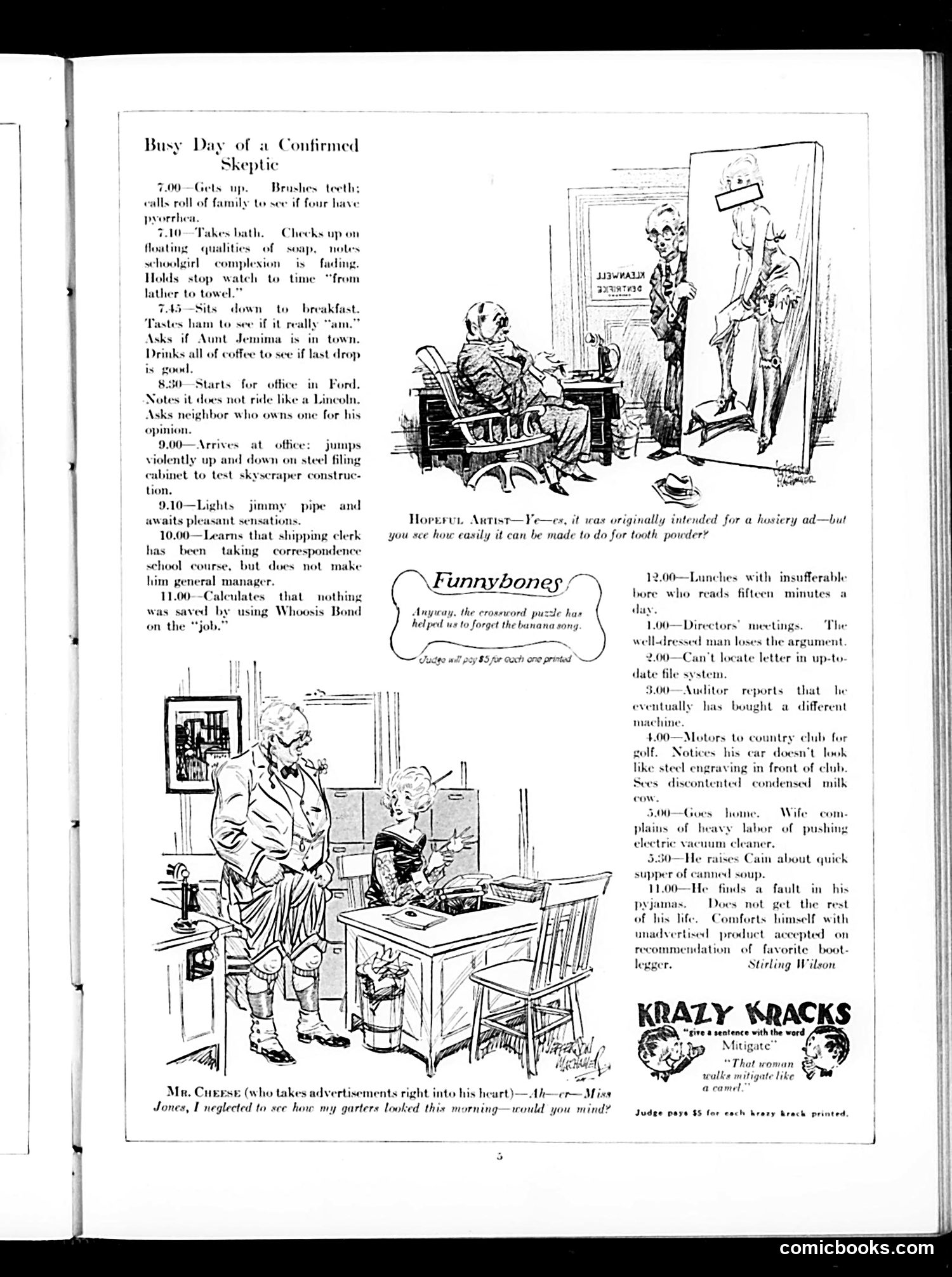
This page presents a humorous daily schedule titled "Busy Day of a Confirmed Skeptic," satirizing someone chronically distrustful of everyday claims and products. The skeptic questions everything from soap quality to Ford automobiles and office equipment throughout his day. The accompanying illustrations show domestic and office scenes depicting the skeptic's suspicious nature. One cartoon features "Mr. Cheese" complaining about his appearance in advertisements, suggesting satire about commercial manipulation and vanity. The "Funnybones" section and "Krazy Kracks" feature are lighter humor segments typical of Judge magazine's format. The overall satire targets American consumer culture and advertising's proliferation in the 1920s-30s era, mocking excessive skepticism while implicitly criticizing the reliability of contemporary consumer products and marketing claims.
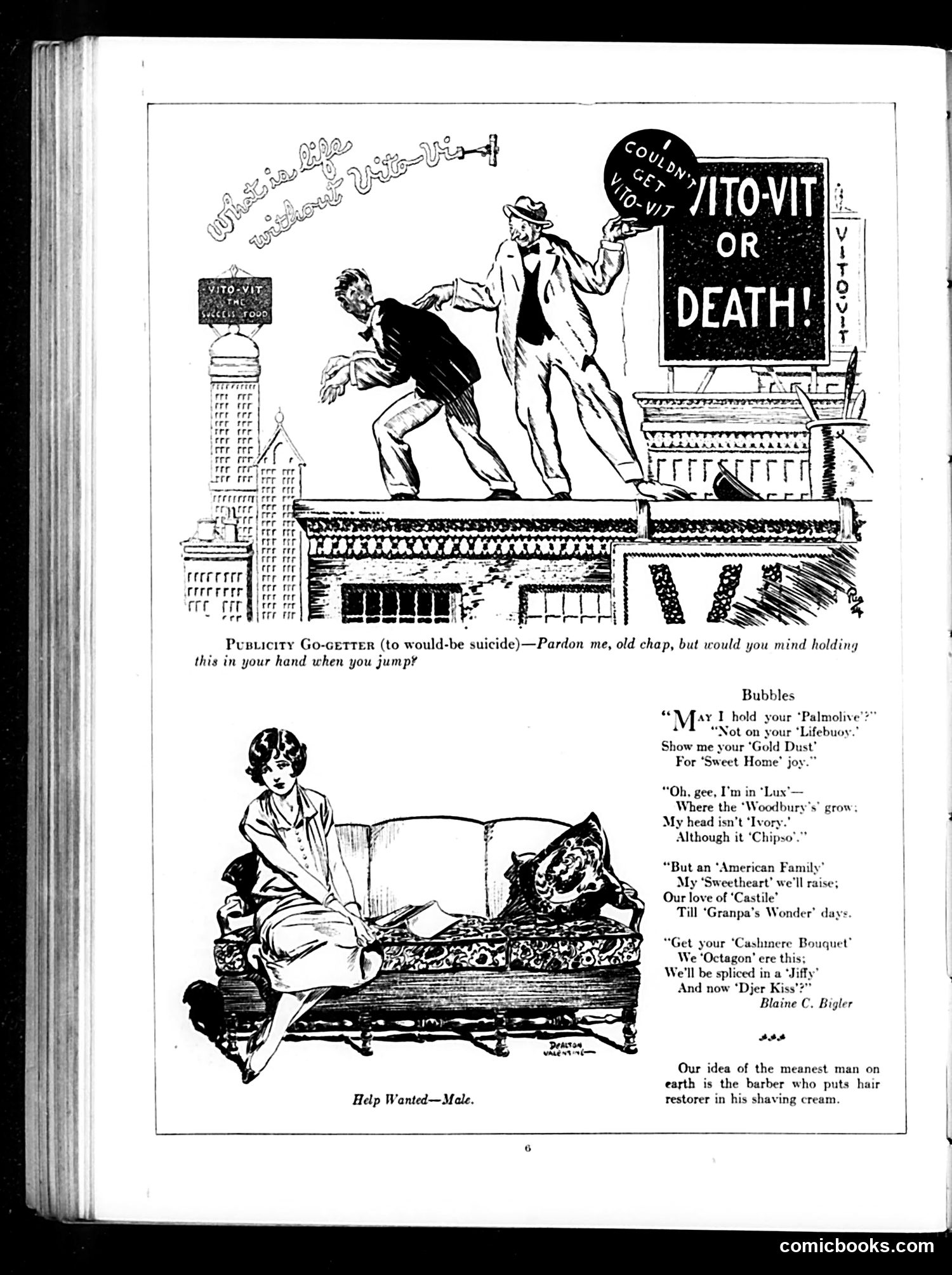
**Top Cartoon**: A suicide-prevention publicity stunt. A man about to jump from a building is stopped by a "Publicity Go-getter" who asks him to hold a product (likely Vito-Vit) while jumping—to generate advertising. The joke satirizes how far companies will go to advertise, exploiting even tragic situations for commercial gain. The sign "Vito-Vit or Death" darkly plays on the suicide scenario. **Bottom Section**: "Bubbles" is a humorous poem by Blaine C. Bigler that parodies advertising by using famous soap and cleaning product brand names as if they were real words in romantic dialogue (Palmolive, Lifebuoy, Gold Dust, Lux, Woodbury's, Ivory, Chipso, etc.). It's absurdist humor mocking how ubiquitous consumer advertising had become in everyday speech. The final quip about barbers adding hair restorer to shaving cream jokes about deceptive sales tactics.
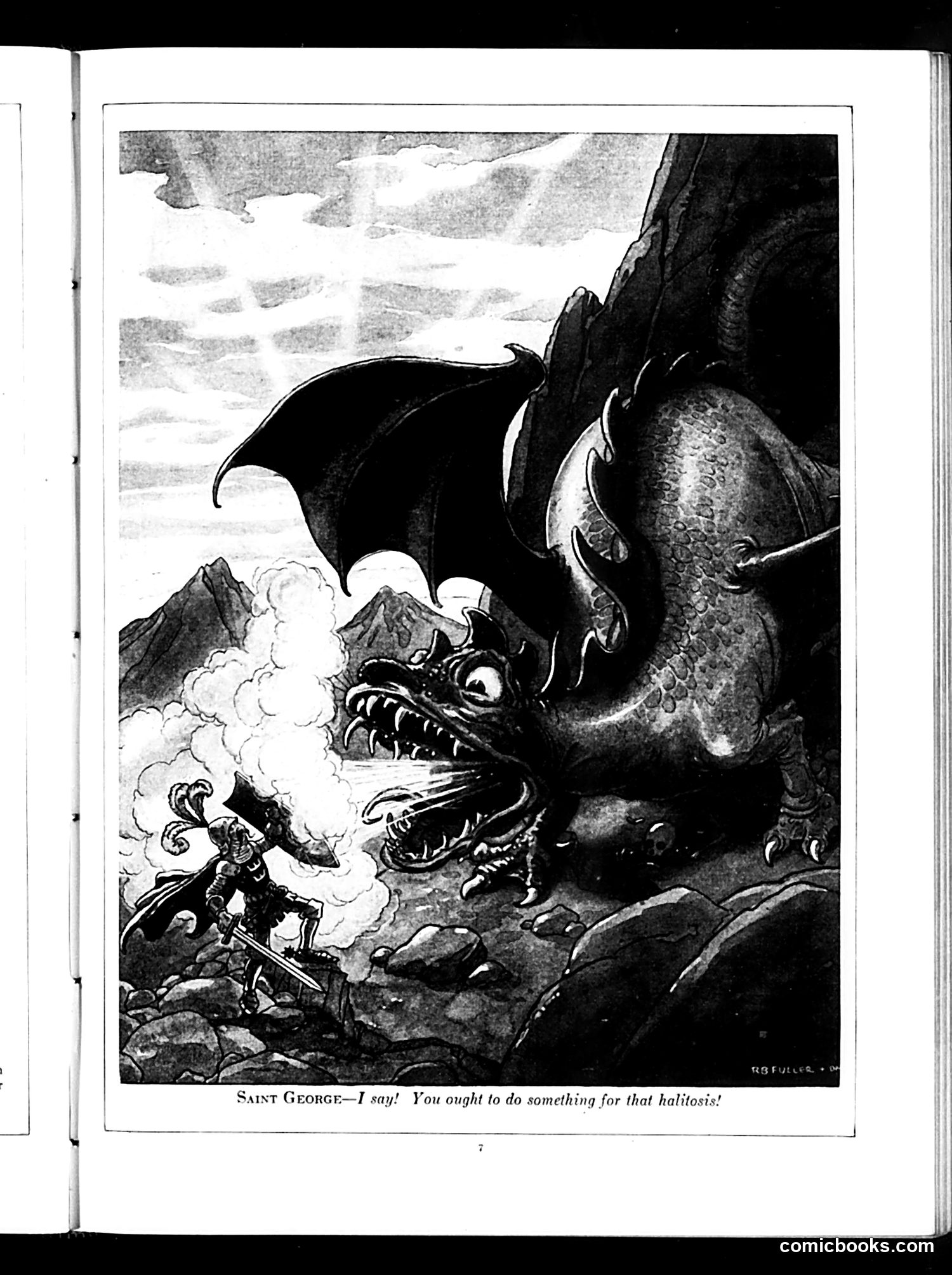
This cartoon depicts the legendary Saint George confronting a large, fearsome dragon. The satire repurposes the classical heroic narrative as a joke about bad breath ("halitosis"). Saint George, shown as a small armored knight, addresses the dragon not with his traditional battle cry but with a modern commercial complaint about the creature's foul-smelling breath. The humor derives from juxtaposing medieval legend with early 20th-century advertising language—"halitosis" was a newly popular commercial term used to market mouthwash and dental products. The cartoon mocks both consumer culture's medicalization of ordinary conditions and the absurdity of applying modern commercial anxieties to classical mythology. The point is satirical commentary on contemporary advertising's invasiveness into unlikely contexts.
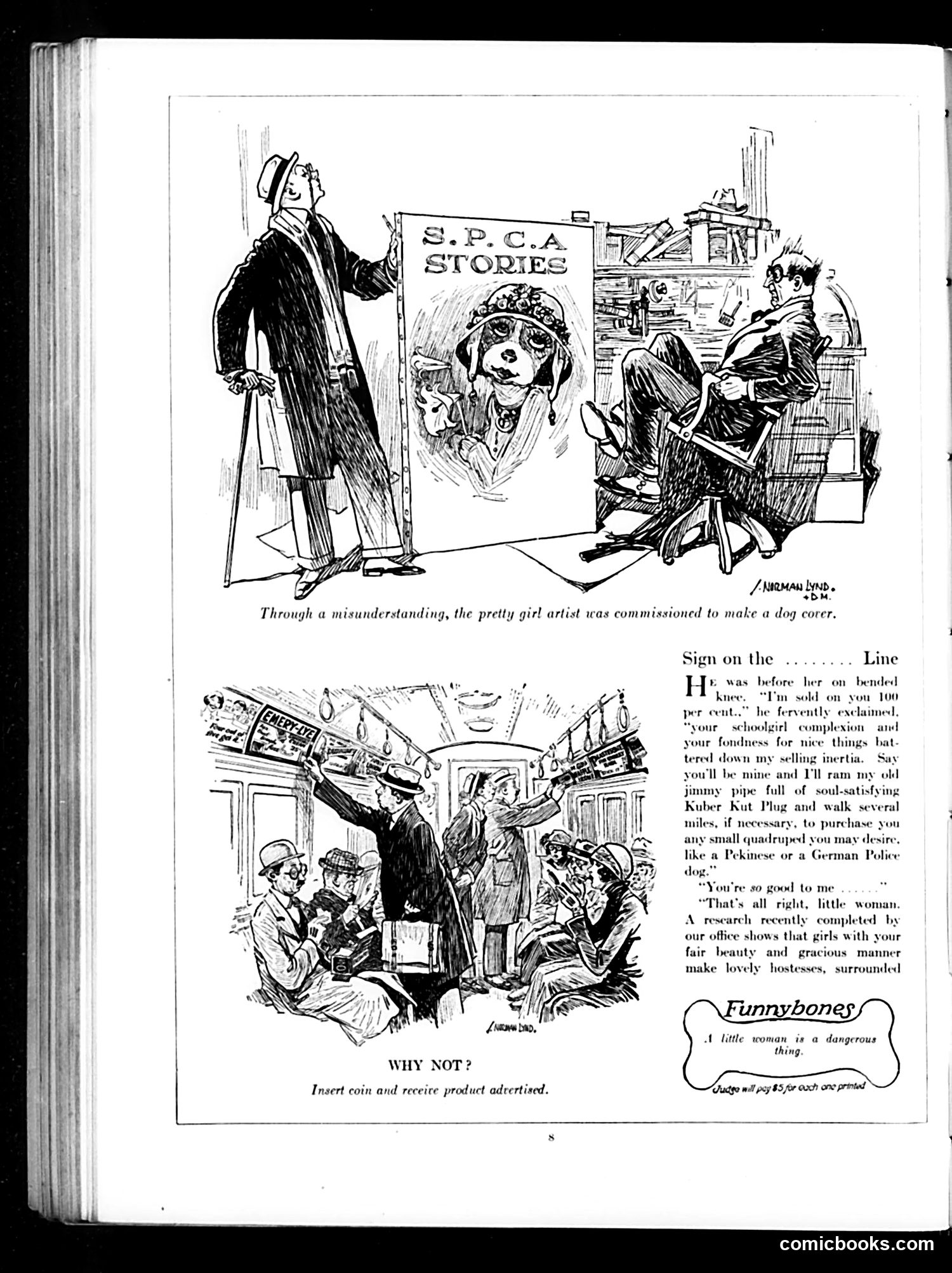
This page contains two satirical cartoons from *Judge* magazine mocking early 20th-century social conventions and advertising. The top cartoon jokes about miscommunication: a man commissioned a "pretty girl artist" to create a dog cover (likely for furniture), but she misunderstood and created an S.P.C.A. (animal welfare organization) poster instead. The bottom cartoon satirizes manipulative courtship and advertising. A man uses flattery and a marriage proposal to convince a woman to buy his tobacco product ("Kuber Kut Plug"), offering to purchase her a pet dog as incentive. The accompanying text mocks commercial research claiming beautiful women make good hostesses—implying they're valued only for appearance and hospitality. The "Funnybones" caption ("A little woman is a dangerous thing") suggests ironic skepticism about women's agency and decision-making. Overall, these cartoons critique both commercial manipulation and gender stereotypes prevalent in that era.
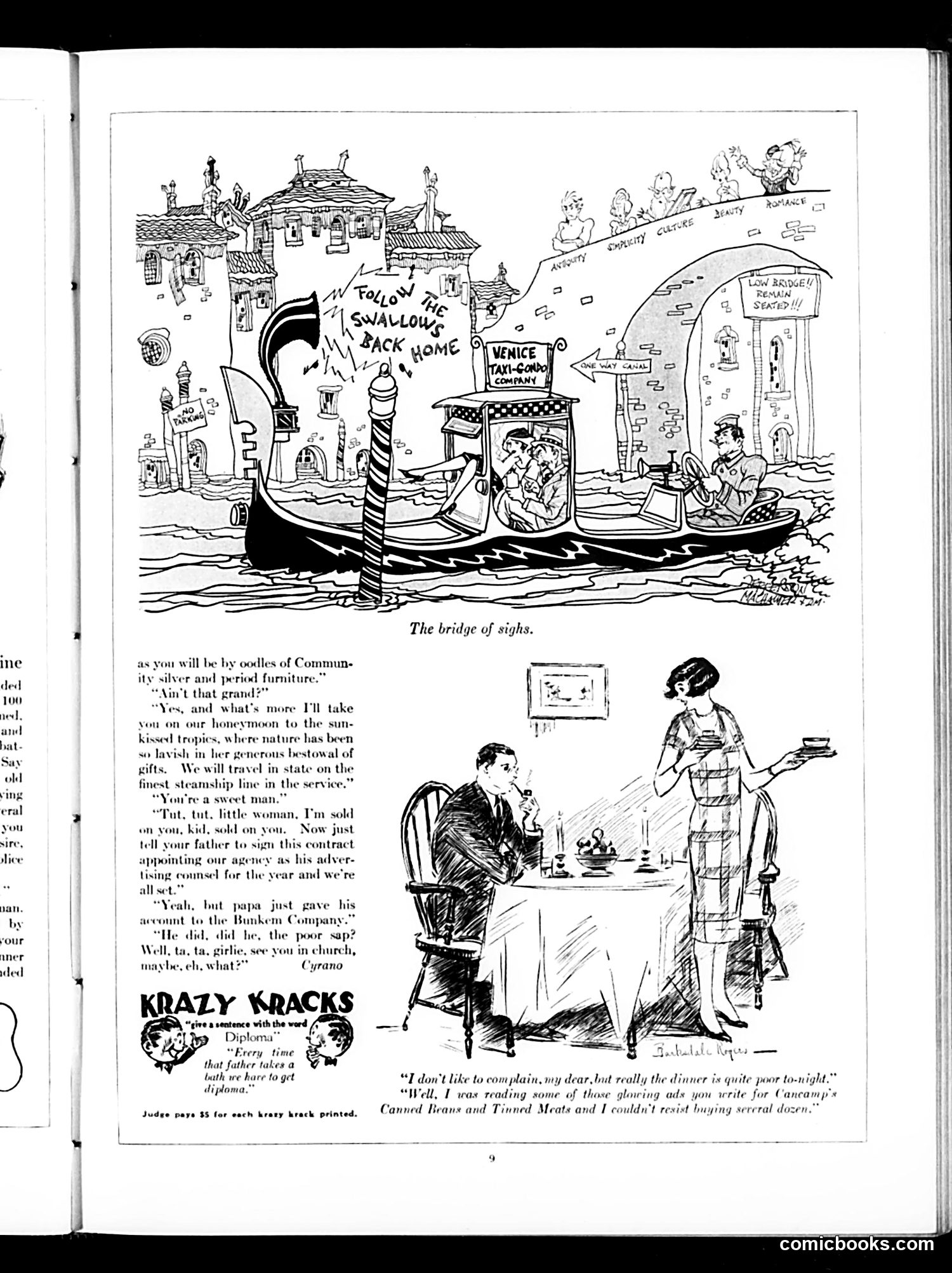
This page contains two separate comic narratives satirizing early 20th-century advertising and consumer culture. **Top cartoon ("The Bridge of Sighs"):** A man proposes marriage while promising luxury—"Community silver," tropical honeymoons, finest steamships. His fiancée's father, however, has already signed him as advertising counsel for the "Bunkem Company," trapping him in a business contract. The satire mocks both aggressive advertising practices and the way business deals override personal relationships. **Bottom cartoon ("Krazy Kracks"):** A wife complains dinner is poor. Her husband discovers she bought canned beans and meats *because* of his own glowing advertisements for these products. The joke exposes the gap between advertising claims and actual product quality—the ads convinced even the advertiser's own wife, backfiring on him. Both pieces critique misleading advertising endemic to the era, suggesting ads made exaggerated promises while products disappointed. The humor targets advertisers' hypocrisy and consumer gullibility.
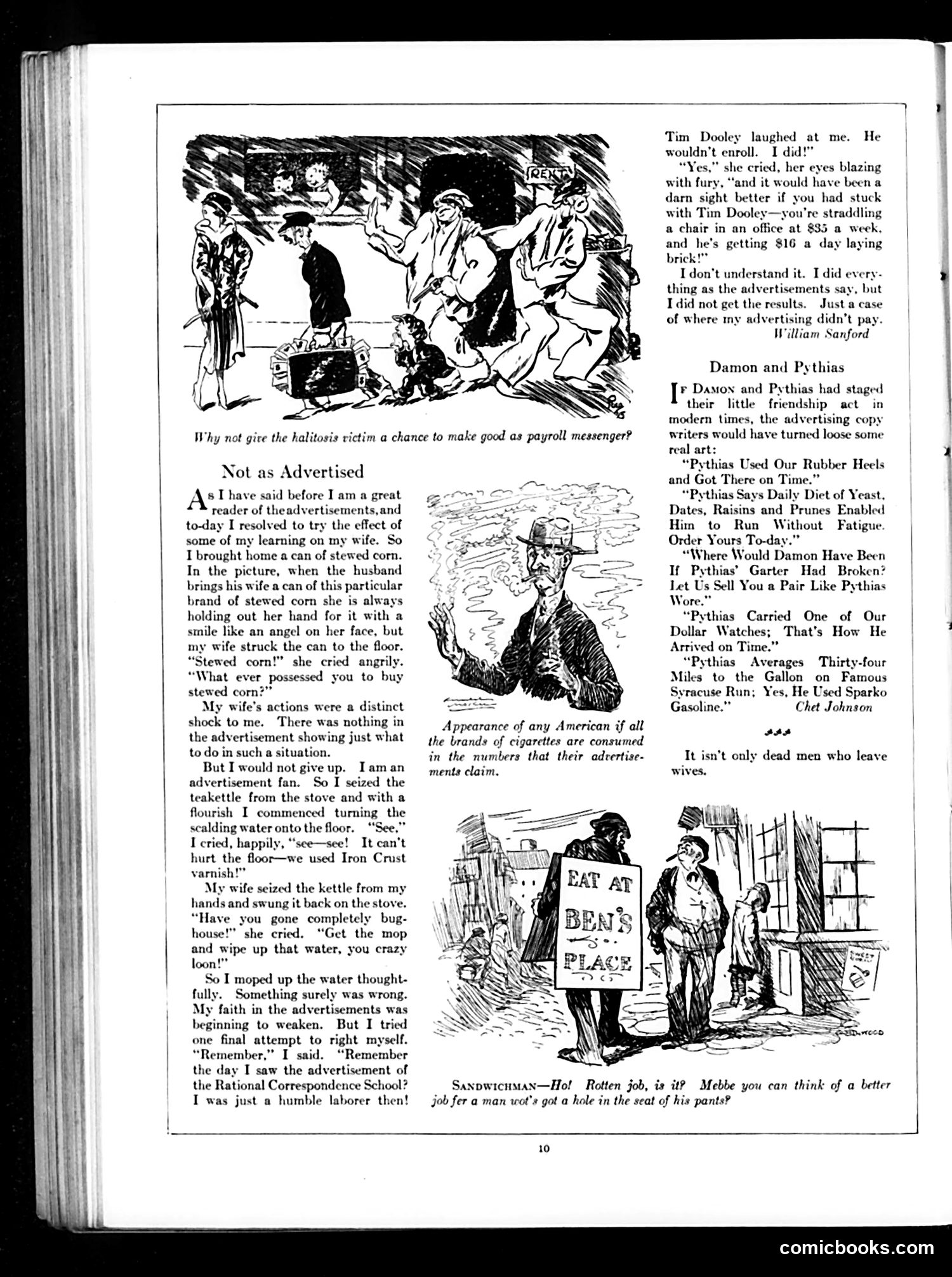
This 1920s satirical piece mocks the gap between advertising promises and reality. The main article, "Not as Advertised," follows a husband who literally follows product advertisements' claims—buying stewed corn expecting his wife to smile angelically, pouring boiling water on his floor to demonstrate the durability of "Iron Crust" varnish. She's furious. The joke: advertisements show idealized scenarios disconnected from actual human behavior and consequences. The accompanying "Damon and Pythias" section parodies how advertisers would exploit even ancient legends of friendship, inventing absurd product endorsements (rubber heels, garters, watches, gasoline) to capitalize on any cultural reference. The bottom cartoon mocks a desperate jobseeker with a hole in his pants asking a sandwich vendor for work advice—commenting on economic hardship and social degradation. The overall satire criticizes aggressive early-20th-century advertising's manipulative dishonesty and consumers' naive faith in marketing claims.
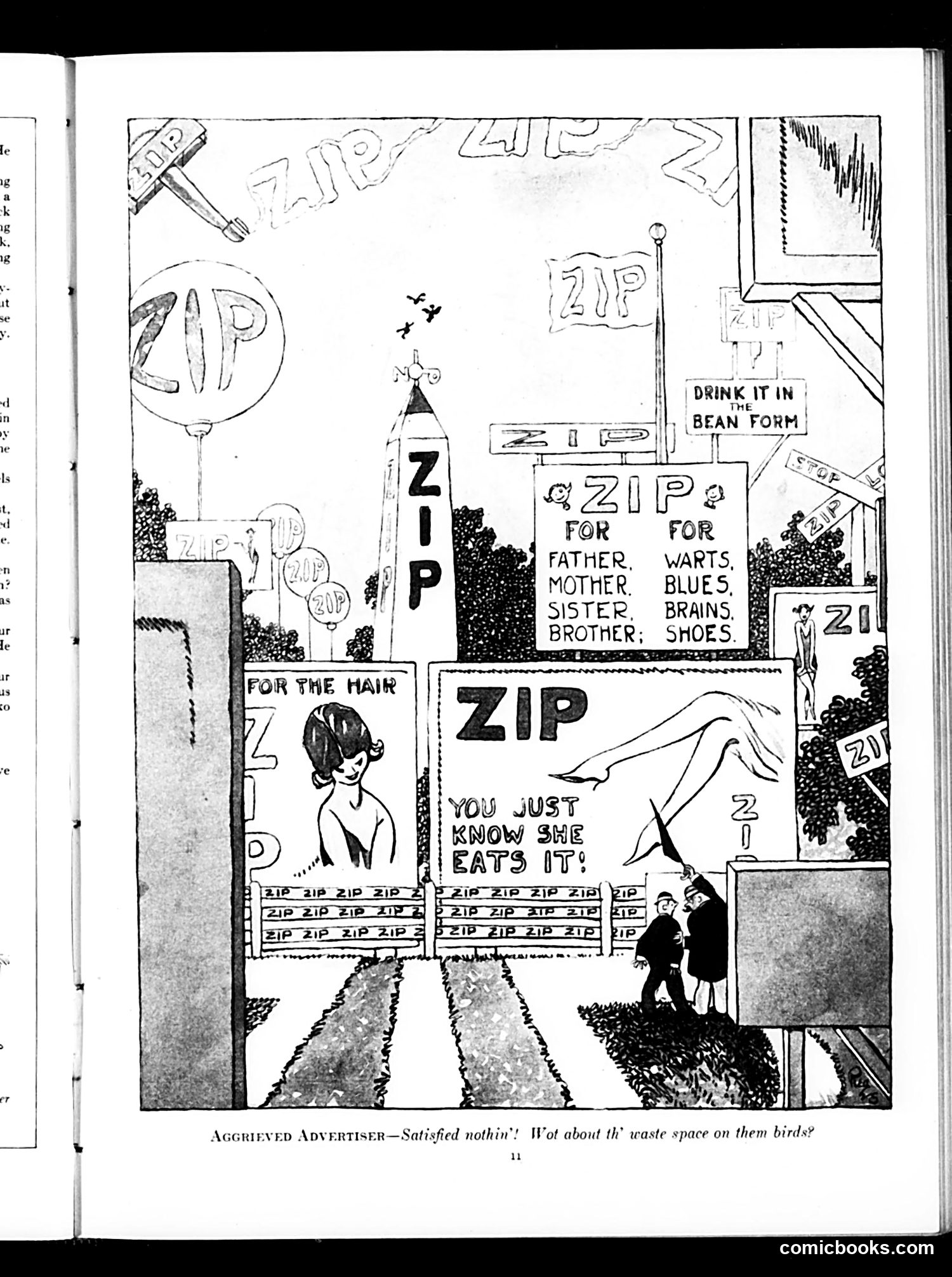
This is a satirical cartoon mocking over-aggressive advertising in early 20th-century print media. The image depicts a fictional "ZIP" product advertised everywhere—on balloons, rockets, signs, and even painted on a woman's legs—with claims it cures everything (hair loss, warts, blues, brains, shoes, etc.). The caption's complaint—"Satisfied nothin'! Wot about th' waste space on them birds?"—is the joke: an advertiser greedily points out that even the birds and sky lack advertisements. The satire targets both the absurd proliferation of ads and advertisers' insatiable desire to monetize every visible surface. The product "ZIP" appears entirely fictional, exaggerating real patent-medicine marketing tactics common in that era. The cartoonist criticizes how advertisements had become inescapable visual pollution.
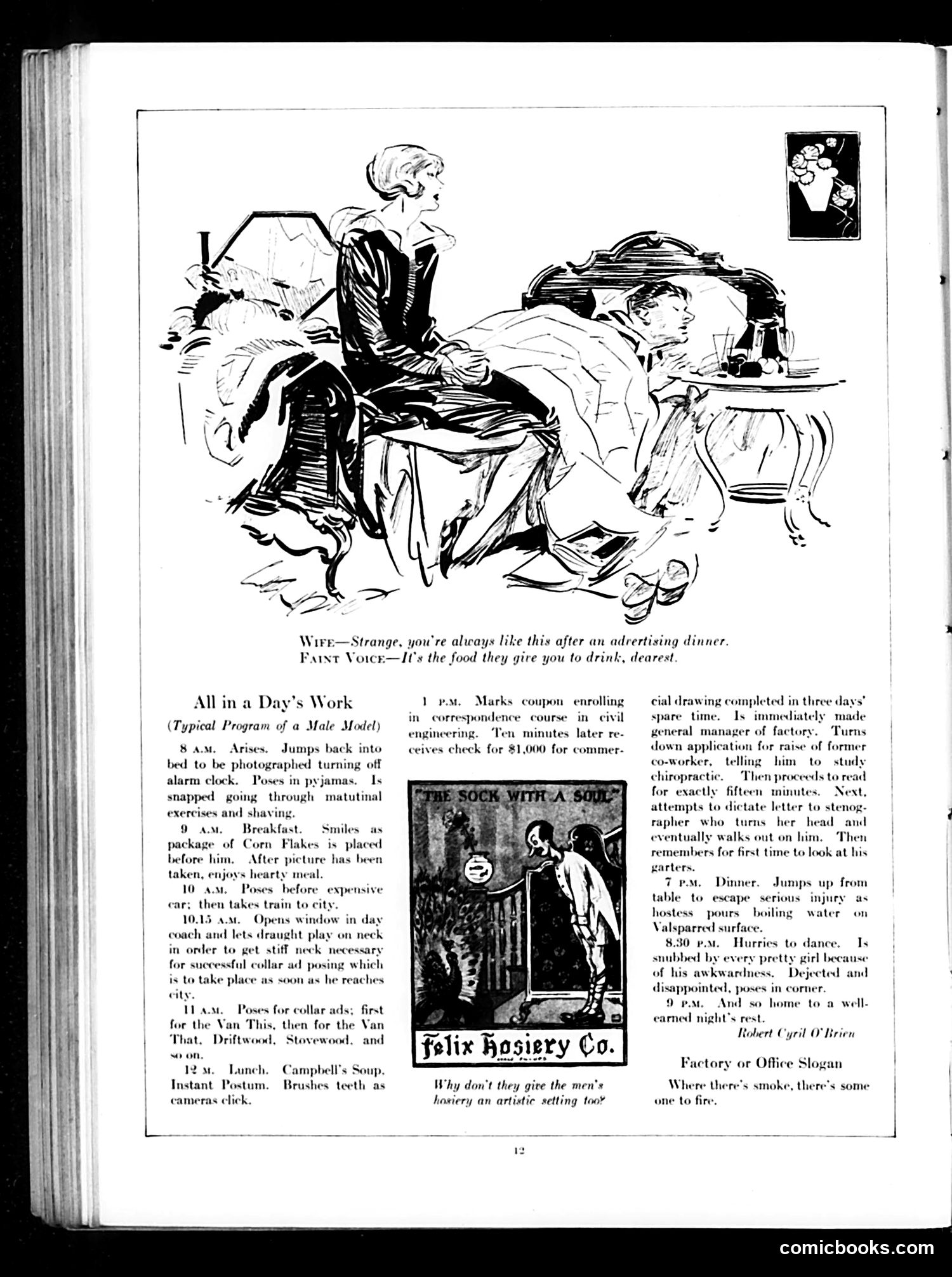
This two-part satirical piece mocks the lucrative but absurd life of male models in advertising during the early 20th century. **The cartoon at top** depicts a husband returning home disheveled after an advertising dinner, with his wife commenting that the expensive food they serve is really just "the food they give you to drink"—a jab at the heavy alcohol consumption at such industry events. **The main article** details a model's typical day: he poses for breakfast cereal ads, collar advertisements, and soup products, earning enormous sums ($1,000 for three days' work) while living an otherwise pathetic life—he's socially awkward, gets rejected by women, and nearly scalds himself at dinner. The satire highlights the disconnect between these men's inflated salaries for trivial work versus their actual incompetence in real life. **The Felix Hosiery advertisement** appears inserted ironically, with a caption questioning why men's hosiery ads don't get equally "artistic" treatment, reinforcing the piece's mockery of advertising pretension.
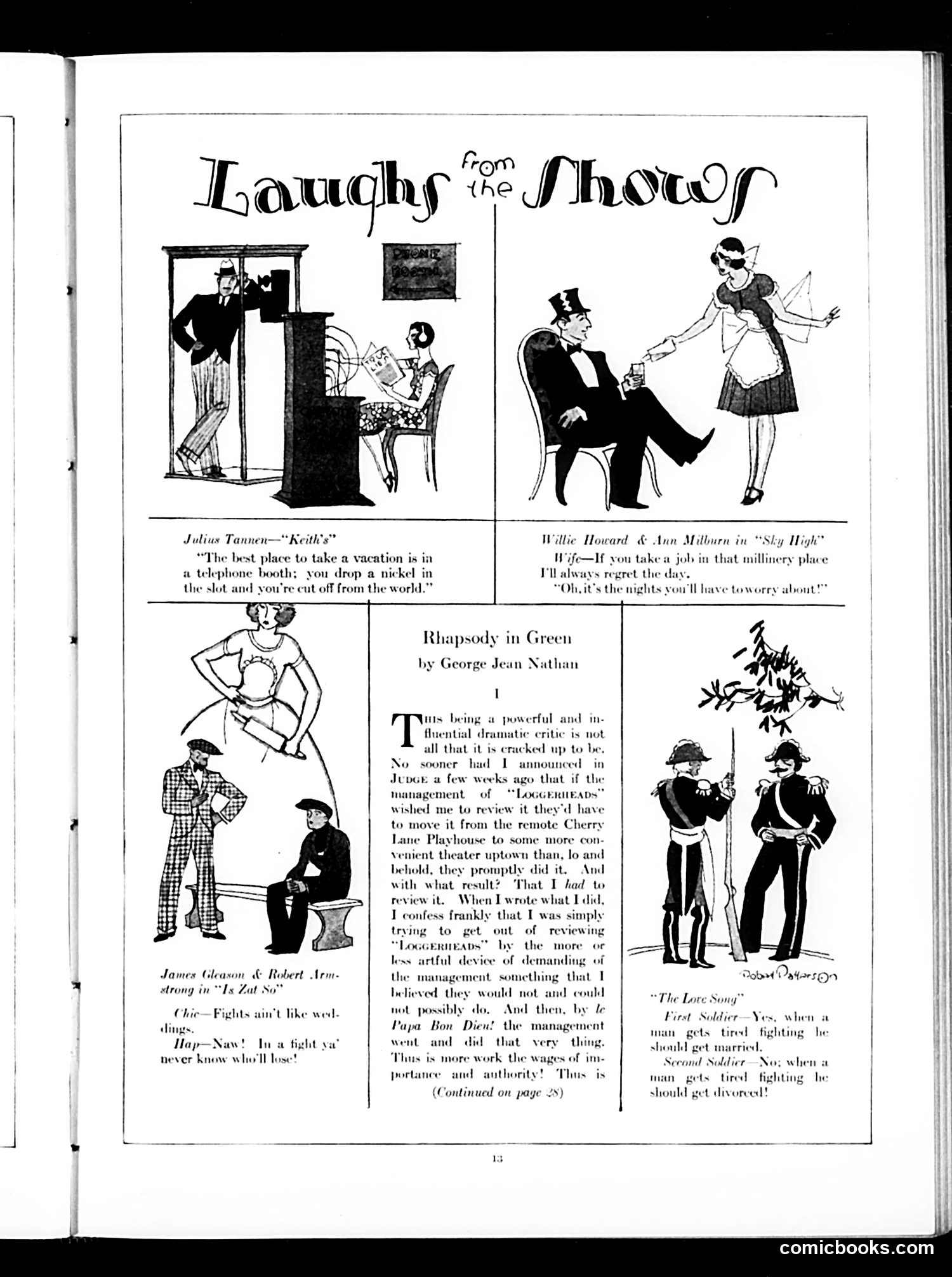
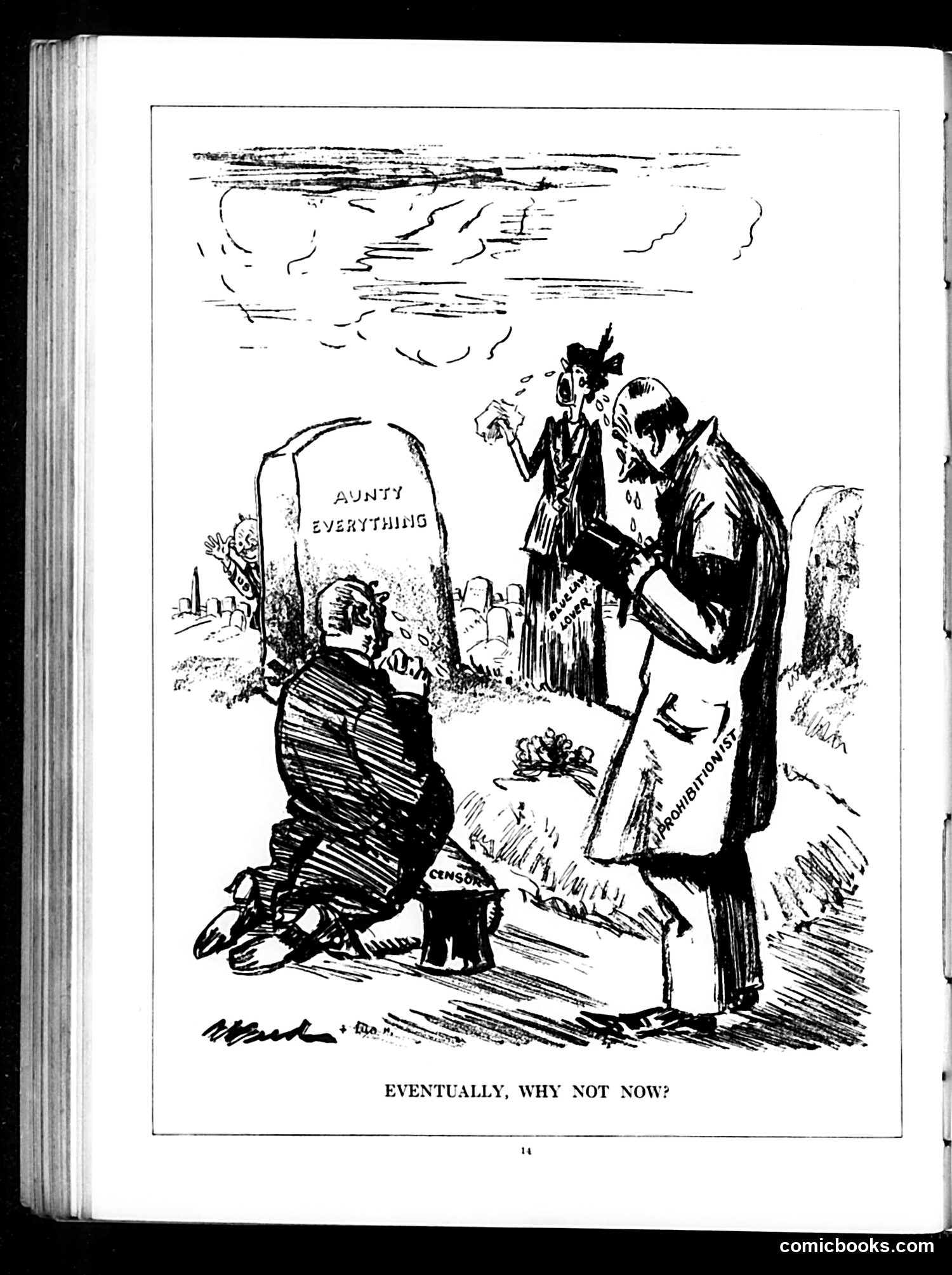
This Judge magazine cartoon satirizes arguments against Prohibition. A figure kneels at a gravestone labeled "AUNTY EVERYTHING," while two stern figures (likely representing Prohibition enforcers or politicians) hold documents marked "CENSORSHIP" and "PROHIBITION." The cartoon mocks the logic of incremental restriction: if society accepts censorship and prohibition now, the image suggests, why not expand these controls indefinitely? The "Aunty Everything" gravestone implies the death of individual liberty under expanding governmental control. This appears to be anti-Prohibition commentary, arguing that accepting such restrictions sets a dangerous precedent for further government intrusion into private life. The sarcastic title questions whether society should simply accept total control now rather than waiting for its inevitable expansion.
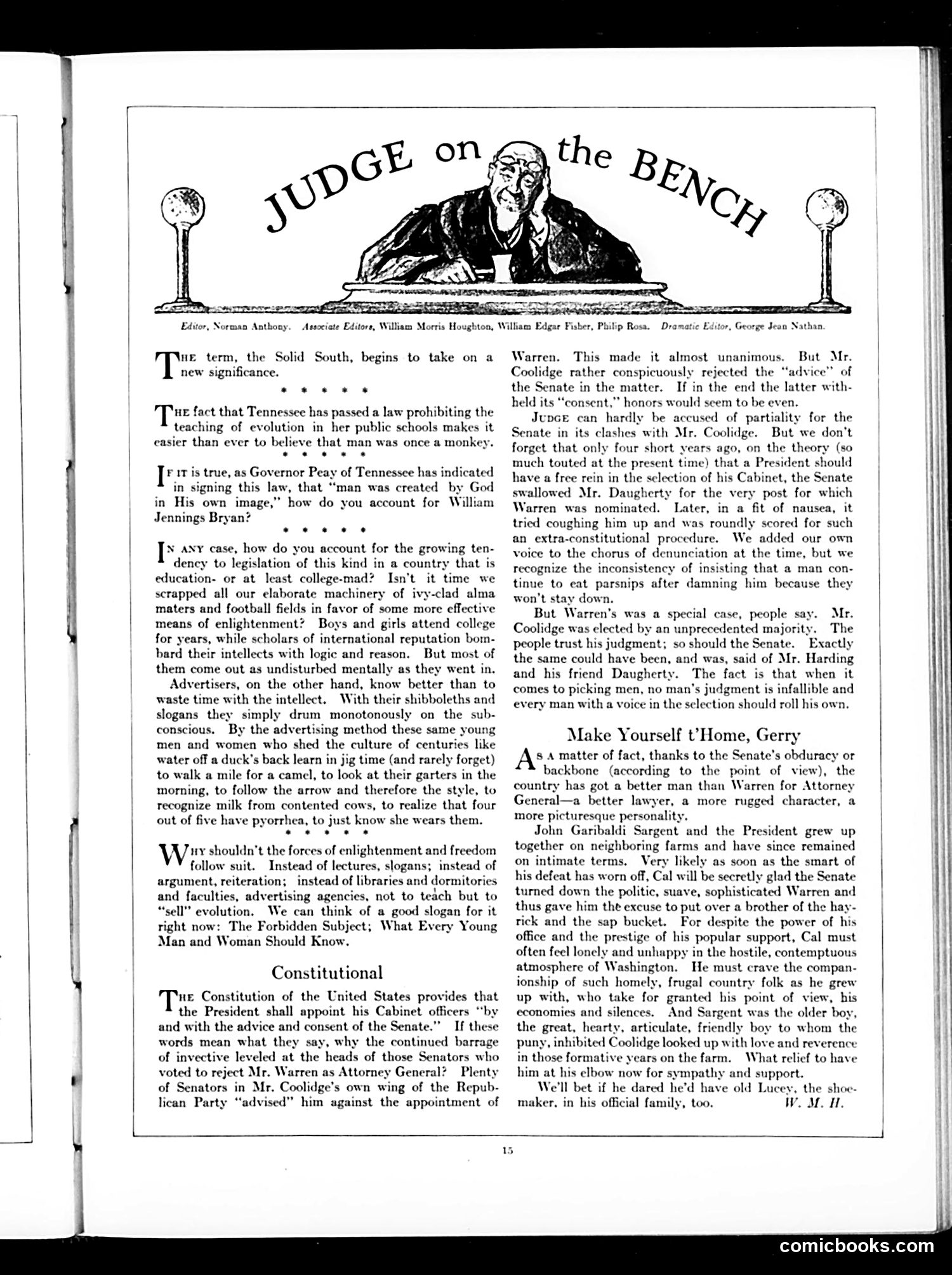
This page critiques President Coolidge's handling of Charles Evans Warren's rejected nomination as Attorney General. The cartoon shows a stern judge presiding over the constitutional dispute. **The Political Issue**: Coolidge ignored Senate advice against Warren's appointment, then the Senate withheld consent—creating a constitutional standoff. The article argues both branches acted within their rights, though it notes the hypocrisy: four years earlier, the same Senate had meekly accepted Harry Daugherty as Attorney General under Harding, then later regretted it. **The Satire**: Judge mocks the "unprecedented majority" argument—that Coolidge's electoral victory granted him unchecked Cabinet power. The piece points out this identical claim justified Harding's equally questionable appointment, suggesting no president's popularity should override constitutional checks. The opening section sardonically critiques Tennessee's evolution ban and compares evolution to advertising's effectiveness at persuading the public mind.
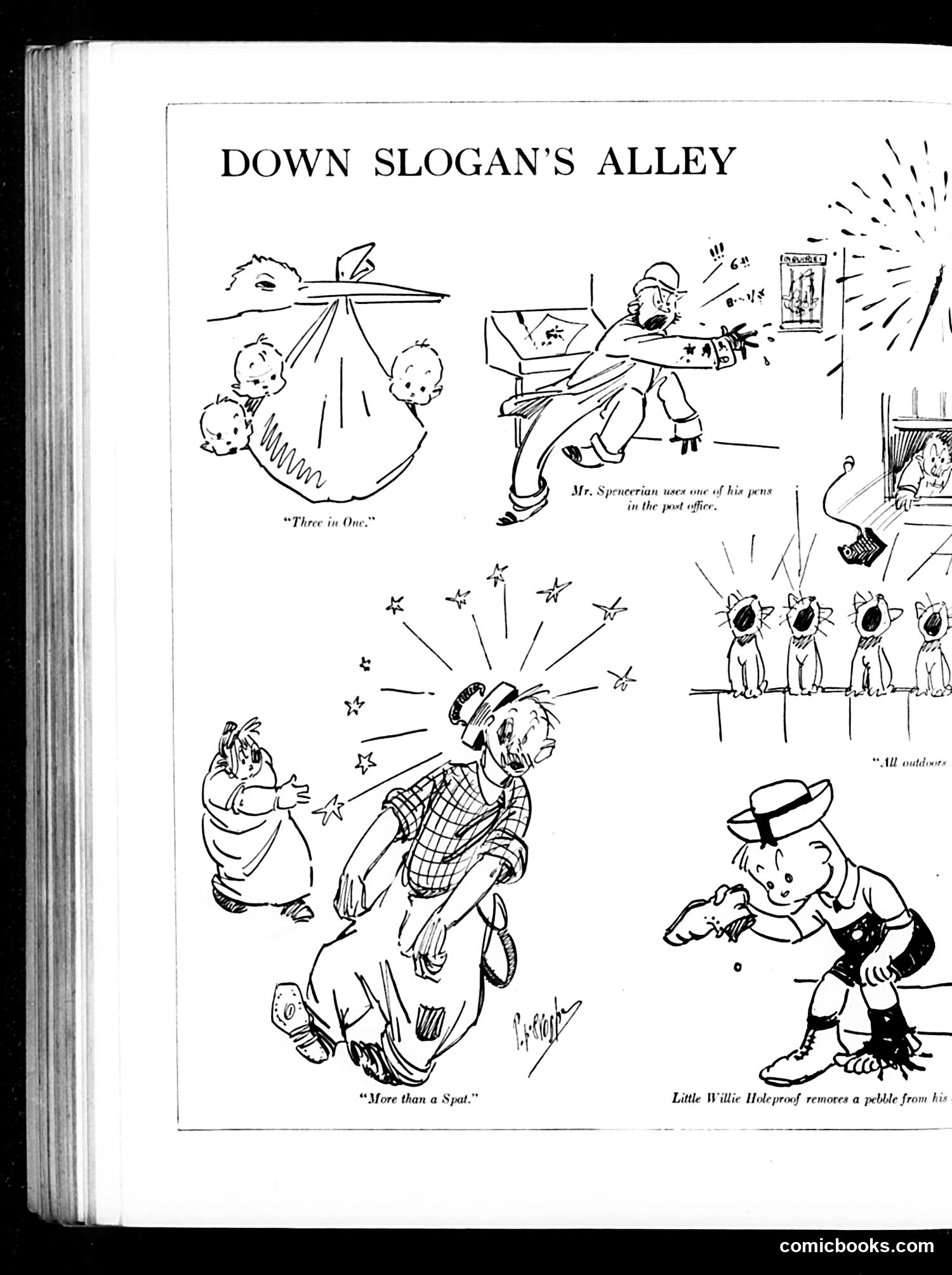
This page contains several cartoon vignettes satirizing everyday life and character types: **"Three in One"** depicts a stork delivering triplets—a commentary on large families, likely poking fun at the challenges of childrearing. **"More than a Spot"** shows a man surrounded by stars, suggesting he's been caught in mischief or scandal—"more than a spot" meaning his troubles are worse than a minor blemish. **"Mr. Spencerian uses one of his pens in the post office"** appears to reference a specific person's distinctive handwriting or penmanship. **"Little Willie Holeproof removes a pebble from his [shoe]"** (text cuts off) depicts a boy in action—likely a continuation of a recurring character's misadventures. The cartoons use exaggerated drawings and puns typical of early 20th-century Judge magazine humor, targeting domestic life and social pretension.
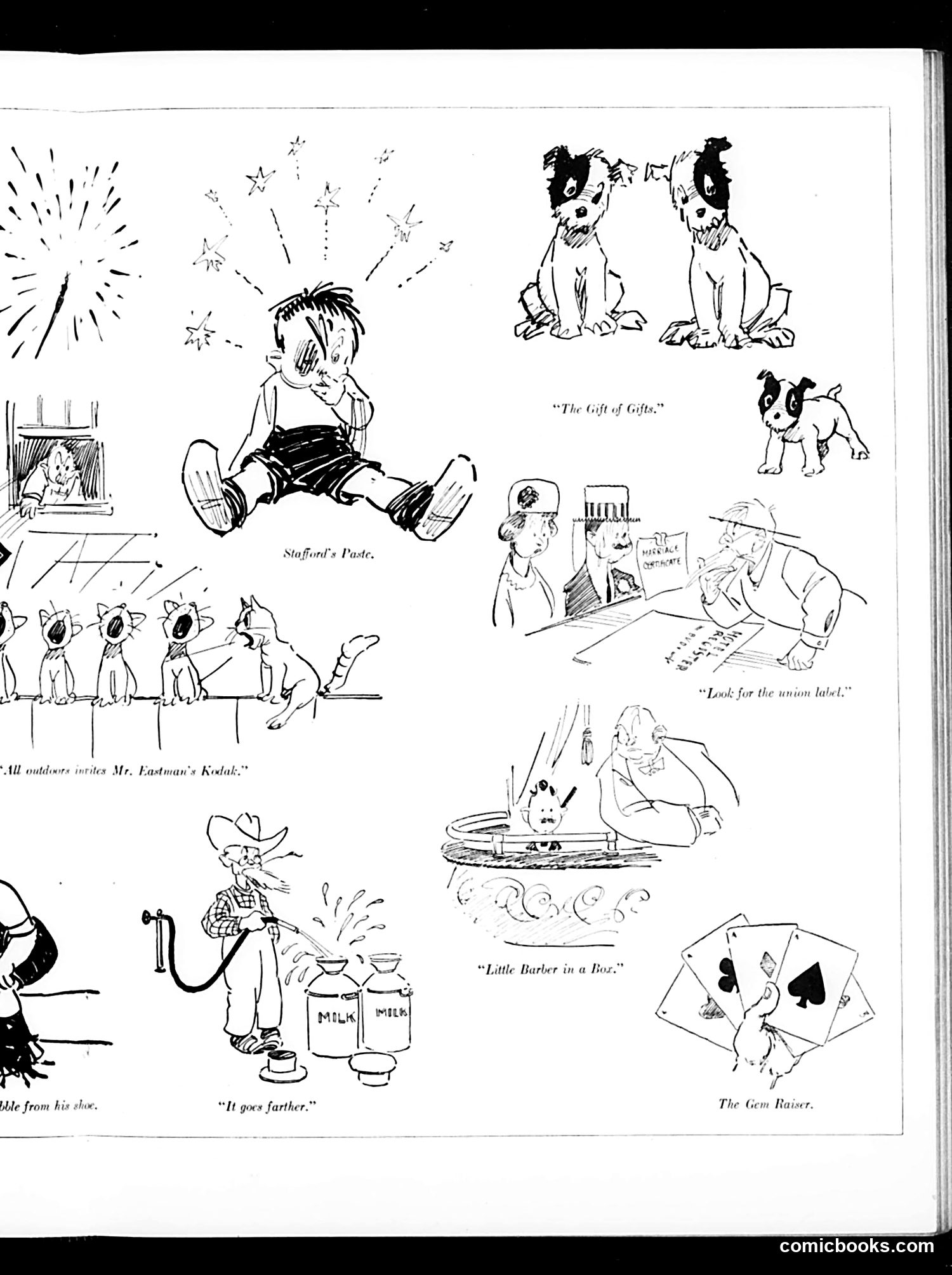
This page from *Judge* magazine contains several humorous cartoon vignettes with social commentary. The panels include: - "Stafford's Paste": A child overwhelmed by sparkling gifts - "The Gift of Gifts": Two dogs depicted as presents - "All outdoors invites Mr. Eastman's Kodak": Cats watching outdoor scenes, advertising Kodak cameras - "It goes farther": A cowboy milking cows, suggesting product efficiency - "Look for the union label": Appears to reference labor/union concerns - "Little Barber in a Box": A novelty item - "The Gem Raiser": Playing cards with humorous intent The page satirizes consumer products and gift-giving culture of the era, mixing advertising with social commentary. References to Kodak cameras and "union labels" suggest early 20th-century concerns about manufacturing and commercial products.
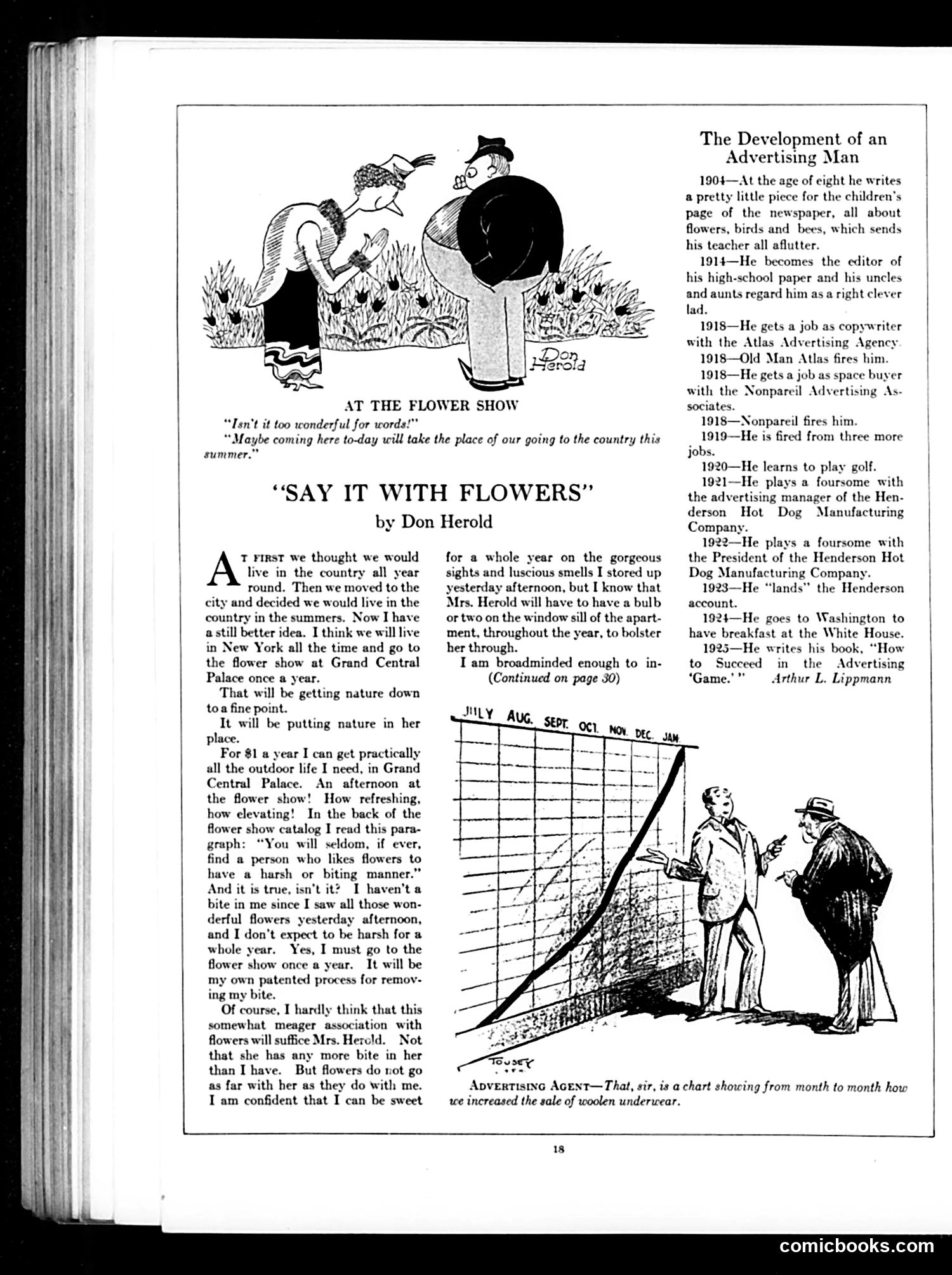
This Judge page contains two satirical pieces mocking urban middle-class life and advertising culture. **"Say It With Flowers"** (by Don Herold): A humorous essay satirizing city dwellers who abandon plans for country living in favor of visiting the Grand Central Palace flower show once yearly. Herold mocks the pretension of substituting one afternoon of artificial nature for genuine outdoor life, and jokes that flowers allegedly make people pleasant—implying flowers are a cheap emotional substitute. **"The Development of an Advertising Man"** (by Arthur L. Lippmann): A satirical timeline showing an advertising man's rise from childhood writing to eventual success. The joke lies in the absurdity: he's fired repeatedly in 1918-1919, then gains success simply by *playing golf* with business executives (1920-1923), culminating in a White House breakfast and a self-help book. The cartoon below shows him presenting inflated sales charts—satirizing how advertising creates impressive-looking but possibly meaningless metrics to justify its value. Both pieces mock 1920s American materialism, corporate culture, and the advertising industry's capacity for self-promotion.
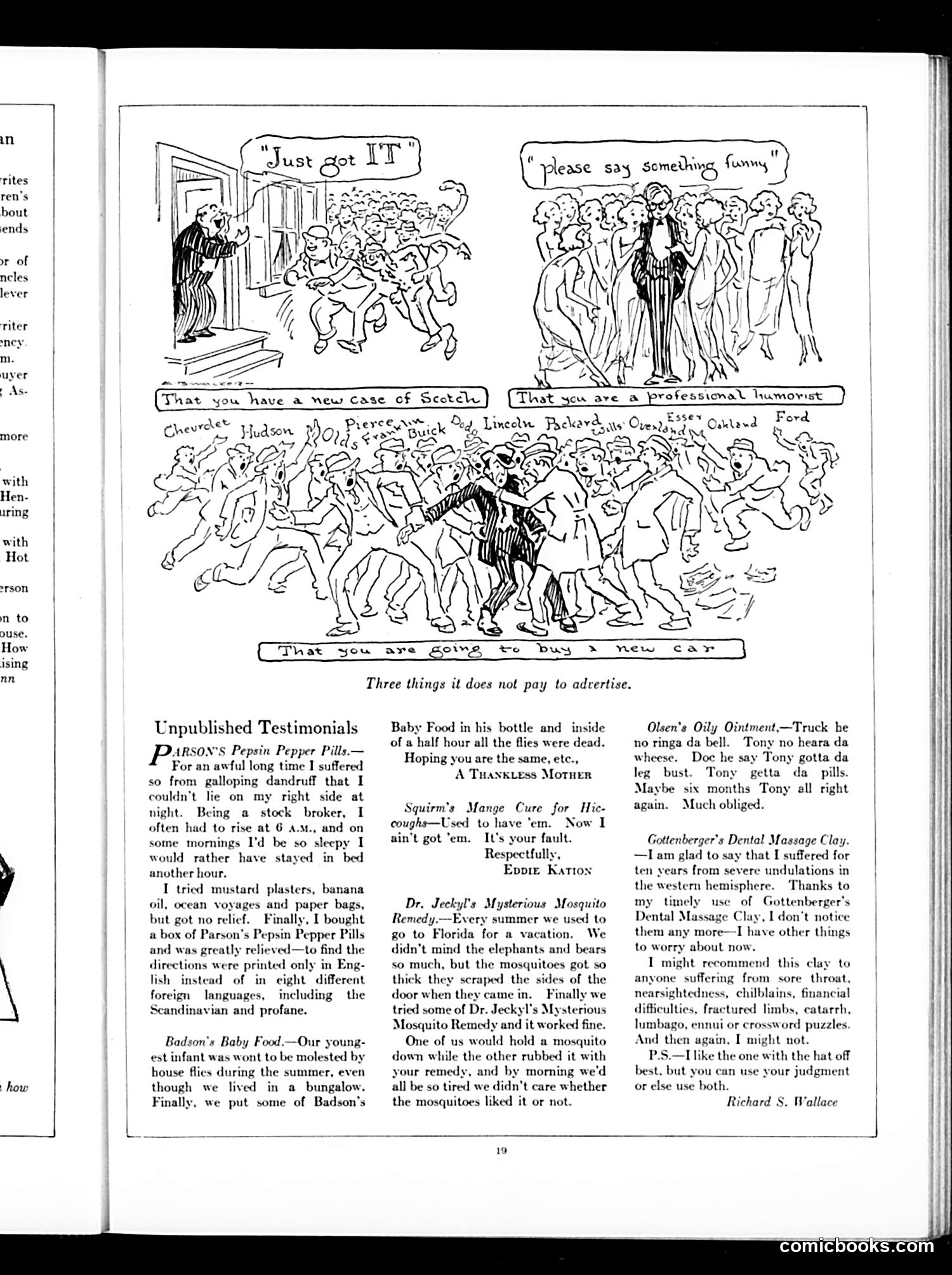
This Judge magazine page satirizes fraudulent patent medicine advertising through fake testimonials. The cartoons show the consequences of claiming false cures: crowds of desperate people mobbing someone who "just got IT" (presumably cured), then demanding he "say something funny" as a professional humorist, and finally swarming around him planning to "buy a new car"—implying they expect miraculous enrichment. The mock testimonials below parody the era's ubiquitous medical ads with absurd, contradictory claims: a dandruff cure that somehow affects sleep patterns; a baby food that kills flies; a hiccough remedy named "Squirm's Mange Cure." One testimonial humorously claims the product worked so well the user stopped noticing it helped. The headline's point: certain products—likely quack medicines and dubious cures—shouldn't be advertised because the false promises create impossible expectations and angry customers. This reflects Progressive Era consumer skepticism toward unregulated patent medicines.
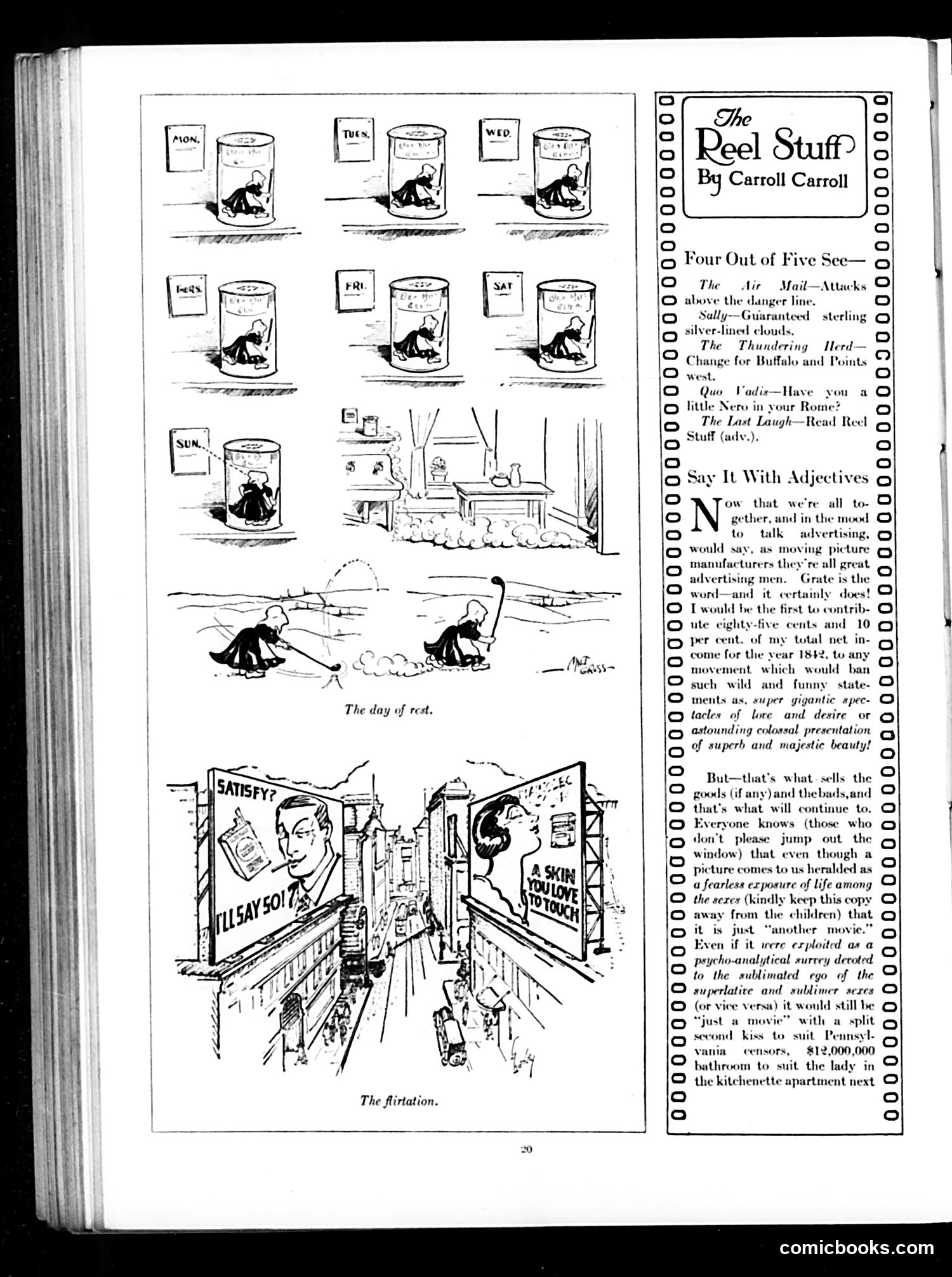
This satirical column mocks 1920s film advertising hyperbole. The top comics show a figure in a jar labeled with days of the week—likely depicting how moviegoers are trapped in repetitive cinema consumption. "Say It With Adjectives" criticizes how studios use grandiose language ("super gigantic spectacles," "astounding colossal presentation") to market ordinary films. Carroll notes everyone knows these pictures are just "another movie," despite elaborate marketing claiming deep artistic or psychological significance. The humor targets the disconnect between inflated promotional language and actual film content: studios promise fearless social exposures or sophisticated narratives, but deliver standardized products featuring expensive bathrooms and censored kisses to satisfy Pennsylvania's strict film standards. The bottom illustration ("The Flirtation") appears to show movie-theater advertising displays, reinforcing the column's focus on how cinema is sold rather than what it actually delivers.
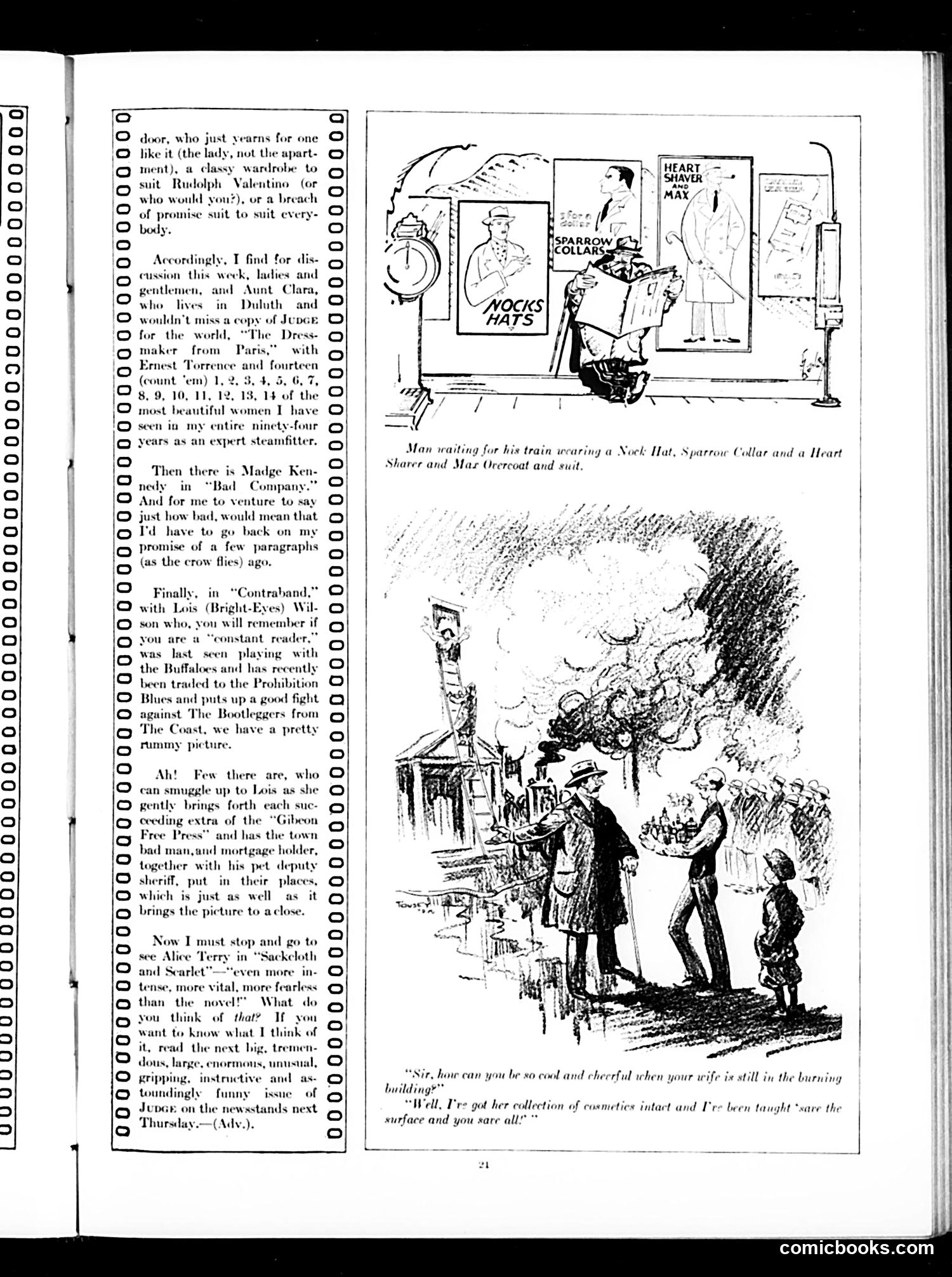
This page combines entertainment reviews with satirical cartoons about 1920s consumer culture and marriage. **Top cartoon**: A man waits for a train wearing fashionable clothing (Nick Hat, Sparrow Collar, Max overcoat). The joke satirizes male materialism and shallow priorities—he remains cheerful despite his wife being trapped in a burning building because he's preserved her cosmetics collection and learned to "save the surface," a likely reference to a beauty product advertisement. The humor targets both consumer culture obsession and marital indifference. **Left text**: A theater critic (likely the magazine's author) reviews current films: "The Dressmaker from Paris" (featuring Ernest Torrence and fourteen women), Madge Kennedy in "Bad Company," and "Contraband" with Lois Wilson. The critic emphasizes the films' visual spectacle and female performers rather than plot substance. The page essentially mocks 1920s priorities: commercial entertainment, beauty product consumerism, and material comfort over genuine human concern.
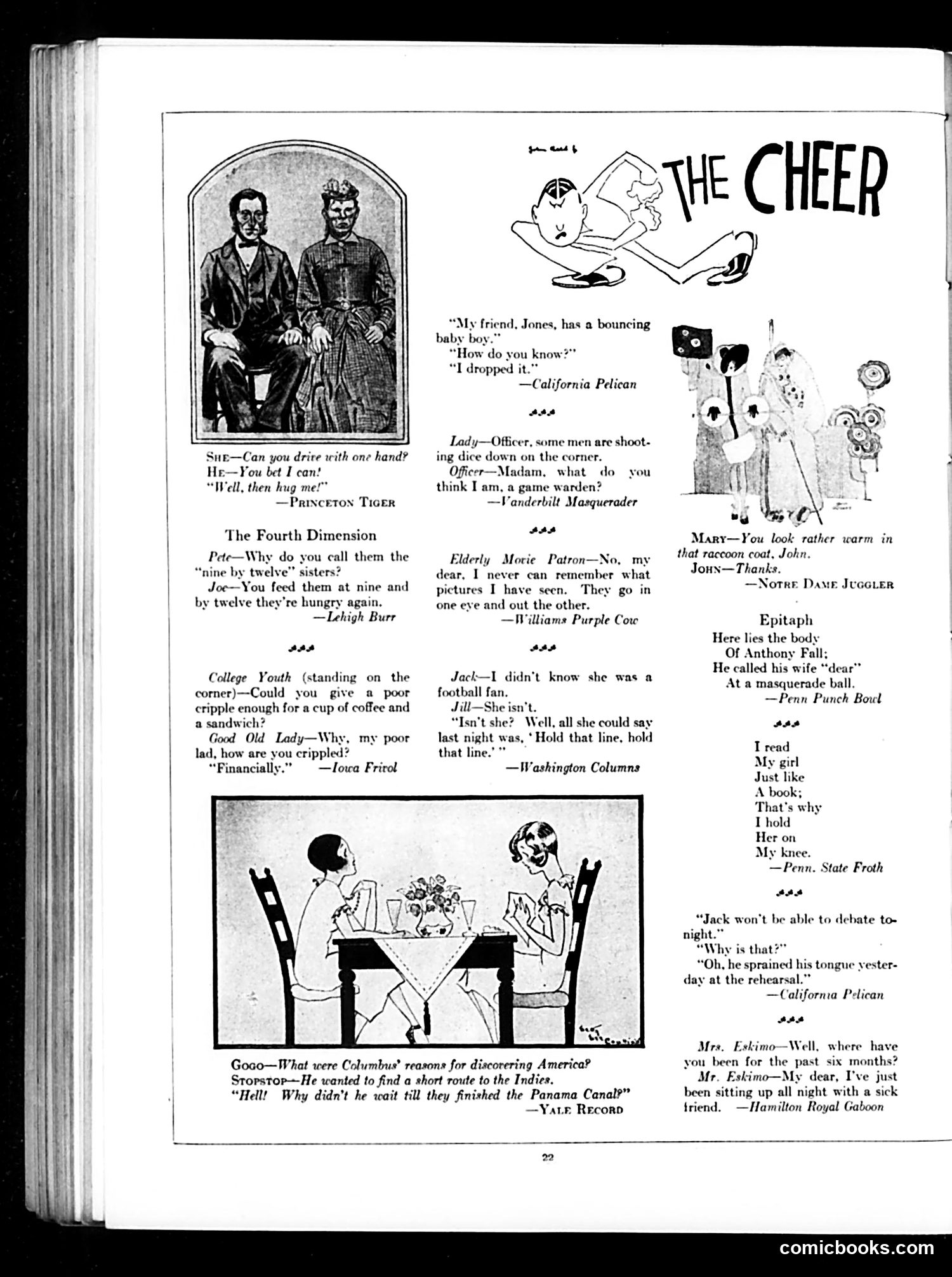
This is a humor page collecting jokes and quips from college newspapers and humor magazines of the era (likely 1910s-1920s based on style). Rather than political satire, it's social comedy targeting college youth and modern life. The jokes mock: - **Dating/romance awkwardness** (the "hug me" exchange, reading girlfriends "like books") - **Economic hardship** ("crippled financially") - **Absent-minded behavior** (the movie patron who forgets what he's seen) - **Misunderstandings** (the woman shouting "hold that line" at a football game, unaware it's sports terminology) - **Modern conveniences** (the Panama Canal joke—why discover America early if you could wait for easier passage?) The cartoon illustration shows a couple dining, with one person facing away, fitting the flirtation/dating theme. The "Epitaph" warns husbands against calling wives "dear" at social events—implying infidelity or indiscretion. The Eskimo joke's punchline is unclear without more context. These are gentle, college-focused humor pieces rather than biting satire.
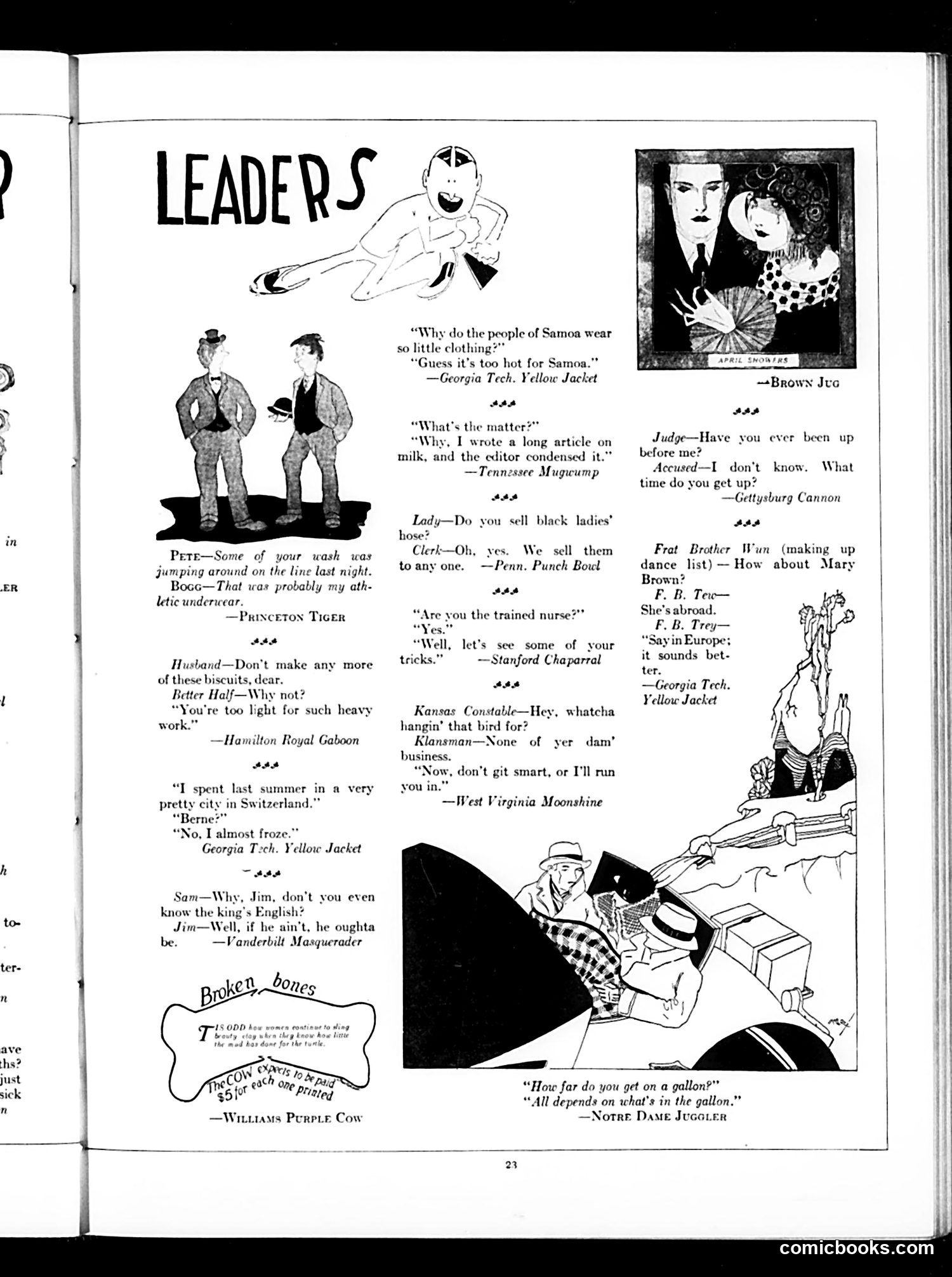
This page collects brief jokes and witticisms from college humor magazines, organized under the heading "Leaders." The content reflects early 20th-century collegiate humor targeting common social situations: mishearing, domestic disputes, misunderstandings about colonial peoples, and wordplay. Notable elements include a joke about a Klansman that presents the KKK member as subject to law enforcement—suggesting the constable represents legitimate authority asserting control over the Klansman's activities. A "milk condensing" joke plays on editorial brevity. Several jokes rely on racist stereotypes about Samoa and references to "black ladies' hose" (hosiery). The illustrations include a couple in formal dress (top right) captioned "Brown Jug," and a bottom cartoon about fuel economy with innuendo about alcohol ("what's in the gallon"). The page primarily showcases collegiate wit rather than explicit political commentary, though the Klan reference reflects contemporary anxieties about vigilante violence during Prohibition.
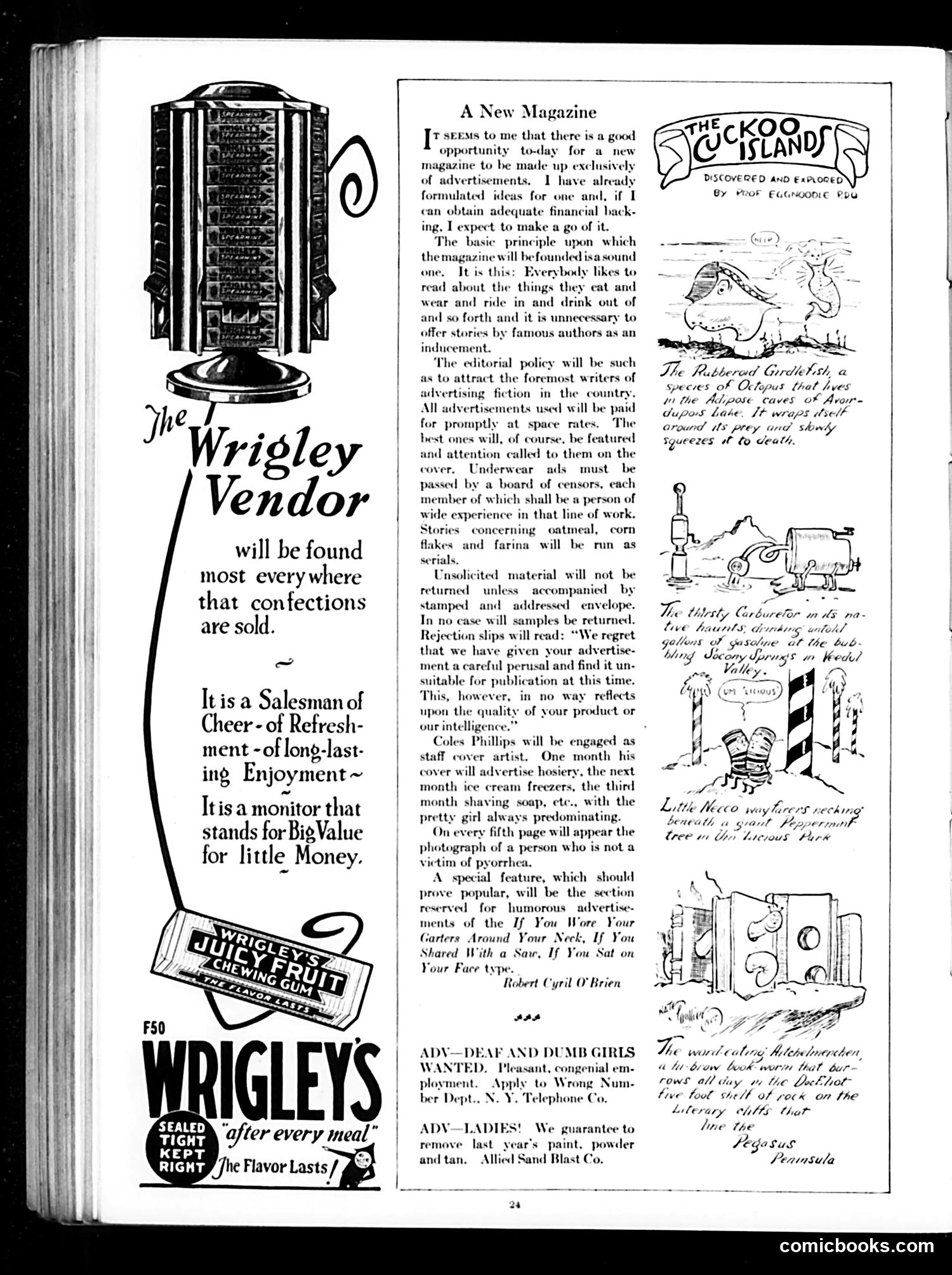
This page combines advertising with editorial satire. The left side features a **Wrigley's gum advertisement** depicting their vending machine as a cheerful salesman bringing refreshment and value. The right side presents **"A New Magazine"** — a humorous editorial proposal by Robert Cyril O'Brien suggesting a publication made *entirely of advertisements*. This is satirical commentary on American consumer culture and advertising's growing prominence in the 1920s. O'Brien facetiously argues that readers prefer ads about products they consume over literary fiction, and proposes absurd editorial policies: censoring underwear ads, running oatmeal stories as serials, and rejecting samples. Below this are **"The Cuckoo Island"** cartoons — whimsical illustrated creatures with nonsensical descriptions (the "Pabberoid Girdlefish," "thirsty Curburelor," etc.), appearing to be Judge's typical decorative satirical humor. The page also includes help-wanted ads, reflecting period employment notices. Overall, this reflects **1920s magazine culture** where advertisements were becoming dominant commercial content, which O'Brien mocks by proposing the logical extreme.
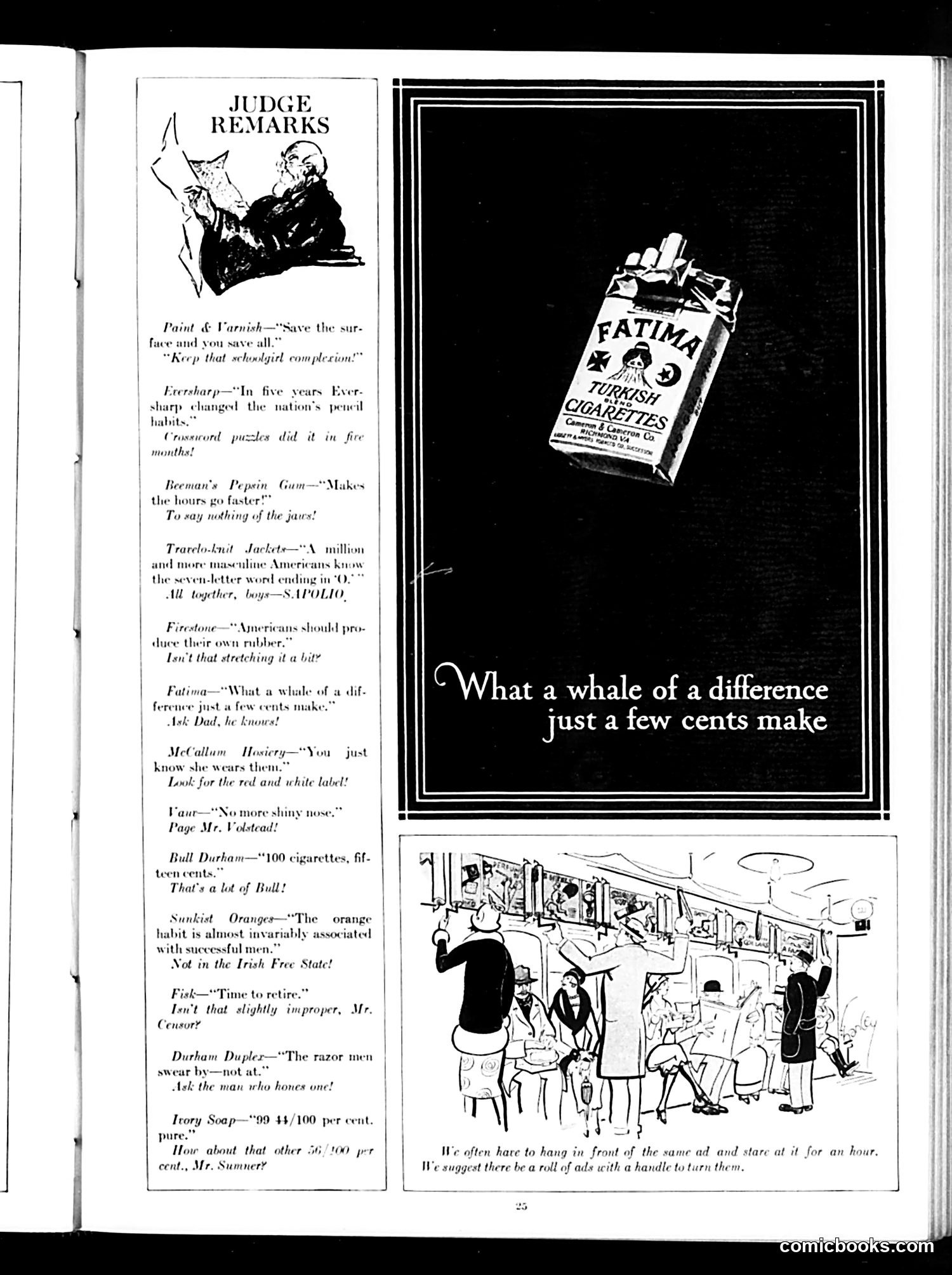
This page from **Judge** satirical magazine contains two distinct sections: **Left side - "Judge Remarks":** A column of brief satirical quips about popular consumer products and their advertising claims. References include Eversharp pencils, Sapolio soap, Fatima cigarettes, Bull Durham tobacco, Sunkist oranges, and Ivory Soap. The jokes mock exaggerated advertising claims—for example, claiming Eversharp pencils changed "the nation's pencil habits" in five years, or that Ivory Soap is "99 44/100 per cent. pure" (sarcastically questioning what the remaining fraction is). **Right side - Advertisement and cartoon:** Features a Fatima cigarettes ad with the slogan "What a whale of a difference just a few cents make," followed by a cartoon showing people crammed in what appears to be a streetcar or public vehicle, unable to escape repetitive advertisements. The caption suggests ads should have "a roll...with a handle to turn them"—mocking the inescapability of advertising in public spaces. **Overall point:** Satirizing both exaggerated product advertising and advertising saturation in American consumer culture.
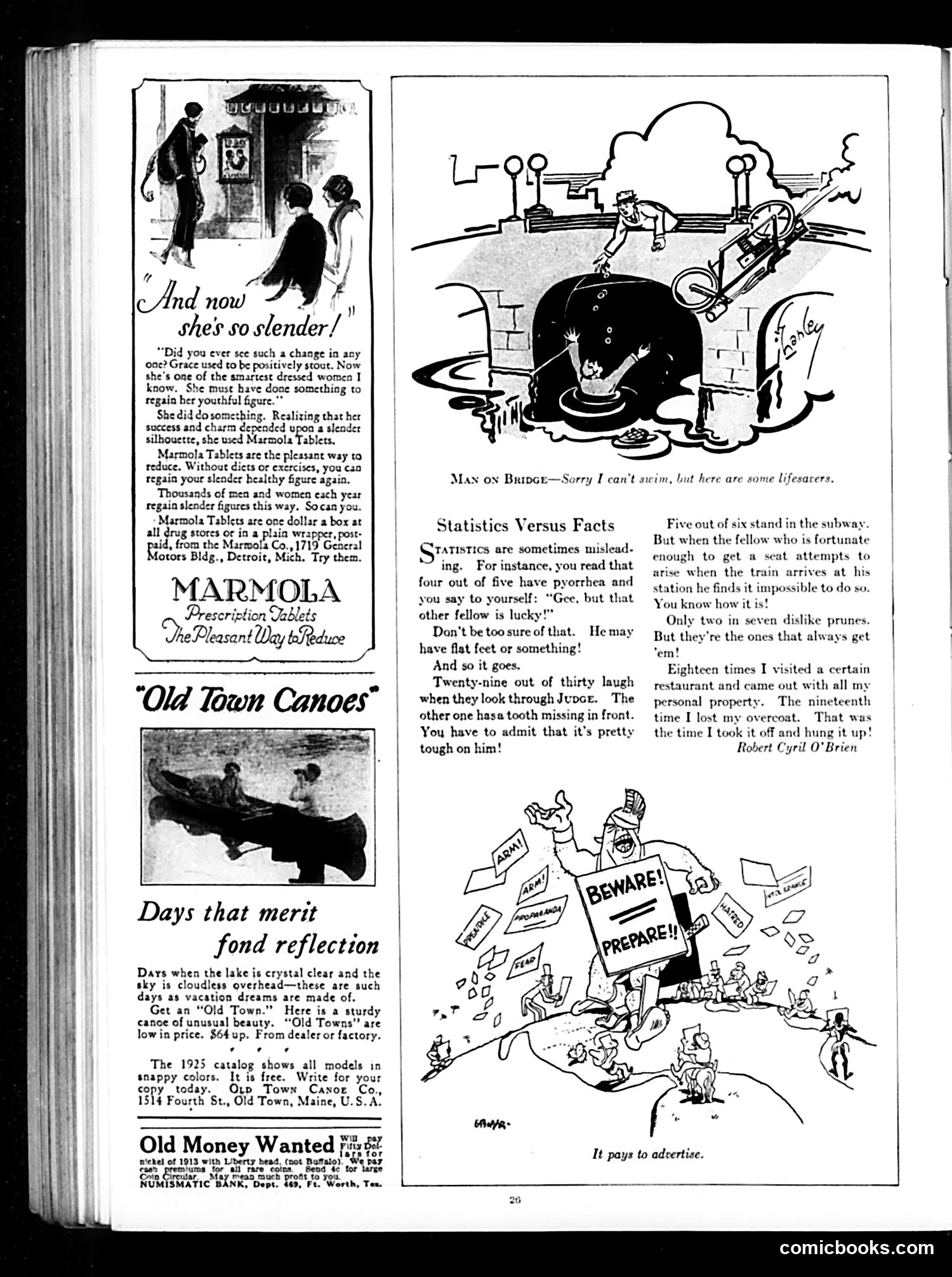
This page mixes advertisements with satirical content. The top-left features a **Marmola Tablets ad** promoting weight-loss pills to women, playing on 1920s beauty standards that prized slenderness. The ad uses social pressure ("the smartest dressed women") to market the product. The main cartoon, "Man on Bridge," uses absurdist humor about statistics. It illustrates how misleading numerical claims can be—if "four out of five" have a dental problem, the fifth person might have different problems entirely. The cartoon mocks advertising's tendency to cherry-pick statistics to seem convincing while ignoring individual variation. The accompanying essay elaborates this theme through anecdotes (people missing trains, disliking prunes, losing overcoats), reinforcing that statistics obscure messy reality. The page also includes period ads for **Old Town Canoes** and **rare coins**, typical of 1920s magazine content. The satire targets both advertising's misleading claims and readers' gullibility toward statistical "proof."
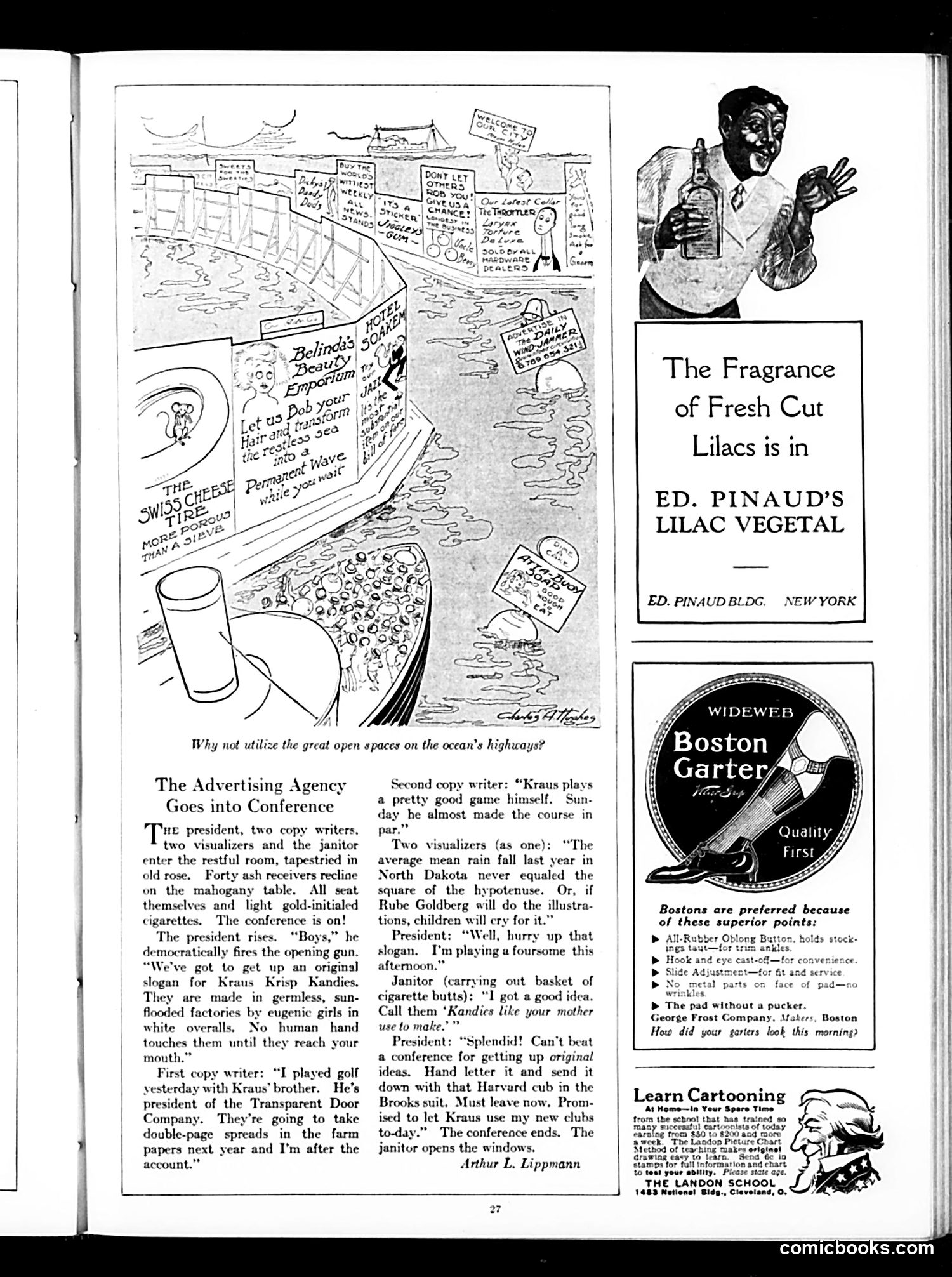
This cartoon satirizes early-20th-century advertising culture and corporate decision-making. A company president and his creative team—two copywriters, two visualizers, and a janitor—meet to develop a slogan for "Kraus Krisp Kandies." The satire targets how advertising agencies actually *work*: the executives spend the conference discussing golf games and personal connections rather than brainstorming. The janitor, sitting silently throughout, produces the only genuinely useful idea ("Kandies like your mother use to make"), which the president immediately adopts and claims credit for. The joke exposes that real advertising success comes from luck and clichéd sentimentality rather than the pretentious "creative process" the agency performs. The visualizers' absurdist comment about North Dakota rainfall "equaling the hypotenuse" mocks pseudo-intellectual corporate jargon used to mask lack of actual ideas.
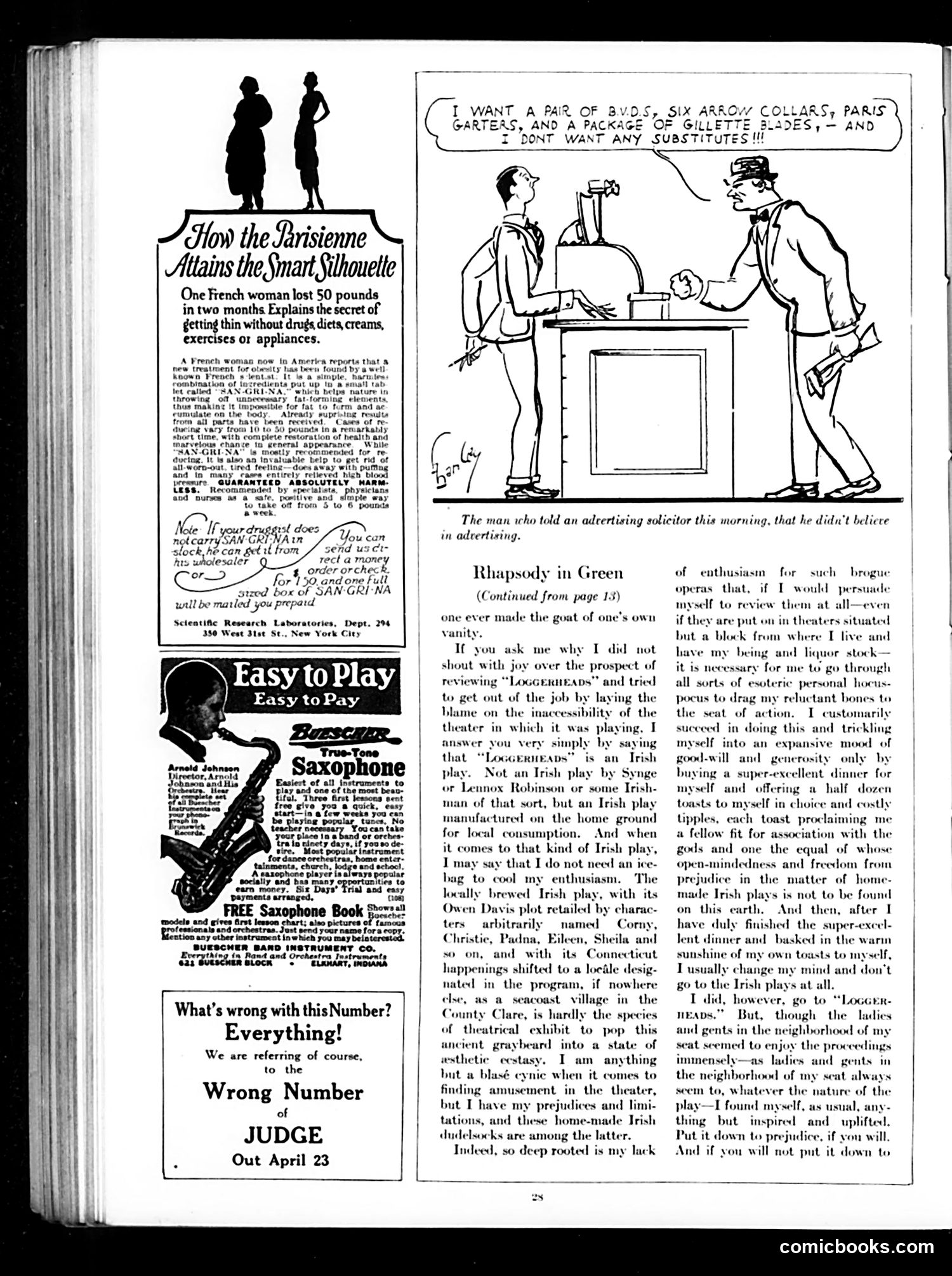
This Judge magazine page contains several distinct elements: **Top cartoon**: A man at a store counter demands specific products—"BVD's, six arrow collars, Paris garters, and Gillette blades"—insisting "I don't want any substitutes!" The caption reveals he's the same man who told an advertising solicitor that morning he "didn't believe in advertising." The joke satirizes consumer hypocrisy: people claim to reject advertising while demanding brand-name products, proving advertising has conditioned them. **Advertisements**: Include weight-loss product "San-Grina," a Buescher saxophone, and promotion for the film "Wrong Number" (releasing April 23). **Article "Rhapsody in Green"**: A theater critic complains about locally-produced Irish plays, dismissing them as predictable formula entertainment despite their popularity, while admitting he bribes himself with expensive dinners to attend them. The page overall satirizes consumer behavior, advertising effectiveness, and cultural pretension.
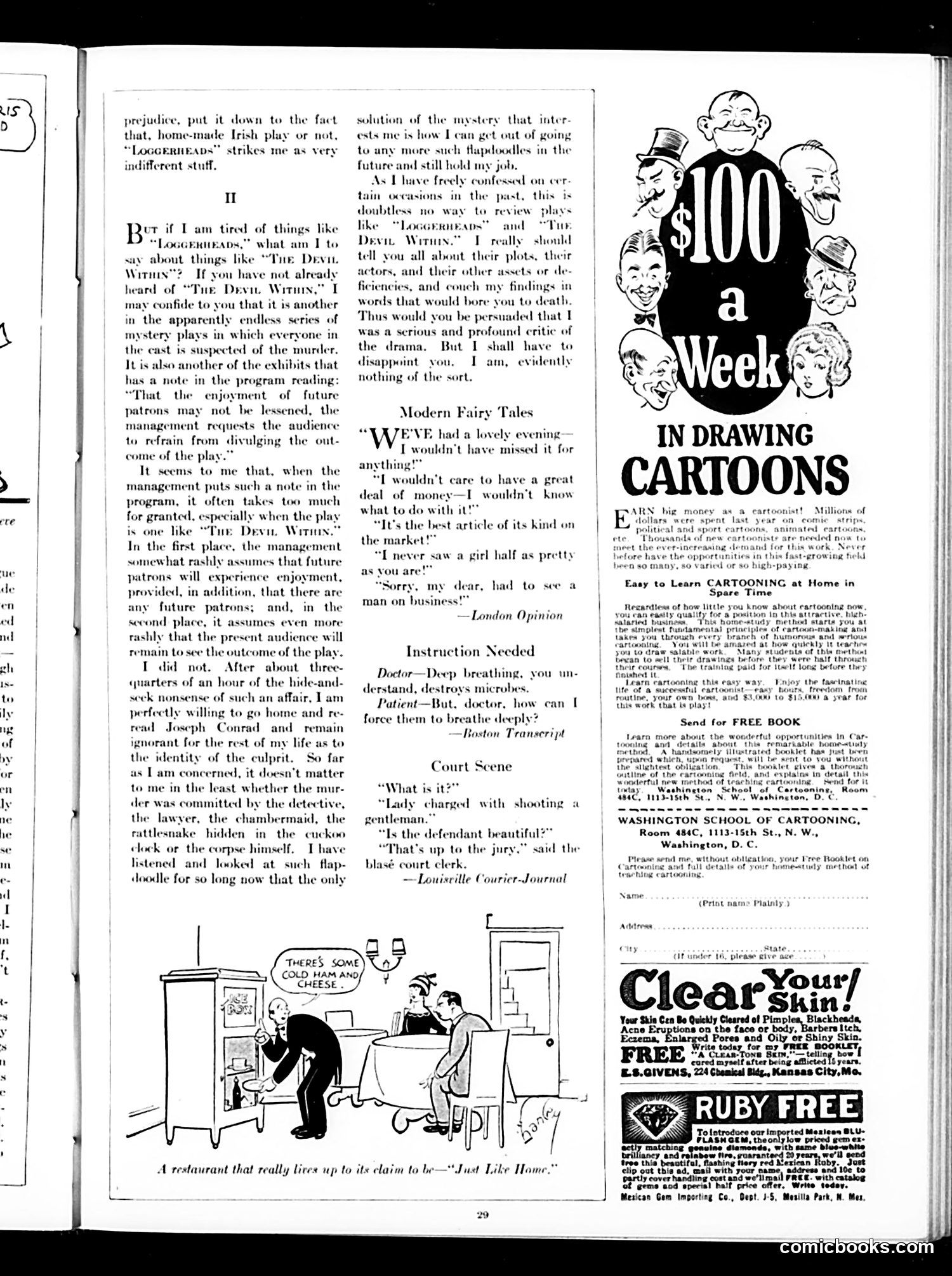
This page from Judge magazine contains theater criticism and advertisements rather than political cartoons. The main editorial content critiques contemporary Broadway mystery plays, particularly "Logerheads" and "The Devil Within." The critic dismisses these productions as tedious "whodunits" where everyone suspects everyone else of murder. He sarcastically notes that management's program warning against spoilers assumes audiences will actually stay to learn the culprit's identity—which he clearly did not. The cartoon at bottom shows a restaurant scene where a waiter mentions "cold ham and cheese," satirizing establishments claiming to be "Just Like Home"—a contemporary advertising cliché. The page also features advertisements for cartooning correspondence courses and skin-care products, typical of 1920s magazine content. The satire targets both predictable theatrical formulas and false advertising claims of the era, rather than political figures or events.
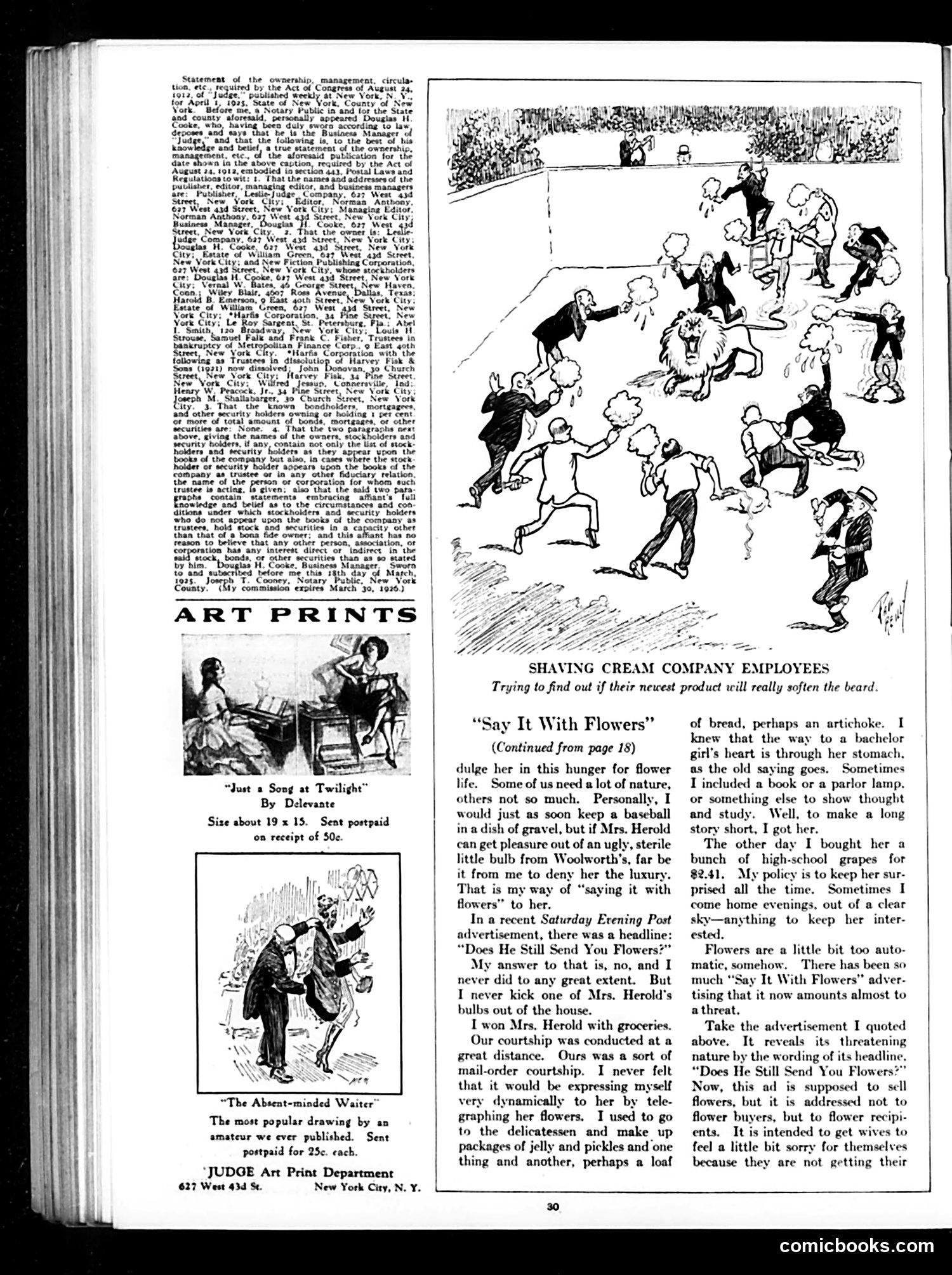
This page mixes legal/administrative content with humorous illustrations and a domestic humor column. **Main cartoon "Shaving Cream Company Employees"**: Shows workers engaged in slapstick chaos—falling, slipping, fighting—with the caption "Trying to find out if their newest product will really soften the beard." This satirizes exaggerated advertising claims common in the 1920s, suggesting the product doesn't work as promised and employees are literally testing it through physical comedy. **Art Prints section**: Advertises two drawings—"Just a Song at Twilight" and "The Absent-minded Waiter"—reflecting Judge's practice of selling popular illustrations as affordable prints. **"Say It With Flowers" column**: A domestic humor piece about gift-giving in courtship. The author critiques the advertising slogan "Say It With Flowers" (a real 1920s campaign), noting he won his wife with groceries instead. It gently mocks both flower-giving as romantic gesture and mail-order courtship conventions of the era. The page reflects 1920s consumer culture, advertising satire, and domestic comedy themes typical of Judge magazine.
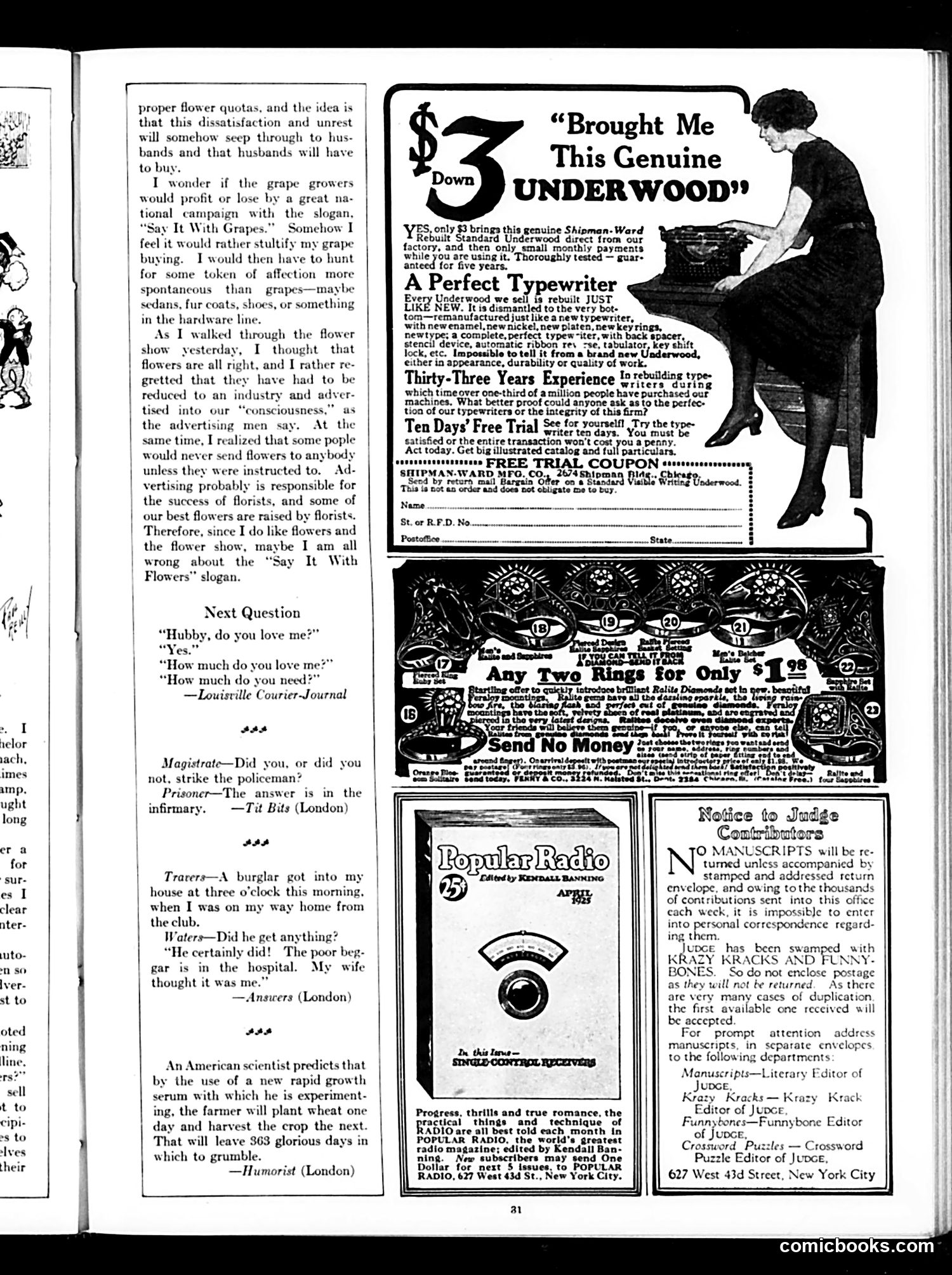
This page is primarily **advertising and editorial content**, not political cartooning. The main advertisement promotes a **rebuilt Underwood typewriter** for $3 down, marketed as "just like new" after complete factory remanufacturing. It emphasizes the company's 33-year history rebuilding machines and offers a 10-day free trial—typical early 20th-century sales tactics. Below that are several brief **humorous anecdotes** reprinted from other publications (Louisville Courier-Journal, Tit Bits, Answers magazines). These joke columns touch on marital affection, police encounters, and burglary—standard period humor with no political content. The page also contains advertisements for **rings and a radio**, plus editorial notices about manuscript submissions to Judge. The accompanying illustration of a woman at a typewriter is **product advertising imagery**, not satire. There are no political cartoons or caricatures visible on this page—it represents the advertising-heavy format typical of early 20th-century magazines.
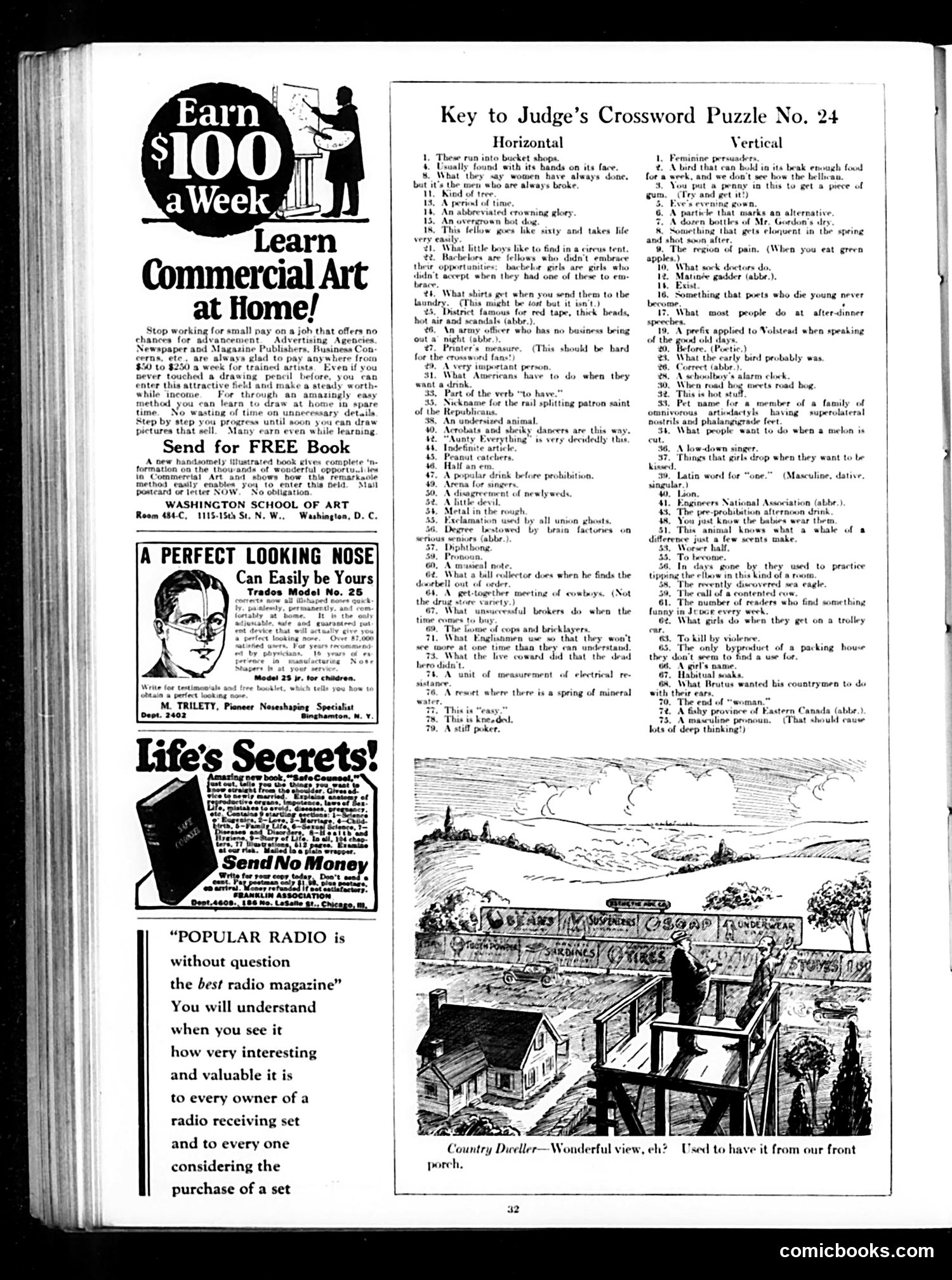
This is primarily a **commercial advertising and puzzle page**, not a political cartoon. The dominant content includes: **Main Features:** - Advertisement for the Washington School of Art's correspondence course in commercial art ("Earn $100 a Week") - A nose-reshaping advertisement (M. Trilety's cosmetic service) - A "Life's Secrets" book advertisement - Popular Radio magazine advertisement - **Key to Judge's Crossword Puzzle No. 24** with clues and answers - An illustration of a "Country Dweller" at bottom **Historical Context for Modern Readers:** The ads reflect 1920s-era concerns: correspondence art courses promised economic mobility; nose-reshaping services reflected ethnic anxieties about assimilation; radio was still novel consumer technology. The crossword clue references ("Volstead," Prohibition era humor) date this definitively to the 1920s-early 1930s. The page lacks political satire or caricature—it's routine magazine filler content focused on monetizing reader interest through advertisements and puzzles.
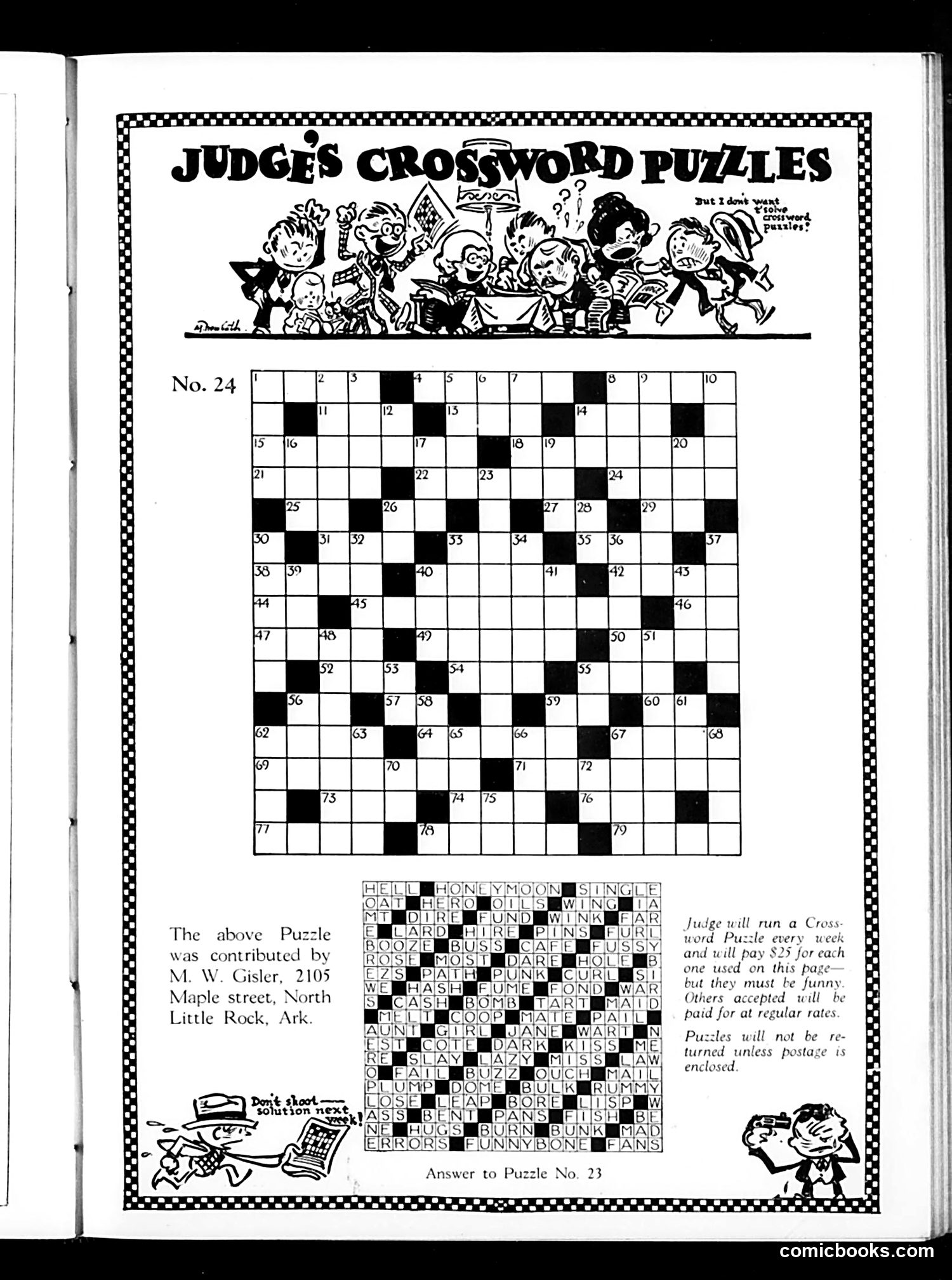
This page presents **Puzzle No. 24**, a standard crossword puzzle submitted by a contributor from Arkansas. The cartoon header features playful characters around a cauldron, establishing a whimsical tone. The significant content is the **announcement** that Judge magazine will now publish crossword puzzles weekly, paying $25 for accepted funny puzzles and lesser rates for others. This reflects the **1920s-30s crossword craze**, when these puzzles became a national phenomenon and major competitive draw for publications. The page also shows the **answer key to Puzzle No. 23**, demonstrating Judge's format of running these as recurring features. The note about requiring postage for returns suggests a high submission volume. This represents how American magazines competed for readers by offering reader-submitted content and prizes—an early form of audience engagement that made crosswords both entertainment and participatory experience.
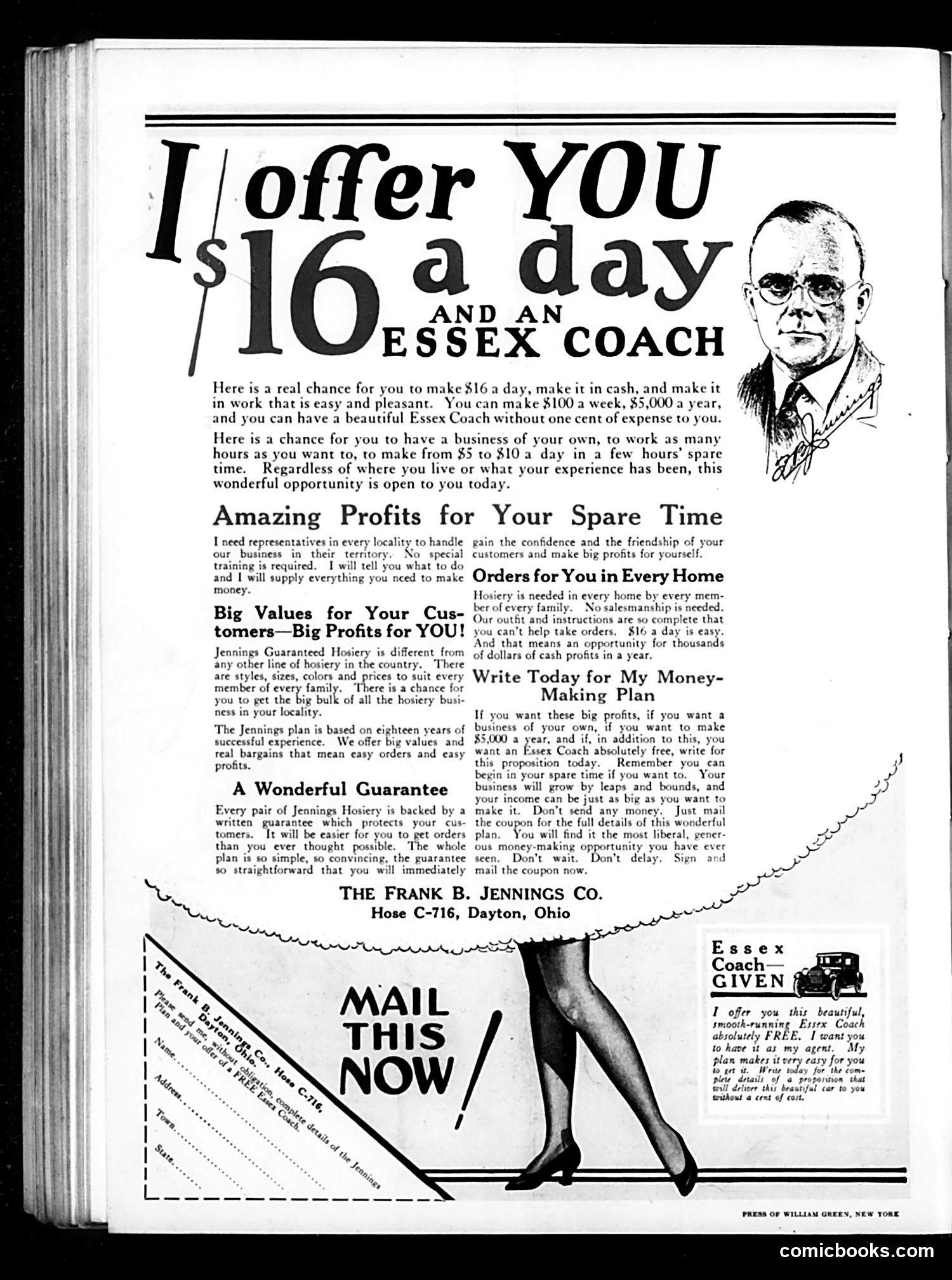
This page is **primarily an advertisement**, not political satire. It promotes two overlapping get-rich-quick schemes from early 20th-century America: 1. **The Frank B. Jennings Co.** offers hosiery sales representatives the chance to earn $16 daily ($5,000 yearly) selling guaranteed stockings door-to-door. 2. **The Essex Coach giveaway** sweetens the deal: successful hosiery agents receive a free Essex automobile (a popular mid-range car of the 1920s-30s). The pitch targets Depression-era or working-class readers with promises of easy spare-time income, no special training required, and a valuable automobile "without one cent of expense." The attractive illustration of women's legs and the automobile imagery appeal to consumer desires. Judge likely ran such advertisements for revenue. Today, this exemplifies predatory direct-mail marketing tactics that exploit economic desperation—a practice still recognizable in modern spam and MLM schemes.