
Judge, 1925-04-11 · page 17 of 36
Judge — April 11, 1925 — page 17: what you’re looking at
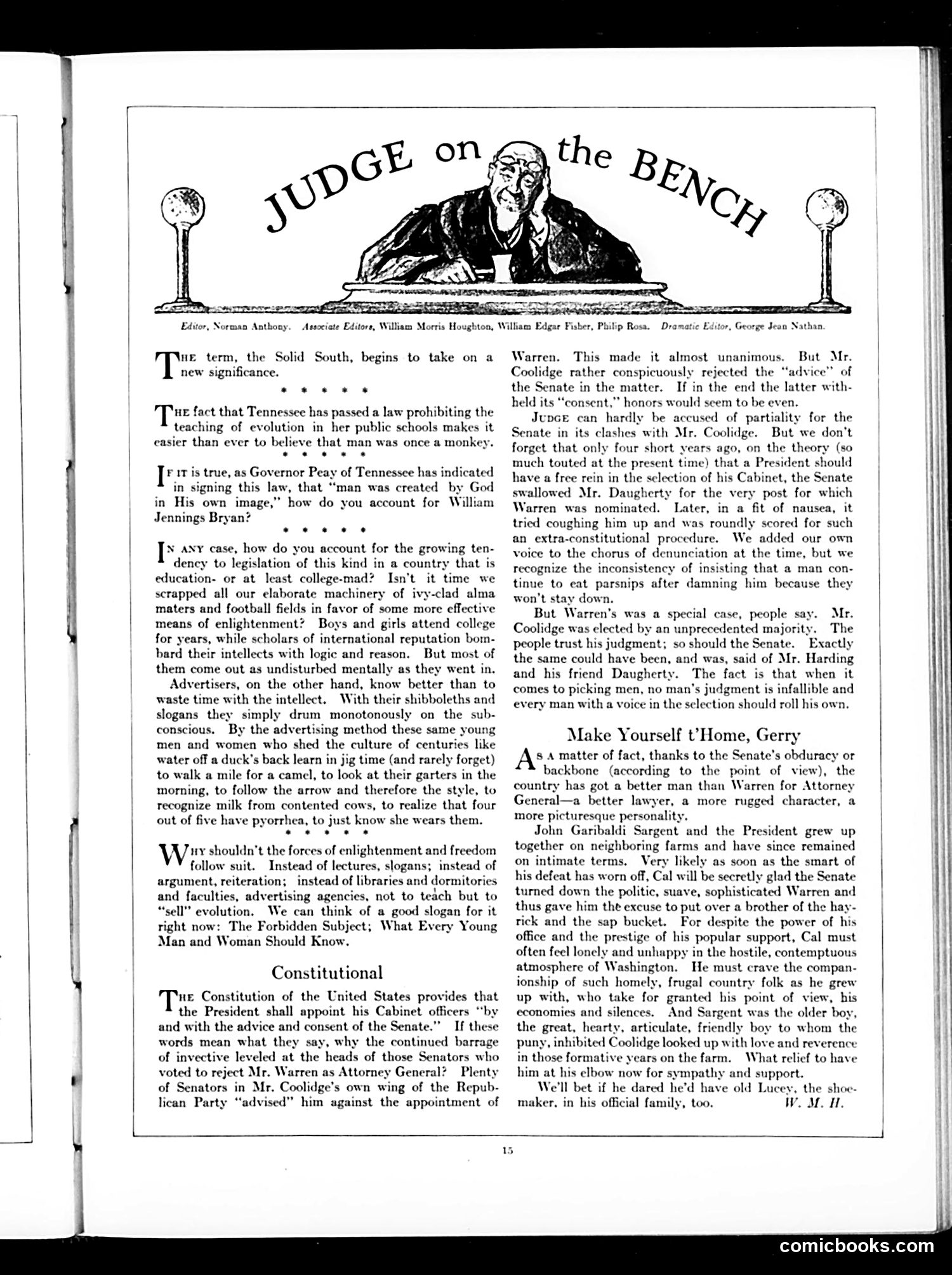
What you’re looking at
This page critiques President Coolidge's handling of Charles Evans Warren's rejected nomination as Attorney General. The cartoon shows a stern judge presiding over the constitutional dispute. **The Political Issue**: Coolidge ignored Senate advice against Warren's appointment, then the Senate withheld consent—creating a constitutional standoff. The article argues both branches acted within their rights, though it notes the hypocrisy: four years earlier, the same Senate had meekly accepted Harry Daugherty as Attorney General under Harding, then later regretted it. **The Satire**: Judge mocks the "unprecedented majority" argument—that Coolidge's electoral victory granted him unchecked Cabinet power. The piece points out this identical claim justified Harding's equally questionable appointment, suggesting no president's popularity should override constitutional checks. The opening section sardonically critiques Tennessee's evolution ban and compares evolution to advertising's effectiveness at persuading the public mind.
📄 Transcribed text from this page (OCR, searchable)
Machine-transcribed from the original scan — historical spelling and the odd misread are preserved.
—_$———— —— HE term, the Solid South, begins to take on a new significance. ee ee es T fact that Tennessee has passed a law prohibiting the teaching of evolution in her public schools makes it easier than ever to believe that man was once a monkey. oe eee F 1T is true, as Governor Peay of Tennessee has indicated in signing this law, that “man was created by God in His own image,” how do you account for William Jennings Bryan? I ‘ ANY case, how do you account for the growing ten- dency to legislation of this kind in a country that is education- or at least college-mad? Isn't it time we scrapped all our elaborate machinery of ivy-clad alma maters and football fields in favor of some more effective means of enlightenment? Boys and girls attend college for years, while scholars of international reputation bom- bard their intellects with logic and reason. But most of them come out as undisturbed mentally as they went in. Advertisers, on the other hand, know better than to waste time with the intellect. With their shibboleths and slogans they simply drum monotonously on the sub- conscious. By the advertising method these same young men and women who shed the culture of centuries like water off a duck’s back learn in jig time (and rarely forget) to walk a mile for a camel, to look at their garters in the morning, to follow the arrow and therefore the style, to recognize milk from contented cows, to realize that four out of five have pyorrhea, to just know she wears them. oe eee eee ee V uy shouldn't the forces of enlightenment and freedom follow suit. Instead of lectures, slogans; instead of argument, reiteration; instead of libraries and dormitories and faculties, advertising agencies, not to teach but to “sell” evolution. We can think of a good slogan for it right now: The Forbidden Subject; What Every Young Man and Woman Should Know. Constitutional ne Constitution of the United States provides that the President shall appoint his Cabinet officers “by and with the advice and consent of the Senate.” If these words mean what they say, why the continued barrage of invective leveled at the heads of those Senators who voted to reject Mr. Warren as Attorney General? Plenty of Senators in Mr. Coolidge’s own wing of the Repub- lican Party “advised” him against the appointment of Warren. This made it almost unanimous. Coolidge rather conspicuously rejected the “advice” of the Senate in the matter. If in the end the latter with- held its “consent,” honors would seem to be even. Juvce can hardly be accused of partiality for the Senate in its clashes with Mr. Coolidge. But we don't forget that only four short years ago, on the theory (so much touted at the present time) that a President should have a free rein in the selection of his Cabinet, the Senate swallowed Mr. Daugherty for the very post for which Warren was nominated. Later, in a fit of nausea, it tried coughing him up and was roundly scored for such an extra-constitutional procedure. We added our own voice to the chorus of denunciation at the time, but we recognize the inconsistency of insisting that a man con- tinue to eat parsnips after damning him because they won't stay down. But Warren's was a special case, people say. Mr. Coolidge was elected by an unprecedented majority. The people trust his judgment; so should the Senate. Exactly the same could have been, and was, said of Mr. Harding and his friend Daugherty. The fact is that when it comes to picking men, no man’s judgment is infallible and every man with a voice in the selection should roll his own. But Mr. Make Yourself t’Home, Gerry s A matter of fact, thanks to the Senate’s obduracy or backbone (according to the point of view), the country has got a better man than Warren for Attorney General—a better lawyer, a more rugged character, a more picturesque personality. John Garibaldi Sargent and the President grew up together on neighboring farms and have since remained on intimate terms. Very likely as soon as the smart of his defeat has worn off, Cal will be secretly glad the Senate turned down the politic, suave, sophisticated Warren and thus gave him the excuse to put over a brother of the hay- rick and the sap bucket. For despite the power of his office and the prestige of his popular support, Cal must often feel lonely and unhappy in the hostile, contemptuous atmosphere of Washington. He must crave the compan- ionship of such homely, frugal country folk as he grew up with, who take for granted his point of view, his economies and silenc nd Sargent was the older boy, the great, hearty, articulate, friendly boy to whom the puny, inhibited Coolidge looked up with love and reverence in those formative years on the farm. What relief to have him at his elbow now for sympathy and support. We'll bet if he dared he'd have old Lucey, the shoe- maker, in his official family, too. W. MH. comicbooks.com