
A complete issue · 36 pages · 1925
Judge — March 28, 1925
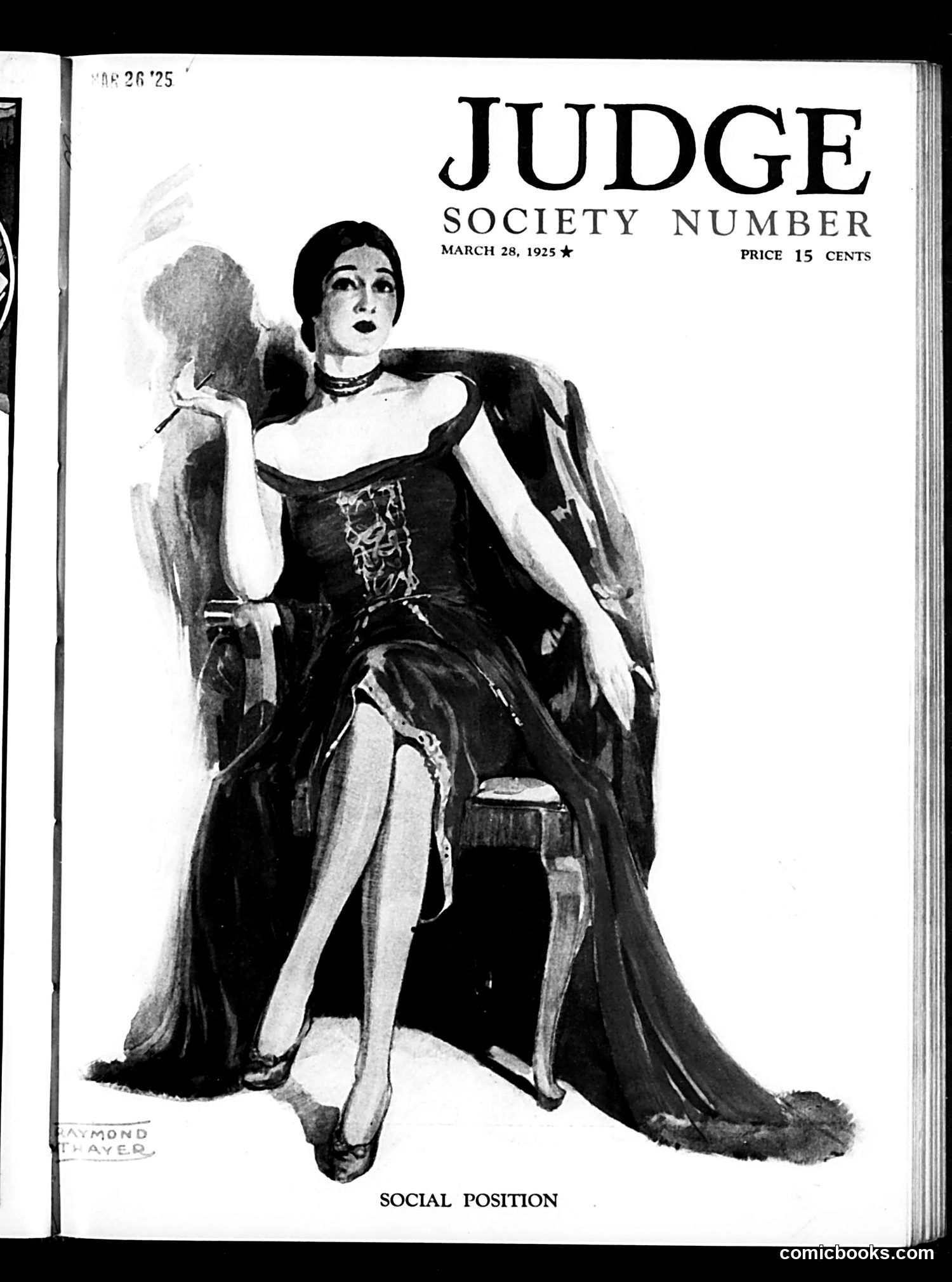
This cover illustration satirizes wealth and social climbing in 1920s America. The drawing depicts a fashionably dressed woman in an elegant black gown with fur stole, seated confidently while smoking. The title "Social Position" suggests the satire targets how material displays—expensive clothing, accessories, and affected poses—were used to establish or claim social status during the Jazz Age. The woman's poised, slightly aloof demeanor and sophisticated styling represent the new "modern woman" of the 1920s. The satire likely mocks how superficial trappings could substitute for genuine social standing, or how wealthy individuals performed status through consumption and appearance rather than breeding or character—a recurring theme in Judge's social commentary of this era.
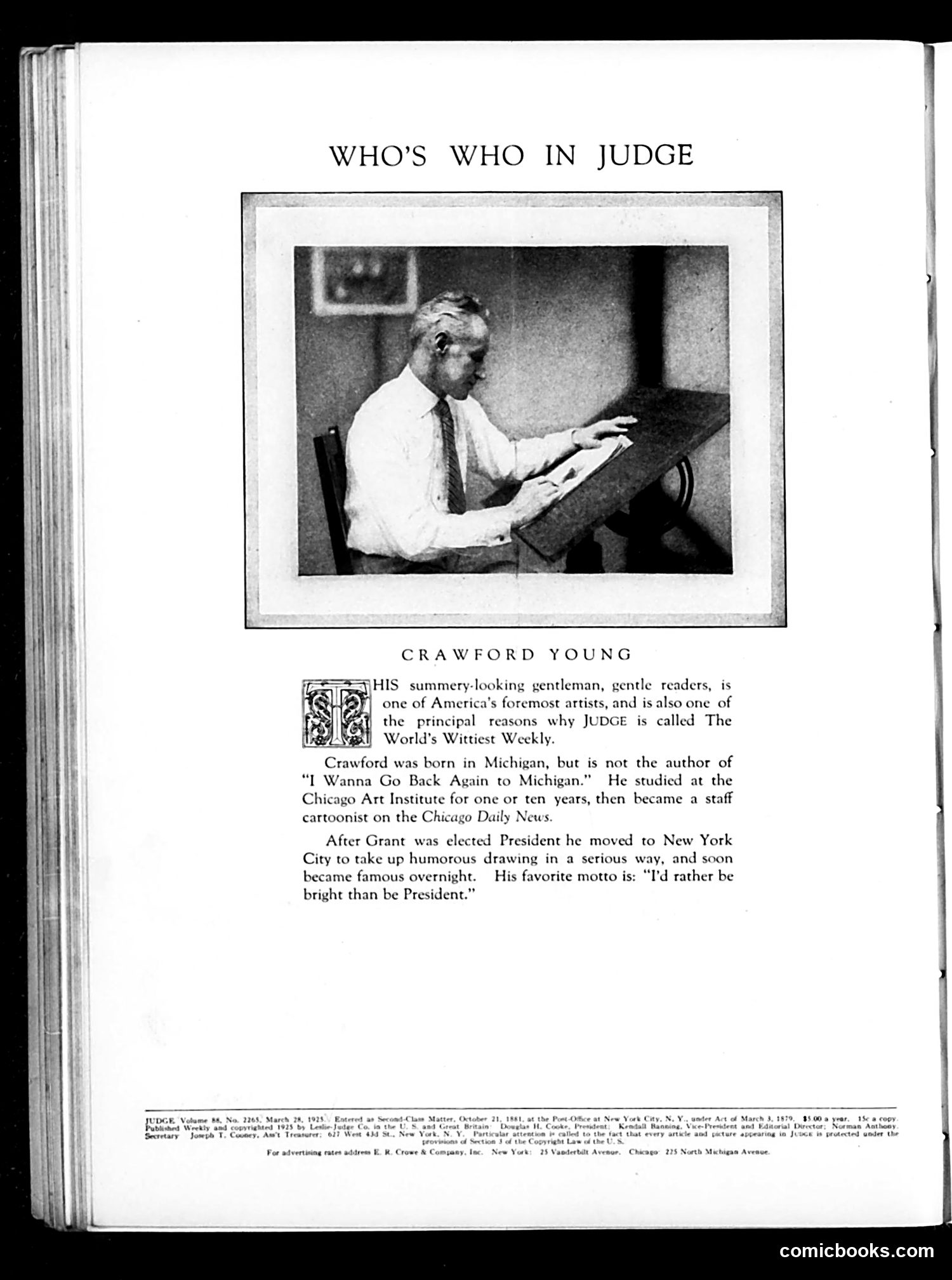
This is a biographical profile page featuring **Crawford Young**, a prominent American cartoonist and illustrator. The photograph shows him at work, drawing at a desk. According to the text, Young was one of America's foremost artists and a principal contributor to *Judge* magazine, which was called "The World's Wittiest Weekly." He studied at the Chicago Art Institute and worked as a staff cartoonist for the *Chicago Daily News*. The profile notes that after President Grant's election, Young moved to New York City to pursue humorous drawing "in a serious way" and became famous overnight. His stated philosophy was: "I'd rather be bright than be President." The page celebrates Young's artistic achievements and wit.
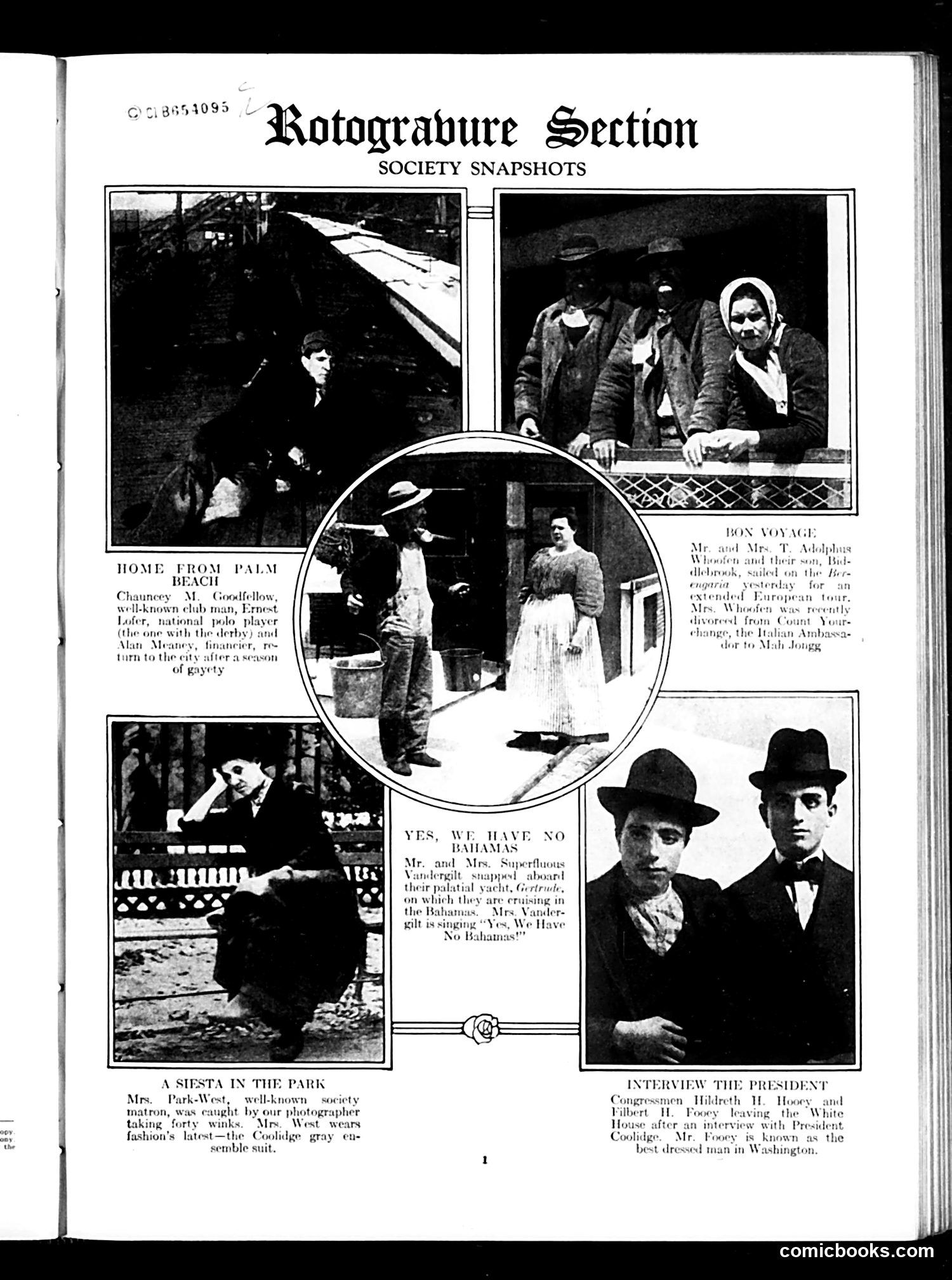
This page presents five society photographs with humorous captions typical of Judge magazine's satirical coverage of high society: 1. **"Home from Palm Beach"** features Chauncey Goodfellow and others returning from a vacation. 2. **"A Siesta in the Park"** shows Mrs. Park-West, a society matron, caught napping in public—the joke being that a fashionable woman in a "Coolidge gray ensemble suit" has been photographed in an undignified moment. 3. **"Yes, We Have No Bananas"** depicts Mr. and Mrs. Vandergilt on their yacht *Gertrude*, with a caption referencing the popular song. 4. **"Interview the President"** shows Congressmen Hildreth and Fosey leaving the White House after meeting President Coolidge, noted as "the best dressed man in Washington." The satire targets wealthy elites and their leisure activities.
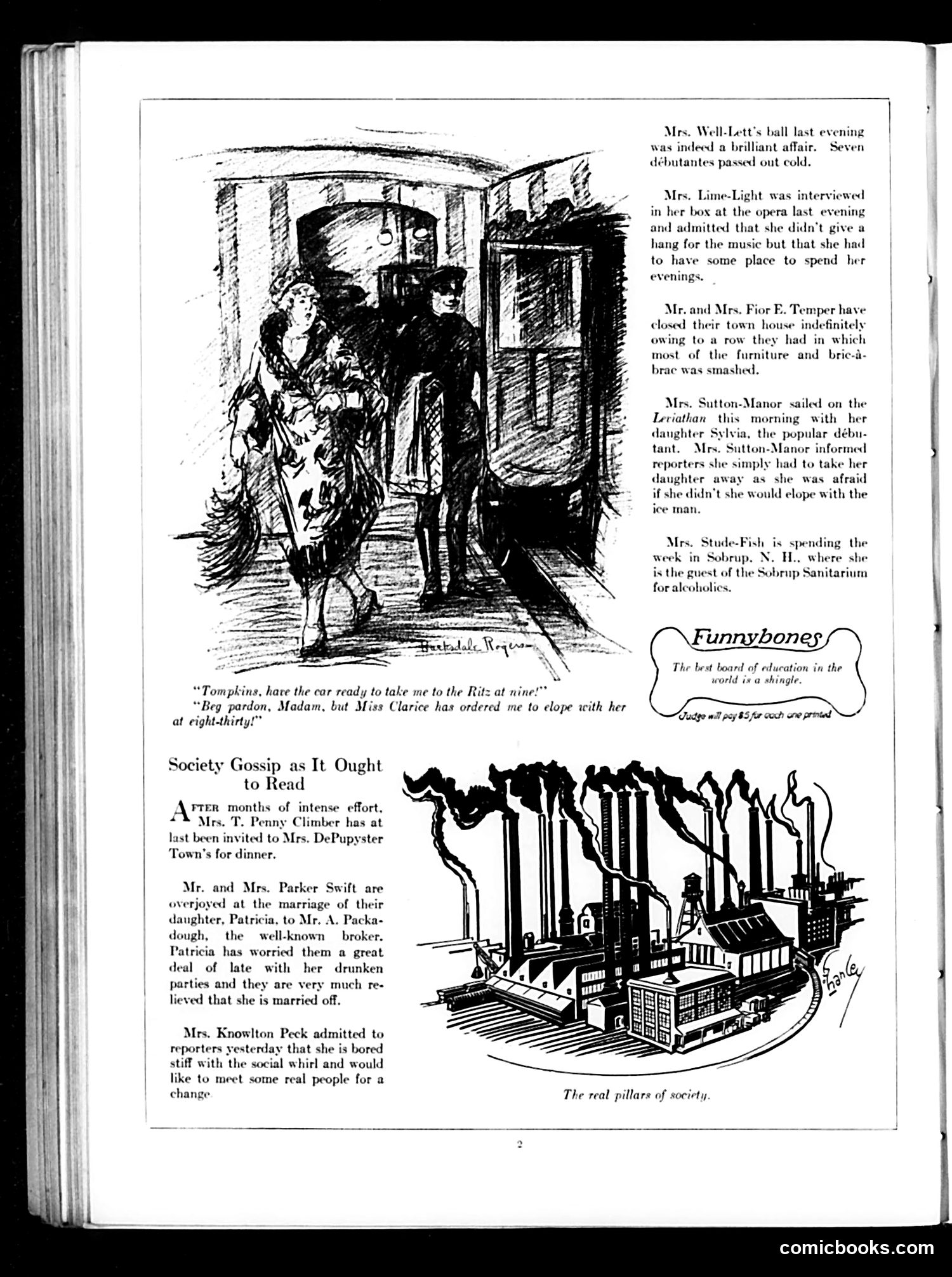
This page contains **society gossip** rather than political satire. The main cartoon depicts an elopement scene—a young couple fleeing with a chaperone's assistance, captioned with dialogue about eloping "at eighty-thirty" (likely 8:30). The sketch satirizes romantic melodrama popular in contemporary fiction and theater. The "Society Gossip as It Ought to Read" section mocks high-society social anxieties: marriages, boring social events, and wealthy families' concerns about their daughters' matrimonial prospects. The industrial illustration labeled "The real pillars of society" sarcastically contrasts manufacturing and labor with the frivolous upper-class concerns detailed above—suggesting factories, not socialites, form society's true foundation. The overall tone is lighthearted mockery of elite social pretensions.
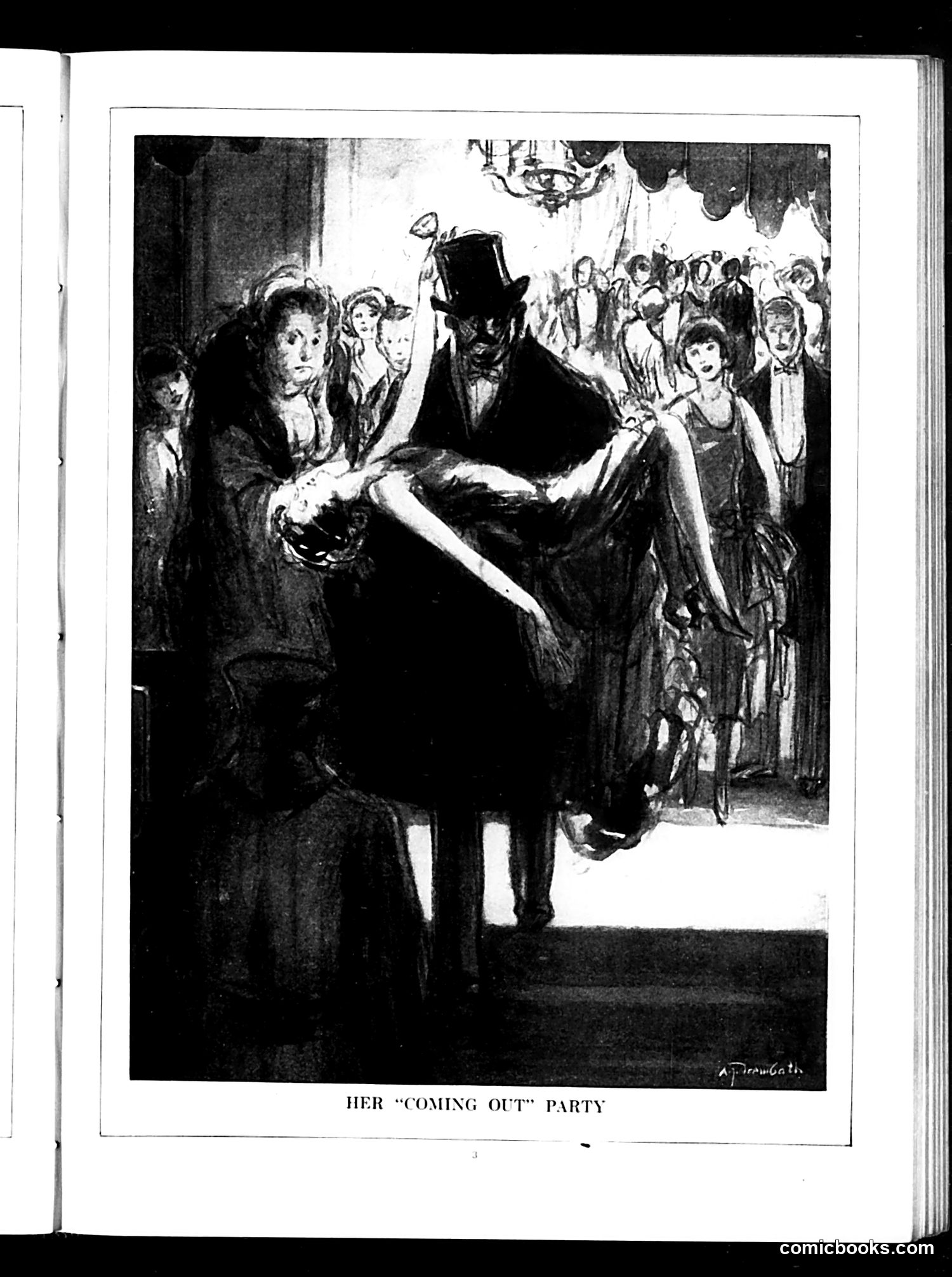
This illustration satirizes the social debut of a young woman from high society. The caption refers to a "coming out" party—a formal event where aristocratic or wealthy families presented their unmarried daughters to society, traditionally signaling they were eligible for marriage. The cartoon depicts a man in formal evening wear (top hat and tails) presenting an apparently unconscious or swooning woman to an assembled crowd of onlookers at what appears to be an elegant ball or reception. The satire likely mocks either the artificiality of such social rituals, the young woman's lack of agency in the proceedings, or possibly critiques wealthy society's pretensions and excess. The woman's limp posture suggests she's overwhelmed, exhausted, or uninterested in her own presentation.
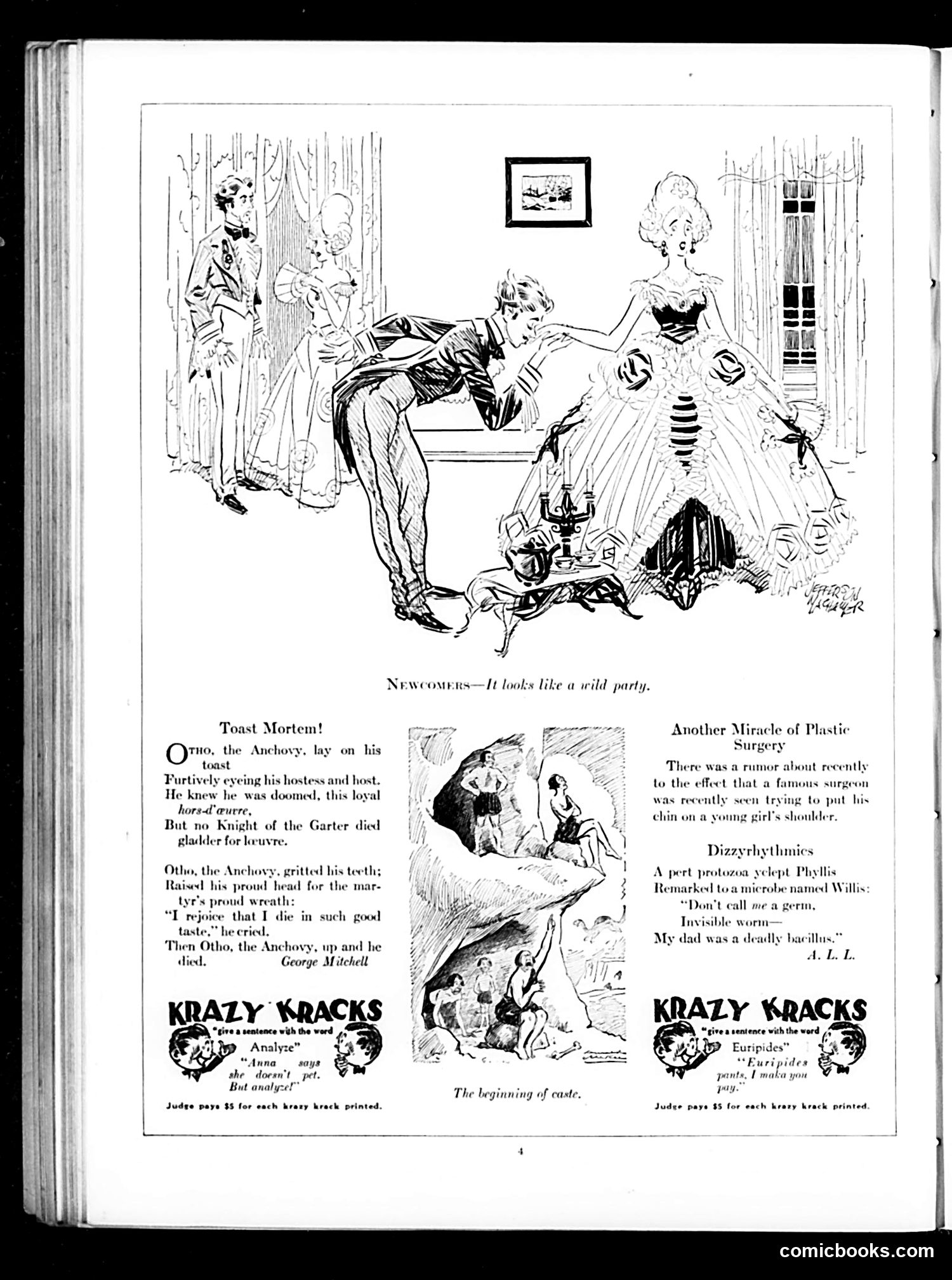
This page mixes humor with advertising. The top cartoon titled "Newcomers—It looks like a wild party" depicts a formal social gathering where new arrivals appear shocked by the scene—likely satirizing nouveau riche or outsiders unfamiliar with high society behavior. The "Toast Mortem!" section is a poem about someone named Otto the Anchovy dying, written in mock-serious style by George Mitchell. This appears to be humorous nonsense verse rather than political commentary. "Another Miracle of Plastic Surgery" and "Dizzyrhythmics" are brief satirical notes about contemporary fads—cosmetic surgery and modern dance or music trends. The page is primarily filled with "Krazy Kracks" advertisements offering judges' prizes, which were typical Judge magazine revenue drivers. The actual satirical content is minimal.
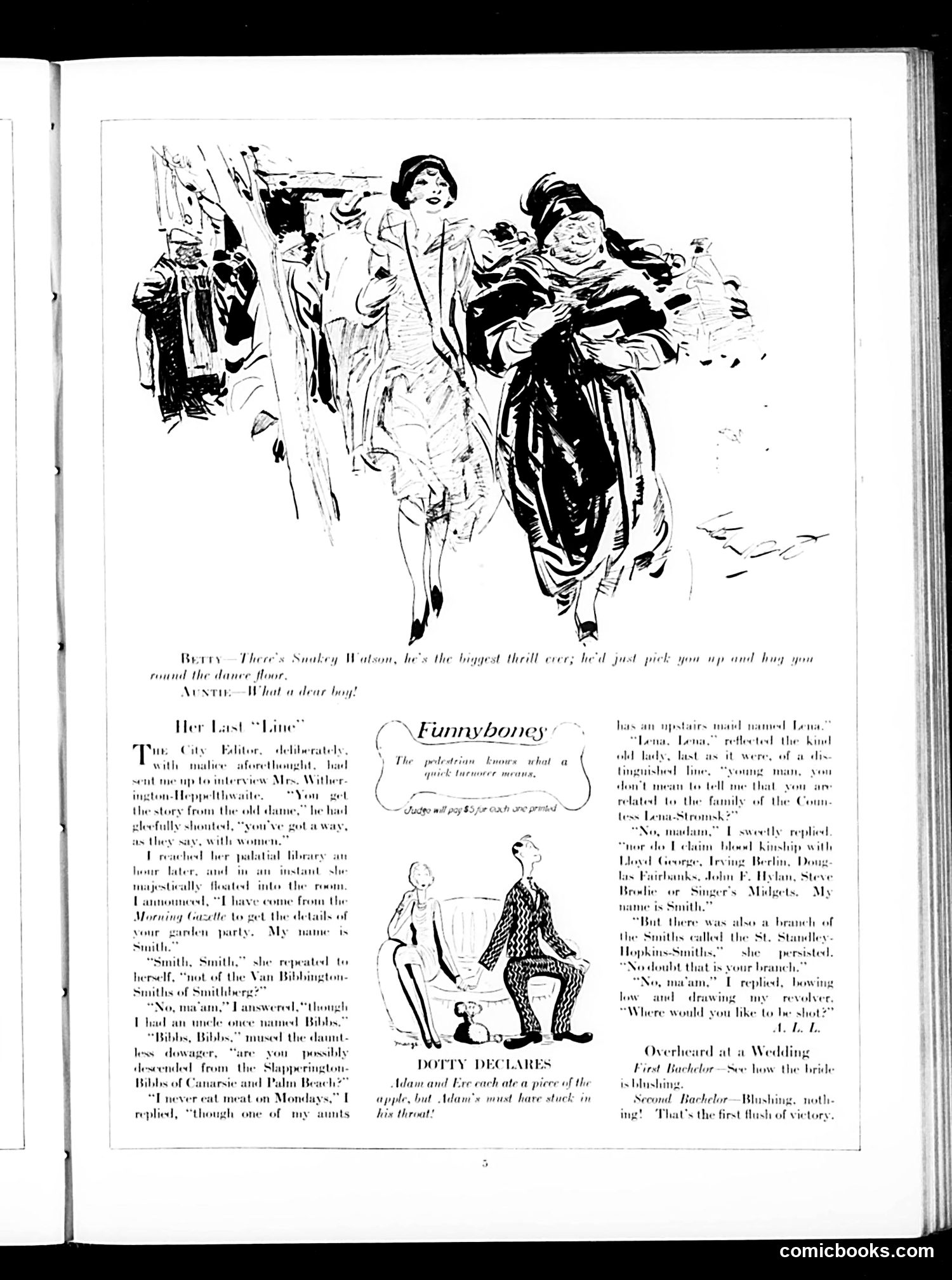
This page contains social humor typical of early 20th-century Judge magazine. The top illustration shows fashionable women on a dance floor, with dialogue about "Smokey Watson" and picking someone up "round the dance floor" — satirizing Jazz Age dating customs and the newfound social freedoms of women in that era. The middle section, "Funnyboney," presents a domestic scene mocking marital confusion: a woman named Smith claims a garden-party connection, but the man denies knowing her or any "Smiths," questioning whether she's confusing him with someone else. It's humor about mistaken identity and social pretense. The bottom section, "Overheard at a Wedding," presents brief jokes about newlyweds and wedding traditions, using the blushing bride as a setup for mild humor about matrimony.
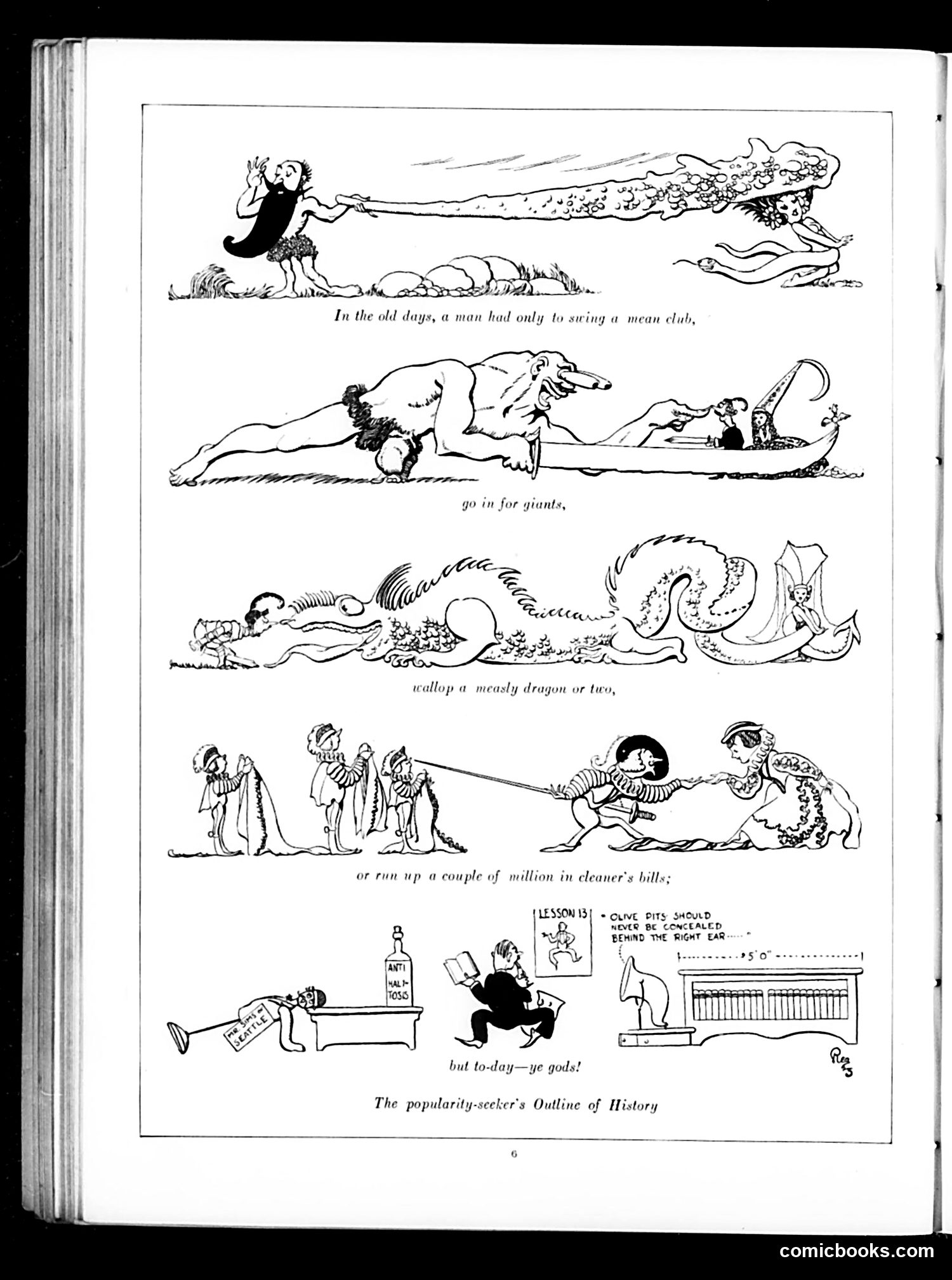
This cartoon satirizes how standards for success and respectability have changed over history. It presents a humorous "outline" progressing from primitive to modern times: - **Old days**: A man needed only physical strength (swinging a club) or wealth (running up cleaning bills) - **Modern era ("but to-day—ye gods!")**: The standards have become absurdly specific and trivial, including a technical diagram about concealing "cute pits" (likely armpit appearance) "behind the right ear" The satire mocks contemporary society's obsession with superficial appearance and etiquette rules. The title "The popularity-seeker's Outline of History" suggests that modern "popularity-seeking" has become comically elaborate compared to simpler past criteria for status. The increasingly ridiculous requirements parody both pseudo-scientific self-help advice and the growing consumer culture's emphasis on personal grooming and social positioning in early 20th-century America.
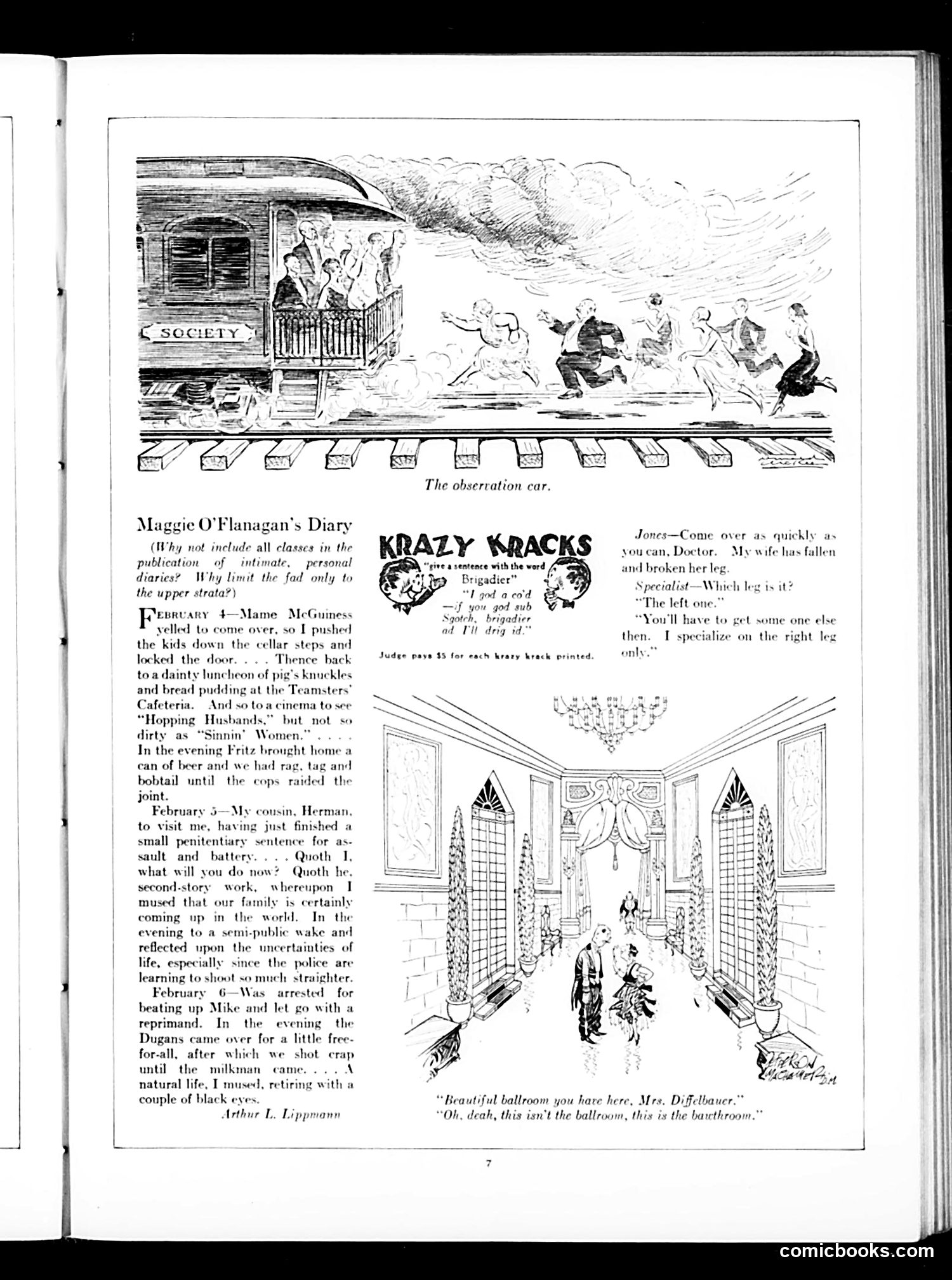
This page contains three satirical pieces mocking different social classes and professions: **"Maggie O'Flanagan's Diary"** parodies the contemporary trend of publishing society women's intimate diaries by presenting a working-class Irish woman's account. It satirizes lower-class life through exaggerated stereotypes: criminal relatives, police raids, domestic violence, and petty crime. The subtitle notes the irony that such publications only included "upper strata" perspectives. **"Krazy Kracks"** is a joke competition where readers submit puns for cash prizes. **The specialist joke** mocks medical specialization as absurdly narrow—a doctor who only treats right legs, not left ones, exemplifying professional pretension taken to ridiculous extremes. **The ballroom cartoon** ridicules newly wealthy people (suggested by the "Diffelbauer" name) who confuse their bathroom for a ballroom, suggesting their unfamiliarity with proper society etiquette despite their wealth. The page reflects early 20th-century American class anxieties and ethnic stereotyping common to Judge's satirical humor.
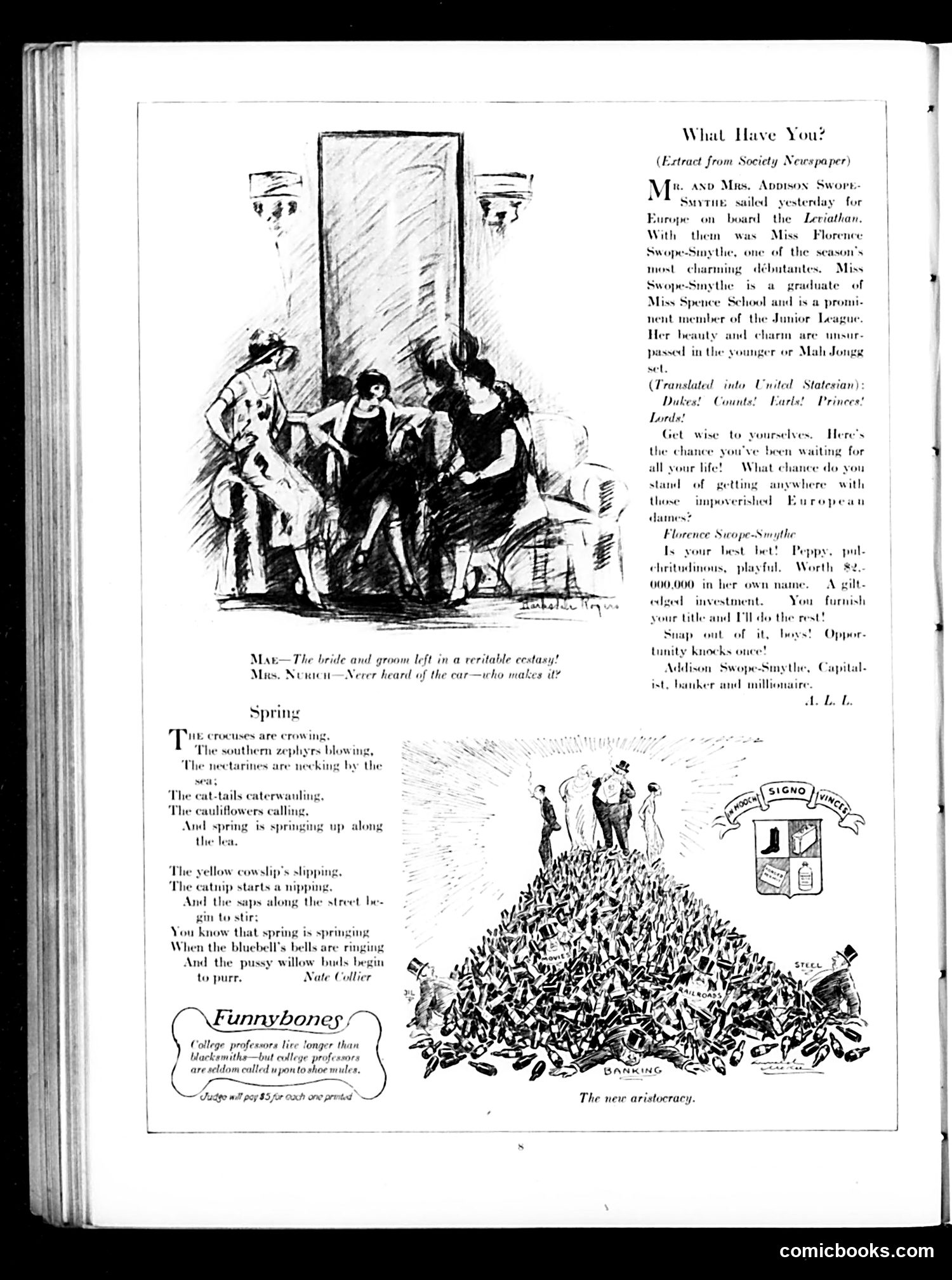
This page from Judge contains two distinct satirical pieces: **"What Have You?"** mocks the American wealthy class's obsession with European aristocracy. The piece presents a society newspaper announcement about a debutante's European voyage, then "translates" it into blunt American terms: wealthy industrialist Addison Swope-Smythe is essentially advertising his daughter as a marriageable commodity to impoverished European nobility. The satire exposes how American plutocrats compete to marry their daughters into titled families—trading new money for old prestige while European aristocrats gain financial security. The phrase "impoverished European dames" emphasizes the transactional nature of such unions. **"Spring"** and the **"Funnybones"** section are lighter humor—punning wordplay about springtime and an observation about college professors' salaries. **"The new aristocracy"** cartoon (bottom right) appears to depict wealthy Americans literally piled atop money/banking symbols, suggesting that in modern America, financial power—not hereditary titles—defines the true ruling class.
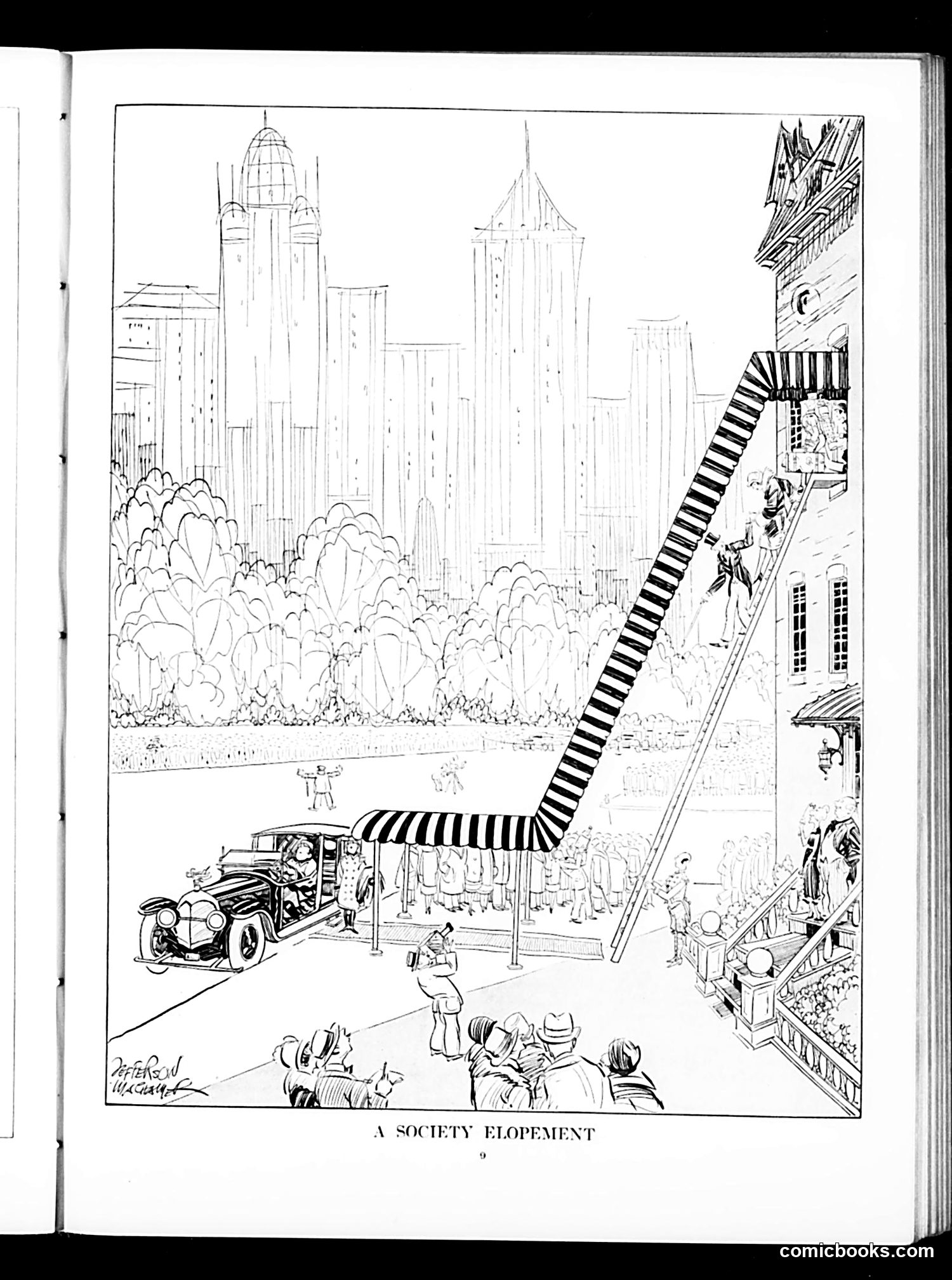
This cartoon satirizes wealthy urban society by depicting a dramatic "elopement" using an exaggerated visual metaphor. A couple flees the city in an old automobile up a giant striped ramp, escaping the towering skyline (appears to be New York City) and crowds of onlookers. The striped ramp—resembling a circus or carnival structure—suggests the theatrical, sensational nature of society scandals. The joke appears to target how society elopes (secret marriages, romantic escapes) become public spectacles. The massive scale of the escape apparatus, crowds watching, and circus-like staging mock how the wealthy treat private romantic affairs as grand public dramas. The cartoonist's signature appears to read "Judge," though this is the publication name rather than the artist's signature.
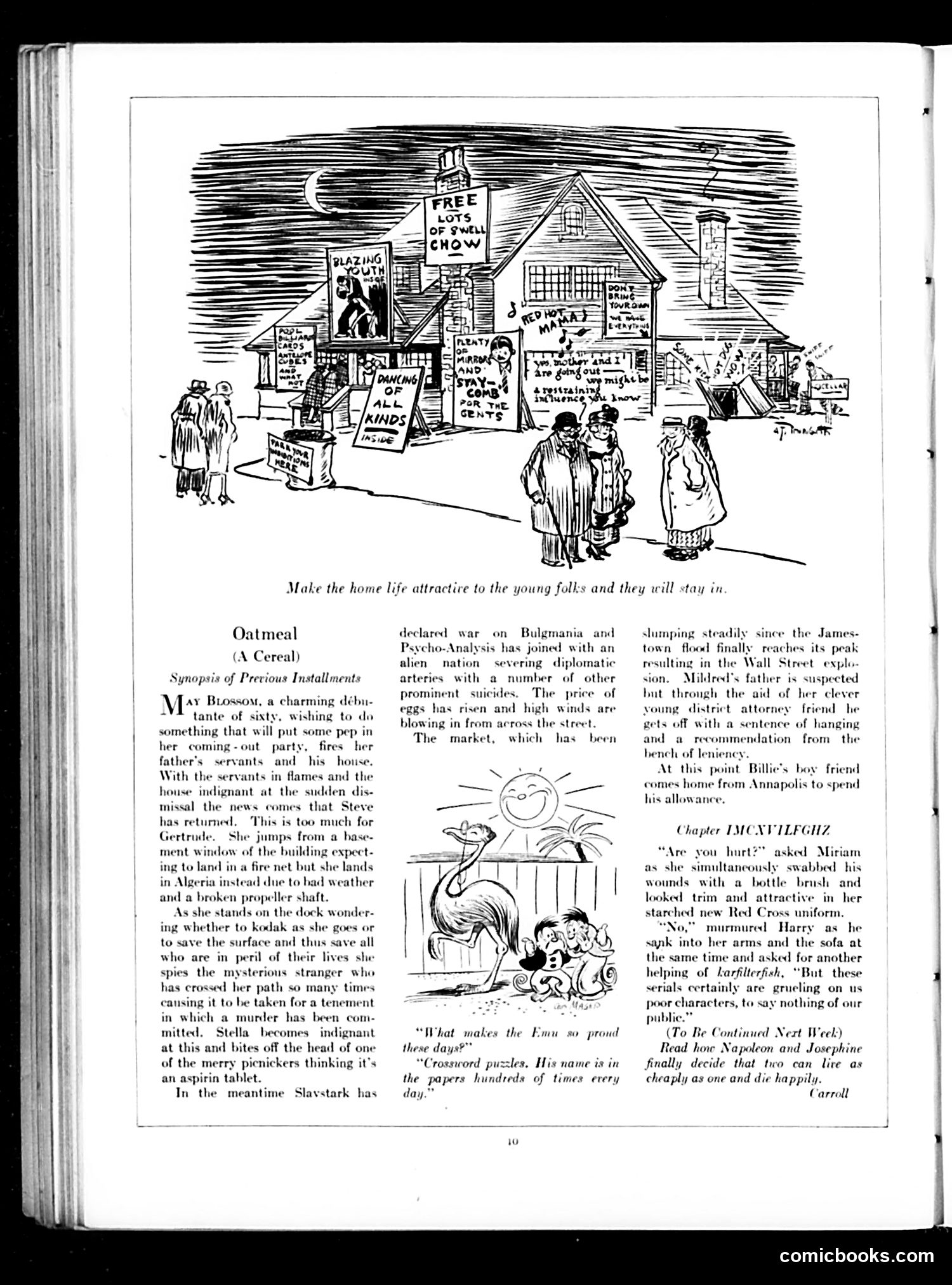
This page contains a serialized comic strip called "Oatmeal" that parodies melodramatic serialized fiction popular in early 20th-century magazines. The "Synopsis of Previous Installments" deliberately makes no logical sense—it piles absurd, disconnected plot elements (a 60-year-old debutante, fires, Algeria, war declarations, crossword puzzles) into incoherent chaos. The satire targets two things: (1) the overblown, deliberately convoluted plots of serialized stories that kept readers hooked week after week, and (2) the fourth-wall-breaking complaint from "Harry" that "these serials certainly are grueling on us poor characters"—mocking how serialized fiction prioritized commercial continuation over narrative coherence. The small cartoon joke about the emu's pride in appearing in crossword puzzles is a light gag unrelated to the main satire.
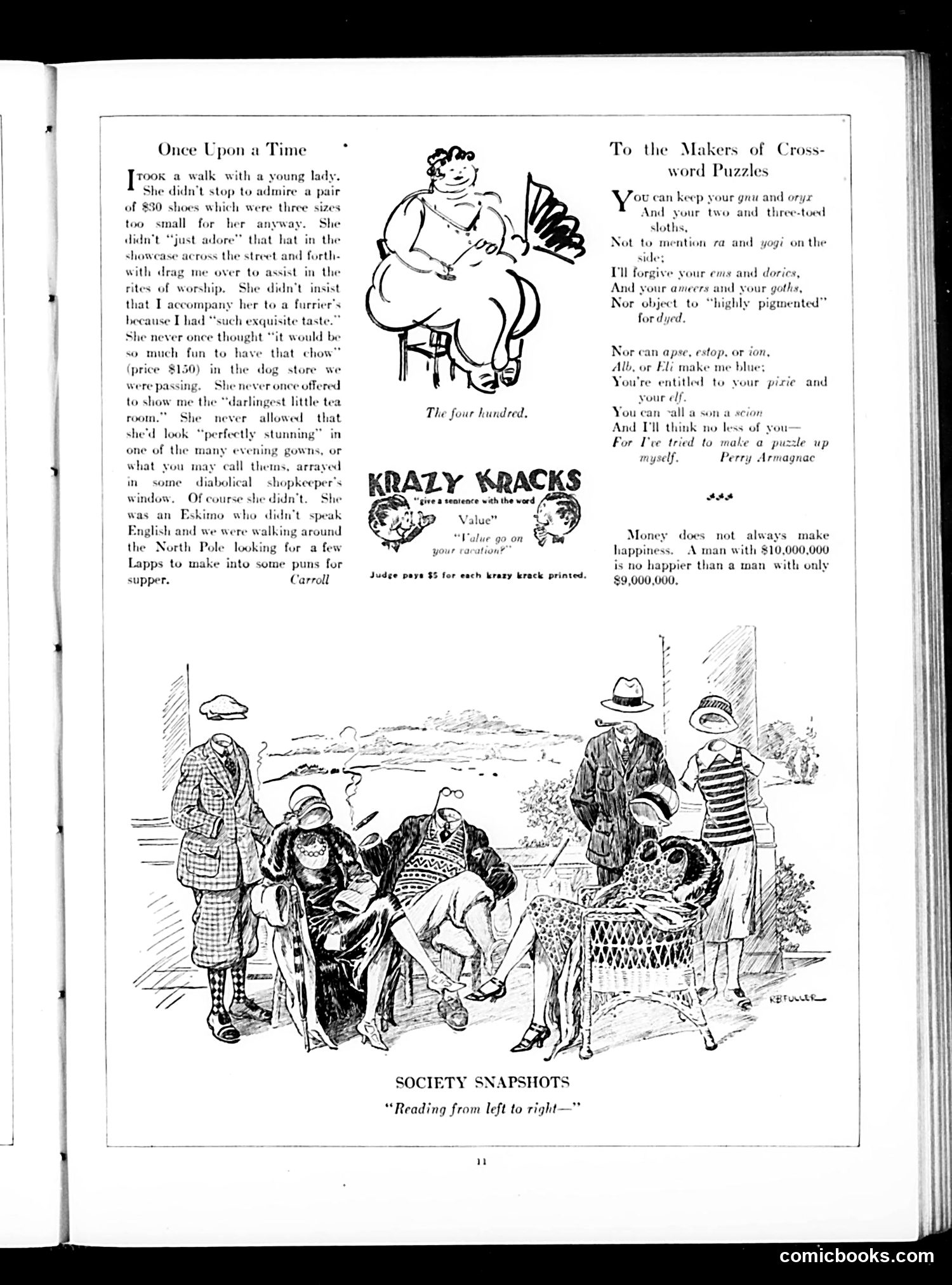
This page from Judge magazine contains three distinct sections satirizing early 20th-century American society and popular culture. **"Once Upon a Time"** is a humorous story contrasting an idealized woman (who shows no interest in fashion, luxury goods, or material display) with the author's actual companion—revealed as an Eskimo woman at the North Pole. The joke mocks contemporary expectations that women obsess over shoes, hats, furs, and gowns. **"Krazy Kracks"** appears to be a reader-submission humor section where Judge paid $5 for witty one-liners. **"To the Makers of Crossword Puzzles"** is a comedic poem by Perry Armagnac granting permission to puzzle-makers to use obscure words (gnu, oryx, sloths, ra, yogi, etc.) while requesting they spare readers from overused crossword staples. **"Society Snapshots"** is a cartoon depicting well-dressed figures at what appears to be a social gathering, captioned "Reading from left to right"—likely a visual joke about the fashionable set. The final aphorism about wealth and happiness offers social commentary typical of Judge's satirical voice.
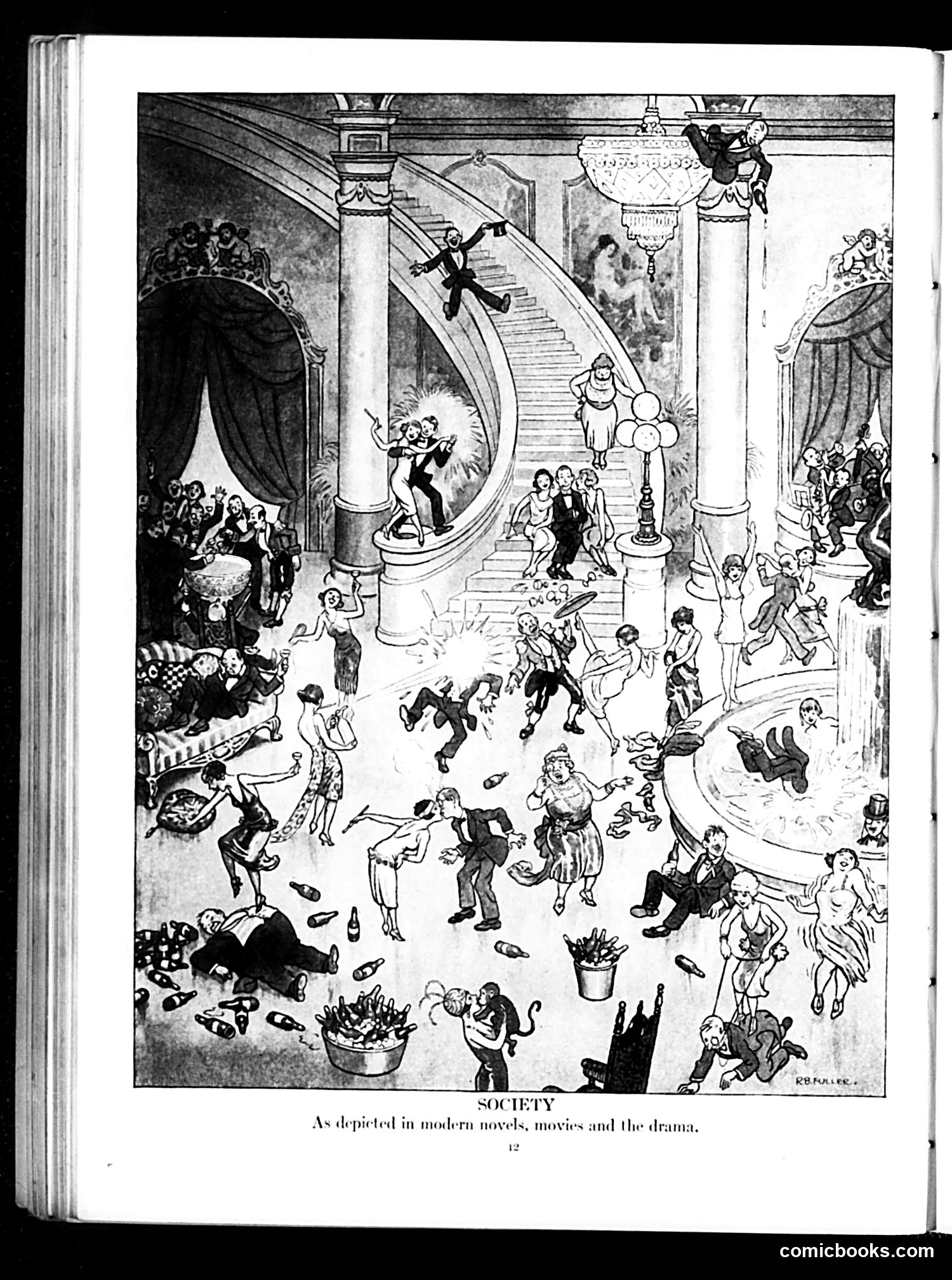
This cartoon ridicules wealthy elite society "as depicted in modern novels, movies and the drama." The elaborate ballroom scene shows the supposed glamour of high society descending into chaos: revelers drink heavily (bottles scattered everywhere), people dance wildly or collapse, and general debauchery unfolds beneath ornate columns and chandeliers. The satire targets how contemporary literature and entertainment romanticized the upper classes, suggesting the reality was actually frivolous excess and moral decay. The contrast between the grand architectural setting and the undignified behavior emphasizes the hypocrisy—wealth and refinement masking superficiality and vice. This reflects early 20th-century Progressive-era skepticism toward the wealthy elite, particularly mocking how their lifestyle was portrayed versus lived.
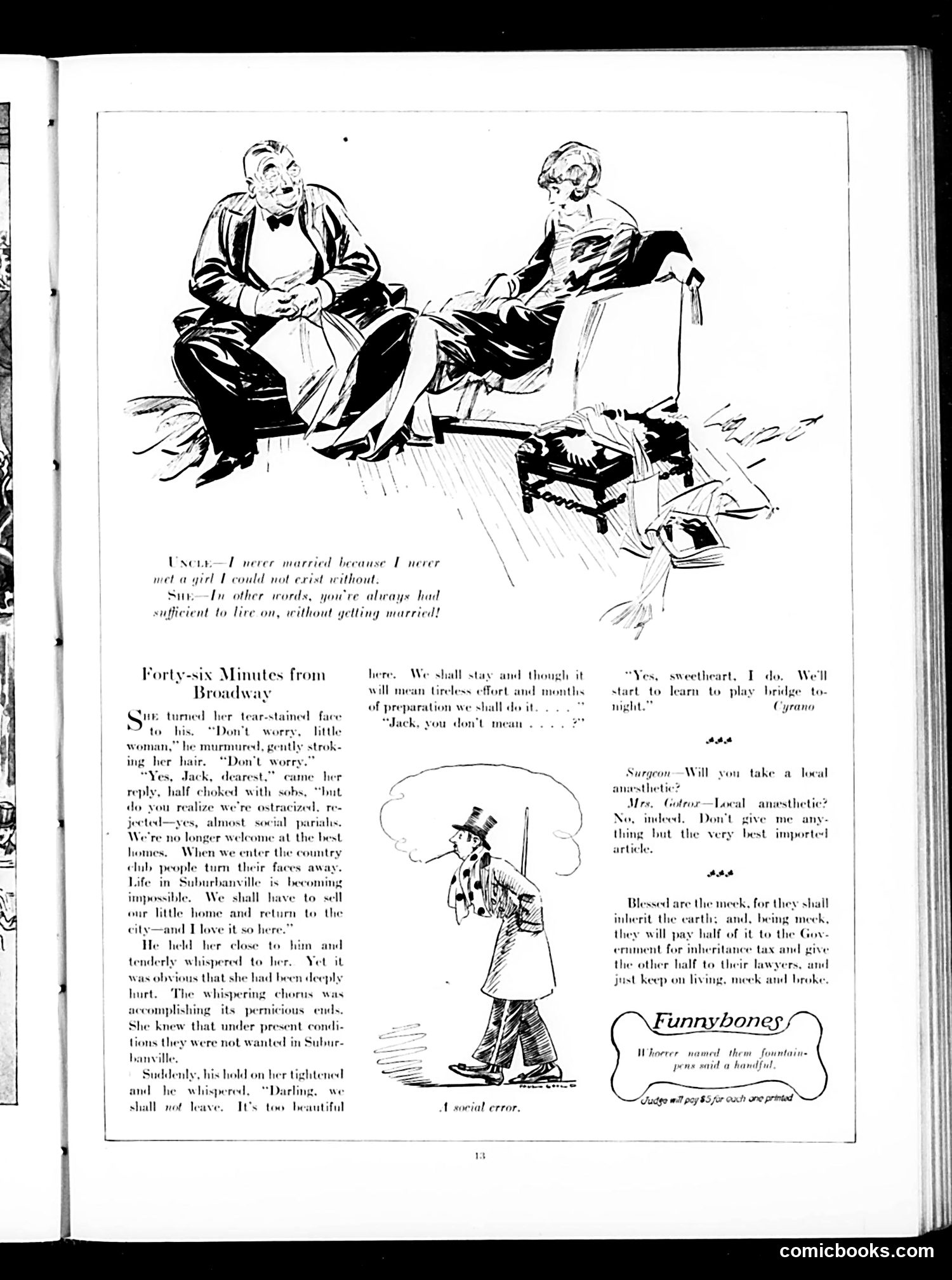
This page contains social satire from the early 20th century addressing marriage, class, and suburban respectability. **Top cartoon**: A couple discusses marriage. The man claims he never married because no woman was self-sufficient enough; the woman sarcastically replies he simply had enough money to avoid it—a jab at male hypocrisy about women's independence. **Main story, "Forty-six Minutes from Broadway"**: A couple contemplates leaving their suburban community after being socially ostracized. The narrative suggests they've been "rejected" and are "no longer welcome" in country clubs—likely because they've violated some social convention (possibly a scandal or improper behavior). Despite this rejection, the man persuades his tearful wife to stay, declaring "It's too beautiful." **Side jokes**: Brief medical and inheritance humor about anesthetics and meek widows paying taxes and lawyers. **"Funnybones" caption**: A pun about fountain pens. The satire targets suburban snobbery, social conformity, and the superficial respectability games of early-1900s middle-class America.
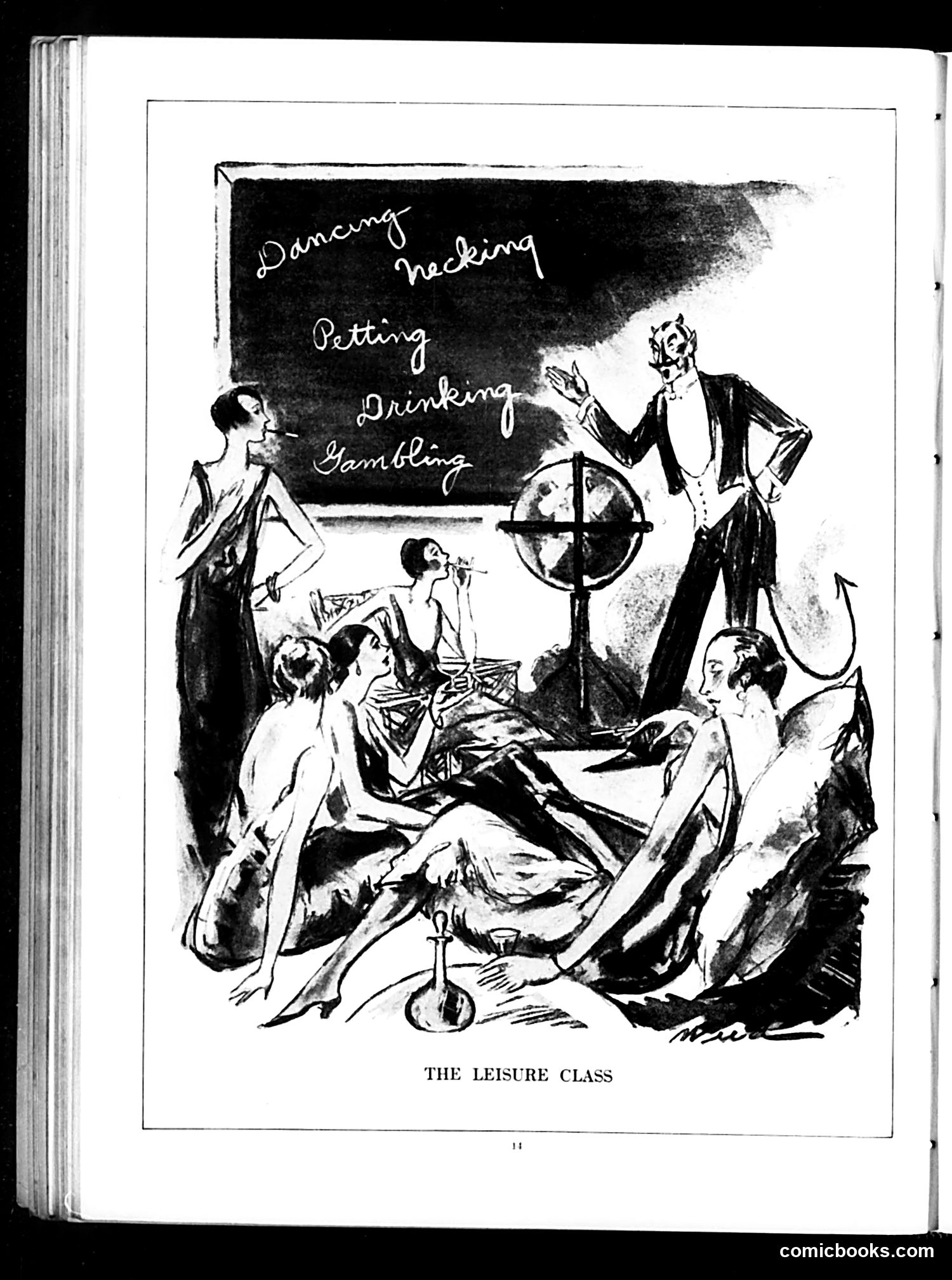
This satirical cartoon criticizes wealthy people's pastimes. The blackboard lists activities associated with the idle rich: "Dancing, Necking, Petting, Drinking, Gambling." Two well-dressed men in formal attire (likely representing wealthy gentlemen or socialites) supervise or oversee a group of partially-clothed women engaged in these vices. The figures appear to embody decadence and moral laxity. The satire targets the "leisure class"—a term referring to wealthy people freed from productive labor. Judge magazine used this cartoon to mock the perceived frivolity, moral corruption, and social irresponsibility of the wealthy during what appears to be the Jazz Age or 1920s-30s era. The artwork suggests these activities represent a wasteful, dissolute lifestyle disconnected from ordinary working people's concerns.
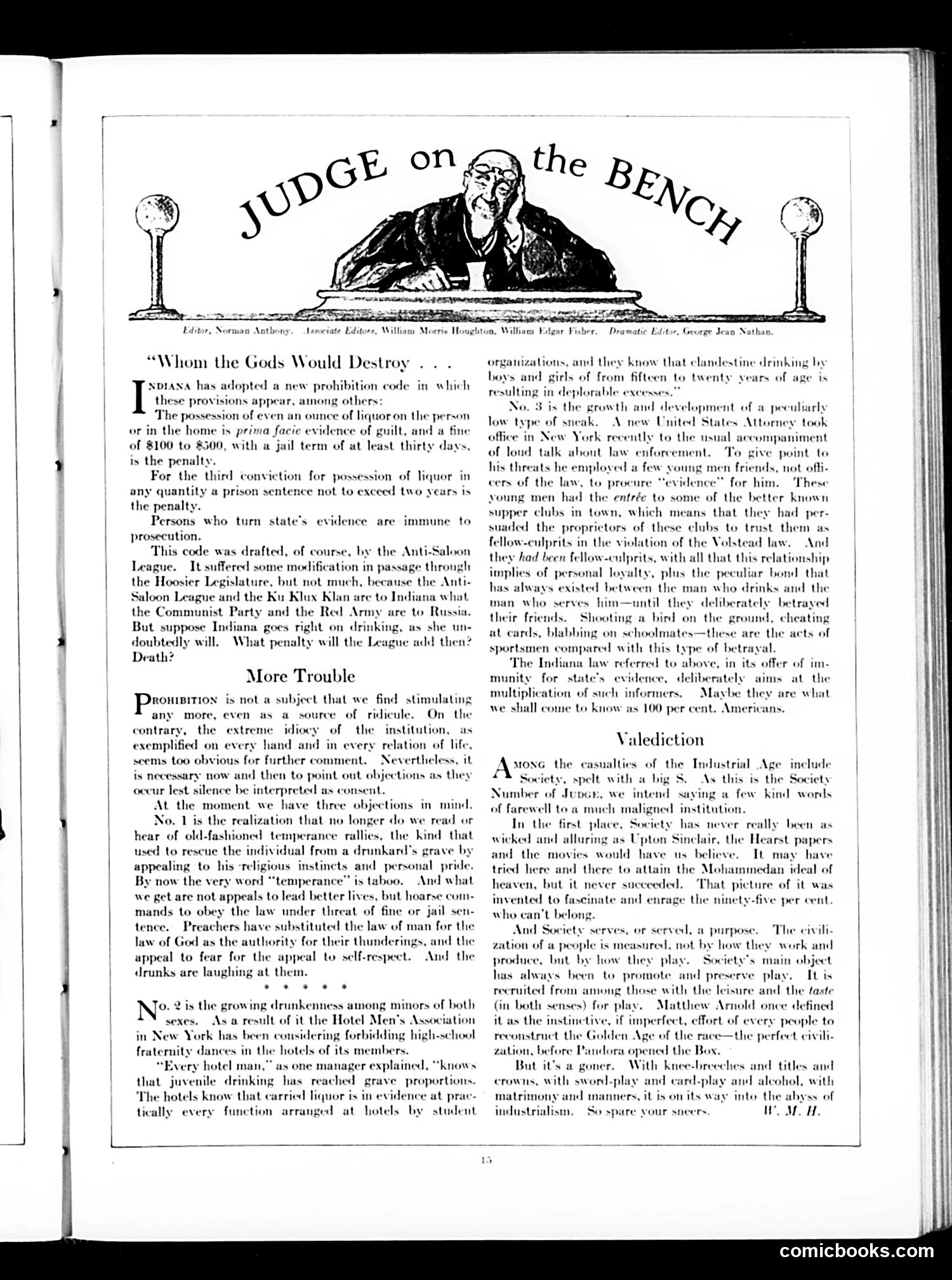
This page critiques **Prohibition enforcement** through three interconnected complaints: **The Main Cartoon** (header): Shows a stern judge presiding—visualizing the harsh judicial machinery of Prohibition. **Three Key Objections:** 1. **Lost moral appeal**: Prohibition replaced religious temperance appeals with legal threats. The satire: enforcement via fear rather than conscience makes drinkers laugh, not reform. 2. **Youth drinking surge**: Hotel managers report high schoolers openly bringing liquor to fraternity dances despite (or because of) Prohibition's existence. 3. **Corrupted enforcement**: A new U.S. Attorney hired young men posing as "friends" to infiltrate speakeasies and gather evidence against proprietors and patrons. The satire scorns this as **betrayal worse than cheating**—comparing entrapment to shooting birds on the ground. **The broader target**: Indiana's Anti-Saloon League and Ku Klux Klan's draconian code offering immunity to informants, which Judge sees as deliberately multiplying such betrayals. The satire argues Prohibition's enforcement mechanisms are morally corrupting society itself.
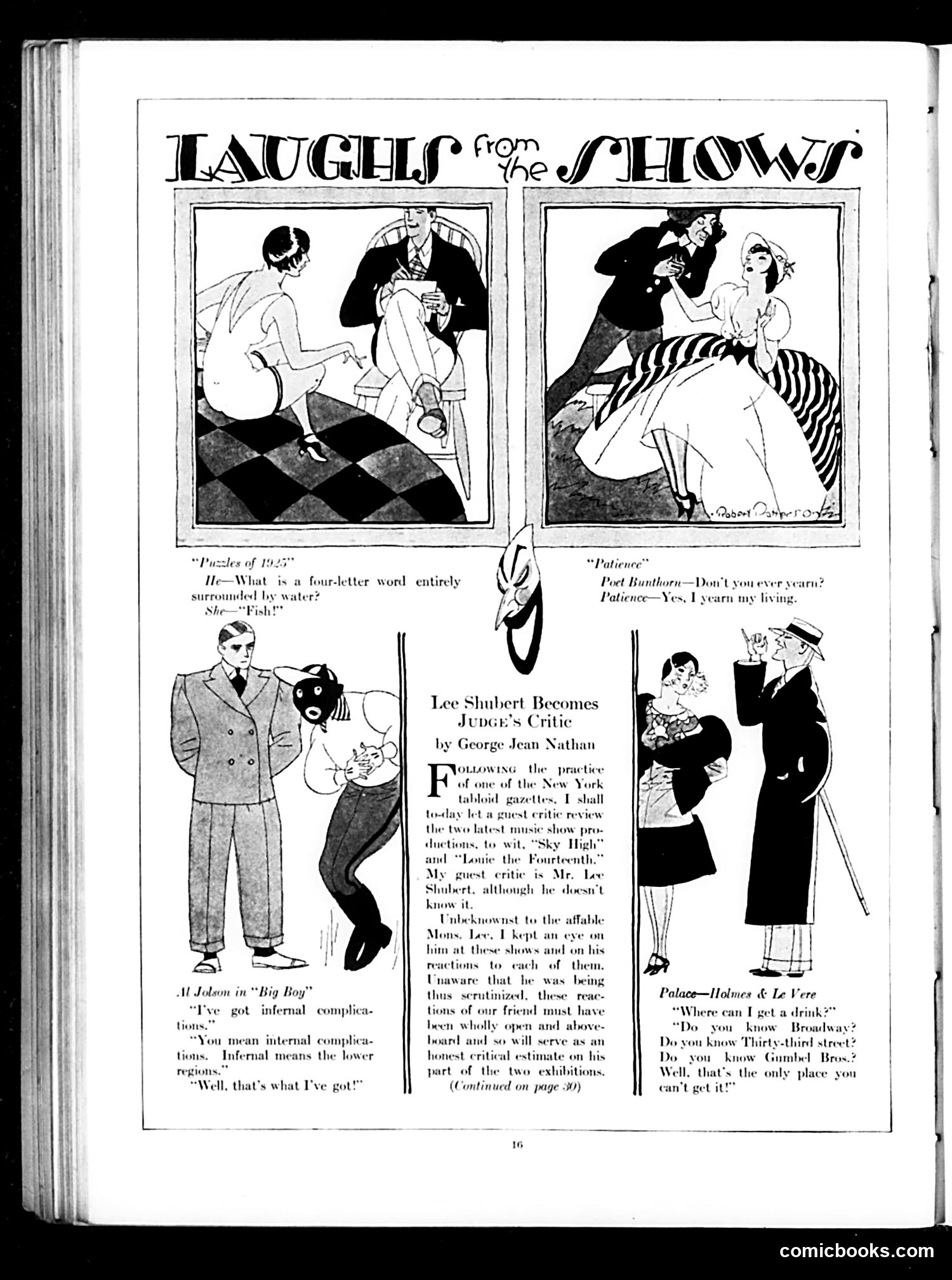
This page collects theatrical humor from circa 1925. The top cartoons lampoon Broadway shows: one features Al Jolson in "Big Boy" with a pun about "infernal complications" (wordplay on anatomy), and another references "Patience," likely Gilbert & Sullivan's operetta. The central article by George Jean Nathan announces Lee Shubert (a major theatrical producer) as an unwitting guest critic reviewing two musicals ("Sky High" and "Louie the Fourteenth"). The satire: Nathan watched Shubert's genuine reactions without his knowledge, claiming this reveals honest critical assessment—mocking both Shubert's authority and the theater world's pretensions. The bottom joke references Prohibition-era drinking culture: a character asks where to find alcohol on Broadway, receiving directions to "Gumbel Bros."—the only place you *can't* get a drink, implying it's a legitimate business, making the irony sharp during illegal alcohol sales.
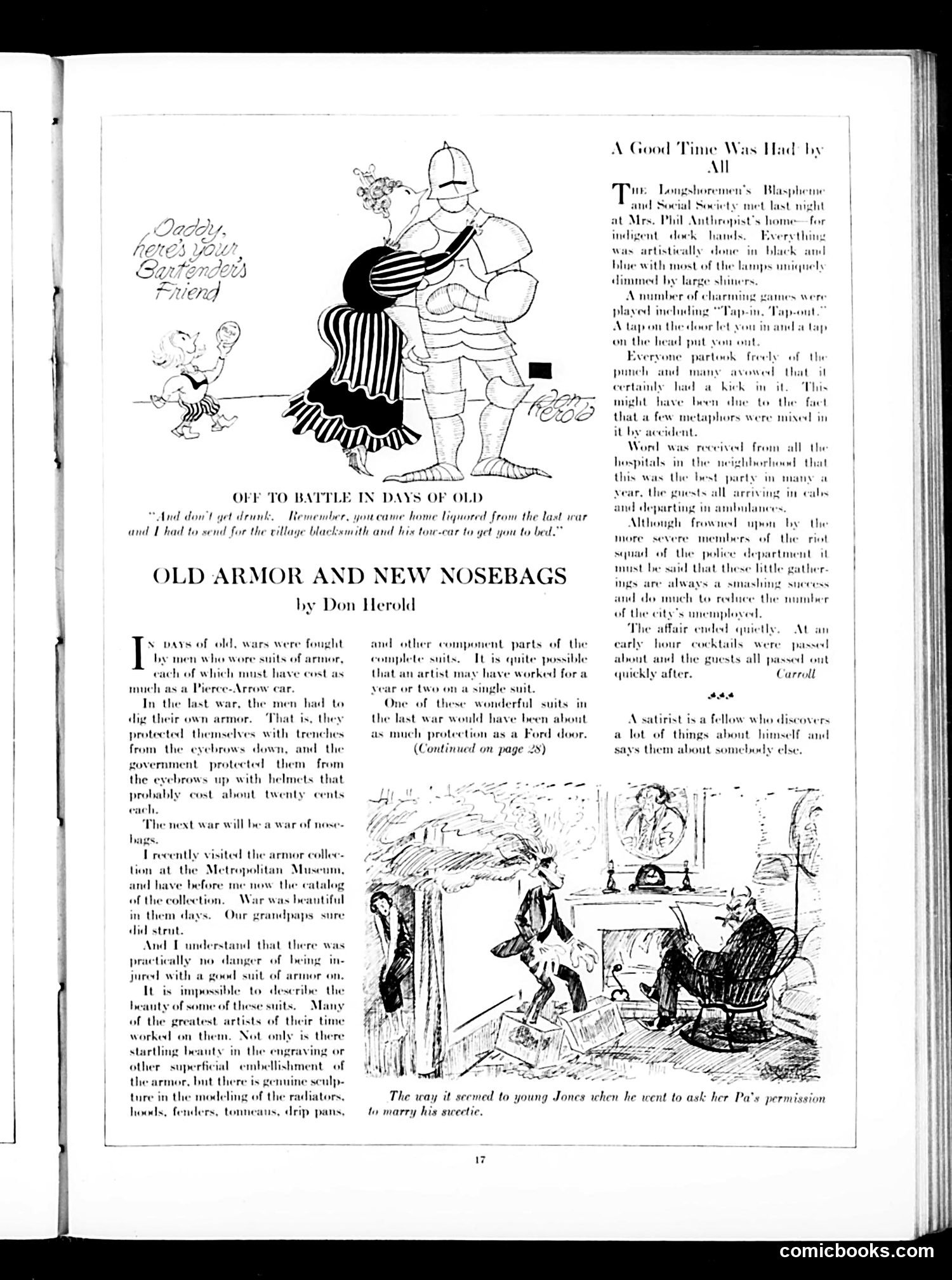
This page contains two distinct satirical pieces from Judge magazine: **"Old Armor and New Nosebags"** by Don Herold contrasts medieval knights' elaborate, beautifully crafted armor with WWI soldiers' cheap military gear. The joke: modern warfare equipment—costing mere pennies—offers no real protection, unlike the ornate suits of old. The title's "nosebags" refers satirically to soldiers' crude supplies versus knights' grandeur. Herold suggests the next war will emphasize cheap, mass-produced protective gear over artistry. **"A Good Time Was Had by All"** humorously reports on a "Longshoremen's Blaspheme and Social Society" party that devolved into chaos—guests got drunk, fights broke out, ambulances were called. The deadpan society-page tone contrasts sharply with the rowdy reality. The closing quip about satirists discovering unflattering truths appears unrelated, likely a filler joke. Both pieces mock contemporary American society through exaggeration and ironic contrast—one comparing past craftsmanship to present cheapness, the other exposing working-class rowdiness masquerading as respectable socializing.
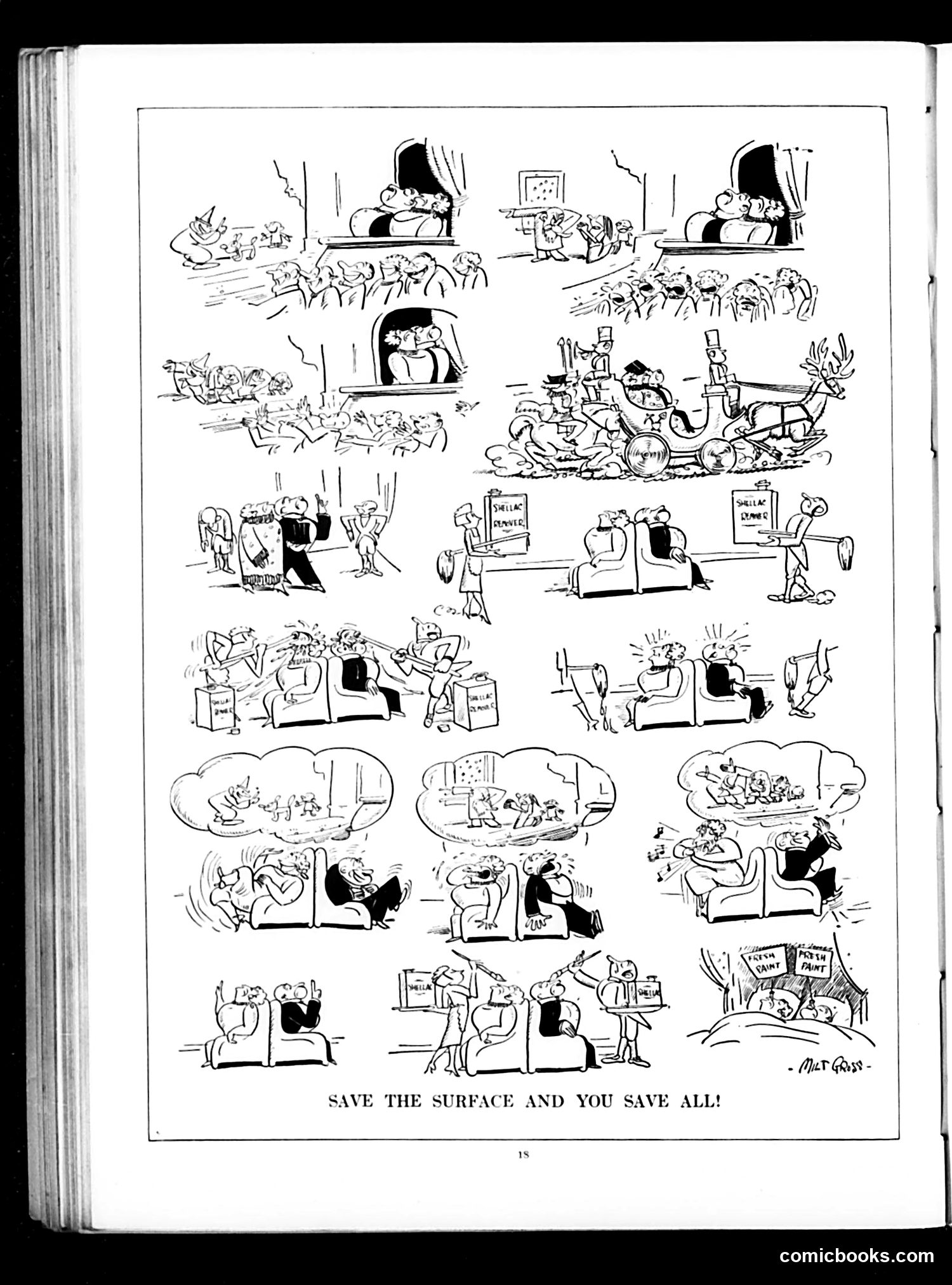
This is a single-panel cartoon by Milt Gross titled "Save the Surface and You Save All!" The image depicts a chaotic domestic scene with multiple vignettes showing a couple in various states of marital discord and household chaos—arguing, fighting, moving furniture, packing boxes, and sleeping separately. The cartoon appears to be satirizing a wartime conservation slogan (likely WWI-era, given the stylistic period). By applying the serious message "save the surface and you save all" to a deteriorating marriage instead of national resources, Gross creates dark humor through absurd juxtaposition. The joke suggests that if this troubled couple merely maintained appearances ("the surface"), their relationship might be salvageable—a cynical commentary on both domestic life and propaganda messaging.
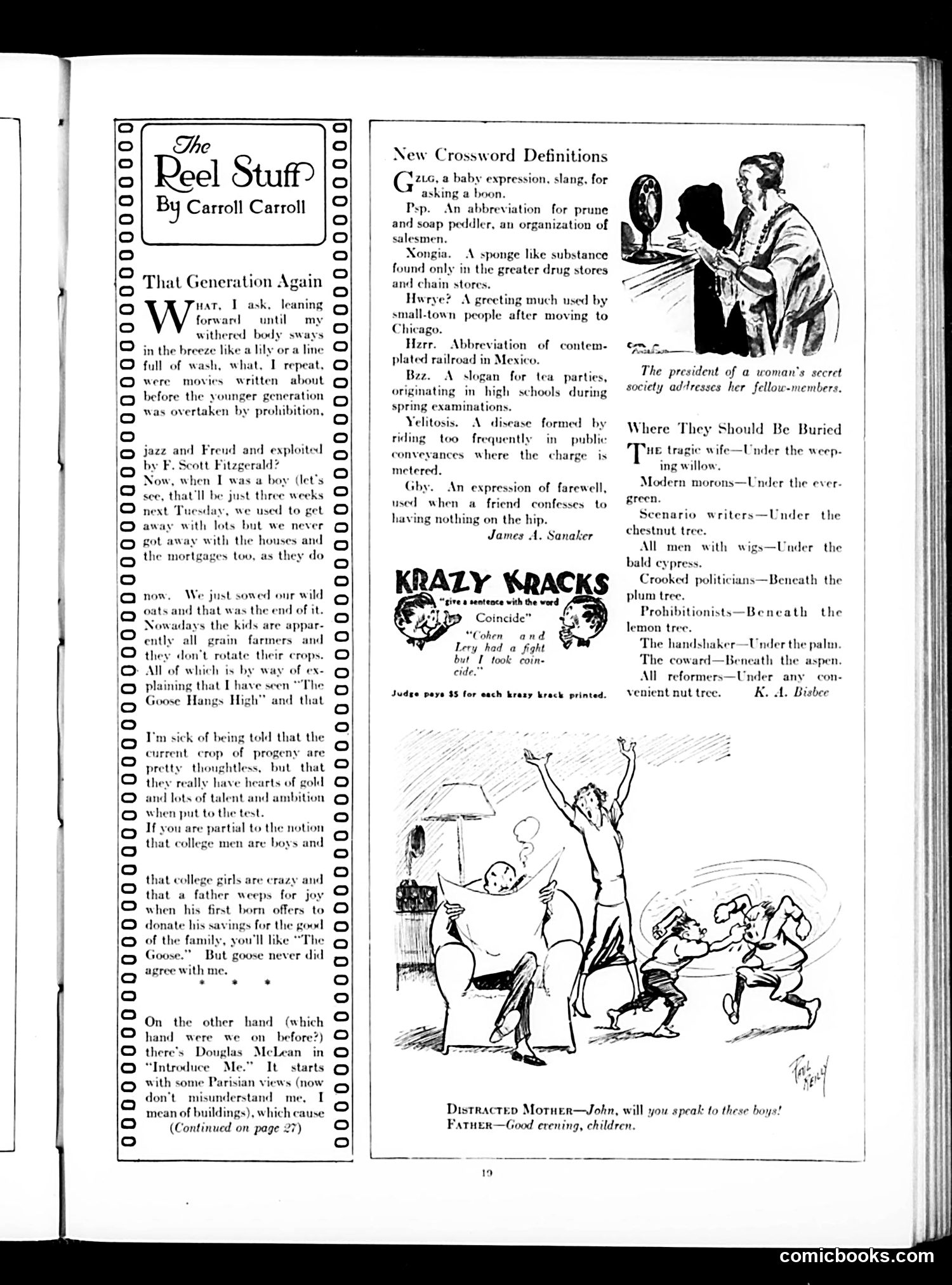
This page from Judge (a satirical magazine) contains three distinct pieces satirizing 1920s American society: **"That Generation Again"** (left column): Carroll Carroll's essay mocks the younger generation's perceived moral decline. An elderly narrator contrasts his youth—when "sowing wild oats" meant modest misbehavior—with modern college students who apparently engage in serious financial and moral transgressions without consequence. The piece critiques how movies romanticize these youth as talented and well-intentioned despite their questionable behavior. References to "Goose Hangs High" and Douglas McLean films anchor this in contemporary entertainment. **"New Crossword Definitions"** and **"Krazy Kracks"**: Humorous fake dictionary entries and puns mocking modern urban life, drug culture ("greater drug stores"), prohibition, and Midwestern transplants to Chicago. **"Where They Should Be Buried"**: Dark humor listing where various social types deserve burial—politicians, prohibitionists, and scenario writers receiving particular ridicule. The overall tone reflects the Jazz Age's generational conflict and satirizes both youth excess and moral gatekeeping.
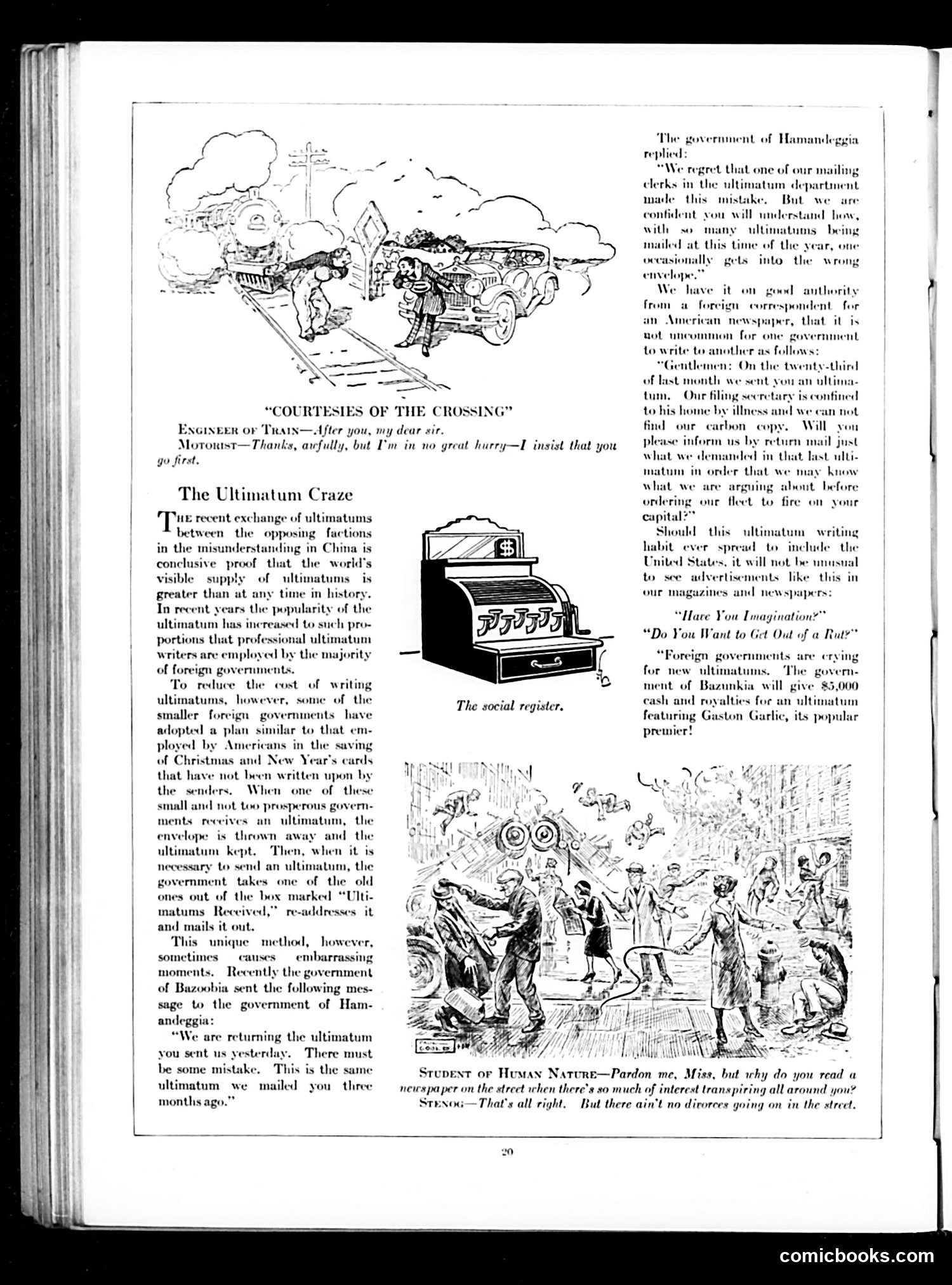
This page satirizes the proliferation of diplomatic ultimatums issued by foreign governments during an international crisis (likely the Boxer Rebellion era in China, referenced in the text). The satire operates on multiple levels: **Main Concept**: As governments increasingly exchange ultimatums, the practice becomes so routine that it resembles mass-produced correspondence. Smaller nations adopt a recycling system—reusing old ultimatums marked "Ultimatums Received"—leading to bureaucratic chaos (one government unknowingly sends back an ultimatum it received months earlier). **The Joke**: What began as serious diplomatic threats has become absurdly routine, commodified, and administratively bungled. The satire suggests governments are so consumed with ultimatum-writing that they lose track of what they're actually demanding. **Supporting Comics**: The page includes lighter jokes about social conventions ("Courtesies of the Crossing") and human nature (people reading newspapers for scandal/divorces rather than actual street events). The underlying point: unchecked diplomatic brinkmanship reduces serious international threats to farce.
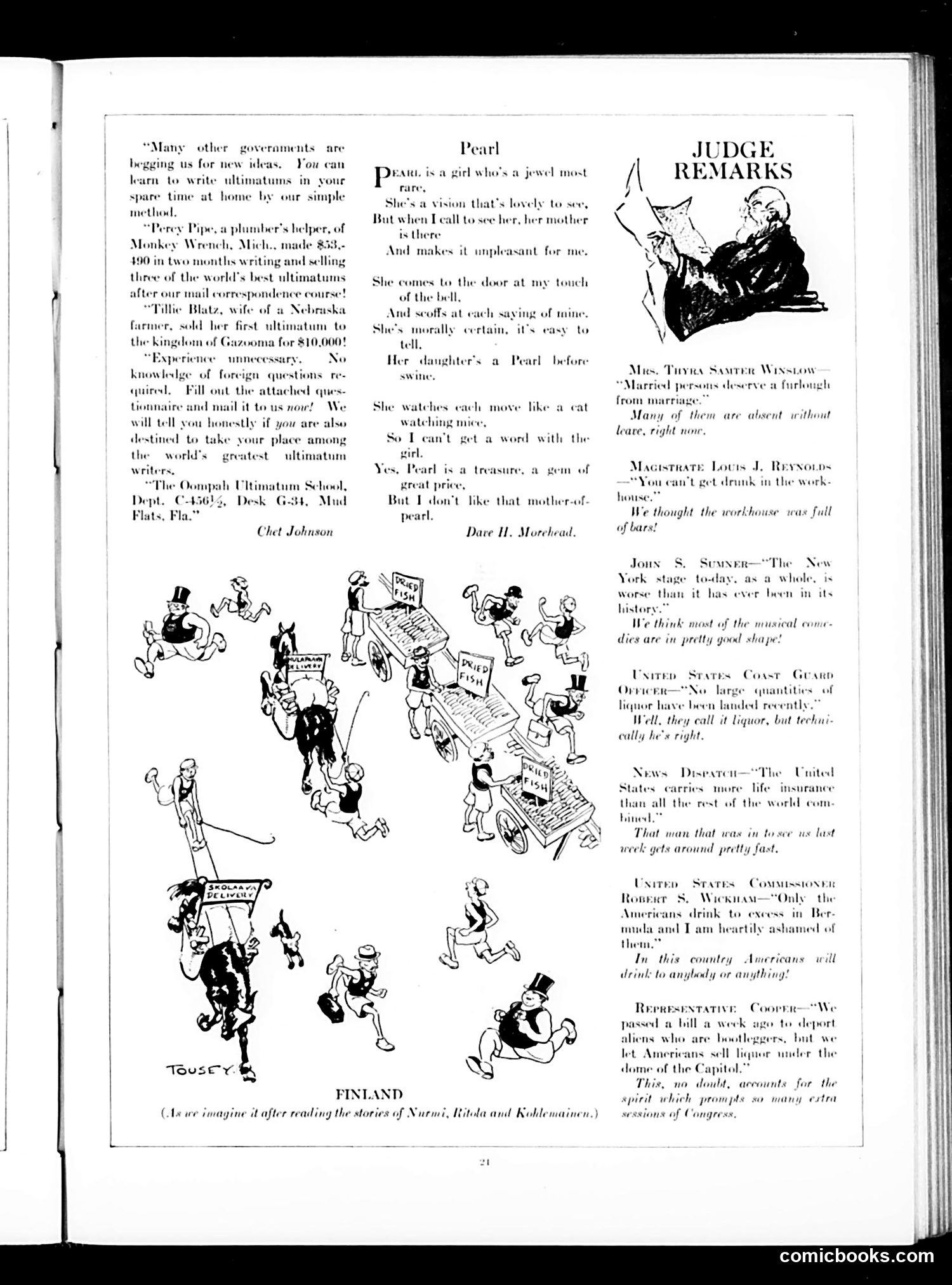
This page contains satirical commentary typical of Judge magazine's early 20th-century style. **Main Content:** The "Ultimatum School" advertisement parodies correspondence courses that promised quick wealth. It mocks the idea that ordinary Americans (a plumber's helper, a farmer's wife) could write diplomatic ultimatums and sell them to foreign governments—a joke about American diplomatic overconfidence and the proliferation of get-rich-quick schemes. **"Pearl" Poem:** A romantic comedy about a suitor frustrated by an overbearing, moralistic mother-in-law who guards her daughter jealously. The pun "mother-of-pearl" concludes the complaint. **Finland Cartoon:** The illustration depicts chaotic scenes labeled "Finland," likely satirizing Finnish athletes (Nurmi, Ritola, Kohlemainen were famous Finnish distance runners of the era). The exaggerated cartoon style suggests Judge was joking about Finland's athletic dominance or national character. **"Judge Remarks":** A standard feature offering humorous observations from public figures, typically contradicting their statements with ironic counterpoints—here about marriage, drunkenness, theater quality, and immigration policy.
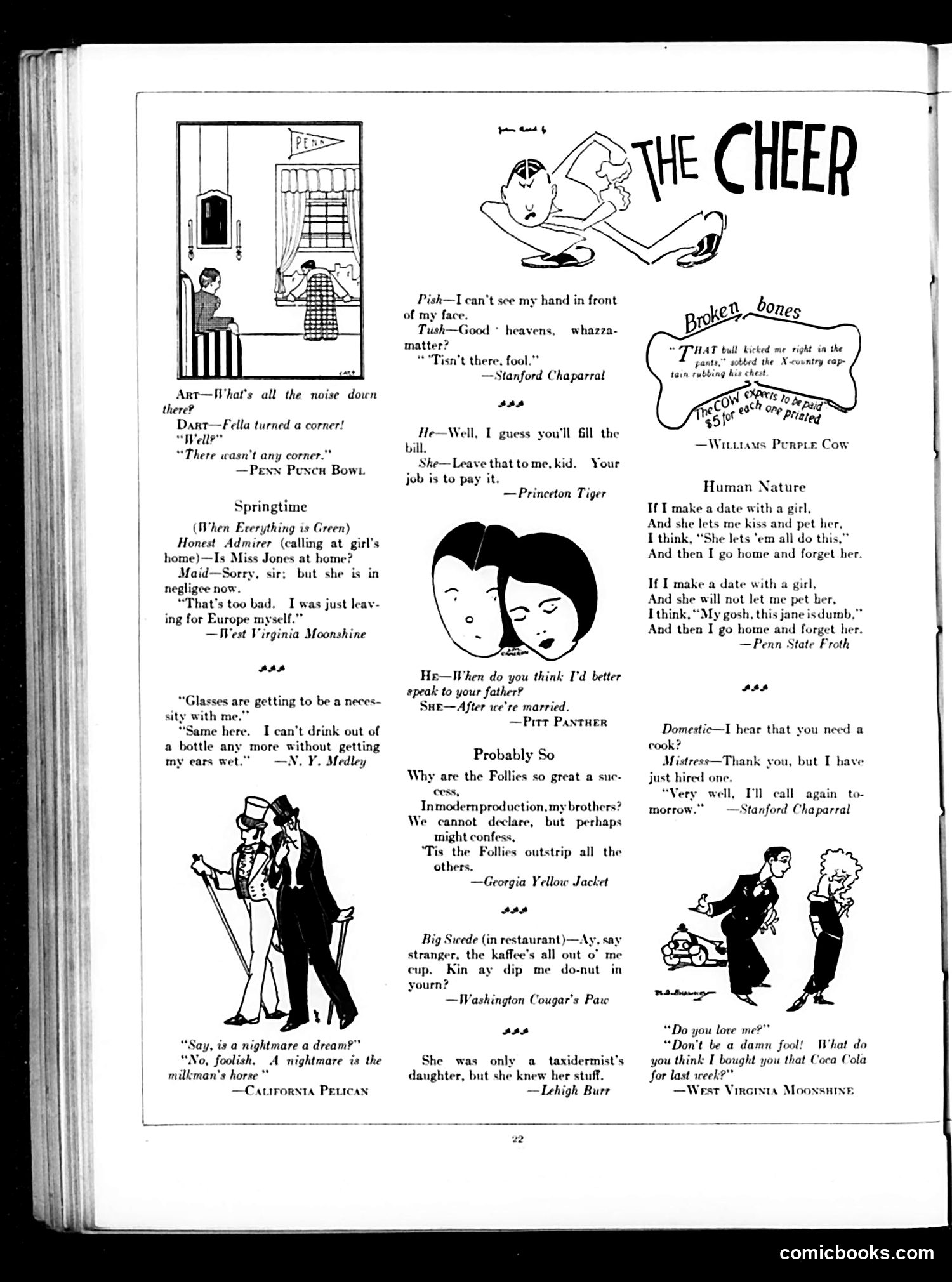
This is a collection of brief jokes and one-liners from various college humor magazines, organized thematically around dating, romance, and social situations. The content reflects early 20th-century collegiate humor. **Key themes:** - **Dating etiquette**: Jokes about courting, marriage proposals, and romantic awkwardness - **Gender dynamics**: Humor centered on young women's behavior and male confusion (e.g., the "taxidermist's daughter" joke playing on double meanings) - **Class/accent humor**: The "Big Swede" character uses exaggerated dialect, typical of period ethnic humor - **College culture**: Multiple attributions to Penn State, Princeton, Stanford suggest this targets university audiences **The satire**: These aren't political cartoons but rather gentle social satire about courtship customs, changing attitudes toward women's independence, and the confusion between traditional propriety and modern behavior. The humor is largely observational rather than biting—poking fun at dating confusion rather than attacking institutions. The page reflects 1920s-era attitudes toward romance and gender roles that would seem dated or offensive today.
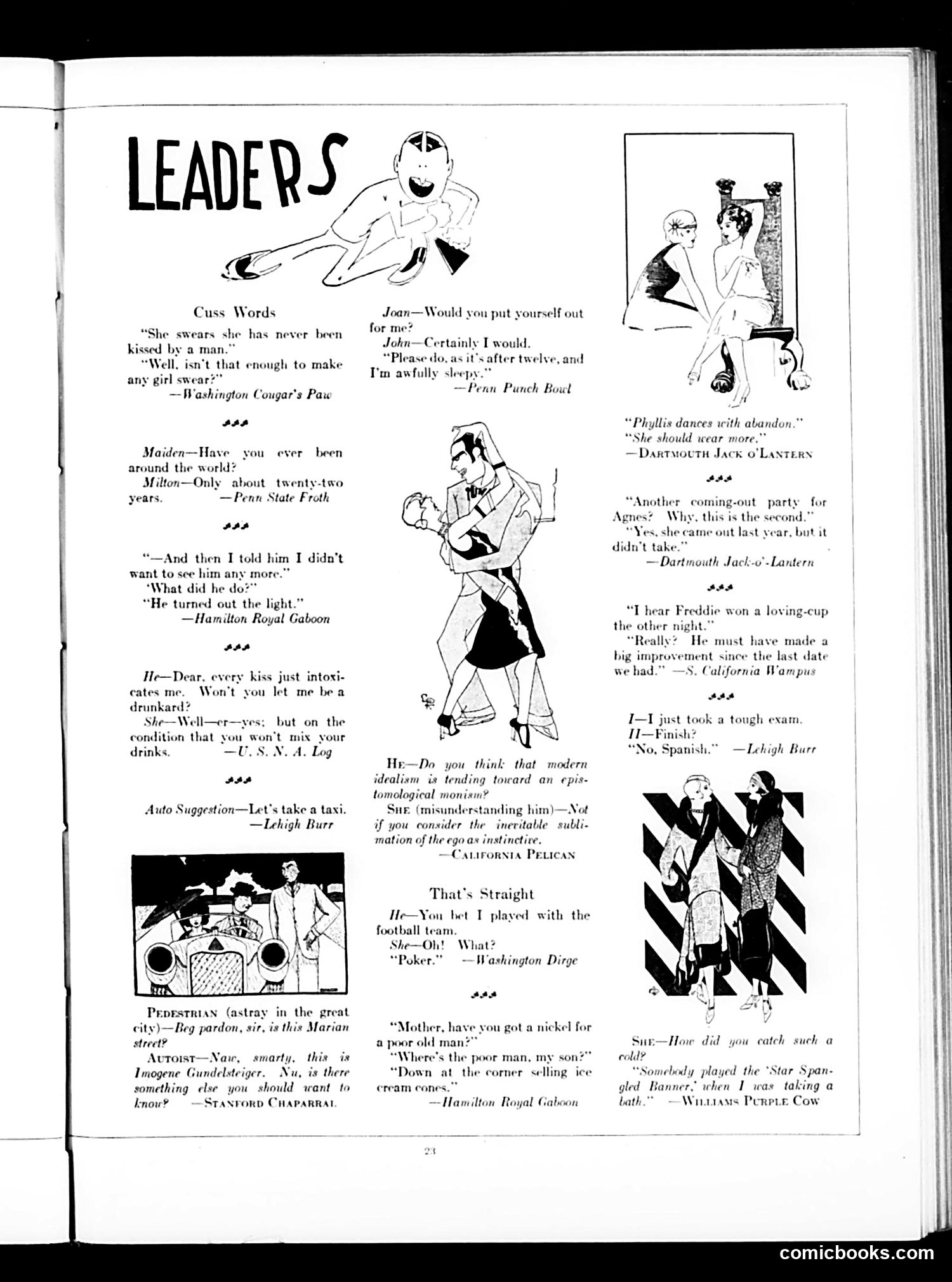
This page from *Judge* magazine collects brief humorous quips and one-panel jokes organized under the heading "Leaders"—likely meaning popular or trending jokes circulating among college publications. The humor derives from **misunderstandings and double meanings**: a woman who won't be kissed swearing (curse words), a man claiming to have "traveled" by living twenty-two years, a couple's goodnight kiss interrupted by turning off lights, and a drunk playing "poker" (not football). One joke satirizes **pretentious academic speech**: a woman nonsensically parroting philosophical jargon back to a man using it to impress her—mocking intellectualism as performative. The illustrations show **flapper-era dating scenarios** typical of 1920s college humor: young people in modern, informal relationships. References to "coming-out parties," loving-cups (trophies), and exam anxiety anchor these in contemporary campus life. The *sources*—Penn State, Stanford, Dartmouth, Lehigh—indicate these are reprinted from college humor magazines, creating a national collection of collegiate wit.
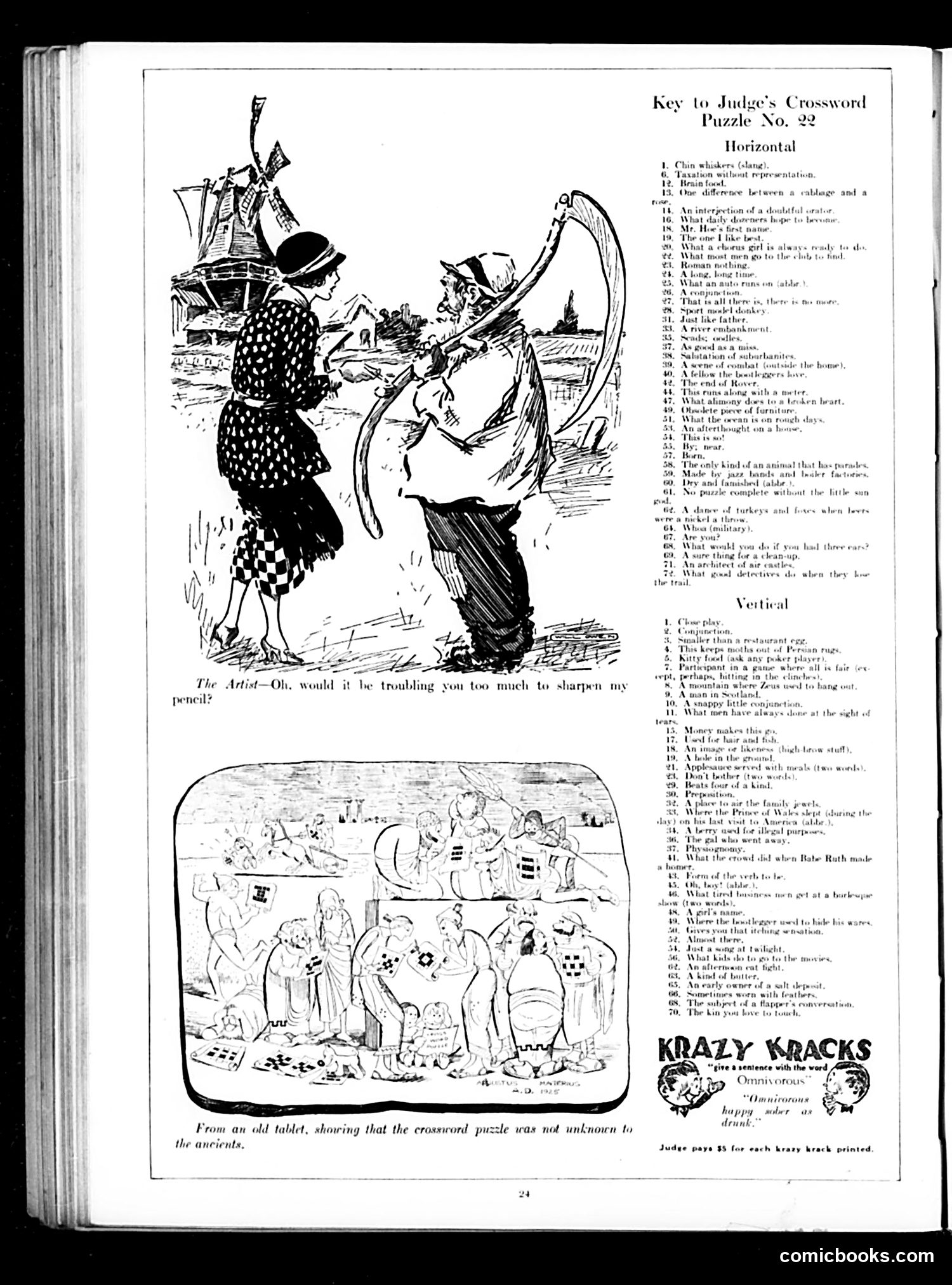
This page contains two satirical cartoons about crossword puzzles, a craze sweeping America in the 1920s. **Top cartoon:** An artist appeals to a fashionable woman to sharpen his pencil, humorously suggesting that crossword puzzle-solving has worn down his pencil to a stub—a jab at the obsessive popularity of the puzzle craze. **Bottom cartoon:** Labeled "From an old tablet, showing that the crossword puzzle was not unknown to the ancients," this mock-historical image depicts ancient people engaged in what appears to be puzzle-solving activities. The satire mocks the crossword craze's overwhelming cultural dominance by sarcastically suggesting it's an ancient, timeless obsession rather than a new fad. Both cartoons ridicule how thoroughly crossword puzzles had captured the public imagination during this period, presenting the phenomenon as both frivolous and comically all-consuming.
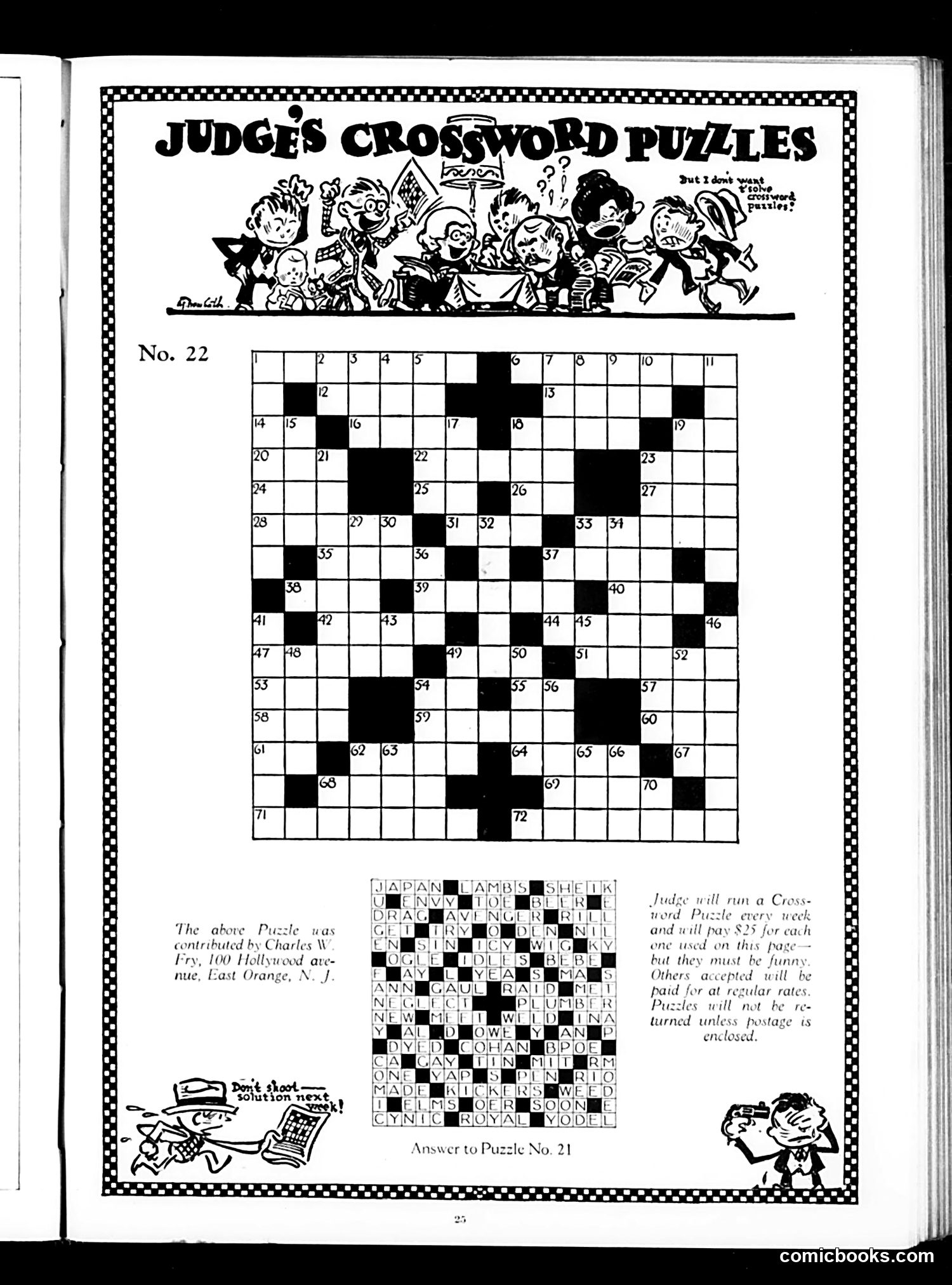
This page presents a crossword puzzle competition from Judge magazine, a prominent American satirical publication. The puzzle itself is untitled and appears to be purely recreational—a standalone word game with no apparent political or social satire embedded in its structure. The page includes an answer key to the previous puzzle (No. 21) and advertising copy explaining Judge's puzzle contest: the magazine will pay $25 for accepted puzzles, with other submissions compensated at regular rates, provided they're humorous. Puzzles won't be returned without postage. The contributor credited is Charles W. Fry of East Orange, New Jersey. The cartoon illustrations are generic decorative elements typical of Judge's playful visual style, featuring whimsical characters unrelated to specific political references. This appears to be primarily entertainment content rather than satirical commentary.
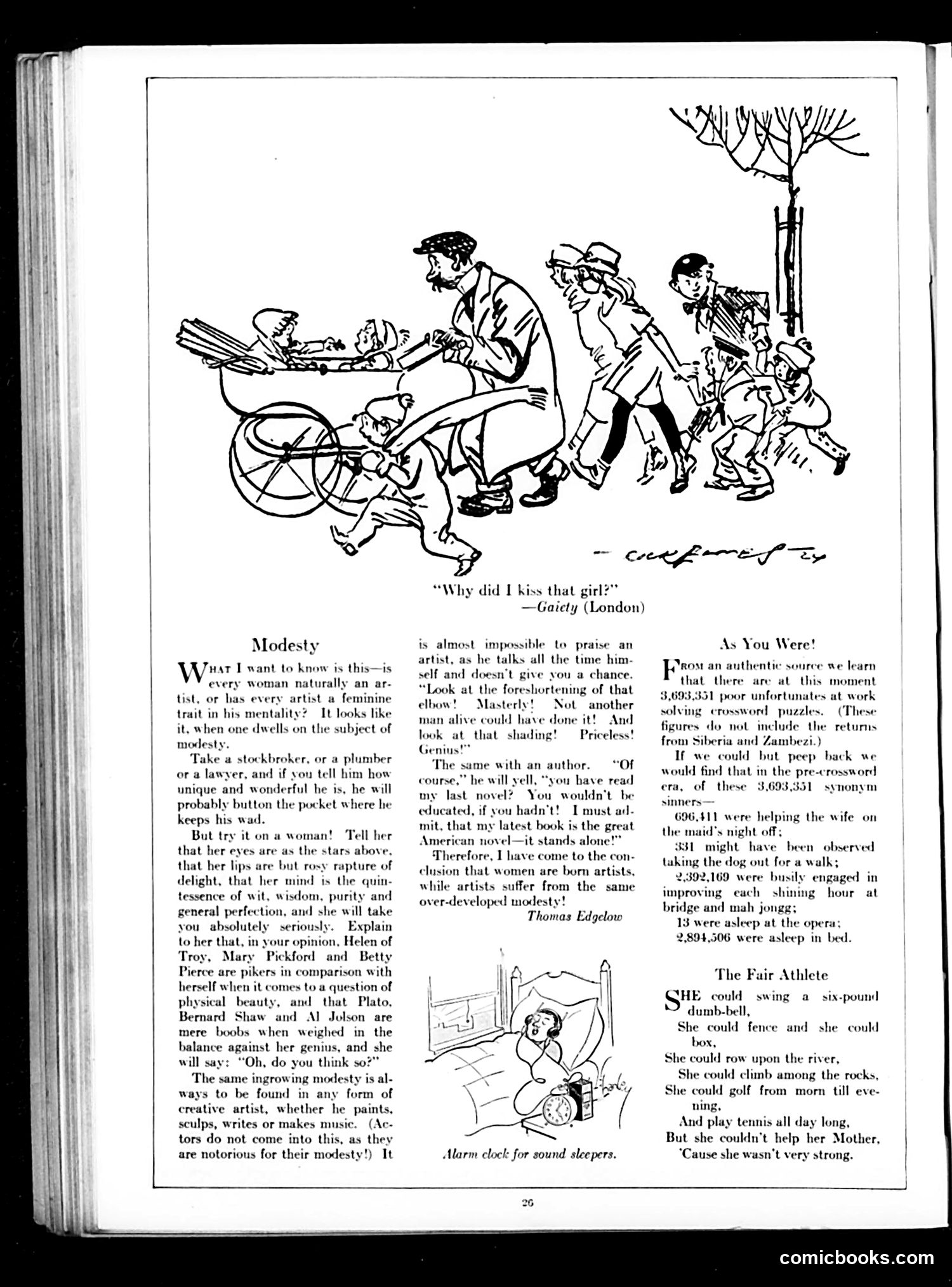
**Main Cartoon (top):** Depicts a man pushing a baby carriage while surrounded by multiple children following behind. The caption "'Why did I kiss that girl?'" (attributed to Gaiety, London) is a crude joke implying the man is responsible for all these children—mocking his romantic/sexual decisions. **"Modesty" Essay:** A humorous critique contrasting how men and women respond to flattery. The author argues women (and artists generally) fish for compliments and accept praise earnestly, while businessmen dismiss it. He concludes women are naturally artists because they share artists' excessive vanity. The piece satirizes both feminine affectation and artistic ego. **"As You Were!":** Statistical satire about the recent crossword puzzle craze, humorously cataloging what 3.6+ million people were doing before crosswords became a fad—sleeping, playing cards, helping wives. It mocks the puzzle's sudden popularity. **"The Fair Athlete":** A poem ironically praising a woman's athletic prowess (weightlifting, fencing, rowing, golfing, tennis) while she "couldn't help her Mother / 'Cause she wasn't very strong"—satire on the contradiction between modern athletic women and traditional domestic expectations.
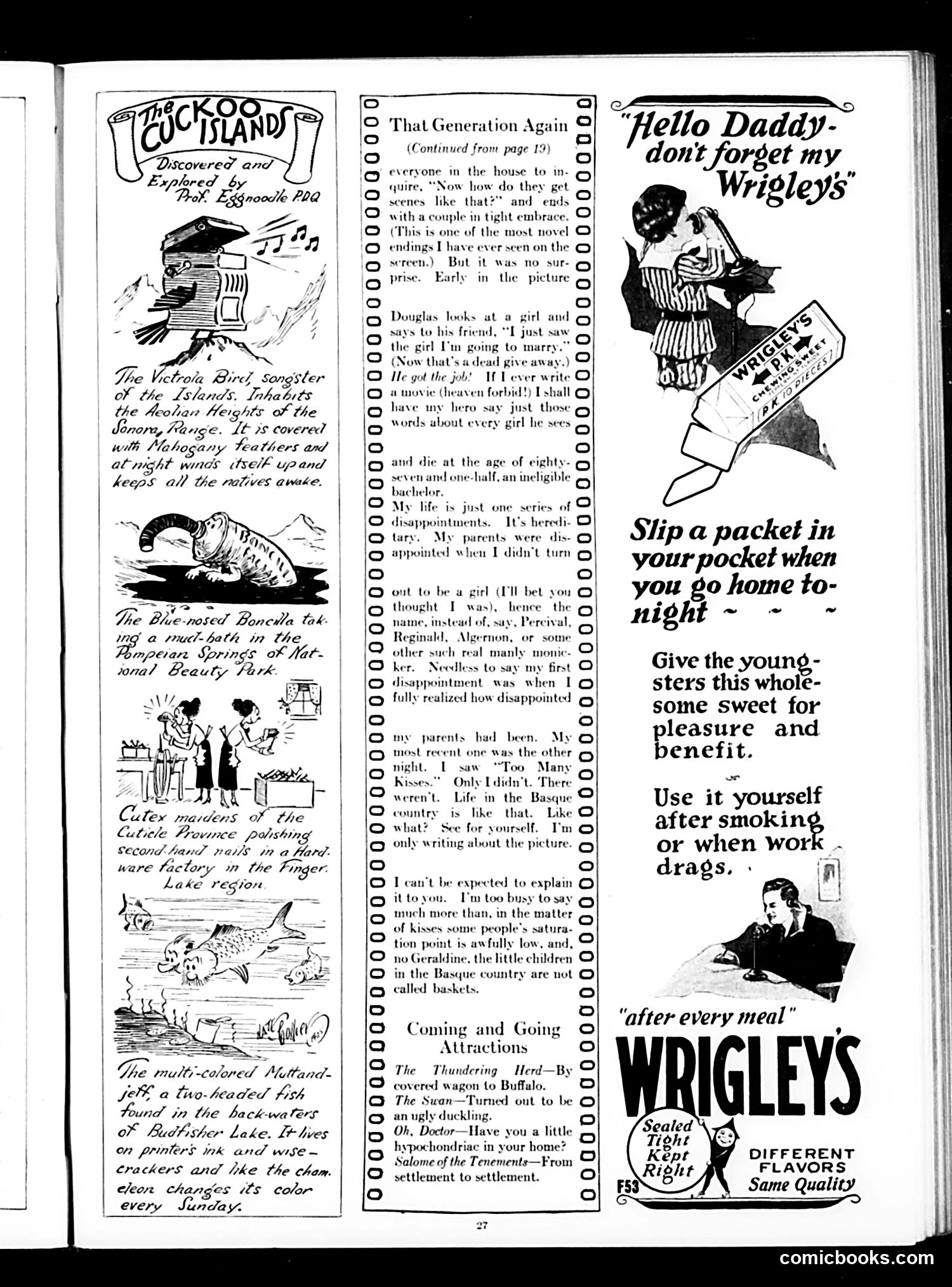
This page contains two distinct elements: **Left side:** "The Cuckoo Islands" is a mock-naturalist feature satirizing film reviews. It presents imaginary creatures with names like "Victrola Bird Songster" and "Blue-nosed Boncila"—absurd inventions presented as if discovered by "Prof. Egnoode PhD." This is humorous pseudo-scientific nonsense, likely mocking overwrought nature documentaries or pretentious film criticism of the era. **Center:** A film review titled "That Generation Again" critiques a Douglas Fairbanks movie (likely from the 1920s), complaining that modern films rely on romance and kissing rather than plot substance. The reviewer humorously laments that every Fairbanks film follows the same formula: boy sees girl, boy announces he'll marry her, film ends with an embrace. **Right side:** A Wrigley's chewing gum advertisement targeting parents, suggesting they give gum to children as a "wholesome sweet" and use it themselves to freshen breath after smoking or work fatigue—framing gum as a practical aid rather than mere candy.
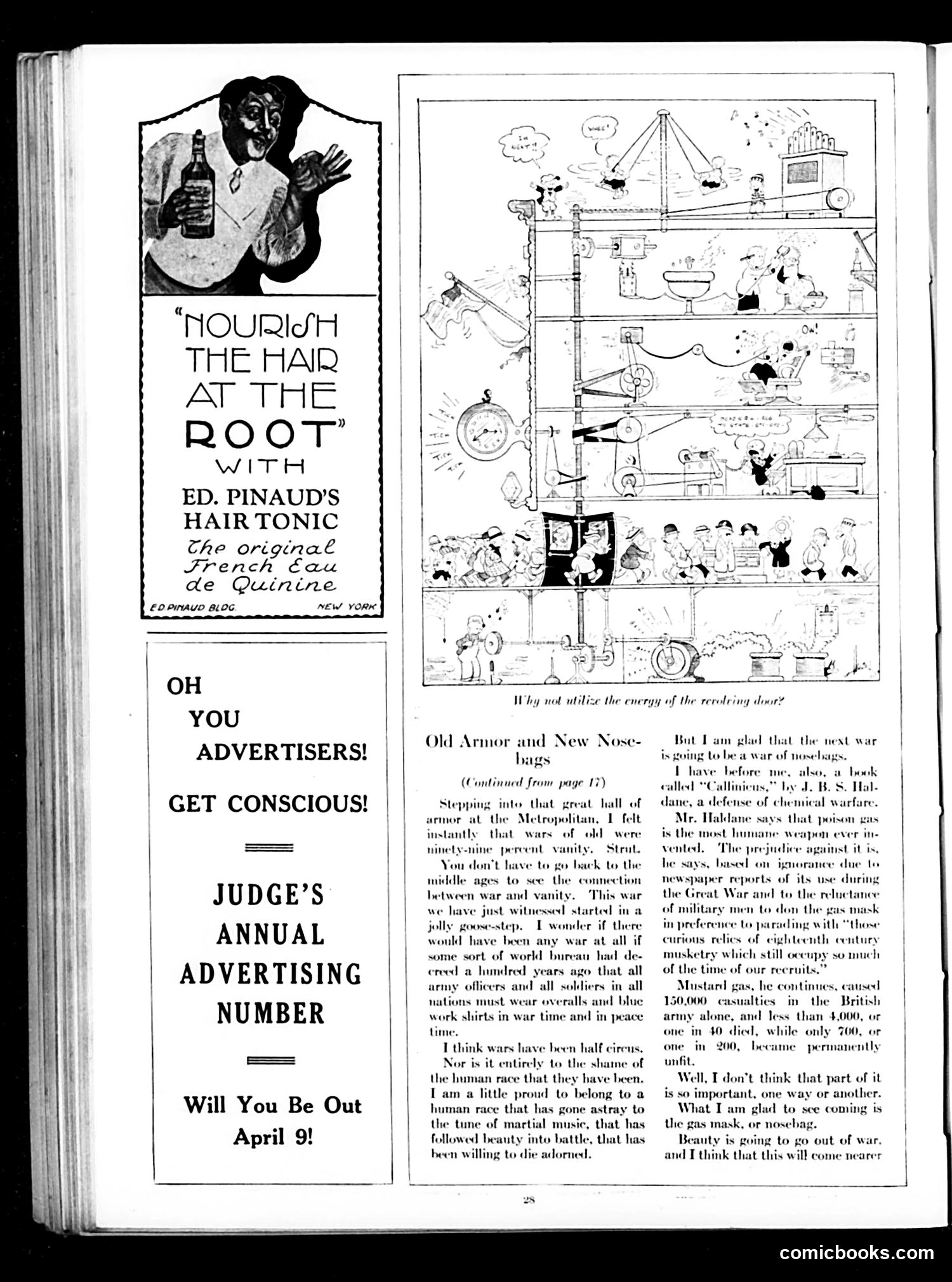
This page combines advertising with editorial content from Judge's Annual Advertising Number (dated April 9). **Left side:** An advertisement for Ed. Pinaud's Hair Tonic, a French product marketed with a caricatured male face and period typography typical of early 20th-century ads. **Right side:** An illustrated article titled "Old Armor and New Nosebags" discusses how vanity has driven military display throughout history. The author argues that wars have been "half circus," with soldiers willing to die adorned in impressive uniforms. However, he expresses optimism that poison gas warfare will eliminate this vanity—gas masks ("nosebags") will make soldiers ugly and uniform, finally removing beauty from combat. He cites J.H.S. Haldane's claims that mustard gas, despite its reputation, caused fewer casualties than traditional warfare methods. **The satire:** The piece darkly jokes that dehumanizing warfare technology might finally accomplish what reason couldn't—stripping war of its romantic appeal by making soldiers literally faceless.
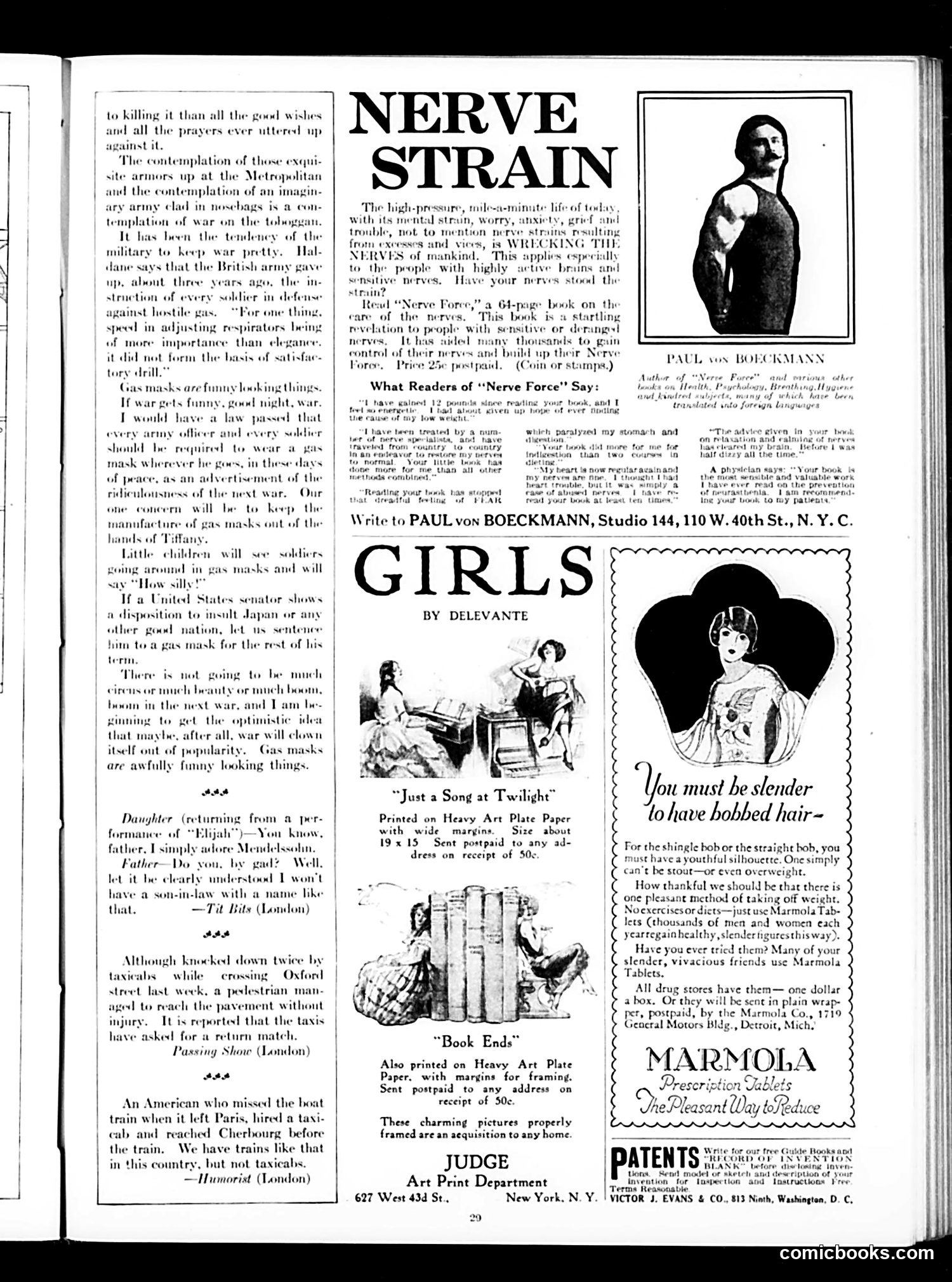
This page combines editorial commentary with advertisements typical of early 20th-century satirical magazines. **Main Content - "Nerve Strain":** The editorial critiques the absurdity of modern warfare by focusing on gas masks. It sarcastically argues that if gas masks look ridiculous, war itself becomes comedic and loses its supposed dignity. The author suggests that making soldiers and officials wear gas masks in everyday life would expose war's fundamental absurdity to the public—particularly children, who would recognize how "silly" it all is. This appears to be anti-war sentiment critiquing military preparation and glorification, likely written during or shortly after WWI when chemical weapons became a concern. **Advertisements:** The page includes ads for "Nerve Force" (a patent medicine claiming to cure nervous strain), art prints, and Marmola tablets (a weight-loss product tied to the contemporary "bobbed hair" fashion requiring slenderness). **Humor Snippets:** Brief jokes from other publications mock pretentious names, taxi safety, and train service—standard period humor.
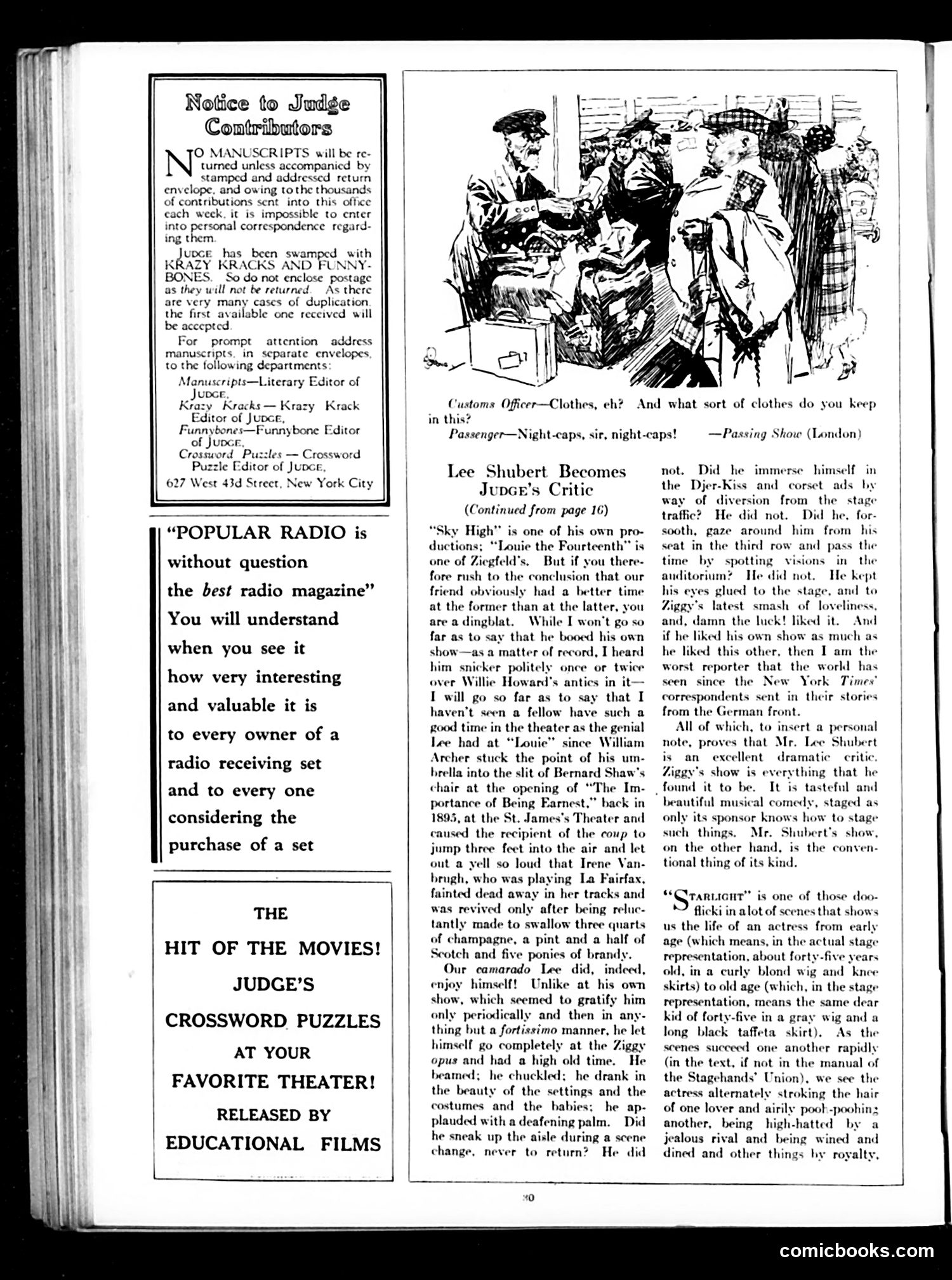
This page contains primarily **administrative notices and advertisements** rather than political satire. The main cartoon depicts a **customs inspection scene** at what appears to be a border crossing. A customs officer questions a passenger about clothing in their luggage. The passenger replies "Night-caps, sir, night-caps!"—a play on words suggesting sleeping caps rather than actual garments. This is a mild visual pun typical of Judge's humor, likely referencing smuggling concerns or travel stereotypes of the era, though the specific historical context is unclear. The bulk of the page comprises **editorial notices** about manuscript submissions, advertisements for "Popular Radio" magazine and crossword puzzle films, and a theater review of a Lee Shubert production. There is **no significant political satire** visible. The review praises Shubert's dramatic criticism abilities while describing his enthusiasm for a Ziegfeld show.
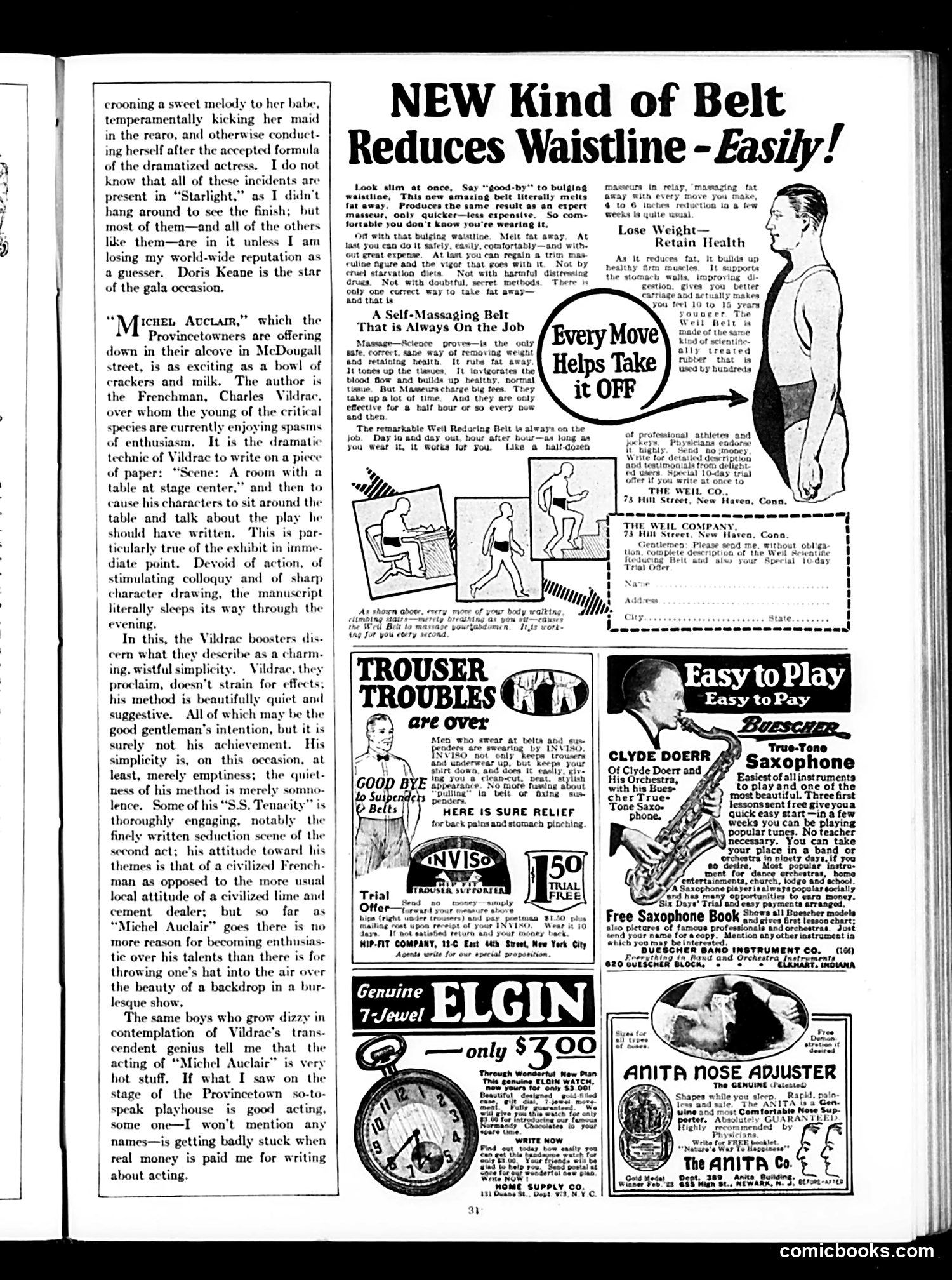
This page is primarily **advertising**, not editorial cartooning. The main content is a theater review by what appears to be a drama critic discussing plays including "Starlight" (starring Doris Keane) and "Michel Auclair" by French playwright Charles Vildrac. The bulk of the page features **vintage product advertisements** typical of 1920s magazines: a "reducing belt" promising weight loss through massage, a saxophone mail-order course, an Elgin watch, trouser press, and a nose adjuster device. The satire here is **implicit rather than explicit**—these ads themselves are somewhat absurd by modern standards (the nose adjuster promising to reshape one's nose, the magical reducing belt). However, Judge magazine's readers would have recognized these as legitimate contemporary products, not parodies. The magazine simply juxtaposed serious drama criticism with dubious health/beauty products, allowing readers to draw their own conclusions about American consumer culture. No specific political figures or events are referenced on this page.
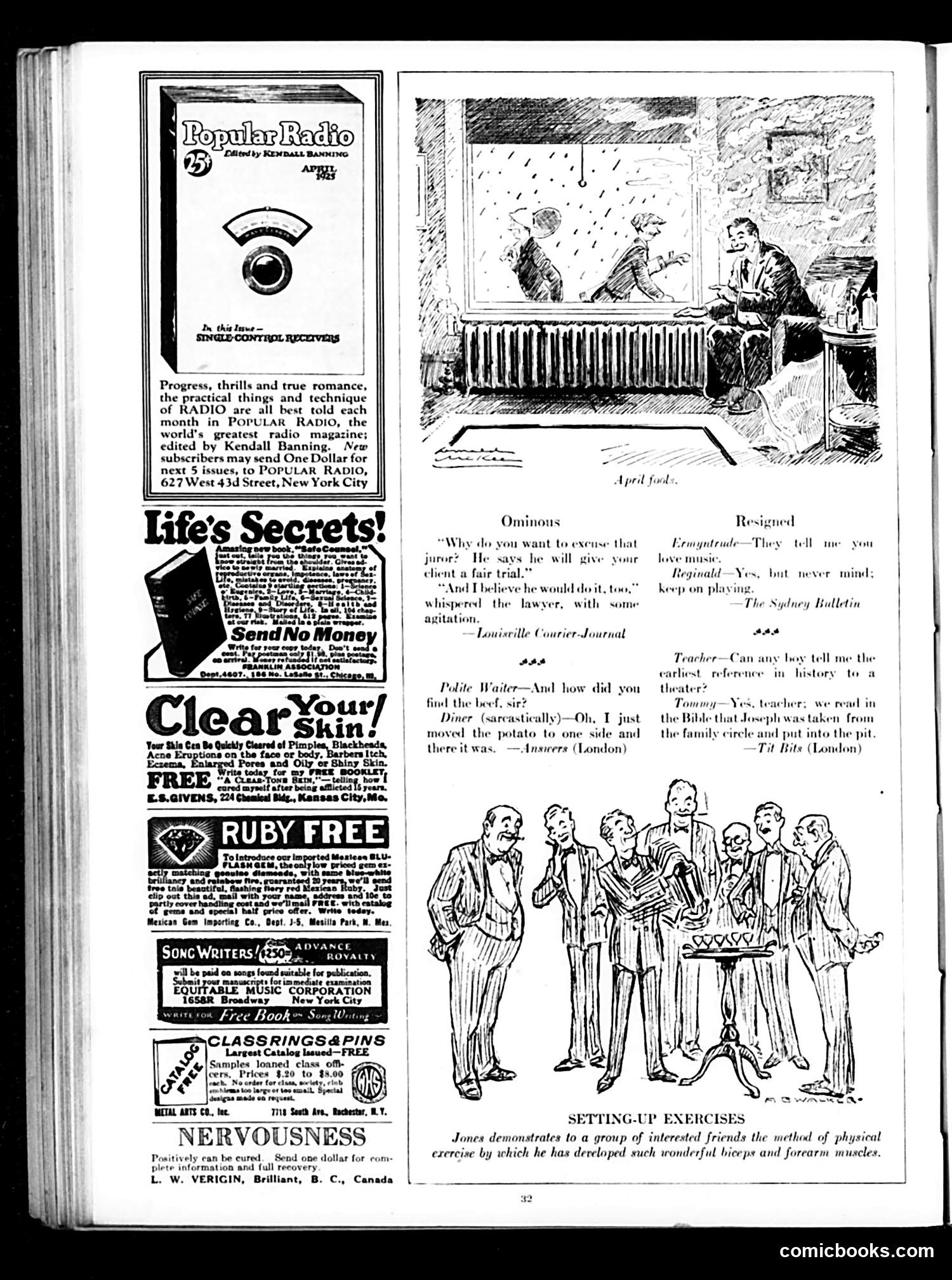
This page is primarily **advertisements and humor snippets** rather than political satire. The content includes: **Visual Content:** - Top right: A cartoon titled "April Fools" showing two men at a window during rain—likely depicting a practical joke or foolish situation. - Bottom: "Setting-Up Exercises"—a sketch of a man demonstrating physical fitness to friends, playing on the 1920s fitness craze. **Humor Pieces:** Four brief jokes about lawyers being untrustworthy ("will give your client a fair trial"), a waiter's sarcasm about finding a potato instead of beef, a woman named Ermyntrude who loves but won't stop playing music, and a teacher's joke about Joseph being put in a pit (biblical wordplay). **Advertisements:** The left column contains numerous ads: Popular Radio magazine, "Life's Secrets" book, skin treatments, ruby gemstones, songwriting royalties, and class rings—typical early-1920s mail-order offerings. The page reflects **general humor and consumer culture** rather than political commentary.
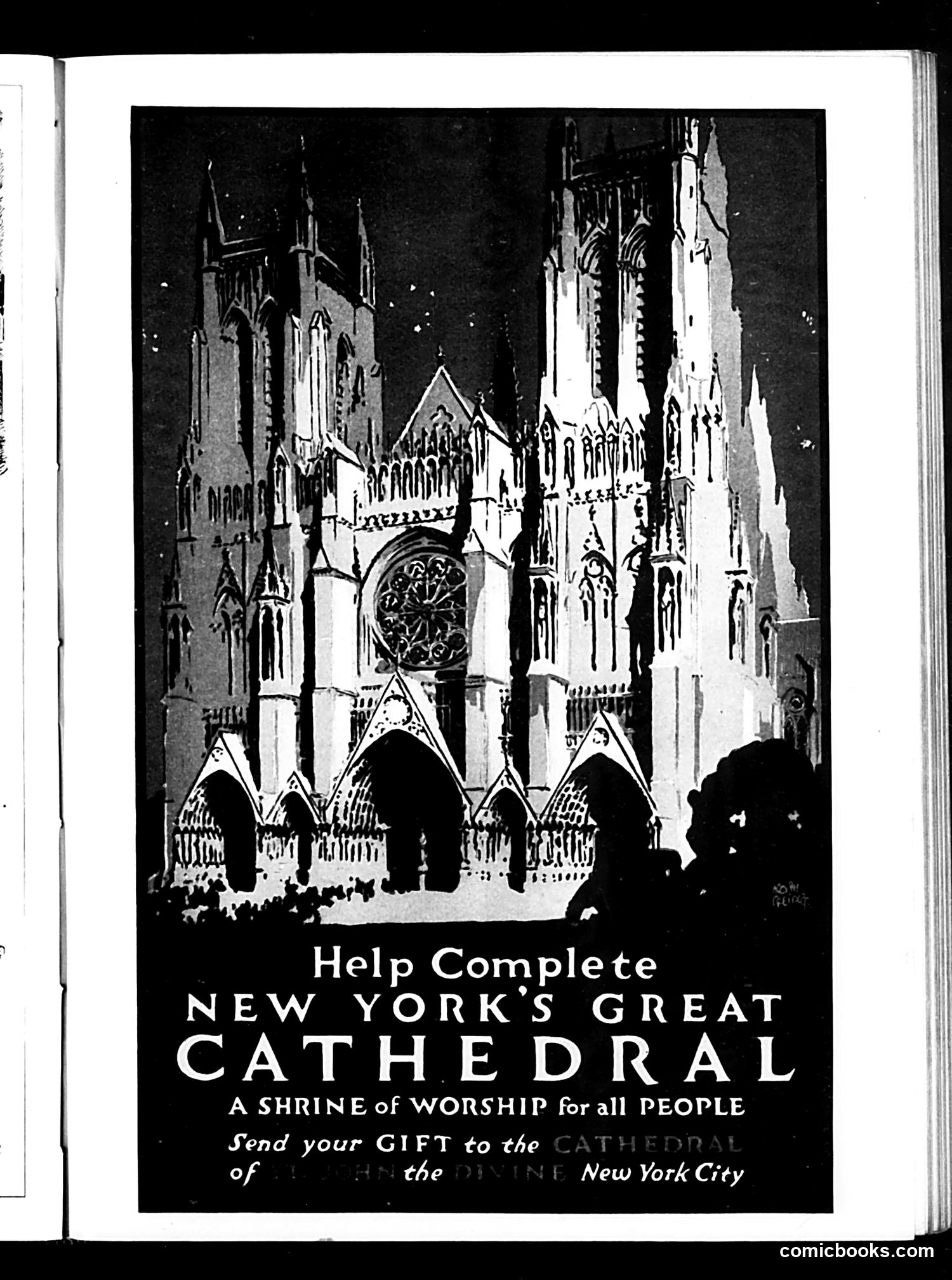
This appears to be a fundraising advertisement rather than political satire. It promotes donations to complete New York's great cathedral—likely the Cathedral of St. John the Divine in Manhattan, which was under construction for decades (begun 1892, still incomplete today). The dramatic nighttime illustration emphasizes the Gothic structure's grand, incomplete state with its soaring towers and ornate details. The appeal's language—"A SHRINE of WORSHIP for all PEOPLE"—suggests ecumenical or inclusive religious messaging typical of early-to-mid 20th century cathedral fundraising. Rather than satirizing individuals or events, this is a straightforward charitable solicitation leveraging Judge magazine's readership to support the cathedral's completion. No specific political figures or social commentary are evident.
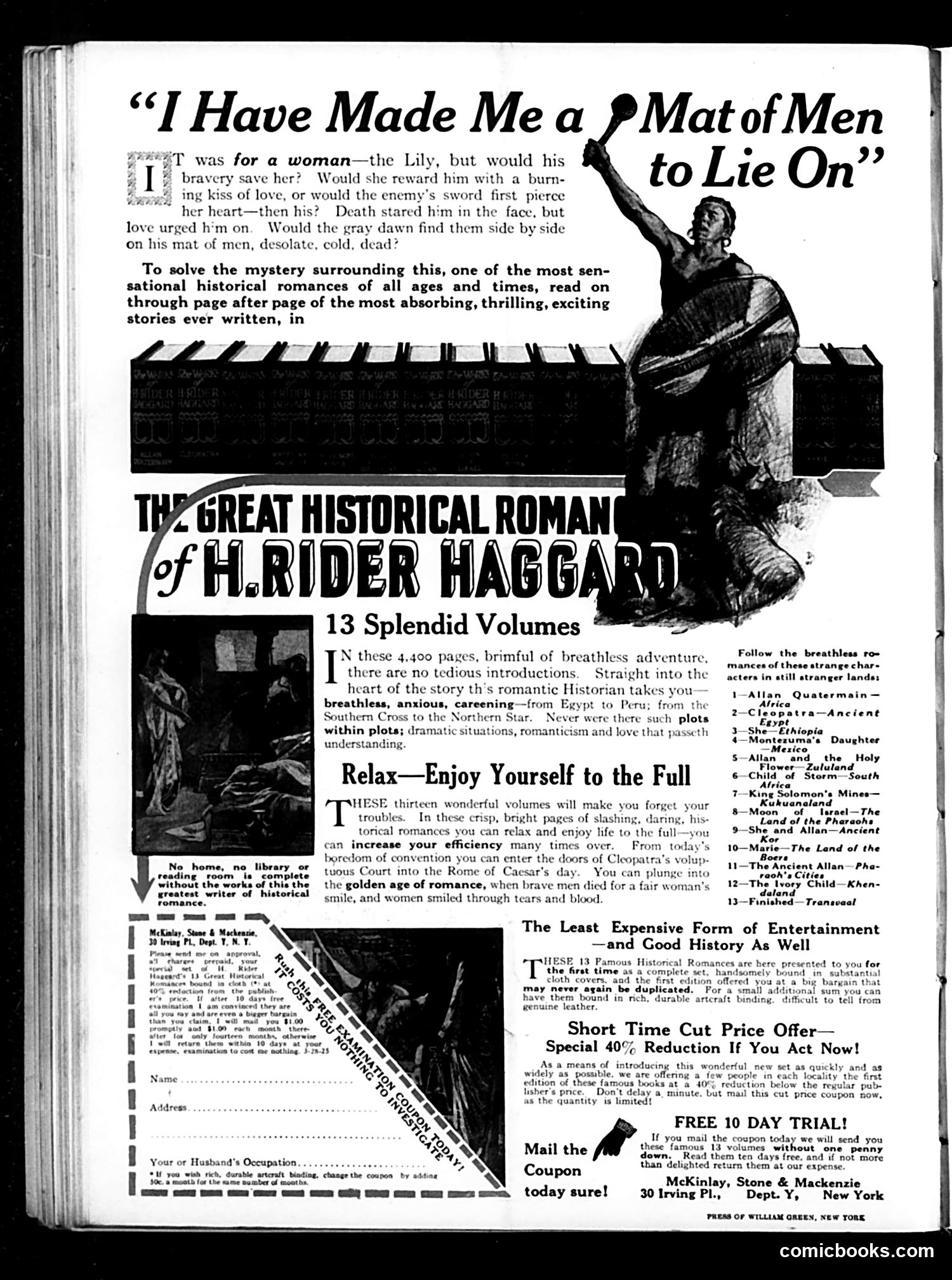
This page is primarily an **advertisement**, not satire or political commentary. It promotes a 13-volume collection of adventure novels by H. Rider Haggard, the Victorian adventure writer. The dramatic opening text—about a woman called "the Lily" and a soldier facing death—appears designed to hook readers with romantic melodrama. The accompanying illustration shows a muscular man in colonial dress, evoking Haggard's famous protagonist Allan Quatermain. The list of titles reveals the collection's focus: exotic colonial adventure across Africa, Egypt, Peru, and Mexico (*King Solomon's Mines*, *She*, *Allan Quatermain*). These were enormously popular escape literature. The pitch emphasizes relaxation ("forget your troubles"), efficiency gains, and accessing glamorous historical worlds from Cleopatra to Caesar. A "40% reduction" and "10-day free trial" create urgency. This reflects early 20th-century magazine advertising—using dramatic prose, exotic imagery, and psychological appeals to promote entertainment as productivity-boosting leisure.