
Judge, 1925-03-28 · page 32 of 36
Judge — March 28, 1925 — page 32: what you’re looking at
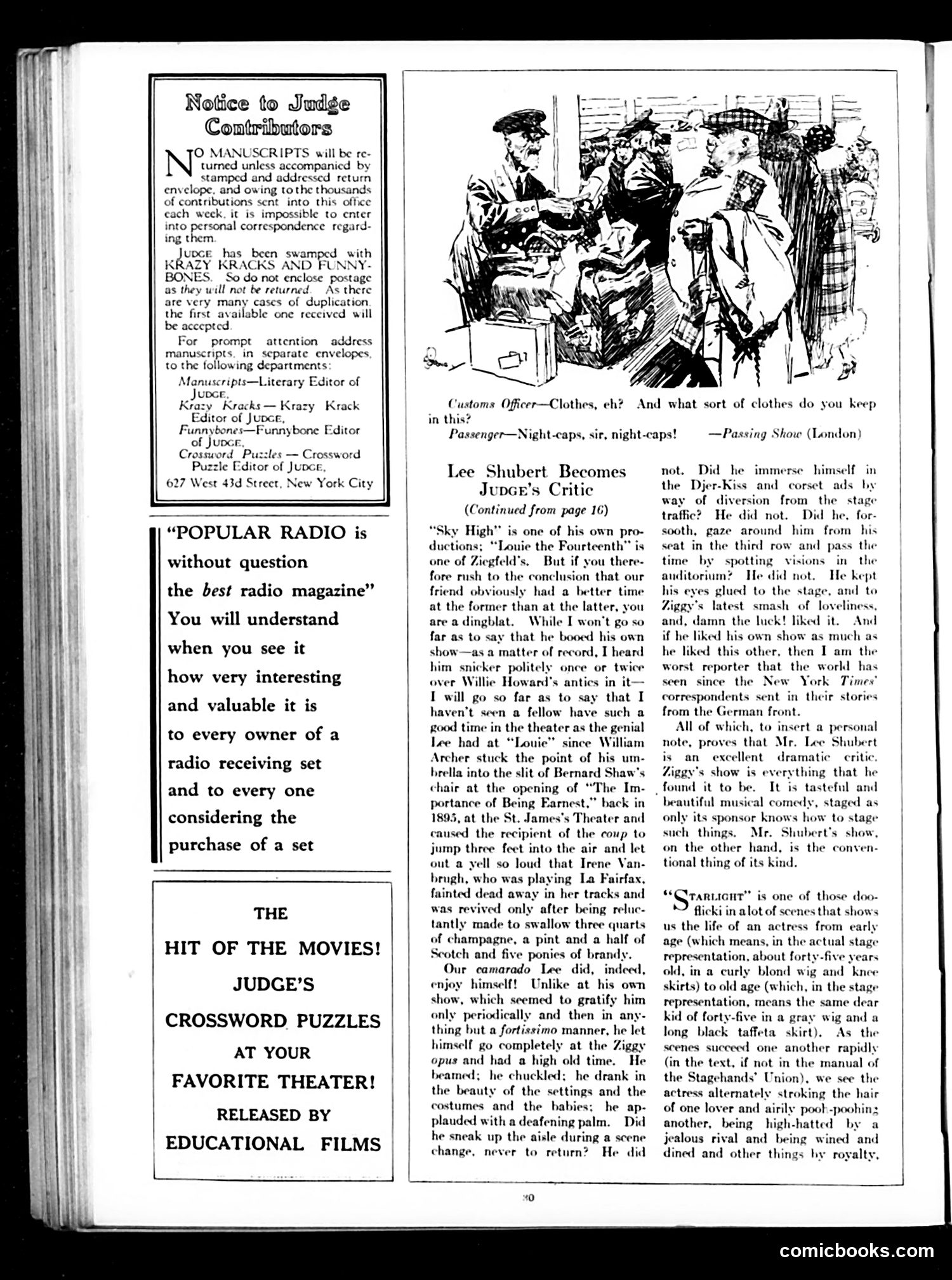
What you’re looking at
This page contains primarily **administrative notices and advertisements** rather than political satire. The main cartoon depicts a **customs inspection scene** at what appears to be a border crossing. A customs officer questions a passenger about clothing in their luggage. The passenger replies "Night-caps, sir, night-caps!"—a play on words suggesting sleeping caps rather than actual garments. This is a mild visual pun typical of Judge's humor, likely referencing smuggling concerns or travel stereotypes of the era, though the specific historical context is unclear. The bulk of the page comprises **editorial notices** about manuscript submissions, advertisements for "Popular Radio" magazine and crossword puzzle films, and a theater review of a Lee Shubert production. There is **no significant political satire** visible. The review praises Shubert's dramatic criticism abilities while describing his enthusiasm for a Ziegfeld show.
📄 Transcribed text from this page (OCR, searchable)
Machine-transcribed from the original scan — historical spelling and the odd misread are preserved.
Notice to Judge Contributors O MANUSCRIPTS will be re- N tumed unless accompanied by stamped and addressed return envelope, and owing tothe thousands of contributions sent into this office cach week. it is impossible to enter into personal correspondence regard- ing them. upce has been swamped with KRAZY KRACKS AND FUNNY- BONES. So do not enclose postage as they will not be returned. As there are very many cases of duplication. the first available one received will be accepted For prompt attention address manuscripts. in separate envelopes. to the following departments Manuscripts—Literary Editor of Juoce Krazy Kracks— Krazy Krack Editor of Juoce, Funnybones—Funnybone Editor of JuDcE Crossw Puzzles — Crossword Pu: ditor of JuDce, 627 West 43d Street, New York City “POPULAR RADIO is without question the best radio magazine” You will understand when you see it how very interesting and valuable it is to every owner of a radio receiving set and to every one considering the purchase of a set eh THE HIT OF THE MOVIES! JUDGE’S CROSSWORD PUZZLES AT YOUR FAVORITE THEATER! | RELEASED BY EDUCATIONAL FILMS Customs Officer—Clothes, eh? And what sort of clothes do you keep in th Passenger—Night-caps, sir, night-caps! Lee Shubert Becomes Jupce’s Critic (Continued from page 16) is one of his own pro- Auie the Fourteenth” is one of Zicgfeld’s, But if you there- fore rush to the conclusion that our friend obviously had a better time at the former than at the latter, you are adingblat. While I won't go so far as to say that he booed his own show—as a matter of record, I heard him snicker politely once or twice over Willie Howard’s antics in it— I will go so far as to say that I haven't seen a fellow have such a good time in the theater as the genial lee had at “Louie” since William Archer stuck the point of his um- brella into the slit of Bernard Shaw's chair at the opening of “The Im- portance of Being Earnest,” back in 1895, at the St. James's Theater and caused the recipient of the coup to jump three feet into the air and let out a yell so loud that Irene Van- brugh, who was playing La Fairfax, fainted dead away in her tracks and was revived only after being reluc- tantly made to swallow three quarts of champagne, a pint and a half of Scotch and five ponies of brandy. Our camarado Lee did, indeed, enjoy himself! Unlike at his own show, which seemed to gratify him only periodically and then in any- thing but a fortissimo manner, he let himself go completely at the Ziggy opus and had a high old time. He beamed; he chuckled; he drank in the beauty of the settings and the costumes and the babies; he ap- plauded with a deafening palm. Did he sneak up the aisle during a scene change, never to return? He did found it to be. It is —Passing Show (London) not. Did he immerse himself in the Djer-Kiss and corset ads by way of diversion from the st. traffic? He did not. Did he, for- sooth, gaze around him from his seat in the third row and pass the time by spotting vis auditorium? He didn hi glued to the stag: Ziggy’s latest smash and, damn the luck! liked it. And if he liked his own show as much as he liked this other, then I am the worst reporter that the world has seen since the New York Times’ correspondents sent in their stories from the German front. All of which, to insert a personal note, proves that Mr. Lee Shubert is an excellent’ dramatic critic, Ziggy's show is everything that he asteful and beautiful musical comedy, staged as only its sponsor knows how to stage such things. Mr. Shubert’s show, on the other hand, is the conven- tional thing of its kind. ns in the He kept nd to loveliness, **Qtariicnt” is one of those doo- ~* flicki in alot of scenes that shows us the life of an actress from early age (which means, in the actual stage representation, about forts old, in a curly blond wig and skirts) to old age (which, in the stage representation, means the same dear kid of forty-five in a gray wig and a long black taffeta skirt), As the scenes succeed one another rapidly (in the text, if not in the manual of the Stagehands’ Union), we see the actress alternately stroking the hair of one lover and airily pook-poohing another, being high-hatted by a jealous rival and being wined and dined and other things by royalty, comicbooks.com