
Judge, 1925-03-28 · page 17 of 36
Judge — March 28, 1925 — page 17: what you’re looking at
What you’re looking at
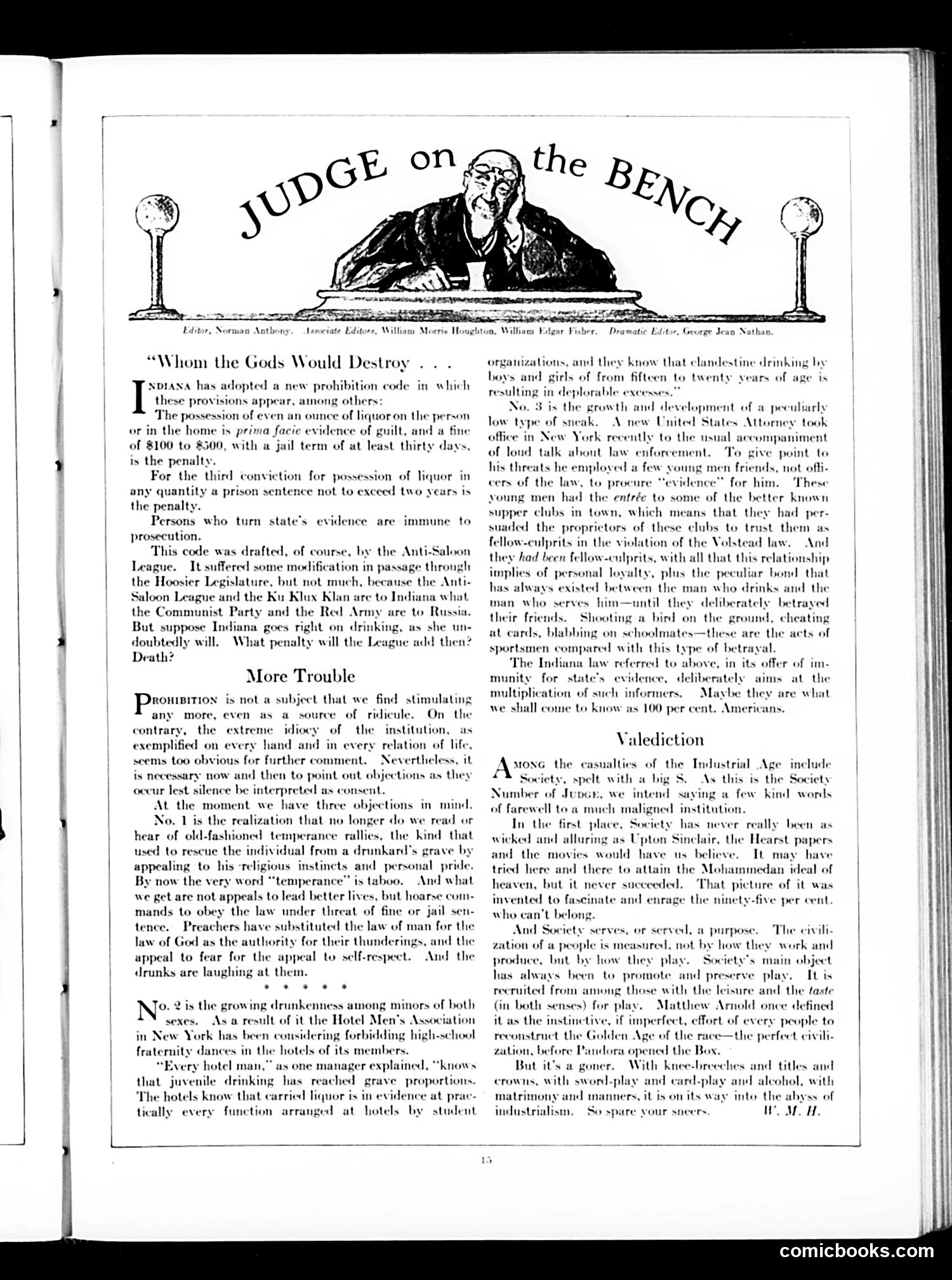
This page critiques **Prohibition enforcement** through three interconnected complaints: **The Main Cartoon** (header): Shows a stern judge presiding—visualizing the harsh judicial machinery of Prohibition. **Three Key Objections:** 1. **Lost moral appeal**: Prohibition replaced religious temperance appeals with legal threats. The satire: enforcement via fear rather than conscience makes drinkers laugh, not reform. 2. **Youth drinking surge**: Hotel managers report high schoolers openly bringing liquor to fraternity dances despite (or because of) Prohibition's existence. 3. **Corrupted enforcement**: A new U.S. Attorney hired young men posing as "friends" to infiltrate speakeasies and gather evidence against proprietors and patrons. The satire scorns this as **betrayal worse than cheating**—comparing entrapment to shooting birds on the ground. **The broader target**: Indiana's Anti-Saloon League and Ku Klux Klan's draconian code offering immunity to informants, which Judge sees as deliberately multiplying such betrayals. The satire argues Prohibition's enforcement mechanisms are morally corrupting society itself.
📄 Transcribed text from this page (OCR, searchable)
Machine-transcribed from the original scan — historical spelling and the odd misread are preserved.
en ee NDIANA has a new prohibition code in which I these provisions appear, among others: The possession of even an ounce of liquoron the person or in the home is prima facie evidence of guilt, and a fine of $100 to $500, with a jail term of at least thirty days, is the penalty. For the third conviction for possession of liquor in any quantity a prison sentence not to exceed two yeurs is the penalty. Persons who turn state’s evidence are immune to prosecution. This code was drafted, of course, by the Anti-Saloon League. It suffered some modification in passage through the Hoosier Legislature, but not much, because the Anti- Saloon League and the Ku Klux Klan are to Indiana what the Communist Party and the Red Army are to Russia. But suppose Indiana goes right on drinking. doubtedly will. Death? she un- What penalty will the League add then? More Trouble Promsrtios is not a subject that we find stimulating any more, even as a source of ridicule. On the contrary, the extreme idiocy of the institution, as exemplified on every hand and in every relation of life, seems too obvious for further comment. Nevertheless, it is necessary now and then to point out objections as they occur lest silence be interpreted as consent. At the moment we have three objections in- mind. No. 1 is the realization that no longer do we read or hear of old-fashioned temperance rallies, the kind that used to rescue the individual from a drunkard’s grave t appealing to his ‘religious instincts and personal pri By now the very word “temperance” is taboo. And what we get are not appeals to lead better lives, but hoarse com- mands to obey the law under threat of fine or jail sen- tence. Preachers have substituted the law of man for the law of God as the authority for their thunderings, and the And the appeal to fear for the appeal to self-respect. drunks are laughing at them. ee ee N°: 2 is the growing drunkenness among minors of both exes, Asa result of it the Hotel Men's Association in w York has been considering forbidding high-school fraternity dances in the hotels of its members. “Every hotel man,” as one manager explained, “knows that juvenile drinking has reached grave proportions. ‘The hotels know that carried liquor is in evidence at prac- tically every function arranged at hotels by student Dramatic Editor, George Jean Nathan. organizations, and they know that clandestine drinking by boys and girls of from fifteen to twenty years of age is resulting in deplorable No. 3 is the growth and development of a peculiarly low type of st A new United States Attorney took in New York recently to the usual accompaniment of loud talk about law enforcement. his threats he employed a few young men friends, not offi- cers of the law, to procure “evidence” for him. These young men had the entrée to some of the better known supper clubs in town, which means that they had per- suaded the proprietors of these clubs to trust them as fellow-culprits in the violation of the Volstead law. And they had been fellow-culprits, with all that this relationship implies of personal loyalty, plus the peculiar bond that has always existed between the man who drinks and the man who serves him—until they deliberately betrayed their friends. Shooting a bird on the ground, cheating at cards, blabbing on schoolmates—the are the acts of sportsmen compared with this type of betrayal. The Indiana law referred to above, in its offer of im- munity for state's evidence, deliberately aims at the multiplication of such informers. Maybe they are what we shall come to know as 100 per cent. Americans. office To give point to Valediction A wore the casualties of the Industrial F® Society, spelt with a big S. As this is the Society Number of Jupce, we intend saying of farewell to a mic aligned institutio: In the first place, Society has never re wicked and alluring as Upton Sinclair, the Hearst papers and the movies would have us believe. It may have tried here and there to attain the Mohammedan ideal of heaven, but it never succeeded. That picture of it was invented to fascinate and enrage the ninety-five per cent who can’t belong. Age include few kind words And Society serves, or served, a purpose. The civili- zation of a people is measured, not by how they work produce, but by how they play. Society's main object has always been to promote and preserve. f It is recruited from among those with the leisure and the taste (in both senses) for play. Matthew Arnold once defined it as the instinctive, if imperfect, effort of every people to reconstruct the Golden Age of the race—the perfect civili- zation, before Pandora opened the Box. But it’s a goner. With knee-breeches and titles and crowns, with sword-play and card-play and alcohol, with matrimony and manners, it is on its way into th industrialism, So spare your sneers comicbooks.com