
A complete issue · 36 pages · 1924
Judge — November 15, 1924
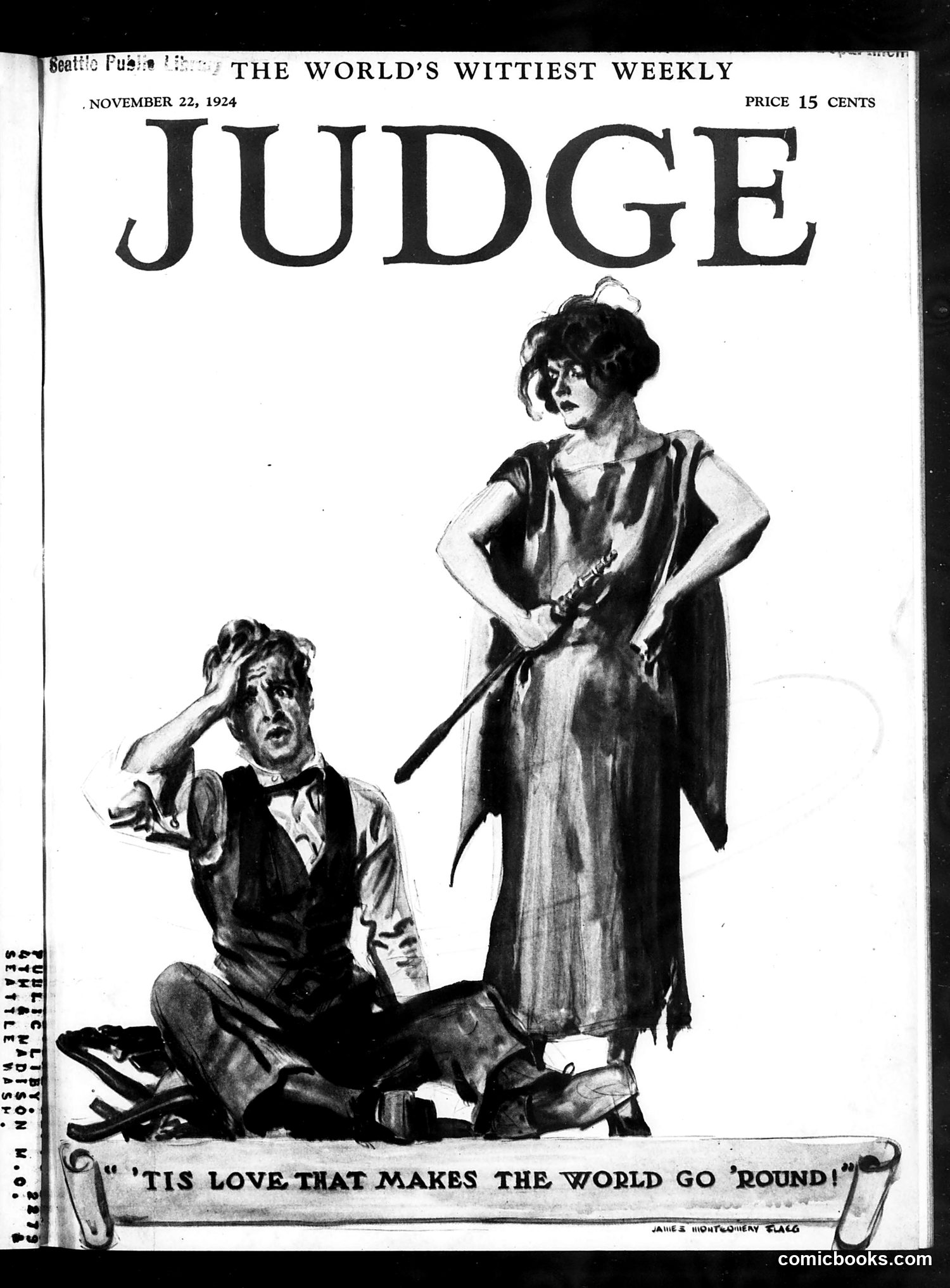
This cover depicts a domestic conflict scene with the caption "'TIS LOVE THAT MAKES THE WORLD GO 'ROUND!" The illustration shows a woman standing with a weapon (appears to be a club or bat) while a man sits on the ground in a distressed pose. The satire appears to mock romantic relationships and marriage, sardonically suggesting that "love" manifests as domestic violence or marital strife. This reflects Judge's typical humor style—using exaggeration and dark comedy to critique social behaviors. The image parodies the sentimental notion that love is ennobling and positive, instead depicting it as chaotic and violent. This represents early 20th-century satirical commentary on gender relations and marriage dynamics, presented through the magazine's irreverent comedic lens.
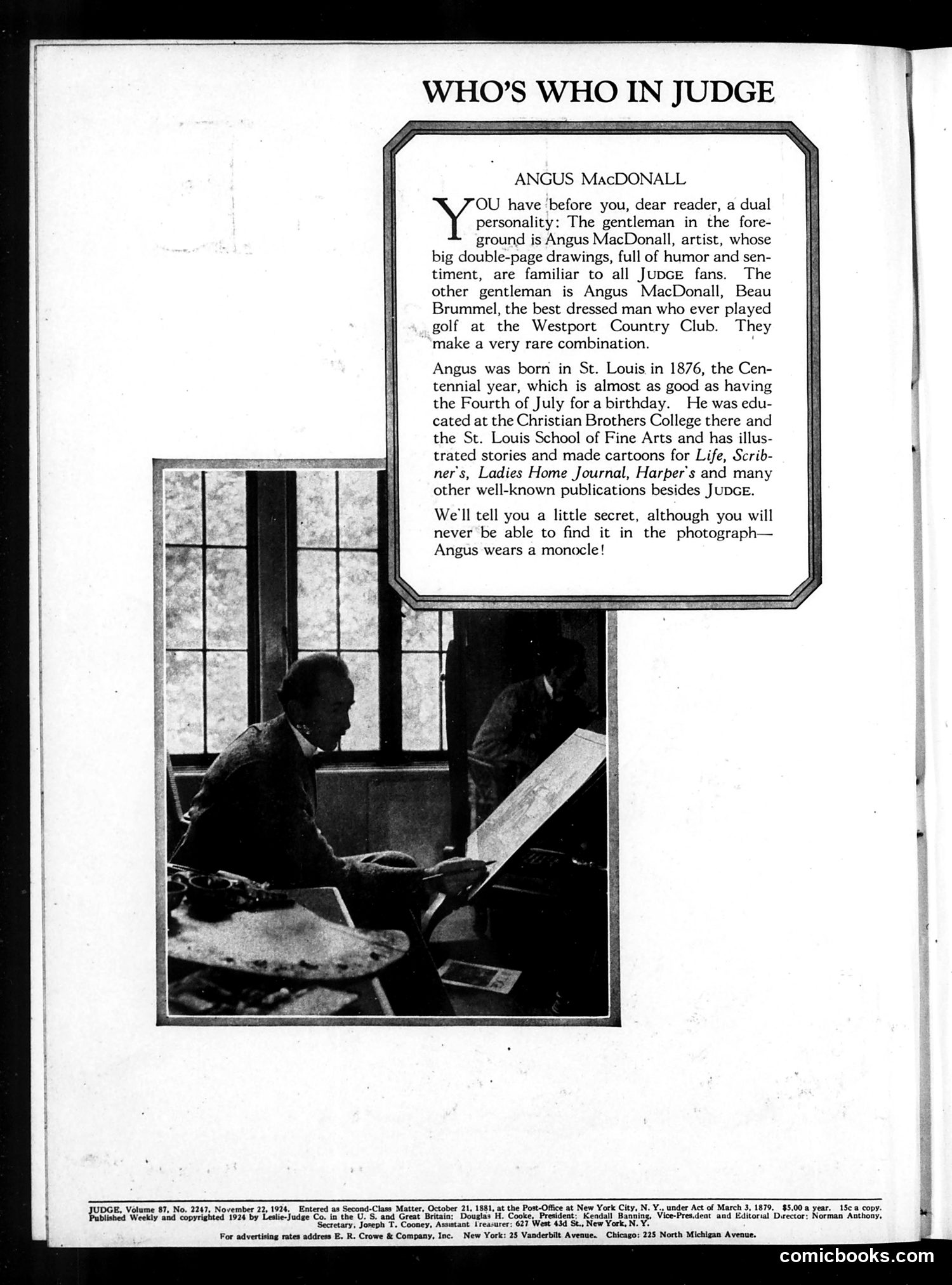
This is a profile page introducing **Angus MacDonald**, a cartoonist and illustrator for *Judge* magazine. The text describes him as having a "dual personality": MacDonald the artist (known for humorous double-page drawings) and MacDonald the golfer ("Beau Brummel," the best-dressed man at Westport Country Club). Born in St. Louis in 1876, MacDonald was educated at Christian Brothers College and the St. Louis School of Fine Arts. He illustrated for *Life*, *Scribner's*, *Ladies' Home Journal*, and *Harper's* before joining *Judge*. The accompanying photograph shows MacDonald at work at a drawing table. A playful note mentions he wears a monocle—a detail supposedly invisible in the photograph, adding humor to the profile.
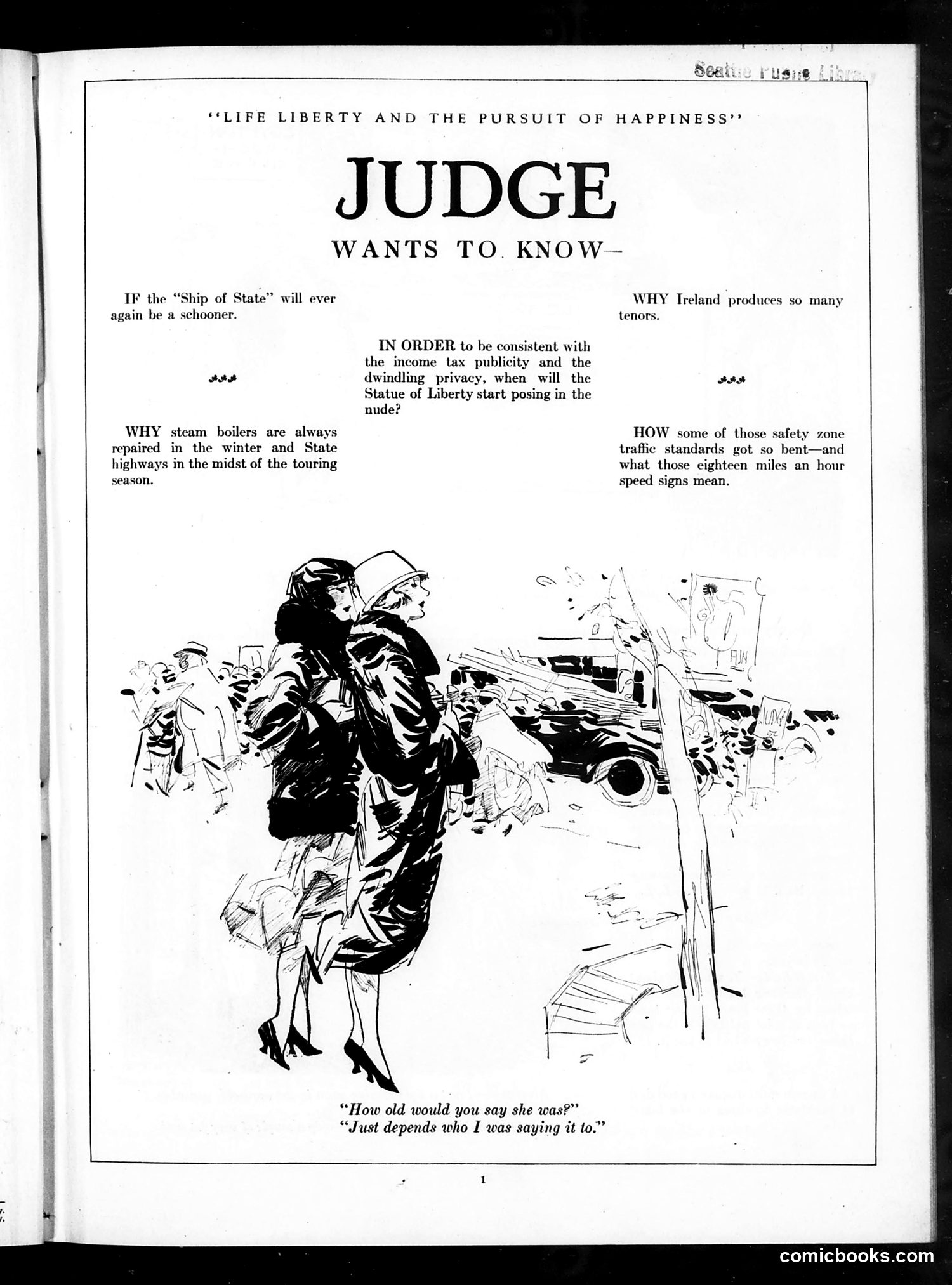
This Judge magazine page presents satirical "questions the Judge wants to know"—a recurring feature mocking current events and public figures through posed rhetorical questions. The main illustration depicts a woman carrying a child, fleeing what appears to be a chaotic scene with vehicles and wreckage, captioned with dialogue about someone's age depending "who I was saying it to." The surrounding text raises topical questions including references to: - The "Ship of State" (government) - Irish immigration ("WHY Ireland produces so many tenors") - Infrastructure maintenance timing ("steam boilers...repaired in winter") - Traffic safety standards and speed limits Without specific dates visible, the exact events referenced are unclear, but the page typifies Judge's satirical approach: using absurdist questions to critique government inefficiency, social conditions, and public policy inconsistencies of the era.
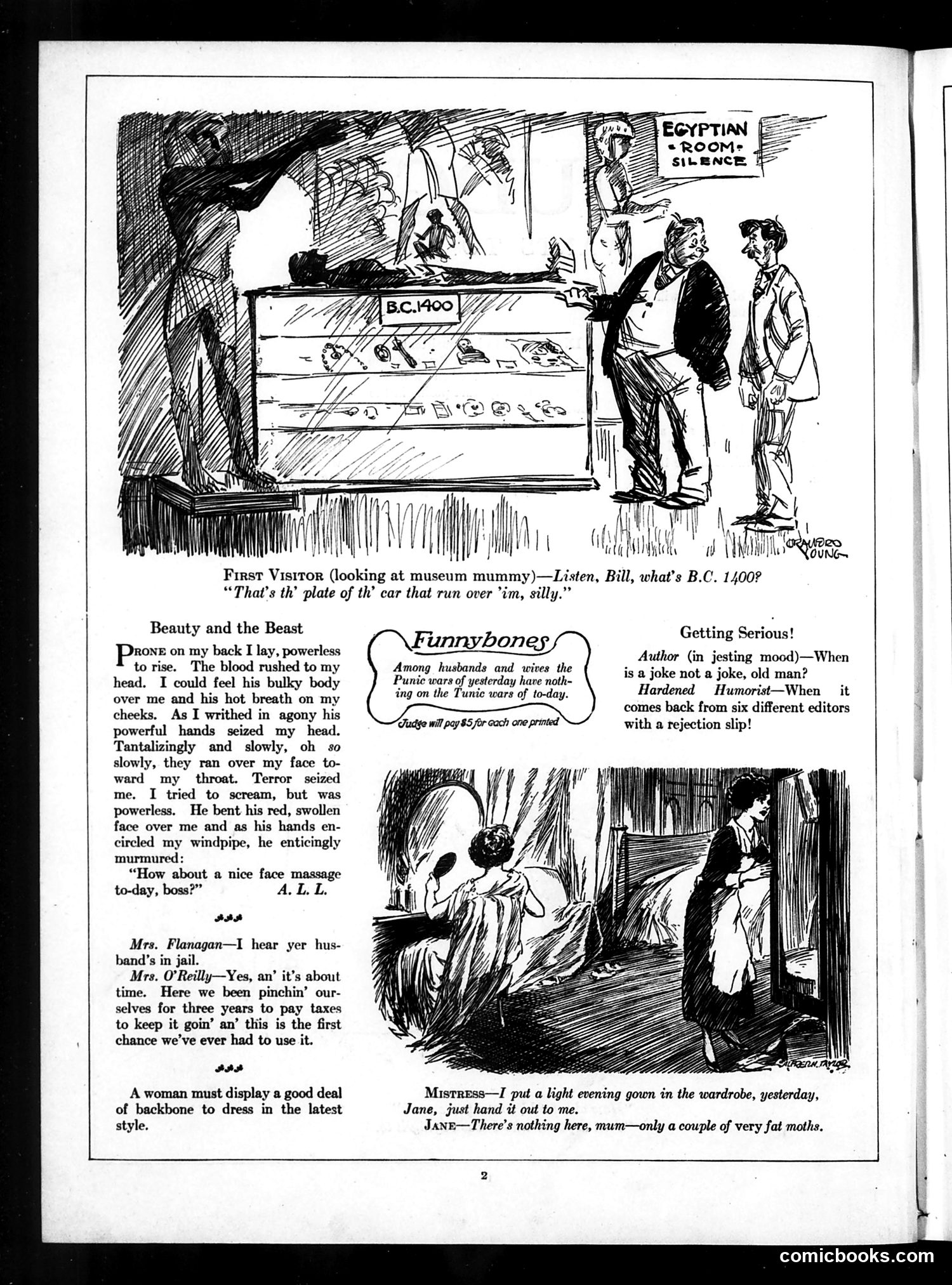
**Top Cartoon - "Egyptian Room Silence":** The cartoon satirizes museum visitors' ignorance. A visitor (Bill) mistakes the museum label "B.C. 1400" for a license plate, asking what vehicle "ran over" the mummy. The joke mocks casual visitors who bring modern assumptions to ancient artifacts, treating an archaeological dating system as contemporary automotive information. It's gentle satire about public museum behavior and widespread lack of historical literacy. **Text Features:** The page includes "Funnybones" (humorous anecdotes), "Beauty and the Beast" (satirical story about domestic life), and "Getting Serious" (a cartoon about rejected manuscript submissions). These pieces collectively mock everyday social situations—spousal relations, museum visits, and the writer's life—typical of Judge's satirical humor targeting middle-class American experiences and attitudes.
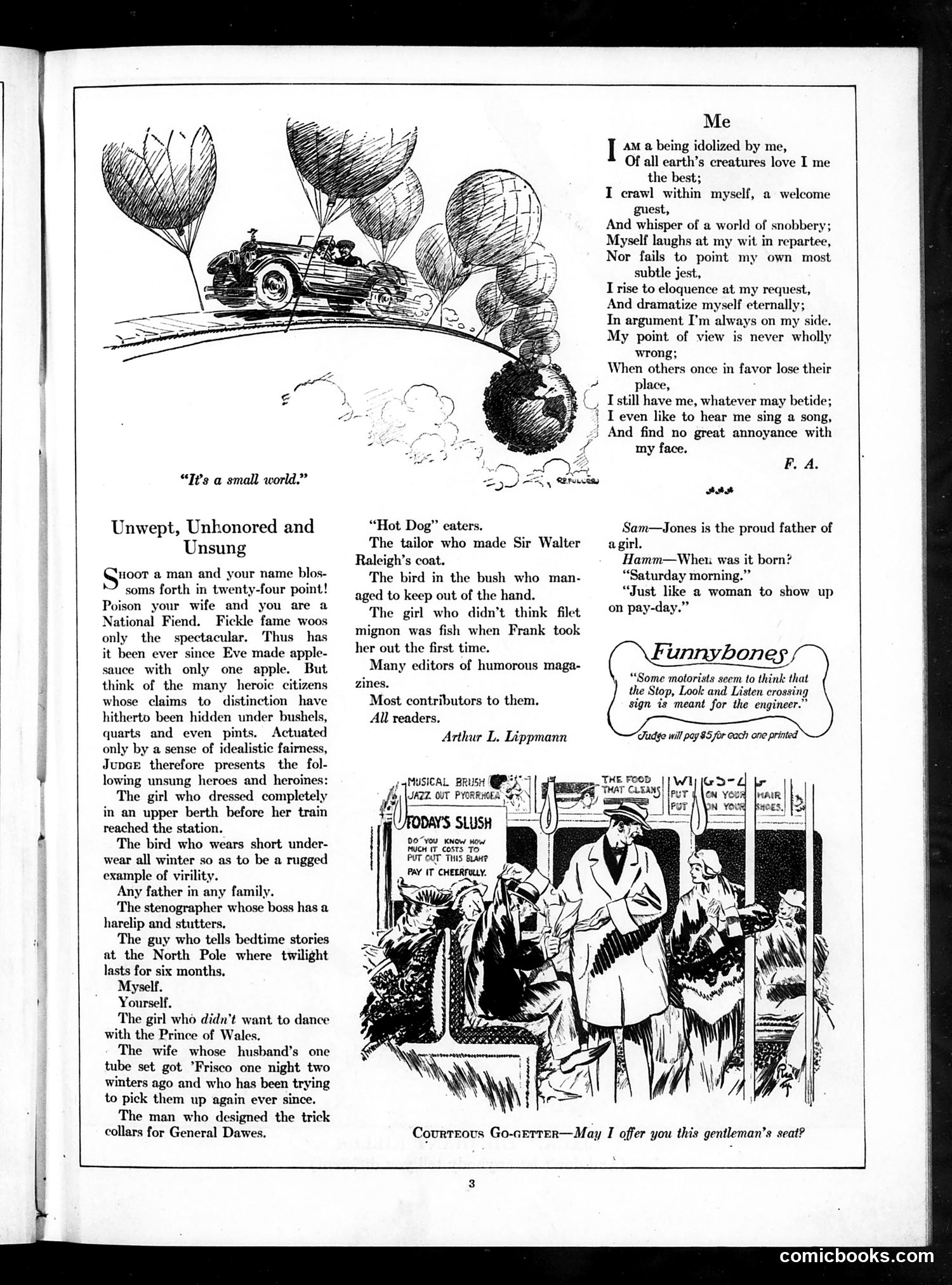
This page contains miscellaneous humor pieces rather than a unified political cartoon. **"Me" (poem by F.A.)**: A satirical self-portrait celebrating narcissism and argumentative nature—poking fun at someone insufferably self-centered who always insists they're right. **"Unwept, Unhonored and Unsung"**: A series of absurdist character sketches (written by Arthur L. Lippmann) lampooning everyday types—incompetent professionals, unremarkable people, and minor annoyances. Examples include a tailor with poor work and someone who tells bedtime stories at the North Pole. **"Courteous Go-getter" cartoon**: Shows a shop scene where a man offers his seat to a woman—satire of exaggerated politeness or performative courtesy in commercial settings. The overall tone is light social satire targeting personality flaws and social pretensions rather than serious political commentary.
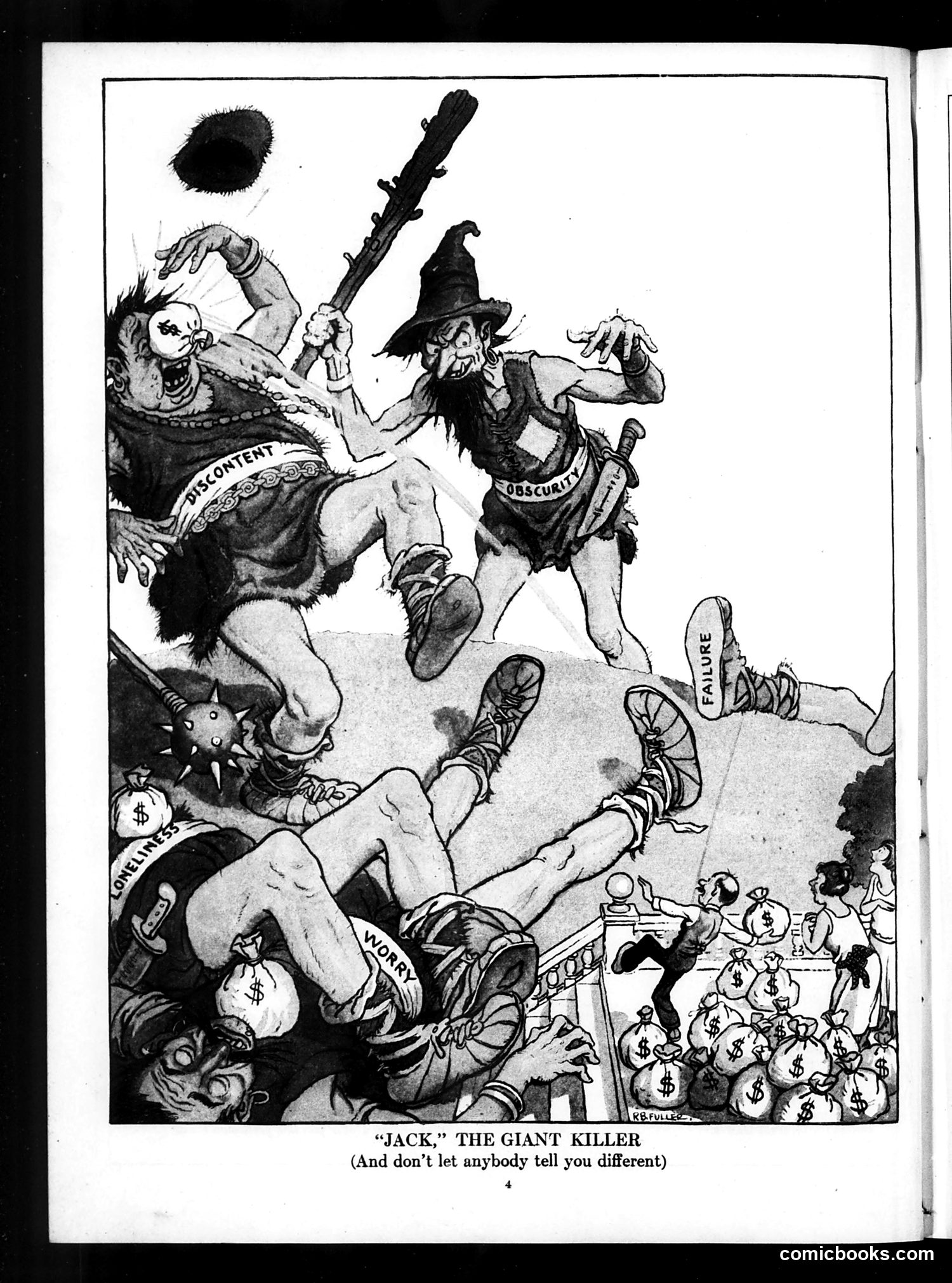
This political cartoon satirizes monopolistic business practices through the fairy tale metaphor of Jack the Giant Killer. The giant represents corporate consolidation or robber baron capitalism, depicted as a destructive force kicking down fortifications labeled "FAILURE" while wielding "OBSCURITY" as a weapon. The labels visible—"CONTENT," "COLLATERAL," and money bags marked with "$"—suggest the giant is trampling financial systems and legitimate business. At the giant's feet, small figures (representing ordinary citizens or small businesses) scatter around bags of money. The subtitle "(And don't let anybody tell you different)" implies ironic commentary on claims that such monopolistic practices benefit society. This reflects early 20th-century Progressive Era concerns about unchecked corporate power and wealth concentration.
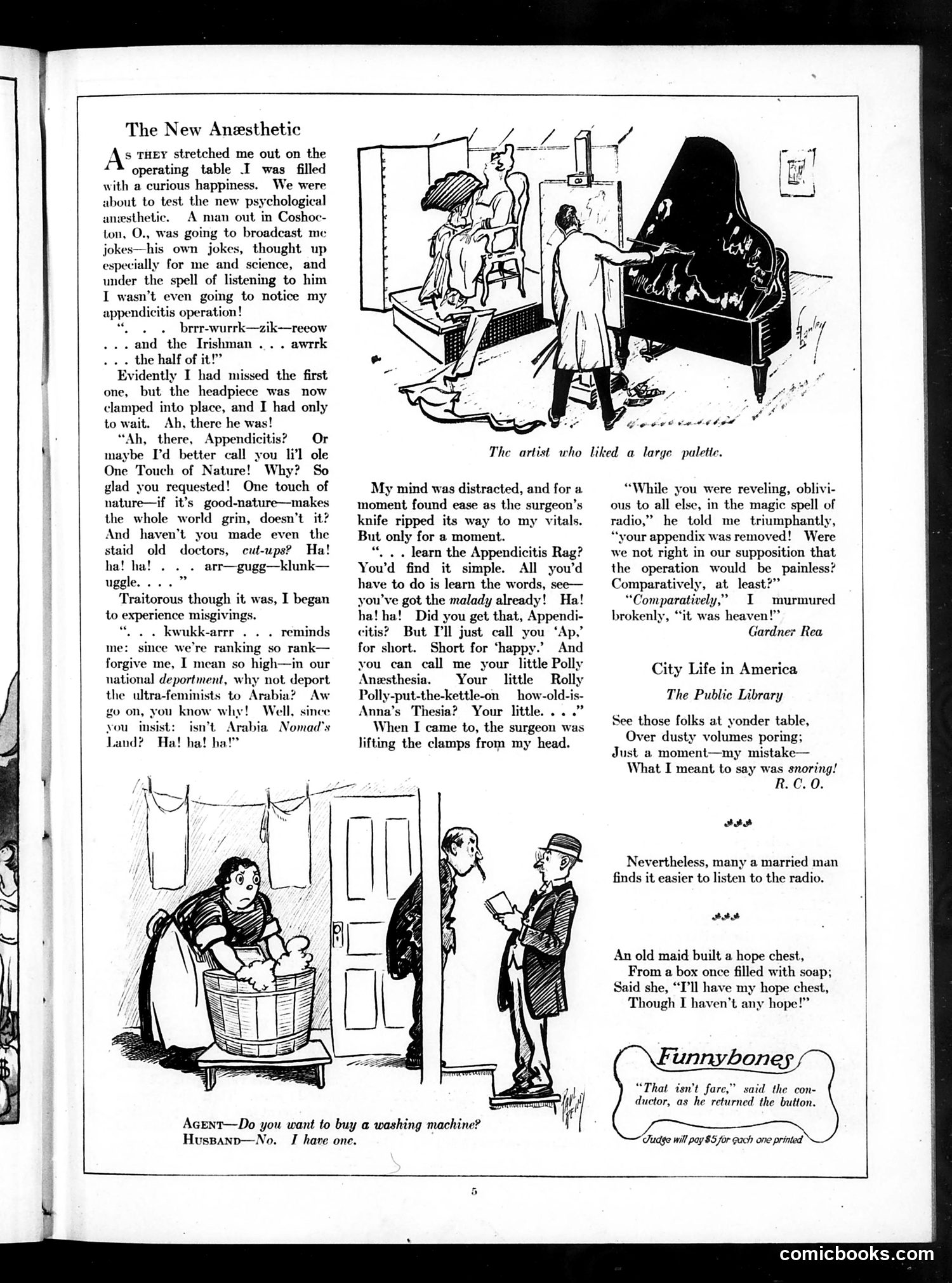
This satirical story mocks a supposedly new "psychological anesthetic" that would allow patients to remain conscious during surgery while being entertained by jokes and radio broadcasts. The narrator describes the absurd experience of lying on an operating table while a surgeon cracks jokes—including ethnic humor ("the Irishman") and puns about appendicitis ("Appendicitis Rag")—to distract from the pain. The humor ridicules both modern medical pretensions and contemporary entertainment obsession. Rather than actual anesthesia, patients are offered distraction through comedy and radio, a commentary on cheap solutions to serious problems. The accompanying cartoons about washing machines and hope chests represent typical period advertisements, while "Funnybones" offers additional social humor typical of Judge's satirical content.
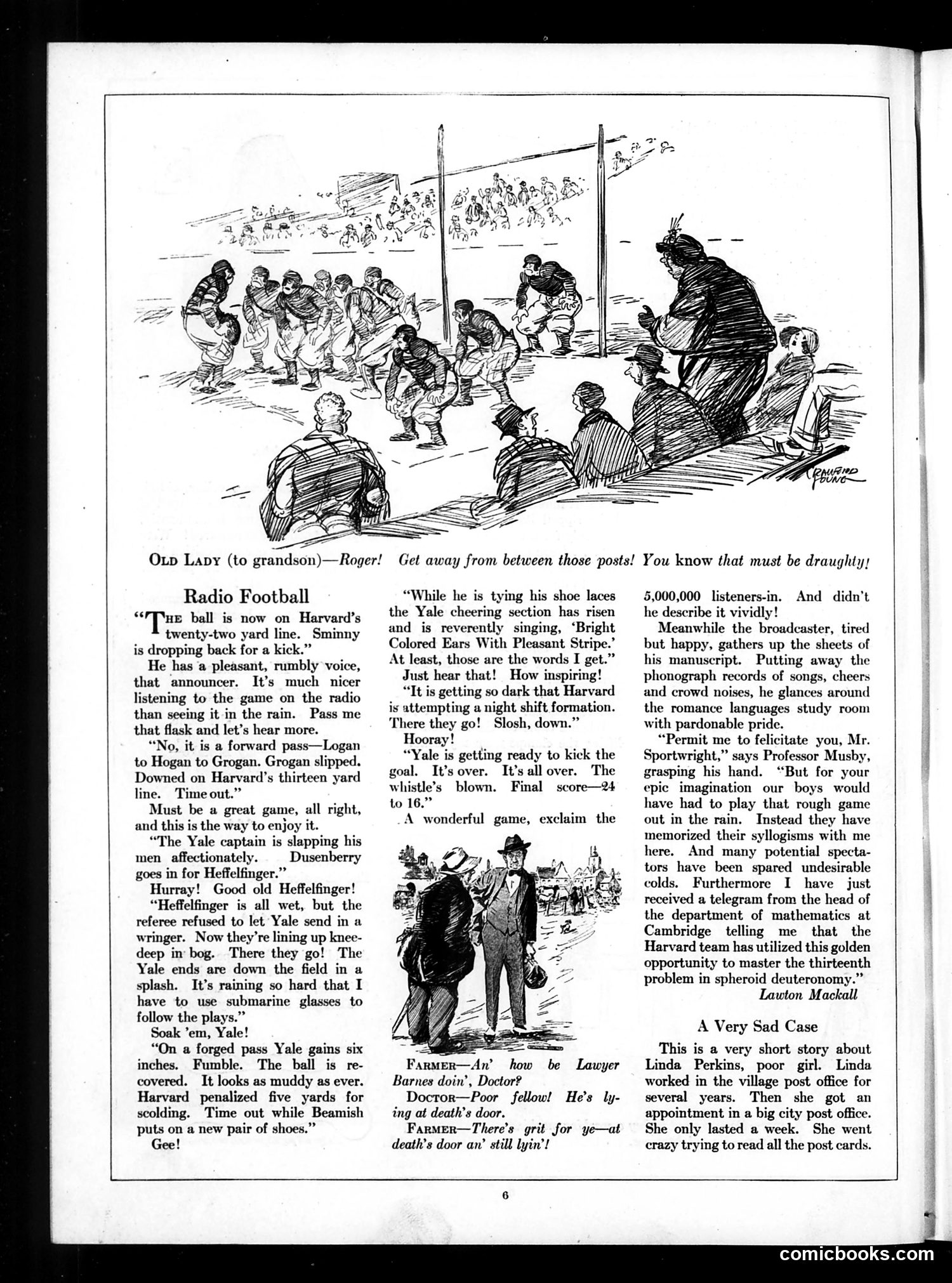
This Judge magazine page satirizes the emerging phenomenon of **radio sports broadcasting**—a novelty in the 1920s-30s. The main cartoon mocks how listeners imagined football games based solely on a radio announcer's dramatic play-by-play narration. The joke: the actual game is a muddy, chaotic mess in heavy rain, but the broadcaster's vivid description makes it entertaining for 5 million listeners huddled indoors. The announcer even fabricates details (a "forged pass," players in "night shift formation") to enhance drama. The satire targets how radio could transform mundane reality into compelling entertainment through imagination and creative narration. A secondary joke shows a professor praising the broadcaster for keeping students indoors studying mathematics instead of watching the game—turning the broadcast into an accidental academic benefit. The page's other brief jokes are unrelated: one about an old lady worried about "draughts" (drafts), another pun about a dying lawyer still "lying."
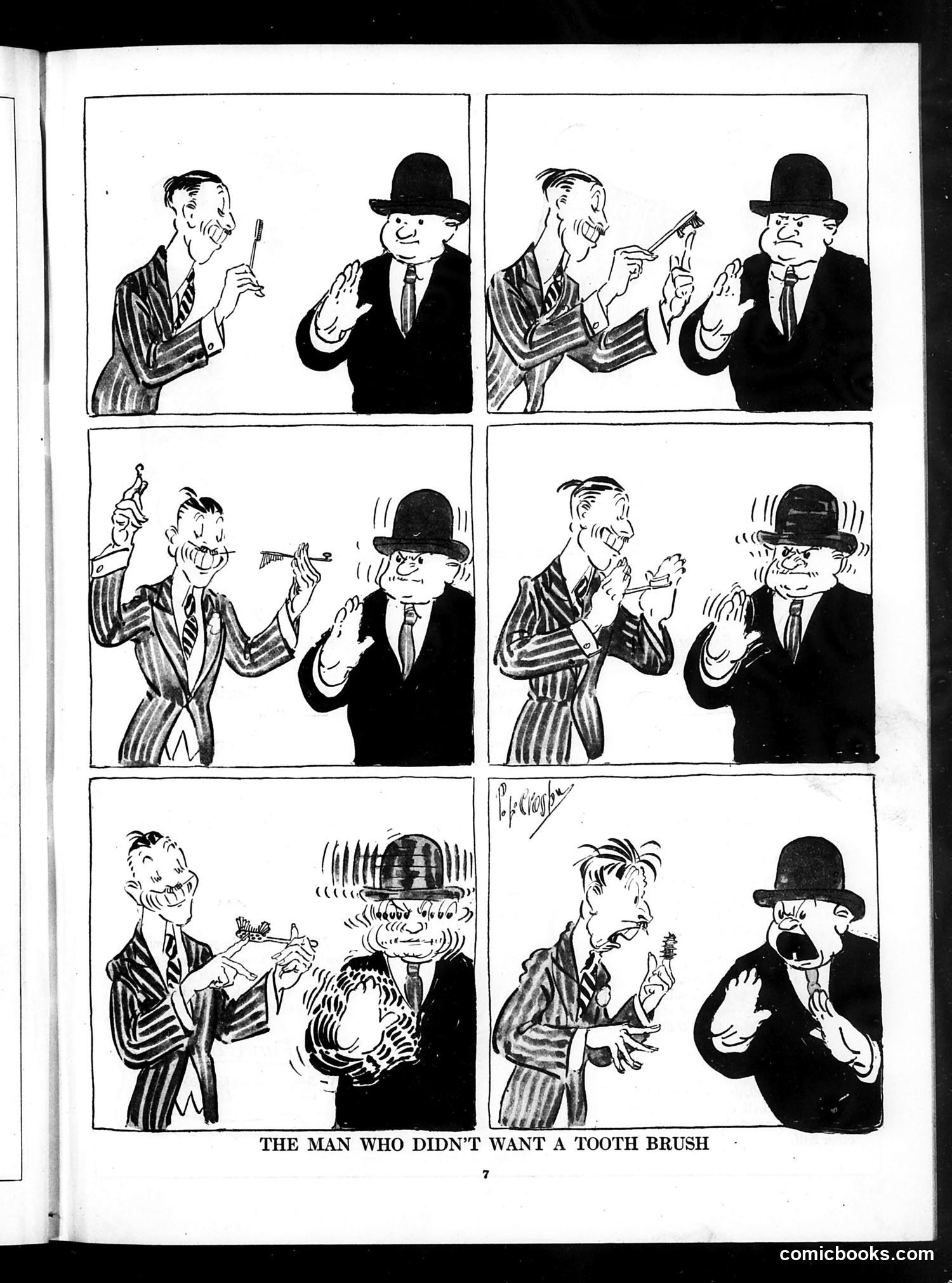
This six-panel comic strip depicts a salesman in a pinstriped suit attempting to sell a toothbrush to a bowler-hatted gentleman who emphatically refuses. The narrative escalates through increasingly aggressive sales tactics: The salesman demonstrates the product, gestures persuasively, uses both hands to emphasize points, shows the customer testimonials or documentation, and finally appears to be forcibly trying to place the brush in the man's mouth while the customer recoils in distress. The satire mocks aggressive 1920s-30s sales culture and high-pressure advertising tactics, where pushy salesmen ignored customer objections. The humor lies in the absurdity of trying to force an unwanted consumer product on someone who has clearly and repeatedly declined—a commentary on the era's sometimes coercive commercial practices.
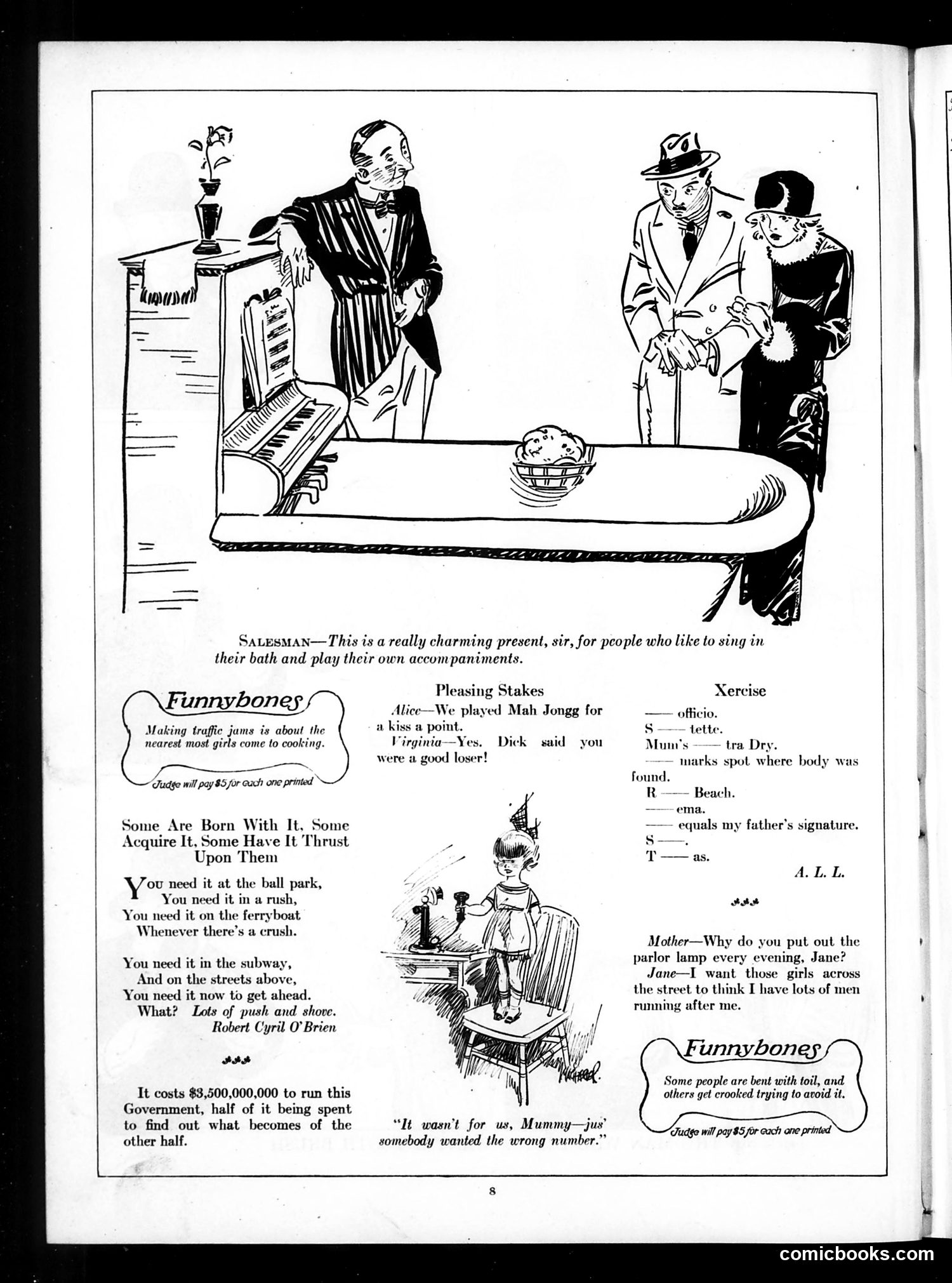
This page contains humorous short jokes and cartoons typical of early-20th-century American satirical magazines. **Main cartoon (top):** A salesman pitches a novelty item—apparently a piano or musical instrument for bathtubs—to wealthy customers. The joke is that it's absurdly impractical. **"Funnybones" quips:** Short, snappy one-liners mocking contemporary social observations. One suggests women lack domestic skills ("traffic jams" vs. cooking); another satirizes government waste ($3.5 billion spent partly investigating where money goes—implying bureaucratic inefficiency and corruption). **Poetry section:** "Some Are Born With It..." celebrates aggressive ambition and "push and shove" as necessary for success—reflecting competitive, individualistic 1920s values. **Other jokes:** Include references to Mah-jongg (a trendy game), a telephone mixup, and flirtation tactics. The final "Funnybones" mocks hypocrisy about work ethic. The page reflects Judge's formula: urbane humor targeting the affluent, social commentary on modern life, and satirizing both gender roles and government incompetence.
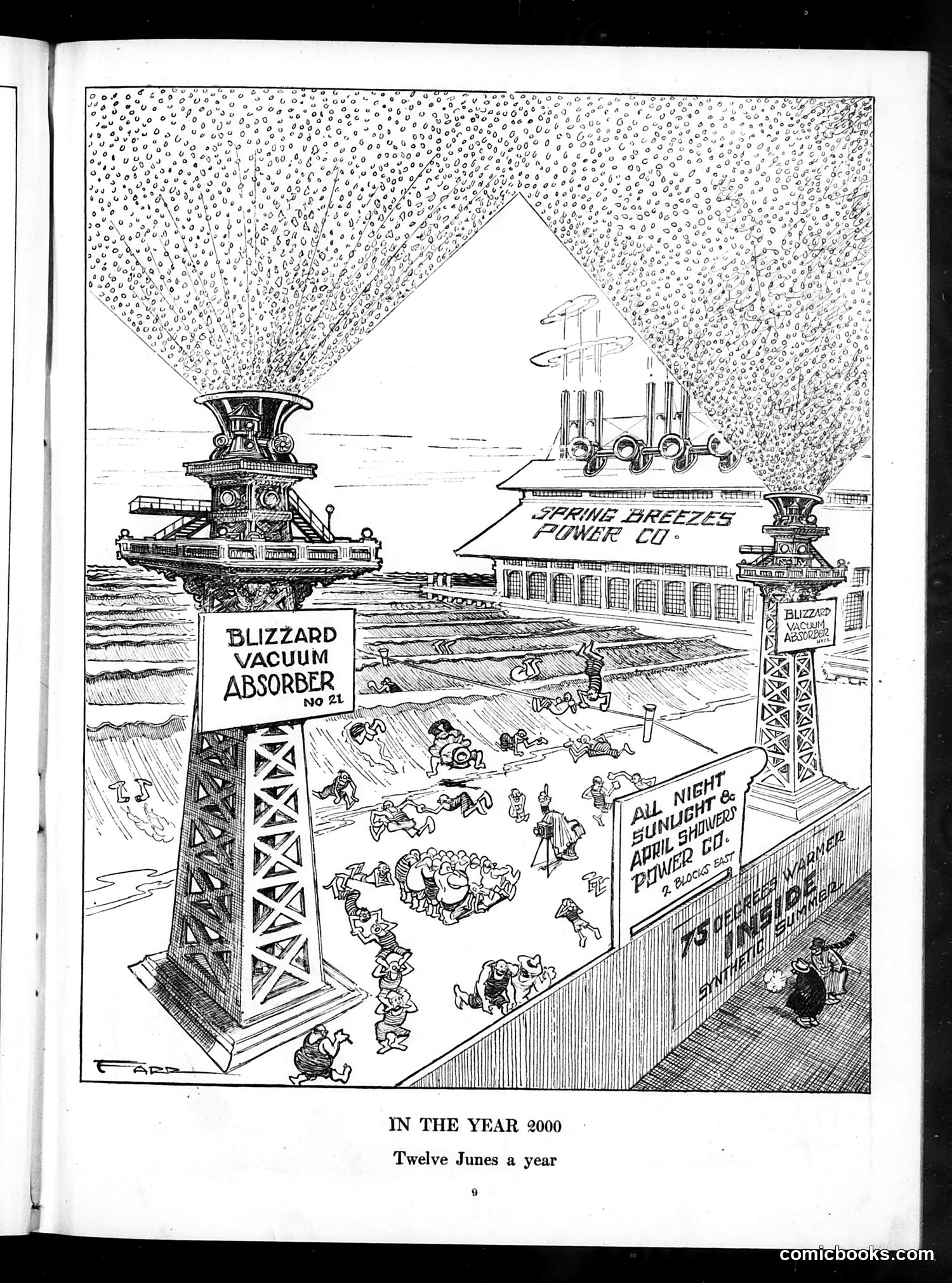
This is a futuristic satire imagining life "IN THE YEAR 2000" with "Twelve Junes a year"—suggesting catastrophically increased heat or weather disruption. The cartoon depicts a dystopian industrial landscape where people are being blown away by powerful wind gusts from various "power companies": the **Blizzard Vacuum Absorber No. 21**, **Spring Breezes Power Co.**, **All Night Sunlight & April Showers Power Co.**, and **Synthetic Weather Shaper**. These fictional companies appear to be mechanically controlling or weaponizing weather as an energy source. The masses of people being scattered across the ground suggest this new technology causes chaos and suffering. The satire mocks corporate exploitation of natural resources and emerging industrial power generation, imagining a future where companies literally monetize and manipulate weather itself, leaving ordinary citizens as collateral damage.
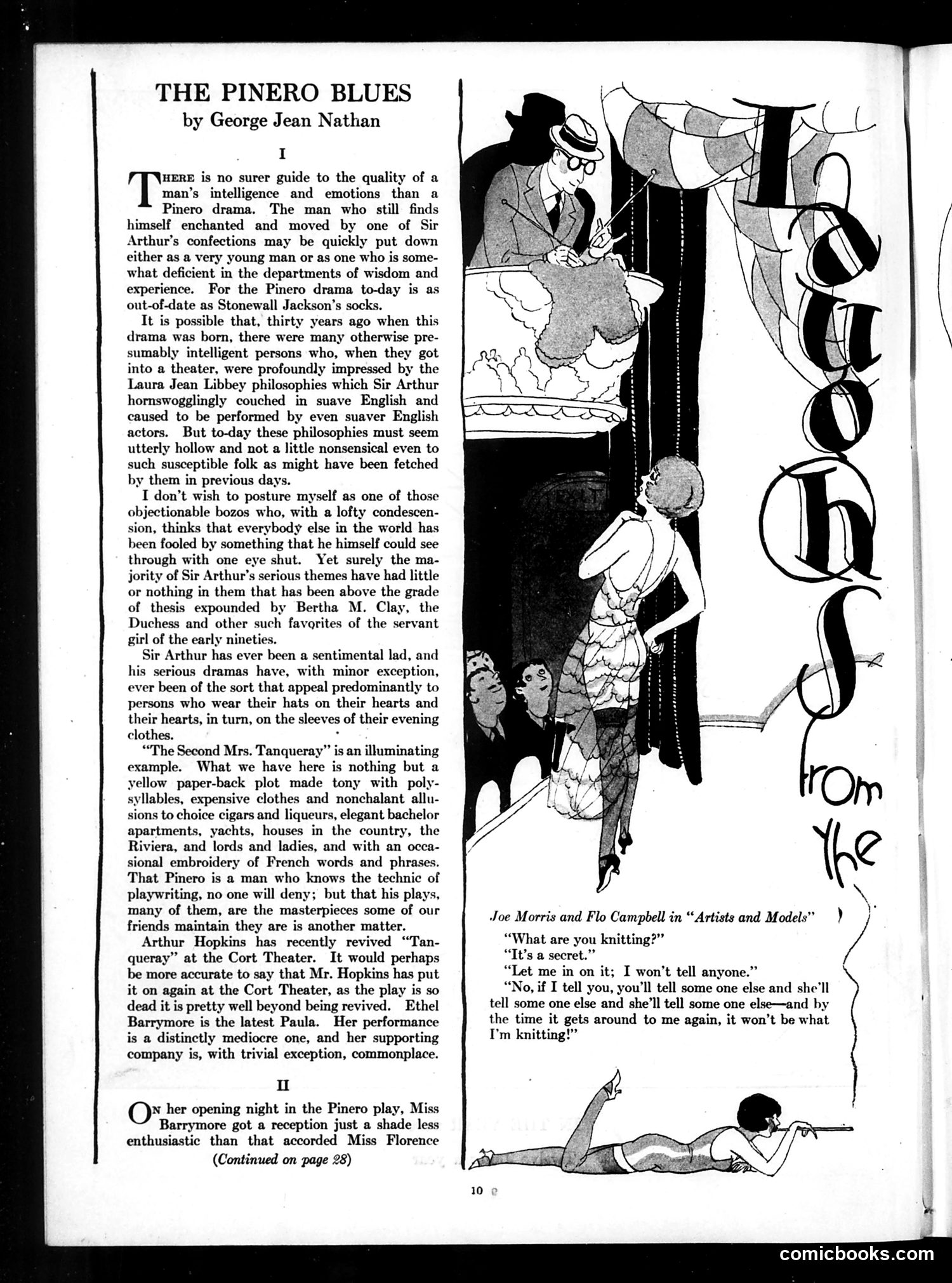
This is a theater criticism piece attacking Sir Arthur Wing Pinero, a prominent British playwright, as hopelessly outdated. Critic George Jean Nathan argues that anyone still moved by Pinero's dramas is either very young or intellectually deficient. He dismisses *The Second Mrs. Tanqueray* as a shallow "yellow paper-back plot" dressed up with expensive props and French phrases—essentially cheap sentimentality marketed as sophistication. The accompanying illustration shows the recent 1924 revival at the Cort Theater starring Ethel Barrymore, whom Nathan judges as "distinctly mediocre." The small comic below mocks gossip by showing how secrets spread through repeated retellings until they're completely distorted. The satire targets both Pinero's supposedly old-fashioned melodrama and the theatrical establishment's willingness to revive it with mediocre casts.
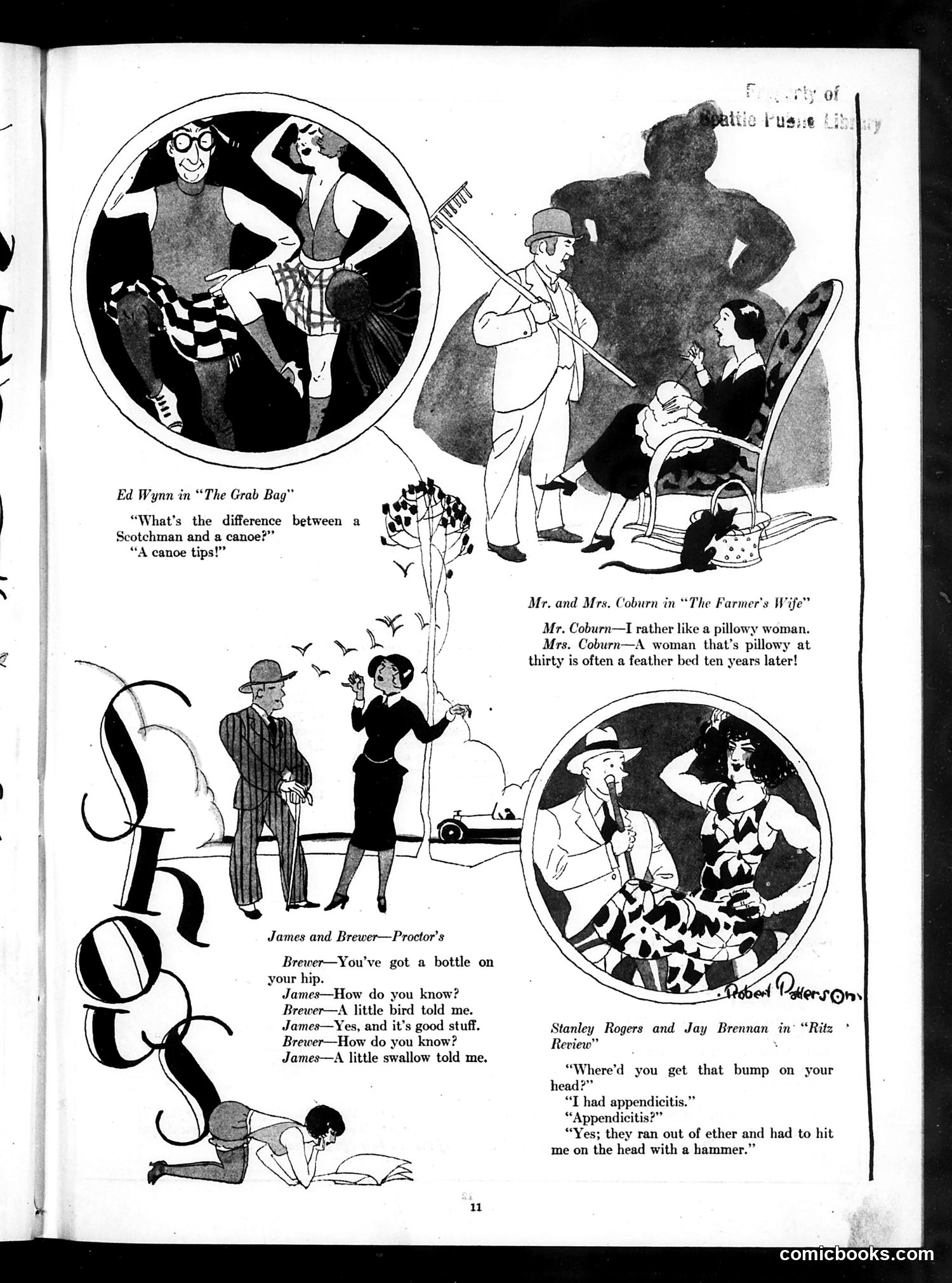
This page showcases theatrical humor from early 20th-century vaudeville and Broadway productions. The content consists of four separate joke sequences: **Ed Wynn in "The Grab Bag"** features a pun playing on Scottish stereotypes about frugality—a canoe "tips" (capsizes) while a Scotsman won't. **"The Farmer's Wife"** presents domestic humor about women's aging, with a wife's retort that "pillowy" (plump) women become heavier with time. **James and Brewer** contains a double entendre joke about hidden alcohol (Prohibition-era reference, likely), with wordplay on "bird" and "swallow." **"Ritz Review"** offers absurdist humor about medical mishaps—hitting a patient with a hammer instead of using anesthesia. These are theater advertisements showcasing comedians and shows of the era. The humor relies on ethnic stereotypes, physical comedy references, and contemporary social anxieties (Prohibition, women's bodies, medical practices). The cartoons illustrate the comedians performing these bits.
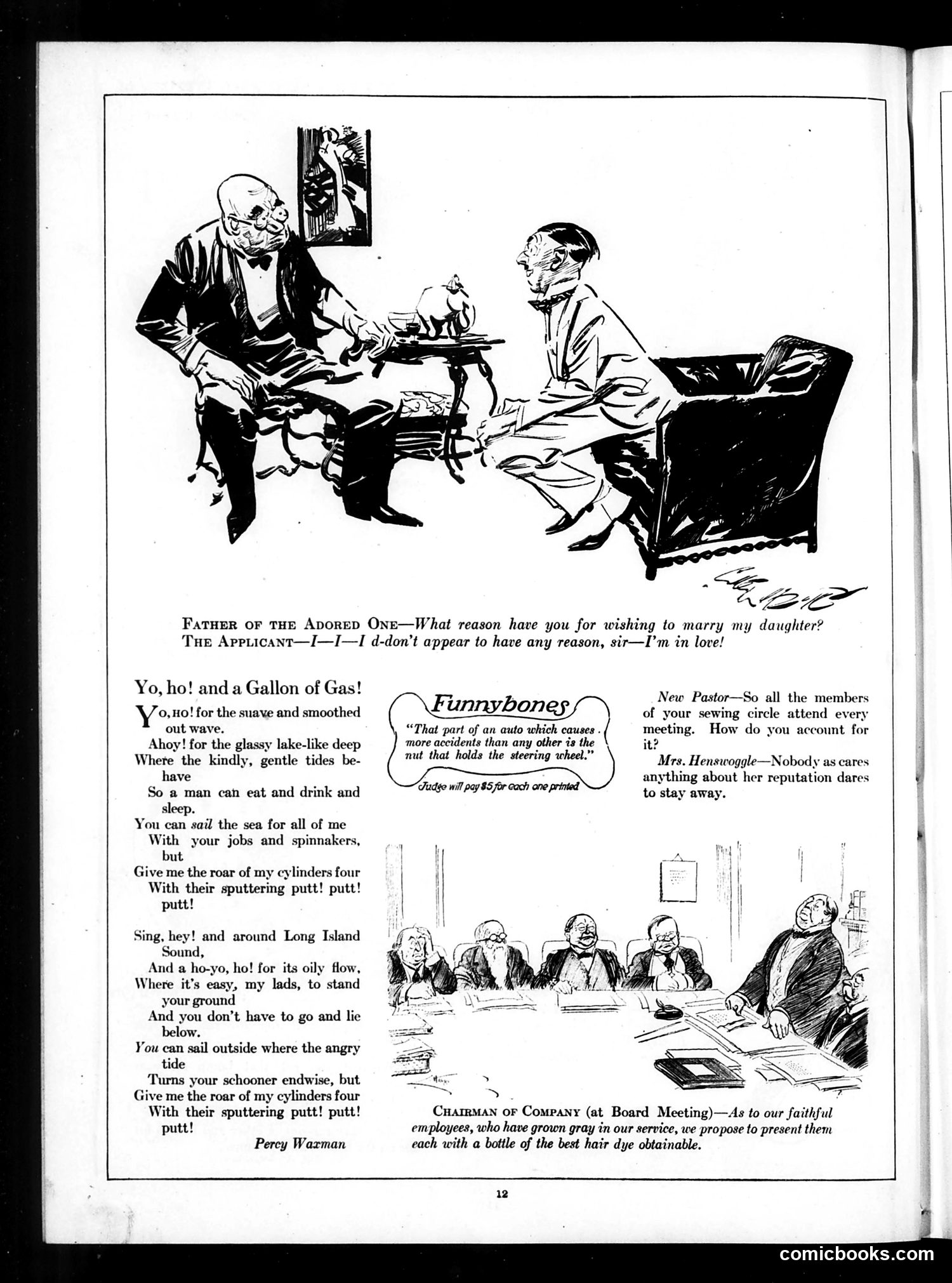
This page contains three distinct satirical pieces: **Top cartoon**: A young man seeks permission to marry a father's daughter. When asked his reason, he admits he has none—he's "in love." The satire mocks romantic impulsiveness versus practical considerations in marriage proposals. **Middle poem** ("Yo, ho! and a Gallon of Gas!"): A celebration of automobiles over traditional sailing. The repeated refrain about "cylinders four" and "sputtering putt" praises car engines. This reflects early 20th-century enthusiasm for automobiles as superior to older maritime transportation—a common theme as cars became widespread. **Funnybones section**: Brief jokes, including one about steering wheels causing accidents (a dig at driver incompetence), and a biting piece about a company chairman proposing to give gray-haired long-serving employees hair dye instead of meaningful retirement benefits. This mocks corporate cheapness and disrespect toward loyal workers. The page satirizes romance, technological change, and workplace exploitation typical of Judge's social commentary.
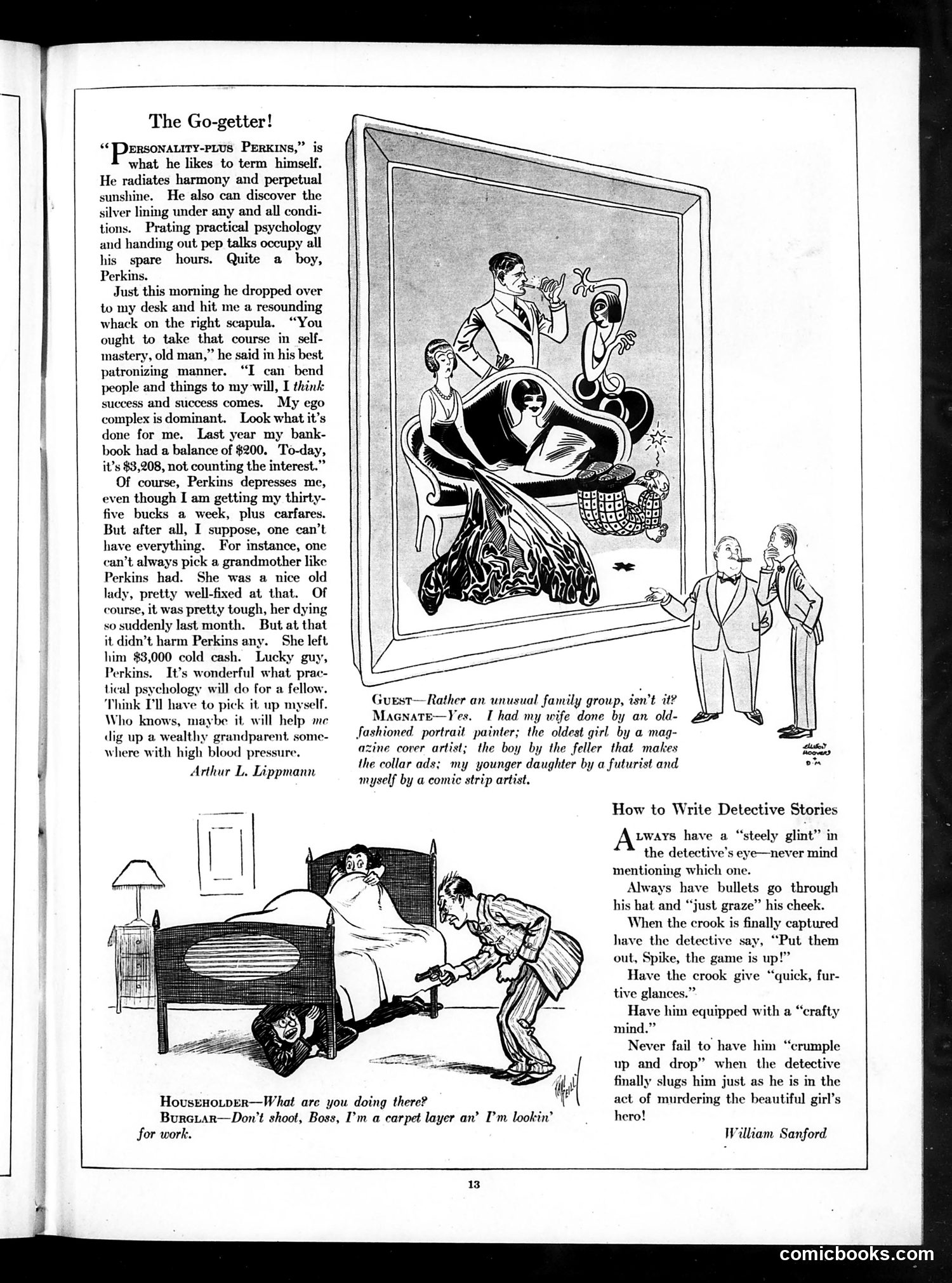
This page contains three satirical pieces mocking early 20th-century cultural trends: **"The Go-getter!"** satirizes the self-help movement and "positive thinking" craze. Perkins exemplifies the manipulative self-improvement charlatan—spouting pop psychology about willpower and ego while actually succeeding only through inherited wealth (a $3,000 inheritance from his grandmother). The narrator's deadpan conclusion—that he should find a wealthy grandparent with high blood pressure—undercuts Perkins's claims that mindset creates success. **The family portrait cartoon** mocks how different artistic styles (old-fashioned painting, magazine illustration, advertising art, futurism, comics) reveal character superficiality—each family member portrayed in whatever trendy visual medium suits their personality. **"How to Write Detective Stories"** parodies pulp detective fiction's clichéd tropes: stock descriptions, predictable action beats, and melodramatic coincidences that strain credibility. All three pieces target American commercial culture's reliance on empty formulas and superficial psychology.
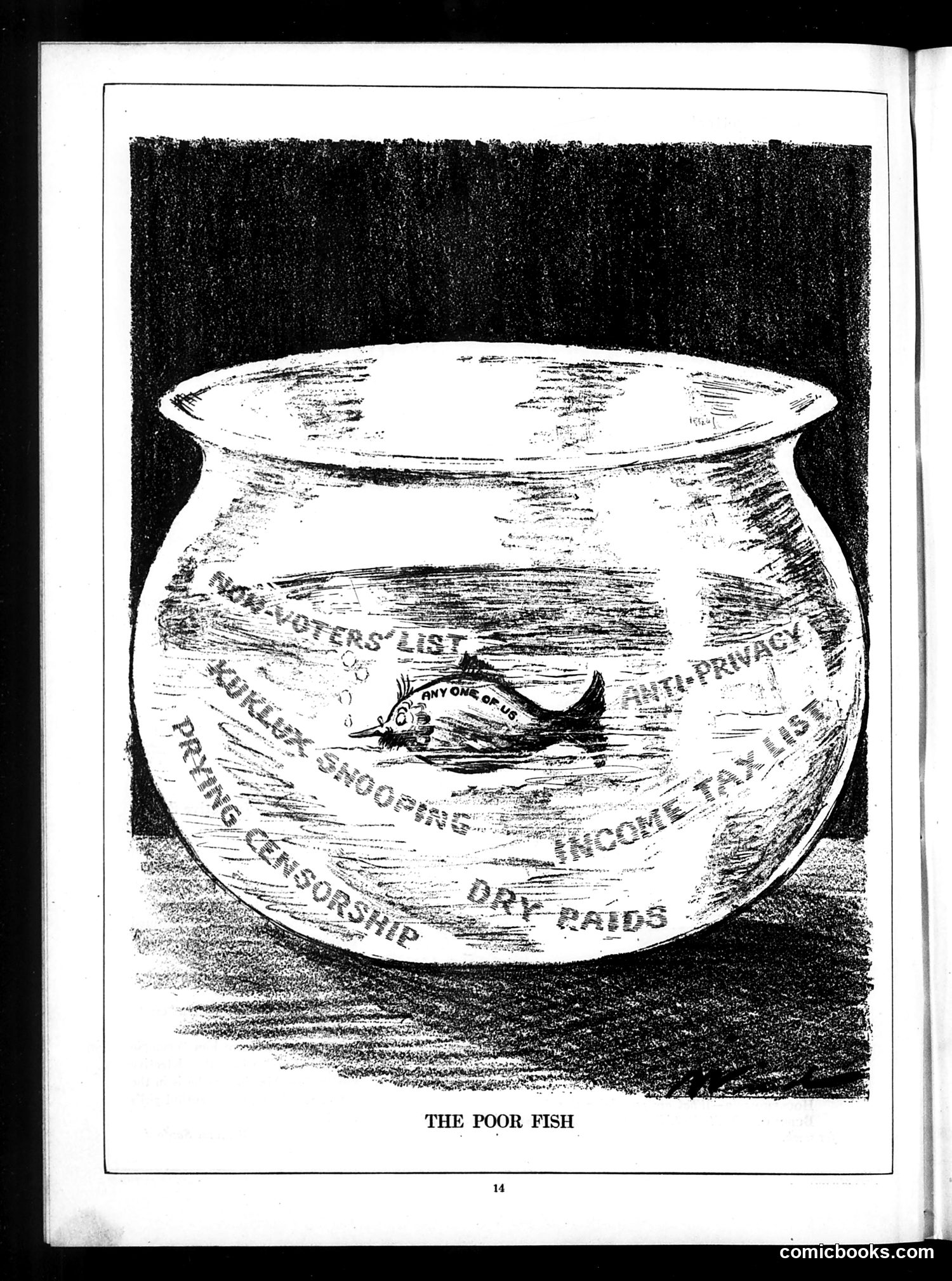
This cartoon depicts a fishbowl containing a single fish, surrounded by text labels reading "SNOOPING," "DRY RAIDS," "INCOME TAX LIST," "SMOOTING CENSORSHIP," and "PRIVACY" — phrases appearing to spiral around the trapped fish. The satire targets government overreach and intrusions into citizens' private lives. The fish represents an ordinary person constrained by multiple governmental policies: tax collection, alcohol prohibition enforcement ("dry raids"), censorship, surveillance ("snooping"), and loss of privacy. The bowl functions as a metaphor for confinement and helplessness. This likely dates from the Prohibition era (1920s-1930s) when Judge magazine frequently criticized government expansion. The cartoon's title emphasizes the "poor" citizen trapped by bureaucratic entanglement, expressing contemporary concerns about expanding state power.
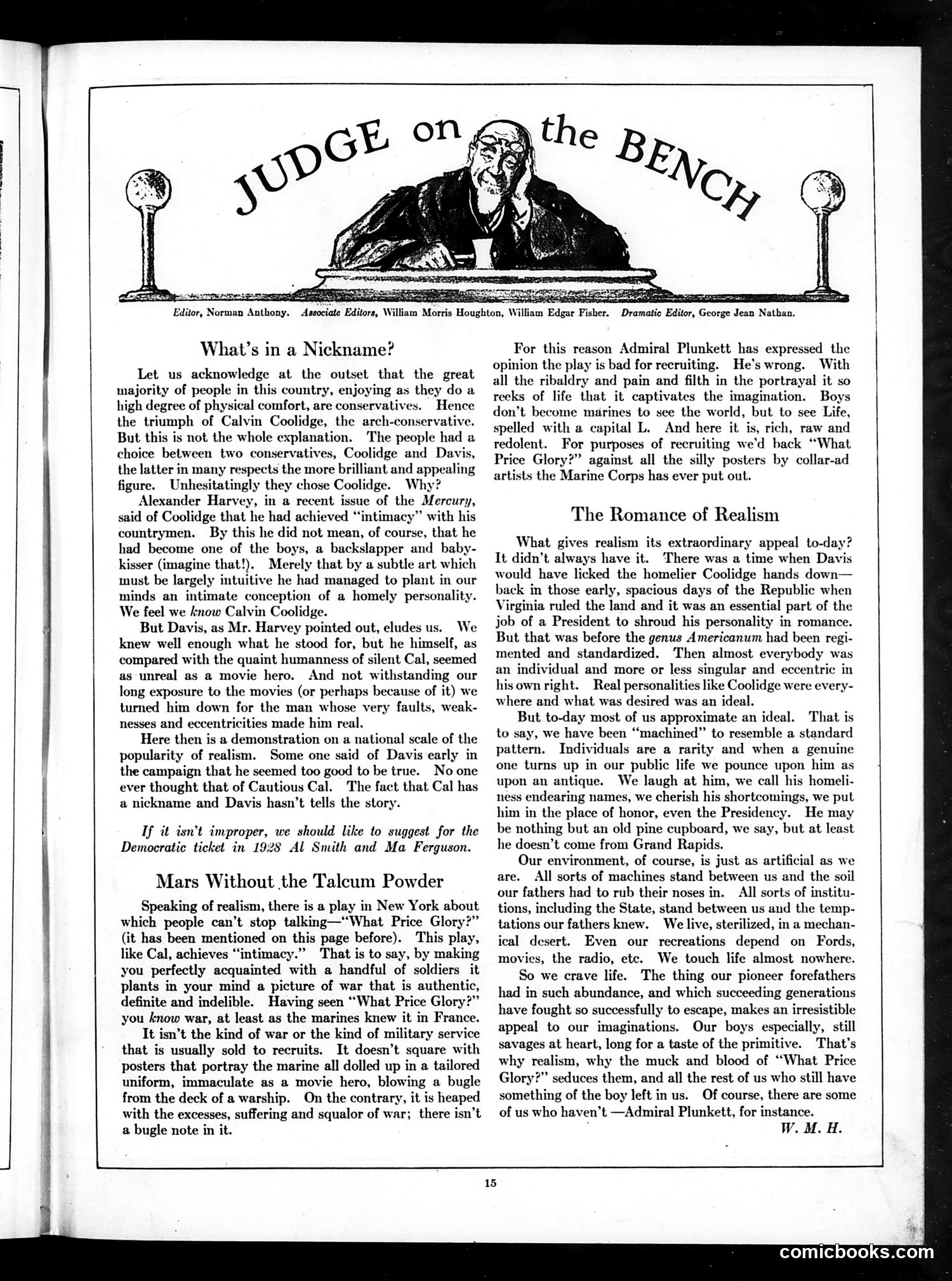
This page discusses why Calvin Coolidge defeated John W. Davis in the 1928 presidential election through the lens of "realism." The author argues that Coolidge's homely, relatable persona—reinforced by his nickname "Cal"—made him feel authentic to voters, while Davis seemed artificial and distant despite being more intellectually brilliant. The page then pivots to praising the play "What Price Glory?" for its gritty, realistic portrayal of marines in WWI, arguing it actually aids recruitment better than sanitized military propaganda. Admiral Plunkett had criticized the play as bad for recruiting, but the author disagrees. The central argument: modern Americans, living in a standardized, mechanized society, crave authenticity and "life spelled with a capital L." They reject polished artificiality in favor of raw, messy realism—whether in politicians or entertainment. The homely nickname and genuine imperfection paradoxically make figures more appealing than cultivated perfection.
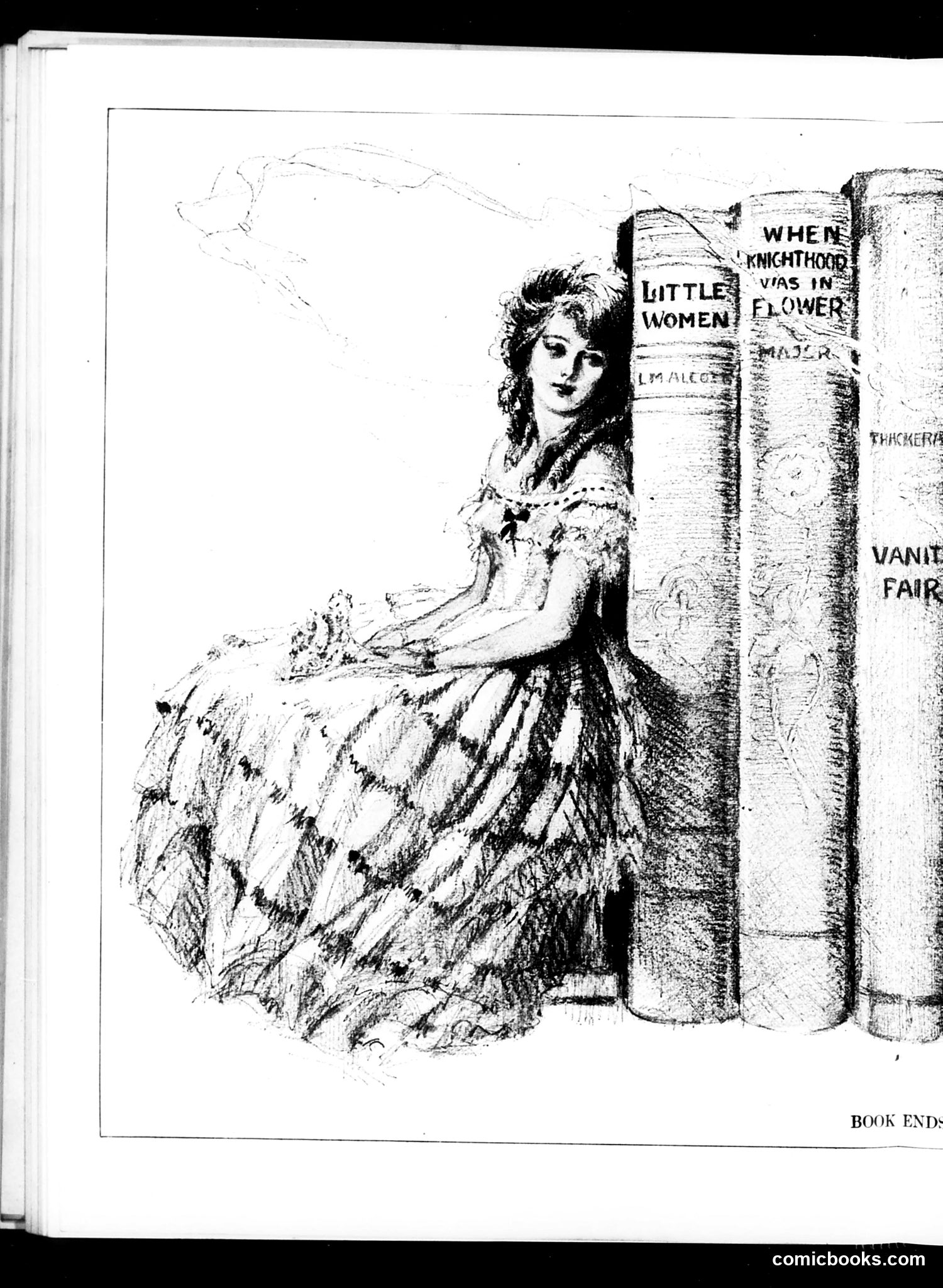
This page appears to be an advertisement or illustration labeled "BOOK ENDS" from *Judge* magazine. It depicts an elegantly dressed woman in an elaborate gown leaning against stacked books. The visible book spines reference classic literature: "Little Women," "When Knighthood Was in Flower," and others (some titles partially unclear in the reproduction). The satire likely mocks Victorian or Edwardian literary culture—either celebrating women's literary sophistication or, more likely given *Judge's* satirical nature, gently ridiculing the pretentiousness of displaying classic literature as decorative status symbols. The woman's elaborate costume and pose suggest both refinement and artificiality, typical of *Judge's* social commentary on upper-class affectation.
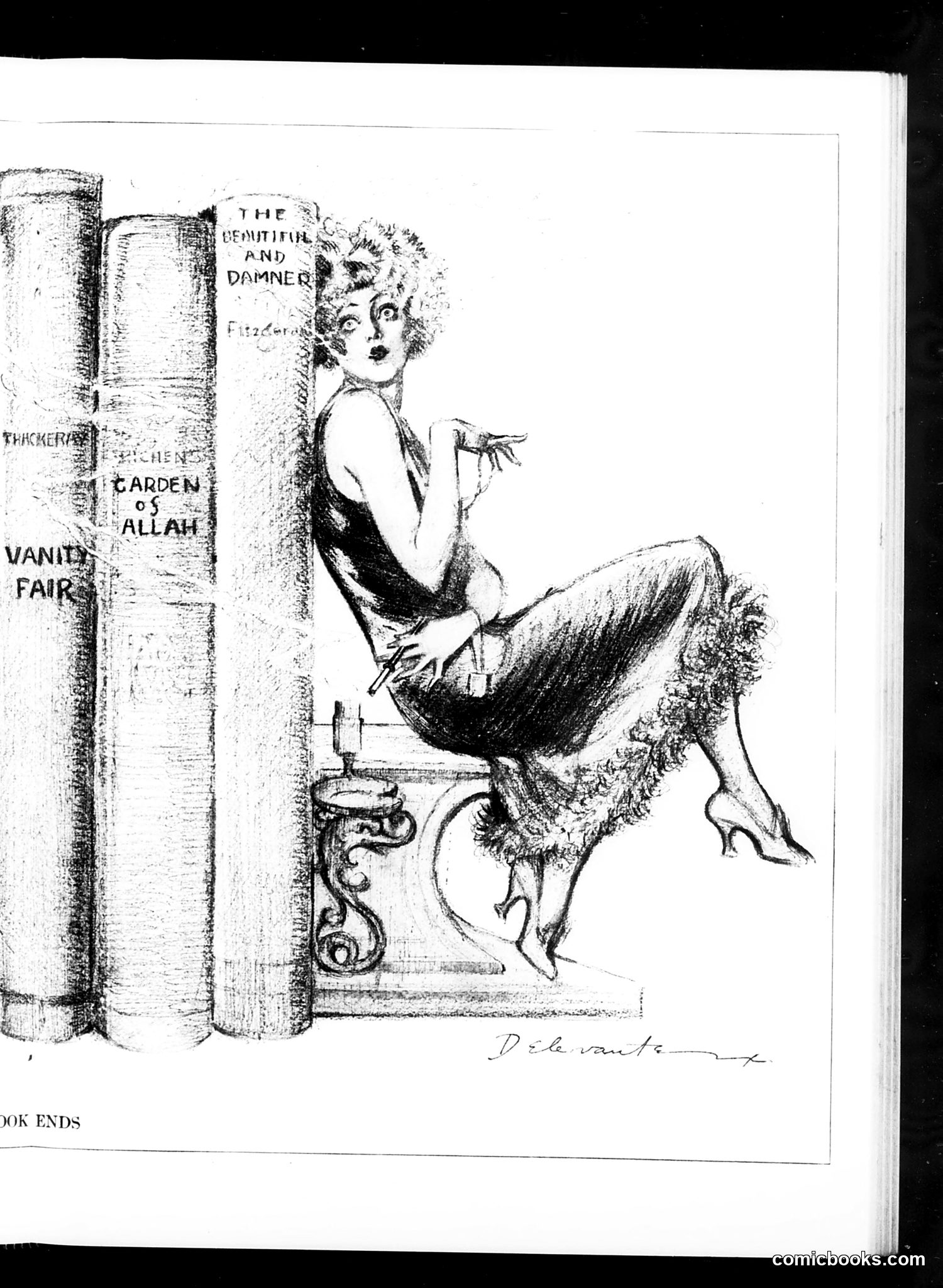
This appears to be an illustration from Judge magazine's back matter, showing a stylized female figure seated near a stack of books. The visible book spines read "The Beautiful and Damned" (by F. Scott Fitzgerald), "Thickera's Kitchen Garden of Allah," and "Vanity Fair." The seated woman, drawn in a flapper style typical of 1920s satirical art, appears to be a commentary on contemporary literary tastes or women's reading habits. The figure's pose and styling suggest satire about how fashionable women engaged with popular literature of the era—mixing serious modernist fiction like Fitzgerald with more escapist or sensational works. The cartoon likely mocks either women's literary choices or the publishing industry's catering to female readers. However, without a date or caption, the specific satirical point remains somewhat unclear.
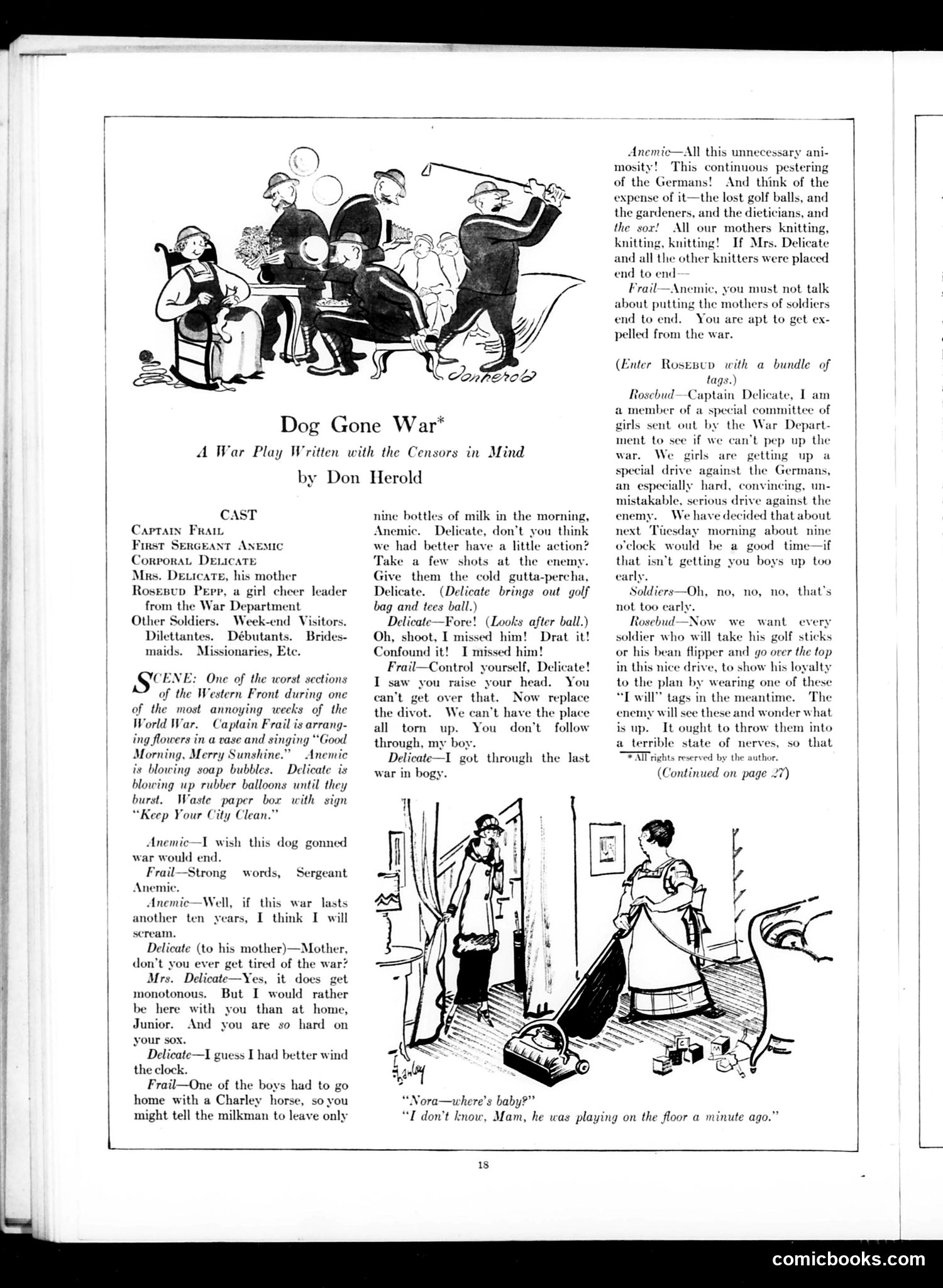
This is a comedic anti-war play by Don Herold mocking WWI's absurdities and censorship. The joke is that soldiers at the front engage in trivial, civilian activities—arranging flowers, blowing bubbles, playing golf—instead of actual combat. The satire targets: (1) the disconnect between wartime sacrifice and home-front frivolity (mothers knitting endlessly, concerns about sock durability); (2) bureaucratic nonsense (a "War Department" girl promoting a scheduled offensive with encouraging tags); (3) the suppression of genuine soldier complaints through censorship ("written with the Censors in Mind"). The title itself is ironic: this isn't a "war" but a parody of one. Characters complain about expense and monotony rather than danger. The final illustration shows a woman searching for her baby—suggesting the domestic chaos behind the martial facade. Herold's critique: wartime leadership is farcical, sacrifices meaningless, and honest soldier sentiment is silenced by patriotic pressure.
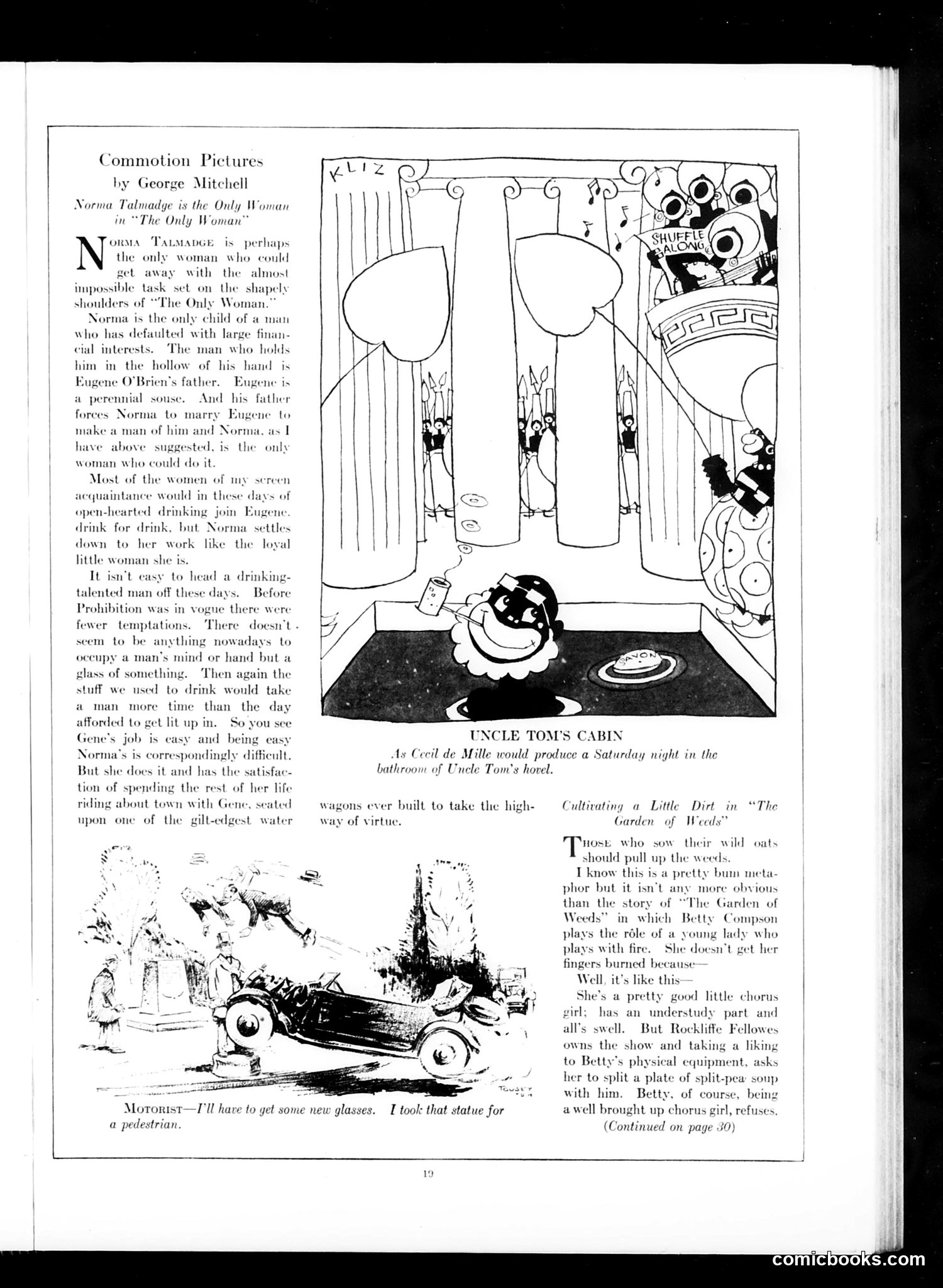
This page discusses early 1920s silent films. The main content critiques actress **Norma Talmadge** in "The Only Woman," praising her as uniquely capable of restraining a drinking man (her co-star Eugene O'Brien) during the **Prohibition era**—when alcohol was legally banned but widely consumed anyway. The satire suggests most actresses would "drink for drink" with male leads, but Talmadge maintains proper, loyal feminine virtue. The cartoon "Uncle Tom's Cabin" appears to mock Cecil B. DeMille's grandiose filmmaking style, contrasting his elaborate production values with humble source material. "The Garden of Weeds" references the moral double standard: a chorus girl who refuses a producer's sexual advances (the "split pea soup" proposition) is portrayed as virtuous, yet the story itself warns against "sowing wild oats." The motorist joke at bottom is unrelated wordplay. The satire reflects 1920s anxieties about female propriety, Prohibition hypocrisy, and Hollywood's sexual exploitation of actresses.
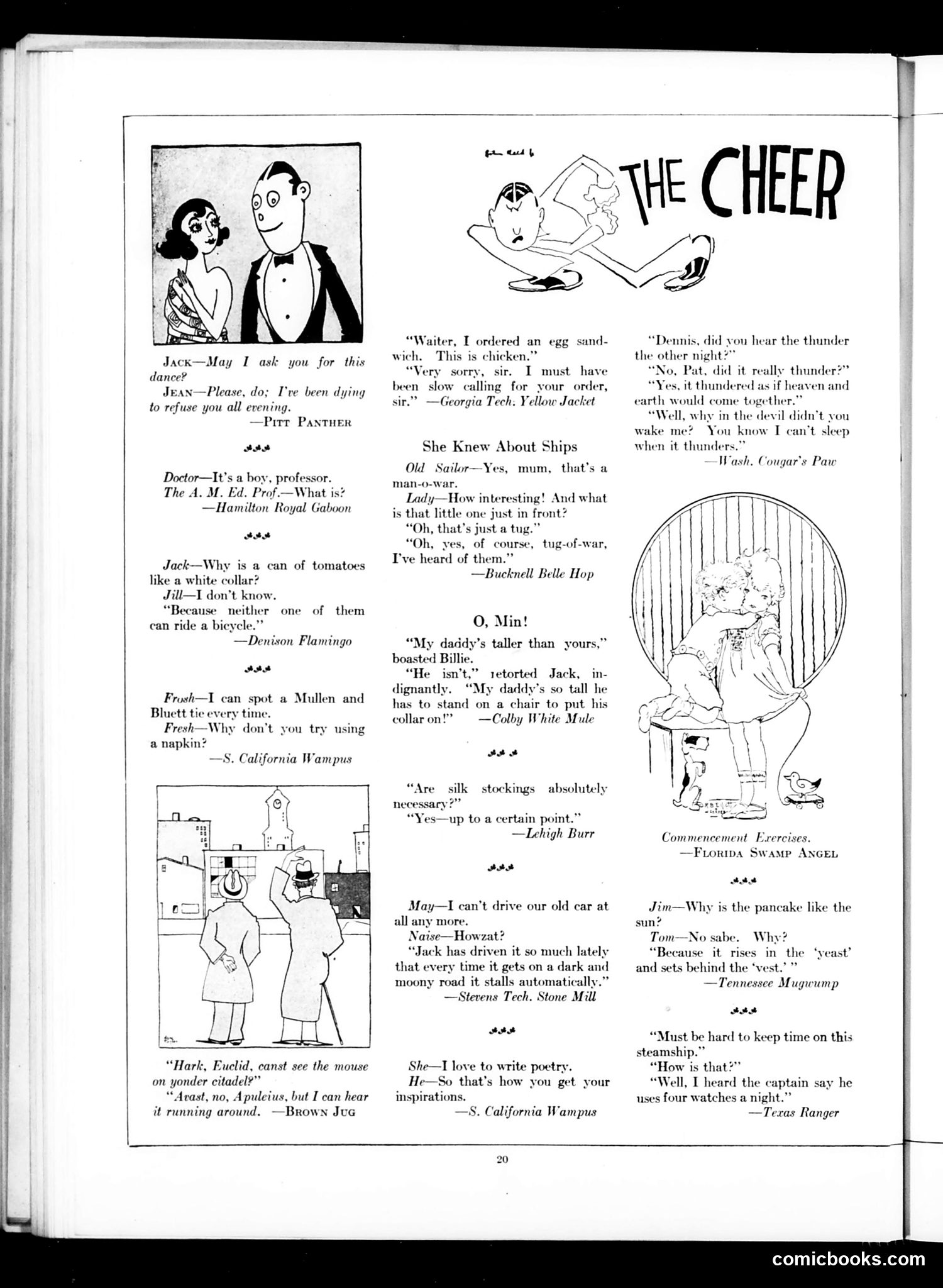
This is a collection of brief jokes and comic strips from college humor magazines, typical of early 20th-century American student publications. The page contains: **Main elements:** - A cartoon couple (top left) with flirtatious dialogue - Several short joke exchanges from different colleges (Georgia Tech, Denison, etc.) - A cartoon of two women in what appears to be a kitchen or ship setting - Another cartoon showing two figures in conversation **The humor relies on:** - Puns and wordplay ("tug-of-war" confusion, "pancake" and "yeast/vest") - Misunderstandings by naive characters (a woman confusing naval terminology) - Exaggeration (a father so tall he needs a chair for his collar) - Observational humor about college life and dating The jokes are credited to various college publications, suggesting this was a compilation of collegiate humor, typical of Judge's appeal to educated, young readers. The satire is mild—focused on social manners, courtship, and innocent absurdity rather than political commentary.
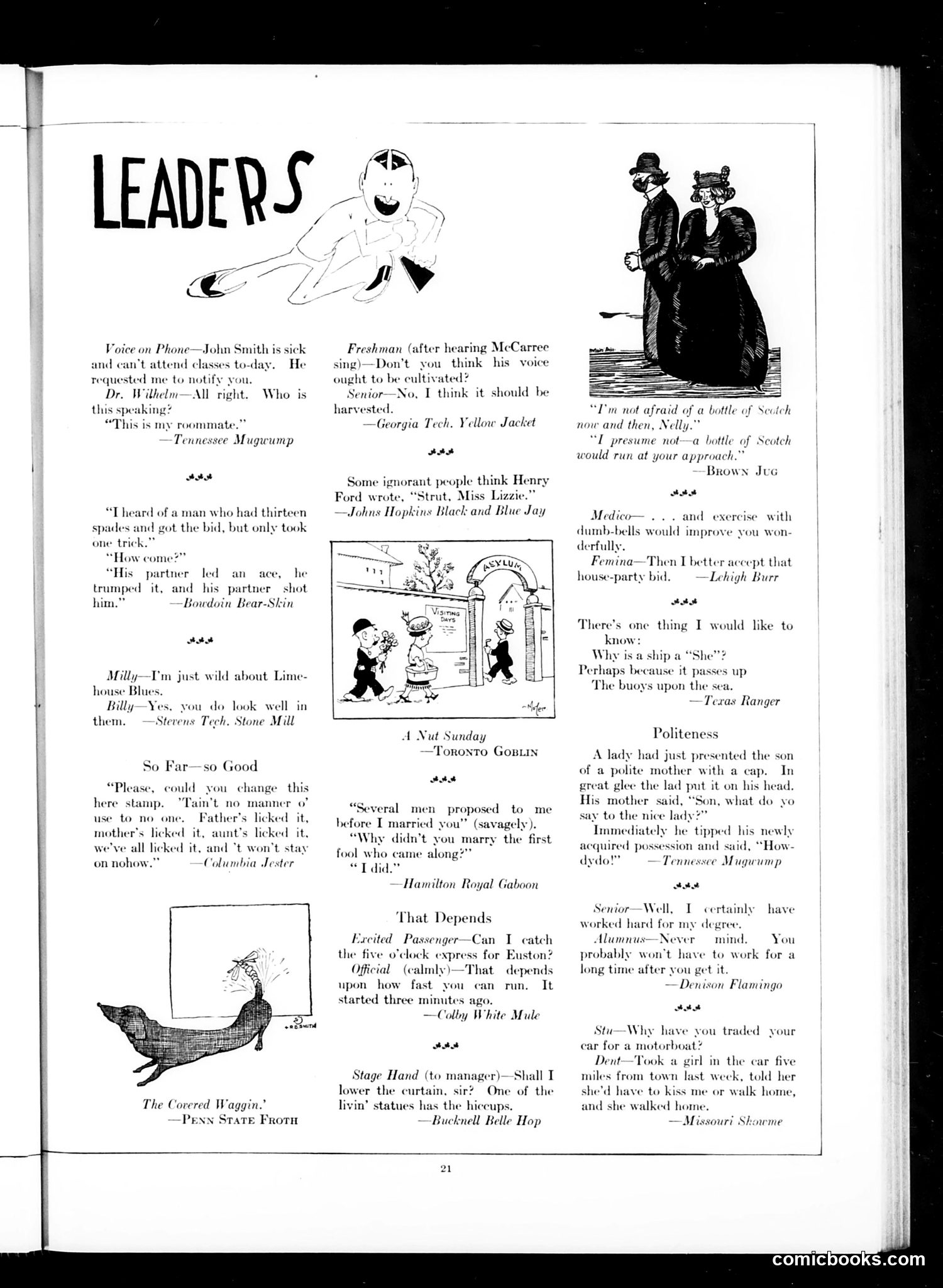
This is a "Leaders" humor column featuring collegiate jokes and brief satirical vignettes, typical of Judge's early-20th-century format. Most content targets college life and social conventions: **Key targets:** - **College culture**: Jokes about bridge players, singing instruction, and fraternity life - **Gender roles**: A woman criticized for rejecting marriage proposals; jokes about women's vanity and emotional reactions - **Male courtship anxieties**: A man's failed motorboat strategy to coerce a kiss - **Class pretension**: References to cultivating voices and "polite" etiquette performances - **Modern inconveniences**: A joke about a train that's already departed **The cartoons** include whimsical illustrations (a covered wagon, a reclining figure) that complement the gag-based humor rather than serving as primary satire. The overall tone is lighthearted mockery of American social customs, particularly among educated young people, with no apparent political commentary—typical of Judge's collegiate humor section from this era.
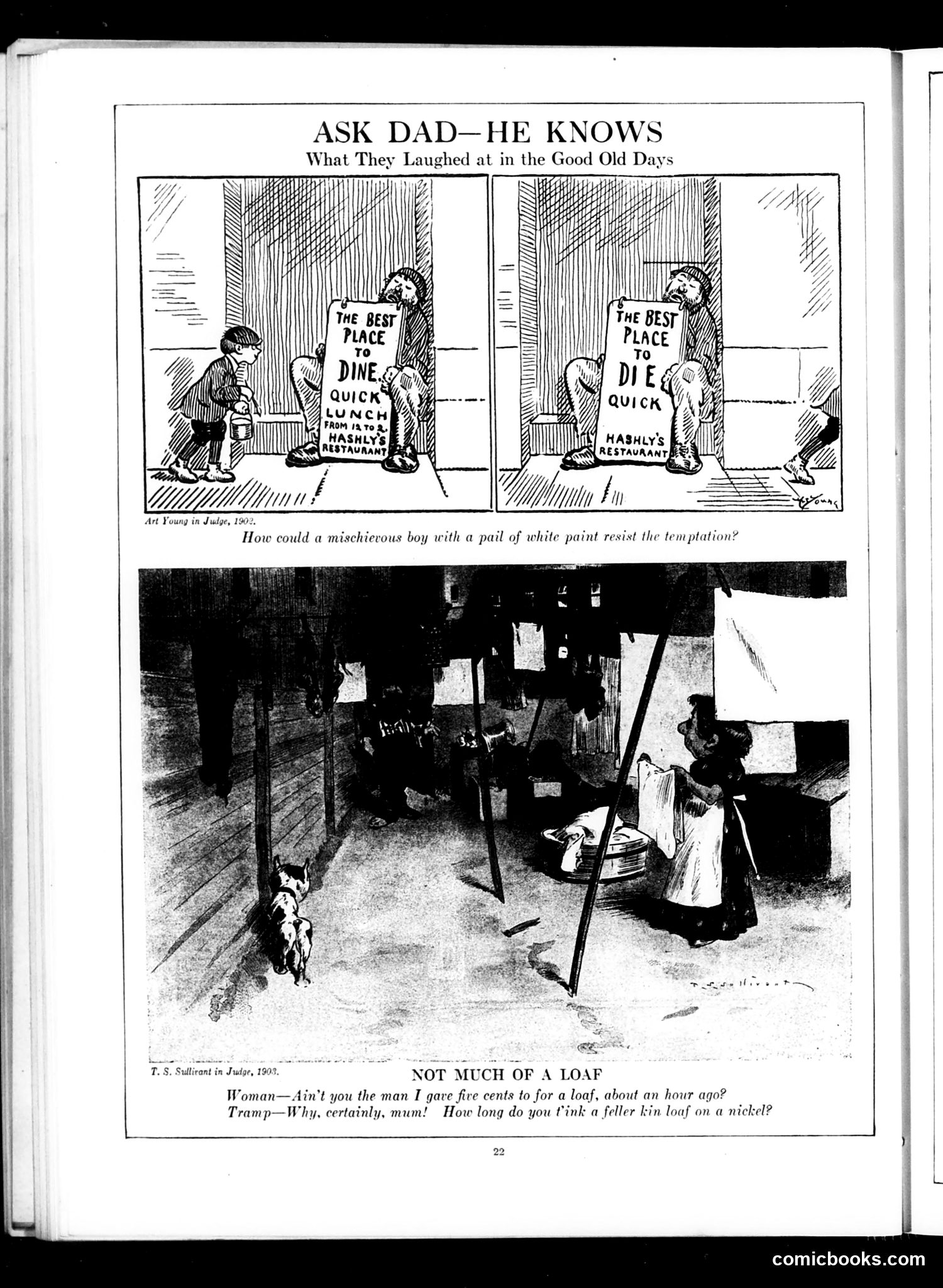
This page contains two unrelated humorous cartoons from early 1900s Judge magazine: **Top (Art Young, 1902):** A boy with white paint considers defacing restaurant signs. The joke plays on temptation—the boy sees identical signs for "Hashly's Restaurant" advertising "the best place to dine quick" and is tempted to paint over one sign to alter its message, creating mischief. **Bottom (T.S. Sullirant, 1903):** A woman confronts a tramp, asking if he's the man she gave five cents for a loaf of bread an hour earlier. His response—that a fellow can't "loaf" (both rest/wander AND eat from) a nickel's worth of bread long—is a pun exploiting the double meaning of "loaf." Both represent typical Judge humor of the era: mild, pun-based or situation comedy aimed at middle-class readers, with no political content. They're nostalgic pieces about "what they laughed at in the good old days."
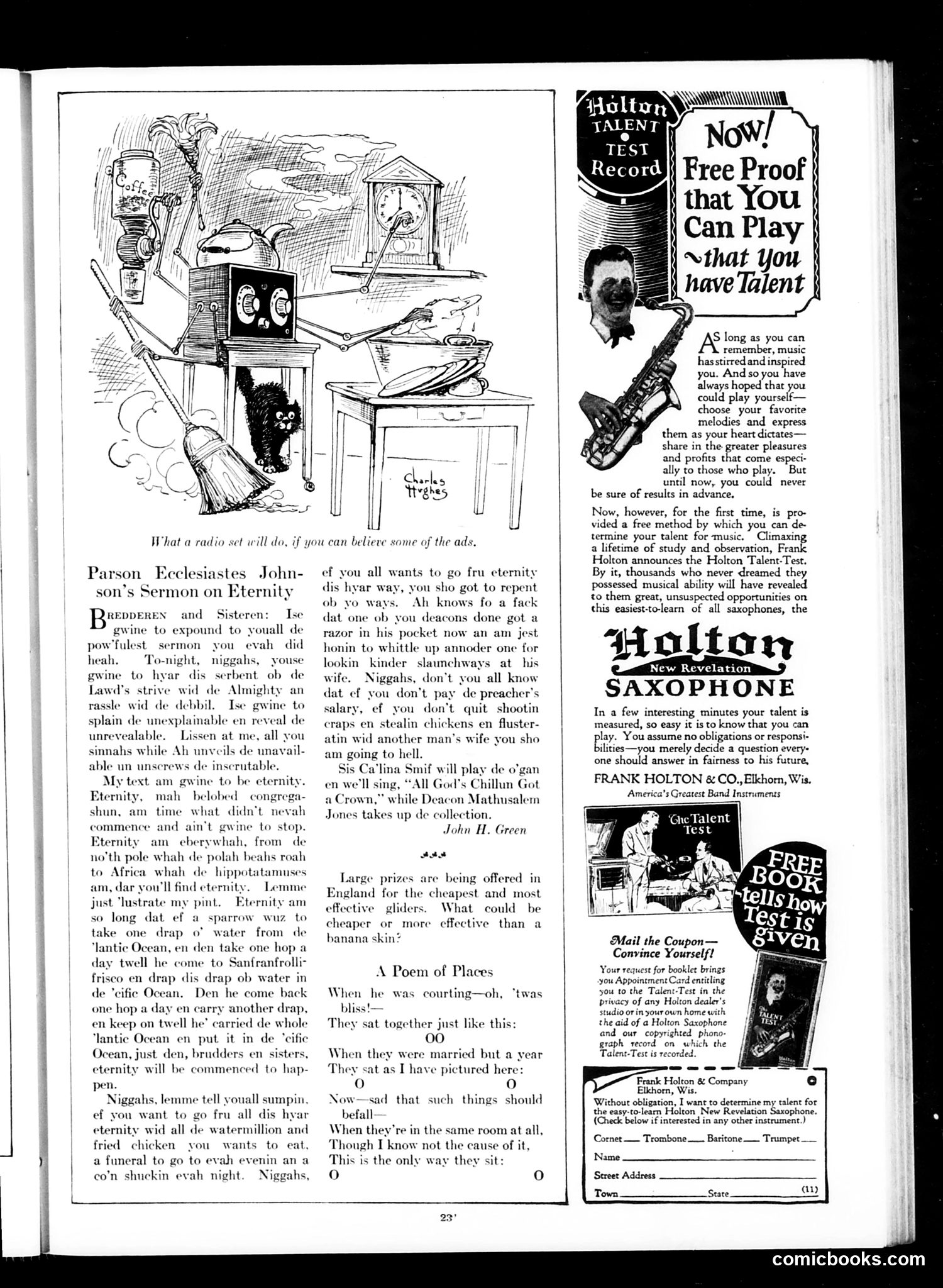
**Main Cartoon (Left):** Satirizes exaggerated radio advertising claims. The sketch shows a chaotic domestic scene with a radio set as the centerpiece, surrounded by improbable outcomes—suggesting ads promise the radio will do everything from cooking to cleaning to entertainment. The caption directly mocks this: "What a radio set will do, if you can believe some of the ads." **Parson Ecclesiastes Johnson's Sermon:** A dialect-heavy humor piece (using deeply offensive racist stereotypes common to early 20th-century publications) featuring a Black preacher's elaborate sermon on eternity, filled with folksy metaphors and moral warnings about sin. **Supporting Content:** - "A Poem of Places": A brief joke about marital discord, showing couples' seating positions deteriorating from courtship closeness to complete separation - **Advertisement:** Frank Holton saxophone company offering a "free talent test" to determine if readers can play The page predominantly contains humorous editorial content and period advertising, reflecting Judge's mix of satire and commercial promotion typical of 1920s American magazines.
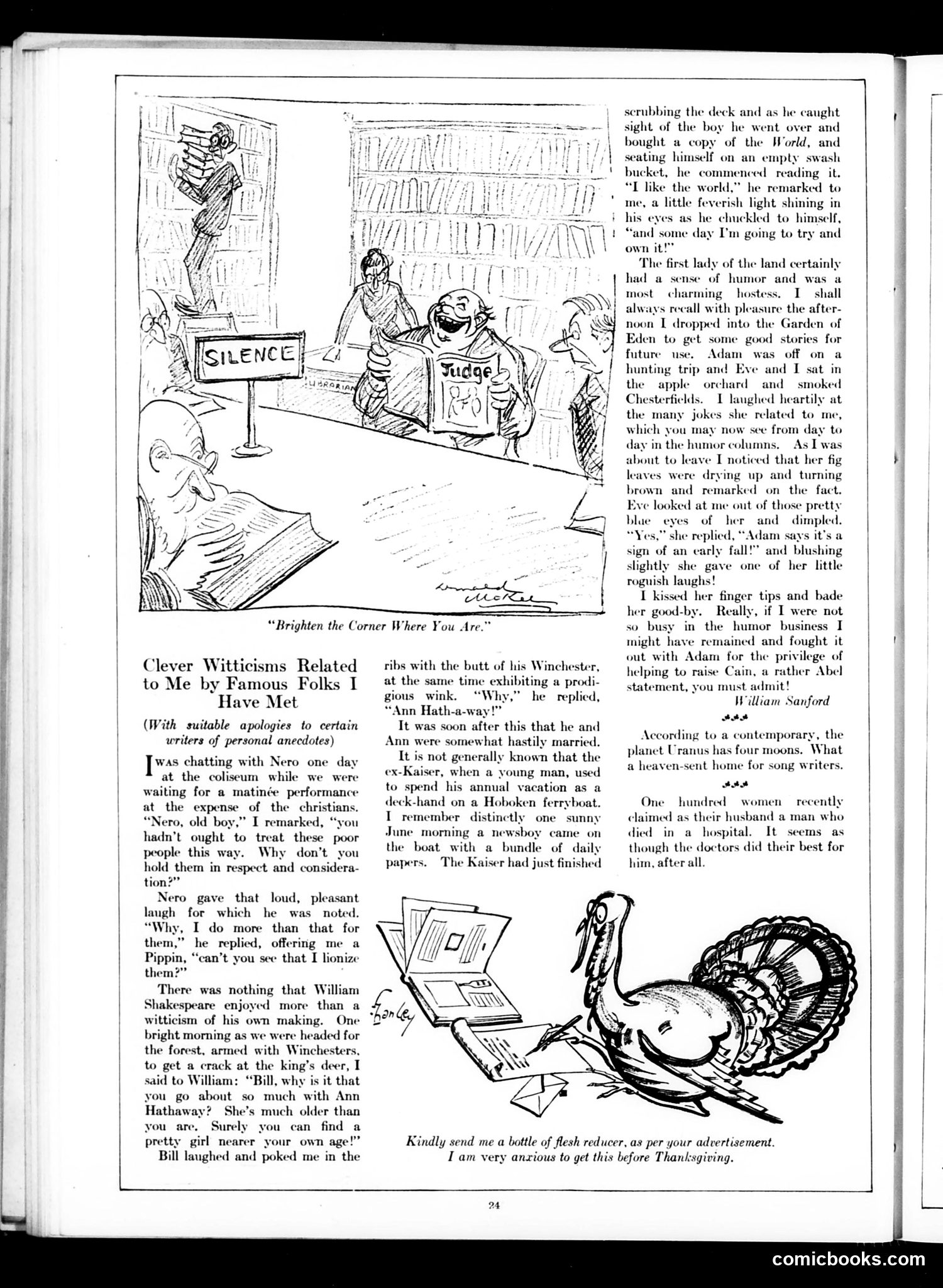
This page contains a humorous essay by William Sanford presenting fictional anecdotes about famous historical and mythological figures. The satire operates through anachronism—placing these figures in modern situations and having them make contemporary wisecracks. The jokes include: Nero "lionizing" Christians (wordplay on his persecution); Shakespeare's pun on "Ann Hath-a-way" (his wife Anne Hathaway); the ex-Kaiser as a young ferryboat deckhand expressing ambitions to "own" the world (dark foreshadowing of his imperial ambitions); and Adam and Eve in the Garden of Eden discussing withering fig leaves as a sign of "early fall." The cartoons and brief jokes below mock contemporary institutions—doctors, marriage, and weight-loss advertising. The satire relies on readers' familiarity with history, literature, and classical mythology, using absurdist humor typical of Judge magazine's style. The overall effect is lighthearted, parodying the popular "clever anecdote" essay format of the era while making oblique social commentary.
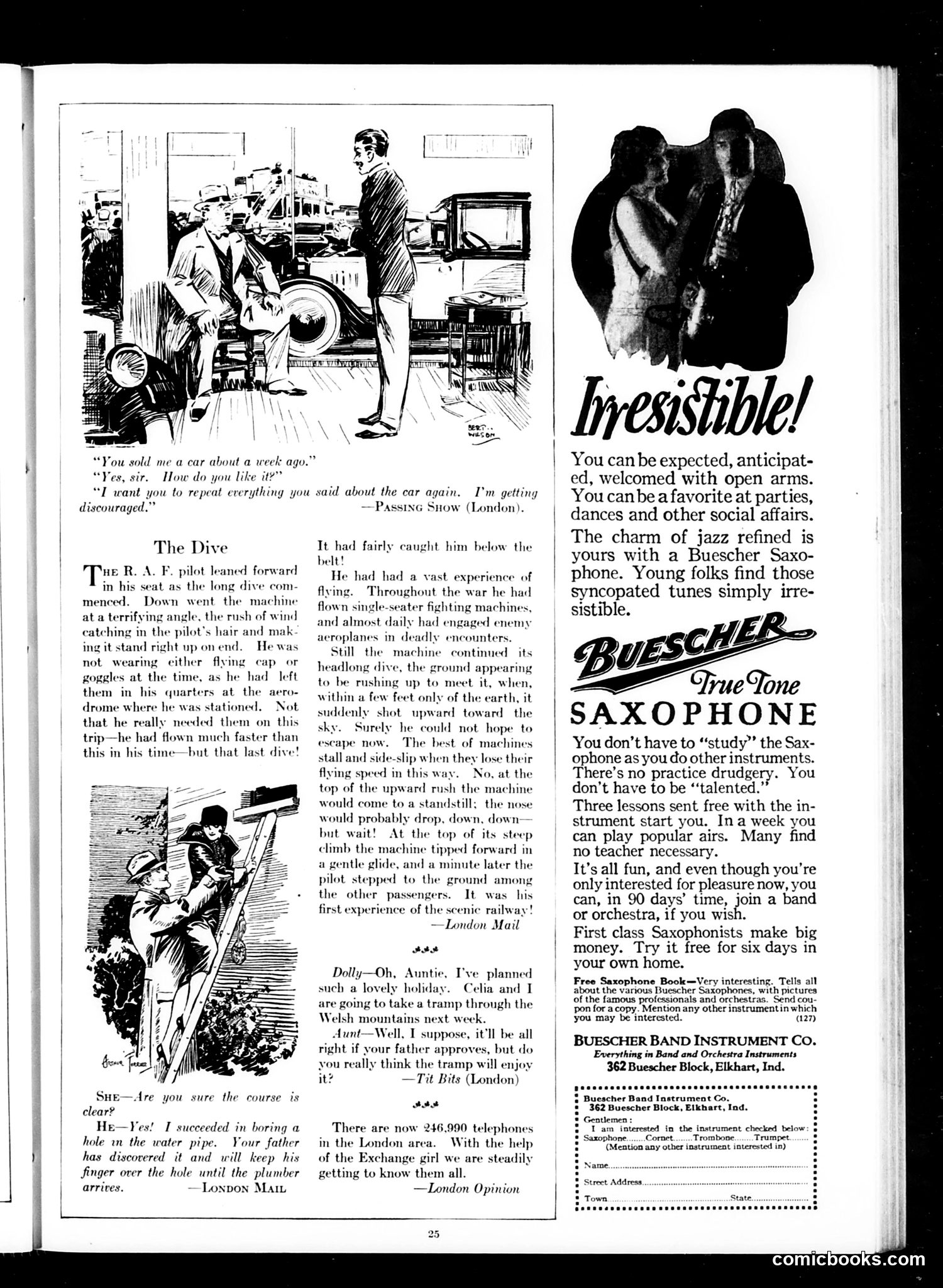
This page mixes humor with advertising. The cartoons satirize common frustrations: **"The Dive"** jokes about a pilot's thrilling first experience on a scenic railway—the text builds tension describing a dangerous airplane dive, only to reveal the mundane reality of an amusement park ride. The humor lies in the anticlimactic reveal and the pilot's overreaction to ordinary entertainment. **Other brief jokes** mock domestic complaints: a car salesman's repeated pitch becoming tiresome, a water pipe mishap, and assumptions about whether a tramp (vagrant) would enjoy a hiking trip. **The Buescher Saxophone ad** dominates the right side, promoting saxophones as effortless fun for Jazz Age youth. It emphasizes that playing requires no talent or practice, positioning the instrument as a social asset for parties and dances—appealing to 1920s modernity and leisure culture. The page reflects post-WWI optimism, jazz's popularity, and consumer marketing aimed at young people seeking accessible entertainment and social status.
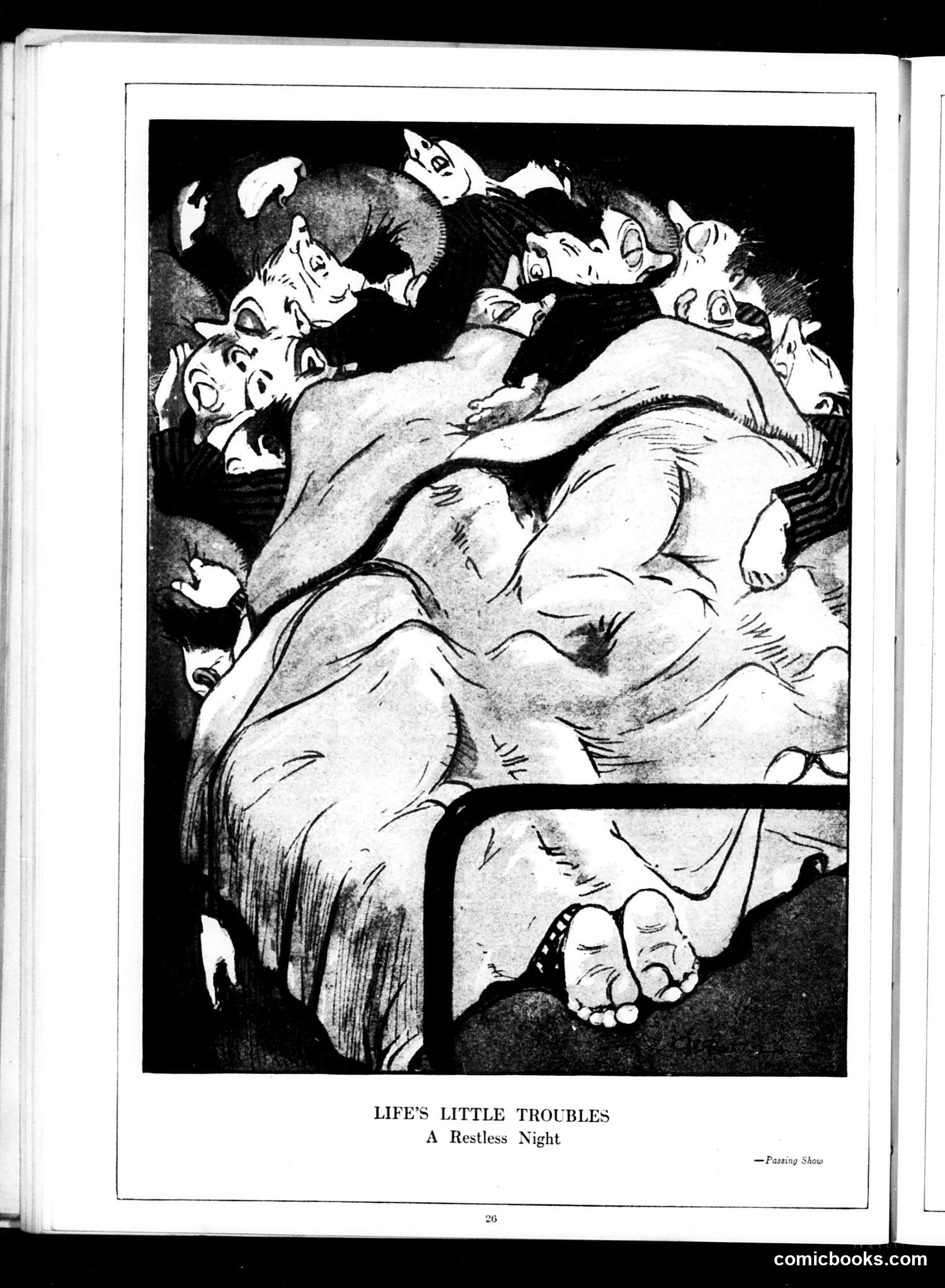
This cartoon depicts a humorous domestic scene from what appears to be the early 20th century. A rotund man lies in bed, surrounded by caricatured faces—likely representing his wife and children—who appear agitated or demanding. The exaggerated expressions suggest chaos and noise disrupting his sleep. The satire targets the common complaint of husbands about sleepless nights caused by family members. The title "Life's Little Troubles" frames this as an everyday domestic annoyance, though the grotesque facial expressions amplify the man's sense of being overwhelmed and disturbed. The humor derives from the relatable frustration of attempting rest amid household commotion—a theme that would resonate with Judge magazine's primarily male readership of the era.
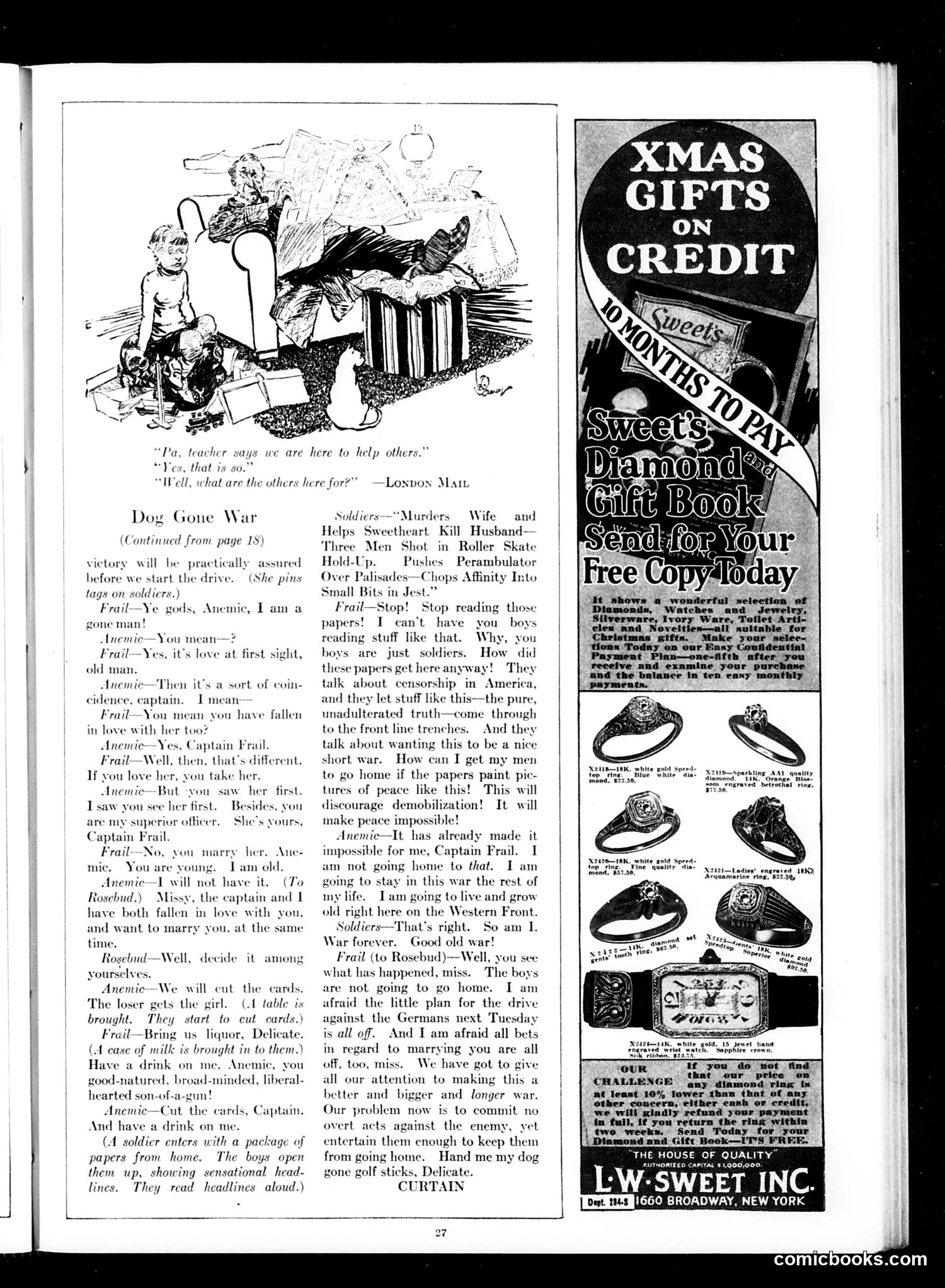
This satirical play-within-a-page mocks WWI's prolongation and military censorship. Two soldiers (Captain Frail and Anemic) both fall for a woman named Rosebud; they're prepared to marry her when newspapers arrive with sensational crime headlines. The joke: Captain Frail, eager to keep troops deployed, realizes these lurid domestic stories—murders, affairs, violence—will discourage soldiers from returning home. He's horrified that uncensored "truth" might actually make peace seem appealing. The irony is sharp: to maintain the war effort, he needs soldiers *afraid* of civilian life, not peace. By the play's end, the soldiers voluntarily commit to lifelong warfare, having learned that home is worse than the trenches. The satire critiques both military leadership's vested interest in prolonging conflict and sensationalist press coverage. The final punchline—"War forever"—underscores how institutional forces and media shape soldiers' choices, making endless conflict seem preferable to civilian reality.
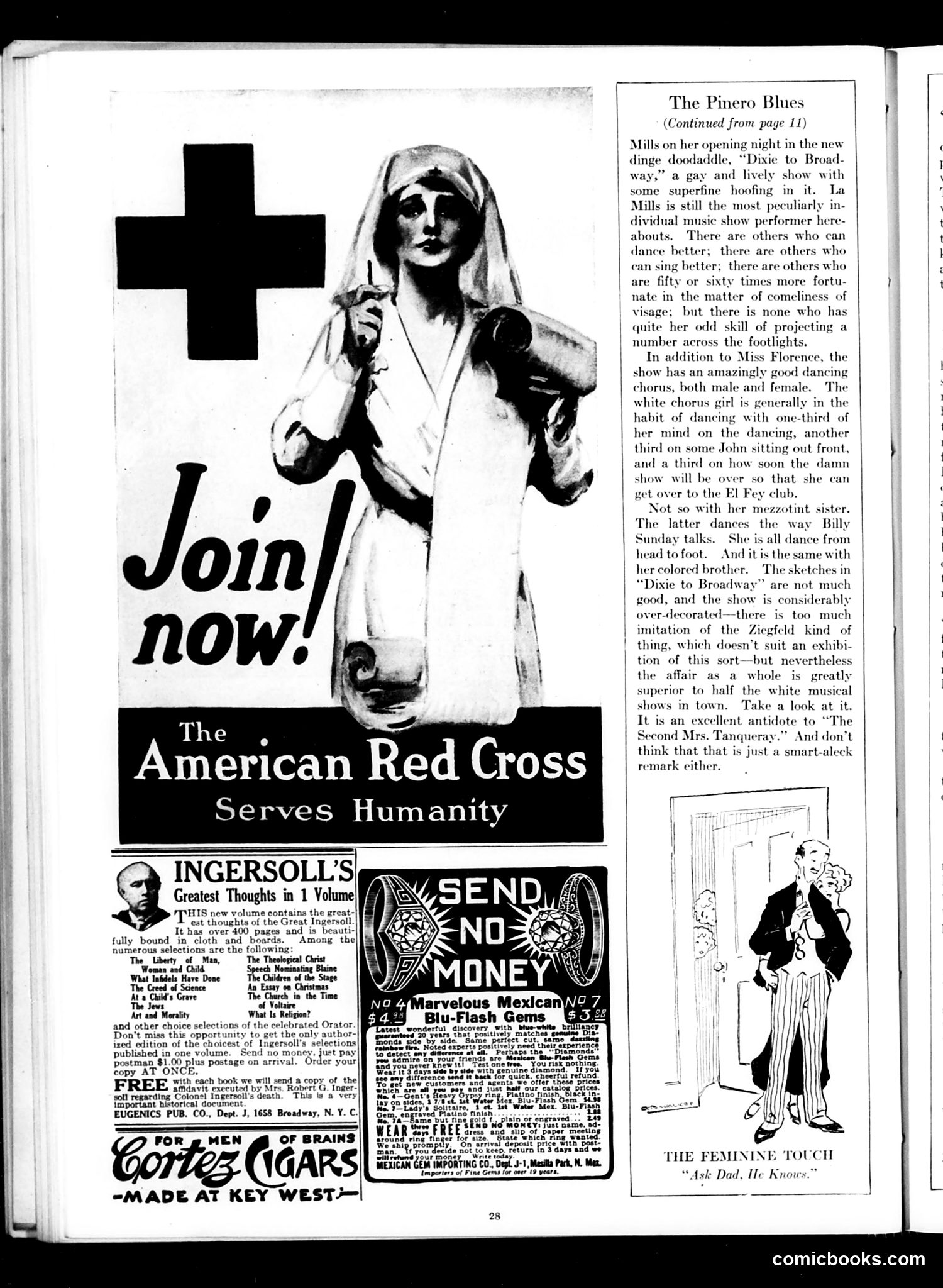
This page contains primarily **advertising** rather than political satire. The dominant content includes: **Main Advertisement:** A Red Cross recruitment poster featuring a woman in nurse's attire with a cross symbol, urging "Join now!" This reflects WWI-era mobilization efforts to recruit nurses and support personnel. **Other Ads:** Include Ingersoll's philosophical writings collection, Mexican gemstones, and Cortez cigars—typical commercial advertisements of the period. **Editorial Content:** "The Pinero Blues" is a theater review (continued from page 11) critiquing Broadway musical performances, particularly discussing Black performers like Florence Mills and comparing their work favorably to white productions. The reviewer praises Mills's distinctive performance style. **Small Cartoon:** "The Feminine Touch" shows a domestic scene with the caption "Ask Dad, He Knows"—a brief humor piece on gender dynamics. The page reflects early 1920s American culture: wartime patriotism, emerging Black performers in mainstream theater, and advertising-heavy magazine format.
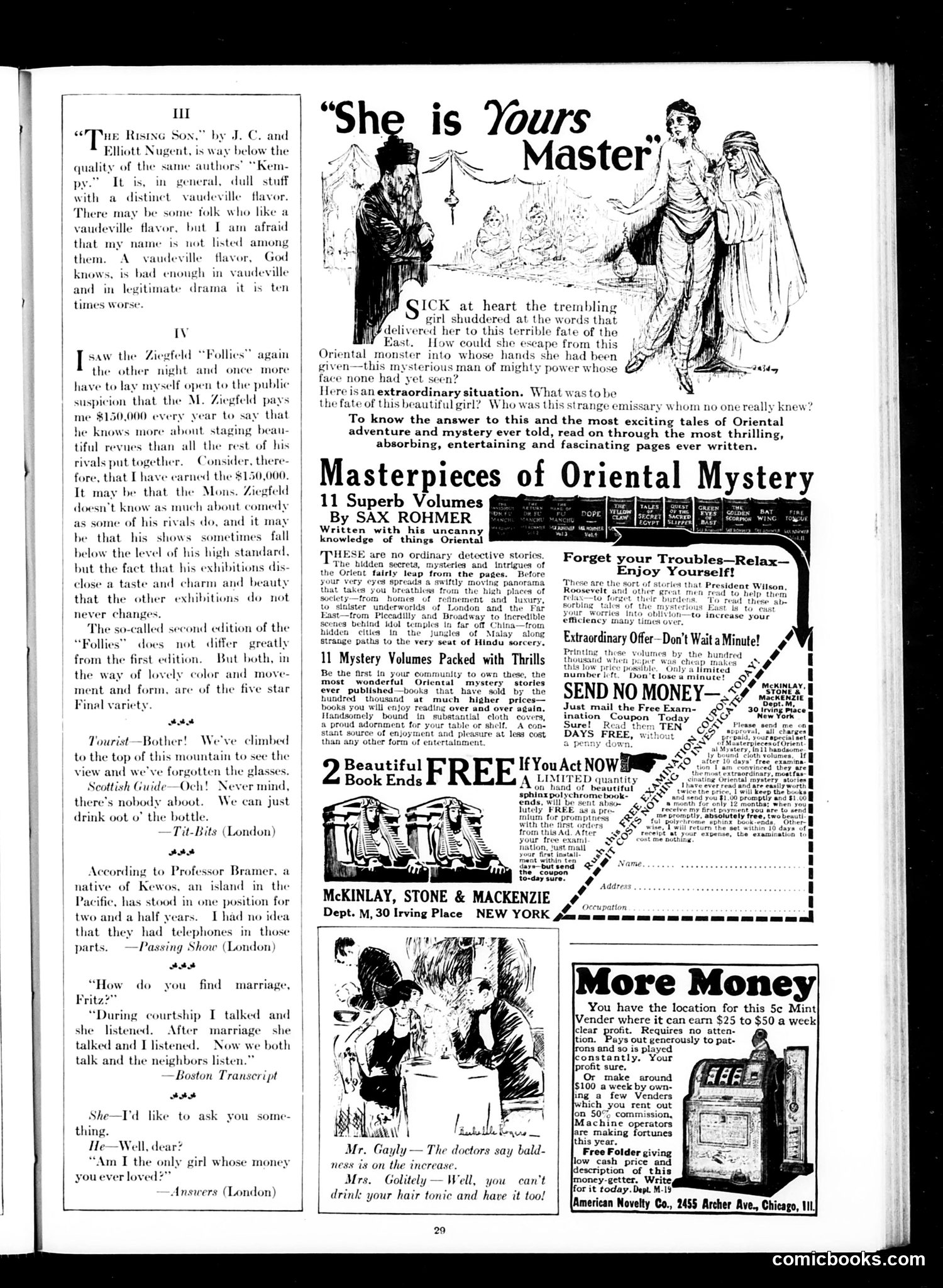
This page is primarily **advertising and light humor**, not political satire. The main content promotes "Masterpieces of Oriental Mystery," an 11-volume book series by Sax Rohmer (known for the "Fu Manchu" character). The top illustration advertises these books using the phrase "She is Yours Master"—depicting a young Western woman in apparent distress being handed over to an sinister Oriental figure. This exploits the **"Yellow Peril" racist trope** common in early 20th-century pulp fiction: the fear of Asian men threatening white women. The page also includes humor columns and brief jokes about courtship and marriage (typical Judge magazine fare). Nothing here carries significant political meaning—it's simply period advertising that reveals **contemporary racial anxieties and stereotypes** that modern readers should recognize as deeply offensive and now-outdated xenophobic marketing. The Sax Rohmer books were wildly popular despite (or because of) their racial content.
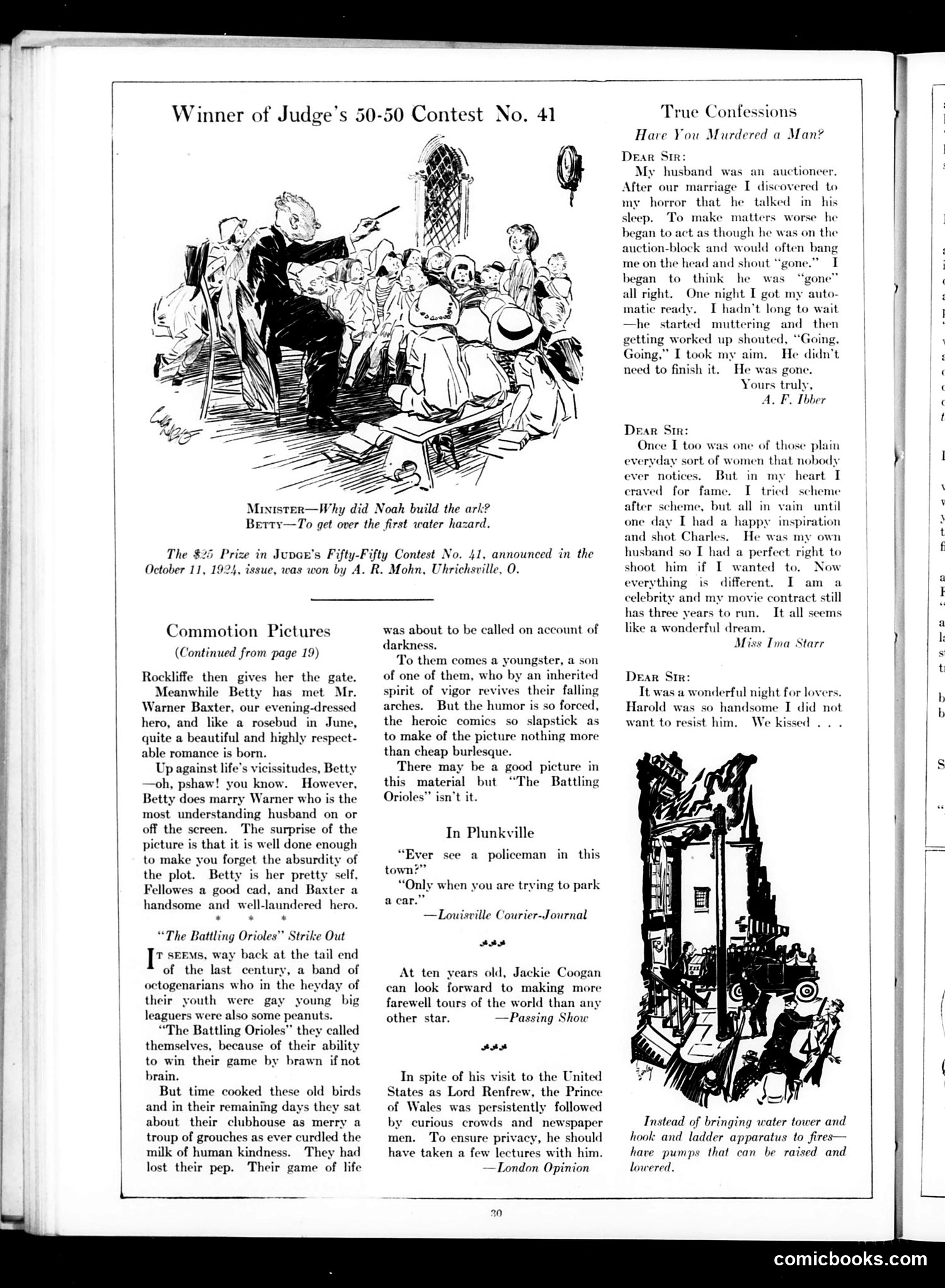
This page contains film reviews, humor, and satirical content typical of Judge magazine: **"The Battling Orioles" review** mocks a sentimental sports picture about aging former baseball players. The satire targets both the film's forced sentimentality and the nostalgia industry—suggesting Hollywood exploits tired themes of "glory days" with cheap emotional manipulation rather than genuine storytelling. **The "True Confessions" section** is dark satirical humor about women who murder their husbands and become celebrities as a result. The joke attacks both sensationalist crime coverage and the era's celebrity worship—implying that notoriety (even through murder) grants fame that formerly ordinary women craved. This reflects 1920s anxieties about changing social values and media sensationalism. **Minor jokes** include a minister-and-child exchange about Noah's ark (a water hazard pun) and quips about Jackie Coogan's endless farewell tours and the Prince of Wales being followed by crowds despite seeking privacy. The overall tone is cynical about American entertainment, celebrity culture, and crime reporting.
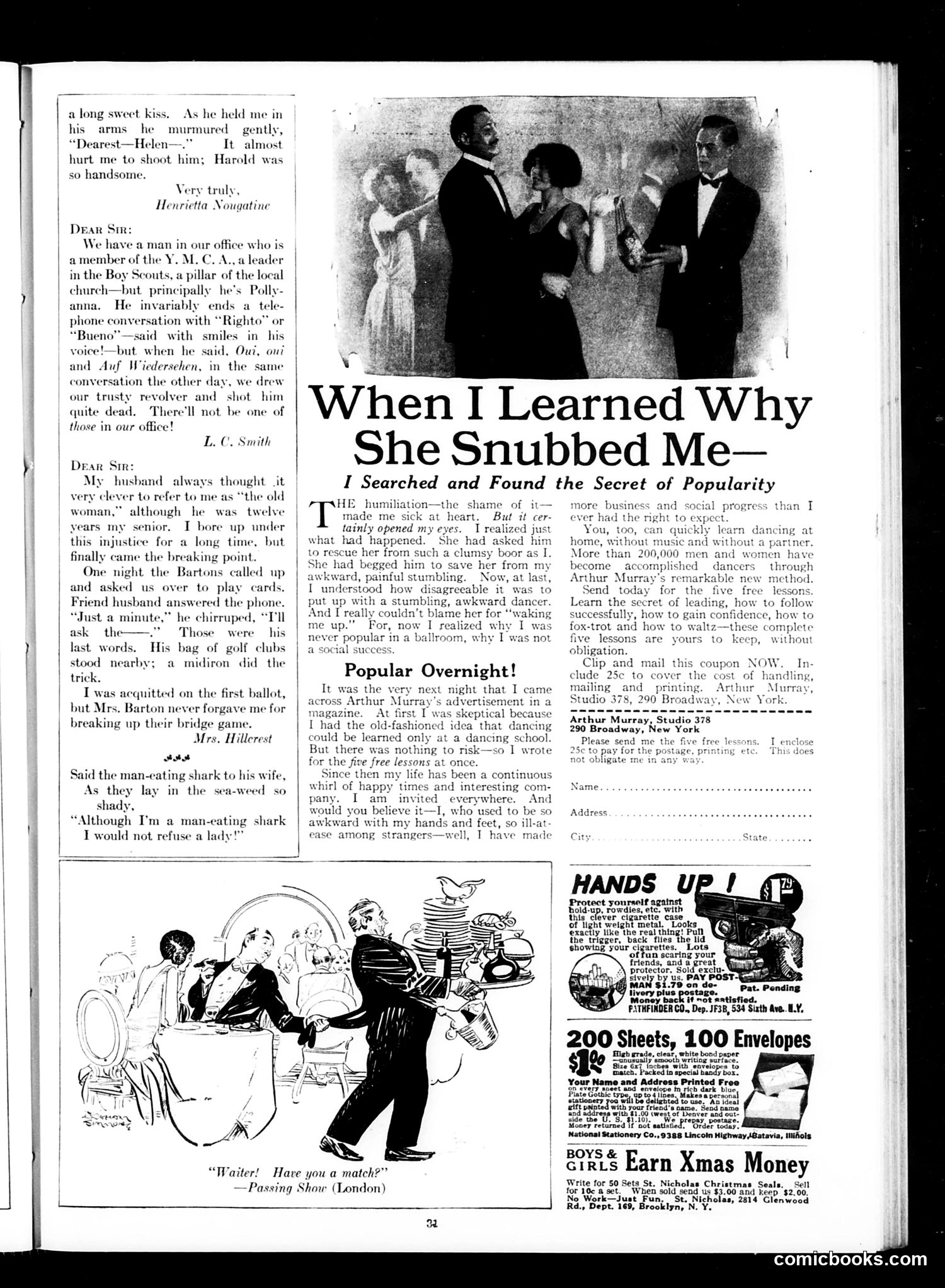
This page contains three satirical "Dear Sir" letters to the editor mocking marital discord and domestic violence, presented as dark humor typical of 1920s-30s Judge magazine. **The Letters' "Jokes":** - First letter describes a woman shooting her overly cheerful office colleague who speaks in foreign phrases - Second describes a woman murdering her husband for calling her "the old woman" after 12 years of marriage - Third features a man-eating shark refusing to eat a lady **The Main Feature Article:** "When I Learned Why She Snubbed Me" advertises **Arthur Murray's dance lessons**—a real, famous dance instruction service. The narrative follows a man rejected by a woman at a dance, discovering through Arthur Murray that poor dancing caused his social failure. The ad promises popularity and business success through learning to dance. **Context for Modern Readers:** This juxtaposes casually brutal domestic murder "humor" with earnest advertising for self-improvement through dancing. The contrast reveals period attitudes: murder is a punchline, but social awkwardness is genuinely shameful and fixable through commerce. Both reflect anxieties about changing social standards and class mobility in early 20th-century America.
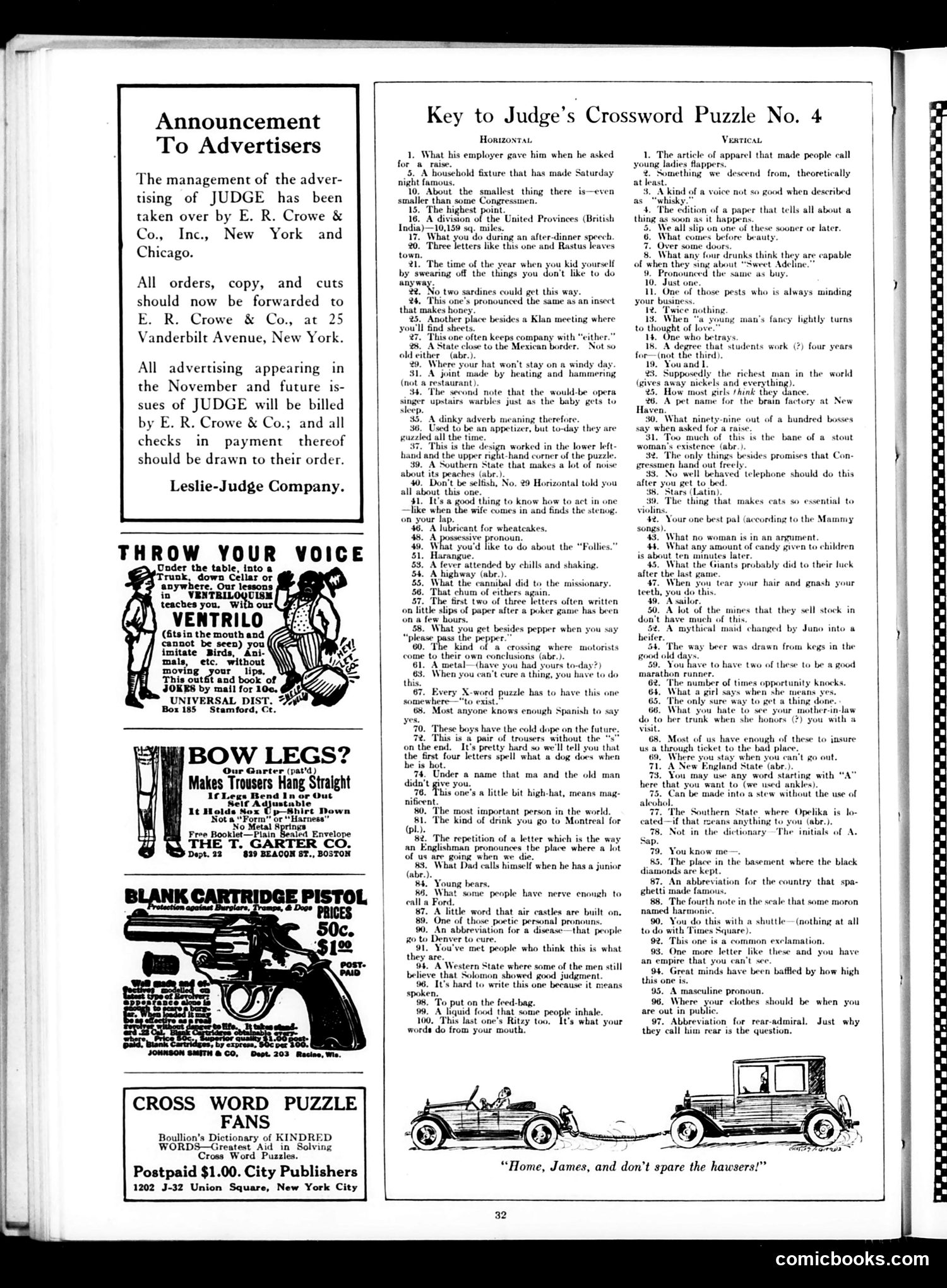
This page is primarily **advertisements and administrative notices** with a crossword puzzle. The main content includes: 1. **Announcement to Advertisers**: Judge's advertising management has transferred to E. R. Crowe & Co., Inc. 2. **Period Advertisements** (early-to-mid 20th century): - Ventriloquism lessons - "Bow Legs" trouser garters - Blank cartridge pistols - Cross-word puzzle dictionary 3. **Crossword Puzzle No. 4**: The page features clues for a crossword puzzle with satirical, humorous definitions typical of Judge magazine's comedic style—mixing wordplay with social commentary about contemporary life (employer raises, congressional incompetence, Klan meetings, etc.). 4. **Cartoon Caption**: At bottom, a driving cartoon captioned "Home, James, and don't spare the hawsers!" (a pun on "horses"). This is a **utilitarian page** mixing business operations with period advertising and puzzles rather than featuring substantial editorial satire or political cartooning.
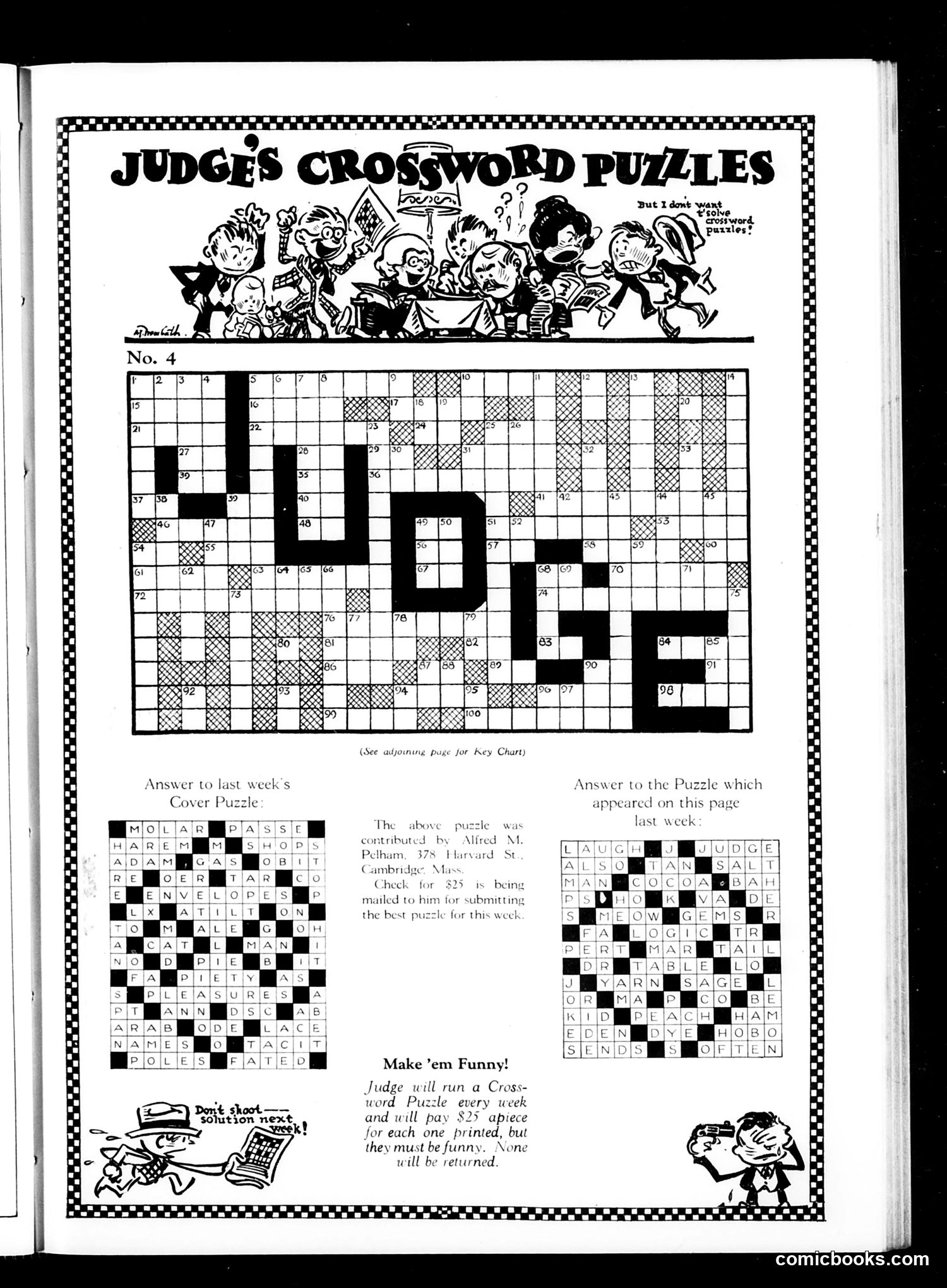
This page from *Judge* magazine presents **Crossword Puzzle No. 4**, a recreational feature popular in early-to-mid 20th century publications. The cartoonish header illustrations show children and adults enthusiastically engaged with puzzles, capturing the widespread craze for crosswords that swept America. The page includes the puzzle grid itself, answers to the previous week's puzzle, and a **contest announcement**: *Judge* will pay $25 for submitted crossword puzzles "if they must be funny"—appealing to readers' creativity while building content. The humorous cartoon at bottom-left ("Don't shoot—solution next week!") gently mocks the frustration puzzles cause. This represents *Judge's* pivot toward entertainment and audience participation, reflecting 1920s-30s popular culture where crosswords were a mainstream leisure activity. The "$25" prize was significant compensation, encouraging reader submissions during an era when magazines actively engaged their audiences beyond passive reading.
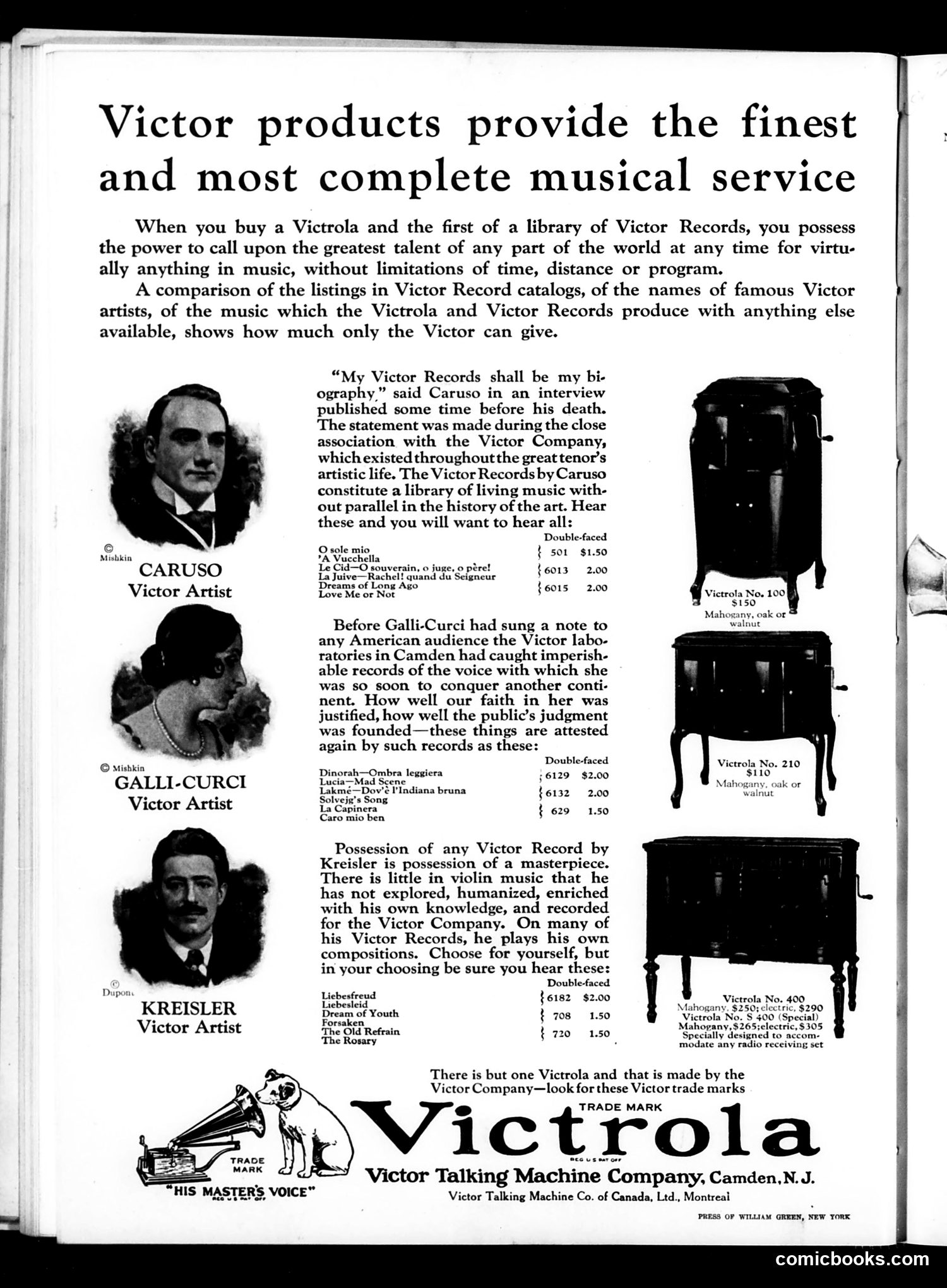
This page is **not a cartoon or satire**—it's a straightforward advertisement for Victrola phonographs and Victor Records, placed in *Judge* magazine. The page features photographs of three famous recording artists (Caruso, Galli-Curci, and Kreisler) alongside lists of their Victor recordings and prices. It includes images of three Victrola models available for purchase. The advertising strategy emphasizes that Victor Records capture "the greatest talent of any part of the world," using celebrity endorsements and catalog listings to demonstrate product superiority. A quote from tenor Enrico Caruso—"My Victor Records shall be my biography"—serves as testimonial. The page concludes with Victor's trademark ("His Master's Voice") and company information, identifying this as a commercial advertisement rather than editorial or satirical content.