
Judge, 1924-11-15 · page 8 of 36
Judge — November 15, 1924 — page 8: what you’re looking at
What you’re looking at
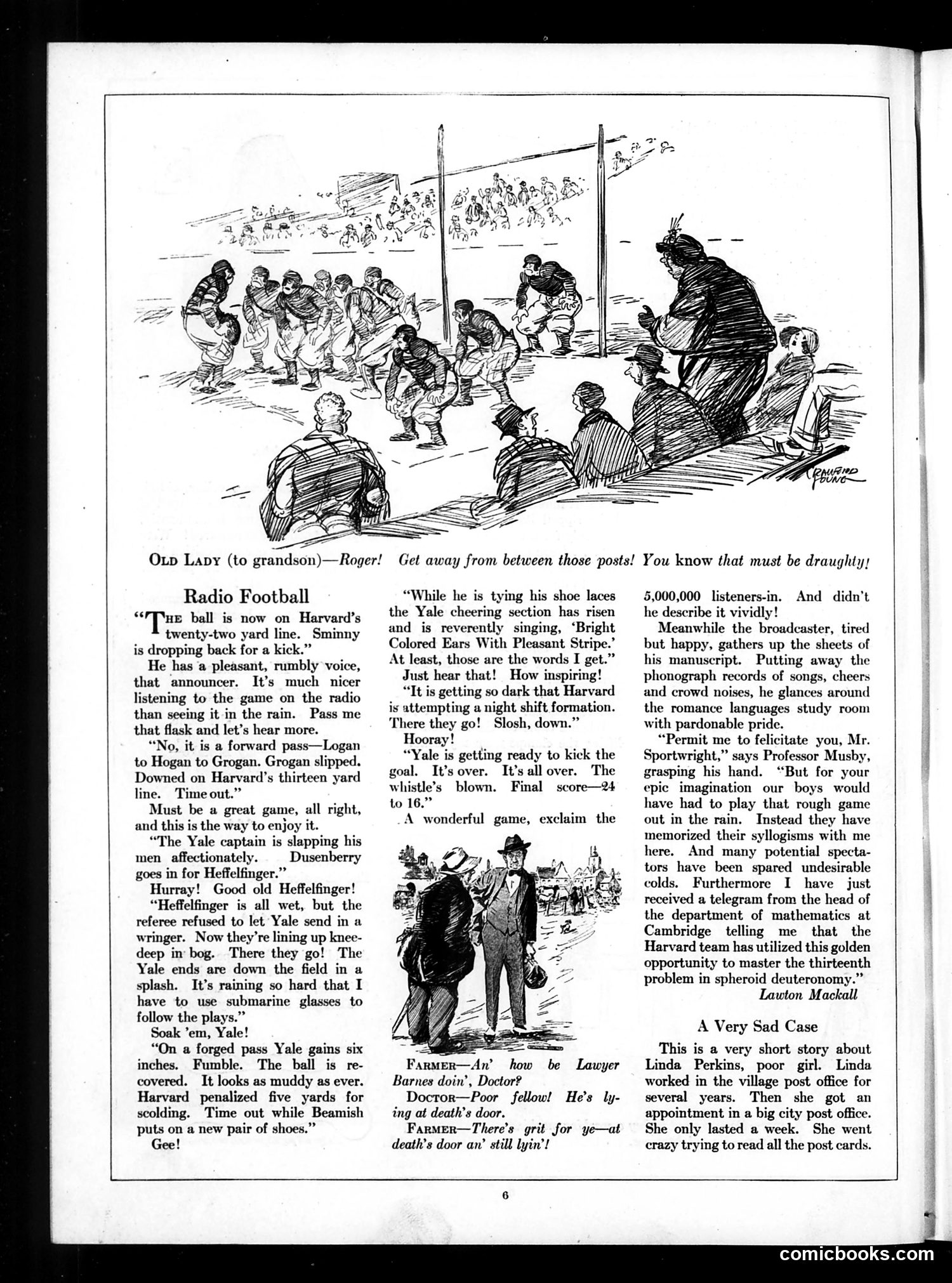
This Judge magazine page satirizes the emerging phenomenon of **radio sports broadcasting**—a novelty in the 1920s-30s. The main cartoon mocks how listeners imagined football games based solely on a radio announcer's dramatic play-by-play narration. The joke: the actual game is a muddy, chaotic mess in heavy rain, but the broadcaster's vivid description makes it entertaining for 5 million listeners huddled indoors. The announcer even fabricates details (a "forged pass," players in "night shift formation") to enhance drama. The satire targets how radio could transform mundane reality into compelling entertainment through imagination and creative narration. A secondary joke shows a professor praising the broadcaster for keeping students indoors studying mathematics instead of watching the game—turning the broadcast into an accidental academic benefit. The page's other brief jokes are unrelated: one about an old lady worried about "draughts" (drafts), another pun about a dying lawyer still "lying."
📄 Transcribed text from this page (OCR, searchable)
Machine-transcribed from the original scan — historical spelling and the odd misread are preserved.
a Otp Lapy (to grandson) —Roger! Get away from between those posts! You know that must be draughty! Radio Football “ue ball is now on Harvard’s twenty-two yard line. Sminny is dropping back for a kick.” He has a pleasant, rumbly voice, that announcer. It’s much nicer listening to the game on the radio than seeing it in the rain. Pass me that flask and let’s hear more. “No, it is a forward pass—Logan to Hogan to Grogan. Grogan slipped. Downed on Harvard’s thirteen yard line. Time out.” Must be a great game, all right, and this is the way to enjoy it. “The Yale captain is slapping his men affectionately. Dusenberry goes in for Heffelfinger.” Hurray! Good old Heffelfinger! “Heffelfinger is all wet, but the referee refused to let Yale send in a wringer. Now they’re lining up knee- deep in bog. There they go! The Yale ends are down the field in a splash. It’s raining so hard that I have to use submarine glasses to follow the plays.” Soak ’em, Yale! “On a forged pass Yale gains six inches. Fumble. The ball is re- covered. It looks as muddy as ever. Harvard penalized five yards for scolding. Time out while Beamish puts on a new pair of shoes.” Gee! “While he is tying his shoe laces the Yale cheering section has risen and is reverently singing, ‘Bright Colored Ears With Pleasant Stripe.’ At least, those are the words I get.” Just hear that! How inspiring! “It is getting so dark that Harvard is attempting a night shift formation. There they go! Slosh, down.” Hooray! “Yale is getting ready to kick the goal. It’s over. It’s all over. The whistle’s blown. Final score—24 to 16.” A wonderful game, exclaim the FarmER—An’ how be Lawyer Barnes doin’, Doctor? Docror—Poor fellow! He’s ly- ing at death’s door. Farmer—There’s grit for ye—at death’s door an’ still lyin’! 5,000,000 listeners-in. he describe it vividly! Meanwhile the broadcaster, tired but happy, gathers up the sheets of his manuscript. Putting away the phonograph records of songs, cheers and crowd noises, he glances around the romance languages study room with pardonable pride. “Permit me to felicitate you, Mr. Sportwright,” says Professor Musby, grasping his hand. “But for your epic imagination our boys would have had to play that rough game out in the rain. Instead they have memorized their syllogisms with me here. And many potential specta- tors have been spared undesirable colds. Furthermore I have just received a telegram from the head of the department of mathematics at Cambridge telling me that the Harvard team has utilized this golden opportunity to master the thirteenth problem in spheroid deuteronomy.” Lawton Mackall And didn't A Very Sad Case This is a very short story about Linda Perkins, poor girl. Linda worked in the village post office for several years. Then she got an appointment in a big city post office. She only lasted a week. She went crazy trying to read all the post cards. comicbooks.com