
Judge, 1924-11-15 · page 21 of 36
Judge — November 15, 1924 — page 21: what you’re looking at
What you’re looking at
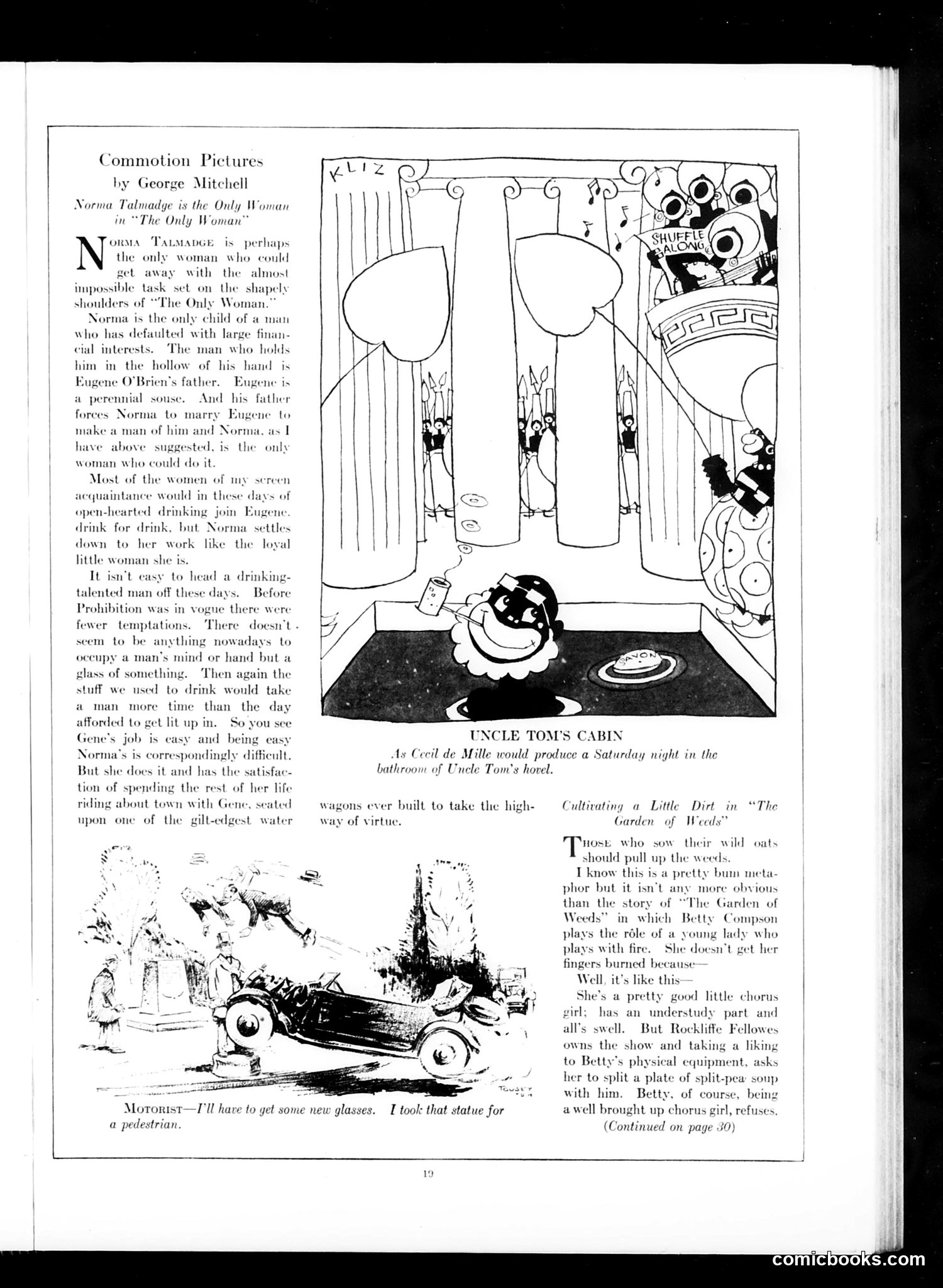
This page discusses early 1920s silent films. The main content critiques actress **Norma Talmadge** in "The Only Woman," praising her as uniquely capable of restraining a drinking man (her co-star Eugene O'Brien) during the **Prohibition era**—when alcohol was legally banned but widely consumed anyway. The satire suggests most actresses would "drink for drink" with male leads, but Talmadge maintains proper, loyal feminine virtue. The cartoon "Uncle Tom's Cabin" appears to mock Cecil B. DeMille's grandiose filmmaking style, contrasting his elaborate production values with humble source material. "The Garden of Weeds" references the moral double standard: a chorus girl who refuses a producer's sexual advances (the "split pea soup" proposition) is portrayed as virtuous, yet the story itself warns against "sowing wild oats." The motorist joke at bottom is unrelated wordplay. The satire reflects 1920s anxieties about female propriety, Prohibition hypocrisy, and Hollywood's sexual exploitation of actresses.
📄 Transcribed text from this page (OCR, searchable)
Machine-transcribed from the original scan — historical spelling and the odd misread are preserved.
Commotion Pictures hy George Mitchell O Norma Talmadge is the Only Woman O ) ¢ b in “The Only Woman” \ ey (3 onma TALMADGE is perhaps SHUESNG, | the only woman who could . | get away with the impossible task set_on the sha shoulders of “The Only Woman.” rma is the only child of a man defaulted with larg who » finan- cial interests. The man who holds him in the hollow of his hand is Eugene O'Brien's father. Et ne is mnial souse. And his father Norma to marry Eugene to a pe force: make a man of him and Norma, as | have above suggested, is the only woman who could do it Most of the women of my sereen acquaintance would in these days of open-hearted drinking join I drink for drink, but Norma settles down to her work like the loyal little woman she is. It isn’t y to head a drinking- talented man off these days. Before Prohibition was in vo; 1e there were fewer temptations. ‘There doesn’t - sm to be ys to nything nowai ‘upy a man’s mind or hand but a ass of something. Ther in the stuff we used to drink would take a man more time than the day afforded to get lit up in. So you see Gene’s job is: easy and being easy UNCLE TOM’S CABIN | Norma’s is correspondingly difficult, As Cecil de Mille would produce a Saturday night in the But she does it and has the satisfac. bathroom of Uncle Tom's hovel. | tion of spending the rest of her life riding about town with Gene cated wagons ever built to take the high- Cultivating a Little Dirt in “The upon one of the gilt-edgest water way of virtue. Garden of Weeds” Tr who sow their wild) oats should pull up the weeds I know this is a pretty bum meta- phor but it isn’t any more obvious than the story of “The Garden of | | Weeds” in which Betty Compson | plays the réle of a young lady who | plays with fire. She doesn’t get her | fingers burned because | Well, it’s like this | She’s a pretty good little chorus girl; has an understudy part and all's swell. But Rockliffe Fellowes owns the show and taking a liking to Betty's physical equipment, asks her to split a plate of split-pew soup with him. Betty, of course, being Mortorist—I'll have to get some new glasses. I tool: that statue for a well brought up chorus girl, refuses. a pedestrian. (Continued on page 30)