
Judge, 1924-11-15 · page 17 of 36
Judge — November 15, 1924 — page 17: what you’re looking at
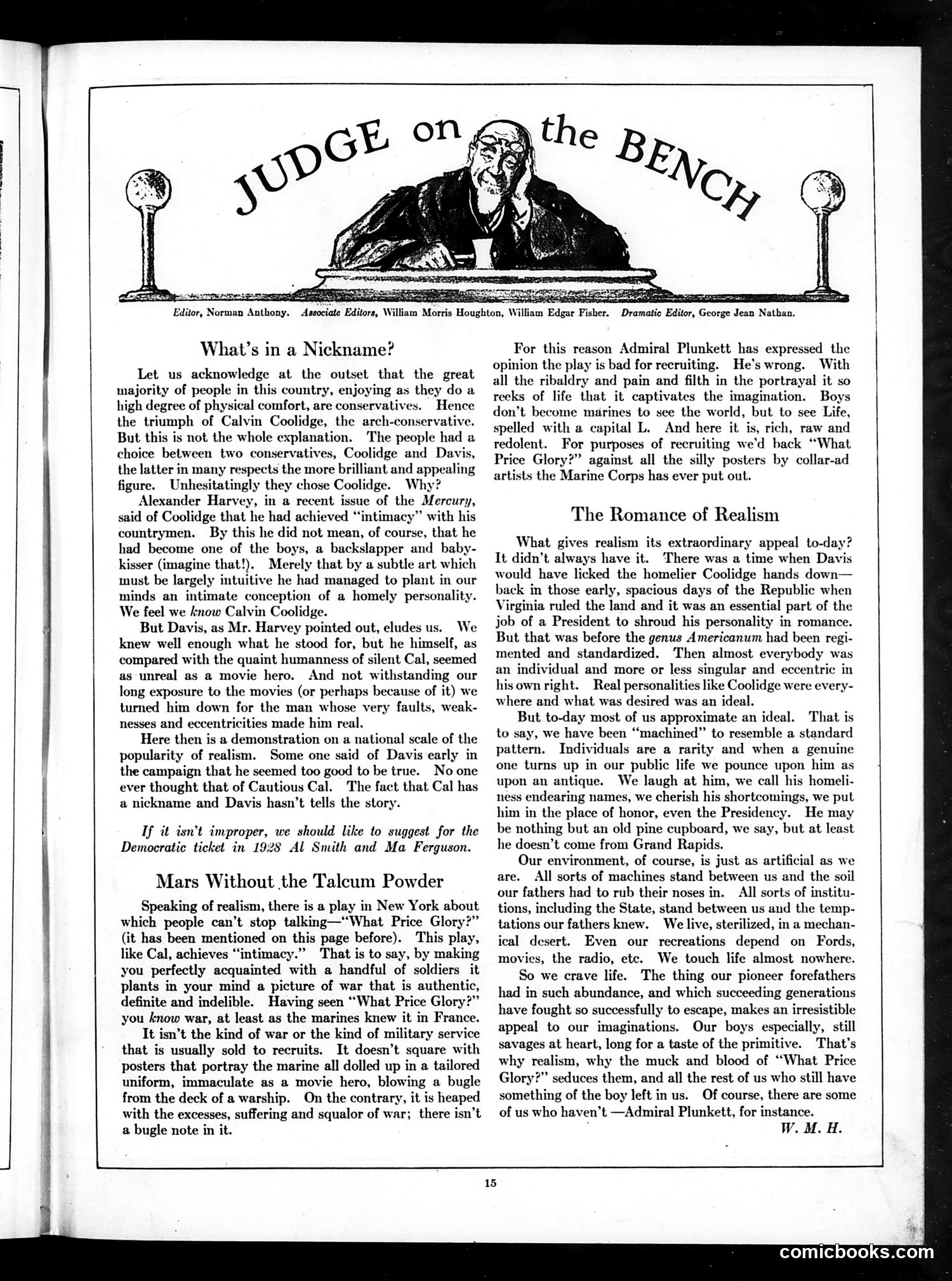
What you’re looking at
This page discusses why Calvin Coolidge defeated John W. Davis in the 1928 presidential election through the lens of "realism." The author argues that Coolidge's homely, relatable persona—reinforced by his nickname "Cal"—made him feel authentic to voters, while Davis seemed artificial and distant despite being more intellectually brilliant. The page then pivots to praising the play "What Price Glory?" for its gritty, realistic portrayal of marines in WWI, arguing it actually aids recruitment better than sanitized military propaganda. Admiral Plunkett had criticized the play as bad for recruiting, but the author disagrees. The central argument: modern Americans, living in a standardized, mechanized society, crave authenticity and "life spelled with a capital L." They reject polished artificiality in favor of raw, messy realism—whether in politicians or entertainment. The homely nickname and genuine imperfection paradoxically make figures more appealing than cultivated perfection.
📄 Transcribed text from this page (OCR, searchable)
Machine-transcribed from the original scan — historical spelling and the odd misread are preserved.
What’s in a Nickname? Let us acknowledge at the outset that the great majority of people in this country, enjoying as they do a high degree of physical comfort, are conservatives. Hence the triumph of Calvin Coolidge, the arch-conservative. But this is not the whole explanation. The people had a choice between two conservatives, Coolidge and Davis, the latter in many respects the more brilliant and appealing figure. Unhesitatingly they chose Coolidge. Why? Alexander Harvey, in a recent issue of the Mercury, said of Coolidge that he had achieved “intimacy” with his countrymen. By this he did not mean, of course, that he had become one of the boys, a backslapper and baby- kisser (imagine that!). Merely that by a subtle art which must be largely intuitive he had managed to plant in our minds an intimate conception of a homely personality. We feel we know Calvin Coolidge. But Davis, as Mr. Harvey pointed out, eludes us. We knew well enough what he stood for, but he himself, as compared with the quaint humanness of silent Cal, seemed as unreal as a movie hero. And not withstanding our long exposure to the movies (or perhaps because of it) we turned him down for the man whose very faults, weak- nesses and eccentricities made him real. Here then is a demonstration on a national scale of the popularity of realism. Some one said of Davis early in the campaign that he seemed too good to be true. No one ever thought that of Cautious Cal. The fact that Cal has a nickname and Davis hasn’t tells the story. If it isn’t improper, we should like to suggest for the Democratic ticket in 1928 Al Smith and Ma Ferguson. Mars Without the Taleum Powder Speaking of realism, there is a play in New York about which people can’t stop talking—‘‘What Price Glory?” (it has been mentioned on this page before). This play, like Cal, achieves “intimacy.” That is to say, by making you perfectly acquainted with a handful of soldiers it plants in your mind a picture of war that is authentic, definite and indelible. Having seen “What Price Glory?” you know war, at least as the marines knew it in France. It isn’t the kind of war or the kind of military service that is usually sold to recruits. It doesn’t square with posters that portray the marine all dolled up in a tailored uniform, immaculate as a movie hero, blowing a bugle from the deck of a warship. On the contrary, it is heaped with the excesses, suffering and squalor of war; there isn’t a bugle note in it. liam Morris Houghton, W jam Edgar Fisher. Dramatic Editor, George Jean Nathan. For this reason Admiral Plunkett has expressed the opinion the play is bad for recruiting. He’s wrong. With all the ribaldry and pain and filth in the portrayal it so reeks of life that it captivates the imagination. Boys don’t become marines to see the world, but to see Life, spelled with a capital L. And here it is, rich, raw and redolent. For purposes of recruiting we'd back ‘What Price Glory?” against all the silly posters by collar-ad artists the Marine Corps has ever put out. The Romance of Realism What gives realism its extraordinary appeal to-day? It didn’t always have it. There was a time when Davis would have licked the homelier Coolidge hands down— back in those early, spacious days of the Republic when Virginia ruled the land and it was an essential part of the job of a President to shroud his personality in romance. But that was before the genus Americanum had been regi- mented and standardized. Then almost everybody was an individual and more or less singular and eccentric in his own right. Real personalities like Coolidge were every- where and what was desired was an ideal. But to-day most of us approximate an ideal. That is to say, we have been “machined” to resemble a standard pattern. Individuals are a rarity and when a genuine one turns up in our public life we pounce upon him as upon an antique. We laugh at him, we call his homeli- ness endearing names, we cherish his shortcomings, we put him in the place of honor, even the Presidency. He may be nothing but an old pine cupboard, we say, but at least he doesn’t come from Grand Rapids. Our environment, of course, is just as artificial as we are. All sorts of machines stand between us and the soil our fathers had to rub their noses in. All sorts of institu- tions, including the State, stand between us and the temp- tations our fathers knew. We live, sterilized, in a mechan- ical desert. Even our recreations depend on Fords, movies, the radio, etc. We touch life almost nowhere. So we crave life. The thing our pioneer forefathers had in such abundance, and which succeeding generations have fought so successfully to escape, makes an irresistible appeal to our imaginations. Our boys especially, still savages at heart, long for a taste of the primitive. That’s why realism, why the muck and blood of “What Price Glory?” seduces them, and all the rest of us who still have something of the boy left in us. Of course, there are some of us who haven’t —Admiral Plunkett, for instance. W. M. H. se apc icici Sg cr comicbooks.com