
Judge, 1924-11-15 · page 12 of 36
Judge — November 15, 1924 — page 12: what you’re looking at
What you’re looking at
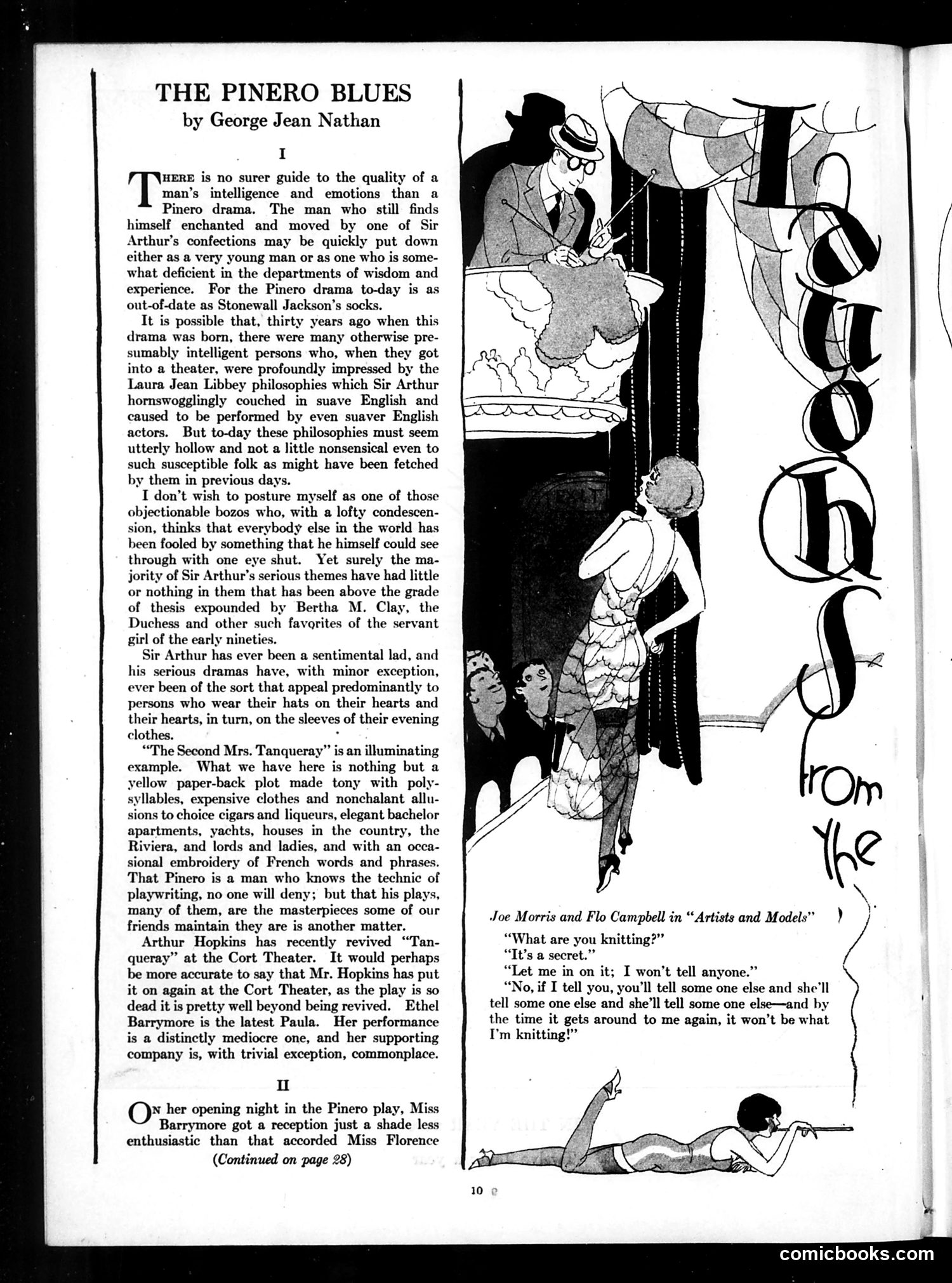
This is a theater criticism piece attacking Sir Arthur Wing Pinero, a prominent British playwright, as hopelessly outdated. Critic George Jean Nathan argues that anyone still moved by Pinero's dramas is either very young or intellectually deficient. He dismisses *The Second Mrs. Tanqueray* as a shallow "yellow paper-back plot" dressed up with expensive props and French phrases—essentially cheap sentimentality marketed as sophistication. The accompanying illustration shows the recent 1924 revival at the Cort Theater starring Ethel Barrymore, whom Nathan judges as "distinctly mediocre." The small comic below mocks gossip by showing how secrets spread through repeated retellings until they're completely distorted. The satire targets both Pinero's supposedly old-fashioned melodrama and the theatrical establishment's willingness to revive it with mediocre casts.
📄 Transcribed text from this page (OCR, searchable)
Machine-transcribed from the original scan — historical spelling and the odd misread are preserved.
THE PINERO BLUES by George Jean Nathan I HERE is no surer guide to the quality of a man’s intelligence and emotions than a Pinero drama. The man who still finds himself enchanted and moved by one of Sir Arthur’s confections may be quickly put down either as a very young man or as one who is some- what deficient in the departments of wisdom and experience. For the Pinero drama to-day is as out-of-date as Stonewall Jackson’s socks. It is possible that, thirty years ago when this drama was born, there were many otherwise pre- sumably intelligent persons who, when they got into a theater, were profoundly impressed by the Laura Jean Libbey philosophies which Sir Arthur hornswogglingly couched in suave English and caused to be performed by even suaver English actors. But to-day these philosophies must seem utterly hollow and not a little nonsensical even to such susceptible folk as might have been fetched by them in previous days. I don’t wish to posture myself as one of those objectionable bozos who, with a lofty condescen- sion, thinks that everybody else in the world has been fooled by something that he himself could see through with one eye shut. Yet surely the ma- jority of Sir Arthur’s serious themes have had little or nothing in them that has been above the grade of thesis expounded by Bertha M. Clay, the Duchess and other such favorites of the servant girl of the early nineties. Sir Arthur has ever been a sentimental lad, and his serious dramas have, with minor exception, ever been of the sort that appeal predominantly to persons who wear their hats on their hearts and their hearts, in turn, on the sleeves of their evening clothes. . “The Second Mrs. Tanqueray” is an illuminating example. What we have here is nothing but a yellow paper-back plot made tony with poly- syllables, expensive clothes and nonchalant allu- sions to choice cigars and liqueurs, elegant bachelor apartments, yachts, houses in the country, the Riviera, and lords and ladies, and with an occa- sional embroidery of French words and phrases. That Pinero is a man who knows the technic of playwriting, no one will deny; but that his plays, many of them, are the masterpieces some of our friends maintain they are is another matter. Arthur Hopkins has recently revived “Tan- queray” at the Cort Theater. It would perhaps be more accurate to say that Mr. Hopkins has put it on again at the Cort Theater, as the play is so dead it is pretty well beyond being revived. Ethel Barrymore is the latest Paula. Her performance is a distinctly mediocre one, and her supporting company is, with trivial exception, commonplace. bit Ox her opening night in the Pinero play, Miss Barrymore got a reception just a shade less enthusiastic than that accorded Miss Florence (Continued on page 28) Joe Morris and Flo Campbell in “Artists and Models” ) “What are you knitting?” “It’s a secret.” “Let me in on it; I won't tell anyone.” “No, if I tell you, you'll tell some one else and she'll tell some one else and she’ll tell some one else—and by the time it gets around to me again, it won’t be what \ / | I'm knitting!” | comicbooks.com