
Judge, 1924-11-15 · page 15 of 36
Judge — November 15, 1924 — page 15: what you’re looking at
What you’re looking at
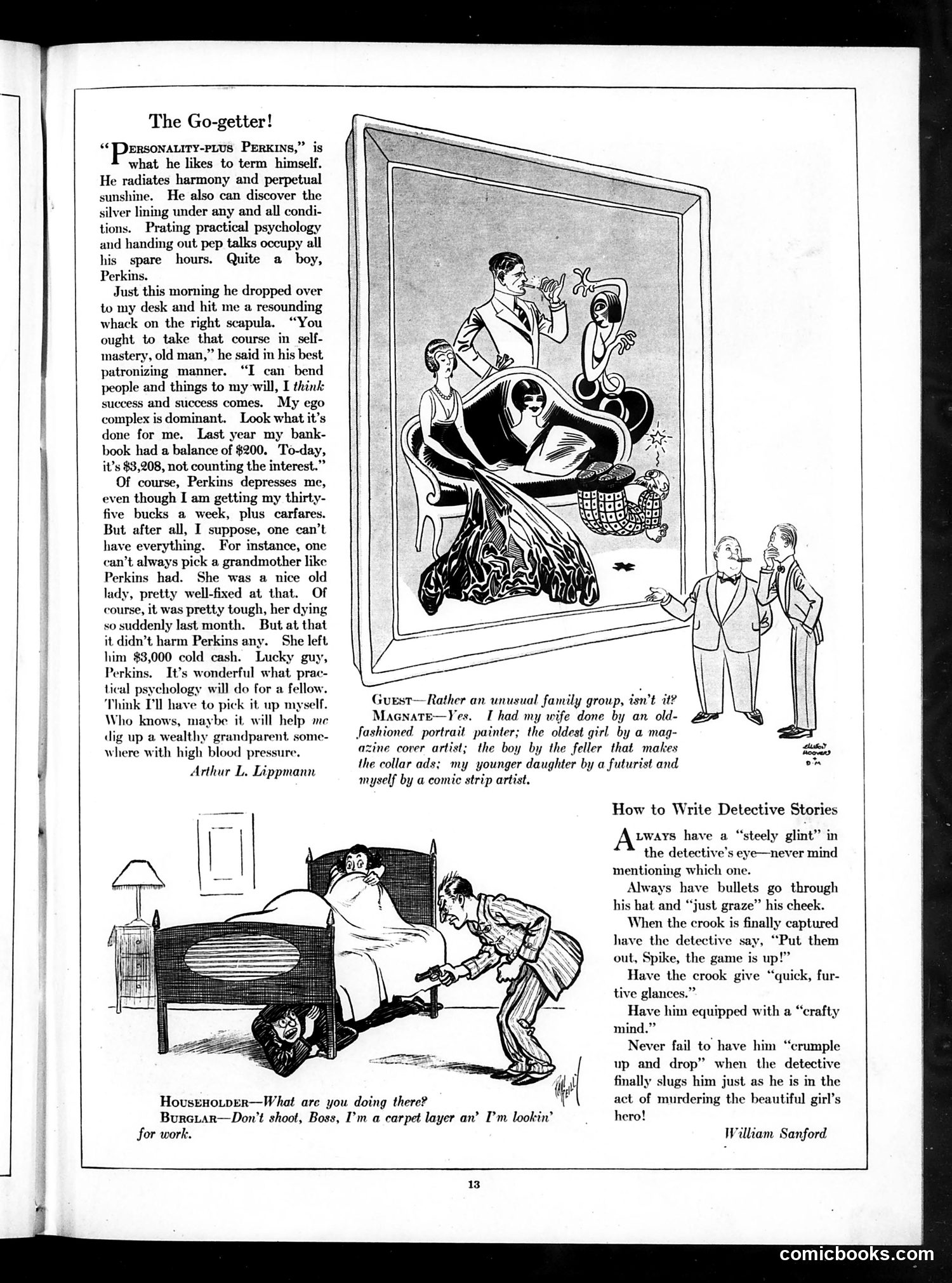
This page contains three satirical pieces mocking early 20th-century cultural trends: **"The Go-getter!"** satirizes the self-help movement and "positive thinking" craze. Perkins exemplifies the manipulative self-improvement charlatan—spouting pop psychology about willpower and ego while actually succeeding only through inherited wealth (a $3,000 inheritance from his grandmother). The narrator's deadpan conclusion—that he should find a wealthy grandparent with high blood pressure—undercuts Perkins's claims that mindset creates success. **The family portrait cartoon** mocks how different artistic styles (old-fashioned painting, magazine illustration, advertising art, futurism, comics) reveal character superficiality—each family member portrayed in whatever trendy visual medium suits their personality. **"How to Write Detective Stories"** parodies pulp detective fiction's clichéd tropes: stock descriptions, predictable action beats, and melodramatic coincidences that strain credibility. All three pieces target American commercial culture's reliance on empty formulas and superficial psychology.
📄 Transcribed text from this page (OCR, searchable)
Machine-transcribed from the original scan — historical spelling and the odd misread are preserved.
The Go-getter! ‘¢ PeRsONALITy-PLUS Perkins,” is what he likes to term himself. He radiates harmony and perpetual sunshine. He also can discover the silver lining under any and all condi- tions. Prating practical psychology and handing out pep talks occupy all his spare hours. Quite a boy, Perkins. Just this morning he dropped over to my desk and hit me a resounding whack on the right scapula. “You ought to take that course in self- mastery, old man,” he said in his best patronizing manner. “I can bend people and things to my-will, I think success and success comes. My ego complex is dominant. Look what it’s done for me. Last year my bank- book had a balance of $200. To-day, it’s $3,208, not counting the interest.” Of course, Perkins depresses me, even though I am getting my thirty- five bucks a week, plus carfares. But after all, I suppose, one can’t have everything. For instance, one can’t always pick a grandmother like Perkins had. She was a nice old lady, pretty well-fixed at that. Of course, it was pretty tough, her dying so suddenly last month. But at that it didn’t harm Perkins any. She left him $3,000 cold cash. Lucky guy, Perkins. It’s wonderful what prac- tical psychology will do for a fellow. ‘Think T'll have to pick it up myself. Who knows, maybe it will help me dig up a wealthy grandparent some- where with high blood pressure. Arthur L. Lippmann Guest—Rather an unusual family group, isn’t it? Macnate—Yes. I had my wife done by an old- fashioned portrait painter; the oldest girl by a mag- azine cover artist; the boy by the feller that makes ey, the collar ads; my younger daughter by a futurist and om myself by a comic strip artist. HovustHoitpEr—What are you doing there? Burciar—Don’t shoot, Boss, I’m a carpet layer an’ I’m lookin’ for work. How to Write Detective Stories Lways have a “steely glint” in the detective'’s eye—never mind mentioning which one. Always have bullets go through his hat and “just graze” his cheek. When the crook is finally captured have the detective say, “Put them out, Spike, the game is up!” Have the crook give “quick, fur- tive glances.” Have him equipped with a “crafty mind.” Never fail to have him “crumple up and drop” when the detective finally slugs him just as he is in the act of murdering the beautiful girl’s hero! William Sanford | comicbooks.com