
A complete issue · 36 pages · 1924
Judge — August 16, 1924
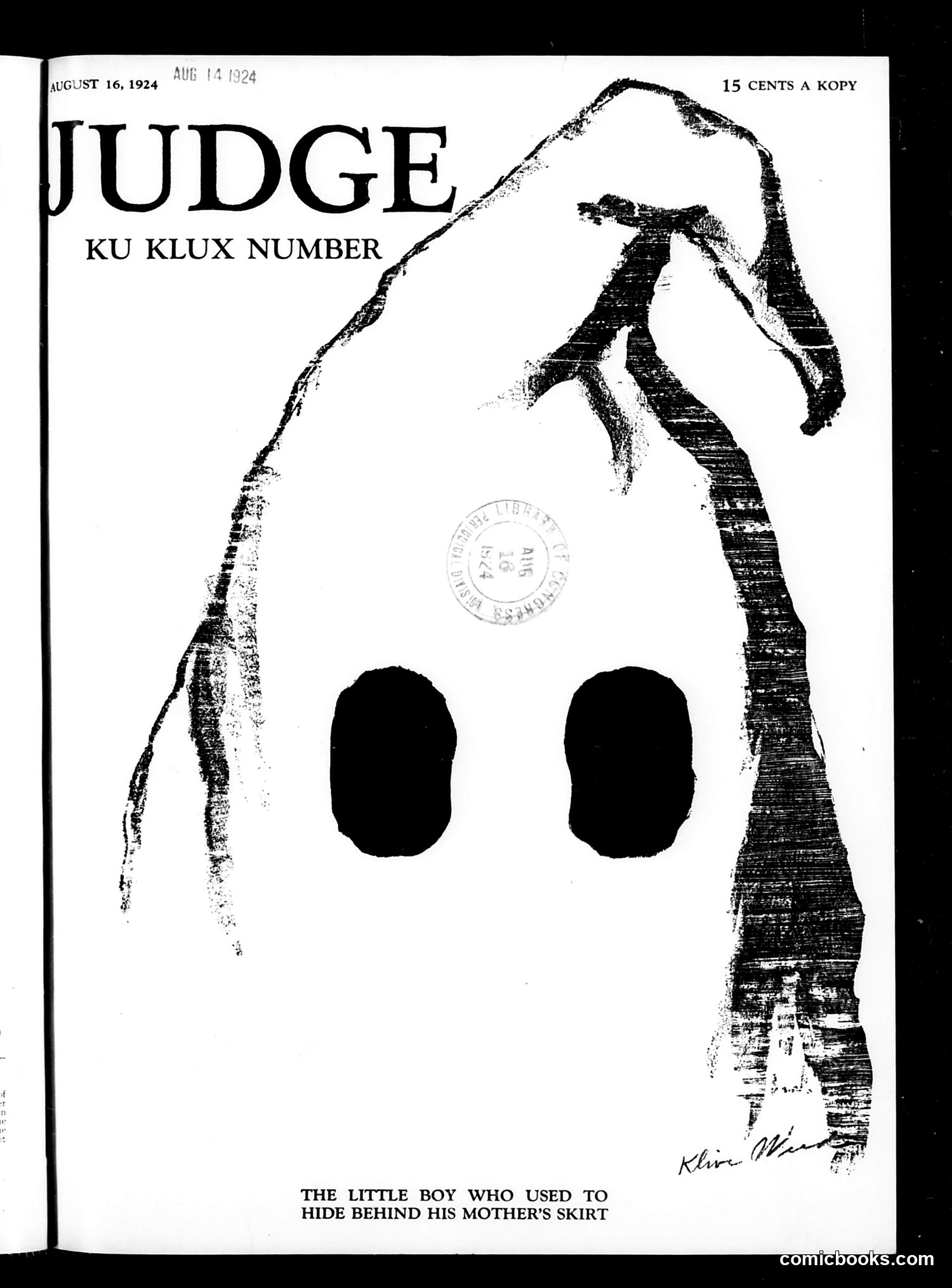
This is the cover of Judge magazine's "Ku Klux Number" from August 16, 1924. The illustration depicts a robed KKK figure with two black oval holes for eyes, beneath the caption "THE LITTLE BOY WHO USED TO HIDE BEHIND HIS MOTHER'S SKIRT." The satire appears to mock the KKK as cowardly—comparing the organization to a timid child hiding for protection. By 1924, the KKK was experiencing a resurgence and political influence, particularly in Midwestern and Northern states. Judge magazine, a satirical publication, uses this cover to ridicule the Klan's membership and ideology, suggesting that despite their intimidating appearance and violent reputation, they are fundamentally cowardly and dependent, not genuinely powerful.
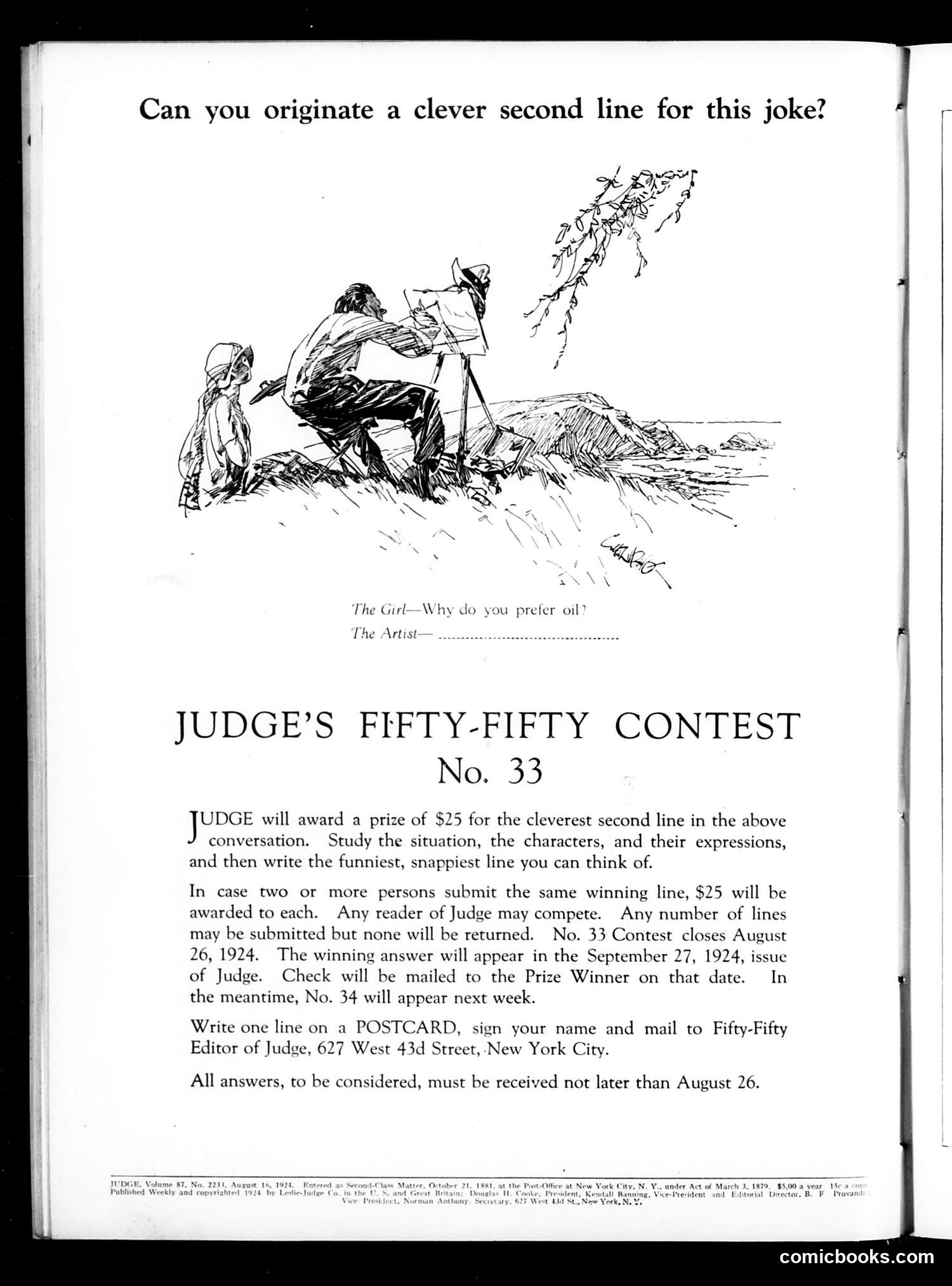
This is a "Fifty-Fifty Contest" — Judge magazine's humor competition offering a $25 prize for the cleverest second line to a joke setup. The cartoon shows an artist painting outdoors while a young girl watches. She asks, "Why do you prefer oil?" The contest invites readers to complete the artist's response. The humor likely plays on the double meaning of "oil" — both the painting medium and petroleum/crude oil, or possibly references the artist's motivation (financial gain, romantic interest, etc.). Without seeing the winning answer published later, we can't know the intended punchline, but the setup relies on viewers understanding artistic practice and finding an unexpected, clever twist. This format was typical popular entertainment in 1920s magazines, crowdsourcing humor from readers.
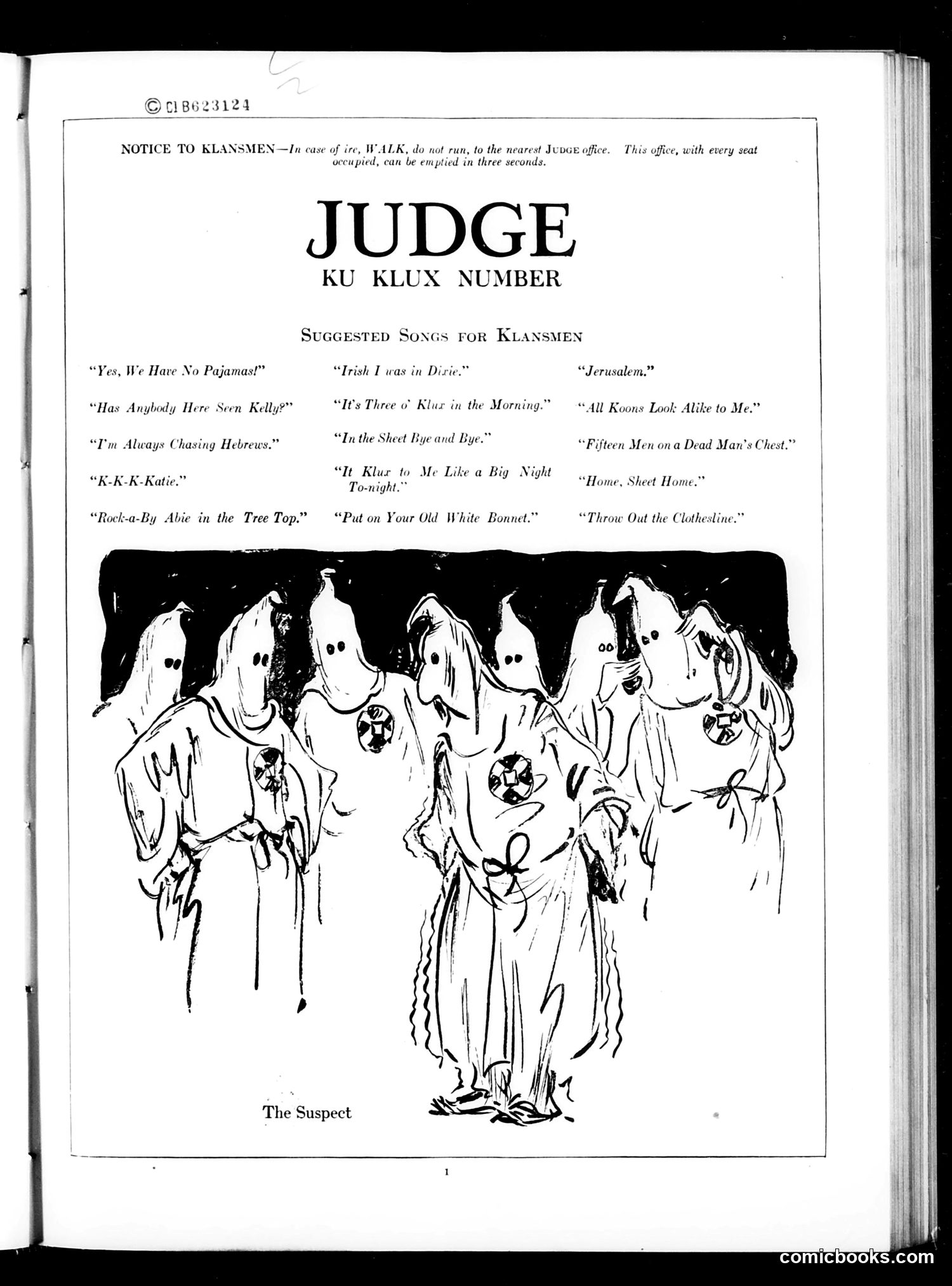
This page from *Judge* magazine satirizes the **Ku Klux Klan** through the heading "Judge Ku Klux Number." The illustration depicts robed KKK members—identifiable by their characteristic white hoods and burning cross emblems on their chests. The "Notice to Klansmen" warning at the top is ironic: it mockingly advises KKK members to visit a judge's office, suggesting legal consequences for their activities. The suggested song titles are parodies of popular tunes, repurposed with anti-KKK lyrics (e.g., "K-K-K-Katie" becomes a mocking reference to the Klan's initials). The label "The Suspect" under the group drawing indicates the entire Klan is portrayed as criminal. This represents *Judge*'s editorial stance against the Klan during a period of significant Klan activity in American history.
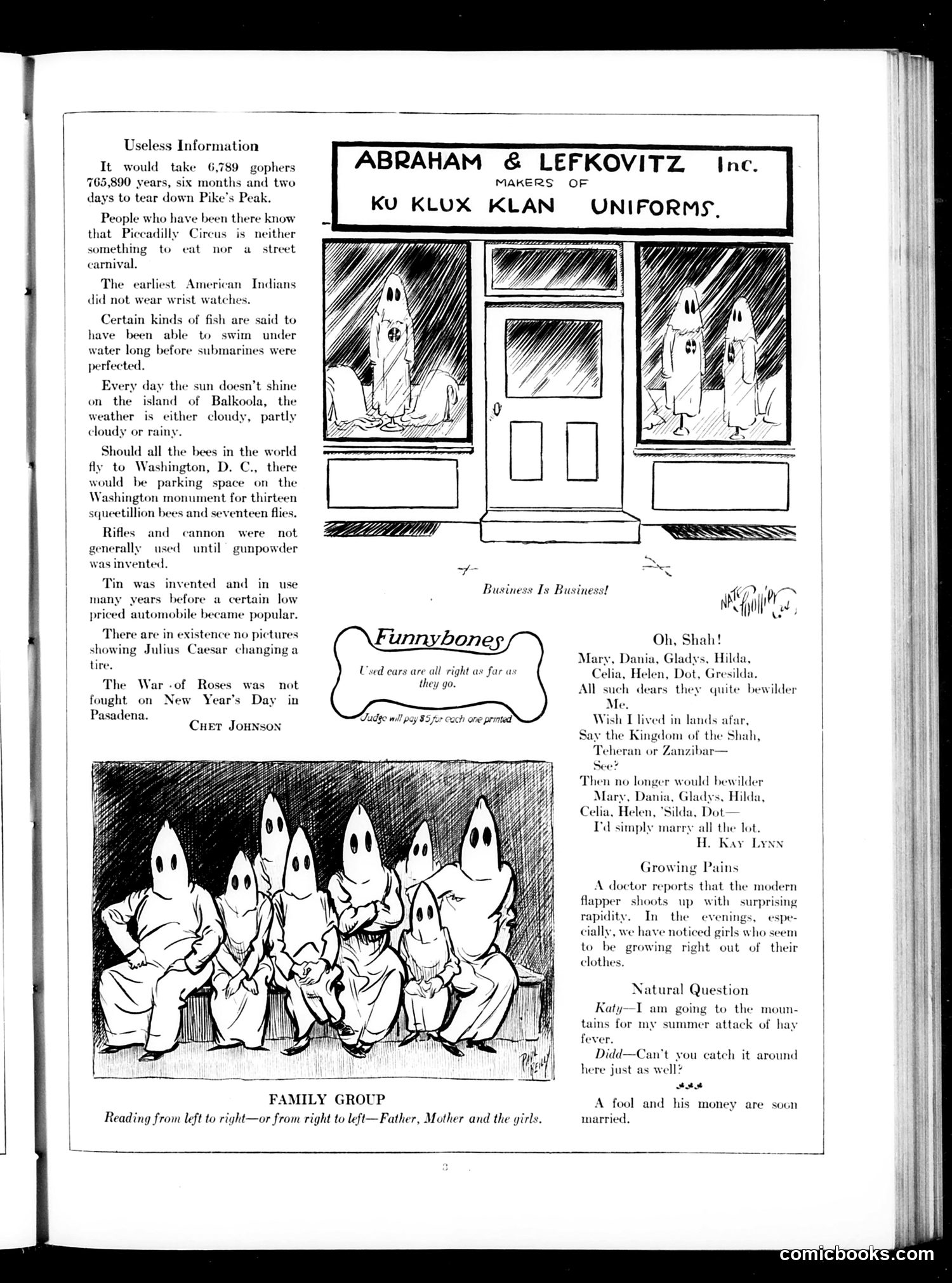
The page contains three distinct elements: 1. **Advertisement**: A storefront display for "Abraham & Lefkovitz Inc., Makers of Ku Klux Klan Uniforms." The ad depicts robed KKK figures in a shop window. This appears to be **satirical commentary** mocking the KKK by suggesting the organization was commercially manufactured rather than organic—implying it was a business product rather than a grassroots movement. 2. **"Funnybones"**: Light humor column with brief jokes about ears and marriages. 3. **"Family Group"**: A cartoon showing robed KKK members (father, mother, and girls) presented as a "family," likely satirizing how the Klan presented itself as wholesome Americana while promoting racist ideology. The satire targets the KKK's commercialization and the contradiction between its claimed values and actual destructive purpose.
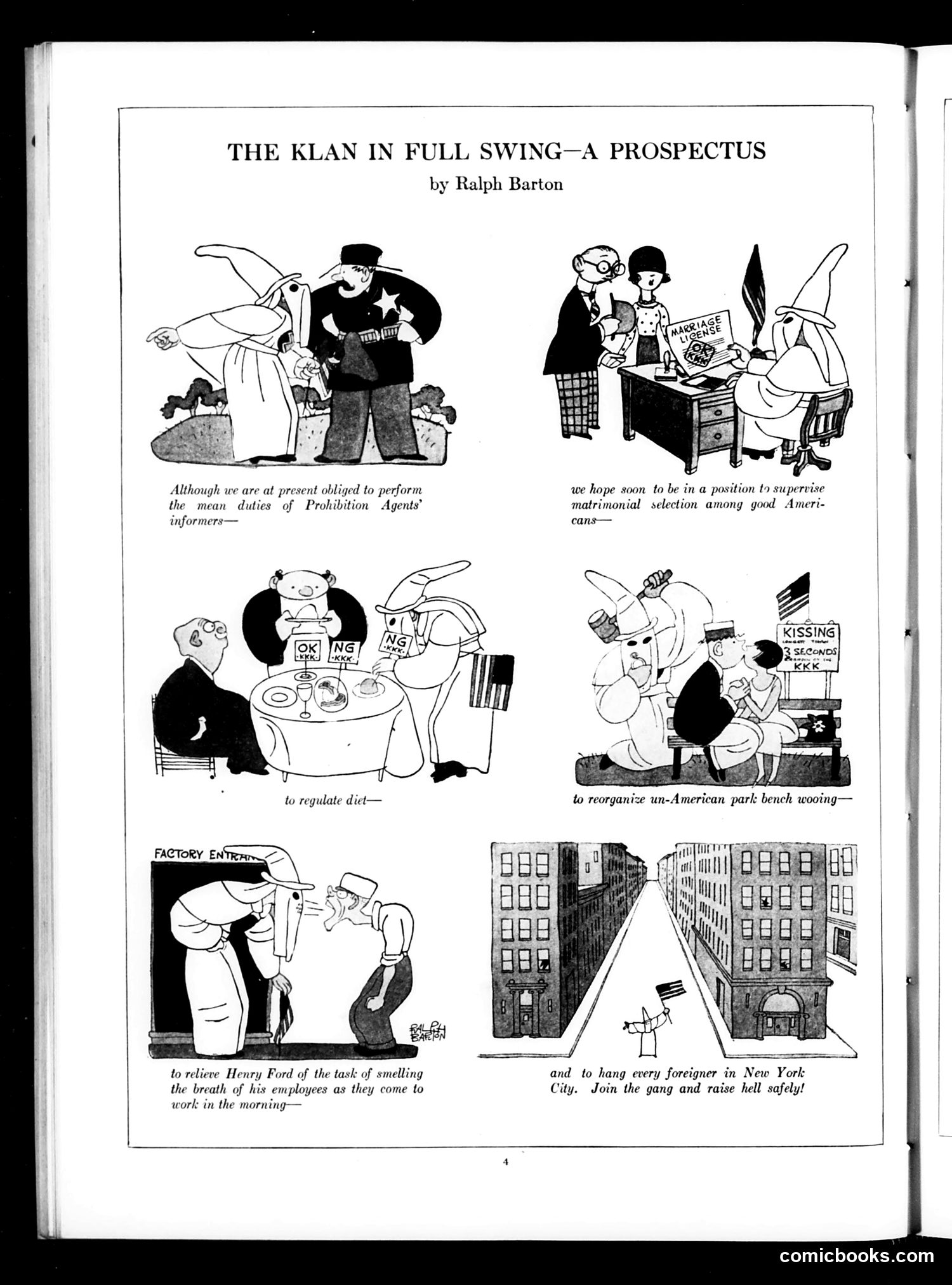
This is a satirical critique of the Ku Klux Klan's stated objectives, presented as if they were mundane civic goals. The cartoon mocks the Klan's claim to represent "American" values by depicting their actual agenda through exaggerated scenarios: - Regulating diet and matrimonial selection among "good Americans" - Reorganizing park benches (likely referring to racial segregation) - Relieving Henry Ford of factory odor complaints (Ford was a known Klan sympathizer) - Hanging foreigners in New York City The satire exposes the Klan's violent xenophobia and racist ideology beneath their rhetoric of "Americanism." By treating violent racial terror as bureaucratic busywork, Barton highlights the absurdity and moral bankruptcy of the organization's stated mission.
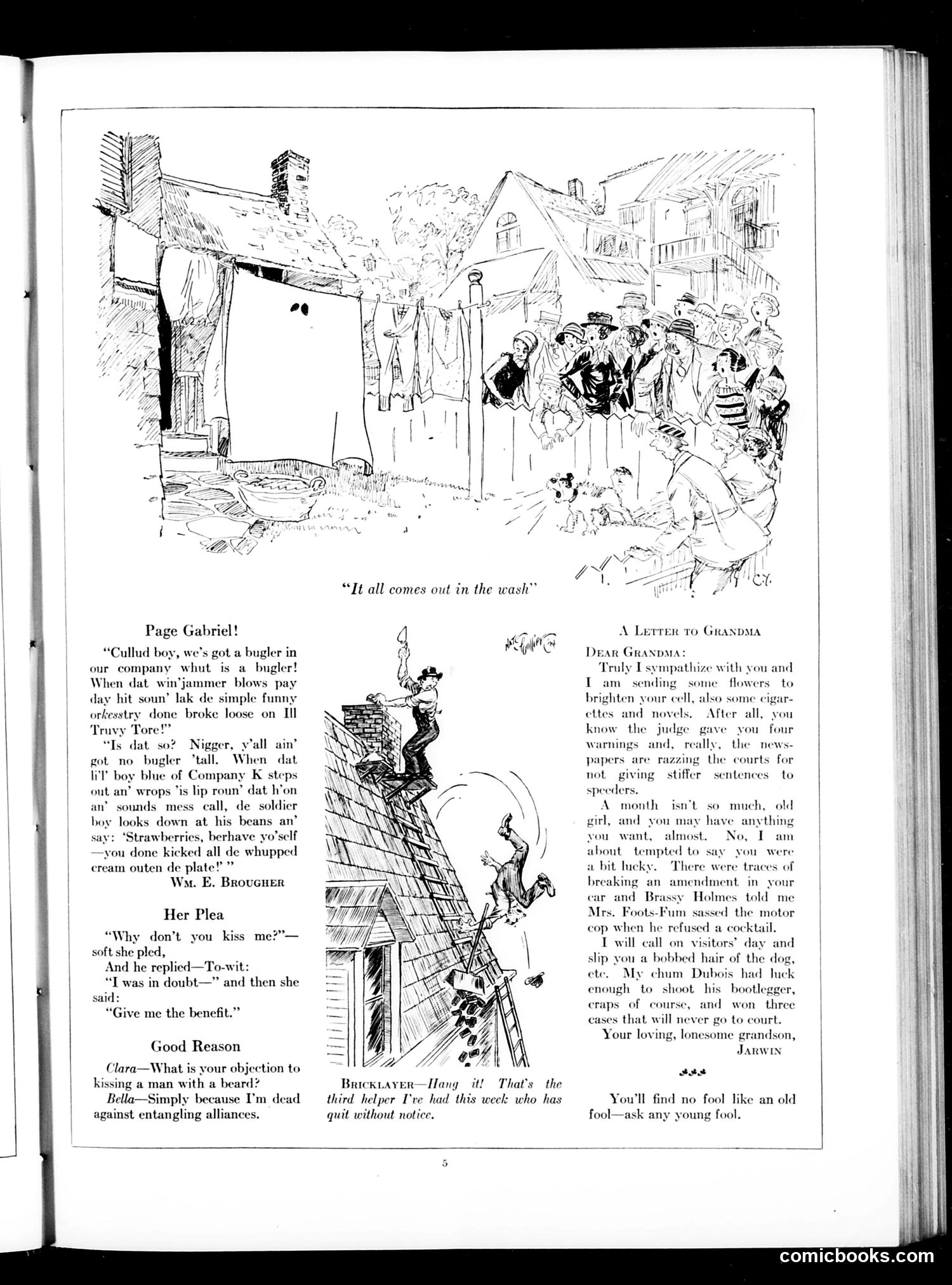
This page contains several short satirical pieces typical of early-20th-century American humor magazines: **"Page Gabriel!"** uses dialect humor mocking African American speech to joke about a military bugler whose playing is so loud it startles soldiers eating. The racial caricature and stereotypical dialect reflect the period's regrettable comic conventions. **"Her Plea" and "Good Reason"** are brief romantic/relationship jokes with wordplay ("give me the benefit," "entangling alliances"). **"Bricklayer"** makes a mild workplace joke about employee turnover. **"A Letter to Grandma"** is the page's sharpest satire—a grandson writes to his grandmother in jail, revealing Prohibition-era corruption: judicial leniency toward wealthy criminals (his friend "won three cases"), bootlegging, and casual lawbreaking. The humor satirizes how wealthy people evade consequences while ordinary citizens face prosecution. The top cartoon illustrates "It all comes out in the wash"—likely a general domestic humor scene with no specific political reference.
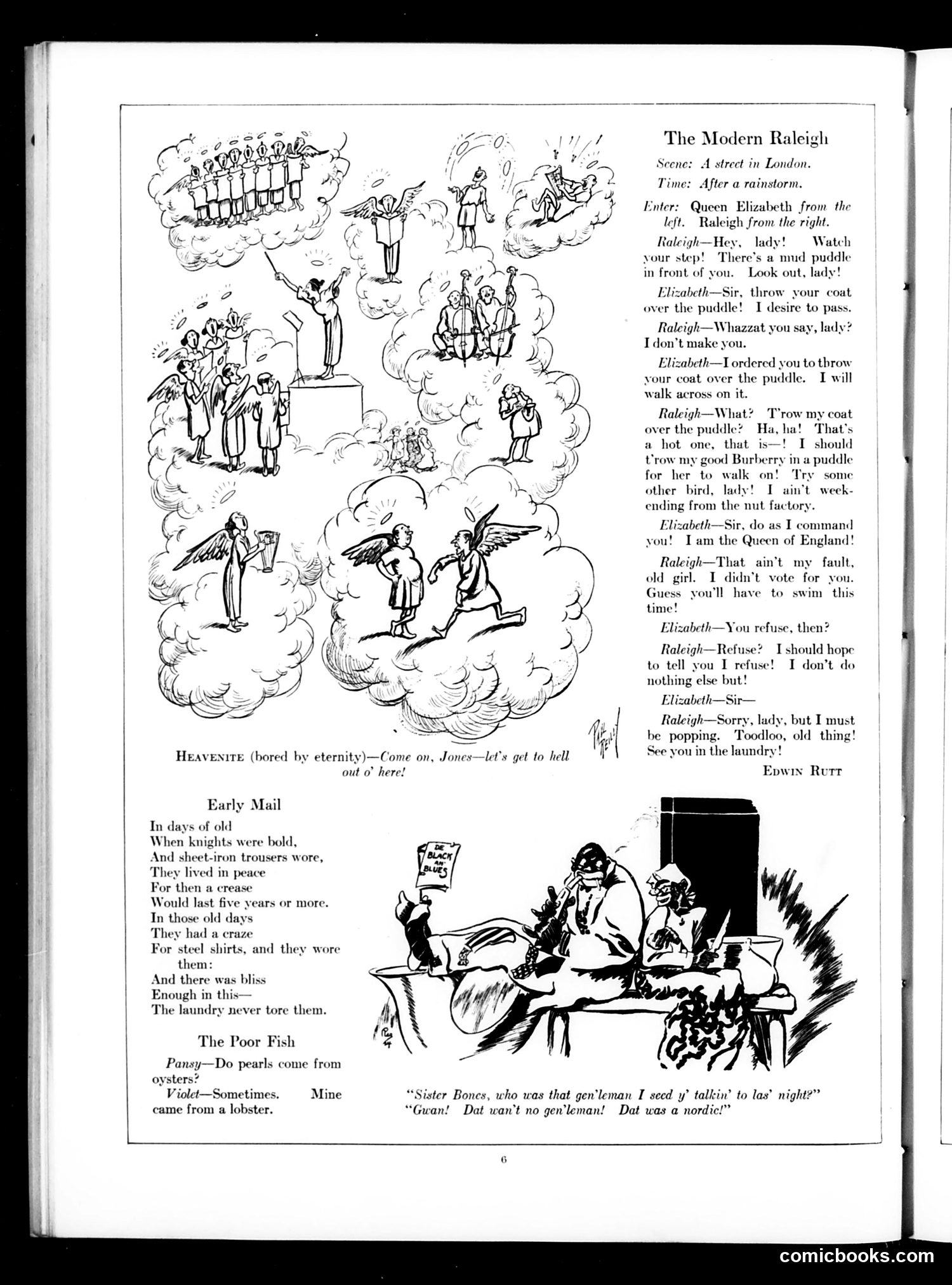
This sketch mocks the myth of Sir Walter Raleigh laying his coat over a puddle for Queen Elizabeth I. The "modern" version depicts a working-class man (rendered in dialect as "t'row" instead of "throw") who refuses the Queen's command, citing his good "Burberry" coat and claiming he didn't vote for her anyway. He dismisses her royal authority with casual disrespect. The satire attacks two targets: the romanticized legend of courtly chivalry and deference to aristocracy, and the modern working man's newfound democratic attitude—he owes nothing to a queen simply by birth. The character's refusal reflects early 20th-century class consciousness and diminished respect for inherited rank. His final quip about "the laundry" adds comedic practicality to the rebellion against romantic gesture.
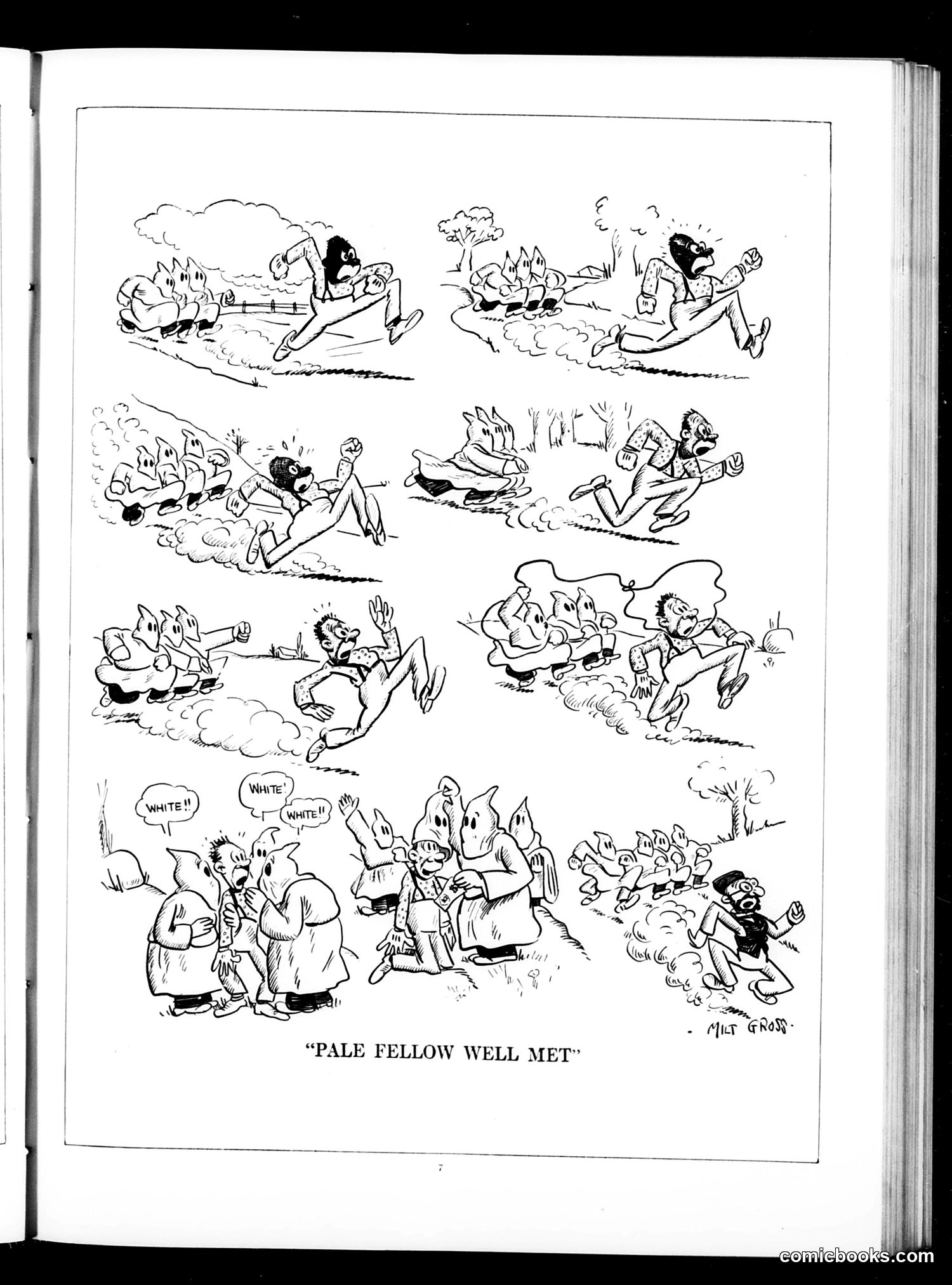
This comic strip by Milt Gross depicts a series of escalating scenes showing someone—likely a pale or sickly character—encountering fires or explosions in various outdoor settings. The figure repeatedly flees from flames and smoke across a landscape. The bottom panel shifts tone, showing what appears to be a crowd of people calling out "WHITE! WHITE! WHITE!"—possibly referencing the person's pallid complexion as a running joke. Without additional historical context from Judge magazine's publication date, the exact political or social satire remains unclear. The humor appears to center on physical comedy and the character's repeatedly bad luck with fires, with the racial undertones of "WHITE" calls requiring more specific period context to fully interpret.
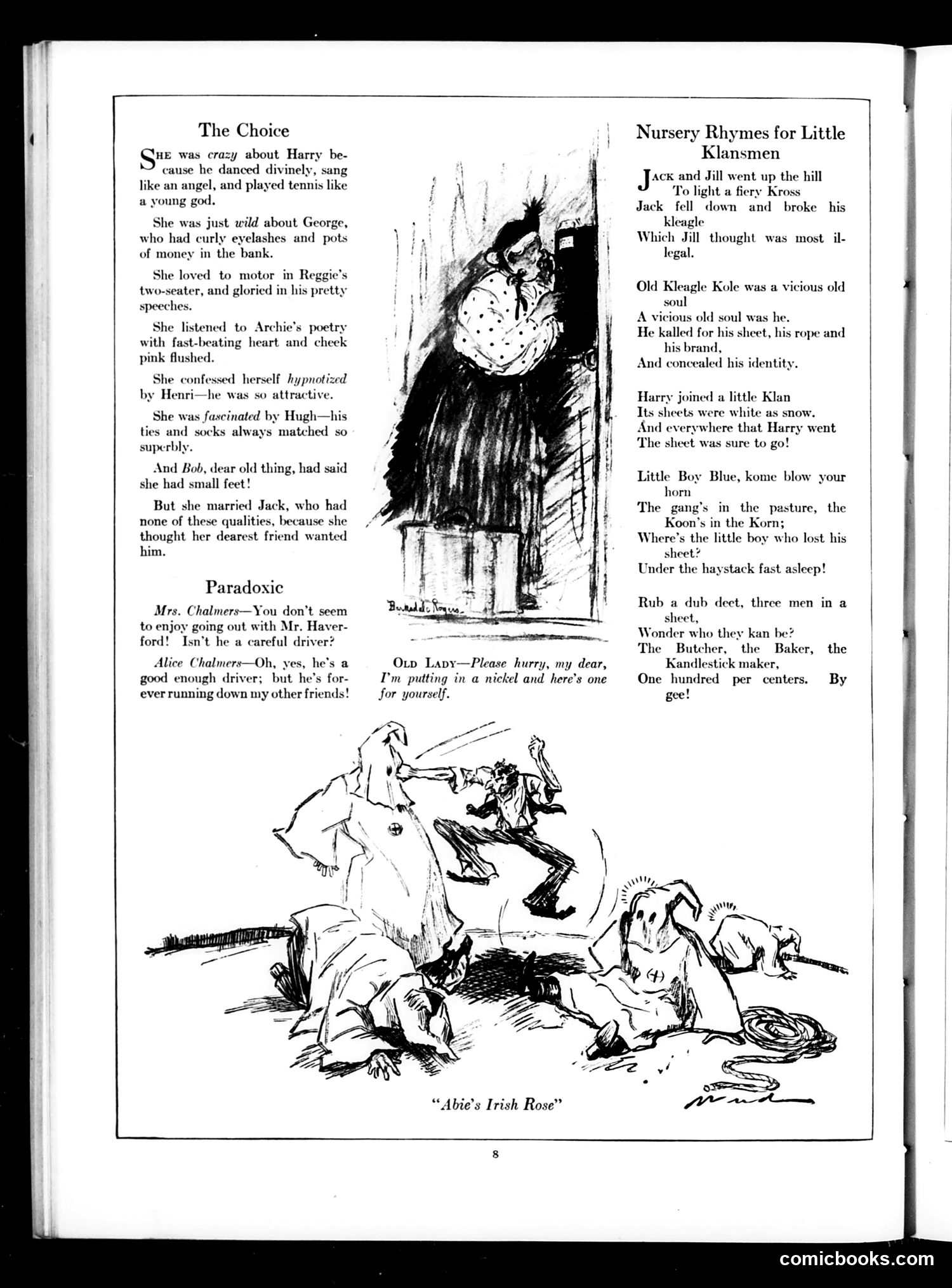
**"The Choice" and "Paradoxic"** are romantic comedies about women's contradictory preferences. The first satirizes a woman who loves multiple suitors for their superficial qualities (dancing, wealth, poetry) yet marries Jack, who possesses none of these—solely because her friend wanted him. The second jokes about a careful driver who undermines his appeal by constantly criticizing the woman's other friends. Both mock feminine inconsistency and poor judgment in romance. **"Nursery Rhymes for Little Klansmen"** is sharply anti-KKK satire. It parodies familiar nursery rhymes while substituting Klan terminology ("kleagle," "klan," "koon," "kandlestick"). The rhymes mock the Klan's secret identity (hidden under sheets) and violent activities. This appears designed to ridicule and delegitimize the organization by making it absurd to children—an aggressive political statement against organized racism. The page likely dates to the 1920s-1930s when the Klan experienced resurgence.
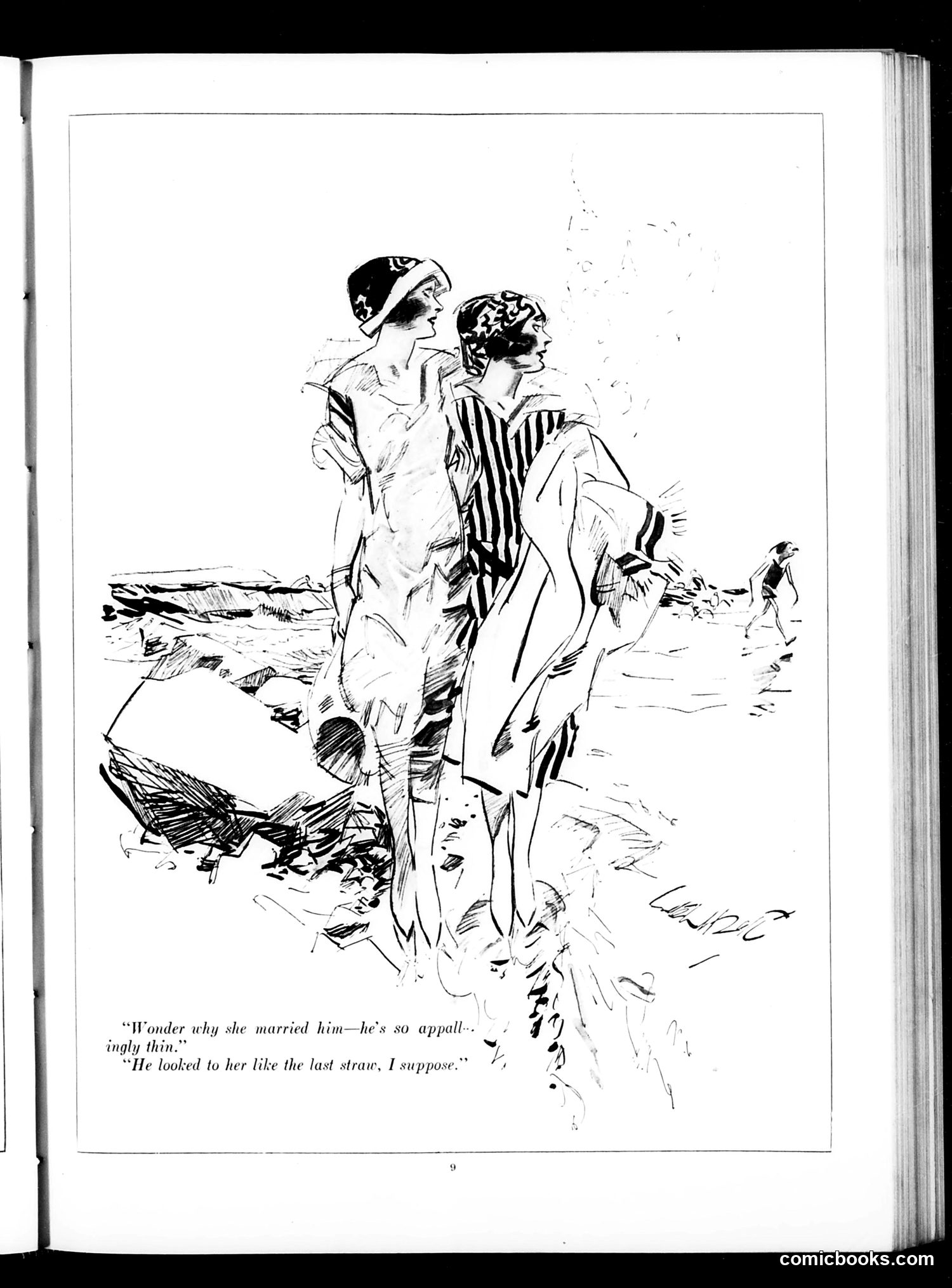
This cartoon depicts two fashionably dressed women on a beach observing a thin man. The dialogue satirizes an unhappy marriage: one woman wonders why the wife married such an unappealing, gaunt husband, while the other replies that he represented "the last straw"—suggesting the woman married him out of desperation rather than love. The humor targets early 20th-century marriage dynamics and gender relations. The phrase "last straw" implies the woman had exhausted better options and settled reluctantly. The beach setting and the women's stylish attire (typical 1920s fashion) suggest leisure-class commentary. The satire mocks both the husband's unattractiveness and the pragmatic desperation driving some marriages, rather than romantic ideals.
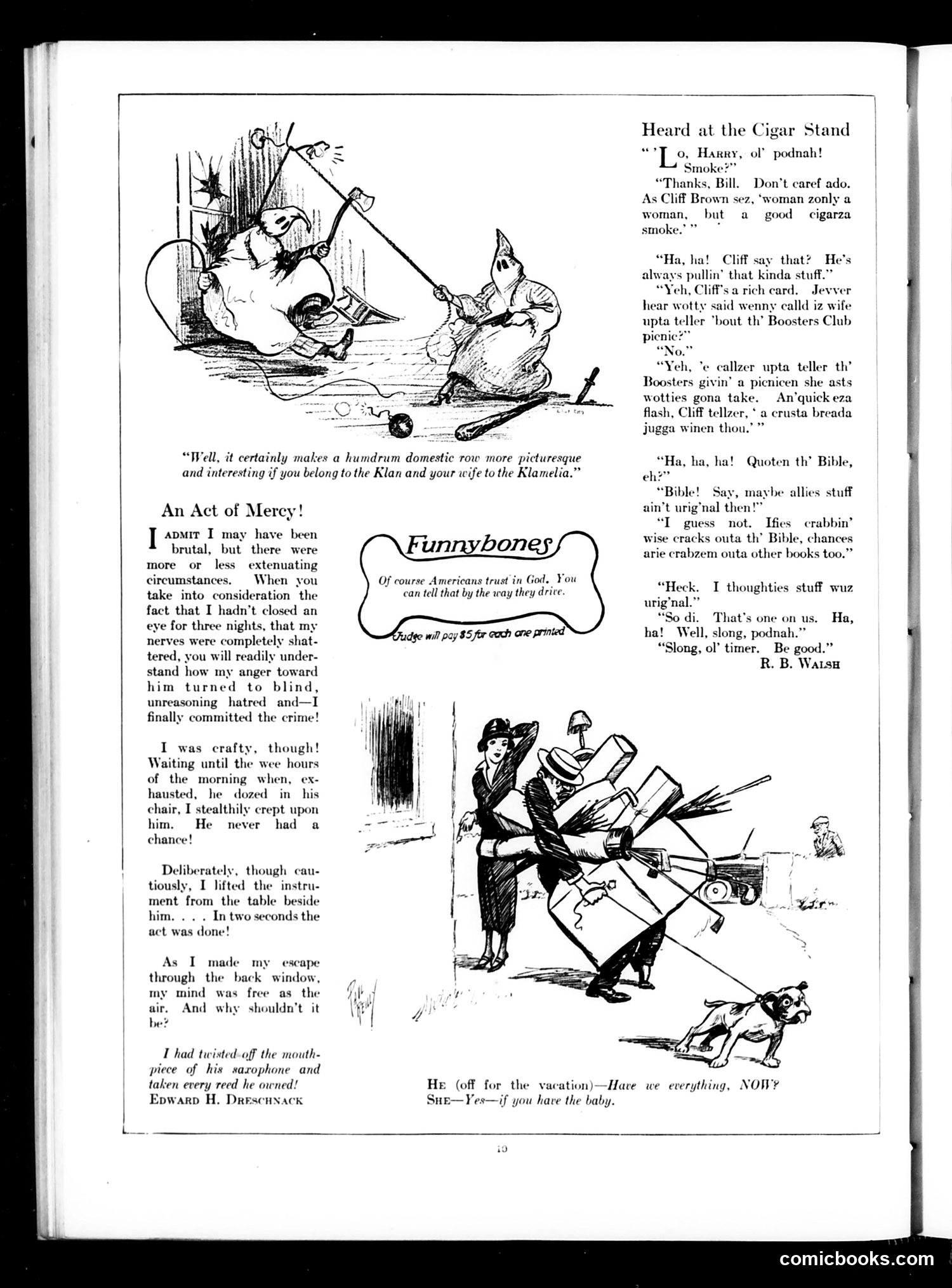
This page contains three distinct satirical pieces: **Top cartoon:** Mocks domestic violence within the KKK by suggesting marital conflict becomes "picturesque" when both spouses belong to Klan-affiliated organizations (the "Klamelia" being the women's auxiliary). This reflects 1920s criticism of the Klan's mainstream social presence. **"An Act of Mercy":** A darkly humorous confessional about committing a "crime"—which is revealed to be merely removing the mouthpiece from someone's saxophone. The elaborate guilt and stealth mock overwrought emotional responses to minor household annoyances. **"Heard at the Cigar Stand":** Reproduces working-class dialect humor, with men discussing a colleague (Cliff Brown) and his witty remarks about women and the Bible. This reflects period attitudes toward colloquial speech as comedic material. **Bottom cartoon:** A domestic joke about vacation packing—the husband asks if they have everything; the wife replies affirmatively only if they have the baby, implying the baby is easily forgotten. The page reflects 1920s American magazine humor: KKK satire, slapstick domesticity, and ethnic/class-based dialect comedy.
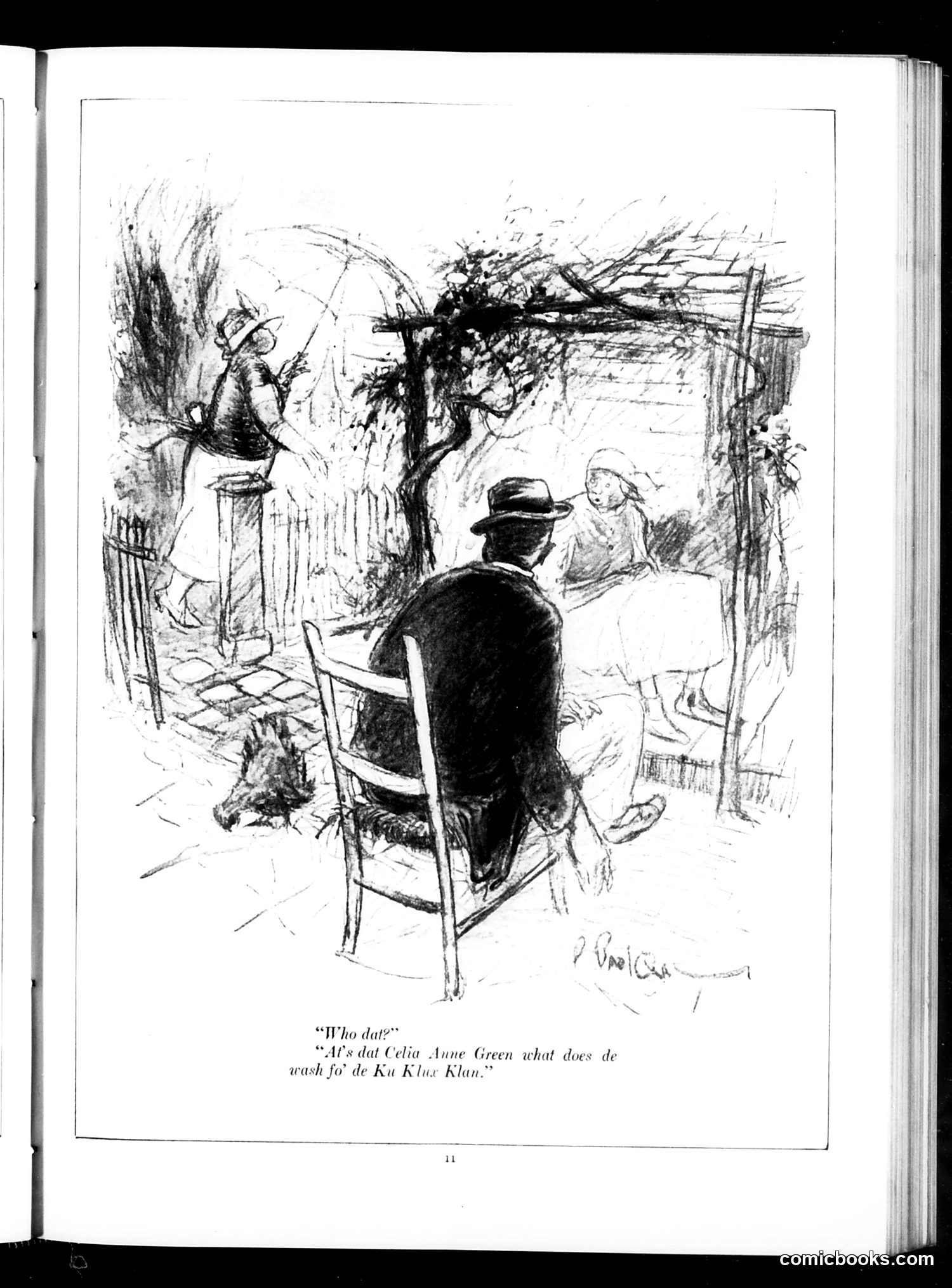
This appears to be a satirical cartoon from Judge magazine mocking racial dialect and social dynamics. The caption uses exaggerated African American vernacular ("Who dat?" and "Al's dat Celia Anne Green what does de wash fo' de Ku Klux Klan"). The scene depicts a man seated in a chair facing a woman, with a dog at his feet. The cartoon's point seems to be satirizing the KKK by suggesting even their laundry services employed Black women—an absurd, darkly comedic jab at the organization's racism and hypocrisy. The crude dialect and caricature reflect the offensive conventions of early 20th-century American satire. Without knowing the specific publication date, the exact social/political context remains somewhat unclear, though the KKK reference suggests the cartoon addresses the organization's activities during a period of its prominence.
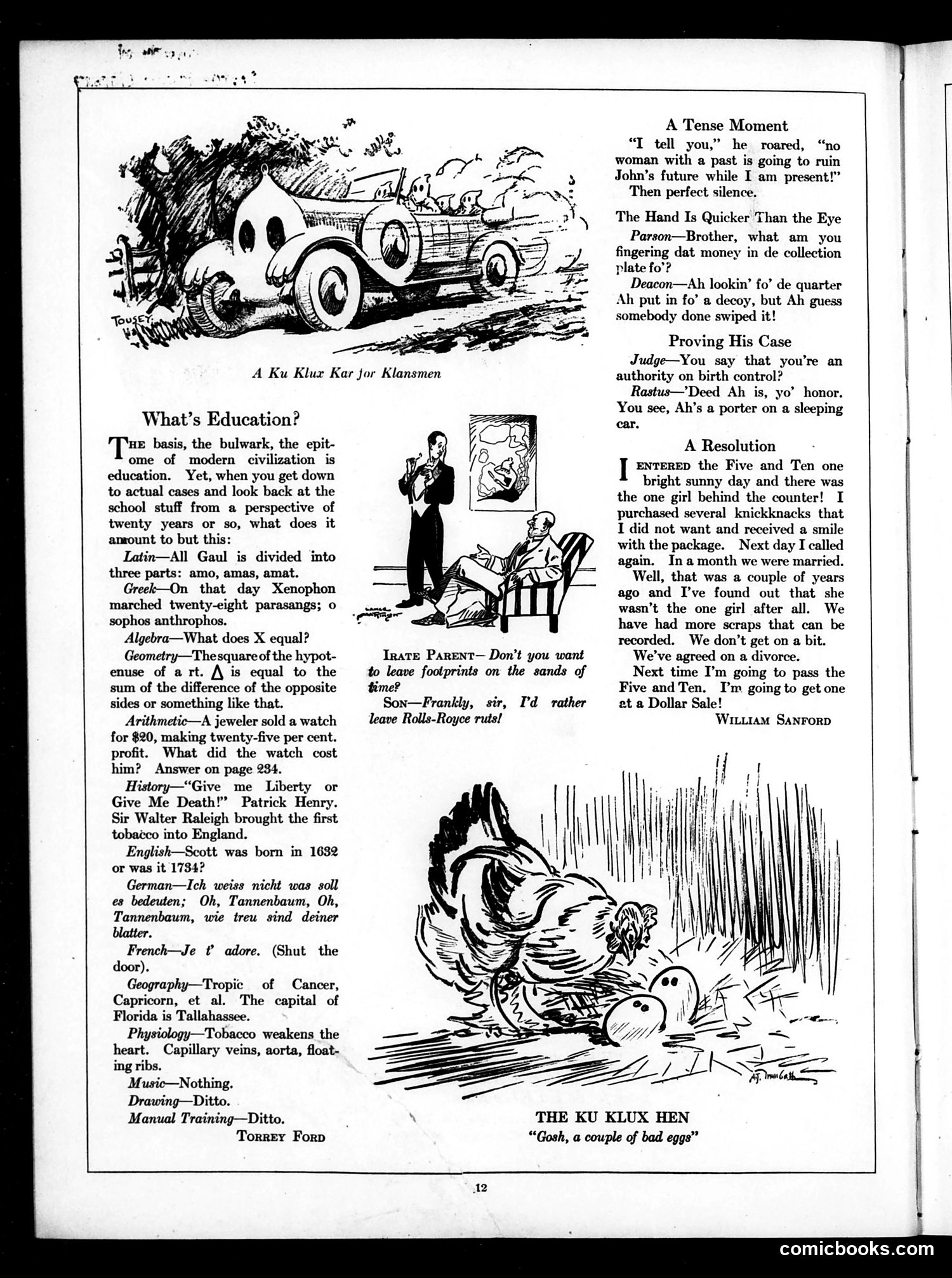
This page contains multiple satirical pieces typical of 1920s-era humor: **"A Ku Klux Kar for Klansmen"** depicts a car crash, darkly mocking the KKK by suggesting their vehicles are as dangerous and destructive as the organization itself. **"What's Education?"** by Torrey Ford satirizes the gap between classroom learning and real-world usefulness—students memorize Latin phrases, geometry theorems, and historical facts that prove useless in adult life. The humor lies in recognizing how trivial much school curriculum becomes. **"The Ku Klux Hen"** cartoon appears to use the KKK reference metaphorically, with "bad eggs" likely alluding to the organization's corrupt or criminal members. The remaining pieces are brief comedic dialogues mocking various social situations: an irate parent's concerns, a church deacon's petty theft, birth control claims, and a cautionary tale about meeting one's spouse at a five-and-ten store. The consistent thread is satirizing contemporary American society's absurdities through exaggeration and wordplay.
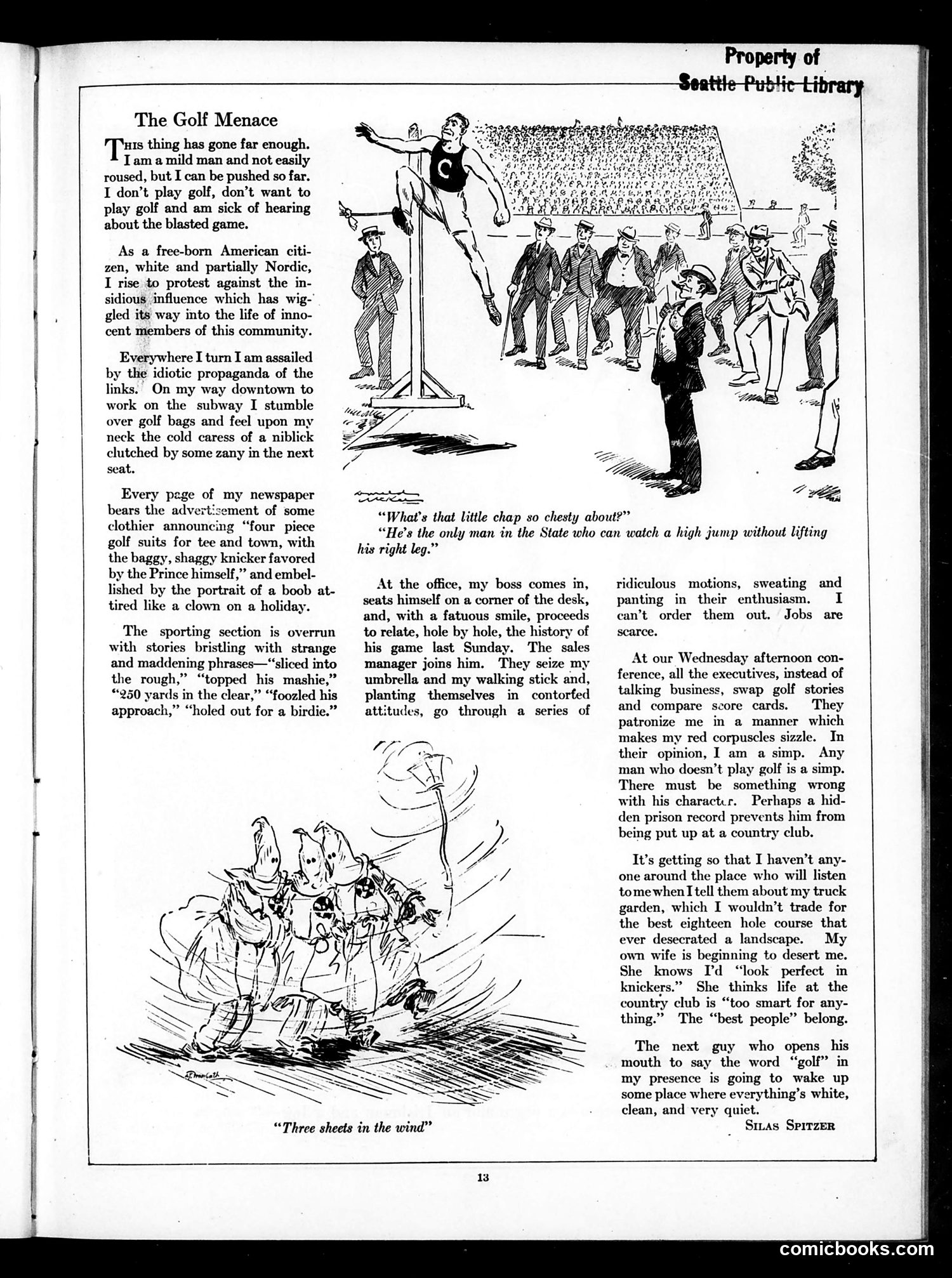
This article by Silas Spitzer mocks golf's overwhelming cultural penetration in 1920s America. The narrator—a non-golfer—complains that golf obsession has invaded every aspect of life: subway commutes, newspaper advertising, workplace conversation, and even his marriage. The satire targets several things: golf's association with upper-class pretension (expensive "four piece" suits, country club exclusivity), the incomprehensible jargon golfers use ("mashie," "foozled"), and most pointedly, the *social pressure* to participate. Non-golfers are dismissed as simps or social failures. His boss and colleagues waste work time discussing games; executives prioritize golf scores over business. The illustrations show golf's intrusive omnipresence—even during a high jump competition. The final caption, "Three sheets in the wind," suggests the narrator's exasperated (or intoxicated) state. Essentially, Spitzer satirizes how a leisure activity became a status marker and social obligation, excluding and marginalizing those who refused participation.
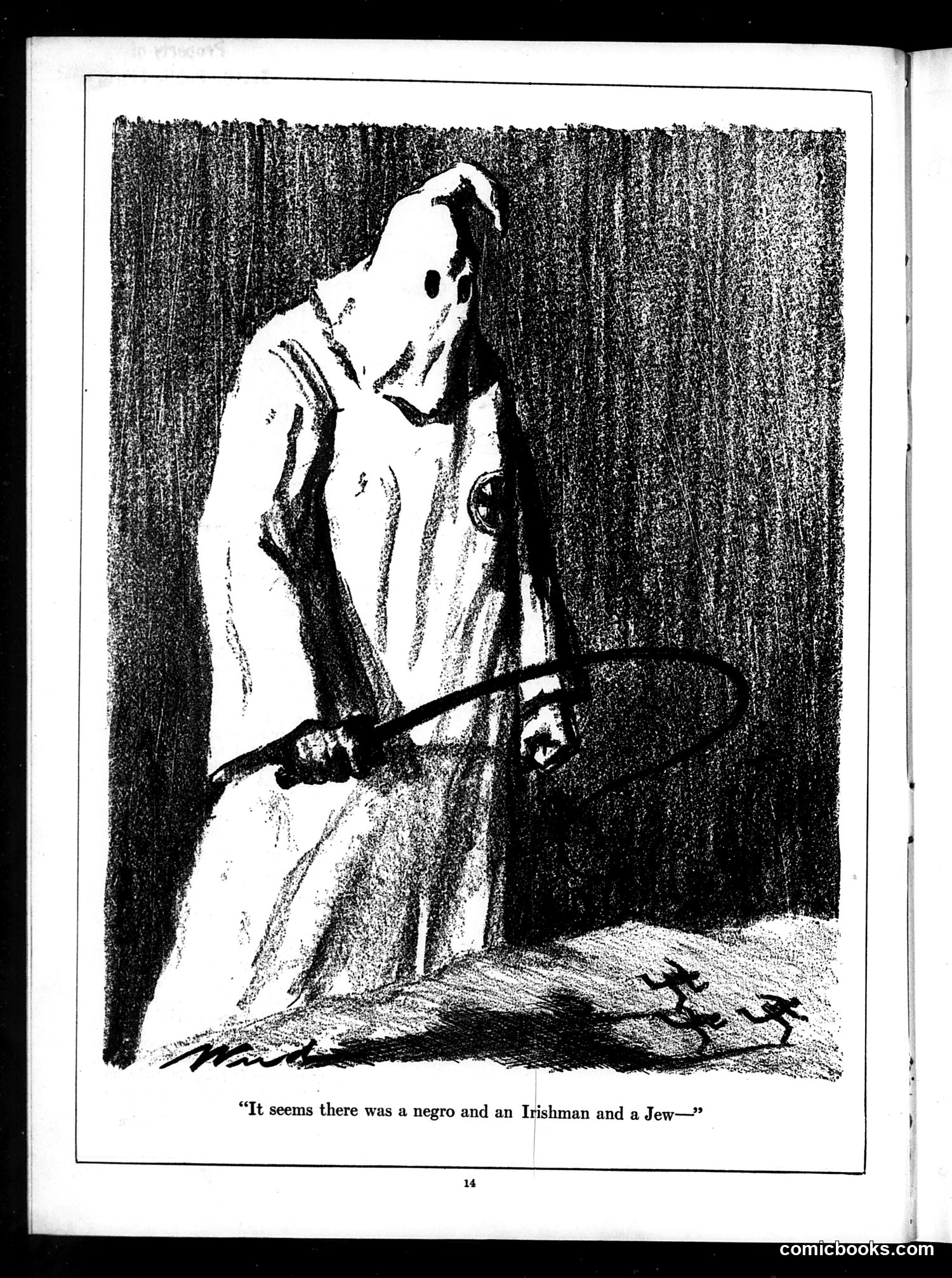
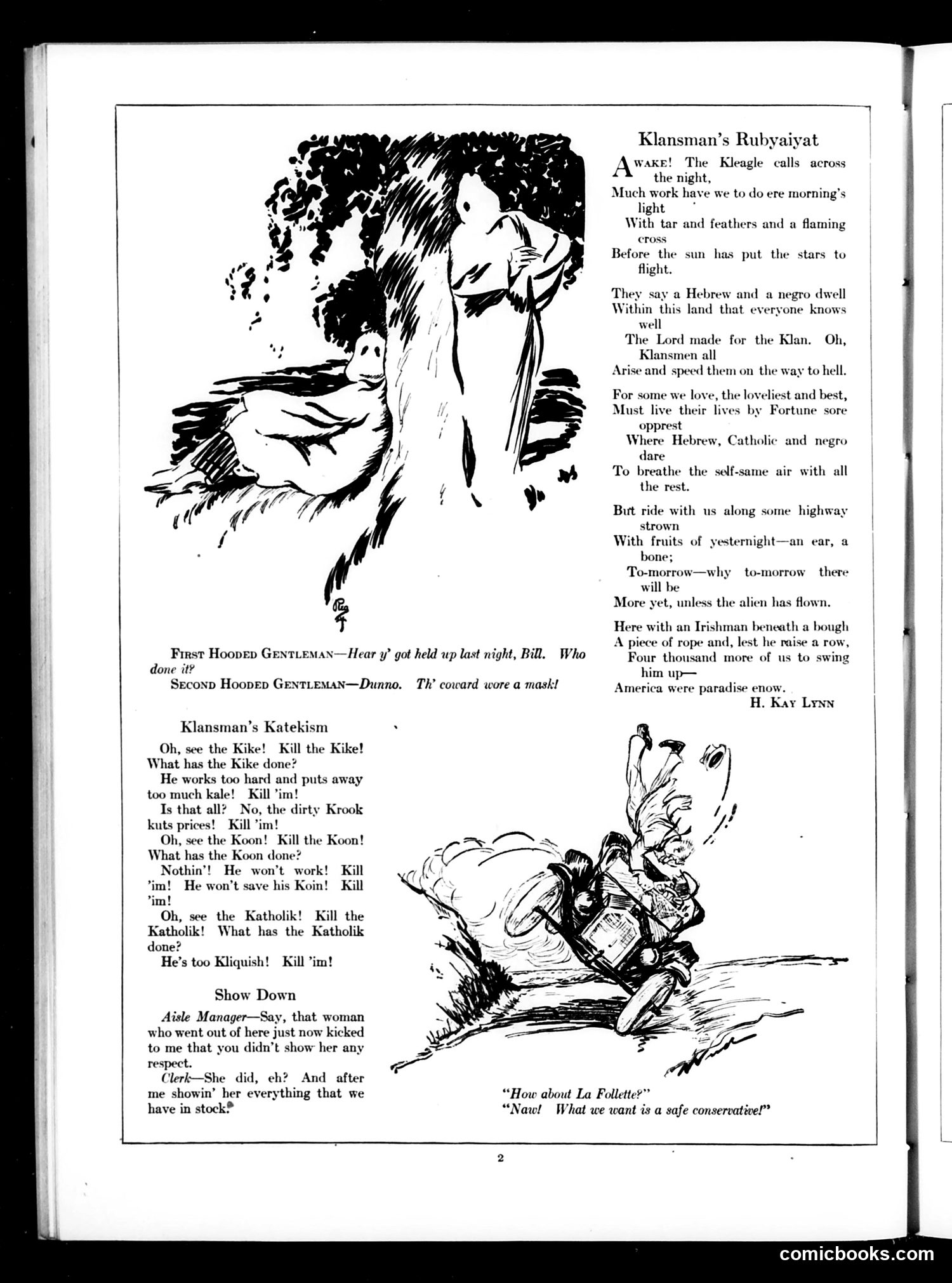
This is a dark political cartoon from *Judge* magazine depicting a grim reaper or death figure holding a scythe, standing over what appears to be bodies or victims. The caption reads: "It seems there was a negro and an Irishman and a Jew—" The cartoon appears to satirize violent prejudice and sectarian violence in America. The incomplete caption suggests a setup to a joke or saying—possibly referencing the common "walks into a bar" joke format—but subverts it with imagery of death and murder. The implication is that members of these three marginalized groups (Black Americans, Irish immigrants, and Jewish Americans) were targets of violence and discrimination. The cartoon likely critiques either the perpetrators of such violence or society's casual acceptance of it by presenting the grim outcome as punchline material. Without a specific date, the exact historical incident referenced remains unclear.
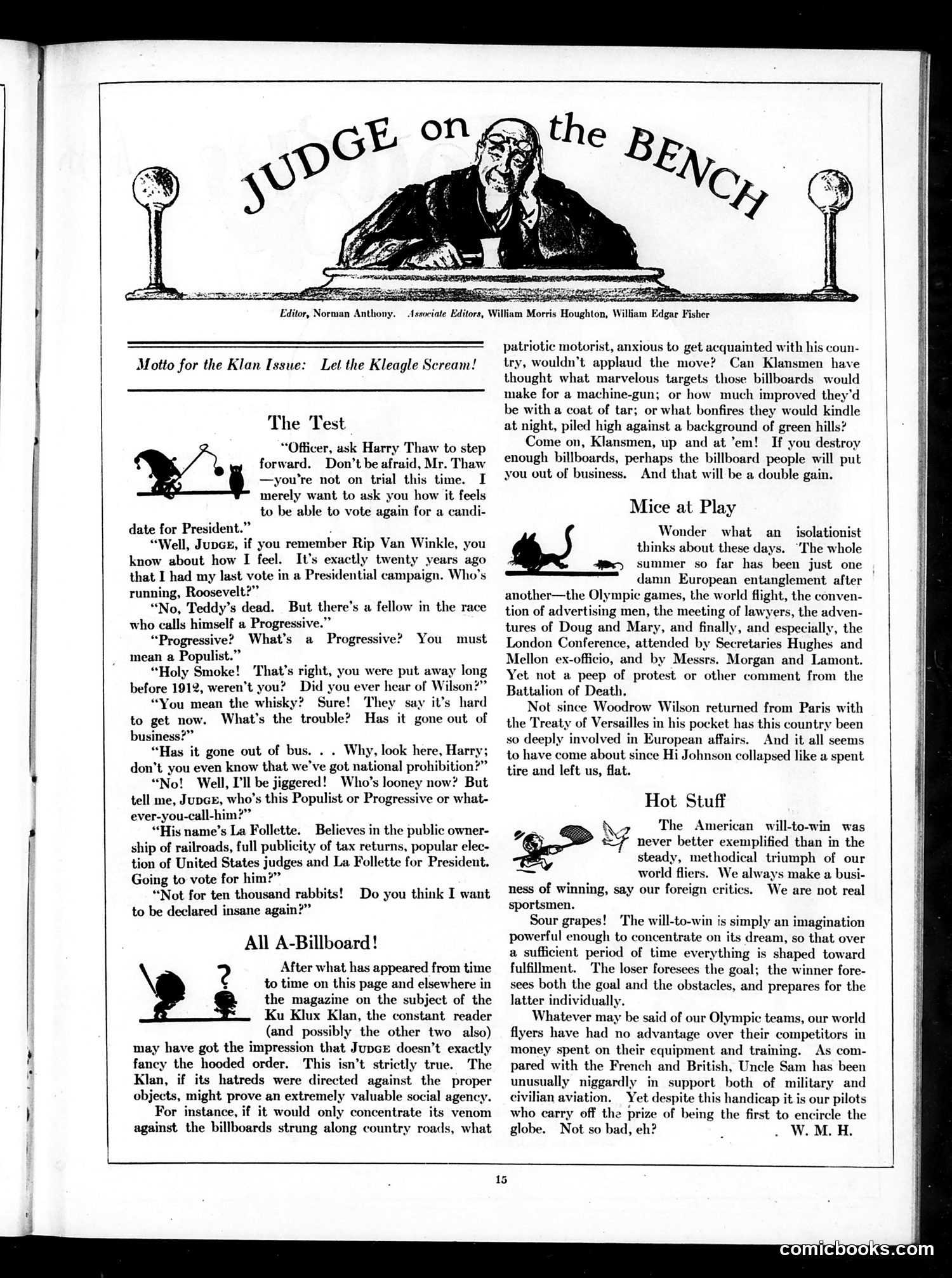
This page satirizes American politics and culture during the early 1920s. **"The Test"** features Harry Thaw, a real figure (appears to be the wealthy man involved in a notorious 1906 murder case) emerging from long institutionalization to vote. The joke lampoons his confusion about modern politics: he doesn't recognize "Progressive" ideology, confuses Woodrow Wilson with whiskey, and is shocked by Prohibition. The satirist mocks how out-of-touch even recently-freed citizens are with current affairs. **"All A-Billboard!"** ironically "praises" the Ku Klux Klan—but only if it redirected its hatred toward roadside advertisements instead of people. This biting satire condemns the Klan's actual violent racism while attacking billboard pollution. **"Mice at Play"** criticizes isolationists for remaining silent during European entanglements (post-WWI affairs, the London Conference), comparing them to mice while real political drama unfolds. **"Hot Stuff"** defends American competitive spirit against foreign critics. The masthead notes this is the "Klan Issue"—Judge was using satire to mock the Klan's resurgence in 1920s America.
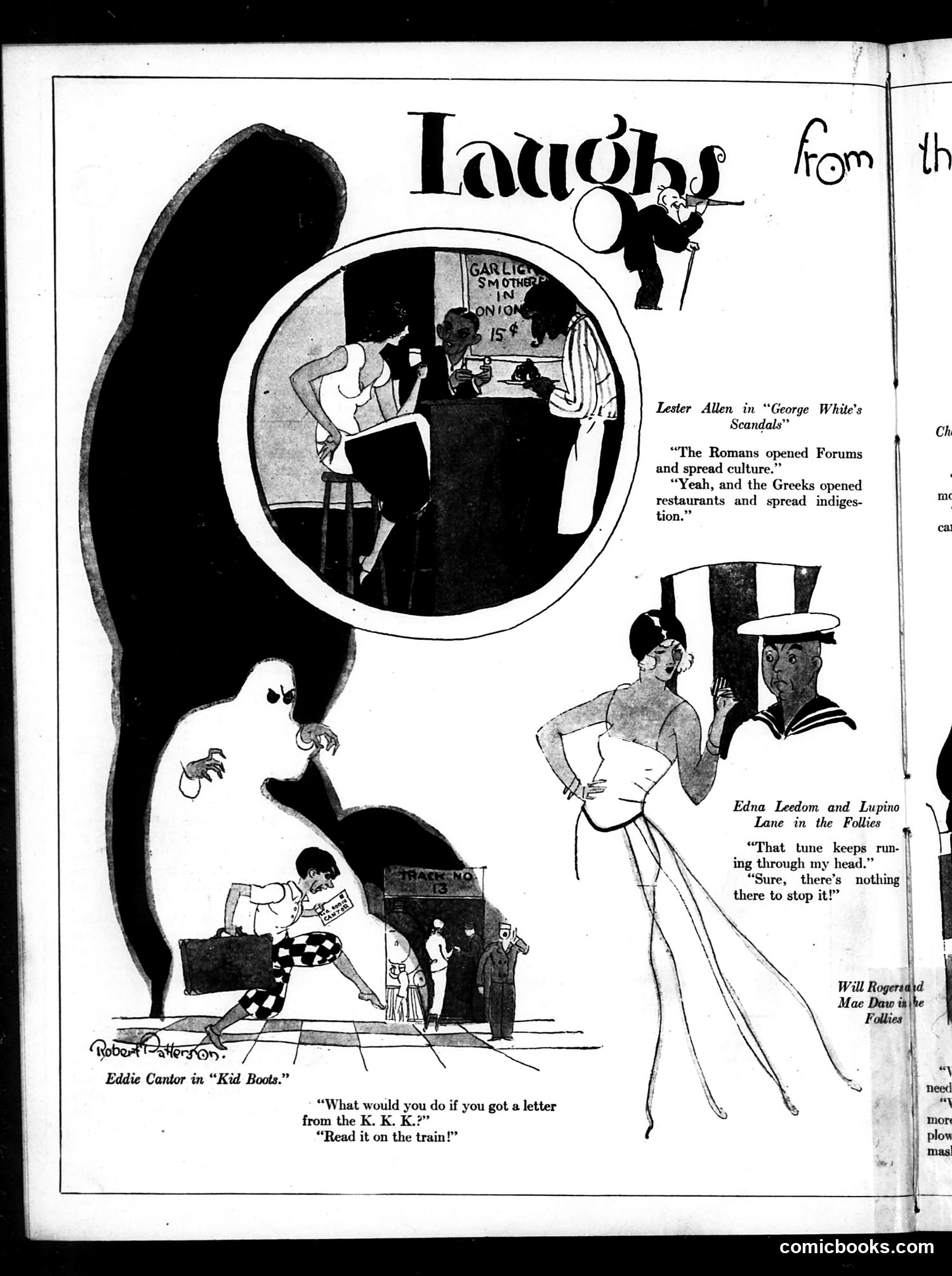
This page collects humorous quotes and caricatures from 1920s Broadway shows and entertainers. The jokes are light satirical commentary: **The Romans/Greeks exchange** mocks pretentious claims about classical civilization's cultural contributions—the punchline being that Greeks actually spread indigestion (via restaurants), not sophistication. **The "tune in my head" joke** is a simple insult: suggesting the woman's mind is so empty that nothing could block a melody from playing there. **The K.K.K. reference** is darker. The punchline about reading a threatening K.K.K. letter "on the train" appears to mock the danger casually—treating a serious racial threat as merely inconvenient. This reflects 1920s casual attitudes toward the Klan's resurgence. The page features theatrical performers (Lester Allen, Eddie Cantor, Will Rogers) from contemporary hit shows like *George White's Scandals* and the *Follies*, suggesting this section recycled witticisms from popular entertainment.
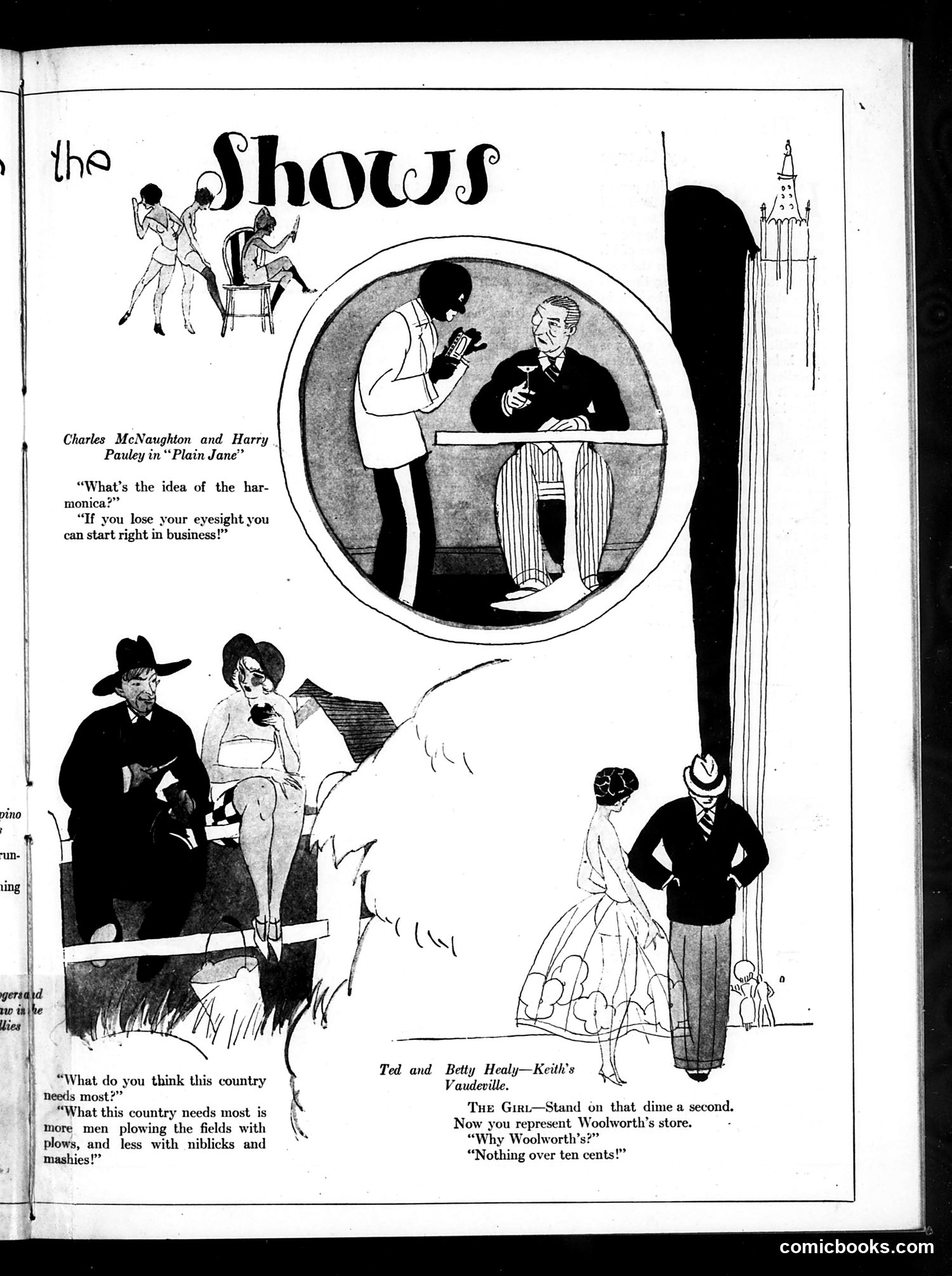
This page features theatrical vaudeville humor from the silent/early sound era. The sketches mock common show-business gags: **Top circle**: McNaughton and Pauley perform a "Plain Jane" bit where losing eyesight somehow qualifies someone for business—likely satirizing absurd stage logic. **Left panel**: A dialogue about plowing fields with "niblicks and mashies" (golf clubs)—joking that the country prioritizes leisure sports over agriculture, a common 1920s concern about urbanization and shifting values. **Right panel**: The Healy vaudeville sketch uses Woolworth's (the budget "five-and-dime" store chain) as a metaphor: a girl represents the store because everything about her costs "nothing over ten cents"—a cutting joke about her cheap appearance or low value. The humor relies on knowing Woolworth's cultural reputation as ultra-affordable.
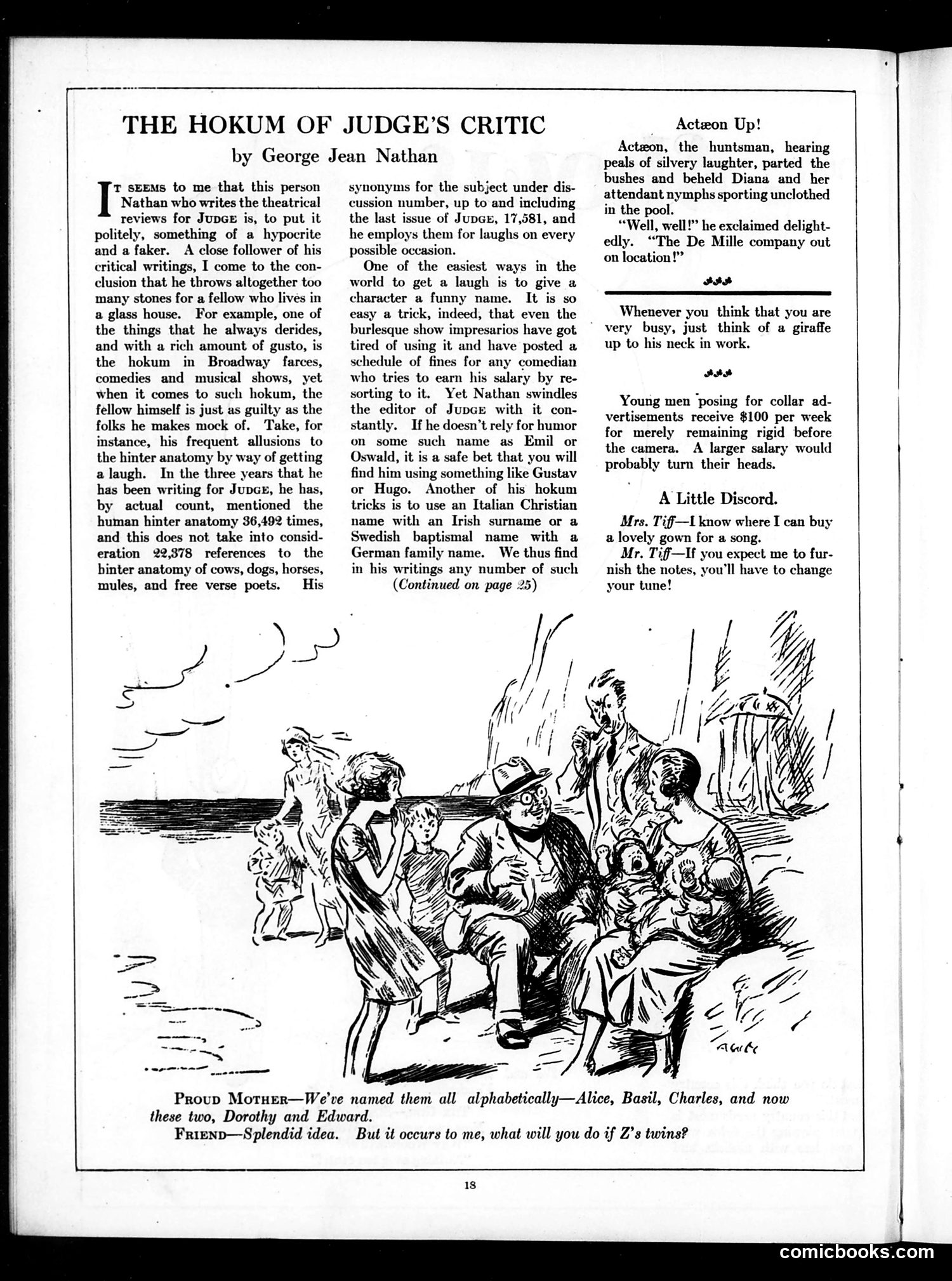
**Main Article: "The Hokum of Judge's Critic"** George Jean Nathan critiques the magazine's own theater critic (unnamed but self-referential) for hypocrisy. The critic regularly mocks "hokum" (cheap tricks and contrived humor) in Broadway shows while employing identical tactics: crude anatomical jokes (36,492+ mentions of "hinter anatomy"), relying on funny character names, and mixing ethnic surnames artificially. **Bottom Cartoon** Shows a proud mother explaining she's named her children alphabetically: Alice, Basil, Charles, Dorothy, Edward. A friend quips that if she has twins starting with "Z," the naming scheme collapses—a simple joke about the alphabet's finite limits and family planning absurdity. **Sidebar Items** Brief jokes: one references Cecil B. DeMille's film location shoots; another plays on "giraffe up to his neck"; the final "Discord" item puns on a wife buying a gown "for a song" but needing the husband to "furnish the notes." The page demonstrates Judge's self-aware satire and period humor style.
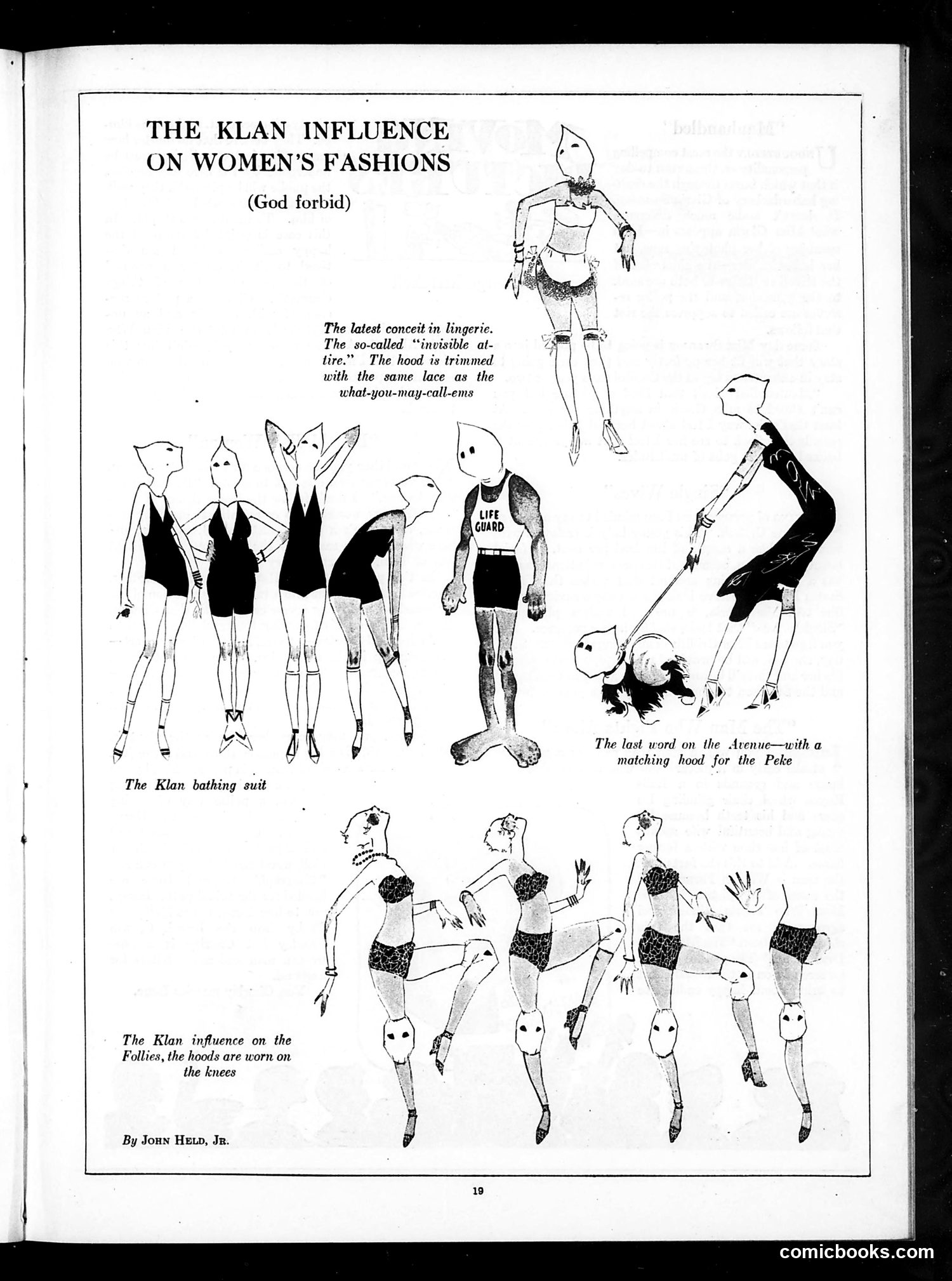
This satire by John Held Jr. mocks the Ku Klux Klan by depicting KKK hoods absurdly incorporated into 1920s women's fashion. The cartoons show: - Bathing suits with KKK-style hoods - Lingerie featuring hood designs - Women at the Follies (a famous Broadway revue) wearing hoods on their knees - A woman walking a small dog ("Peke") while matching in KKK attire The joke satirizes both the Klan's growing cultural prominence in the 1920s and the era's flapper fashions. By rendering the Klan's most iconic symbol—their distinctive white hood—as a ridiculous fashion accessory, Held ridicules the organization's pretensions while mocking high society's adoption of absurd trends. The subtitle "(God forbid)" emphasizes the author's moral disapproval of the Klan's influence on American culture.
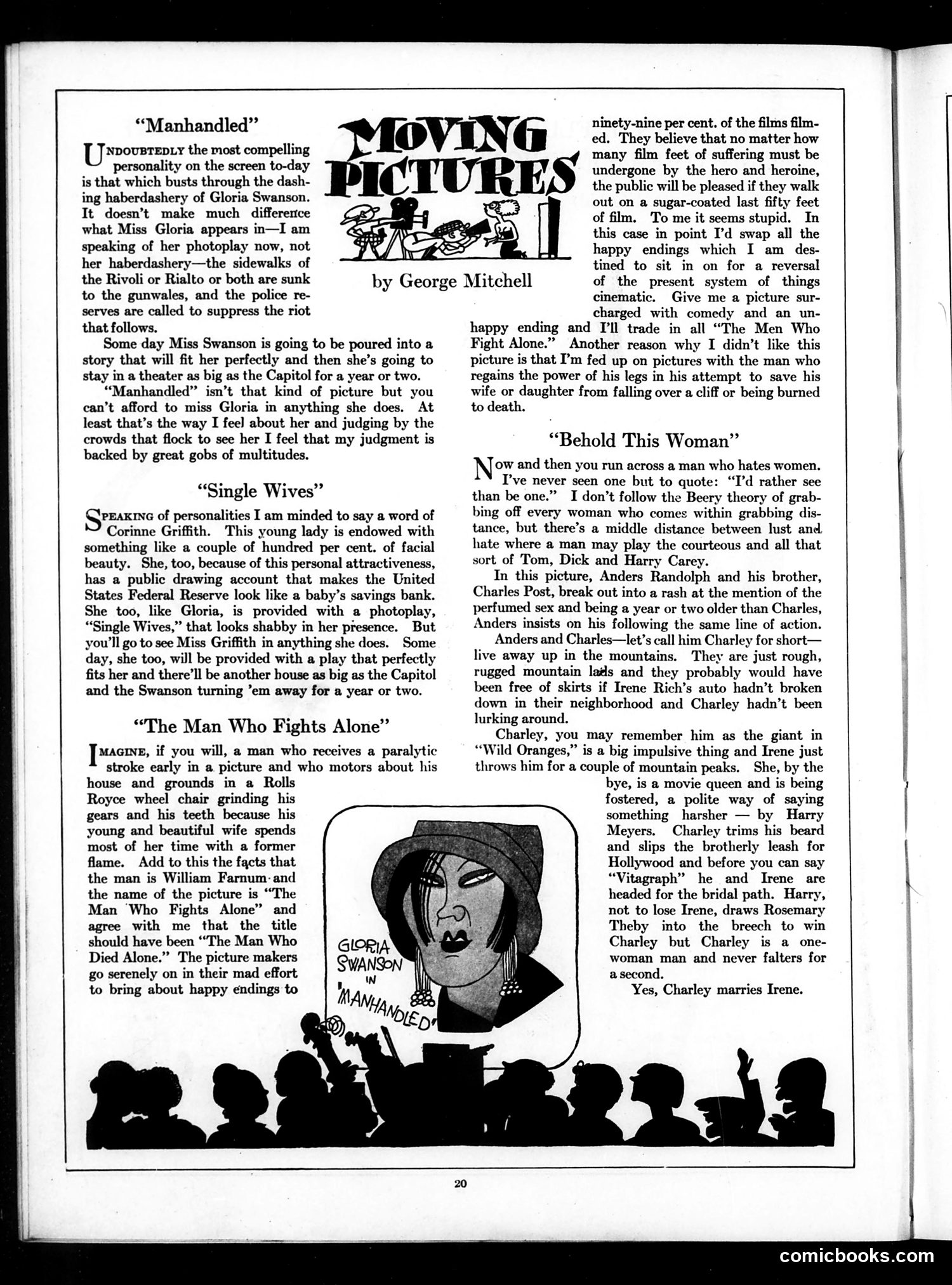
This page from Judge magazine contains film criticism by George Mitchell reviewing recent movies, circa early 1920s. **The Films and References:** The critic reviews three pictures: "Manhandled" and "Single Wives" starring major silent film actresses Gloria Swanson and Corinne Griffith respectively, plus "The Man Who Fights Alone" with William Farnum. (A fourth film, "Behold This Woman," begins at page's bottom.) **The Satire's Point:** Mitchell satirizes the film industry's indifference to quality storytelling. He argues that Swanson and Griffith are so popular that studios can give them mediocre plots—the actresses' star power alone guarantees packed theaters ("the sidewalks of the Rivoli or Rialto...are sunk to the gunwales"). He also mocks predictable melodrama: films where paralyzed heroes miraculously regain mobility to rescue wives from cliffs or fires. Mitchell demands better—stories worthy of talented performers, not just vehicles showcasing famous faces. The criticism reflects broader 1920s debates about artistic merit versus commercial filmmaking.
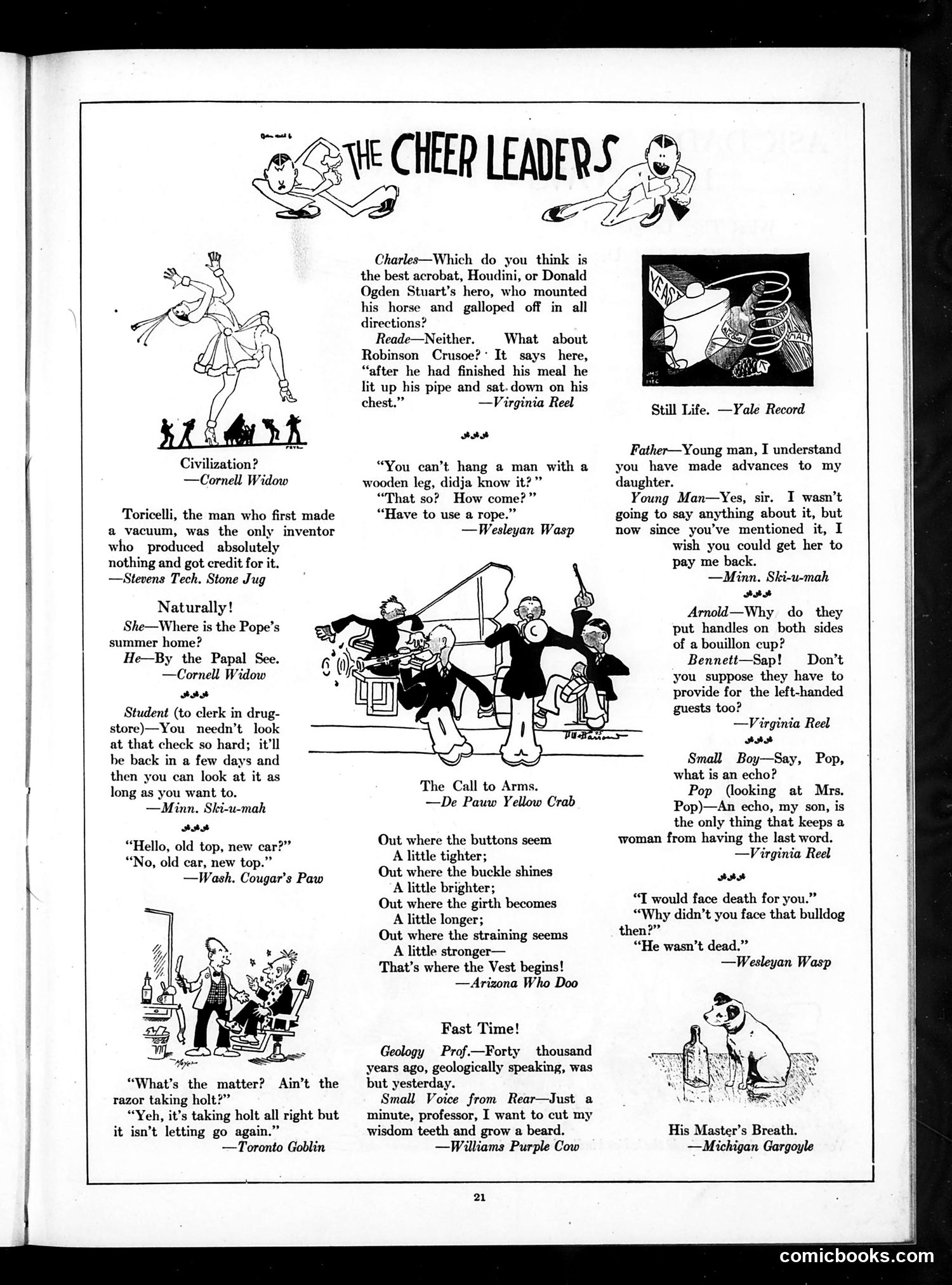
This is a collection of college humor jokes from various university publications, compiled under the "Cheer Leaders" banner. The content reflects early 20th-century collegiate wit—mostly puns, wordplay, and light social satire with no apparent political content. The jokes target: absent-minded professors (the geology professor), gender stereotypes (women always wanting the last word), courtship awkwardness, and everyday absurdities (razors that won't release, bouncy checks). References to Houdini and Robinson Crusoe are literary/popular culture allusions rather than political commentary. The humor is genteel and school-spirited—typical of Judge's lighter sections. The cartoons depict generic college life scenes. No identifiable political figures or controversial social movements appear. This represents mainstream American college humor of the era: mildly irreverent toward authority but fundamentally conservative in outlook.
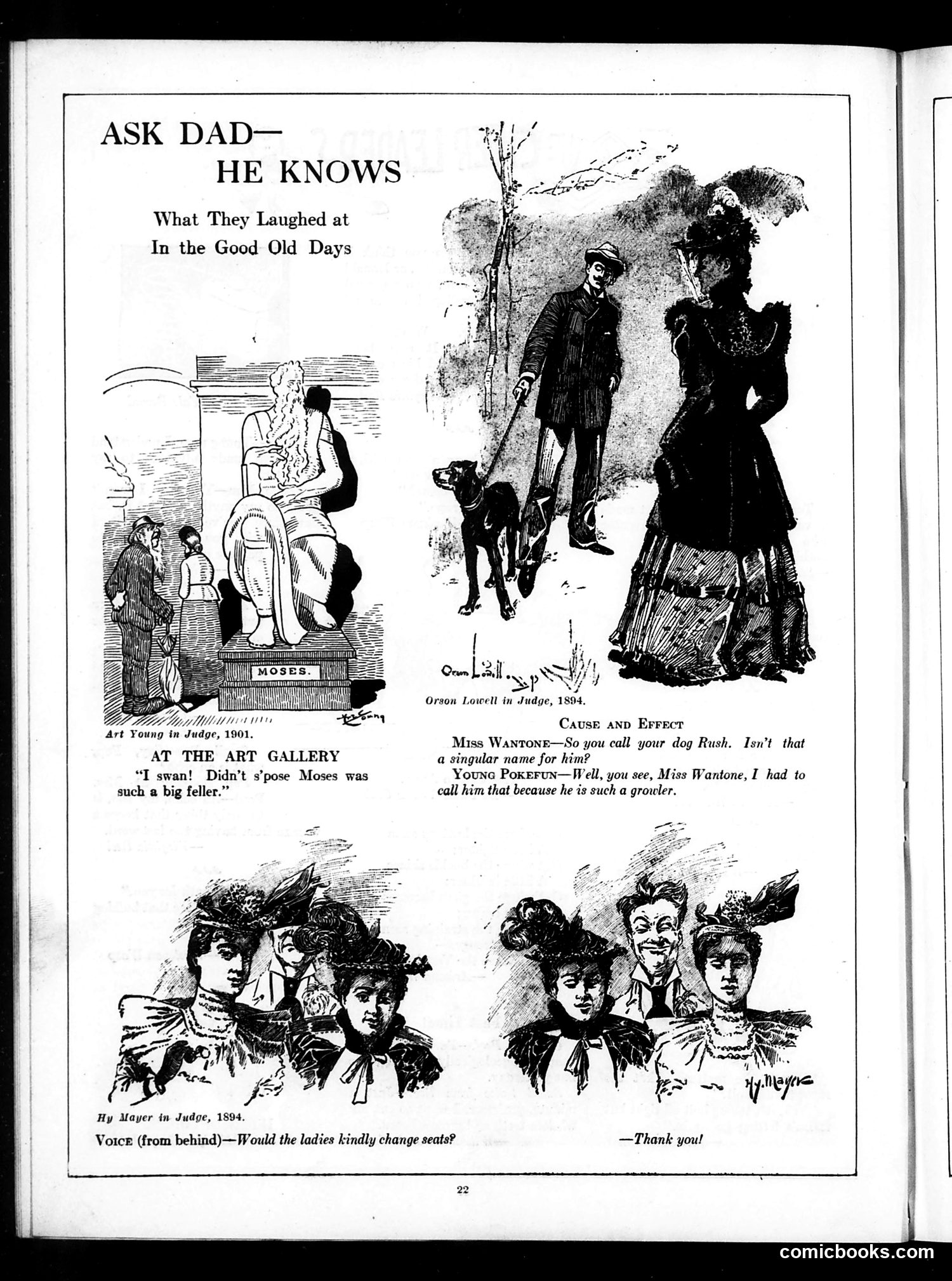
This page from *Judge* magazine presents nostalgic humor from the 1890s-1901, framed as "what they laughed at in the good old days." The cartoons feature period-typical jokes: 1. **Art Gallery scene**: Rural visitor mistakes a classical statue of Moses for an unusually large person—humor based on unsophistication. 2. **Dog naming joke**: A young man named his dog "Rush" because the dog is a "growler" (complainer)—a pun on the word. 3. **Theater scene**: A man politely requests ladies change seats, presumably blocking his view—gentle social comedy about theater etiquette. 4. **Orson Lowell illustration**: Shows well-dressed figures, possibly referencing a social situation. The overall theme mocks earlier generations' simpler, more innocent humor compared to contemporary 1900s sensibilities. The cartoons emphasize rural naïveté, wordplay, and genteel social situations—reflecting *Judge*'s primarily middle-class audience and their presumed superiority to "old-fashioned" comedy.
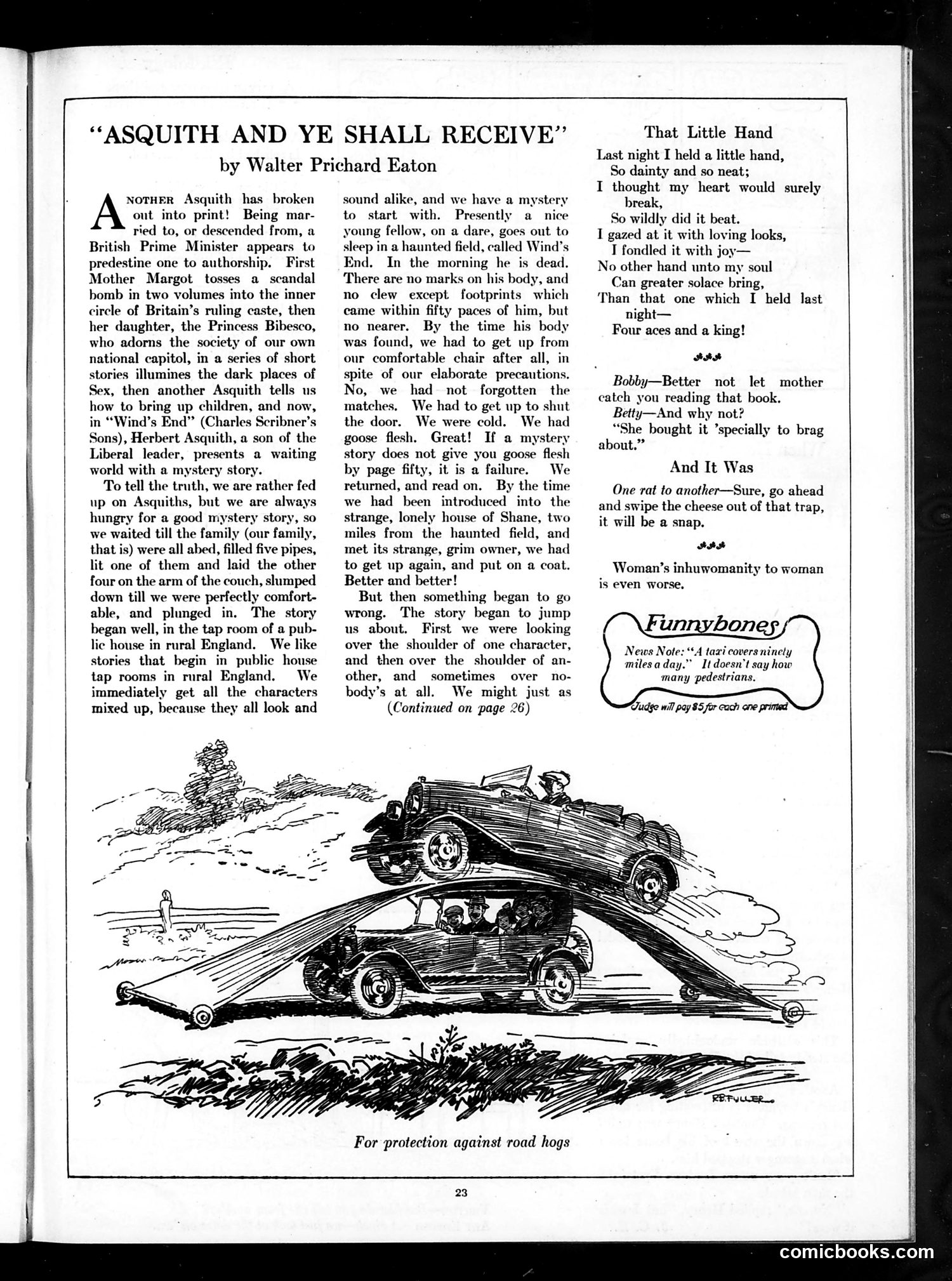
The page features a book review by Walter Prichard Eaton mocking the literary output of the Asquith family—relatives of British Prime Minister H.H. Asquith. Eaton sarcastically notes that marrying into or descending from the Asquith line apparently guarantees authorship, citing Margot Asquith's scandal memoir, her daughter Princess Bibesco's stories about sexuality, and now Herbert Asquith's mystery novel "Wind's End." The review praises the mystery's atmospheric tension until the narrative structure deteriorates, jumping between characters' perspectives confusingly. The cartoon below depicts cars on an angled platform—a humorous illustration of "protection against road hogs," likely mocking reckless drivers of the era. The remaining short items are unrelated humor pieces: sentimental poems about holding hands (with a card-game punchline), jokes about rodents and mousetraps, and a satirical news note about taxi safety.
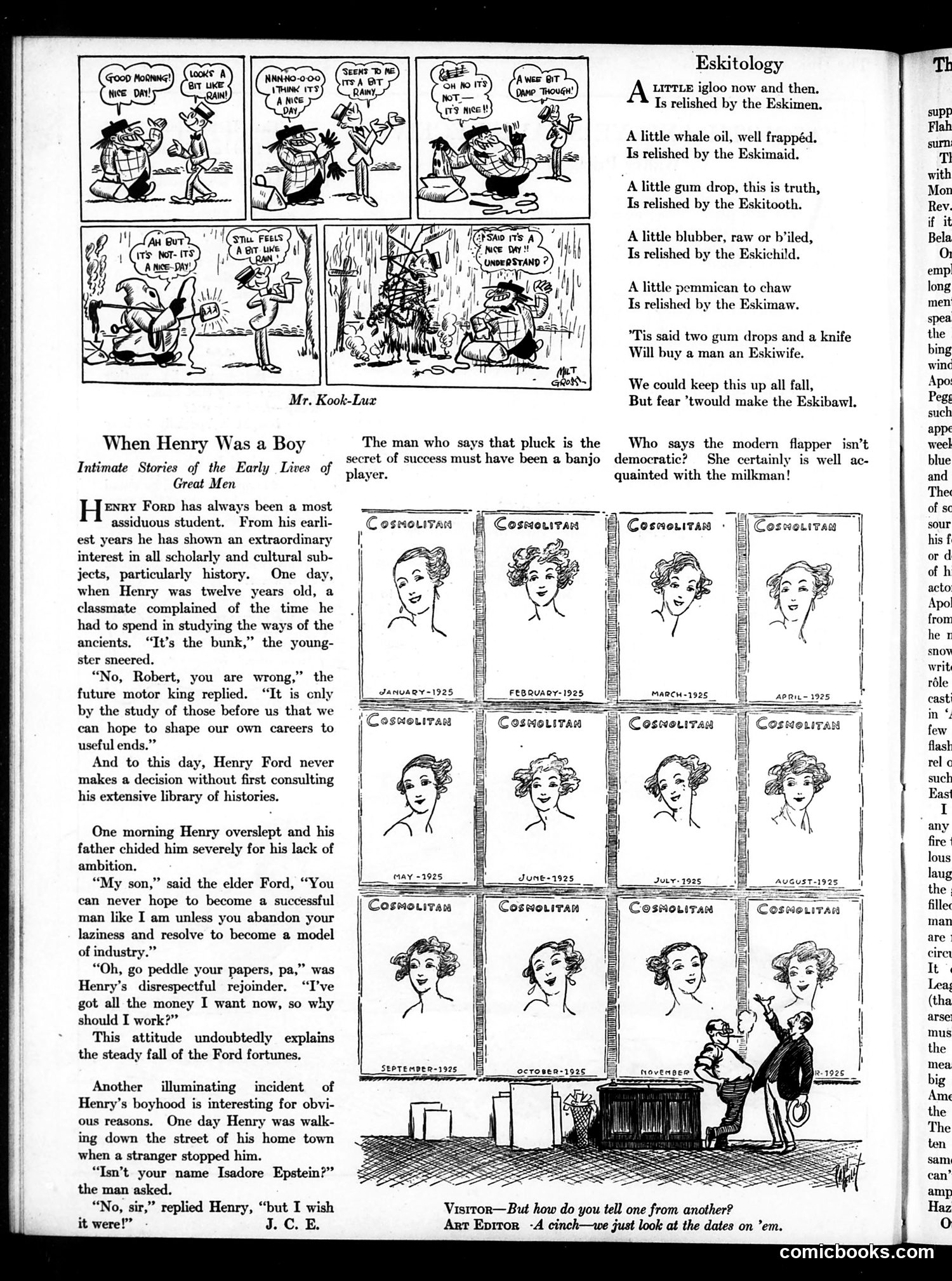
**"Eskitology"** is a humorous poem playing on Inuit/Eskimo culture through rhyming couplets. Each stanza lists items "relished by the Eskimo[s]"—igloos, whale oil, gum drops, blubber, pemmican—establishing a joking pseudo-ethnographic tone. The final stanza suggests gum drops and a knife can purchase an "Eskiwife," reducing Indigenous people to stereotyped caricatures for comedic effect. This reflects early-20th-century attitudes treating non-Western peoples as exotic subjects of ridicule rather than as actual communities. **"When Henry Was a Boy"** offers anecdotal stories about young Henry Ford emphasizing his supposed work ethic and business acumen. The narrative portrays Ford consulting historical texts and rejecting his father's criticism with youthful irreverence. **The Cosmopolitan hairstyle series** displays twelve sketched female faces representing monthly variations in women's hairstyles (January 1925 through December 1925), likely illustrating fashion trends. The **"modern flapper"** quip mocks young women's independence, sarcastically calling them "democratic" because they associate with milkmen—suggesting frivolous social mixing.
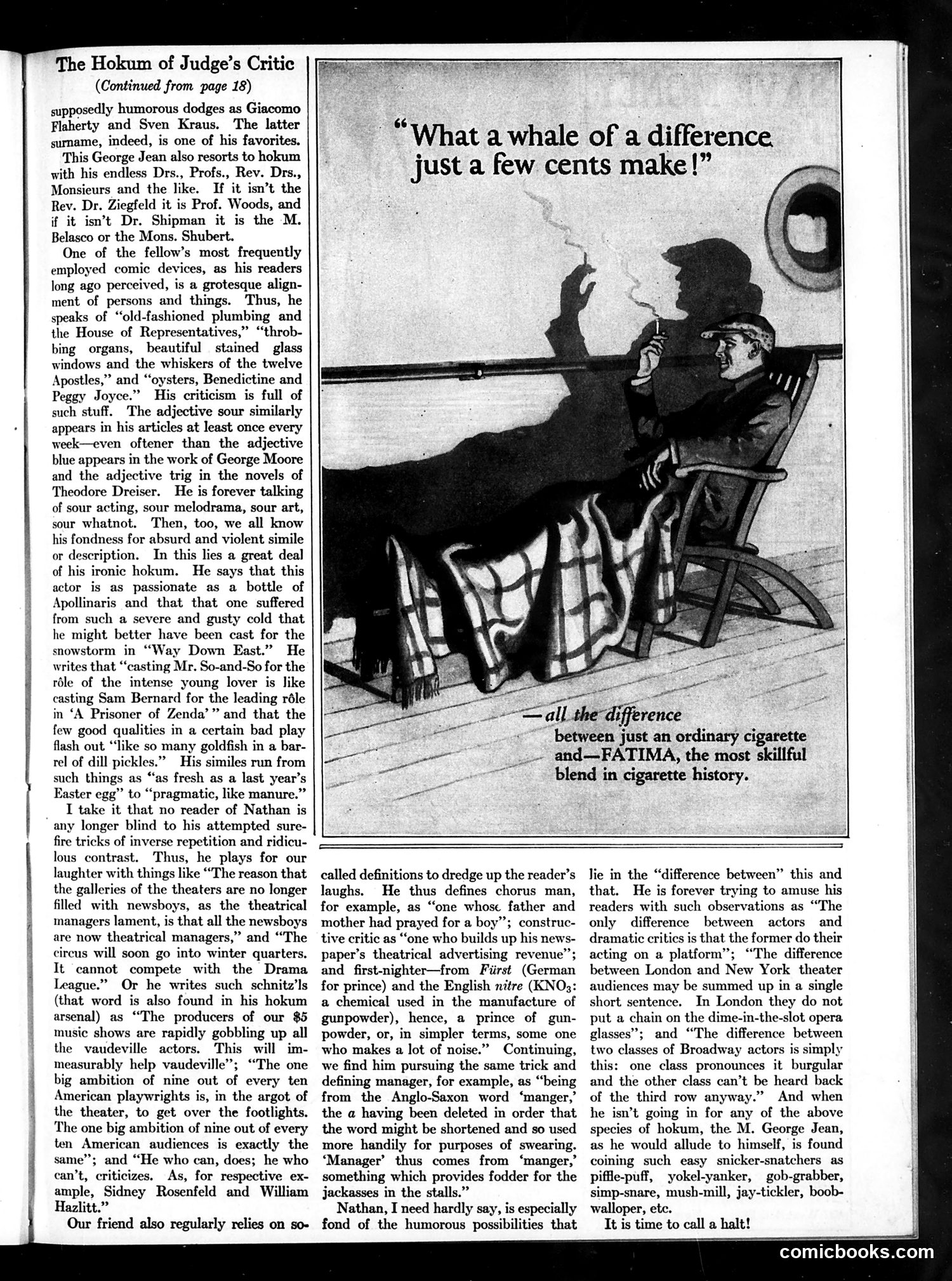
This page critiques a theater critic (likely George Jean Nathan, Judge's regular drama reviewer) for relying on predictable comedic hokum. The left column catalogs his stock tricks: forced absurd comparisons ("as passionate as a bottle of Apollinaris"), excessive use of the word "sour," grotesque juxtapositions ("oysters, Benedictine and Peggy Joyce"), and contrived wordplay definitions. The advertisement on the right—showing a man relaxing in a chair—is a Fatima cigarettes ad claiming the brand makes "a whale of a difference." This placement is likely intentional irony: the article mocks Nathan's overuse of exaggerated claims about minor differences, while the ad beside it makes similarly hyperbolic marketing claims. The satire targets Nathan's writing style as formulaic and manipulative, relying on tired devices rather than genuine criticism. For modern readers, this reveals early 20th-century theater criticism was apparently as prone to cliché as contemporary entertainment journalism.
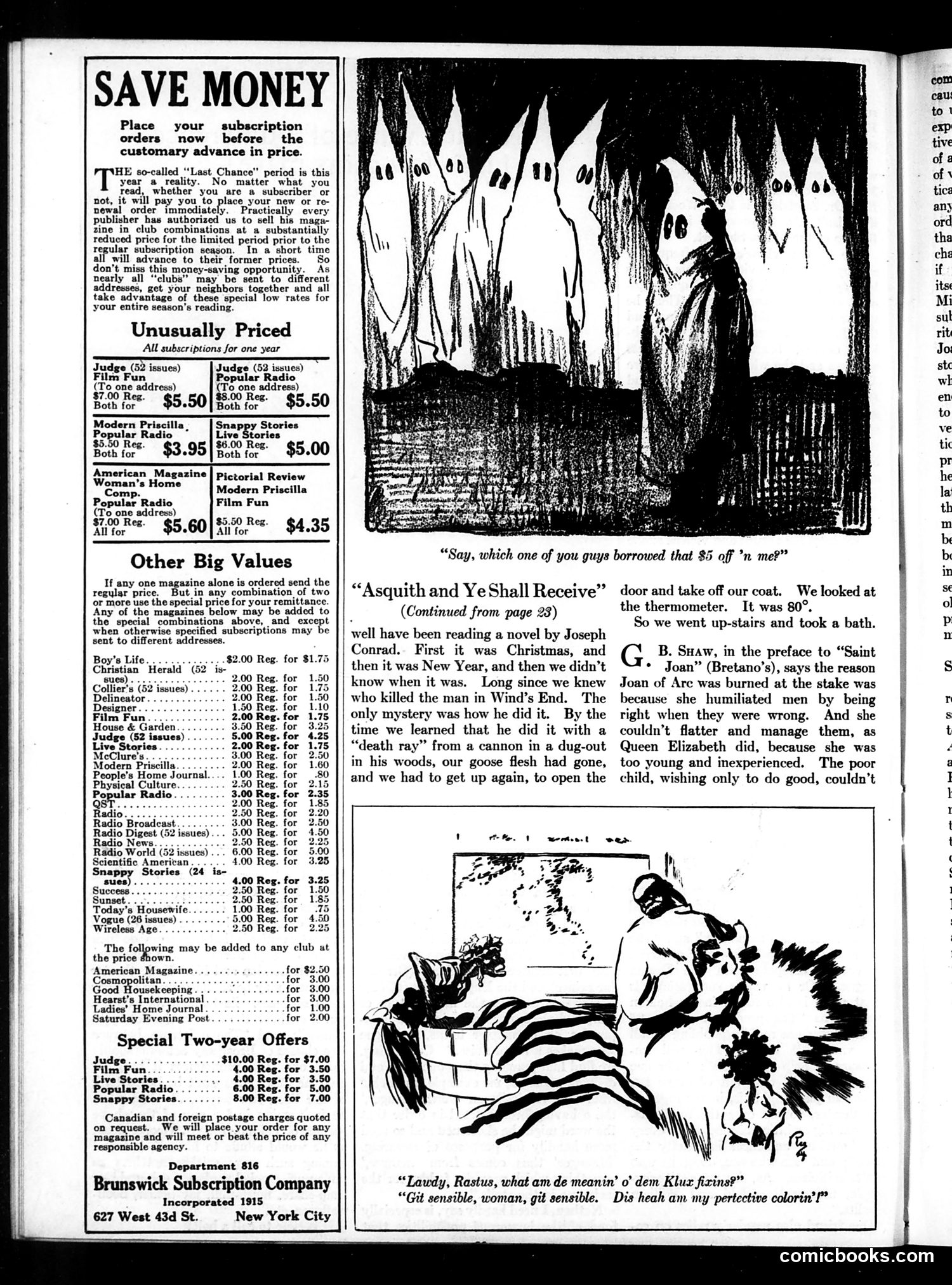
This page is primarily **advertising and subscription promotion**, not satire or political commentary. It dominates the layout with pricing offers for magazine bundles from the Brunswick Subscription Company. The two small cartoons are unrelated humor: **Top cartoon**: Shows ghostly figures (KKK robes implied by the pointed hoods) with one asking which "guy borrowed that $5 off 'n me?"—crude street humor about theft among the group. **Bottom cartoon**: Titled "Laudy, Rastus, what am de meanin' o dem Kluz lyzins?" Uses racist dialect humor featuring Black characters discussing the KKK. The punchline plays on mispronunciation and dialect comedy typical of early 20th-century mass media. Both cartoons employ casual bigotry standard to the era. The page otherwise contains serialized fiction excerpts and standard magazine pricing—reflecting Judge's focus on affordable entertainment subscriptions during what appears to be a pre-season sales push ("Last Chance" pricing period).
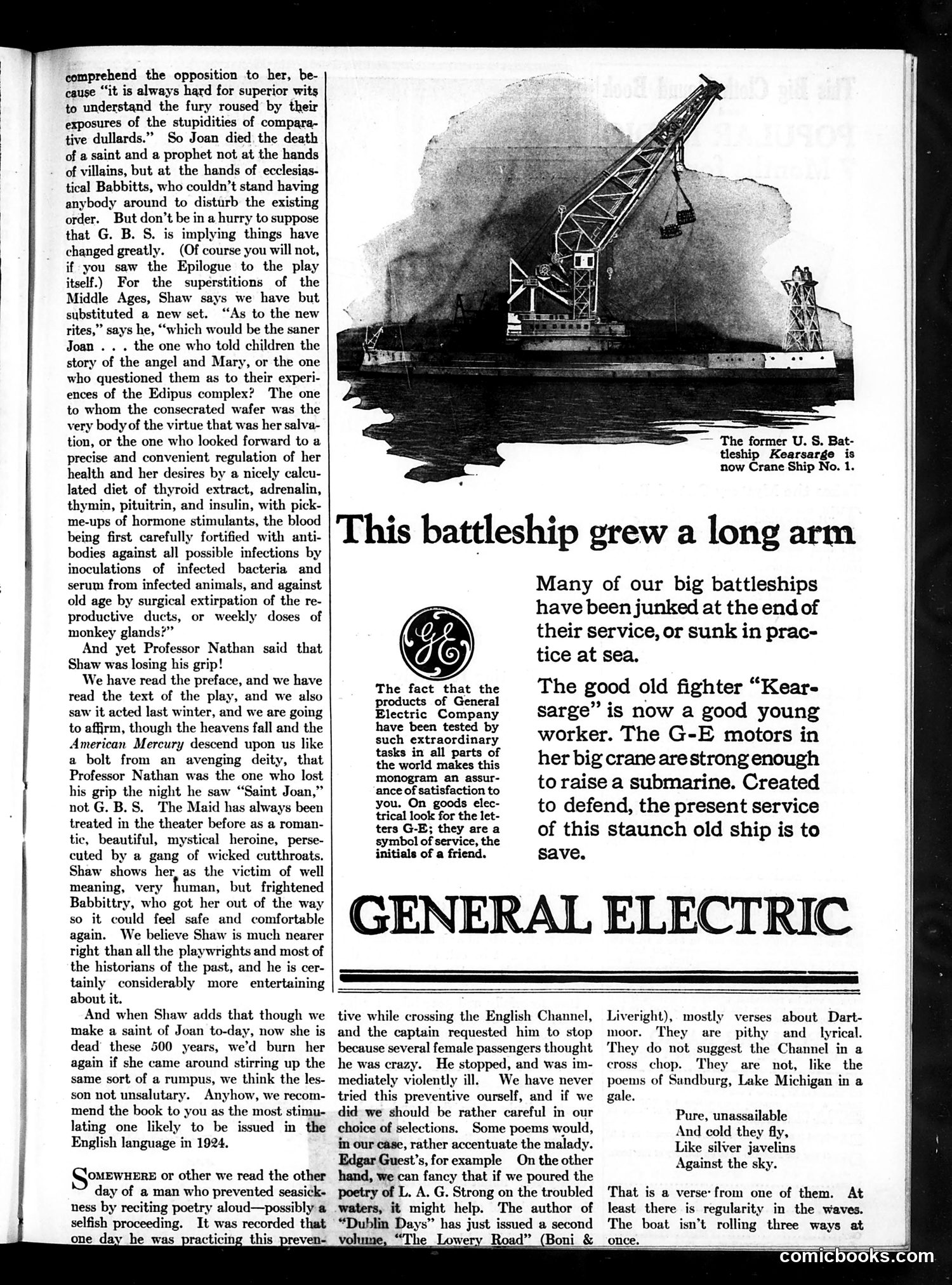
This page combines literary criticism with advertising. The main text reviews George Bernard Shaw's play *Saint Joan*, praising Shaw's portrayal of Joan of Arc as a victim of well-meaning but fearful bureaucrats ("Babbittry"—a term from Sinclair Lewis's *Babbitt*, meaning conformist mediocrity). The critic argues Shaw's interpretation, where Joan is persecuted by frightened ecclesiastical officials protecting the status quo, is more historically accurate and morally relevant than traditional romantic treatments. The review contrasts medieval superstitions with modern ones (thyroid extract, hormone treatments), suggesting human foolishness persists regardless of era. The right side features a **General Electric advertisement** showing the USS Kearsarge converted into "Crane Ship No. 1," illustrating GE motors' industrial strength and durability. The ad conflates military defense with commercial utility—what once served war now serves industry—reflecting post-WWI American industrial confidence. Together, the page juxtaposes intellectual critique of institutional fear with corporate celebration of technological progress.
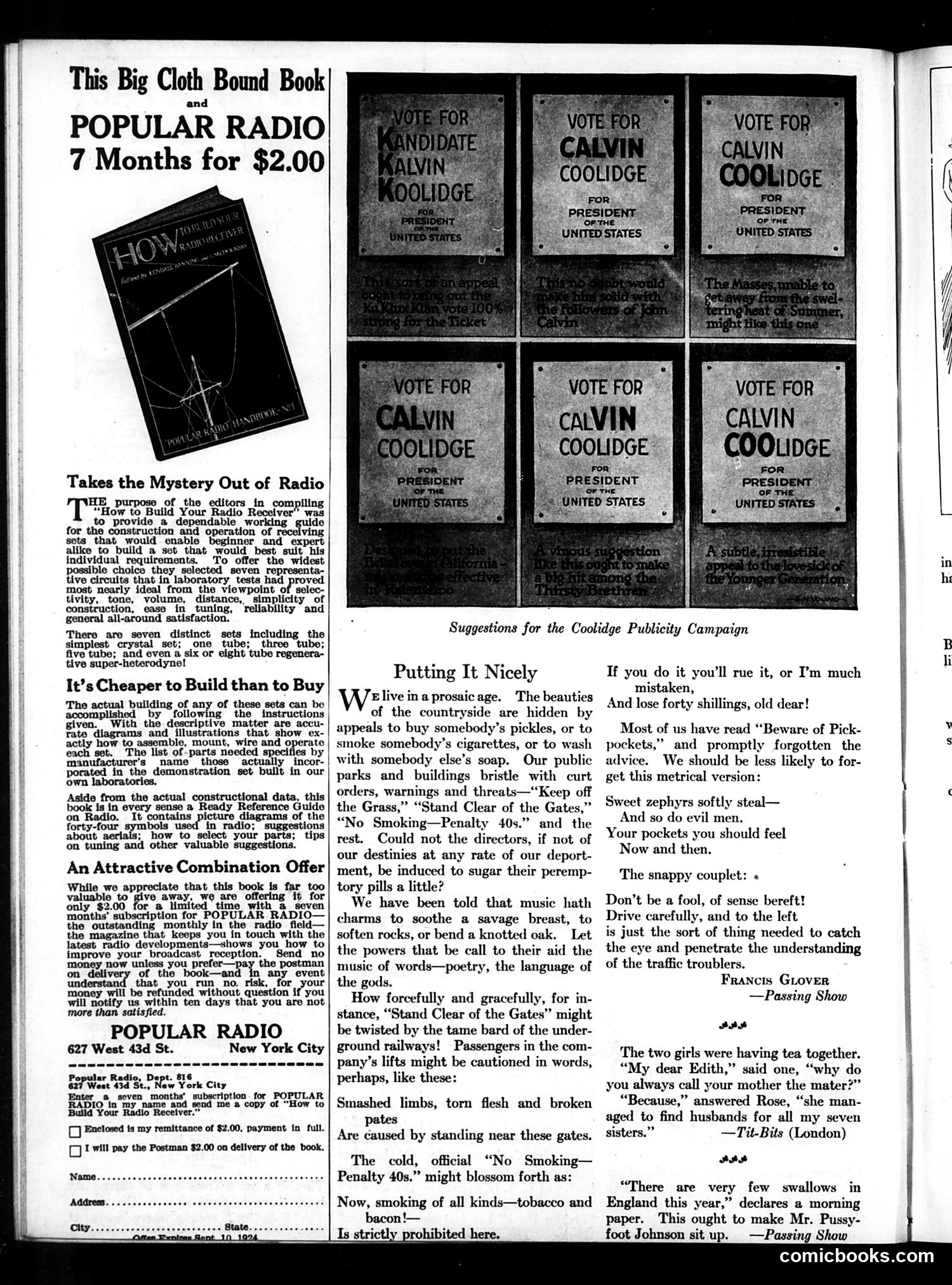
This page is primarily advertising for radio books and magazines, but includes a satirical article titled "Putting It Nicely" mocking Calvin Coolidge's 1924 presidential publicity campaign. The article ridicules attempts to make public warnings and restrictions sound poetic and appealing rather than stern. It suggests that dreary official signs like "No Smoking—Penalty 40s." should be rewritten as verse to seem more pleasant. The satire implies Coolidge's campaign team was trying to soften his notoriously dour public image through flowery language and appeals. Six identical "Vote for Calvin Coolidge" posters appear above the article—a visual gag emphasizing the repetitive, mechanical nature of the campaign messaging. The joke is that no amount of poetic rewriting can fundamentally change an austere political figure's essential nature.
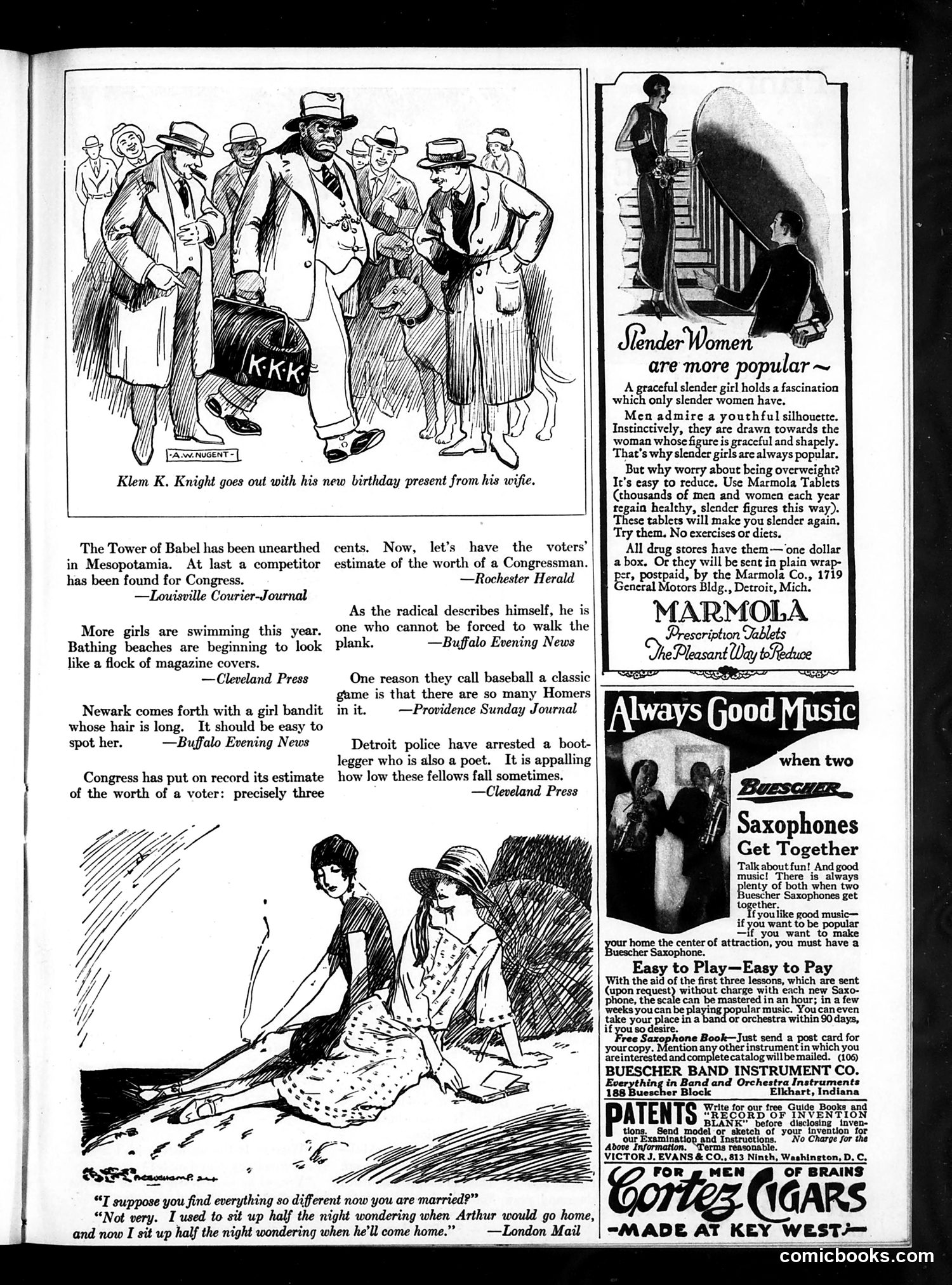
This page combines political humor with period advertisements, typical of Judge's satirical format. **Top Cartoon:** "Klem K. Knight goes out with his new birthday present from his wife" depicts a man with a KKK symbol on his bag among well-dressed men. This directly satirizes the Ku Klux Klan, suggesting membership as a laughable "gift" — Judge's editorial stance against the organization. **Text Humor:** Short quoted jabs mock Congress's low voter valuation, female criminals, and contemporary social trends (swimming, marriage). These reflect 1920s concerns about changing gender roles and political corruption. **Advertisements:** The page is dominated by product ads (Marmola weight-loss tablets, Buescher saxophones, cigars) that reveal period anxieties: female slenderness as essential attractiveness, jazz-age leisure culture, and patent-seeking schemes. **Lower Cartoon:** A marriage joke about wondering when husbands come/go home—mild domestic humor typical of the era. The page reflects post-WWI American society preoccupied with changing morality, consumerism, and identity politics.
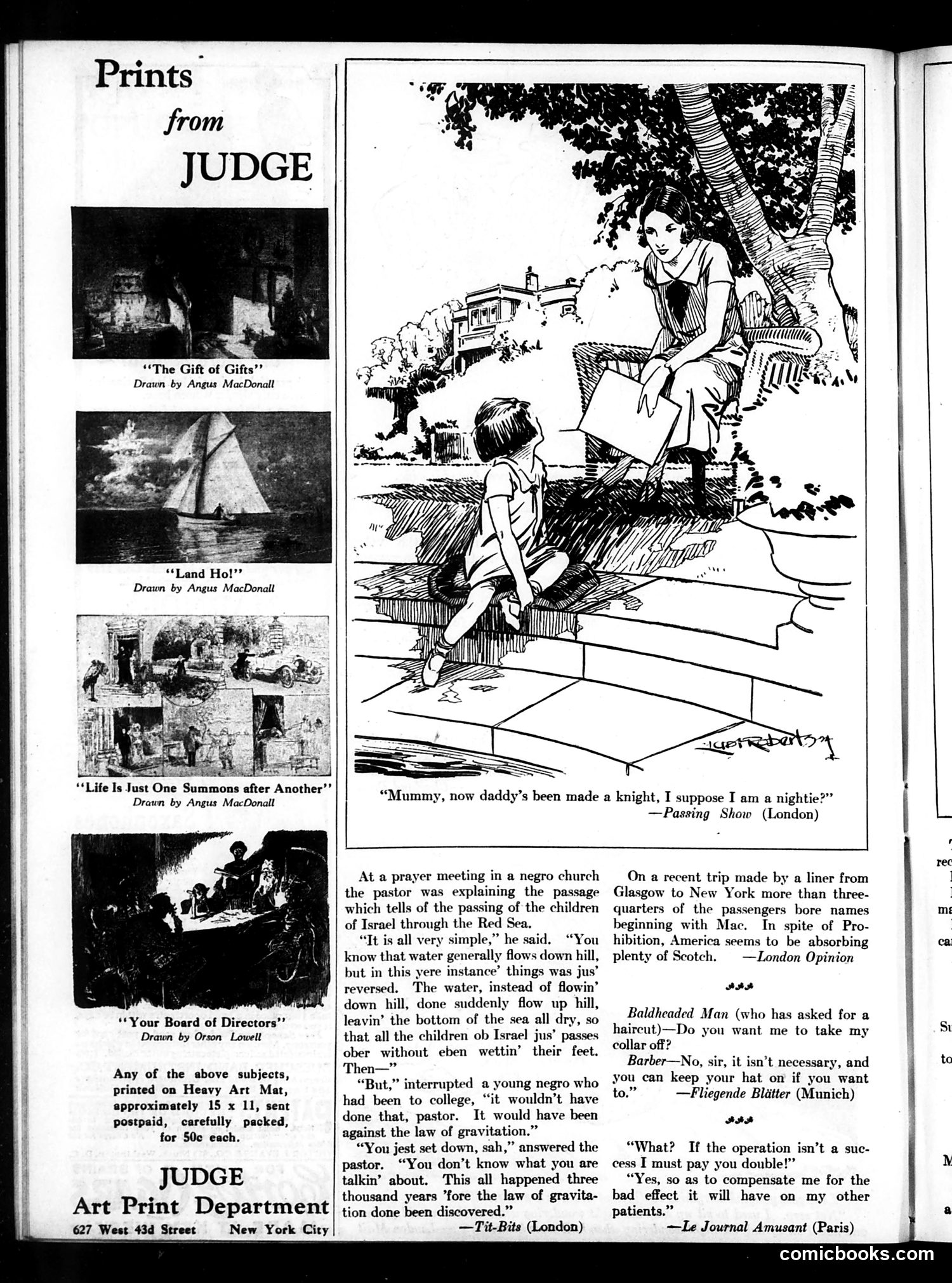
This page is primarily an **advertisement for art prints** from Judge's Art Print Department, featuring four illustrations by various artists available for 50 cents each. The main cartoon (top right) shows a child asking her mother: "Mummy, now daddy's been made a knight, I suppose I am a nightie?" — a simple pun playing on the similar-sounding words "knight" and "nightie" (British term for nightgown). This reprinted joke from London's *Passing Show* relies on a child's innocent wordplay misunderstanding. Below are four humor snippets from international publications (*Tit-Bits*, *London Opinion*, *Fliegende Blitter*, *Le Journal Amusant*) — typical filler content for satirical magazines of this era. These include a story about a Black pastor explaining biblical physics, a joke about Scottish immigration to America, and barber/doctor jokes. The page reflects Judge's late-period reliance on reprinted international humor and advertising rather than original satirical political content.
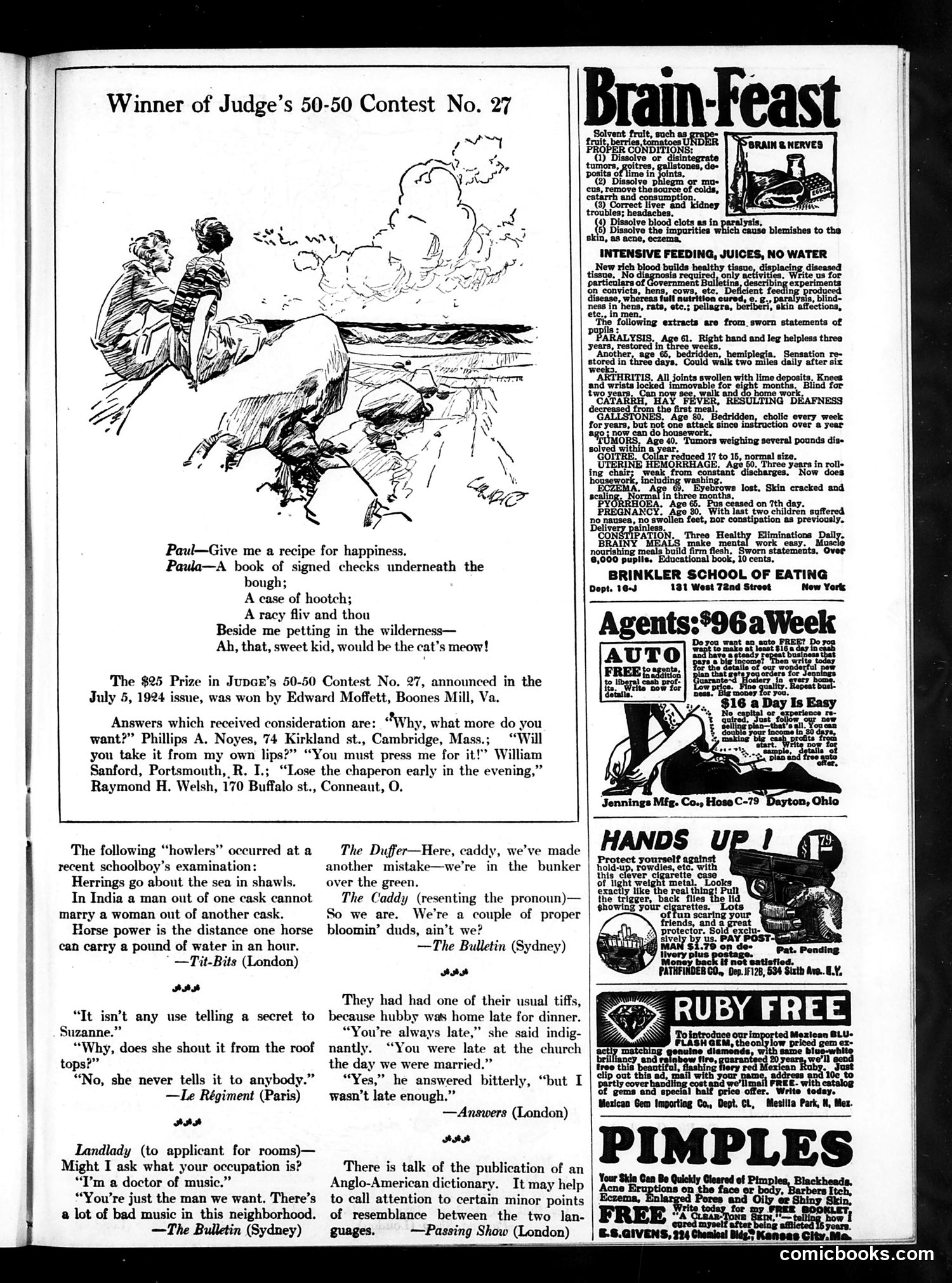
This page from Judge magazine (July 1924) centers on a humor contest where readers submitted punchlines about happiness. The winning cartoon shows two figures in classical dress—Paul and Paula—on a hillside, with Paula's answer representing 1920s aspirational hedonism: wealth ("signed checks"), Prohibition-era alcohol ("hootch"), a car ("racy fliv"), and romance. The phrase "cat's meow" was contemporary slang for something excellent. The page collects various international humorous anecdotes about linguistic misunderstandings and marital/social situations—typical Judge filler content. Most notable is the Prohibition-era joke about bunkers and "bloomin' duds," reflecting post-WWI British slang. The right side comprises advertisements for dubious remedies (the "Brinkler School of Eating" promises to cure paralysis and tumors) and employment schemes—typical of 1920s magazines before modern consumer protection. These ads reflect the era's snake-oil medicine culture.
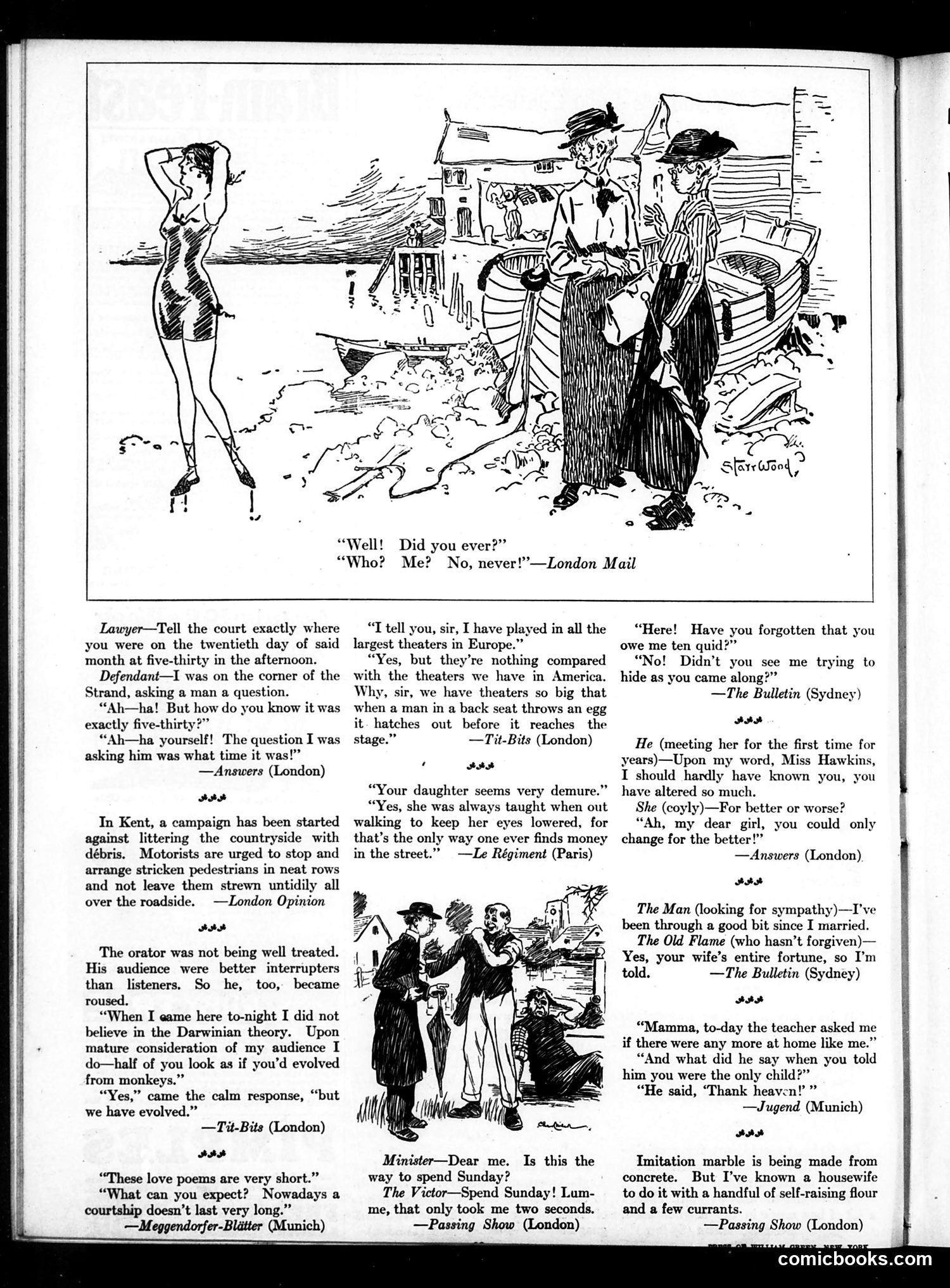
This page collects brief jokes and comic anecdotes from various international publications, reflecting early 20th-century humor. The top cartoon depicts a beach scene where a woman in a bathing suit confronts three fully-clothed men, with the caption "Well! Did you ever?" / "Who? Me? No, never!" The joke plays on the shocking sight of a woman in revealing swimwear—scandalous by standards of the era. The textual jokes mock various social situations: a defendant's circular logic about time, motorists hitting pedestrians (dark humor), an orator insulting his audience as evolutionarily inferior, and exaggerated American theater sizes. Other pieces target courtship customs, daughters trained to look down (implying they find dropped money), marital finances, and strict parenting. The humor reflects period attitudes about gender propriety, class behaviors, marriage, and international differences. Most jokes rely on wordplay, irony, and social observation rather than political commentary.
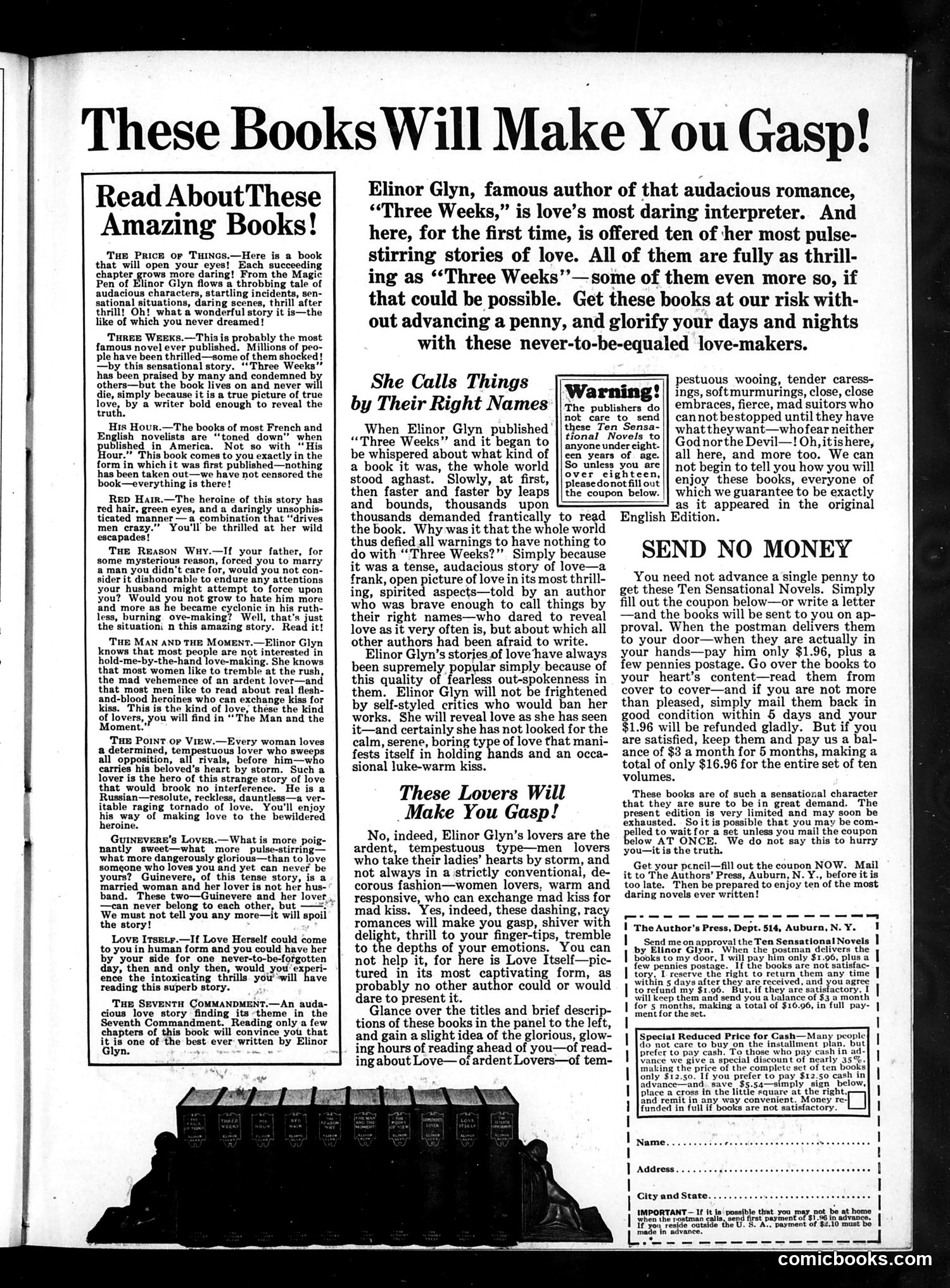
This is a **book advertisement**, not a political cartoon. It promotes ten novels by Elinor Glyn, a famous early 20th-century romance author known for sexually frank writing. The page's appeal lies in **transgressive content marketing**. Each book description emphasizes scandal and daring—"audacious," "sensational," "thrill," repeated warnings about censorship. Notably, "His Hour" claims nothing was "censored" unlike other American editions, and "Three Weeks" mentions it was "shocked" readers, treating controversy as a selling point. The tone is deliberately provocative for its era. Descriptions focus on passionate, aggressive male lovers and female desire ("drives men crazy"), positioning these novels as dangerously frank about sexuality and infidelity. **The pitch**: Buy these books cheaply ($1.96 for the complete set) without paying per book, send no money upfront, and experience thrills your "never dreamed." It's sensationalism marketed as liberation—positioning Glyn as a fearless truth-teller about love that mainstream critics wanted banned.
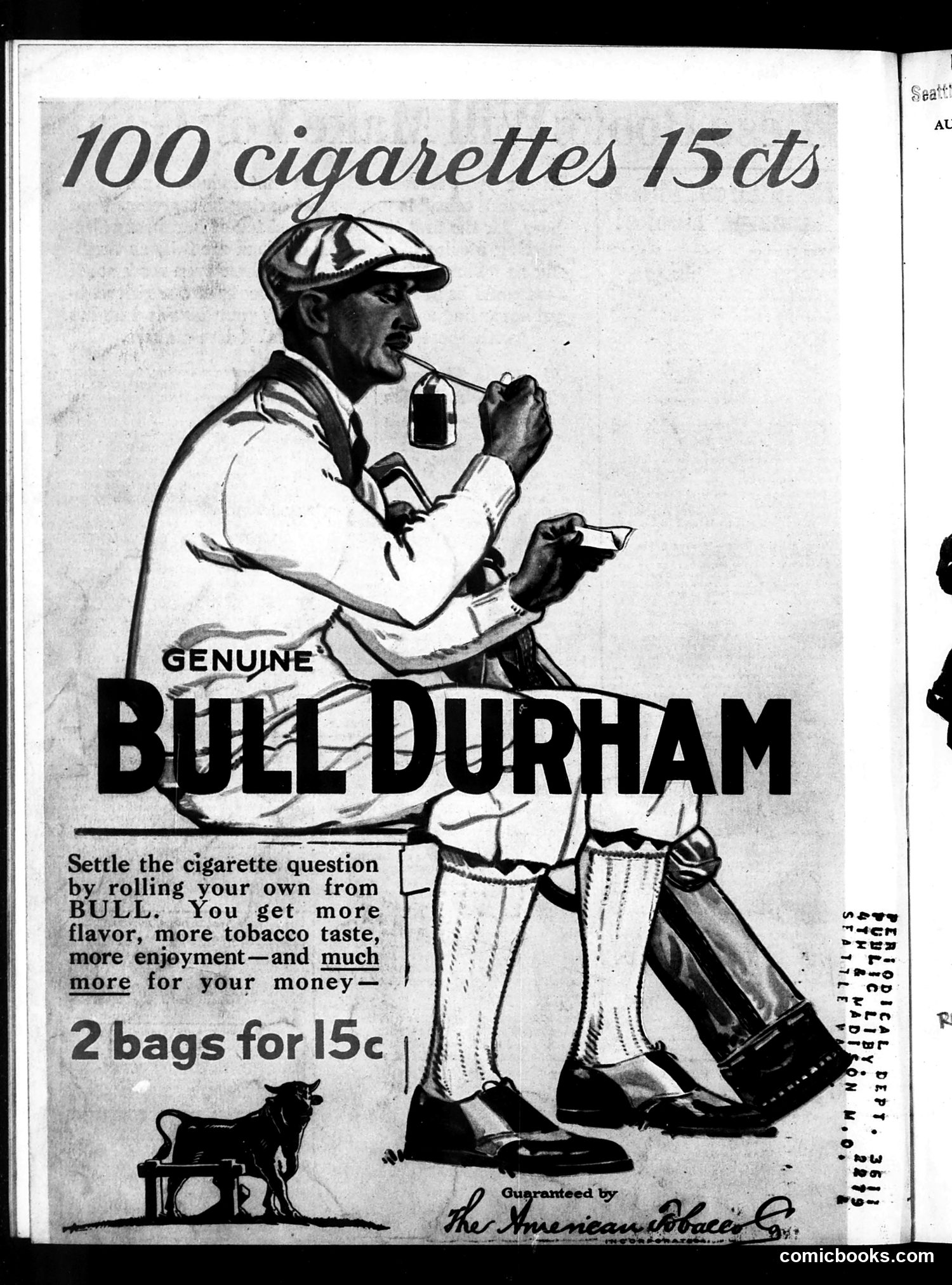
This is a full-page advertisement for Bull Durham rolling tobacco, not satire. The image shows a baseball player (identified by uniform and cap) holding a cigarette and pouch, advertising that customers can roll their own cigarettes from Bull Durham tobacco at economical rates—two bags for 15 cents. The ad's pitch emphasizes value and quality: rolling your own provides "more flavor, more tobacco taste, more enjoyment—and much more for your money" compared to pre-made cigarettes. The baseball player serves as an endorsement figure, suggesting the product appeals to athletic, working-class men. The Bull mascot logo appears at bottom. This reflects early 20th-century marketing practices where celebrities and sports figures promoted consumer products without modern regulatory restrictions on tobacco advertising.