
Judge, 1924-08-16 · page 29 of 36
Judge — August 16, 1924 — page 29: what you’re looking at
What you’re looking at
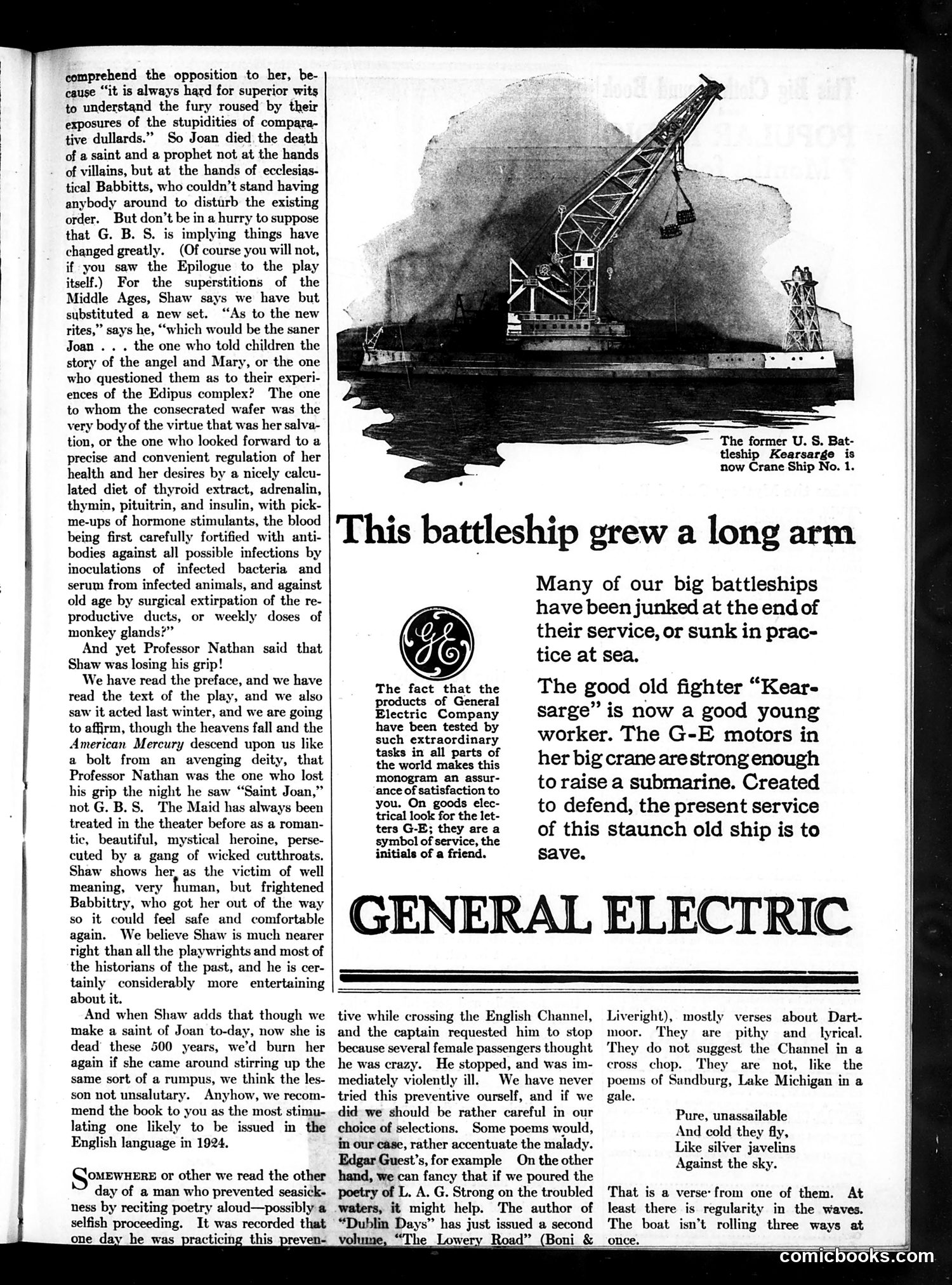
This page combines literary criticism with advertising. The main text reviews George Bernard Shaw's play *Saint Joan*, praising Shaw's portrayal of Joan of Arc as a victim of well-meaning but fearful bureaucrats ("Babbittry"—a term from Sinclair Lewis's *Babbitt*, meaning conformist mediocrity). The critic argues Shaw's interpretation, where Joan is persecuted by frightened ecclesiastical officials protecting the status quo, is more historically accurate and morally relevant than traditional romantic treatments. The review contrasts medieval superstitions with modern ones (thyroid extract, hormone treatments), suggesting human foolishness persists regardless of era. The right side features a **General Electric advertisement** showing the USS Kearsarge converted into "Crane Ship No. 1," illustrating GE motors' industrial strength and durability. The ad conflates military defense with commercial utility—what once served war now serves industry—reflecting post-WWI American industrial confidence. Together, the page juxtaposes intellectual critique of institutional fear with corporate celebration of technological progress.
📄 Transcribed text from this page (OCR, searchable)
Machine-transcribed from the original scan — historical spelling and the odd misread are preserved.
comprehend the opposition to her, be- cause “it is always hard for superior wits to understand the fury roused by their exposures of the stupidities of compara- tive dullards.” So Joan died. the death of a saint and a prophet not at the hands of villains, but at the hands of ecclesias- tical Babbitts, who couldn’t stand having anybody around to disturb the existing order. But don’t be in a hurry to suppose that G. B. S. is implying things have changed greatly. (Of course you will not, if you saw the Epilogue to the play itself.) For the superstitions of the Middle Ages, Shaw says we have but substituted a new set. “As to the new rites,” says he, “which would be the saner Joan . . . the one who told children the story of the angel and Mary, or the one who questioned them as to their experi- ences of the Edipus complex? The one to whom the consecrated wafer was the very body of the virtue that was her salva- tion, or the one who looked forward to a precise and convenient regulation of her health and her desires by a nicely calcu- lated diet of thyroid extract, adrenalin, thymin, pituitrin, and insulin, with pick- me-ups of hormone stimulants, the blood being first carefully fortified with anti- bodies against all possible infections by inoculations of infected bacteria and serum from infected animals, and against old age by surgical extirpation of the re- productive ducts, or weekly doses of monkey glands?” And yet Professor Nathan said that Shaw was losing his grip! We have read the preface, and we have read the text of the play, and we also saw it acted last winter, and we are going to affirm, though the heavens fall and the American Mercury descend upon us like a bolt from an avenging deity, that Professor Nathan was the one who lost his grip the night he saw “Saint Joan,” not G. B.S. The Maid has always been treated in the theater before as a roman- tic, beautiful, mystical heroine, perse- cuted by a gang of wicked cutthroats. Shaw shows her as the victim of well meaning, very human, but frightened Babbittry, who got her out of the way so it could feel safe and comfortable again. We believe Shaw is much nearer right than all the playwrights and most of the historians of the past, and he is cer- tainly considerably more entertaining about it. And when Shaw adds that though we make a saint of Joan to-day, now she is dead’ these 500 years, we’d burn her again if she came around stirring up the same sort of a rumpus, we think the les- son not unsalutary. Anyhow, we recom- mend the book to you as the most stimu- lating one likely to be issued in the English language in 1924. OMEWHERE or other we read the other day of a man who prevented seasick- ness by reciting poetry aloud—possibly a selfish proceeding. It was recorded that one day he was practicing this preven- ~ The former U. S. Bat- tleship Kearsarge is now Crane Ship No. 1. This battleship grew a long arm Many of our big battleships have been junked at the end of their service, or sunk in prac- tice at sea. The fact that the products of General Electric Company have been tested by such extraordinary tasks in all parts of the world makes this monogram an assur- ance of satisfaction to you. On goods elec- trical look for the let- ters G-E; they are a symbol of service, the initials of a friend. Save. The good old fighter “Kear- sarge” worker. The G-E motors in her big crane are strong enough to raise a submarine. Created to defend, the present service of this staunch old ship is to is now a good young GENERAL ELECTRIC tive while crossing the English Channel, and the captain requested him to stop because several female passengers thought he was crazy. He stopped, and was im- mediately violently ill. We have never tried this preventive ourself, and if we did we should be rather careful in our choice of selections. Some poems would, in our case, rather accentuate the malady. Edgar Guest’s, forexample On the other hand, we can fancy that if we poured the poetry of L. A. G. Strong on the troubled waters, it might help. The author of “Dublin Days” has just issued a second volume. 2D ” (Boni_& Liveright), mostly verses about Dart- moor. They are pithy and _ lyrical. They do not suggest the Channel in a cross chop. They are not, like the poems of Sandburg, Lake Michigan in a gale. Pure, unassailable And cold they fly, Like silver javelins Against the sky. That is a verse'from one of them. At least there is regularity in the waves. The boat isn’t rolling three ways at