
Judge, 1924-08-16 · page 27 of 36
Judge — August 16, 1924 — page 27: what you’re looking at
What you’re looking at
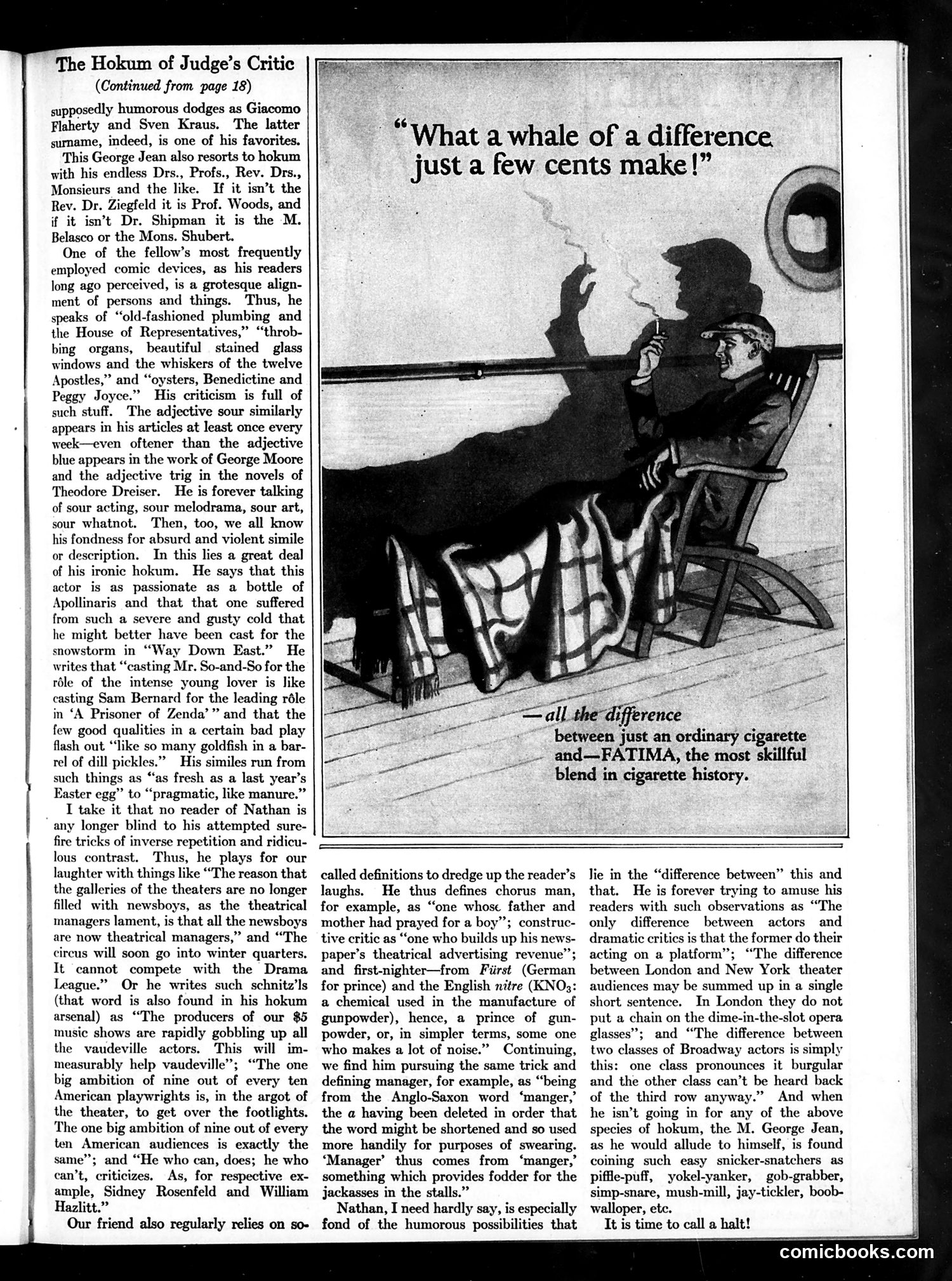
This page critiques a theater critic (likely George Jean Nathan, Judge's regular drama reviewer) for relying on predictable comedic hokum. The left column catalogs his stock tricks: forced absurd comparisons ("as passionate as a bottle of Apollinaris"), excessive use of the word "sour," grotesque juxtapositions ("oysters, Benedictine and Peggy Joyce"), and contrived wordplay definitions. The advertisement on the right—showing a man relaxing in a chair—is a Fatima cigarettes ad claiming the brand makes "a whale of a difference." This placement is likely intentional irony: the article mocks Nathan's overuse of exaggerated claims about minor differences, while the ad beside it makes similarly hyperbolic marketing claims. The satire targets Nathan's writing style as formulaic and manipulative, relying on tired devices rather than genuine criticism. For modern readers, this reveals early 20th-century theater criticism was apparently as prone to cliché as contemporary entertainment journalism.
📄 Transcribed text from this page (OCR, searchable)
Machine-transcribed from the original scan — historical spelling and the odd misread are preserved.
ee — The Hokum of Judge’s Critic (Continued from page 18) supposedly humorous dodges as Giacomo Flaherty and Sven Kraus. The latter surname, indeed, is one of his favorites. This George Jean also resorts to hokum with his endless Drs., Profs., Rev. Drs., Monsieurs and the like. If it isn’t the Rev. Dr. Ziegfeld it is Prof. Woods, and if it isn’t Dr. Shipman it is the M. Belasco or the Mons. Shubert. One of the fellow’s most frequently employed comic devices, as his readers long ago perceived, is a grotesque align- ment of persons and things. Thus, he speaks of “old-fashioned plumbing and the House of Representatives,” “throb- bing organs, beautiful stained glass windows and the whiskers of the twelve Apostles,” and “oysters, Benedictine and Peggy Joyce.” His criticism is full of such stuff. The adjective sour similarly appears in his articles at least once every week—even oftener than the adjective blue appears in the work of George Moore and the adjective trig in the novels of Theodore Dreiser. He is forever talking of sour acting, sour melodrama, sour art, sour whatnot. Then, too, we all know his fondness for absurd and violent simile or description. In this lies a great deal of his ironic hokum. He says that this actor is as passionate as a bottle of Apollinaris and that that one suffered from such a severe and gusty cold that he might better have been cast for the snowstorm in “Way Down East.” He writes that “casting Mr. So-and-So for the réle of the intense young lover is like casting Sam Bernard for the leading réle in ‘A Prisoner of Zenda’” and that the few good qualities in a certain bad play flash out “‘like so many goldfish in a bar- rel of dill pickles.” His similes run from such things as “as fresh as a last year’s Easter egg” to “pragmatic, like manure.” I take it that no reader of Nathan is any longer blind to his attempted sure- fire tricks of inverse repetition and ridicu- lous contrast. Thus, he plays for our laughter with things like “The reason that the galleries of the theaters are no longer filled with newsboys, as the theatrical managers lament, is that all the newsboys are now theatrical managers,” and “The circus will soon go into winter quarters. It cannot compete with the Drama League.” Or he writes such schnitz’ls (that word is also found in his hokum arsenal) as “The producers of our $5 music shows are rapidly gobbling up all the vaudeville actors. This will im- measurably help vaudeville”; “The one big ambition of nine out of every ten American playwrights is, in the argot of the theater, to get over the footlights. The one big ambition of nine out of every ten American audiences is exactly the same”; and “He who can, does; he who can’t, criticizes. As, for respective ex- ample, Sidney Rosenfeld and William Hazlitt.” Our friend also regularly relies on so- “What a whale of a difference just a few cents make!” ~=all the difference Ee : «between just an ordinary cigarette Sern ape _.~ and—FATIMA, the most skillful ere : TS blend in cigarette history. called definitions to dredge up the reader’s laughs. He thus defines chorus man, for example, as “one whose father and mother had prayed for a boy”; construc- tive critic as “one who builds up his news- paper’s theatrical advertising revenue”; and first-nighter—from Fiirst (German for prince) and the English nitre (KNO3: a chemical used in the manufacture of gunpowder), hence, a prince of gun- powder, or, in simpler terms, some one who makes a lot of noise.” Continuing, we find him pursuing the same trick and defining manager, for example, as “being from the Anglo-Saxon word ‘manger,’ the a having been deleted in order that the word might be shortened and so used more handily for purposes of swearing. ‘Manager’ thus comes from ‘manger,’ something which provides fodder for the jackasses in the stalls.” Nathan, I need hardly say, is especially fond of the humorous possibilities that lie in the “difference between” this and that. He is forever trying to amuse his readers with such observations as “The only difference between actors and dramatic critics is that the former do their acting on a platform”; “The difference between London and New York theater audiences may be summed up in a single short sentence. In London they do not put a chain on the dime-in-the-slot opera glasses”; and “The difference between two classes of Broadway actors is simply this: one class pronounces it burgular and the other class can’t be heard back of the third row anyway.” And when he isn’t going in for any of the above species of hokum, the M. George Jean, as he would allude to himself, is found coining such easy snicker-snatchers as piffle-puff, yokel-yanker, gob-grabber, simp-snare, mush-mill, jay-tickler, boob- walloper, etc. It is time to call a halt! comicbooks.co