
Judge, 1924-08-16 · page 22 of 36
Judge — August 16, 1924 — page 22: what you’re looking at
What you’re looking at
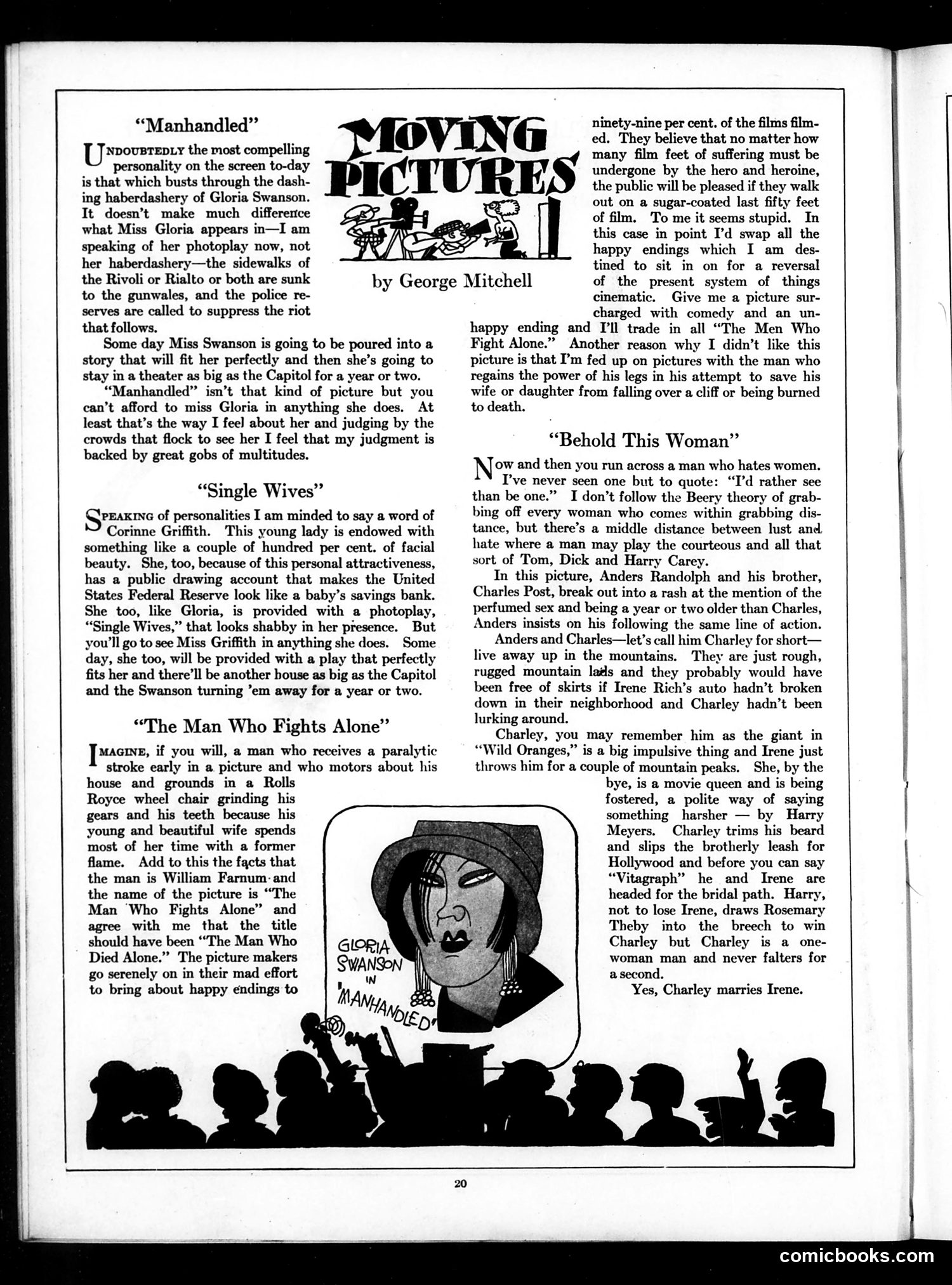
This page from Judge magazine contains film criticism by George Mitchell reviewing recent movies, circa early 1920s. **The Films and References:** The critic reviews three pictures: "Manhandled" and "Single Wives" starring major silent film actresses Gloria Swanson and Corinne Griffith respectively, plus "The Man Who Fights Alone" with William Farnum. (A fourth film, "Behold This Woman," begins at page's bottom.) **The Satire's Point:** Mitchell satirizes the film industry's indifference to quality storytelling. He argues that Swanson and Griffith are so popular that studios can give them mediocre plots—the actresses' star power alone guarantees packed theaters ("the sidewalks of the Rivoli or Rialto...are sunk to the gunwales"). He also mocks predictable melodrama: films where paralyzed heroes miraculously regain mobility to rescue wives from cliffs or fires. Mitchell demands better—stories worthy of talented performers, not just vehicles showcasing famous faces. The criticism reflects broader 1920s debates about artistic merit versus commercial filmmaking.
📄 Transcribed text from this page (OCR, searchable)
Machine-transcribed from the original scan — historical spelling and the odd misread are preserved.
“Manhandled” ing haberdashery of Gloria Swanson. [roceteniy the most compelling moron ninety-nine per cent. of the films film- ed. They believe that no matter how D many film feet of suffering must be ~~ personality on the screen to-day undergone by the hero and heroine, is that which busts through the dash- the public will be pleased if they walk It doesn’t make much differertce what Miss Gloria appears in—I am speaking of her photoplay now, not her haberdashery—the sidewalks of the Rivoli or Rialto or both are sunk to the gunwales, and the police re- serves are called to suppress the riot that follows. Some day Miss Swanson is going to be poured into a story that will fit her perfectly and then she’s going to stay in a theater as big as the Capitol for a year or two. “Manhandled” isn’t that kind of picture but you can’t afford to miss Gloria in anything she does. At least that’s the way I fee] about her and judging by the crowds that flock to see her I feel that my judgment is backed by great gobs of multitudes. “Single Wives” GPeAnina of personalities I am minded to say a word of Corinne Griffith. This young lady is endowed with something like a couple of hundred per cent. of facial beauty. She, too, because of this personal attractiveness, has a public drawing account that makes the United States Federal Reserve look like a baby’s savings bank. She too, like Gloria, is provided with a photoplay, “Single Wives,” that looks shabby in her presence. But you'll go to see Miss Griffith in anything she does. Some day, she too, will be provided with a play that perfectly fits her and there’ll be another bouse as big as the Capitol and the Swanson turning ’em away for a year or two. “The Man Who Fights Alone” MAGINE, if you will, a man who receives a paralytic stroke early in a picture and who motors about his house and grounds in a Rolls Royce wheel chair grinding his gears and his teeth because his young and beautiful wife spends most of her time with a former flame. Add to this the facts that the man is William Farnum: and the name of the picture is “The Man ‘Who Fights Alone” and agree with me that the title should have been “The Man Who Died Alone.” The picture makers go serenely on in their mad effort to bring about happy endings to out on a sugar-coated last fifty feet of film. To me it seems stupid. In this case in point I’d swap all the happy endings which I am des- tined to sit in on for a reversal of the present system of things cinematic. Give me a picture sur- charged with comedy and an un- happy ending and I'll trade in all “The Men Who Fight Alone.” Another reason why I didn’t like this picture is that ’'m fed up on pictures with the man who regains the power of his legs in his attempt to save his wife or daughter from falling over a cliff or being burned to death. “Behold This Woman” Ne and then you run across a man who hates women. I’ve never seen one but to quote: “I’d rather see than be one.” I don’t follow the Beery theory of grab- bing off every woman who comes within grabbing dis- tance, but there’s a middle distance between lust and. hate where a man may play the courteous and all that sort of Tom, Dick and Harry Carey. In this picture, Anders Randolph and his brother, Charles Post, break out into a rash at the mention of the perfumed sex and being a year or two older than Charles, Anders insists on his following the same line of action. Anders and Charles—let’s call him Charley for short— live away up in the mountains. They are just rough, rugged mountain lads and they probably would have been free of skirts if Irene Rich’s auto hadn’t broken down in their neighborhood and Charley hadn’t been lurking around. Charley, you may remember him as the giant in “Wild Oranges,” is a big impulsive thing and Irene just throws him for a couple of mountain peaks. She, by the bye, is a movie queen and is being fostered, a polite way of saying something harsher — by Harry Meyers. Charley trims his beard and slips the brotherly leash for Hollywood and before you can say “Vitagraph” he and Irene are headed for the bridal path. Harry, not to lose Irene, draws Rosemary Theby into the breech to win Charley but Charley is a one- woman man and never falters for a second. Yes, Charley marries Irene. comicbooks.com oo