
A complete issue · 36 pages · 1924
Judge — August 9, 1924
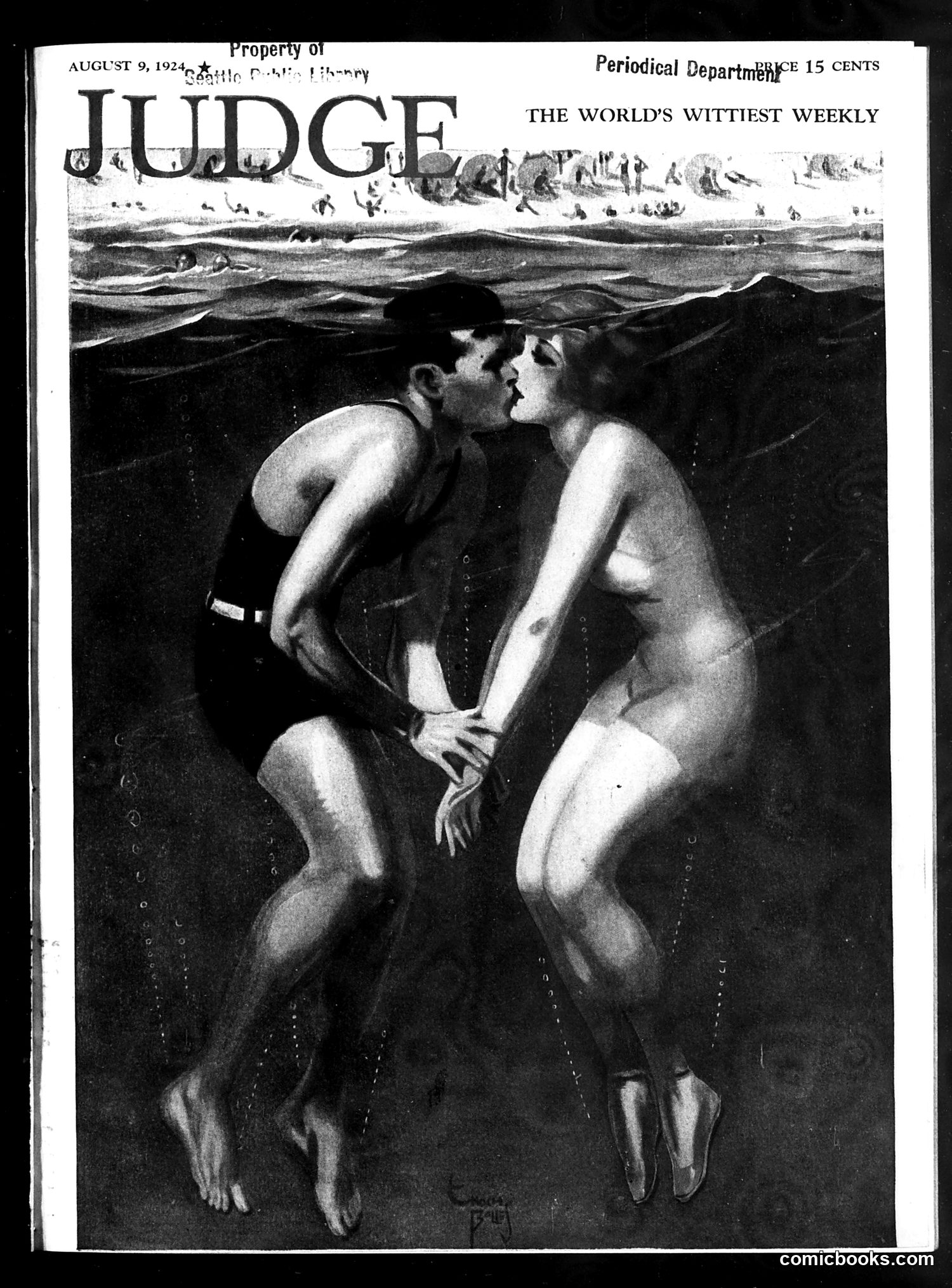
I can see this is the August 9, 1924 cover of Judge magazine ("The World's Wittiest Weekly"), priced at 15 cents. The image shows two figures in an underwater scene - appearing to be swimming or embracing beneath the surface, with a beach and cliffs visible above. However, I cannot reliably identify the specific figures or determine what political or social commentary this cartoon intends without clearer contextual information. The artistic style and composition suggest romantic or intimate subject matter, which was common fodder for Judge's satirical humor, but the specific reference - whether to a political scandal, celebrity gossip, or social trend of 1924 - is unclear from the image alone. To accurately explain the satire's meaning, I would need additional text or caption information that isn't legible in this reproduction.
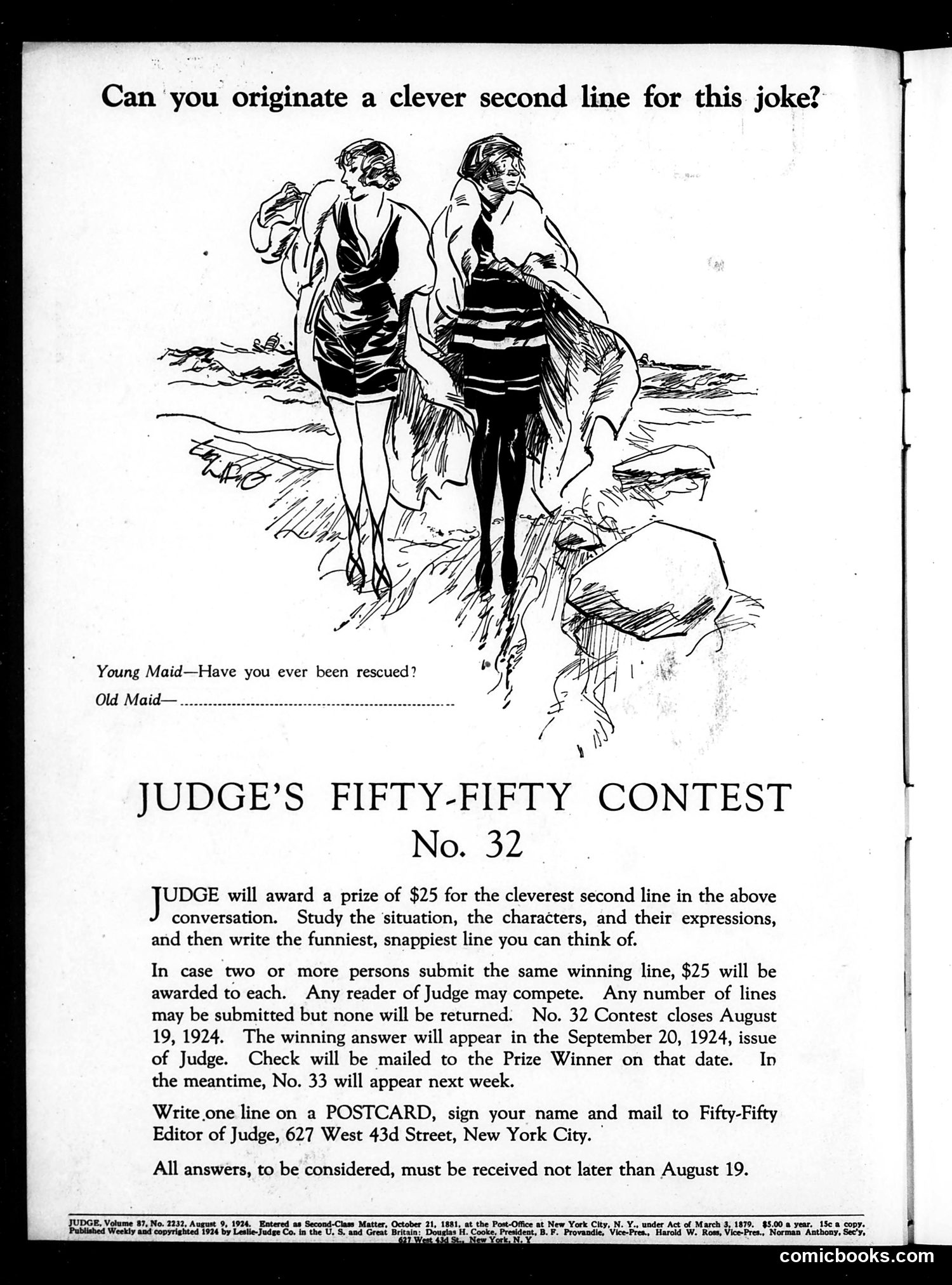
This page features "Judge's Fifty-Fifty Contest No. 32," a humor competition inviting readers to complete a joke. The cartoon shows three young women in 1920s bathing attire at a beach. The setup reads: "Young Maid—Have you ever been rescued? Old Maid—[blank line for reader's answer]." The humor relies on period stereotypes: the contrast between a young woman who might be rescued (implying romantic male attention) and an "old maid" (an unmarried woman past conventional marriageable age). The joke presumably plays on the old maid's lack of romantic prospects or rescue opportunities. Judge offered $25 for the cleverest submitted punchline, reflecting the magazine's tradition of reader-submitted humor contests during the 1920s.
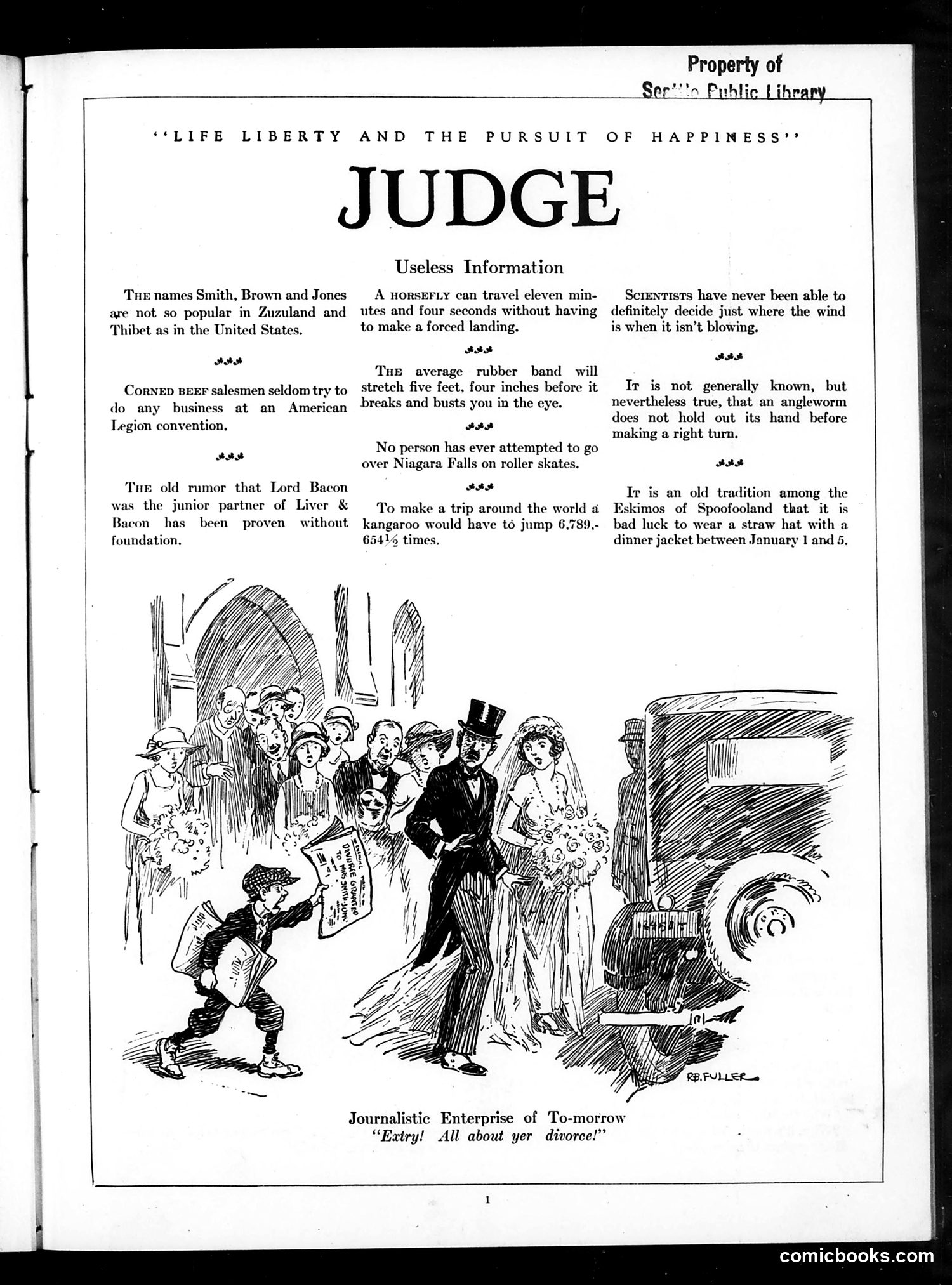
This page from *Judge* magazine features a satirical cartoon titled "Journalistic Enterprise of To-morrow" with the caption "Entry! All about yer divorce!" The cartoon depicts a street scene where a young newspaper vendor aggressively pursues well-dressed pedestrians—particularly a couple (appearing to be newlyweds based on the woman's flowers and formal attire)—hawking divorce-related news. The satire critiques sensationalist journalism and society's apparent obsession with scandal. The implication is that divorce has become so commonplace and scandalous that newspapers will aggressively market divorce stories as entertainment. The cartoon mocks both tabloid journalism practices and the social upheaval around divorce in this era, suggesting a darkly comic future where marital dissolution is treated as entertainment commodity. The "Useless Information" sidebar contains unrelated trivia typical of *Judge*'s humorous filler content.
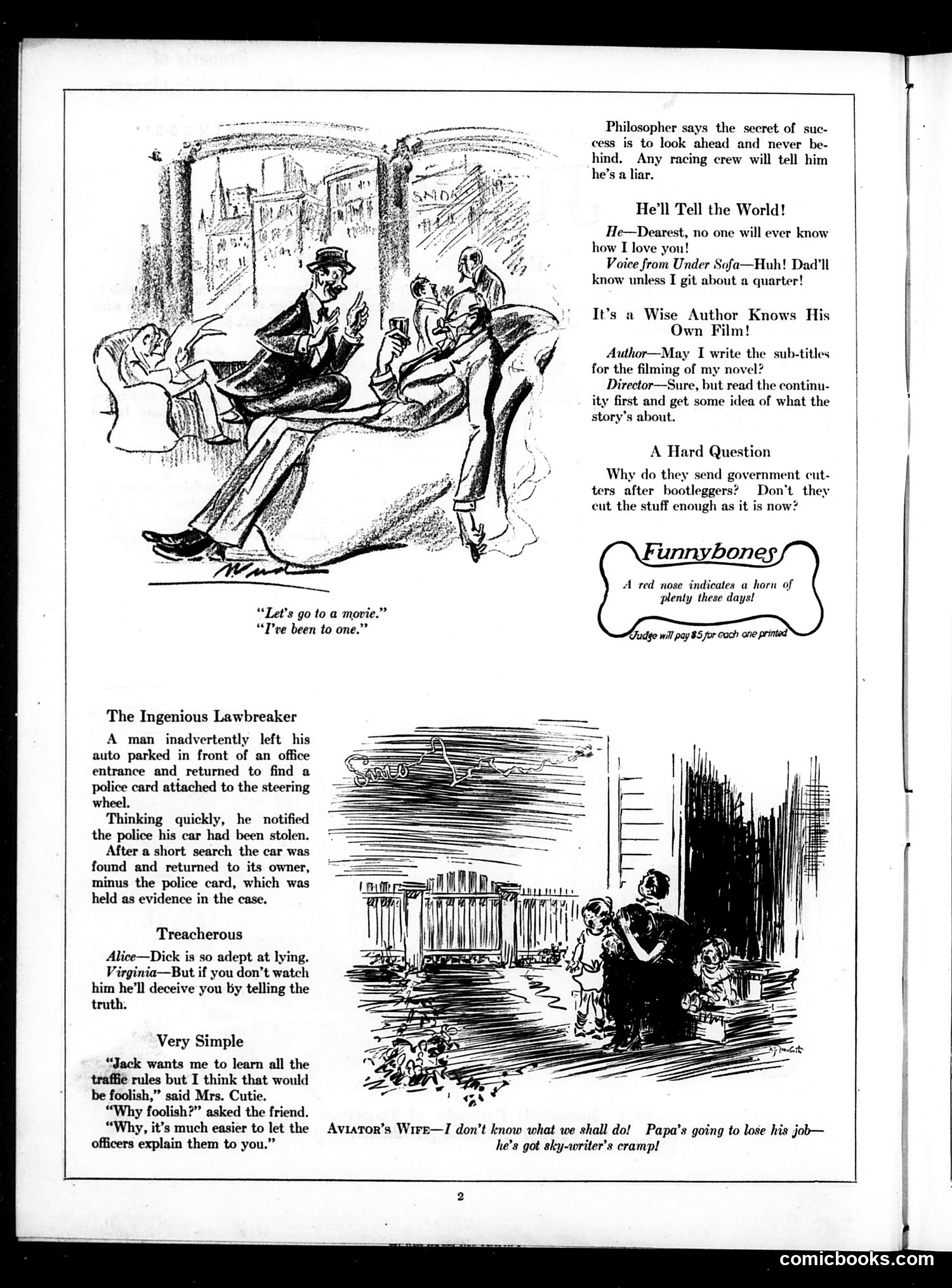
This page contains several standalone humorous anecdotes and cartoons rather than political satire: **Top cartoon**: Shows men discussing going to a movie, with comedic exchanges about keeping secrets and bribing someone with a quarter—typical early 20th-century humor about casual corruption and childhood mischief. **"The Ingenious Lawbreaker"**: A short joke about a man who reports his own stolen car to police, using the police card as evidence he didn't steal it himself—clever wordplay on circular logic. **"Treacherous" and "Very Simple"**: Brief anecdotes about deception and avoiding rules. **Bottom illustration**: Shows an aviator's wife worried about her husband's job security due to "sky-writer's cramp"—a contemporary joke referencing the then-novel aviation industry and aerial advertising. The humor is domestic and observational rather than politically pointed.
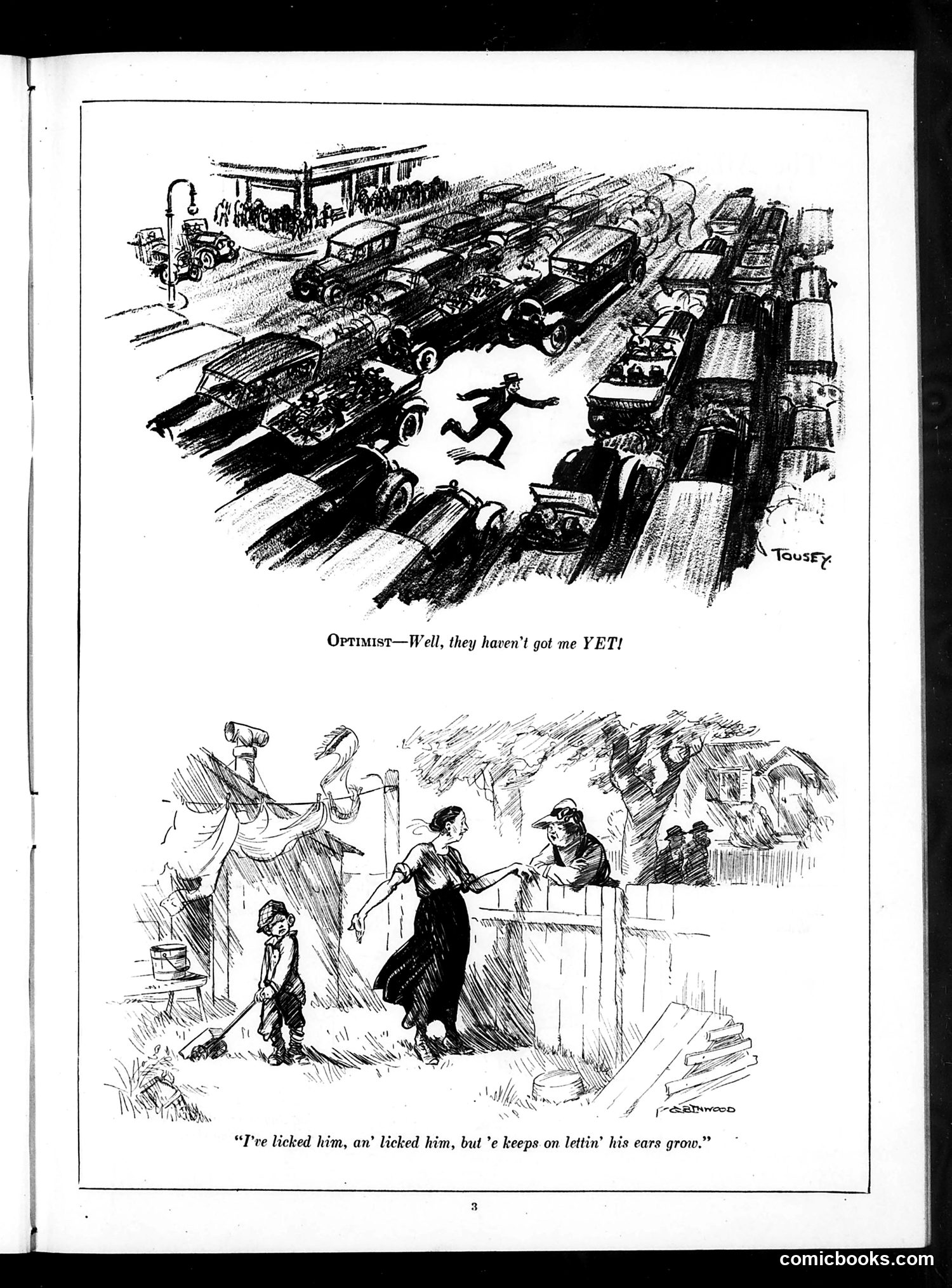
**Top Cartoon ("Optimist"):** A man navigates through rows of parked cars and trucks in what appears to be a junkyard or impound lot. His optimistic caption—"Well, they haven't got me YET!"—suggests he's evading capture or confiscation, likely referencing vehicle seizure during Prohibition or a similar enforcement action. The cartoon satirizes stubborn optimism in the face of obvious danger. **Bottom Cartoon:** A woman scolds a boy about another child, saying "I've licked him, an' licked him, but 'e keeps on lettin' his ears grow." This appears to be a humorous domestic scene poking fun at childhood misbehavior or physical characteristics that resist correction—the oversized ears being the joke's focal point.
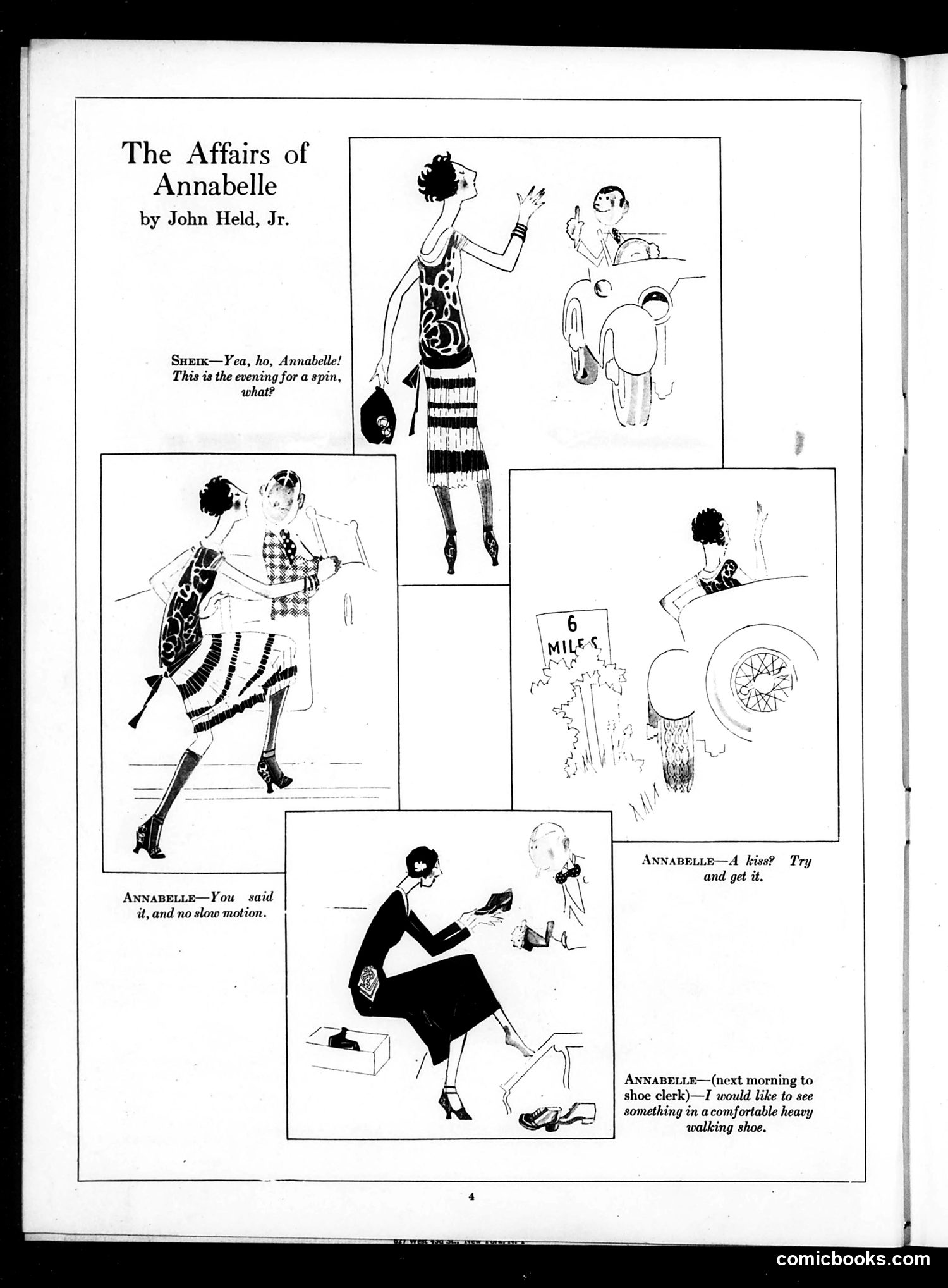
This is a comic strip about a young woman named Annabelle, drawn in the style typical of 1920s Judge magazine. The humor centers on Annabelle's romantic adventures and mishaps with male suitors. The strip depicts her various encounters: she invites a man for an evening "spin," goes on a motorcycle ride, and attempts to impress a shoe clerk by requesting "something in a comfortable heavy walking shoe" (likely after exhausting her feet from dancing or activities with suitors). The satire mocks 1920s "modern girl" culture—the flapper era's dating practices, automobile culture, and women's newfound social freedoms. Annabelle represents the independent, pleasure-seeking young woman that both fascinated and scandalized conservative society during this period. The humor is gentle, focusing on romantic pursuits rather than explicit social critique.
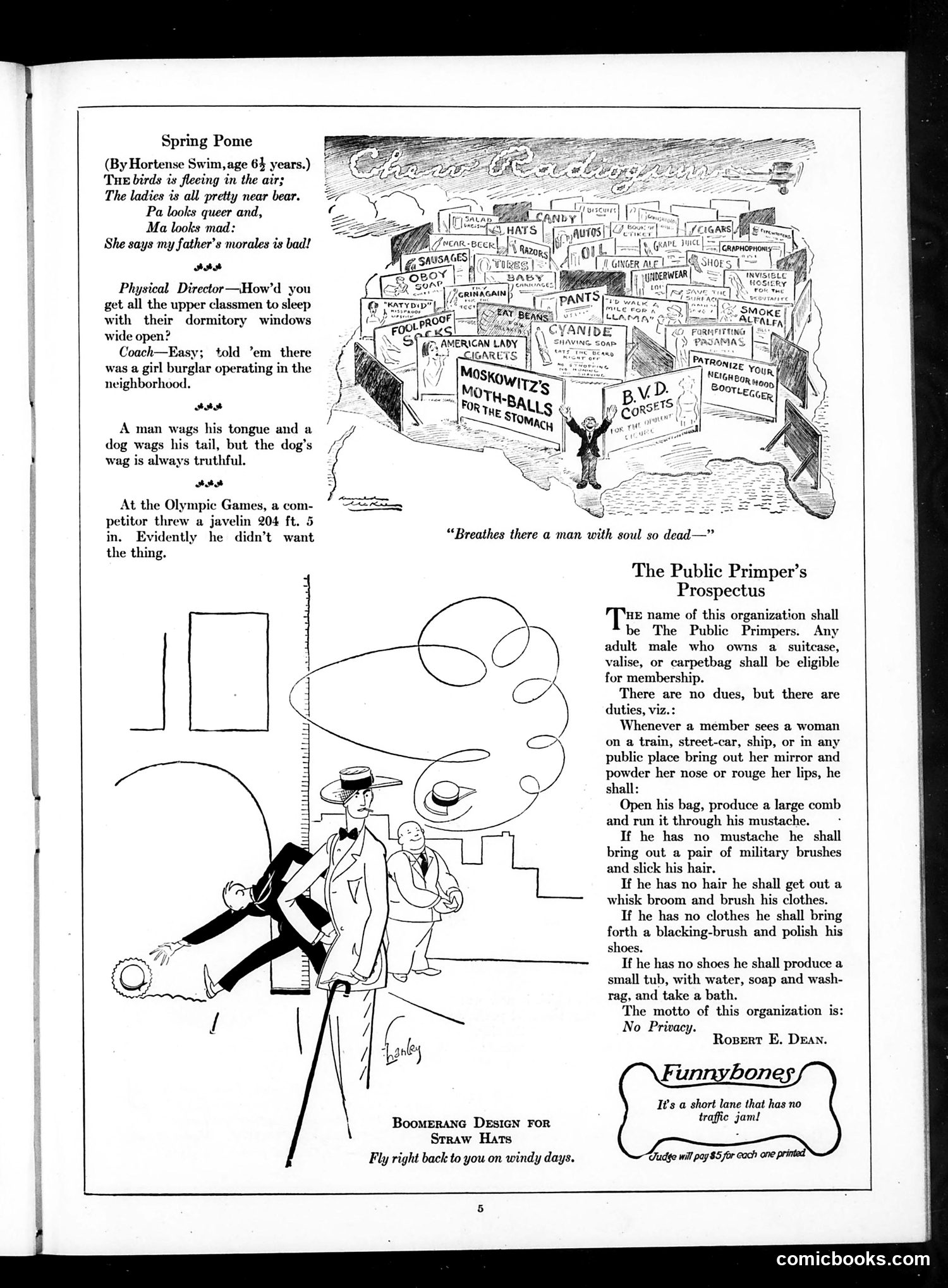
This page contains several brief satirical pieces typical of early 20th-century humor magazines: **"Spring Pome"** mocks amateur poetry and generational conflict—a poorly written verse by a 64-year-old woman complaining about her father's morals. **Physical Director anecdote** jokes about college dormitory life and uses a "girl burglar" as a punchline—playing on period anxieties about crime and propriety. **The Public Primper's Prospectus** satirizes male vanity and social pretension by describing a mock fraternal organization where men obsessively groom themselves when women appear in public. The escalating list (combs, brushes, shoe-polish, baths) mocks both masculine self-consciousness and invasion of privacy. The motto "No Privacy" drives the satire home. **Boomerang Straw Hat design** is a throwaway visual gag about windy weather. The page is primarily **humorous commentary on social behavior** rather than political satire—targeting vanity, poor writing, college life, and gender dynamics of the era. The "girl burglar" reference suggests period crime anxieties, but no specific event is referenced.
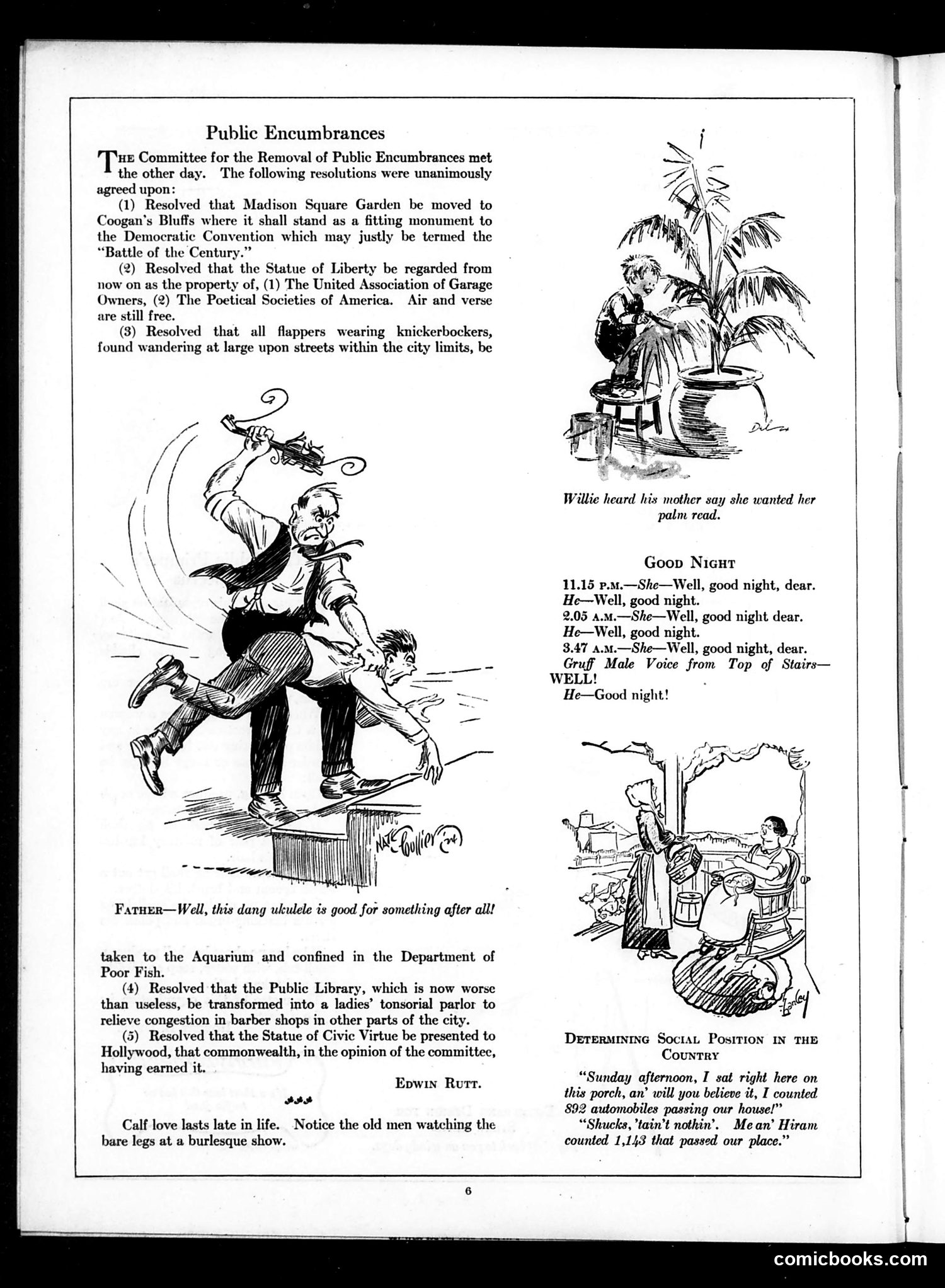
This page satirizes civic complaints and social trends of the 1920s through mock "resolutions": **Political references:** Resolution (1) mocks the Democratic Convention, calling it a "Battle of the Century" — likely referencing a contentious party meeting. **Social satire:** - Resolution (3) ridicules "flappers" (young women) wearing knickerbockers (short pants), treating this fashion as a public nuisance - Resolution (4) jokes that the Public Library is "worse than useless" and should become a beauty salon — mocking both declining library use and the era's beauty culture boom - Resolution (5) suggests Hollywood represents moral decay, deserving the "Statue of Civic Virtue" **Other humor:** Side cartoons mock 1920s life—elderly men at burlesque shows, couples' repetitive "good nights," and rural boasting about automobile traffic as a status symbol. The overall tone satirizes both modern anxieties about changing morality and the vanity of civic institutions and social climbing.
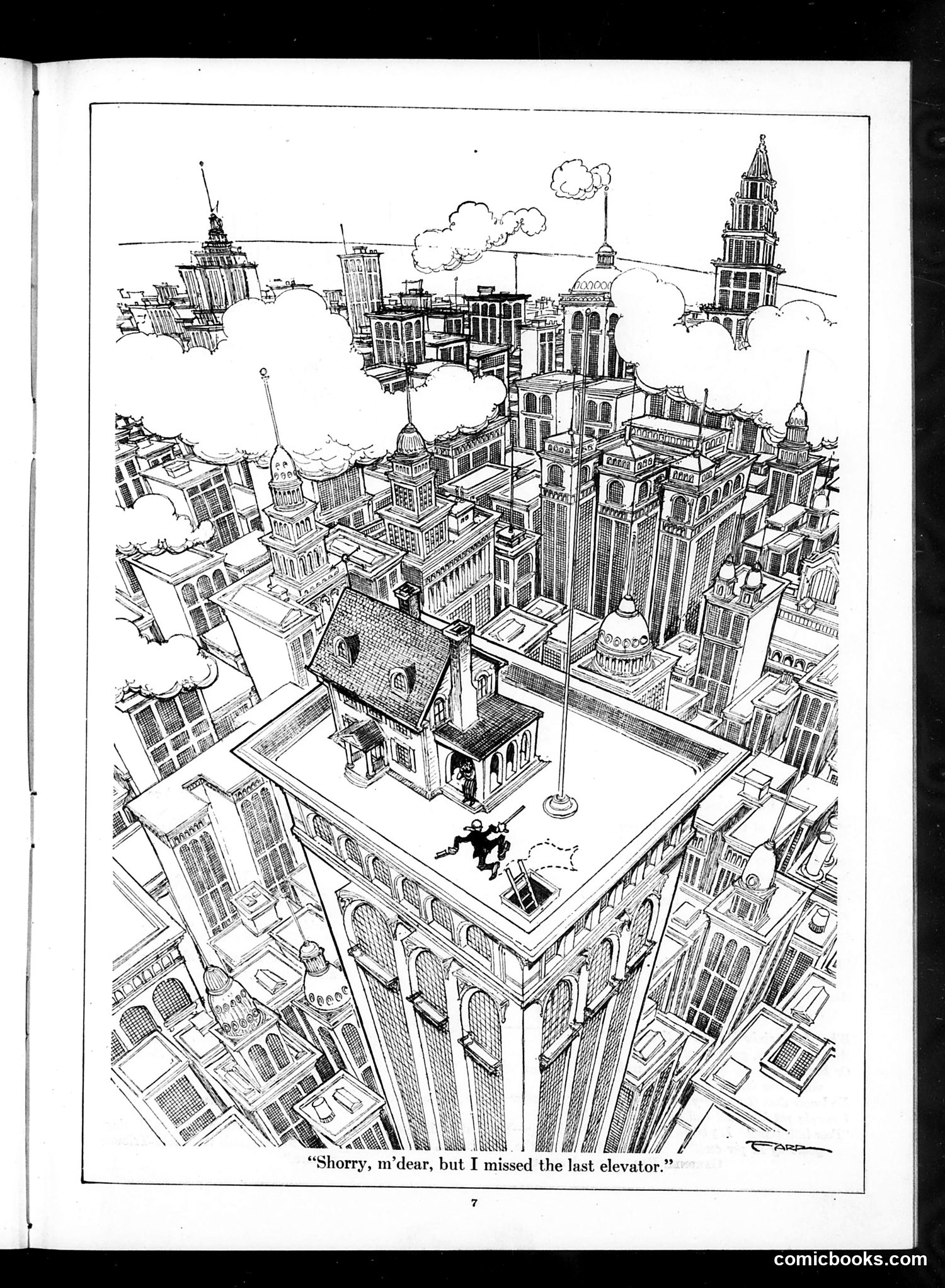
This is a single-panel cartoon depicting a man in formal attire standing atop an enormous skyscraper, looking down at a tiny church building far below on a street. The caption reads: "Sorry, m'dear, but I missed the last elevator." The satire critiques the dominance of modern commercial architecture and urban development over religious institutions. The towering skyscraper dwarfs the church, suggesting that materialism and business have eclipsed spiritual life in American cities. The joke's dark humor—the man has apparently jumped or fallen from the building—underscores the moral consequences of prioritizing wealth and progress over faith. This reflects early-twentieth-century anxieties about urbanization, secularization, and the erosion of traditional values in rapidly developing American cities.
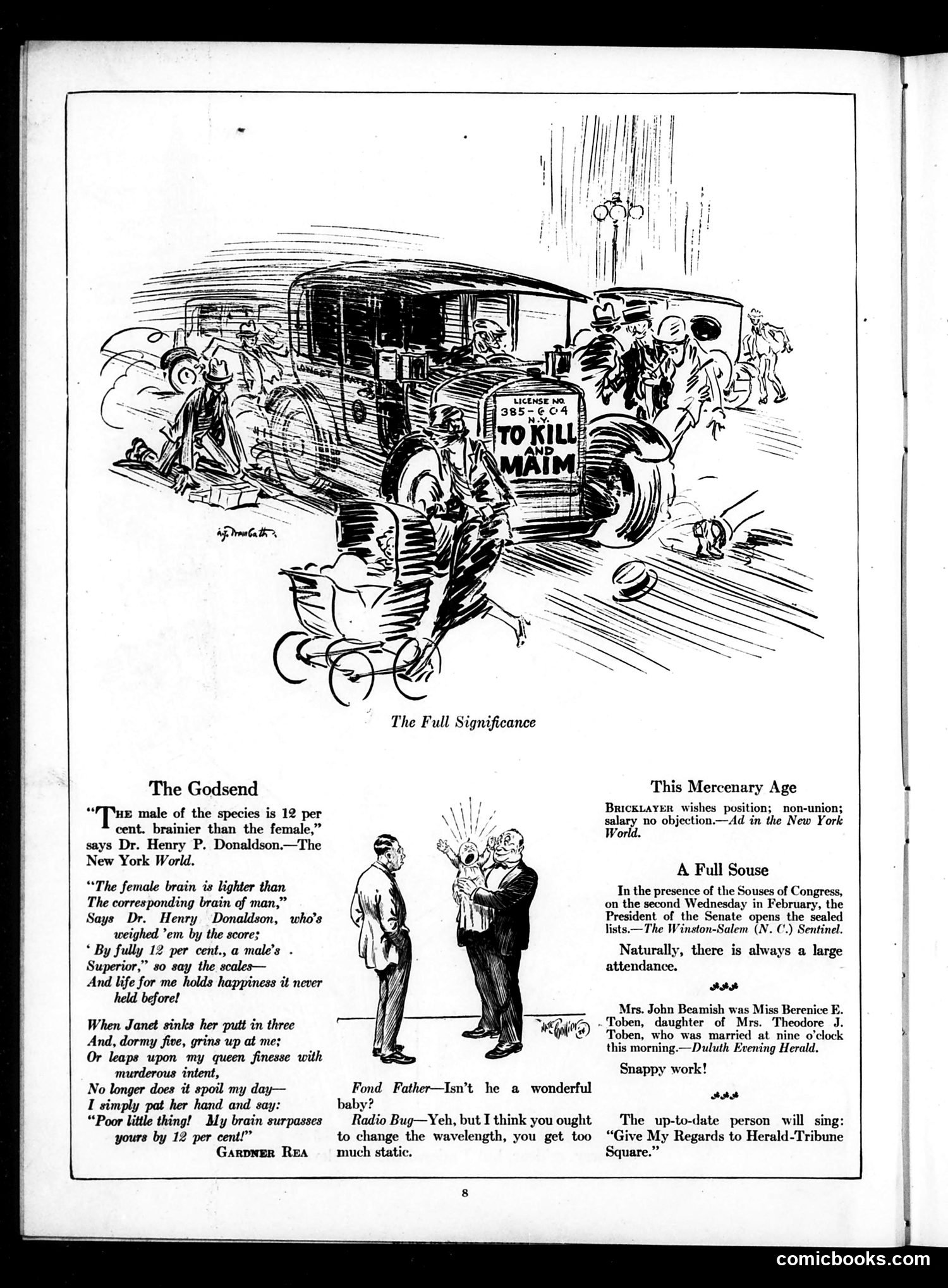
The main cartoon satirizes traffic danger, showing a car with a license plate reading "TO KILL MAIM" surrounded by chaos—pedestrians fleeing, a baby carriage endangered. This is social commentary on automobile fatalities, which were a growing public concern in the early automotive era. Below are three separate joke sections: **"The Godsend"** mocks Dr. Henry P. Donaldson's scientific claim that male brains are 12% larger/superior. The poem shows a man smugly rejoicing over this "fact," only to be humiliated by women outperforming him at golf and card games—satirizing pseudoscientific justifications for male superiority. **"This Mercenary Age"** presents brief satirical news items, including a brick-layer seeking non-union work and a woman married "at nine o'clock" (implying very young marriage). **"A Full Souse"** jokes about Congressional attendance at presidential events, using "Souse" (drunkard) as wordplay. The humor relies on recognizing contemporary anxieties: automobile safety, gender role debates, labor issues, and political corruption.
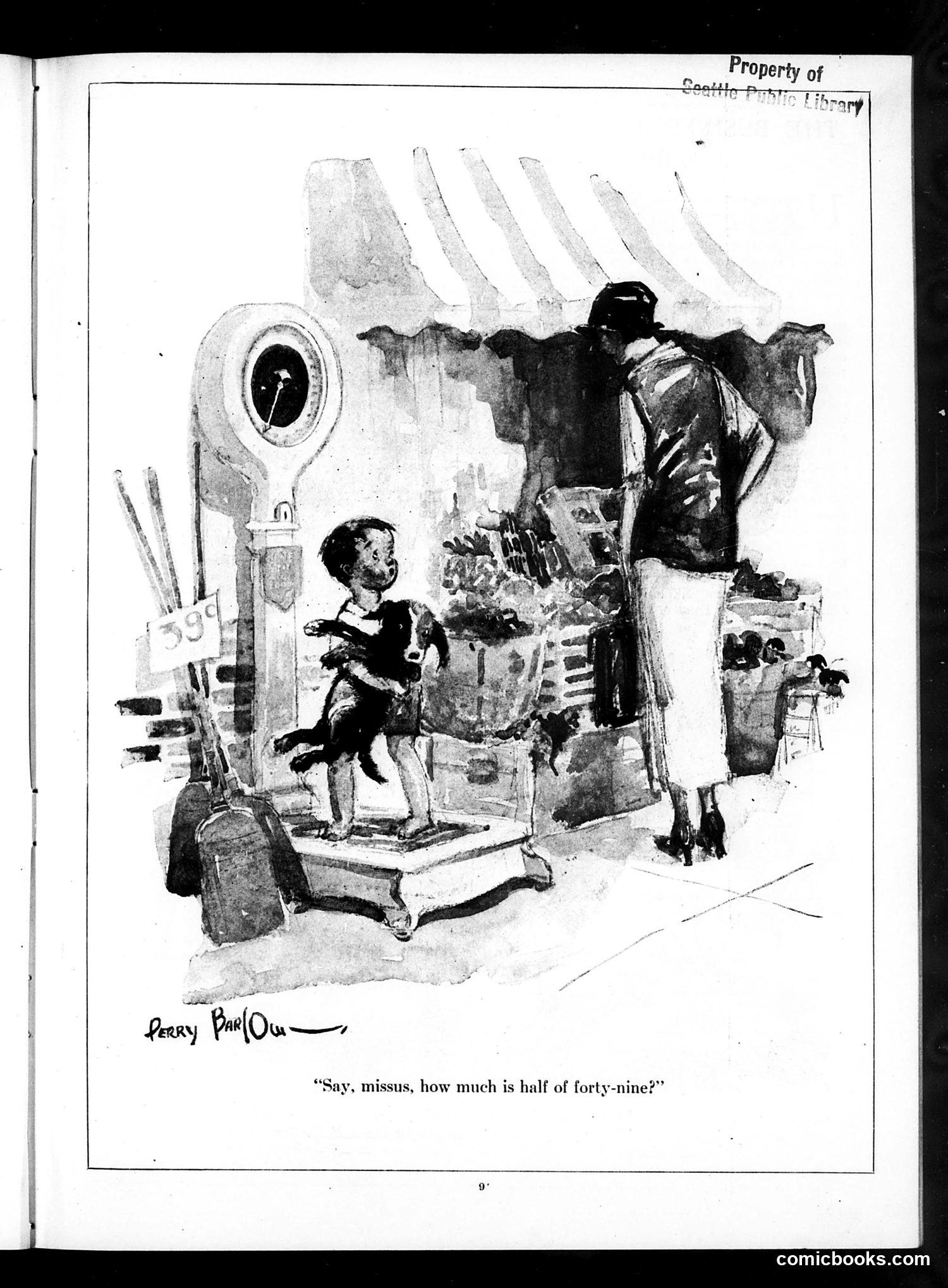
This cartoon by Perry Barlow (signed lower left) depicts a domestic scene where a young boy asks his mother a basic arithmetic question: "Say, missus, how much is half of forty-nine?" The humor appears to rely on the boy's inability or unwillingness to do simple math, resorting to asking his mother instead. The scene includes period details—household furnishings, clothing styles, and what appears to be a cluttered domestic interior—typical of early 20th-century American homes. The satire likely comments on educational standards or parental indulgence, suggesting children were either inadequately taught arithmetic or were becoming lazy about basic problem-solving. The boy's casual address of his mother as "missus" adds to the comedic tone, implying youthful informality or cheekiness. Without knowing the specific Judge publication date, the exact social commentary remains somewhat unclear.
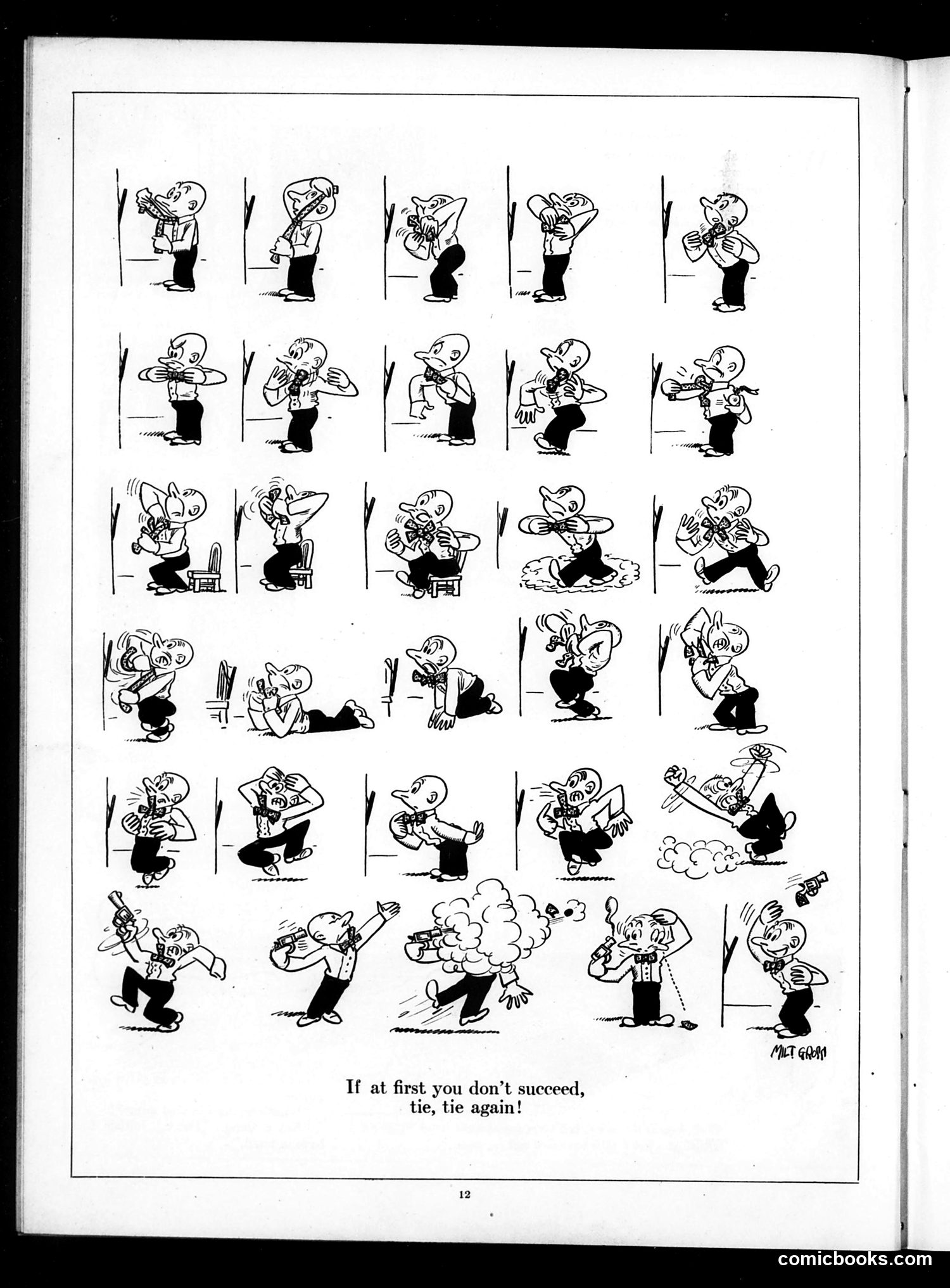
This is an instructional comic strip by Met Giehan showing a child learning to tie shoes, with 25 sequential panels demonstrating the process step-by-step. The caption reads "If at first you don't succeed, tie, tie again!"—a pun on the common saying "if at first you don't succeed, try, try again." The humor derives from the visual pun: each panel literally shows the child tying (shoes), while the caption references "tie" homophonically. This is gentle, family-oriented humor typical of *Judge* magazine's lighter content. The instructional nature suggests this may have appeared alongside practical advice columns or educational features common in early-to-mid 20th century periodicals. The artwork style and subject matter indicate this is likely from that era, though exact publication date is unclear from the image alone.
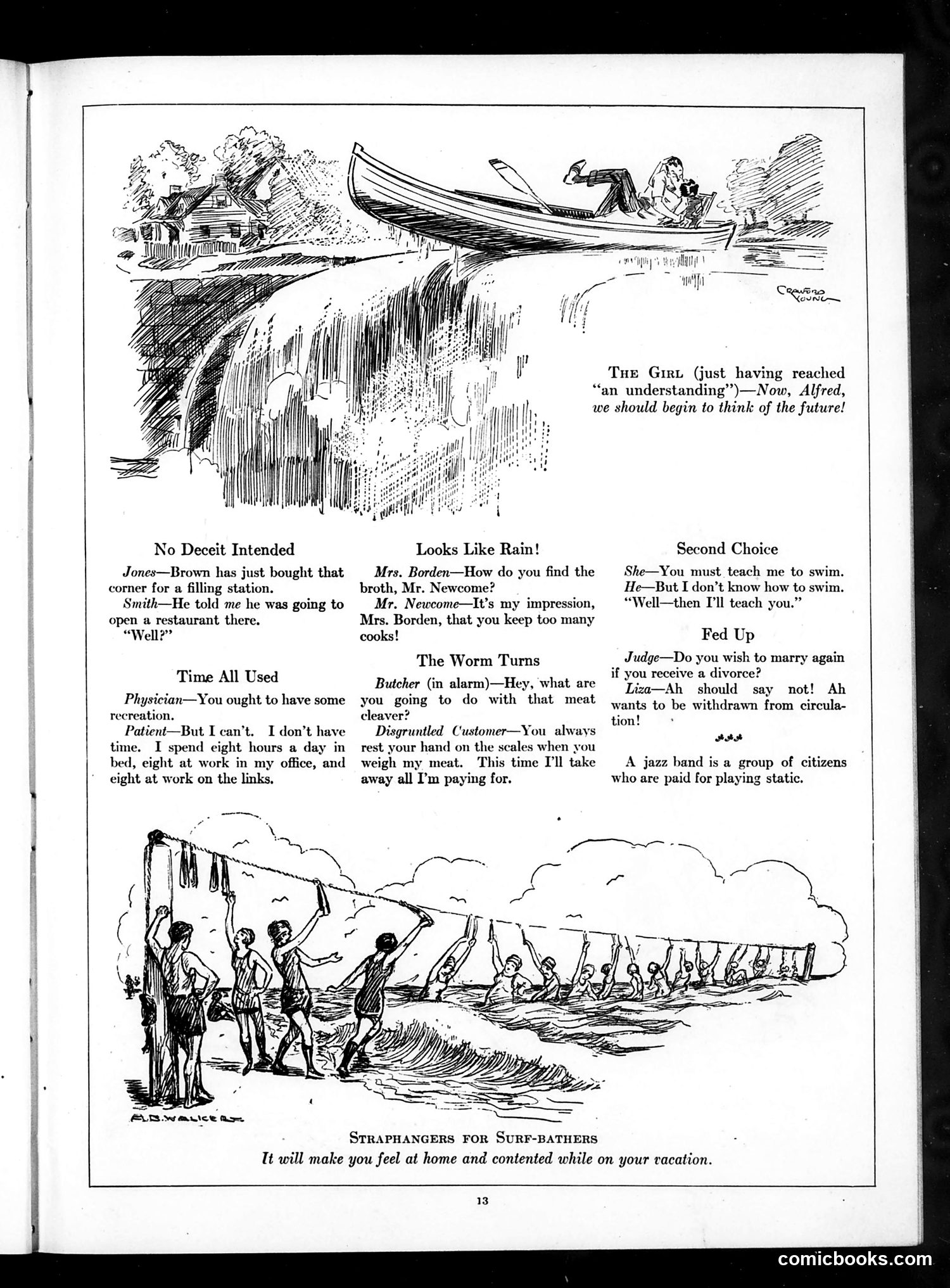
This page from *Judge* magazine contains multiple short humorous sketches satirizing early 20th-century American life: **"No Deceit Intended"** mocks how businesses rebrand themselves—Brown claims one thing but does another, suggesting dishonest business practices were common. **"Time All Used"** satirizes the overworked professional who allocates his 24 hours (8 sleep, 8 work, 8 leisure) entirely, leaving no actual free time despite having "recreation." **"The Worm Turns"** depicts a customer finally retaliating against a dishonest butcher who uses thumb-on-scales tricks to cheat on weight. **"Looks Like Rain"** is a dated joke about Mrs. Borden having too many cooks, implying her broth is muddled. The bottom cartoon, "Straphangers for Surf-Bathers," sarcastically suggests crowded public transit (straphangers) mimics beach conditions, making vacation unnecessary. **"Fed Up"** and **"Second Choice"** are brief romantic/divorce jokes typical of the era's humor. The jazz band definition is a period joke about jazz as noise rather than music—reflecting generational attitudes toward emerging jazz culture.
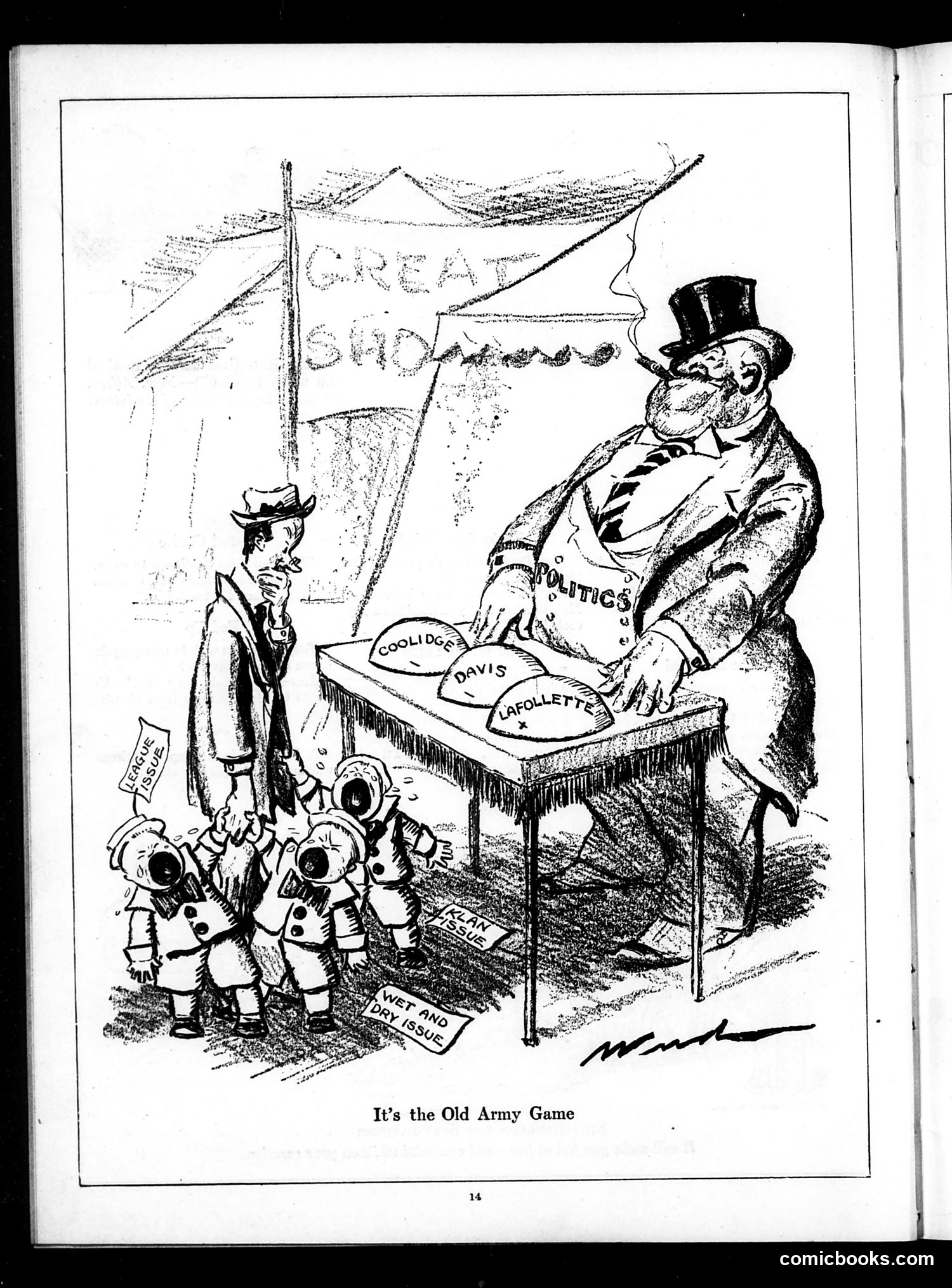
This cartoon satirizes military recruitment and political maneuvering. A rotund gentleman in a top hat (likely a politician or military recruiter) displays three items labeled "COOLIDGES," "DAVIS," and "LAFOLLETTE"—references to 1920s political figures. These appear as offerings or "bait" in what's labeled a "Great Sideshow." The smaller figures below, marked with "BEEF" and "WELDAY ISSUE," represent common soldiers or the public being manipulated. The cartoon critiques how political and military leaders use prominent names and promises to attract recruits or public support, while the actual substance ("the old army game") involves deception. The military tent backdrop emphasizes the recruitment context.
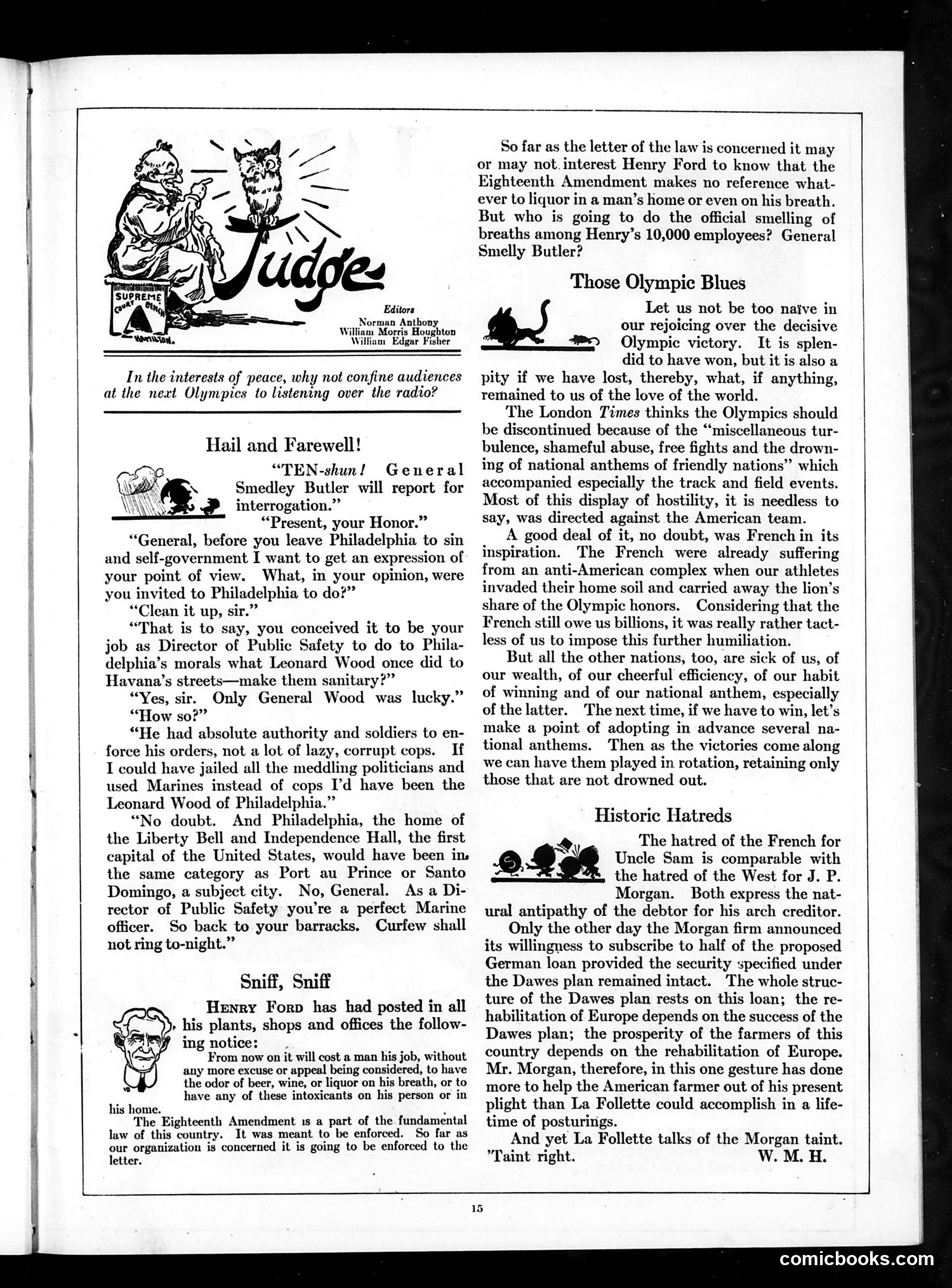
This page contains three distinct satirical pieces targeting 1920s American figures and policies: **"Hail and Farewell!"** mocks General Smedley Butler, Philadelphia's Director of Public Safety, through a fictional interrogation. The satire suggests Butler—a Marine—wanted to impose military authoritarianism on civilian governance (like Leonard Wood did in Cuba), but was constrained by democratic institutions and corrupt civilian police. **"Sniff, Sniff"** ridicules Henry Ford's Prohibition enforcement notice posted in his factories. The joke: Ford's policy claims to enforce the Eighteenth Amendment regarding breath and person, but the Amendment actually only prohibits manufacture/sale—not home possession or consumption. The rhetorical question about "General Smelly Butler" doing breath inspections mocks the absurdity of Ford's overreach. **"Those Olympic Blues"** satirizes American Olympic success breeding international resentment. The piece suggests American athletic dominance, combined with wealth and efficiency, generates anti-American sentiment abroad—particularly from France (still owing war debts to the U.S.), making American victory itself humiliating to others.
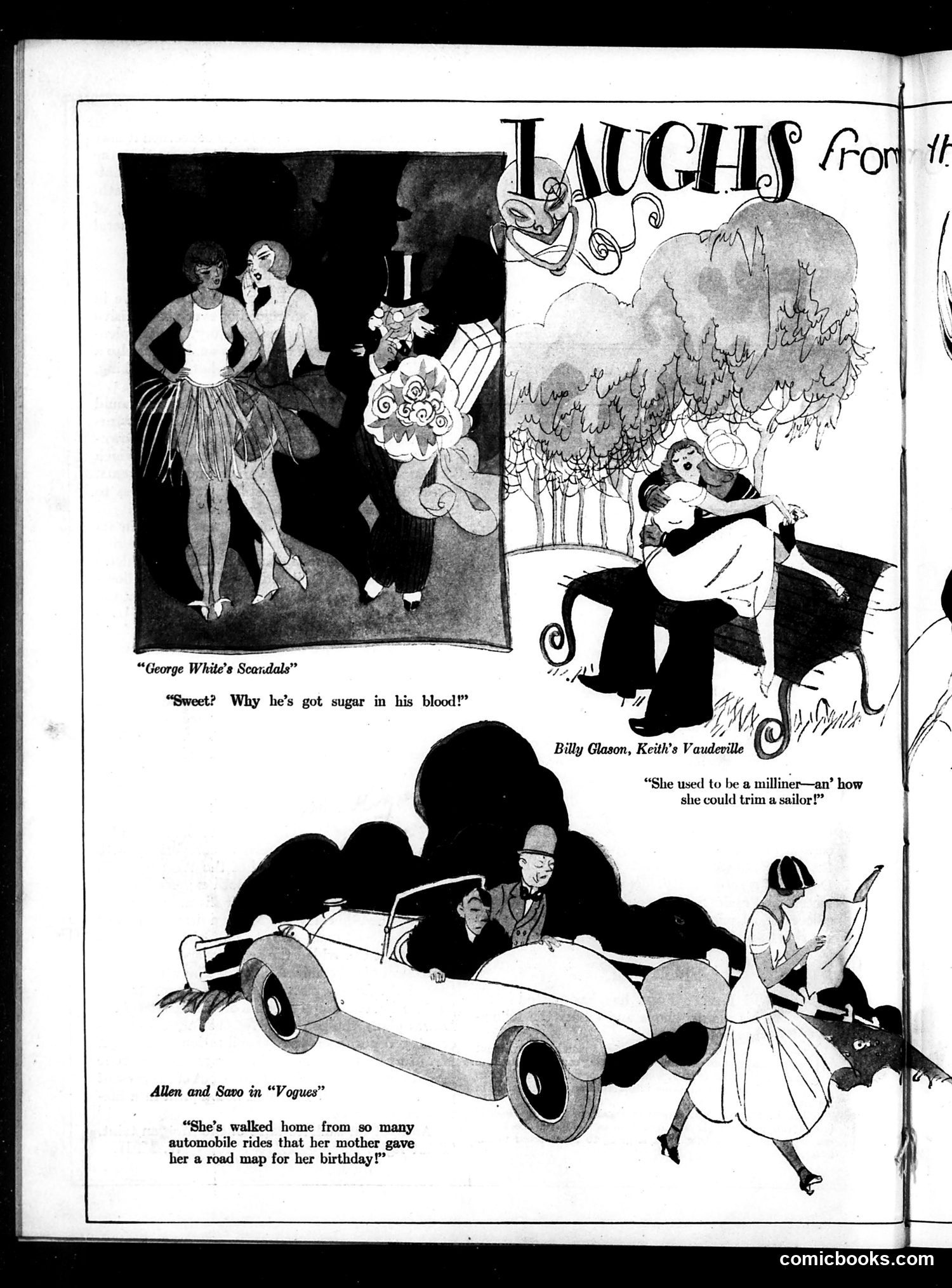
This is a humor page from *Judge* magazine featuring jokes about theatrical productions and modern dating scandals. The top cartoon references "George White's Scandals," a real Broadway revue known for risqué content. The jokes mock romantic and sexual impropriety: the first suggests a man's excessive sweetness indicates dubious character; the second contains a double entendre about a woman's past with sailors. The bottom cartoon about "Allen and Savo in Vogues" (likely another theatrical production) satirizes the dating habits of young women in the Jazz Age—specifically the trend of unmarried women taking automobile rides with men, which was scandalous behavior for the era. The joke implies promiscuity through the exaggerated claim that a girl has taken so many car rides she needs a road map, playing on contemporary anxieties about women's newfound independence and changing sexual mores.
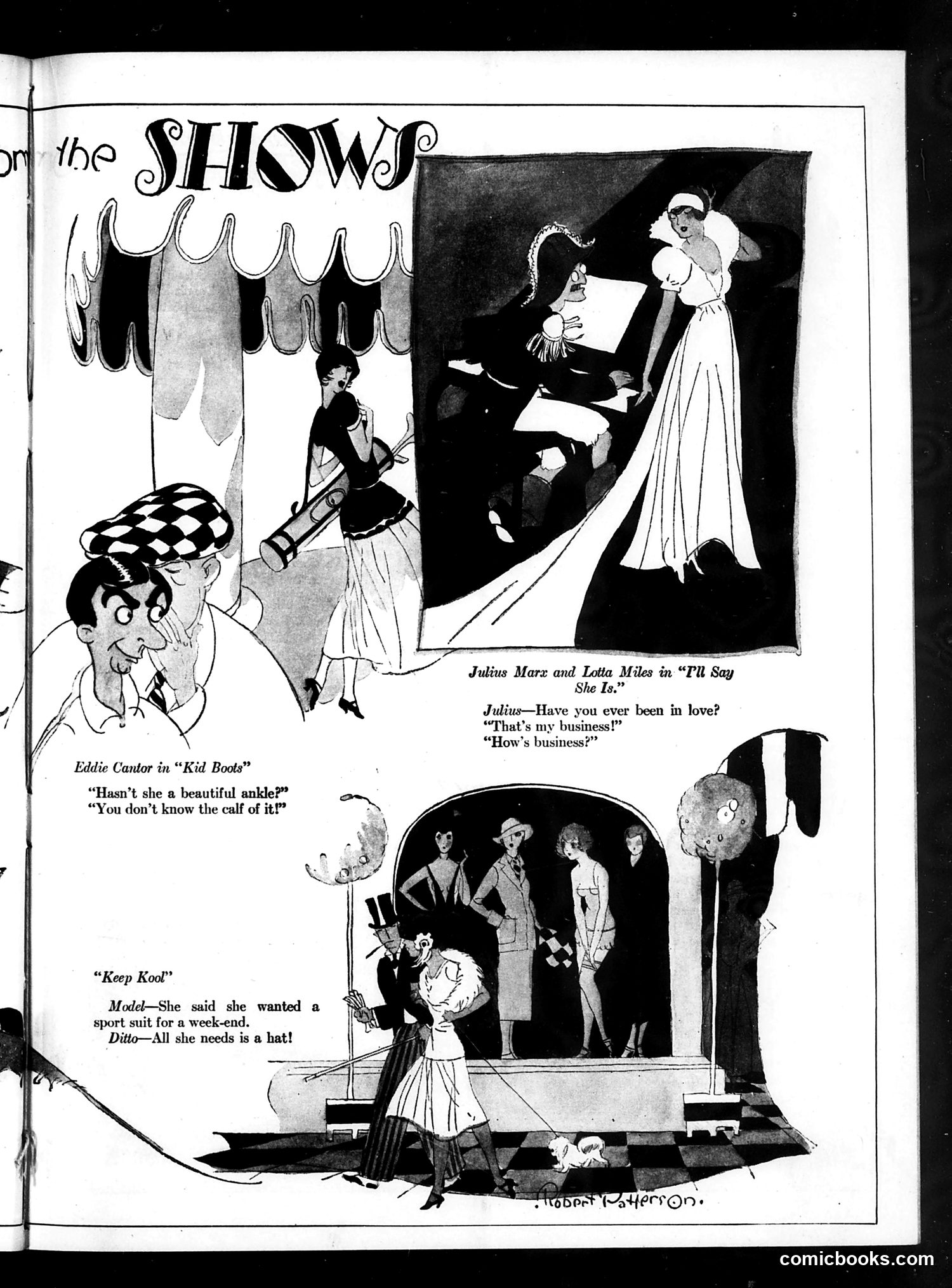
This page showcases theatrical humor from the silent/early sound era, featuring jokes about three productions: **"Kid Boots"** stars Eddie Cantor (a famous vaudeville/film comedian). The ankle joke plays on 1920s fascination with women's legs—previously hidden by long skirts, now scandalized by shorter hemlines. **"I'll Say She Is"** features Julius Marx (likely Groucho Marx) and Lola Miles. Their exchange—"Have you ever been in love?" / "That's my business!" / "How's business?"—is rapid-fire wordplay typical of Marx Brothers comedy. **"Keep Kool"** contains a fashion gag: a model wants a weekend sport suit, but the joke suggests she needs only a hat—implying either minimal clothing or that fashion accessories matter more than actual garments. The humor reflects 1920s preoccupations: women's changing fashions, the popularity of vaudeville comedians transitioning to film, and the era's flirtatious comic sensibilities.
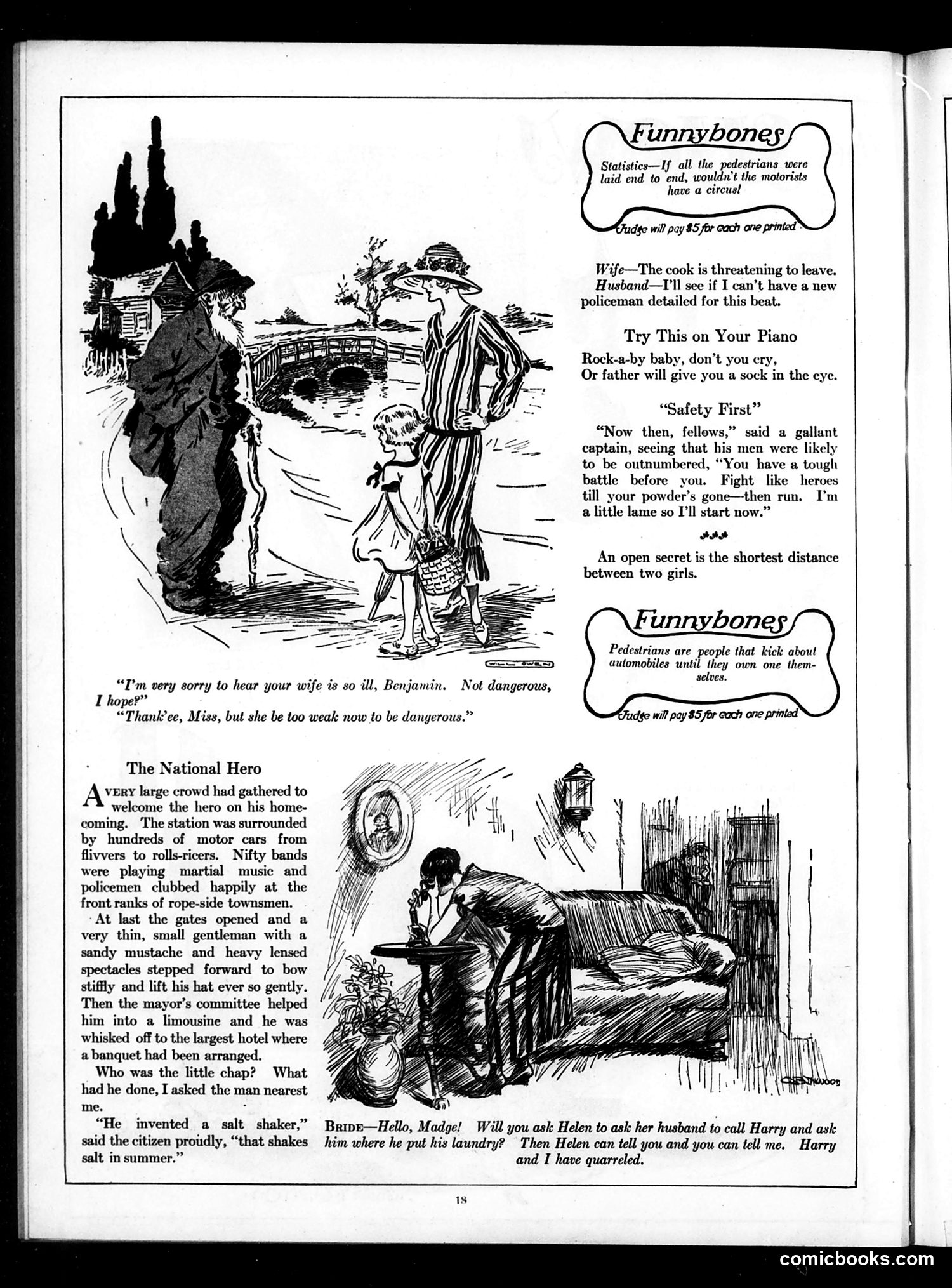
This page contains several satirical pieces mocking early 20th-century American society: **"Safety First" and related jokes** target the era's automobile boom and pedestrian dangers—a major social problem as cars proliferated. The humor plays on the tension between motorists and pedestrians, and parodies the popular "Safety First" movement's rhetoric. **"Try This on Your Piano"** is dark humor about domestic violence, presented as a nursery rhyme—shocking to modern readers but apparently acceptable satire of the era. **"The National Hero"** mocks the absurdity of celebrity worship. A man receives a massive homecoming parade for inventing a salt shaker—a deliberately trivial achievement. This satirizes how societies elevate minor figures to hero status through media spectacle and civic ceremony. **The domestic dialogue scenes** ridicule marriage dynamics and servant relationships typical of the era's class and gender assumptions. The overall tone reflects Judge's satirical approach to social trends, technological disruption, and American pretension.
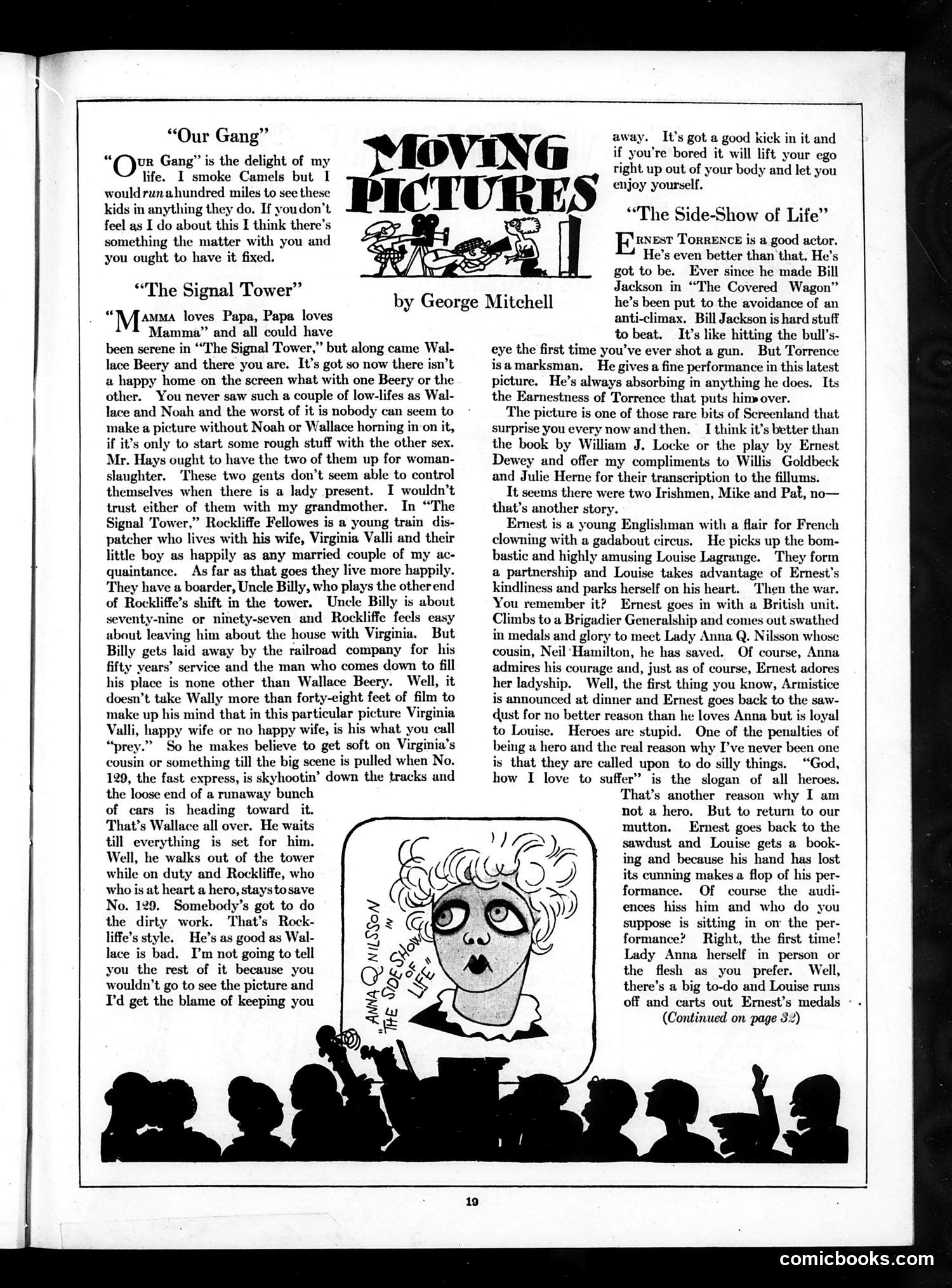
This page reviews three silent films through a satirical lens typical of Judge magazine's entertainment criticism. **"Our Gang"** celebrates child actors in a popular comedy series, praising their natural appeal. **"The Signal Tower"** critiques actor Wallace Beery's typecasting as a villainous seducer. The reviewer sarcastically notes Beery appears in nearly every film to pursue the female lead—here Virginia Valli—creating predictable melodrama. The plot involves a railroad dispatcher (Rockliffe Fellowes) and Beery's rival character, with climactic danger from a runaway train. The satire mocks both Beery's repetitive "heavy" roles and Hollywood's reliance on such formulas, even joking that Will Hays (the film industry's moral arbiter) should prosecute Beery for "woman-slaughter." **"The Side-Show of Life"** praises Ernest Torrence as a skilled actor who avoided the trap of diminishing returns after his acclaimed role in "The Covered Wagon," comparing his consistency to hitting a bullseye repeatedly. The magazine's tone blends genuine appreciation with sharp criticism of Hollywood conventions.
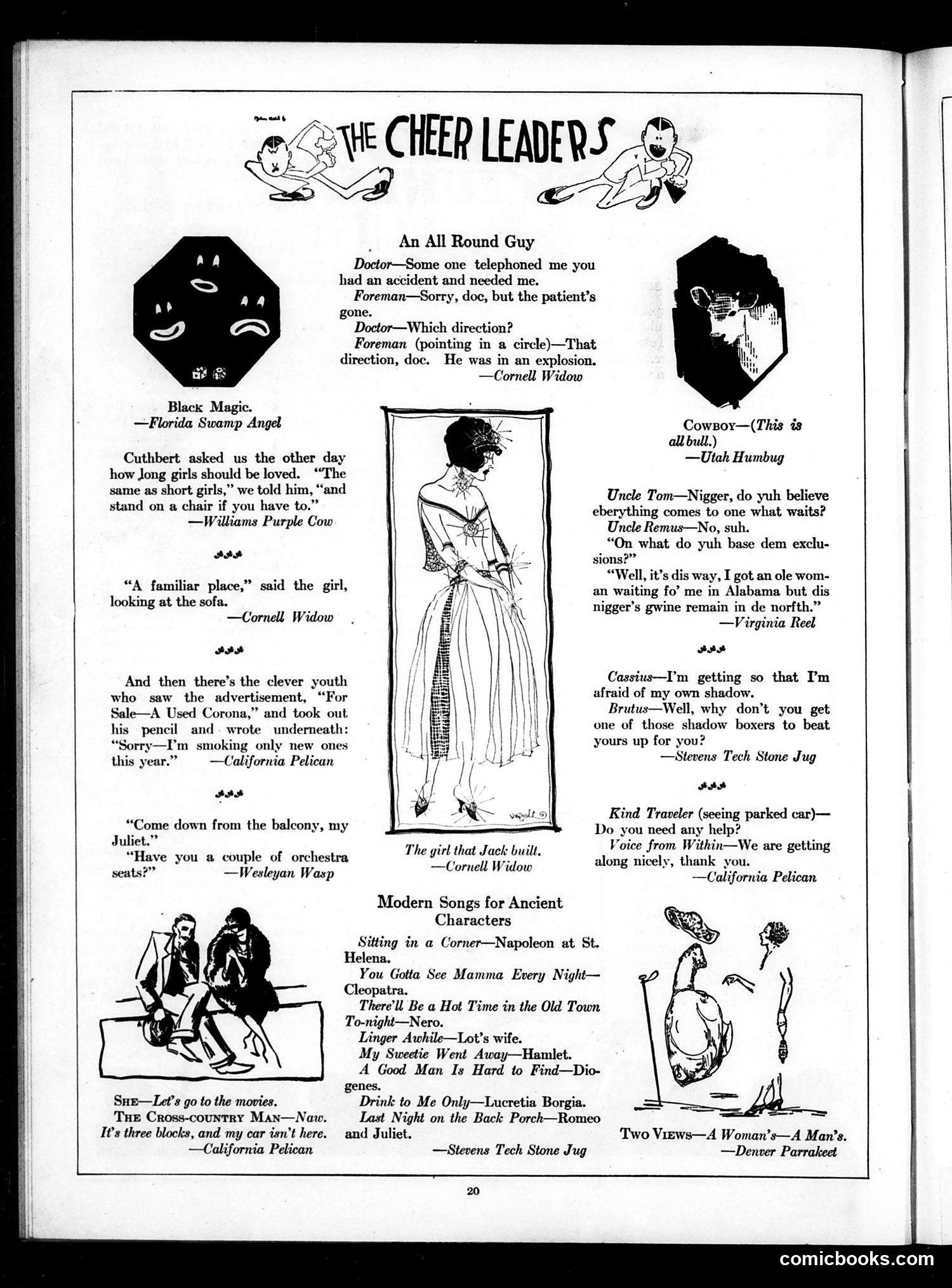
This page collects humor from college newspapers, arranged as jokes and satirical observations rather than political cartoons. The content reflects early-20th-century college culture and social attitudes. **Key elements:** - **"An All Round Guy"**: Workplace dark humor about an industrial explosion victim - **College newspaper humor**: Jokes about dating ("stand on a chair"), cinema-going, and romantic mishaps - **"Modern Songs for Ancient Characters"**: Witty pairing of popular contemporary songs with historical/classical figures (Napoleon, Nero, Hamlet, Romeo and Juliet)—a clever wordplay format common in the era **Notable issue**: The page contains racial slurs and stereotypical dialect humor ("Uncle Tom," "Uncle Remus") that reflect deeply offensive period attitudes, now jarring to modern readers. The overall tone is lighthearted college humor—absurdist jokes, romantic comedy, and literary/historical references aimed at educated readers. The satire targets pretension and social conventions rather than politics.
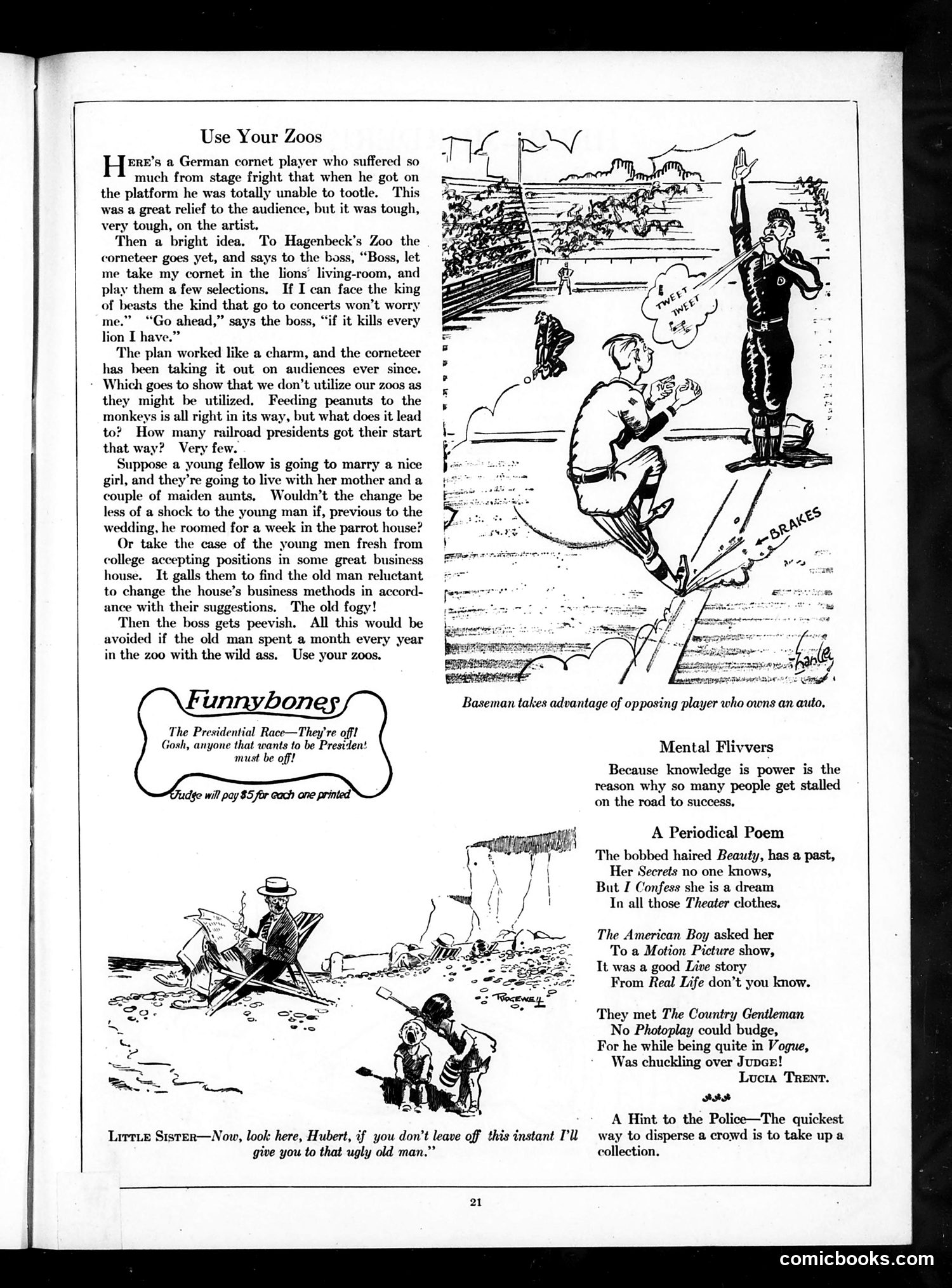
This humorous article proposes absurdly using zoo animals to desensitize people to life's challenges. The central anecdote features a German cornet player with stage fright who overcomes it by performing for lions at Hagenbeck's Zoo, then applies this confidence to concert audiences. The satire extends this logic ridiculously: young men should room in parrot houses before marriage, and businessmen should spend months with wild asses to develop tolerance for their bosses' inflexibility. The joke mocks both excessive self-help thinking and generational conflict—specifically young college-educated men's frustration with old-fashioned business practices. By proposing zoos as character-building institutions, the author satirizes the era's earnest self-improvement culture while poking fun at how little understanding exists between youth and their elders in industrial America.
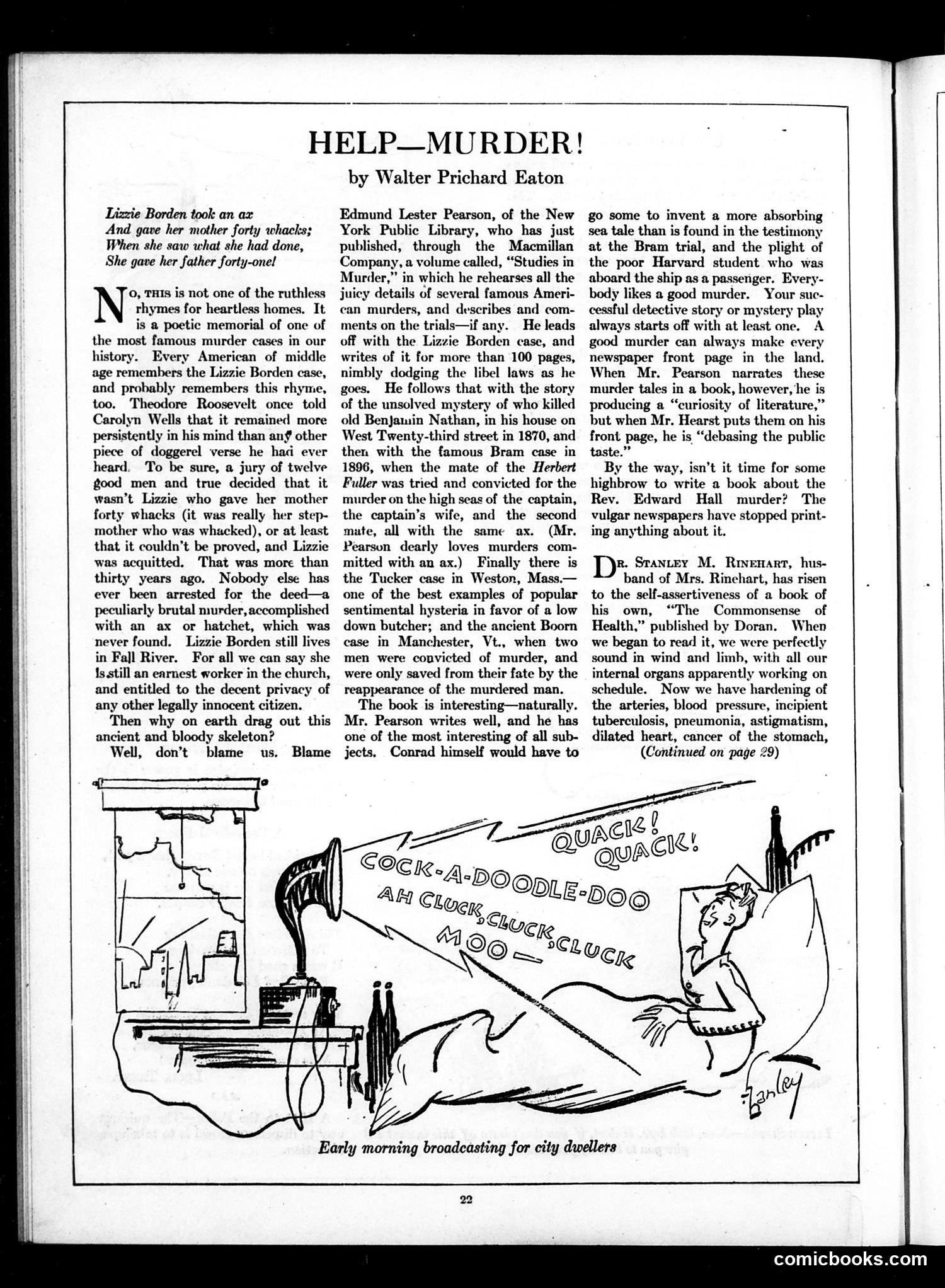
This article critiques Edmund Lester Pearson's new book "Studies in Murder," which resurrects sensational American murder cases—most famously the Lizzie Borden case (a real 1892 unsolved killing where Borden was acquitted despite suspicion). **The satire's point:** Eaton attacks the double standard of "highbrow" literary culture. Pearson's scholarly book about murders is praised as legitimate literature, yet when newspaper publisher William Randolph Hearst covers similar crimes, he's condemned for "debasing public taste." The author sarcastically suggests that perhaps Hearst should write a book instead—implying that packaging sensationalism as literature doesn't make it more respectable, only more pretentious. **The cartoon** mocks early radio broadcasting waking city dwellers with a rooster's noise—a visual gag about unwanted interruptions, likely commenting on modern intrusions into domestic life. The piece ultimately argues that society's moral outrage depends not on *content* but on *packaging*—a critique of cultural hypocrisy that remains relevant today.
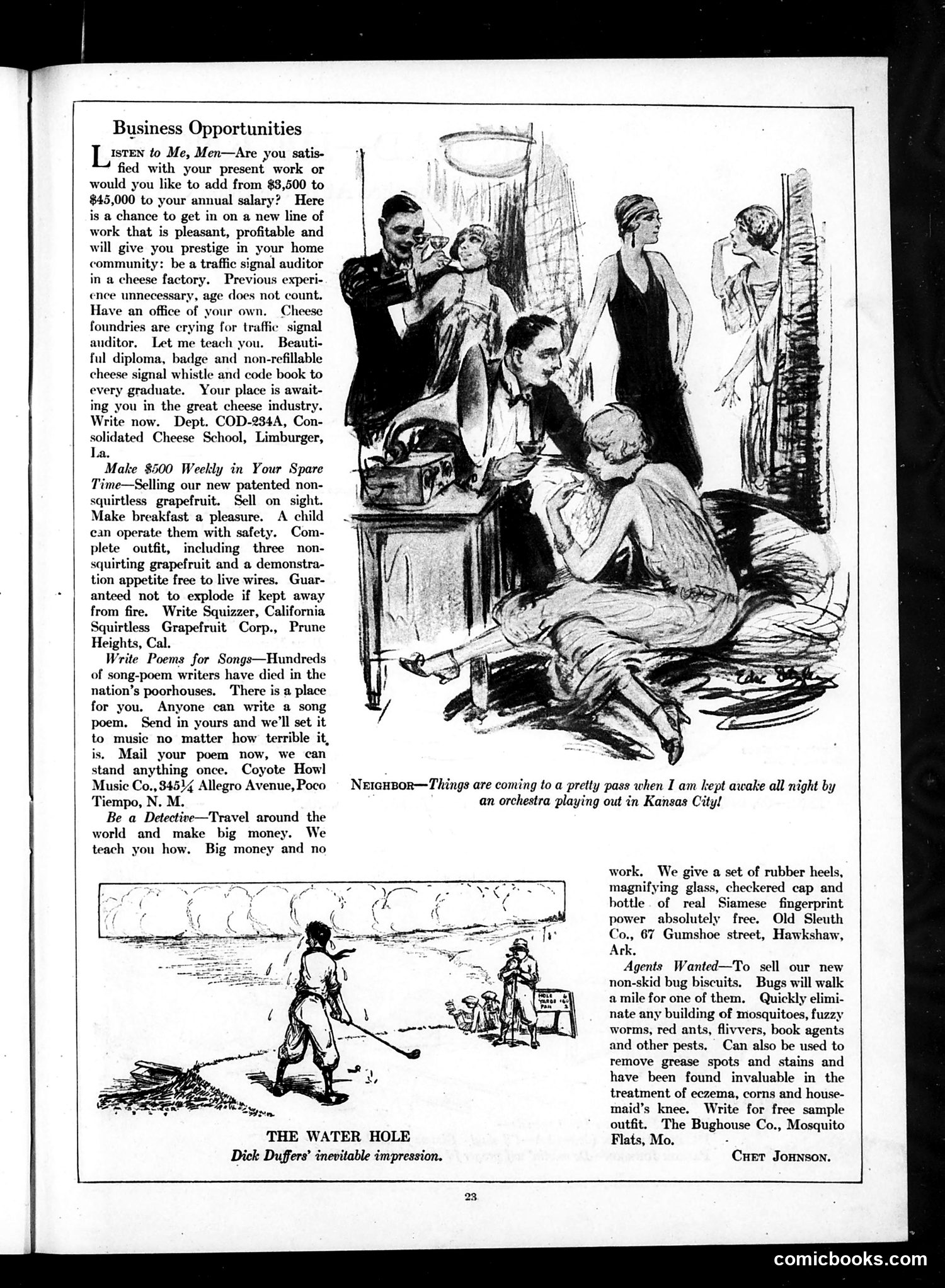
This page is primarily **satirical advertising**—Judge magazine's mockery of get-rich-quick schemes that preyed on economically desperate Americans, likely from the 1920s-1930s. The fake job listings parody fraudulent business opportunities of the era: "traffic signal auditor in a cheese factory" and "non-skid bug biscuits" are absurdist nonsense designed to ridicule legitimate-sounding but worthless schemes. Promises of easy money ($500 weekly, $45,000 salary increases) with no experience required reflect actual scams targeting unemployed workers. The cartoon vignette at top shows working-class people in desperate circumstances—satirizing who fell for such pitches. The "Water Hole" illustration depicts rural poverty, reinforcing the magazine's critique of how vulnerable populations were exploited by charlatans. The single domestic cartoon at right (neighbor complaining about Kansas City orchestra noise) is unrelated filler—standard magazine humor—not part of the scam satire. **The point**: Judge exposed predatory con-artist advertising targeting the economically vulnerable.
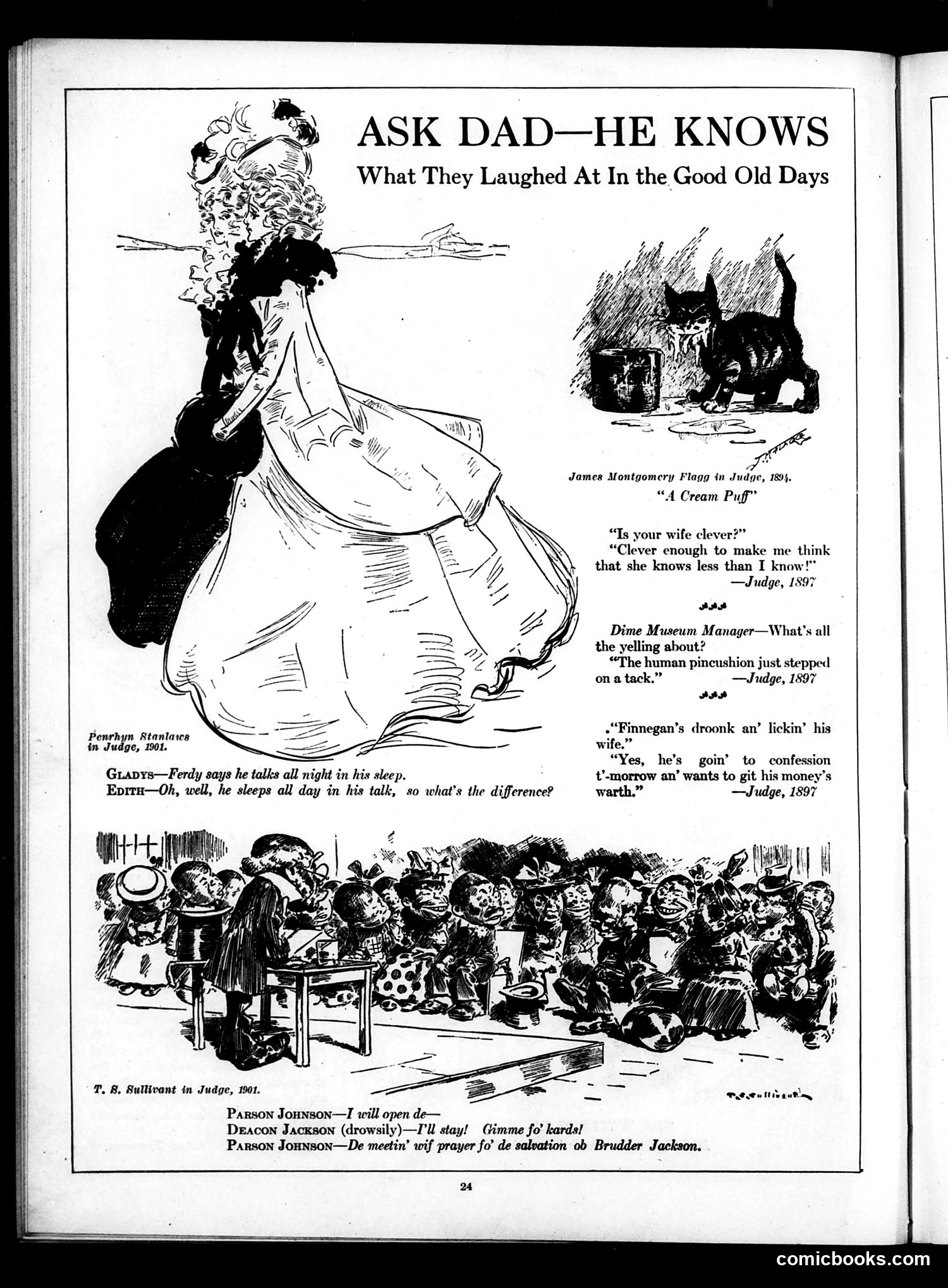
This page collects humorous one-liners and cartoon gags from Judge magazine (1894-1901), presented as period humor for nostalgic readers. The cartoons employ ethnic stereotypes and gendered jokes typical of the era: - **Top cartoon** by James Montgomery Flagg depicts a woman in an elaborate dress, accompanying a joke about wives being clever enough to feign ignorance. - **Middle section** includes vaudeville-style gags: a "dime museum" (cheap freak show) joke, and Irish-accented dialect humor about a drunk man named Finnegan and his wife. - **Bottom cartoon** by T.B. Sullivant shows a church scene with African American characters (rendered in period dialect) where a deacon interrupts prayer proceedings requesting playing cards. The page's framing—"What They Laughed At In the Good Old Days"—suggests nostalgic amusement at outdated humor styles. The material reflects casual use of racial/ethnic caricature and stereotypical gender dynamics commonplace in early 20th-century American humor magazines.
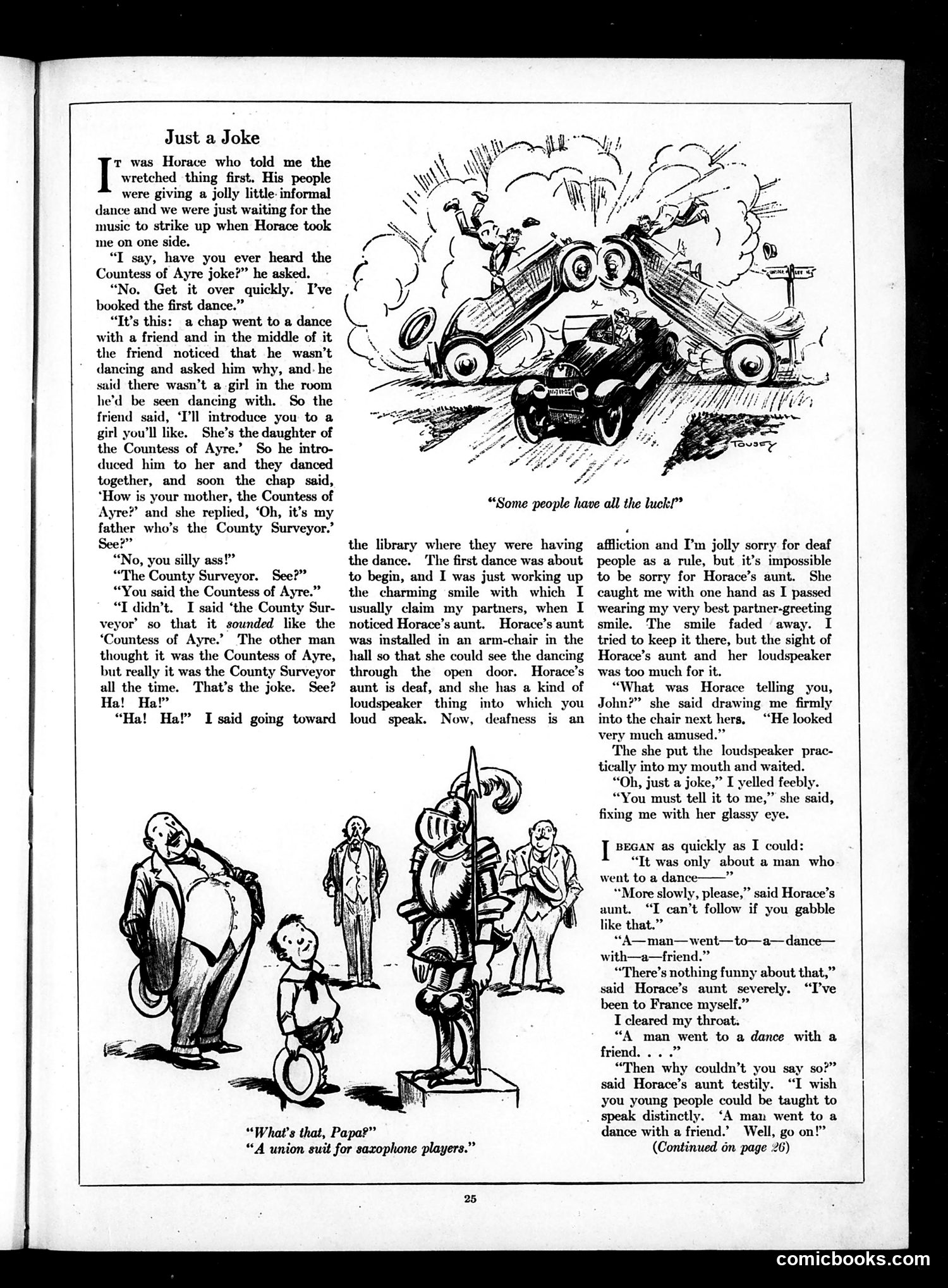
This is a humorous story about the social awkwardness of telling a joke to a deaf person. Horace sets up an elaborate pun: introducing someone to a girl, claiming she's "the daughter of the Countess of Ayre"—which sounds like "County Surveyor" when spoken aloud. The joke's humor relies entirely on homophonic wordplay. The satire targets multiple targets: Horace's tedious, convoluted joke-telling; the narrator's discomfort navigating social situations; and especially Horace's elderly deaf aunt, portrayed as imperious and domineering despite her disability. When the narrator attempts to retell the joke to her through her loudspeaker hearing device, her literal-minded, humorless responses and demands for slow, distinct speech undermine the entire comedic premise—the pun collapses when spoken slowly and clearly. The accompanying cartoon of a car accident illustrates another layer: some people's misfortune becomes others' entertainment, much like the aunt's deafness becomes the story's comedic center.
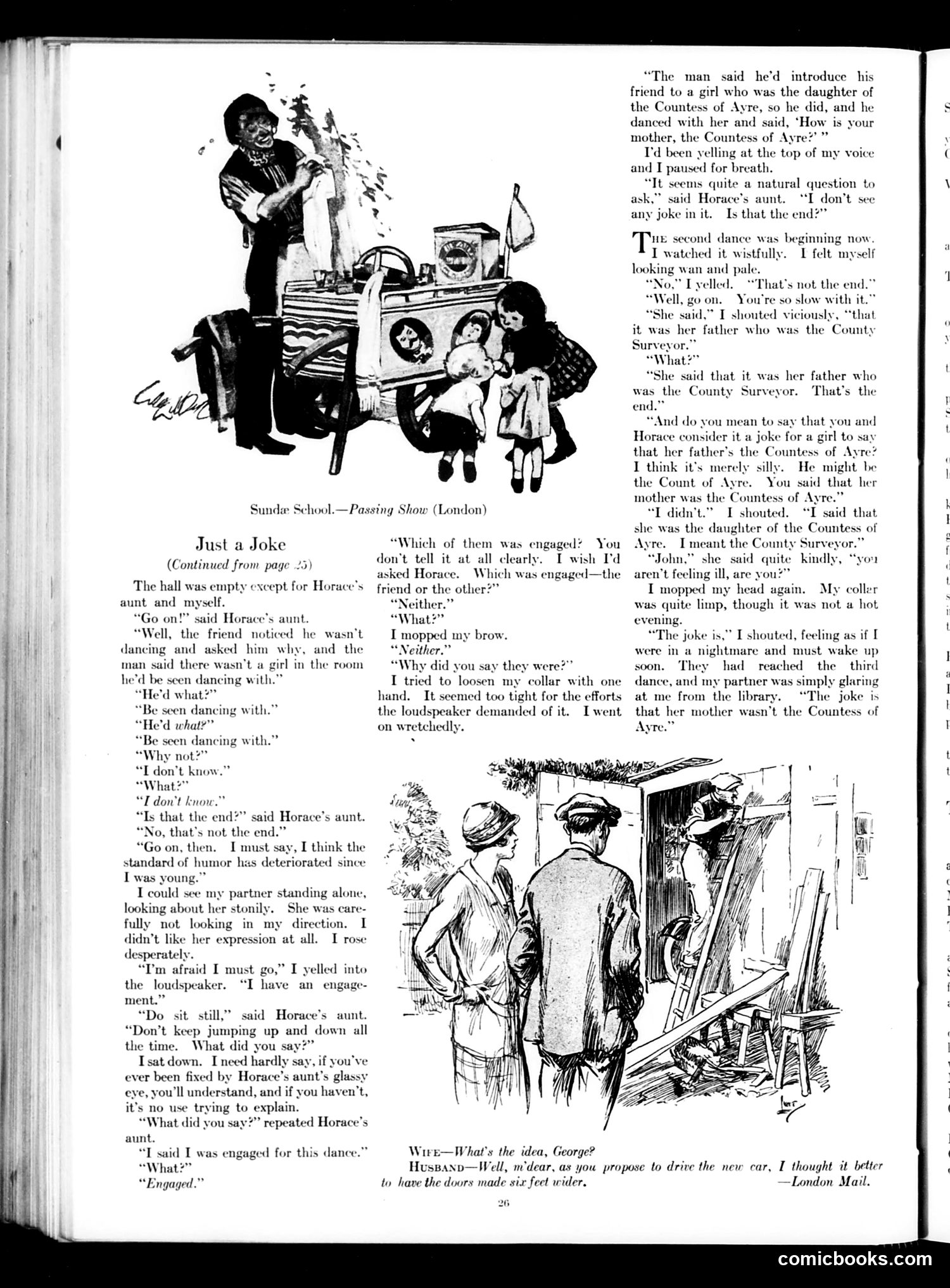
This is a humorous story about a man trying to tell a joke at a dance while repeatedly interrupted by Horace's aunt, who demands clarification. The joke itself—about introducing a girl as the "daughter of the Countess of Ayre," who then reveals her father is merely the County Surveyor—relies on a class-based punchline: the humor lies in the deflating revelation that despite aristocratic maternal connections, the girl's father holds only a modest surveying position. The satire targets multiple things: the narrator's poor storytelling, the aunt's pedantic questioning, and implicitly, the English class system's pretensions. The secondary cartoon below mocks husbands buying oversized car doors for their wives' driving, a jab at women drivers. Both pieces use exasperation and social awkwardness for comedic effect, typical of Judge's early-20th-century approach to domestic and class humor.
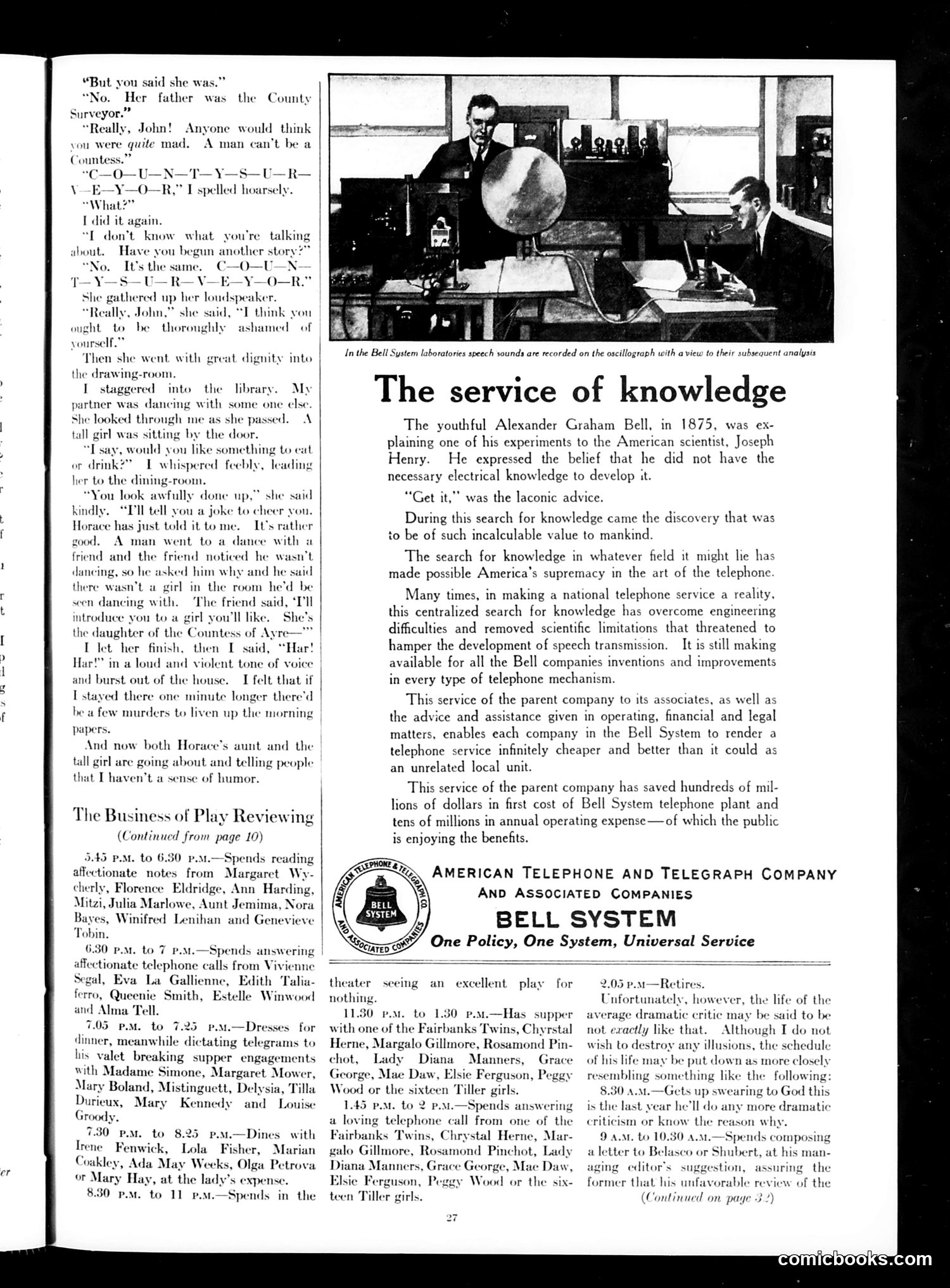
**Main Cartoon/Story (Left):** A domestic comedy about a misunderstanding. A man attempts to explain that someone's father was a "County Surveyor" to a woman who keeps mishearing it as "Countess." When he spells it out letter-by-letter over a telephone/loudspeaker, she still doesn't understand. The joke satirizes telephone communication technology—specifically its poor sound quality and the frustration of trying to convey information through early telephone systems. The man's exasperation and the woman's incomprehension mock the limitations of telephonic speech transmission. **Right Side Advertisement:** A Bell System ad celebrating Alexander Graham Bell and the company's research into improving telephone technology. The irony is evident: the advertisement directly addresses the communication problem satirized in the cartoon beside it, claiming Bell's laboratories work to perfect "speech transmission." The pairing appears intentional—satirizing telephone limitations while simultaneously advertising their solution.
This page is **primarily advertisements** for investment products, with minimal satirical content. The notable elements: **The cartoon**: Features "The Doc" (likely representing financial/investment advice), shown as a dog mascot, offering consultation services through Judge magazine's "Investment Bureau." This appears to be a mascot-driven advertisement rather than political satire. **The context**: Published during the prosperous 1920s (referenced date: August 2, 1924), this reflects the era's booming stock market and aggressive investment marketing. The ads promise safety and high returns (7% bonds), targeting middle-class investors seeking wealth accumulation. **The satire, if present, is implicit**: The repetitive guarantees of safety ("not a single investor has lost a dollar") and the emphasis on "secrets" of investing subtly mock the period's widespread investment optimism and sales pitches—ironic given the financial crash would occur five years later. The page is primarily **commercial content**, not political commentary.
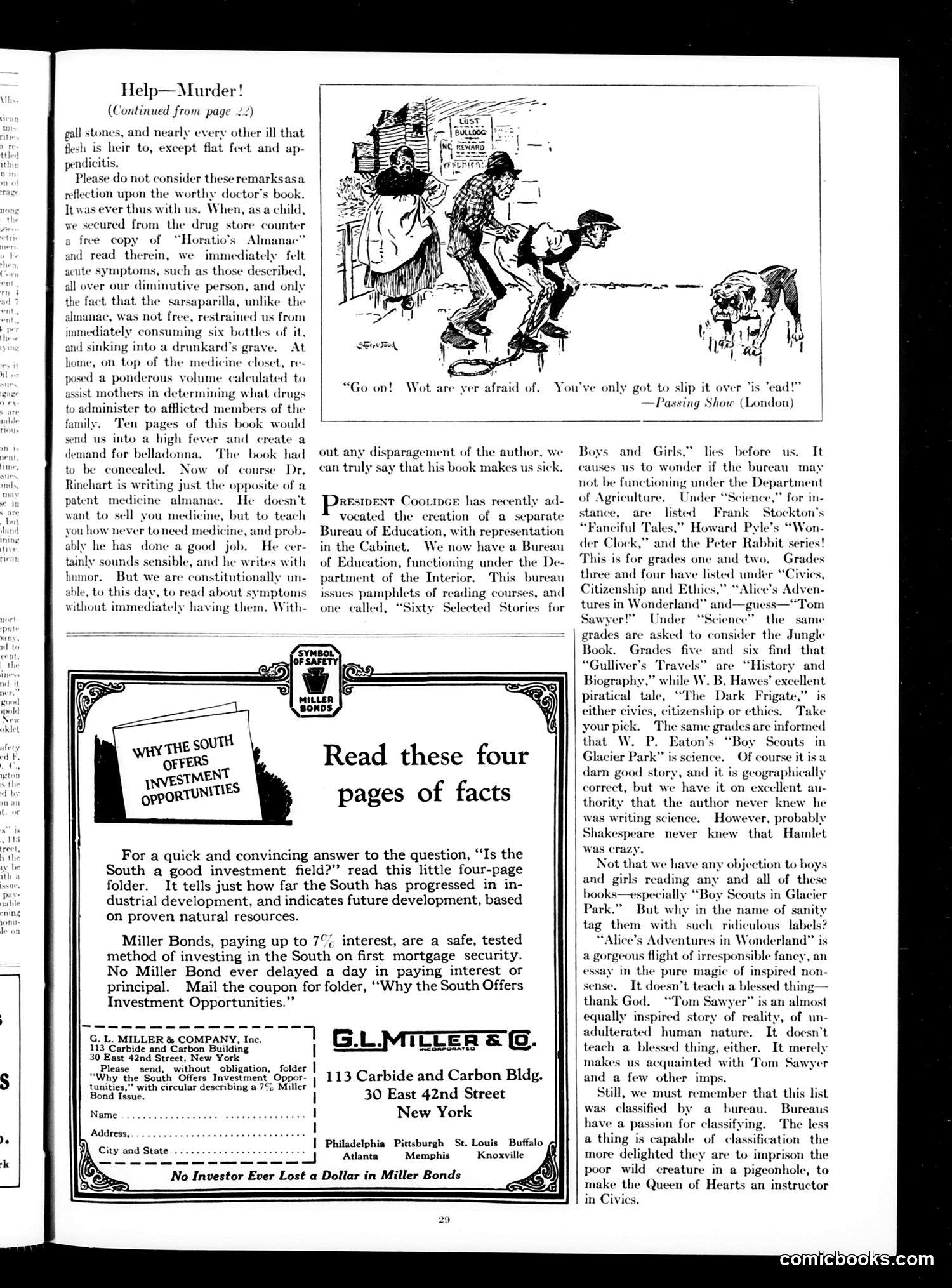
The main cartoon depicts a street scene with figures apparently engaged in criminal activity—one appears to say "Go on! Wot are yer afraid of. You've only got to slip it over 'is 'ead!"—suggesting a mugging or violent crime in progress. The caption attributes this to the *Passing Show* (London), indicating Judge is reprinting British satire. The surrounding text is satirical commentary about reading medical literature. The author humorously describes how reading Dr. Rinehart's medical book induces imaginary symptoms—a relatable hypochondriac joke about medical literature causing anxiety, even when well-intentioned. The page also contains a substantial advertisement for Miller Bonds, promoting Southern investment opportunities, and editorial criticism of the Department of Education's "Sixty Selected Stories for Boys and Girls," which the author mocks for classifying fiction (like *Alice in Wonderland* and *Gulliver's Travels*) as science or history rather than literature. The cartoons and text reflect early 20th-century concerns about education, health anxiety, and investment.
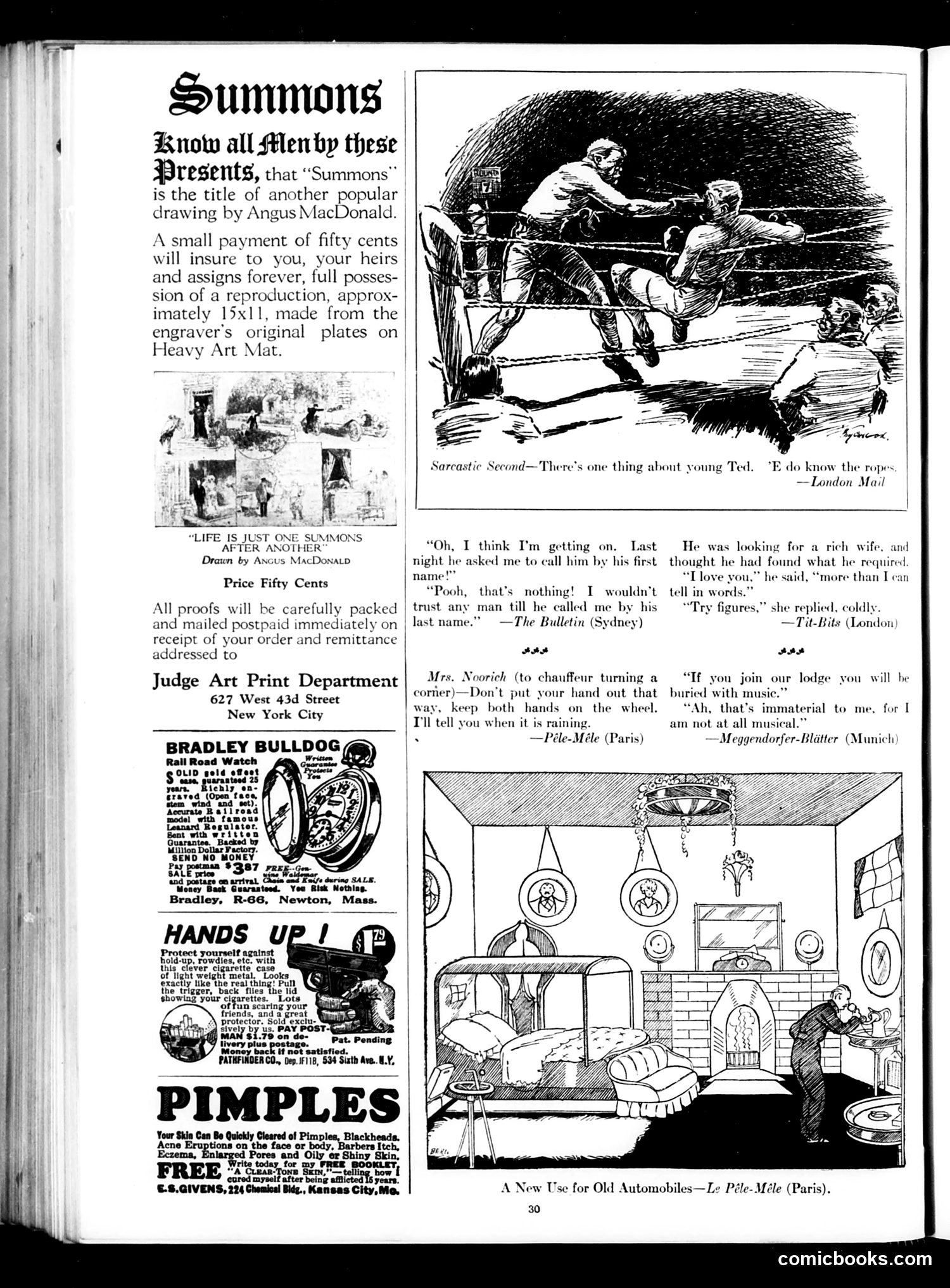
This page primarily features advertisements and reprinted jokes from international publications, rather than original political commentary. **Main Content:** The top cartoon by Angus MacDonald depicts a boxing match titled "Summons," with the caption "Life is just one summons after another"—a visual pun on legal summonses, suggesting life's endless obligations. **Reprinted Jokes:** The page collects brief, captioned cartoons from foreign sources (London Mail, The Bulletin Sydney, Tit-Bits London, Pèle-Mèle Paris, Meggendorfer-Blitter Munich). These are mild domestic humor: a young man gaining confidence, a wife criticizing her husband's romantic declarations, a chauffeur receiving driving instructions during rain, and a lodge member unimpressed by the promise of musical burial. **Advertisements:** The page is heavily dominated by product ads: a Bradley Bulldog watch, a fake gun cigarette case (as a novelty/self-defense item), and pimple treatments—typical early 20th-century magazine fare. The content reflects Judge's format of mixing original cartoons with international reprinted humor and commercial advertising.
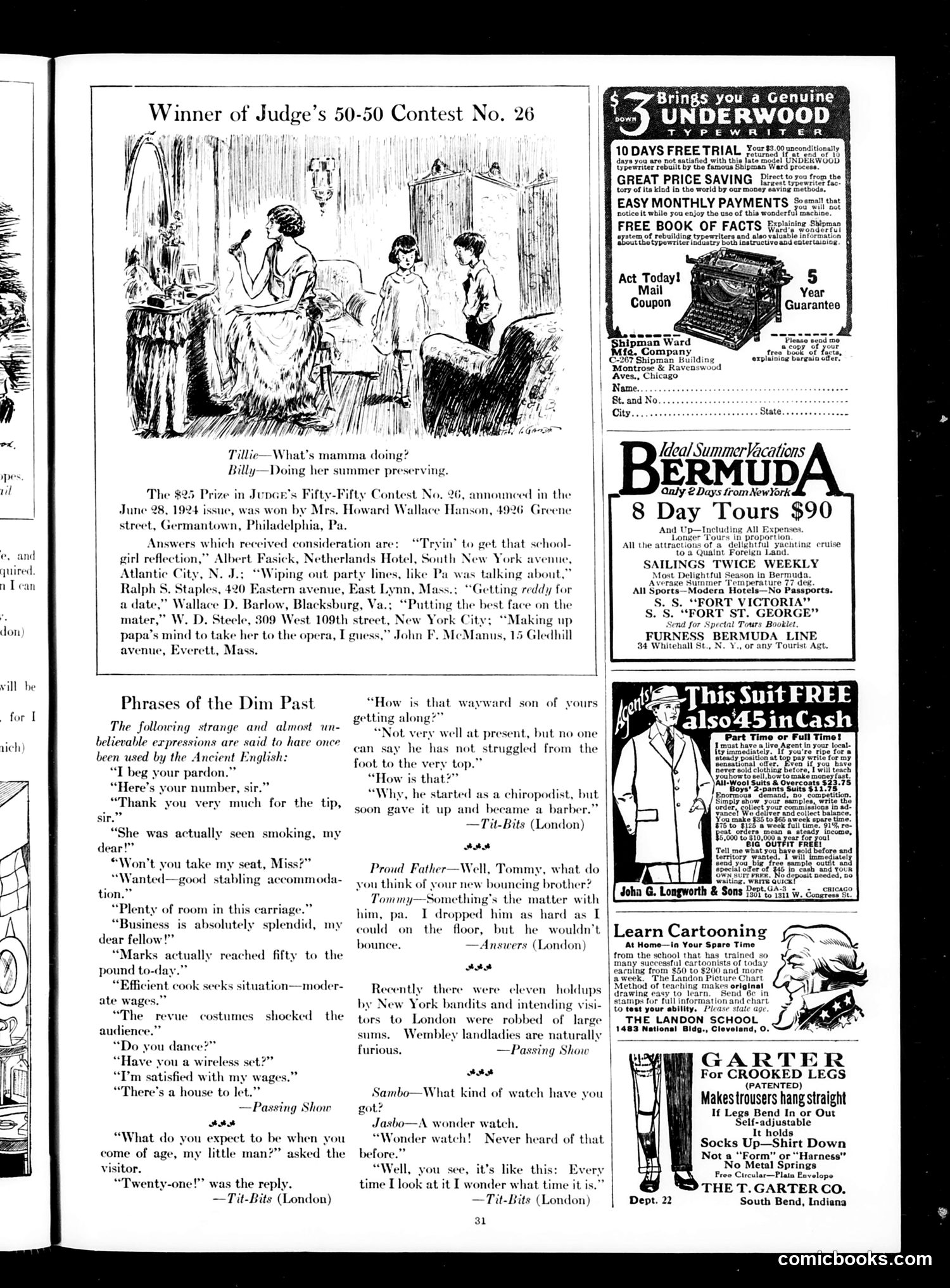
This page is primarily **advertisements and filler content**, not political satire. The main cartoon shows a domestic scene labeled "Winner of Judge's 50-50 Contest No. 26"—a humor caption contest. The joke depicts a mother "doing her summer preserving" while children watch, with the punchline suggesting she's preserving her composure or managing household duties during summer. The bulk of the page consists of: - A contest results section listing prize winners - "Phrases of the Dim Past"—nostalgic humor about old-fashioned expressions (e.g., "Thank you for the tip, sir") - Various period advertisements (Underwood typewriters, Bermuda vacations, mail-order clothing, cartooning lessons) **The social context**: These ads reflect 1920s consumer culture and mail-order commerce. The humor relies on gentle domestic situations and wordplay rather than political commentary. This appears to be a typical Judge magazine filler page from the 1920s era.
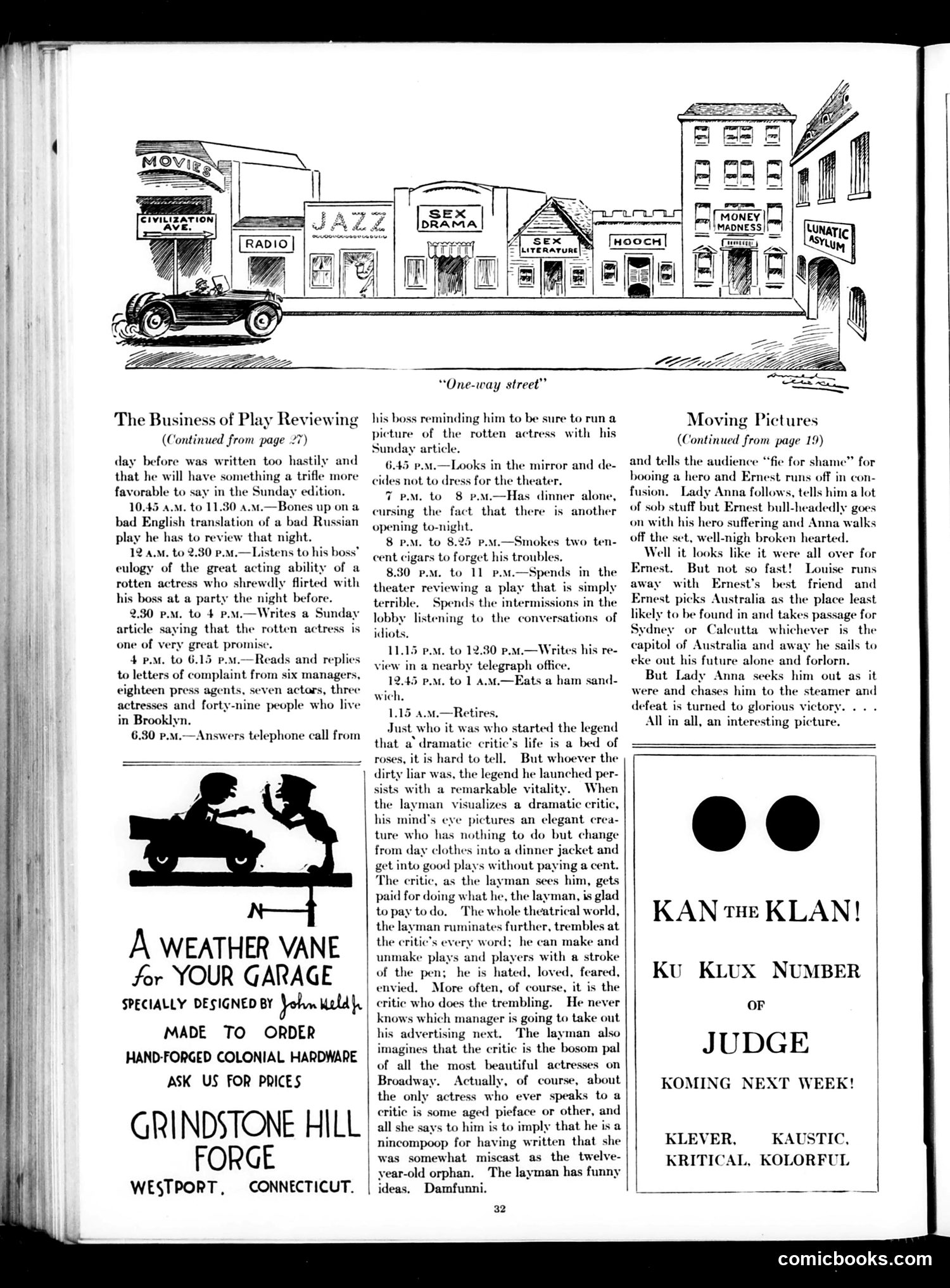
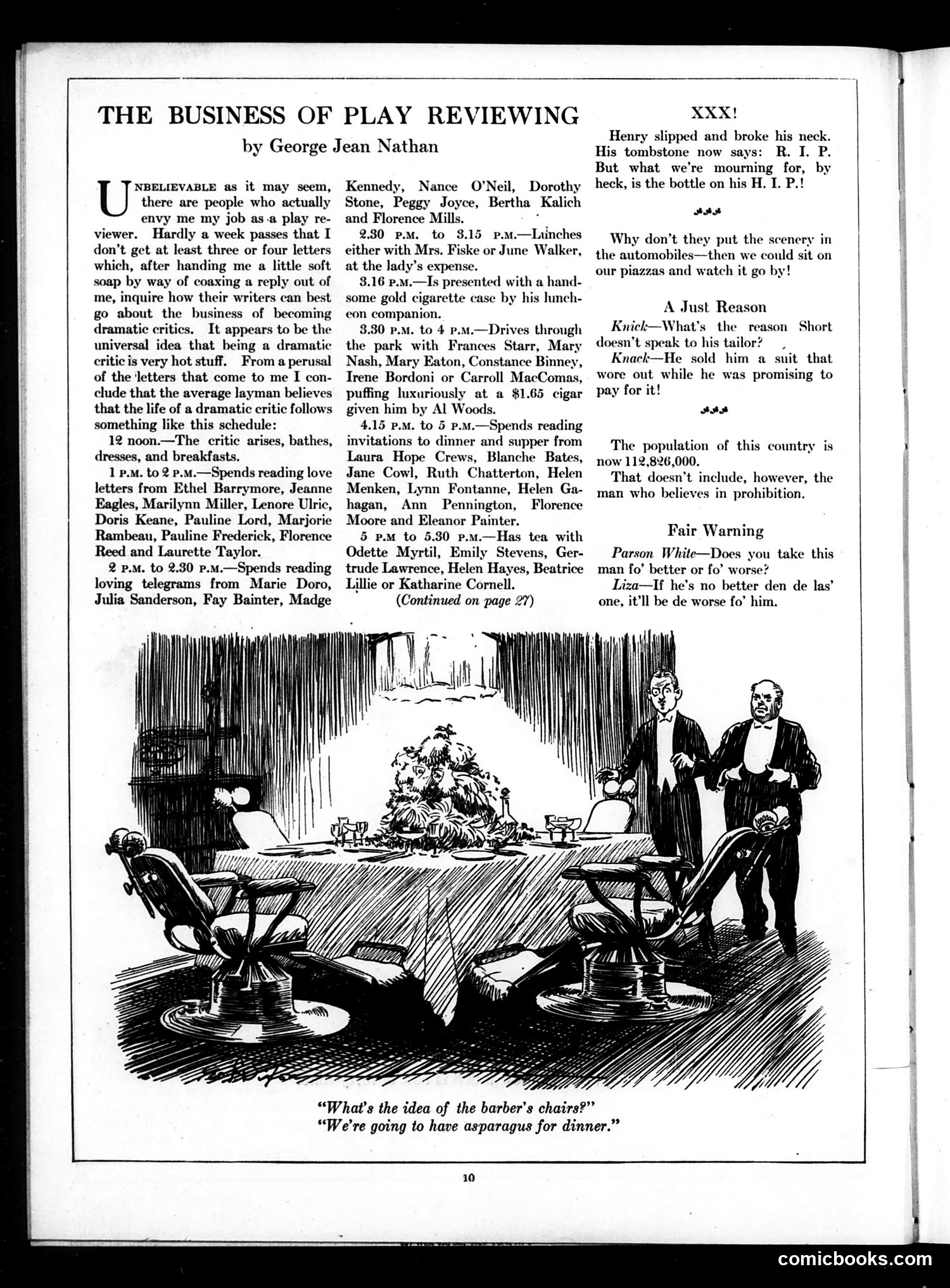
This satirical piece mocks theater critics by detailing their actual daily schedule—which contradicts the glamorous myth. The humor lies in the gap between what laypeople imagine critics do (attend fine plays, wield power over careers, socialize with beautiful actresses) and reality: they rush through bad translations, write favorable reviews of mediocre actresses their boss flirted with, endure terrible opening nights, and have no actual influence beyond what managers allow. The accompanying illustration shows a "One-way street" of movie theaters and entertainment venues, reinforcing the assembly-line nature of entertainment reviewing. The piece satirizes both the theater world's superficiality and critics' compromised position—they're not powerful arbiters but rather powerless workers subject to managerial pressure and public complaint.
This page is primarily an **advertisement for a summer resort** rather than political satire. The ad promotes a vacation destination emphasizing recreational activities (boating, bathing, tennis, golf, fishing) at "15¢ a week" rates. The left column contains fragmented text from an adjacent article discussing cinema and artistic expression—references to "hot polloi," Henry of some kind, and theater industry concerns. This appears unrelated to the resort ad itself. The advertisement's humor is mild and commercial rather than satirical: "If there's a wheeze we get it!" and "Hot and cold running laughter" are playful marketing slogans. There are oblique references to the Klan in the left column text ("Klan and its disguise"), but these appear part of a separate article, not the advertisement's message. **Bottom line:** This is primarily a vintage vacation resort advertisement with generic promotional humor, alongside unrelated editorial content. No significant political satire is evident on this particular page.
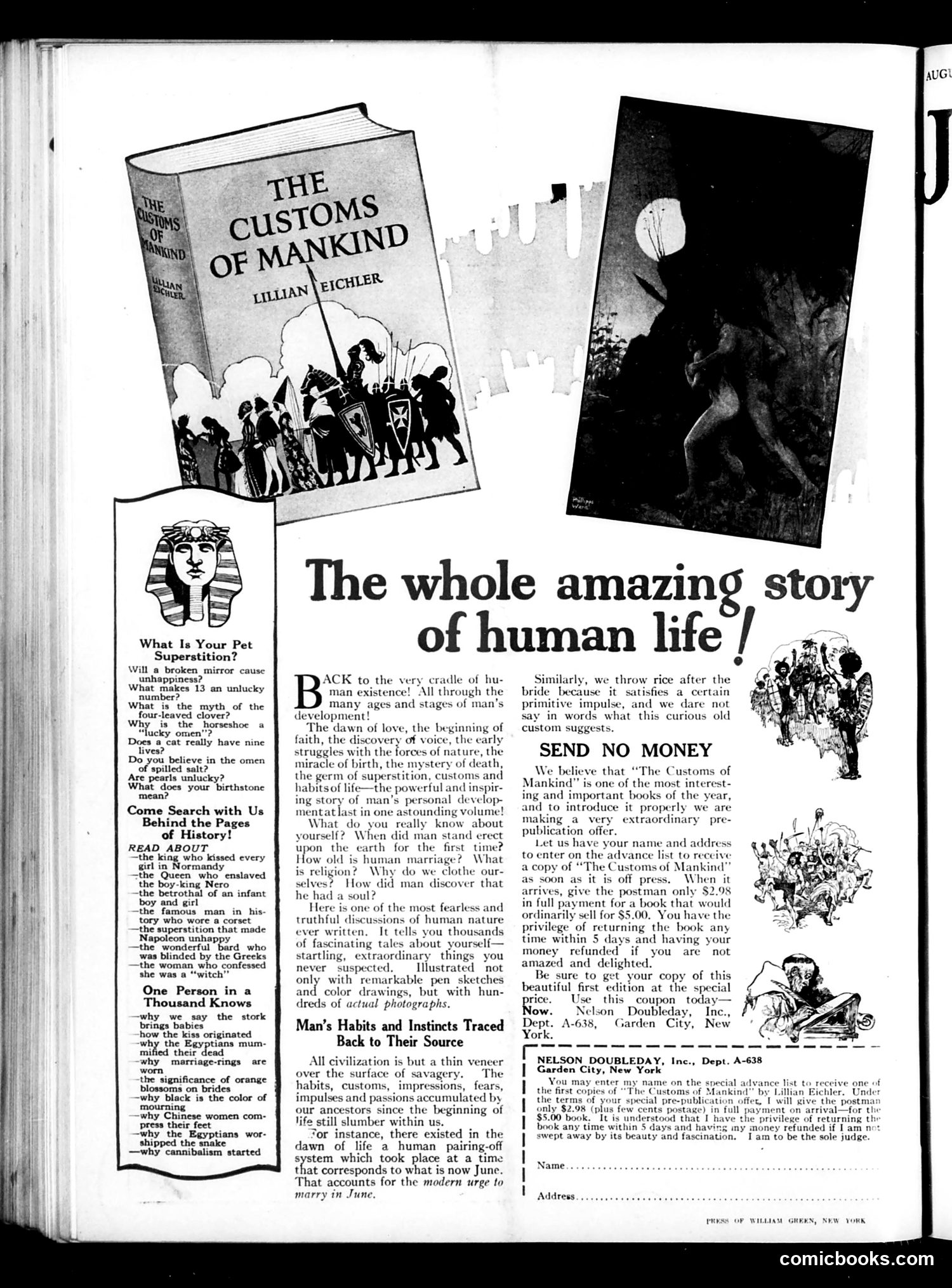
This page is primarily a **book advertisement** for "The Customs of Mankind" by Lillian Eichler, published by Nelson Doubleday. The satirical content is minimal. The left sidebar lists trivia questions about superstitions and historical curiosities ("Why is the horseshoe lucky?" "Why do we say the stork brings babies?") to hook reader interest. The main advertisement promises these mysteries will be answered in the book. The central text uses pseudo-anthropological language—claiming human behavior stems from primitive ancestral impulses—to explain modern customs. Examples: throwing rice at weddings satisfies "primitive impulses"; marrying in June reflects ancient animal mating seasons. The top shows the book's cover and an atmospheric illustration. The "SEND NO MONEY" offer was a common direct-mail sales tactic of the era, requiring payment upon delivery. This reflects early 20th-century popular fascination with evolutionary psychology and anthropology, presented here as sensationalized popular science to drive book sales.