
Judge, 1924-08-09 · page 24 of 36
Judge — August 9, 1924 — page 24: what you’re looking at
What you’re looking at
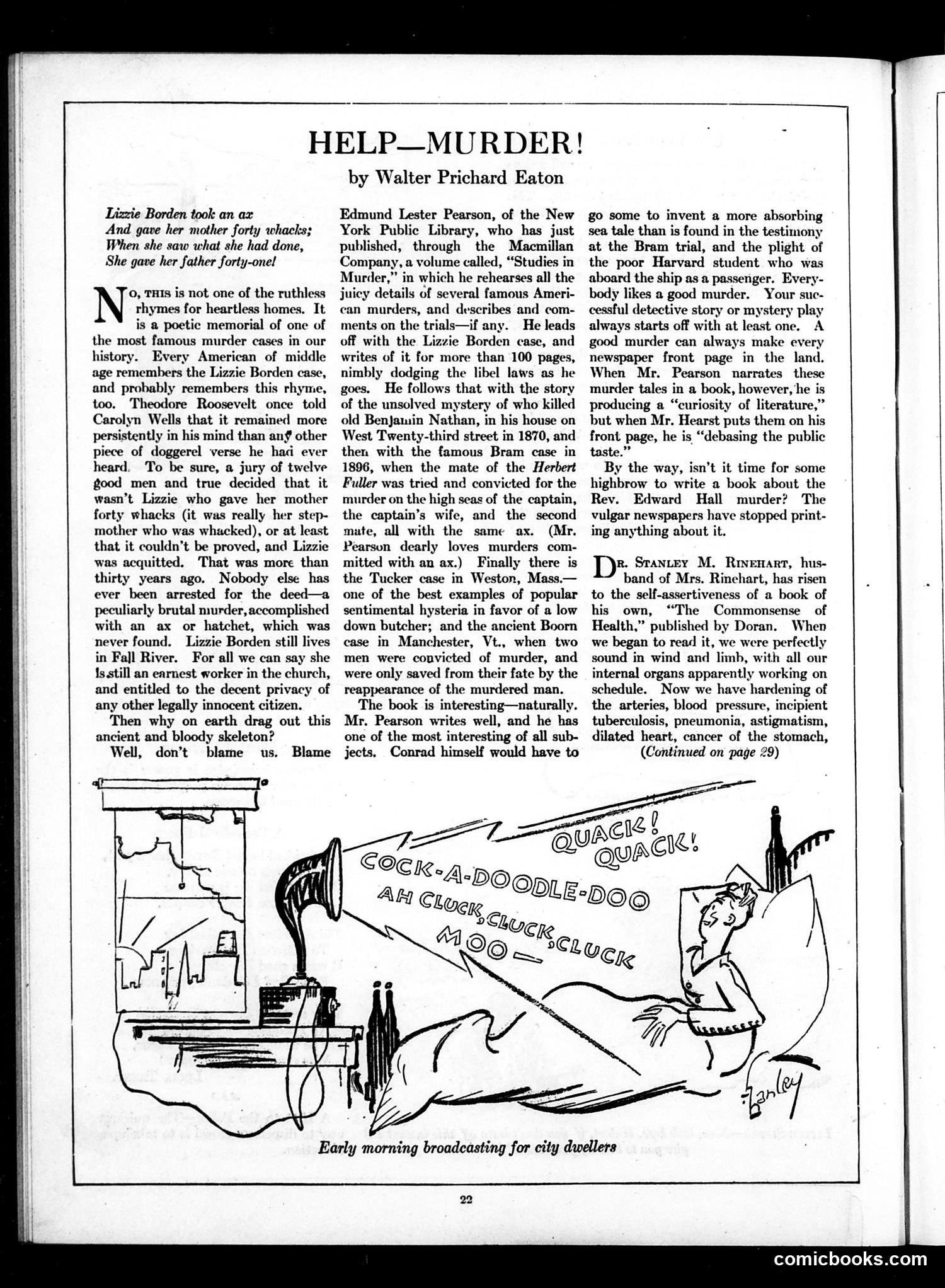
This article critiques Edmund Lester Pearson's new book "Studies in Murder," which resurrects sensational American murder cases—most famously the Lizzie Borden case (a real 1892 unsolved killing where Borden was acquitted despite suspicion). **The satire's point:** Eaton attacks the double standard of "highbrow" literary culture. Pearson's scholarly book about murders is praised as legitimate literature, yet when newspaper publisher William Randolph Hearst covers similar crimes, he's condemned for "debasing public taste." The author sarcastically suggests that perhaps Hearst should write a book instead—implying that packaging sensationalism as literature doesn't make it more respectable, only more pretentious. **The cartoon** mocks early radio broadcasting waking city dwellers with a rooster's noise—a visual gag about unwanted interruptions, likely commenting on modern intrusions into domestic life. The piece ultimately argues that society's moral outrage depends not on *content* but on *packaging*—a critique of cultural hypocrisy that remains relevant today.
📄 Transcribed text from this page (OCR, searchable)
Machine-transcribed from the original scan — historical spelling and the odd misread are preserved.
HELP—MURDER! by Walter Prichard Eaton Lizzie Borden took an ax And gave her mother forty whacks; When she saw what she had done, She gave her father forty-onel 0, THIs is not one of the ruthless N rhymes for heartless homes. It is a poetic memorial of one of the most famous murder cases in our history. Every American of middle age remembers the Lizzie Borden case, and probably remembers this rhyme, too, Theodore Roosevelt once told Carolyn Wells that it remained more persistently in his mind than an other piece of doggerel verse he had ever heard. To be sure, a jury of twelve good men and true decided that it wasn’t Lizzie who gave her mother forty whacks (it was really her step- mother who was whacked), or at least that it couldn’t be proved, and Lizzie was acquitted. That was more than thirty years ago. Nobody else has ever been arrested for the deed—a peculiarly brutal murder, accomplished with an ax or hatchet, which was never found. Lizzie Borden still lives in Fall River. For all we can say she {s still an earnest worker in the church, and entitled to the decent privacy of any other legally innocent citizen. Then why on earth drag out this ancient and bloody skeleton? Well, don’t blame us. Blame Edmund Lester Pearson, of the New York Public Library, who has just published, through the Macmillan Company, a volume called, “Studies in Murder,” in which he rehearses all the juicy details of several famous Ameri- can murders, and describes and com- ments on the trials—if any. He leads off with the Lizzie Borden case, and writes of it for more than 100 pages, nimbly dodging the libel laws as he goes. He follows that with the story of the unsolved mystery of who killed old Benjamin Nathan, in his house on West Twenty-third street in 1870, and then with the famous Bram case in 1896, when the mate of the Herbert Fuller was tried and convicted for the murder on the high seas of the captain, the captain’s wife, and the second mute, all with the same ax. (Mr. Pearson dearly loves murders com- mitted with an ax.) Finally there is the Tucker case in Weston, Mass.— one of the best examples of popular sentimental hysteria in favor of a low down butcher; and the ancient Boorn case in Manchester, Vt., when two men were convicted of murder, and were only saved from their fate by the reappearance of the murdered man. The book is interesting—naturally. Mr. Pearson writes well, and he has one of the most interesting of all sub- jects. Conrad himself would have to go some to invent a more absorbing sea tale than is found in the testimony at the Bram trial, and the plight of the poor Harvard student who was aboard the ship as a passenger. Every- body likes a good murder. Your suc- cessful detective story or mystery play always starts off with at least one. A good murder can always make every newspaper front page in the land. When Mr. Pearson narrates these murder tales in a book, however, he is producing a “curiosity of literature,” but when Mr. Hearst puts them on his front page, he is “debasing the public taste.” By the way, isn’t it time for some highbrow to write a book about the Rev. Edward Hall murder? The vulgar newspapers have stopped print- ing anything about it. R. SrantEY M. Rinenart, hus- band of Mrs. Rinehart, has risen to the self-assertiveness of a book of his own, “The Commonsense of Health,” published by Doran. When we began to read it, we were perfectly sound in wind and limb, with all our internal organs apparently working on schedule. Now we have hardening of the arteries, blood pressure, incipient tuberculosis, pneumonia, astigmatism, dilated heart, cancer of the stomach, (Continued on page 29) comicbooks.com