
Judge, 1924-08-09 · page 21 of 36
Judge — August 9, 1924 — page 21: what you’re looking at
What you’re looking at
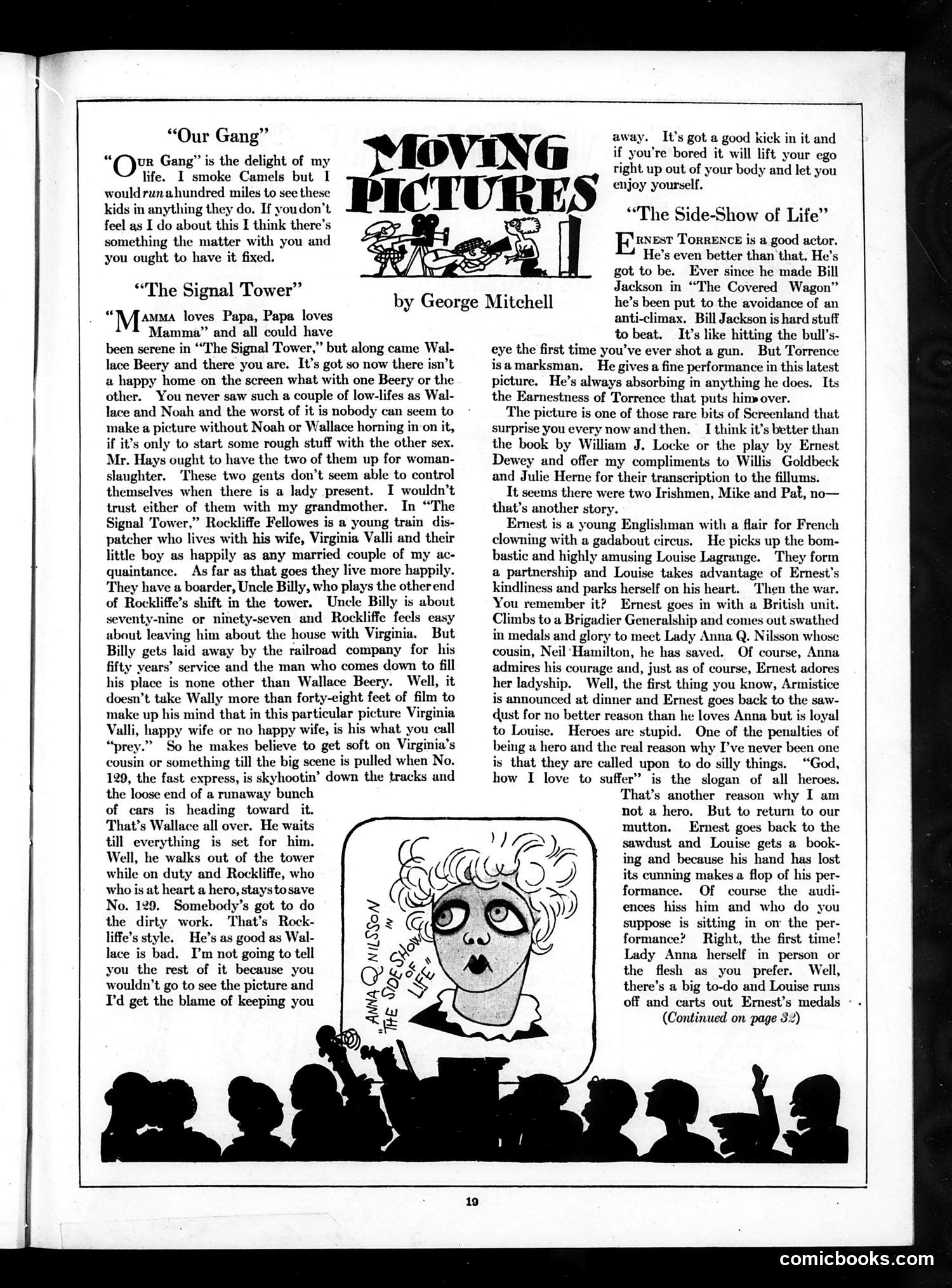
This page reviews three silent films through a satirical lens typical of Judge magazine's entertainment criticism. **"Our Gang"** celebrates child actors in a popular comedy series, praising their natural appeal. **"The Signal Tower"** critiques actor Wallace Beery's typecasting as a villainous seducer. The reviewer sarcastically notes Beery appears in nearly every film to pursue the female lead—here Virginia Valli—creating predictable melodrama. The plot involves a railroad dispatcher (Rockliffe Fellowes) and Beery's rival character, with climactic danger from a runaway train. The satire mocks both Beery's repetitive "heavy" roles and Hollywood's reliance on such formulas, even joking that Will Hays (the film industry's moral arbiter) should prosecute Beery for "woman-slaughter." **"The Side-Show of Life"** praises Ernest Torrence as a skilled actor who avoided the trap of diminishing returns after his acclaimed role in "The Covered Wagon," comparing his consistency to hitting a bullseye repeatedly. The magazine's tone blends genuine appreciation with sharp criticism of Hollywood conventions.
📄 Transcribed text from this page (OCR, searchable)
Machine-transcribed from the original scan — historical spelling and the odd misread are preserved.
“Our Gang” “Ou Gang” is the delight of my feel as I do about this I think there’s something the matter with you and you ought to have it fixed. “The Signal Tower” “Maus loves Papa, Papa loves Mamma” and all could have been serene in “The Signal Tower,” but along came Wal- lace Beery and there you are. It’s got so now there isn’t a happy home on the screen what with one Beery or the other. You never saw such a couple of low-lifes as Wal- lace and Noah and the worst of it is nobody can seem to make a picture without Noah or Wallace horning in-on it, if it’s only to start some rough stuff with the other sex. Mr. Hays ought to have the two of them up for woman- slaughter. These two gents don’t seem able to control themselves when there is a lady present. I wouldn’t trust either of them with my grandmother. In “The Signal Tower,” Rockliffe Fellowes is a young train dis- patcher who lives with his wife, Virginia Valli and their little boy as happily as any married couple of my ac- quaintance. As far as that goes they live more happily. They have a boarder, Uncle Billy, who plays the other end of Rockliffe’s shift in the tower. Uncle Billy is about seventy-nine or ninety-seven and Rockliffe feels easy about leaving him about the house with Virginia. But Billy gets laid away by the railroad company for his fifty years’ service and the man who comes down to fill his place is none other than Wallace Beery. Well, it doesn’t take Wally more than forty-eight feet of film to make up his mind that in this particular picture Virginia Valli, happy wife or no happy wife, is his what you call “prey.” So he makes believe to get soft on Virginia’s cousin or something till the big scene is pulled when No. 129, the fast express, is skyhootin’ down the tracks and the loose end of a runaway bunch of cars is heading toward it. That’s Wallace all over. He waits till everything is set for him. Well, he walks out of the tower while on duty and Rockliffe, who who is at heart a hero, staystosave No. 129. Somebody’s got to do the dirty work. That’s Rock- liffe’s style. He’s as good as Wal- lace is bad. I’m not going to tell you the rest of it because you wouldn't go to see the picture and I'd get the blame of keeping you by George Mitchell away. It’s got a good kick in it and Piovi G if you're bored it will lift your ego right up out of your body and let you life. I smoke Camels but I enjoy yourself. wouldrunahundred miles to see these PICTURES oy yourself. kids in anything they do. If youdon’t ~& ; “The Side-Show of Life” Ee" TorrENCz is a good actor. He’s even better than that. He’s got to be. Ever since he made Bill Jackson in “The Covered Wagon” he’s been put to the avoidance of an anti-climax. Bill Jackson is hard stuff to beat. It’s like hitting the bull’s- eye the first time you’ve ever shot a gun. But Torrence isa marksman. He gives a fine performance in this latest picture. He’s always absorbing in anything he does. Its the Earnestness of Torrence that puts hin over. The picture is one of those rare bits of Screenland that surprise you every now and then. I think it’s better than the book by William J. Locke or the play by Ernest Dewey and offer my compliments to Willis Goldbeck and Julie Herne for their transcription to the fillums. It seems there were two Irishmen, Mike and Pat, no— that’s another story. Ernest is a young Englishman with a flair for French clowning with a gadabout circus. He picks up the bom- bastic and highly amusing Louise Lagrange. They form a partnership and Louise takes advantage of Ernest's kindliness and parks herself on his heart. ‘Then the war. You remember it? Ernest goes in with a British unit. Climbs to a Brigadier Generalship and comes out swathed in medals and glory to meet Lady Anna Q. Nilsson whose cousin, Neil ‘Hamilton, he has saved. Of course, Anna admires his courage and, just as of course, Ernest adores her ladyship. Well, the first thing you know, Armistice is announced at dinner and Ernest goes back to the saw- dust for no better reason than he loves Anna but is loyal to Louise. Heroes are stupid. One of the penalties of being a hero and the real reason why I’ve never been one is that they are called upon to do silly things. “God, how I love to suffer” is the slogan of all heroes. That’s another reason why I am not a hero. But to return to our mutton. Ernest goes back to the sawdust and Louise gets a book- ing and because his hand has lost its cunning makes a flop of his per- formance. Of course the audi- ences hiss him and who do you suppose is sitting in on the per- formance? Right, the first time! Lady Anna herself in person or the flesh as you prefer. Well, there’s a big to-do and Louise runs off and carts out Emest’s medals - (Continued on page 32) comicbooks.com