
Judge, 1924-08-09 · page 17 of 36
Judge — August 9, 1924 — page 17: what you’re looking at
What you’re looking at
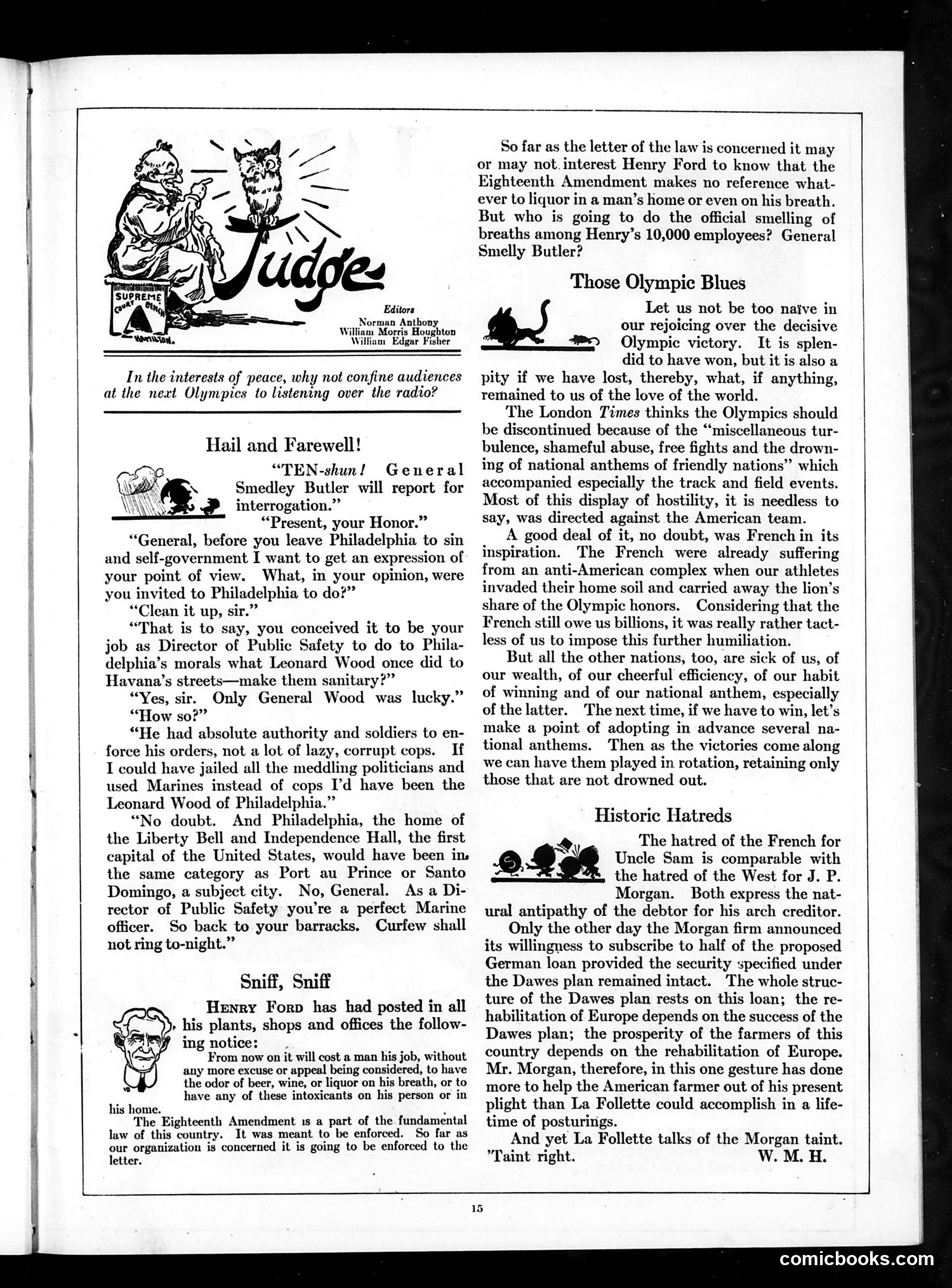
This page contains three distinct satirical pieces targeting 1920s American figures and policies: **"Hail and Farewell!"** mocks General Smedley Butler, Philadelphia's Director of Public Safety, through a fictional interrogation. The satire suggests Butler—a Marine—wanted to impose military authoritarianism on civilian governance (like Leonard Wood did in Cuba), but was constrained by democratic institutions and corrupt civilian police. **"Sniff, Sniff"** ridicules Henry Ford's Prohibition enforcement notice posted in his factories. The joke: Ford's policy claims to enforce the Eighteenth Amendment regarding breath and person, but the Amendment actually only prohibits manufacture/sale—not home possession or consumption. The rhetorical question about "General Smelly Butler" doing breath inspections mocks the absurdity of Ford's overreach. **"Those Olympic Blues"** satirizes American Olympic success breeding international resentment. The piece suggests American athletic dominance, combined with wealth and efficiency, generates anti-American sentiment abroad—particularly from France (still owing war debts to the U.S.), making American victory itself humiliating to others.
📄 Transcribed text from this page (OCR, searchable)
Machine-transcribed from the original scan — historical spelling and the odd misread are preserved.
ae i 4 i Editors rman Anthony Morris Houghton jam Edgar Fisher In the interests of peace, why not confine audiences at the next Olympics to listening over the radio? Hail and Farewell! “TEN-shun! General Smedley Butler will report for interrogation.” “Present, your Honor.” “General, before you leave Philadelphia to sin and self-government I want to get an expression of your point of view. What, in your opinion, were you invited to Philadelphia to do?” “Clean it up, sir.” “That is to say, you conceived it to be your job as Director of Public Safety to do to Phila- delphia’s morals what Leonard Wood once did to Havana’s streets—make them sanitary?” “Yes, sir. Only General Wood was lucky.” “How so?” “He had absolute authority and soldiers to en- force his orders, not a lot of lazy, corrupt cops. If I could have jailed all the meddling politicians and used Marines instead of cops I’d have been the Leonard Wood of Philadelphia.” “No doubt. And Philadelphia, the home of the Liberty Bell and Independence Hall, the first capital of the United States, would have been ins the same category as Port au Prince or Santo Domingo, a subject city. No, General. As a Di- rector of Public Safety you’re a perfect Marine officer. So back to your barracks. Curfew shall not ring to-night.” Sniff, Sniff Henry Forp has had posted in all his plants, shops and offices the follow- ing notice: From now on it will cost a man his job, without any more excuse or appeal being considered, to have the odor of beer, wine, or liquor on his breath, or to have any of these intoxicants on his person or in his home. : The Eighteenth Amendment 1s a part of the fundamental law of this country. It was meant to be enforced. So far as our organization is concerned it is going to be enforced to the letter. So far as the letter of the law is concerned it may or may not.interest Henry Ford to know that the Eighteenth Amendment makes no reference what- ever to liquor in a man’s home or even on his breath. But who is going to do the official smelling of breaths among Henry’s 10,000 employees? General Smelly Butler? Let us not be too naive in Those Olympic Blues our rejoicing over the decisive Olympic victory. It is splen- oS did to have won, but it is also a pity if we have lost, thereby, what, if anything, remained to us of the love of the world. The London Times thinks the Olympics should be discontinued because of the “miscellaneous tur- bulence, shameful abuse, free fights and the drown- ing of national anthems of friendly nations” which accompanied especially the track and field events. Most of this display of hostility, it is needless to say, was directed against the American team. A good deal of it, no doubt, was French in its inspiration. The French were already suffering from an anti-American complex when our athletes invaded their home soil and carried away the lion’s share of the Olympic honors. Considering that the French still owe us billions, it was really rather tact- less of us to impose this further humiliation. But all the other nations, too, are sick of us, of our wealth, of our cheerful efficiency, of our habit of winning and of our national anthem, especially of the latter. The next time, if we have to win, let’s make a point of adopting in advance several na- tional anthems. Then as the victories come along we can have them played in rotation, retaining only those that are not drowned out. Historic Hatreds The hatred of the French for OL a Uncle Sam is comparable with the hatred of the West for J. P. Morgan. Both express the nat- ural antipathy of the debtor for his arch creditor. Only the other day the Morgan firm announced its willingness to subscribe to half of the proposed German loan provided the security specified under the Dawes plan remained intact. The whole struc- ture of the Dawes plan rests on this loan; the re- habilitation of Europe depends on the success of the Dawes plan; the prosperity of the farmers of this country depends on the rehabilitation of Europe. Mr. Morgan, therefore, in this one gesture has done more to help the American farmer out of his present plight than La Follette could accomplish in a life- time of posturinigs. And yet La Follette talks of the Morgan taint. Taint right. W. M. H. comicbooks.com