
Judge, 1924-08-09 · page 29 of 36
Judge — August 9, 1924 — page 29: what you’re looking at
What you’re looking at
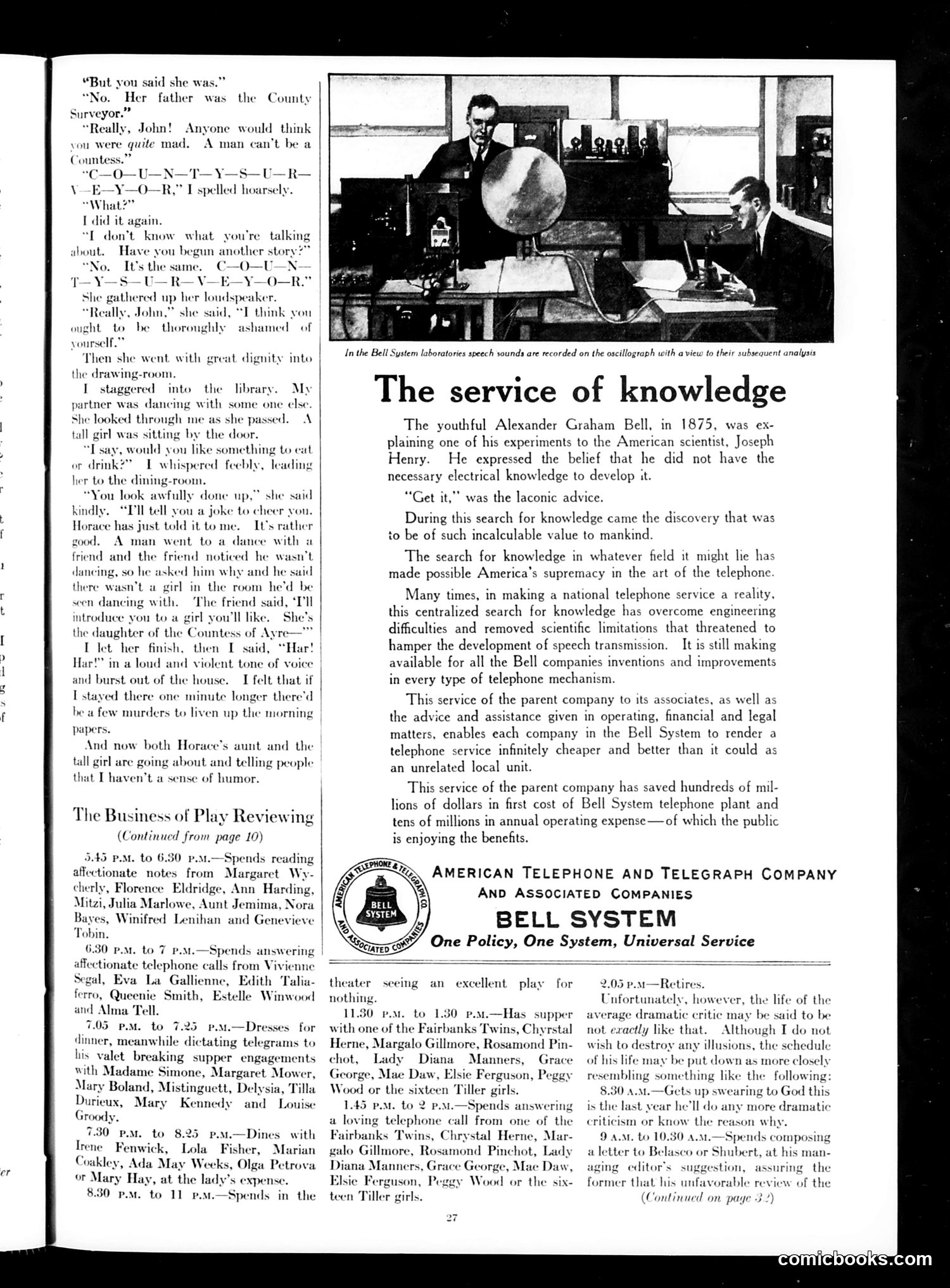
**Main Cartoon/Story (Left):** A domestic comedy about a misunderstanding. A man attempts to explain that someone's father was a "County Surveyor" to a woman who keeps mishearing it as "Countess." When he spells it out letter-by-letter over a telephone/loudspeaker, she still doesn't understand. The joke satirizes telephone communication technology—specifically its poor sound quality and the frustration of trying to convey information through early telephone systems. The man's exasperation and the woman's incomprehension mock the limitations of telephonic speech transmission. **Right Side Advertisement:** A Bell System ad celebrating Alexander Graham Bell and the company's research into improving telephone technology. The irony is evident: the advertisement directly addresses the communication problem satirized in the cartoon beside it, claiming Bell's laboratories work to perfect "speech transmission." The pairing appears intentional—satirizing telephone limitations while simultaneously advertising their solution.
📄 Transcribed text from this page (OCR, searchable)
Machine-transcribed from the original scan — historical spelling and the odd misread are preserved.
“But you said she was.” “No. Her father was the County Surveyor.” “Really, John! Anyone would think vou were quite mad, A man can’t be a Countess.” : O—U—N—T— Y—S— U— R— E—Y—O—R,” I spelled hoarsely. “What?” I did it again. “[ don't: know what you're talking about. “No. It’s the same. C—O—U—N T— Y—S— U— R— V—E—Y—O0-R..” She gathered up her loudspeaker. “Really, John,” she said, “I think you ought. to. be thoroughly yourself.” ashamed of Then she went with great dignity into the drawing-room. I staggered into the library. My partner was dancing with some one els« she looked through me as she passed. A all girl was sitting by the door. “Tsay, would you like something to eat or drink?” her to the dining-room. “You look awfully done up,” she said kindly. “Dll tell you a joke to cheer you. Horace has just told it tome. It’s rather good. A man went to a dance with a friend and the friend noticed he wasn’t dancing, so he asked him why and he said there wasn’t a girl in the room he'd be The friend said, ‘I'll introduce you to a girl you'll like. She's the daughter of the Countess of Ayre—” I let her finish, then [ said, “Ha Har!” in a loud and violent tone of voice and burst out of the house. I felt that if I stayed there one minute longer there'd I whispered feebly, leading seen dancing with. be a few murders to liven up the morning papers. And now both Horace’s aunt and the tall girl are going about and telling people that I haven’t a sense of humor. The Business of Play Reviewing (Continued from page 10) P.M. to 6.30 p.M.—Spends reading tionate notes from Margaret Wy- cherly, Florence Eldridge, Ann Harding, Mitzi, Julia Marlowe, Aunt Jemima, Nora Bayes, Winifred Lenihan and Genevieve Tobin. p.m. to 7 p.t.—Spends answering affectionate telephone calls from Vivienne Segal, Eva La Gallienne, Edith alia- ferro, Queenie Smith, Estelle Winwood and Alma Tell. p.M.—Dresses for dinner, meanwhile dictating telegrams to his valet breaking supper engagements with Madame Simone, Margaret Mower, Mary Boland, Mistinguett, Delysia, Tilla Durieux, Mary Kennedy and Louise Grood 7.30 pM. to 8.25 p.m.—Dines with Irene Fenwick, Lola Fisher, Marian Coakley, Ada May Weeks, Olga Petrova or Mary Hay, at the lady’s expense. 8.30 p.m. to TL p.a.—Spends in the Have you begun another story?” | In the Bell System laboratories speech sounds are recorded on the oscillograph with a view to their subsequent analysis The service of knowledge The youthful Alexander Graham Bell, in 1875, was ex- plaining one of his experiments to the American scientist, Joseph Henry. He expressed the belief that he did not have the necessary electrical knowledge to develop it. “Get it,” was the laconic advice. During this search for knowledge came the discovery that was to be of such incalculable value to mankind. The search for knowledge in whatever field it might lie has made possible America’s supremacy in the art of the telephone Many times, in making a national telephone service a reality, this centralized search for knowledge has overcome engineering difficulties and removed scientific limitations that threatened to hamper the development of speech transmission. It is still making available for all the Bell companies inventions and improvements in every type of telephone mechanism. This service of the parent company to its associates, as well as the advice and assistance given in operating, financial and legal matters, enables each company in the Bell System to render a telephone service infinitely cheaper and better than it could as an unrelated local unit. This service of the parent company has saved hundreds of mil- lions of dollars in first cost of Bell System telephone plant and tens of millions in annual operating expense— of which the public is enjoying the benefits. AMERICAN TELEPHONE AND TELEGRAPH COMPANY AND ASSOCIATED COMPANIES BELL SYSTEM One Policy, One System, Universal Service theater seeing an excellent play for nothing. 11.30 p.m. to 1.30 p.a.—Has supper with one of the Fairbanks Twins, Chyrstal Herne, Margalo Gillmore, Rosamond Pin- chot, Lady Diana George, Mae Daw, Elsie Ferguson, Peggy Wood or the sixteen Tiller girls. 1.45 p.m. to 2 p..—Spends answering a loving telephone call from one of the Fairbanks Twins, Chrystal Herne, Mar- galo Gillmore, Rosamond Pinchot, Lady Diana Manners, Grace George, Mae Daw, Elsie Ferguson, Peggy Wood or the six- teen Tiller girls. Manners, Grace p.m—Retires. Unfortunately, however, the life of the average dramatic critic may be said to be not eractly like that. Although I do not wish to destroy any illusions, the schedule of his life may be put down as more closely resembling something like the following: 8.30 a.m.—Gets up swearing to God this is the last year he’ll do any more dramatic criticism or know the reason why. 9 a.m. to 10.30 4.s1.—Spends composing a letter to Belasco or Shubert, at his man- aging editor's suggestion, assuring the former that his unfavorable review of the (Continued on paye 32)