
A complete issue · 36 pages · 1924
Judge — May 17, 1924
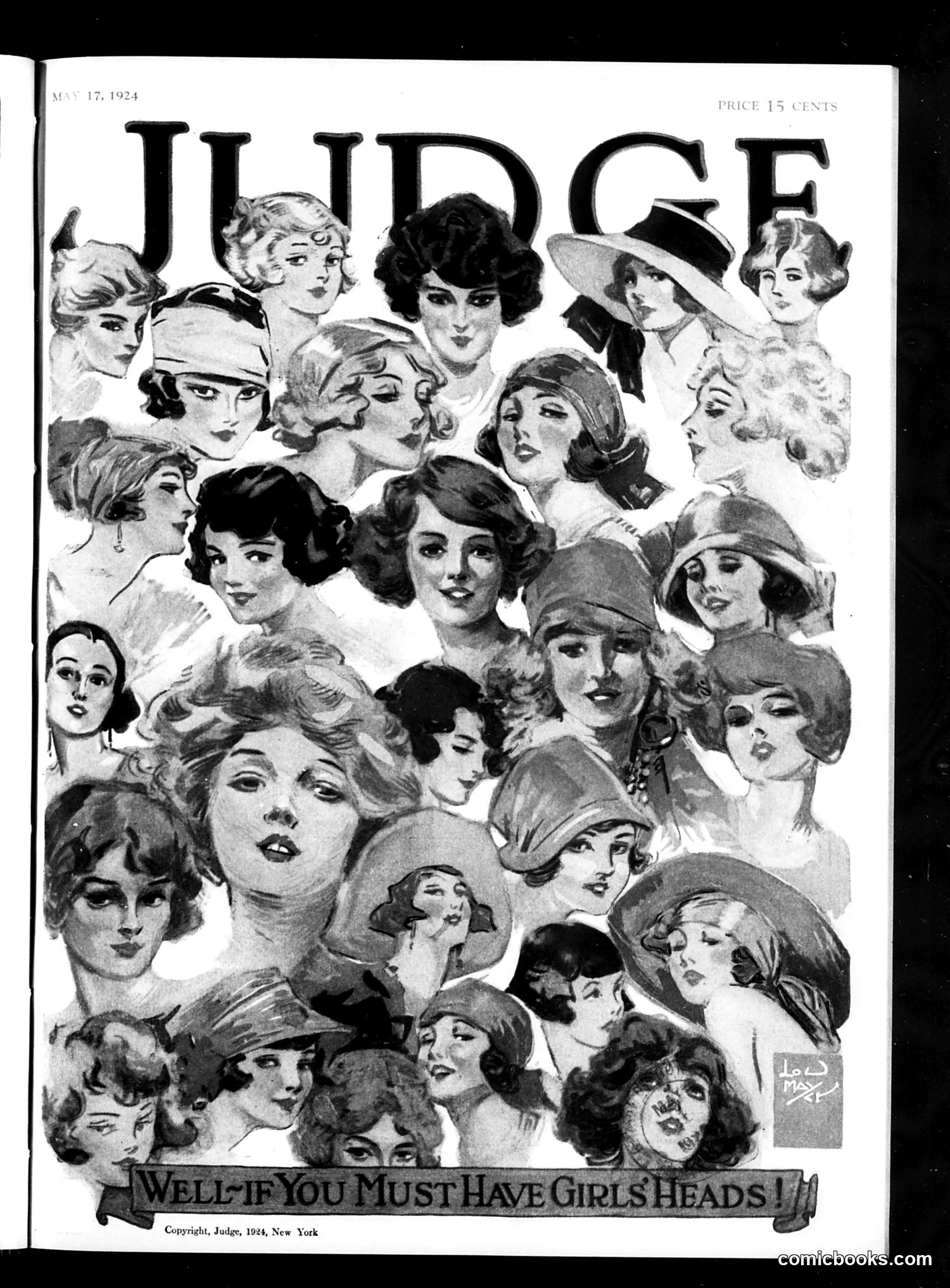
This *Judge* magazine cover from May 17, 1924, satirizes the fashionable bobbed hairstyles of the 1920s. The illustration shows numerous women's faces displaying variations of the "bob"—the short, chin-length haircut that shocked conservative society during this era. The caption's resigned tone ("Well—If You Must") suggests generational tension: older Americans viewed bobbed hair as scandalous and unfeminine, associated with the independent "flapper" culture and women's changing social roles post-suffrage. The crowded composition emphasizes how ubiquitous the style had become, making it an object of both mockery and inevitability. The satire targets not the women themselves, but societal hand-wringing over this symbol of female liberation and modernity.
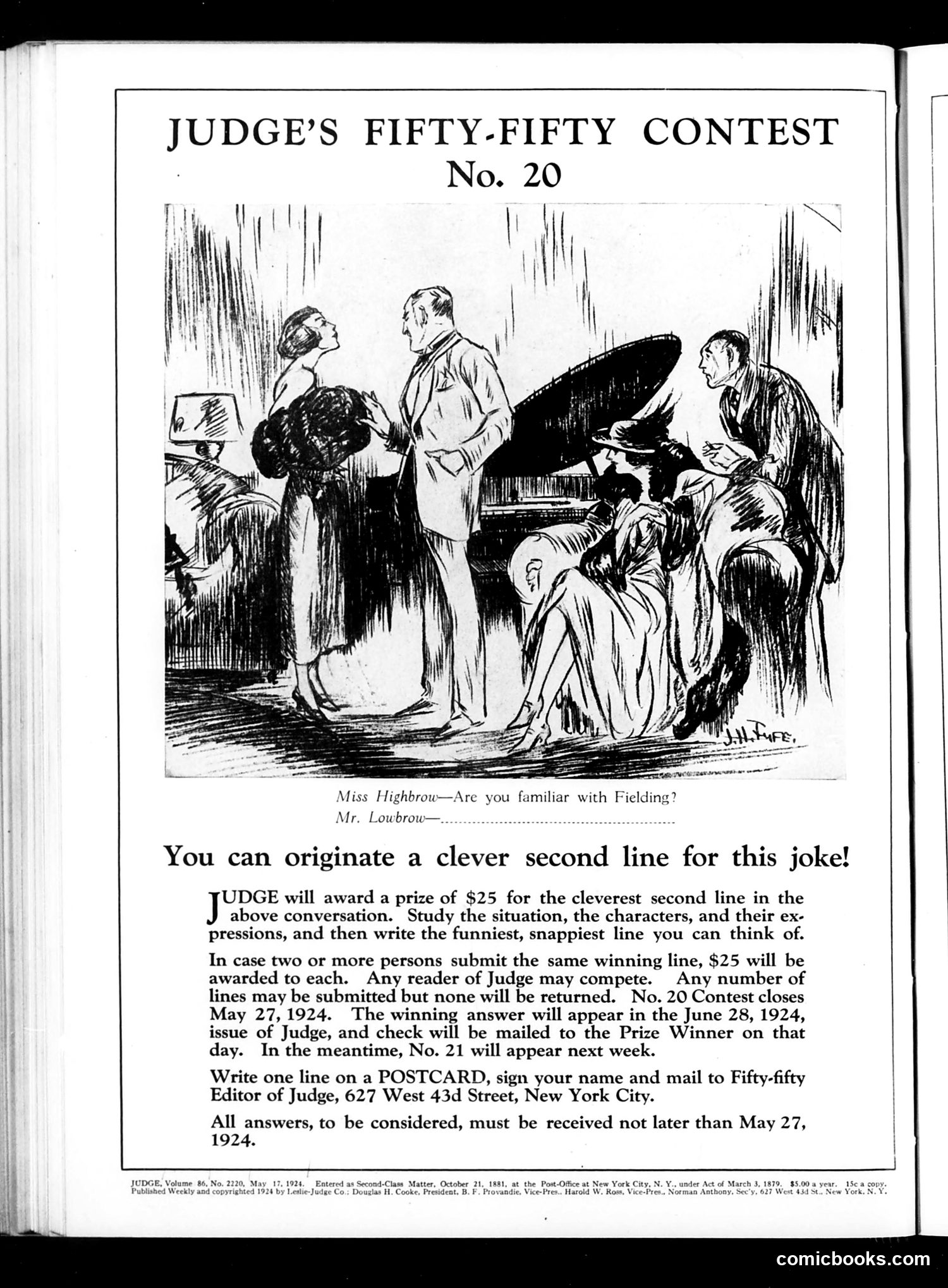
This page presents a cartoon caption-completion contest. The illustration shows a social gathering where a woman (Miss Highbrow) asks a man (Mr. Lowbrow) if he's "familiar with Fielding"—likely referencing Henry Fielding, the 18th-century novelist. The joke's setup exploits the double meaning: "Fielding" could refer either to the literary classic or to something entirely different in colloquial speech. Readers were invited to submit a clever "second line" response for the Mr. Lowbrow character, with a $25 prize for the wittiest answer. The contest reflects Judge magazine's audience participation model and early 1920s social humor contrasting "highbrow" and "lowbrow" cultural literacy—a recurring theme in period comedy.
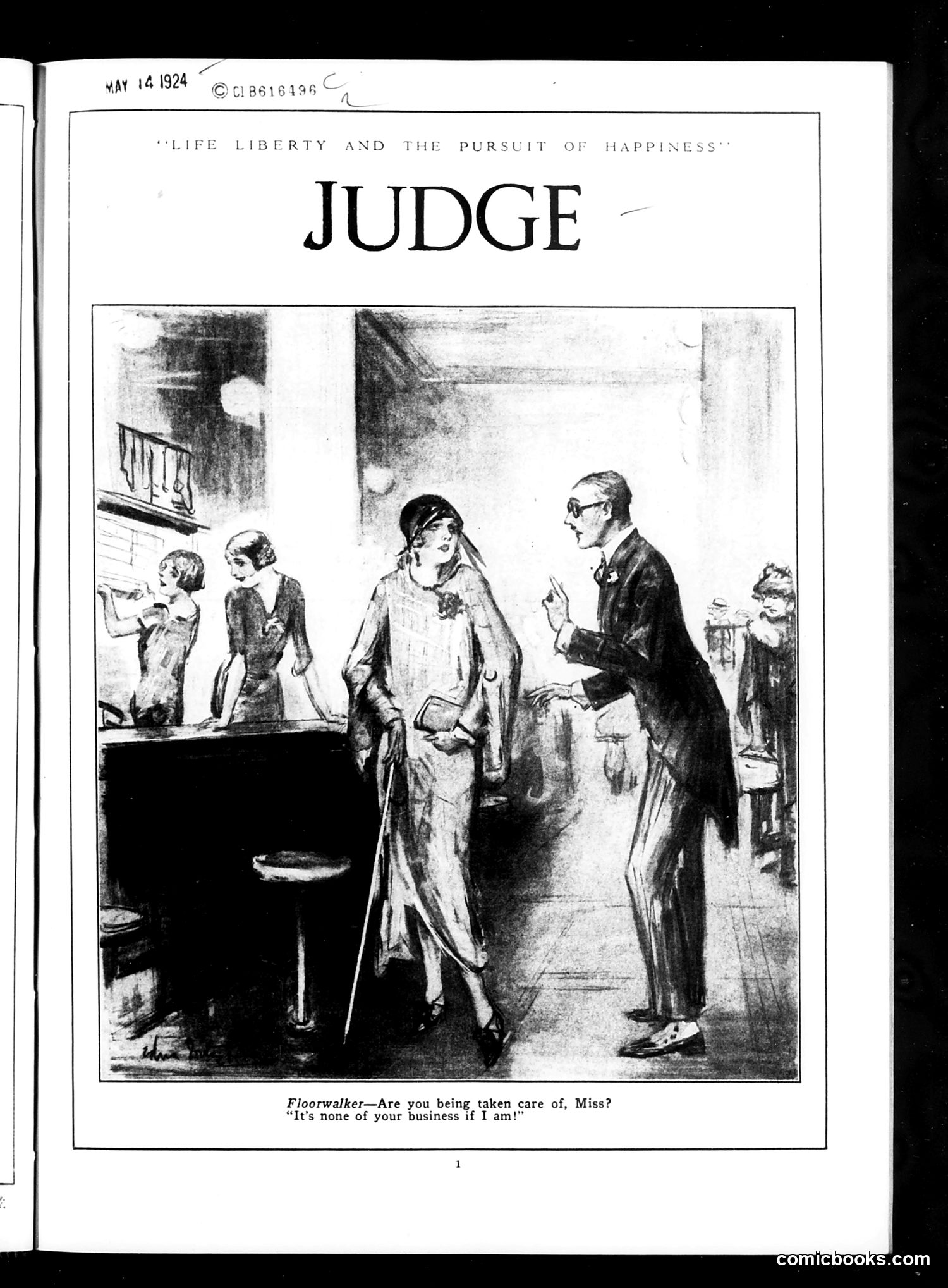
This page depicts a domestic scene involving a "floorwalker" (a department store employee who assisted customers) addressing a woman. The caption reads: "Floorwalker—Are you being taken care of, Miss?" with her response: "It's none of your business if I am!" The satire targets changing social mores of the 1920s, particularly the "New Woman"—the independent, modern female who rejected Victorian propriety. The woman's sharp retort to the solicitous employee suggests she's asserting her right to privacy and autonomy, refusing deference or paternalistic concern. Children visible in the background may emphasize the clash between traditional family structures and modern attitudes. The cartoon mocks both the woman's boldness and the awkwardness it creates in public spaces.
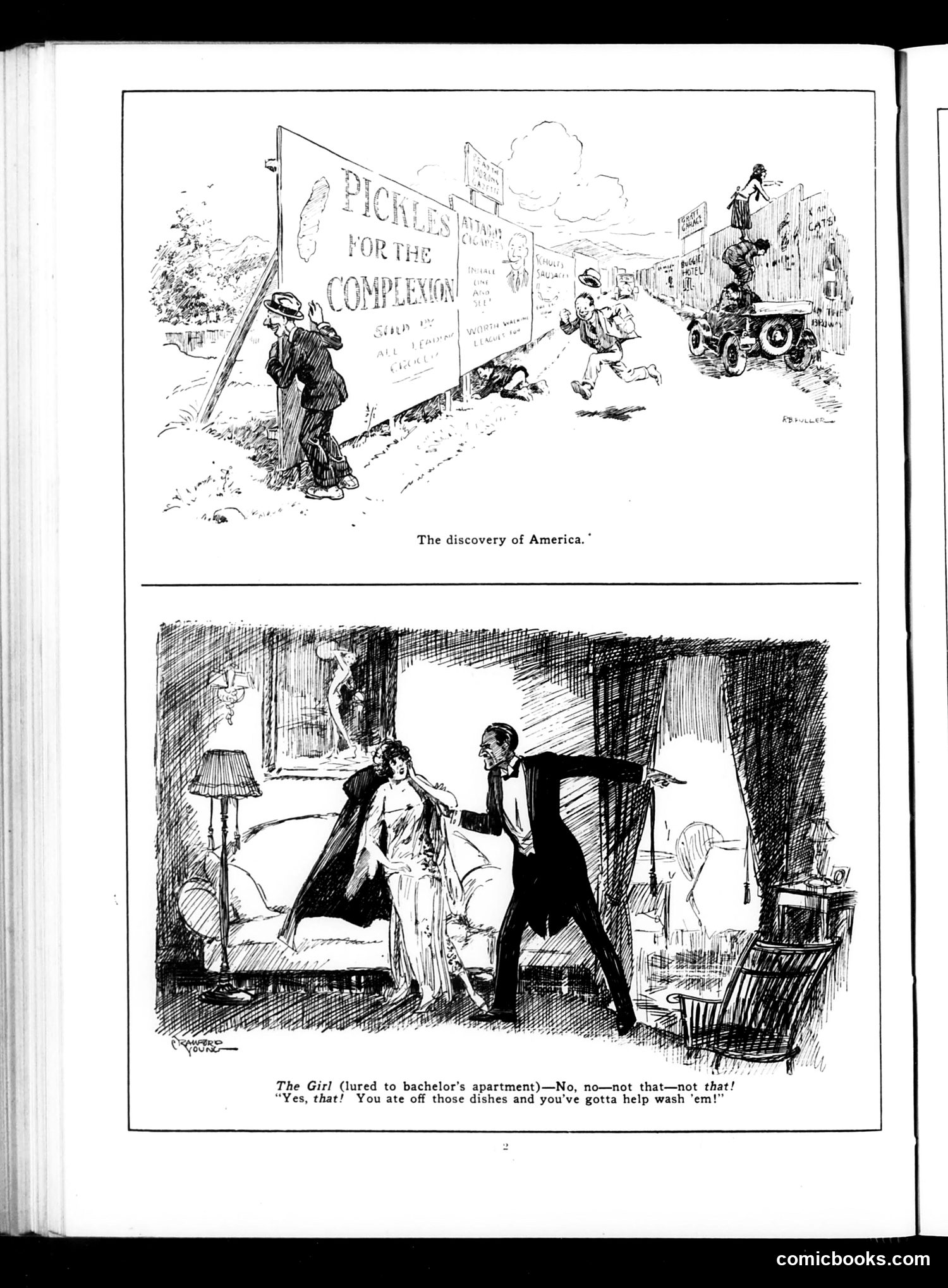
**Top cartoon ("The discovery of America"):** This is satirical commentary on modern commerce and tourism. Children and adults swarm around a street sign advertising "PICKLES FOR THE COMPLEXION" and other dubious products. The title mocks how Americans "discover" (or rediscover) commercial gimmicks and fads, treating newfound merchandise with the reverence historically accorded to Columbus's voyage. The humor lies in equating commercial hype with genuine discovery. **Bottom cartoon ("The Girl"):** A domestic comedy showing a woman in a bachelor's apartment, scolding a man about housework. She demands he wash dishes he dirtied, enforcing domestic responsibility. The satire targets changing gender roles and expectations—perhaps mocking either women's growing assertiveness in male spaces or men's resistance to household duties. The title suggests this represents a new social dynamic worth satirizing.
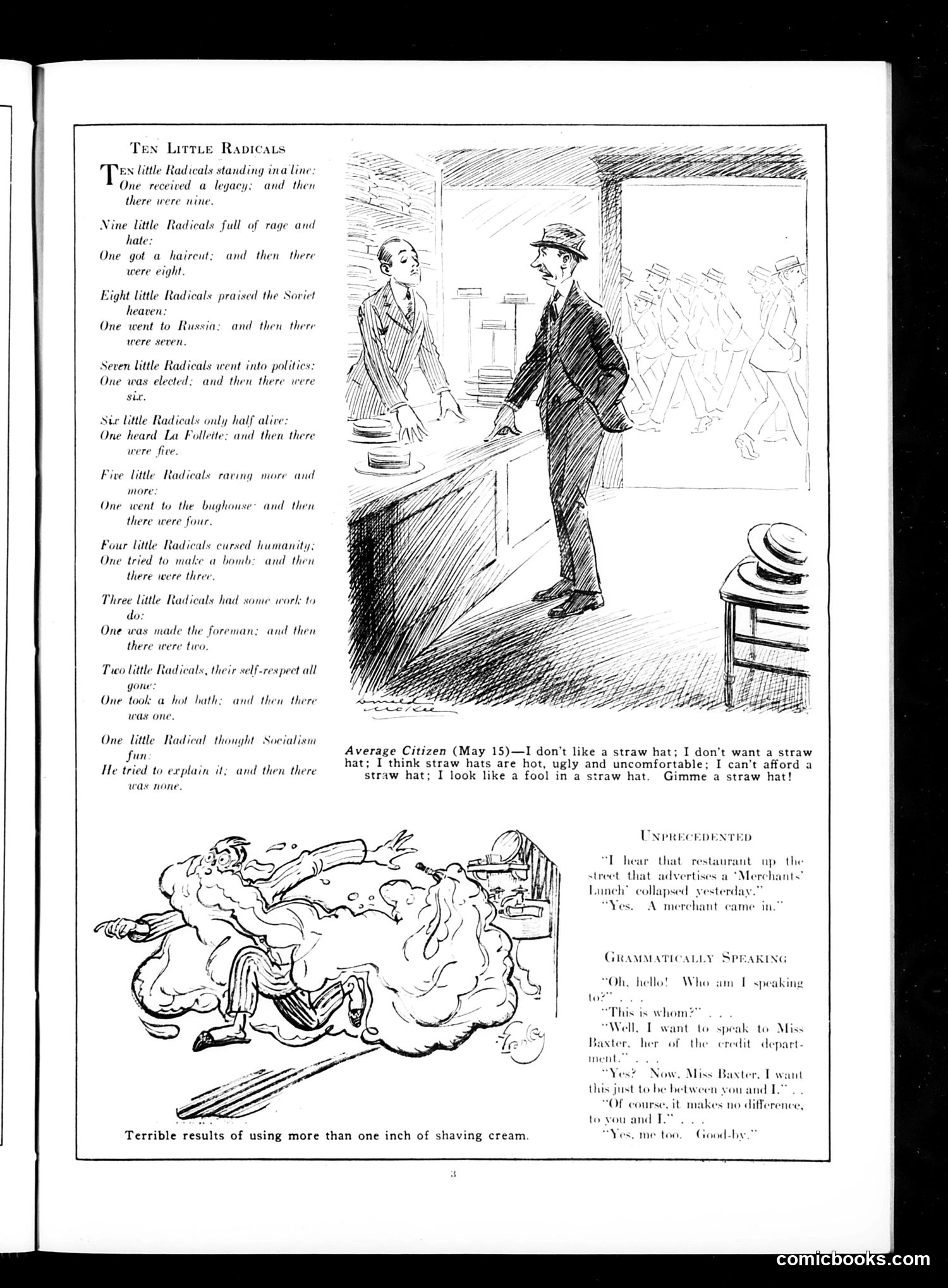
**"Ten Little Radicals"** (top left) is a parody of the children's rhyme "Ten Little Indians," satirizing radical political activists. Each verse describes radicals disappearing through various fates—getting haircuts, fleeing Russia, dying in failed bomb-making—suggesting radicals either reform or meet violent ends. This reflects early 20th-century American anxiety about anarchists and socialist "radicals." **The cartoon below** shows a man engulfed in shaving cream, captioned "Terrible results of using more than one inch of shaving cream." This is straightforward visual humor with no political content. The remaining snippets—"Average Citizen," "Unprecedented," and "Grammatically Speaking"—appear to be brief satirical anecdotes about everyday absurdities, typical of Judge's humor format.
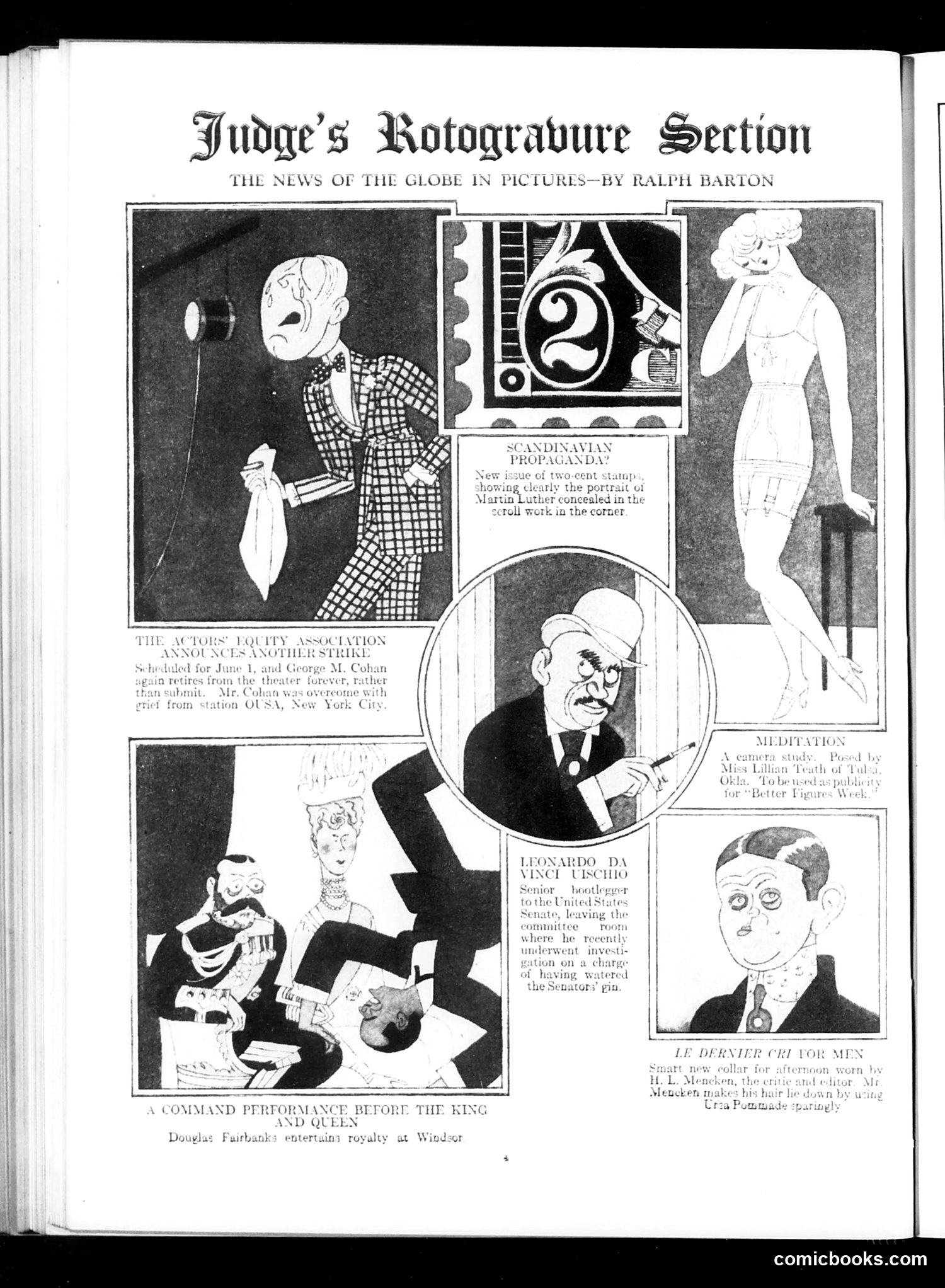
This page contains four satirical cartoons from Judge magazine, likely from the 1920s based on the art style: 1. **"The Actors' Equity Association Announces Another Strike"** - Mocks a labor dispute involving actors Lionel and George M. Cohan, with exaggerated theatrical poses suggesting the melodrama of their conflict. 2. **"Scandinavian Propaganda"** - Depicts caricatured figures promoting Nordic aesthetics or immigration, with text referencing "portrait of Marilyn Leacock" and scroll work, suggesting xenophobic commentary on Scandinavian cultural influence. 3. **"A Command Performance Before the King and Queen"** - Shows Douglas Fairbanks entertaining royalty at Windsor, celebrating his star status. 4. **"Le Dernier Cri for Men"** and other small items mock contemporary fashion trends and social figures through caricature and wordplay typical of period satirical humor.
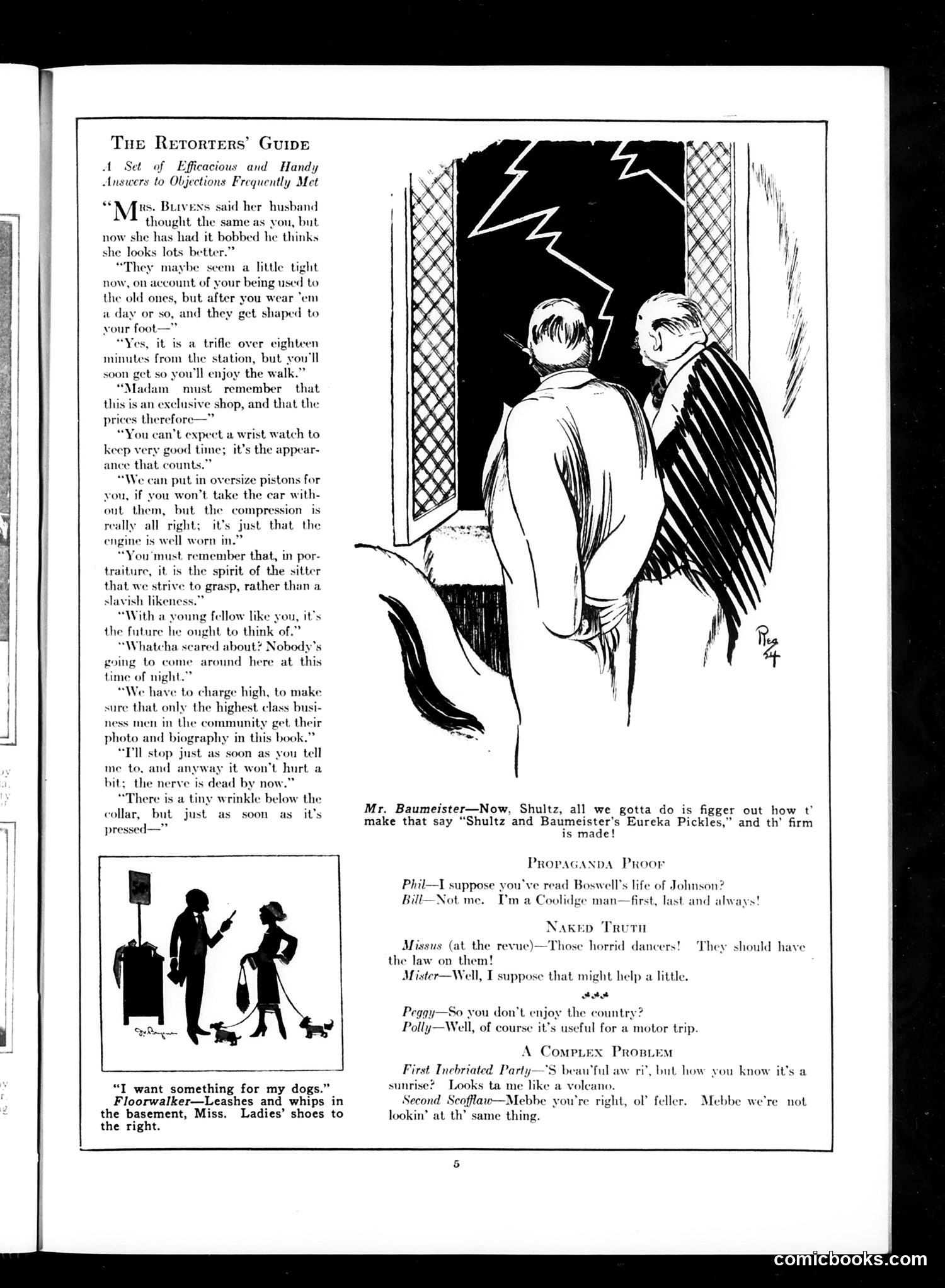
This "Reporter's Guide" satirizes common excuses used to justify poor service or products. The page collects stock responses salespeople, professionals, and service providers use to deflect customer complaints. Examples include: a hairdresser defending a bobbed haircut, a shoe salesman claiming tight shoes will stretch, a realtor dismissing a long commute, a photographer prioritizing "spirit" over likeness, and a dentist claiming a patient's nerve is "dead." The smaller cartoons mock other social evasions: a floorwalker's euphemism for women's shoes; two drunk men disagreeing about whether it's sunrise; a pickle company's rebranding scheme; and a reference to Calvin Coolidge's notoriously taciturn nature. The satire targets 1920s consumer culture—the gap between business promises and reality, and the clever rhetorical strategies used to manipulate customers into accepting mediocrity.
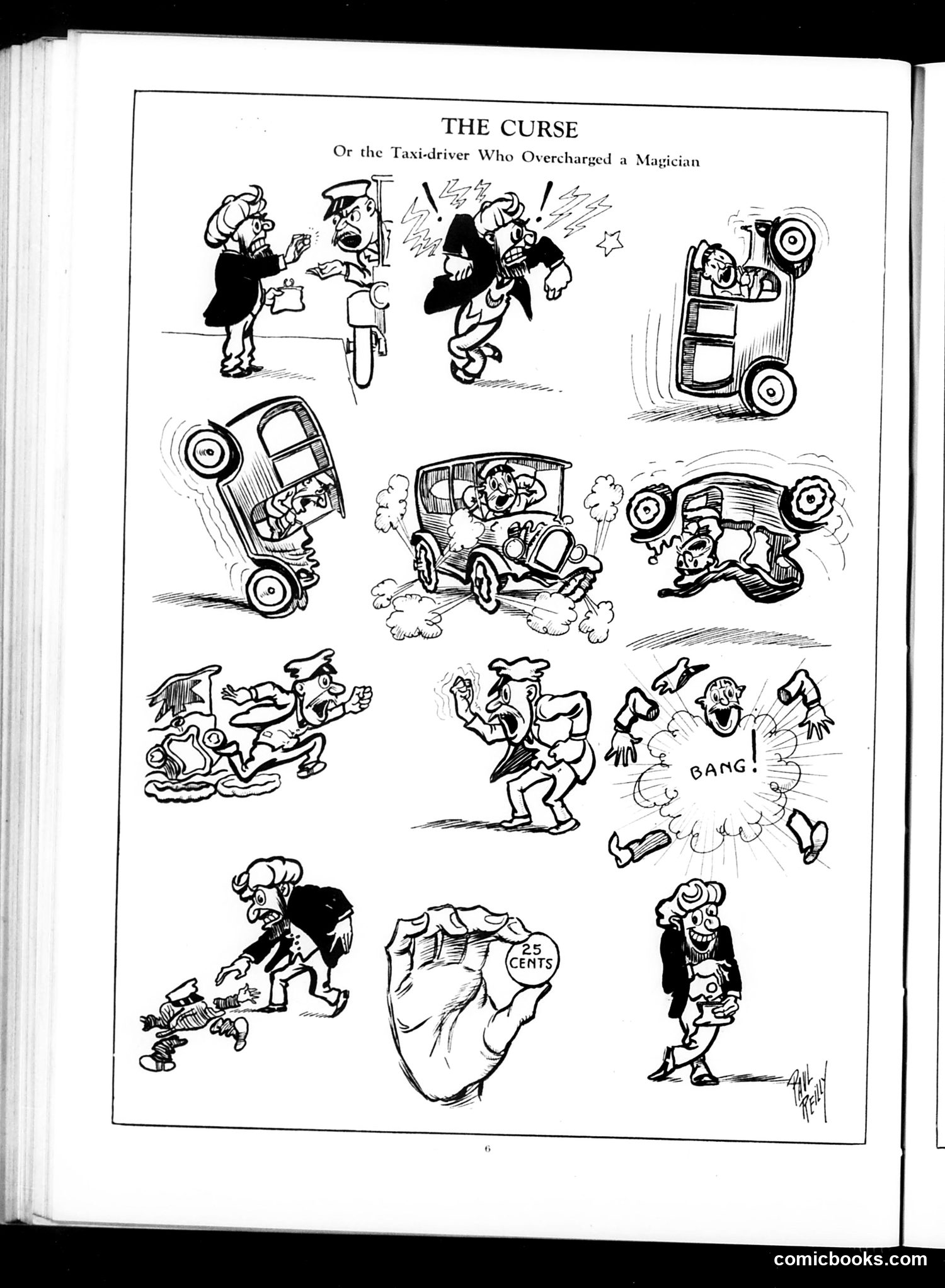
This comic sequence depicts a humorous revenge narrative. A magician (top left) discovers a taxi driver has overcharged him and apparently casts a curse in retaliation. What follows is a series of escalating misfortunes befalling the taxi driver: his cab repeatedly flips and crashes, he experiences increasingly chaotic accidents, and objects appear to spontaneously malfunction around him. The final panel shows the magician collecting payment (suggested by the hand holding money marked "CENTS"). The satire targets the widespread practice of taxi drivers overcharging passengers—a common urban complaint in early 20th-century America. The joke plays on the idea that wronging a magician brings magical retribution, suggesting such cheating should carry supernatural consequences. It's lighthearted social commentary wrapped in fantasy.
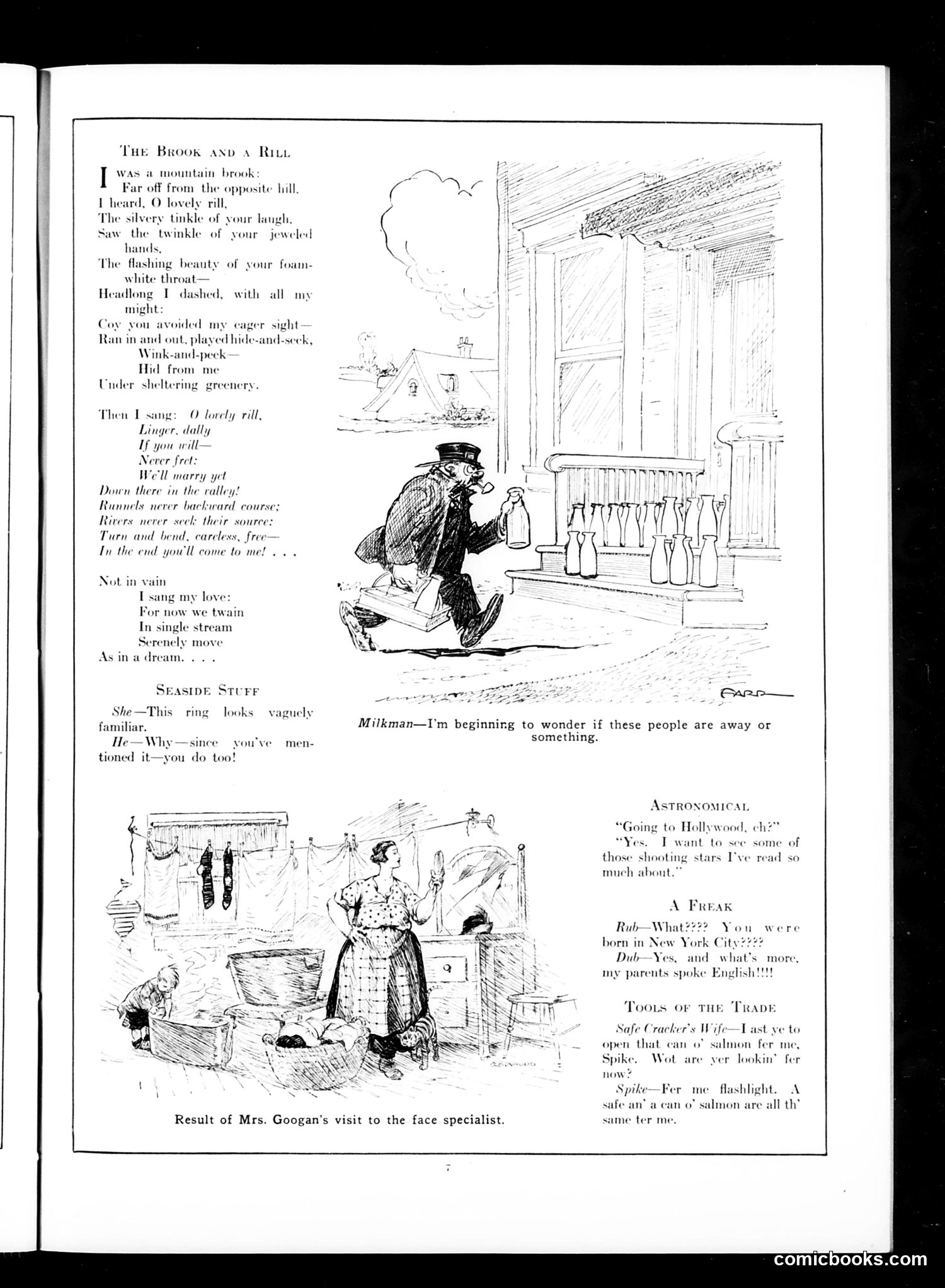
This page contains several brief humor pieces typical of Judge's satirical style: **"The Brook and a Rill"** is a romantic poem about two streams merging, using water as metaphor for courtship and marriage. **"Seaside Stuff"** jokes about a couple recognizing a ring, with the implication of shared romantic history. **"Astronomical"** pokes fun at Hollywood's appeal—the speaker wants to see "shooting stars," conflating celestial phenomena with movie stars. **"A Freak"** satirizes class/ethnic pretension: a New York City native whose parents spoke English is presented as oddly noteworthy, likely mocking either affected speech or the speaker's surprise that immigrants' children assimilate. **"Tools of the Trade"** depicts a safe-cracker's wife, where the husband treats opening a salmon can identically to cracking safes—dark humor about a criminal's mindset. The **illustration** below shows the aftermath of Mrs. Googan's cosmetic procedure, suggesting unsuccessful or absurd results from a "face specialist." These represent Judge's mix of wordplay, social observation, and visual gags.
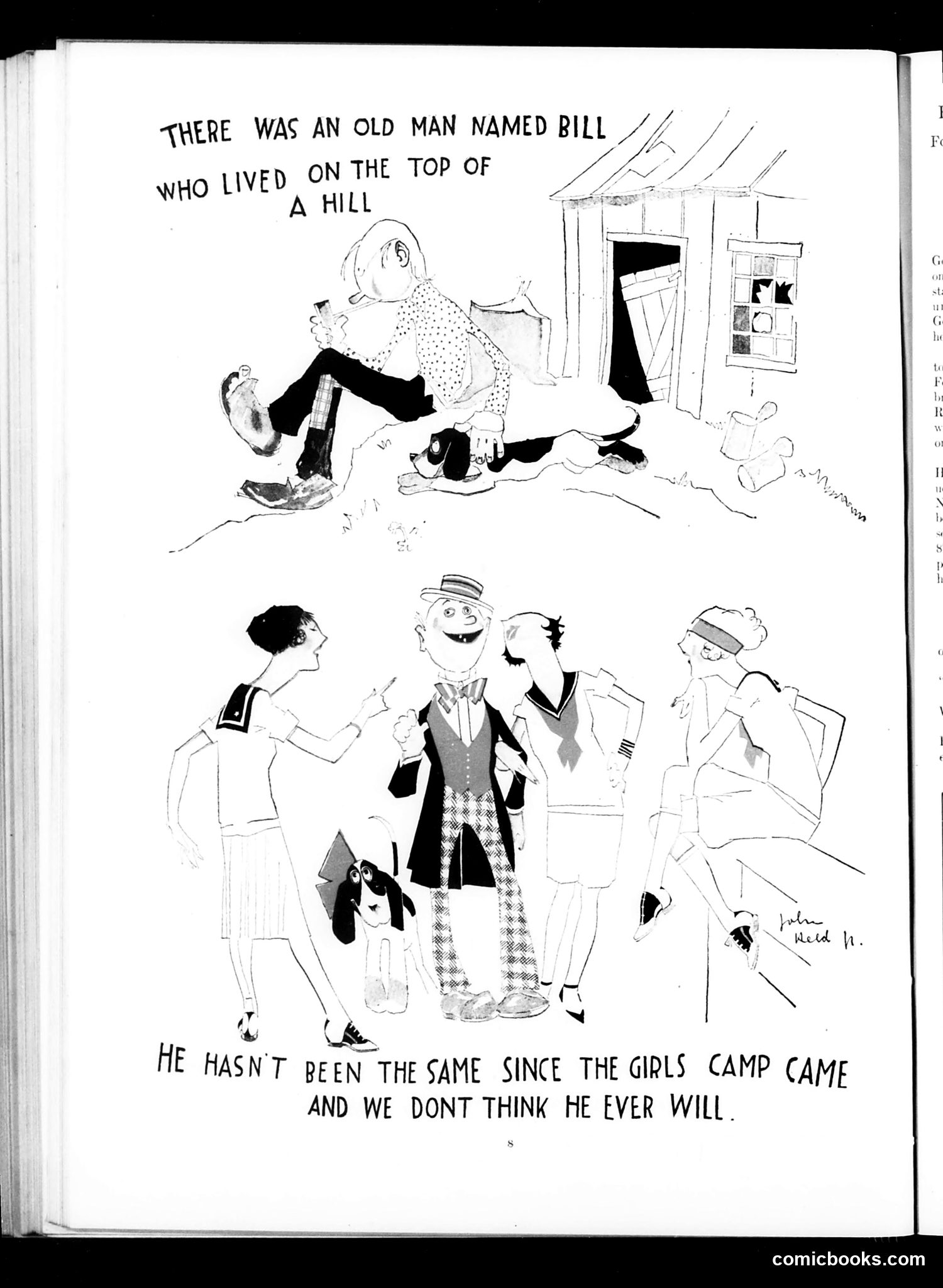
This is a humorous comic based on the nursery rhyme "There Was an Old Man Named Bill." The top panel shows an elderly man living in a modest hilltop home. The bottom panel depicts him surrounded by young women from a nearby girls' camp, with Bill grinning widely while three men observe him with expressions of resignation or dismay. The joke satirizes how the arrival of the girls' camp has transformed the old man's life and temperament—he's now energized and besotted with the attention of young women, much to the dismay of his male peers. The humor plays on the contrast between his previously quiet existence and his sudden, dramatic change in behavior and mood since the camp's arrival. It's a lighthearted commentary on aging, romance, and how female attention can revitalize an older man's spirits.
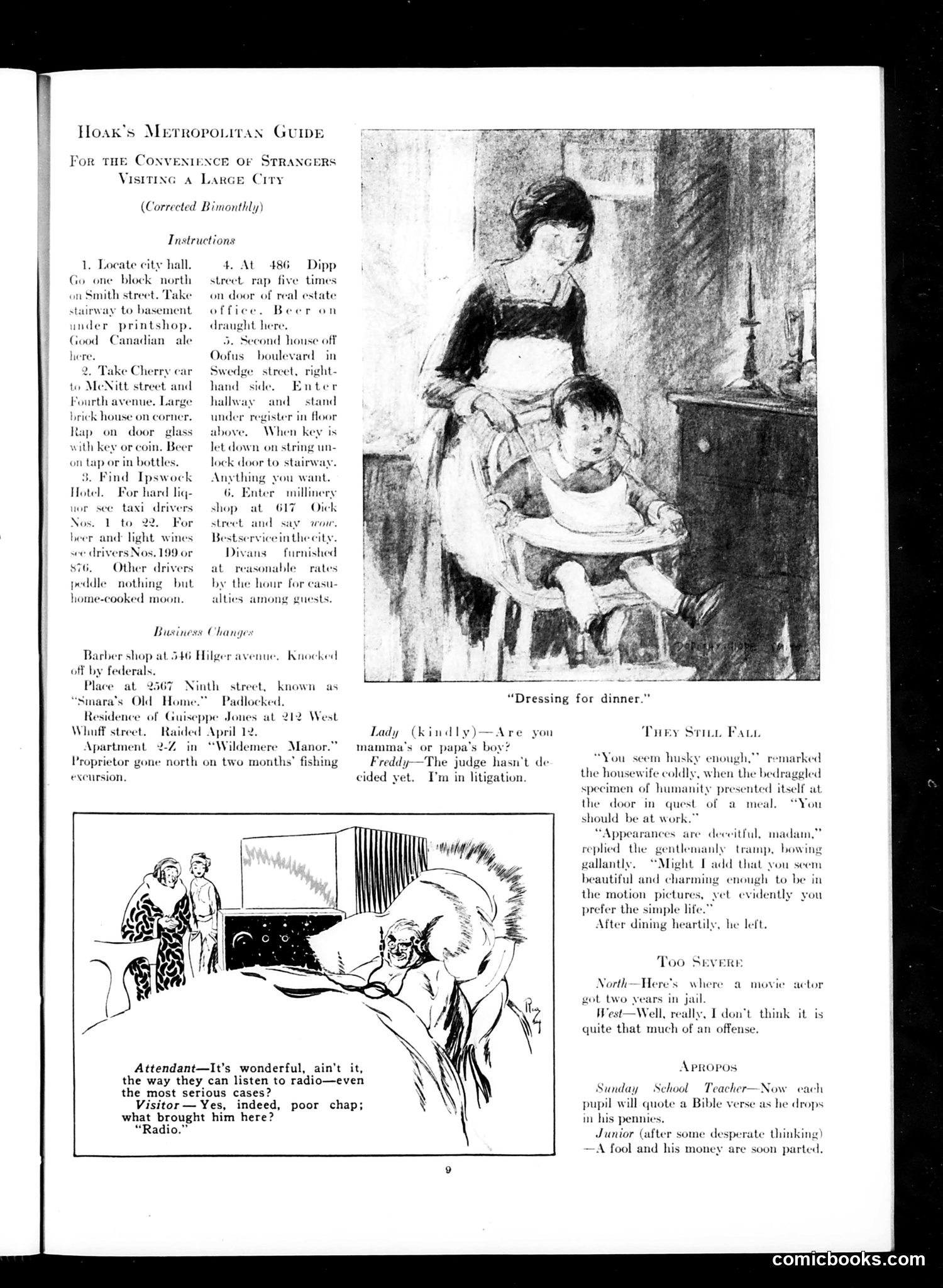
This page satirizes Prohibition-era urban corruption and vice. "Hoak's Metropolitan Guide" mockingly presents a map for accessing illegal alcohol and gambling in a major city—speakeasies disguised as legitimate businesses (real estate offices, milleries, taxi services). The guide's format parodies official city tourism materials while its content exposes widespread lawbreaking. The "Business Changes" section records recent federal raids on speakeasies and gambling operations, suggesting futile enforcement efforts. The cartoon depicts a man listening to a radio while two figures discuss it in a bedroom—likely satirizing radio's novelty or distraction from serious matters. Other humor pieces mock vagrant con artists and Sunday school hypocrisy. The overall message: Prohibition created rampant underground criminal networks that were openly known and tolerated in American cities, making enforcement laughable.
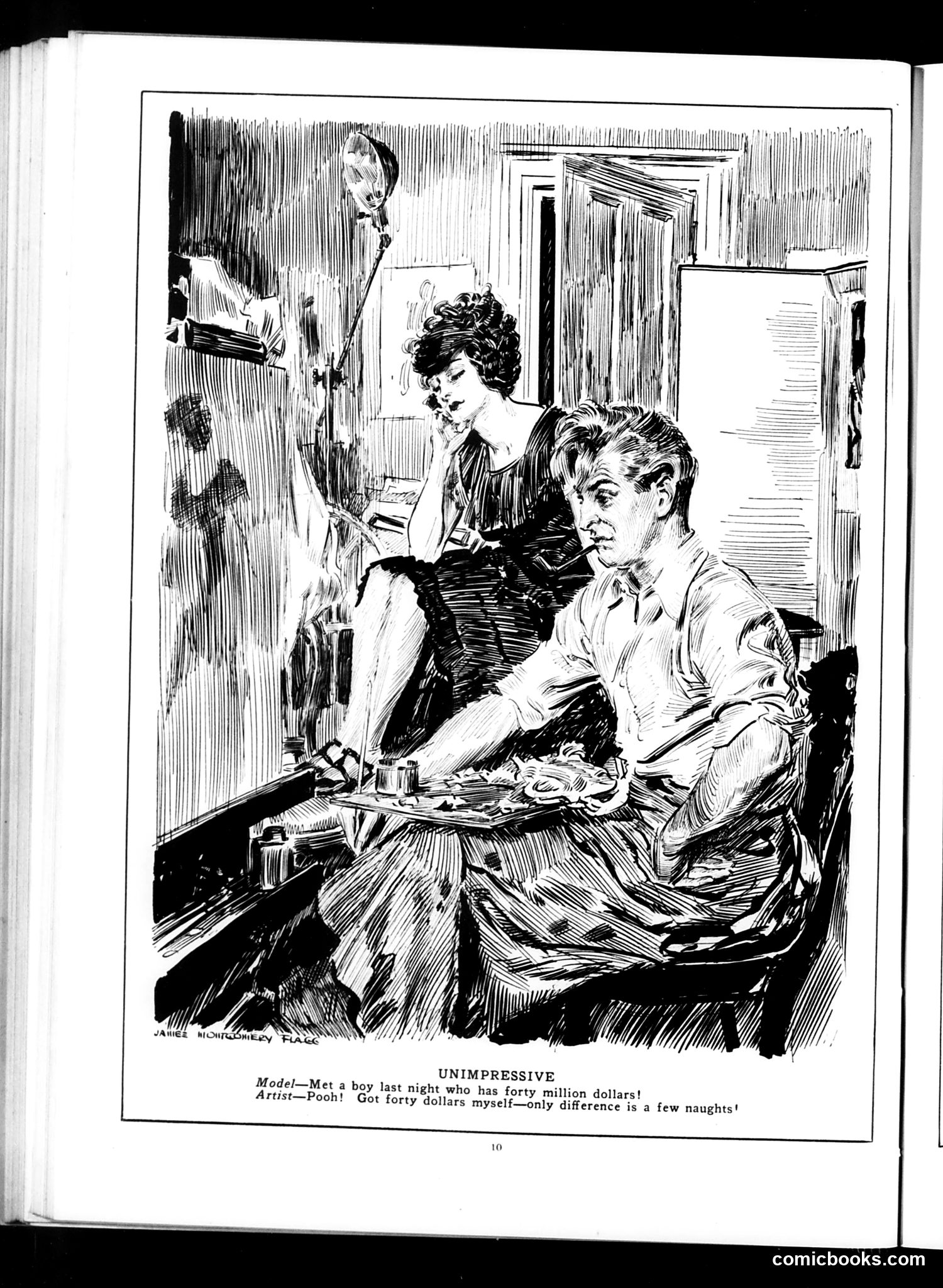
This single-panel cartoon satirizes wealth and artistic pretension. An artist dismisses a wealthy model, saying he met a boy last night worth forty million dollars—yet sees "only difference is a few naughts!" (British slang for zeros). The joke mocks the artist's apparent materialism: he values people primarily by their bank accounts rather than character. It simultaneously ridicules nouveau riche ("new money") culture, suggesting that extreme wealth doesn't confer actual sophistication or distinction. The model's apparent attractiveness is rendered meaningless compared to the other man's vast fortune. The cartoon reflects early 20th-century anxieties about American wealth inequality and the perceived moral bankruptcy of those obsessed with money over substantive qualities.
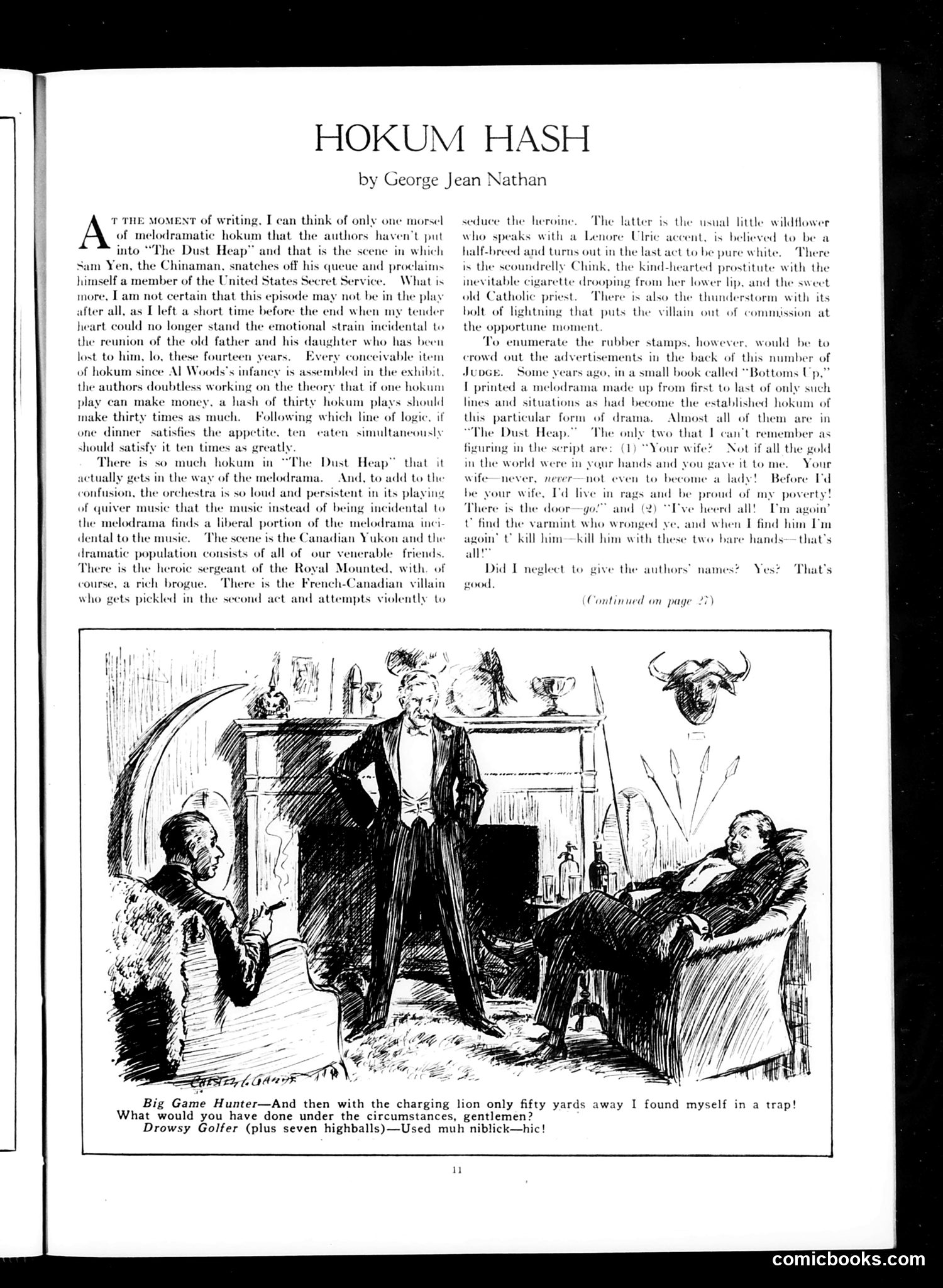
This is a theater review by critic George Jean Nathan attacking the melodrama "The Dust Heap" for relying excessively on tired, contrived plot devices (which he calls "hokum"). Nathan catalogs the clichés: the Chinese character, the innocent heroine with a mysterious past who turns out to be "pure white," the French-Canadian villain, the sympathetic prostitute, the thunderstorm finale that conveniently eliminates the villain. He argues the play throws in *everything* without restraint, assuming that if one hokum play succeeds financially, thirty hokum plays mashed together will succeed thirty times over. The small cartoon below illustrates an unrelated joke: a drowsy golfer claims he once used a golf club (niblick) against a charging lion fifty yards away—an obviously false tall tale he's embellished with alcohol. The satire targets both theatrical laziness and the absurd recycling of melodramatic tropes audiences had seen countless times before.
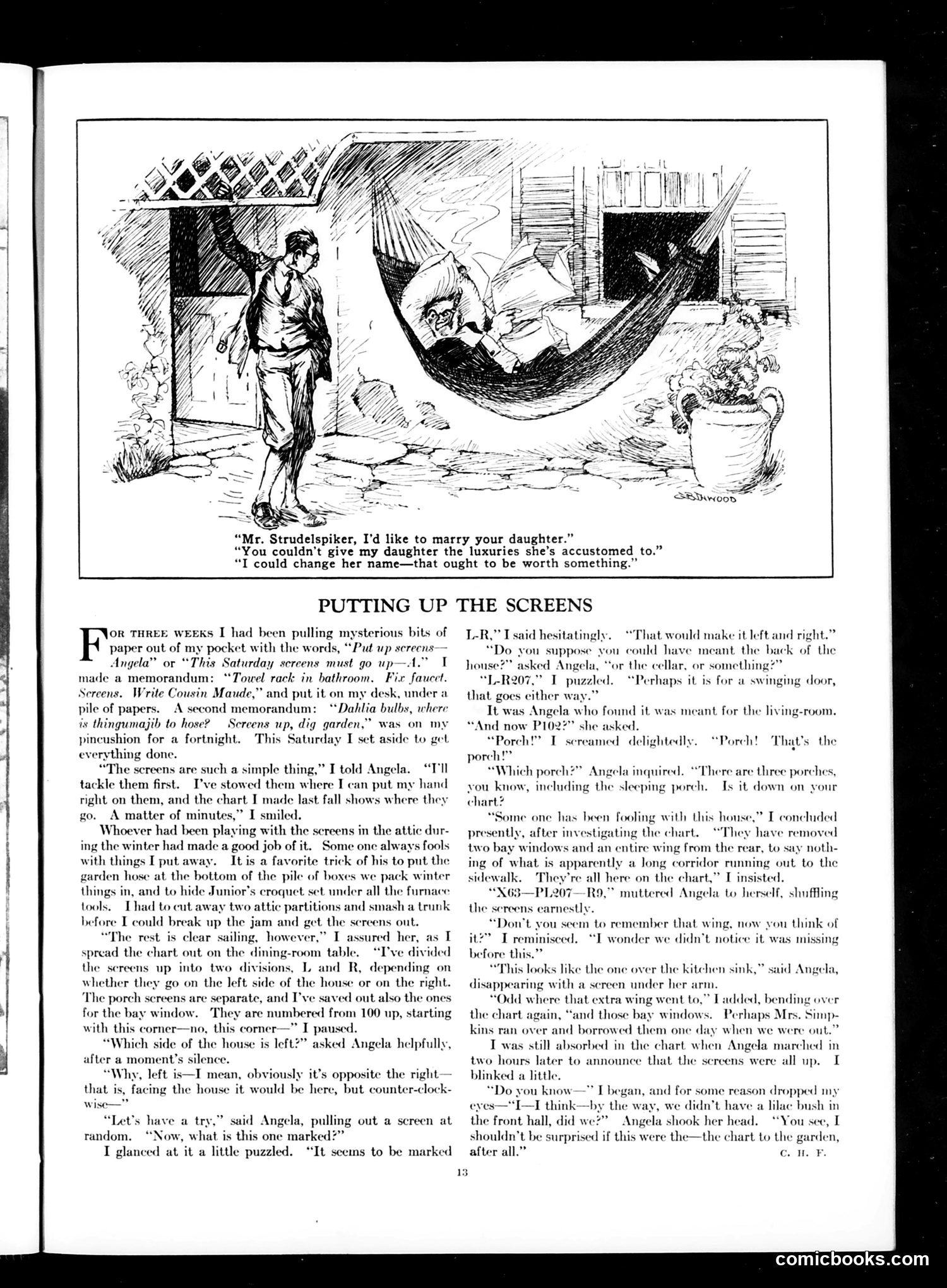
The page contains a single-panel cartoon and accompanying humorous short story, both about domestic life. **The Cartoon:** A suitor proposes to marry a woman, but her father refuses, saying he cannot provide the luxuries she's accustomed to. The suitor's response—"I could change her name—that ought to be worth something"—is the joke: he suggests that a changed surname is somehow compensation for financial inadequacy. This satirizes both social climbing (marrying for status) and the notion that a woman's value derives from her name/marital status rather than material circumstances. **The Story:** A husband attempts to organize and install window screens using a chart, but finds the numbering system confusing and discovers the house layout on the chart no longer matches reality (missing wings, bay windows). Angela (his wife) eventually succeeds where he fumbles. The satire mocks masculine incompetence at household tasks and the gap between male confidence and actual capability—common Judge magazine themes ridiculing domestic fumbling. Both pieces humorously expose upper-middle-class anxieties about marriage, money, and gender roles.
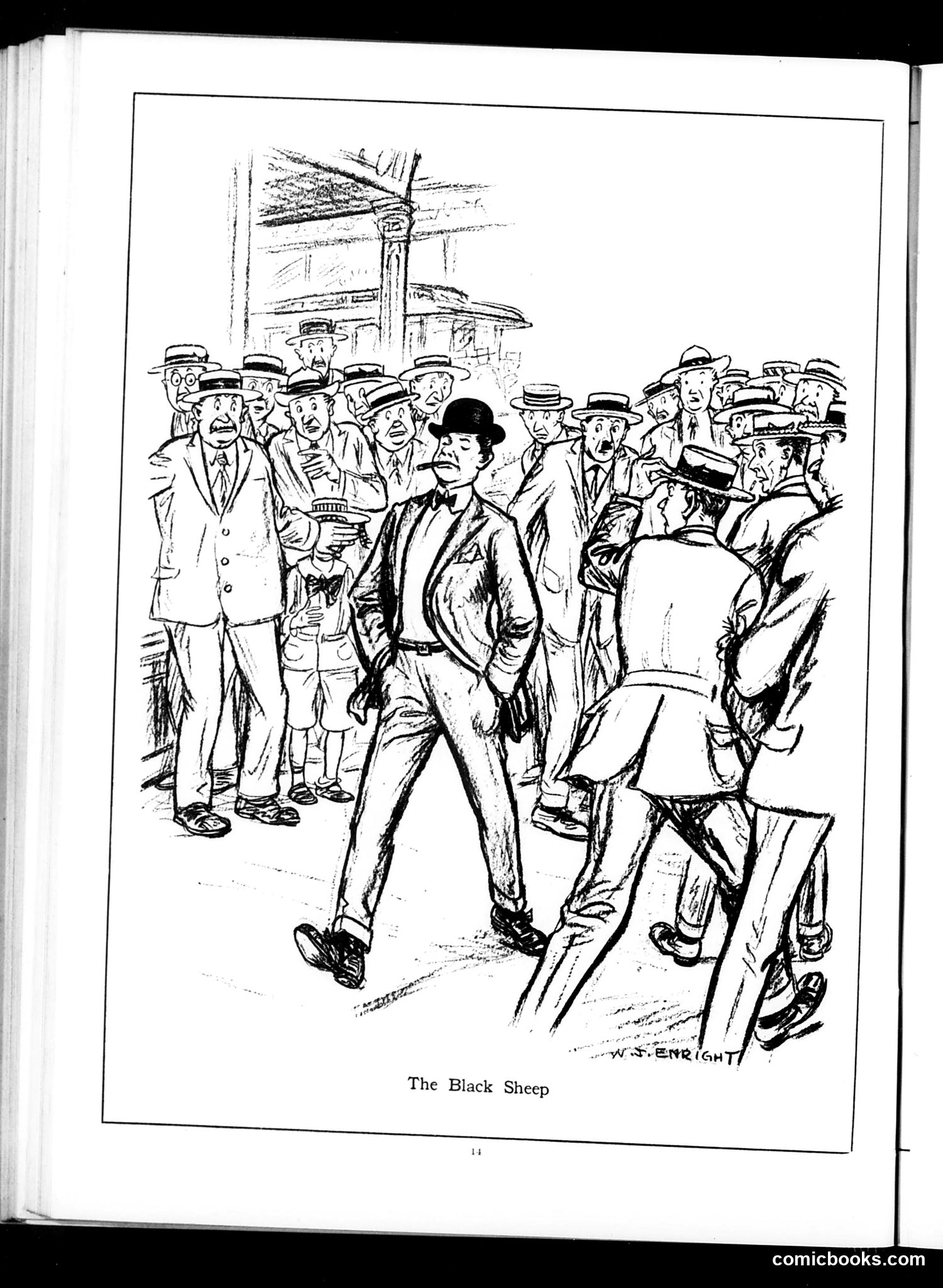
This cartoon depicts a man in dark clothing standing apart from a crowd of formally dressed gentlemen in suits and hats, all appearing to gather outside what looks like a public building or institution (possibly a courthouse or government building). The title "The Black Sheep" is the key to understanding the satire. The phrase refers to someone who doesn't fit in with their family or group—an outsider or nonconformist. The visual metaphor shows one figure visibly distinguished from the crowd, suggesting commentary on social ostracism or the treatment of someone viewed as undesirable or scandalous within respectable society. Without additional context from the magazine issue, the specific identity of the "black sheep" figure remains unclear, though the cartoon likely comments on a contemporary public figure or social situation involving rejection from mainstream circles.
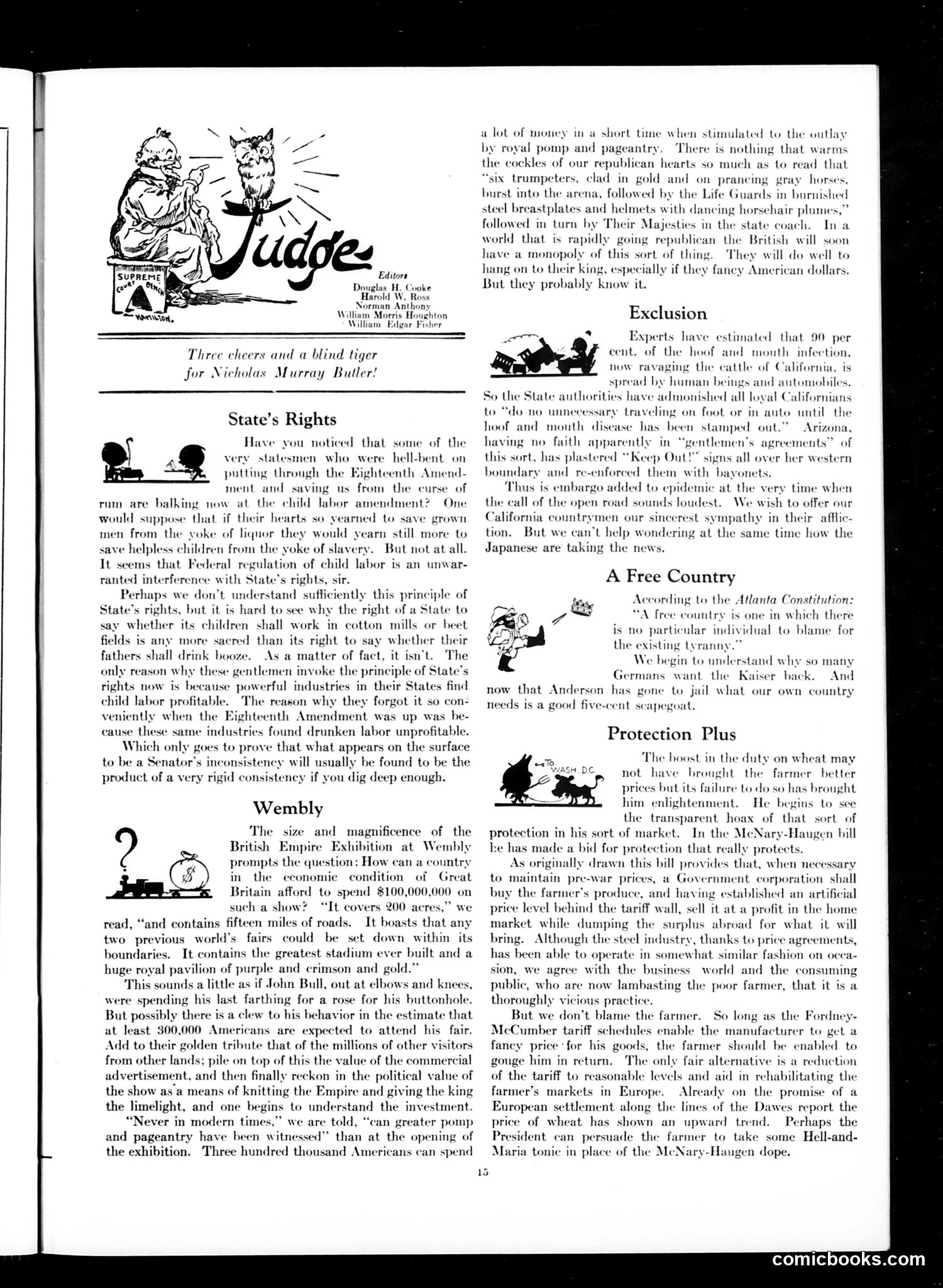
This page contains three political editorials with accompanying cartoons: **"State's Rights"**: Satirizes senators who championed the 18th Amendment (Prohibition) as a federal intervention for moral good, yet oppose federal child labor laws as unconstitutional "State's rights" violations. The hypocrisy is exposed: these same senators supported federal power when it benefited their states' industries (by eliminating "drunken labor"), but now invoke states' rights to protect child labor in their cotton mills and beet fields—revealing their consistency is purely financial self-interest, not principle. **"Wembly"**: Mocks Britain's lavish $100 million British Empire Exhibition while the nation faces economic hardship ("John Bull, out at elbows and knees"). The satire suggests Britain stages this extravagant spectacle specifically to attract wealthy American visitors and their dollars, using royal pageantry and imperial grandeur to manipulate republican Americans into spending money. **"Exclusion"**: Briefly notes California's quarantine against hoof-and-mouth disease spread by human contact and automobiles. The page criticizes political hypocrisy, financial self-interest masquerading as principle, and imperial manipulation of American wealth.
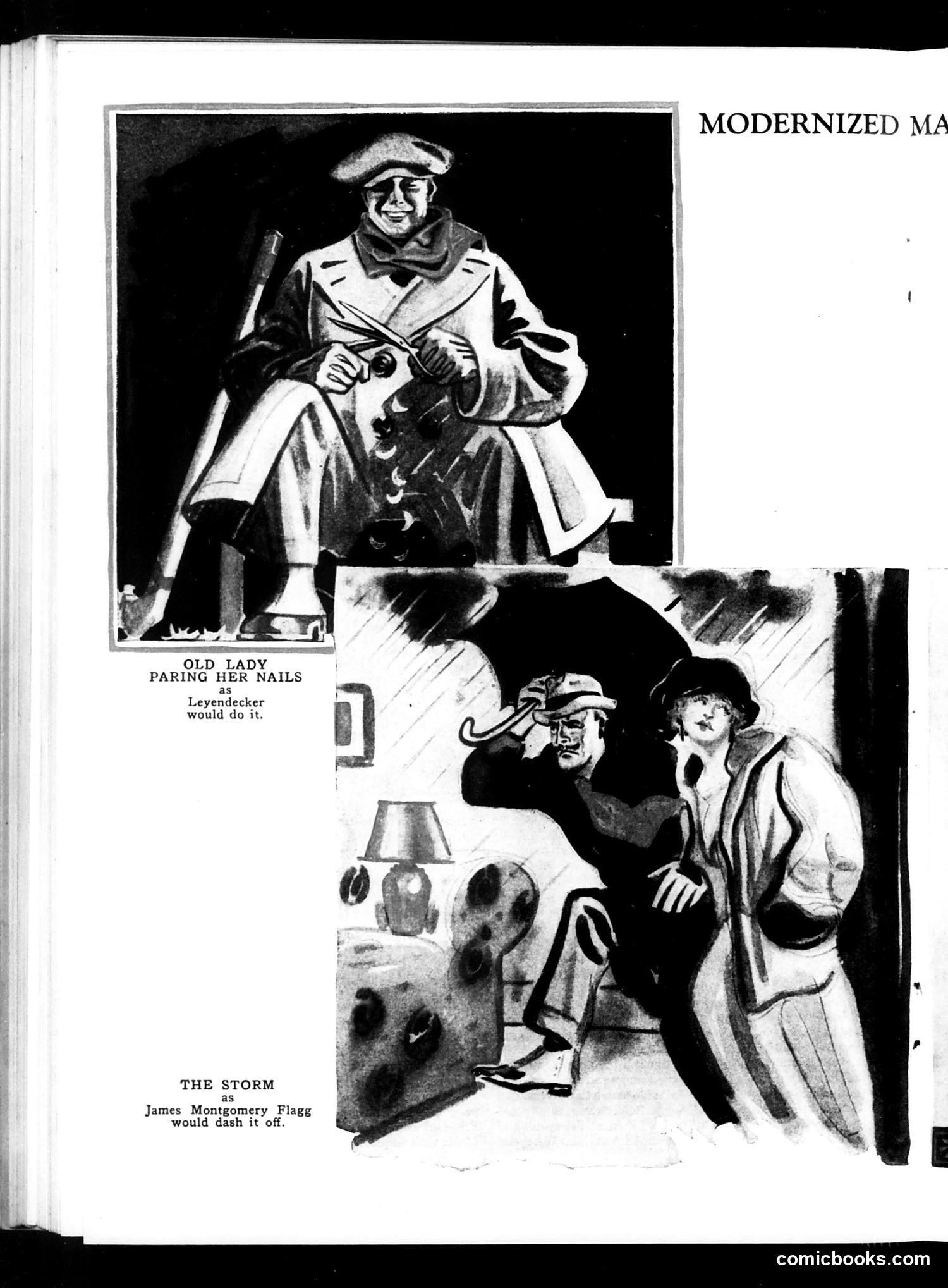
This page contains two satirical art parodies mocking the distinctive styles of famous illustrators. The top image shows an "Old Lady Paring Her Nails" rendered in the precise, polished style of J.C. Leyendecker, known for his refined commercial illustrations. The bottom image depicts "The Storm" as James Montgomery Flagg would execute it—apparently more dramatically and loosely rendered. Both captions suggest these artists had recognizable, signature approaches to their work. The satire mocks how identifiable their artistic mannerisms were, implying their styles were so distinctive that even mundane subjects became recognizable as "theirs." This appears to be playful professional ribbing within the illustration community circa the early 20th century.
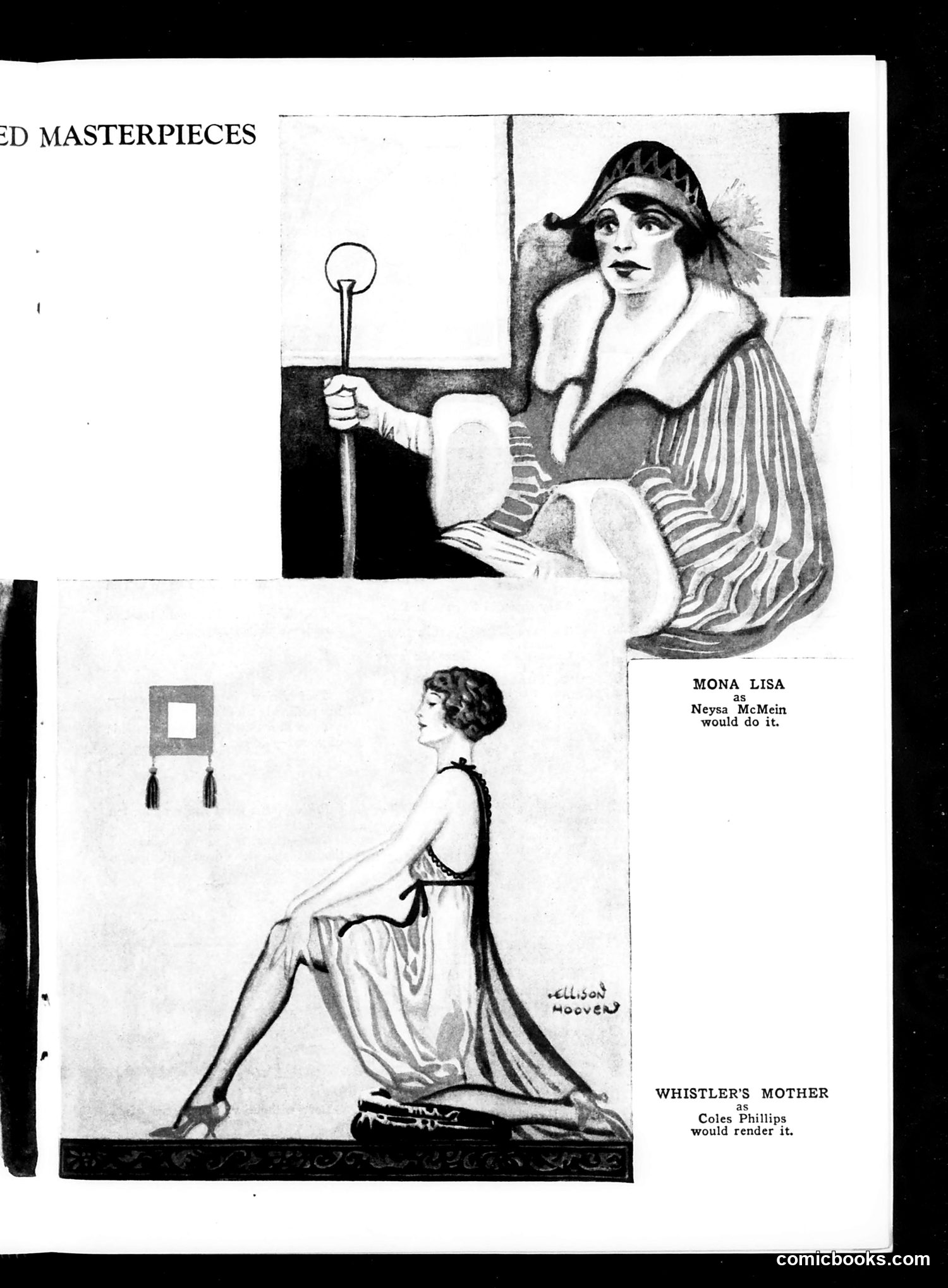
This page satirizes two prominent illustrators of the era—Neysa McMein and Coles Phillips—by reimagining famous artworks in their distinctive styles. The top image shows the Mona Lisa reinterpreted by McMein as a fashionable 1920s woman: flapper-style clothing, bobbed hair, and a modern pose with a cigarette holder instead of da Vinci's subtle mystery. The bottom shows Whistler's Mother rendered by Phillips in his signature style: an elegant, simplified silhouette emphasizing graceful lines and fashion rather than psychological depth. The satire suggests these popular commercial illustrators would strip away the original paintings' artistic substance, replacing timeless human complexity with contemporary fashion and glamour. It's gentle mockery of how commercial illustration trends could trivialize canonical masterpieces.
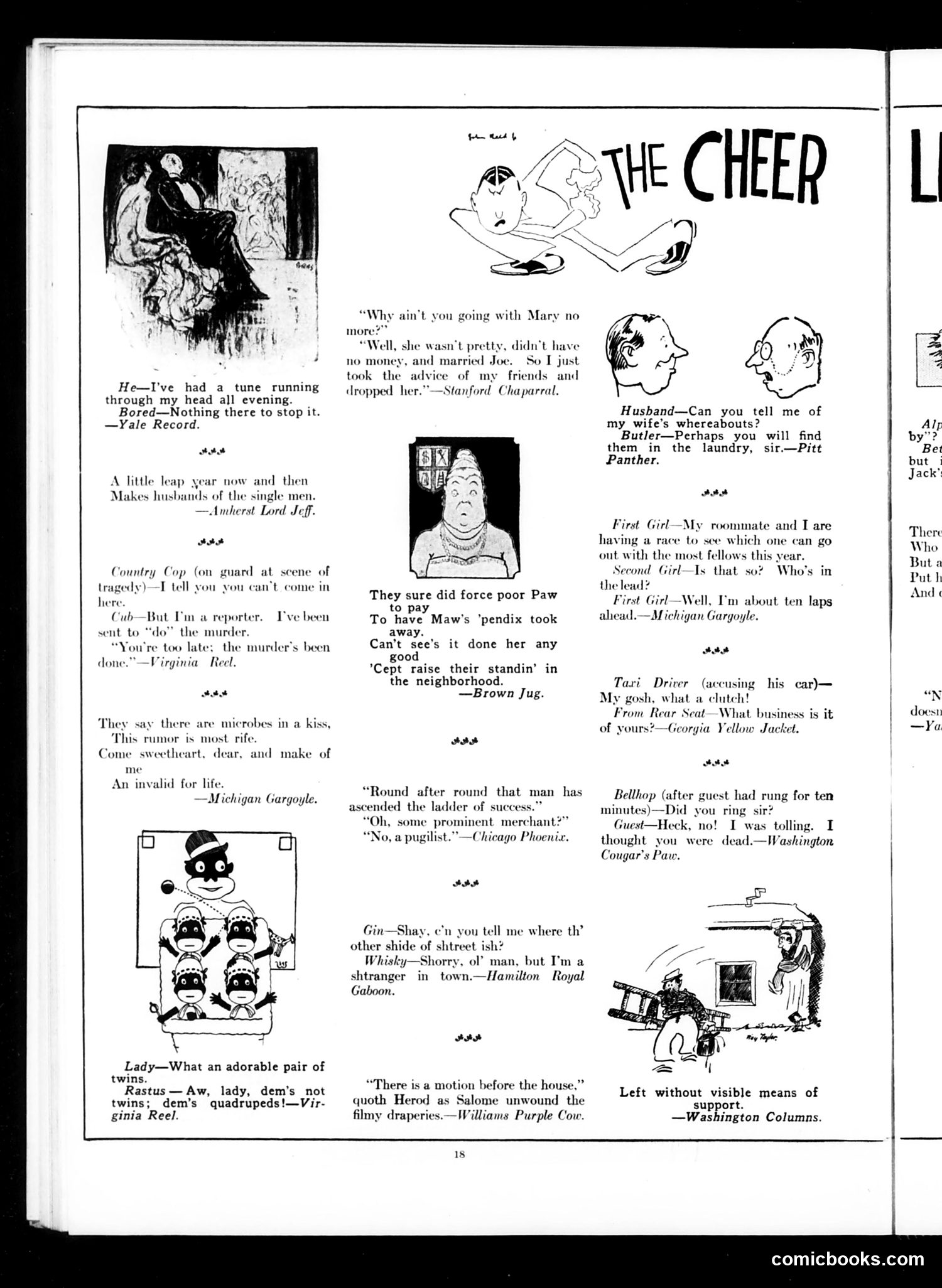
This is a collection of short jokes and comic vignettes typical of early 20th-century college humor magazines. The content reflects period social attitudes: **Notable elements:** - **Racial caricature**: The "Rastus" joke uses a dehumanizing stereotype, calling Black children "quadrupeds" instead of twins—reflecting the casual racism of the era. - **Gender/marriage jokes**: Multiple entries mock wives ("whereabouts in the laundry"), leap year customs, and women competing for male attention—reflecting period anxieties about changing gender roles. - **Working-class humor**: Jokes about taxi drivers, bellhops, and cops reflect urban American life. - **Intoxication jokes**: References to "gin" and "whisky" personified as drunk characters, common in Prohibition-era humor. - **Biblical allusion**: The Herod/Salome reference is a knowing literary joke for educated readers. The page primarily offers light, often crude social commentary rather than political satire, capturing 1920s-era collegiate wit and casual prejudices.
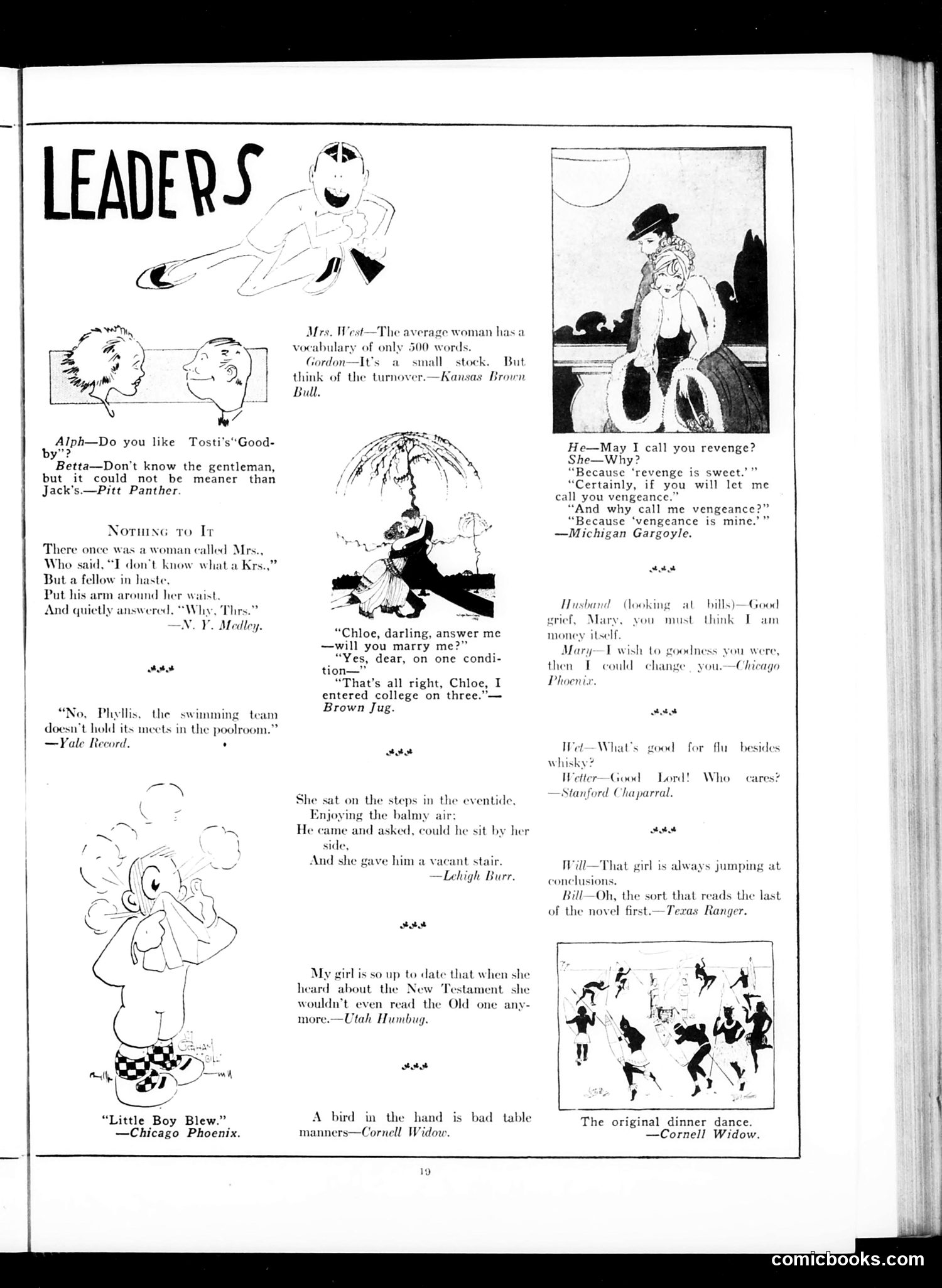
This page collects brief humorous quips and jokes typical of early 20th-century college magazines and satirical publications. The content includes: **Visual jokes**: A caricatured figure labeled "Little Boy Blew" (likely referencing the nursery rhyme), paired illustrations of flirtation scenes, and a final sketch of "the original dinner dance." **Verbal humor** centers on: - Gender stereotypes (women's limited vocabulary, wives' spending habits) - Courtship and marriage negotiations (conditional proposals, marriage as transactional) - Puns and wordplay ("revenge/vengeance" as romantic terms) - College-campus humor (swimming teams, conclusion-jumpers) - Period slang and observations about modern dating **The satire targets** contemporary social attitudes: women as intellectually limited, marriage as economic arrangement, and the emerging "modern girl" concept. The repeated attribution to various college papers (Yale, Cornell, Stanford) suggests this was syndicated humor shared among American universities. The overall tone is lightweight social commentary rather than sharp political satire, typical of Judge's lighthearted filler content.
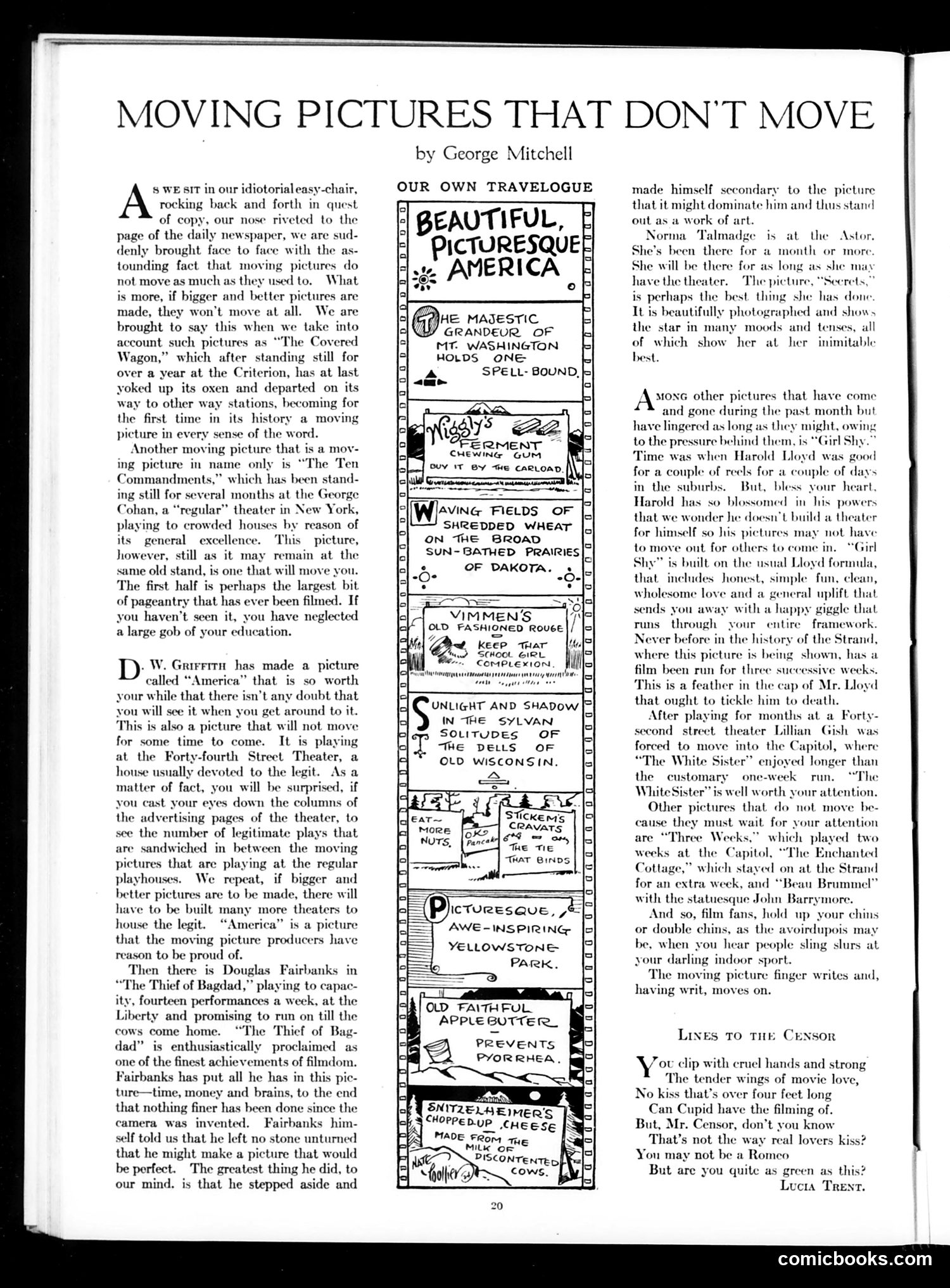
This article satirizes the film industry's paradox: major movies sit stationary in theaters for extended runs despite being called "moving pictures." Mitchell highlights films like *The Covered Wagon*, *The Ten Commandments*, and D.W. Griffith's *America*—all critically acclaimed productions that played for months without relocating, contradicting their medium's name. The accompanying "travelogue" section parodies tourist attractions and Americana imagery through absurdist advertisements (Mt. Washington, Yellowstone, apple butter). The satire suggests that prestigious films have become static attractions like tourist destinations—audiences must journey to them rather than the pictures "moving" to other venues. The piece critiques how blockbuster success creates bottlenecks: theaters can't accommodate demand, forcing longer runs. Mitchell's tongue-in-cheek conclusion argues that to build truly ambitious pictures, the industry needs more theaters to prevent this gridlock.
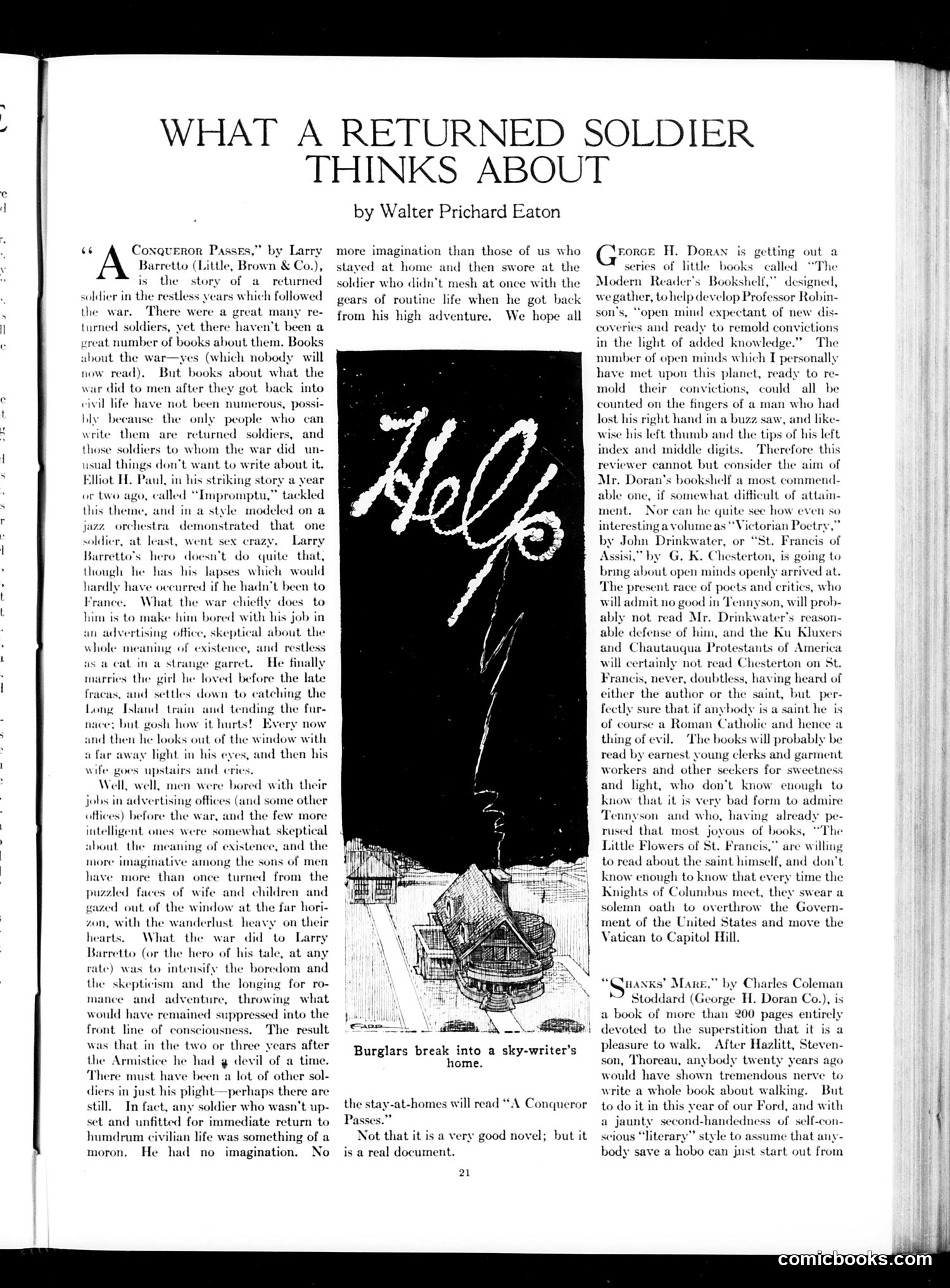
This is a book review column by Walter Prichard Eaton discussing post-WWI literature. The main subject is Larry Barretto's novel *"A Conqueror Passes"* about a returned soldier struggling to readjust to civilian life after the war. **The central point:** The reviewer argues that soldiers who found civilian routine boring and meaningless after combat experienced a genuine psychological shift—not a character flaw. Pre-war ennui was intensified into real distress by wartime experience. Eaton critiques stay-at-home civilians who expected seamless reintegration, calling soldiers who struggled "real documents" rather than failures. **The illustration** shows a burglar breaking into a "sky-writer's home"—likely a visual joke about advertising or modern absurdity, somewhat disconnected from the main review. The secondary review of *"The Modern Reader's Bookshelf"* (a curated book series) humorously dismisses the notion that people actually change their minds when presented new information—suggesting cynicism about intellectual growth.
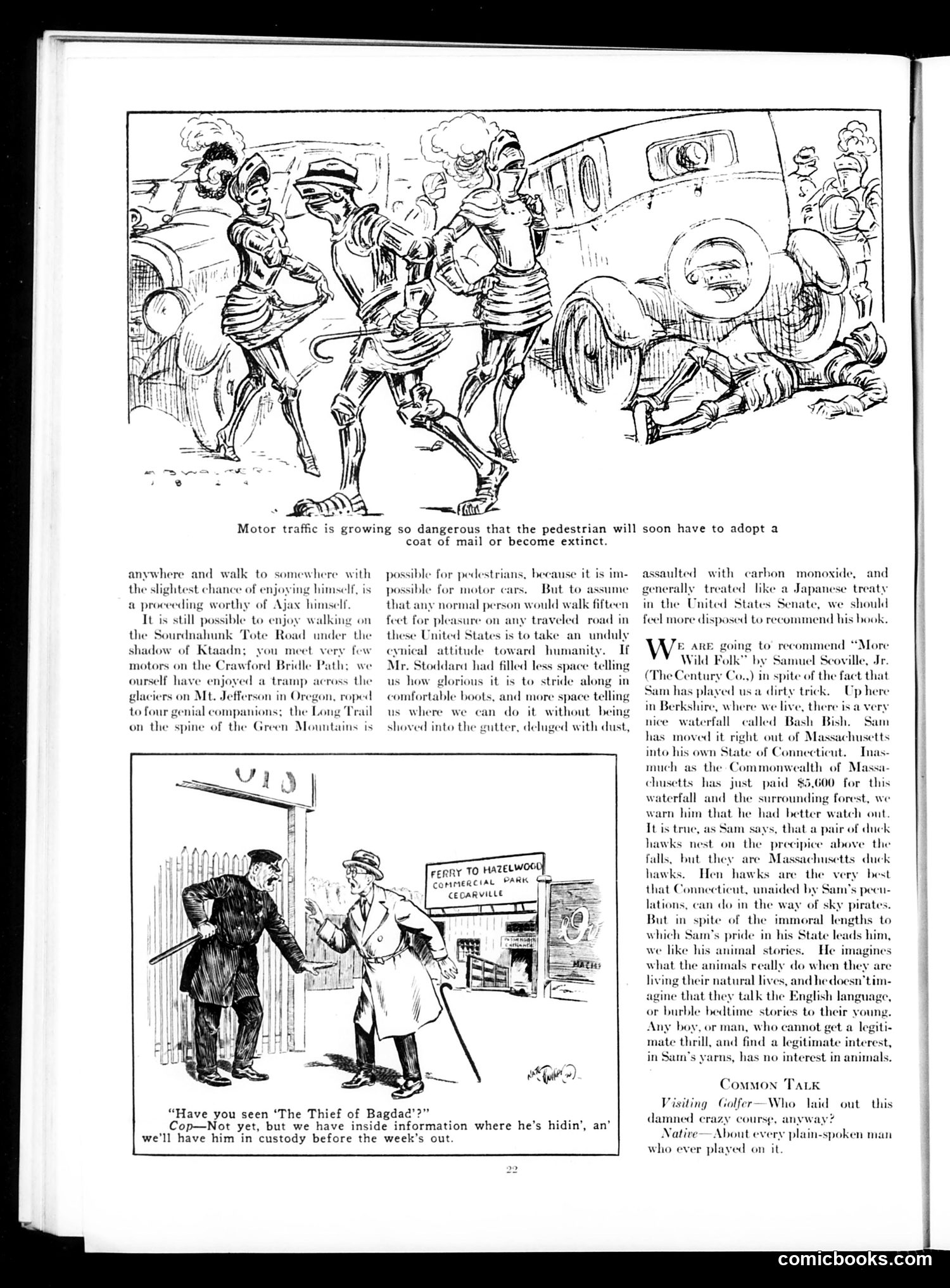
**Top Cartoon:** Satirizes dangerous automobile traffic. The caption warns that pedestrians must soon adopt "a coat of mail or become extinct"—exaggerating the threat cars pose to walkers. The detailed illustration shows fantastically armored figures in futuristic protective gear boarding an airship, mocking the absurd lengths people may need to go to avoid motor vehicles. This reflects genuine early-20th-century anxiety about automobiles as new, lethal hazards to public safety. **Bottom Cartoon:** A policeman tells someone he has "inside information" about "The Thief of Bagdad's" whereabouts and will have him "in custody before the week's out." This appears to reference either a popular play/film or ongoing news story, likely making fun of police incompetence or boastful claims they cannot deliver on. **Text Content:** Samuel Scoville Jr.'s book review and general commentary on pedestrian safety, nature writing, and Connecticut wildlife. The page blends humor with genuine concern about motorcar dangers to urban life.
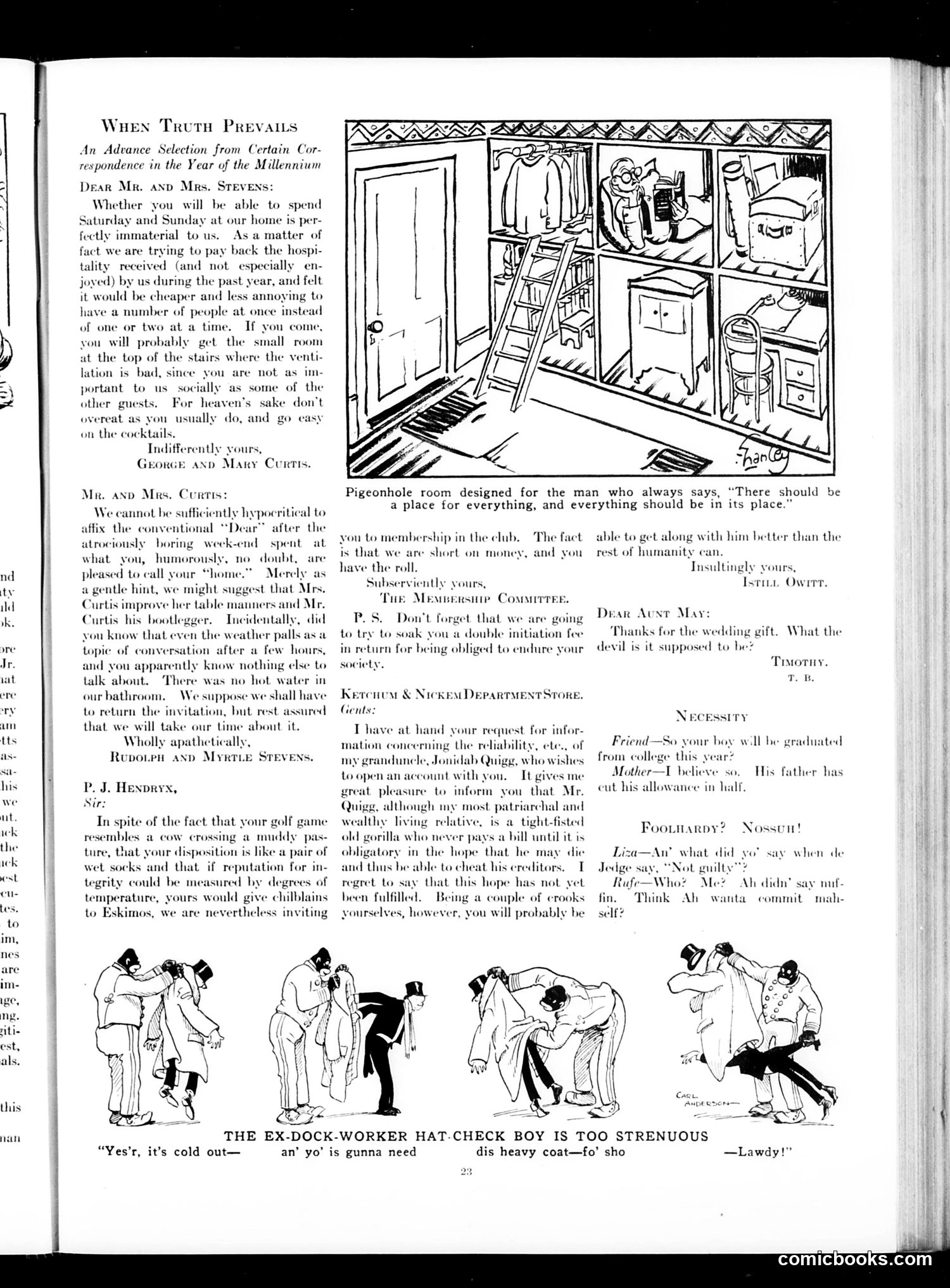
This page satirizes upper-class social hypocrisy through a series of letters exchanged between wealthy families. The main satirical point: wealthy people extend social invitations not from genuine hospitality but from calculated self-interest—to repay debts, secure club memberships, or exploit others' money. Each letter reveals the writer's true contempt masked by formal politeness. The Curtises invite guests to a bad room and warn them not to eat much; the Stevens respond by insulting their hosts' golf game and manners while noting "you have the roll" (money); the Membership Committee admits they want the recipient's wealth; and a character reference letter about someone reveals he's a "tight-fisted" crook they expect to cheat creditors. The bottom cartoon about "the ex-dock-worker hat check boy" appears unrelated—a brief gag about class mobility or social awkwardness. **The satire targets:** Gilded Age pretense, the transactional nature of high society, and how financial anxiety drives social performance among the wealthy.
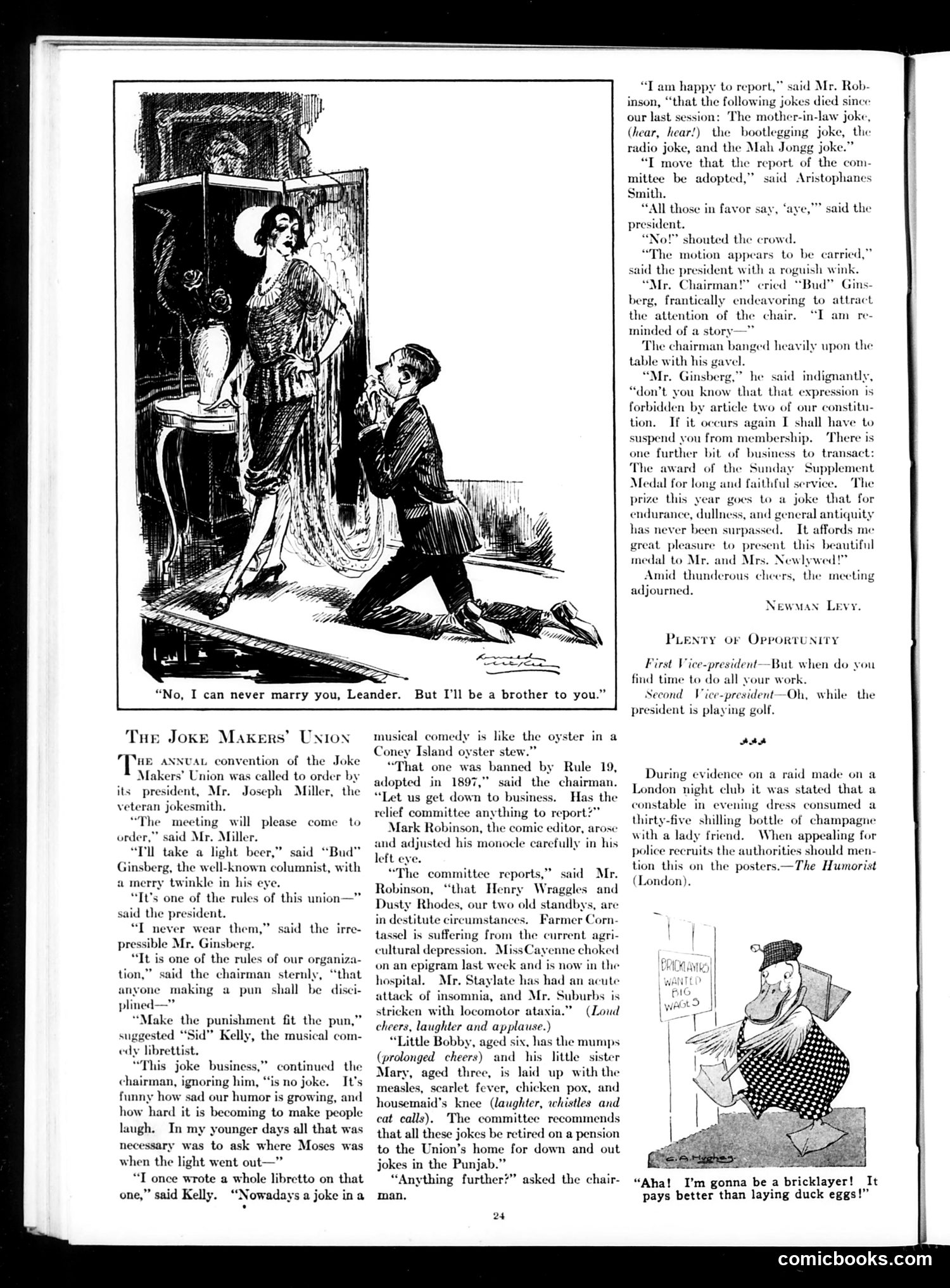
This satirical piece mocks the decline of American humor and joke-telling as an art form. It personifies jokes as members of a union—led by "Joseph Miller" (referencing the 18th-century joke book *Joe Miller's Jests*)—holding a convention to address their profession's deterioration. The satire targets several elements: outdated jokes ("Where was Moses when the light went out?"), now-dead joke types (mother-in-law, bootlegging, radio, Mah Jongg jokes), and comic writers struggling professionally during economic depression. Named figures like "Bud" Ginsberg (a columnist) and "Sid" Kelly (a librettist) represent real entertainment industry figures. The main joke: humor itself has become a "down and out" profession requiring pension support. The cartoon above depicts a romantic scene ("I'll be a brother to you") that contextualizes the union's discussions about tired comedic material. The piece suggests early 1920s anxiety about whether modern audiences can still find genuine laughter.
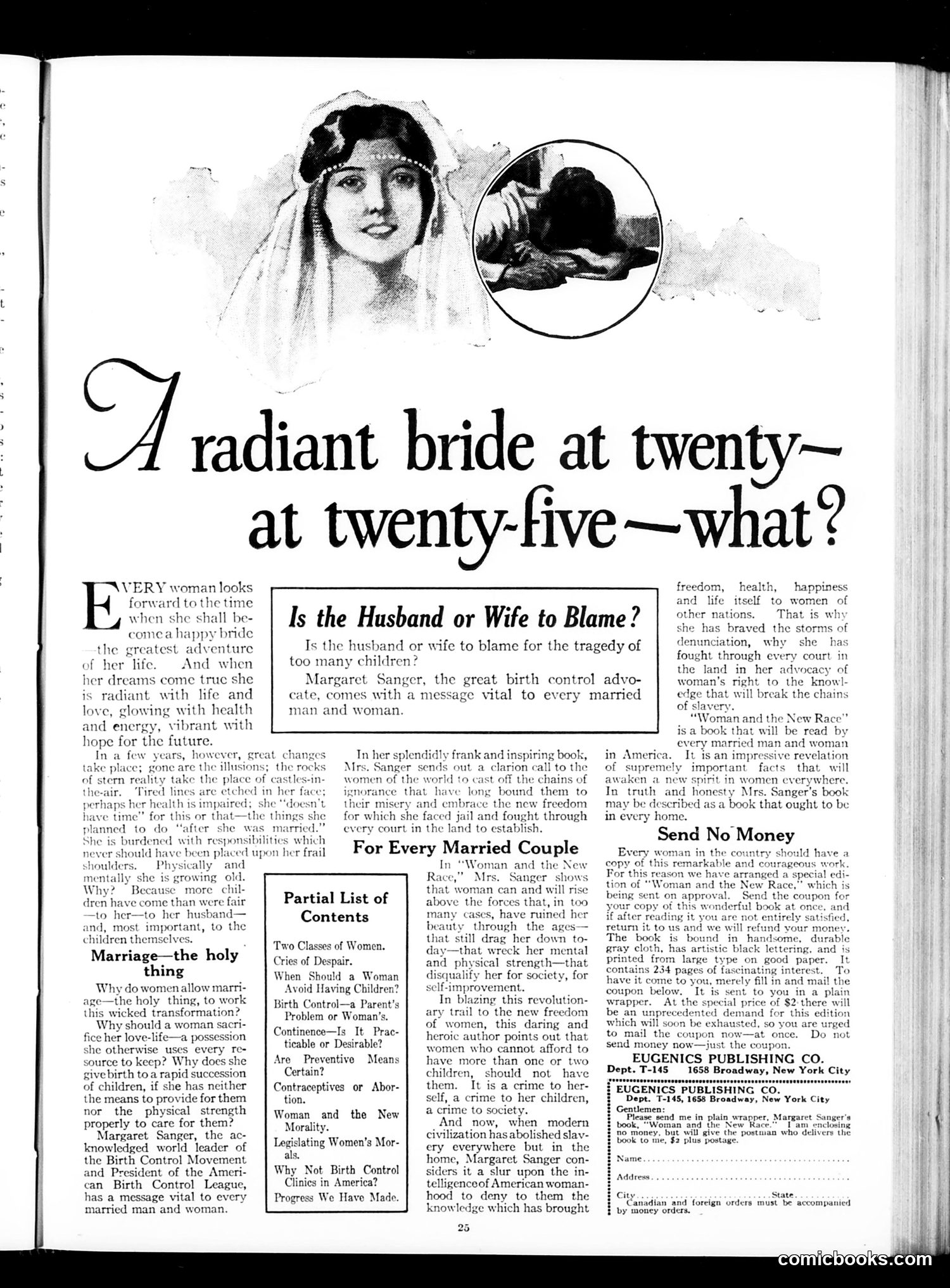
This page promotes Margaret Sanger's birth control advocacy book *"Woman and the New Race."* The headline's rhetorical question contrasts a young bride's health and vitality with her deteriorated appearance after years of unwanted pregnancies—the implicit answer being: exhausted, worn-out, prematurely aged. The satirical point targets the social expectation that married women must bear children continuously, regardless of financial means or physical capacity. Sanger argues this practice constitutes "a crime to herself, a crime to her children, a crime to society." The page frames birth control knowledge as liberation comparable to abolishing slavery—a radical stance for the 1920s. The ad targets "every married couple," positioning contraception as necessary medical information wrongly denied to women. The content table lists chapters addressing poverty, women's health, and moral questions, presenting birth control as a serious social issue rather than scandal.
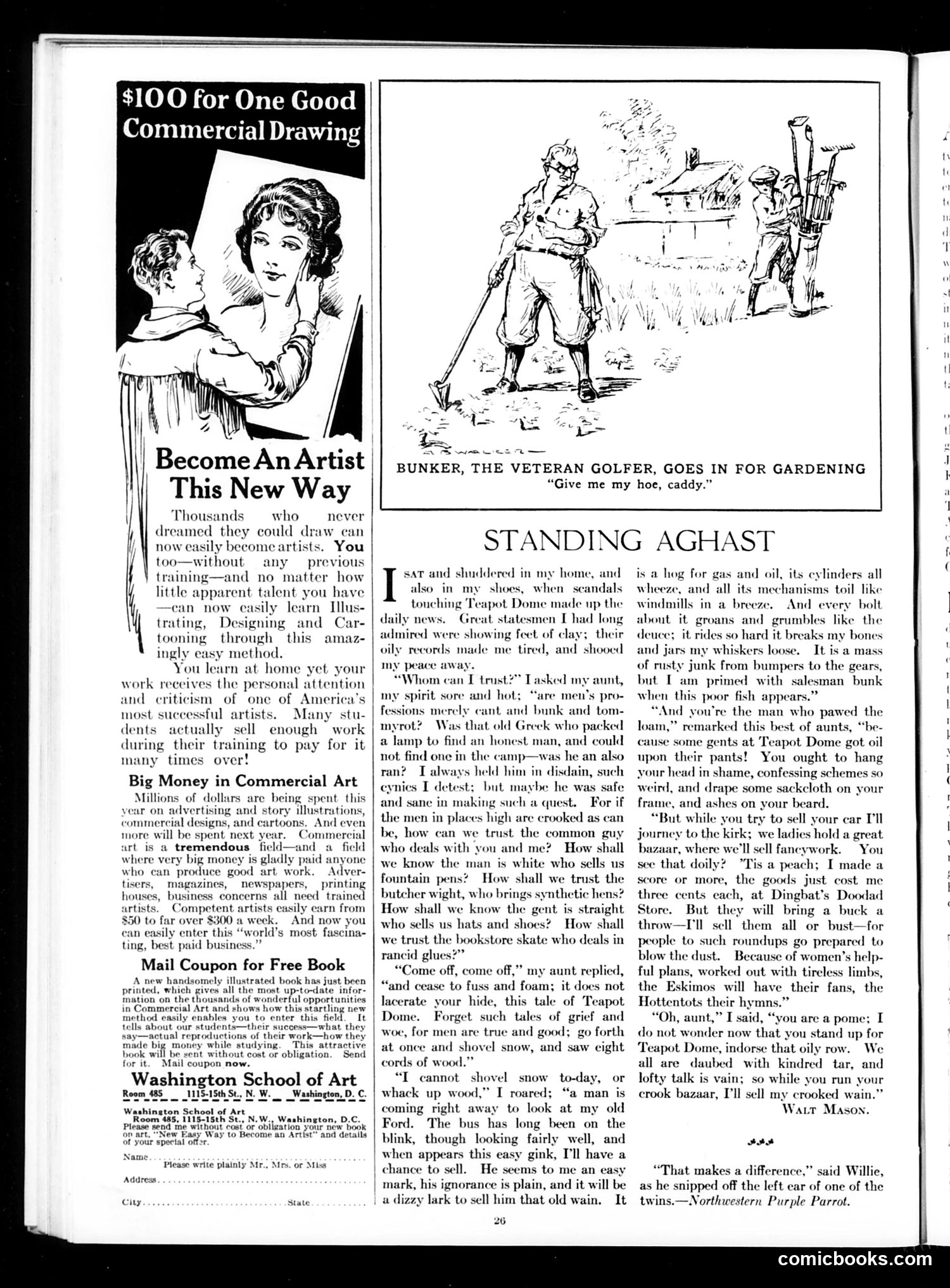
This page contains two distinct elements: **Left side:** A commercial advertisement for the Washington School of Art, promoting correspondence courses in illustration and cartooning. It promises students can earn substantial money ($100-$300+ weekly) in the booming commercial art field, with no prior training needed. This reflects 1920s optimism about accessible career paths. **Right side:** A humorous cartoon and accompanying story titled "Standing Aghast." The narrative depicts someone anxious about the Teapot Dome scandal (a major 1920s corruption affair), fretting over whom to trust in a dishonest society. Their aunt dismisses these worries and advises practical action instead. The opening cartoon shows "Bunker, the veteran golfer" requesting his hoe from his caddy—a pun on "hoe" (garden tool) versus the golfing context. The satire mocks both scandal-induced paranoia and the gap between intellectual worry and mundane reality.
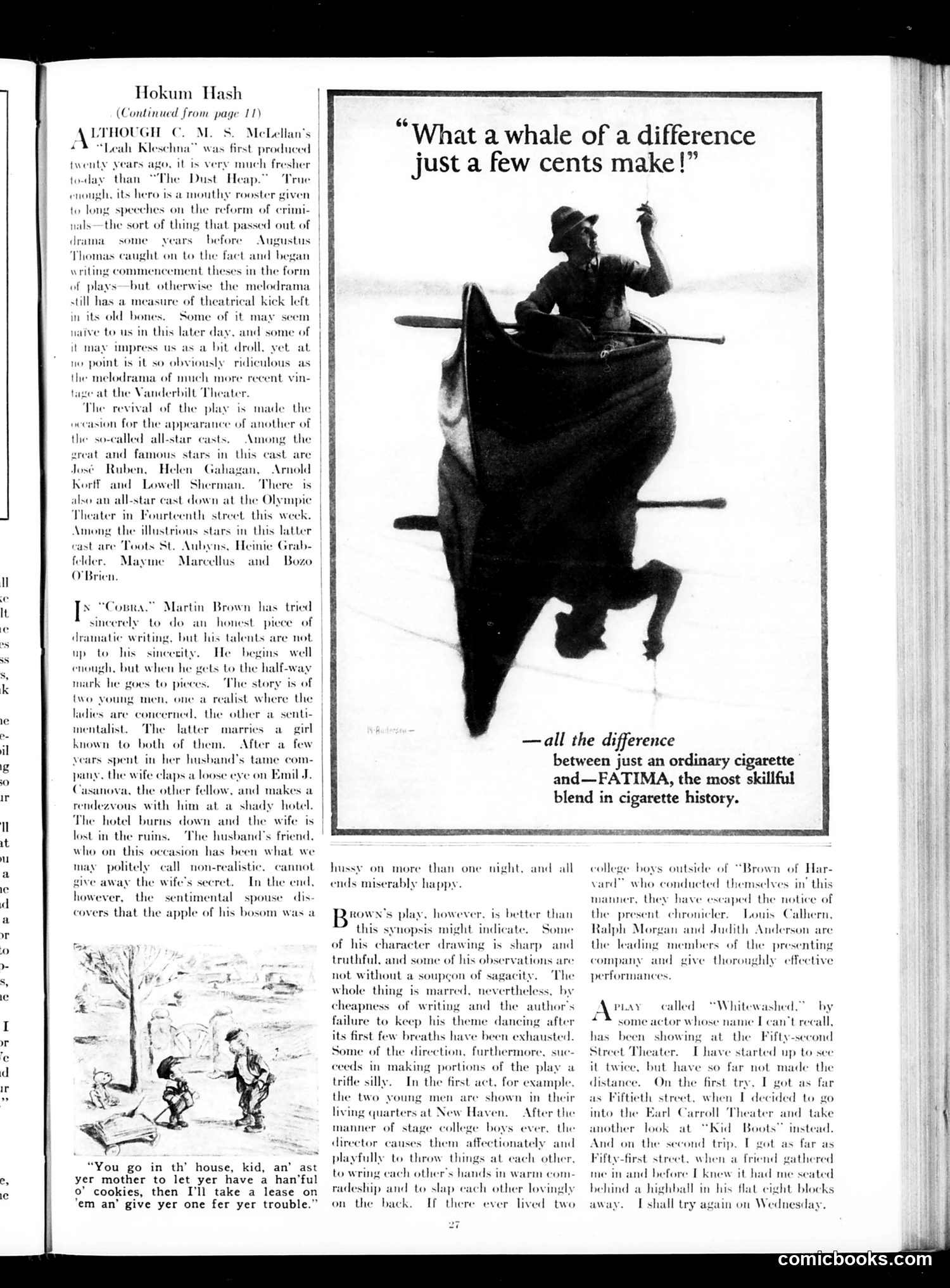
This page from Judge magazine contains theater reviews and a cigarette advertisement disguised as social commentary. **The Main Image:** A deliberately absurd photograph shows a man in contorted position with oars, captioned "What a whale of a difference just a few cents make!" This is a **Fatima cigarette advertisement** — a real brand that competed with premium rivals. The ad sarcastically suggests minor price differences justify choosing Fatima, using an obviously ridiculous image for comedic effect. **The Text:** The "Hokum Hash" column reviews recent Broadway plays, critiquing their artistic merits. Reviews mention revivals of *Leah Kleschna*, *The Dust Heap*, and contemporary plays like *Corba*. The tone is dismissive — praising some actors while noting the plays themselves are often poorly written or dated melodramas. **The Satire:** The juxtaposition of absurdist advertising alongside serious theater criticism creates ironic commentary on both commercial marketing and theatrical mediocrity in 1920s entertainment.
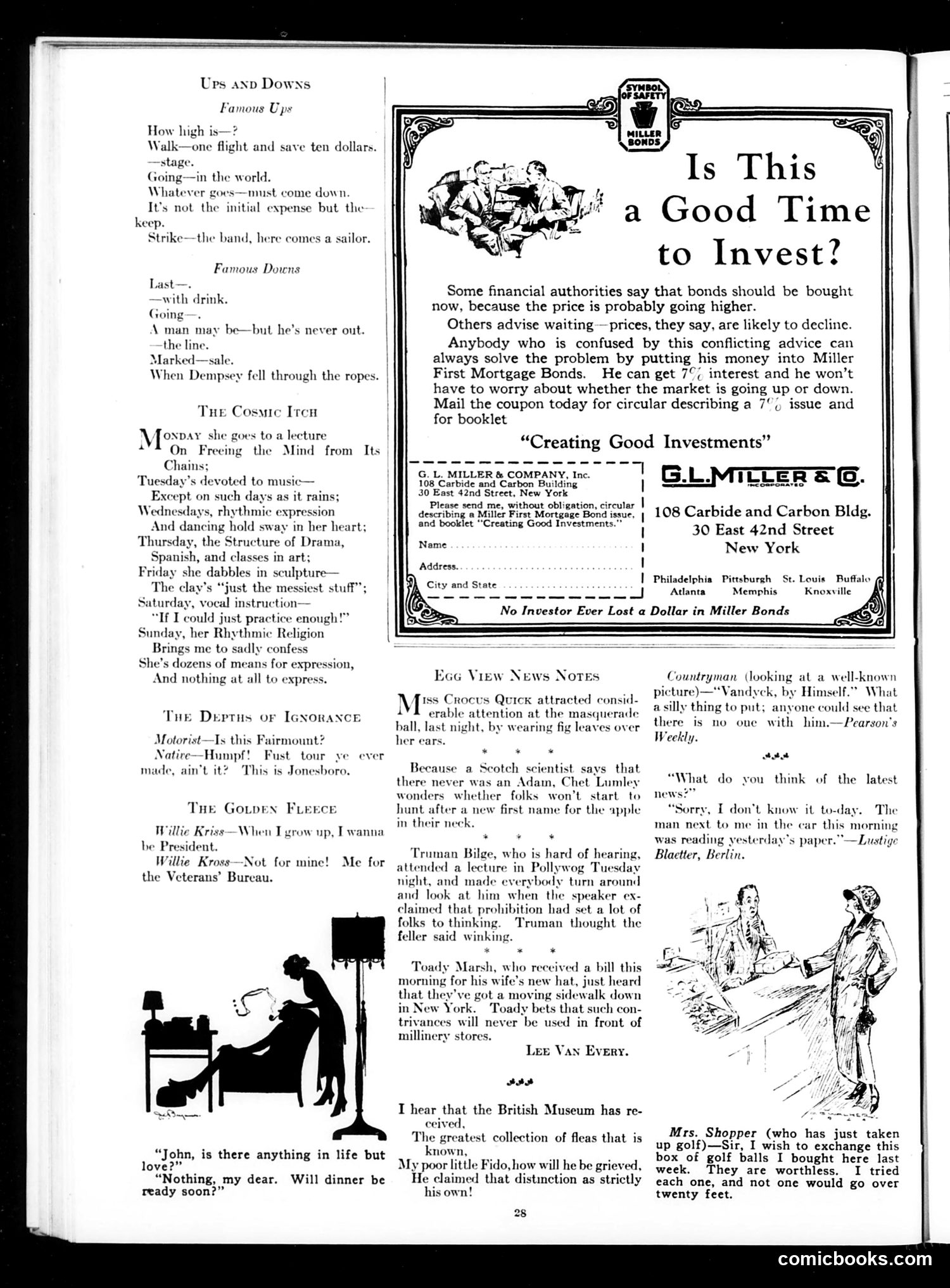
This page from Judge magazine contains several satirical pieces mocking contemporary social pretensions and absurdities: **"The Cosmic Itch"** ridicules a woman who obsessively pursues intellectual and artistic pursuits—attending lectures on freeing the mind, music, dance, drama, and sculpture—yet has "nothing at all to express." The satire targets dilettantism and performative self-improvement culture among the leisured classes. **"The Depths of Ignorance"** presents a brief joke about provincial narrow-mindedness, contrasting a tourist's polite inquiry with a local's defensive hostility. **"The Golden Fleece"** appears to mock Willie Kross's ambitions regarding the Veterans' Bureau—likely criticizing nepotism or self-serving politics in government agencies. The right side is a G.L. Miller & Co. bond advertisement claiming investors needn't worry about market fluctuations with their "safe" mortgage bonds—a pitch to anxious Depression-era investors. **"Egg View News Notes"** contains light gossip and observational humor about eccentric local figures and absurd situations, reflecting Judge's typical humorous society column style.
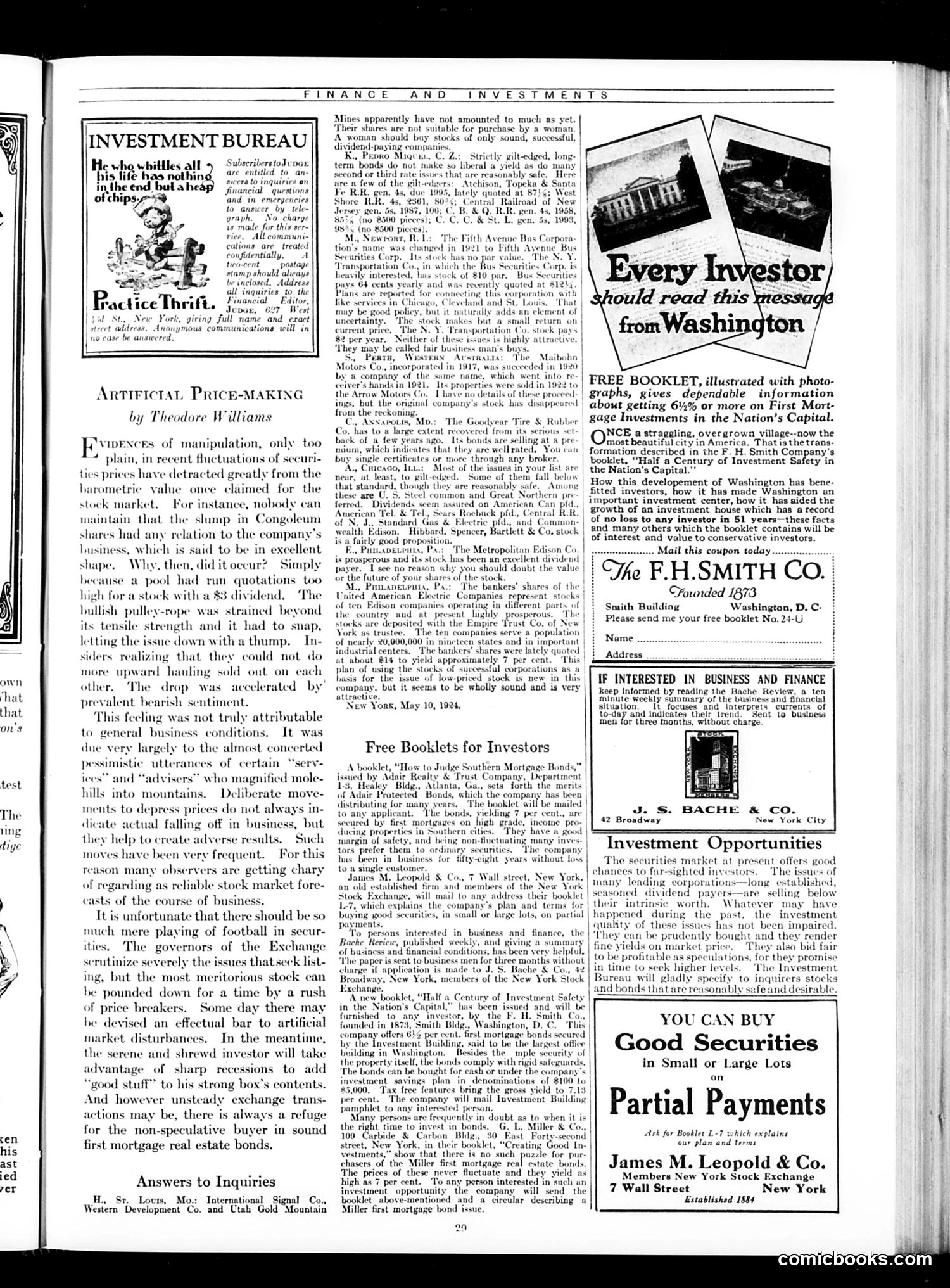
This page is primarily **financial advertising** rather than political satire. The main content includes investment advice columns and multiple ads for financial services (F.H. Smith Co., James M. Leopold & Co., Bache & Co.). The only cartoon visible is small, in the upper left, titled "Investment Bureau." It depicts a figure at a desk labeled "Investment Bureau" with the caption noting that "his life has nothing in the end but a loss of guesses"—a satirical jab at the unreliability of investment advice. The page reflects **1920s financial culture**, promoting bonds, stocks, and mortgage securities to readers. The heavy advertising suggests Judge profited significantly from financial services marketing during this era, blending entertainment with commercial promotion typical of the period.
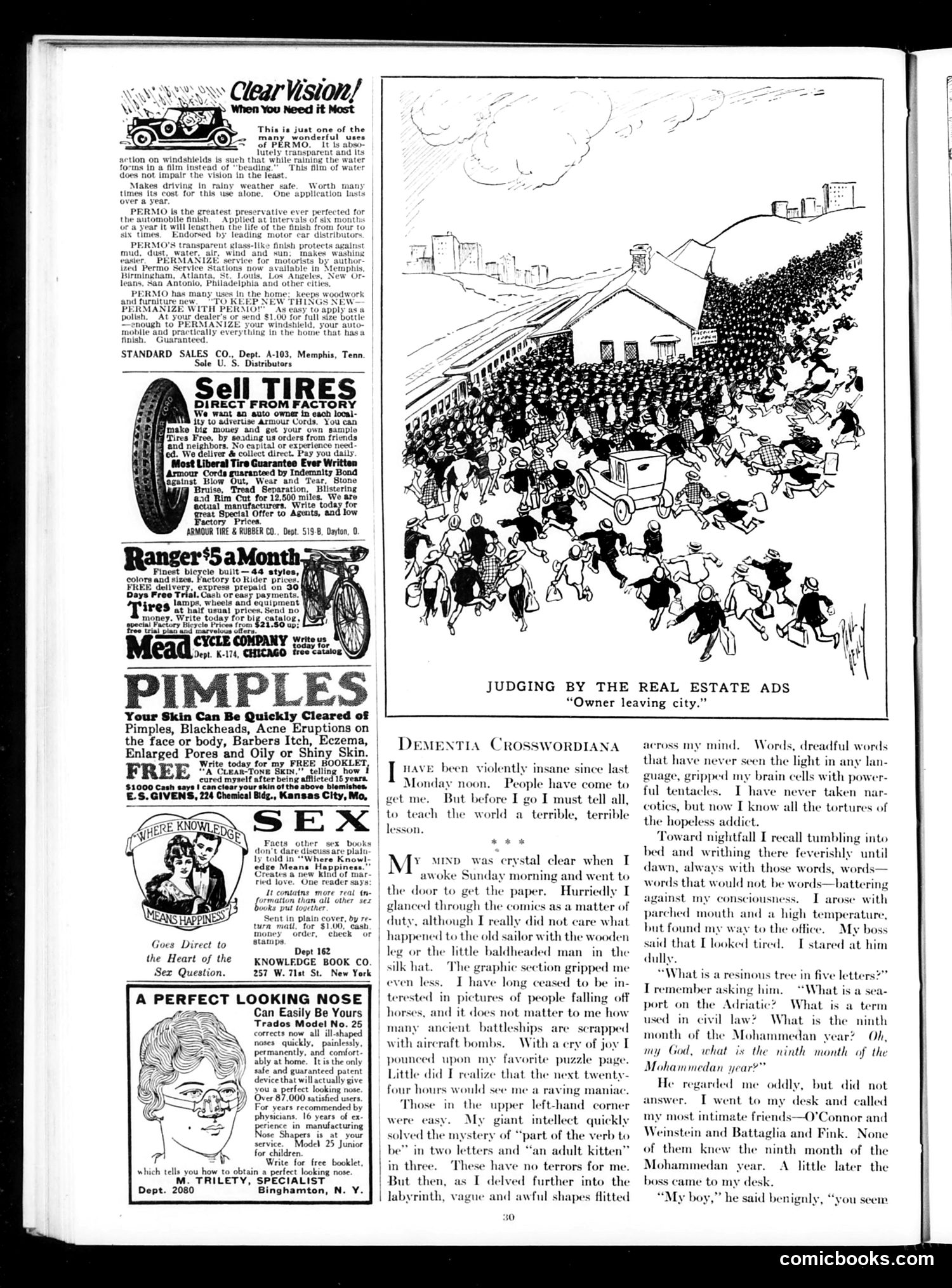
This page is primarily **advertisements** (typical for Judge magazine), but includes one notable content piece: "Dementia Crosswordiana," a humorous short story about a man driven to madness by a crossword puzzle. **The Satire:** The story mocks the sudden craze for crossword puzzles in the 1920s. The narrator begins sane on Sunday, tackles a crossword puzzle with confidence, but descends into violent insanity over the next 24 hours—suggesting the puzzles' difficulty and addictive nature drove people to breakdown. The joke is that something marketed as harmless entertainment actually torments its solvers. **The Real Estate Cartoon (right):** Shows a massive crowd of people fleeing a city (visible in background). The caption "Judging by the Real Estate Ads—'Owner leaving city'" suggests satirical commentary on urban exodus, likely post-WWI or during economic uncertainty, where "owner leaving city" became ubiquitous real estate language—implying widespread departures. Both items reflect 1920s anxieties: new entertainment crazes and urban demographic shifts.
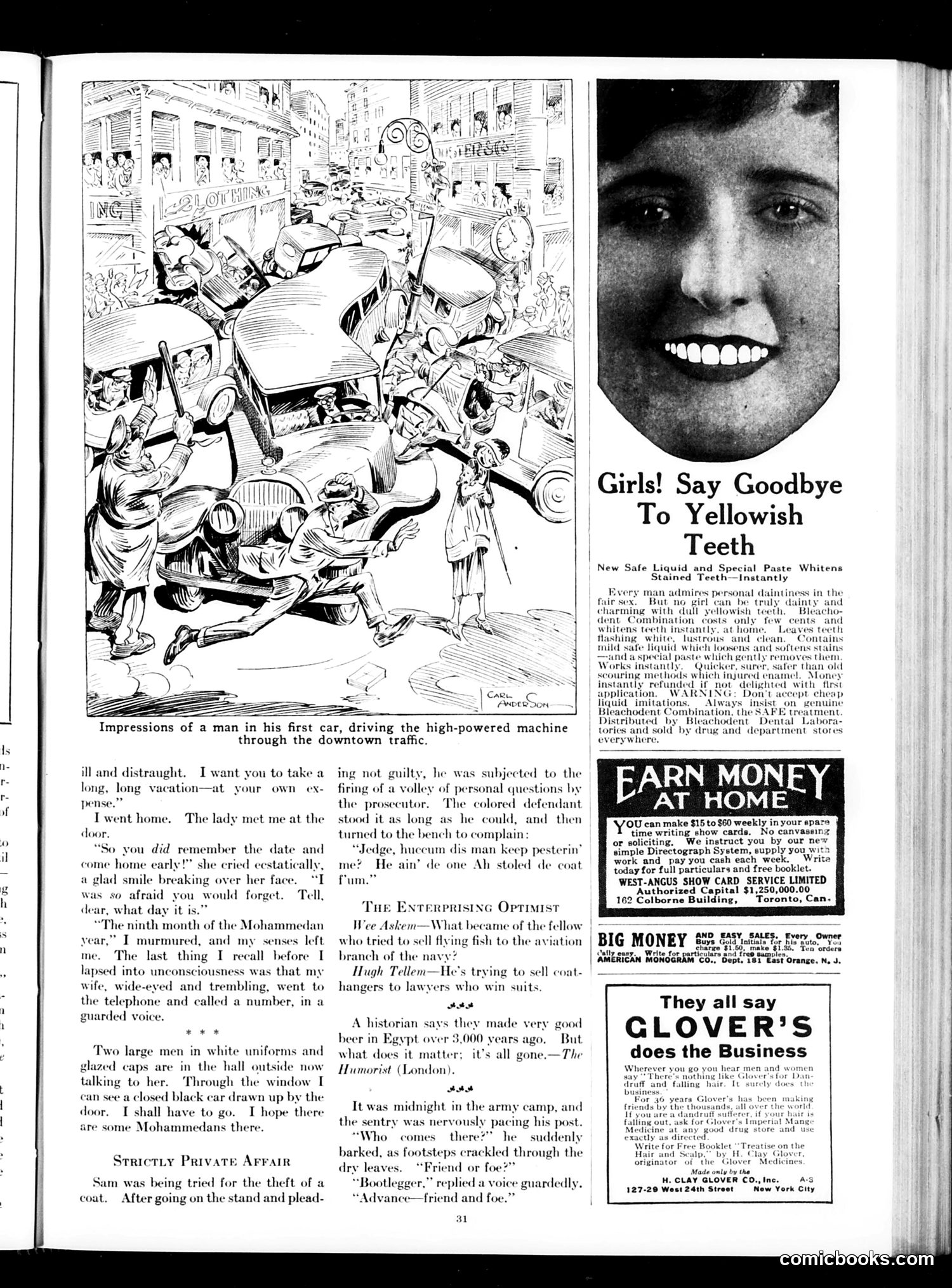
The main cartoon shows a chaotic traffic accident downtown—a man in his first car has caused mayhem with his "high-powered machine," with vehicles colliding and pedestrians fleeing. The satirical point: early automobile driving was dangerous and unpredictable, especially for inexperienced drivers navigating crowded city streets. The accompanying text story is absurdist humor: a man tells his boss he needs vacation after being asked to remember an anniversary. When he comes home, his wife greets him warmly—until he confuses the date with "the ninth month of the Mohammedan year." She believes he's mentally unwell and calls authorities (the "two large men in white uniforms" arriving). The joke satirizes the anxieties of early 20th-century male forgetfulness and the medicalization of perceived mental distress. The page also contains period advertisements and shorter jokes about social topics.
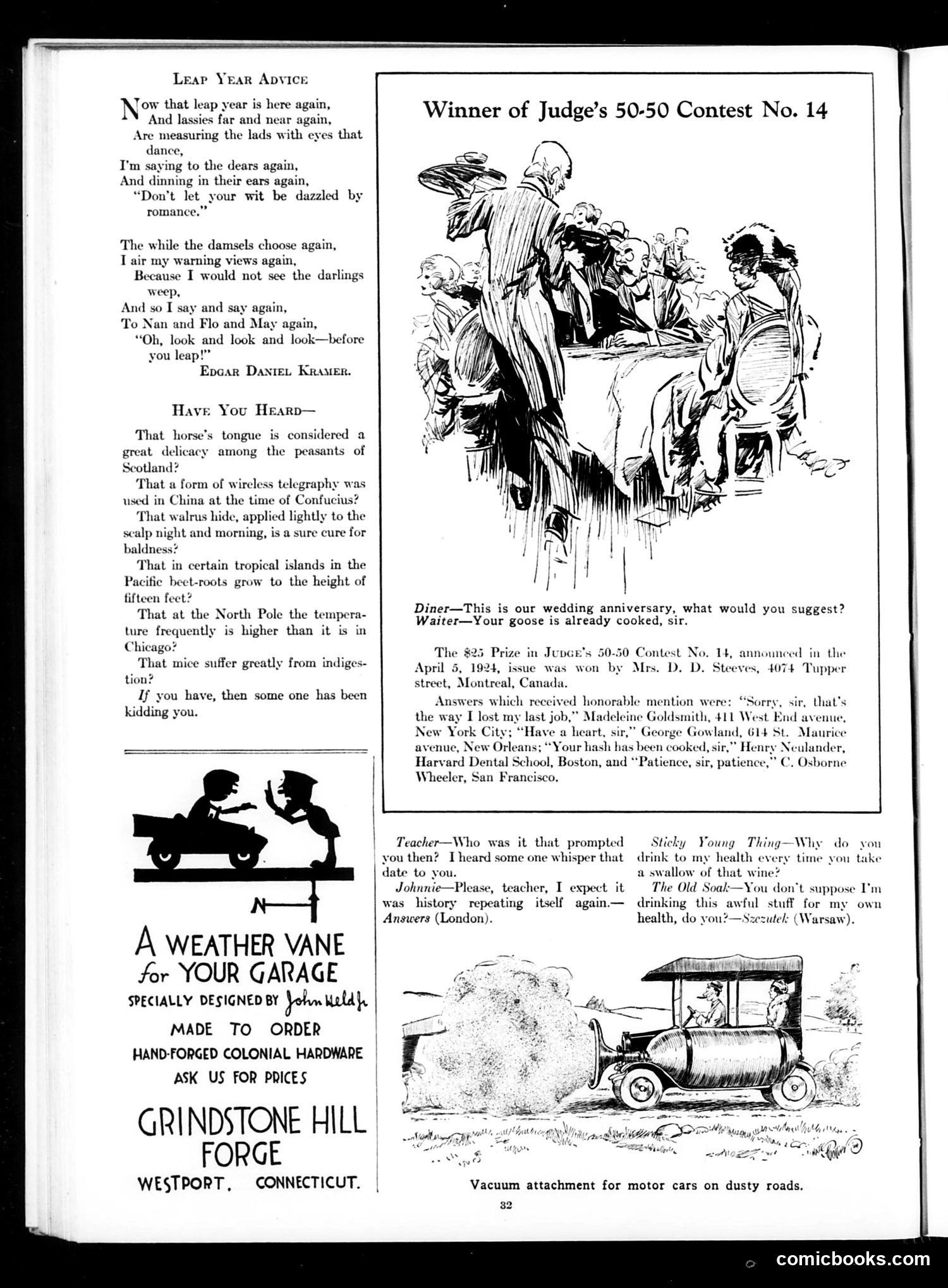
This page from *Judge* magazine (circa 1924) contains several distinct elements: **"Leap Year Advice"** (top left): A poem by Edgar Daniel Kramer warning young women against being swept away by romance during leap year—when tradition held that women could propose to men. The satire mocks overly cautious parental advice. **"Winner of Judge's 50-50 Contest No. 14"** (center): A cartoon joke where a diner asks a waiter for anniversary dinner suggestions, and the waiter replies "Your goose is already cooked, sir"—meaning the situation is already determined/hopeless. It's a play on the husband's predicament in marriage. **"Have You Heard"** (left): A humorous section of false trivia (walrus hide cures baldness, etc.), ending with the joke that readers have been "kidded"—a common *Judge* feature. **Bottom section**: Two brief joke exchanges about romance and drinking, typical of the magazine's humor format. The advertisements for a weather vane and vacuum attachment are standard period content, not satirical.
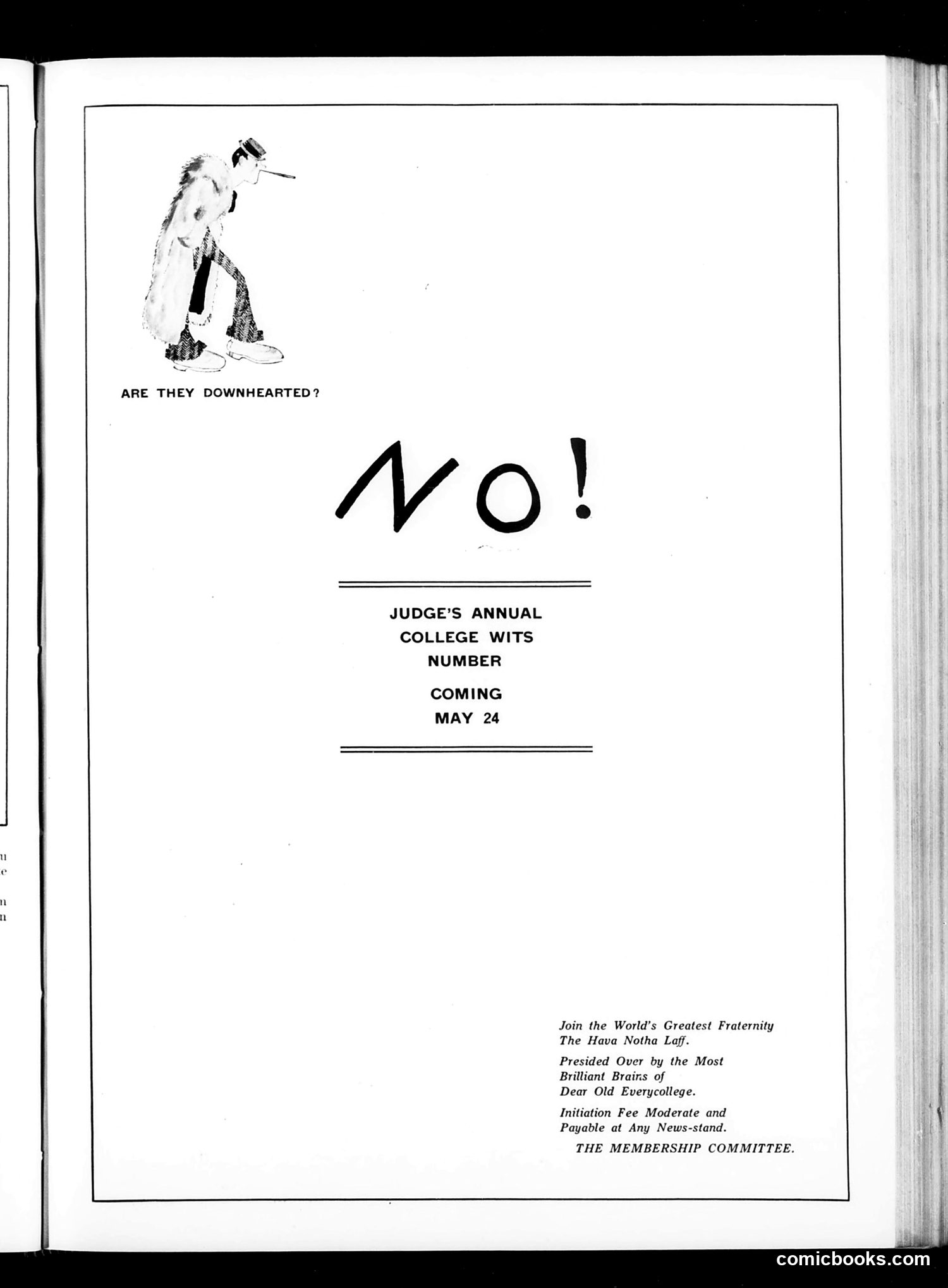
This is a **promotional advertisement** for Judge magazine's upcoming "College Wits" issue (May 24), not a political cartoon. The small illustration shows a dejected figure asking "ARE THEY DOWNHEARTED?" — likely referencing college students or young men, though the specific context is unclear without additional context. The main text humorously advertises a fake fraternity called "The Hava Notha Laff" (phonetic for "have another laugh"), positioning Judge magazine itself as a comedy club for college readers. It appeals to college audiences by promising humor "presided over by the most brilliant brains" and offering memberships available at newsstands. This reflects Judge's strategy of marketing satirical humor to educated, college-aged readers during the early-to-mid 20th century.
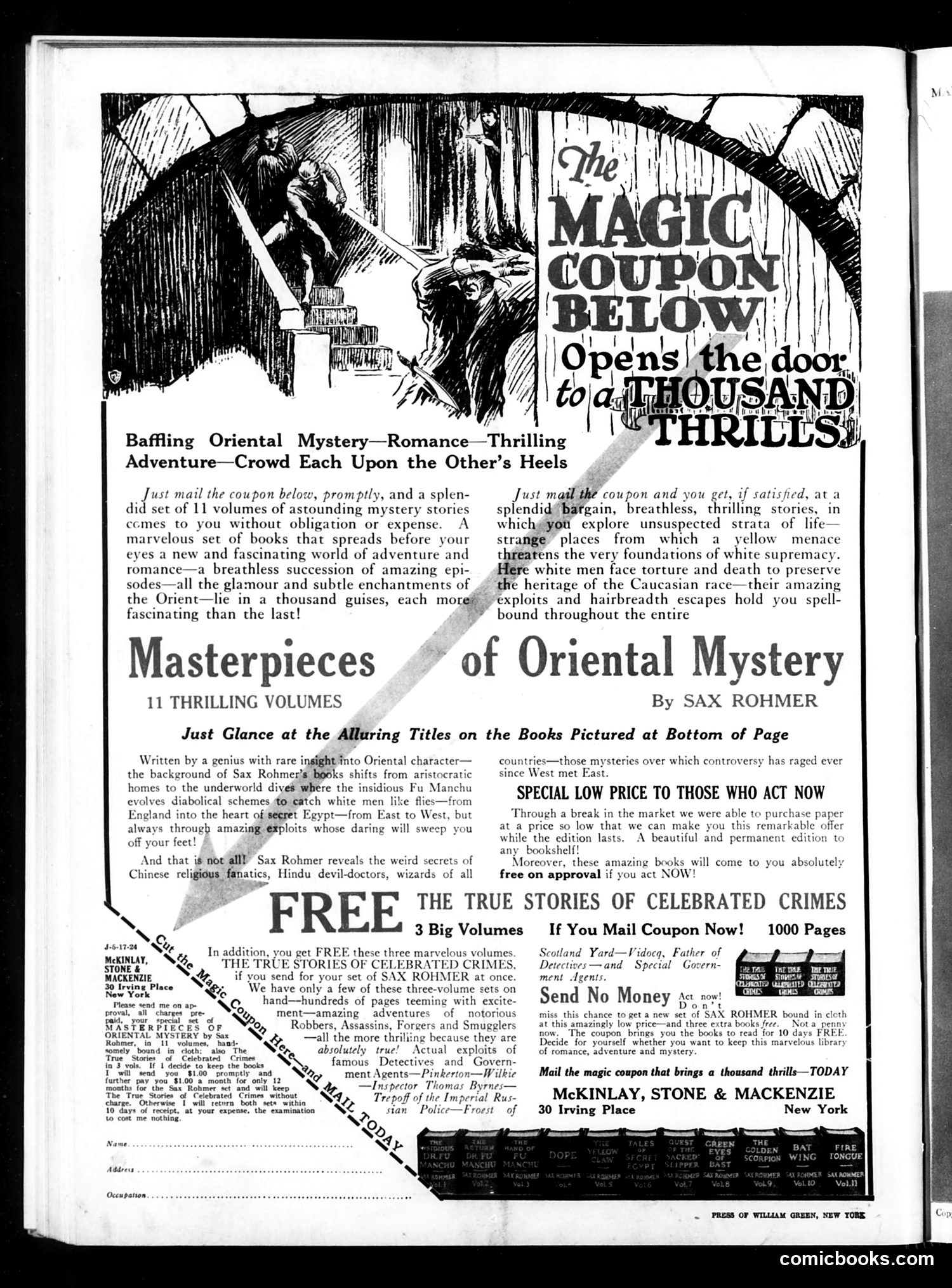
This page is **primarily advertising**, not satire or political commentary. It promotes Sax Rohmer's "Masterpieces of Oriental Mystery"—a 11-volume book series—along with a free bonus of "The True Stories of Celebrated Crimes." The illustration depicts characters in what appears to be an exotic, vaguely Asian setting with dramatic architecture, supporting the "Oriental Mystery" theme. **What's notable to modern readers:** The ad explicitly appeals to **racial anxiety**. It promises stories where "a yellow menace threatens the very foundations of white supremacy" and depicts "white men face torture and death" defending "the heritage of the Caucasian race." This reflects early 20th-century **yellow peril** propaganda—fears about Asian invasion/dominance popular in Western media of that era. Sax Rohmer's Fu Manchu character (mentioned in the text) embodied this trope: the sinister Oriental villain threatening Western civilization. The ad treats these racist premises as entertainment selling points, which reveals period attitudes toward race and empire that modern readers would find deeply offensive.