
Judge, 1924-05-17 · page 13 of 36
Judge — May 17, 1924 — page 13: what you’re looking at
What you’re looking at
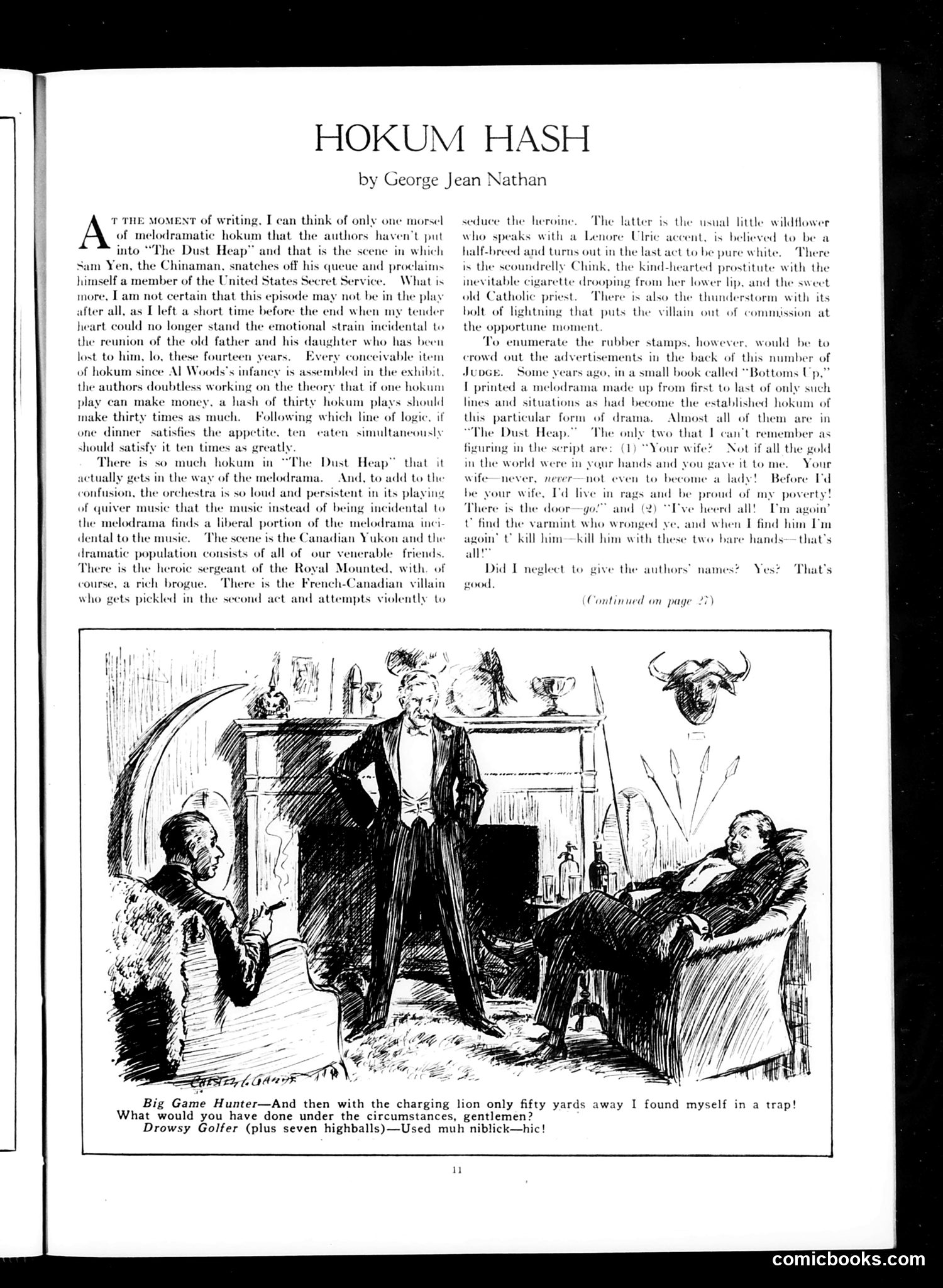
This is a theater review by critic George Jean Nathan attacking the melodrama "The Dust Heap" for relying excessively on tired, contrived plot devices (which he calls "hokum"). Nathan catalogs the clichés: the Chinese character, the innocent heroine with a mysterious past who turns out to be "pure white," the French-Canadian villain, the sympathetic prostitute, the thunderstorm finale that conveniently eliminates the villain. He argues the play throws in *everything* without restraint, assuming that if one hokum play succeeds financially, thirty hokum plays mashed together will succeed thirty times over. The small cartoon below illustrates an unrelated joke: a drowsy golfer claims he once used a golf club (niblick) against a charging lion fifty yards away—an obviously false tall tale he's embellished with alcohol. The satire targets both theatrical laziness and the absurd recycling of melodramatic tropes audiences had seen countless times before.
📄 Transcribed text from this page (OCR, searchable)
Machine-transcribed from the original scan — historical spelling and the odd misread are preserved.
HOKUM HASH by George Jean Nathan ? THE MOMENT of writing. I can think of only one morsel A of melodramatic hokum that the authors haven't put into “The Dust Heap” and that is the scene in which sam Yen, the Chinaman, snatches off his queue himself a member of the United States S um not certain that this episode may not be in the play s [left a short time before the end when my tender heart could no longer stand the emotional strain incidental to the reunion of the old father and his daughter who has been lost to him, lo, these fourteen y id proclaims What is et Servic is ry conceivable item of hokum since Al Woods's infaney is assembled in the exhibit. the authors doubtless working on the theory that if one hokum play can make money, a hash of thirty hokum plays should make thirty times as much. Following which line of logic. if one dinner satisfies the appetite. should satisfy it ten times as gi There is so much hokum in “The Dust Heap” that it actually gets in the way of the melodrama. And, to add to the confusion, the orchestra is so loud and persistent in its playing of quiver music that the music ins eaten simultaneously 1 of being incider the melodrama finds a liberal portion of the melodrama inci dental to the music. ‘The scene is the Canadian Yukon and the natic population consists of all of our venerable There is the heroic s it of the Royal Mounted, with. of There is the French-Canadian villain who gets pickled in the second act and attempts violently to friends. course, a rich brogue. AES _ oH: Be iar: : Big Game Hunter—And then with the charging lion only fifty yards away What would you have done under the circumstances, gentlemen? Drowsy Golfer (plus seven highballs)—Used muh niblick—hic! seduce the heroine: The | who speaks with a Lenore aatter is the usual little wildflower Ulric accent, is believed to be a half-breed and turns out in the last act to be pure white. ‘There is the scoundrelly Chink, the kind-hearted prostitute with the from her lower lip, and the sweet holic priest s also the thunderstorm with its bolt of lightning that puts the villain out of commission at the opportune moment To enumerate the rubber stamps, however crowd out the ady JubGE. would be to tisements in the back of this number of ©, in a small book called “Bottoms Up,” made up from first to last of only such lines and situations as had become the established hokum of this particular form of drama. Almost all of them are in The Dust Heap.” ‘The only two that 1 can't remember as wuring in the s Not if all the gold Your Before Fd be your wife, I'd live in rags and be proud of my poverty! Some ye I printed a melodran ript are: (1) “Your wife? in the world were in your hands and you gave it to me. wife never, never—not even to become a lady! 2) “T've heerd all! find the varmint who wronged y n't’ kill him —kill him with » is the door—go!” and ( Pm agoin’ and when T find him Dm two bare hands— that’s Did T neglect to give the good. Yes? That's authors’ names? Continued on page 2? I found myself in a trap! comicbooks.com