
Judge, 1924-05-17 · page 23 of 36
Judge — May 17, 1924 — page 23: what you’re looking at
What you’re looking at
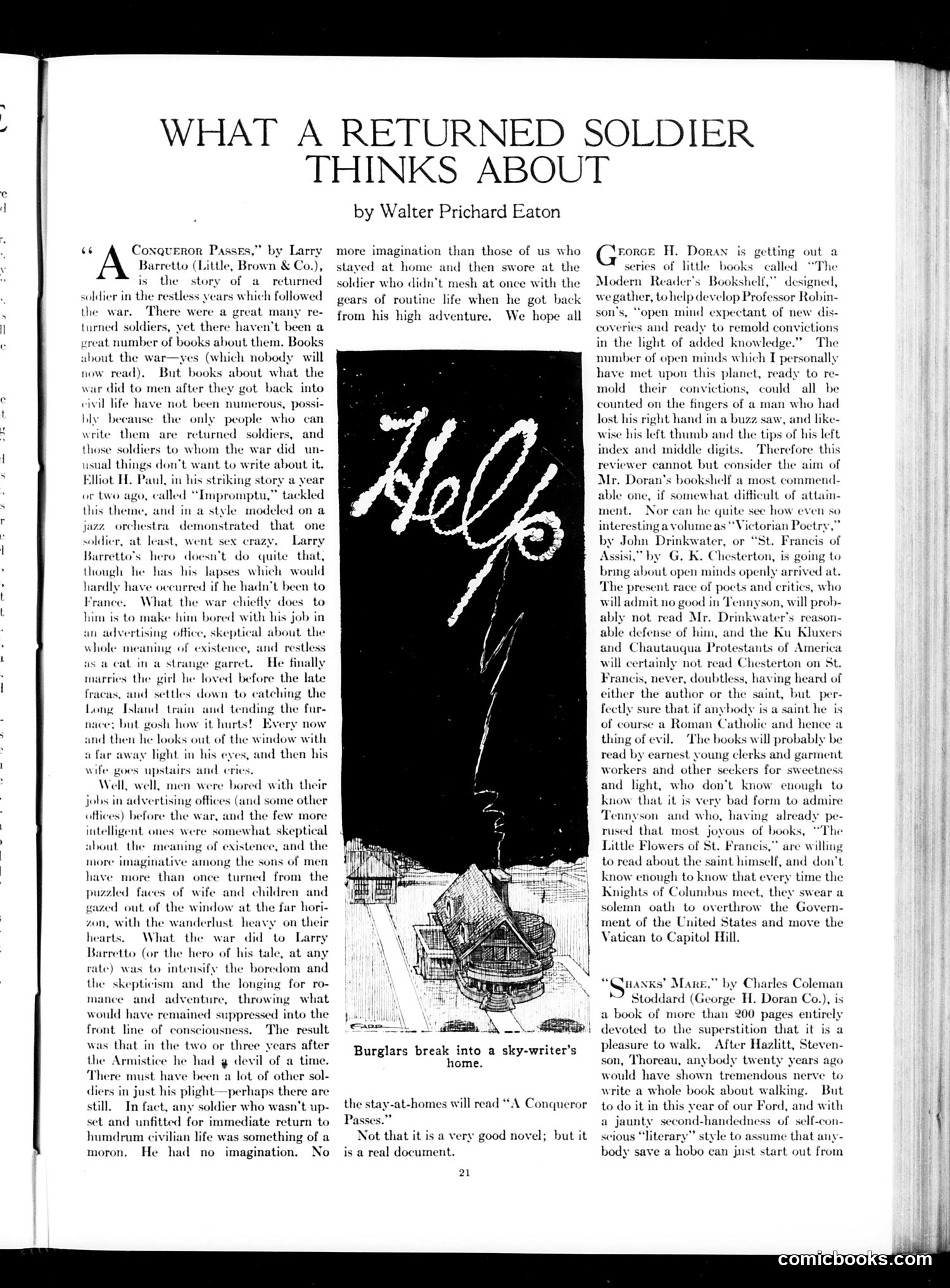
This is a book review column by Walter Prichard Eaton discussing post-WWI literature. The main subject is Larry Barretto's novel *"A Conqueror Passes"* about a returned soldier struggling to readjust to civilian life after the war. **The central point:** The reviewer argues that soldiers who found civilian routine boring and meaningless after combat experienced a genuine psychological shift—not a character flaw. Pre-war ennui was intensified into real distress by wartime experience. Eaton critiques stay-at-home civilians who expected seamless reintegration, calling soldiers who struggled "real documents" rather than failures. **The illustration** shows a burglar breaking into a "sky-writer's home"—likely a visual joke about advertising or modern absurdity, somewhat disconnected from the main review. The secondary review of *"The Modern Reader's Bookshelf"* (a curated book series) humorously dismisses the notion that people actually change their minds when presented new information—suggesting cynicism about intellectual growth.
📄 Transcribed text from this page (OCR, searchable)
Machine-transcribed from the original scan — historical spelling and the odd misread are preserved.
WHAT A RETURNED SOLDIER THINKS ABOUT 6“ Conqueror Passes,” by Larry A Barretto (Little, Brown & Co.), is the story of a returned soldier in the restless years which followed the war. There were a at many re- turned soldiers, yet there haven't been a great number of books about them. Books about the war—yes (which nobody will But books about what the war did to men after they got back into civil life have not been numerous, possi- g now read), bly because the only people who can write them are returned soldiers, and those soldiers to whom the war did un- usual things don’t want to write about it. Elliot H. Paul, in his striking sto: year or two ago, called “Impromptu,” tackled this theme, and ina style modeled on a jazz orchestra demonstrated that one solic Larry Barretto’s hero doesn’t do quite that, though he has his lapses which would hardly have occurred if he hadn't been to France. What the war chiefly does to him is to make him bored with his job in an advertising office, skeptical about the at least, went sex eri whole meaning of existence, and restless He finally marries the girl he loved before the late fracas, and settles down to catching the Long Island train and tending the fur- nace; but gosh how it hurts!) Every now and then he looks out of the window with away light in his eyes, and then his wife goes upstairs and cries. Well, well, men were bored with their jobs in advertising offices (and some other offices) before the war, and the few more intelligent ones were somewhat skeptical about the meaning of existence, and the more im: native among the sons of men than once turned from the puzzled faces of wife and children and gazed out of the window at th zon, with the wanderlust heavy on their ts. What the war did to Larry Barretto (or the hero of his tale, at any have mor ‘ar hori- rate) was to intensify the boredom and the skepticism and the longing for ro- mance and adventure, throwing what would have remained suppressed into the front line of consciousness. The result was that in the two or three years after the Armistice he had g devil of a time. There must have been a lot of other sol- diers in just his plight—perhaps there are still. In fact, any soldier who wasn’t up- set and unfitted for immediate return to humdrum civilian life was something of a moron. He had no imagination. No by Walter Prichard Eaton more imagination than those of us who stayed at home and then swore at the soldier who didn’t mesh at once with the gears of routine life when he got back from his high adventure. We hope all Burglars break into a sky-writer’s home. the stay-at-homes will read “A Conqueror Passes.” Not that it is a very good novel; but it is a real document. 21 \rorce H. Doran is getting out a series of little books called “The Modern Reader's Bookshelf,” designed, we gather, to help develop Professor Robin- son's, “open mind expectant of new dis- and ready to remold convictions in the light of added knowledge.” The number of open minds which I personally have met upon this planet, ready to re- mold their convictions, could all be counted on the fingers of a man who had lost his right hand in a buzz saw, and like- wise his left thumb and the tips of his left index and middle digits. Therefore this reviewer cannot but consider the aim of Mr. Doran's bookshelf a most commend- somewhat difficult of attain- or can he quite see how even so coverie: able one, i ment. interesting a volume as “Victorian Poetry,” by John Drinkwater, or “St. Francis of Assisi,” by G. K. Chesterton, is going to bring about open minds openly arrived at. ‘The present race of pocts and critics, who will admit no good in Tennyson, will prob- ably not read Mr. Drinkwater’s reason- able defense of him, and the Ku Kluxers and Chautauqua Protestants of America will certainly not read Chesterton on St. Francis, never, doubtless, having heard of either the author or the saint, but per- fectly sure that if anybody is a saint he is of course a Roman Catholic and hence a thing of evil. The books will probably be read by earnest young clerks and garment workers and other seekers for sweetness and light, who don't know enough to know that it is very bad form to admire Tennyson and who, having already pe- rused that most joyous of books, “The Little Flowers of S re willing to read about the saint himself, and don’t know enough to know that every time the Knights of Columbus meet, they swear a solemn oath to overthrow the Govern- ment of the United States and move the Vatican to Capitol Hill. Francis, xks’ Mare,” by Charles C Stoddard (George H. Doran Ci a book of more than 200 pages entirely devoted to the superstition that it is a pleasure to walk. After Hazlitt, Steven- son, Thoreau, anybody twenty rs ago would have shown tremendous nerve to write a whole book about walking. But to do it in this year of our Ford, and with a jaunty second-handedness of self-con- scious “literary” style to assume that any- body save a hobo can just start out from