
Judge, 1924-05-17 · page 17 of 36
Judge — May 17, 1924 — page 17: what you’re looking at
What you’re looking at
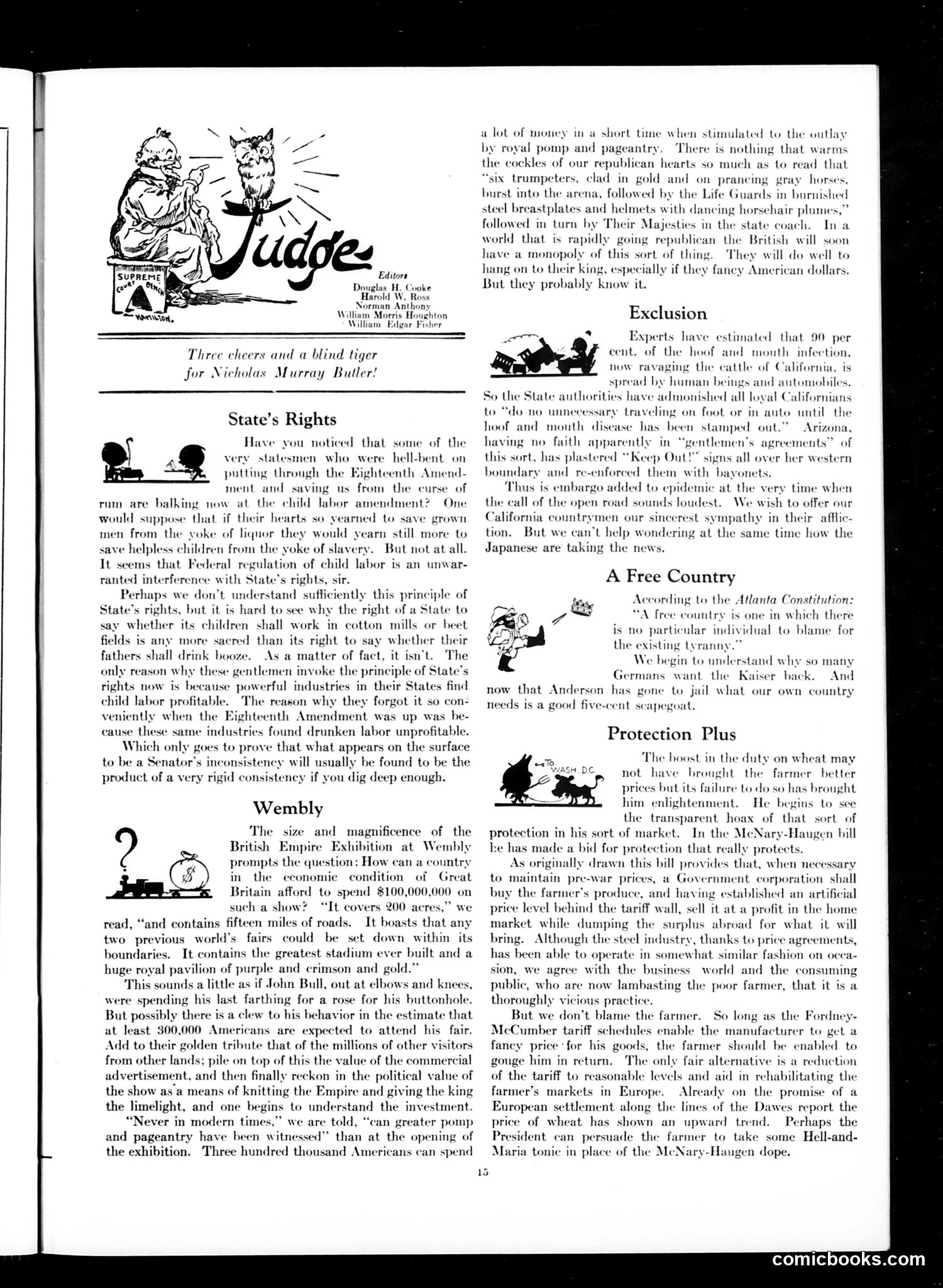
This page contains three political editorials with accompanying cartoons: **"State's Rights"**: Satirizes senators who championed the 18th Amendment (Prohibition) as a federal intervention for moral good, yet oppose federal child labor laws as unconstitutional "State's rights" violations. The hypocrisy is exposed: these same senators supported federal power when it benefited their states' industries (by eliminating "drunken labor"), but now invoke states' rights to protect child labor in their cotton mills and beet fields—revealing their consistency is purely financial self-interest, not principle. **"Wembly"**: Mocks Britain's lavish $100 million British Empire Exhibition while the nation faces economic hardship ("John Bull, out at elbows and knees"). The satire suggests Britain stages this extravagant spectacle specifically to attract wealthy American visitors and their dollars, using royal pageantry and imperial grandeur to manipulate republican Americans into spending money. **"Exclusion"**: Briefly notes California's quarantine against hoof-and-mouth disease spread by human contact and automobiles. The page criticizes political hypocrisy, financial self-interest masquerading as principle, and imperial manipulation of American wealth.
📄 Transcribed text from this page (OCR, searchable)
Machine-transcribed from the original scan — historical spelling and the odd misread are preserved.
“ Editors Douglas H. Cooke Harold W. Ross Norman Anthony William Morris Houghton William Edgar Fisher Three cheers and a blind tiger State’s Rights Have you noticed that some of the ‘or Nicholas Murray Butler! y very statesmen who were hell-bent on putting through the iteenth Amend- 2 © ment and saving us from the curse of rum are balking now at One would suppose that if their hearts so yearned to save grown men from the yoke of liquor they would yearn still more to save helpless children from the yoke of slavery. But not at all. It seems that Federal regulation of child labor is an unwar- ranted interference with State’s rights, sir. Perhaps we don’t understand sufficiently this principle of State’s rights, but it is hard to see why the right of a State to say whether its children shall work in cotton mills or beet fields is any more sacred than its right to say whether their fathers shall drink booze. As a matter of fact, it isn’t. The only reason why these gentlemen invoke the principle of $ Ss rights now is because powerful industries in their States find child labor profitable. veniently when the the child labor amendment? The reason why they forgot it so con- Eighteenth Amendment was up was be- cause these same industries found drunken labor unprofitable. Which only goes to prove that what appears on the surface to be a Senator's inconsistency will usually be found to be the product of a very rigid consistency if you dig deep enough. Wembly The size and magnificence of the British Empire Exhibition at Wembly prompts the question: How can a country in the economic condition of Great Britain afford to spend $100,000,000 on such a show? “It covers 200 acres,” we read, “and contains fifteen miles of roads. It boasts that any two previous world’s fairs could be set down within its boundaries. It contains the greatest stadium ever built and a huge royal pavilion of purple and crimson and gold.” ‘This sounds a little as if John Bull, out at elbows and knees, were spending his last farthing for a rose for his buttonhole. But possibly there is a clew to his behavior in the estimate t at least 300,000 Americans are expected to attend his fair. Add to their golden tribute that of the millions of other visitors from other lands; pile on top of this the value of the commercial advertisement, and then finally reckon in the political value of the show as'a means of knitting the Empire and giving the king the limelight, and one begins to understand the investment. “Never in modern times,” we are told, “can greater pomp and pageantry have been witnessed” than at the opening of the exhibition. Three hundred thousand Americans can spend a lot of money in a short time when stimulated to the outlay by royal pomp and pageantry. There is nothing that warms the cockles of our republican hearts so much as to read that “six trumpeters, clad in gold and on prancing gray horses, burst into the arena, followed by the Life Guards in burnished steel breastplates and helmets with dancing horsehair plumes,” followed in turn by Their Majesties in the state coach. In a world that is rapidly going republican the British will soon have a monopoly of this sort of thing. They will do well to hang on to their king, especially if they fancy American dollars. But they probably know it. now ravaging the cattle of California, is athe spread by human beings and automobiles. So the State authorities have admonished all loyal Californians Exclusion Experts have estimated that 90 per cent. of the hoof and mouth infection, to “do no unnecessary traveling on foot or in auto until the hoof and mouth disease has been stamped. out having no faith apparently in “gentlemen's agreements” of this sort, has plastered “Keep Out!” signs all over her western boundary and re-enforced them with bayonets. Thus is embargo added to epidemic at the very time when the call of the open road sounds loudest. We wish to offer our California countrymen our sincerest sympathy in their afflic- tion. But we can’t help wondering at the same time how the Japanese are taking the news. A Free Country According to the Atlanta Constitution: “A free country is one in which there is no particular individual to blame for the existing tyranny.” We begin to understand why so many Germans want the Kaiser back. And now that Anderson has gone to jail what our own country needs is a good five-cent scapegoat. Protection Plus The boost in the duty on wheat may not have brought the farmer better prices but its failure to do so has brought him enlightenment. He begins to see the transparent hoax of that sort of protection in his sort of market. In the MeNary-Haugen bill le has made a bid for protection that really protects. As originally drawn this bill provides that, when necessary to maintain pre-war prices, a Government corporation shail buy the farmer's produce, and having established an artificial price level behind the tariff wall, sell it at a profit in the home market while dumping the surplus abroad for what it will bring. Although the steel industry, thanks to price agreements, has been able to operate in somewhat similar fashion on ocea- sion, we agree with the business world and the consuming public, who are now lambasting the poor farmer, that it is a thoroughly vicious practice. But we don’t blame the farmer. So long as the Fordney McCumber tariff schedules enable the manufacturer to get a fancy price ‘for his goods, the farmer should be enabled to gouge him in return. The only fair alternative is a reduction of the tariff to reasonable levels and aid in rehabilitating the farmer’s markets in Europe. Already on the promise of a European settlement along the lines of the Dawes report the price of wheat has shown an upward trend. Perhaps the President can persuade the farmer to take some Hell-and- Maria tonic in place of the McNary-Haugen dope. comicbooks.com