
A complete issue · 36 pages · 1924
Judge — February 16, 1924
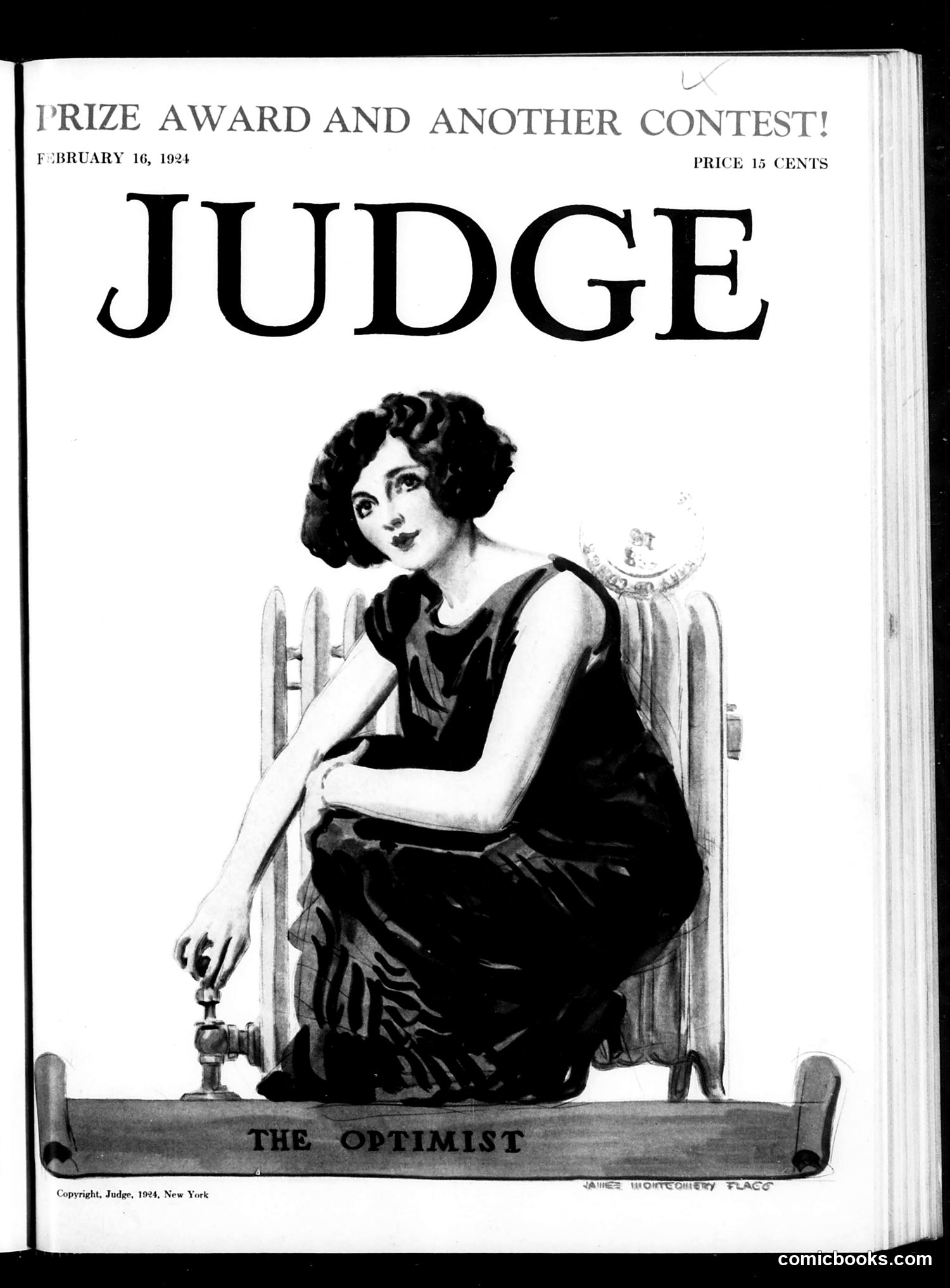
This cover illustration titled "The Optimist" depicts a woman in 1920s attire sitting in a chair, smiling while holding what appears to be a small gas burner or heating device. The image likely satirizes post-WWI economic hardship or domestic struggles of the era. The woman's composed expression despite holding such a modest or inadequate heating source suggests ironic commentary on how people maintained cheerfulness amid practical difficulties—perhaps referencing fuel shortages, poverty, or the challenges of Depression-era living that preceded the 1929 crash. The headline promises "Prize Award and Another Contest," indicating this issue contained contests for readers, a common Judge magazine feature of the period.
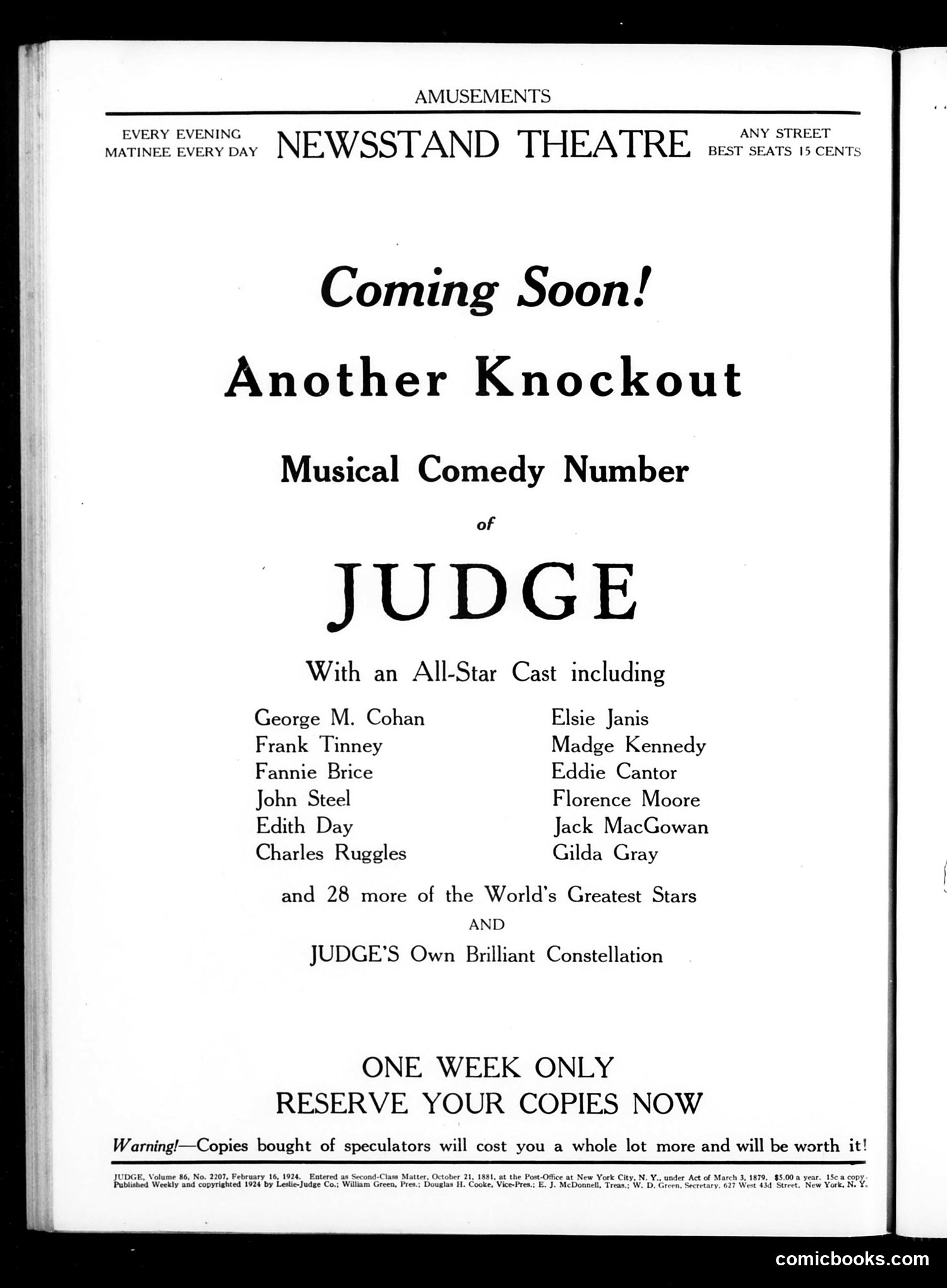
This page is primarily **advertising**, not political satire. It's a theater advertisement for the Newsstand Theatre promoting an upcoming musical comedy called "Another Knockout" featuring the character **Judge**. The ad announces an "All-Star Cast" including vaudeville and theatrical performers of the era like George M. Cohan, Frank Tinney, and Fannie Brice. The copy emphasizes exclusivity ("ONE WEEK ONLY") and warns potential buyers that scalped tickets from speculators will cost significantly more than the stated 15-cent best-seat price. This reflects early 1920s theatrical promotion strategies. "Judge" appears to be either an existing theatrical character or production being revived, though the specific reference isn't entirely clear from this advertisement alone.
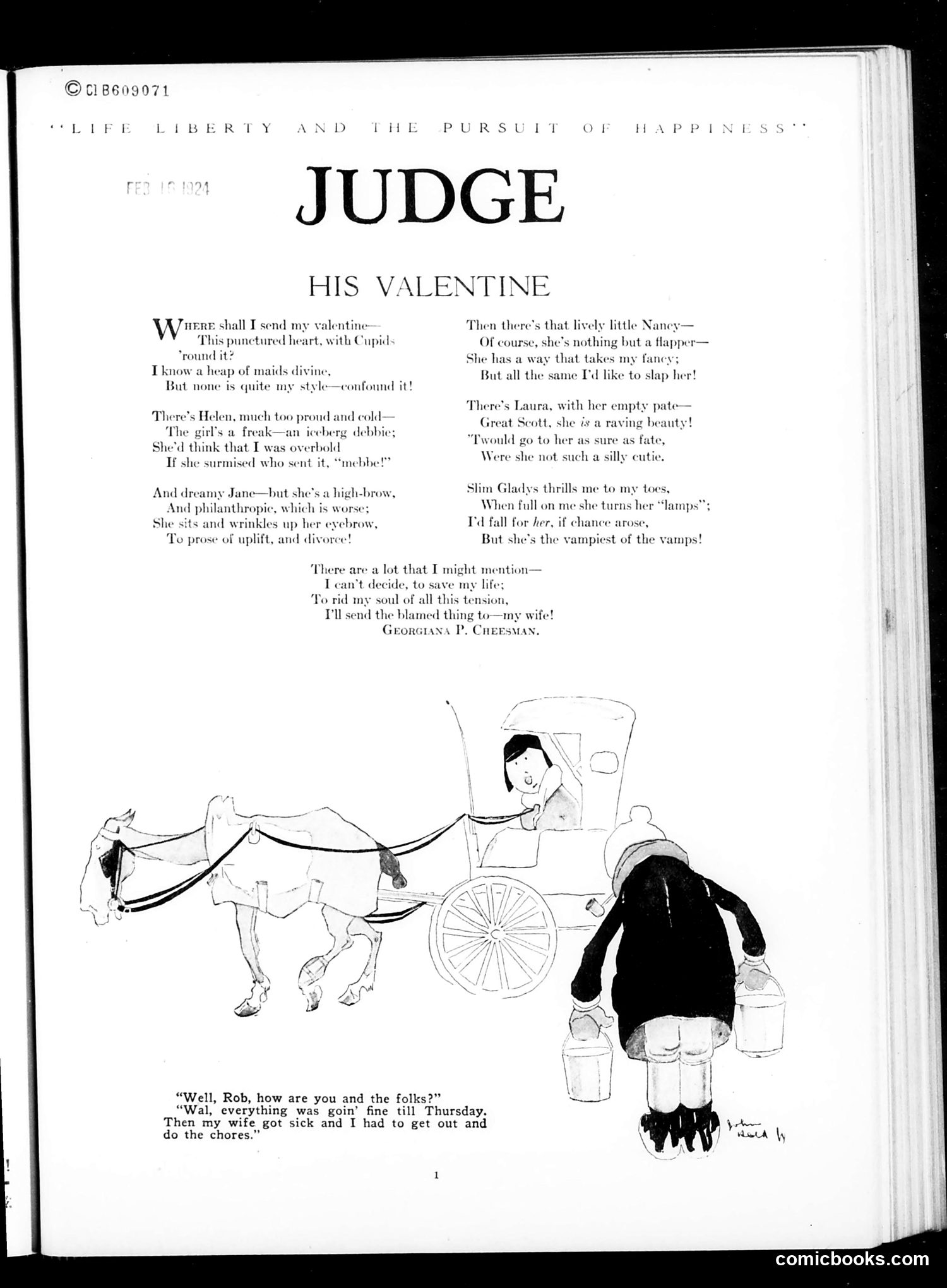
This page presents a humorous poem by Georgian P. Chessman titled "His Valentine," satirizing a married man's conflicted thoughts about sending romantic valentines to various women while being bound to his wife. The poem lists desirable women (Nancy, Laura, Jane, Gladys) whom the speaker fantasizes about, but ultimately acknowledges his wife as the real obstacle to his romantic aspirations. The final couplet reveals the joke: he'll send his valentine to his wife instead—not from affection, but as damage control to "rid [his] soul of all this tension." The accompanying illustration shows a milkman making early morning deliveries, captioning a domestic complaint: his wife became sick, forcing him to handle household chores. The cartoon reinforces themes of marital obligation and domestic duty constraining male freedom.
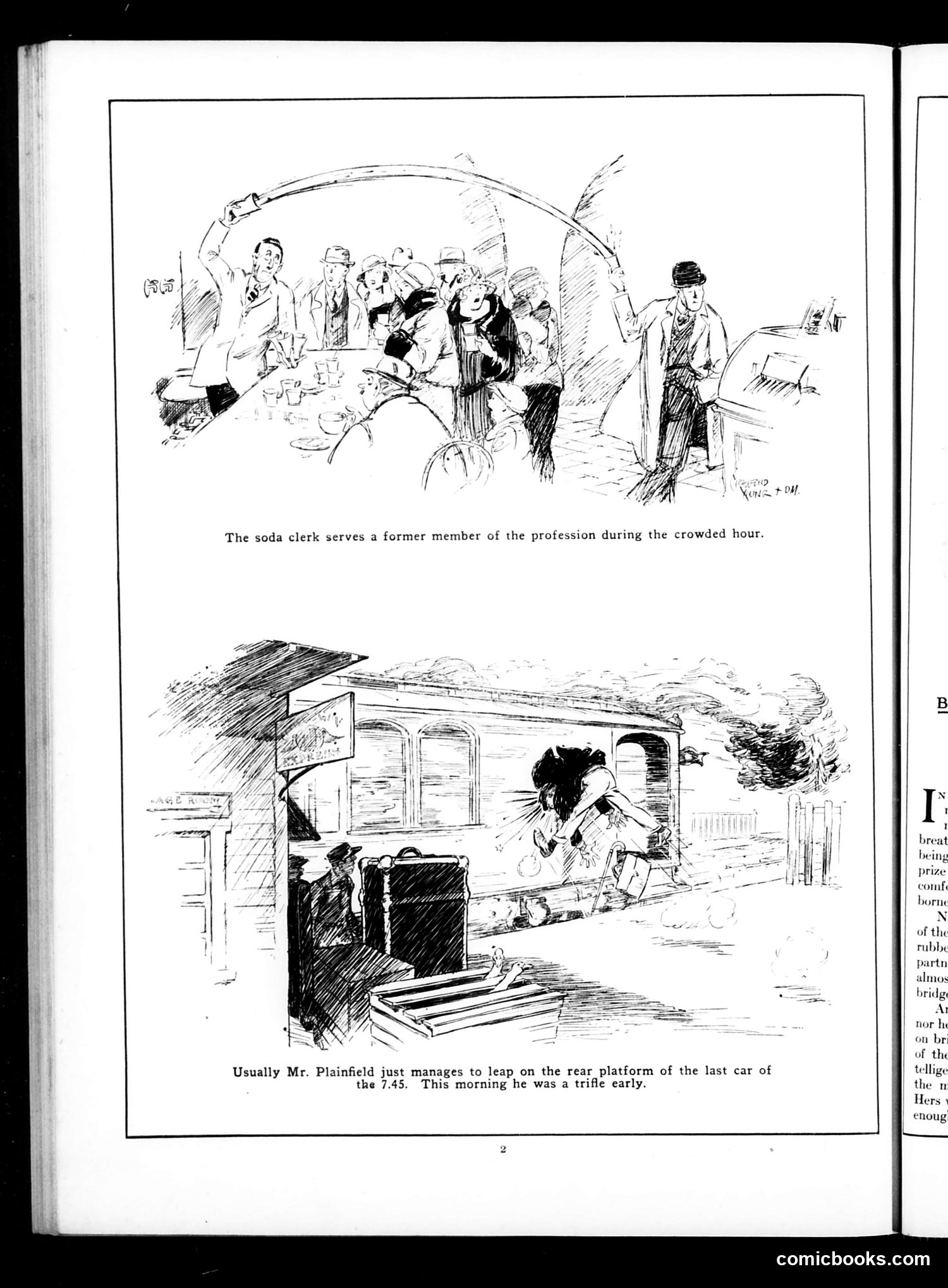
This page contains two unrelated satirical sketches: **Top cartoon:** Shows a soda fountain clerk serving drinks to well-dressed patrons during rush hour. The caption jokes that he's serving "a former member of the profession"—likely referring to a lawyer or doctor now reduced to working as a soda clerk, reflecting economic hardship or professional decline. The humor targets class anxiety and downward mobility among educated workers. **Bottom cartoon:** Depicts Mr. Plainfield missing his usual train. The caption notes he "just manages to leap on the rear platform of the last car of the 7:45" but "this morning he was a trifle early"—implying he arrived so early he had no dramatic last-second scramble. This is gentle humor about commuter routine and habitual behavior. Both sketches reflect early 20th-century urban American life.
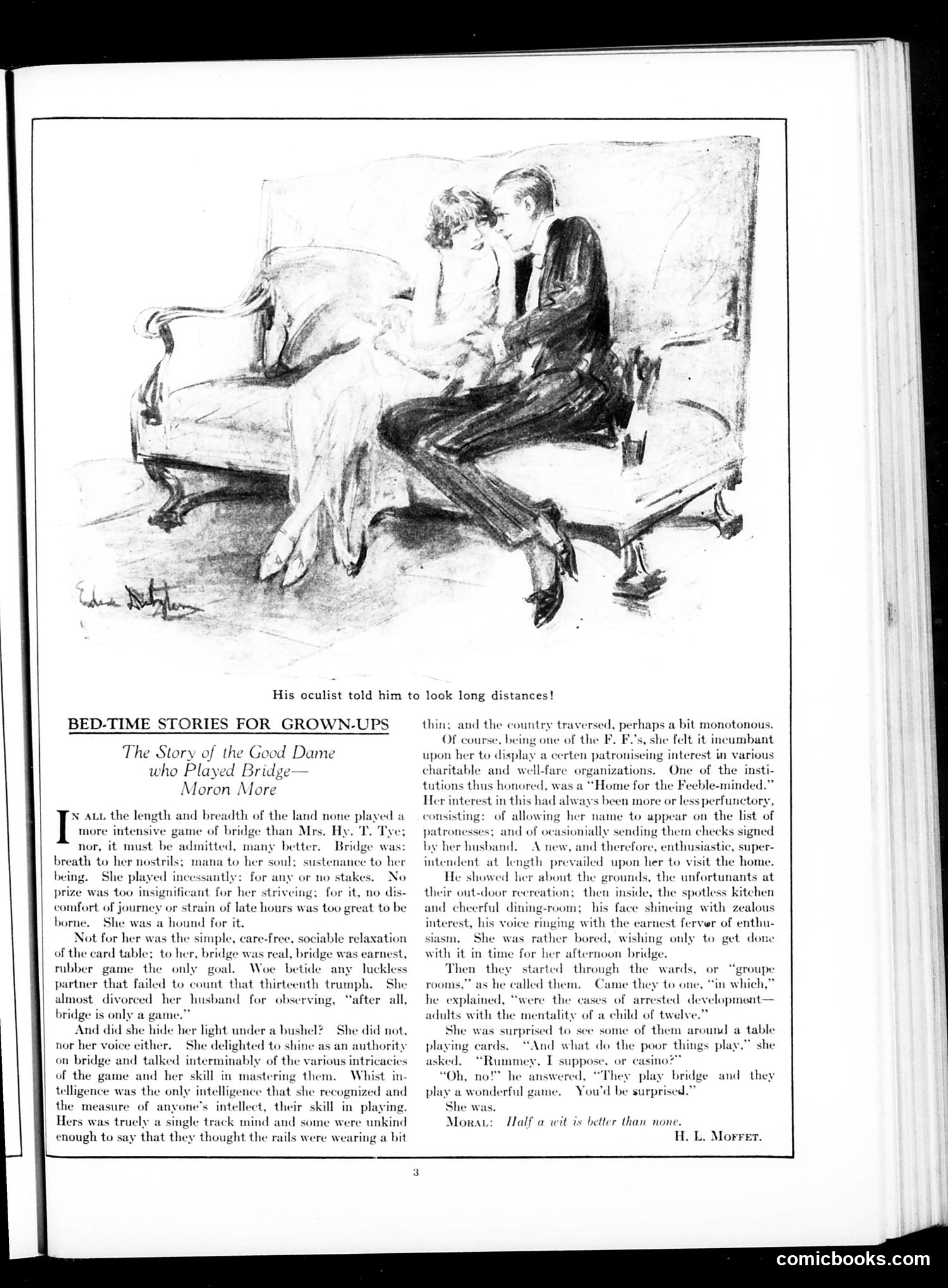
This page from *Judge* magazine presents a satirical bedtime story for adults mocking bridge-obsessed society women. The illustration shows a woman enthusiastically describing her bridge activities to what appears to be a doctor or visitor. The satire targets the era's upper-class women's preoccupation with bridge as both social status marker and all-consuming hobby. The story ridicules how a supposedly charitable "Home for the Feeble-minded" becomes merely a vehicle for the protagonist to pursue bridge games and display her patronage credentials. The moral—"Half a wit is better than none"—suggests that bridge players lack intellectual substance, playing a trivial game while pretending to meaningful charitable work. This reflects early 20th-century anxieties about idle wealthy women and superficial philanthropy.
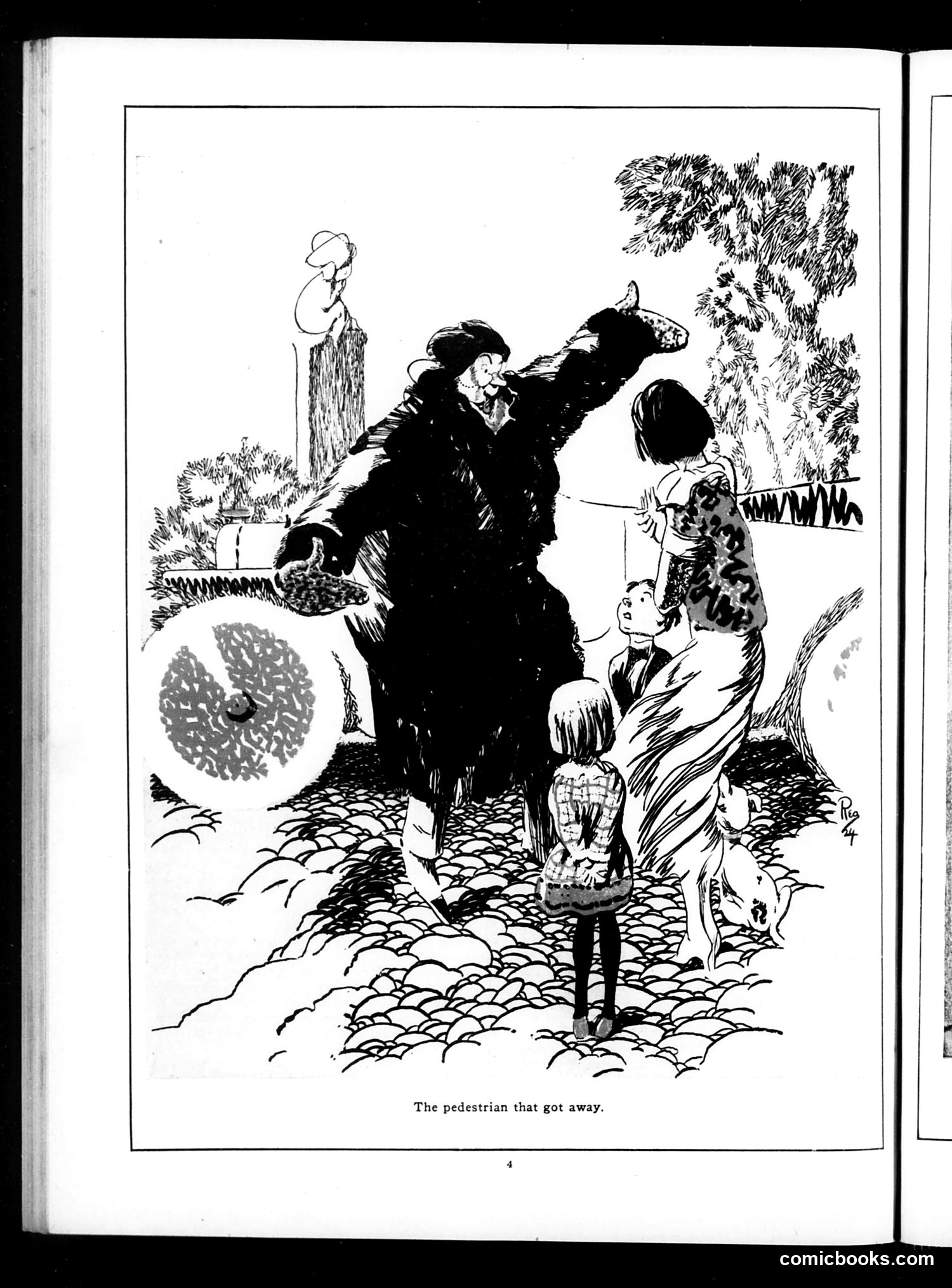
This cartoon satirizes the reckless danger of early automobiles. A well-dressed motorist, having struck a pedestrian, dramatically gestures in apparent shock or indignation while children witness the scene. The humor is darkly ironic: the title suggests the motorist "got away" with the accident—implying both that the victim survived and that the driver faced no consequences. The cartoon critiques two related issues: the carelessness of early drivers and the lack of legal accountability for traffic incidents. The children's presence emphasizes how normalized such accidents were becoming in public spaces. This reflects early-20th-century anxieties about automobiles as dangerous novelties that injured people with impunity, before modern traffic laws and insurance existed.
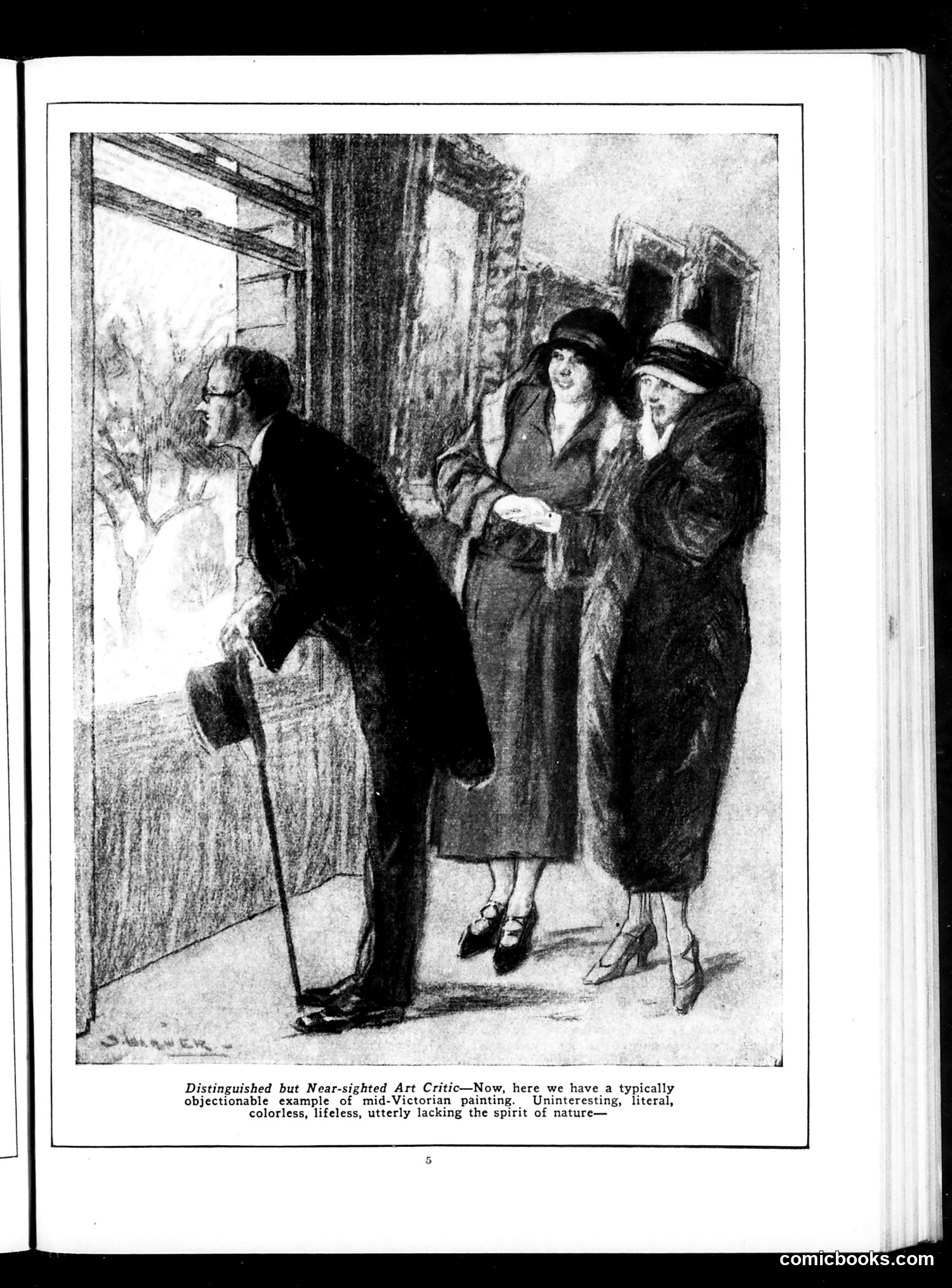
This cartoon mocks pretentious art critics, particularly those dismissing Victorian-era painting. A distinguished gentleman with a cane examines a landscape painting through a window, delivering harsh criticism to three fashionable women behind him. The joke's irony: he's criticizing the painting as "colorless" and "lifeless" while looking at an actual *real* outdoor scene—likely a spring landscape visible through the window pane, not the painting at all. The satire targets near-sighted (literal and metaphorical) critics who pontificate about art without careful observation, using fashionable modernist language ("spirit of nature") to dismiss older work. The women appear amused or skeptical, suggesting even his audience recognizes his absurdity. The cartoon ridicules both artistic pretension and the gap between critical pronouncements and actual aesthetic judgment.
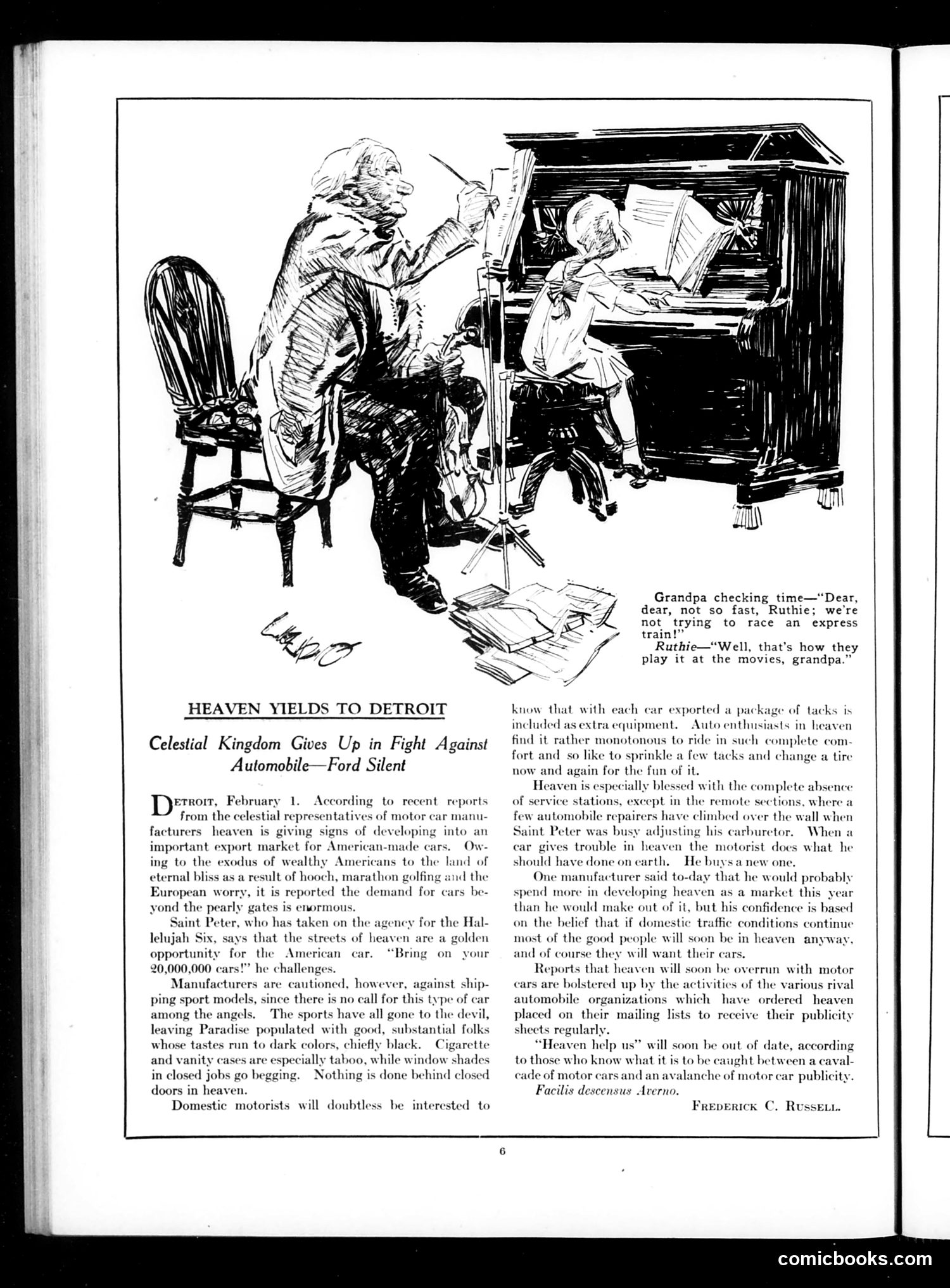
This satirical article mocks the American automobile industry's aggressive expansion and marketing during the 1920s boom era. The piece imagines car manufacturers competing to sell vehicles in heaven itself, with Saint Peter now serving as an agent for the "Hallelujah Six." **The satire targets:** - **Excessive consumerism**: Even paradise apparently needs cars, reflecting Depression-era anxieties about materialism - **Auto industry dominance**: The notion that manufacturers will pursue any market, however absurd - **Marketing saturation**: References to "mailing lists" and "publicity sheets" mock relentless advertising tactics - **American excess**: The cartoon's inset joke shows grandparents and children mimicking reckless movie-style driving, suggesting popular culture promotes dangerous speed The Latin closing phrase "Facilis descensus Averno" (easy is the descent to hell) wryly suggests that America's automotive obsession represents moral decline. The page is primarily text-based satire with one cartoon illustration depicting the generational impact of car culture.
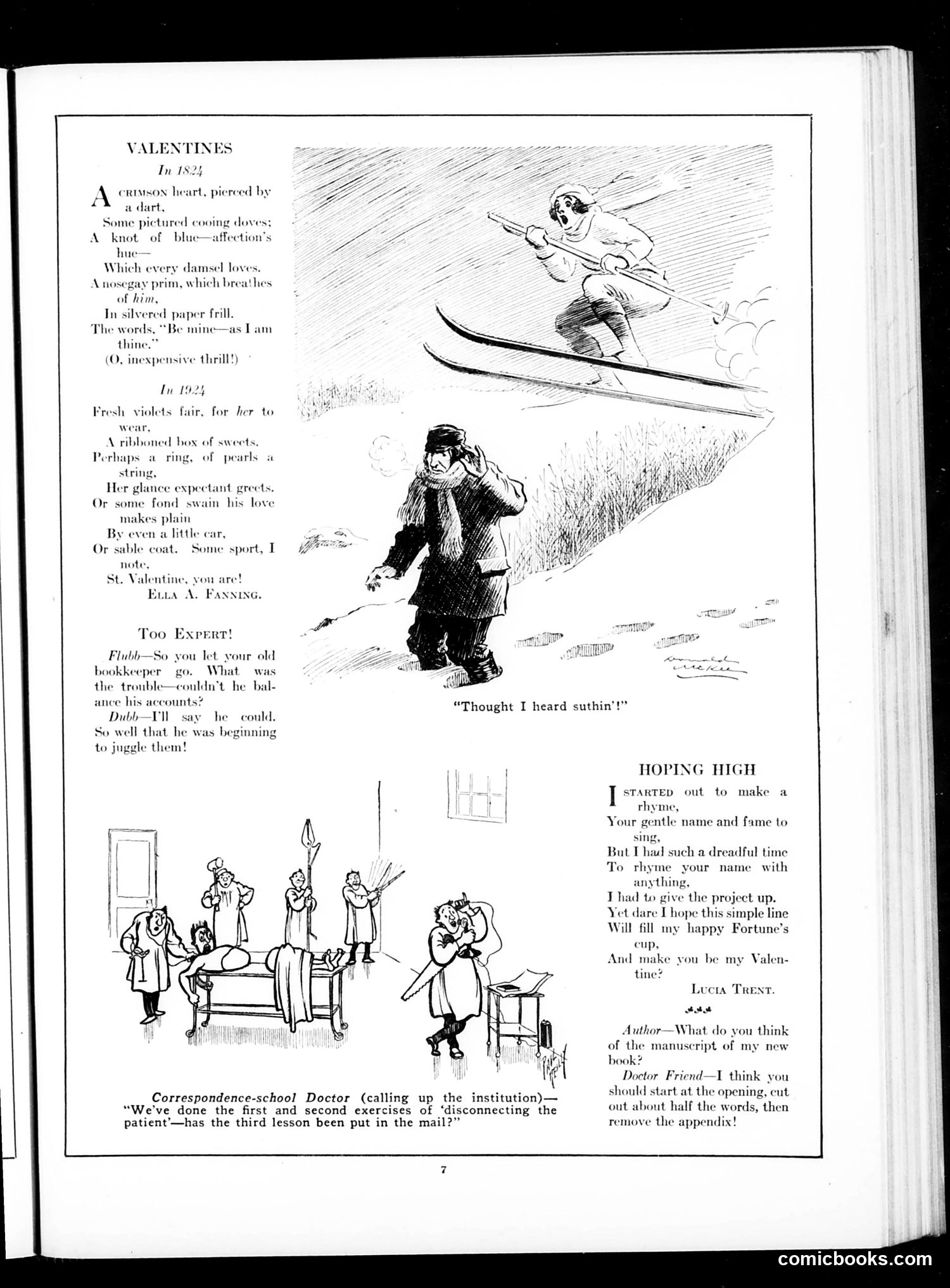
This page combines Valentine's Day humor with general satirical content circa 1924. The main feature contrasts 1824 and 1924 Valentine traditions—the first featuring simple, inexpensive tokens (paper hearts, flowers), the second showing modern materialism (cars, jewelry, coats). The satire critiques how commercialization has inflated courtship expectations. A separate joke mocks an incompetent bookkeeper who was "juggling" accounts—a euphemism for cooking the books/embezzlement. Another cartoon satirizes correspondence schools' questionable medical instruction. The final exchanges poke fun at writers struggling with bad manuscript submissions. The skiing figure appears unrelated to the text, likely advertising or filler content. Overall, the page reflects 1920s anxieties about modernization, fraud, and declining standards.
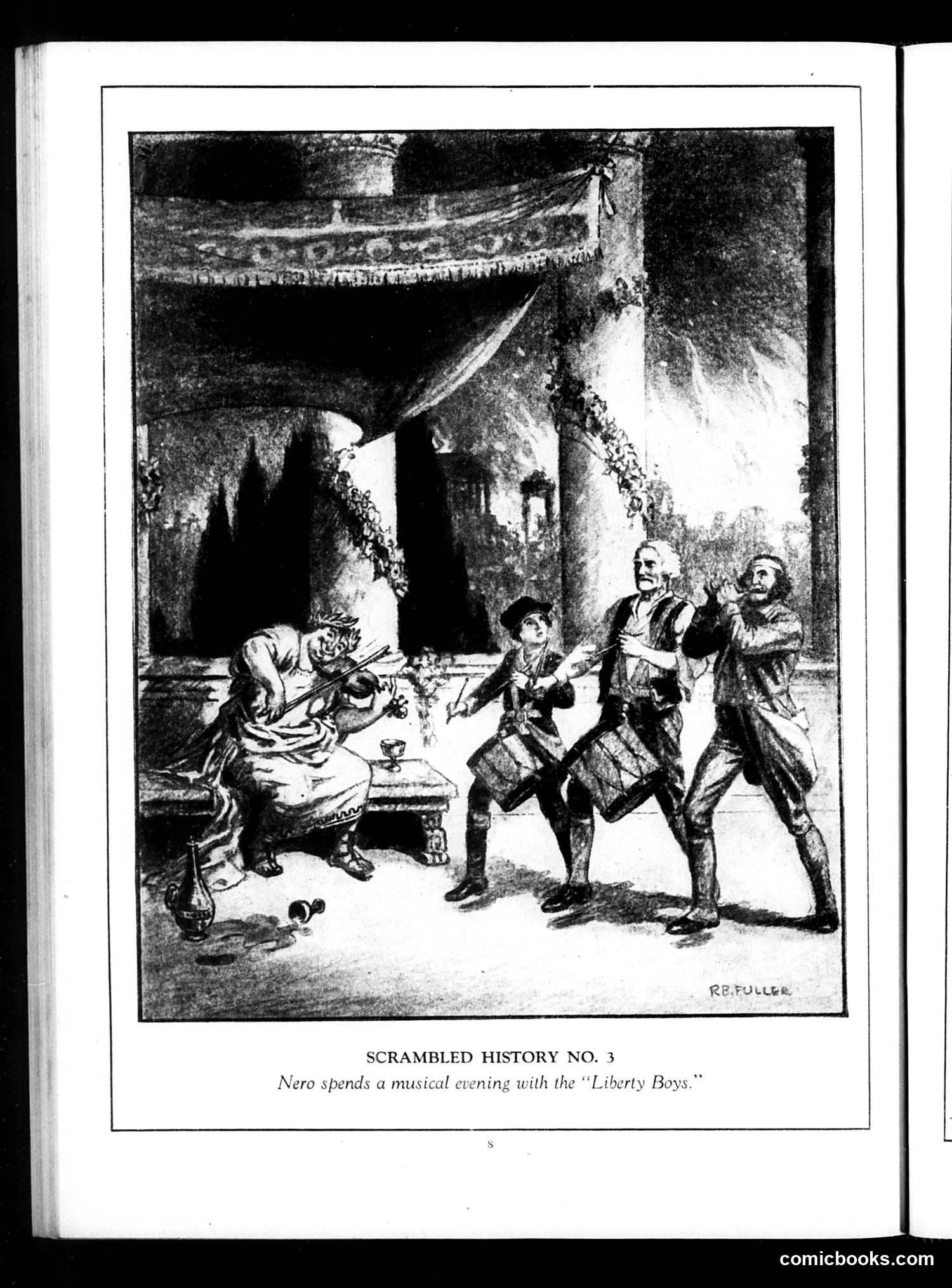
This satirical cartoon humorously reimagines Roman Emperor Nero alongside the "Liberty Boys"—likely a reference to American Revolutionary War-era groups or possibly a contemporary organization. The title "Scrambled History" signals intentional historical absurdity. The joke appears to conflate Nero (infamous for allegedly fiddling while Rome burned) with American patriots, suggesting either: (1) a critique of the "Liberty Boys'" actual conduct, or (2) mockery of how revolutionary rhetoric was being misapplied. The formal setting and musical context evoke Nero's legendary decadence, while the anachronistic pairing creates comedic incongruity. Without the magazine's publication date, the specific "Liberty Boys" referenced remain unclear—they could reference a colonial militia, a political organization, or a contemporary group Judge's readers would recognize.
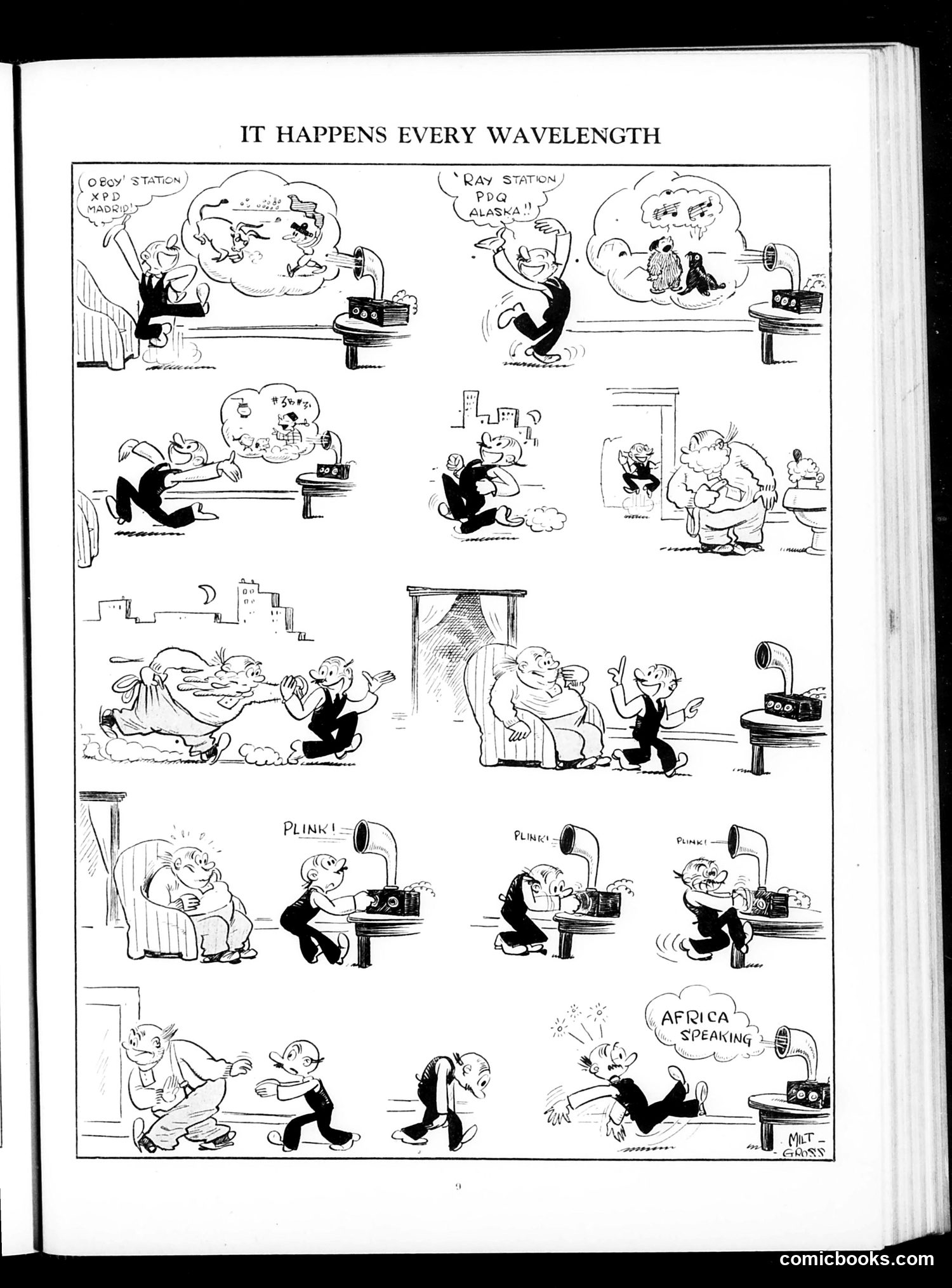
This comic satirizes early radio broadcasting by showing the same chaotic scenario repeating across different radio stations and wavelengths. A man operating various radio equipment repeatedly transmits to different audiences—labeled "O'Boy Station," "Ray Station," and "PDQ Alaska"—each time receiving increasingly absurd responses (music, Alaska references, etc.). The repeated "PLINK!" sound effects suggest technical malfunctions or interference. The final panels show the operator being chased and physically attacked by listeners, culminating in "Africa Speaking," suggesting the broadcast has gone globally wrong. The satire targets the then-novel medium of radio broadcasting, mocking its technical unreliability, unpredictable reach across wavelengths, and the chaos that ensues when signals go awry or reach unintended audiences. It's a commentary on early radio's growing but unstable influence.
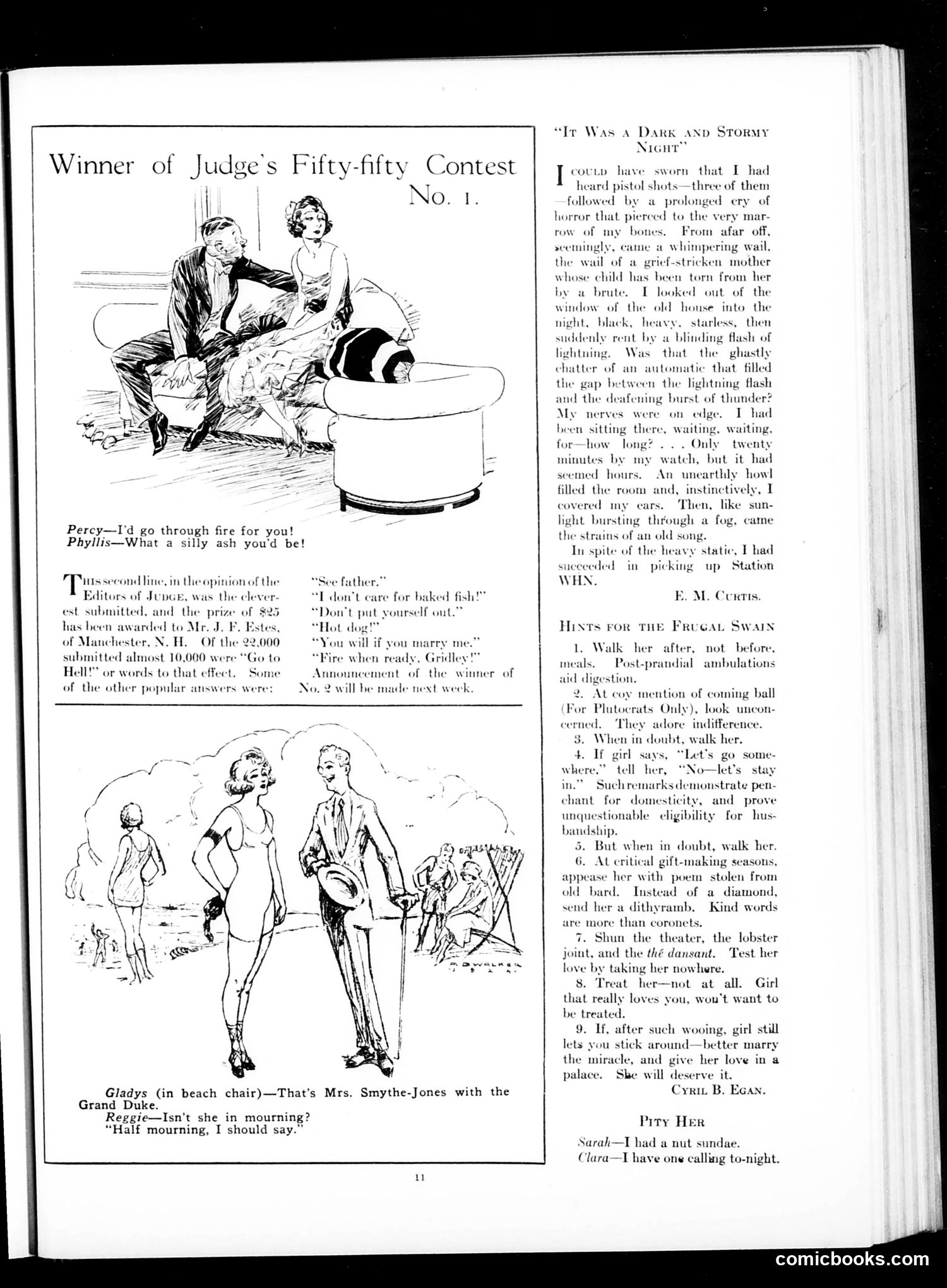
This page contains humor typical of 1920s-era Judge magazine. The "Fifty-Fifty Contest" announces a competition where readers submit clever rejoinders to opening lines. The winning entry—a man saying "I'd go through fire for you!" met with "What a silly ash you'd be!"—plays on the double meaning of "ash" (residue from fire). The beach scene joke relies on class commentary: "Mrs. Smythe-Jones" wearing "half mourning" suggests she's pretending to grieve while vacationing, mocking upper-class affectation. "Hints for the Frugal Swain" satirizes penny-pinching courtship advice, suggesting walks are free entertainment and cheap poetry substitutes for diamonds—poking fun at working-class or Depression-era dating tactics and male stinginess. The dramatic story fragment "It Was a Dark and Stormy Night" appears to be either parody or genuine pulp fiction common to the era. The humor assumes readers understood early 20th-century dating conventions, class distinctions, and period slang.
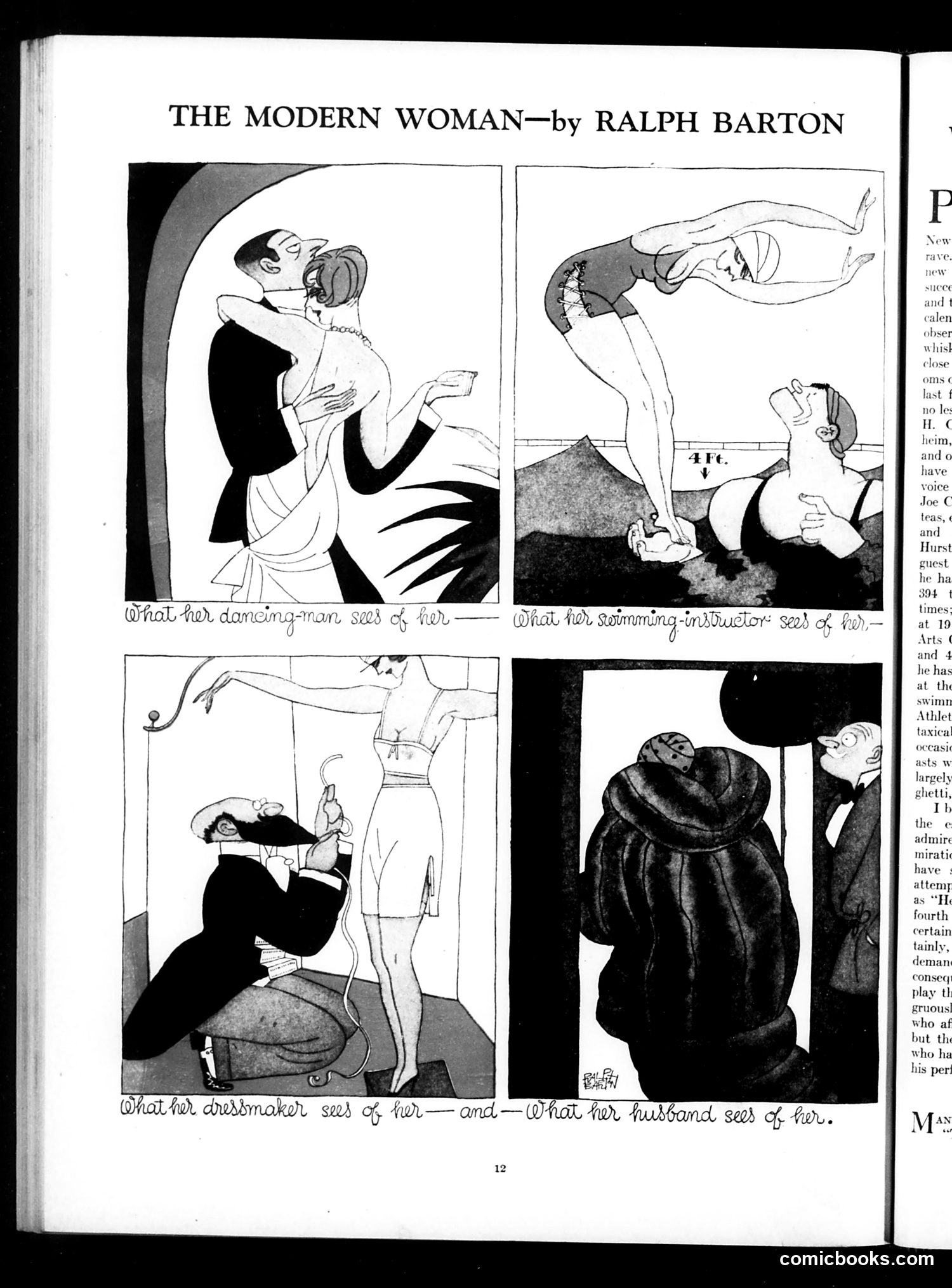
This four-panel satirical cartoon by the prominent social cartoonist Ralph Barton depicts different male perspectives on the modern woman of the 1920s era. Each panel shows what different types of men notice about women: 1. A dancing man focuses on physical attractiveness during dance 2. A swimming instructor observes her athletic form at a pool (marked "4 Ft.") 3. A dressmaker examines her measurements and fashion choices 4. A husband sees only her expensive fur coat from behind The satire targets both the "modern woman"—depicted as fashionable, athletic, and increasingly visible in public spaces—and male society's reductive views of women. Each profession reduces her to a single, self-interested perspective. The joke reflects 1920s anxieties about women's changing social roles, their bodies on display in new contexts (swimming, dancing), and consumer culture, while mocking men's inability to see beyond their own narrow interests.
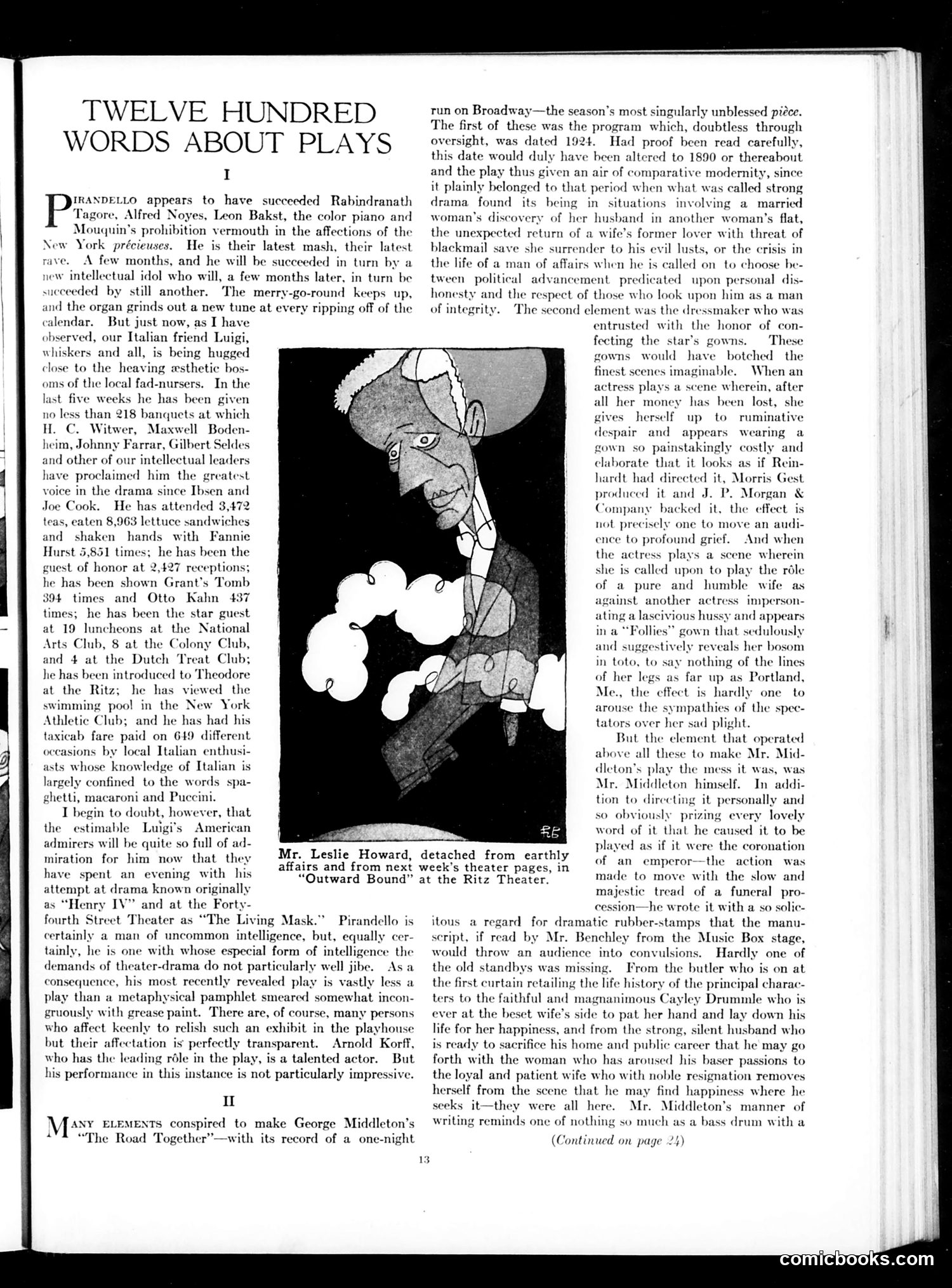
This page satirizes the pretentious faddishness of New York's cultural elite. The author mocks how Pirandello (the Italian playwright Luigi Pirandello) has become the fashionable obsession of "précieuses"—affected, cultured New Yorkers who cycle through intellectual enthusiasms. The piece catalogs absurdly specific statistics of receptions, banquets, and social honors showered upon him. The cartoon shows Leslie Howard in "Outward Bound" at the Ritz Theater—apparently as a positive counterpoint to the pretentious avant-garde drama being celebrated. The satire targets the artificial enthusiasm of Manhattan's intellectual circles: they treat Pirandello as genius while having spent evenings with his actual play ("Henry IV"), which the author dismisses as "vastly less a play than a metaphysical pamphlet." The joke: they admire what they don't truly understand, and their affectation is "perfectly transparent."
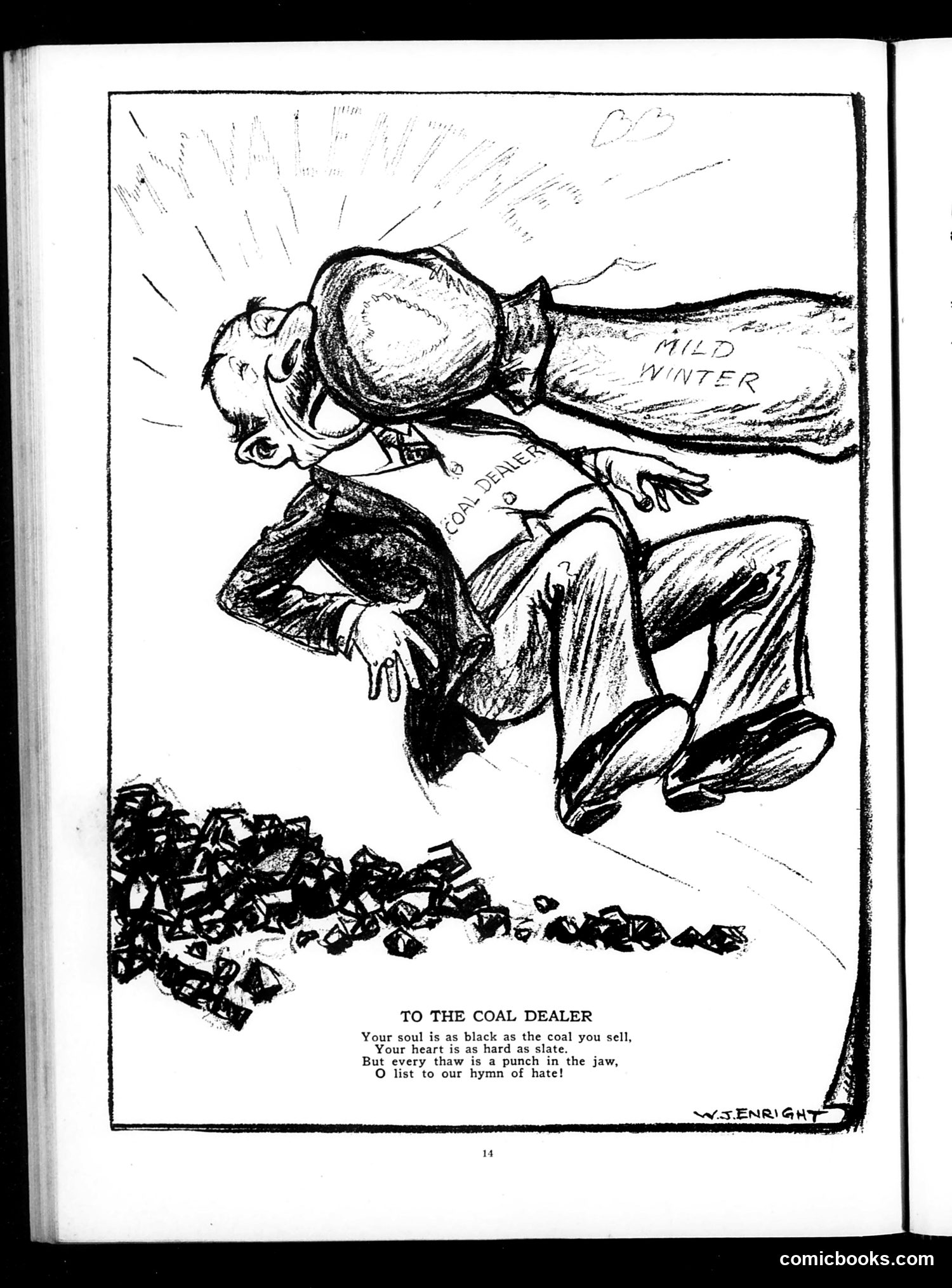
This satirical cartoon attacks coal dealers during winter, depicting a figure being knocked backward by the force of a thaw (spring warming). The cartoon accuses coal dealers of profiting unfairly during harsh winters when fuel demand peaks, suggesting their pricing practices are exploitative and cruel. The text's hostile tone—"hymn of hate"—reflects public anger at coal dealers who allegedly inflated prices during cold weather emergencies. When temperatures rose (the "thaw"), demand dropped, costing dealers profits—hence the metaphorical "punch in the jaw." This likely reflects early 20th-century American consumer frustration with monopolistic heating fuel practices. The "Mild Winter" label suggests dealers feared season changes that would reduce their leverage over desperate customers needing heat.
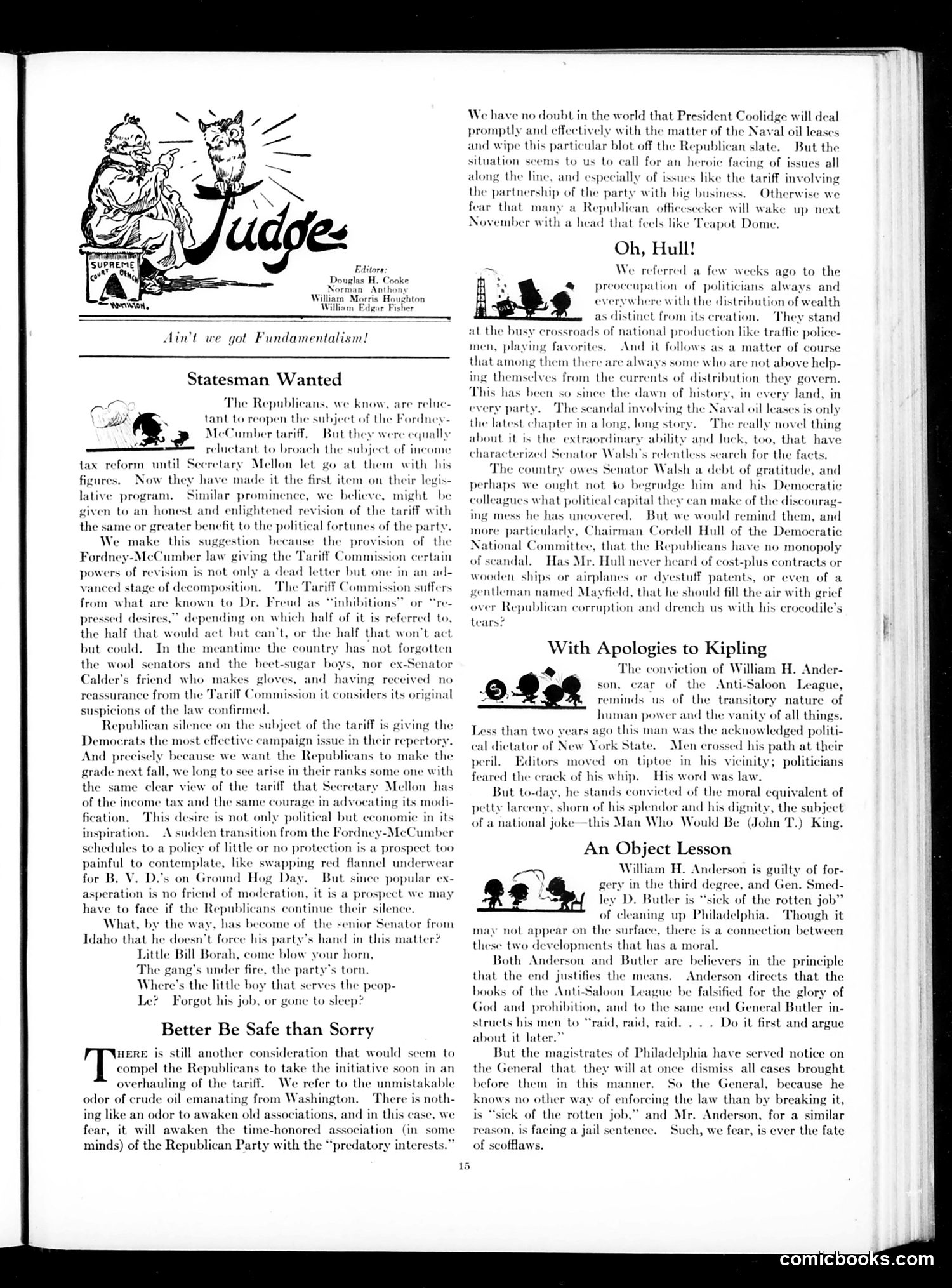
This page contains multiple political editorials satirizing Republican Party challenges circa 1923-1924. The main cartoon depicts an owl (representing judicial wisdom or the Republican Party) confronting fundamentalism—likely referencing the Scopes trial debates dividing Americans. **"Statesman Wanted"** criticizes Republicans for avoiding tariff reform despite Secretary Mellon's tax changes. It specifically mocks Senator William Borah of Idaho ("Little Bill Borah"), calling him out for failing party leadership during this crisis. **"Better Be Safe than Sorry"** references the Teapot Dome scandal (oil leases), warning that the "odor of crude oil" will damage Republican credibility and revive public distrust of the party's association with "predatory interests." **"Oh, Hull!"** and other sections critique Democratic Chairman Cordell Hull while noting politicians obsess over wealth *distribution* rather than *creation*—a fundamental economic philosophy disagreement. The overall message: Republicans face multiple crises (tariffs, oil scandals, internal divisions) requiring bold leadership, not silence.
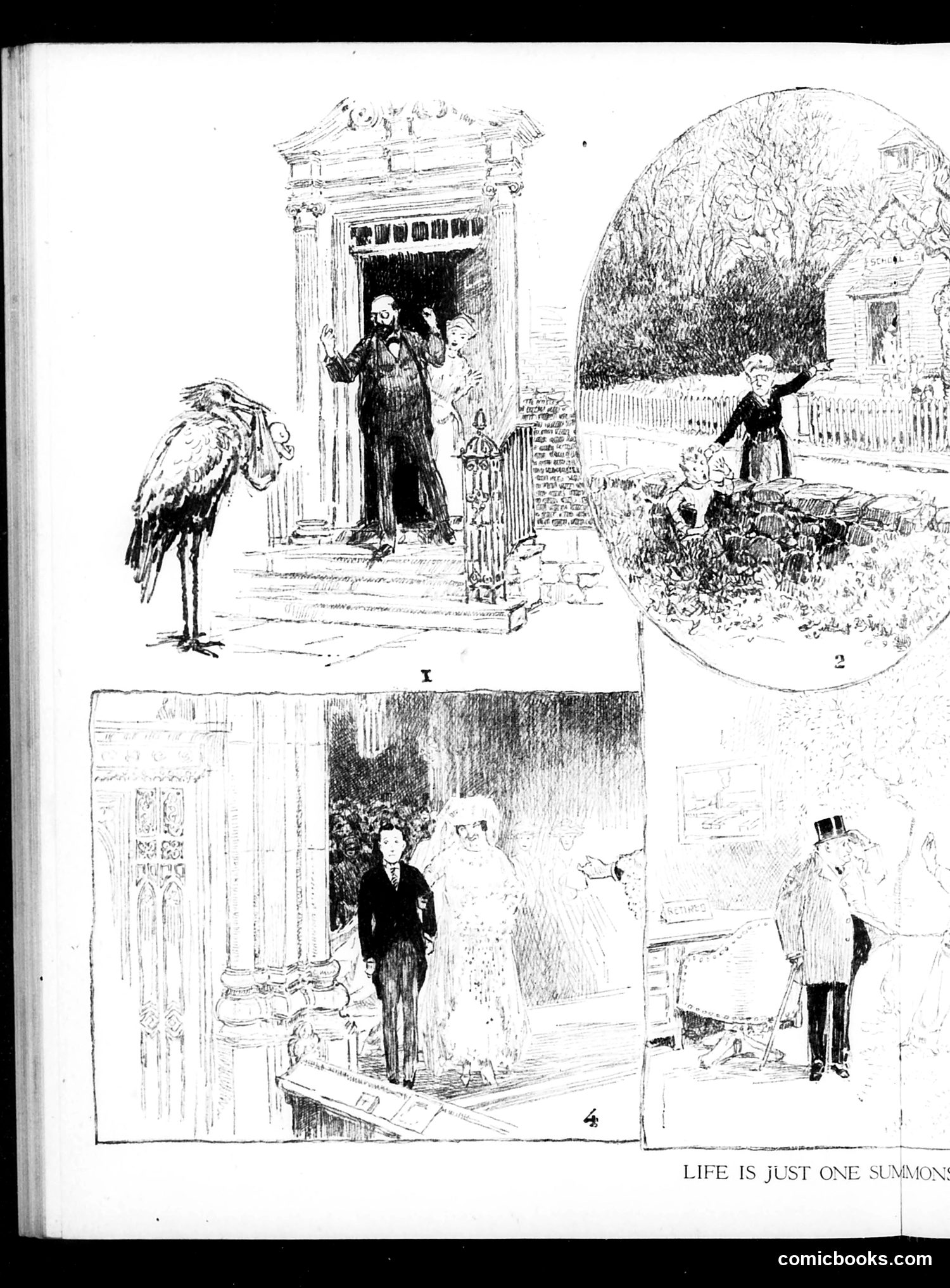
This page contains four untitled satirical sketches under the heading "LIFE IS JUST ONE SUMMONS." Each panel appears to depict a legal summons scenario in Victorian-era America: 1. A stork arrives at a doorway with what appears to be a legal notice 2. A woman tends a garden while being served papers 3. An indoor scene with figures and legal documents 4. A man in formal dress, possibly a lawyer or officer The overarching joke—suggested by the title—is that life consists of receiving one legal summons after another. The humor appears to target the frequency of lawsuits and legal entanglements in American society, possibly satirizing either the litigation-heavy culture or the unpredictability of legal troubles striking at any moment, in any circumstance. The specific individuals and particular legal references remain unclear from the image alone.
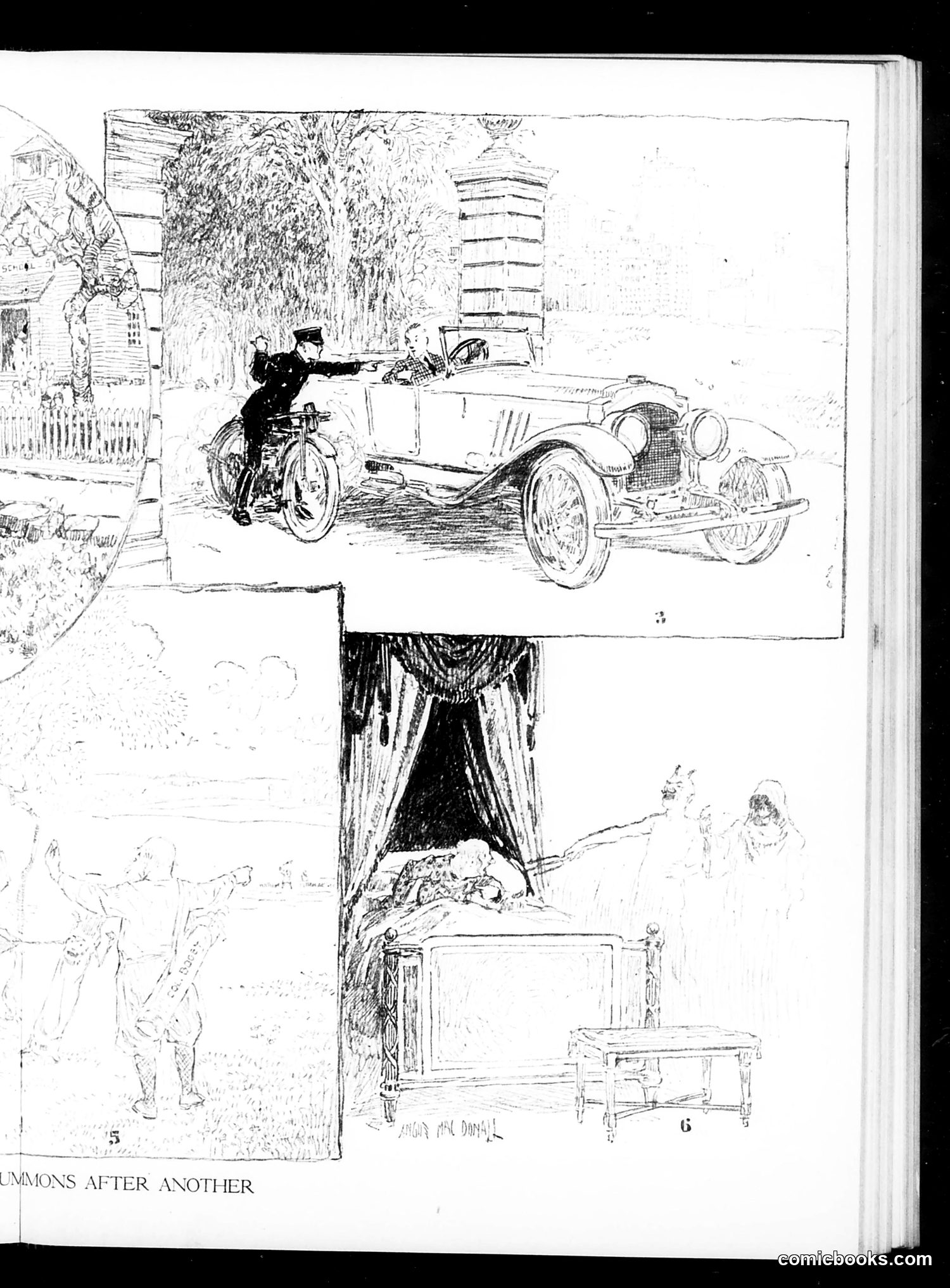
This page contains two cartoon panels with the caption "SUMMONS AFTER ANOTHER" (likely a pun on "summers"). **Top panel:** A motorcyclist on a bicycle gestures toward an automobile, appearing to issue a summons or citation. The scene is set on a residential street with period architecture (appears early 20th century). **Bottom panel:** An interior bedroom scene with a canopied bed and figures, suggesting a domestic or romantic scenario. The joke appears to play on "summons" (legal notices) versus "summers" — though the exact satirical point is unclear without additional context. The pairing suggests commentary on either traffic law enforcement, romantic entanglements, or seasonal social situations common to the era. The title's wordplay is the primary humor mechanism visible here. The OCR text is too corrupted to provide additional clarity on the intended meaning.
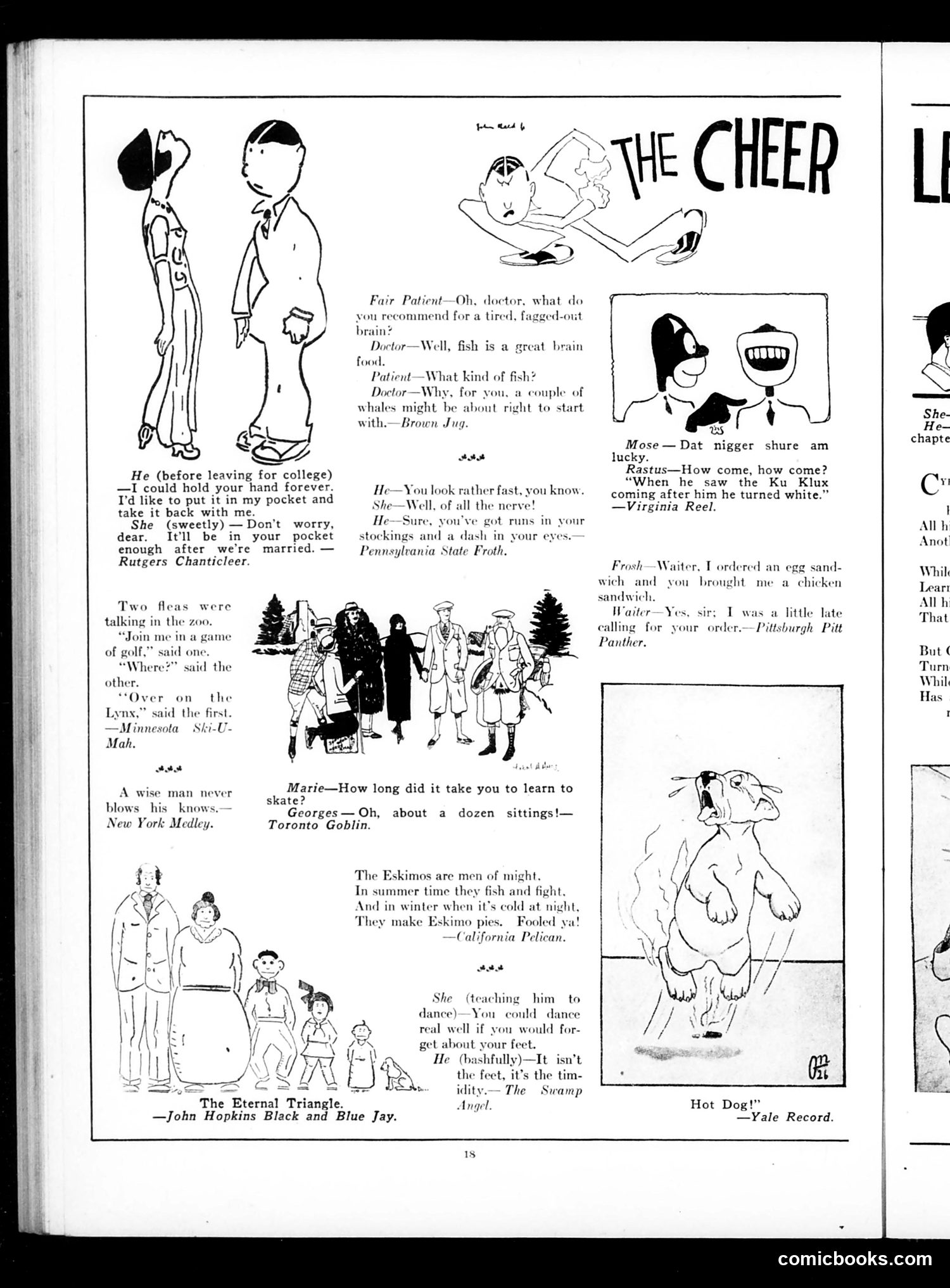
This page collects brief jokes and comic vignettes typical of early 20th-century college humor magazines. Most content relies on wordplay and social observation rather than political satire. Notable items include a crude racial joke ("Virginia Reel") using a period slur, playing on the Ku Klux Klan—reflecting the casual racism of the era. A "doctor" joke recommends whale meat as brain food. College-oriented humor appears throughout: references to specific universities (Rutgers, Toronto, Minnesota, Yale, Pittsburgh), dating anxieties ("The Eternal Triangle"), and campus life (a waiter mixing up sandwich orders). One cartoon shows a family group labeled "The Eternal Triangle"—likely satirizing triangular relationship drama common in period fiction and social gossip. The illustrations are simple line drawings accompanying brief attributed quips from various college publications, designed for quick laughs rather than sustained satire. The content reflects casual period attitudes that would be considered offensive today.
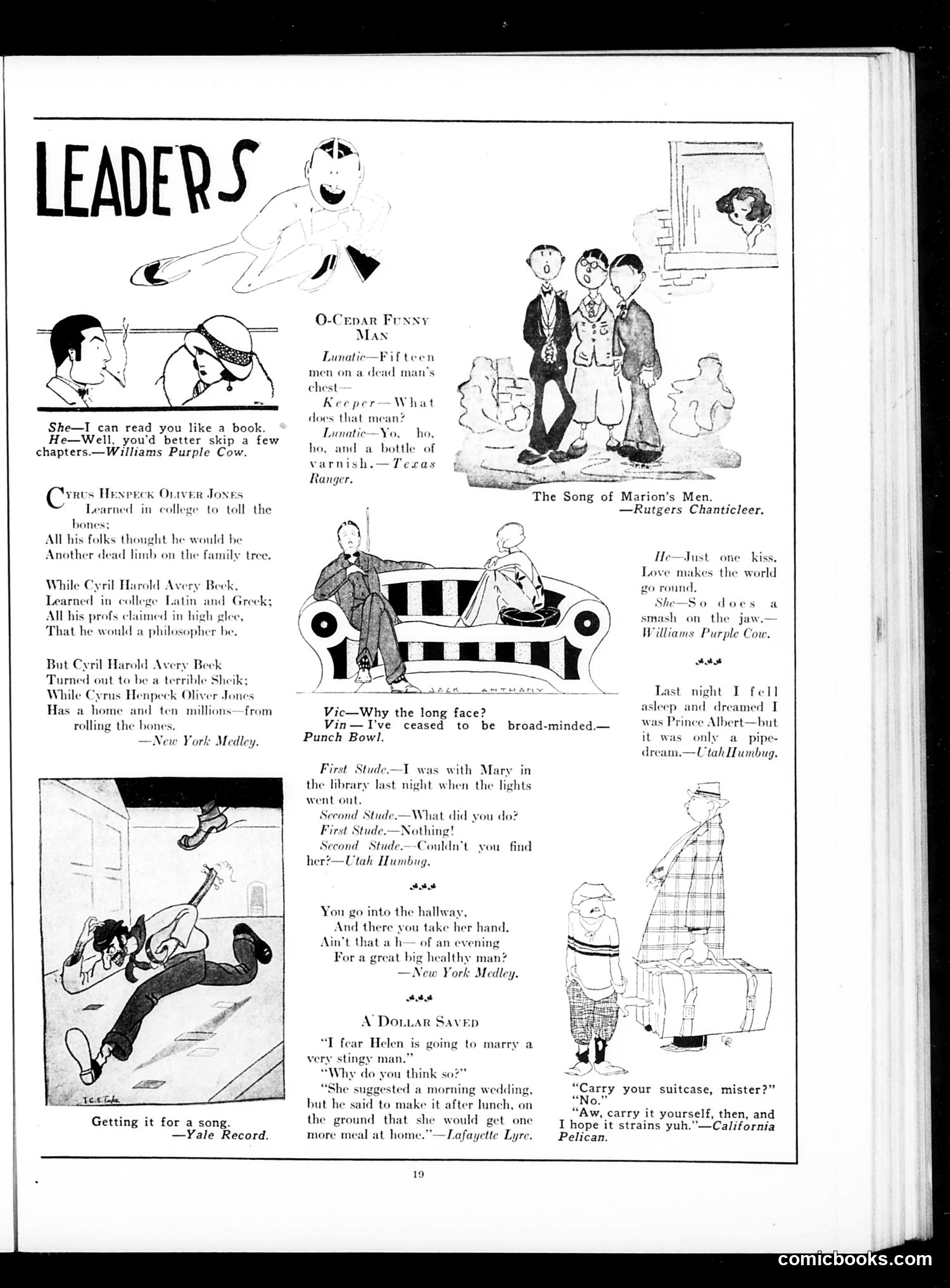
This is a humor/joke page from *Judge* magazine featuring various cartoon gags and witticisms typical of early 20th-century American satire. **Main content:** - Multiple short jokes and quips organized around small cartoon illustrations - Themes include romantic mishaps, college life, and class commentary - The "Leaders" heading suggests these are popular jokes or catchphrases **Notable satirical elements:** - "Cyrus Henpeck Oliver Jones" vs. "Cyril Harold Avery Beck": A working-class hustler ("rolling the bones"—gambling) outsuccessfully a college-educated intellectual, mocking educated pretension - Library/romance jokes playing on era conventions - "A Dollar Saved": Satire of misers, with the punchline about a groom delaying his wedding to avoid feeding guests—commentary on extreme cheapness - Various quips about kissing and courtship reflect period dating customs **No identifiable political figures** appear to be caricatured. This is primarily **social satire** targeting educational snobbery, romantic conventions, and miserliness—typical *Judge* material mocking American middle-class foibles through humor.
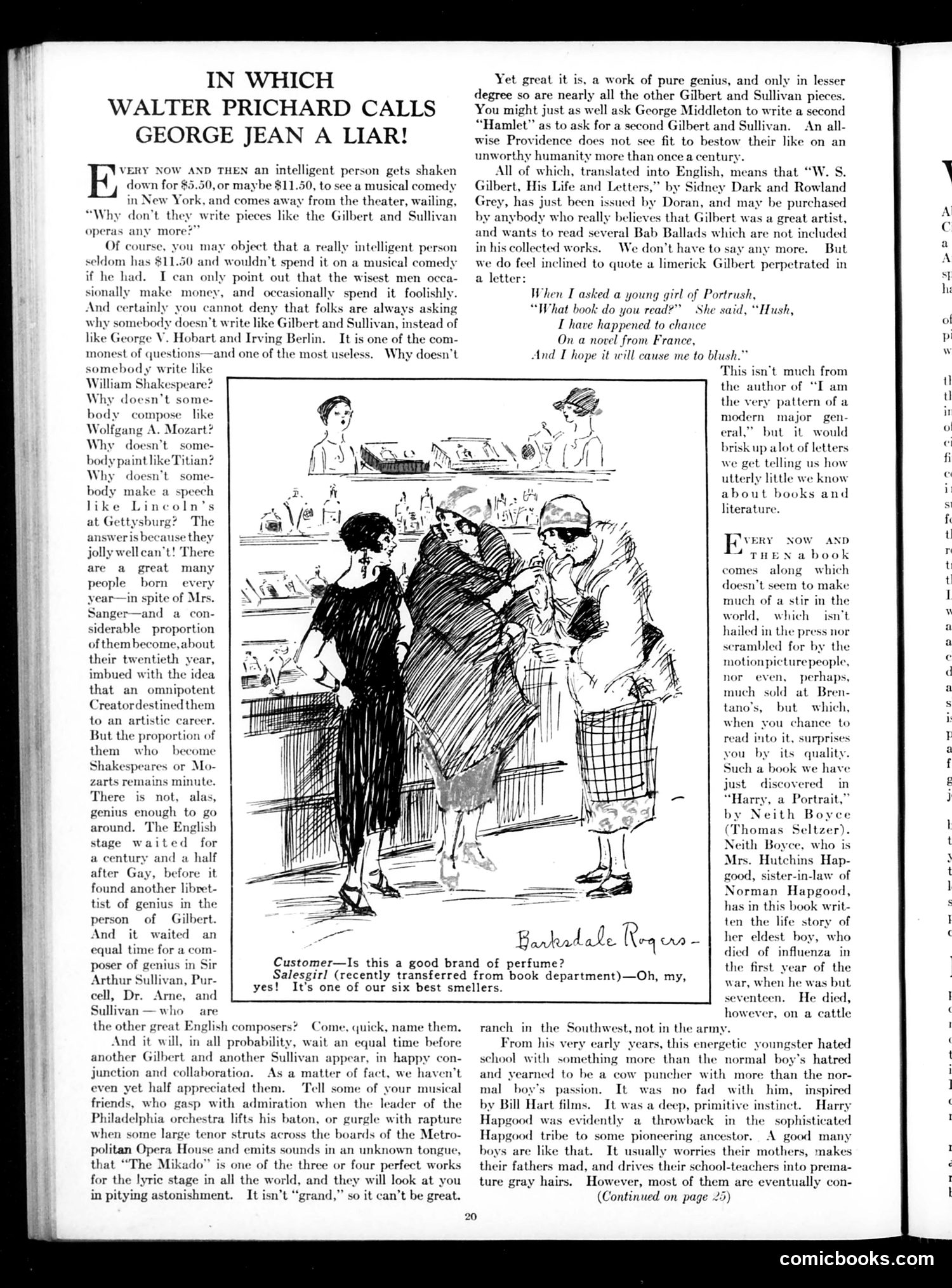
This page critiques the persistent cultural complaint that modern composers don't create works equal to Gilbert and Sullivan's operettas. The author Walter Prichard argues this is an absurd, unanswerable question—like asking why no one writes Shakespearean plays anymore. He contends that genius appears rarely across centuries; expecting multiple Gilberts is unreasonable. The accompanying illustration shows a department store scene where a customer asks a saleswoman about perfume quality. The caption jokes that the perfume is "one of our six best smellers"—a satire on how people arbitrarily rank mediocre modern works as "great," similar to how they undervalue *The Mikado* because it isn't "grand." The piece also reviews "W. S. Gilbert, His Life and Letters" (published by Doran), including a silly limerick Gilbert wrote, suggesting even genius occasionally produces forgettable work.
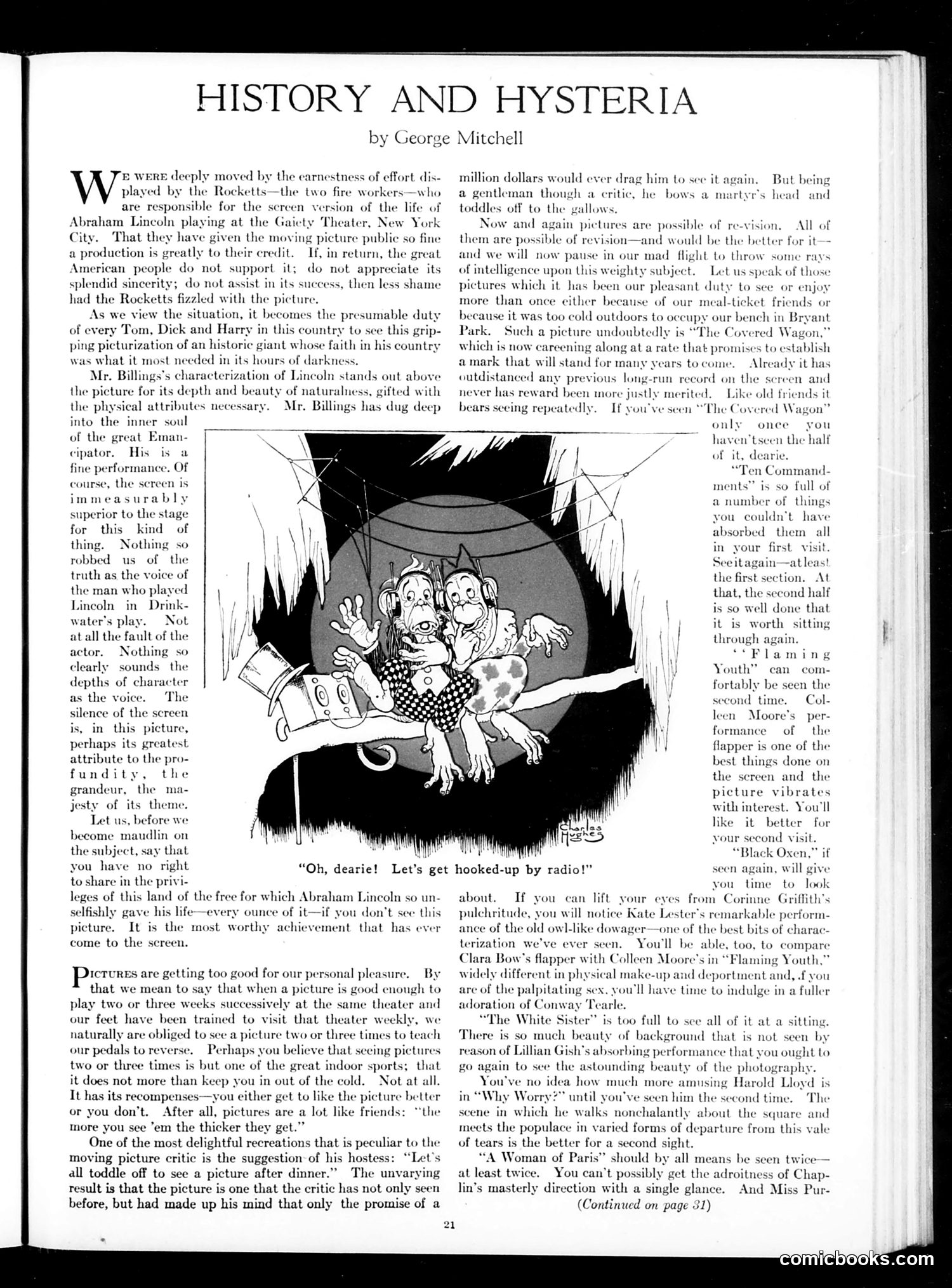
This page reviews a 1924 Lincoln film starring actor Billings, praising its "depth and naturalness." The cartoon (captioned "Oh, dearie! Let's get hooked-up by radio!") depicts figures humorously listening to radio—likely satirizing the tension between emerging radio technology and cinema's dominance as entertainment. The article argues Americans have a patriotic *duty* to see Lincoln films, invoking Lincoln's sacrifice ("every ounce of it") to shame people into attendance. Mitchell advocates repeat viewings, claiming familiarity improves appreciation ("the more you see 'em the thicker they get"). The satire targets both movie-industry boosterism and the cultural anxiety about new media (radio). The juxtaposition of earnest Lincoln-worship with flippant entertainment consumption—plus the moral hectoring—ridicules the film industry's manipulation of patriotic sentiment to drive box-office revenue.
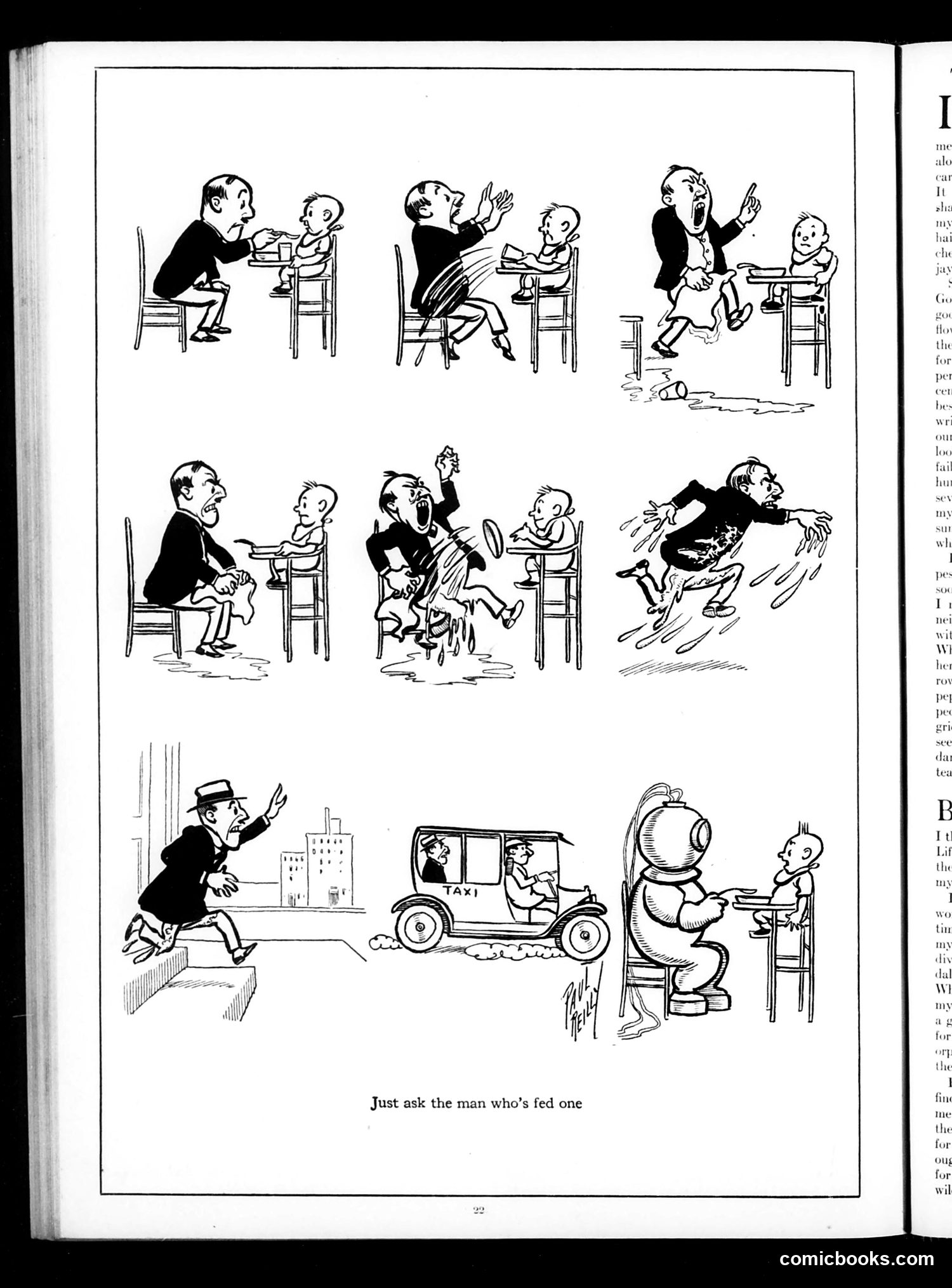
This single-panel cartoon appears to be an advertisement or slogan-based comic rather than political satire. The caption "Just ask the man who's fed one" is a play on the famous advertising slogan "Ask the man who owns one" (likely referencing automobile advertisements of the early 20th century). The sequential images show a man feeding a small child in increasingly chaotic ways—from normal feeding to wild gesticulation to physical comedy involving a taxi and a large spherical object. The joke suggests that feeding a child is an absurdly difficult, exhausting, or humorous experience. The satirical point appears to target parenting challenges or child-feeding difficulties, using exaggerated physical comedy rather than political commentary.
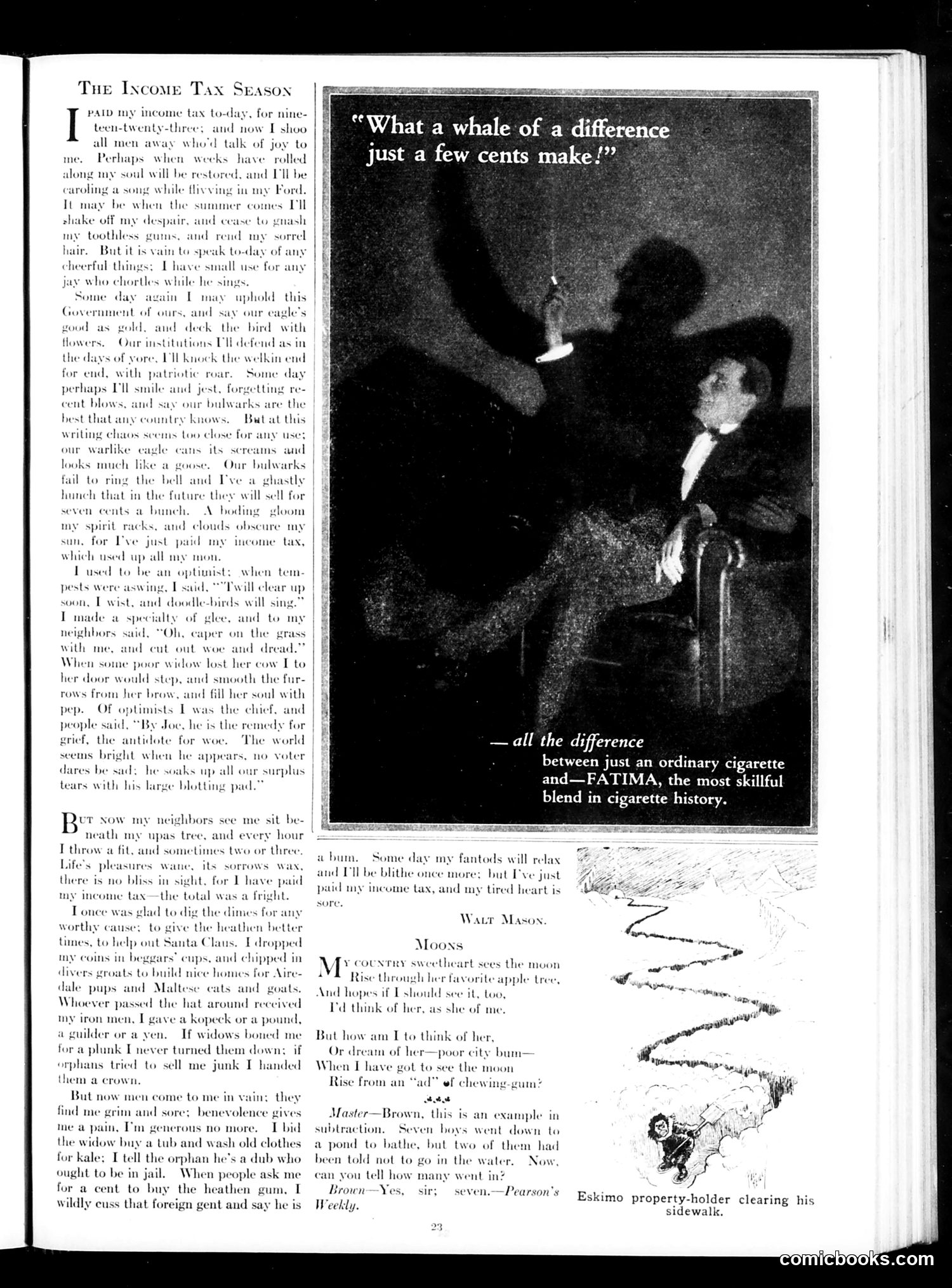
**Main Content - "The Income Tax Season":** This is a humorous essay by Walt Mason lamenting the 1919 income tax. The author describes his transformation from an optimistic philanthropist into a miserly curmudgeon after paying his tax bill ("nine-teen-twenty-three"). The satire mocks how tax season destroys his charitable spirit—he once helped widows, orphans, and beggars, but now refuses them money. The point: income taxation is presented as so burdensome it corrupts Americans' generosity and patriotic spirit. **Advertisement - Fatima Cigarettes:** A large cigarette ad claiming superior "blend" quality, using the hook "what a whale of a difference just a few cents make"—ironic juxtaposition with the adjacent article about depleting one's wealth to taxes. **Minor Content:** Small poems about moonlight and a classroom subtraction problem round out the page—typical filler for period magazines. **Historical Context:** This reflects 1920s resentment of post-WWI federal income taxes, which many viewed as punitive and un-American.
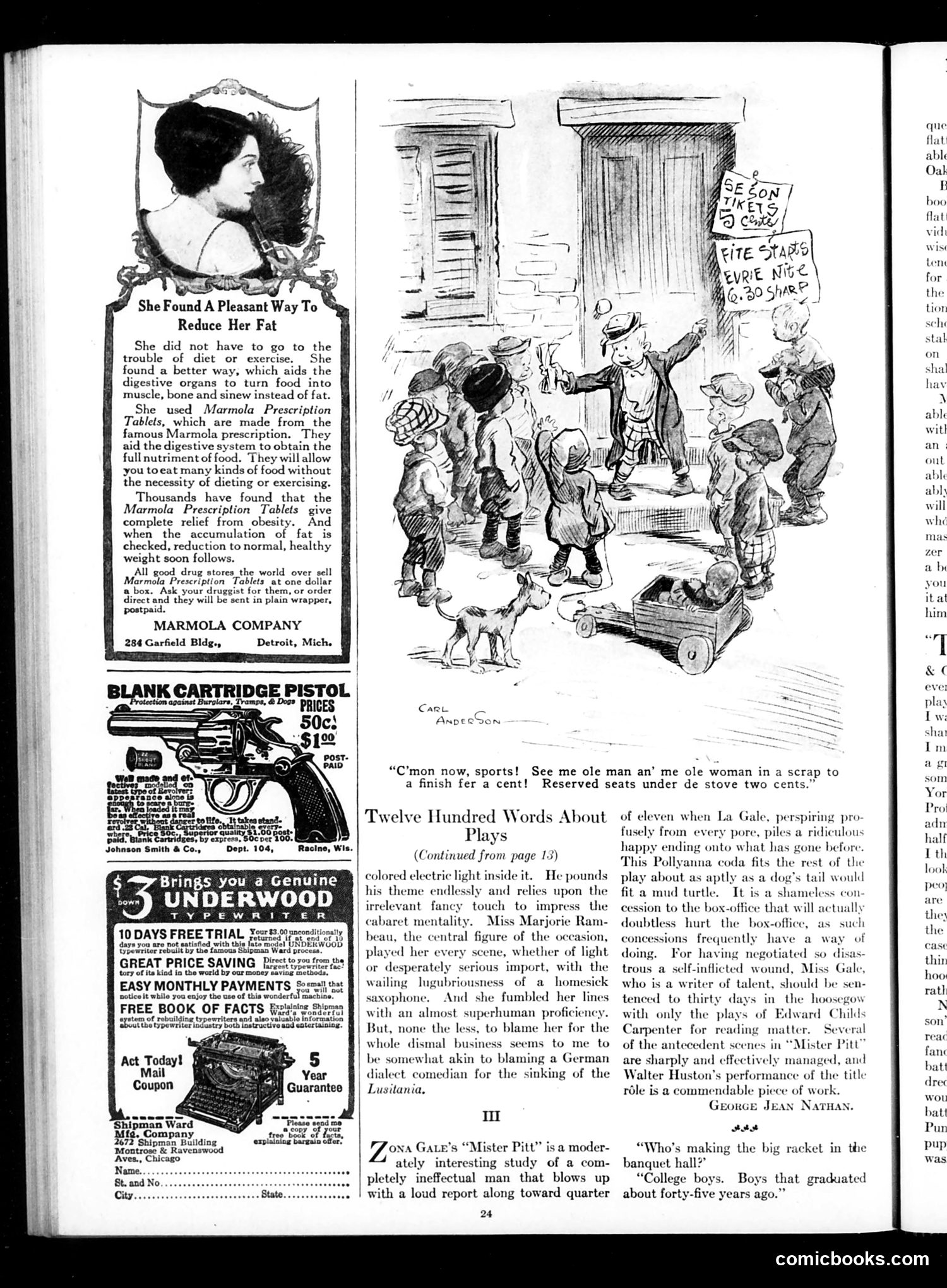
This page combines advertisements with theater criticism and a street-scene cartoon. **The Main Cartoon** (center-right, signed "Carl Anderson"): Depicts working-class children engaged in street gambling or fighting, with one child hawking the spectacle to passersby for a cent admission, with "reserved seats under de stove" for two cents. The heavy dialect ("C'mon now, sports," "ole man," "ole woman") represents contemporary stereotyping of poor immigrants or urban underclass speech patterns. The satire mocks both the poverty-stricken conditions forcing children into such activities and the casual entertainment value wealthy observers might extract from others' misfortune. **The Advertisements** promote weight-loss pills (Marmola Tablets) and a typewriter on monthly installment plans—typical early-1900s consumer marketing. **The Theater Criticism** (bottom) reviews contemporary Broadway plays with harsh judgments of performances and plotting, typical of Judge's satirical arts coverage. The page reflects Progressive Era anxieties about urban poverty, childhood welfare, and working-class entertainments.
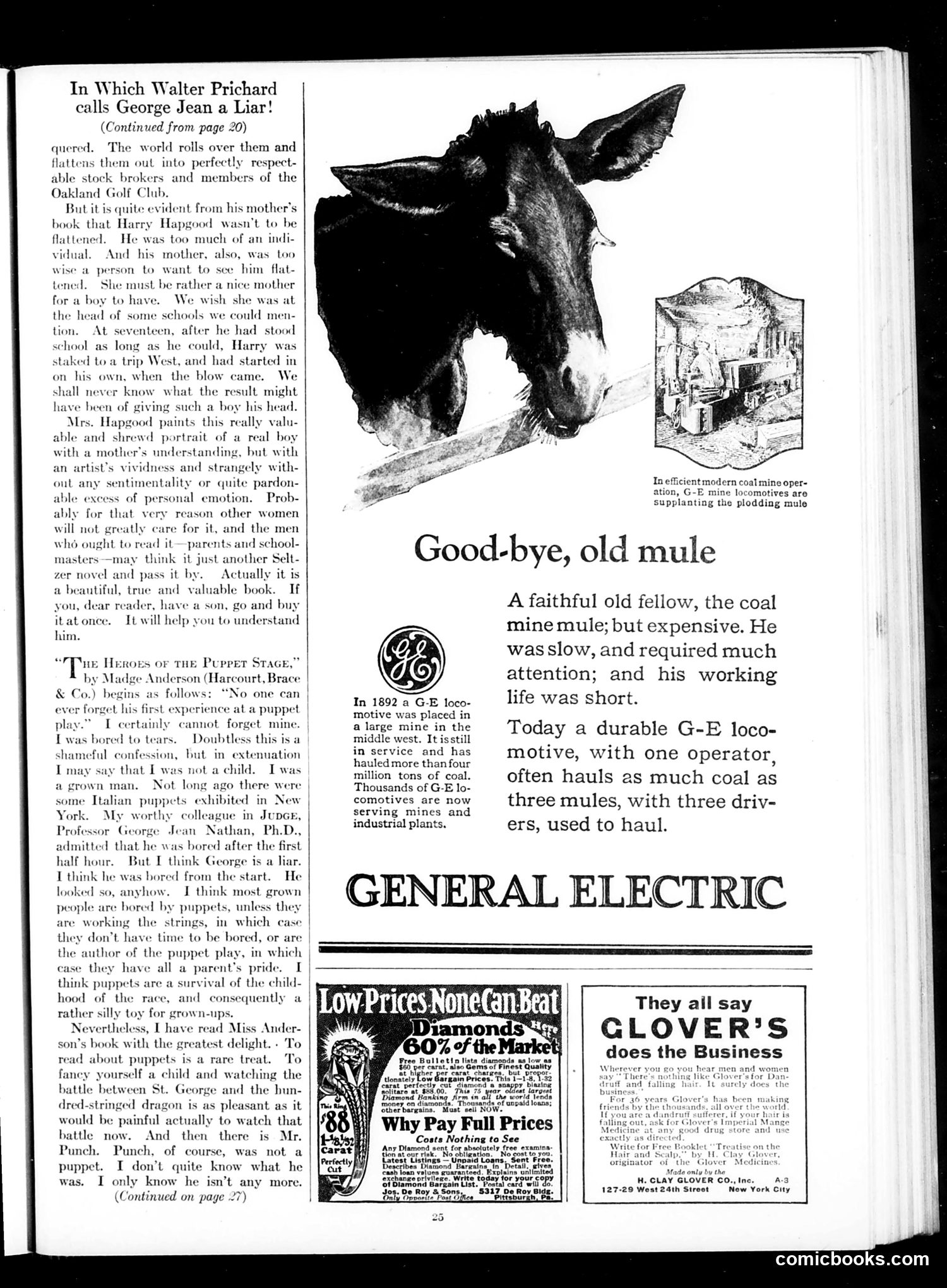
This page contains **literary criticism and advertising**, not political cartoons. The main editorial content features Walter Prichard critiquing George Jean Anderson's book "Heroes of the Puppet Stage." Prichard sarcastically calls Anderson a "liar" for claiming to be bored by a puppet show, arguing that most grown adults *are* naturally bored by puppets unless actively involved with them. He praises Anderson's book despite predicting parents and schoolmasters won't read it, dismissing it as "just another Seltzer novel." The page includes three advertisements: General Electric promotes replacing coal-mine mules with efficient locomotives (a technological progress narrative); a diamond company advertises bulk purchasing; and Glover's medicines claim universal approval. The content reflects early 20th-century concerns: child education philosophy, the displacement of animal labor by machinery, and consumer product marketing. The "liar" accusation is literary snark, not political commentary.
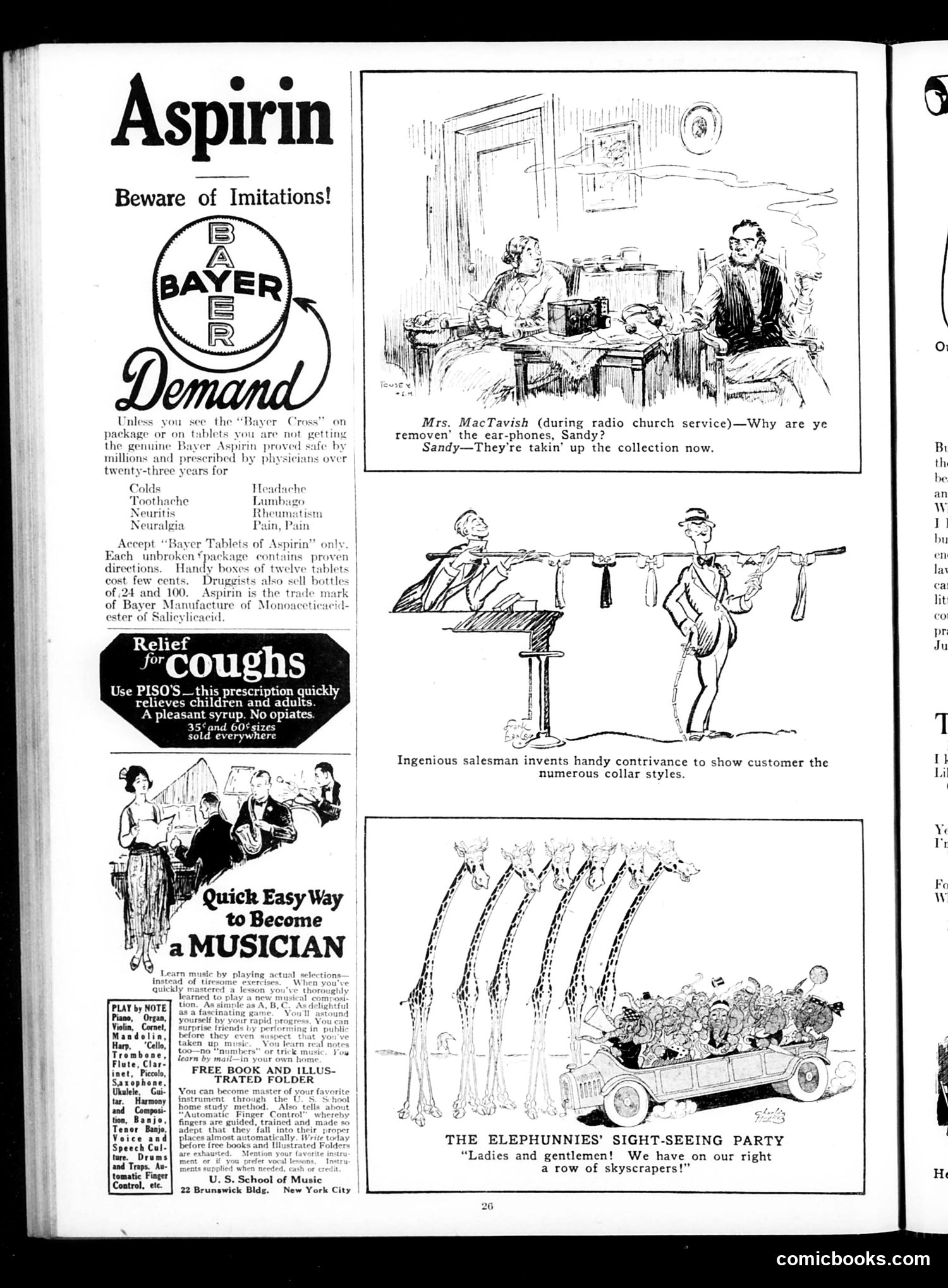
This page is primarily **advertising**, with three comic strips serving as filler content. The main advertisements promote Bayer Aspirin (emphasizing the trademark "Bayer Cross" to distinguish genuine product from counterfeits), Piso's cough syrup, and the U.S. School of Music correspondence course. The three comic strips offer light humor: 1. **"Mrs. MacTavish"**: A Scottish woman removes her telephone earpiece during a radio church service—the joke being the collection plate is being passed, and she doesn't want to be caught unprepared. 2. **The collar salesman**: A clever sales tactic showing multiple collar styles displayed on a clothesline, illustrated as an "ingenious" sales method. 3. **"The Elephunnies' Sight-Seeing Party"**: Anthropomorphic elephants on a tour, with a guide humorously calling skyscrapers "sights"—simple visual humor. The page reflects early 20th-century consumer culture, trademark concerns, and gentle domestic comedy typical of Judge magazine's humor.
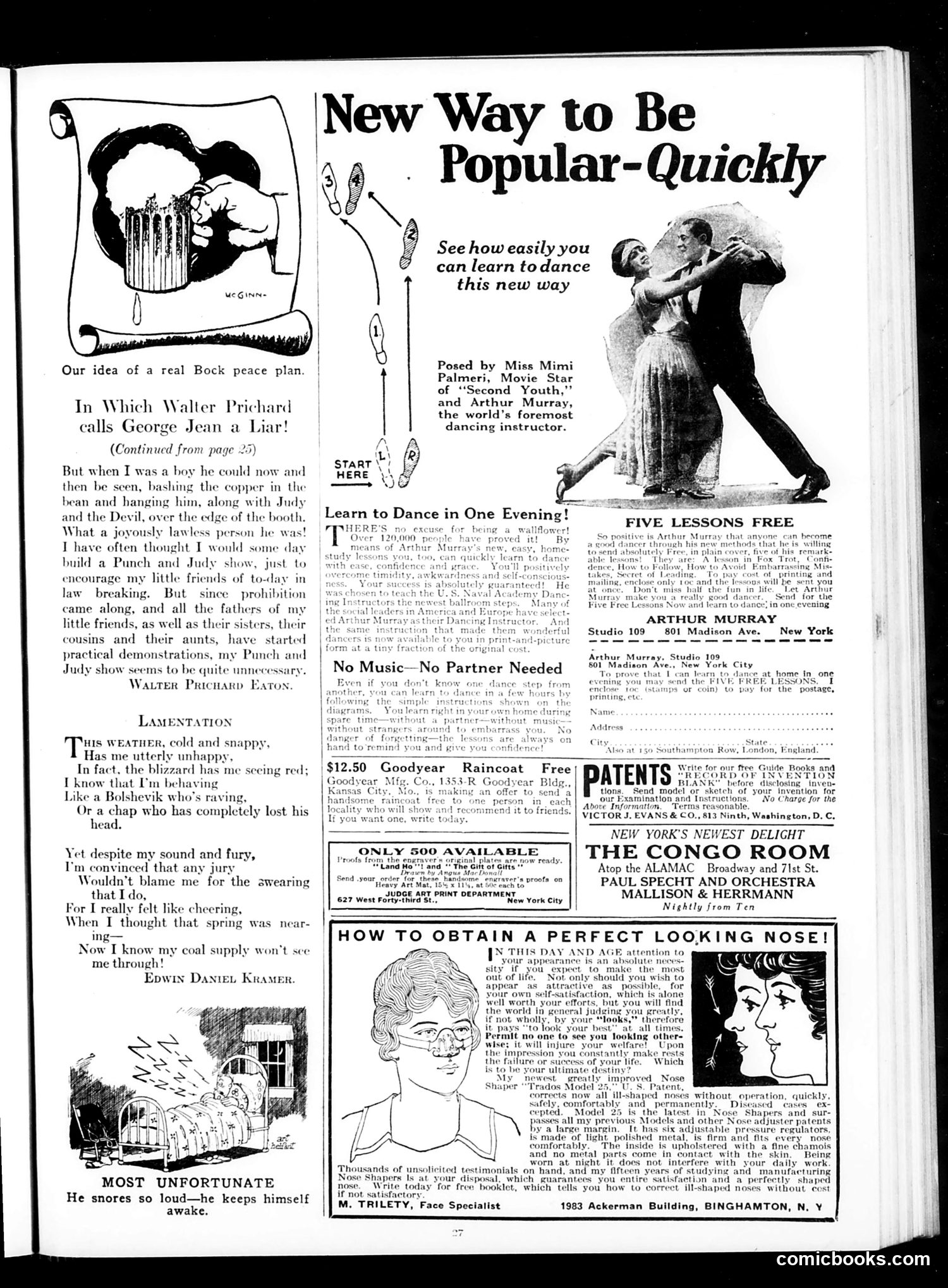
This page is primarily **advertising and humor content** rather than political satire. The main cartoon at top-left, titled "Our idea of a real Bock peace plan," appears to reference **Walter Pritchard calling George Jean a liar** in an ongoing serialized story (continued from page 25). The cartoon depicts someone forcefully pouring beer, likely satirizing failed peace negotiations of the era—the phrase "Bock peace plan" is a pun on "bock" beer. The page is dominated by **1920s commercial advertisements**: Arthur Murray's dancing lessons ("Learn to Dance in One Evening"), a Goodyear raincoat offer, patent filing services, and various beauty/lifestyle products. A minor cartoon shows an insomniac kept awake by his own snoring—simple domestic humor. The "Lamentation" poem by Edwin Daniel Kramer humorously laments coal shortages and spring delays, reflecting post-WWI economic concerns. Overall, this is a **typical Judge magazine layout**: light satire mixed with period advertisements targeting middle-class readers.
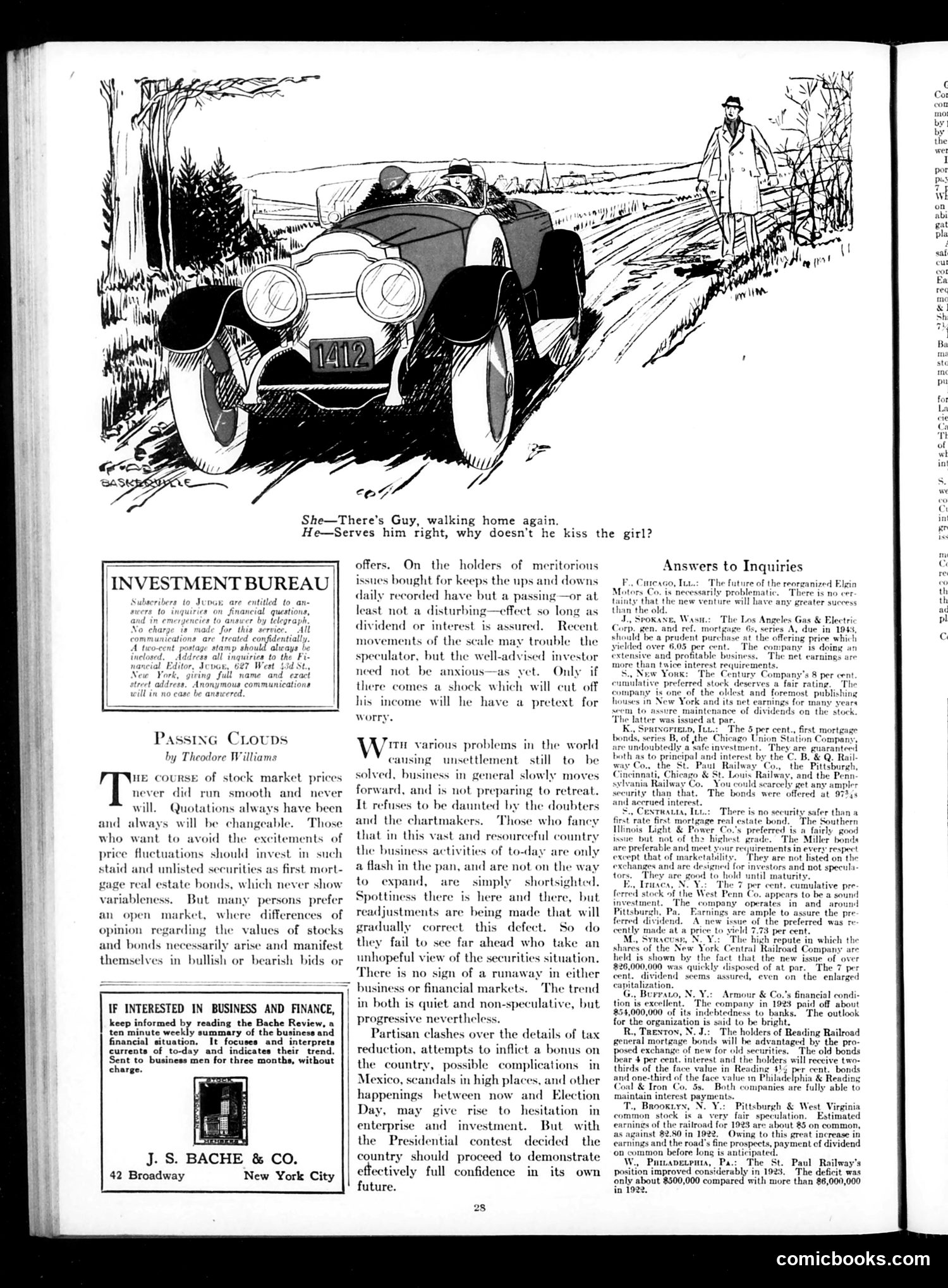
The cartoon depicts a young couple in a speeding automobile. The woman comments that "Guy" is "walking home again," and the man responds sarcastically, "Serves him right, why doesn't he kiss the girl?" **The satire:** This is a commentary on modern dating and courtship customs in the 1920s. The joke targets changing social norms—the woman seems to suggest that Guy should have been more forward/romantic (kissing the girl), but instead he's walking home alone, apparently having failed at romance. The automobile itself represents modernity and the new freedom it offered young people for unsupervised courtship, making the man's timidity seem outdated or foolish. The page also contains financial advice columns ("Answers to Inquiries," "Passing Clouds") and period advertising, typical of Judge magazine's mixed editorial content.
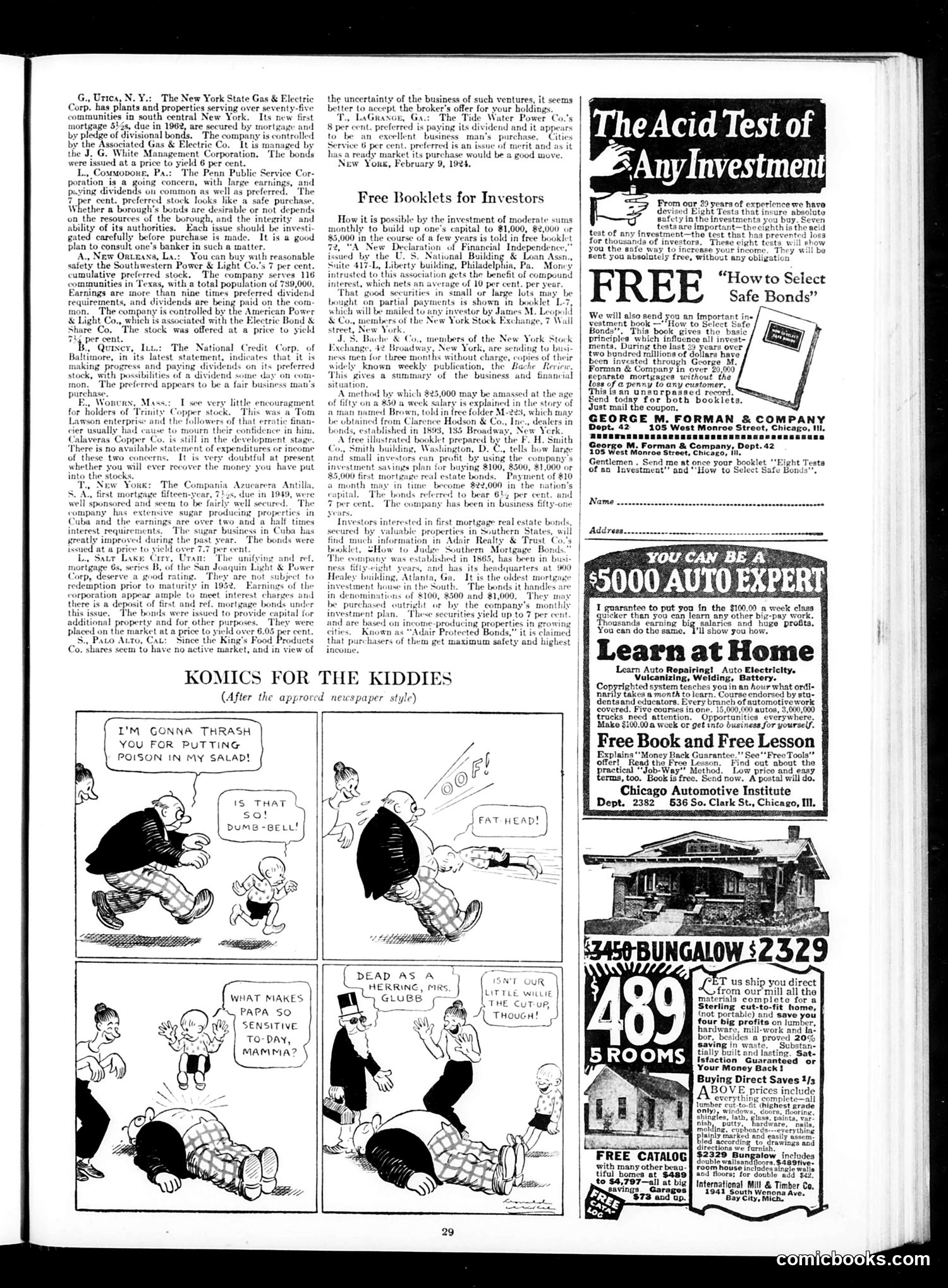
This comic strip satirizes domestic life, specifically paternal authority and food disputes. The scenario depicts a father discovering poison in his salad—likely an exaggeration of a child's complaint about an unpalatable meal. The humor operates on multiple levels: the child's dramatic threat ("I'm gonna thrash you for putting poison in my salad!") is absurd hyperbole; the father's response ("Is that so? Dumb bell!") shows typical period parental dismissiveness toward children's grievances. The final panels show the father collapsing after tasting the salad himself, validating the child's complaint through slapstick reversal—the adult who mocked the child becomes the victim. This reflects early 20th-century attitudes about parent-child dynamics: children's objections to meals were dismissed as exaggeration or rudeness, yet the joke ultimately sympathizes with the child's legitimate complaint. The comic gently mocks both stuffy parental authority and the actual quality of domestic cooking.
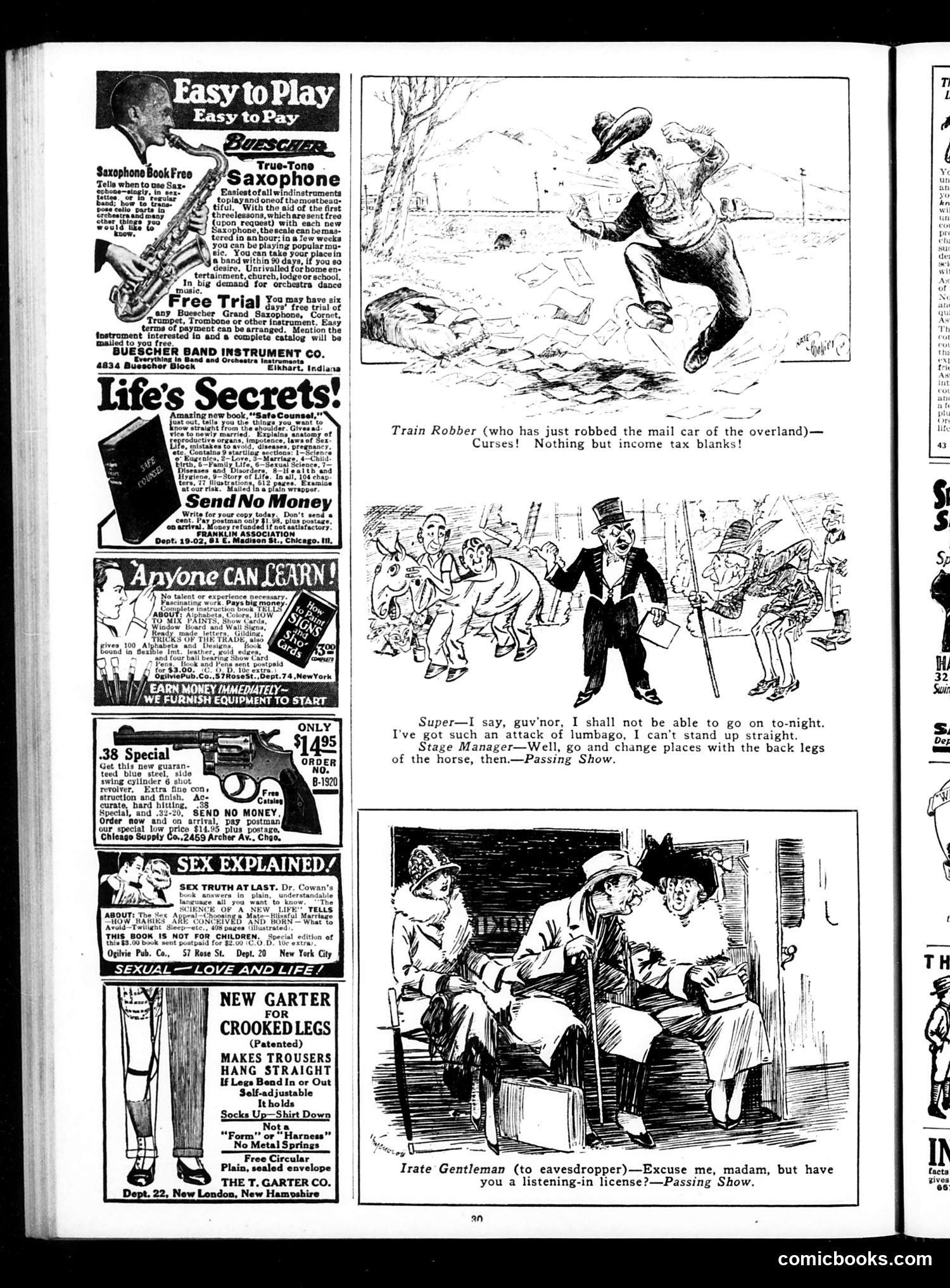
This page combines advertisements with three satirical cartoons from the "Passing Show" column: **The cartoons mock contemporary concerns:** 1. **Train Robber**: References the income tax (newly established or recently expanded in America). The joke's bite: even criminal success yields nothing but tax paperwork—a commentary on how pervasive and inescapable taxation had become. 2. **Stage Manager/Super**: A theatrical joke about a performer claiming lumbago (lower back pain) to avoid performing. The absurdist punchline—replacing him with the horse's back legs—mocks both the excuse and theater's physical demands. 3. **Eavesdropper**: References radio broadcasting regulations, specifically "listening licenses" (Britain required these). The satire: privacy invasion through wireless technology, with bureaucratic licensing required even to listen privately. **The advertisements** (saxophone lessons, self-help books, revolvers, garters) reflect 1920s-30s consumer culture aimed at self-improvement and modernization. The page satirizes income taxes, theatrical pretense, and emerging technology regulation—all contemporary anxieties for Judge's readership.
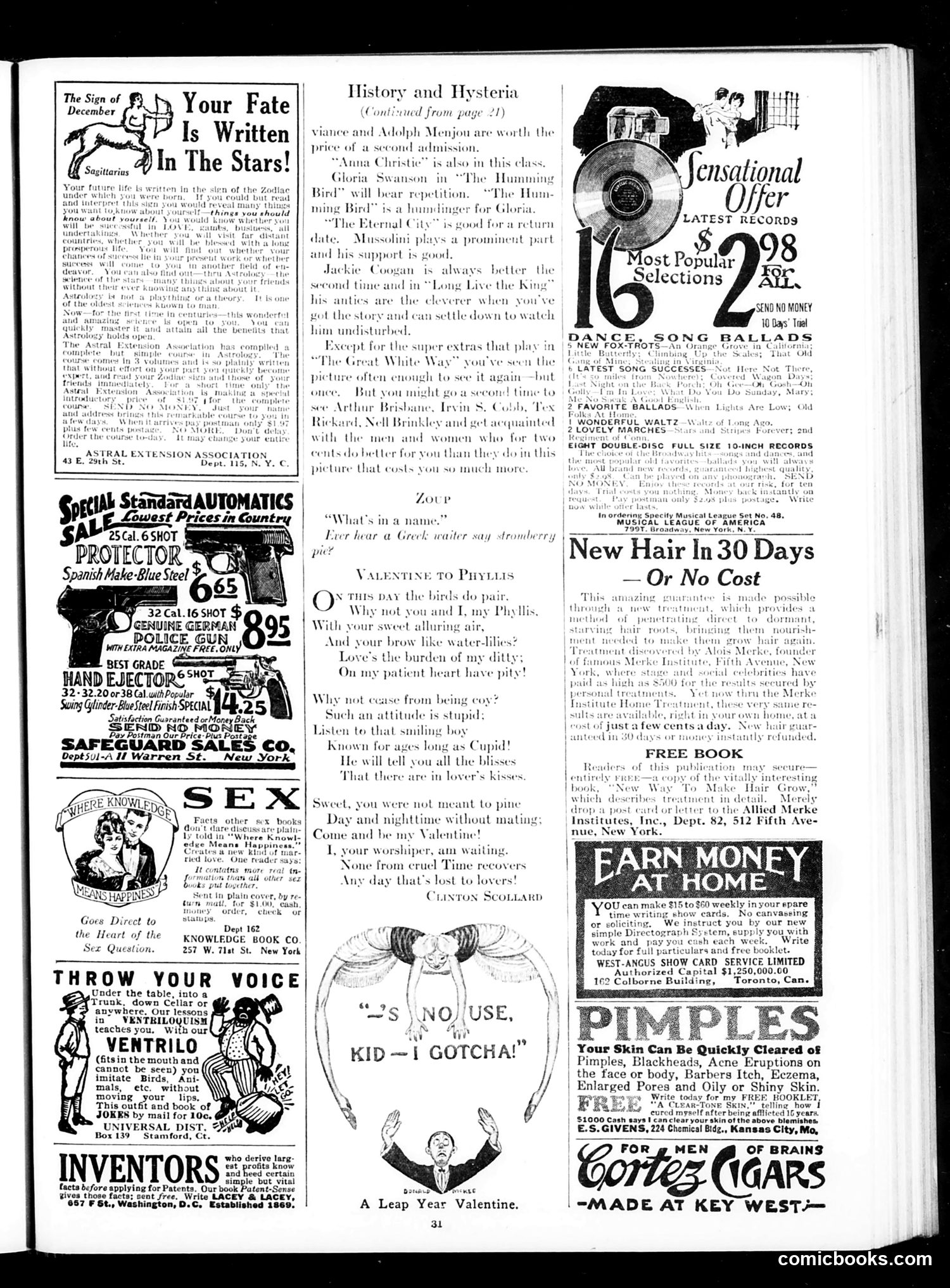
This page is primarily **advertising and light entertainment**, not political satire. The main content includes: **Cartoon**: "A Leap Year Valentine" depicts a woman with exaggerated features chasing a man, illustrating the Leap Year tradition where women were socially permitted to propose to men—reversing normal gender roles. The joke plays on the man's panic ("No use, kid—I gotcha!"), treating marriage proposal as something to escape. **Poem**: "Valentine to Phyllis" by Clinton Scollard is a romantic verse encouraging a coy woman to reciprocate love, conventional sentiment for the era. **Advertisements** dominate the page, offering mail-order products typical of 1920s-30s magazines: fortune-telling courses, revolvers, ventriloquism lessons, sex advice books, hair growth treatments, and home business opportunities. These ads targeted vulnerable readers seeking self-improvement, romance, or income. The content reflects period attitudes: gender role reversals as comedic, aggressive courtship as normal, and faith in dubious mail-order "cures."
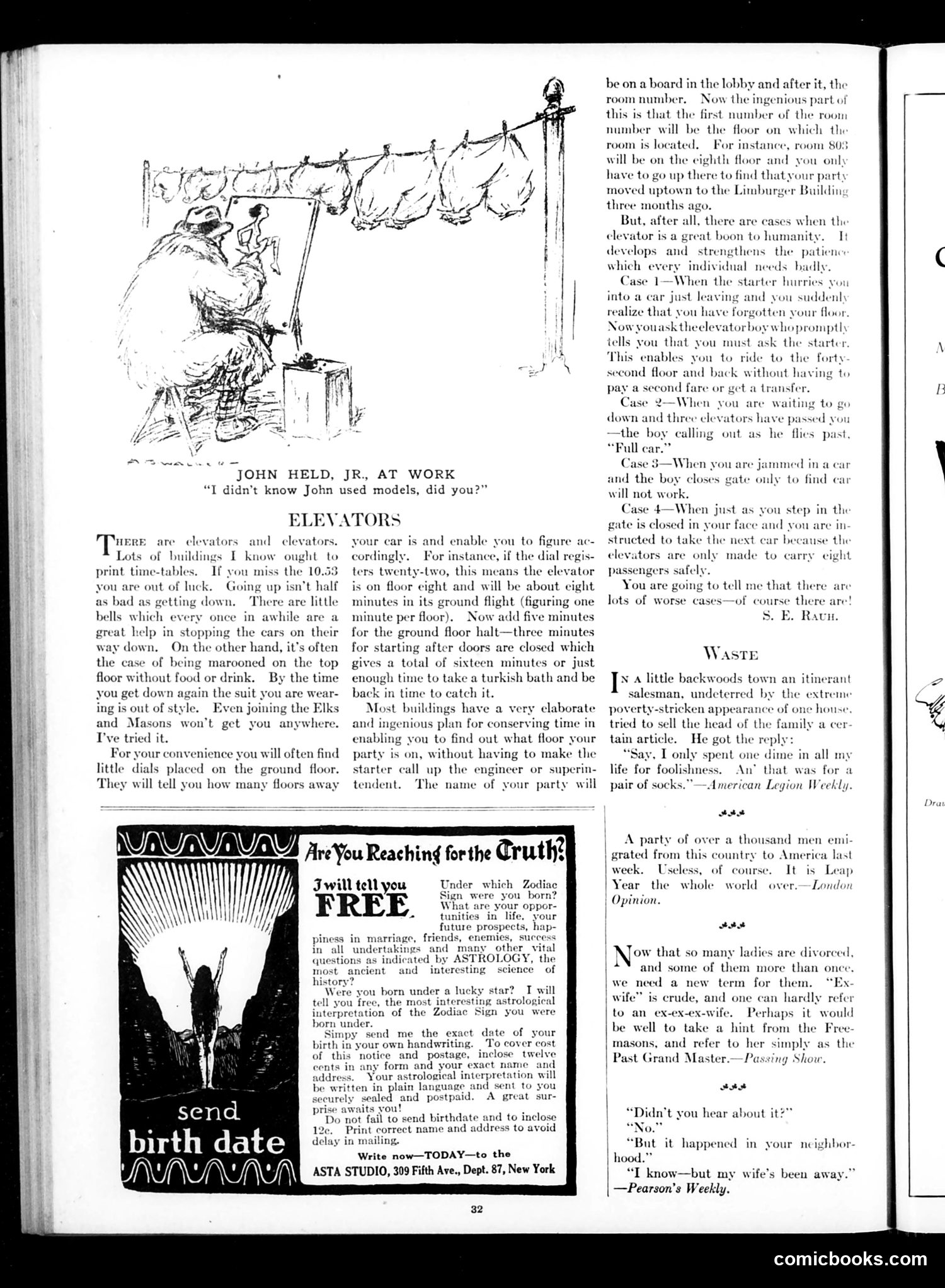
**The John Held Jr. Cartoon (top left):** This sketch depicts Held, a famous cartoonist of the 1920s, working at his drawing board. The caption jokes that he uses models for his work—a playful reference to his practice of drawing from life, particularly his iconic "flapper" illustrations that defined the era. **The "Elevators" Article:** This is satirical commentary on inefficient building elevators in 1920s urban America. The author humorously catalogs elevator frustrations: missed cars, confusing floor numbering systems, overcrowding, and malfunctioning equipment. The "four cases" where elevators supposedly benefit passengers are actually examples of absurd inconveniences (being forced to ride to an unintended floor, overcrowding, mechanical failure, exclusion due to capacity limits). The satire mocks both the technology's unreliability and modern urban inconveniences generally—a relatable complaint for contemporary city dwellers navigating new skyscraper culture.
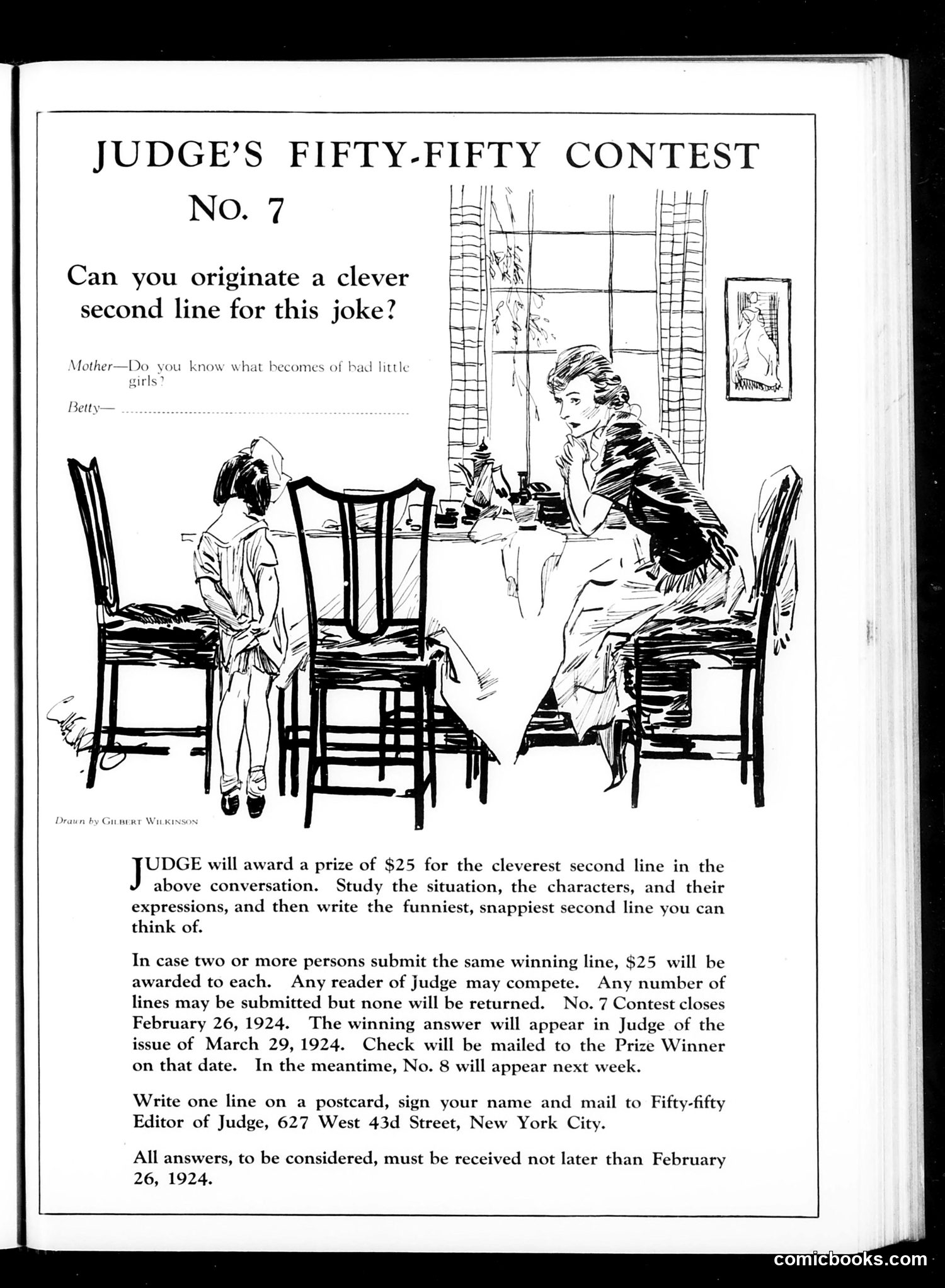
This page presents a reader-participation contest from *Judge* magazine (February 1924). The setup shows a mother asking her daughter Betty: "Do you know what becomes of bad little girls?" Readers are invited to submit a clever punchline. The contest reflects early 20th-century humor conventions and parenting discourse—the threat of consequences for misbehaving children was common in period comedy. The illustration depicts a domestic scene with period dress and furnishings. The $25 prize (substantial for 1924) incentivized reader engagement, a popular magazine circulation strategy of the era. The contest mechanism—submissions by postcard to the magazine's New York office—was typical of pre-digital audience participation. For modern readers, the humor likely depends on understanding what dark or unexpected consequence the era's comedians might have suggested for "bad girls," reflecting period attitudes toward childhood discipline and gender.
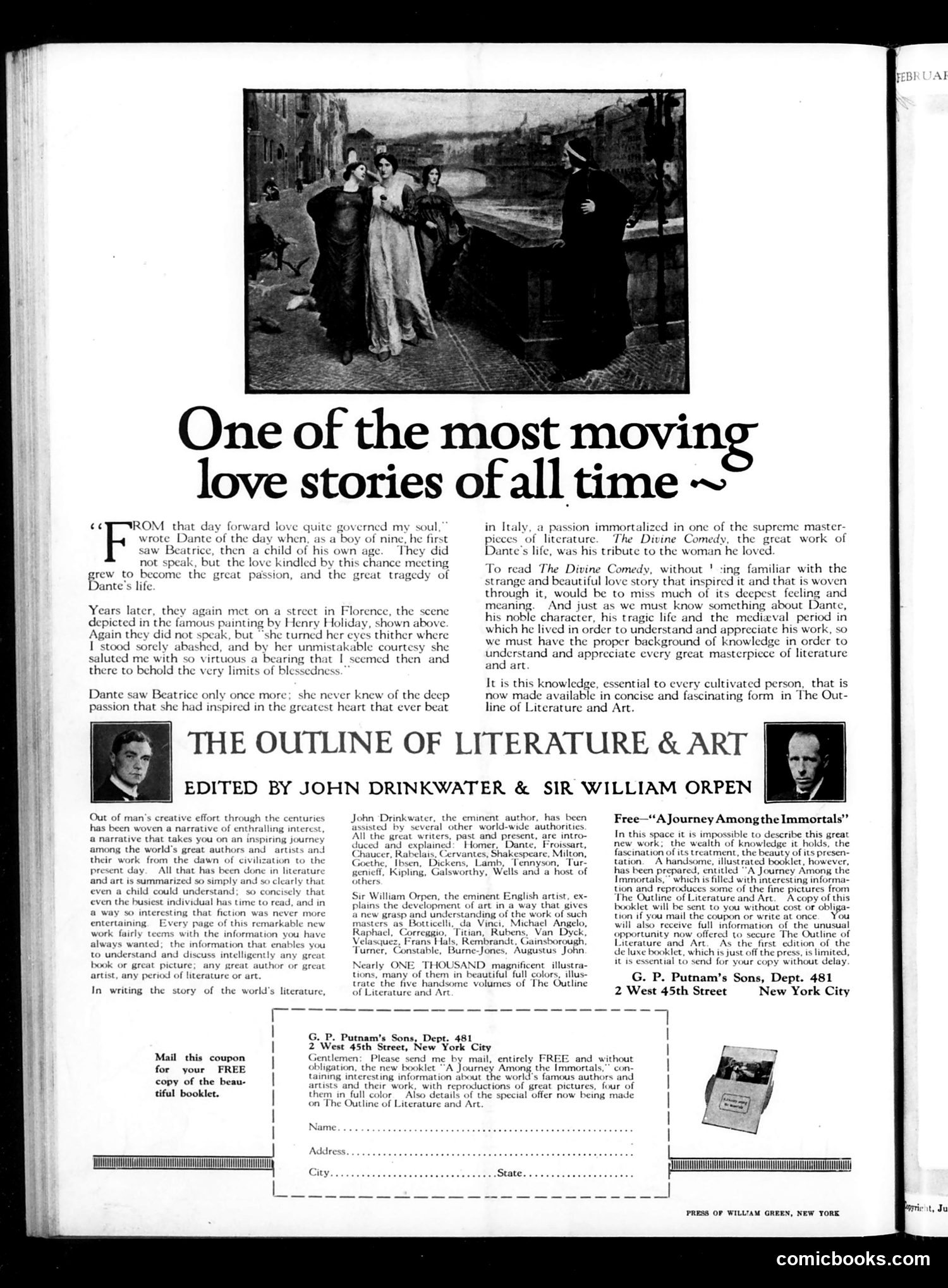
This page is primarily **advertising copy**, not satire or a political cartoon. It promotes "The Outline of Literature & Art," an educational encyclopedia edited by John Drinkwater and Sir William Orpen. The top features a **reproduction of Henry Holiday's famous painting** depicting Dante Alighieri encountering Beatrice Portinari on a Florence street—illustrating the medieval poet's legendary unrequited love that inspired *The Divine Comedy*. The text frames this romantic narrative as a hook to encourage readers to purchase the book, arguing that understanding literature requires biographical and historical context. The advertisement emphasizes the work's comprehensiveness (covering major authors and artists from antiquity onward) and accessibility. **The appeal is educational and cultural**, marketing to early 20th-century readers aspiring to cultivated knowledge. There is no satirical content visible—this is straightforward commercial promotion dressed in literary appreciation.