
Judge, 1924-02-16 · page 5 of 36
Judge — February 16, 1924 — page 5: what you’re looking at
What you’re looking at
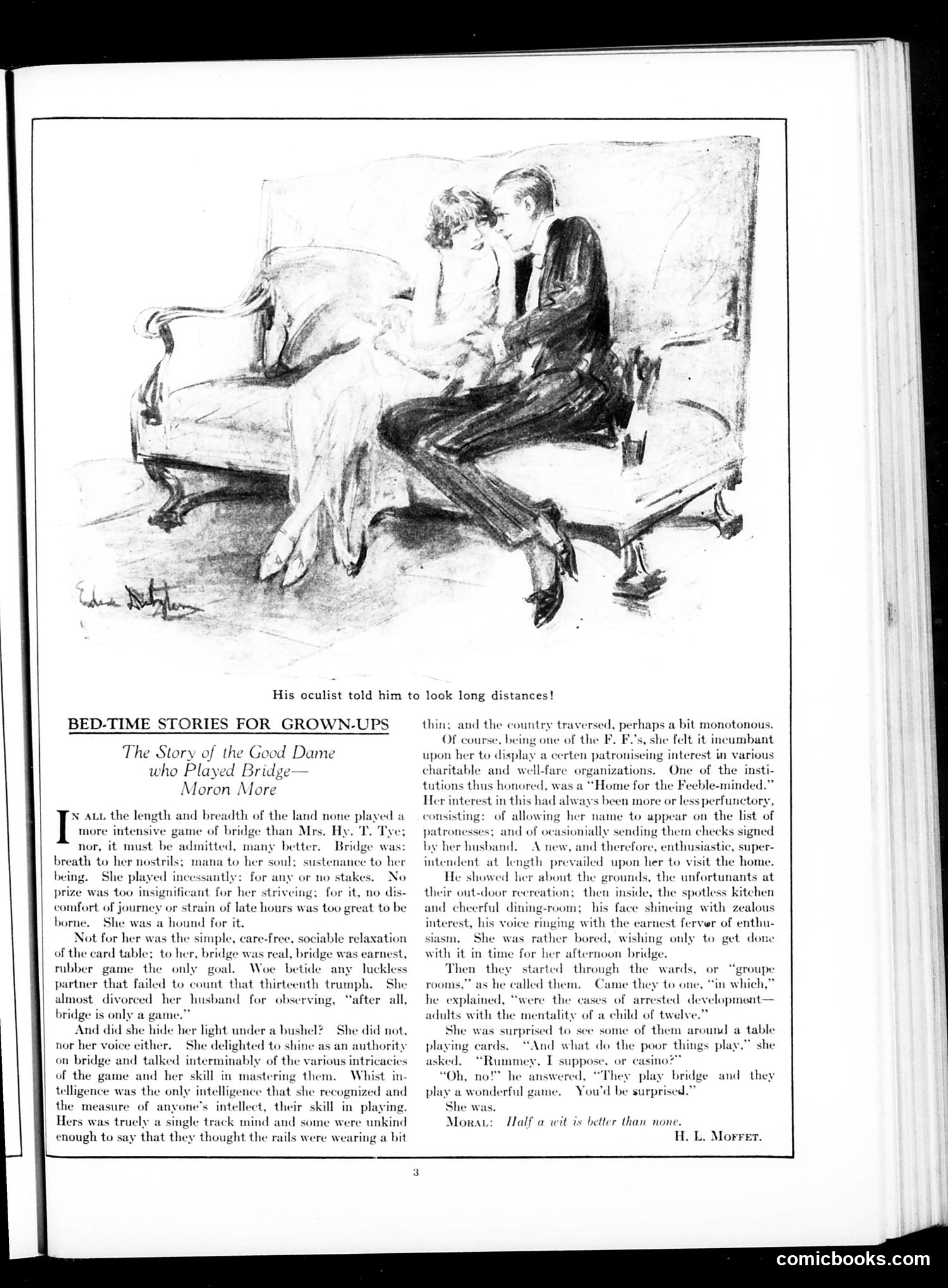
This page from *Judge* magazine presents a satirical bedtime story for adults mocking bridge-obsessed society women. The illustration shows a woman enthusiastically describing her bridge activities to what appears to be a doctor or visitor. The satire targets the era's upper-class women's preoccupation with bridge as both social status marker and all-consuming hobby. The story ridicules how a supposedly charitable "Home for the Feeble-minded" becomes merely a vehicle for the protagonist to pursue bridge games and display her patronage credentials. The moral—"Half a wit is better than none"—suggests that bridge players lack intellectual substance, playing a trivial game while pretending to meaningful charitable work. This reflects early 20th-century anxieties about idle wealthy women and superficial philanthropy.
📄 Transcribed text from this page (OCR, searchable)
Machine-transcribed from the original scan — historical spelling and the odd misread are preserved.
His oculist told him BED-TIME STORIES FOR GROWN-UPS The Story of the Good Dame who Played Bridge— Moron More N ALL the length and breadth of the land none pl more intensive game of bridge than Mrs. Hy nor, it must be admitted, many better. breath to her nostril She play to her sssantly: for any or no stakes. No prize was too insignificant for her striveing; for it, no dis- comfort of journey or strain of late hours was too great to be borr She was a hound for it. ana to her soul; sustenan being. ot for her was the simple, care-free, sociable relaxation of the card table; to her, bridge was real, bridge was earnest, rubber game the only goal. Woe betide any luckless partner that failed to count that thirteenth trumph. She almost divorced her husband for observing, “after all, bridge is only a game.” And did she hide her light under a bushel? nor her voice either. She delighted to shi on bridge and talked interminably of the various intricacies of the Whist in- telligence was the only intelligence that she recognized and the measure of anyone’s intellect, their skill in pla | Hers was truely a single track mind and some were unkind enough to say that they thought the rails were wearing a bit SS She did not, 1s an authority game and her skill in mastering them. to look long distances! thin; and the country traversed, perhaps a bit monotonous. Of course, being one of the F. F.’s, she felt it ineumbant upon her to display a certen patroniseing interest in various charitable and well-fare organizations. One of the insti- tutions thus honored, was a “Home for the Feeble-minded.” Her interest in this had alw consisting: of allowing he s been more or less perfunctory, une to appear on the list of ally sending them checks signed and therefore, enthusiastic, super- intendent at length prevailed upon her to visit the home. He showed her about the grounds, the unfortunants at their out-door recreation; then inside, the spotless kitchen his face shineing with zealous ing with the earnest ferver of enthu- She was rather bored, wishing only to get done with it in time for her afternoon bridge. Then the. rooms,” as he patronesses; and of ocasion by her husband. A new. and cheerful dinin, interest, his voice rit OM; siasm. started through the wards, or led them. he explained, “were the cases of arrested development— adults with the mentality of a child of twelve.” She wa “groupe Came they to one, “in which,” surprised to see some of them around a table frig cards. “And -shatsdlo-the: poor ings’ play,” she d. “Rummey, I suppose Ih, no! he answered, or casino?” They play bridge and they play a wonderful game. You'd be surprise She was. Morar: Half a wit ix better than none. H. L. Morrer. comicbooks.com