
Judge, 1924-02-16 · page 23 of 36
Judge — February 16, 1924 — page 23: what you’re looking at
What you’re looking at
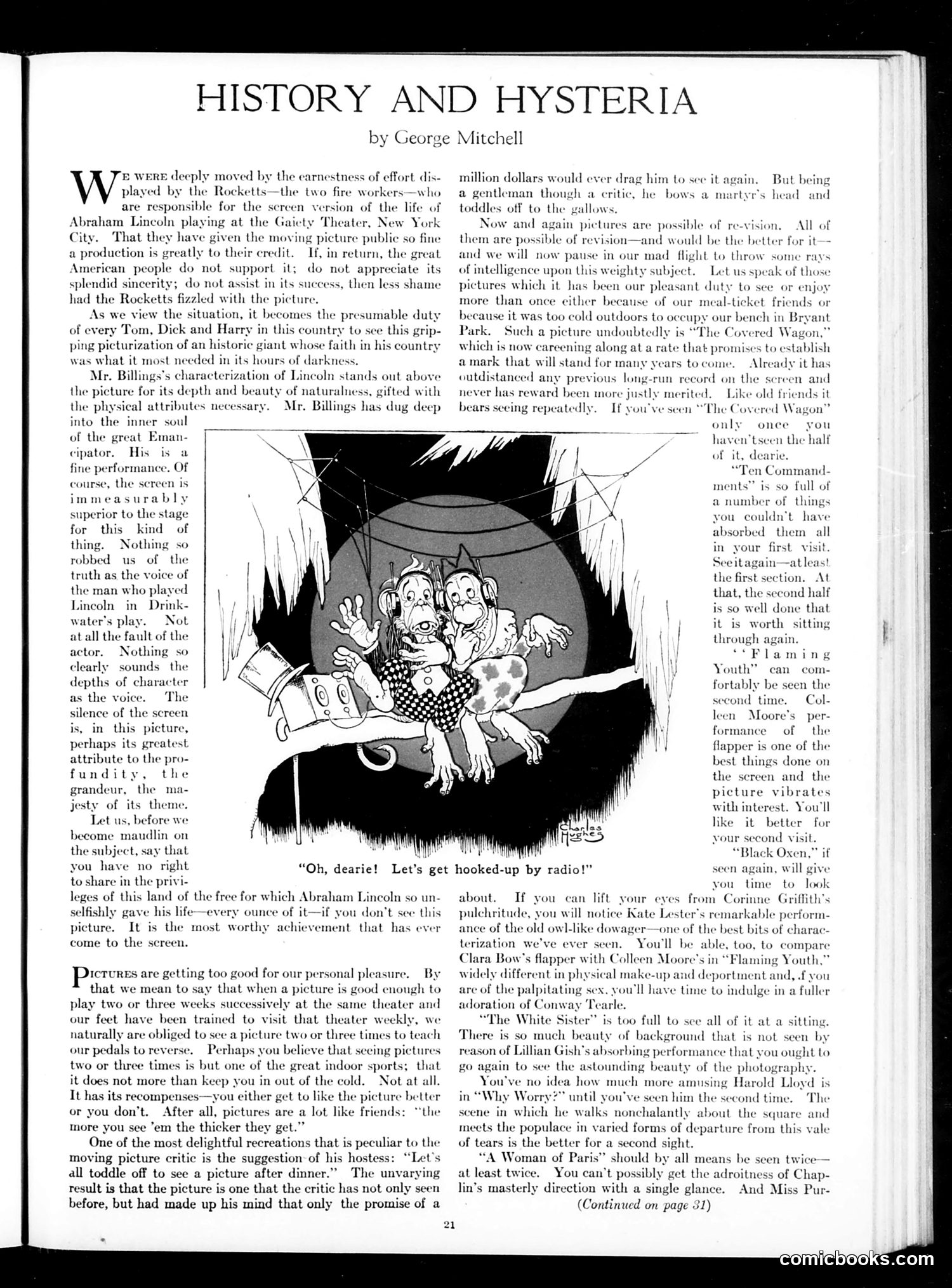
This page reviews a 1924 Lincoln film starring actor Billings, praising its "depth and naturalness." The cartoon (captioned "Oh, dearie! Let's get hooked-up by radio!") depicts figures humorously listening to radio—likely satirizing the tension between emerging radio technology and cinema's dominance as entertainment. The article argues Americans have a patriotic *duty* to see Lincoln films, invoking Lincoln's sacrifice ("every ounce of it") to shame people into attendance. Mitchell advocates repeat viewings, claiming familiarity improves appreciation ("the more you see 'em the thicker they get"). The satire targets both movie-industry boosterism and the cultural anxiety about new media (radio). The juxtaposition of earnest Lincoln-worship with flippant entertainment consumption—plus the moral hectoring—ridicules the film industry's manipulation of patriotic sentiment to drive box-office revenue.
📄 Transcribed text from this page (OCR, searchable)
Machine-transcribed from the original scan — historical spelling and the odd misread are preserved.
HISTORY AND HYSTERIA by George Mitchell E WERE deeply moved by the earnestness of effort dis- W played by the Rocketts—the two fire workers—who are responsible for the screen version of the life of Abraham Lincoln playing at the Theater, New York City. That they have given the moving picture public so fine a production is greatly to their credit. If, in return, the great American people do not support it; do not apprec splendid sincerity; do not assist in its suc had the Rocketts fizzled with the picture. As we view the situation, it becomes the presumable duty of every Tom, Dick and Harry in this country to see this grip- ping picturization of an historic giant whose faith in his country was what it most needed in its hours of darkness. Mr. Billings’s characterization of Lincoln stands out above the picture for its depth and beauty of naturalness, gifted with the physical attributes necessary. Mr, Billings has dug deep into the iaicty te its sss, then less shame inner soul million dollars would ever drag him to see it again. a gentleman though he toddles off to the ow and again pictures are possible of re-vision, But being a critic, bows a martyr’s head and lows. All of them are possible of revision—and would be the better for it— and we will now pause in our mad flight to throw some ri of intelligence upon this weighty subject. Let us speak of th pictures which it has been our pleasant duty to see or enjoy more than once cither because of our meal-ticket friends or because it was too cold outdoors to occupy our bench in Bryant Park. Such a picture undoubtedly is “The Covered Wago which is now careening along at a rate that promises to establish amark that will stand for many years tocome. Already it has outdistanced any previous long-run record on the screen and never has reward been more justly merited. Like old friends it bears secing repeatedly. If you've seen “Phe Covered Wagon” only onee you of the great Eman- cipator. His fine performance. Of the screen is is a course, immeasurably superior to the stage for this kind of thing. Nothing so robbed us of the truth as the voice of the man who played Lincoln in water's play. atall the fault of the actor. Nothing so clearly the depths of character as the voice. The silence of the screen in this picture, perhaps its greatest attribute to the pro- fundity, the grandeur, the ma- jesty of its theme. Let us, before we become maudlin on the subject, say that you have no right to share in the privi- leges of this land of the free for which Abraham Lincoln so un- fishly gave his life—every ounce of it—if you don’t see this picture. It is the most worthy that come to the screen. sounds. “Oh, dearie! achievement has ever Prcteres are getting too good for our personal pleasure. By that we mean to say that when a picture is good enough to play two or three weeks successively at the same theater and our feet have been trained to visit that theater weekly, naturally are obliged to see a picture two or three times to teach our pedals to reverse. Perhaps you believe that seeing pictures two or three times is but one of the great indoor sports; that it does not more than keep you in out of the cold. Not at all. It has its recompen: you either get to like the picture better or you don’t. After all, pictures are a lot like friends: “the more you see ’em the thicker they get.” One of the most delightful recreations that is peculiar to the moving picture critic is the suggestion of his hoste all toddle off to see a picture after dinner.” The unvarying result is that the picture is one that the critic has not only before, but had made up his mind that only the promise of a we Let’s get haven’tscen the half “Ten Command- is so full of thi ments” a number of couldn't them all first. visit. Seeitagain—atleas! the first section. At that, the second half is so well done that it is worth sitting through again. Youth” fortably be seen the you absorbed in your laming can com- second time. Col- Moore's per- formance the flapper is one of the best things done on the picture vibrates with interest. You'll like it better for your second visit. “BL Oxen,” seen in, will to look Griffith's ute Lester's remarkable pe leen of screen and the if hooked-up by radio!” you time about. If you can lift your eyes from Corinne pulchritude, you will notice K ance of the old owl-like dowager—one of the best bits of charac- terization we’ You'll be Clara Bow’s flapper with Colleen Moore's in “Flaming Youth,” widely different in physical make-up and deportment and, you are of the palpitating sex. you'll have time to indulge in a fuller adoration of Conway Tearle. “The White $ is too full to see all of it at a sitting. There is so much beauty of background that is not seen by form- seen. able, too, to compare reason of Lillian Gish’s absorbing performance that you ought to go again to see the astounding beauty of the photography. You've no idea how much more amusing Harold Lloyd is in “Why Worry?” until you've seen him the second time." The scene in which he walks nonchalantly about the square and meets the populace in varied forms of departure from this vak of tears is the better for a second sight. “A Woman of Paris” should by all means be seen twice at least twice. You can't possibly get the adroitness of Chap- lin’s masterly direction with a single glance. And Miss Pur- (Continued on page 31) 21 ichooks.com