
Judge, 1924-02-16 · page 17 of 36
Judge — February 16, 1924 — page 17: what you’re looking at
What you’re looking at
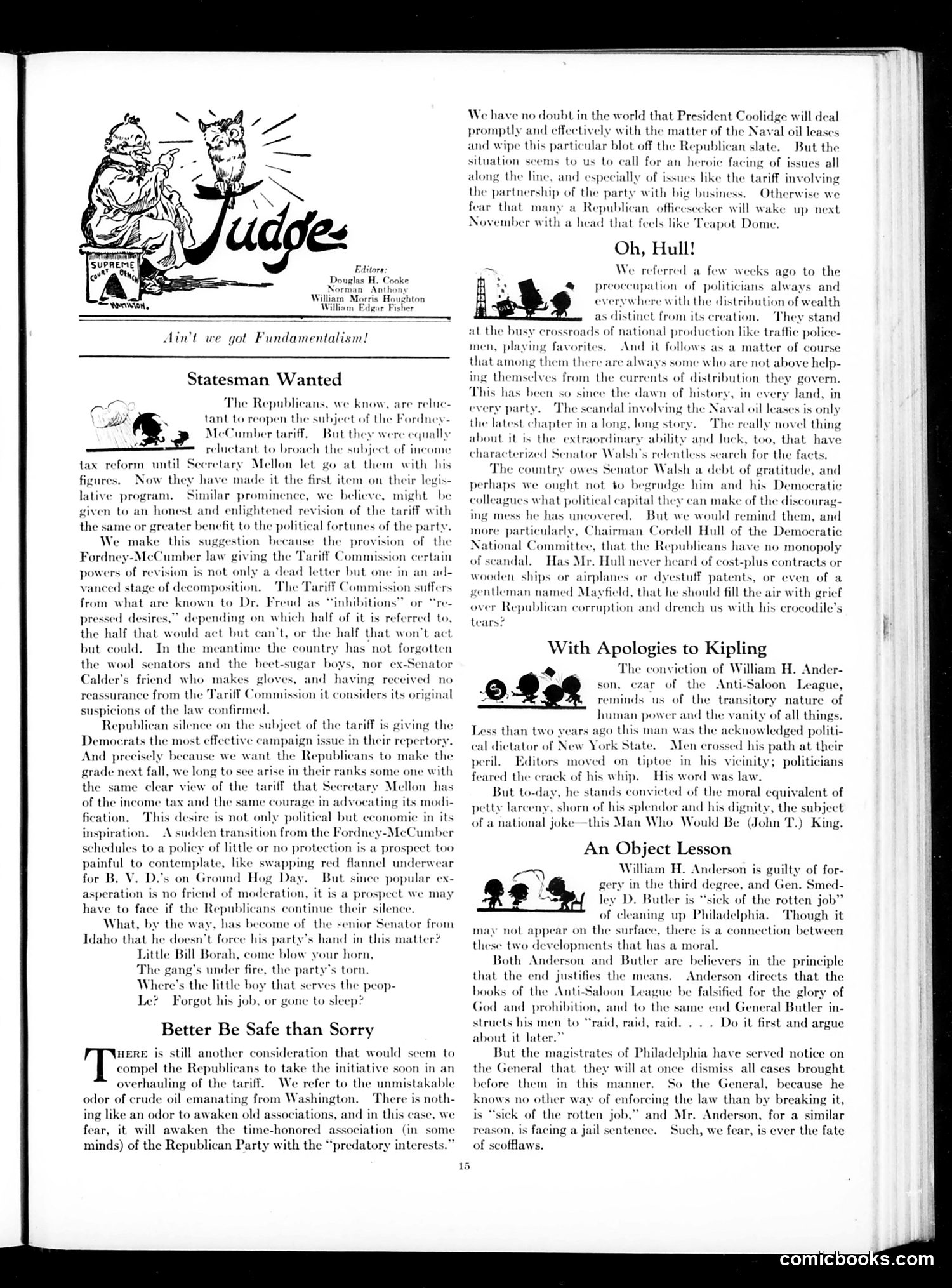
This page contains multiple political editorials satirizing Republican Party challenges circa 1923-1924. The main cartoon depicts an owl (representing judicial wisdom or the Republican Party) confronting fundamentalism—likely referencing the Scopes trial debates dividing Americans. **"Statesman Wanted"** criticizes Republicans for avoiding tariff reform despite Secretary Mellon's tax changes. It specifically mocks Senator William Borah of Idaho ("Little Bill Borah"), calling him out for failing party leadership during this crisis. **"Better Be Safe than Sorry"** references the Teapot Dome scandal (oil leases), warning that the "odor of crude oil" will damage Republican credibility and revive public distrust of the party's association with "predatory interests." **"Oh, Hull!"** and other sections critique Democratic Chairman Cordell Hull while noting politicians obsess over wealth *distribution* rather than *creation*—a fundamental economic philosophy disagreement. The overall message: Republicans face multiple crises (tariffs, oil scandals, internal divisions) requiring bold leadership, not silence.
📄 Transcribed text from this page (OCR, searchable)
Machine-transcribed from the original scan — historical spelling and the odd misread are preserved.
Editors Douglas H. Cooke Ain't we got Fundamentalism! Statesman Wanted The Republicans, we know, are reluc- tant to reopen the subject of the Fordney- MeCumber tariff. But they were equally reluctant to broach the subject of income ecretary Mellon let go at them with his have made it the first item on their legis- orn oi, pe FP tax reform until figures. Now the lative program. Similar prominence, we believe, might be given to an honest and enlightened revision of the tariff with the se r greater benefit to the political fortunes of the party. Ww this suggestion because the provision of the Fordney-McCumber law giving the Tariff Commission certain powers of revision is not only a dead letter but one in an ad- vanced s of decomposition. The Tariff Commission suffers from what are known to Dr. Freud as “inhibitions” or * pressed desires,” depending on which half of it is referred to, the half that would act but can’t, or the half that won't act but could. In the meantime the country has not forgotten the wool senators and the beet-sugar boys, nor ¢ Calder's friend who makes gloves, and having rec reassurance from the Tariff Commission it considers its original ions of the law Republican silence on the subject of the tariff is giving the Democ susp onfirmed. s the most effective campaign issue in their repertory. And precisely because we want the Republicans to make the grade next fall, we long to sce arise in their ranks some one with the same clear view of the tariff that of the income tax and the same coura fication. This desire is not only polit inspiration. scretary Mellon has n advocating its modi- al but economic in its A sudden transition from the Fordney-MeCumber schedules to a policy of little or no protection is a prospect too painful to contemplate, like swapping red flannel underwear for B. V. D.’s on Ground Hog Day. But since popular ex- asperation is no friend of moderation, it is a prospect we may have to face if the Republicans continue their silence. What, by the way, has become of the senior Senator from Idaho that he doesn’t fe his party’s hand in this matter? Little Bill Borah, come blow your horn, The gang’s under fire, the party’s torn. Where's the little boy that serves the peop- Le? Forgot his job. or gone to sleep? Better Be Safe than Sorry HERE is still another consideration that would seem to compel the Republicans to take the initiative soon in an overhauling of the tariff. We refer to the unmistakable odor of crude oil emanating from Washington. There is noth- ing like an odor to awaken old associations, and in this case, we fear, it will awaken the time-honored association (in some minds) of the Republican Party with the “predatory interests.” We have no doubt in the world that President Coolidge will deal promptly and effectively with the matter of the Naval oil leases and wipe this particular blot off the Republican slate. But the situation scems to us to call for an heroic facing of issues all along the line, Ily of issues like the tariff involving the partnership of the party with big business. fear that many a Republican. officeses November with a head that feels like Oh, Hull! We referred a few weeks ago to the preoceupation of politicians always and everywhere with the distribution of wealth as distinct from its creation. and esp Otherwise we will wake up next Teapot Dome. They stand at the busy crossroads of national production like traffic police- men, playing favorites. And it follows as a matter of course that among them there are always some who are not above help- ing themselves from the currents of distribution they govern. This has beer > the dawn of hist Th ndal involving the } the latest chapter in a long, long story. about it is the ext characterized Sen: sin y Jand, in aval oil leases is only ‘The really novel thing ordi k, too, that have or Walsh's relentless search for the facts. The country owes Senator Walsh a debt of gratitude, and in eve every party. ury ability and luc perhaps we ought not to begrudge him and his Democratic colleagues what political capital they can make of the discourag- ing mess he has uncovered. But we would remind them, and more particularly, Chairman Cordell Hull of the Democratic National Committee, that the Republicans have no monopoly idal. Has Mr. Hull never heard of cost-plus contracts or n ships or airplanes or dyestuff patents, or even of a gentleman named Mayfield, that he should fill the air with grief over Republican corruption and drench us with his erocodile’s tears? of se With Apologies to Kipling * The conviction of William H. Ander- son; evar of the Anti:Saloon League; reminds us of the transitory nature of Juiman power and, the-vanity of all things: Less than two years ago this man was the acknowledged politi- cal dictator of New York State. Men crossed his path at their peril. Editors moved on tiptoe in his vicinity; politicians feared the crack of his whip. His word was law. But to-day, he stands convicted of the moral equivalent of petty larceny, shorn of his splendor and his dignity, the subject of a national joke—this Man Who Would Be (John 'T.) King. An Object Lesson - William H. Anderson is guilty of for- ¢ 4 gery in the third degree, and Gen. Sme ley D. Butler is “sick of the rotten job” of cleaning up Philadelphia. Though it may not appear on the surface, there is a connection between these two developments that has a moral. Both Anderson and Butler are believers in the principle that the end justifies the means. Anderson directs that the books of the An joon League be falsified for the glory of God and prohibition, and to the same end eral Butler in- structs his men to “raid, raid, raid. . . . Do it first and argue about it later.”” But the magistrates of Philadelphia have served notice on the General that. they will at once dismiss all cases brought before them in this manner. knows no other way of enfor¢ So the General, because he ig the law than by breaking it, of the rotten job,” and Mr. Anderson, for a similar reason, is facing a jail sentence. Such, we fear, is ever the fate of scofflaws. is “sick comicbooks.com