
Judge, 1924-02-16 · page 22 of 36
Judge — February 16, 1924 — page 22: what you’re looking at
What you’re looking at
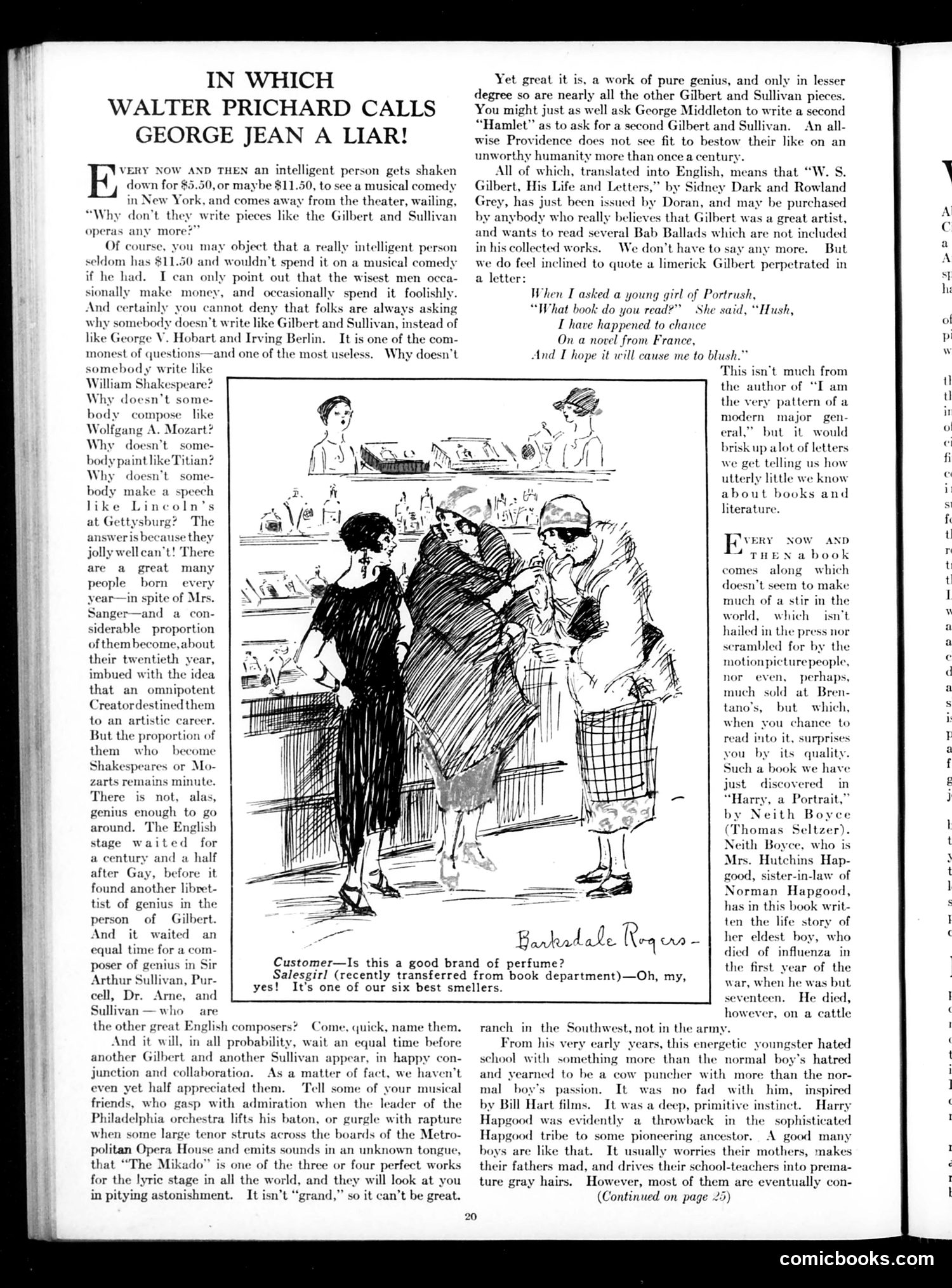
This page critiques the persistent cultural complaint that modern composers don't create works equal to Gilbert and Sullivan's operettas. The author Walter Prichard argues this is an absurd, unanswerable question—like asking why no one writes Shakespearean plays anymore. He contends that genius appears rarely across centuries; expecting multiple Gilberts is unreasonable. The accompanying illustration shows a department store scene where a customer asks a saleswoman about perfume quality. The caption jokes that the perfume is "one of our six best smellers"—a satire on how people arbitrarily rank mediocre modern works as "great," similar to how they undervalue *The Mikado* because it isn't "grand." The piece also reviews "W. S. Gilbert, His Life and Letters" (published by Doran), including a silly limerick Gilbert wrote, suggesting even genius occasionally produces forgettable work.
📄 Transcribed text from this page (OCR, searchable)
Machine-transcribed from the original scan — historical spelling and the odd misread are preserved.
IN WHICH WALTER PRICHARD CALLS GEORGE JEAN A LIAR! VERY NOW AND THEN an intelligent person gets shaken BE down for $5.50, or maybe $11.50, to see a musical comedy in New York, and comes away from the theater, wailing, “Why don’t they write pieces like the Gilbert and Sullivan operas any more Of course, you may object that a really intelligent person seldom has $11.50 and wouldn’t spend it on a musical comedy if he had. I can only point out that the wisest men occa- sionally make money, and occasionally spend it foolishly. And certainly you cannot deny that folks are always asking why somebody doesn’t write like Gilbert and Sullivan, instead of like George V. Hobart and Irving Berlin. It is one of the com- monest of questions—and one of the most useless. Why doesn’t somebody write like William Shakespeare? Why doesn’t some- body compose like Wolfgang A. Mozart? Why doesn’t some- body paint likeTitian? Yet great it is, a work of pure genius, and only in lesser degree so are nearly all the other Gilbert and Sullivan pieces. You might just as well ask George Middleton to write a second “Hamlet” as to ask for a second Gilbert and Sullivan. An all- wise Providence does not see fit to bestow their like on an unworthy humanity more than once a century. All of which, translated into English, means that “W. S. Gilbert, His Life and Letters,” by Sidney Dark and Rowland Grey, has just been issued by Doran, and may be purchased by anybody who really believes that Gilbert was a great artist, and wants to read several Bab Ballads which are not included in his collected works. We don’t have to say any more. But we do feel inclined to quote a limerick Gilbert perpetrated in a letter: When I asked a young girl of Portrush, “What book do you read?” She said, “Hush, T have happened to chance On a novel from France, And I hope it will cause me to blush.” This isn’t much from the author of “I am the very pattern of a modern major gen- eral,” but it) would brisk up alot of letters we get telling us how Why doesn’t some- body make a speech li Lincoln's at Gettysburg? The answer is because they jolly wellcan’t! There are a great many people born every r—in spite of Mrs. Sanger—and a con- siderable proportion of them become, about their twentieth year, imbued with the idea that an omnipotent Creatordestined them to an artistic ¢: Pr. But the proportio them who become Shakespeares or Mo- zarts remains minute. There is not, alas, genius enough to go around. The English stage waited for a century and a half after Gay, before it found another libret- tist of genius in the person of Gilbert. And it waited an equal time for a com- poser of genius in Sir Arthur Sullivan, Pur- cell, Dr. Arne, and Sullivan —who are the other great English composers? Come, quick, name them, And it will, in all probability, wait an equal time before another Gilbert and another Sullivan appear, in happy con- junction and collaboration. As a matter of fact, we haven't even yet half appreciated them. Tell some of your musical friends, who gasp with admiration when the leader of the Philadelphia orchestra lifts his baton, or gurgle with rapture when some large tenor struts across the boards of the Metro- politan Opera House and emits sounds in an unknown tongue, that “The Mikado” is one of the three or four perfect works for the lyric stage in all the world, and they will look at you in pitying astonishment. It isn’t “grand,” so it can’t be great. Customer—lIs this a good brand of perfume? Salesgir! (recently transferred from book department)—Oh, my, yes! It’s one of our six best smellers. utterly little we know about books and literature. Kk ERY NOW AND 4tHENa book comes along which doesn’t seem to make much of a stir in the world, which isn’t hailed in the press nor scrambled for by the motionpicturepeople, nor even, perhaps, much sold at Bren- tano’s, but which, when you chance to read into it, surprises you by its quali Such a book we hav just discovered “Harry, a Portrait,” by Neith Boy (Thomas Seltzer). Neith Boyce, who is Mrs. Hutchins Hap- good, sister-in-law of Norman Hapgood, has in this book writ- ten the life story of her eldest boy, who died of influenza in the first year of the war, when he was but seventeen. He died, however, on a cattle ranch in the Southwest, not in the army. From his very early years, this energetic youngster hated school with something more than the normal boy’s hatred and yearned to be a cow puncher with more than the nor- mal boy's passion. It was no fad with him, inspired by Bill Hart films. It was a deep, primitive instinct. Harry Hapgood was evidently a throwback in the sophisticated Hapgood tribe to some pioneering ancestor. A good many boys are like that. It usually worries their mothers, makes their fathers mad, and drives their school-teachers into prema- ture gray hairs. However, most of them are eventually con- (Continued on page 25) comicbooks.com