
Judge, 1924-02-16 · page 15 of 36
Judge — February 16, 1924 — page 15: what you’re looking at
What you’re looking at
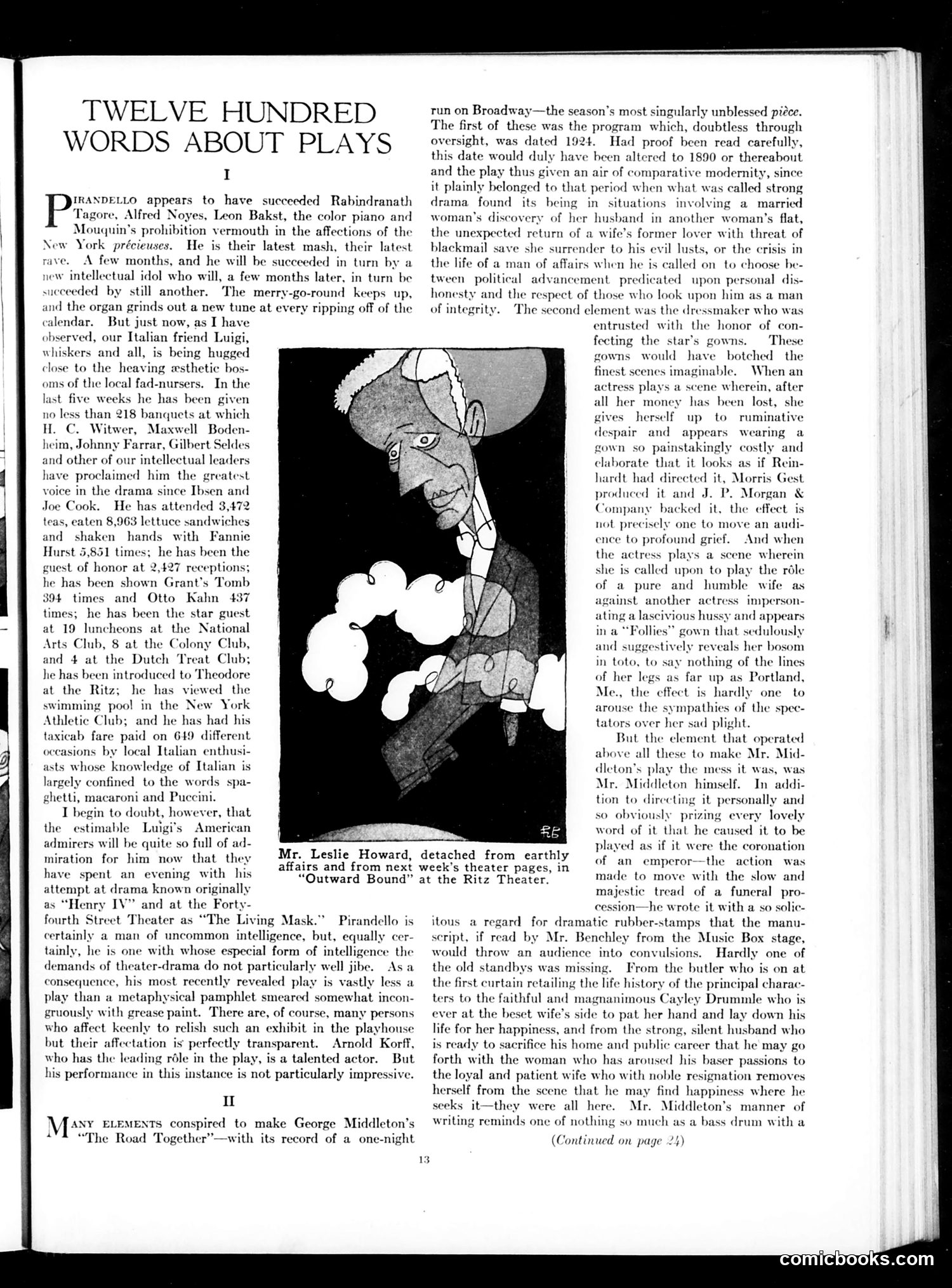
This page satirizes the pretentious faddishness of New York's cultural elite. The author mocks how Pirandello (the Italian playwright Luigi Pirandello) has become the fashionable obsession of "précieuses"—affected, cultured New Yorkers who cycle through intellectual enthusiasms. The piece catalogs absurdly specific statistics of receptions, banquets, and social honors showered upon him. The cartoon shows Leslie Howard in "Outward Bound" at the Ritz Theater—apparently as a positive counterpoint to the pretentious avant-garde drama being celebrated. The satire targets the artificial enthusiasm of Manhattan's intellectual circles: they treat Pirandello as genius while having spent evenings with his actual play ("Henry IV"), which the author dismisses as "vastly less a play than a metaphysical pamphlet." The joke: they admire what they don't truly understand, and their affectation is "perfectly transparent."
📄 Transcribed text from this page (OCR, searchable)
Machine-transcribed from the original scan — historical spelling and the odd misread are preserved.
TWELVE HUNDRED WORDS ABOUT PLAYS I IRANDELLO appears to have succeeded Rabindranath Tagore, Alfred Noyes, Leon Bakst, the color piano and Mouquin’s prohibition vermouth in the affections of the New York précieuses. He is their latest mash, their latest A few months, and he will be succeeded in turn by a new intellectual idol who will, a few months later, in turn be succeeded by still another. The merry-go-round keeps up, and the organ grinds out a new tune at every ripping off of the calendar. But just now, as I have observed, our Italian friend Luigi, whiskers and all, is being hugged close to the heaving wsthetic bos- oms of the local fad-nursers. In the last five weeks he has been given no less than 218 banquets at which H. C. Witwer, Maxwell Boden- heim, Johnny Farrar, Gilbert Seldes and other of our intellectual leaders have proclaimed him the greatest voice in the drama since Ibsen and Joe Cook. He has attended 3,472 teas, eaten 8,963 lettuce sand. and shaken hands with Hurst 5,851 times; he has been the guest of honor at 2,427 re he has been shown Grant’s Tomb 394 times and Otto Kahn 437 times; he has been the star guest at 19 luncheons at the National Arts Club, 8 at the Colony Club, and 4 at the Dutch Treat Club; he has been introduced to Theodore at the Ritz; he has viewed the swimming pool in the New York Athletic Club; and he has had his taxicab fare paid on 649 different occasions by local Italian enthusi- asts whose knowledge of Italian is largely confined to the words spa- ghetti, macaroni and Puccini. I begin to doubt, however, that the estimable Luigi's American admirers will be quite so full of ad- miration for him now that they have spent an evening with his attempt at drama known originally as “Henry IV” and at the Forty- fourth Street Theater as “The Living Mask.” Pirandello is certainly a man of uncommon intelligence, but, equally cer- tainly, he is one with whose especial form of intelligence the demands of theater-drama do not particularly well jibe. Asa consequence, his most recently revealed play is vastly less a play than a metaphysical pamphlet smeared somewhat incon- gruously with grease paint. There are, of course, many persons who affect keenly to relish such an exhibit in the playhouse but their affectation is perfectly transparent. Arnold Korff, who has the leading réle in the play, is a talented actor. But his performance in this instance is not particularly impressive. Il rave. otions; M&3x Etemests conspired to make George Middleton's YL “The Road Together”—with its record of a one-night Mr. Leslie Howard, detached from earthly affairs and from next week's theater pages, in “Outward Bound” at the Ritz Theater. run on Broadway—the season’s most singularly unblessed piéce. The first of these was the program which, doubtless through oversight, was dated 1924. Had proof been read carefully, this date would duly have been altered to 1890 or thereabout and the play thus given an air of comparative modernity, since it plainly belonged to that period when what was called strong drama found its being in situations involving a married woman’s discovery of her husband in another woman’s flat, the unexpected return of a wife’s former lover with threat of blackmail save she surrender to his evil lusts, or the crisis in the life of a man of affairs when he is called on to choose b tween political advancement predicated upon personal dis honesty and the respect of those who look upon him as a man of integrity. The second element was the dressmaker who was entrusted with the honor of con- fecting the star’s gowns. These would have botched the finest scenes imaginable. When an actress plays a scene wherein, after all her money gives herself up to despair and gowns has been lost, ruminative appears wearing a gown so painstakingly costly and claborate that it looks as if Rein- hardt had directed it, Morris Gest produced it and J. P. Morgan & Company backed it, the effect is not precisely one to move an audi- ence to profound grief. And when the actress plays a scene wherein she is called upon to play the réle humble wife as against another actress imperson- of a pure and ating a lascivious hussy and appears in a ‘*Follies” gown that sedulously and suggestively reveals her bosom in toto, to say nothing of the lines of her legs as far up as Portland, Me., the effect is hardly one to arouse the sympathies of the spec- tators over her sad plight. But the element that operated above all these to make Mr. Mid- dleton’s play the mess it was, was Mr. Middleton himself. In addi- tion to directing it personally and so obviously prizing every lovely word of it that he caused it to be played as if it were the coronation of an emperor—the action was made to move with the slow and majestic tread of a funeral pro- cession—he wrote it with a so solic- itous a regard for dramatic rubber-stamps that the manu- script, if read by Mr. Benchley from the Music Box stage, would throw an audience into convulsions. Hardly one of the old standbys was missing. From the butler who is on at the first curtain retailing the life history of the principal charac- ters to the faithful and magnanimous Cayley Drummle who is ever at the beset wife’s side to pat her hand and lay down his life for her happiness, and from the strong, silent husband who is ready to sacrifice his home and public career that he may go forth with the woman who has aroused his baser passions to the loyal and patient wife who with noble resignation removes herself from the scene that he may find happiness where he seeks it—they were all here. Mr. Middleton’s manner of writing reminds one of nothing so much as a bass drum with a (Continued on page 24) icbooks.com