
A complete issue · 37 pages · 1924
Judge — February 2, 1924
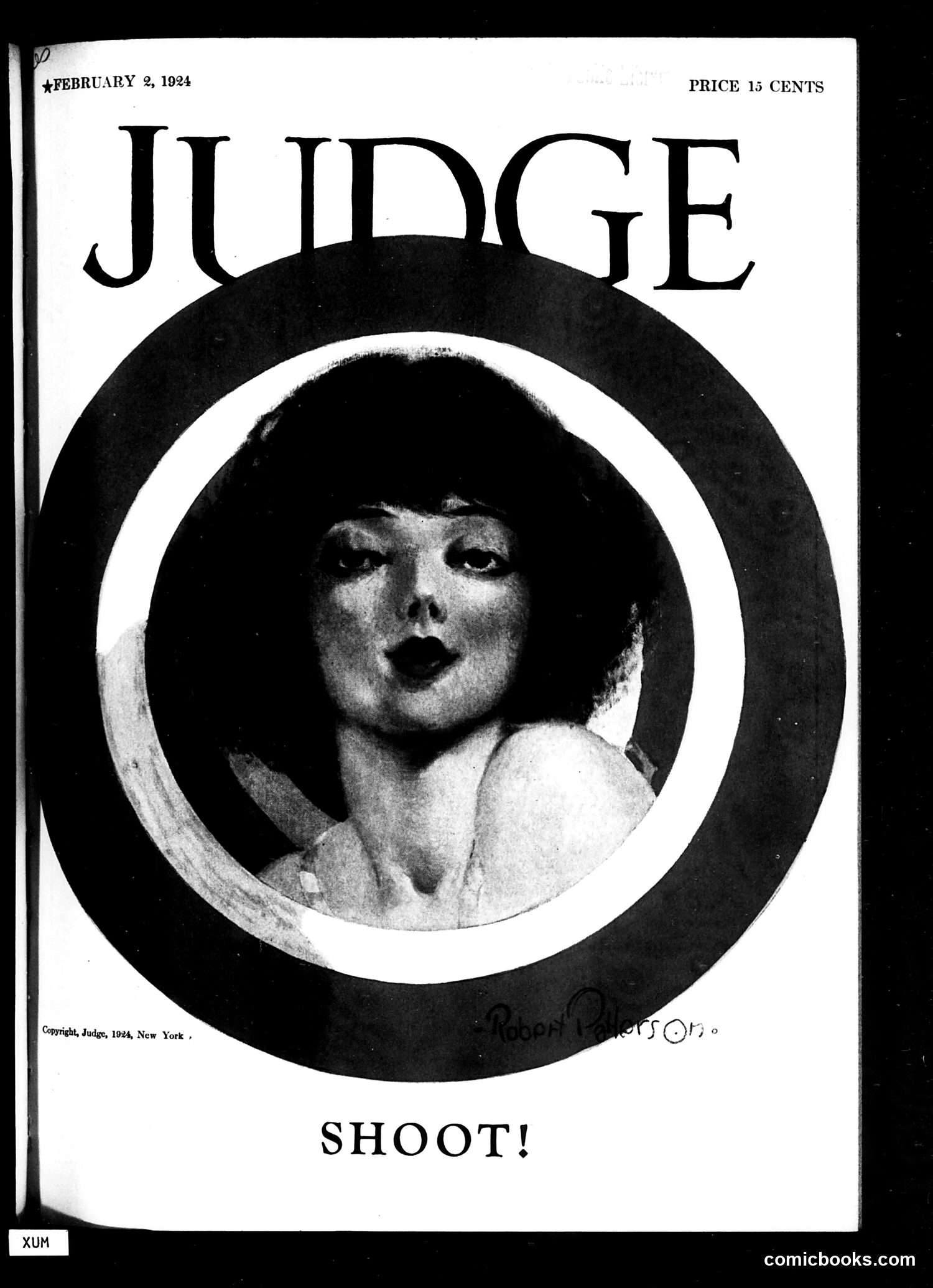
This February 2, 1924 cover features a stylized portrait of a woman's face framed within a large circular target or bullseye design, with the caption "SHOOT!" below. The image appears to be satirizing photography or portrait photography of the era—"Judge" was known for visual humor. The concentric circles create a target-like composition around the subject's face, suggesting the metaphorical "targeting" involved in photography or portraiture. The dramatic styling, bobbed hair, and makeup reflect 1920s "flapper" aesthetics. Without clearer OCR text or additional context, the specific satirical target remains unclear—whether this mocks photographic techniques, a particular public figure, or contemporary beauty standards. The composition itself becomes the joke through its visual wit rather than explicit commentary.
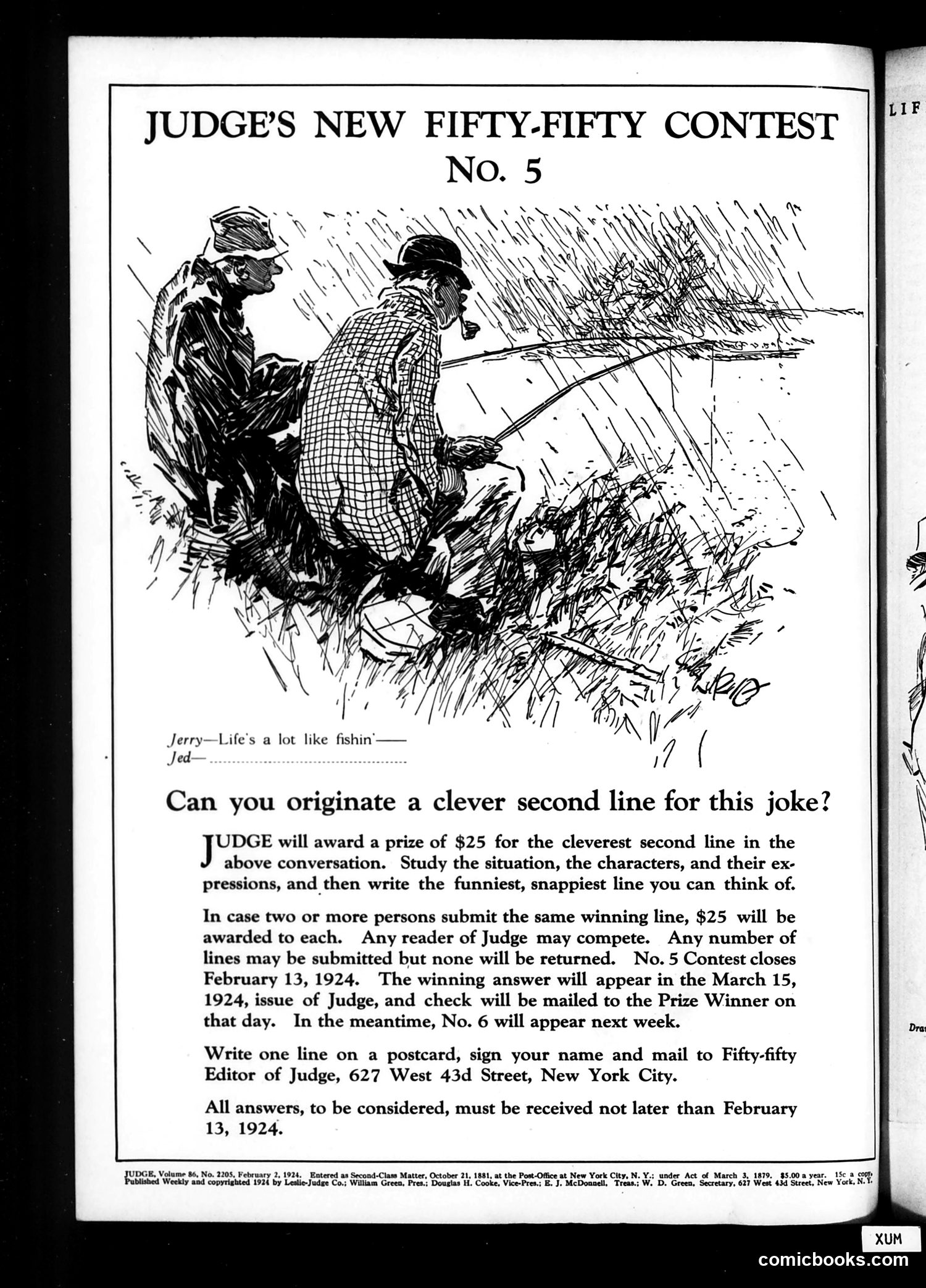
This page presents a humor contest rather than editorial satire. The cartoon depicts two men fishing in a rural setting, with the setup line: "Jerry—Life's a lot like fishin'— Jed—_____________________" Readers are invited to submit a clever second line completing Jed's response, with a $25 prize for the cleverest entry. The contest closes February 13, 1924, and winners appear in the March 15 issue. The fishing scene itself carries no obvious political meaning—it's simply a relatable, timeless scenario chosen for its comedic potential. The contest represents Judge's interactive engagement with readers, a common magazine feature of the 1920s era designed to boost reader participation and loyalty.
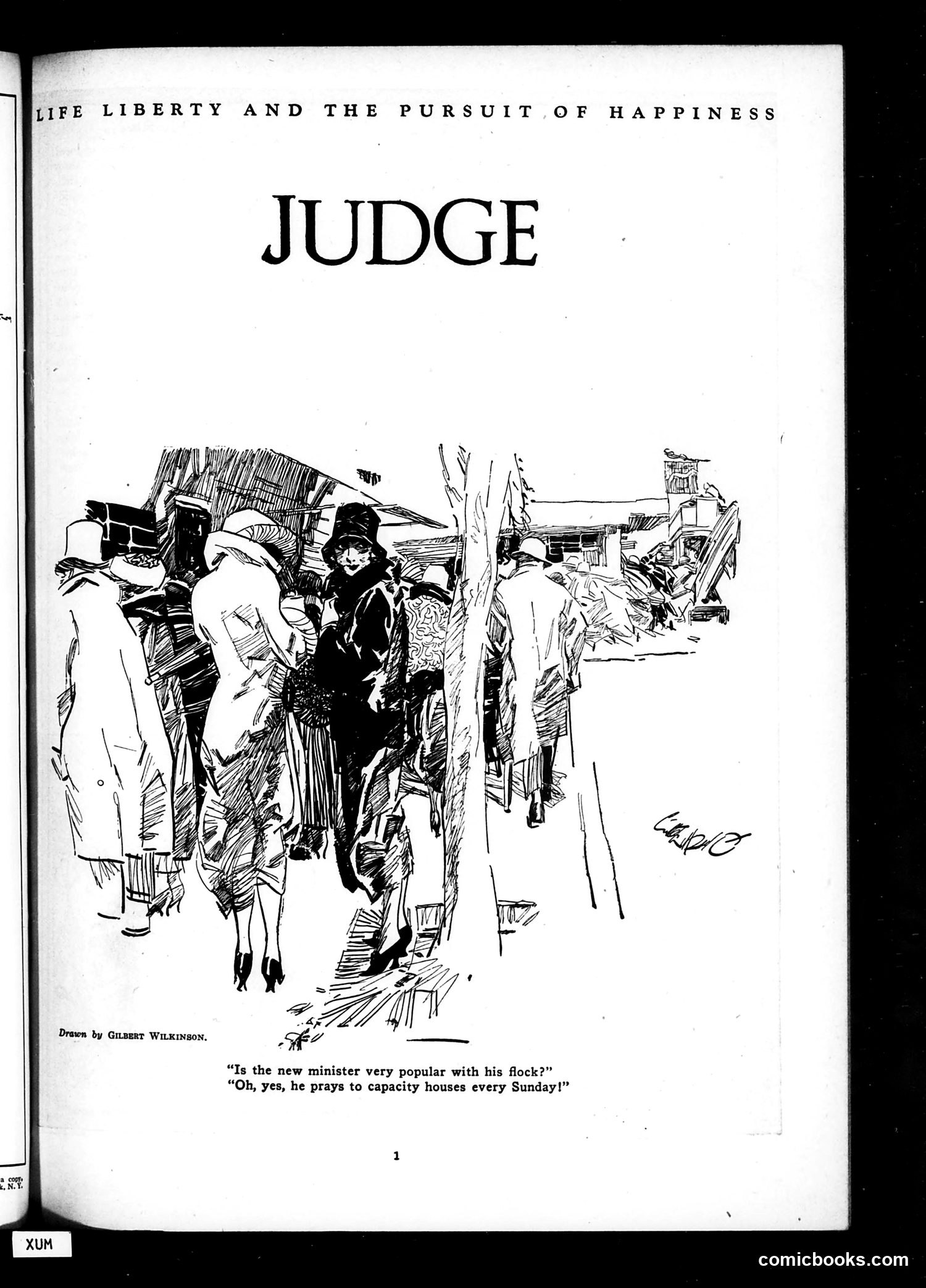
This page from *Judge* magazine features a satirical cartoon titled "Judge" by Gilbert Wilkinson. The sketch depicts what appears to be a crowded street scene with well-dressed figures, including a woman in a hat and coat speaking to others. The caption reads: "Is the new minister very popular with his flock?" / "Oh, yes, he prays to capacity houses every Sunday!" The satire targets a minister whose popularity stems not from spiritual merit but from his ability to fill the church to capacity—suggesting his appeal is superficial or showmanship-based rather than genuinely religious. The joke mocks both the minister's theatrical preaching style and congregants' shallow reasons for attendance, critiquing commercialization of religion and the minister's focus on attendance numbers over authentic faith.
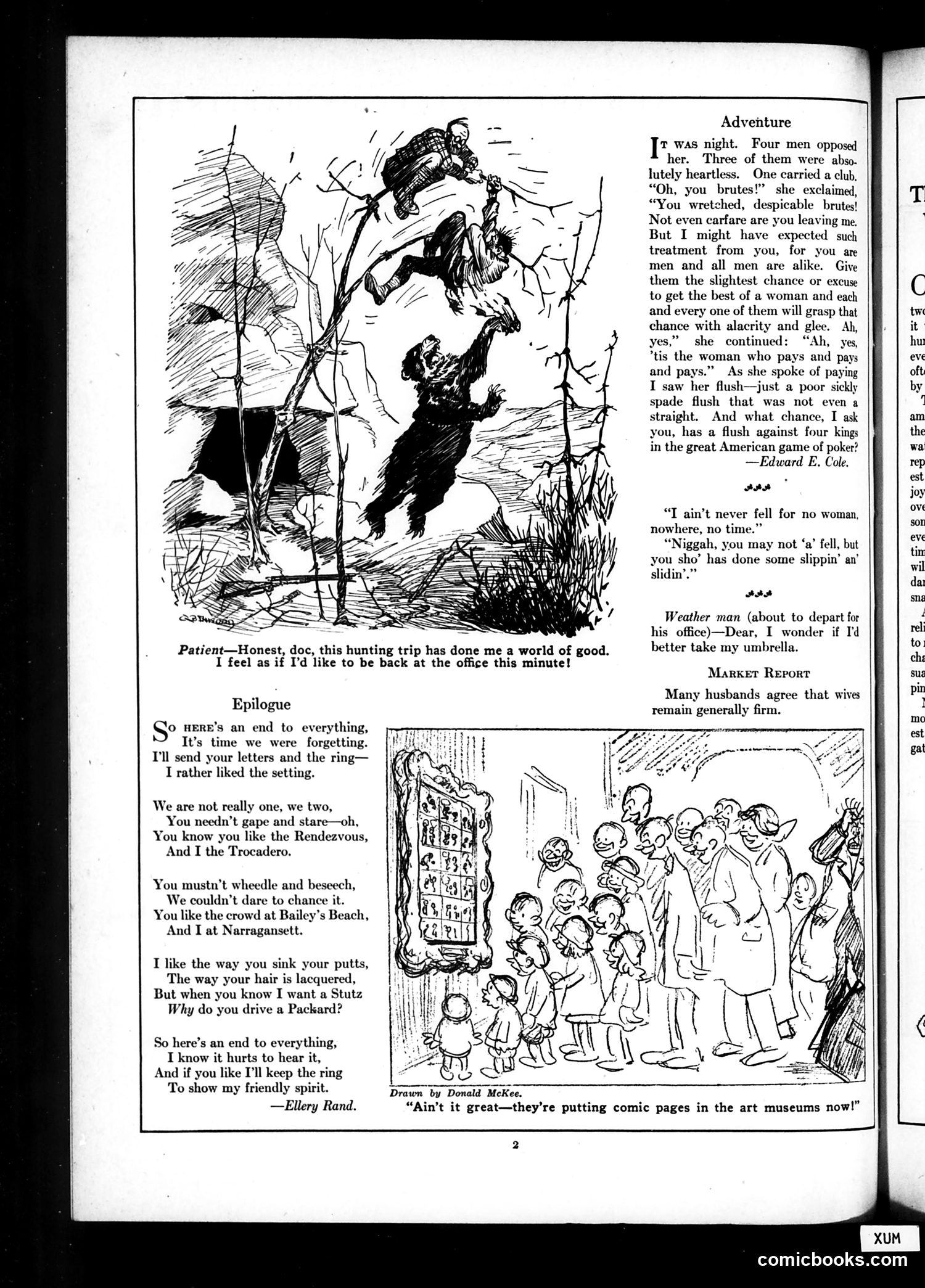
The top illustration depicts a woman being attacked by four men during a nighttime assault. The accompanying text presents her sharp rebuke to her attackers, lecturing them that as "men and all men are alike," they should treat women with respect. She references "the great American game of poker," suggesting these are ordinary men, not gentlemen. The "Epilogue" poem by Ellery Rand that follows appears to mock romantic relationships, listing playful grievances about dating and courtship rituals (driving a Packard, sinking putts, lacquered hair). The bottom cartoon by Donald McKee shows a crowded art museum scene, with the caption joking that comic pages now belong in art museums—satirizing either the growing cultural status of comics or, conversely, mocking their artistic pretensions.
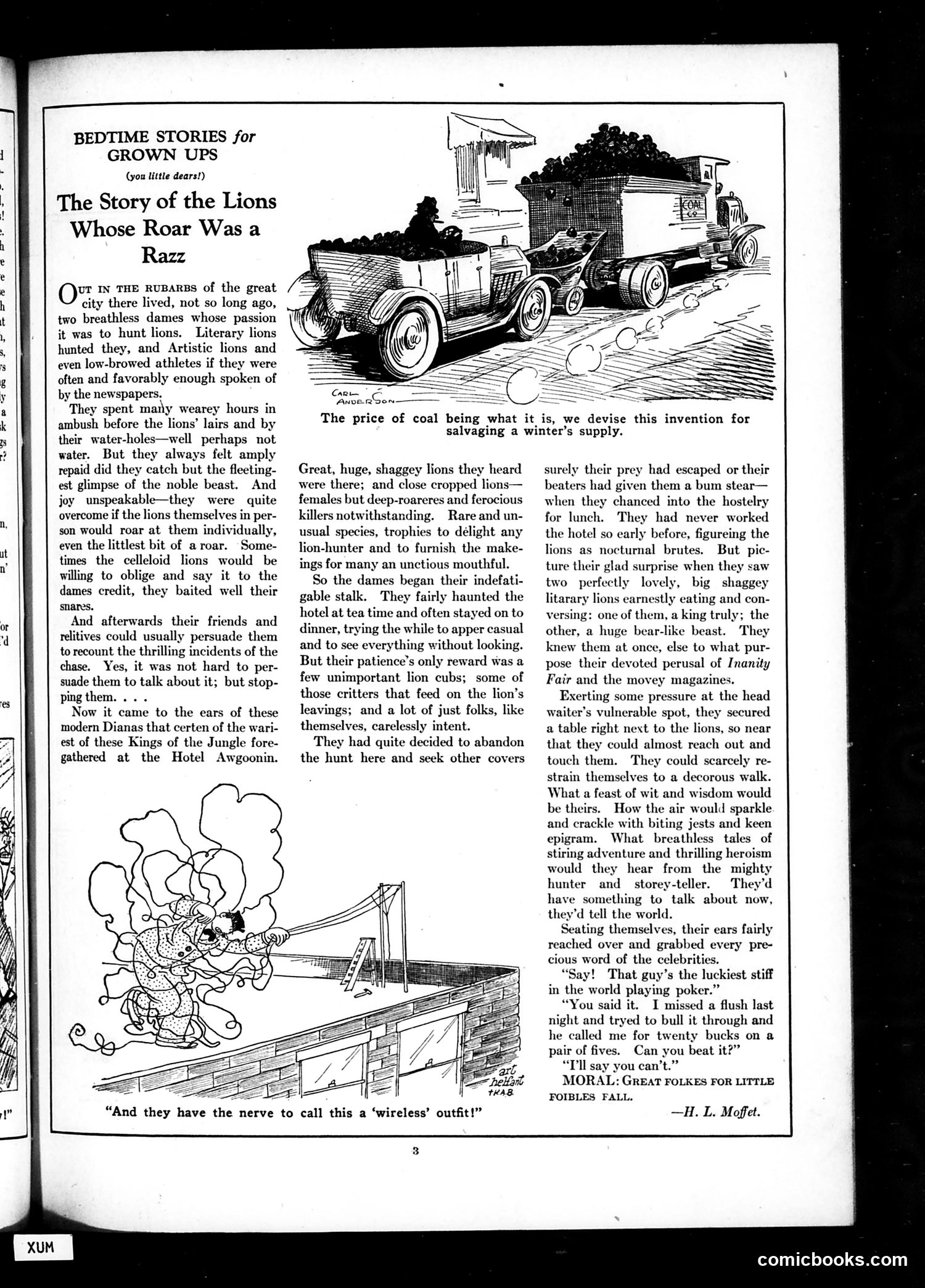
This bedtime story for children satirizes wealthy big-game hunters of the early 20th century. Two aristocratic "dames" who fancy themselves as mighty hunters pursue lions near a hotel in Africa. The joke centers on their pretensions: they spend hours in ambush but rely on water-holes and beaters to do the actual work. When they finally encounter lions at the hotel, the animals prove indifferent to their presence—eating lunch calmly and ignoring the hunters entirely. The satire mocks upper-class women who play at adventure tourism while depending on others' labor, and their delusions of sporting prowess. The "razz" (ridicule) comes from the lions' complete disinterest in these would-be hunters, deflating their grandiose self-image.
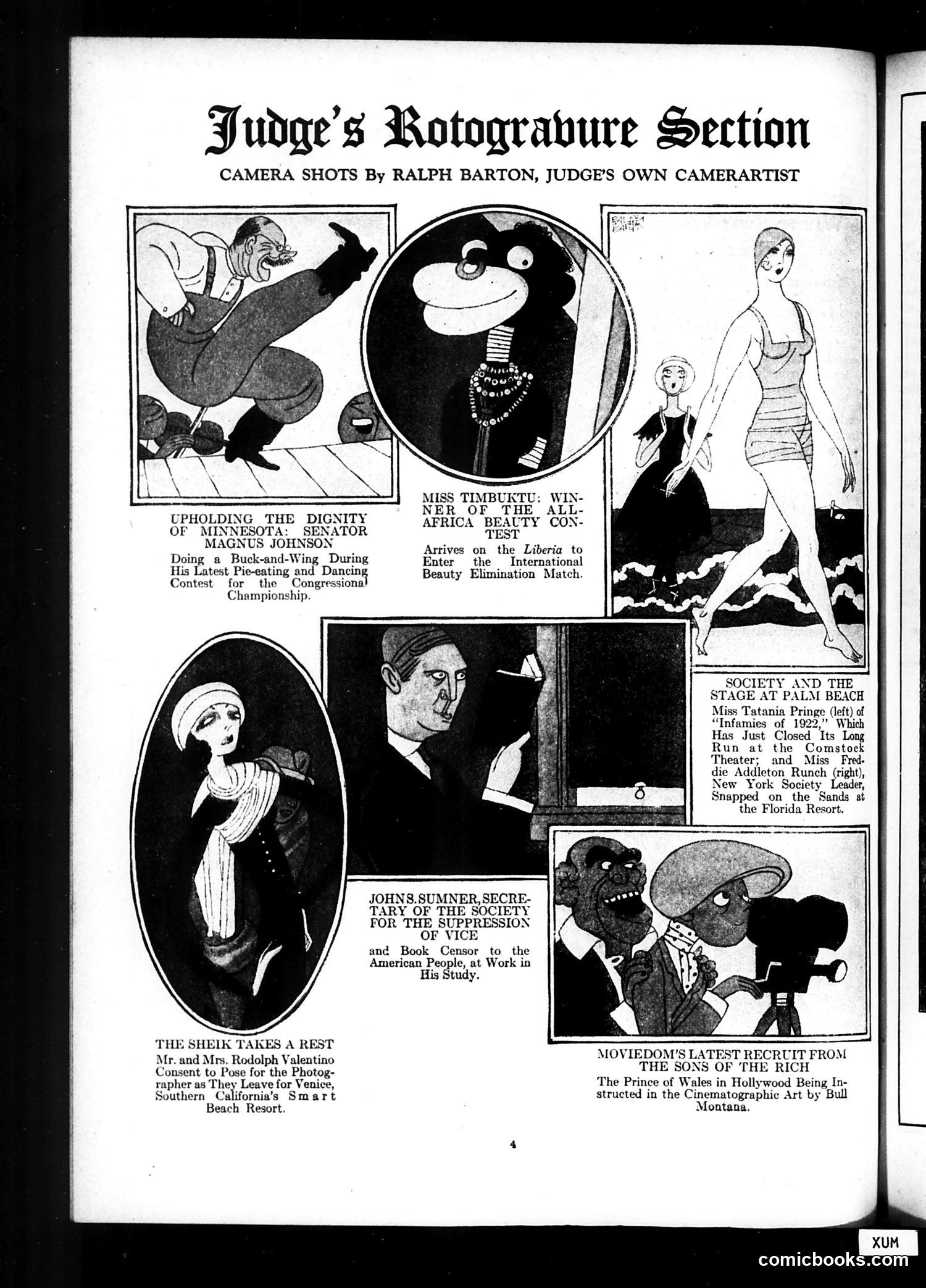
This page features celebrity gossip and entertainment news from Judge magazine's photo section. The content includes: **"The Sheik Takes a Rest"**: A caricature of Rudolph Valentino, the famous silent film star, posed with his wife at a California resort. The "Sheik" reference alludes to his most famous role in *The Sheik* (1921). **"Miss Timbuktu"**: A beauty pageant winner arriving for international competition, depicted with exaggerated caricature typical of the era's racist imagery. **"Society and the Stage"**: Features theater personalities at Palm Beach. **"The Prince of Wales in Hollywood"**: References instruction in cinematography. The page primarily mocks celebrity culture, beauty standards, and entertainment industry figures through caricature and satire—common Judge magazine fare of this period.
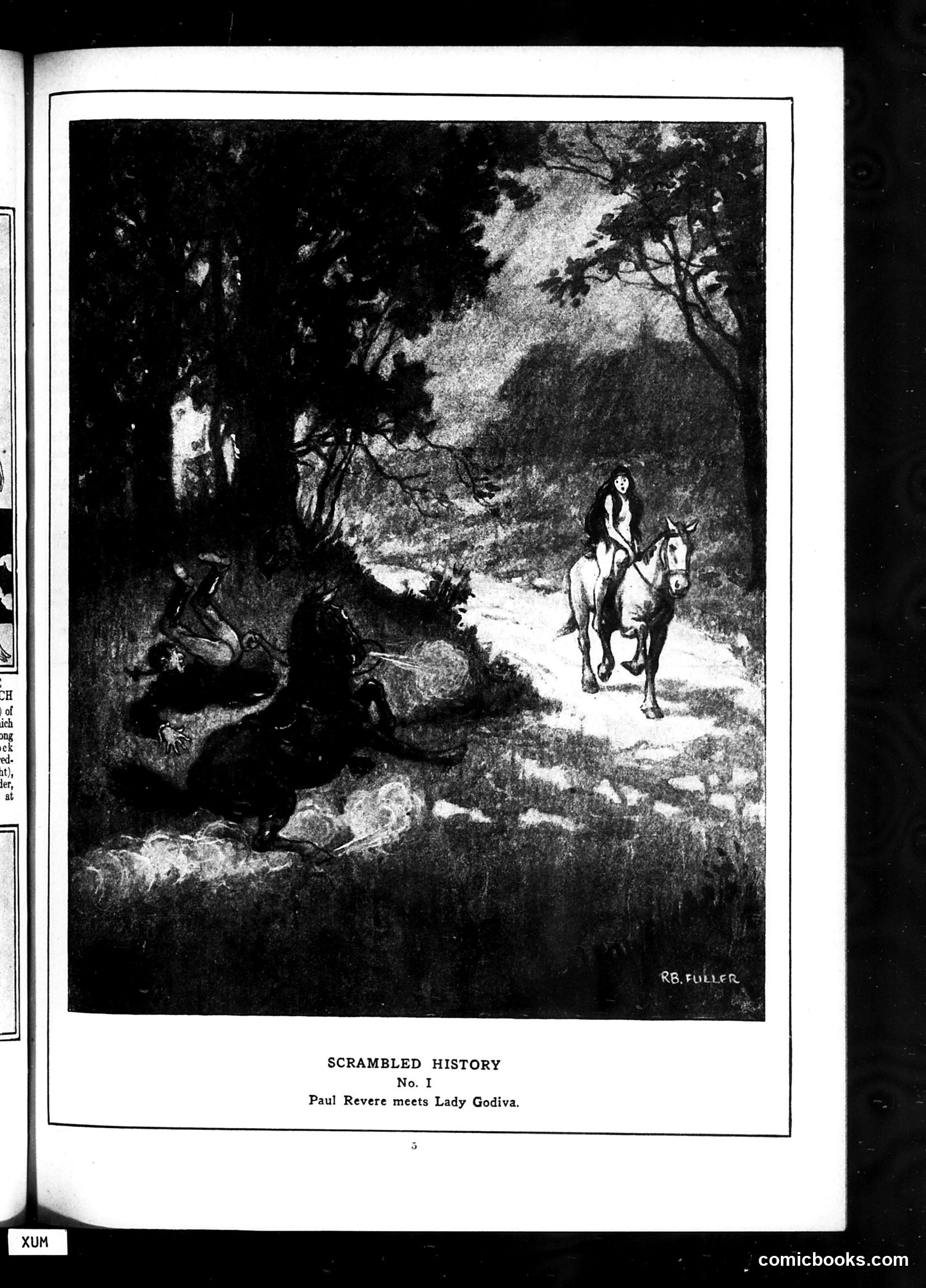
This is a humorous illustration imagining a fictional encounter between two famous historical figures from completely different eras and contexts: Paul Revere (American Revolutionary War messenger, famous for his 1775 midnight ride) and Lady Godiva (the legendary medieval noblewoman known from folklore for riding naked through town). The joke appears to be visual/conceptual rather than political—combining two iconic historical figures in an absurd scenario. Revere, shown on horseback on a forest path, encounters what appears to be Lady Godiva approaching on horseback. The "scrambled history" title suggests the series deliberately mixes historical periods for comedic effect. This appears to be lighthearted entertainment rather than political satire, typical of Judge magazine's illustrated humor content.
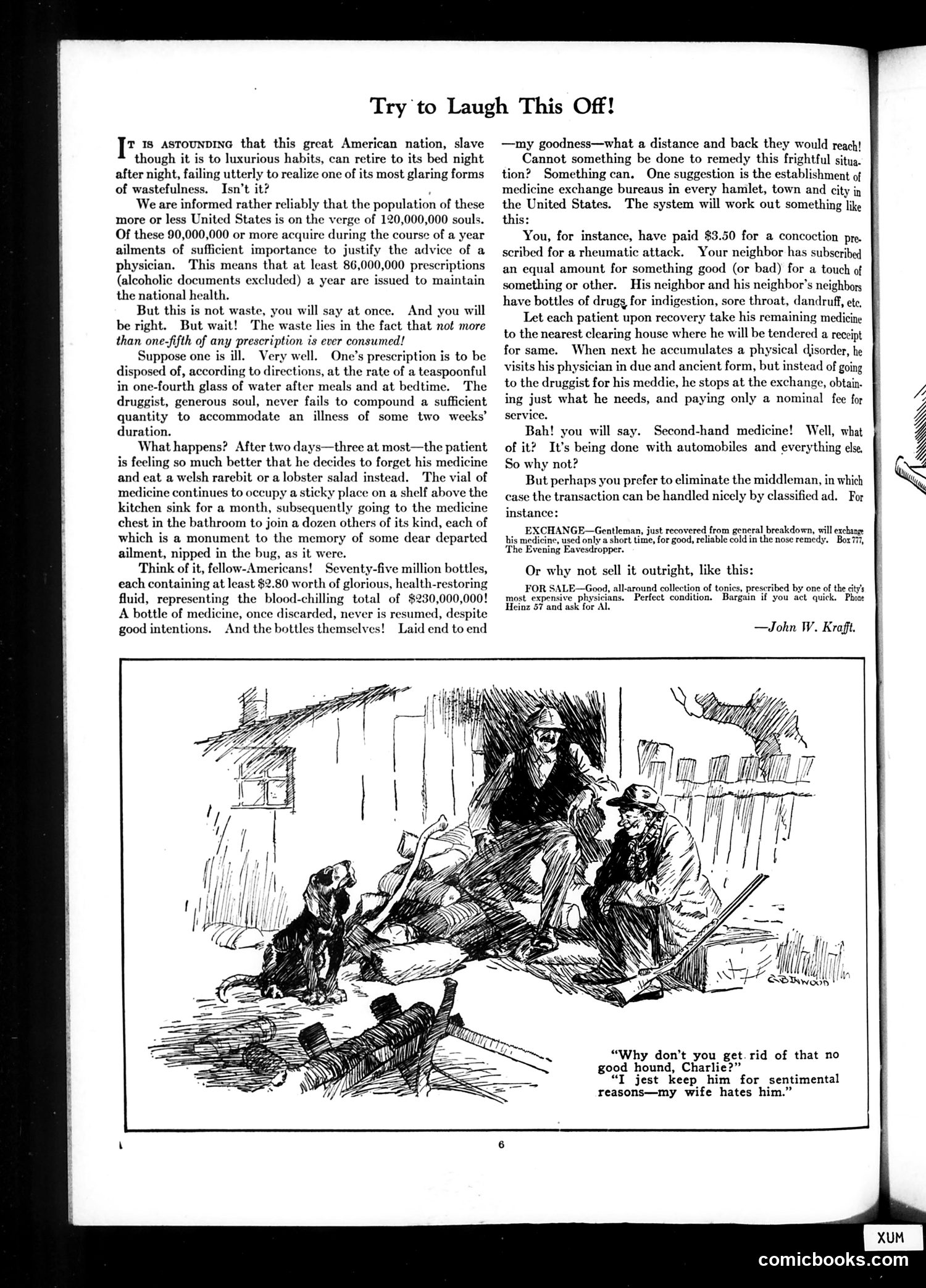
This satirical article by John W. Kraft critiques American medicine waste. The piece argues that approximately 90 million Americans receive prescriptions annually, yet only one-fifth of medication is consumed. Patients typically abandon medicine after feeling better within days, leaving 75 million unused bottles worth $230 million sitting in medicine cabinets. Kraft proposes satirical solutions: establishing "medicine exchange bureaus" where recovered patients deposit unused medicine for others to retrieve, or selling partially-used prescriptions through classified ads—comparing this to used automobiles. The humor lies in presenting these absurd proposals deadpan, implying that if America embraces secondhand cars, why not secondhand medicine? The accompanying cartoon (unrelated to the main text) shows a man explaining why he keeps an unwanted dog: "my wife hates him," illustrating stubbornness in domestic situations. The satire targets American consumerism and medical waste during an era predating modern pharmaceutical disposal regulations.
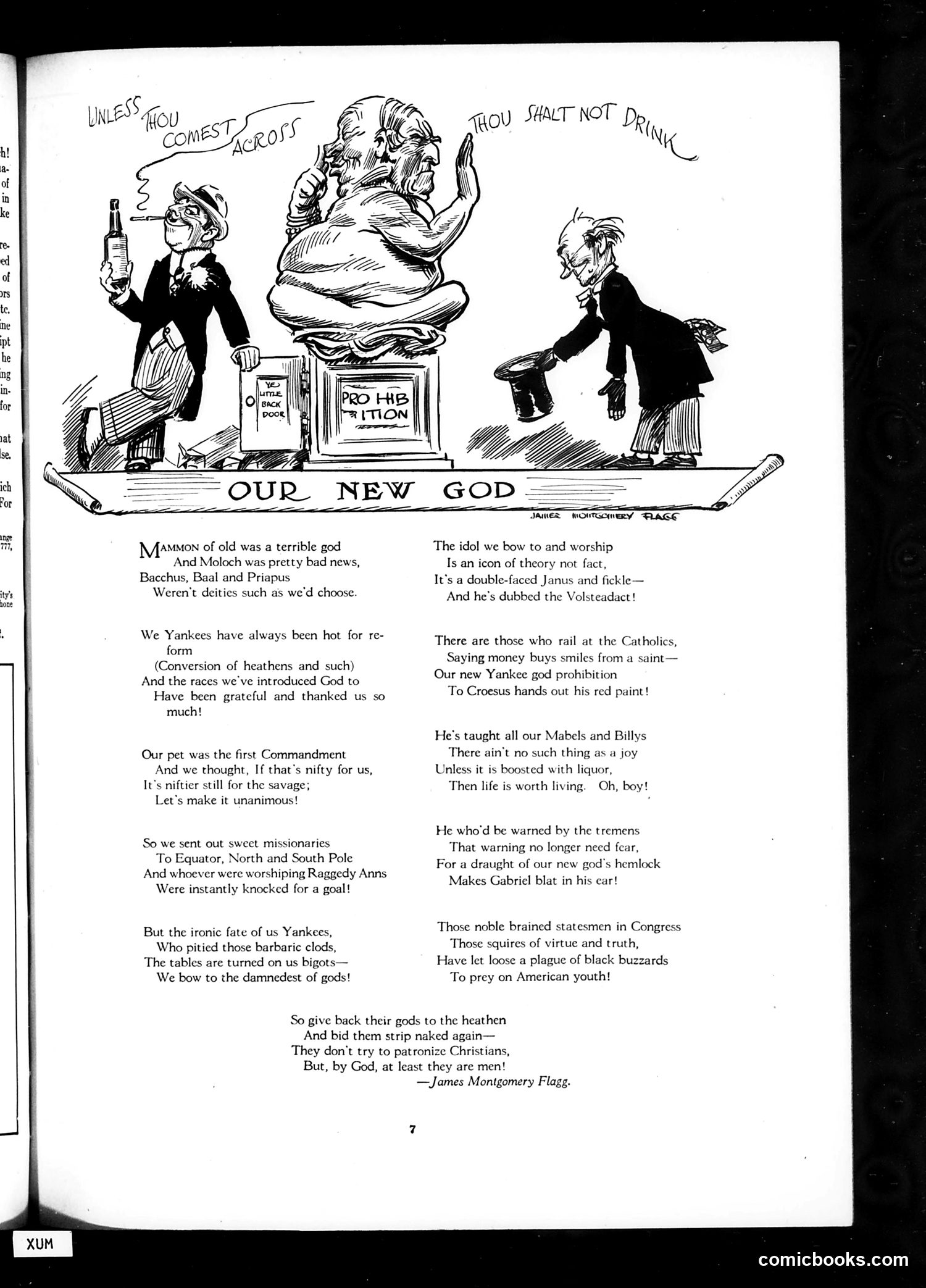
This cartoon satirizes American **Prohibition** (the Volstead Act, which banned alcohol 1920-1933). The central figure is a bloated statue labeled "Prohibition"—the "god" Americans now worship. The satire contrasts American missionary zeal converting "heathens" abroad with hypocrisy at home. Flagg argues that while Americans condemned foreign religions and imposed Christian morality on colonized peoples, they've now created their own false idol: Prohibition itself. The poem criticizes how Prohibition has become a moral crusade that: - Treats alcohol as the root of all sin (like worshiping Mammon) - Corrupts youth by making drinking forbidden fruit - Is enforced by supposedly virtuous congressmen who are actually corrupt - Makes Americans less "men" than the supposedly uncivilized peoples they missionized The two figures flank the statue: one presenting alcohol ("Unless thou comest across"), one refusing it ("Thou shalt not drink")—showing Americans' conflicted relationship with the law. The message: Prohibition is America's new false religion, no better than the "barbaric" gods Americans once mocked.
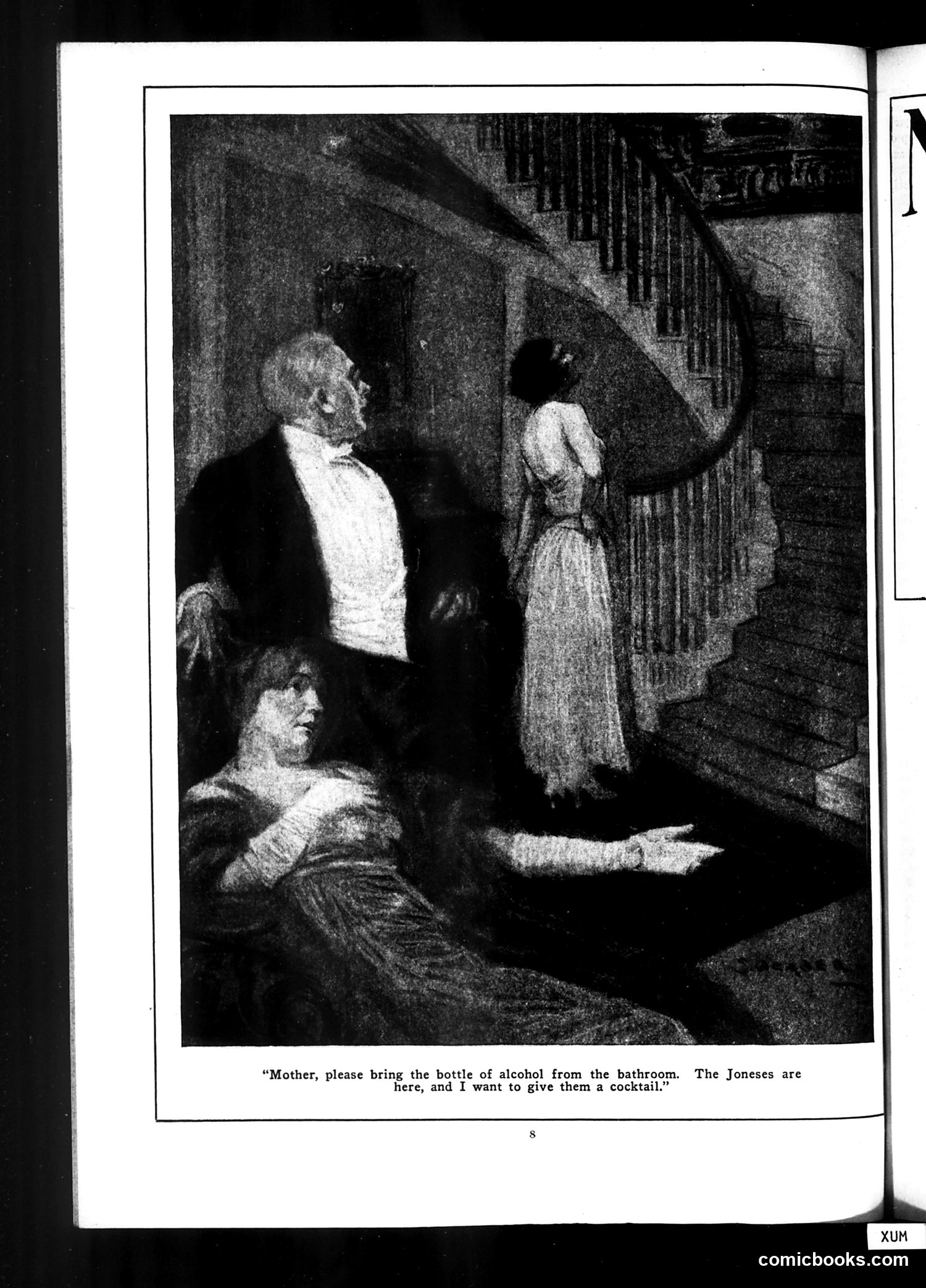
This is a satirical illustration from *Judge* magazine commenting on Prohibition-era hypocrisy. The cartoon depicts a man openly requesting alcohol from his mother while guests (the Joneses) are present—behavior that would have been illegal during Prohibition (1920-1933). The satire targets the widespread disregard for Prohibition laws among the middle and upper classes. Despite the constitutional ban on alcohol, wealthy Americans routinely kept private supplies and served drinks to guests, flouting the law. The casual, matter-of-fact tone of the request—essentially asking his mother to fetch contraband in front of visitors—highlights how normalized this lawbreaking had become in respectable households. The humor relies on the contradiction between public propriety and private rule-breaking that characterized Prohibition society.
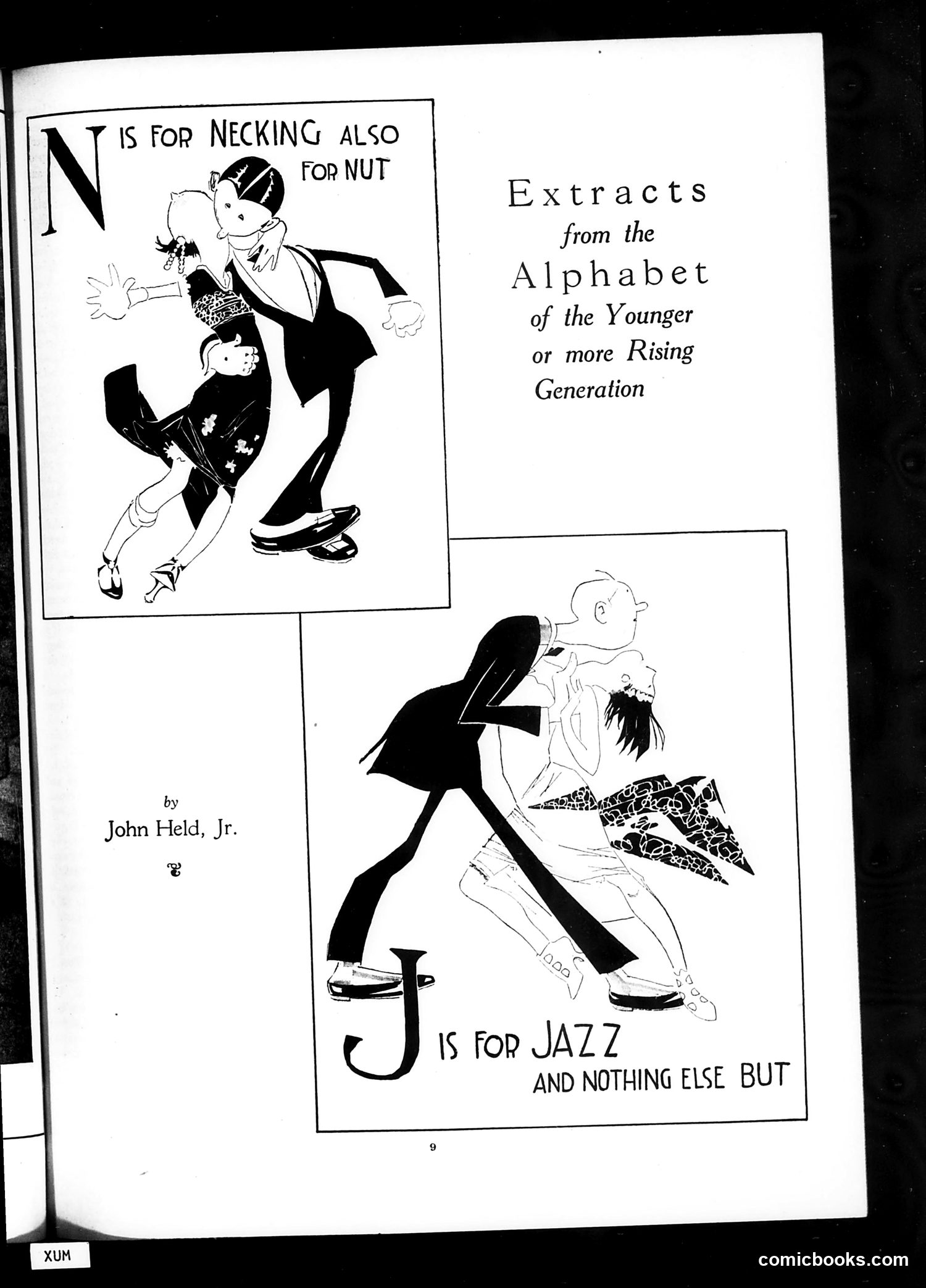
This page from John Held Jr.'s "Alphabet of the Younger or more Rising Generation" satirizes 1920s youth culture through two illustrated entries: **"N is for Necking Also for Nut"** shows a flapper and man in an intimate embrace, mocking the era's "necking" (kissing) trend that scandalized older generations. **"J is for Jazz and Nothing Else But"** depicts energetic dancers, satirizing young people's obsession with jazz music and dancing—behaviors considered morally suspect by traditionalists. Held, a prominent 1920s cartoonist, used these entries to both document and gently mock the "Younger Generation's" rebellious departure from Victorian propriety. The exaggerated, lively illustrations capture the era's moral panic about flappers, jazz, and changing sexual mores among American youth.
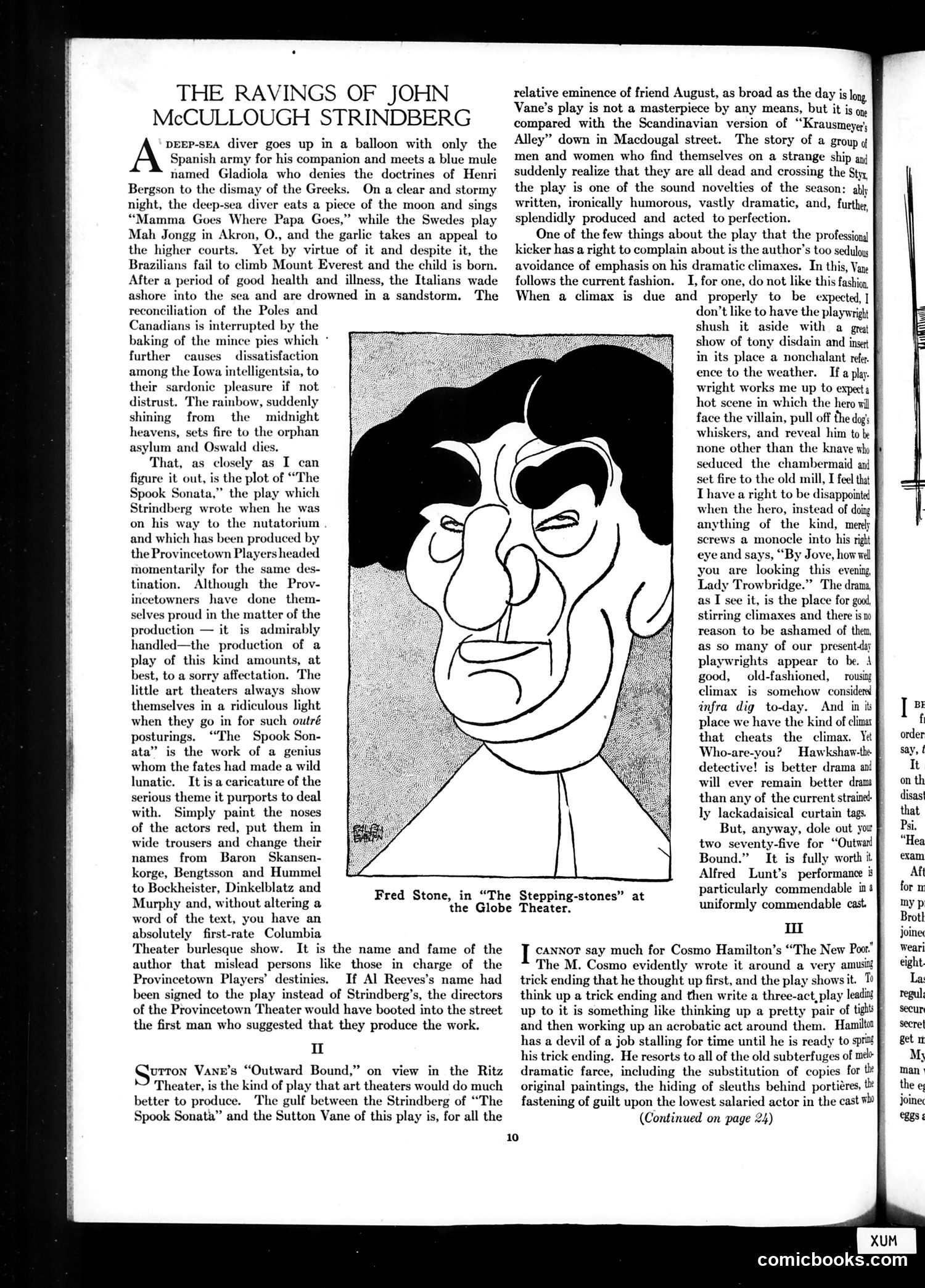
This page critiques avant-garde theater through a satirical review of August Strindberg's "The Spook Sonata," produced by the Provincetown Players. The caricature depicts **Fred Stone** performing in "The Stepping-stones" at the Globe Theater. The author ridicules Strindberg's play as incomprehensible modernist nonsense—deliberately mocking its surreal plot with an absurdist summary (divers, blue mules, Mah Jongg in Ohio). The central argument: small art theaters mistake Strindberg's "genius lunacy" for serious art simply due to his famous name. The author suggests renaming characters to mundane Irish/German names and the play becomes obvious burlesque. By contrast, Sutton Vane's "Outward Bound" (about dead passengers crossing a strange ship) is praised as genuinely innovative yet accessible—the kind of play art theaters *should* produce instead of pretentiously staging incomprehensible European modernism. The satire targets 1920s artistic pretension: little theaters championing difficult European plays not on merit but reputation.
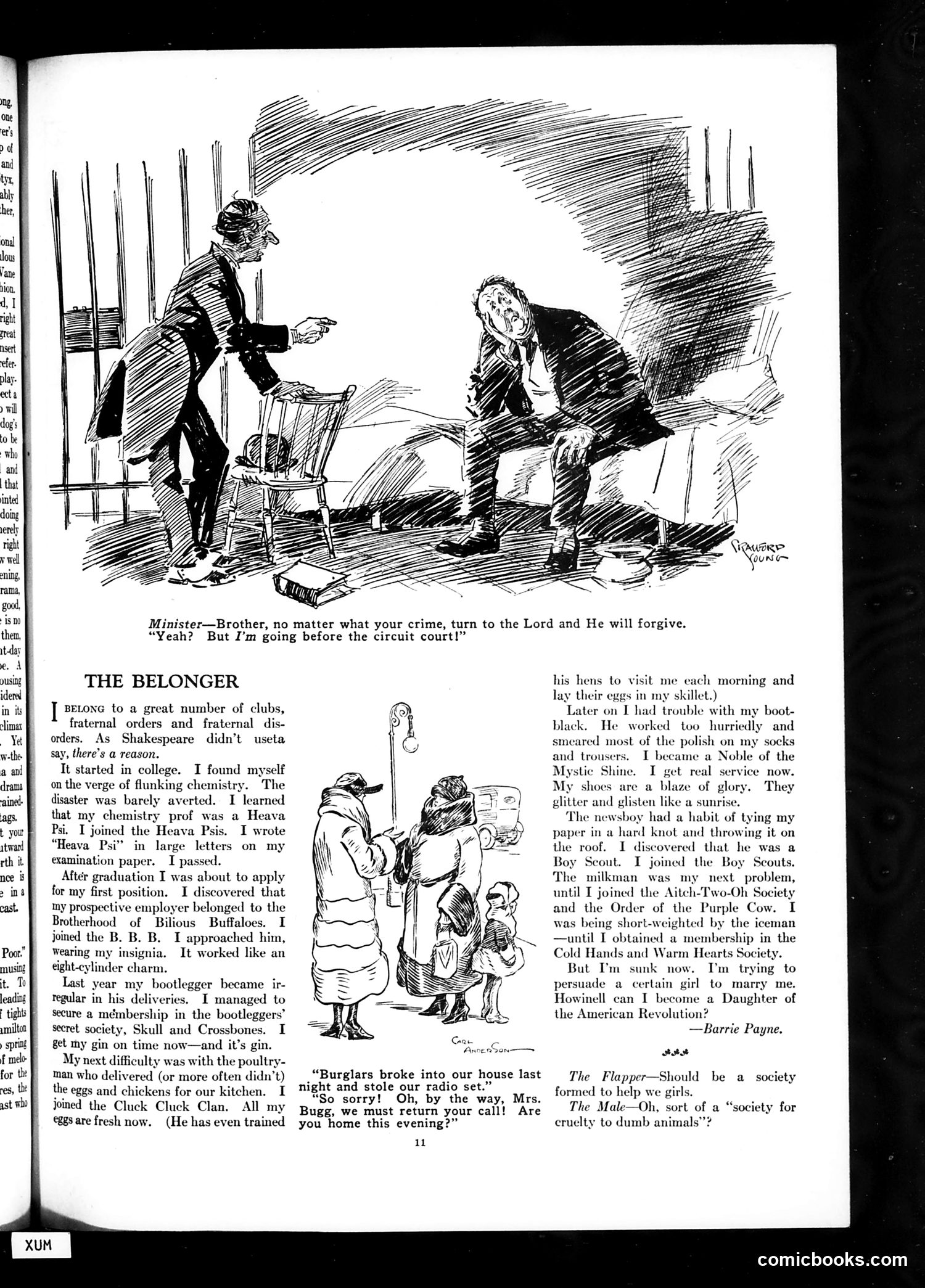
The top cartoon satirizes religious hypocrisy: a minister tells a criminal to seek divine forgiveness, but the criminal dismisses this, preferring to face the secular legal system ("circuit court"), suggesting earthly consequences matter more than spiritual redemption. "The Belonger" is a humorous essay mocking fraternal club culture. The narrator joins numerous organizations—college fraternities, the "Brotherhood of Bilious Buffaloes," Boy Scouts, the "Order of the Purple Cow"—each time to solve a specific practical problem (getting good grades, securing gin during Prohibition, fixing service issues). The satire targets Americans' obsessive club-joining, treating fraternal orders as mere transactional solutions rather than meaningful communities. The accompanying illustrations show club members in various regalia. The scattered joke captions at bottom mock social pretense and gender relations typical of 1920s satirical humor. The overall page reflects Judge magazine's role critiquing American social institutions and consumer culture.
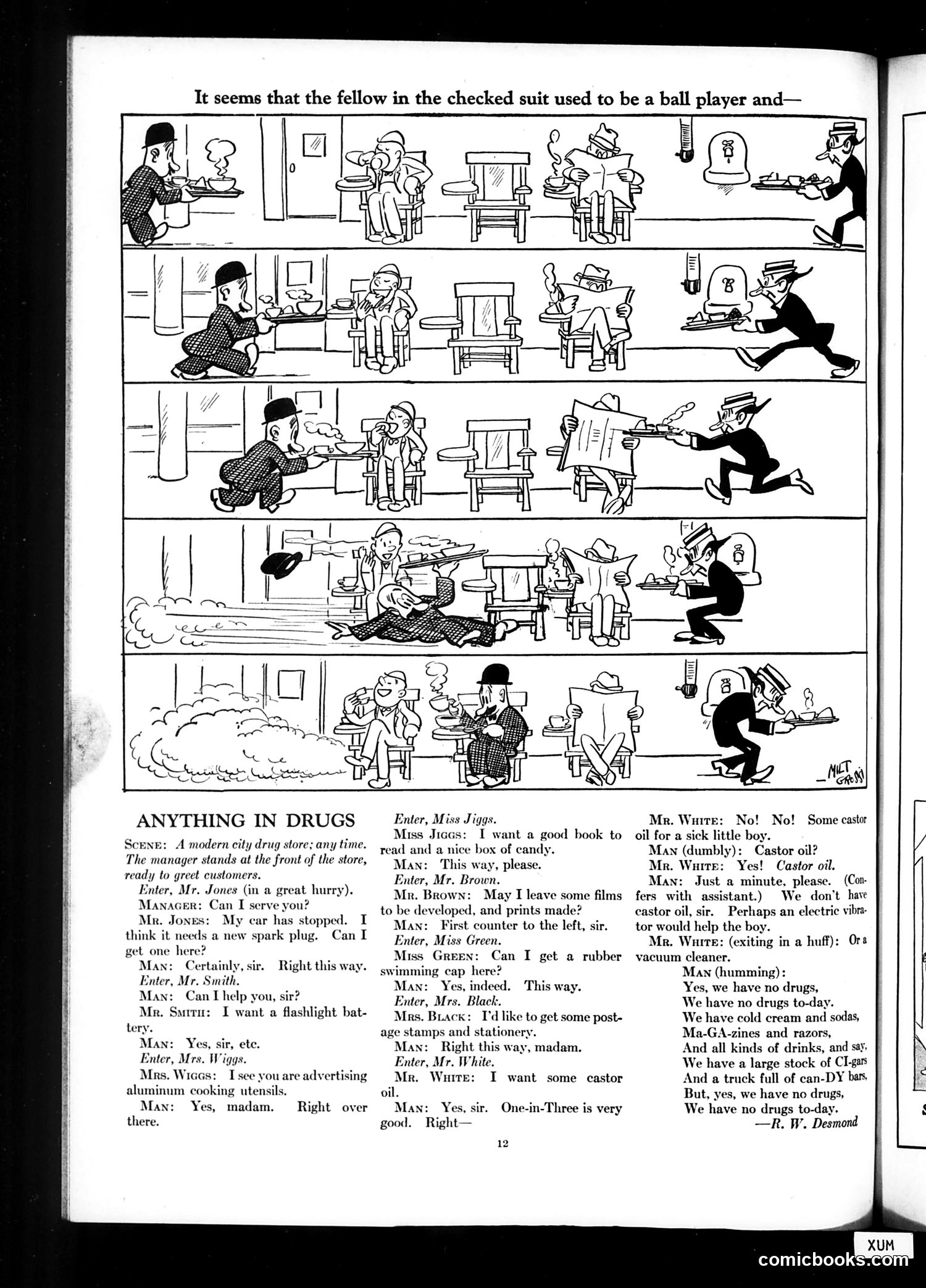
This comic strip satirizes the absurdity of early 20th-century American drug stores, which functioned as general variety stores rather than pharmacies. The humor works through ironic contrast: a customer seeking actual medicine (castor oil for a sick child) cannot obtain it, while the store stocks utterly unrelated items—car spark plugs, flashlight batteries, aluminum cookware, rubber swimming caps, and candy. The joke critiques how these establishments had abandoned their core pharmaceutical purpose, instead becoming cluttered emporiums selling everything except drugs. The manager's deflection—offering an electric vibrator instead of medicine—underscores the absurdity. The accompanying song ("We have no drugs to-day") drives home the satirical point that these "drug stores" paradoxically had no actual drugs available, highlighting consumer frustration and commercial priorities gone awry.
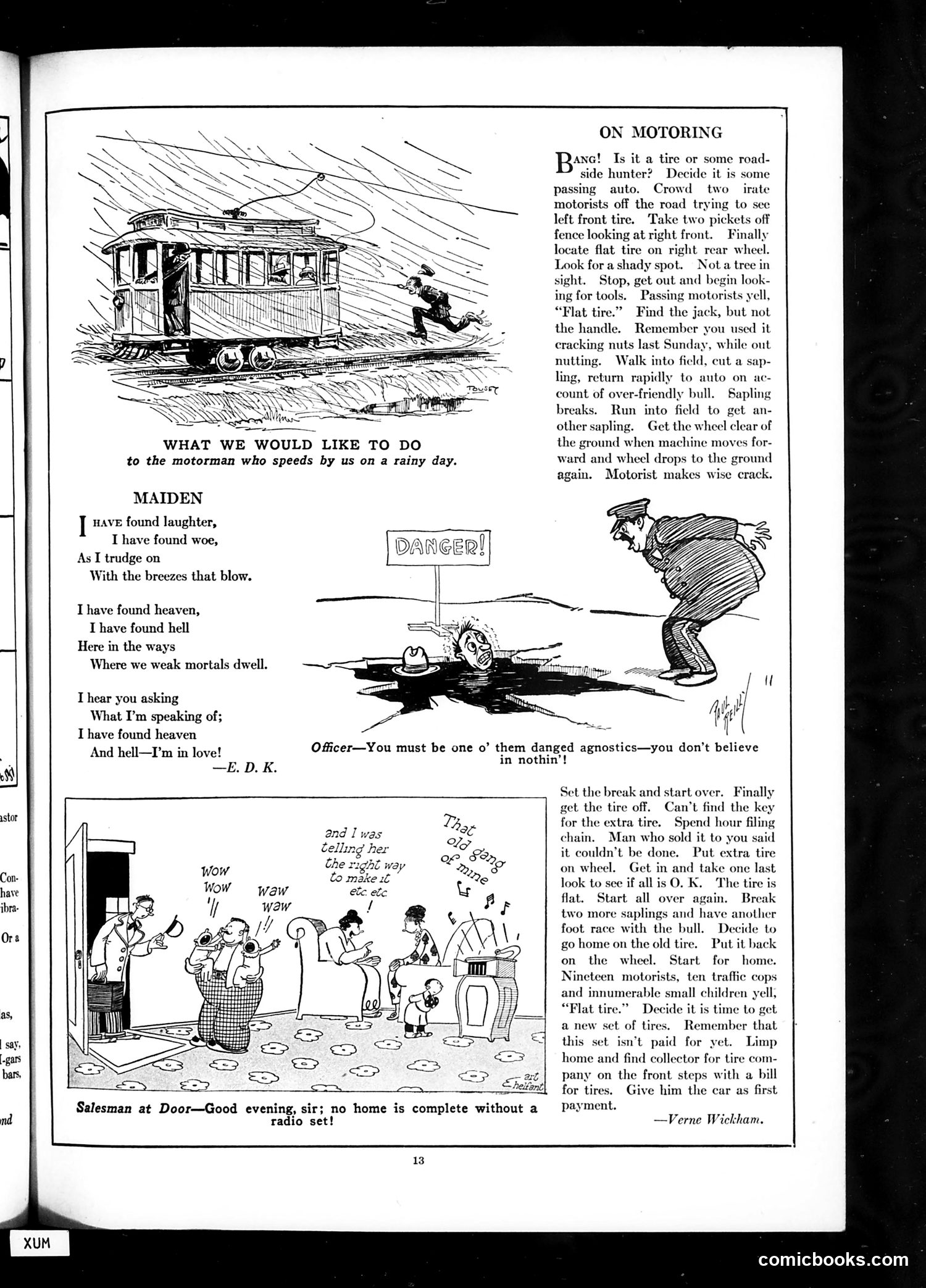
This page satirizes early automotive ownership's frustrations. The main article humorously details the chaotic experience of fixing a flat tire: locating it among crowds of rubber-necking motorists, finding missing tools, improvising repairs in fields while dodging aggressive bulls, and the endless cycle of failures. The joke captures the reality that cars—then relatively new and unreliable—created more problems than they solved. The sidebar cartoon mocks a radio salesman's pitch, suggesting that consumers already burdened by car expenses are now being sold unnecessary luxuries ("no home is complete without a radio set"). The "Maiden" poem appears unrelated—likely filler content. The overall message: automobiles are troublesome, expensive contraptions that trap owners in endless maintenance cycles and debt, while salesmen exploit their desperation with additional purchases.
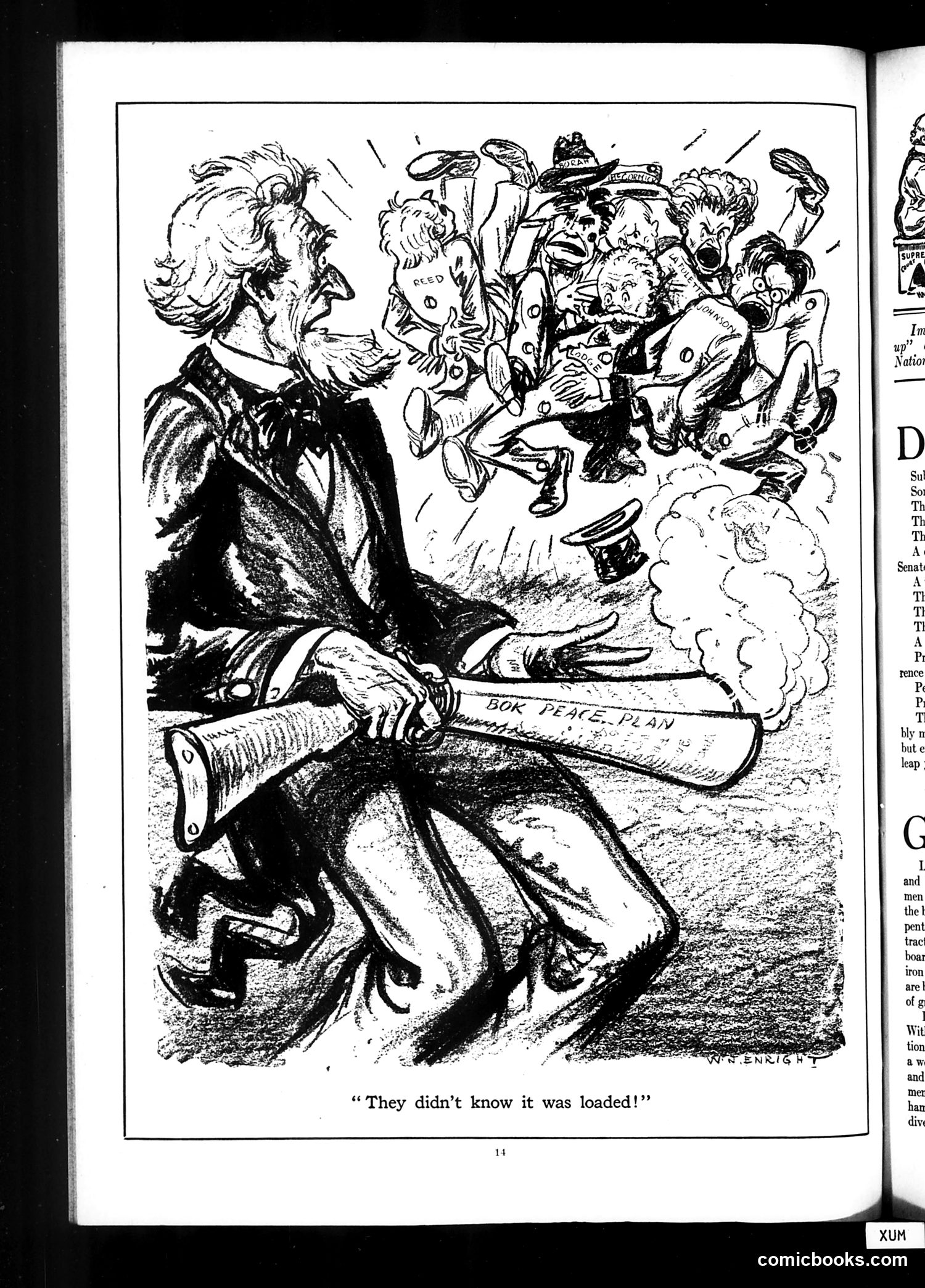
This cartoon depicts a figure (appearing to be a politician or public official based on his formal dress and prominent position) holding a rolled document labeled "BOK PEACE-PLAN" while surrounded by chaotic figures in the background. The caption "They didn't know it was loaded!" suggests a deliberate deception—the "peace plan" document appears innocuous but contains hidden consequences or controversial provisions that those affected weren't aware of. The cartoon satirizes a peace proposal (likely from the early 20th century, given Judge magazine's era) by implying its creator knowingly concealed problematic elements within what was presented as a straightforward peace initiative. The surrounding figures' distressed reactions emphasize the unintended or hidden impact of this supposedly benign proposal.
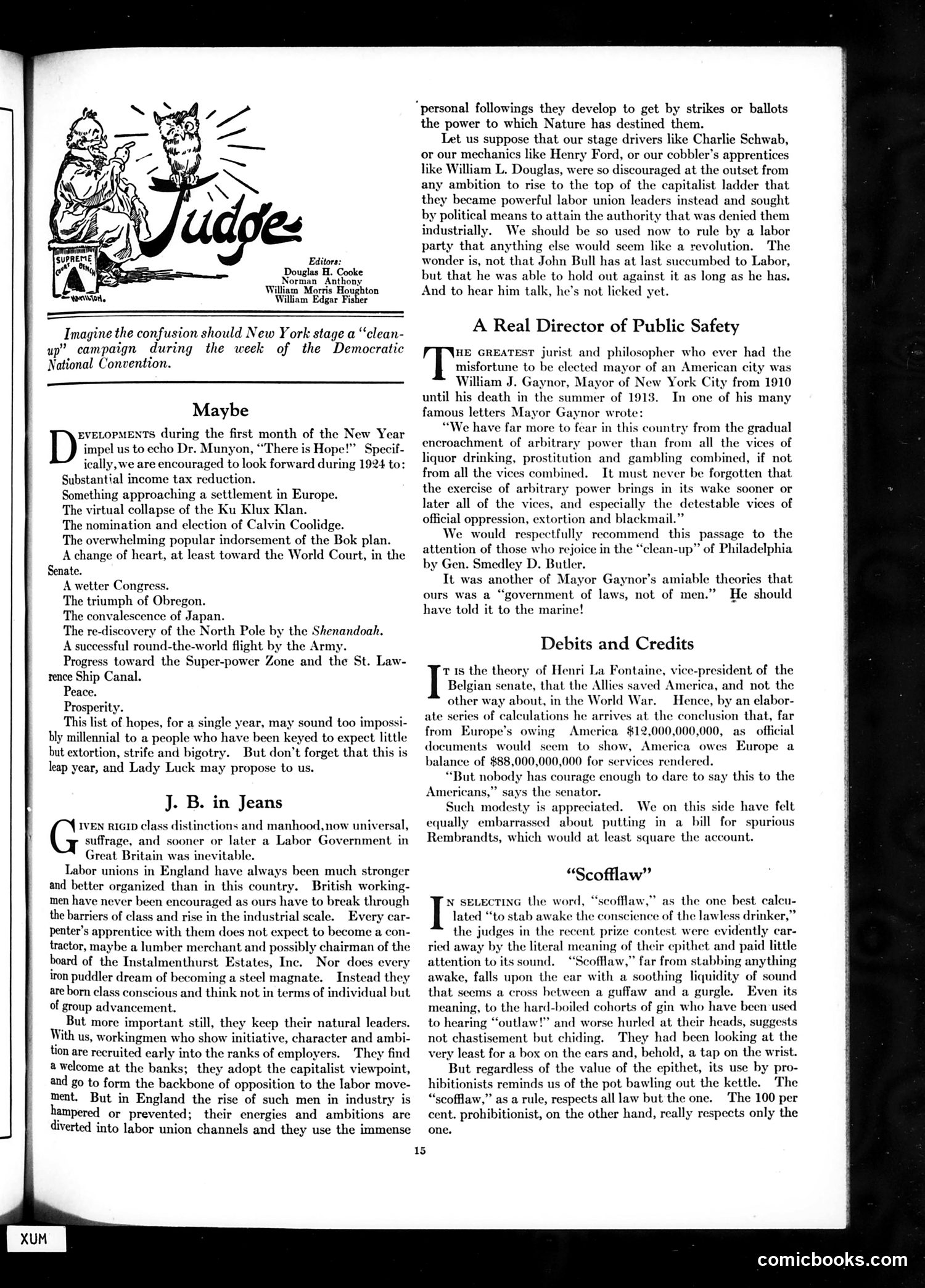
**The Cartoon ("Judge"):** The masthead illustration shows a judge figure holding what appears to be a cat or similar creature, with radiating lines suggesting emphasis or surprise. The caption jokes that New York's Democratic National Convention cleanup campaign would create "confusion"—satirizing the gap between the city's actual conditions and its aspirations to appear respectable during a major political event. **Content Overview:** This 1924 Judge page mixes political commentary with humor. A section titled "Maybe" lists optimistic hopes for 1924 (income tax reduction, Klan collapse, Calvin Coolidge's election, peace, prosperity)—presented with gentle irony about whether such millenial expectations could realistically occur, especially in a leap year. **Major Article:** "A Real Director of Public Safety" praises William J. Gaynor, New York's mayor (1910-1913), as a jurist and philosopher who warned against "gradual encroachment of arbitrary power" in America—contrasting his leadership with concerns about authoritarian governance. **Labor Commentary:** "J.B. in Jeans" discusses why British workers more readily organized into labor unions than Americans, suggesting American workers' belief in upward mobility prevented class solidarity.
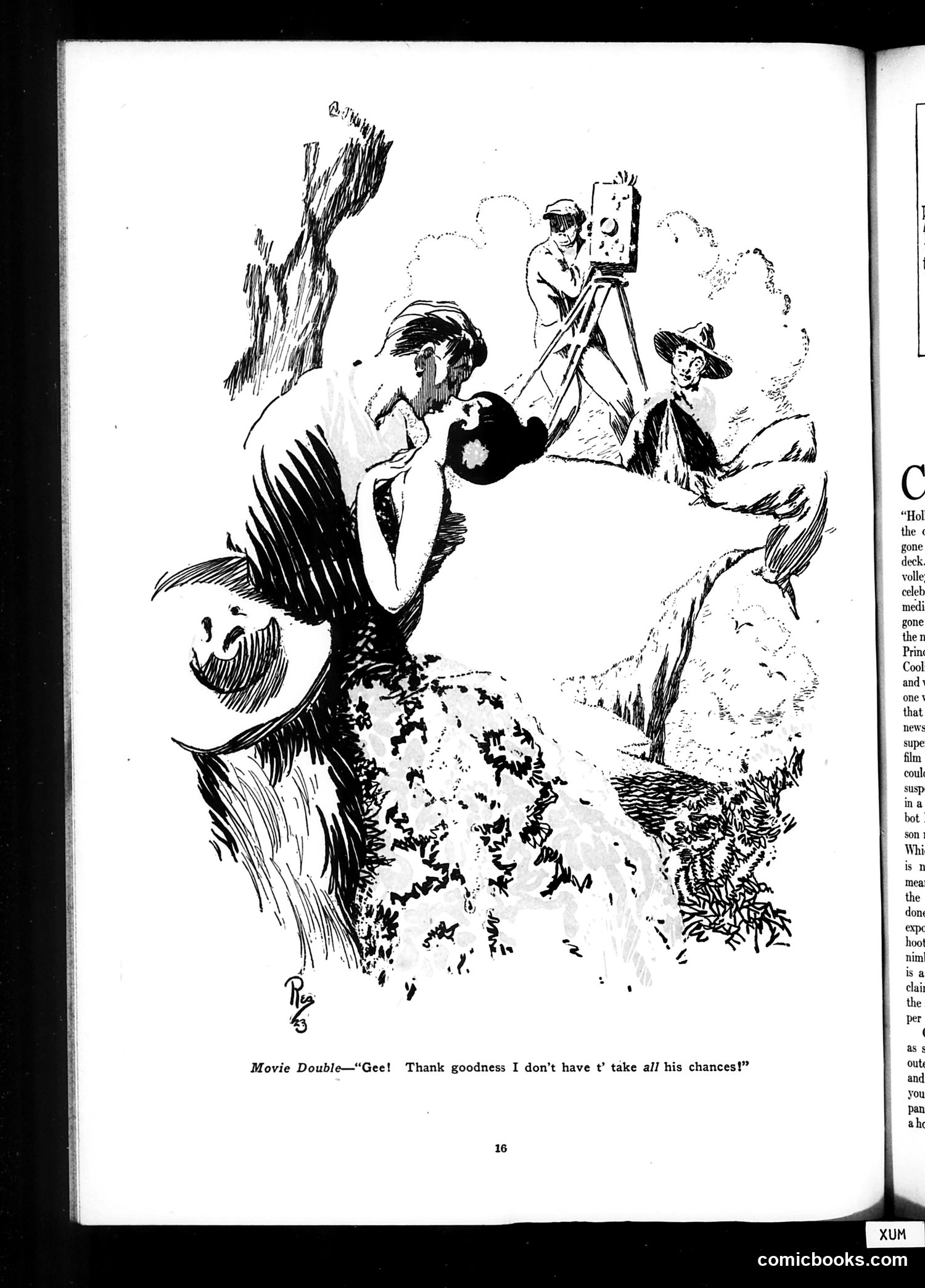
This is a satirical cartoon about Hollywood film stunt doubles. The illustration shows a glamorous woman in an elegant dress observing two men on a film set—one operating a movie camera on a tripod, and another (the stunt double) performing a dangerous action near a cliff edge. The joke critiques the disparity between movie stars and their replacements: the star (represented by the fashionable woman) avoids physical risks while the stunt double performs dangerous scenes. Her relief—"Thank goodness I don't have to take all his chances"—mocks the star's cushy position, highlighting the stark contrast between a performer's glamorous public image and the hidden labor and danger performed by anonymous doubles. This reflects early 20th-century Hollywood's exploitation of stunt workers.
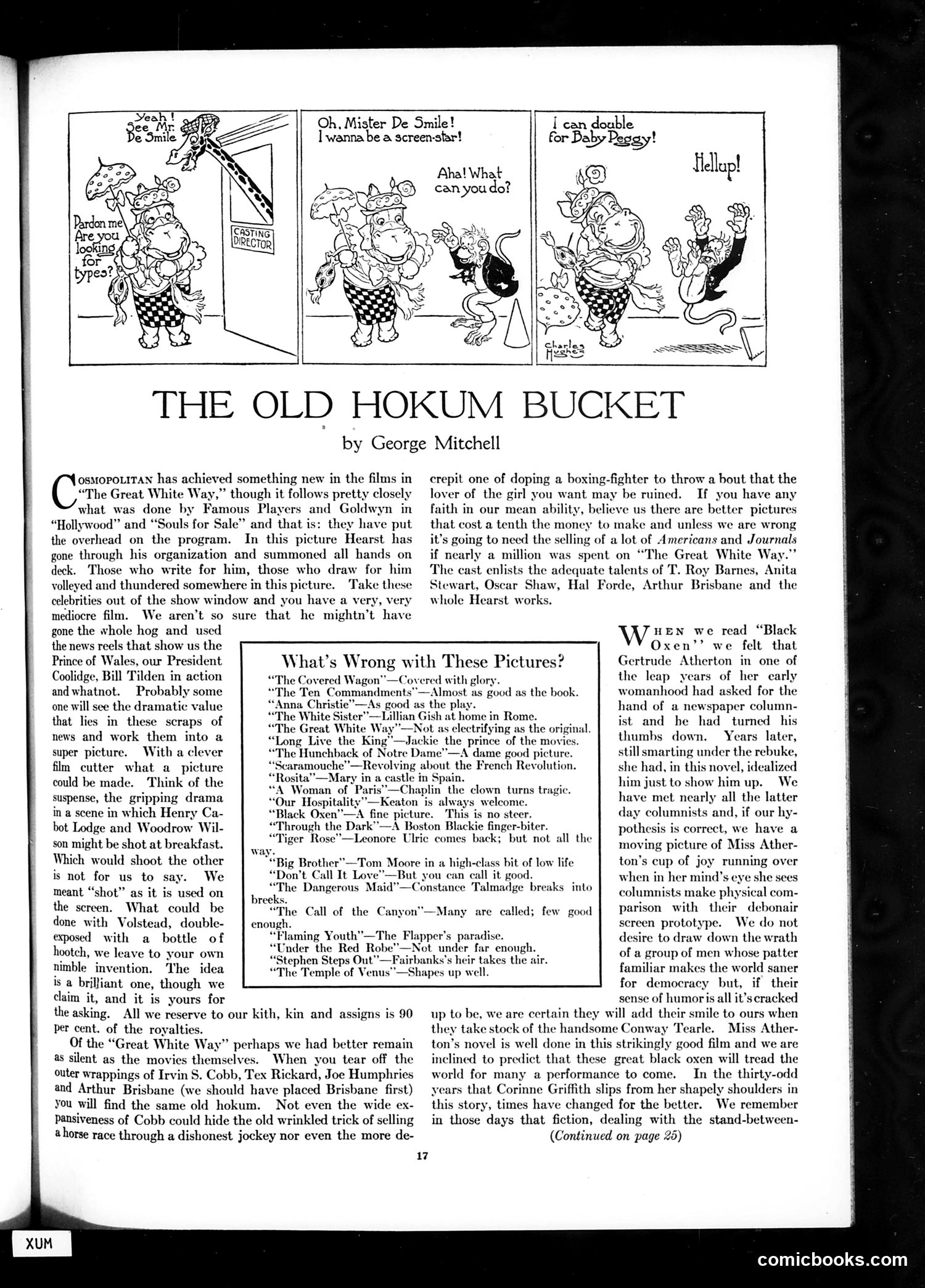
This page from *Judge* magazine contains a three-panel comic strip satirizing Hollywood filmmaking, followed by a film criticism article. **The Comic Strip ("The Old Hokum Bucket"):** A character named "Mr. De Smile" auditions aspiring screen actors. One claims to want to be a "screen-star" like child star Baby Peggy; another offers to "double for Baby Peggy." The joke mocks how Hollywood opportunistically capitalized on established stars' popularity, with aspiring actors trading on others' names rather than developing genuine talent. **The Article:** Critic George Mitchell attacks *Cosmopolitan* magazine's film "The Great White Way" for relying on celebrity names (William Randolph Hearst's organization, columnist Arthur Brisbane, sports figures) rather than quality storytelling. The accompanying box lists contemporary films with pun-based critiques, mocking formulaic Hollywood productions. Mitchell argues these films are mediocre "hokum"—superficial entertainment dressed up with celebrity prestige rather than substantive content. The satire targets 1920s Hollywood's shallow celebrity-driven marketing practices.
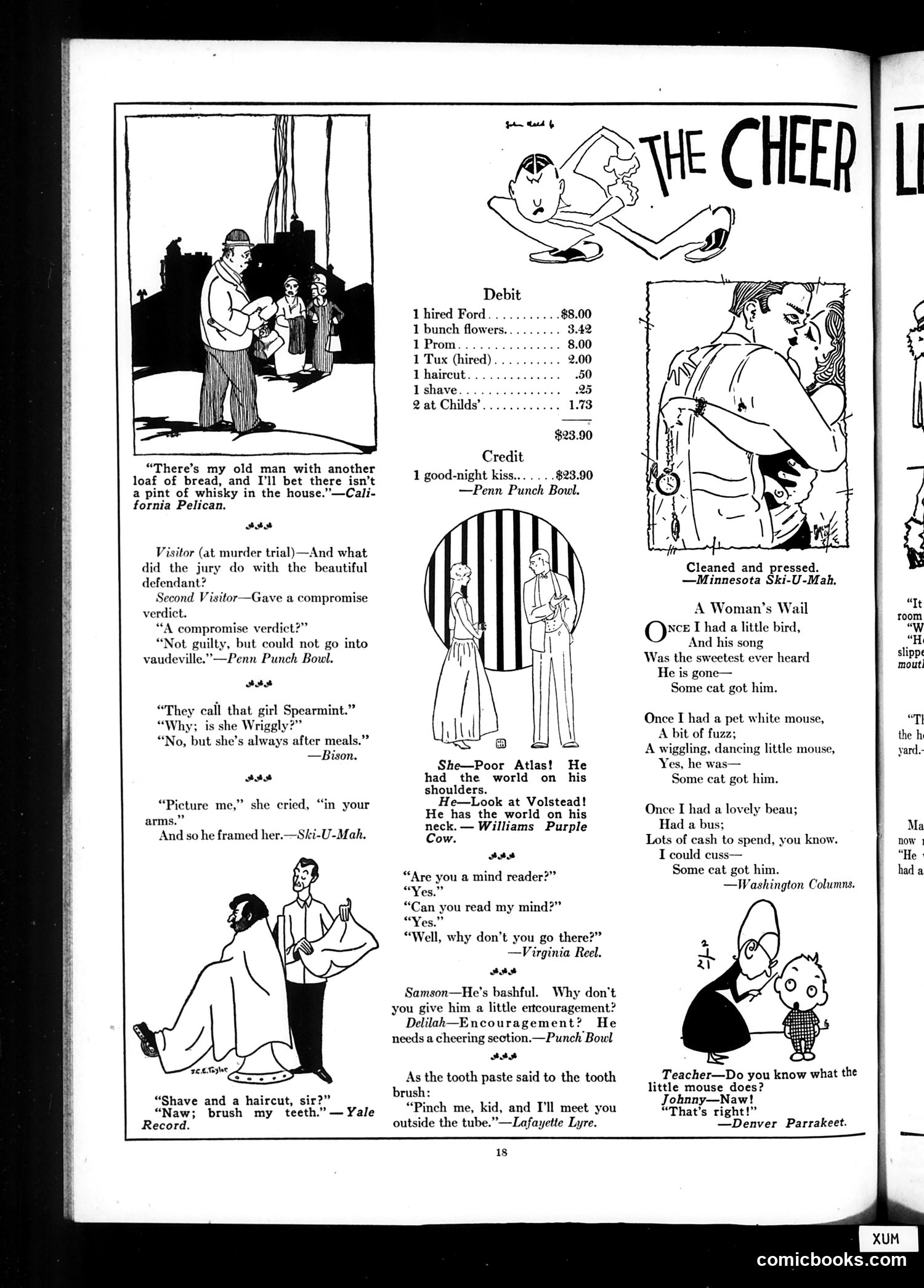
This is a humor page from an early-20th-century college/satirical magazine featuring short jokes and cartoons. The content includes: **Social humor**: Jokes about dating expenses ("Debit/Credit" sketch showing a prom costing $23.90, offset by a $23.90 "good-night kiss"), gender stereotypes ("Spearmint" girl always seeking meals), and courtship dynamics. **Prohibition-era reference**: The "Volstead" joke references the Volstead Act (Prohibition), with Atlas carrying "the world on his neck"—suggesting the burden of alcohol prohibition on society. **Literary allusion**: A Samson/Delilah joke plays on the biblical seduction story, with modern twist about needing "encouragement." **Miscellaneous wordplay**: Puns about framing a girl, brushing teeth instead of shaving, and toothpaste innuendo. The page reflects 1920s college life: dating culture, Prohibition, and innocent romantic comedy typical of campus publications.
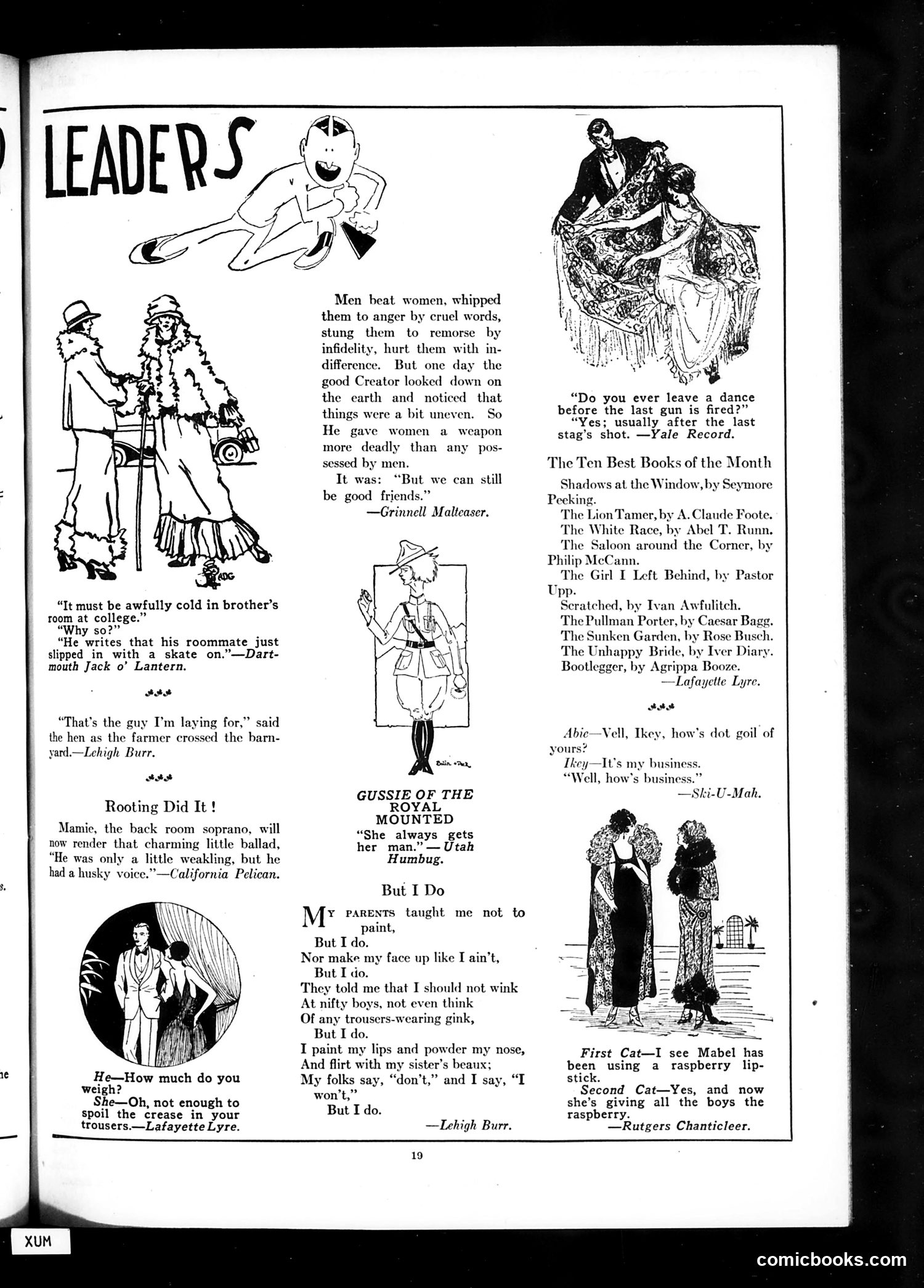
This Judge magazine page (likely early 20th century) collects humorous quotes and cartoons from college humor publications. The satire targets social conventions of the era: **Main themes:** 1. **Gender dynamics**: A Grinnell quote mocks men's mistreatment of women, suggesting their "weapon" is emotional manipulation—the friendship line that keeps men hoping. 2. **Youth rebellion**: "But I Do" catalogs young women defying parental rules about makeup, flirting, and behavior—common 1920s anxieties about "modern girls" abandoning propriety. 3. **College humor**: Scattered jokes about roommates, dances, and dating reflect student life concerns (cold dorms, leaving parties early to avoid being a "stag"). 4. **Ethnic humor**: The "Abie/Ikey" dialogue uses Yiddish-inflected speech—period-typical stereotyping. The page mainly reprints college newspaper humor rather than original Judge content, reflecting the magazine's role curating youth culture commentary.
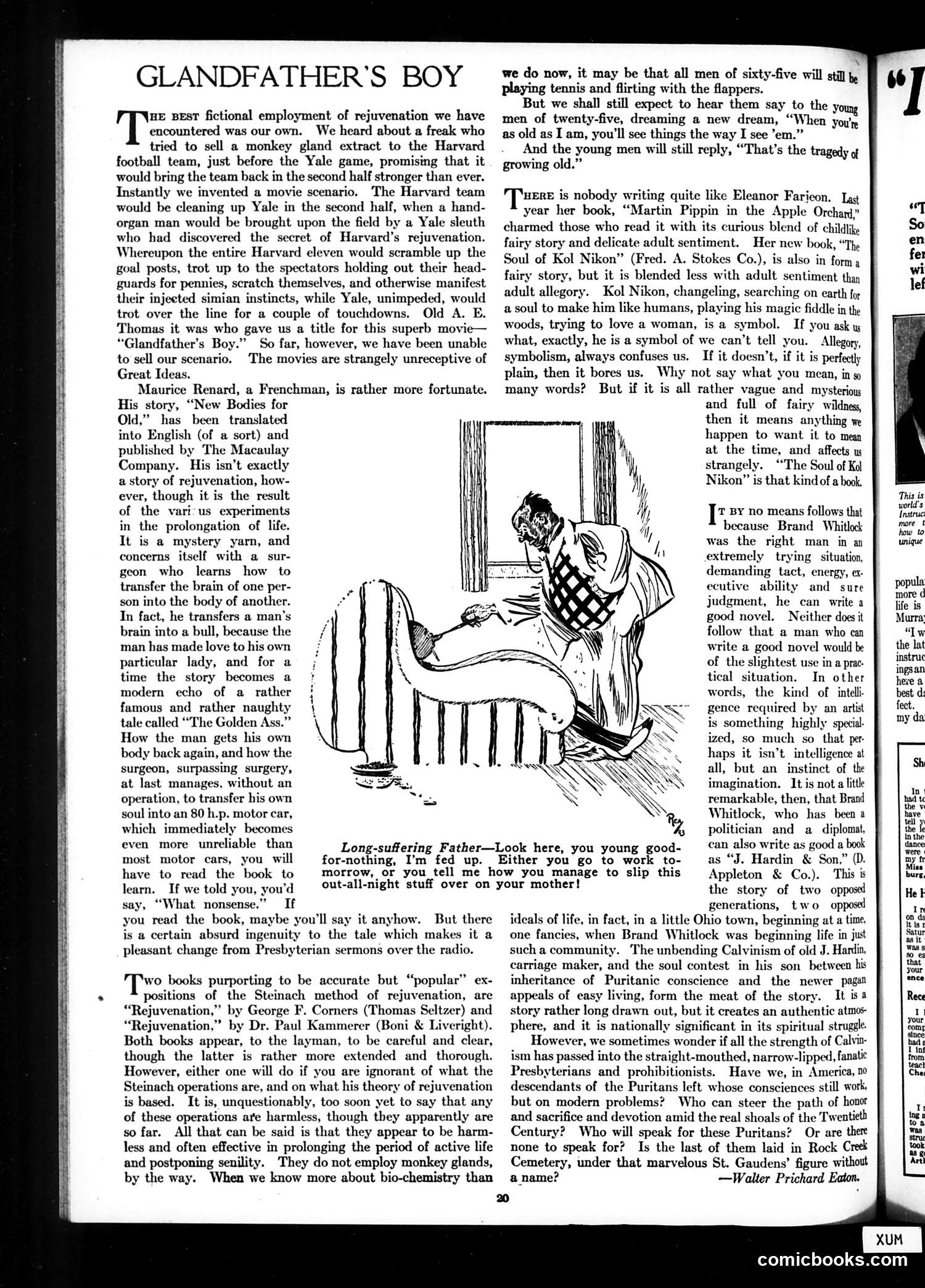
This satirical article mocks the 1920s craze for rejuvenation treatments, particularly the "Steinach method" involving gland operations. The piece opens with a joke about selling monkey gland extract to Harvard's football team before a Yale game, suggesting the absurdity of such claims. The main target is Maurice Renard's French novel "New Bodies for Old," which concerns a surgeon transferring human brains into different bodies—including a bull. Judge ridicules both the fictional premise and contemporary pseudo-scientific rejuvenation theories as nonsensical. The accompanying cartoon depicts an aging father confronting his young son about sneaking out at night, humorously linking youthful behavior to the era's obsession with staying young. The satire suggests that no gland treatment will stop people from aging mentally or behaviorally—young men will always think old men are out of touch, regardless of biological interventions. The piece mocks both popular fiction and the era's gullible embrace of dubious medical "advances."
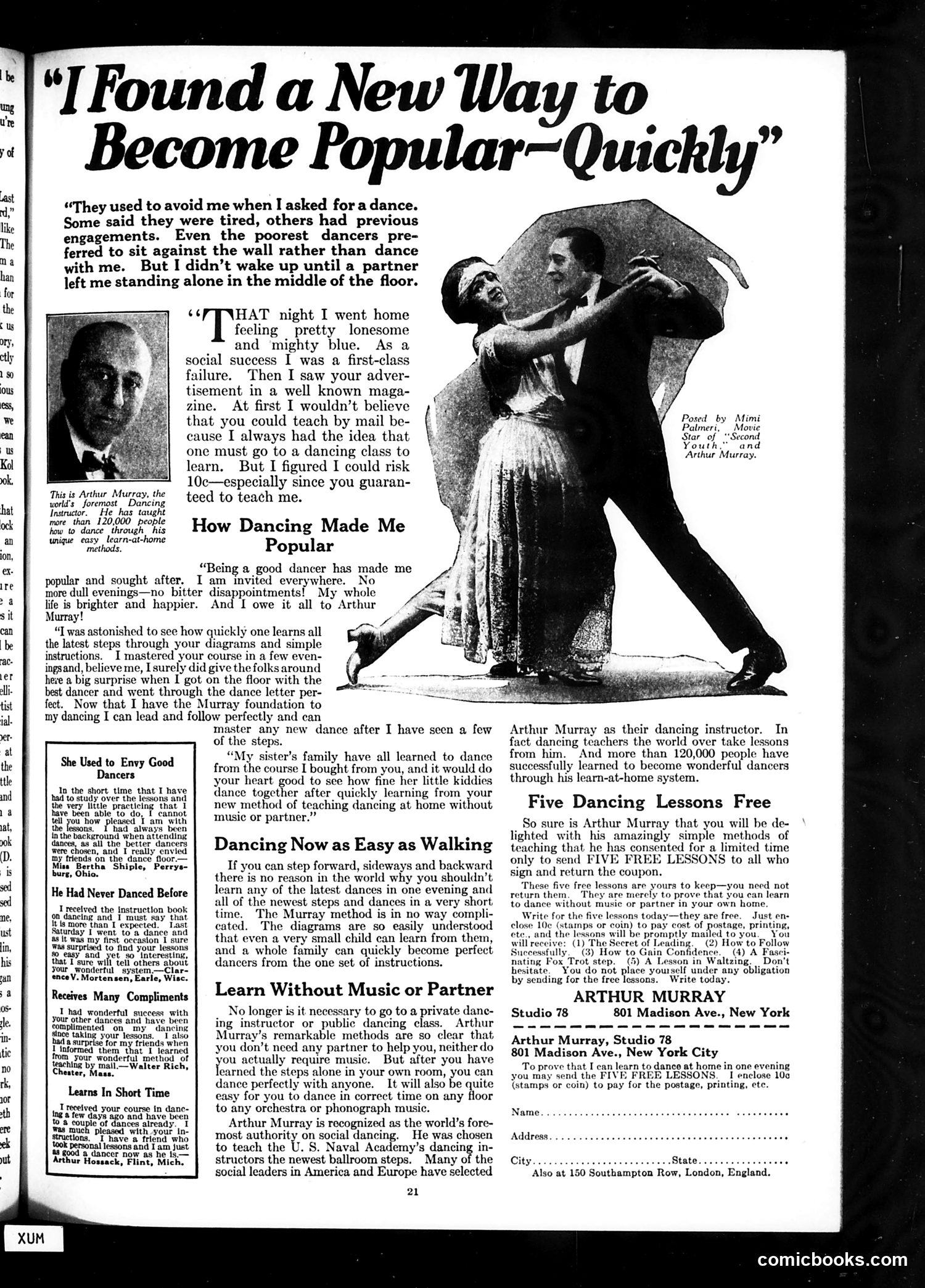
This is primarily an **advertisement**, not satirical content. It features Arthur Murray, a real dance instructor, promoting his mail-order dancing lessons through testimonials claiming they make people socially popular. The page shows Murray as a dancing instructor teaching a female student. The testimonials—from people claiming they were once unpopular—assert that learning to dance "quickly" transformed their social lives. The humor is gentle and self-promotional rather than satirical: the implied joke is that dancing ability directly correlates with social acceptance and romantic success. The ad emphasizes Murray's "simple" diagram-based method requires no partner or music, and offers five free lessons to interested readers. This represents early 20th-century consumer culture marketing, positioning dance lessons as a commodity solution to social insecurity.
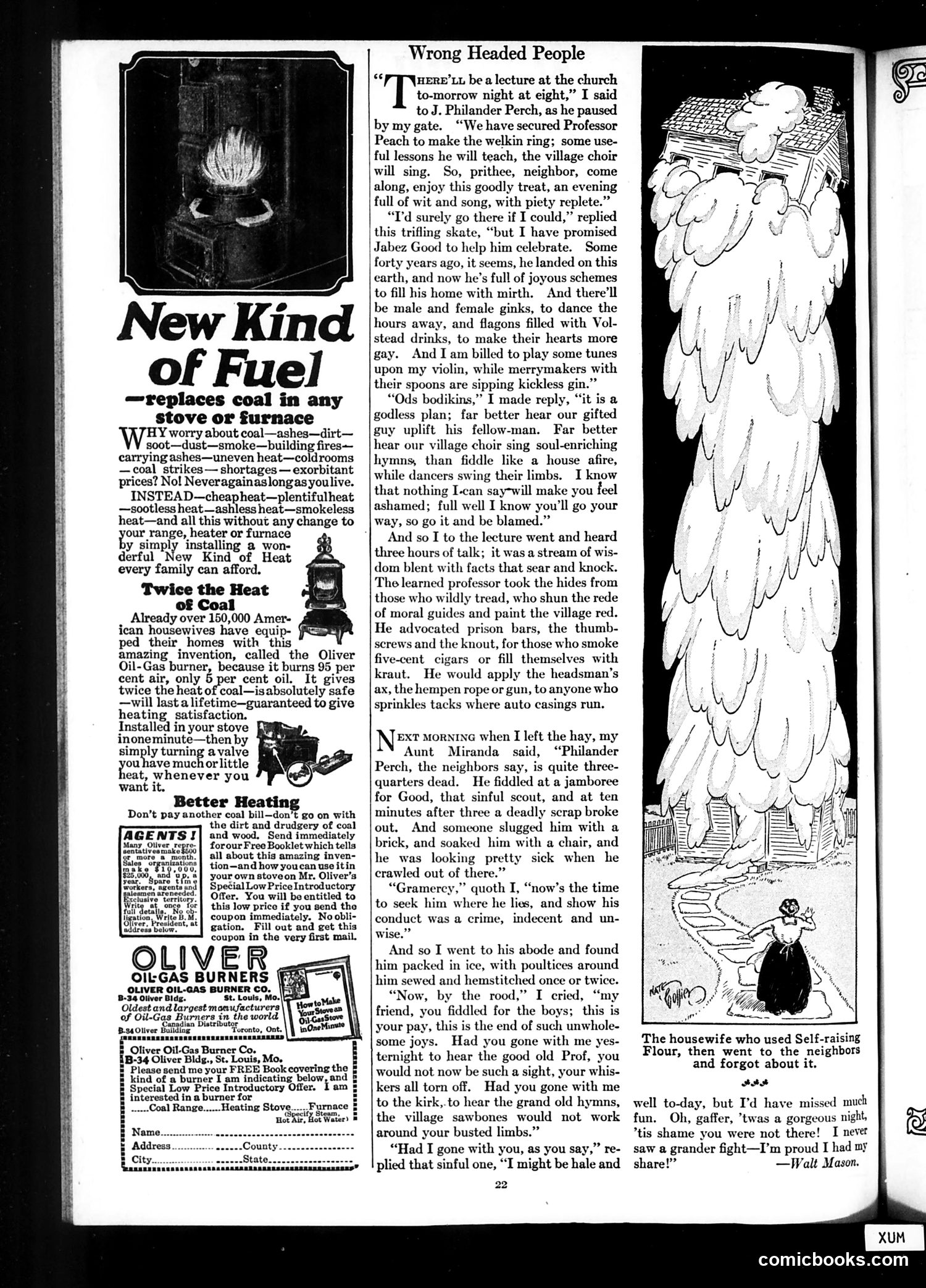
This page combines advertising with satirical commentary on Prohibition-era morality. **The Advertisement:** The Oliver Oil-Gas Burner dominates the left side, promoting a fuel alternative to coal during what appears to be an energy/fuel crisis period (likely post-WWI). **The Satire ("Wrong Headed People"):** The story mocks self-righteous moral crusaders. A pious narrator invites J. Philander Perch to a church lecture by "Professor Peach," but Perch chooses to celebrate a friend's birthday instead—complete with dancing, "Volstead drinks" (alcohol, illegal under Prohibition), and violin music. The narrator's response is dripping with sanctimony, lecturing Perch about moral duty. However, the joke turns: the professor's actual lecture advocates *extreme* violence (execution, thumbscrews) against minor offenders—smokers, beer drinkers, and even those who leave tacks on roads. **The Point:** The satire exposes hypocrisy: the "godless" celebration of friendship and joy is presented as morally superior to the professorial crusader's violent authoritarianism. The cartoon critiques Prohibition-era moral panic and its advocates' disproportionate punishments.

This is **not satire or a cartoon**—it's a **straightforward advertisement** for chiropractic medicine, placed in *Judge* magazine. The page promotes chiropractic as a legitimate health profession, claiming it grew from a single founder's idea in 1905 to the "second largest health profession" with 25,000 practitioners and state government recognition. The advertisement emphasizes chiropractic's success **despite** opposition from established medical professions and unfavorable laws, framing this as proof of merit rather than a sign of questionable practice. The definition box explains the basic principle: spinal adjustment to restore nerve function. This reflects the historical period (likely 1920s) when chiropractic was still fighting for legitimacy against medical establishment resistance. The ad's defensive tone—stressing independent growth without government funding and success among patients "other methods failed"—reveals the profession was still considered controversial by mainstream medicine, even as it gained state recognition.
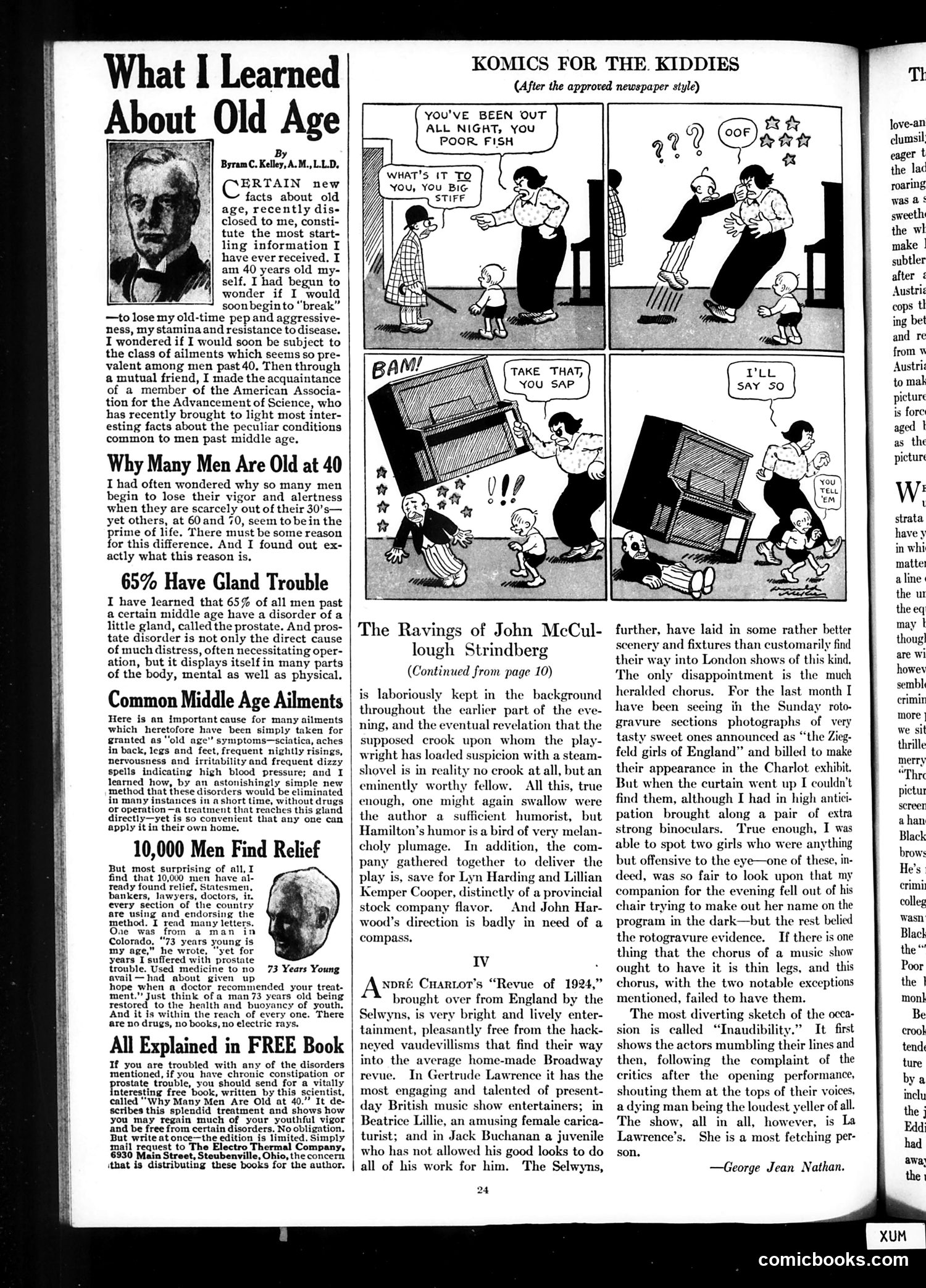
This comic strip parodies the crude, violent style of early newspaper comics. The three panels show an adult man brutally beating small children with a stick or club—depicted matter-of-factly as humor. The satire targets how newspapers presented comics as "wholesome entertainment for children" while actually depicting slapstick violence. The subtitle "(After the approved newspaper style)" makes explicit the critique: major papers were publishing violent, crude content and calling it appropriate for kids. The dialogue—"You've been out all night, you poor fish" and "What's it to you, you big stiff?"—uses lowbrow slang typical of the era's newspaper comics. The strip shows an adult disciplining children through physical assault, reflecting early-20th-century attitudes toward corporal punishment, which Judge appears to be mocking as absurdly inappropriate entertainment. This is social satire about media standards and acceptable content for children's publications.
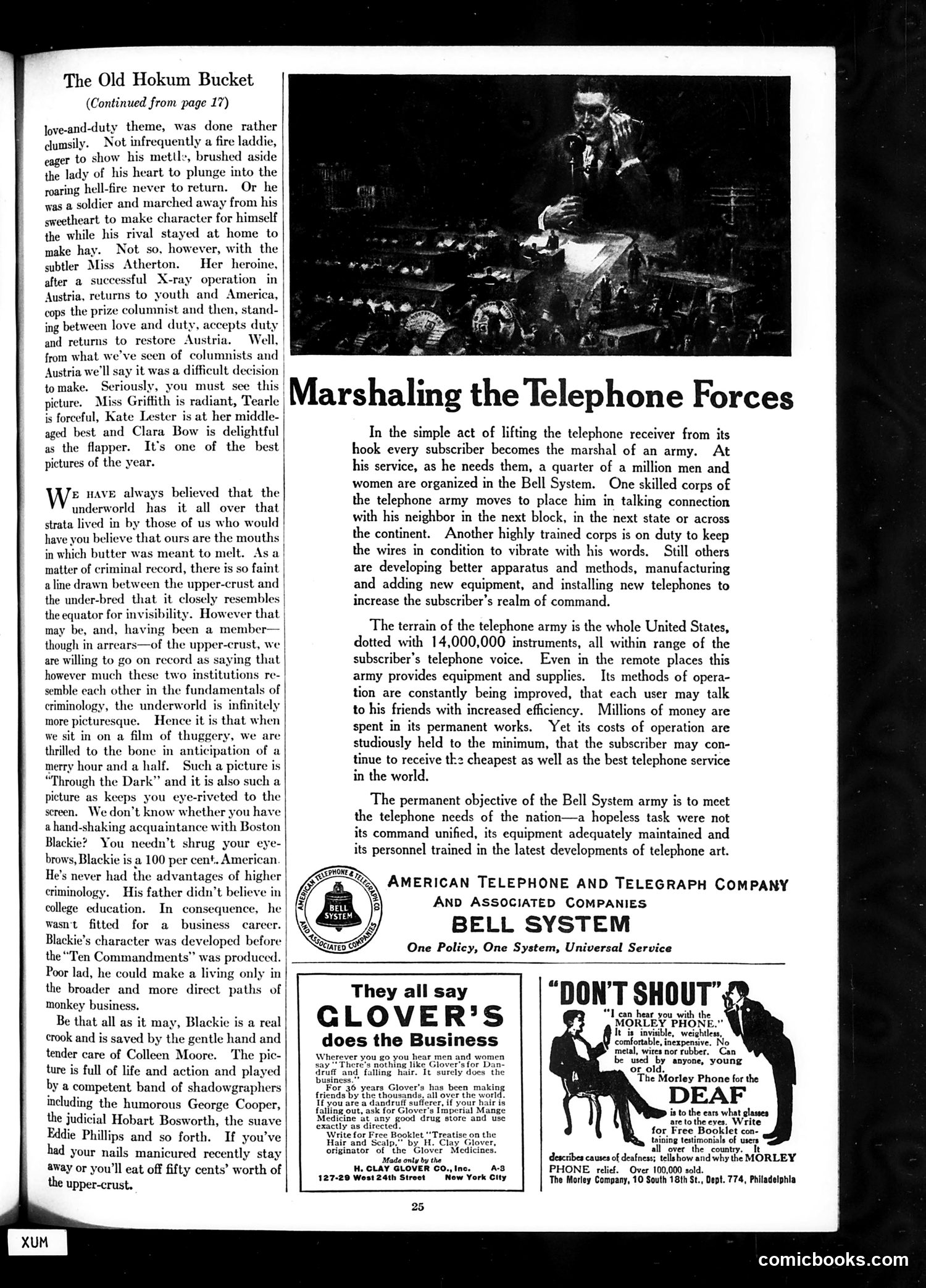
This page is primarily **advertising and film reviews** rather than political satire. The main content includes: 1. **Film reviews** ("The Old Hokum Bucket"): Judge's critic discusses movies featuring actors like Clara Bow and Colleen Moore, praising dramatic plots about duty versus romance and crime melodramas. 2. **Bell System advertisement**: The large illustrated section celebrates telephone infrastructure as a disciplined "army" of 250,000 workers serving 14 million instruments nationwide. It's corporate propaganda positioning the Bell monopoly as an essential national service. 3. **Lower advertisements**: For Glover's products and the Morley Phone for deaf users. The tone is lighthearted consumer commentary mixed with corporate boosterism—typical of 1920s Judge magazine. There's no identifiable political cartoon or satire on this particular page. The "satire" is implied only in the film review's gentle mockery of melodramatic movie conventions, not in any partisan critique.
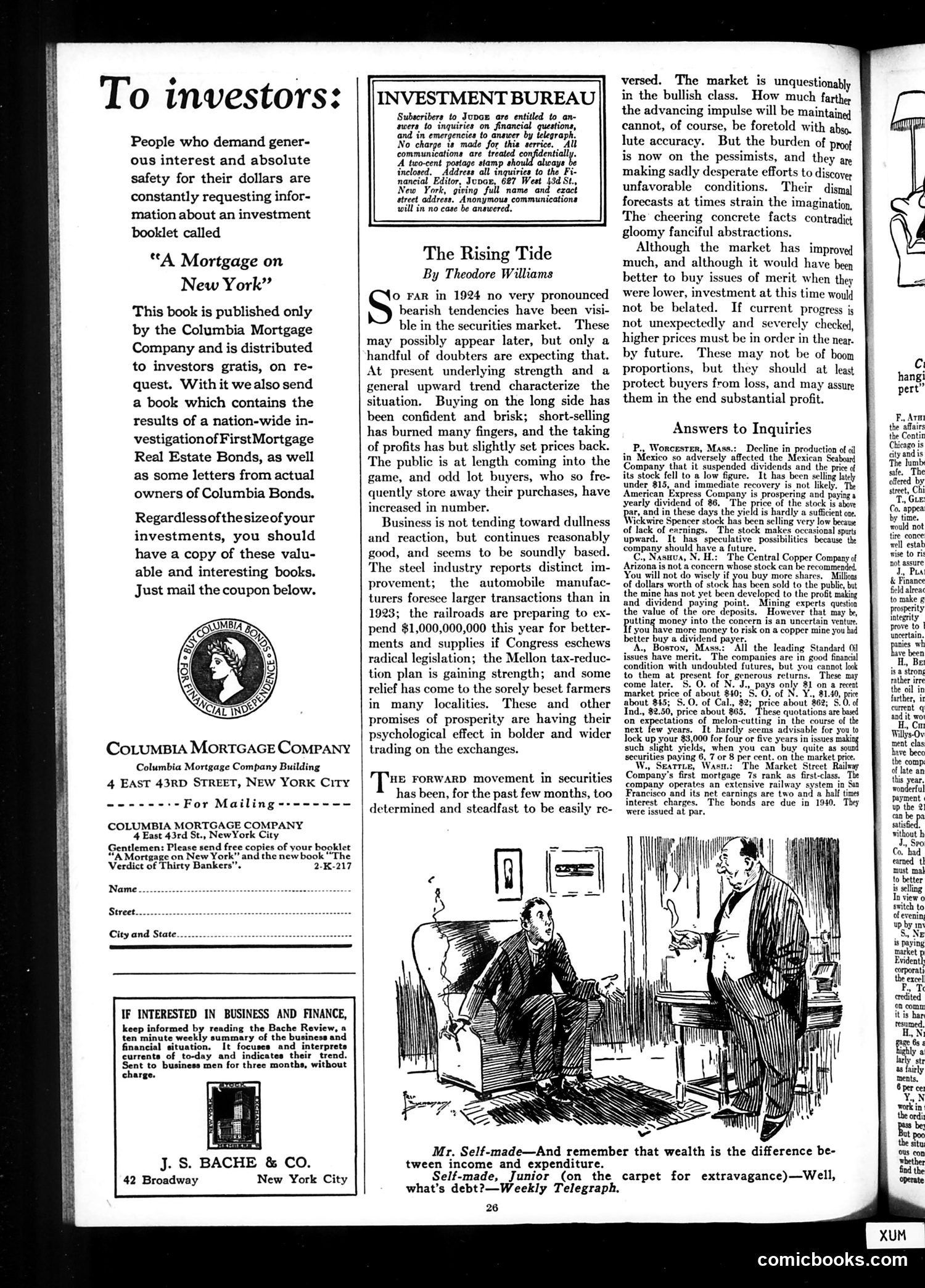
This page is primarily **advertising and financial content** rather than editorial cartoons. The main satire appears in the single cartoon at bottom: a businessman sits at his desk while another man enters, and the caption reads: "Mr. Self-made—And remember that wealth is the difference between income and expenditure. Self-made, Junior (on the carpet for extravagance)—Well, what's debt?" The joke satirizes the **hypocrisy of "self-made" wealth**—a father lectures his son about financial discipline while the son has accumulated debt, undercutting the father's claims of superior wisdom or virtue. This critiques the era's veneration of self-made millionaires. The rest of the page contains investment advertisements and an article titled "The Rising Tide" by Theodore Williams discussing **1924 stock market optimism**, reflecting the prosperous pre-1929 economic climate. The advertisements promote financial products and investment services.
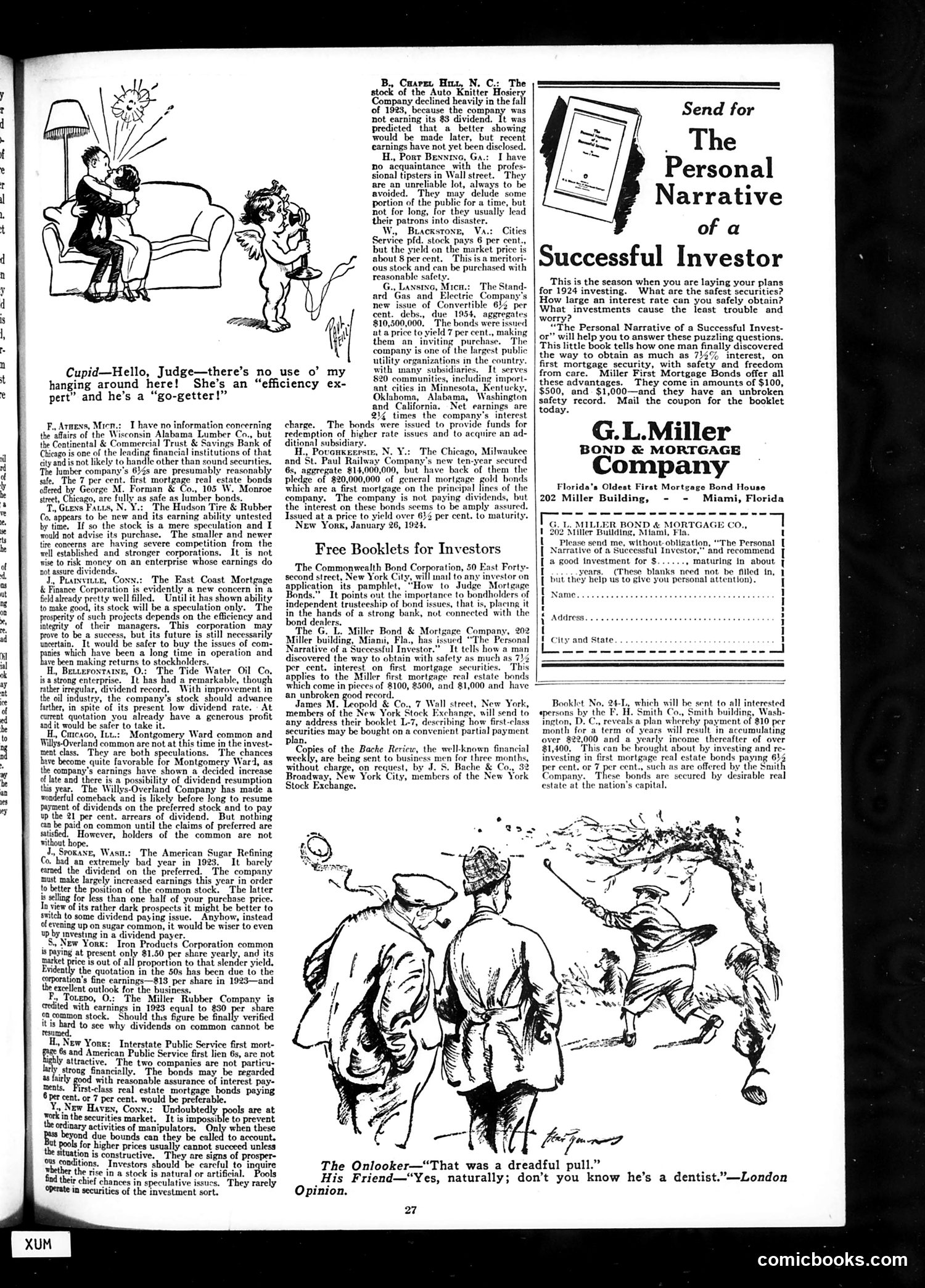
This page contains investment advice columns and satirical cartoons about 1920s financial speculation. **The Top Cartoon:** A couple sits on a couch with Cupid. The woman complains her husband is useless—he hangs around doing nothing while she's an "efficiency expert" and he's merely a "go-getter." The satire mocks the era's obsession with corporate jargon ("efficiency expert," "go-getter") applied to marriage, suggesting these business buzzwords had become absurdly ubiquitous and meaningless in everyday life. **The Page Content:** The bulk is financial advice addressing readers' investment questions about stocks and bonds from companies like Hudson Tire, Montgomery Ward, and American Sugar Refining. This reflects the 1920s investment boom when ordinary Americans eagerly bought securities. **The Bottom Cartoon:** Two men pull a tooth labeled with a dentist's sign. One says extracting it was "a dreadful pull"—likely satirizing the painful process of getting investment advice or extracting money from uncertain stocks during market volatility. The page captures pre-1929 Crash optimism mixed with caution about speculation.
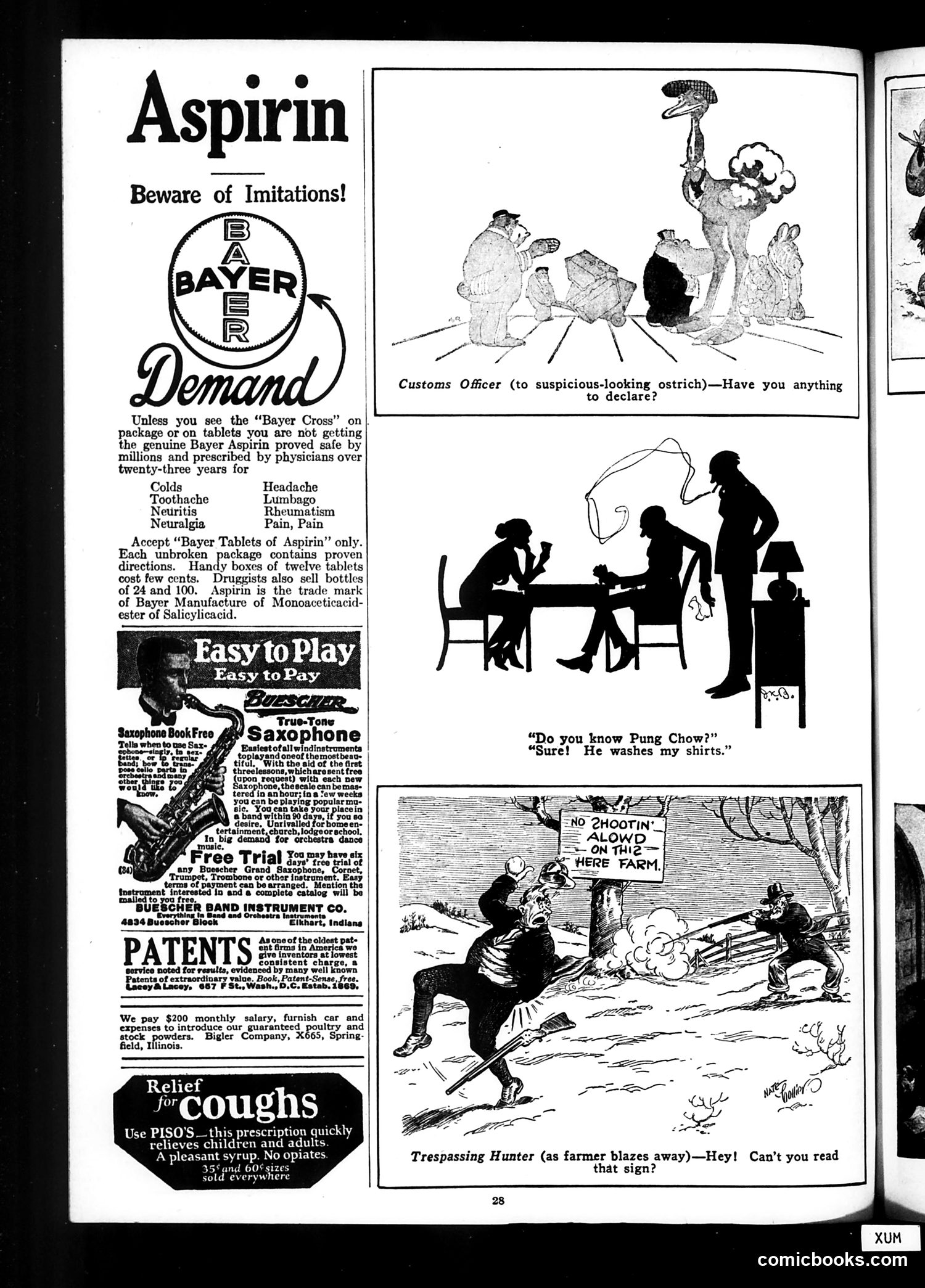
This page mixes **advertisements** (Aspirin, saxophone, patents, cough syrup) with **three humor cartoons**: 1. **Customs Officer & Ostrich**: A traveler attempting to smuggle contraband by disguising it as an exotic bird—a visual gag on customs evasion and the absurdity of smuggling attempts. 2. **"Do you know Pung Chow?"**: A domestic humor joke playing on the Chinese name sounding like English slang, with the punchline being the mundane reality that this person simply does laundry. 3. **Trespassing Hunter**: A farmer shoots at a hunter who claims ignorance of a "No Shooting" sign—satirizing careless hunters and rural disputes over hunting rights. The cartoons represent typical early 20th-century Judge humor: visual wordplay, ethnic comedy (now considered offensive), and rustic/domestic situational humor. The extensive advertising reflects the magazine's business model of selling commercial space alongside satirical content.
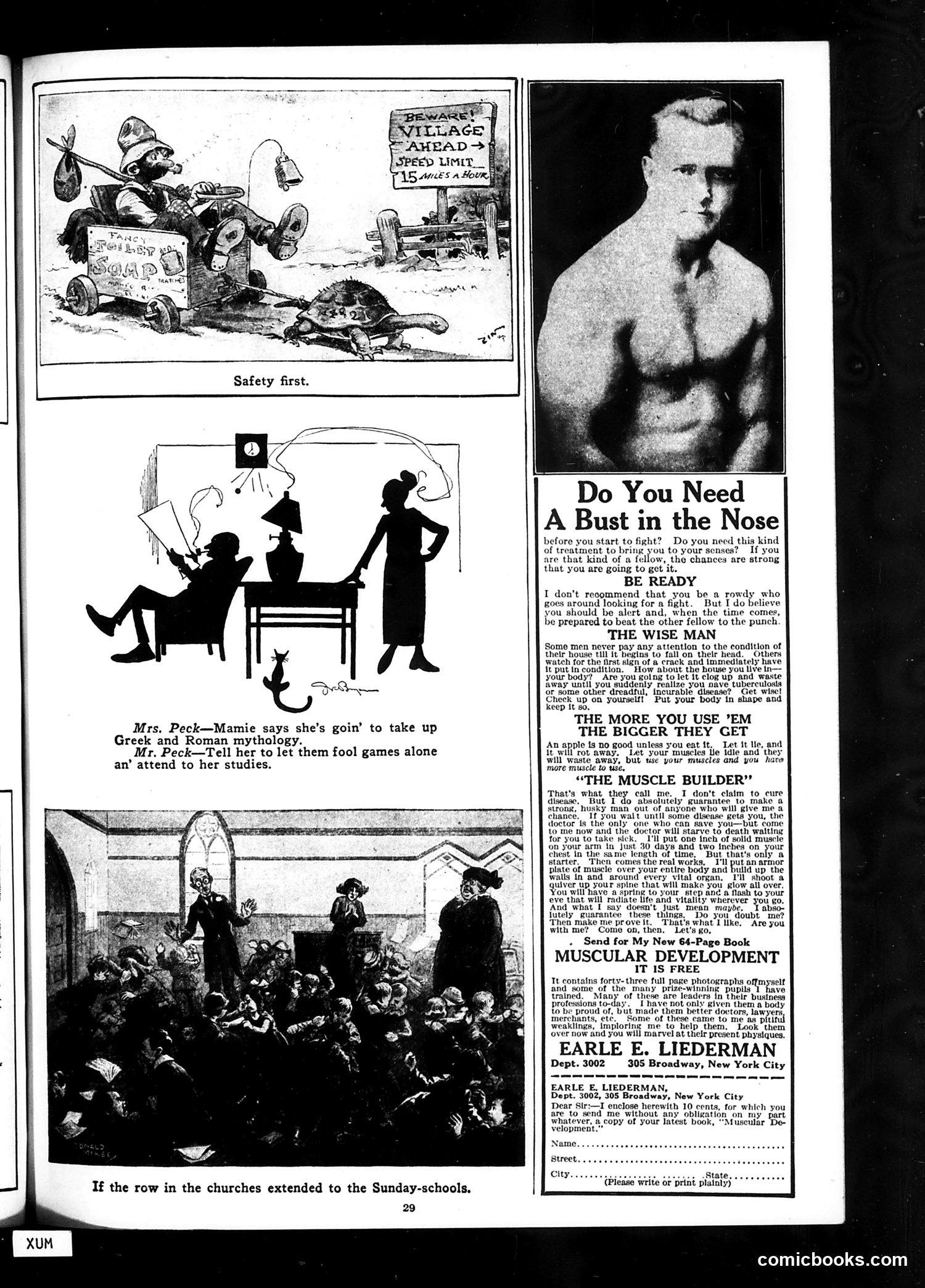
This page contains three unrelated items typical of early 20th-century magazines: **Top cartoons**: "Safety First" depicts a reckless driver in a toy car ignoring speed-limit warnings while nearly hitting a turtle—satirizing dangerous driving and public safety concerns. The middle cartoon mocks Roman/Greek mythology education as frivolous distraction from practical studies. **Bottom image**: Shows a crowded church congregation, captioned "If the row in the churches extended to the Sunday-schools"—likely referring to contemporary church disputes or scandals that the cartoonist suggests would cause chaos if extended to children's education. **Right side**: A full-page advertisement for Earle E. Liederman's muscle-building program, featuring a shirtless physique photo and promotional text. This represents the era's popular mail-order fitness schemes, promising dramatic physical transformation. The "free" 64-page book was a standard marketing tactic to generate leads. The page juxtaposes social satire with commercial appeals typical of Judge's mixed editorial-advertising format.
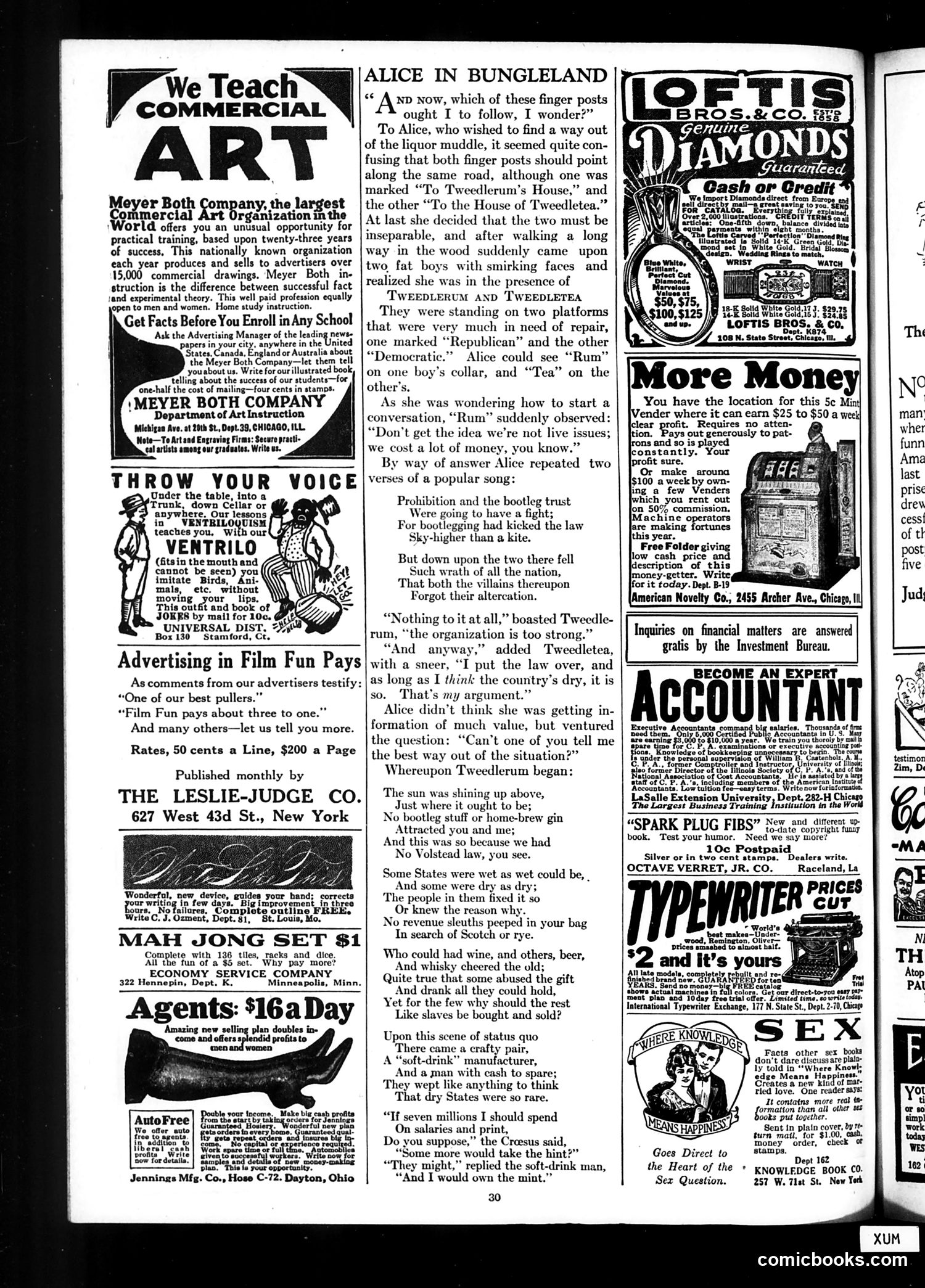
This is a Prohibition-era political cartoon using Lewis Carroll's *Alice in Wonderland* framework. "Alice" encounters two corrupt politicians—Tweedlerum ("Rum") and Tweedletea ("Tea")—representing Republican and Democratic parties respectively. The satire mocks both parties as equally complicit in failing Prohibition enforcement. Despite claiming the law works, they admit it "costs a lot of money" and reveal their corruption: Tweedletea boasts he personally decides whether the country is "dry" through his own authority, while Tweedlerum claims "the organization is too strong" to stop bootlegging. The poem's opening verse about "Prohibition and the bootleg trust" having a "fight" represents the satirist's cynical view that both parties merely performed theatrical opposition to organized crime while actually enabling it—hence the "smirking faces" and the finger posts pointing to identical destinations.
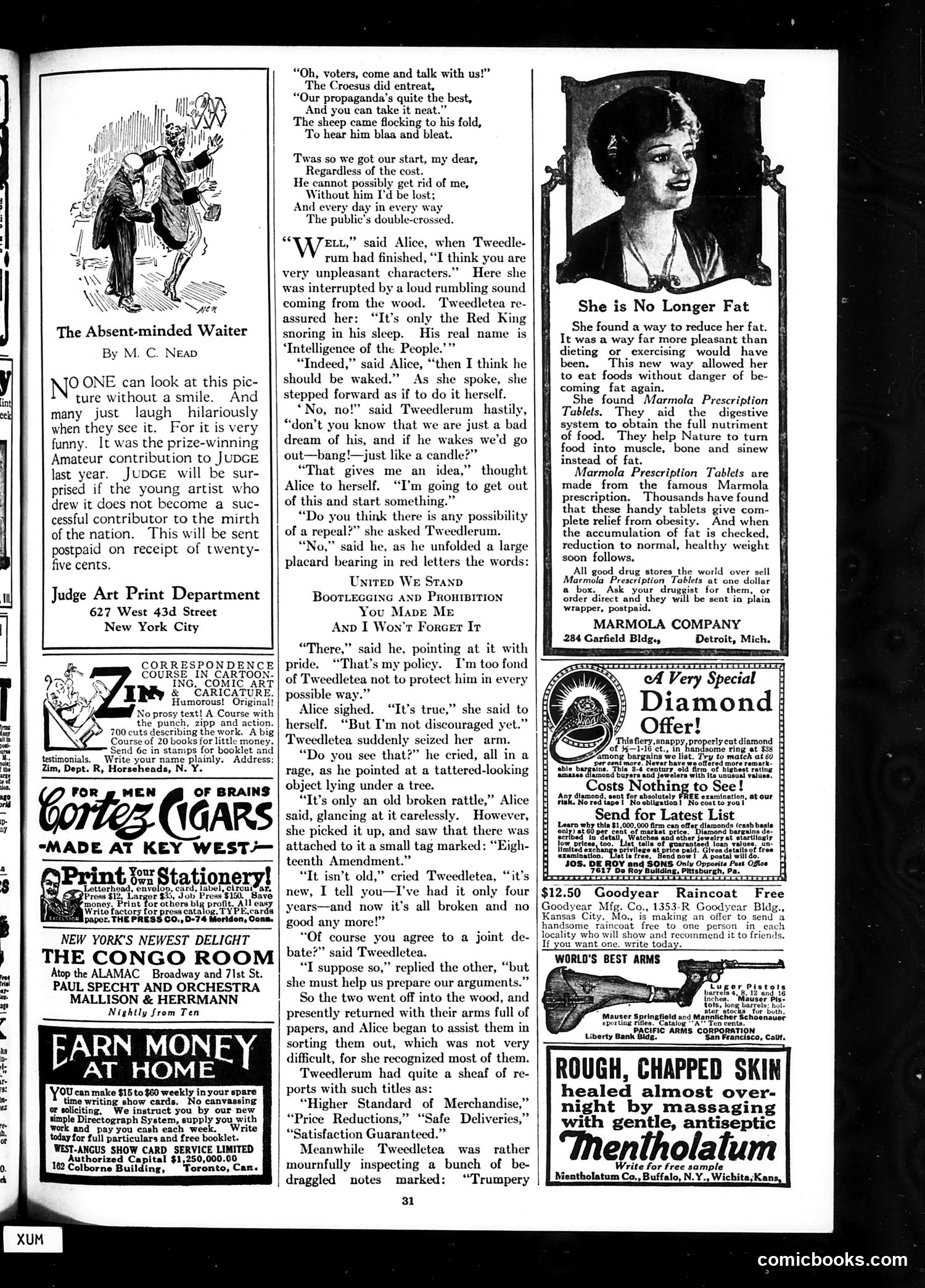
This page contains two distinct pieces: **Left cartoon:** "The Absent-minded Waiter" by M.C. Neabd is a prize-winning humorous drawing (details unclear from image quality) submitted to *Judge* magazine. **Right: Alice in Wonderland Prohibition Satire** dominates the page. Using Lewis Carroll characters, this political allegory mocks Prohibition enforcement. "Tweedledum" and "Tweedledee" represent corrupt politicians protecting bootleggers ("Tweedletea"). Alice discovers the Eighteenth Amendment—depicted as a broken, useless rattle only four years old—symbolizing Prohibition's failure. The "United We Stand" placard ironically represents their corrupt alliance. The satire suggests Prohibition (enacted 1920, making this roughly 1924) has become a tool for organized crime rather than public morality, with politicians complicit in its dysfunction. Alice's determination to "start something" hints at reform or resistance to this corrupt system.
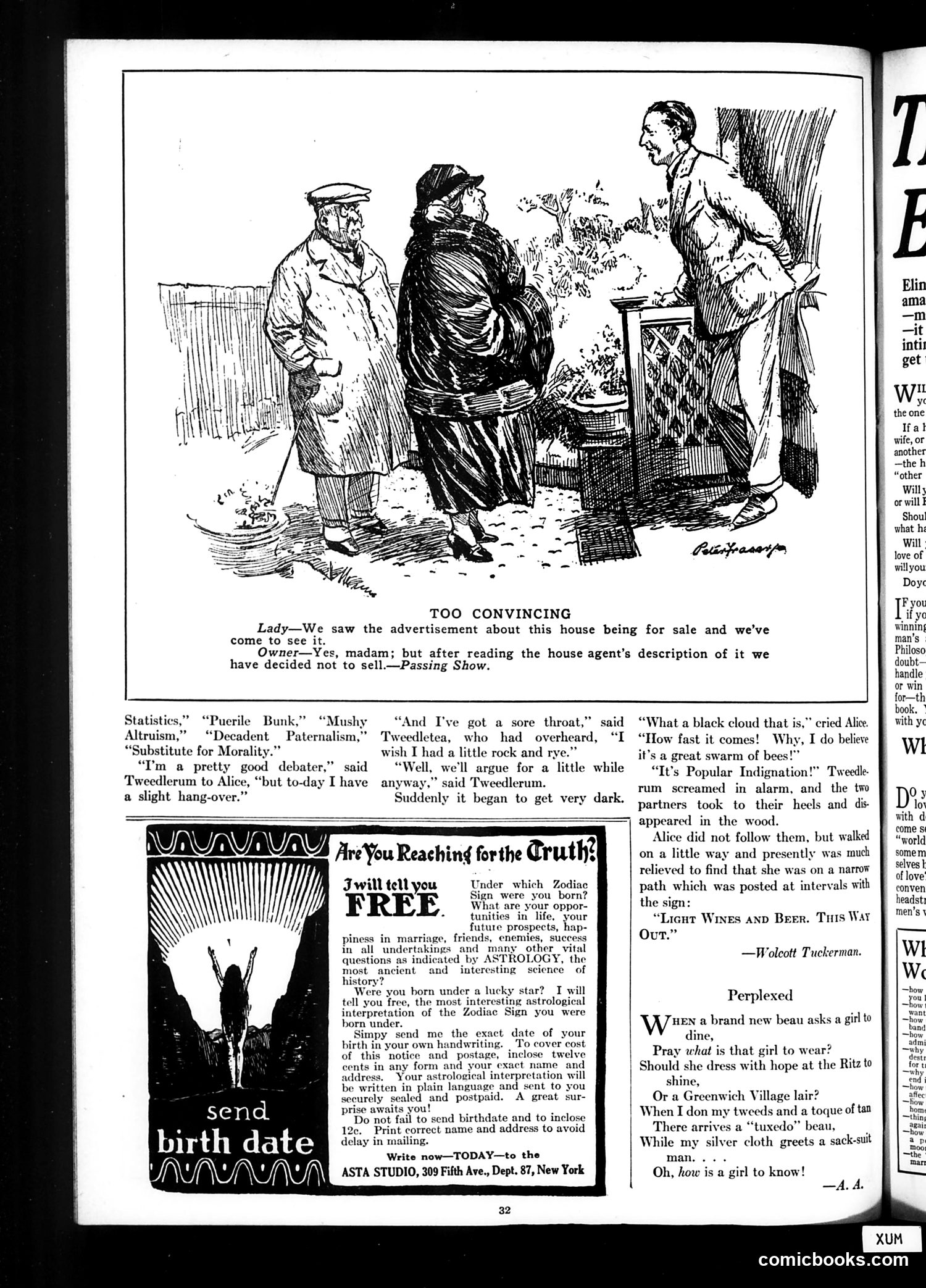
The main cartoon "Too Convincing" satirizes real estate advertising practices. A homeowner tells prospective buyers he's *withdrawn* his house from sale—not because he changed his mind, but because after reading the real estate agent's flowery advertisement describing the property, he and his wife decided they don't want to buy it themselves. The joke targets the gap between exaggerated marketing language and reality: the ad was so persuasively written it convinced even the owner the house wasn't worth selling. The page also includes whimsical text about "Tweedlerum" and "Tweedletea" (characters evoking Lewis Carroll's Tweedledee and Tweedledum), arguing while a storm approaches, which they interpret as "Popular Indignation"—likely satirizing contemporary political or social controversy through fantastical allegory. The remaining content includes ads and light verse, typical of Judge's mixed editorial/advertising format.
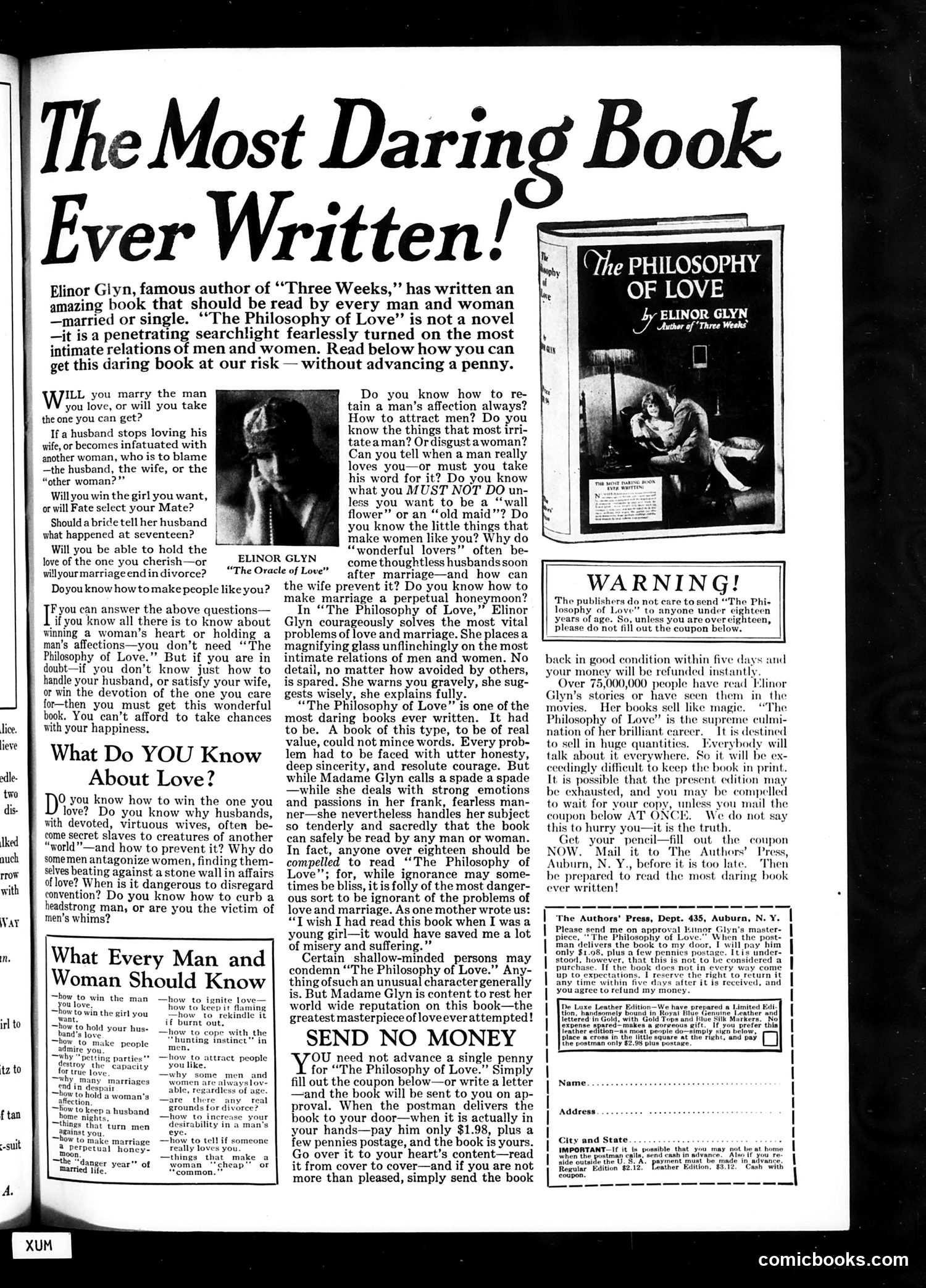
This is a full-page advertisement for Elinor Glyn's book "The Philosophy of Love," marketed as shockingly candid advice on relationships and marriage. Glyn, author of the notorious novel "Three Weeks," is presented as an authority on intimate matters between men and women. The ad employs sensationalism typical of early 20th-century marketing: phrases like "most daring book ever written" and lists of supposedly taboo questions (infidelity, premarital experience, divorce) to suggest the book addresses subjects polite society avoided. A warning box emphasizes the book's controversial nature, claiming it's "not to be considered a trifle" and recommending only adult readers. The approach capitalizes on public fascination with sexual candor during an era of rigid social conventions around courtship, marriage, and gender relations. The ad positions the book as practical wisdom for navigating modern romantic dilemmas—appeals designed to attract both married couples concerned about fidelity and single people seeking relationship advice.
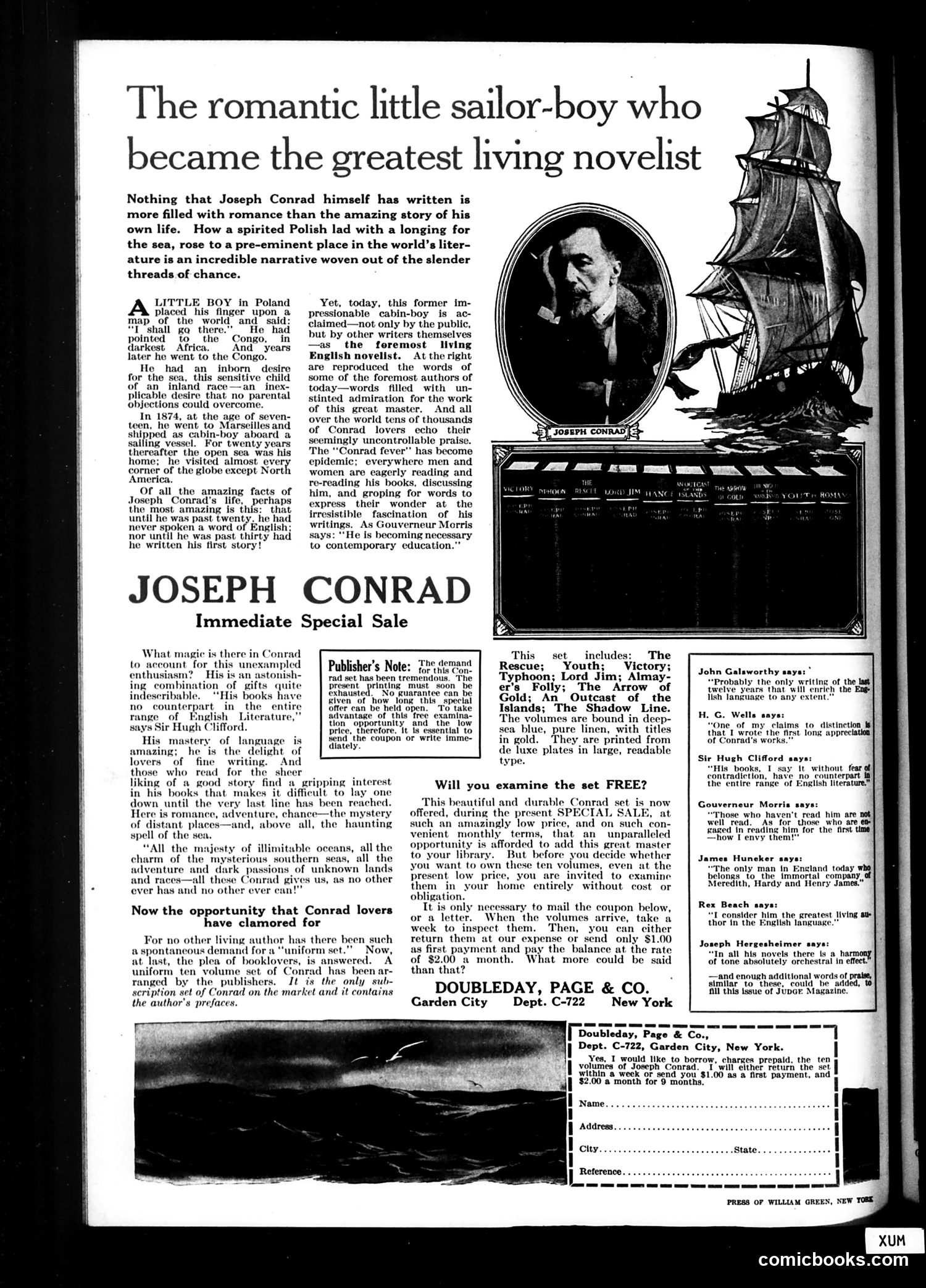
This is primarily **advertising copy**, not satire or political commentary. The page promotes a special sale of Joseph Conrad's collected works through Doubleday, Page & Co. The content celebrates Conrad's biography—a Polish-born sailor who became a preeminent English novelist despite not speaking English until age thirty. The page emphasizes the romantic narrative of his life: a cabin boy who traveled the world for twenty years before becoming a writer. The "cartoon" is actually a portrait illustration of Conrad alongside an image of a sailing ship, establishing the maritime theme central to both his life story and literary appeal. Testimonials from contemporary authors (H.G. Wells, Sir Hugh Clifford, Gouverneur Morris, etc.) praise Conrad's mastery of language and storytelling. The publisher claims Conrad "fever" is epidemic and that his work is "becoming necessary to contemporary education." This represents early 20th-century literary marketing rather than satire—capitalizing on Conrad's genuine celebrity status among educated readers of the period.
I can see this is a page from *Judge* magazine (as indicated by the comicbooks.com attribution), but the image is almost entirely black with only a white margin visible on the left side containing some text and what appears to be a small portrait or illustration at the top. The OCR text provided only contains a website attribution. I cannot reliably identify any cartoon content, political figures, social references, or satirical points from this image, as the main content area is not legible. To provide accurate historical context as requested, I would need a clearer image where the actual cartoon(s) and their details are visible.