
Judge, 1924-02-02 · page 12 of 37
Judge — February 2, 1924 — page 12: what you’re looking at
What you’re looking at
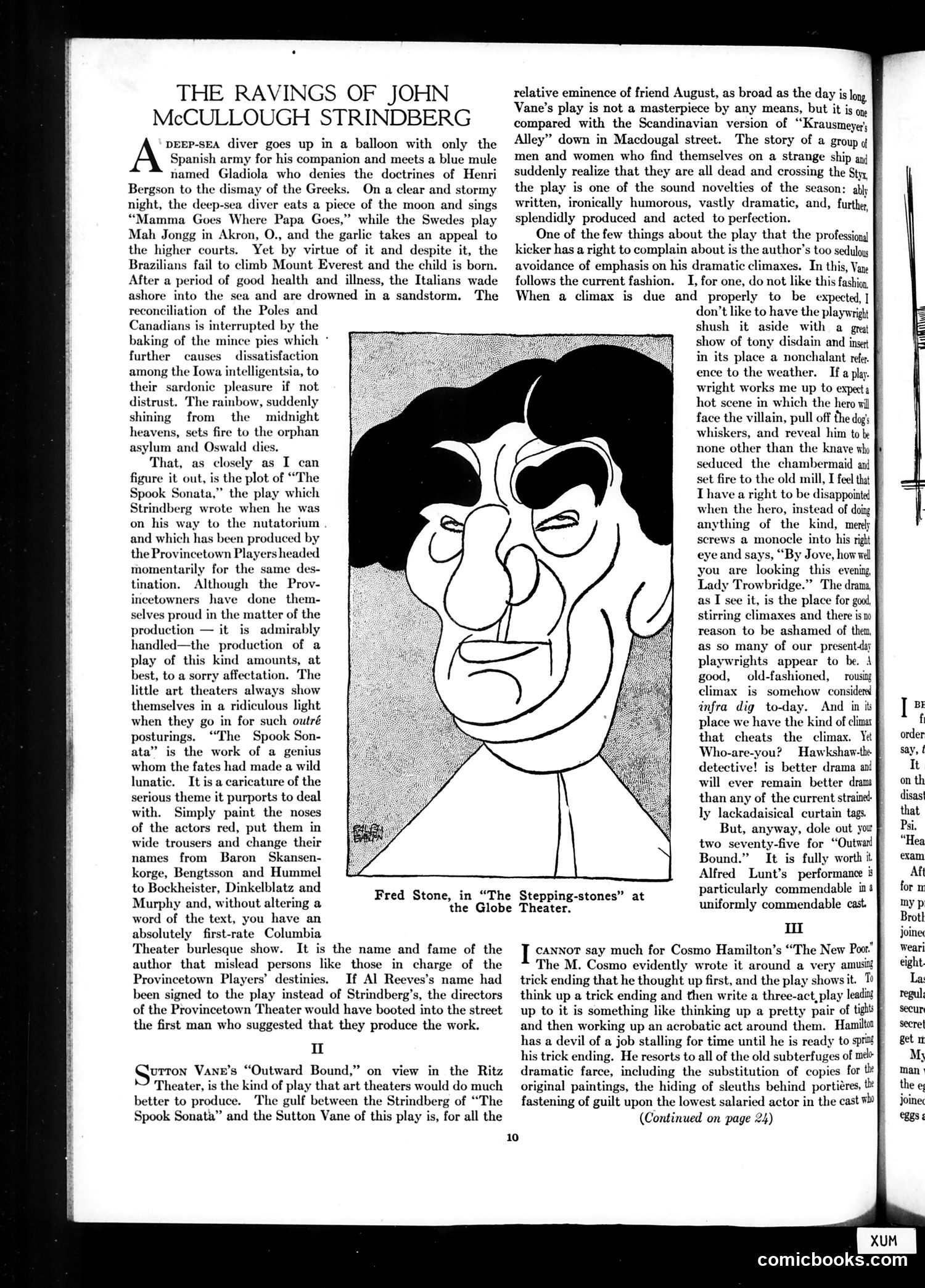
This page critiques avant-garde theater through a satirical review of August Strindberg's "The Spook Sonata," produced by the Provincetown Players. The caricature depicts **Fred Stone** performing in "The Stepping-stones" at the Globe Theater. The author ridicules Strindberg's play as incomprehensible modernist nonsense—deliberately mocking its surreal plot with an absurdist summary (divers, blue mules, Mah Jongg in Ohio). The central argument: small art theaters mistake Strindberg's "genius lunacy" for serious art simply due to his famous name. The author suggests renaming characters to mundane Irish/German names and the play becomes obvious burlesque. By contrast, Sutton Vane's "Outward Bound" (about dead passengers crossing a strange ship) is praised as genuinely innovative yet accessible—the kind of play art theaters *should* produce instead of pretentiously staging incomprehensible European modernism. The satire targets 1920s artistic pretension: little theaters championing difficult European plays not on merit but reputation.
📄 Transcribed text from this page (OCR, searchable)
Machine-transcribed from the original scan — historical spelling and the odd misread are preserved.
THE RAVINGS OF JOHN McCULLOUGH STRINDBERG DEEP-SEA diver goes up in a balloon with only the Spanish army for his companion and meets a blue mule named Gladiola who denies the doctrines of Henri Bergson to the dismay of the Greeks. On a clear and stormy night, the deep-sea diver eats a piece of the moon and sings “Mamma Goes Where Papa Goes,” while the Swedes play Mah Jongg in Akron, O., and the garlic takes an appeal to the higher courts. Yet by virtue of it and despite it, the Brazilians fail to climb Mount Everest and the child is born. After a period of good health and illness, the Italians wade ashore into the sea and are drowned in a sandstorm. The reconciliation of the Poles and Canadians is interrupted by the baking of the mince pies which ° further causes di isfaction among the Iowa intelligentsia, to their sardonic pleasure if not distrust. The rainbow, suddenly shining from the midnight heavens, sets fire to the orphan asylum and Oswald dies. That, as closely as I can figure it out, is the plot of “The Spook Sonata,” the play which Strindberg wrote when he was on his way to the nutatorium and which has been produced by the Provincetown Players headed momentarily for the same des- tination. Although the Prov- incetowners have done them- selves proud in the matter of the production — it is admirably handled—the production of a play of this kind amounts, at best, to a sorry affectation. little art theaters al themselves in a ridiculou when they go in for such outré posturings. “The Spook Son- ata” is the work of a genius whom the fates had made a wild lunatic. It is a caricature of the serious theme it purports to deal with. Simply paint the noses of the actors red, put them in wide trousers and change their names from Baron Skansen- korge, Bengtsson and Hummel to Bockheister, Dinkelblatz and Murphy and, without altering a word of the text, you have an absolutely first-rate Columbia Theater burlesque show. It is the name and fame of the author that mislead persons like those in charge of the Provincetown Players’ destinies. If Al Reeves’s name had been signed to the play instead of Strindberg’s, the directors of the Provincetown Theater would have booted into the street the first man who suggested that they produce the work. I ‘uTton Vane’s “Outward Bound,” on view in the Ritz Theater, is the kind of play that art theaters would do much better to produce. The gulf between the Strindberg of “The Spook Sonata” and the Sutton Vane of this play is, for all the Fred Stone, in “The the Globe Theater. relative eminence of friend August, as broad as the day is long, Vane’s play is not a masterpiece by any means, but it is on compared with the Scandinavian version of “Krausmeye; Alley” down in Macdougal street. The story of a group ¢ men and women who find themselves on a strange ship anj suddenly realize that they are all dead and crossing the Sty, the play is one of the sound novelties of the season: ath written, ironically humorous, vastly dramatic, and, further splendidly produced and acted to perfection. One of the few things about the play that the professiond [ kicker has a right to complain about is the author’s too seduloy avoidance of emphasis on his dramatic climaxes. In this, Van follows the current fashion. I, for one, do not like this fashion, When a climax is due and properly to be expected, | don’t like to have the playwrigtt shush it aside with a great show of tony disdain and inset in its place a nonchalant refe. ence to the weather. If a play. wright works me up to expecta hot scene in which the hero wil face the villain, pull off the dog’ whiskers, and reveal him tok none other than the knave wh seduced the chambermaid ani set fire to the old mill, I feel that Thave a right to be disappointed when the hero, instead of doing anything of the kind, merely screws a monocle into his right eye and says, “By Jove, how wd you are looking this evening Lady Trowbridge.” The drama, as I see it, is the place for goo, stirring climaxes and there is» reason to be ashamed of then, as so many of our present-day playwrights appear to be. 4 good, old-fashioned, rousing climax is somehow considem infra dig to-day. And in is place we have the kind of clima that cheats the climax. Ye Who-are-you? Hawkshaw-the detective! is better drama ani will ever remain better dram than any of the current straine!- ly lackadaisical curtain tags. But, anyway, dole out yor two seventy-five for “Outwan Bound.” It is fully worth it Alfred Lunt’s performance # particularly commendable ins uniformly commendable cast. It I CANNOT say much for Cosmo Hamilton’s “The New Poor.” The M. Cosmo evidently wrote it around a very amusil{ trick ending that he thought up first, and the play shows it. 1 think up a trick ending and then write a three-act, play leadi up to it is something like thinking up a pretty pair of tight and then working up an acrobatic act around them. Hamilta has a devil of a job stalling for time until he is ready to sprit his trick ending. He resorts to all of the old subterfuges of md dramatic farce, including the substitution of copies for original paintings, the hiding of sleuths behind portiéres, the fastening of guilt upon the lowest salaried actor in the cast ¥! (Continued on page 24) Stepping-stones” at XUM comicbooks.com