
Judge, 1924-02-02 · page 17 of 37
Judge — February 2, 1924 — page 17: what you’re looking at
What you’re looking at
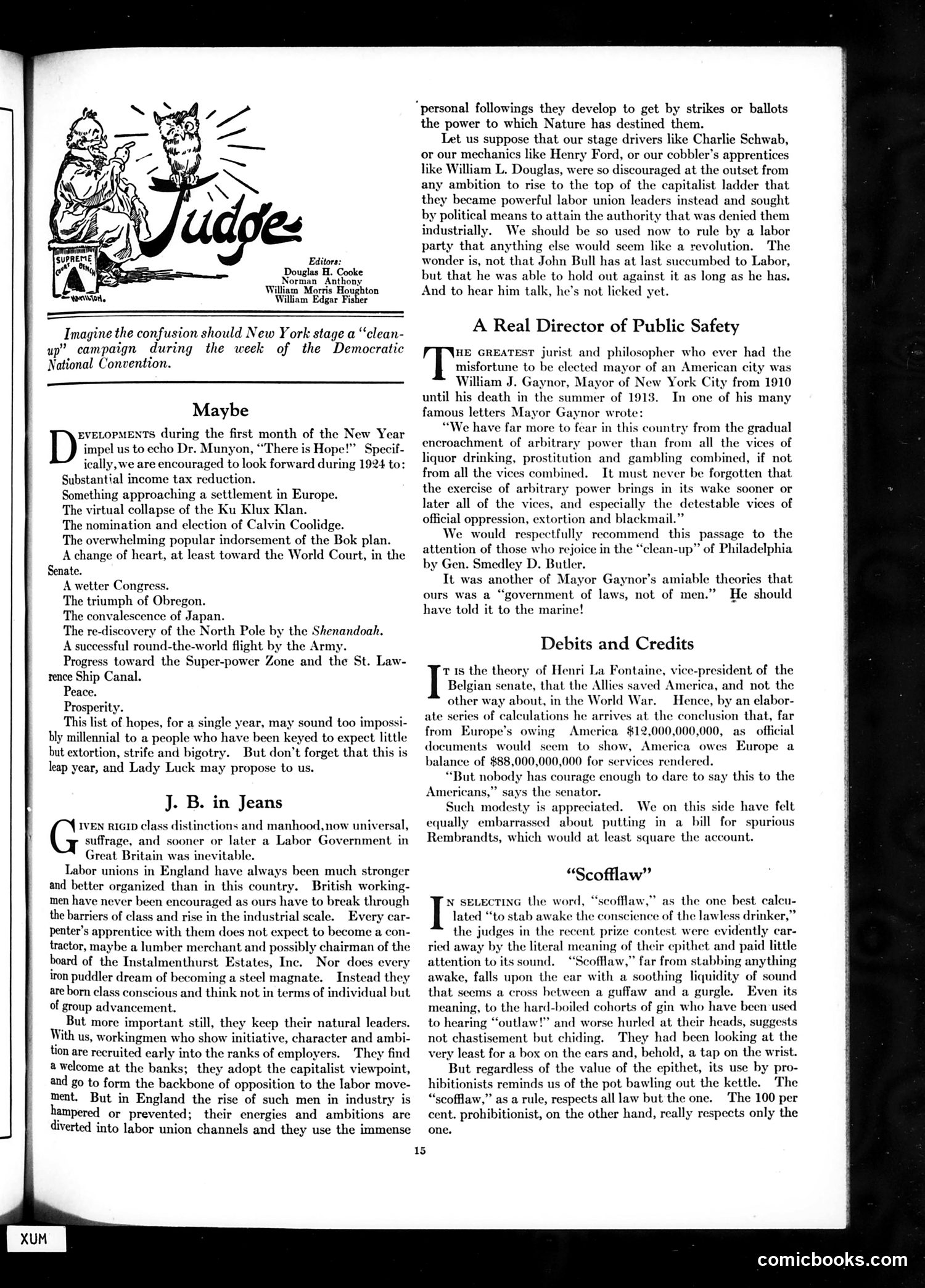
**The Cartoon ("Judge"):** The masthead illustration shows a judge figure holding what appears to be a cat or similar creature, with radiating lines suggesting emphasis or surprise. The caption jokes that New York's Democratic National Convention cleanup campaign would create "confusion"—satirizing the gap between the city's actual conditions and its aspirations to appear respectable during a major political event. **Content Overview:** This 1924 Judge page mixes political commentary with humor. A section titled "Maybe" lists optimistic hopes for 1924 (income tax reduction, Klan collapse, Calvin Coolidge's election, peace, prosperity)—presented with gentle irony about whether such millenial expectations could realistically occur, especially in a leap year. **Major Article:** "A Real Director of Public Safety" praises William J. Gaynor, New York's mayor (1910-1913), as a jurist and philosopher who warned against "gradual encroachment of arbitrary power" in America—contrasting his leadership with concerns about authoritarian governance. **Labor Commentary:** "J.B. in Jeans" discusses why British workers more readily organized into labor unions than Americans, suggesting American workers' belief in upward mobility prevented class solidarity.
📄 Transcribed text from this page (OCR, searchable)
Machine-transcribed from the original scan — historical spelling and the odd misread are preserved.
Douglas H. Cooke Norman Anthony illiam Morris Houghton William Edgar Fisher Imagine the confusion should New York stage a “‘clean- up” campaign during the week of the Democratic National Convention. Maybe EVELOPMENTS during the first month of the New Year D impel us to echo Dr. Munyon, “There is Hope!” Specif- ically, we are encouraged to look forward during 1924 to: Substantial income tax reduction. Something approaching a settlement in Europe. The virtual collapse of the Ku Klux Klan. The nomination and election of Calvin Coolidge. The overwhelming popular indorsement of the Bok plan. A change of heart, at least toward the World Court, in the Senate. A wetter Congress. The triumph of Obregon. The convalescence of Japan. The re-discovery of the North Pole by the Shenandoah. A successful round-the-world flight by the Army. Progress toward the Super-power Zone and the St. Law- rence Ship Canal. Peace. Prosperity. This list of hopes, for a single year, may sound too impossi- bly millennial to a people who have been keyed to expect little but extortion, strife and bigotry. But don’t forget that this is leap year, and Lady Luck may propose to us. J. B. in Jeans IVEN RIGID class distinctions and manhood, now universal, G suffrage, and sooner or later a Labor Government in Great Britain inevitable. Labor unions in England have always been much stronger and better organized than in this country. British working- men have never been encouraged as ours have to break through the barriers of class and rise in the industrial scale. Every car- penter’s apprentice with them does not expect to become a con- tractor, maybe a lumber merchant and possibly chairman of the board of the Instalmenthurst Estates, Inc. iron puddler dream of becomi gasteel magnate. Instead they are born class conscious and think not in terms of individual but of group advancement. But more important still, they keep their natural leaders. With us, workingmen who show initiative, character and ambi- tion are recruited early into the ranks of employe! They find a welcome at the banks; they adopt the capitalist viewpoint, and go to form the backbone of opposition to the labor move- ment. But in England the rise of such men in industry is hampered or prevented; their energies and ambitions are diverted into labor union channels and they use the immense Nor does every “personal followings they develop to get by strikes or ballots the power to which Nature has destined them. Let us suppose that our stage drivers like Charlie Schwab, or our mechanics like Henry Ford, or our cobbler’s apprentices like William L. Douglas, were so discouraged at the outset from any ambition to rise to the top of the capitalist ladder that they became powerful labor union leaders instead and sought by political means to attain the authority that was denied them industrially. We should be so used now to rule by a labor party that anything else would seem like a revolution. The wonder is, not that John Bull has at last succumbed to Labor, but that he was able to hold out against it as long as he has. And to hear him talk, he’s not licked yet. A Real Director of Public Safety Ts GREATEST jurist and philosopher who ever had the misfortune to be elected mayor of an American city was William J. Gaynor, Mayor of New York City from 1910 until his death in the summer of 1913. In one of his many famous letters Mayor Gaynor wrote “We have far more to fear in this country from the gradual encroachment of arbitrary power than from all the vices of liquor drinking, prostitution and gambling combined, if not from all the vices combined. It must never be forgotten that the exercise of arbitrary power brings in its wake sooner or later all of the vices, and especially the detestable vices of official oppression, extortion and blackmail.” We would respectfully recommend this passage to the attention of those who rejoice in the “clean-up” of Philadelphia by Gen. Smedley D. Butler. It was another of Mayor Gaynor’s amiable theories that ours was a “government of laws, not of men.” He should have told it to the marine! Debits and Credits T 1s the theory of Henri La Fontaine, vice-president of the Belgian senate, that the Allies saved America, and not the other way about, in the World War. Hence, by an elabor- ate series of calculations he arrives at the conclusion that, far from Europe’s owing America $12,000,000,000, official documents would seem to show, America owes Europe a balance of $88,000,000,000 for services rendered. “But nobody has courage enough to dare to say this to the Americans,” says the senator. Such modesty is appreciated. We on this side have felt equally embarrassed about putting in a bill for spurious Rembrandts, which would at least square the account. “Scofflaw” ELECTING the word, “‘scofflaw,” as the one best calcu- I lated “to stab awake the conscience of the lawless drinker,” the judges in the recent prize contest were evidently car- ried away by the literal meaning of their epithet and paid little attention to its sound. “Scofflaw,” far from stabbing anything awake, falls upon the ear with a soothing liquidity of sound that seems a cross between a guffaw and a gurgle. Even its meaning, to the hard-boiled cohorts of gin who have been used to hearing “outlaw!” and worse hurled at their heads, suggests not chastisement but chiding. They had been looking at the very least for a box on the ears and, behold, a tap on the wrist. But regardless of the value of the epithet, its use by pro- hibitionists reminds us of the pot bawling out the kettle. The “scofflaw,” as a rule, respects all law but the one. The 100 per cent. prohibitionist, on the other hand, really respects only the one. comicbooks.com