
Judge, 1924-02-02 · page 22 of 37
Judge — February 2, 1924 — page 22: what you’re looking at
What you’re looking at
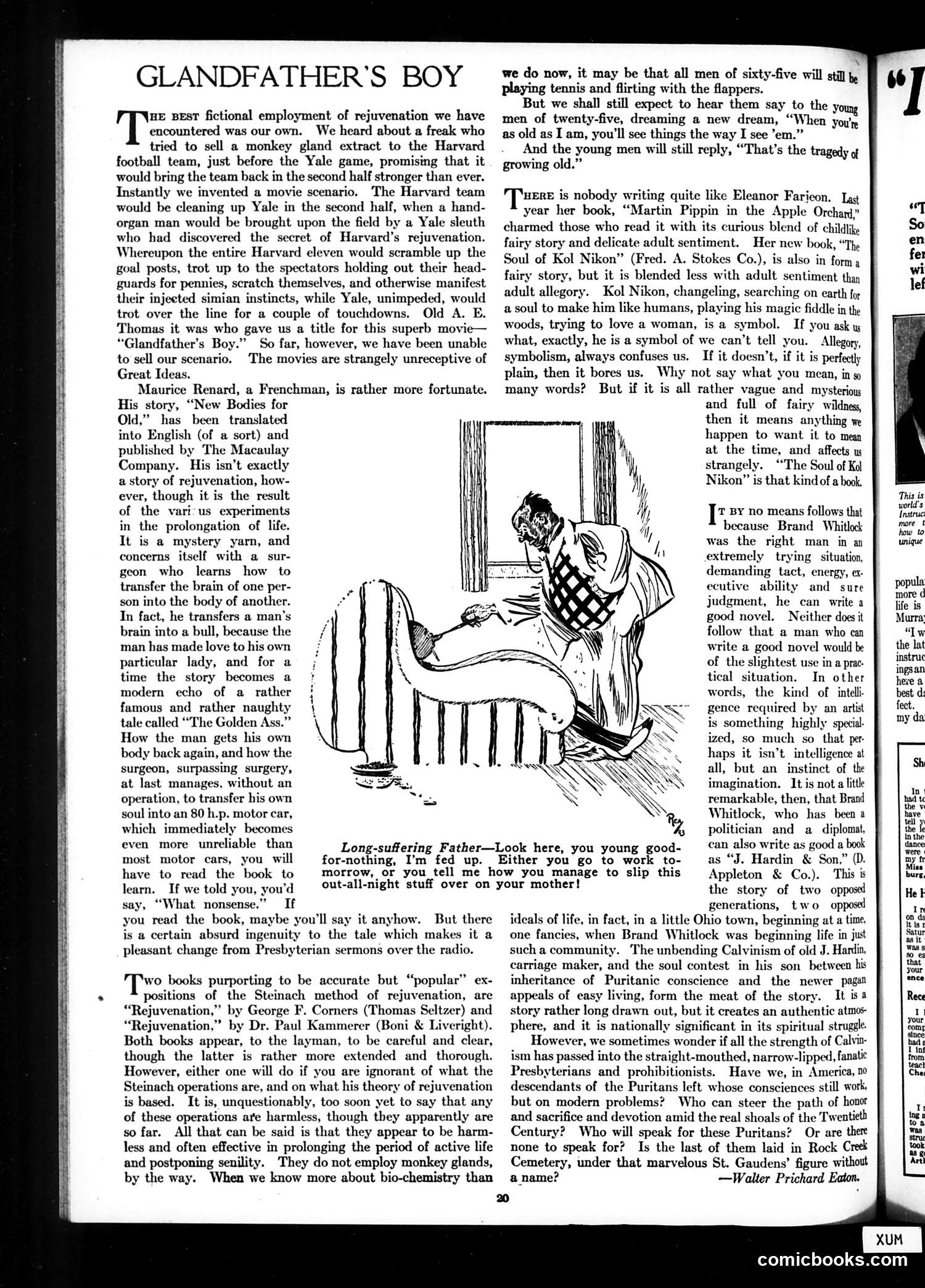
This satirical article mocks the 1920s craze for rejuvenation treatments, particularly the "Steinach method" involving gland operations. The piece opens with a joke about selling monkey gland extract to Harvard's football team before a Yale game, suggesting the absurdity of such claims. The main target is Maurice Renard's French novel "New Bodies for Old," which concerns a surgeon transferring human brains into different bodies—including a bull. Judge ridicules both the fictional premise and contemporary pseudo-scientific rejuvenation theories as nonsensical. The accompanying cartoon depicts an aging father confronting his young son about sneaking out at night, humorously linking youthful behavior to the era's obsession with staying young. The satire suggests that no gland treatment will stop people from aging mentally or behaviorally—young men will always think old men are out of touch, regardless of biological interventions. The piece mocks both popular fiction and the era's gullible embrace of dubious medical "advances."
📄 Transcribed text from this page (OCR, searchable)
Machine-transcribed from the original scan — historical spelling and the odd misread are preserved.
GLANDFATHER’S BOY HE BEsT fictional employment of rejuvenation we have | encountered was our own. We heard about a freak who tried to sell a monkey gland extract to the Harvard football team, just before the Yale game, promising that it would bring the team back in the second half stronger than ever. Instantly we invented a movie scenario. The Harvard team would be cleaning up Yale in the second half, when a hand- organ man would be brought upon the field by a Yale sleuth who had discovered the secret of Harvard’s rejuvenation. Whereupon the entire Harvard eleven would scramble up the goal posts, trot up to the spectators holding out their head- guards for pennies, scratch themselves, and otherwise manifest their injected simian instincts, while Yale, unimpeded, would trot over the line for a couple of touchdowns. Old A. E. Thomas it was who gave us a title for this superb movie— So far, however, we have been unable The movies are strangely unreceptive of “Glandfather’s Boy.” to sell our scenario. Great Ideas. Maurice Renard, a Frenchman, is rather more fortunate. His story, “New Bodies for Old,” has been translated into English (of a sort) and published by The Macaulay Company. His isn’t exactly a story of rejuvenation, how- ever, though it is the result of the varius experiments in the prolongation of life. It is a mystery yarn, and concerns itself with a sur- geon who learns how to transfer the brain of one per- son into the body of another. In fact, he transfers a man’s brain into a bull, because the man has made love to his own particular lady, and for a time the story becomes a modern echo of a rather famous and rather naughty tale called “The Golden Ass.” How the man gets his own body back again, and how the surgeon, surpassing surgery, at last manages, without an operation, to transfer his own soul into an 80 h.p. motor car, which immediately becomes even more unreliable than most motor cars, you will have to read the book to learn. If we told you, you'd say, “What nonsense.” If you read the book, maybe you'll say it anyhow. But there is a certain absurd ingenuity to the tale which makes it a pleasant change from Presbyterian sermons over the radio. for-nothing, I’m fed up. Tre books purporting to be accurate but “popular” ex- positions of the Steinach method of rejuvenation, are “Rejuvenation,” by George F. Corners (Thomas Seltzer) and “Rejuvenation,” by Dr. Paul Kammerer (Boni & Liveright). Both books appear, to the layman, to be careful and clear, though the latter is rather more extended and thorough. However, either one will do if you are ignorant of what the Steinach operations are, and on what his theory of rejuvenation is based. It is, unquestionably, too soon yet to say that any of these operations are harmless, though they apparently are so far. All that can be said is that they appear to be harm- less and often effective in prolonging the period of active life and postponing senility. They do not employ monkey glands, by the way. When we know more about bio-chemistry than Long-suffering Father—Look here, you young good- morrow, or you tell me how you manage to slip this out-all-night stuff over on your mother! N we do now, it may be that all men of sixty-five will stil] be playing tennis and flirting with the flappers. But we shall still expect to hear them say to the Young men of twenty-five, dreaming a new dream, “When you'r as old as I am, you'll see things the way I see ’em.” And the young men will still reply, “That’s the tragedy of growing old.” [sere is nobody writing quite like Eleanor Farjeon. Lag year her book, “Martin Pippin in the Apple Orchar,” charmed those who read it with its curious blend of childlike fairy story and delicate adult sentiment. Her new book, “The Soul of Kol Nikon” (Fred. A. Stokes Co.), is also in form g fairy story, but it is blended less with adult sentiment than adult allegory. Kol Nikon, changeling, searching on earth for a soul to make him like humans, playing his magic fiddle in the woods, trying to love a woman, is a symbol. If you ask y what, exactly, he is a symbol of we can’t tell you. Allegory, symbolism, always confuses us. If it doesn’t, if it is perfectly plain, then it bores us. Why not say what you mean, in» many words? But if it is all rather vague and mysteriouw and full of fairy wildnes, then it means anything we happen to want it to mean at the time, and affects us strangely. “The Soul of Ka Nikon” is that kind of a book. T BY no means follows that because Brand Whitlock was the right man in a extremely trying situation, demanding tact, energy, ex- ecutive ability and sure judgment, he can write a good novel. ther does it follow that a man who can write a good novel would be of the slightest use in a prac- tical situation. In other words, the kind of intelli- gence required by an artist is something highly special- ized, so much so that per haps it isn’t intelligence at all, but an instinct of the imagination. It is not a little remarkable, then, that Brand Whitlock, who has been a politician and a diplomat, can also write as good a book as “J. Hardin & Son,” (D. Appleton & Co.). This is the story of two oppose generations, two opposed ideals of life, in fact, in a little Ohio town, beginning at a time, one fancies, when Brand Whitlock was beginning life in jut such a community. The unbending Calvinism of old J. Hardin, carriage maker, and the soul contest in his son between his inheritance of Puritanic conscience and the newer pagal appeals of easy living, form the meat of the story. It isa story rather long drawn out, but it creates an authentic atmos phere, and it is nationally significant in its spiritual struggle. However, we sometimes wonder if all the strength of Calvin- ism has passed into the straight-mouthed, narrow-lipped, fanatic Presbyterians and prohibitionists. Have we, in America, 10 descendants of the Puritans left whose consciences still work, but on modern problems? Who can steer the path of honot and sacrifice and devotion amid the real shoals of the Twentieth Century? Who will speak for these Puritans? Or are there none to speak for? Is the last of them laid in Rock Cree Cemetery, under that marvelous St. Gaudens’ figure without a name? —Walter Prichard Eaton. Either you go to work to- 66 XUM comicbooks.com