
Judge, 1924-02-02 · page 8 of 37
Judge — February 2, 1924 — page 8: what you’re looking at
What you’re looking at
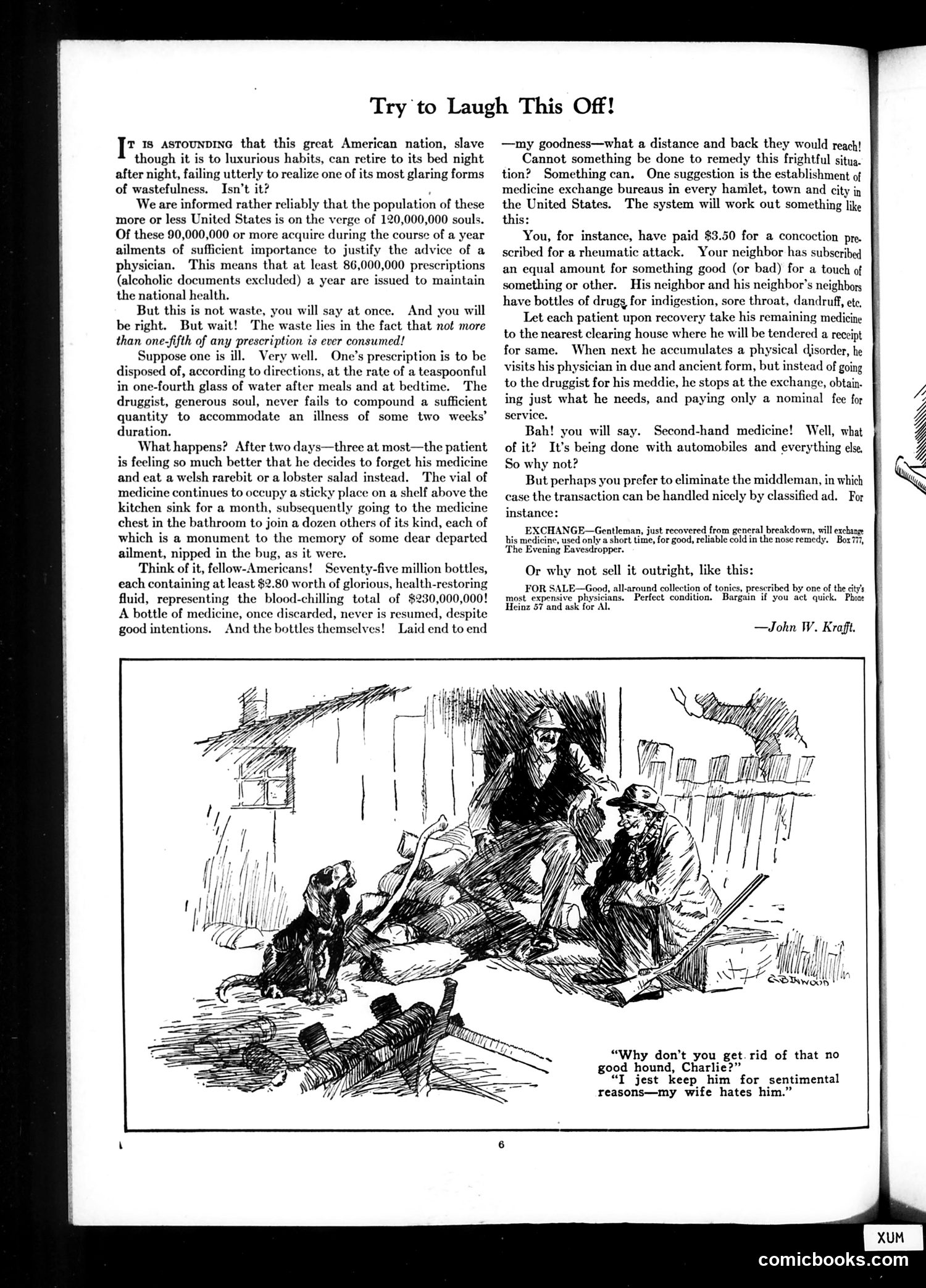
This satirical article by John W. Kraft critiques American medicine waste. The piece argues that approximately 90 million Americans receive prescriptions annually, yet only one-fifth of medication is consumed. Patients typically abandon medicine after feeling better within days, leaving 75 million unused bottles worth $230 million sitting in medicine cabinets. Kraft proposes satirical solutions: establishing "medicine exchange bureaus" where recovered patients deposit unused medicine for others to retrieve, or selling partially-used prescriptions through classified ads—comparing this to used automobiles. The humor lies in presenting these absurd proposals deadpan, implying that if America embraces secondhand cars, why not secondhand medicine? The accompanying cartoon (unrelated to the main text) shows a man explaining why he keeps an unwanted dog: "my wife hates him," illustrating stubbornness in domestic situations. The satire targets American consumerism and medical waste during an era predating modern pharmaceutical disposal regulations.
📄 Transcribed text from this page (OCR, searchable)
Machine-transcribed from the original scan — historical spelling and the odd misread are preserved.
Try to Laugh This Off! I" 18 ASTOUNDING that this great American nation, slave though it is to luxurious habits, can retire to its bed night after night, failing utterly to realize one of its most glaring forms of wastefulness. Isn't it? ‘ We are informed rather reliably that the population of these more or less United States is on the verge of 120,000,000 souls. Of these 90,000,000 or more acquire during the course of a year ailments of sufficient importance to justify the advice of a physician. This means that at least 86,000,000 prescriptions (alcoholic documents excluded) a year are issued to maintain the national health. But this is not waste, you will at once. And you will be right. But wait! The was in the fact that not more than one-fifth of any prescription is ever consumed! Suppose one is ill. Very well. One’s prescription is to be disposed of, according to directions, at the rate of a teaspoonful in one-fourth glass of water after meals and at bedtime. The druggist, generous soul, never fails to compound a sufficient quantity to accommodate an illness of some two weeks’ duration. What happens? After two days—three at most—the patient is feeling so much better that he decides to forget his medicine and eat a welsh rarebit or a lobster salad instead. The vial of medicine continues to occupy a sticky place on a shelf above the kitchen sink for a month, subsequently going to the medicine chest in the bathroom to join a dozen others of its kind, each of which is a monument to the memory of some dear departed ailment, nipped in the bug, as it were. Think of it, fellow-Americans! Seventy-five million bottles, each containing at least $2.80 worth of glorious, health-restoring fluid, representing the blood-chilling total of $230,000,000! A bottle of medicine, once discarded, never is resumed, despite good intentions. And the bottles themselves! Laid end to end —my goodness—what a distance and back they would reach! Cannot something be done to remedy this frightful situa. tion? Something can. One suggestion is the establishment of medicine exchange bureaus in every hamlet, town and city in the United States. The system will work out something like this: You, for instance, have paid $3.50 for a concoction pre. scribed for a rheumatic attack. Your neighbor has subscribed an equal amount for something good (or bad) for a touch of something or other. His neighbor and his neighbor's neighbors have bottles of drugg for indigestion, sore throat, dandruff, ete, Let each patient upon recovery take his remaining medicine to the nearest clearing house where he will be tendered a receipt for same. When next he accumulates a physical disorder, he visits his physician in due and ancient form, but instead of going to the druggist for his meddie, he stops at the exchange, obtain. ing just what he needs, and paying only a nominal fee for service. Bah! you will say. Second-hand medicine! Well, what of it? It’s being done with automobiles and everything else, So why not? But perhaps you prefer to eliminate the middleman, in which case the transaction can be handled nicely by classified ad. For instance: HANGE—Gentleman, just recovered from general breakdown, will exchange bi sed only a short timie, for good, reliable cold in the nose remedy. Box 77, ‘The Evening Eavesdropper. Or why not sell it outright, like this: FOR SALE—G: most expensive ph: Heinz 57 and ask all-around collection of tor cribed by one of the city’s ns. Perfect condition. i you act quick. Phose —John W. Krafft. “Why don’t you get.rid of that no good hound, Charlie?” “I jest keep him for sentimental reasons—my wife hates him.” XUM comicbooks.com