
A complete issue · 36 pages · 1924
Judge — January 19, 1924
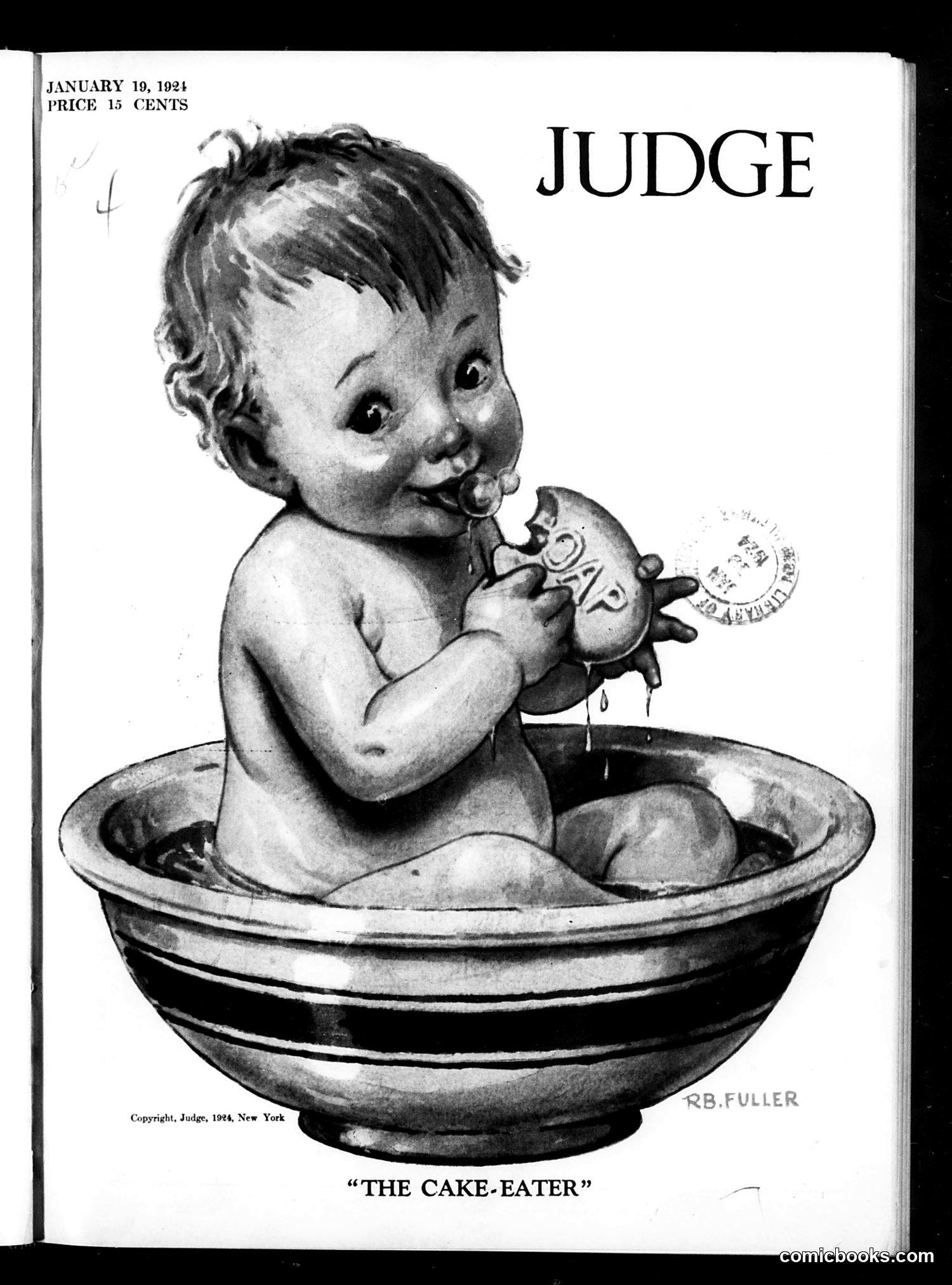
This cartoon satirizes the "cake-eater"—a 1920s slang term for an effeminate or vain young man overly concerned with appearance and pleasure rather than serious pursuits. The illustration depicts a chubby, cherub-like figure in a large bowl, contentedly eating cake while dripping water, suggesting indulgence and childishness. The satire likely targets wealthy young men of the Jazz Age who prioritized leisure and consumption over responsibility. The baby-like portrayal emphasizes the era's criticism of these men as immature and frivolous. The bowl setting reinforces the mockery—treating the "cake-eater" as an object of ridicule rather than a serious adult. This reflects 1920s anxieties about changing masculinity and social values during the post-WWI period.
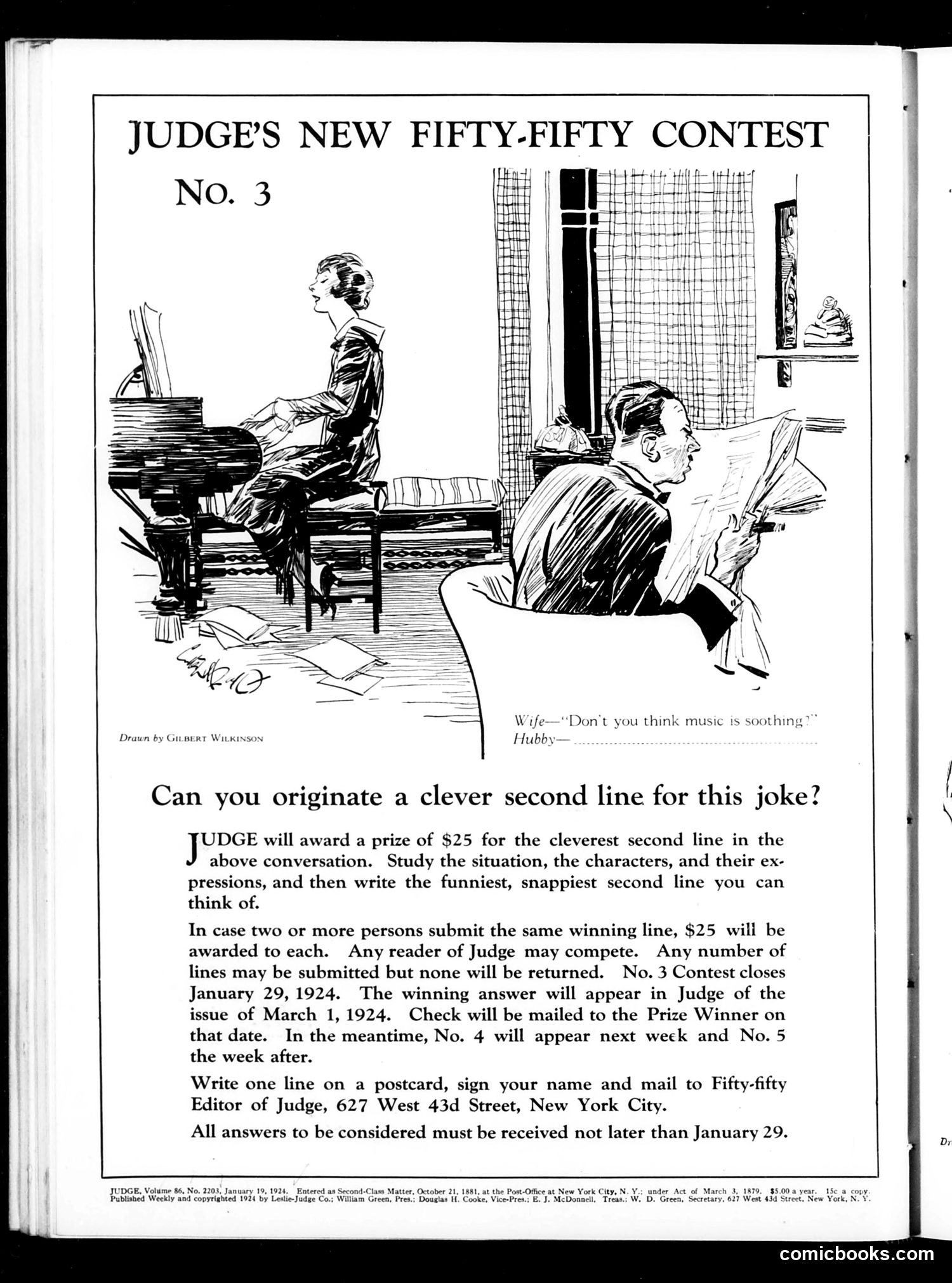
This page presents a cartoon contest rather than political satire. The drawing by Gilbert Wilkinson shows a domestic scene: a woman plays piano while a man reads a newspaper in an armchair, surrounded by scattered papers. The wife says: "Don't you think music is soothing?" The husband's response is blank—readers were invited to submit funny "second lines" to complete the joke. The setup satirizes a common marital dynamic: the wife attempts domestic refinement (piano music) while the husband seems oblivious or irritable. The humor likely hinges on the husband's dismissive or grumpy response to her musical efforts. The contest offered a $25 prize for the cleverest submission, closing January 29, 1924, with winners announced March 1, 1924.
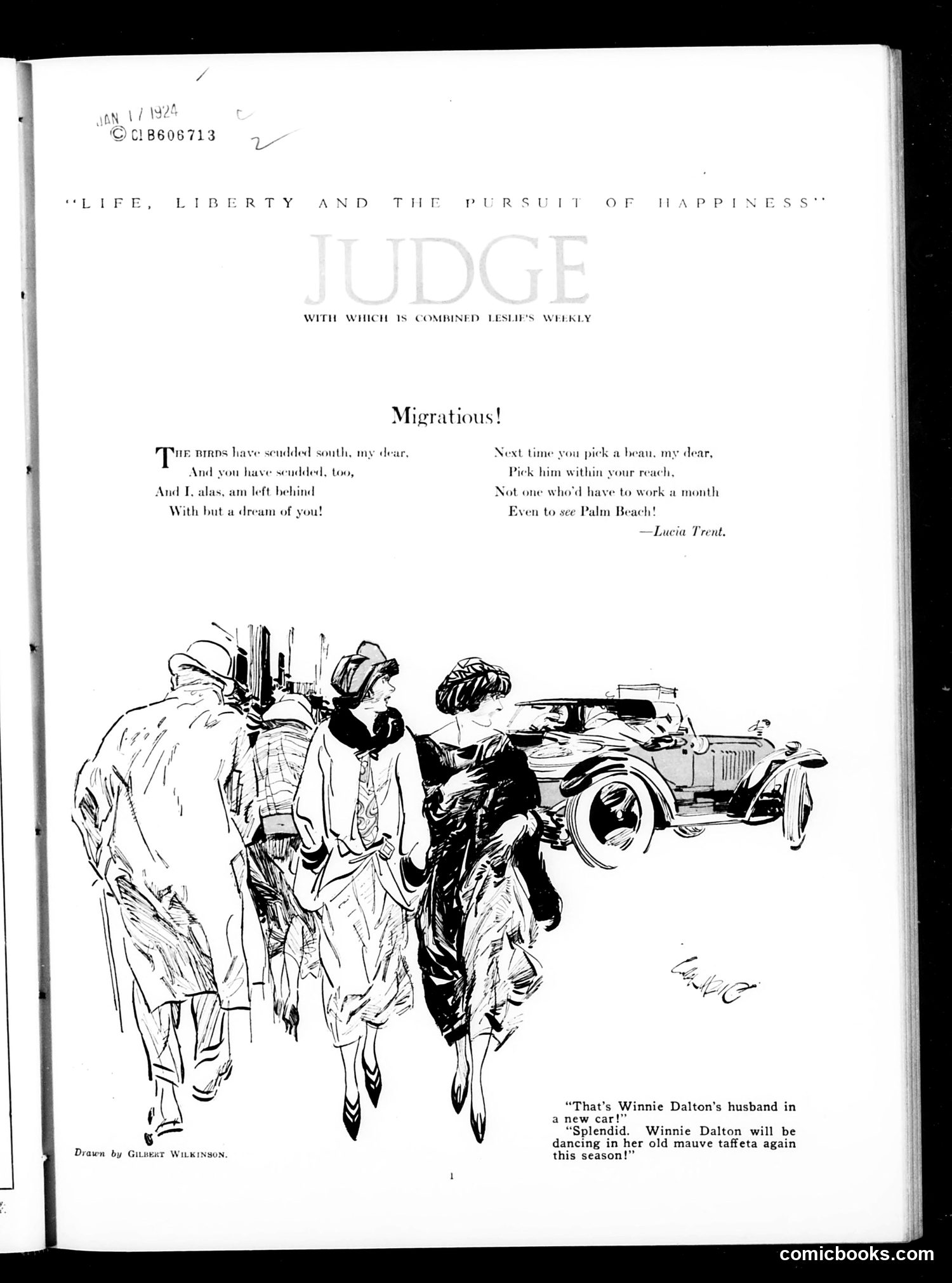
This page satirizes wealthy Americans' seasonal migration to Florida during winter. The poem by Lucia Trent mocks the trend humorously: birds fly south, people follow, and someone's left behind pining for their departed lover. The illustration by Gilbert Wilkinson shows fashionably dressed women departing for warmer climates, accompanied by a motorcar—signaling wealth and modernity. The accompanying caption references "Winnie Dalton's husband" appearing in a theatrical production while his wife enjoys the Florida season in her "old mauve taffeta." The satire targets the leisure-class habit of seasonal relocation to Palm Beach and similar destinations, treating it as an almost automatic, trivial pursuit of the affluent during the 1920s.
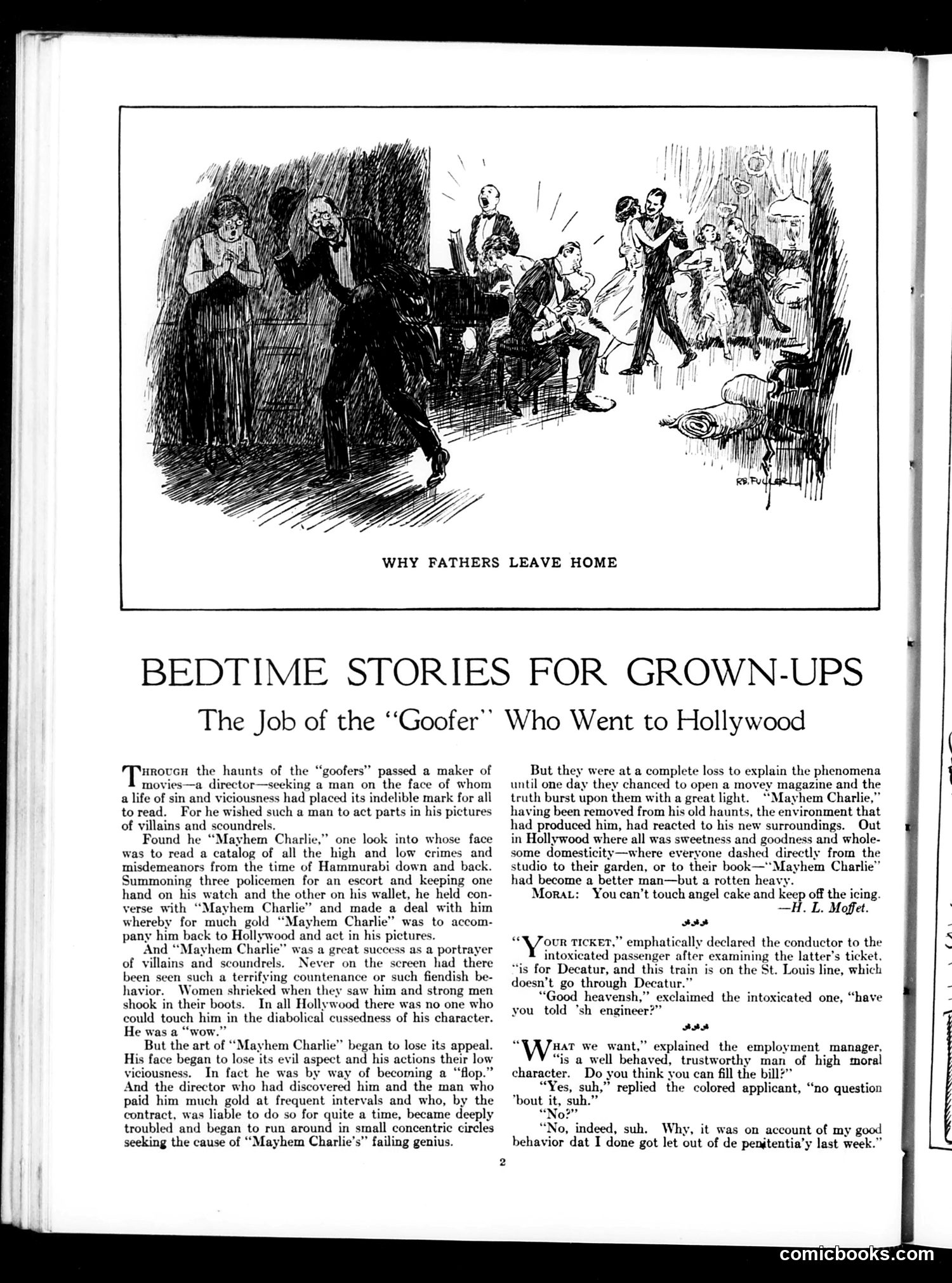
The cartoon titled "Why Fathers Leave Home" depicts a chaotic domestic scene where a father is fleeing the household while children appear to be misbehaving and the home is in disarray. The accompanying text "Bedtime Stories for Grown-Ups" presents a satirical story about "Mayhem Charlie," a failed Hollywood director. The narrative mocks the film industry by describing how a mediocre director achieved success through corrupt dealings with villains, only to lose his position once his usefulness ended. The satire targets early 1900s Hollywood's reputation for moral corruption and cutthroat business practices. The humor relies on readers' familiarity with cinema's rapid growth and its dubious reputation. The "moral" warns against compromising one's integrity for success—a cynical commentary on the entertainment industry's ethical standards during this era.
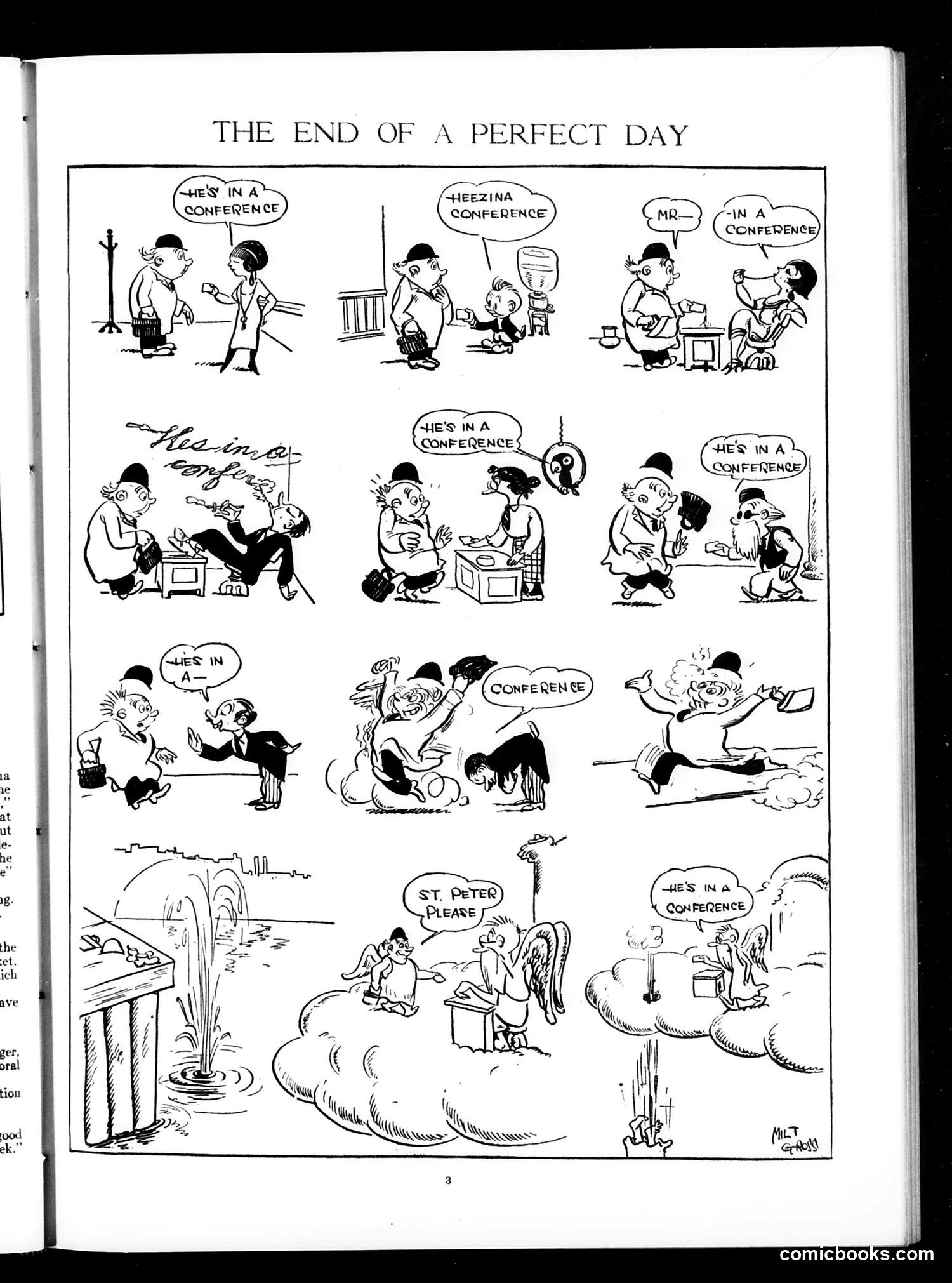
This cartoon satirizes the overworked American businessman, repeatedly caught in conferences throughout his day. The running gag shows various men claiming "he's in a conference" as an excuse for unavailability—whether at the office, home, or elsewhere. The escalating absurdity culminates in heaven, where St. Peter tells an arriving soul "he's in a conference," and finally in hell, where the damned man continues attending conferences even after death. The satire mocks both corporate culture's obsession with endless meetings and the excuse's ubiquity as a deflection. The title's irony—calling such a day "perfect"—underscores the joke: a businessman's entire existence, from work through afterlife, is consumed by pointless conferences, suggesting this is actually his worst nightmare.
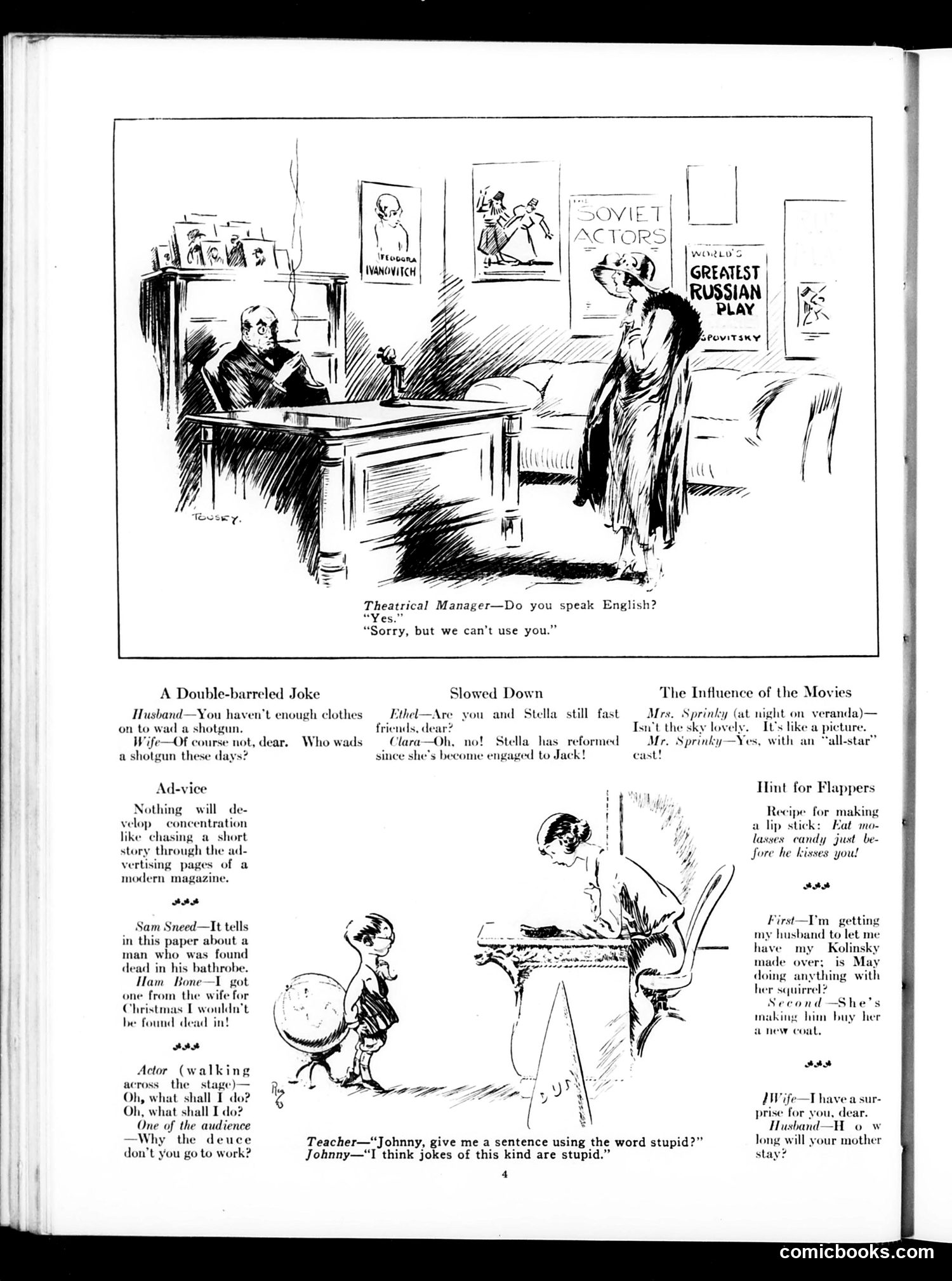
The main cartoon depicts a theatrical manager rejecting a Russian actress who speaks English but cannot be hired. This satirizes post-WWI American attitudes toward Soviet Union representatives—reflecting suspicion and exclusion of Russian communists during the Red Scare period. The surrounding jokes mock various social trends: marriage dynamics, cinema's cultural influence, and linguistic confusion. "The Influence of the Movies" references how Hollywood shaped behavior and speech. "Hint for Flappers" targets the 1920s youth culture and dating practices. The content collectively satirizes modern American anxieties: foreign communist threats, rapid cultural change through mass media, and generational shifts in morality and courtship—themes that dominated public discourse in the post-war 1920s.
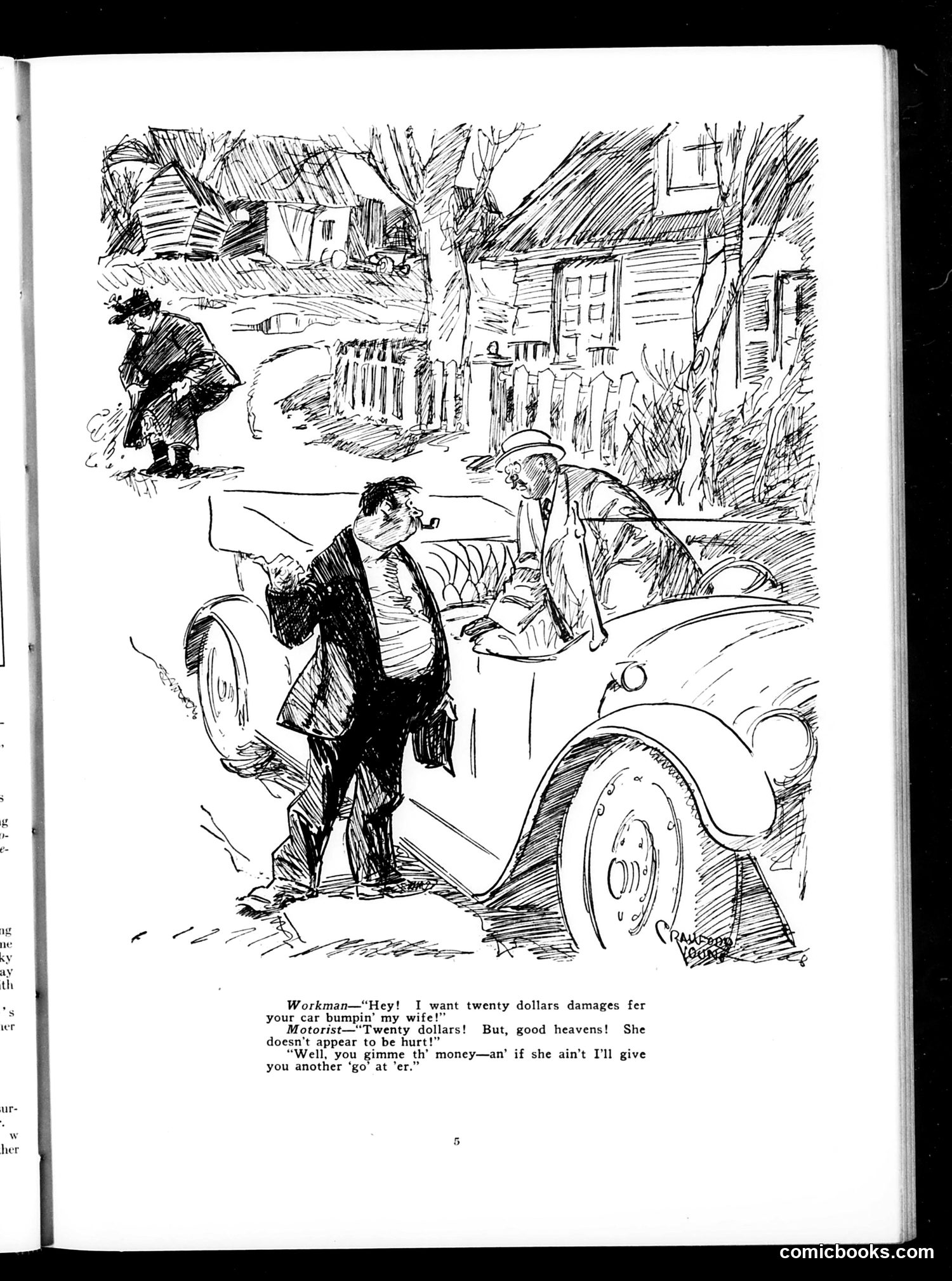
This cartoon satirizes early automobile culture and working-class opportunism. A workman demands $20 damages after a motorist's car bumps his wife. When the motorist notes the wife appears unharmed, the workman makes a crude joke: he'll give the motorist "another go" at hitting her if she isn't actually injured—implying he's fabricating the claim to extort money. The satire targets both the novelty of automobiles (which were causing genuine legal disputes over liability) and the workman's shameless fraud scheme. It reflects anxieties about cars as dangerous urban intrusions and plays on class tensions between motorists (typically wealthier) and working-class pedestrians. The joke's callousness toward the wife suggests period attitudes about women as property in financial disputes.
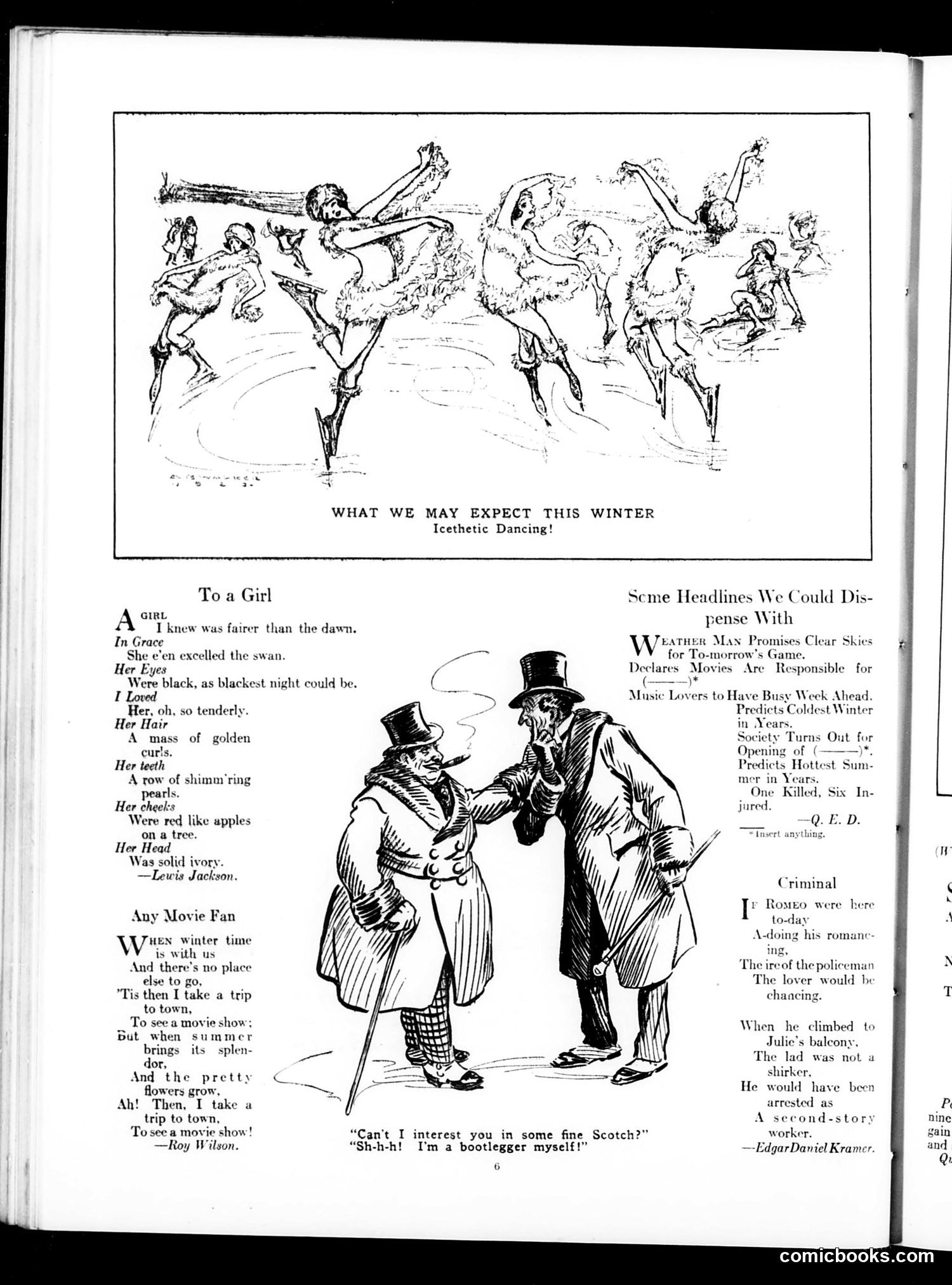
**Top Cartoon:** "Icethetic Dancing" depicts skeletal figures ice-skating—a pun on "aesthetic" that mocks winter recreation as literally bone-chilling and unpleasant. **Main Illustration & Caption:** Two men in top hats and coats discuss bootleg whisky. One offers "fine Scotch"; the other reveals he's a bootlegger himself. This satirizes Prohibition-era hypocrisy: illegal liquor dealers were everywhere, and even criminals encountered each other casually in the black market. **Right Column Jokes:** Mock weather forecasts and sports headlines for their contradictions and absurdity (predicting both coldest winter AND hottest summer). **"Criminal" Poem:** Suggests that if Romeo attempted his famous balcony scene in modern times, he'd be arrested as a "second-story worker" (burglar). This jokes about stricter law enforcement and how old romantic ideals clash with contemporary policing. **Context:** This appears to be from the 1920s Prohibition era, when illegal alcohol sales were rampant and satirists frequently mocked the gap between laws and actual behavior.
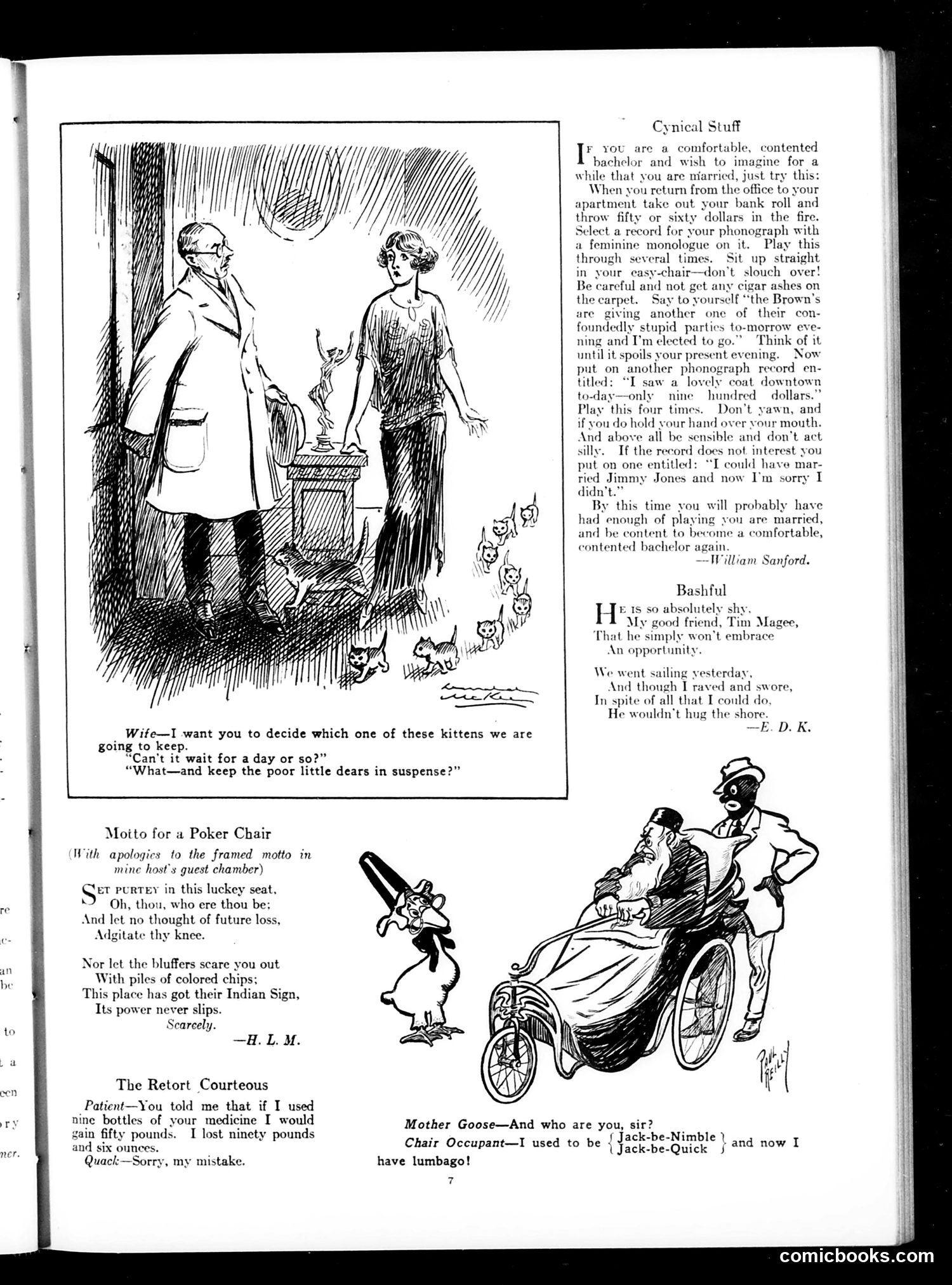
This page contains several brief humorous sketches typical of early 20th-century satirical magazines: **"Cynical Stuff"** mocks bachelor fantasies of married life by suggesting he simulate marriage—waste money, endure boring phonograph records of women's complaints, attend tedious parties, and feign interest in expensive coats. The satire targets both men's reluctance to marry and stereotypes of wives as expensive, nagging burdens. **"Bashful"** is a light poem about an overly shy man (Tim Magee) who won't seize romantic opportunities—he won't even "hug the shore" while sailing. **"Motto for a Poker Chair"** humorously advises poker players to remain calm despite losses, as the venue supposedly has good luck. **"The Retort Courteous"** is a doctor-patient joke where a quack admits giving false medical advice. **The kitten cartoon** depicts a wife pressuring her husband to immediately choose which kitten to keep, illustrating marital impatience. **"Mother Goose"** jokes about an old chair occupant formerly agile ("Jack-be-Nimble") now suffering from lumbago. All emphasize marriage anxieties, aging, and domestic friction—common Judge themes.
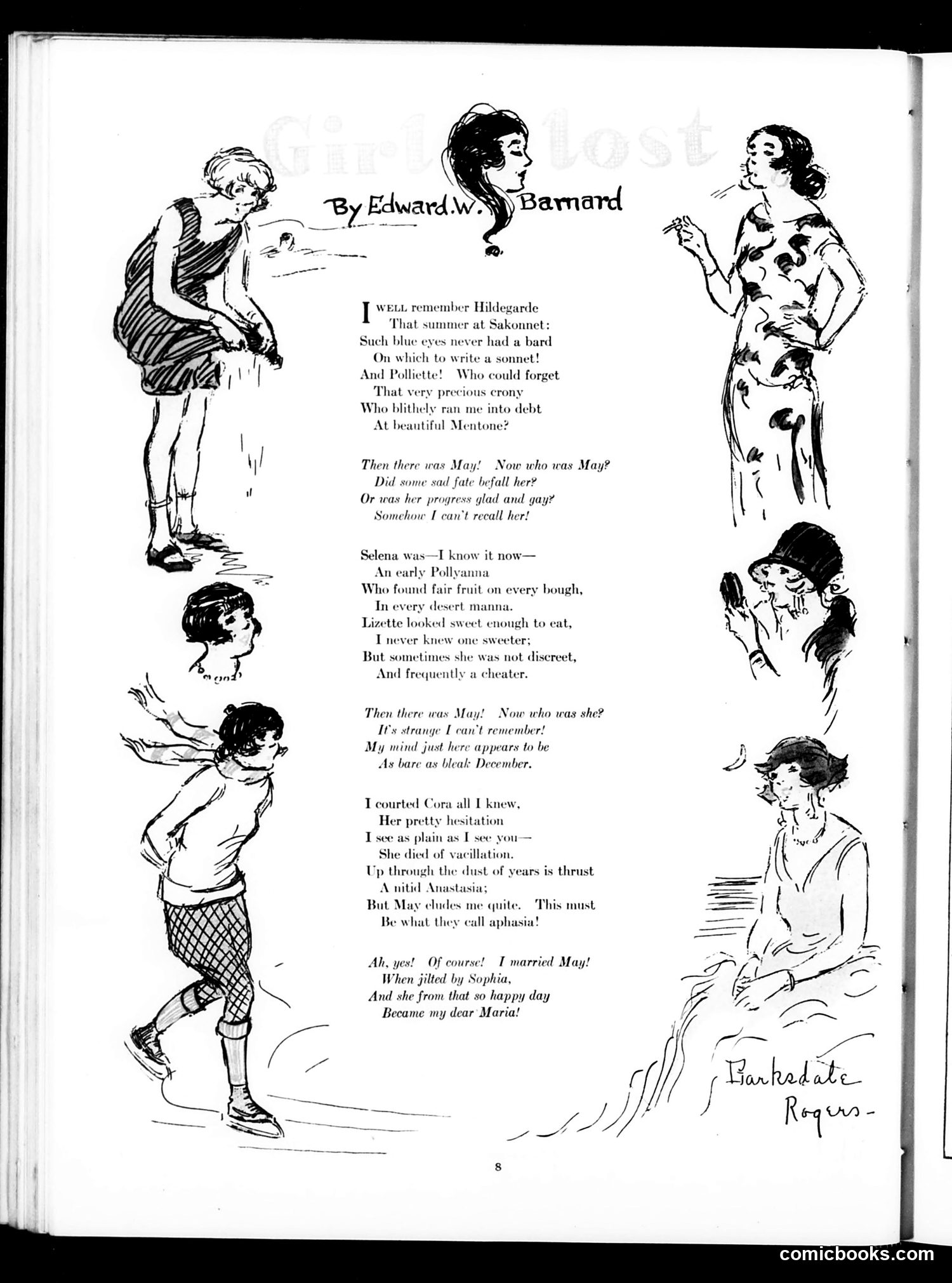
This is a humorous poem by Edward W. Bamard illustrated with sketches of women. The satire targets male romantic fickleness and poor memory. The speaker recalls numerous romantic interests—Hildegarde, Polette, May, Selena, Lizette, Cora, and others—each described with flattering or critical detail. Yet when asked about "May," he cannot remember her at all, attributing this mental blank to "aphasia" (loss of memory/speech). The joke's twist: he eventually remembers he actually *married* May, who became his wife Maria after he was jilted by Sophia. The humor lies in the absurdity that he forgot the one woman important enough to marry while vividly recalling casual romantic interests. The sketches show various fashionable young women in 1920s-style dress and poses, illustrating the speaker's romantic past. The satire gently mocks masculine vanity, poor memory, and the tendency to blur together past relationships—while suggesting marriage itself can fade into a man's consciousness.
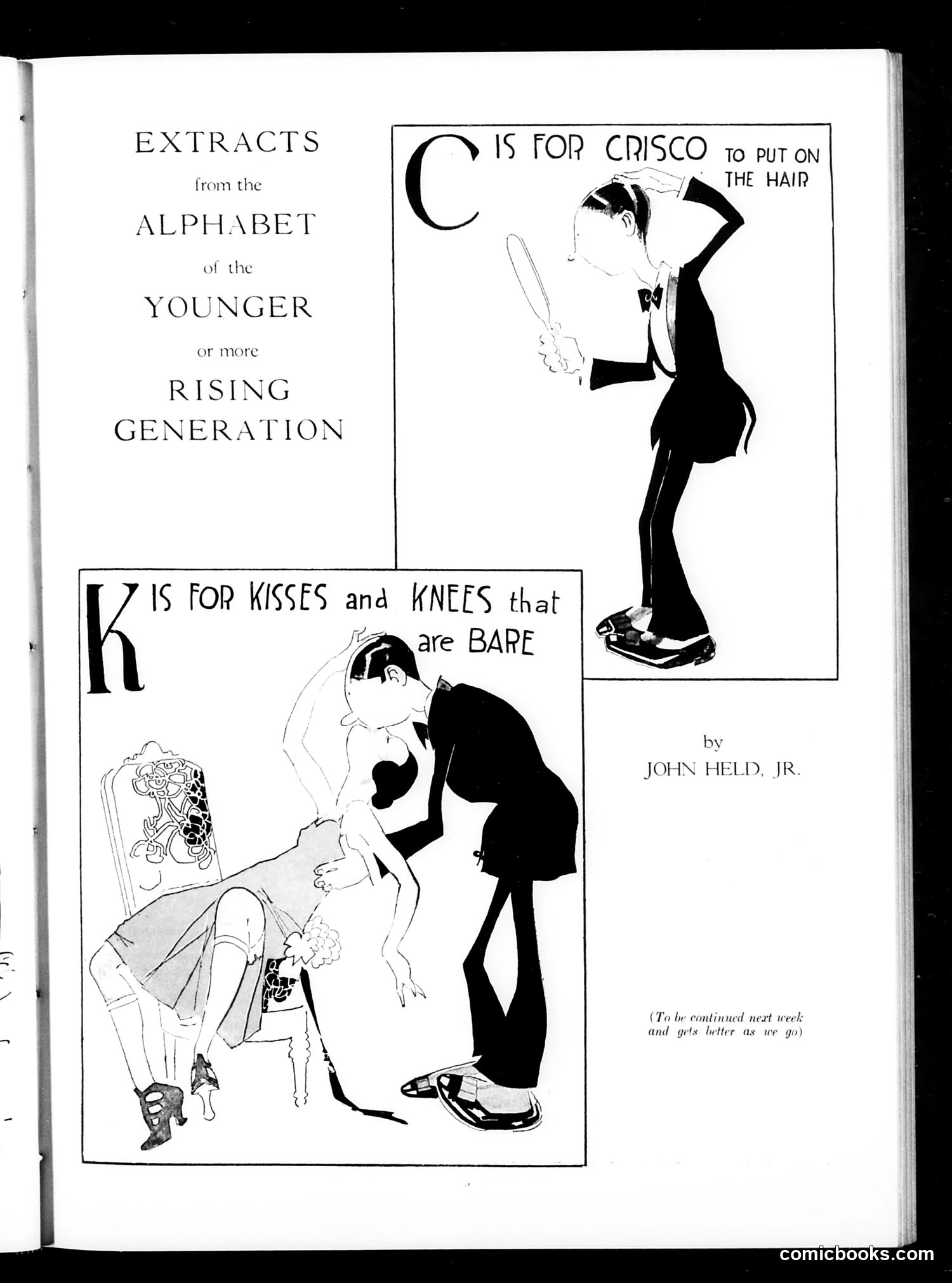
This page from *Judge* magazine presents satirical alphabet entries by John Held Jr., a famous cartoonist known for depicting 1920s youth culture ("the Younger or more Rising Generation"). The "C" entry mocks young women's grooming trends—specifically Crisco (a shortening product) used as hair pomade, shown with a flapper applying it. The "K" entry satirizes modern courtship among youth, depicting "kisses and knees that are bare"—a reference to the era's shocking fashion of women wearing shorter skirts and showing legs, combined with more physical intimacy between unmarried couples. This would have scandalized conservative readers. The cartoons ridicule Jazz Age social liberalism and changing morality among younger generations, using physical humor and exaggeration typical of *Judge's* satirical style.
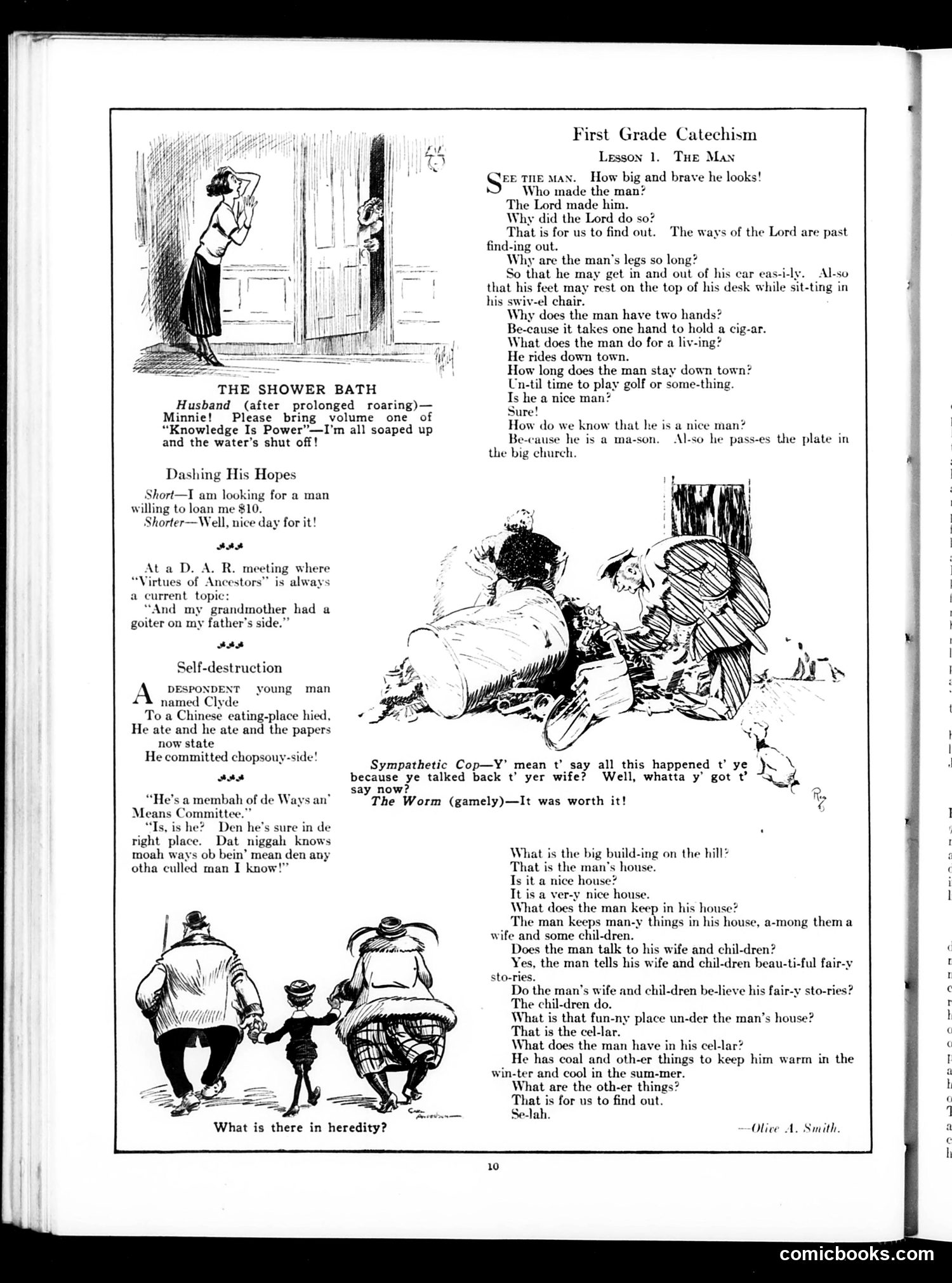
This page satirizes early-1900s American middle-class masculinity through a fake "catechism" (religious instruction format). The humor targets the stereotypical businessman: **The Main Satire:** The "Man" is portrayed as defined by shallow, materialistic pursuits—commuting to work, playing golf, smoking cigars, riding in cars—rather than meaningful virtue. The absurd "answers" mock how society actually values these behaviors. **Specific Jabs:** His long legs help him "get in and out of his car"; he needs two hands to hold a cigarette; he "passes the plate" at church (implying performative religiosity). His house contains a wife, children, and a cellar—presented with the same blank acceptance as furniture. **The Broader Point:** By using religious catechism format (teaching children basic faith), Judge implies this consumerist lifestyle *is* the modern American religion. The wife "believes" his lies; the children will too—perpetuating the cycle. The accompanying cartoons reinforce themes of male foolishness and social hypocrisy, typical of Judge's commentary on Gilded Age pretension.
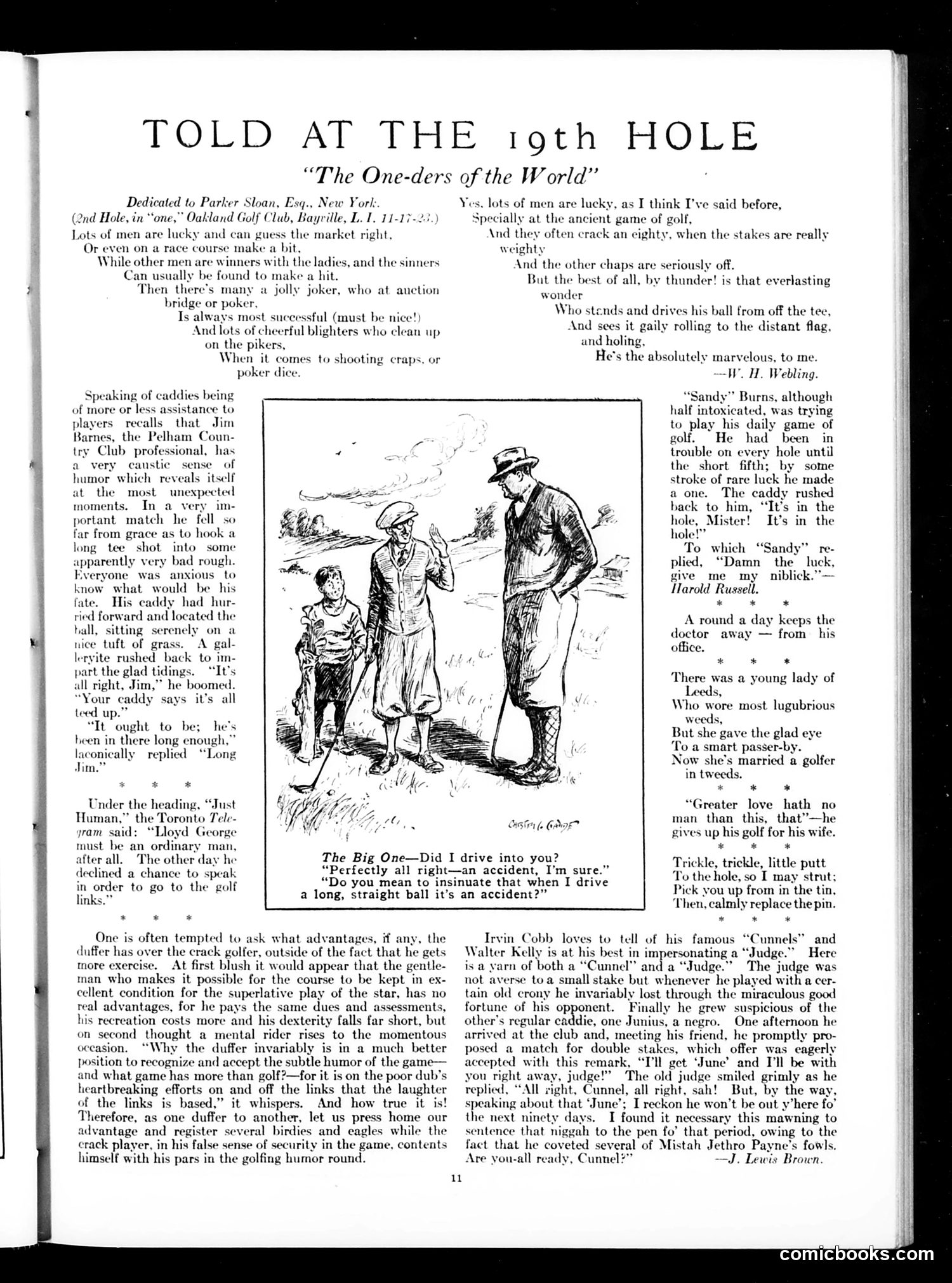
This page collects golfing anecdotes and verses—typical "19th hole" (clubhouse) gossip. The central cartoon shows "The Big One," where a golfer who's driven a long, straight ball is confronted by his caddy, who sarcastically suggests it must have been "an accident," implying the golfer's normally poor play makes a good shot seem impossible. The surrounding text includes stories about caddies and professionals: Jim Barnes's caddy finds a lucky lie in rough grass; "Sandy" Burns, seemingly drunk, makes a hole-in-one on the fifth but complains about losing his club; and Lloyd George is mocked for leaving politics to play golf. The humor is genteel and self-deprecating—aimed at amateur golfers ("duffers") who populate country clubs. The satire gently mocks both incompetent players and the social pretensions of golf culture itself, which was primarily an upper-class leisure activity in the 1910s-20s.
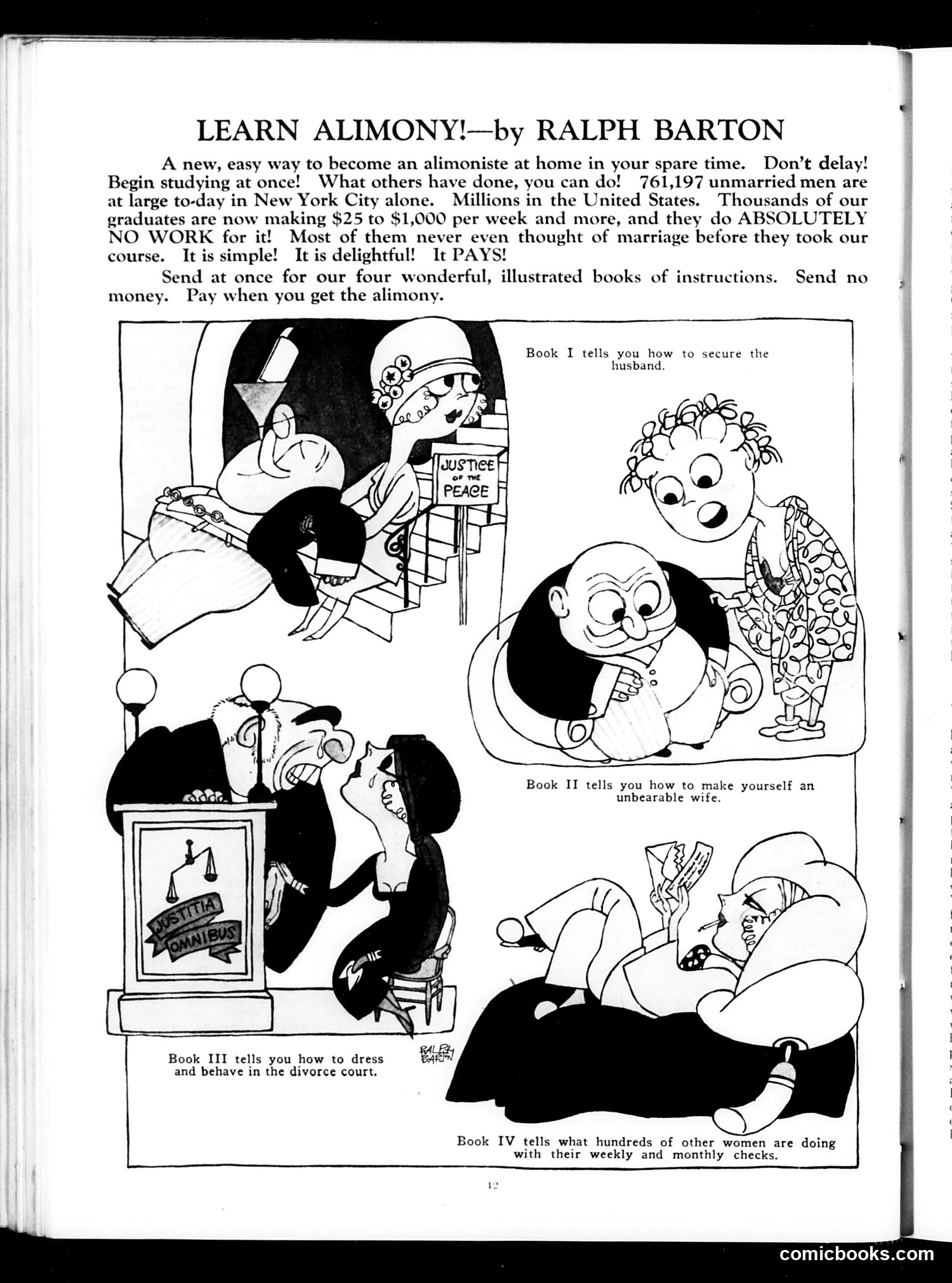
This is satirical advertising by Ralph Barton mocking women who marry for alimony. The "course" promises men can profit without working by marrying women, then divorcing them to collect support payments. The four illustrated books parody the process: securing a husband, becoming unbearable enough to force divorce, winning in court, and collecting regular checks. The cartoons show exaggerated scenarios—judges, courtroom drama, women receiving money. The satire targets **women**, portraying them as scheming gold-diggers who strategically marry and divorce to extract income. It reflects 1920s anxieties about changing divorce laws that granted women alimony—then a relatively new financial protection. Rather than defending this as women's economic security, Barton frames it as a fraudulent racket women exploit. The joke assumes readers will find the concept of women profiting from marriage/divorce morally outrageous, making this primarily misogynistic humor about female avarice and manipulation, wrapped in mock-instructional format.
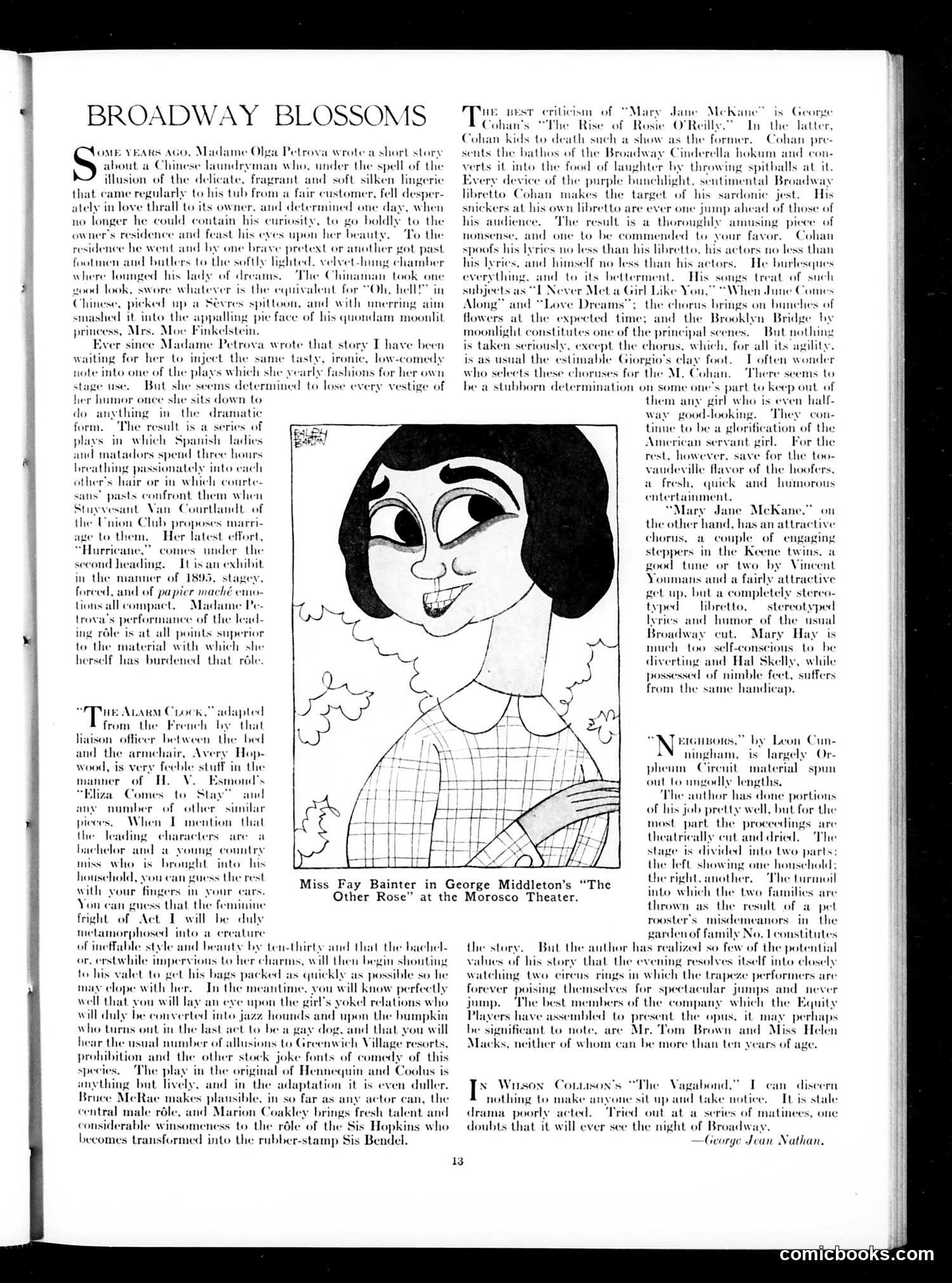
This page contains theater criticism from Judge magazine. The main illustration shows **Miss Fay Bainter** in George Middleton's "The Other Rose" at the Morocco Theater. The critic reviews several Broadway shows with characteristic satirical wit: 1. **Madame Olga Petrova's "Hurricane"** — criticized as overly dramatic and stagey (in the outdated 1895 style), though the critic praises Petrova's performance itself. 2. **"The Alarm Clock"** — dismissed as feeble French farce material. 3. **George M. Cohan's "The Rise of Rosie O'Reilly"** — praised enthusiastically as a parody that "kids to death" the sentimental Broadway Cinderella formula, with Cohan mocking his own work. The critic jokes that Cohan's chorus girls are notably unattractive. 4. **"Mary Jane McKane"** — given mixed reviews for its chorus and music. The tone is irreverent, focusing on how shows either embrace or resist Broadway's formulaic sentimentality.
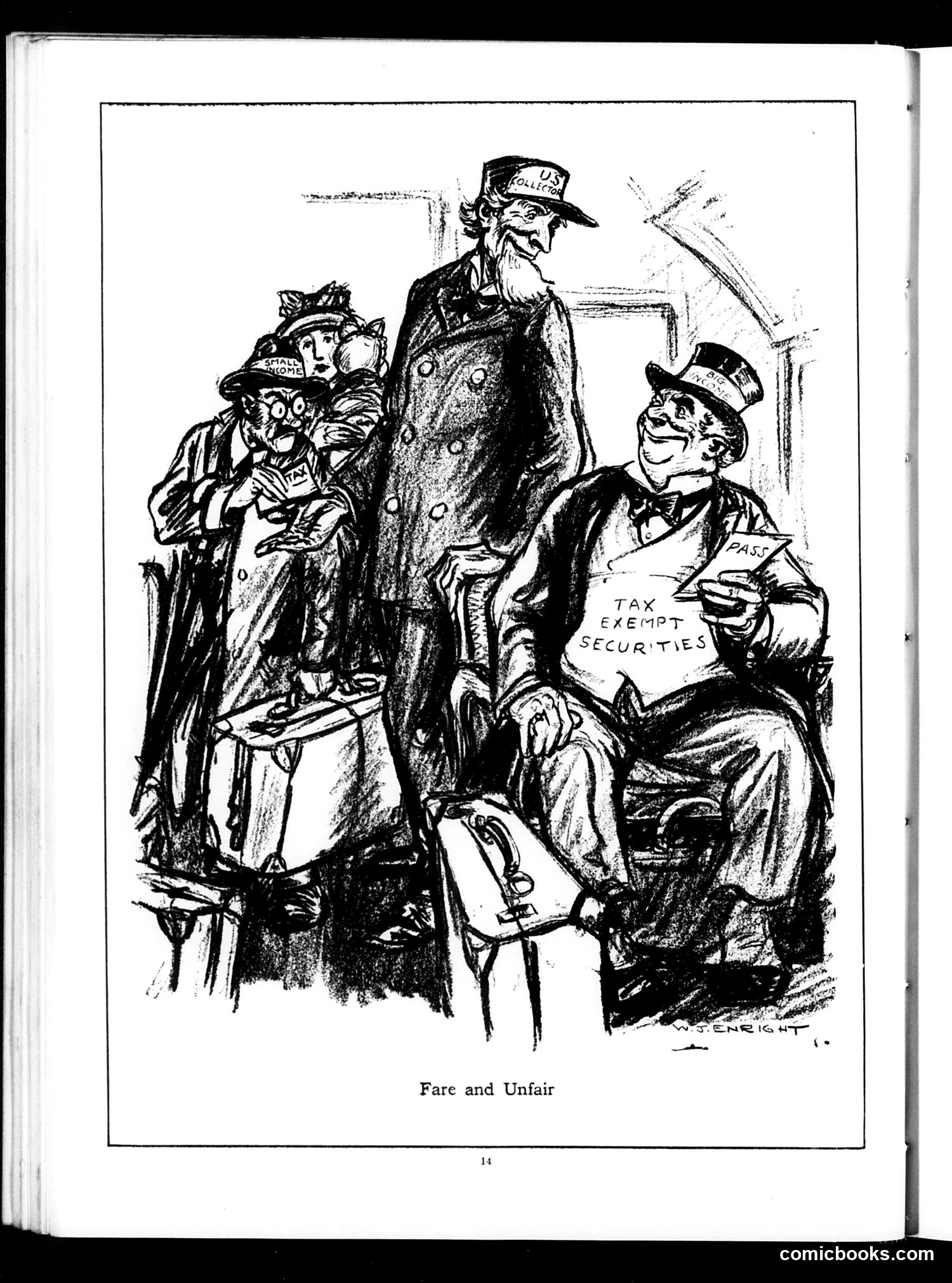
This political cartoon critiques tax policy disparities. Uncle Sam (center, marked "U.S. Police") oversees a scene where wealthy figures (left) receive favorable treatment while a common citizen (right, holding "Tax Exempt Securities") is burdened. The caption's title plays on "fair"—suggesting the taxation system is anything but fair. The cartoon satirizes how the wealthy exploit tax-exempt securities to avoid obligations while ordinary citizens bear the full tax load. Uncle Sam's presence suggests government complicity or failure to enforce equitable taxation. The contrast between the gleeful expressions of the privileged figures and the strained expression of the ordinary taxpayer emphasizes the injustice. This reflects Progressive Era concerns about economic inequality and tax avoidance by the wealthy.
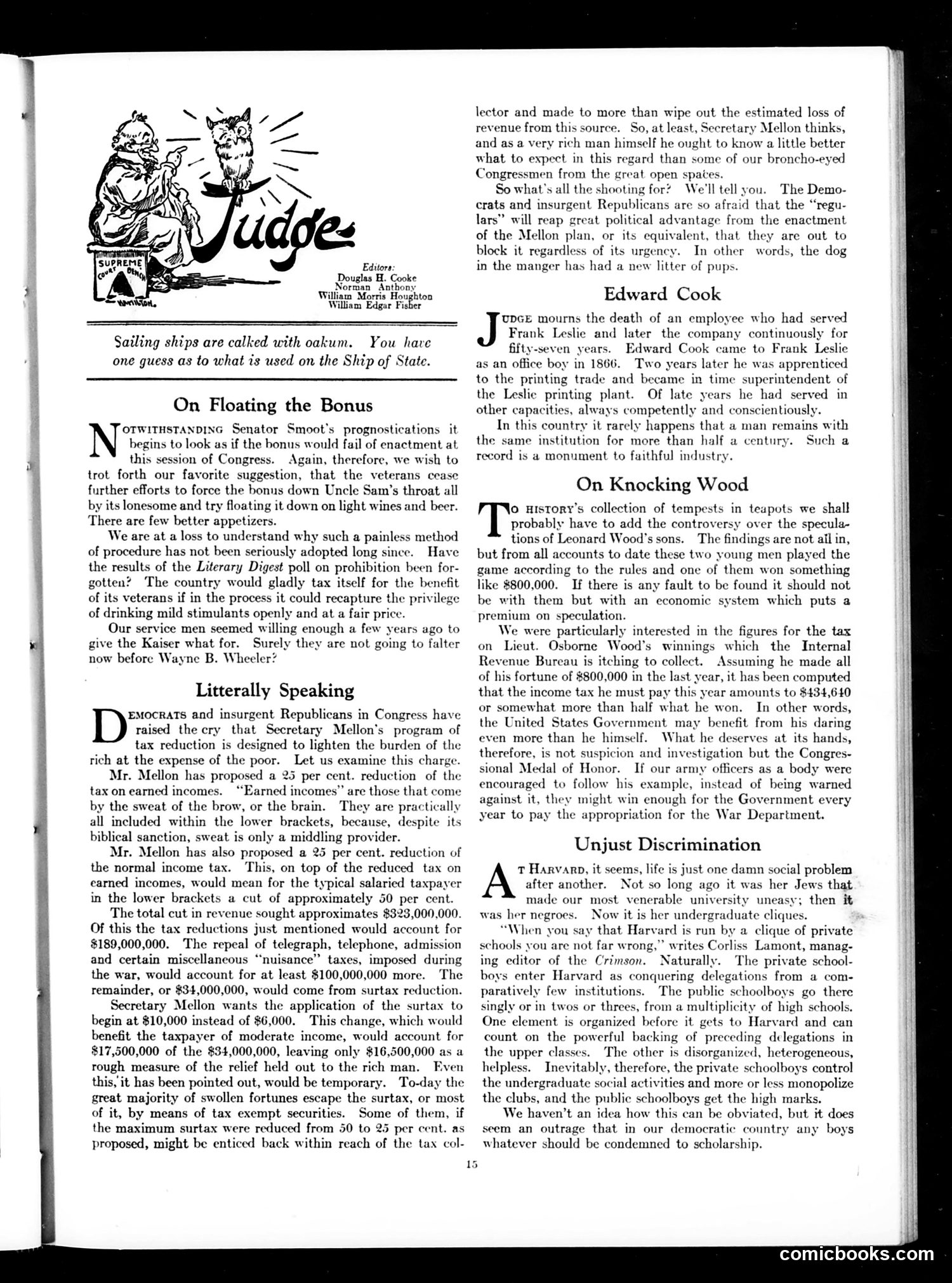
The masthead cartoon depicts a judge figure with an angry cat, likely satirizing contentious Congressional debate. The text uses sharp political commentary on Secretary Mellon's 1920s tax reduction proposal. **Key references:** - **Senator Smoot** and **Wayne B. Wheeler**: Real political figures debating the veterans' bonus and Prohibition - **Secretary Mellon**: Treasury Secretary proposing tax cuts that Democrats claim favor the wealthy - **"Dog in the manger"**: The closing metaphor accuses opposition politicians of blocking beneficial policy purely for partisan advantage, not principle **The satire's point**: Judge defends Mellon's tax plan by meticulously showing it actually benefits middle-class earners through reduced earned-income taxes, not the rich. The magazine characterizes Democratic and "insurgent Republican" opposition as cynical obstruction—they oppose good policy solely to prevent political credit flowing to rivals. The "new litter of pups" suggests petty, spiteful behavior unworthy of serious legislators. This represents conservative editorial positioning during the Harding administration's pro-business policies.
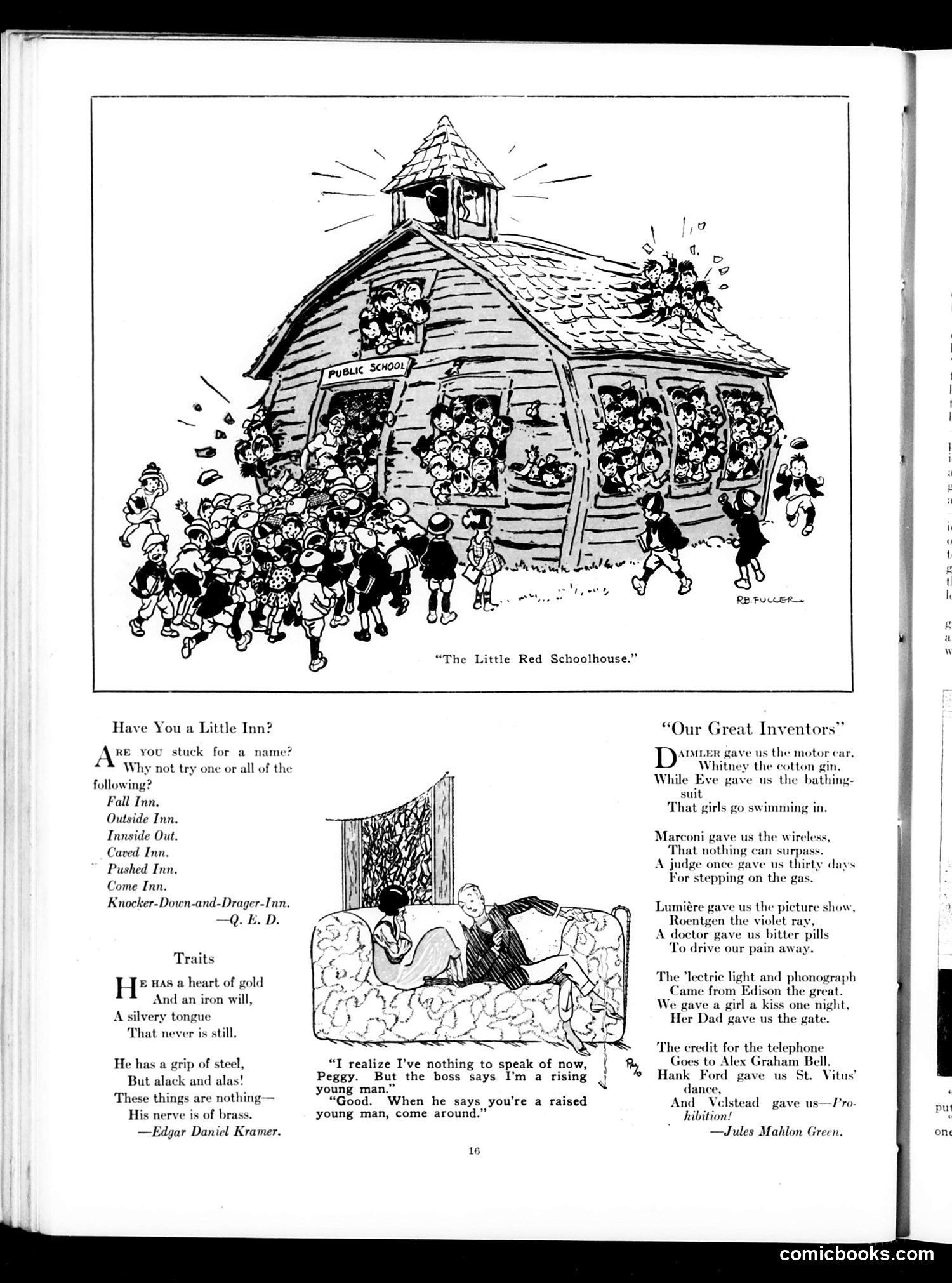
This Judge magazine page contains three separate humorous pieces: **Top cartoon**: A satirical drawing of an overcrowded schoolhouse with children packed inside windows and doors, commenting on educational overcrowding or inadequate school capacity—a social issue of the era. **"Have You a Little Inn?"**: A wordplay joke offering fake tavern names based on puns ("Fall Inn," "Outside Inn," "Innside Out," "Caved Inn," etc.). This reflects Prohibition-era humor mocking speakeasies and illegal drinking establishments. **"Our Great Inventors"**: A humorous poem crediting famous inventors (Daimler, Whitney, Marconi, Edison, Bell) alongside absurd "inventions" like Eve inventing the bathing suit, judges inventing traffic fines, and "Velstead" (referring to the Volstead Act enforcing Prohibition) "inventing" Prohibition itself. The final lines joke about a young man receiving "the gate" (rejection) after kissing someone's daughter. The page reflects early 20th-century American concerns: school crowding, Prohibition enforcement, technological progress, and courtship customs.
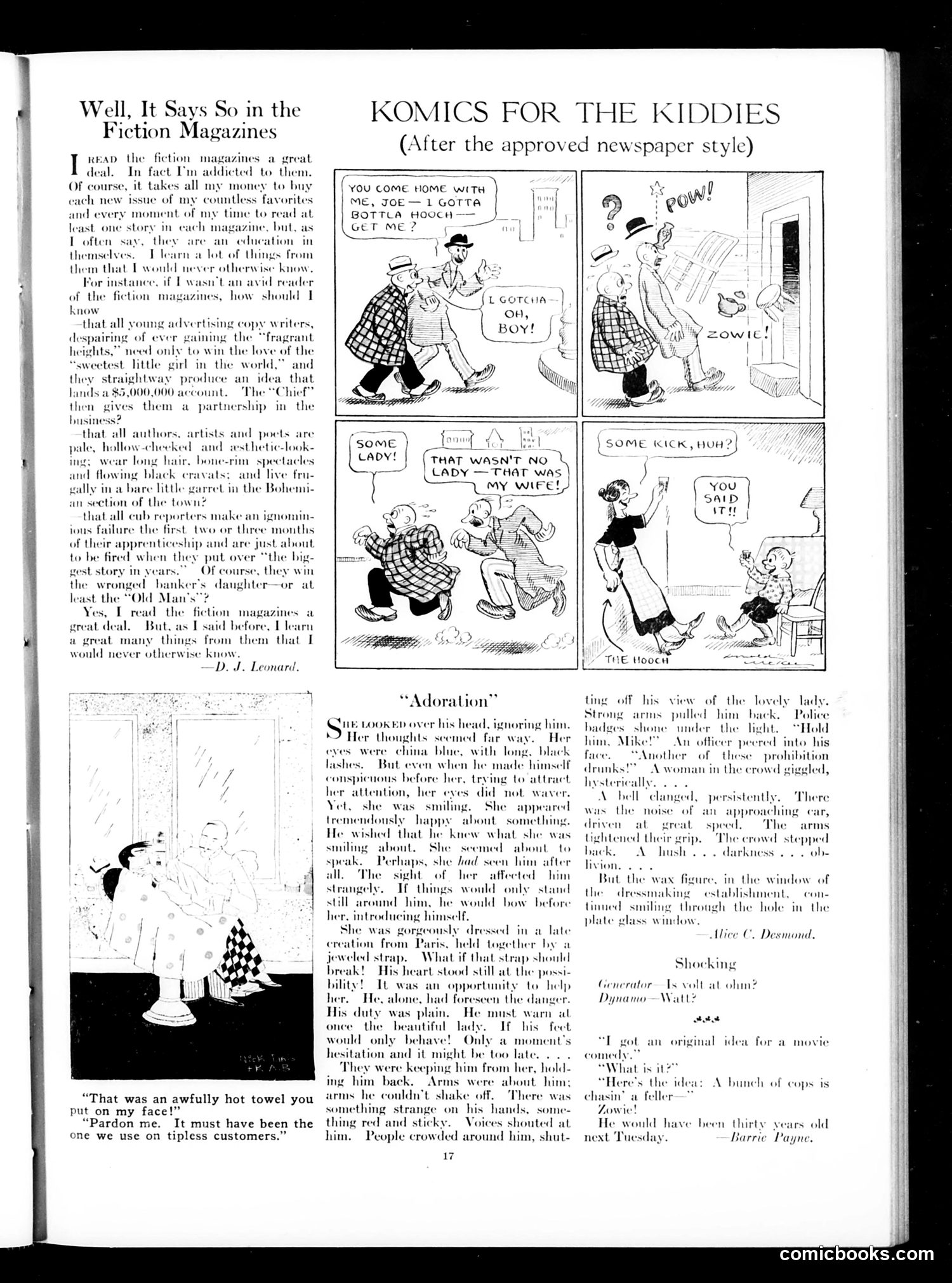
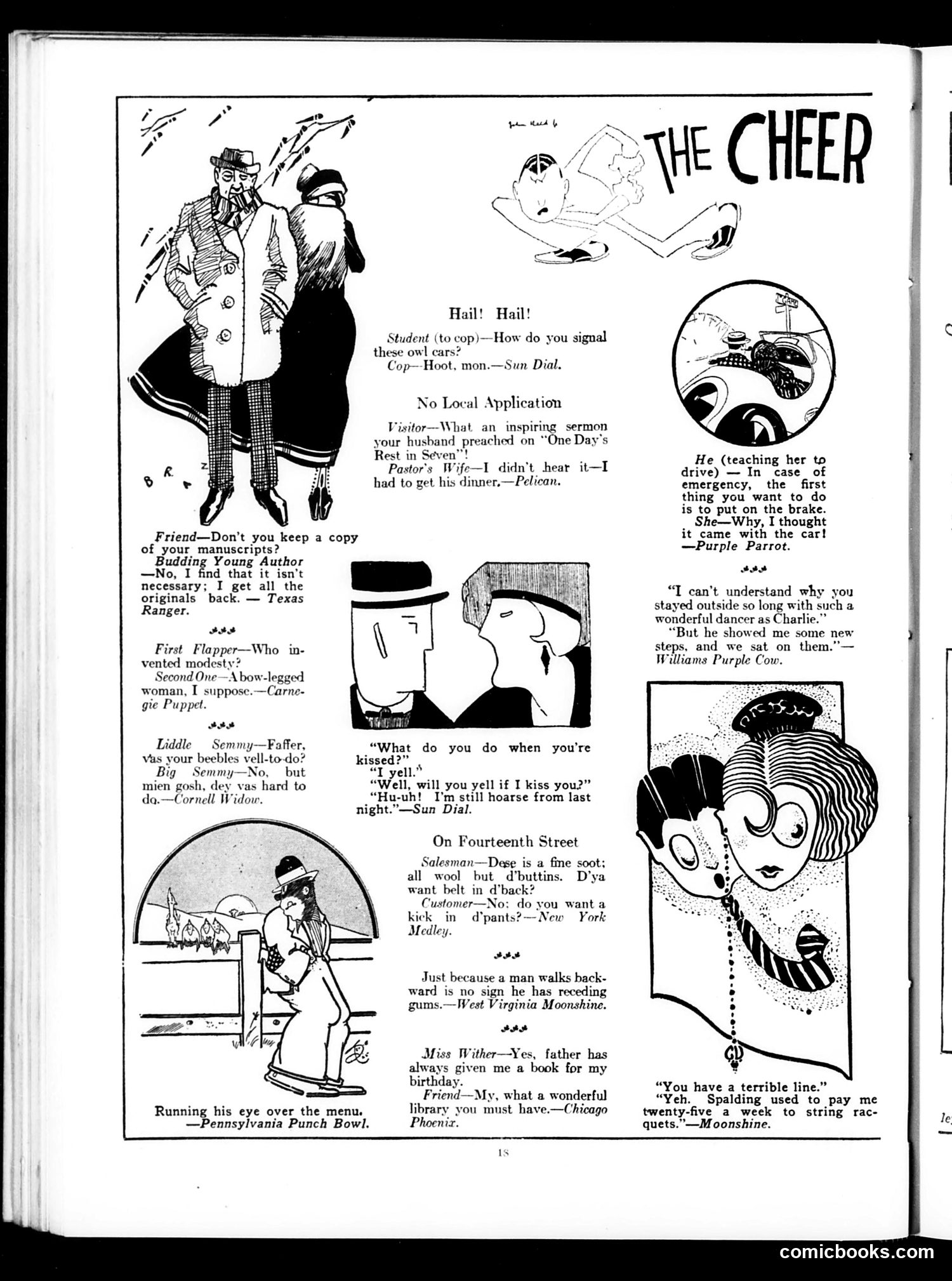
This page collects brief satirical jokes and observations typical of Judge magazine's humor section. The cartoons target early 20th-century social conventions and stereotypes: **Key targets:** - **Gender roles**: A woman learning to drive (humorously portrayed as dangerous), and dating/courtship behavior - **Immigrant/dialect humor**: Multiple jokes featuring exaggerated Yiddish and working-class speech patterns ("Faffer," "d'buttins"), reflecting period attitudes toward immigrant communities - **Class commentary**: References to flappers, "budding authors," and working-class encounters on city streets - **Marriage satire**: A pastor's wife skipping her husband's sermon about rest to prepare dinner **The satire's point**: These gags mock modern social changes (women's independence, changing courtship), pretensions (aspiring writers), and working-class life, while the dialect jokes reflect uncomfortable period prejudices. The overall tone is light rather than pointed—typical of Judge's general-audience humor rather than hard political satire.
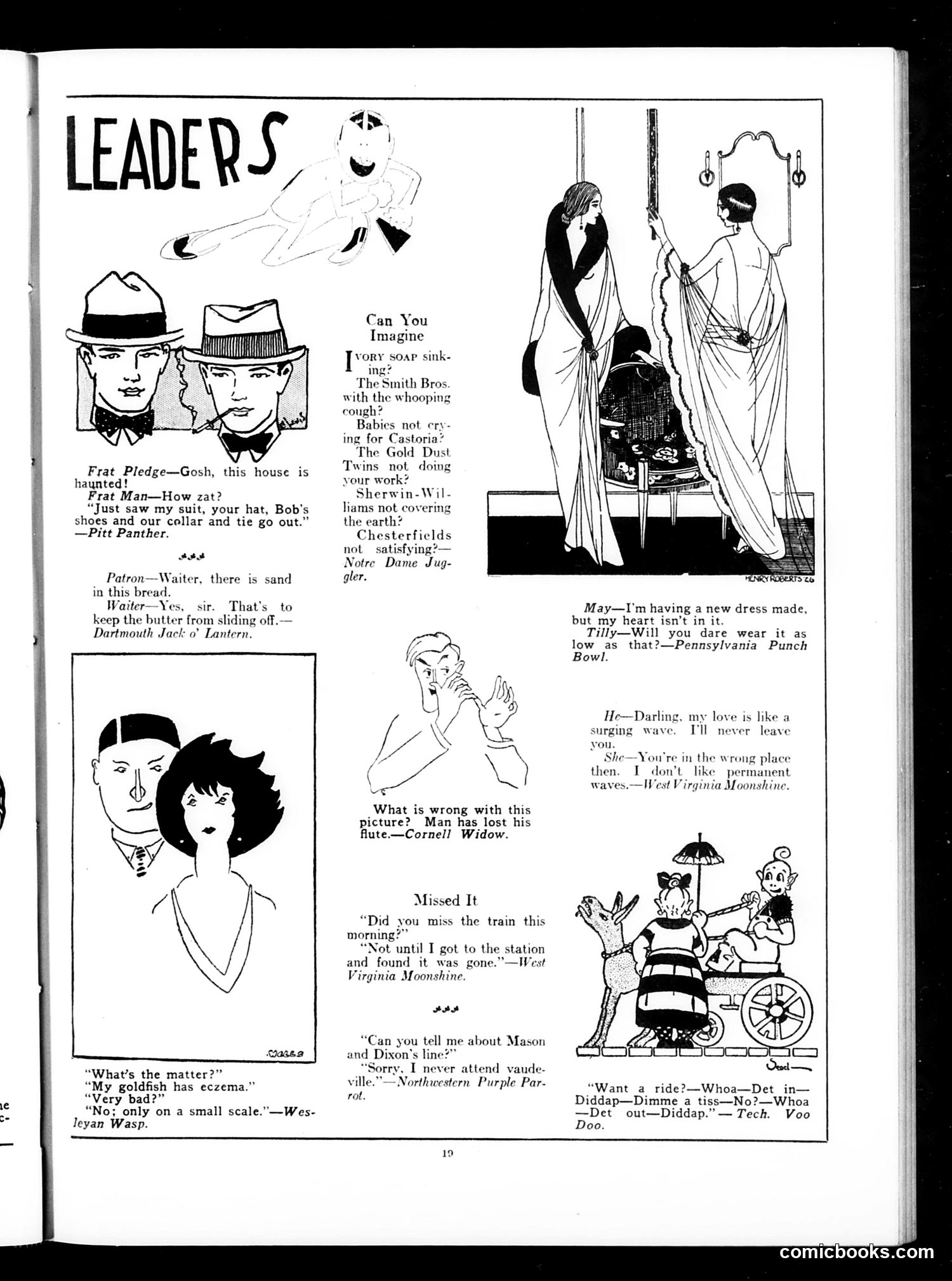
This page collects brief humorous anecdotes and jokes, many sourced from college newspapers (Pitt Panther, Dartmouth Jack o'Lantern, Cornell Widow, etc.). The "Leaders" section mocks famous consumer brands by imagining them failing—Ivory Soap not sinking, Castoria (a children's laxative) babies not crying, Gold Dust Twins not working. These were well-known advertisements of the era, so the humor lies in inverting their marketing promises. The remaining jokes are mostly collegiate humor about dating, courtship mishaps, and wordplay (a woman's "permanent waves" hairstyle misunderstood as emotional commitment; a man missing a train only *after* arriving at the station). The cartoon illustrations—showing fashionable 1920s figures—accompany these lighthearted, somewhat dated romantic and social scenarios typical of Judge's satirical college-humor offerings.
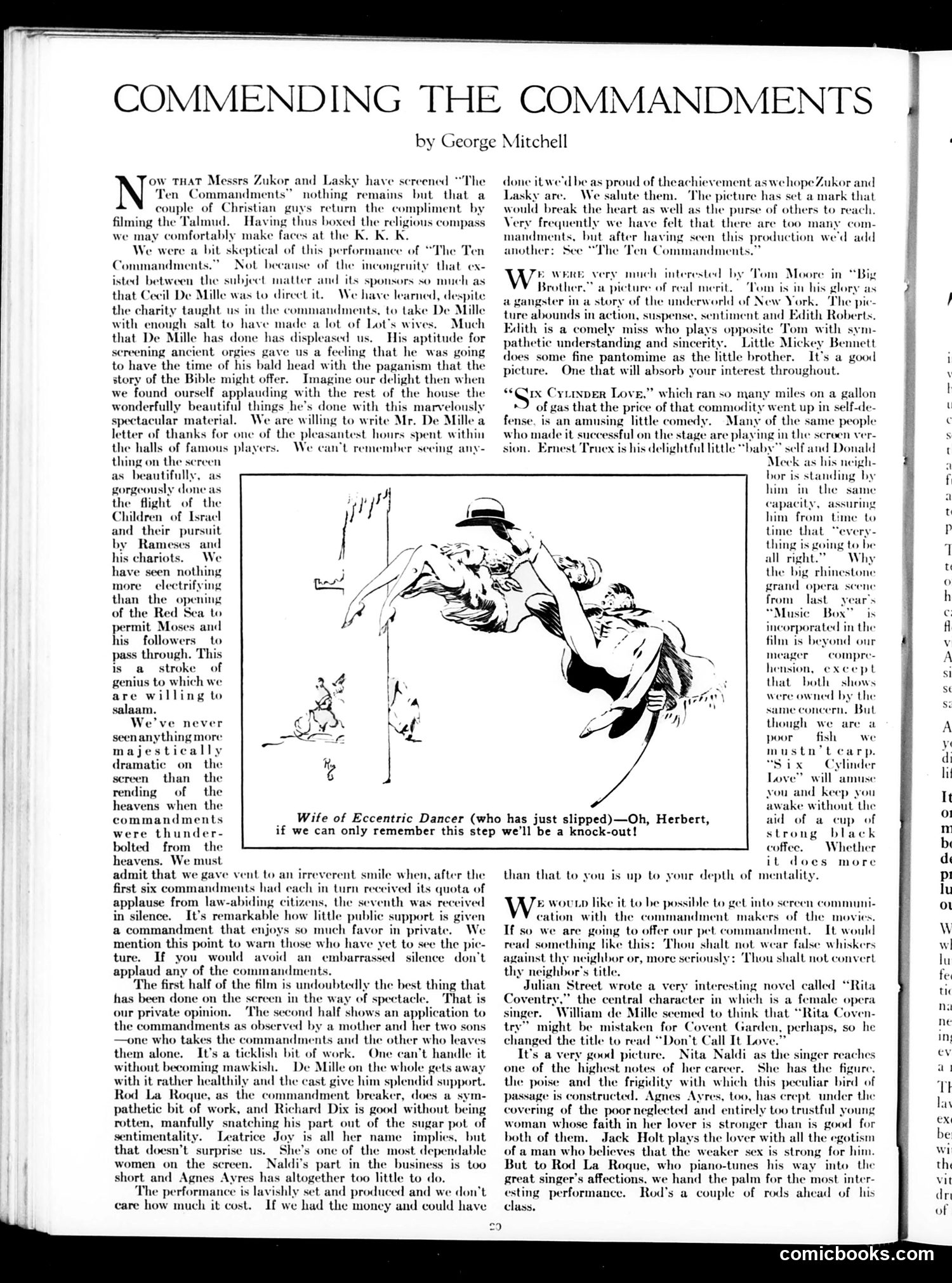
This is a film review by George Mitchell praising Cecil B. DeMille's 1923 film *The Ten Commandments*. The satire operates on multiple levels: **The Main Joke**: Mitchell initially expresses skepticism about DeMille directing biblical material, given his reputation for staging elaborate "ancient orgies" and spectacle. The humor lies in DeMille's actual *restraint*—he succeeds despite expectations he'd turn scripture into sensationalism. **The Cartoon**: Shows a dancer's wife observing her husband's "eccentric" dancing move, joking they'll perfect it as a "knock-out"—a lighthearted aside unrelated to the main review. **The Deeper Satire**: The review subtly mocks American religiosity, noting audiences applauded the first six commandments but gave the seventh (adultery) "silence"—because it "enjoys so much favor in private." This exposes hypocrisy about publicly espoused versus privately practiced morality. The piece reflects 1920s anxieties about cinema's relationship to religious content and morality.
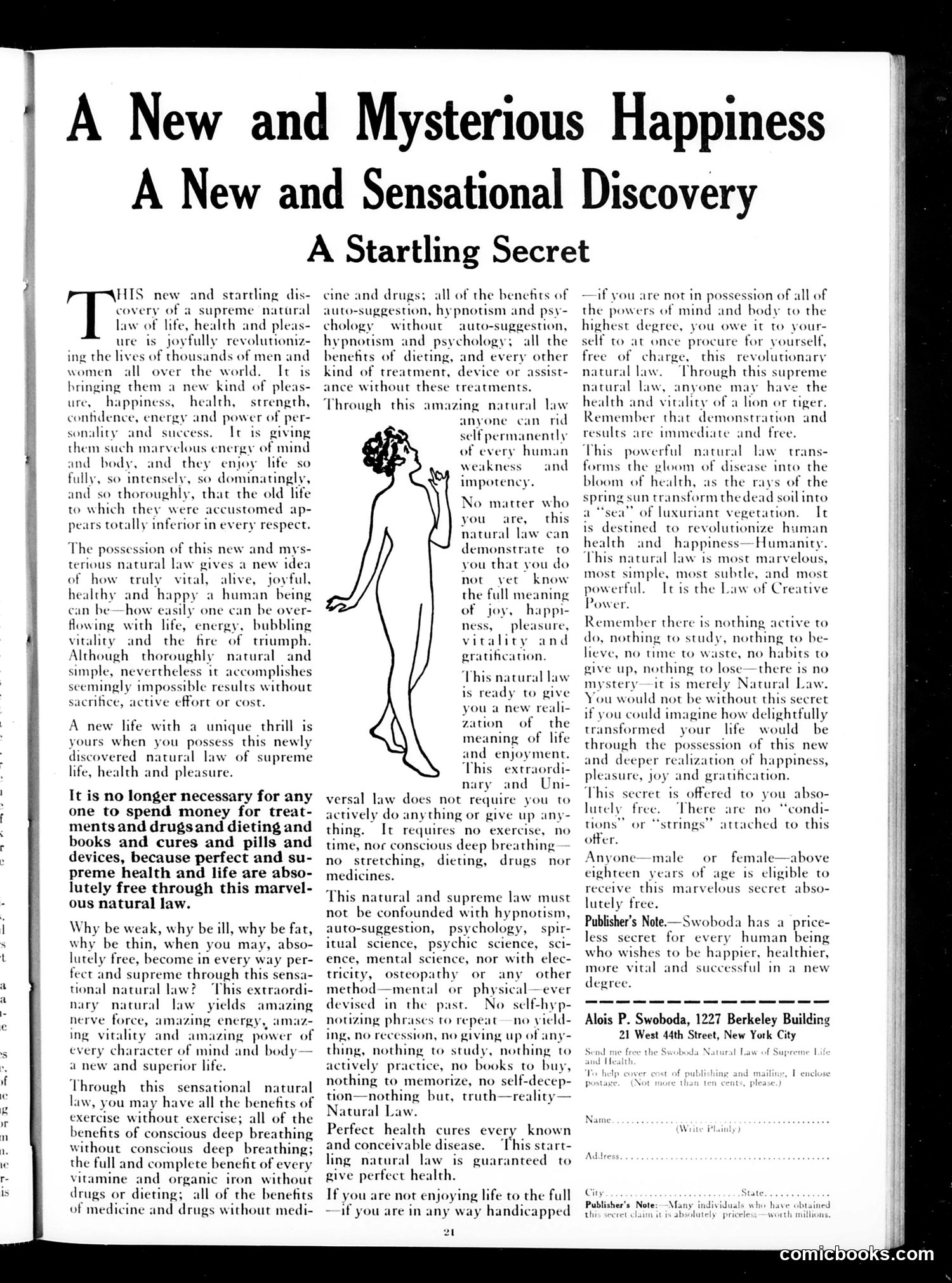
This is a **full-page advertisement**, not satirical content from Judge magazine itself. It's a pitch for an unnamed self-help system claiming to deliver perfect health, happiness, and vitality through a "natural law" requiring no effort, exercise, dieting, medicine, or conscious action. The advertisement's rhetorical strategy reveals what modern readers would recognize as **pseudoscientific snake-oil marketing**. It promises to deliver benefits "without exercise," "without dieting," "without medicine"—essentially claiming magical results through passive acceptance of an unspecified secret. The image shows a simplified female figure, emphasizing physical transformation. **Historical context**: This appears to be early 20th-century wellness fraud, exploiting public interest in "natural" remedies and emerging psychology (hypnotism, suggestion). The vague promises and deliberate obscurity about what the actual product/method is—combined with the emphasis on ease and freedom—are classic confidence-scheme tactics targeting vulnerable readers seeking health solutions.
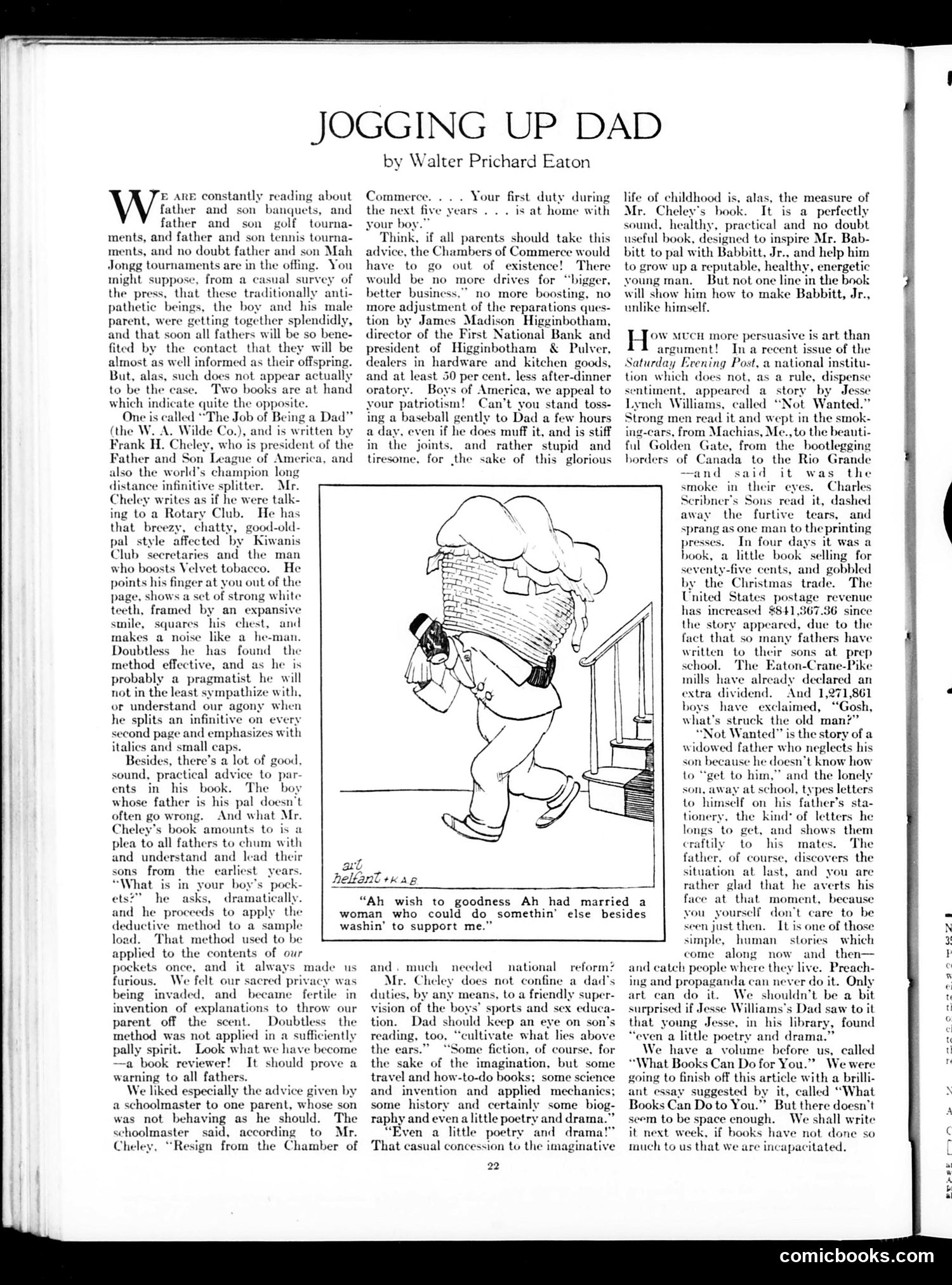
This article reviews two books promoting father-son relationships during an era of popularized "father and son" social events (banquets, golf tournaments). **The Satire:** The author (Walter Prichard Eaton) mocks the earnest, boosterish tone of Frank H. Cheley's parenting manual "The Job of Being a Dad." He caricatures Cheley's writing style as typical of Rotary Club and Kiwanis Club speakers—aggressively cheerful, finger-pointing, self-help rhetoric ("he-man" posturing). **The Political Joke:** Eaton ironically warns that if fathers actually befriended their sons as advised, Chambers of Commerce would collapse because boys wouldn't grow into business-obsessed men like "James Madison Higginbotham"—a satirical everyman businessman. The implication: capitalism requires fathers remain distant authority figures who produce sons destined for commercial ambition. **The Contrast:** He then praises Jesse Lynch Williams's short story "Not Wanted" (published in *Saturday Evening Post*) as more effective than self-help advice—its emotional resonance reportedly caused widespread tears and instant bestseller status.
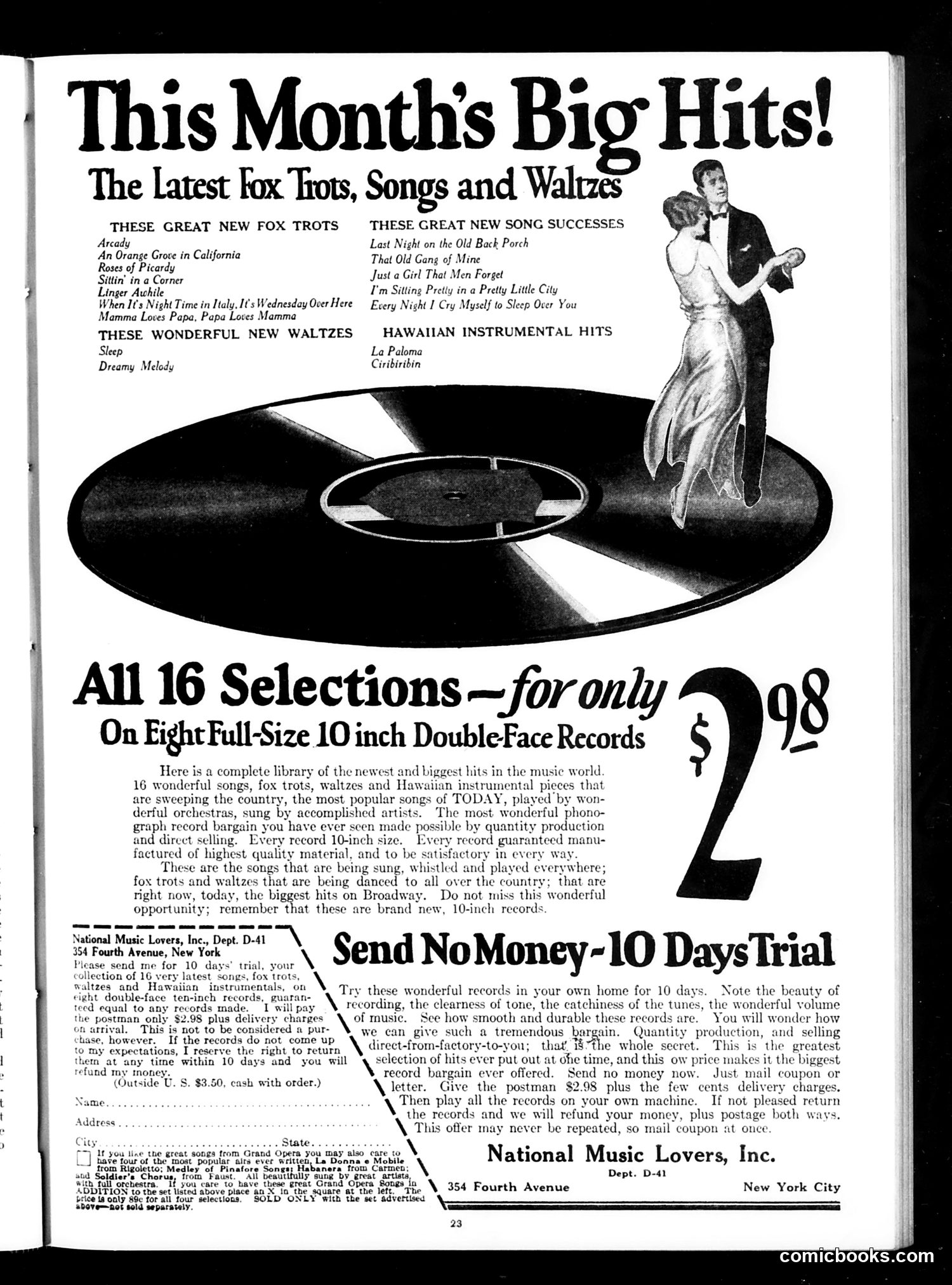
This is primarily a **mail-order advertisement**, not a satirical cartoon. It's from Judge magazine but contains no political satire or caricature. The page advertises phonograph records from National Music Lovers, Inc.—sixteen 10-inch double-sided records for $2.98, offered on a 10-day trial basis with no money required upfront. The illustration shows a couple dancing beside a record, reflecting the era's entertainment culture. The "hits" listed represent popular 1920s music: fox trots (a dance craze), waltzes, and Hawaiian instrumental pieces. Song titles like "Mamma Loves Papa, Papa Loves Mamma" and "I'm Sitting Pretty in a Pretty Little City" reflect period sentiments. The advertisement emphasizes "quantity production and direct selling" as justifying the low price—an early example of mail-order retail marketing. The 10-day trial concept (return if unsatisfied) was a novel sales technique for the era. This reflects 1920s American consumer culture and the phonograph's role as a home entertainment medium.
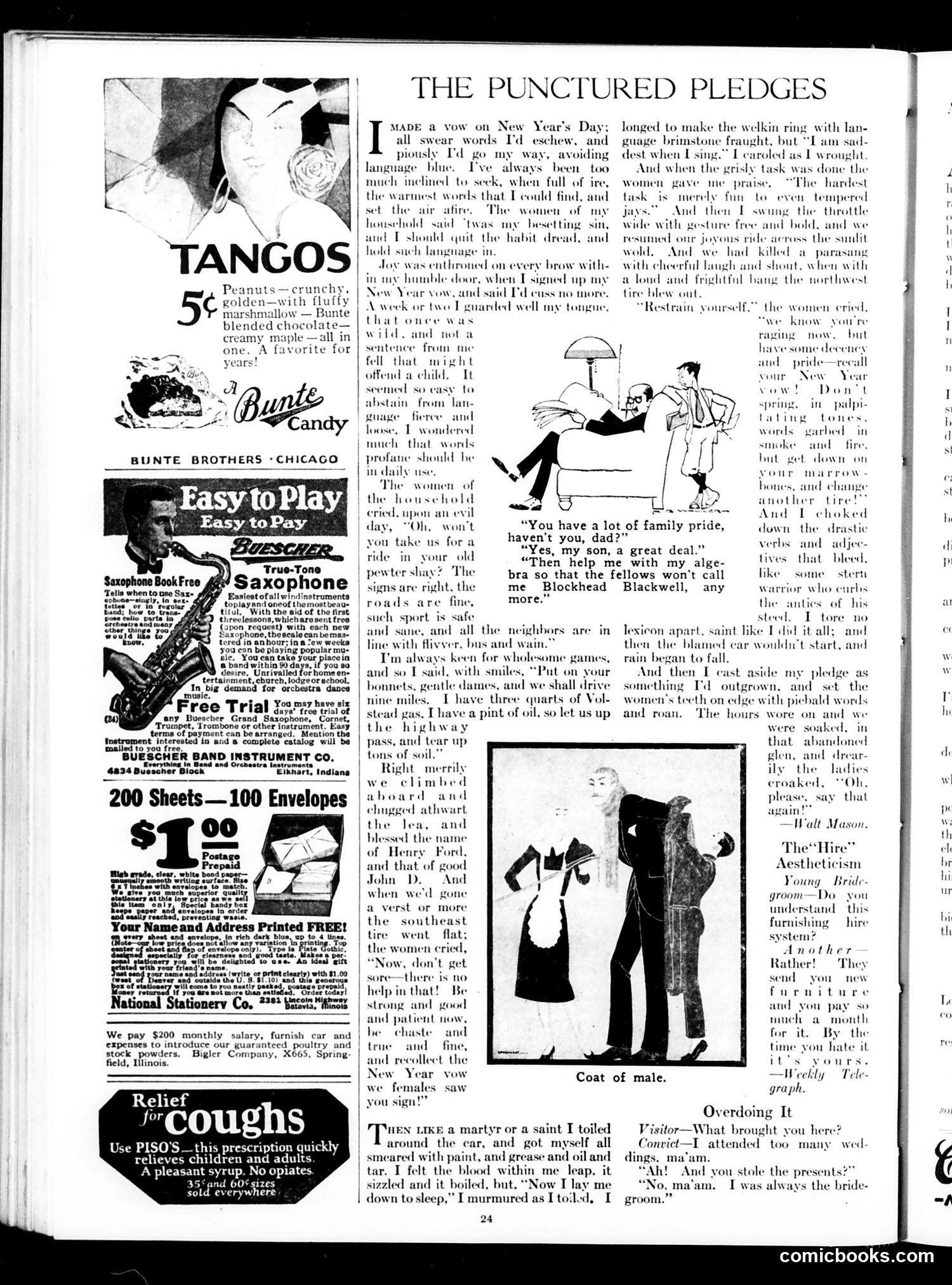
This is a humorous story-with-illustrations about a man who makes a New Year's resolution to stop swearing. He pledges to avoid "language blue" after his household complains his profanity "sets the air afire." For a week he succeeds, but then takes his wife and daughters on a car trip. When their car gets a flat tire, he must work strenuously in the heat, covered in grease and oil. The comedy lies in his internal struggle: he desperately wants to curse but keeps reciting calming phrases ("Now I lay me down to sleep") to honor his pledge. His family observes his obvious strain and praises his "family pride" for maintaining composure. The satire targets both the absurdity of making such pledges and the hypocrisy of New Year's resolutions—he's technically kept his vow but is clearly suffering comically in the attempt. The page is primarily this story with period advertisements (Bunte candy, musical instruments, stationery, cough medicine).
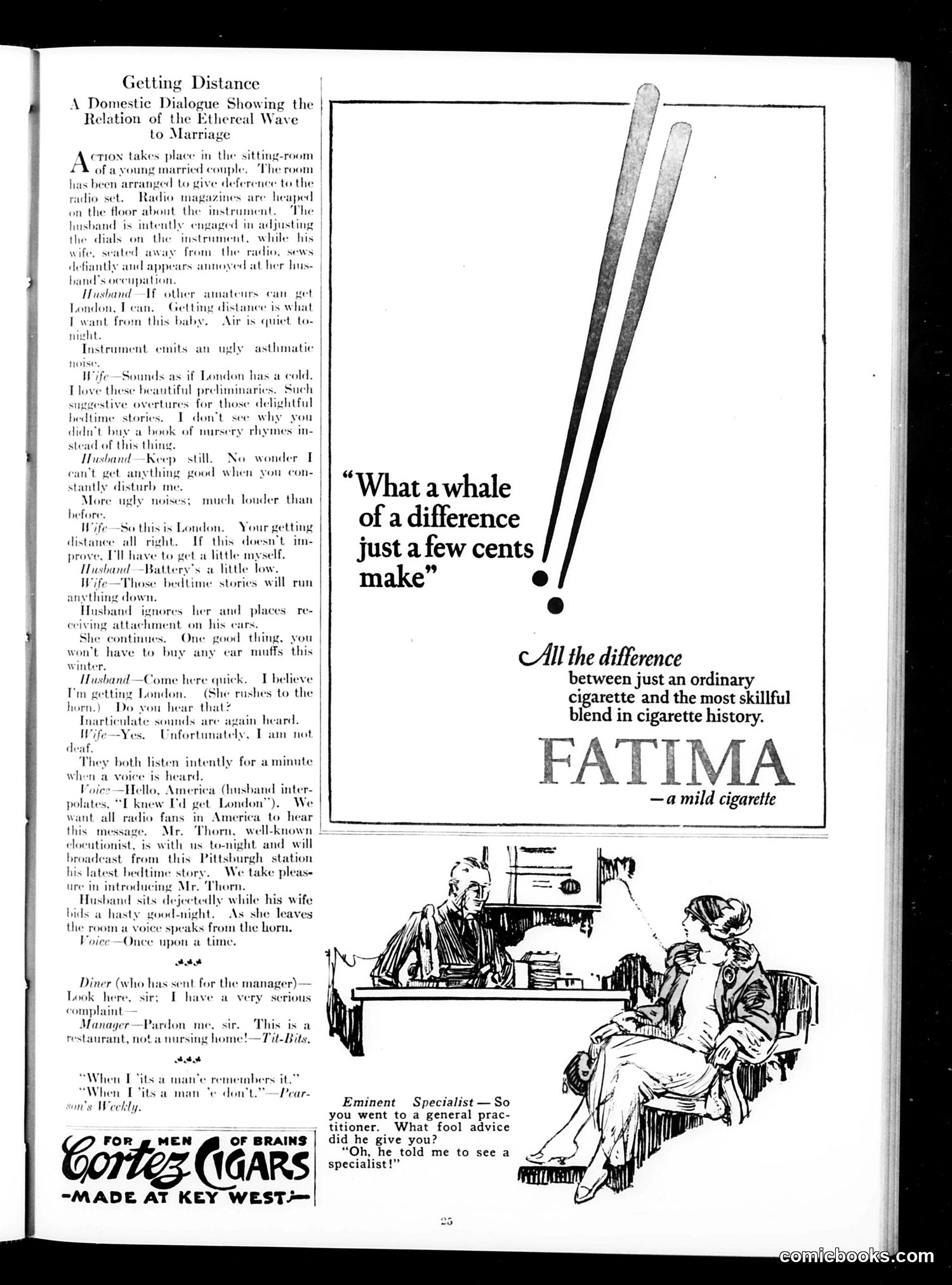
This page contains a domestic comedy sketch and period advertisements. **"Getting Distance" Sketch:** A newly married couple demonstrates how radio technology disrupts household harmony. The husband obsessively tinkers with a radio set, attempting to receive distant broadcasts ("getting distance")—a popular amateur radio hobby of the early wireless era. His wife, relegated to sewing nearby, grows increasingly annoyed by the ugly static and mechanical noise. When he finally receives a transmission from London featuring a bedtime story reader named Mr. Thorn, the wife sarcastically comments that at least she won't need ear muffs that winter, then exits as the story begins "Once upon a time." **The Satire:** The sketch mocks how emerging technology captivates men while excluding and frustrating their wives, inverting domestic priorities. Radio becomes a marital wedge. **Advertisements:** A Fatima cigarette ad and Cortez cigars ad occupy the lower portion—typical period marketing emphasizing product quality through minimal cost differences. The humor derives from radio's novelty status and gender-role tensions in early 20th-century households.
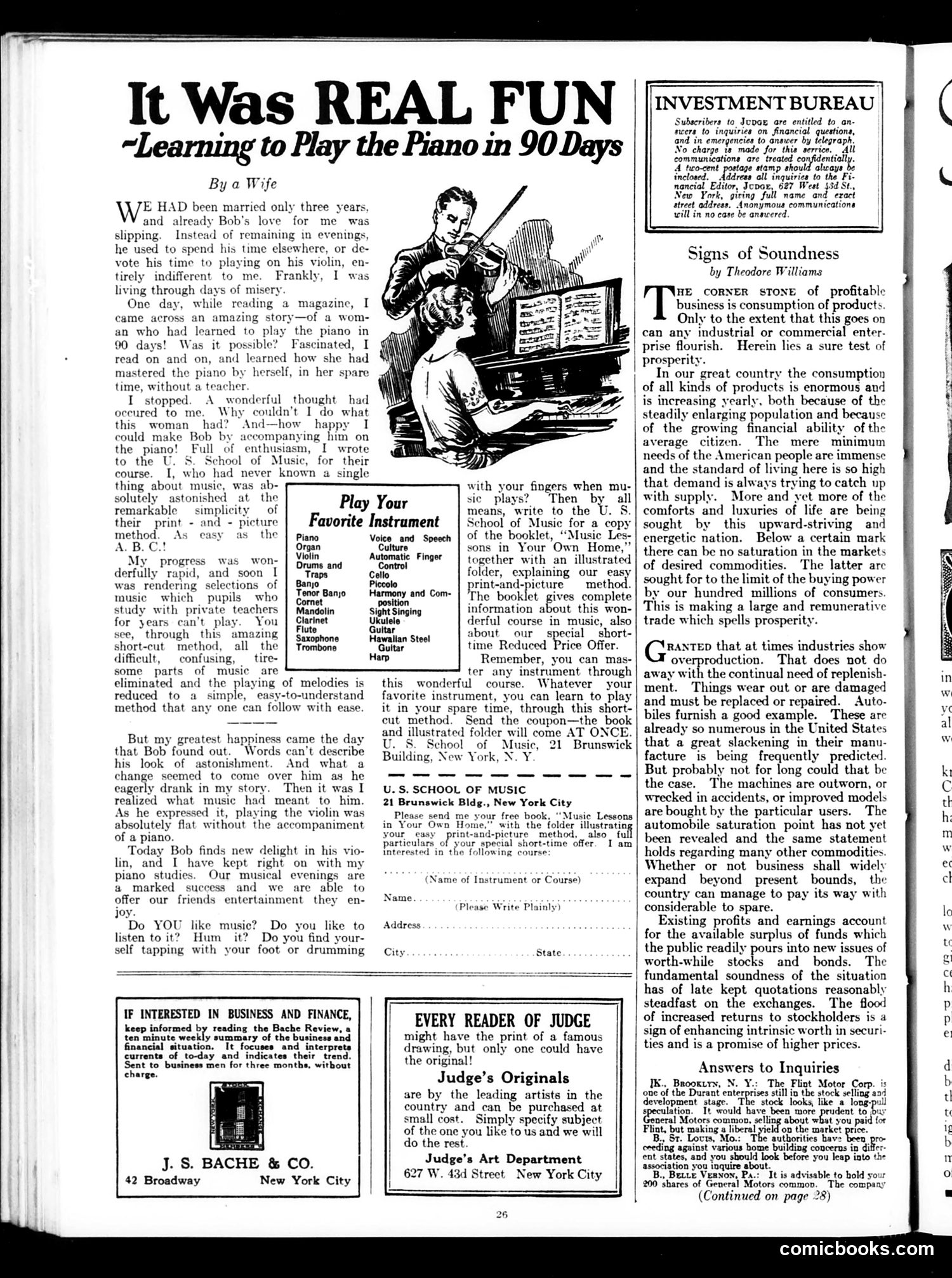
This page contains **primarily advertising** disguised as editorial content. The main feature, "It Was Real Fun," is a testimonial-style advertisement for the U.S. School of Music's mail-order piano course. **The "Satire"**: The piece gently mocks a common domestic anxiety of the era—a wife's fear that her husband is losing interest in her. The solution presented is absurdly simple: she learns piano in 90 days through a correspondence course, which miraculously saves their marriage by accompanying his violin playing. **The Real Message**: This is **not actually satirizing** anything; it's marketing. The narrative structure mimics genuine magazine stories to seem authentic and relatable. The "90 days" claim was a common marketing hook for self-improvement products of this period. **Historical Context**: Early 20th-century mail-order music instruction was heavily advertised in magazines like *Judge*, promising quick, easy mastery without teachers—an appealing fantasy to readers. The page's layout also includes other advertisements (J.S. Bache investment services, Judge's art reproductions), typical of such publications.
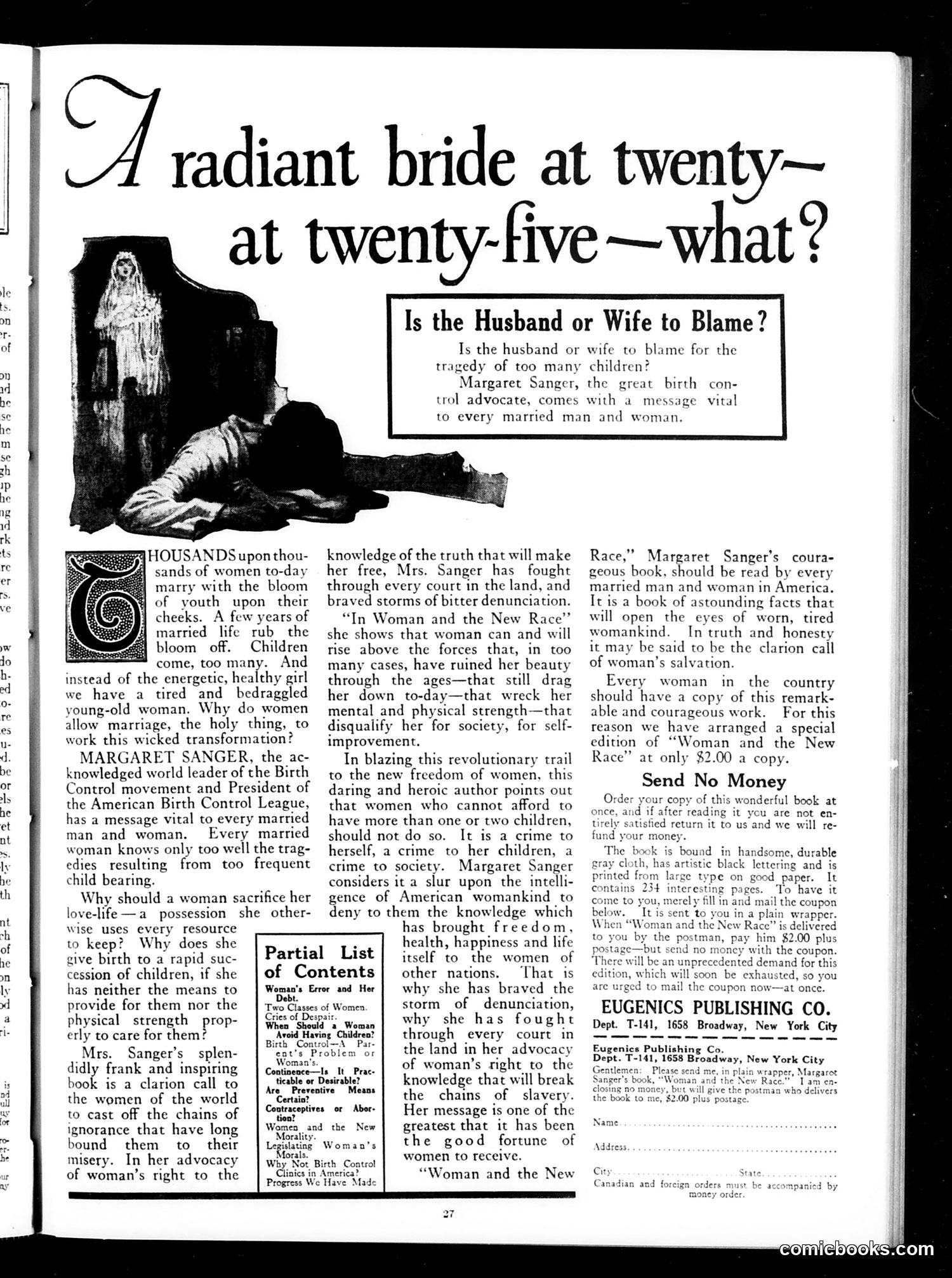
This page advertises Margaret Sanger's book *"Woman and the New Race"* through satirical imagery and advocacy. The cartoon at top depicts a radiant bride at twenty contrasted with an exhausted, aged woman at twenty-five—illustrating the toll of repeated pregnancies on women's health and appearance. The advertisement promotes Sanger's birth-control advocacy, presenting it as liberation from the "chains of slavery" and a remedy for the physical and mental deterioration caused by frequent childbearing. The text frames birth control as both a woman's right to knowledge and a moral imperative—arguing that having children one cannot afford is "a crime to herself, a crime to her children, a crime to society." This reflects the 1920s birth-control movement's arguments: women's autonomy, health preservation, and economic responsibility. The framing as "revolutionary" and "daring" acknowledges that despite Sanger's courtroom victories, birth control remained controversial and legally restricted in many states.
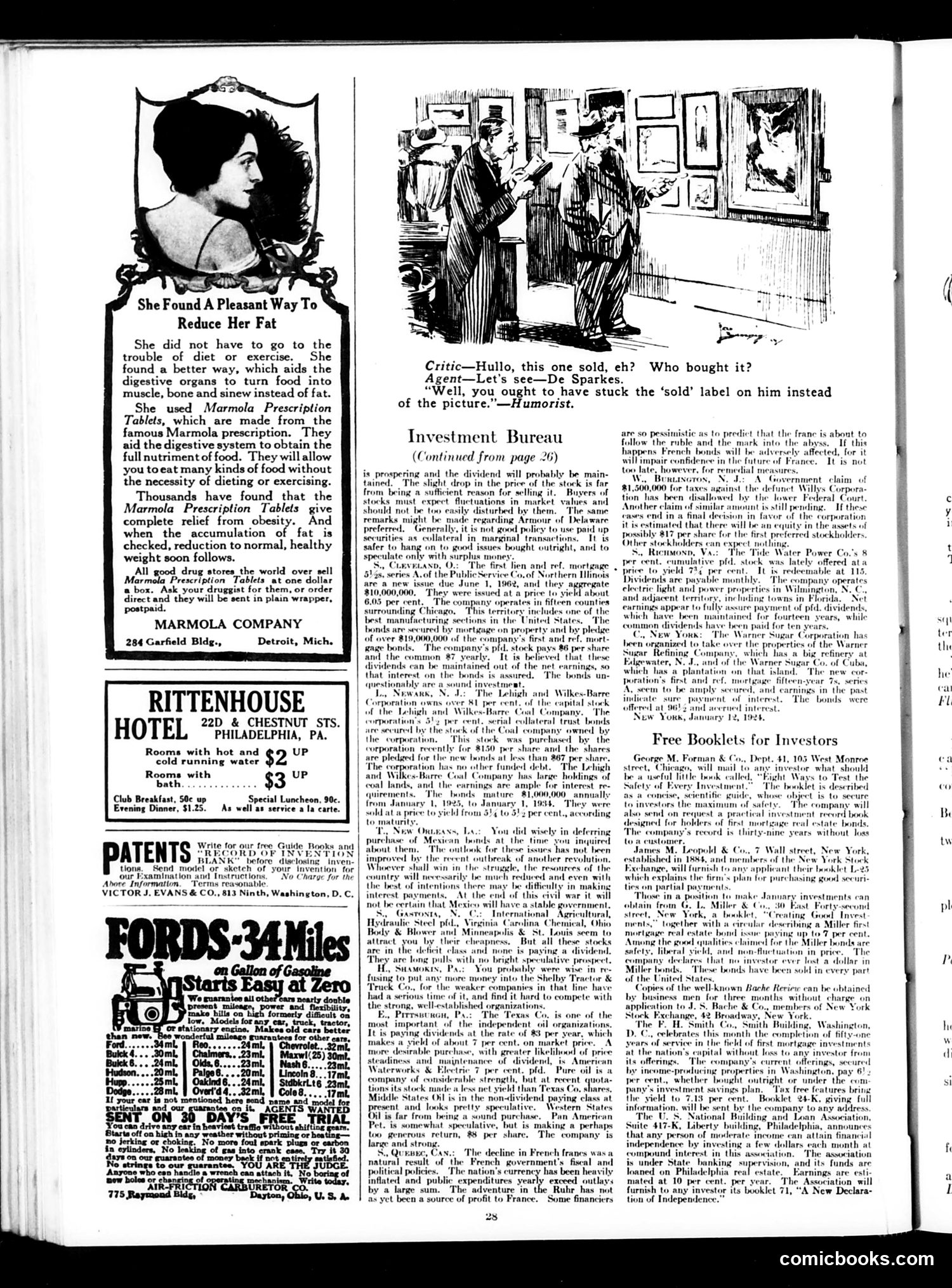
This page contains primarily **advertisements and financial content** rather than political satire. The main satirical cartoon (upper right) shows an art gallery scene with a critic mocking an art dealer. The joke: when the critic learns a painting sold, he quips that the dealer should have placed the "sold" label on the buyer (De Sparkes) instead of the painting—implying the buyer is foolish or worthless. The rest of the page is dominated by ads for **Marmola Prescription Tablets** (a weight-loss product claiming to convert food to muscle rather than fat) and the **Rittenhouse Hotel** in Philadelphia, along with extensive financial commentary about bonds, stocks, and investment opportunities. This reflects Judge's dual nature: while known for political cartooning, it also functioned as a general-interest magazine with advertising revenue. The single cartoon here is mild social humor about art-world pretension, not political commentary.
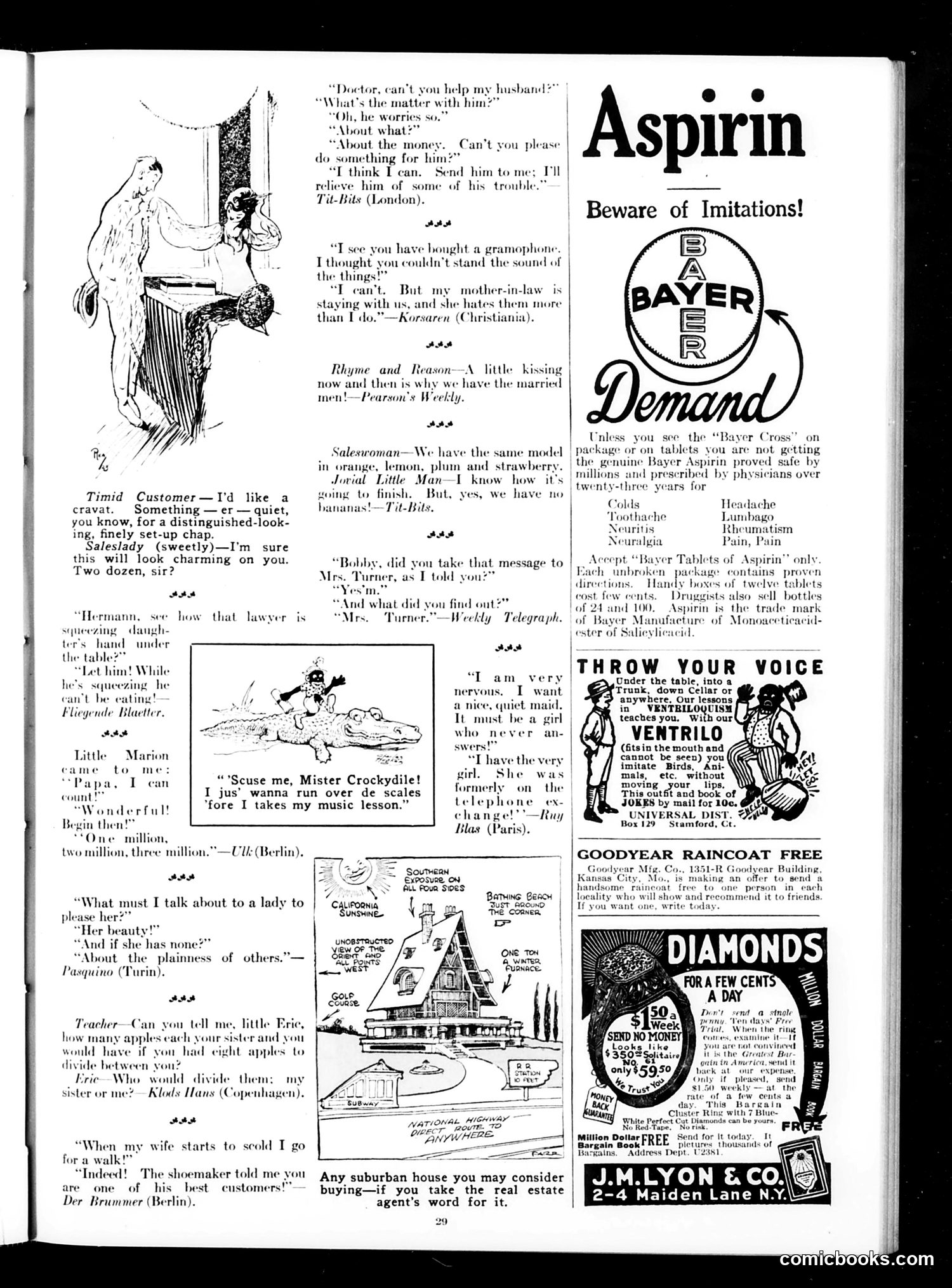
This page primarily contains **humor columns and advertisements** rather than political cartoons. The humorous anecdotes—drawn from international sources (London, Berlin, Paris, Copenhagen, Turin)—are brief, domestic jokes typical of early 20th-century magazines. They mock recognizable social types: timid customers, nagging wives, anxious husbands worried about money, intrusive mothers-in-law, and pedantic teachers. The humor relies on mild marital discord and class-conscious observations (the shoemaker's customer, the real estate agent's exaggeration). The cartoons themselves are minor—simple line drawings accompanying jokes, not satirical commentary on political events. **The advertisements** dominate: Bayer Aspirin (warning against counterfeits), a ventriloquism correspondence course, Goodyear raincoats, and diamond rings. These ads reflect 1920s-30s consumer culture and mail-order commerce. The page is essentially a **typical Judge layout**—humor anthology plus advertisements—rather than satirical political content.
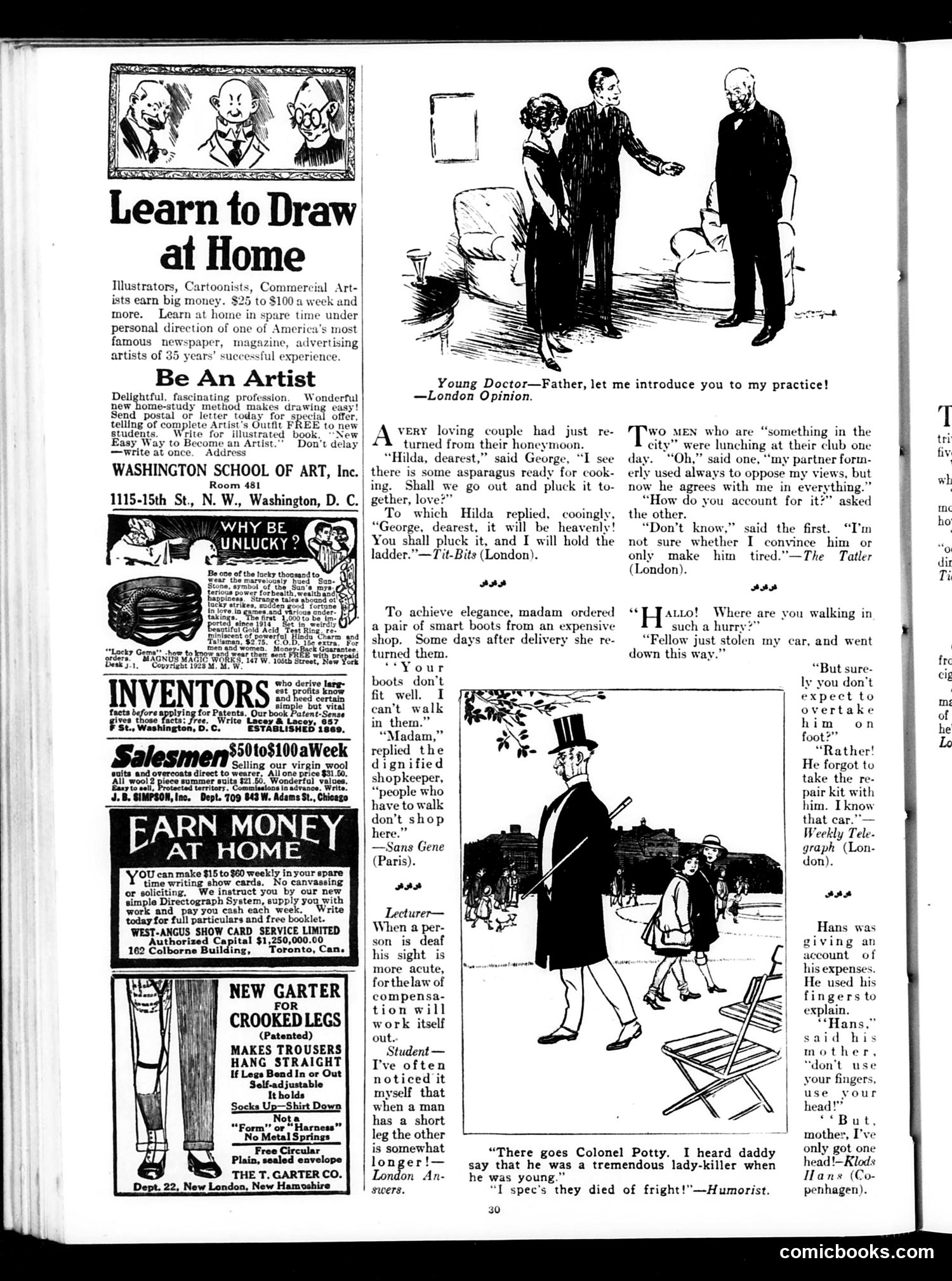
This page from *Judge* (a satirical American magazine) consists primarily of **advertisements and comic anecdotes**, rather than political cartoons. The main content includes several short humorous stories with illustrations: 1. **"Young Doctor"**: A joke about introducing one's medical practice to one's father—likely satirizing professional pretension. 2. **"Two Men at Club"**: A satire on intellectual disagreement, where one man claims his opponent now agrees with him on everything, but admits uncertainty whether he actually convinced him or merely "tired" him into submission—mocking stubborn debate. 3. **"Boot Shop"**: A shopkeeper's dismissive reply to a customer—"people who have to walk don't shop here"—satirizing class attitudes and customer service. 4. **"Stolen Car"**: A joke about pursuing a car thief on foot while the thief forgot his repair kit. 5. **"Colonel Potty"**: A gag about a man reputed as a ladies' man in youth. The page is otherwise dominated by mail-order advertisements (art instruction, inventions, clothing, "unlucky" charms) typical of 1920s-era magazines.
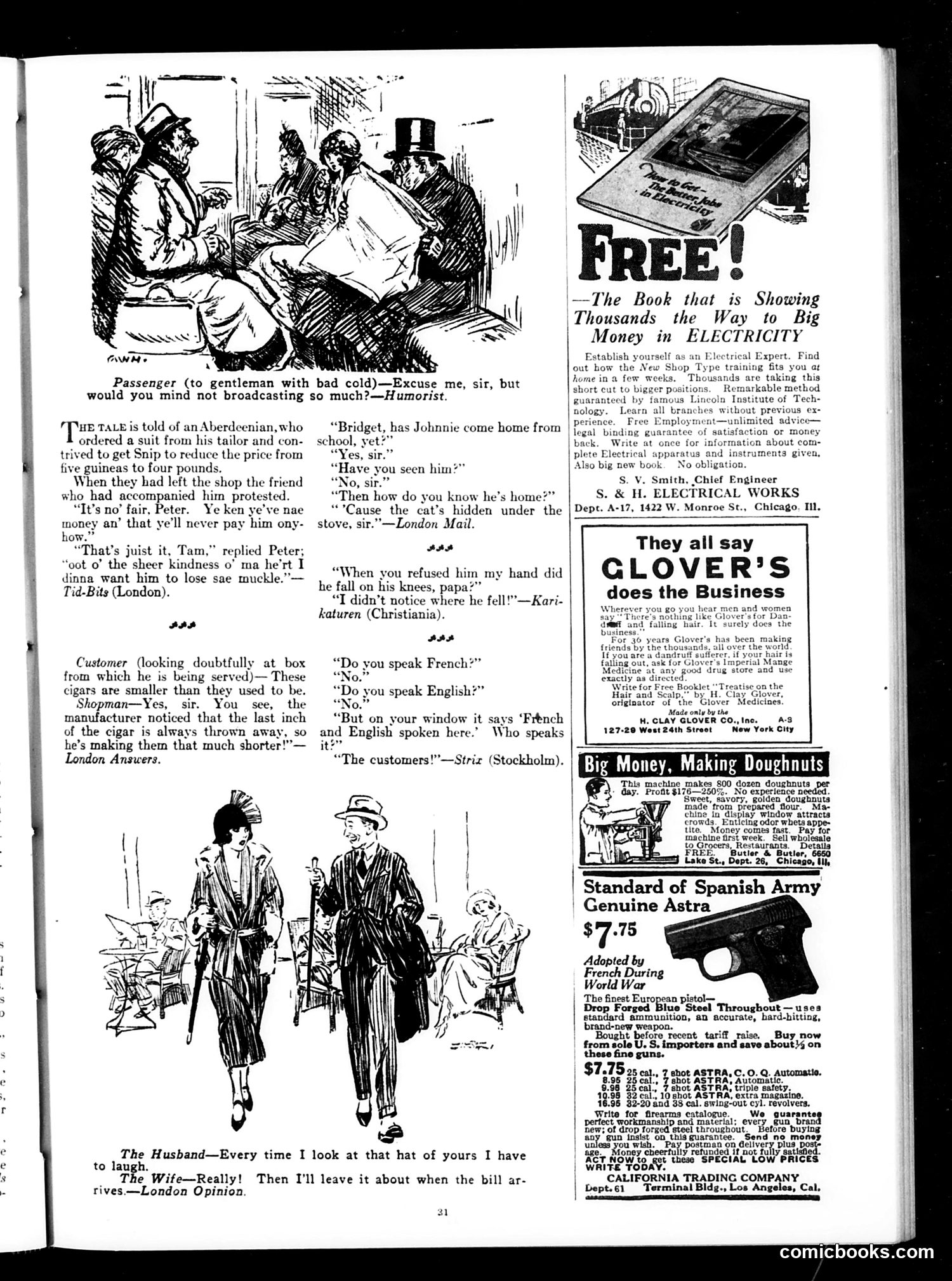
This page contains **humor shorts and period advertisements** rather than political cartoons. The jokes are brief, sourced from various international publications: **The Humor:** The cartoons and jokes mock everyday social situations—a Scottish man's dishonest haggling, shrinking cigars, a wife's expensive hat, a man broadcasting his cold like radio, a housekeeper's logic about the cat, a rejected suitor, and a language barrier at a foreign shop. These are gentle domestic satires with no political content. **The Advertisements:** The right side features vintage mail-order ads typical of 1920s-era Judge: electrical training courses, hair tonic ("Glover's"), a doughnut-making machine for profit, and firearms. These ads reflect the era's entrepreneurial spirit and consumer culture. **Historical Context:** The "broadcasting" reference suggests this is post-1920 (radio era). The French/Spanish language jokes and international joke credits reveal Judge's cosmopolitan readership. The ads' promises of quick wealth and self-improvement reflect 1920s optimism. **No political satire is present on this page.**
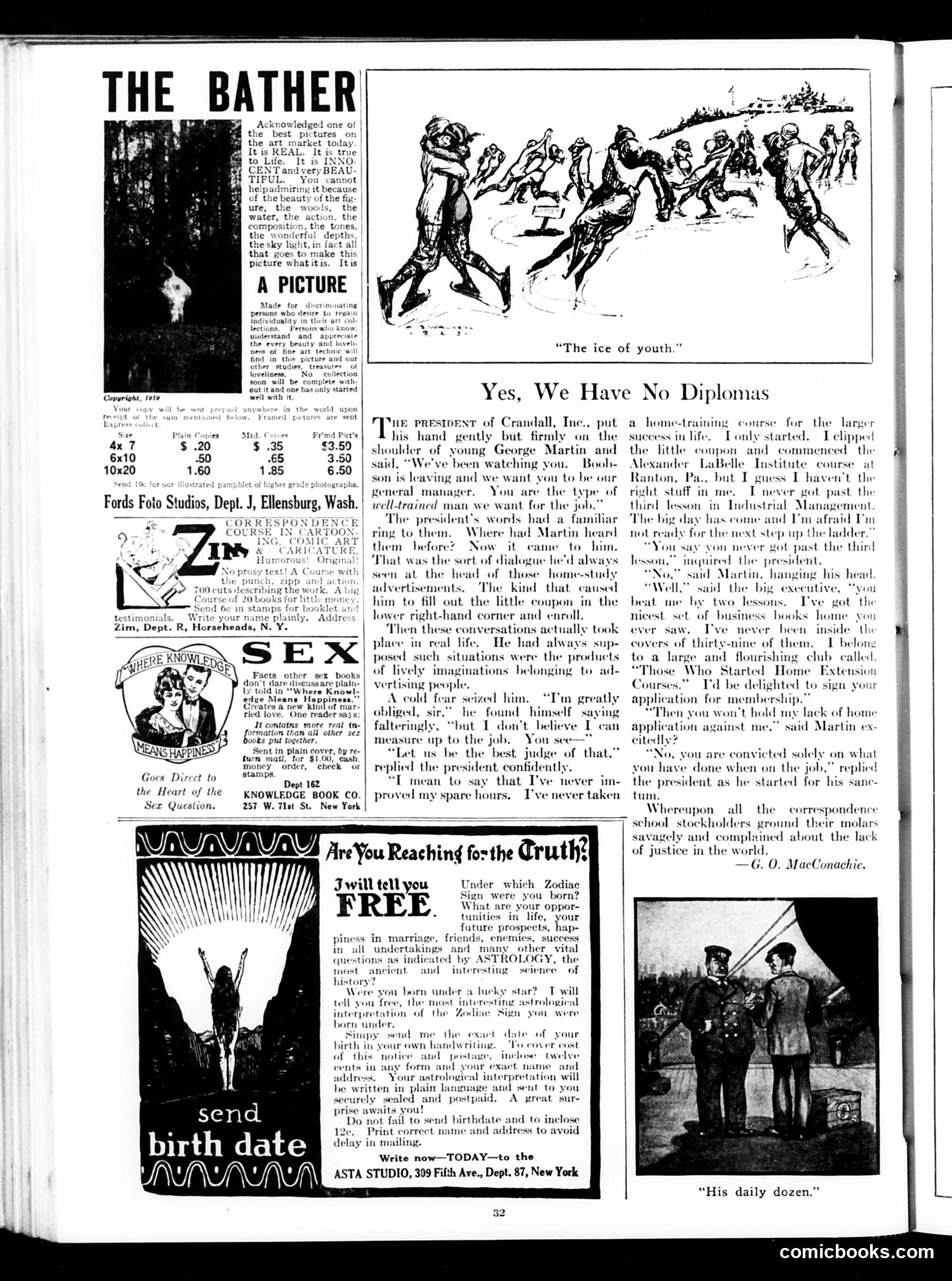
This satirical story mocks the home-study course industry that was booming in the early 20th century. Young George Martin receives a job promotion after filling out a mail-order business course coupon—but he never actually completed it. When he confesses his failure to the company president, the executive reveals he's also a correspondence-course dropout with thirty-nine unread business books at home. He belongs to a club called "Those Who Started Home Extension Courses." The satire targets two things: the false promises of mail-order education programs (which used testimonial-style dialogue in advertisements to lure buyers), and the broader American tendency to purchase self-improvement materials without following through. The ending suggests these incomplete courses were so common among business leaders that failure to complete them was practically a badge of corporate membership. The accompanying advertisements for zodiac readings and "SEX" books reinforce the page's mockery of dubious mail-order schemes.
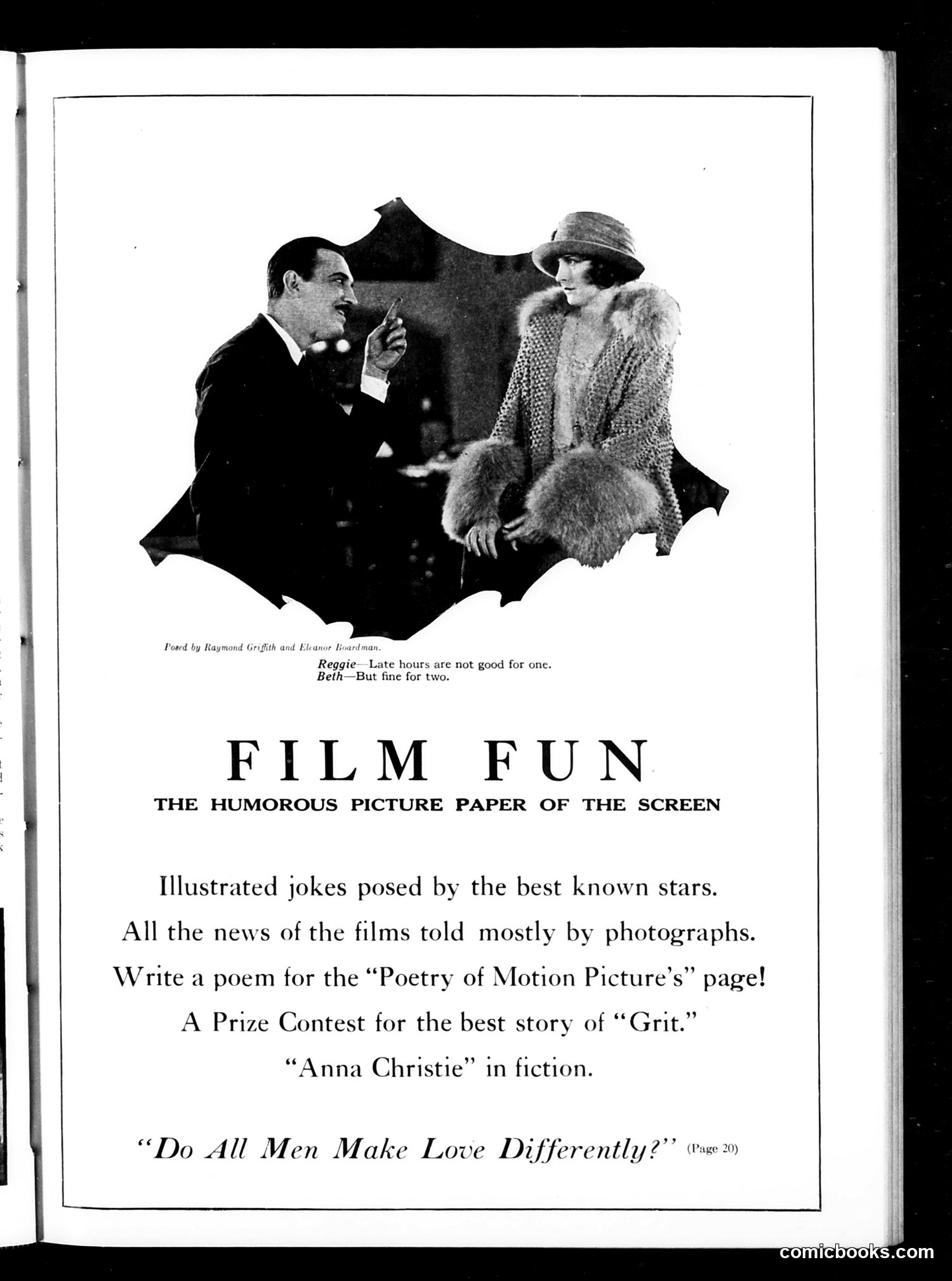
This appears to be a title/contents page for **Film Fun**, a humorous magazine about cinema. The photograph shows actors **Raymond Griffith and Eleanor Boardman** posing for an illustrated joke about dating etiquette: a man (Reggie) warns that late nights are unhealthy, while a woman (Beth) flirtatiously counters that they're "fine for two"—a mild innuendo playing on romantic companionship. The page advertises the magazine's features: illustrated jokes by movie stars, film news in photographs, and contests including one about "Anna Christie" (likely referencing a contemporary film). The overall tone is lighthearted romantic comedy typical of 1920s entertainment magazines, targeting readers interested in cinema gossip and celebrity humor. The joke reflects period attitudes about courtship and gender dynamics.
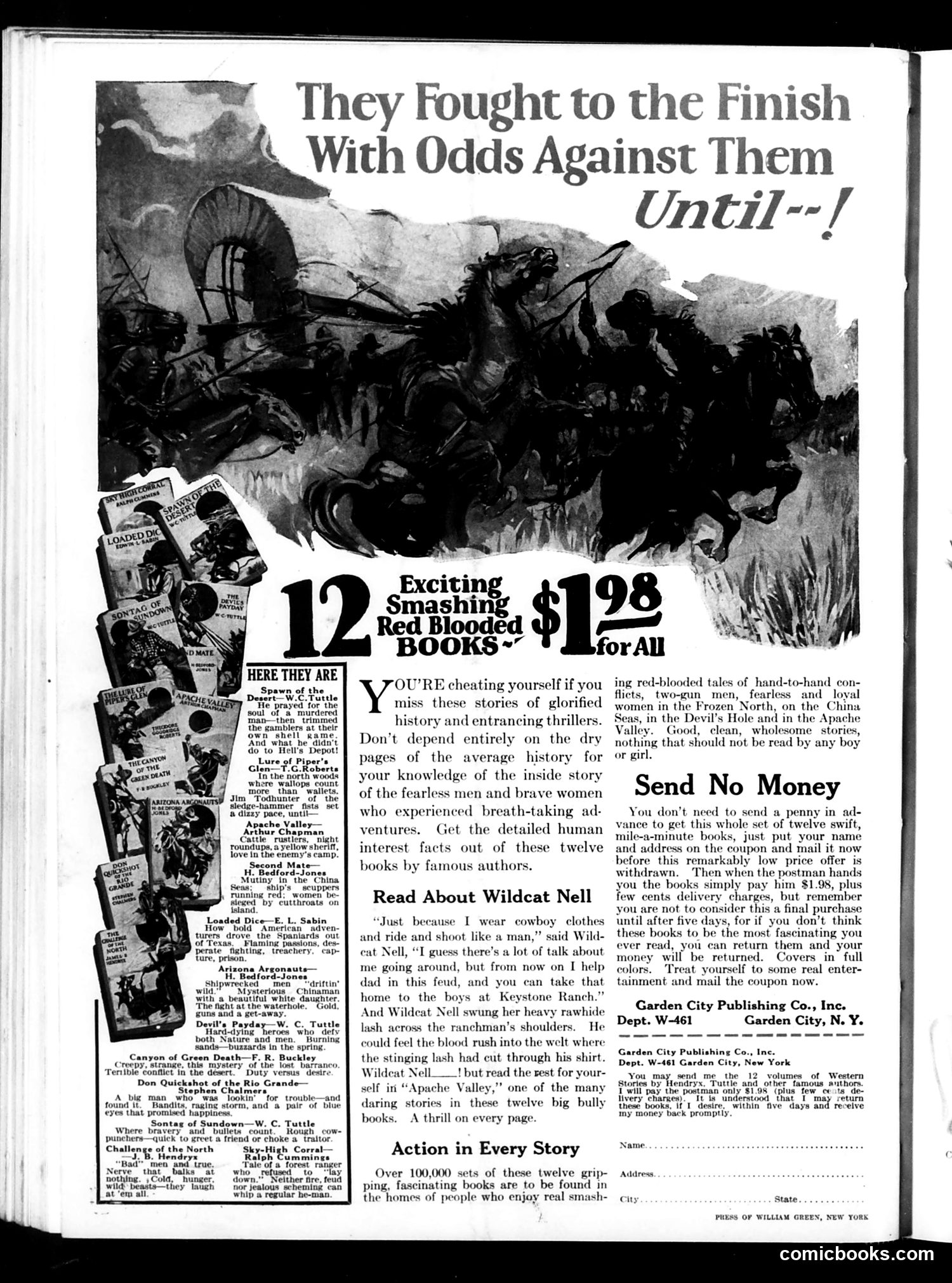
This is primarily **advertising copy**, not satire or political cartoon. It promotes a mail-order book collection of twelve Western adventure novels ($1.98 total) published by Garden City Publishing Co. The page lists titles and plot summaries of pulp-style Western fiction by authors like W.C. Tuttle and Arthur Chapman. The imagery—a dramatic illustration of cowboys and horses in conflict—accompanies marketing copy emphasizing "red-blooded tales" featuring "fearless men and brave women" in frontier settings. The "figures" are fictional characters from these stories (Wildcat Nell, Jim Todhunter, etc.), not real people or political caricatures. The text explicitly promises "good, clean, wholesome stories" suitable for all readers. The only notable angle: the sales pitch uses gendered language ("should not be read by any boy or girl"), suggesting these adventure tales occupied ambiguous territory in early 20th-century publishing—exciting enough to warrant caution, yet marketable as family-appropriate entertainment.