
Judge, 1924-01-19 · page 4 of 36
Judge — January 19, 1924 — page 4: what you’re looking at
What you’re looking at
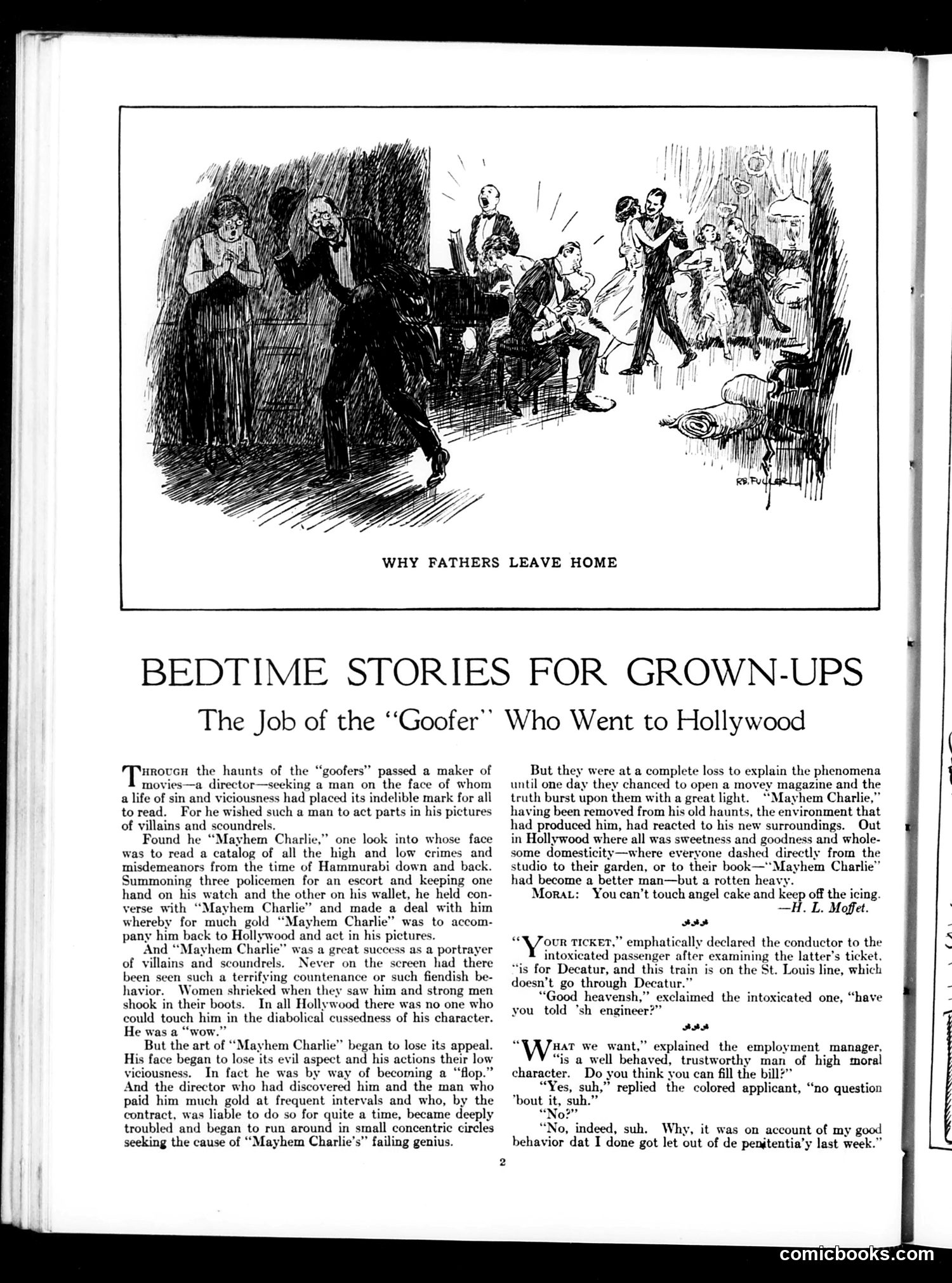
The cartoon titled "Why Fathers Leave Home" depicts a chaotic domestic scene where a father is fleeing the household while children appear to be misbehaving and the home is in disarray. The accompanying text "Bedtime Stories for Grown-Ups" presents a satirical story about "Mayhem Charlie," a failed Hollywood director. The narrative mocks the film industry by describing how a mediocre director achieved success through corrupt dealings with villains, only to lose his position once his usefulness ended. The satire targets early 1900s Hollywood's reputation for moral corruption and cutthroat business practices. The humor relies on readers' familiarity with cinema's rapid growth and its dubious reputation. The "moral" warns against compromising one's integrity for success—a cynical commentary on the entertainment industry's ethical standards during this era.
📄 Transcribed text from this page (OCR, searchable)
Machine-transcribed from the original scan — historical spelling and the odd misread are preserved.
WHY FATHERS LEAVE HOME BEDTIME STORIES FOR GROWN-UPS The Job of the ‘‘Goofer’’ Who Went to Hollywood ROUGH the haunts of the “goofers” passed a maker of movies—a director—seeking a man on the face of whom a life of sin and viciousness had placed its indelible mark for all toread. For he wished such a man to act parts in his pictures of villains and scoundrels. Found he “Mayhem Charlie,” one look into whose face was to read a catalog of all the high and low crimes and misdemeanors from the time of Hammurabi down and back. Summoning three policemen for an escort and keeping one hand on his watch and the other on his wallet, he held con- verse with “Mayhem Charlie” and made a deal with him whereby for much gold “Mayhem Charlie” was to accom- pany him back to Hollywood and act in his pictures. And “Mayhem Charlie” was a great success as a portrayer of villains and scoundrels. Never on the screen had there been seen such a terrifying countenance or such fiendish be- havior. Women shrieked when they saw him and strong men shook in their boots. In all Hollywood there was no one who could touch him in the diabolical cussedness of his character. He was a “wow. But the art of ““Mayhem Charlie” began to lose its appeal. His face began to lose its evil aspect and his actions their low viciousness. In fact he was by way of becoming a “flop.” And the director who had discovered him and the man who paid him much gold at frequent intervals and who, by the contract, was liable to do so for quite a time, became deeply troubled and began to run around in small concentric circles g the cause of “Mayhem Charlie’s”’ failing genius. But they were at a complete loss to explain the phenomena until one day they chanced to open a movey magazine and the truth burst upon them with a great light. “Mayhem Charlie,” having been removed from his old haunts, the environment that had produced him, had reacted to his new surroundings. Out in Hollywood where all was sweetness and goodness and whole- some domesticity—where everyone dashed directly from the studio to their garden, or to their book—*Mayhem Charlie” had become a better man—but a rotten he: Morat: You can’t touch angel cake and keep off the icing. —H. L. Moffet. Fas ‘OUR TICKET,” emphatically declared the conductor to the intoxicated passenger after examining the latter’s ticket. “is for Decatur, and this train is on the St. Louis line, which doesn’t go through Decatur.” “Good heavensh,” exclaimed the intoxicated one, “have you told ‘sh engineer?” ery HAT we want,” explained the employment manager, “is a well behaved, trustworthy man of high moral character. Do you think you can fill the bill?” “Yes, suh,” replied the colored applicant, “no question ‘bout it, suh.” “No. indeed, Why, it was on account of my good behavior dat I ie got let out of de penitentia’y last week.” - GLOER canse lanintth comicbooks.com