
Judge, 1924-01-19 · page 15 of 36
Judge — January 19, 1924 — page 15: what you’re looking at
What you’re looking at
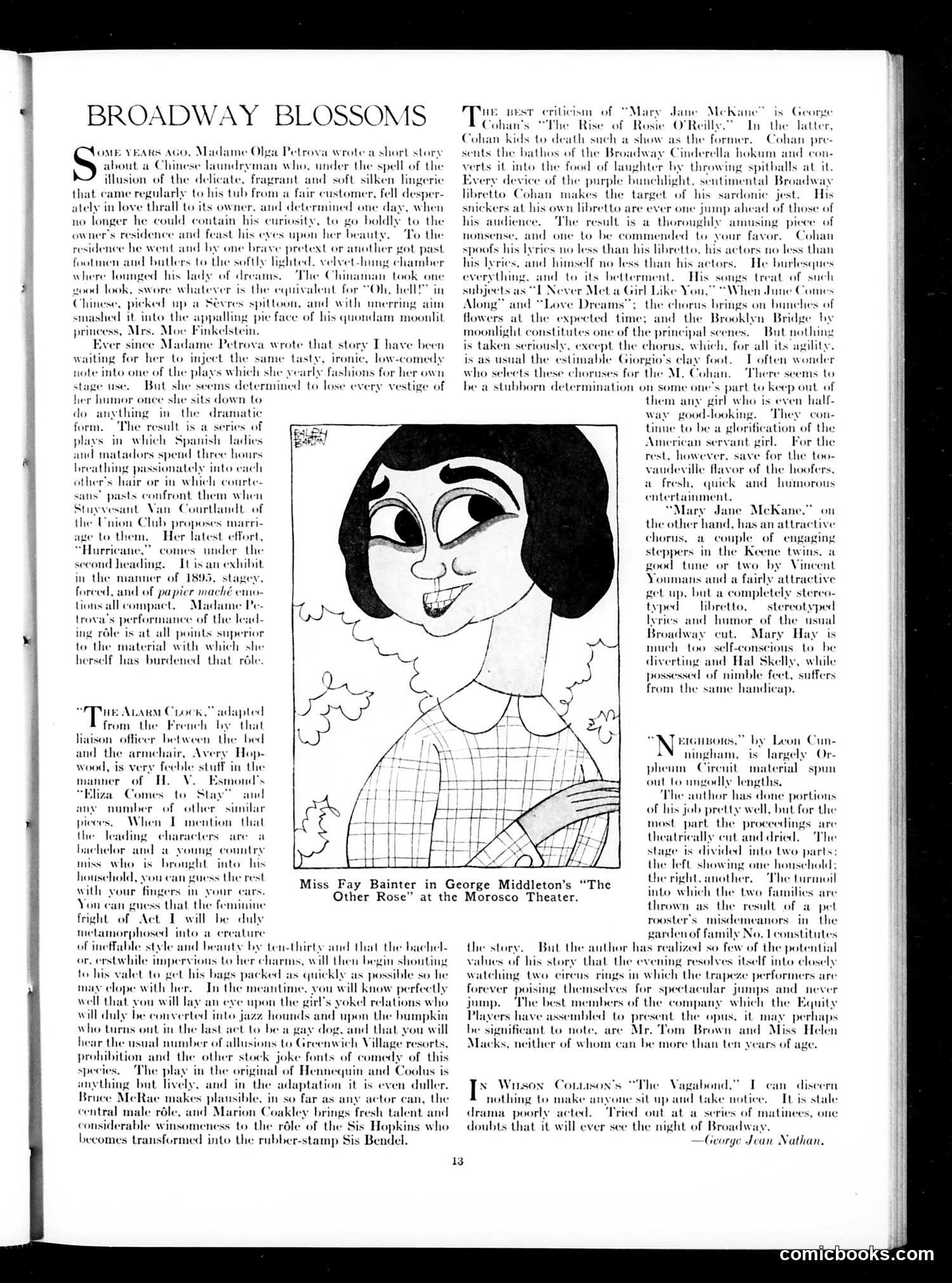
This page contains theater criticism from Judge magazine. The main illustration shows **Miss Fay Bainter** in George Middleton's "The Other Rose" at the Morocco Theater. The critic reviews several Broadway shows with characteristic satirical wit: 1. **Madame Olga Petrova's "Hurricane"** — criticized as overly dramatic and stagey (in the outdated 1895 style), though the critic praises Petrova's performance itself. 2. **"The Alarm Clock"** — dismissed as feeble French farce material. 3. **George M. Cohan's "The Rise of Rosie O'Reilly"** — praised enthusiastically as a parody that "kids to death" the sentimental Broadway Cinderella formula, with Cohan mocking his own work. The critic jokes that Cohan's chorus girls are notably unattractive. 4. **"Mary Jane McKane"** — given mixed reviews for its chorus and music. The tone is irreverent, focusing on how shows either embrace or resist Broadway's formulaic sentimentality.
📄 Transcribed text from this page (OCR, searchable)
Machine-transcribed from the original scan — historical spelling and the odd misread are preserved.
BROADWAY BLOSSOMS OME YEARS AGO, Madame Olga Petrova wrote a short story S about a Chinese laundryman who, under the spell of the illusion of the delicate, fragrant and soft silken lingerie that came regularly to his tub from a fair customer, ately in love thrall to its owner, and determit no longer he could contain his curiosity, to go boldly to the owner's residence and feast his eyes upon her beauty. ‘To the residence he went and by one brave pretext or another got past footmen and butlers to the softly lighted. velvet-hung chamber where lounged his lady of dreams. The Chinaman took one good look, swore whatever is the equivalent for “Oh, hell!” in Chinese, picked up a Sévres spittoon, and with uncrring aim smashed it into the appalling pie face of his quondam moonlit princess, Mrs. Moe Finkelstein. Ever since Madame Petrova wrote that story T have been waiting for her to inject the same tasty, ironic, low-comedy note into one of the plays which she yearly fashions for her own stage use. But she seems determined to lose every vestige of her humor once she sits down to do anything in the dramatic form. The result is a series of plays in which Spanish ladies and mat spend three hours hin i sly into each *s hair or in which courte- sans’ pasts confront them when Stuyvesant Van Courtlandt of the Union Club proposes m age to them, Her latest effort, “Hurricane.” comes under the second heading. It is an exhibit in the manner of 1895, stagey, forced, and of papier maché 1 tions all compact. Madame Pe- trova's performance of the lead- ing role is at all points superior to the material with which she herself has burdened that réle. sll desper- one day, when “OPE ALA RN CiocK.” pled from the French by that liaison officer between the bed and the armehair, Avery Hop- wood, is very feeble stuff in the manner of TL. V. Esmond’s “Eliza Comes to Stay” and any number of other similar pic When T mention that the leading charact bachelor and at young country miss who is brought into his Soare a Mie BEST crilicism of “Mary Jane MehKane™ Cohan’s “The Rise of Rosie O'Reilly.” In Cohan kids to death such a show as the former. sents the bathos of the Broadway Cinderella hokum and con- verts it into tl ight » throwing spithalls at it. ry device of the purple bunchlight, sentimental Broadway libretto Cohan makes the target of his sardonic jest. His snickers at his own libretto are ever one jump ahead of those of his audience. The result is a thoroughly amusing piece of nonsense, and one to be commended to your favor. Cohan spoofs his lyries no less than his libretto, his actors no less than his Iyries, and himself no less than his actors. He burl and to its betterment. His songs treat of such subjects as “I Never Met a Girl Like You,” “When June Comes ; the chorus brings on bunches of and the Brooklyn Bridge by moonlight constitutes one of the principal scenes. But nothing is taken seriously, except the chorus, which, for all its agility. is as usual the estimable Giorgio’s clay foot. [often wonder who selects these choruses for the M. Cohan. ‘There seems to be a stubborn determination on some one’s part to keep out of is Gee the latter, Cohan pr sques them any girl who is even half- way good-looking. They con- tinne to be a glorification of the American servant girl. For the rest, however, save for the too- vaudeville flavor of the hoofers. a fresh, quick and) humorous entertainment. “Mary Jane McKane,” on the other hand, has an att chorus, a couple of enga steppers in the Keene twins, a good tune or two by Vincent attractive get up, but a completely sterco- typed — libretto, stereotyped ‘sand humor of the usual Iway cut. Mary Hay is much too self-conscious to be diverting and Hal Skelly, while possessed of nimble feet, suffers from the same handicap. is EiGuBors.” by Leon Cun- ningham, is largely Or- pheum Circuit, material” spun Out fo ungodly lengths, The author has done portions of his job pretty well, but for the most part the proceedings are utrically cut and dried. ‘The is divided into two parts household, vou ean guess the rest with your fingers in your © You can guess that the feminine fright of Act Twill be duly metamorphosed into a creature of ineffable style and beauty by ten-thirty and that the bachel- or, erstwhile impervious to her charms, will then begin shouting to his valet to get his bags packed as quickly as possible so he may clope with her. In the meantime: Will know perfectly well that you will lay an eye upon the girl's yokel relations who will duly be converted into jazz hounds and upon the bumpkin who turns out in the last act to bea dog, and that you will hear the usual number of allusions to Greenwich Village resorts, prohibition and the other stock joke fonts of comedy of this species. The play in the original of Hennequin and Coolus is anything but lively, and in the adaptation it is even duller. Bruce McRae makes plausible, in so far as any actor can, the central male role, and Marion Coakley brings fresh talent and considerable winsomeness to the réle of the Sis Hopkins who becomes transformed into the rubber-stamp Sis Bendel. Miss Fay Bainter in George Middleton's Other Rose” at the Morosco Theater. the left: showing one houschold: the right. another. The turmoil into which the two families are thrown as the result of a pet rooster’s. misdemeanors in’ the gardenof family No. Leonstitutes the story. But the author has realized so few of the potential values of his story that the evening resolves itself into closely watching two cireus rings in which the trapeze performers are forever poising themselves for spectacular jumps and never jump. The best members of the company whieh the Equity Players have assembled to present the opus, it may perhaps be significant to note, are Mr. Tom Brown and Miss Helen Macks, neither of whom can be more than ten years of age. “The I Wirson Connison’s “The Vagabond.” [can discern nothing to make anyone sit up and take notice. It is stale drama poorly acted. ‘Tried out at a series of matinees, onc doubts that it will ever see the night of Broadway. seorge Jean Nathan.