
Judge, 1924-01-19 · page 24 of 36
Judge — January 19, 1924 — page 24: what you’re looking at
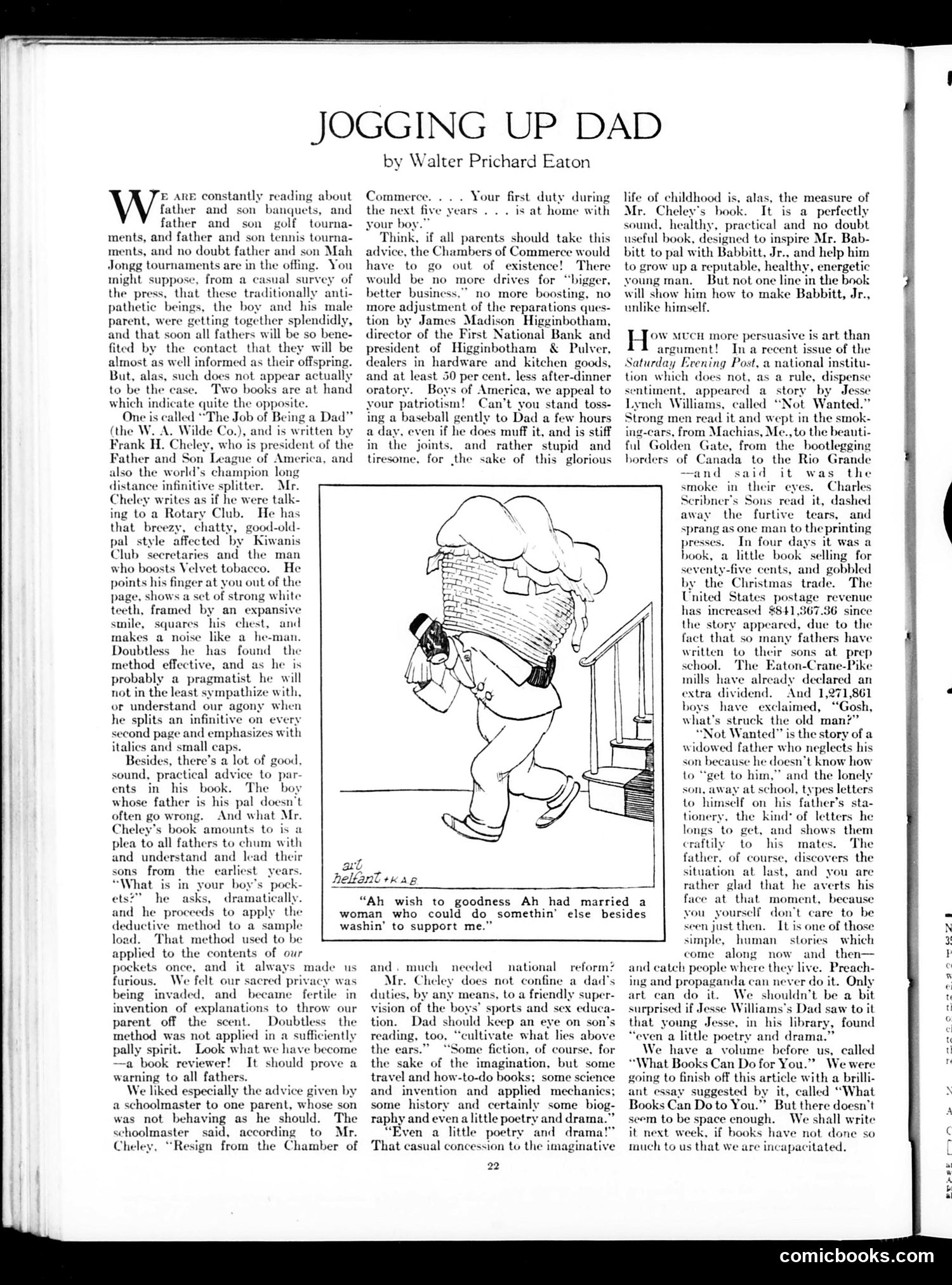
What you’re looking at
This article reviews two books promoting father-son relationships during an era of popularized "father and son" social events (banquets, golf tournaments). **The Satire:** The author (Walter Prichard Eaton) mocks the earnest, boosterish tone of Frank H. Cheley's parenting manual "The Job of Being a Dad." He caricatures Cheley's writing style as typical of Rotary Club and Kiwanis Club speakers—aggressively cheerful, finger-pointing, self-help rhetoric ("he-man" posturing). **The Political Joke:** Eaton ironically warns that if fathers actually befriended their sons as advised, Chambers of Commerce would collapse because boys wouldn't grow into business-obsessed men like "James Madison Higginbotham"—a satirical everyman businessman. The implication: capitalism requires fathers remain distant authority figures who produce sons destined for commercial ambition. **The Contrast:** He then praises Jesse Lynch Williams's short story "Not Wanted" (published in *Saturday Evening Post*) as more effective than self-help advice—its emotional resonance reportedly caused widespread tears and instant bestseller status.
📄 Transcribed text from this page (OCR, searchable)
Machine-transcribed from the original scan — historical spelling and the odd misread are preserved.
JOGGING UP DAD E Are constantly reading about father and son banquets, and father and son golf tourna- ments, and father and son tennis tourna- ments, and no doubt father and son Mah Jongg tournaments are in the offing. You might suppose, from a casual survey of the press, that these traditionally anti- pathetic b the boy and his male parent, were getting together splendidly, and that soon all fathers will be s fited by the contact " almost as well informed as their offspring. But, alas, such does not appear actually to be the ¢ Two books are at hand which indicate quite the opposite. One is called “The Job of Being a Dad” (the W. A. Wilde Co.), and is written by Frank H. Cheley, who is president of the Father and Son League of America, and also the world’s champion long distance infinitive splitter. Mr. Cheley writes as if he were talk- ing to a Rotary Club. He has that breezy, chatty, good-old- pal style affected by Kiwanis Club secretaries and the man who boosts Velvet tobacco. He points his finger at you out of the page, shows a set of strong whit teeth, framed by an expansive smile, squares his chest, and makes a noise like a he-man. Doubtless he has found the method effective, and as he is probably a pragmatist he will not in the least sympathize with, or understand our agony when he splits an infinitive on every second page and emphasizes with italies and small eaps. Besides, there’s a lot of good, sound, practical advice to par- ents in his book. The boy whose father is his pal doesn’t often go wrong. And what Mr. Cheley’s book amounts to is a plea to all fathers to chum with and understand and lead their by Walter Prichard Eaton Commerce. the next five your boy.” Think, if all parents should take this advice, the Chambers of Commerce would have to go out of existence! There would be no more drives for “bigger, better business,” no more boosting, no more adjustment of the reparations ques- tion by James Madison Higginbotham, director of the First National Bank and president of Higginbotham & Pulver, dealers in hardware and kitchen goods, and at least 50 per cent. less after-dinner oratory. Boys of America, we appeal to your patriotism! Can't you stand toss- ing a baseball gently to Dad a few hours a day, even if he does muff it, and is stiff in the joints, and rather stupid and tiresome, for ,the sake of this glorious . Your first duty during vars... is at home with sons from the earliest S. at “What is in your boy's pock. | 2e#enT +x ae life of childhood is, alas, the measure of Mr. Cheley's boc It is a perfectly sound, healthy, practical and no doubt useful book, designed to inspire Mr. Bab- bitt to pal with Babbitt, Jr., and help him to grow up a reputable, healthy, energetic young man. But not one line in the book will show him how to make Babbitt, Jr., unlike himself. H MUCH more persuasive is art than argument! Ina recent issue of the Saturday ning Post, a national institu- tion which does not, as a rule, dispense sentiment, appeared a story by Jesse Lynch Williams, called “Not Wanted.” Strong men read it and wept in the smok- ing-cars, from Machias, Me.,to the beauti- ful Golden Gate, from the bootlegging borders of Canada to the Rio Grande nd said it was the smoke in their Charles Scribner's Sons rea dashed aw the furtive and + presses. ang as one man to the printing In four days it was a hook, a little book selling for seventy-five cents, and gobbled by the Christmas trade. The United States postage revenue has increased $1,367.36 since the story appeared, due to the fact that so many fathers have written to their sons at prep school. The Eaton-Crane-Pike mills have already declared an extra dividend. And _ 1,271,861 boys have exclaimed, “Gosh, what's struck the old man?” “Not Wanted” is the story of a widowed father who neglects his son because he doesn’t know how to “get to him,” and the lonely son, away at school, types letters to himself on his father’s sta- tionery, the kind’ of letters he longs to get, and shows them craftily to his mates. The father, of course, discovers the situation at last, and you are ets?” he asks, dramatically. and he proceeds to apply the wo! deductive method to a sample wa load. That method used to be applied to the contents of our pockets once, and it always made us furious. We felt our sacred privacy was being invaded, and became fertile in invention of explanations to throw our parent off the scent. Doubtless the method was not applied in a sufficiently pally spirit. Look what we have become —a book reviewer! It should prove a warning to all fathers. We liked especially the advice given by a schoolmaster to one parent, whose son was not behaving as he should. The schoolmaster said, according to Mr. Cheley, “Resign from the Chamber of “Ah wish to goodness Ah had married a else besides man who could do somethin’ shin’ to support me.” much needed national reform? y does not confine a dad's and Mr. Chel duties, by any means, to a friendly super- vision of the boys’ sports and sex educa- tion. Dad should keep an eye on son's reading, too, “cultivate what lies above the ears.” “Some fiction, of course, for the sake of the imagination, but some travel and how-to-do books; some science and invention and applied mechanics; some history and certainly some biog- raphy and even a little poetry and drama.” “Even a little poetry and drama That casual concession to the imaginative 22 = rather glad that he averts h face at that moment, because ‘ou yourself don't care to be njustthen. It is one of those simple, human stories which come along now and then— and catch people where they live. Preach- ing and propaganda can never do it. Only art can do it. We shouldn't be a bit surprised if Jesse Williams's Dad saw to it that young Jesse, in his libra found “even a little poetry and drama.” We ha a volume before us, called “What Books Can Do for You.” We were going to finish off this article with a brilli- ant essay suggested by it, called “What Books Can Do to You.” But there doesn’t seem to be space enough. We shall write it next week, if books have not done so much to us that we are incapacitated. comicbooks.com